Disenchanting Enchanted Rock

I was so excited when I found ‘an expert’ on Enchanted Rock, who had written an entire book on the monument and its surroundings and has a website too, with lots of details. I was sure to have found a great source, I thought.

Click pic for my previous post about Enchanted Rock called “My favorite Enchanting photo”

And with a name like Kennedy, it’s gotta be good, right?

In the spirit of disobedience, in a word, no. Two words: Hell, no! Three words: Big, Fat, Disappointment!!

Wow, I didn’t realize anyone can just throw any piece of nonsense together and call it history. Or anthropology. Or pretty much any ‘science’.

Way to spoil a miraculous destination, Kennedy, thanks bunches.

But I can’t really blame him alone, it’s more than a trend. The dumbing down of the public has been documented for decades, and this sort of material that is supposed to pass as educational is a perfect case in point. So, let’s take a few pokes at it from a few of those many angles.

The History of Enchanted Rock in the Texas Hill Country by Ira Kennedy self-published in 2010 naming it https://www.amazon.com/HISTORY-ENCHANTED-ROCK-TEXAS-COUNTRY/dp/1456818783
“The Sacred Landmark of Central Texas”.

It is not sold as a children’s book and costs $21.99. According to the the Amazon page Ira Kennedy is:

“Considered as the state’s leading authority on Enchanted Rock, the sacred mountain of Central Texas, Ira has assisted the author’s of several published books, articles and the Thomas Evans mural of Enchanted Rock in the Austin-Bergstorm International Airport. IN 1992, Ira was awarded a Certificate of Appreciation from the Texas Parks and & Wildlife Department for providing numerous educational talks at Enchanted Rock Natural Area.” And it goes on.

The first Amazon review looked promising.
“Ira Kennedy is the world expert, in the opinion of many, of this beautiful Texas natural treasure. His knowledge comes from spending a great deal of his life on or near the rock. Ira is a creative genius and humble man who has written this amazing book, sure to answer all your questions about this geological wonder. Beautifully illustrated by Ira, you will keep this book among your special collections.”

The ‘book’ itself looks more like a coloring book. There are no references or citations, no bibliography or notes. While the author states he did multi-disciplinary research and himself has an advanced degree and was employed in Naval intelligence as a cryptographer, he must seriously understand what an ‘expert’ text would look like, and this one is the polar opposite of scholarly.

I can only assume ‘expert’ has taken on a new meaning sometime around the year 1999.

Let’s set the tone with his “Brief Historical Timeline” which begins his story in 12,000 B.C. and ends in 1978. With only a smattering of centuries missing, bless his heart!

We learn of a dubious-looking character named Jack Hays who was ‘an enigma’. We learn about a William Kennedy and his ‘flower-spangled’ landscape and ‘lost mines’ the ‘fueled the imaginagtion’. We learn about some immigrants from Germany in the 1840s.

We have the ‘First People’ myths and ‘The Imaginary Frontier’ of the Spanish explorer Alvar Nunez Cabeza de Vaca, who passed right through Mason County in the sixteenth century. And some childish stick figure drawings, some arrowheads and feather headdresses.

Later in the book are some drawings of angry indians who we learn may or may not have practiced human sacrifice.

And that about sums up my waste of money and time! Alas, the journey of discovery continues.

Poor, misunderstood ‘Enchanted Rock’ — I don’t even like your name anymore, so I think I’ll find a new one. And a new history to go with it. It would surely be better footnoted than this toilet paper, and good bit more entertaining I expect too!

I dare say, you there, intrepid traveler, can you smell anything beyond the boulders of bullshit?

My Favorite Enchanting Photo

I’ve gazed at it for what seems like hours, though its magic is hardly captured there. It is just reminiscent of the awe I felt.

That I took it, that’s fine enough for now. I’ll be back, no doubt about that. I’ve no idea still what I’ve seen, only that I don’t see what they say I should see.

This is the One! Amazing!

That we traveled so many miles, and after plenty of discouragement, to get so very fortunate in the end must’ve added to the enchantment. I will cling to it, for a long time to come, I’m sure.

Intrepid traveler, Kath

To be in good company, that helps, always. But I expect next time I’ll go alone, and I’ll stay a good long while, hoping that maybe a few more of its mysteries might come to present themselves to me. That’s how it seems to work.

If I’m patient enough, keen enough, present enough . . .
Perhaps.
Maybe. Or maybe not.
Already there are many obstacles.

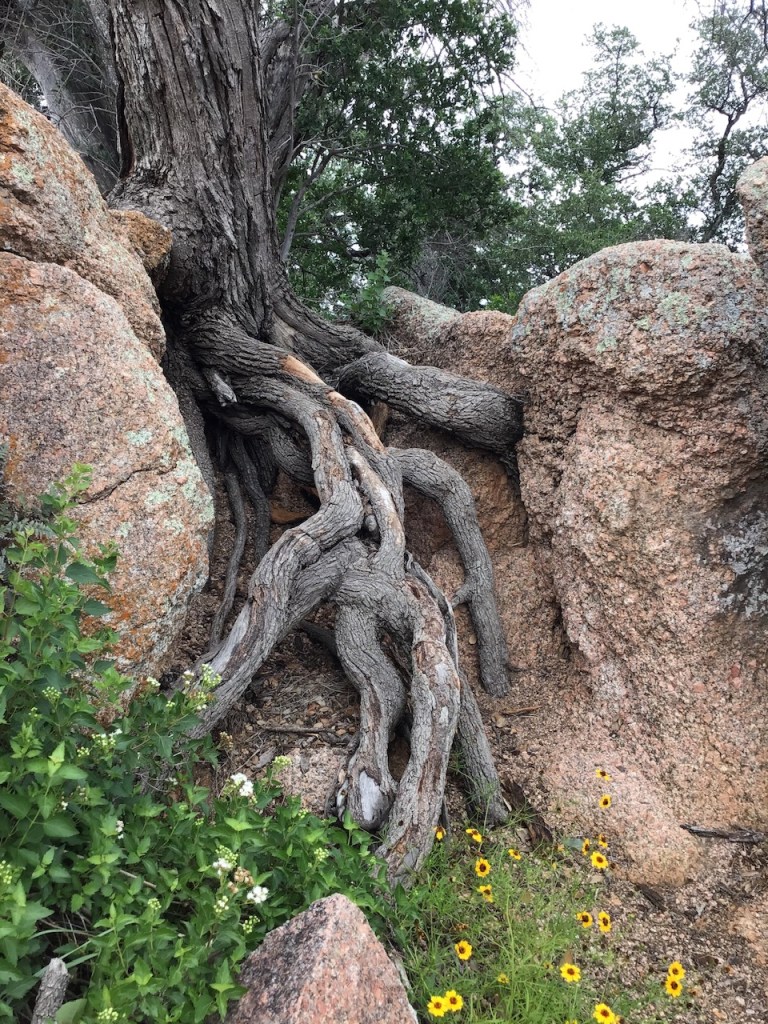
If only they would be, these many obstacles, as permeable as these rocks are to these roots.

If only I could hear their stories and know they were real.

If only I knew. What would I do?

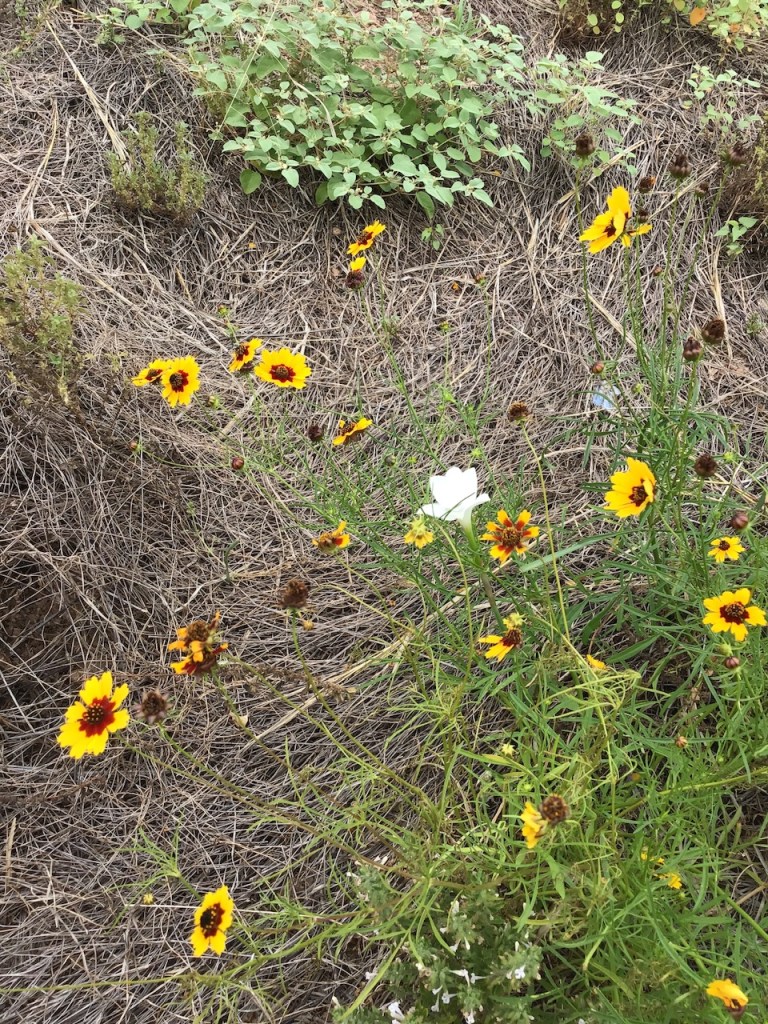
Creep among the rocks, disguised, like these little guys?

You can’t see me . . .

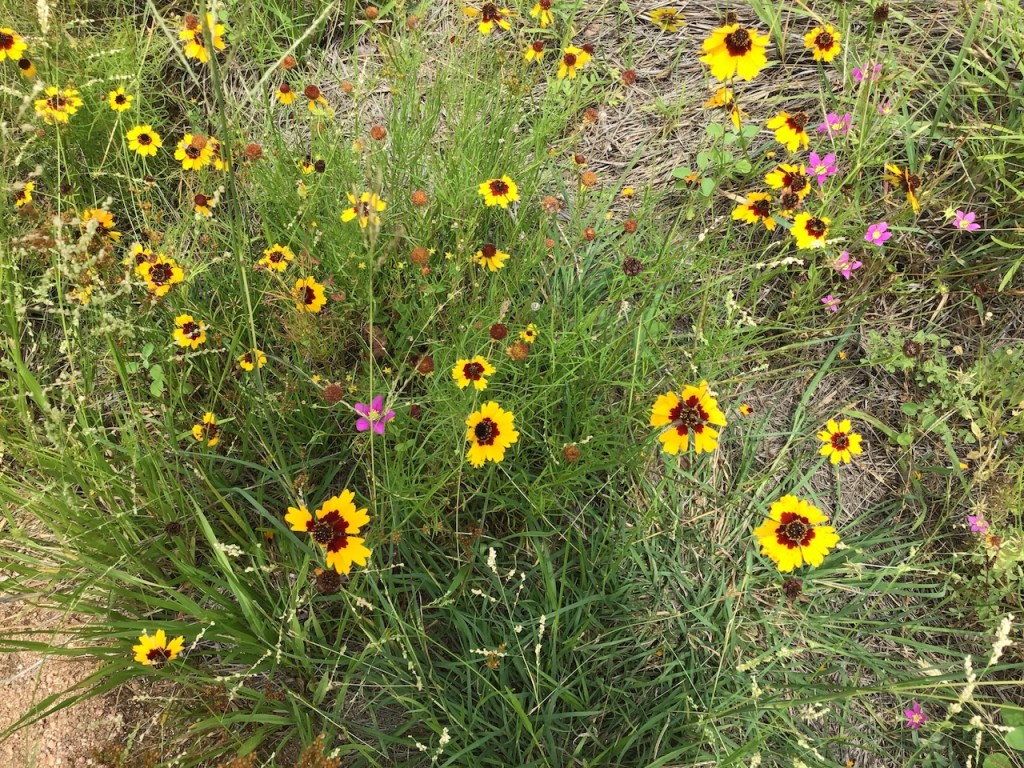
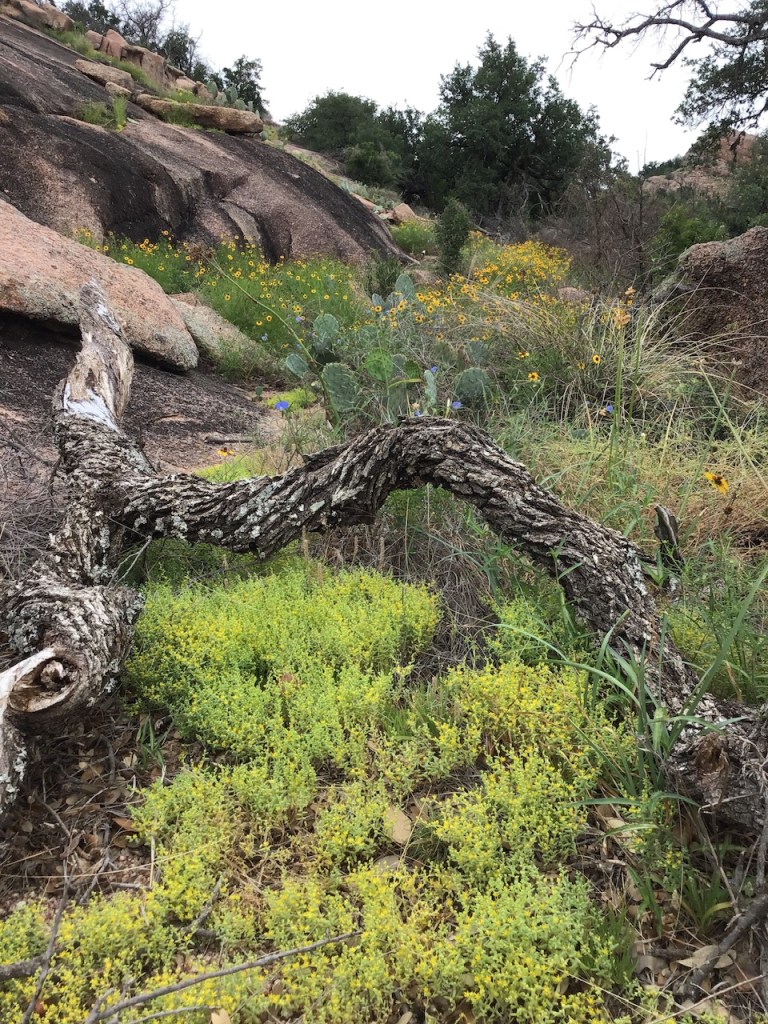
Or mock its odd monochromatic effect with bold color displays in every shallow pool or crevice?

What makes a sight worthy of seeing? Is worth only weighed in the eye of the beholder? How many eyes does it take to spoil a place?

Enchanted Rock is a pink granite mountain located in the Llano Uplift about 17 miles (27 km) north of Fredericksburg, Texas and 24 miles (39 km) south of Llano, Texas, United States. Enchanted Rock State Natural Area.

I don’t know much about rocks, but granite is one we’ve all heard of, thanks to its continued popularity in building, from the popular household granite countertops to Mount Rushmore and the Red Pyramid in Egypt.

This is said to be a testament to its durability, longevity, and resistance to weather.

According to Wiki, it’s quite hard:

“Granite is nearly always massive (lacking any internal structures), hard (falling between 6 and 7 on the Mohs hardness scale),[1] and tough. These properties have made granite a widespread construction stone throughout human history.”

Which makes me all the more curious about the intimate relationship between those roots and rocks. According to the official history, we’re only seeing the proverbial tip of the iceberg.

“Enchanted Rock is a small speck compared to the huge underground rock that spans over 100 square miles. That’s almost four times as big as Manhattan!”

It’s quite hard, and yet it ‘sheds’ kind of like a glacier ‘calves’?
“Eventually, weather and erosion shaped these rocks into the odd shapes you see today.”

How odd!

So, what kind of weather and erosion causes a lozenge shape? Inquiring minds want to know!

A partial official explanation can perhaps be found within worldwide examples of batholiths:

“Batholiths exposed at the surface are subjected to huge pressure differences between their former location deep in the earth and their new location at or near the surface. As a result, their crystal structure expands slightly over time. This manifests itself by a form of mass wasting called exfoliation. This form of weathering causes convex and relatively thin sheets of rock to slough off the exposed surfaces of batholiths (a process accelerated by frost wedging). The result is fairly clean and rounded rock faces. A well-known result of this process is Half Dome in Yosemite Valley.”

That explains the ‘thin sheets’ perhaps, and the rounded rock face, but not so much the lozenges. And the root-rock infusions!

Continuing with Wiki:

Lanite, a rare type of brown rhyolite porphyry with sky-blue quartz crystals and rusty-pink microcline feldspar, is found nowhere else in the world except in Llano County. Llanite can be found along a highway cut 9 mi (14 km) north of Llano on Texas 16. The largest piece of polished llanite in the world can be seen at the Badu House.

The Llano Uplift, a roughly circular geologic dome of Precambrian rock, primarily granite, covers about 50 miles along Texas Highway 29 and was 1.5 billion years in the making. Call it Rock Heaven: Geologists identify 241 rocks and minerals in Llano County, including llanite, a blue-specked dark granite found nowhere else in the world.”
Travel: Rock Heaven in Llano|April 2018| TPW magazine
Lovin’ Llano | October 2008 | TPW magazine

But apparently it was not the discovery of granite, but rather that of iron ore that transformed Llano into a boom town.

“Newspapers spread the word about Llano, recklessly playing up the magnitude of the region’s mineral resources. “Llano iron ore is the finest on the continent,” one story claimed. “Iron Mountain will produce 2,000,000 to 4,000,00 tons annually after the first year.”

“Little visible evidence remains of the Llano iron boom. A 1906 tornado destroyed some of the boomtown buildings north of the river. Other structures suffered a more mysterious fate.
“A number of buildings on the north side burned,” JoAnn McDougall explains. “The owners did it to collect insurance money. They needed cash and didn’t see any other way to get it. So many buildings burned, the insurance companies stopped insuring buildings in Llano, at least for a while.”
The Badu Building

The Badu Buildinghttps://rockandvinemag.com/2024/02/the-badu-building/

According to Wiki:
The geology of northeast Africa is very similar to that of Texas, and many of the two regions’ minerals and fossils are only found in these two locations.[2] A dike of llanite crops out on Texas State Highway 16 about nine miles north of the town of Llano.[3]
Llanite, which is similar to granite, is very strong, with a crushing strength of 37,800 lb/in2 or 26,577,180 kg/m2.[4] The mineral is also very similar in appearance to pietersite

Enchanted Rock was the absolute highlight for me on this road trip, and we almost didn’t make it. For one thing, I almost might not have been able to muster any enjoyment from it at all, being that I was wickedly hung over.

A hangover that dissippated in an instant, in a sudden and unexpected weather shift. The day before I’d been suffering in intense heat walking in a shadeless midday scrubby desert and I was attempting to muster the strength for the same again. For the first 45 minutes of the drive it was not looking promising. What fortune came then, in the last 10 minutes before the entrance, was the most welcome of weather whiplash …

Except that meant the main path of the Enchanted Rock might have to close any minute. Any amount of rain makes the rocks very slick, and they want no accidents. Best get climbing quick!

To be continued . . .

For more Enchanted Rock fact and fiction, begin at the 1:06 mark.


https://youtu.be/OO61UcJMHGw?si=4x33GYsB9oI3lbuF