Repost: Capital Has Outsourced Its Reproduction to the State’s Monopoly on Violence

The best content I know comes from this substack. I can’t recommend it highly enough.

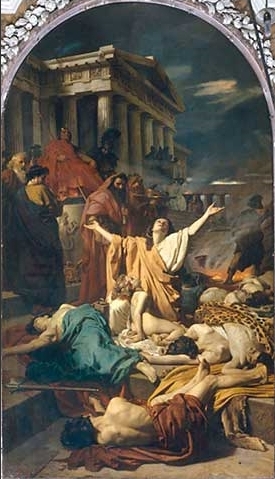
“Capital Has Outsourced Its Reproduction to the State’s Monopoly on Violence”


“How to Explain It to a Six-Year-Old


Imagine a candy shop. The government has made a rule that says everyone has to buy candy from this one shop. No other candy shop is allowed to open. If anyone tries to open a different one, the police close it down.

The candy costs a lot, and some of the candy makes children sick. The candy shop owner went to the government one day and said something like this: if my candy makes children sick, do not make me pay for the doctor. That is not fair to me. It will be too expensive. If you make me pay, I will stop selling candy. So the government made another rule.

If a child gets sick from the candy, the government pays for the doctor. But the government does not have any money of its own. It takes the money from everyone’s parents. The candy shop keeps all the money it makes from the candy. The parents pay for the candy. Then the parents pay for the doctor. The candy shop pays for neither.


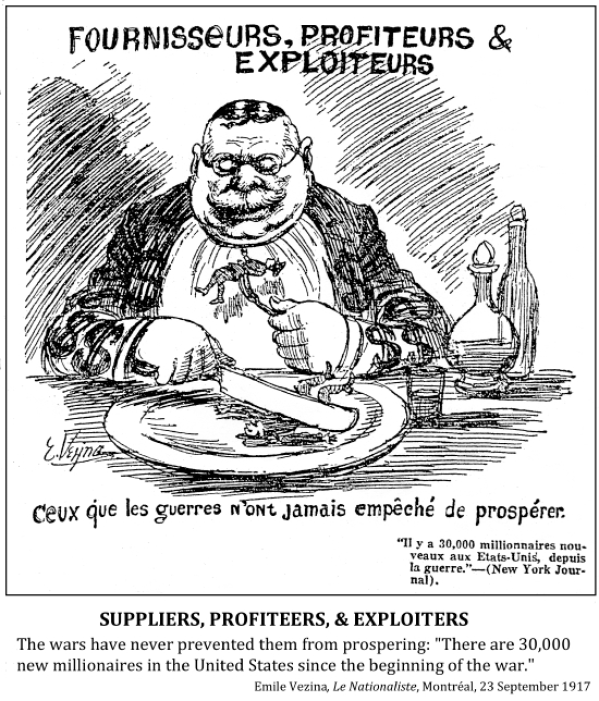
This has been going on for a very long time. Longer than your parents have been alive. Longer than your grandparents have been alive. It started even longer ago than that, in a place called Venice, when knights still fought with swords. From Venice it moved to a city called Amsterdam. Then it moved to England, more than three hundred years ago, when a small group of very rich people convinced the king to let them make the money for the whole country, and then to let the king pay them interest to borrow that same money back. When the arrangement worked well for the rich people, it moved again, across another ocean to America. It stopped being about money and started being about ships, and then about oil, and then about wars, and now about medicine. The names of the things kept changing. The rule did not. One shop is allowed. Everyone must buy. Everyone must pay when the shop’s things cause harm. And the shop is never made to answer for what it sold.


Your parents were told this was normal. Their parents were told this was normal. Their grandparents were told the same thing. It is not normal. It is very old, and it has never been taken apart. It has only been moved from one thing to another. From money to ships to medicine. When you grow up, some of the shops will still be there, still selling things everyone has to buy, still not paying for what they sold. You will remember this: the rule that seems normal is not normal. It was made a long time ago by people who knew exactly what they were doing.”

A World of Cheese

It’s so important to find inspiration, for so many reasons. Sometimes it’s simply a needed morale booster, and that’s important. Othertimes it’s even more crucial, because without it, growth, expansion, mastery, can be much more difficult, if not impossible.

I’m thinking of when I learned to waterski as a kid. I’m not competitive by nature, and I’m introverted, so maybe that’s why inspiration is so crucial to my developmental process.

Introverts can be bold and adventurous, most folks don’t understand that, because they don’t push themselves into the public eye.

Just focus on making cool designs in the water? I’d totally be into that!

That’s not me, it’s a stock photo, but she would’ve inspired me had I seen her!

Once my mom and grandpa taught me the basics, encouraging me all the way to slolem, I didn’t really know what else to do with it anymore. Sure, it was still fun enough, but fun is quickly boring to me without growth. Without learning. Without challenge.

For a naturally competitve person stagnation is less of a problem, they will seek out others and join in, finding the skill-level and motivation to improve in their desired venture.

Our society is built for such types. Even the internet is being rearranged to further augment competition and extroversion, because a militarized, institution-worshipping culture must by necessity favor hierarchy over collaboration.

As a case in point, consider the popular expression, “Those who can . . . do, those who can’t . . . teach.” This condescension deliberately misses the mark to award ‘the doers’ as those ‘at the top’ who are amply rewarded with success and status.

In fact, a good teacher rarely has the same qualities as the high-achieving, status-seeking competitive types, because the skills and capacities required are very different. The best teachers often shun the limelight, and often competion, for good reason. Of course, there are always exceptions to the rule.

It’s not at all uncommon for professionals and lay folk alike to equate their child’s introversion with ‘shyness’ while wishing it will soon be thoroughly outgrown. In many cases a completely natural prediliction for deep-thinking, solitude, study, is suspicion for a mental disorder, as social anxiety, depression, anti-social, or even . . .a lone-wolf serial killer.

Maturity without the coercive social control of modernity demonstrates the opposite, more solitude should naturally be aligned with greater levels of introspection, thoughtfulness, observation, consideration, instead of illiciting derorgatory social criticism like unmotivated, passive, lazy, loner, dorky, awkward, and the like.

I hear that’s changing, but I’m not convinced. Think about it for a sec. How many derorgatory words do we have for the excessively competitive or extraverted in comparison? How often do we lecture extroverts on the importance of introspection as we push introverts to ‘get in the game’?

But, can we really say the obsessively competitive are socially safer than the obsessively reclusive?

I think not.

Highly competitive players, while I fully understand their value as motivators, are rarely good teachers or role models, yet we can’t seem to get enough of them.

They can sometimes be so extraordinarily good they compel admiration from a very great distance, like this dude, who is so mesmerizing, precisely because they can bring out the best, and the worst, in their audiences, as well as in their personal life and relationships.

Not a fan of sports, not particularly attracted to aggression and dominance games, but damn, too long watching him and that might shift somewhat! Lord have mercy!

And yet, while nothing has changed as far as society catering to the extroverted and competitive, before the internet and streaming services, someone like me had a far more challenging time connecting to a ‘master source’.

So, finally, the point of my post.

Cheese influencers, where would I be without them? I think I’d be still not far from my original cheese workshop learning from a decade ago. Instead I’ve been around the world in cheese wisdom, more than once.

Authors, teachers, creators, well, even simple bloggers, we should pat each other on the back more often.

Here’s two amazing cheesemaking inspirations in my wee world lately. I want to pat them on the back, because I am so very grateful to them! They’ve inspired me in so many ways– to up my game, to consider new angles, to experiment, to expand, to deeply appreciate, so, so many things.

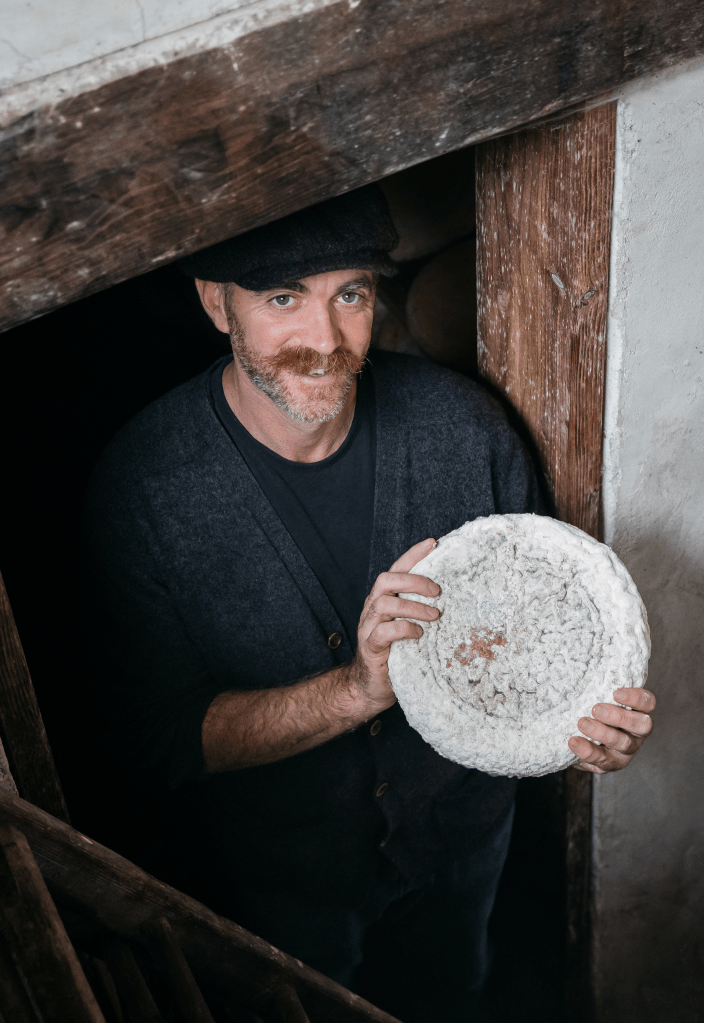
The 50 year cheese veteran Will Studd, who has a new and fantastic documentary out just last year.
Cheese: Searching for a Taste of Place
https://watch.amazon.com/detail?gti=amzn1.dv.gti.3467af9a-b1a6-4e71-b75d-b8dd0723ee89&territory=US&ref_=share_ios_season&r=web

“After establishing several delicatessens in central London in the 1970s, will migrated to Australia, where he has worked tirelessly to promote a greater understanding of what good cheese is all about, as well as championing the cause of traditional cheeses made from raw milk.
Will is the author of two comprehensive cheese books, including Chalk and Cheese, which won ‘World’s Best Cheese Book’ at the Gourmand Awards in Paris. He is also executive producer and presenter of Cheese Slices,  a 29-hour documentary series focused on artisanal cheese. Since its premiere in 2002, Will has filmed hundreds of dairies and cheesemakers in over two dozen countries.”

And on a smaller scale, a Youtuber, passionate and instructive, rather extroverted, possibly even competitive, who is now venturing into live online workshops, and more power to her!

Finish Work

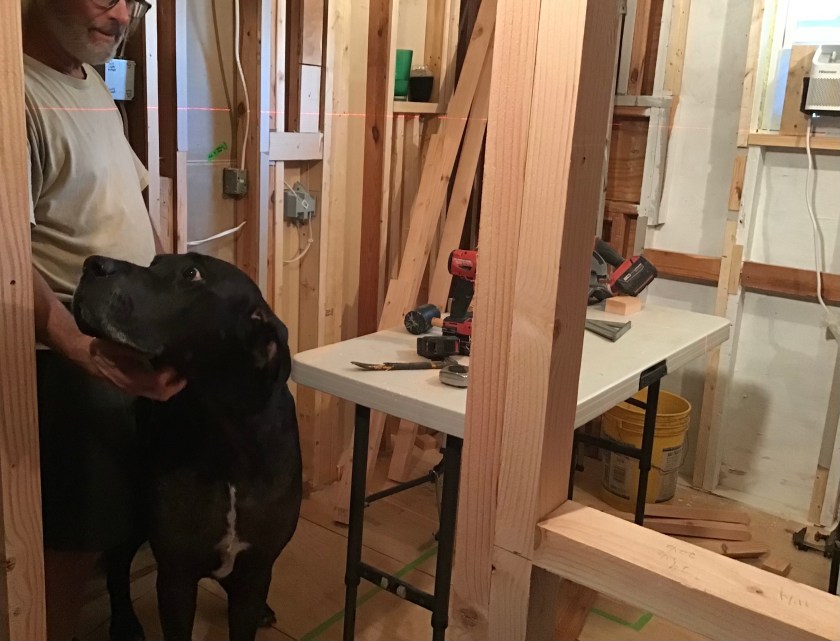
Finally, the fruits of Their/his labor move into the observable by the layman. I’m meaning both here at home, in our bathroom reconstruction, as well as on the grander stage, the Global Reset.

The temporary a/c unit has been so necessary! For the grunt work post, click here. https://kenshohomestead.org/2026/06/17/growth-vs-comfort/

the latest in moisture prevention, perhaps to become the next generation’s asbestos?

Once the global AI Governance is finally visible to the public at large, and we are ruled over officially by cartoon cutouts, at least we will have a gorgeous new bathroom in which to adjust to our Wizard of Oz overlords.

I think it’s fitting that this moment in the latest rewriting of global history we will forever connect it to these long sweltering months of bowel movements in our larvae-infested poop-with-a-view. It’s just too bad the long drop isn’t pasted with the photos of our current parasites-in-charge, that could become a new genre of target practice.

Global AI ‘governance’ aka surveillance, warned about for decades by many researchers whose work was then disseminated by a great many more for decades, is now being noticed by the masses and academia as the final act moves to the center stage.

Abstract
Artificial Intelligence (AI) now shapes many aspects of security and intelligence work. The European Union and NATO have moved in different directions in how they handle its use. The EU leans heavily on law and ethics to keep AI under democratic control, while NATO treats it mainly as a way to speed up operations and strengthen cooperation between allies. Drawing on policy documents and two case studies—biometric surveillance and automated signals intelligence (SIGINT)—securitization and co-production theory are used to show how these choices affect daily collaboration. Governance differences often create friction but can also lead to complementarity in intelligence practice. Coordination should be improved through shared certification standards, secure data-sharing protocols, and the establishment of a permanent EU–NATO working group on AI in security so that innovation supports, rather than divides, transatlantic cooperation.”
Artificial Intelligence Governance and Intelligence Interoperability: Diverging EU and NATO Approaches in National Security Contexts: International Journal of Intelligence and CounterIntelligence: Vol 39 , No 3 – Get Access
https://www.tandfonline.com/doi/full/10.1080/08850607.2025.2578461

In both cases . . .

The grunt work was longer and far dirtier than expected. There were clogged and sloped pipes, some caught only by chance, and luckily so, because they would’ve proven to be disastrous down the road for sure. I was actually a useful idiot more than once. There’s much to be said about the usefulness of a complete but curious novice asking stupid questions to see the hidden in plain sight yet somehow overlooked details.

In the political parallel I’m crafting, the grunt work has also been laid, the architecture of the system has moved from spy novels and science fiction flicks and of course, conspiracy theories, to a bonafide subject of academia, the final stage of normalization. The scafolding is replaced with bricks and cement. Now it will take far more than proverbial monster hurricanes to blow the house down. Ominous continuity. And now they no longer have to pretend they’re pretending!

“Performative power and strategic illusion in Russian foreign policy: geopolitical spectacle and the domestic construction of legitimacy”
Ana Jović-Lazić
https://www.tandfonline.com/doi/full/10.1080/08850607.2025.2578461

ABSTRACT
“Russia uses performance to project strength abroad and sustain legitimacy at home. This article analyses how the state stages media events, rituals and official narratives to construct power beyond its material capacity. Drawing on Bourdieu, Scott, Foucault, Ringmar, and Weber, it examines military parades, Putin’s speeches, state media coverage of the war in Ukraine, narratives of NATO encirclement, and the choreographed 2014 annexation of the Crimea. These performances create what Stoner calls a “myth of authoritarian competence”. Internationally, they signal great power status; domestically, they foster unity and normalise authority. Yet, economic strain and military setbacks expose this performative power’s fragility.”

Here and abroad, it’s all a very expensive and deadly charade.

The US Military is a paper dragon.
“If there’s one thing the war with Iran has revealed, it’s that the U.S. government is woefully underprepared for any sustained conflict, despite spending more on its military than China, Russia, and many more countries combined.
In the first few months of the war with Iran, the U.S. military used up over 1,000 tomahawk missiles, leaving only 2,000 in stockpiles. A third of its inventory, for a war with no strategic benefit to the U.S., that Americans are paying for at the pump and Iranians are paying for with their lives.
The U.S. military budget is now over $1.5 trillion dollars for 2027. An eye-watering amount for a nation running an annual deficit of $1.9 trillion, exceeding the entire annual spending of the British government.”
https://open.substack.com/pub/thelibertylookout/p/the-us-military-is-a-paper-dragon?r=87pg2k&utm_campaign=post&utm_medium=email

But, like our DIY project, in for a penny, in for a pound! Who really cares about budgets anyway?

Here’s what just one arm of our miitary industrial complex does with our tax dollars, develops weapons by experimenting on the defenseless public, with our own money! Oh the irony!

Department of War FY 2027 Budget Estimates ARMY

26 July 2026 | ZEROGeoengineering.com | Conflicts of interests due to U.S. Federal entanglements with foreign governments and foreign militaries make this funding particularly problematic. The following FY 2027 Army Research, Development, Test and Evaluation (RDT&E Program) budget plan through September 30, 2028, is $18,708,826,000.00. Funding “supports the Army’s collaboration in the Interagency Council for Advancing Meteorological Services (ICAMS), which was chartered in 2020 per the “Weather Research and Forecasting Innovation Act of 2017” (Public Law 115-25, April 18, 2017).”
Other research programs include: Unmanned Aerial Systems, applied research, research critical and unique to the Army and DoW (e.g., atmospheric modeling and meteorological technologies), open-air field experimentation, Air Platform Enabling University Applied Research, techniques, methods, and models for the characterization of ambient atmospheric and threat aerosols, aircraft systems, sensors, passive, persistent sensing technologies, novel micro-electromechanical system (MEMS) / aka “smart dust,” genomic research, High Power Microwave and Directed Energy weapons, Electronic Warfare Advanced Technology, 5G, Next G, antenna systems, Golden Dome, Global Navigation Satellite System (GNSS), Artificial Intelligence and Machine Learning (AI/ML) technologies, Radar Digital Twin (EXHILARAMA), classified programs, and many more areas of experimentation.
Department of War FY 2027 Budget Estimates ARMY – Zero Geoengineering

Those doing the grunt work have been at it for over a century, usually with no questions asked, all for a paycheck and a pension.

The governance channel has always been subservient to the financial channel, and we have never been a democracy. Can we call it good news that at least the masks have fallen?

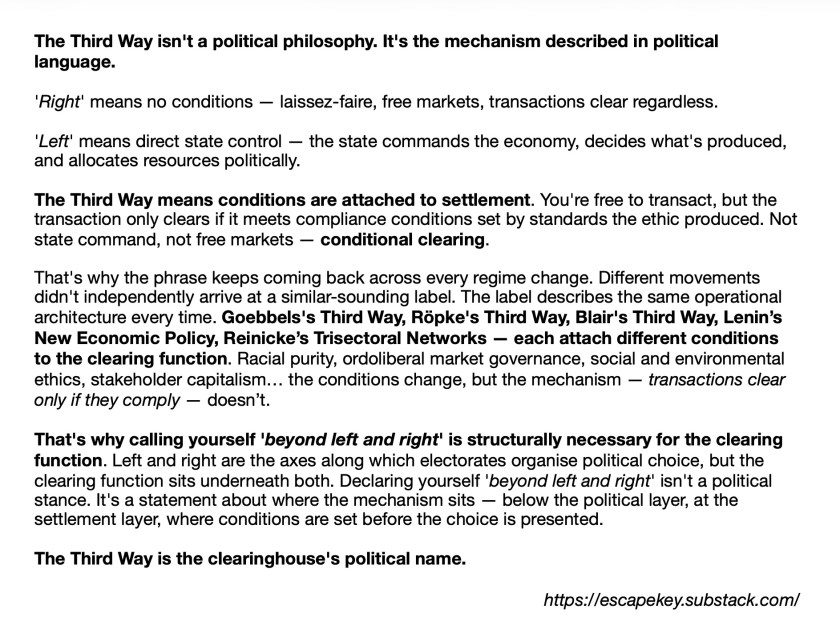
“The clearing architecture reached the post-war institutions through a different route as well, one that had been turning the logic of clearing from finance into governance since before the First World War.
In 1916, Leonard Woolf published International Government, a blueprint for permanent international bodies to manage trade, communications, health and labour standards through functional co-ordination above national governments. His key insight was that once essential functions became international, national governments would gradually lose their grip on the day-to-day running of economic and social life. He proposed that these organisations would work through ‘soft law’ — international recommendations that would steadily harden into binding obligations, because participation would eventually require compliance with international standards. It was clearing logic applied to governance rather than money: membership was voluntary on paper, but functionally impossible to avoid.”
https://open.substack.com/pub/escapekey/p/the-foundational-myth?r=87pg2k&utm_medium=ios

“Quinn Slobodian’s Globalists documents what Röpke and the Geneva School were building: supranational institutions designed to shield economic governance from national electorates, permanently. Their aim was deliberate and unapologetic. These economists believed that democratic populations would make economically foolish choices — protectionism, inflation, capital controls — so the solution was to place the rules governing economic life in institutions that electorates could not touch. Slobodian calls this ‘encasement’. He maps the walls but does not identify what they protect: the clearing function, operating through conditional settlement, safely beyond democratic revision.”

The public observes, but are ignorant as to what they are observing, as ignorance has become a weapon of war against us.

“The third is ignorance as active construct — the deliberate manufacture of doubt, uncertainty, and confusion by parties with an interest in keeping the public unclear. This is the tobacco strategy, the climate-denial strategy, the manufactured uncertainty of product-defense firms. It is ignorance as engineered achievement, and it is the type this volume most wants to make visible.”

The fourth, It is ignorance produced not by concealment but by exhaustion.
https://open.substack.com/pub/unbekoming/p/agnotology-the-making-and-unmaking?r=87pg2k&utm_medium=ios

Question (8): How large is the classified universe of documents, and how does its acquisition rate compare to the open literature held in libraries?
Answer: The classified universe is not a small strongbox in the corner of human learning. It is, on the best available estimates, five to ten times larger than the entire open literature held in the world’s great libraries. The Library of Congress holds roughly 7.5 billion pages across 120 million items. Estimates suggest that as many as a trillion pages may be classified in the United States alone — the equivalent of two hundred Libraries of Congress. In 2001, some 33 million classification actions were taken, adding roughly 330 million pages to the closed archive that year alone. By comparison, the entire Harvard library system, comprising over a hundred libraries, adds about 60 million pages of unclassified material per year. Five times as many pages enter the classified realm as enter the world’s great open depositories combined.
The people involved match the paper. Roughly four million Americans hold security clearances, against about 500,000 college professors in the country. The Information Security Oversight Office reported spending $5.5 billion in 2001 just to keep classified documents secure. The commonsense picture — that a modest domain of state secrets sits adjacent to a vast open commons — is inverted. The open literature is the modest information booth. The vast classified empire sits behind it, unseen, its contents unknowable by definition. This is not a marginal fact about modern knowledge. It is the shape of modern knowledge.”

The on-screen constant political theater and media circus has been so stupidly surreal and exhausting, not only to divide and distract, but also so the pubic welcomes their AI replacements. Anything will be better, right? ‘Voluntarily’ led from the frying pan into the fire by State-manufactured ignorance.

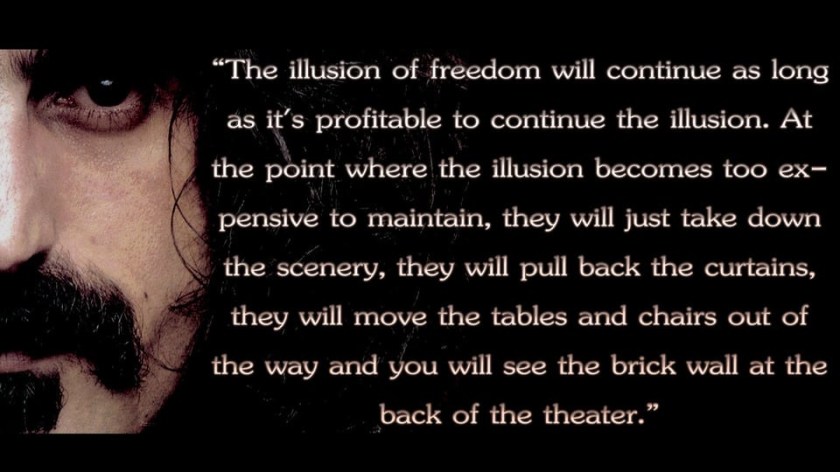
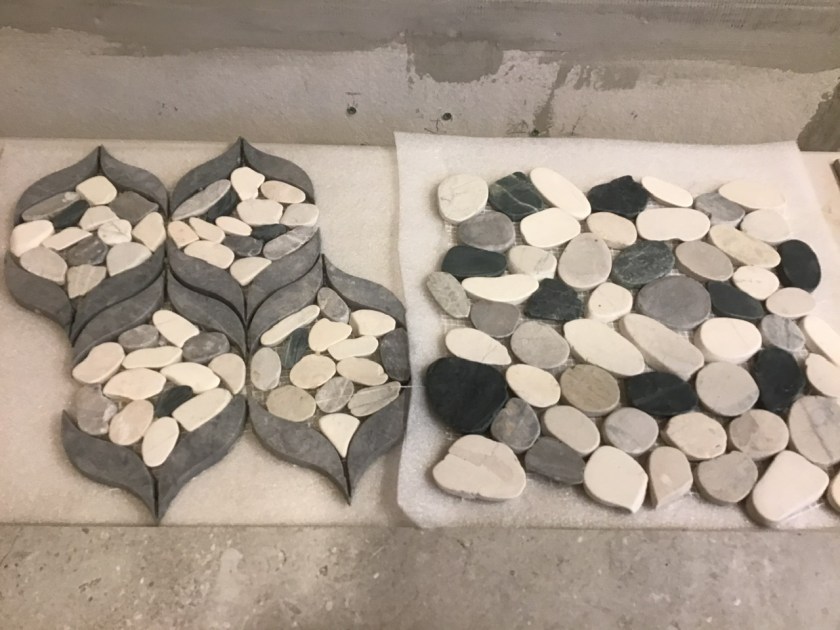
Try to focus on the pretty tiles, not the brick wall

Well, when it comes to our bathroom remodel, it’s definitely going to be a huge improvement and I’m SO excited to finally be seeing the finish work. Finally my hard-earned observation skills and esthetic sensibiities can be put to good use.

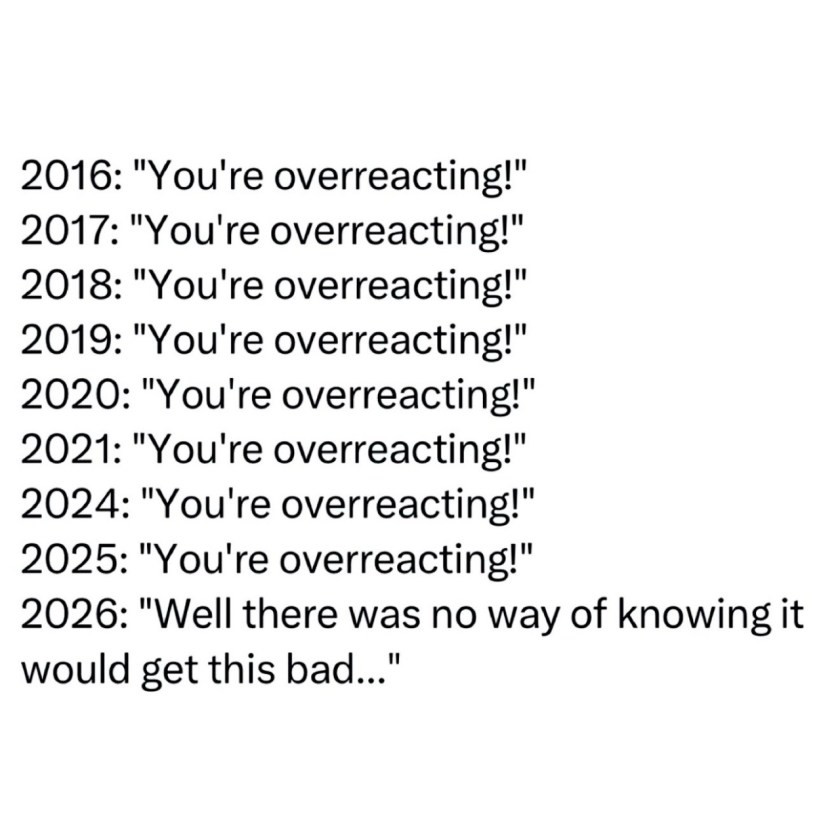
I do not have a parallel certainty for life under global techno-fascism, unfortunately.

Don’t Mess With Amos!

This Substack post has made my day!

The Amish Farmer the Feds Can’t Stop by The Liberty Lookout

Exit & Build – Amos MillerRead on Substack

In the year 2000, an Amish farmer named Amos Miller attended a Weston A. Price Foundation conference with his father. He listened to Sally Fallon talk about traditional food: raw milk, grass-fed meat, fermented vegetables, the way humans ate for ten thousand years before the USDA decided it was dangerous. He went home to Lancaster County, Pennsylvania, and started selling it.
Twenty-six years later, his farm has been raided by federal agents, subjected to three consent decrees, slapped with $85,000 in fines, and dragged through nearly a decade of litigation across federal and state courts. His products have been blockaded, detained, and ordered destroyed.

If you need some good news, continue reading . . .

He’s still selling. His food club has over 4,000 members nationwide. And an appeals court just ruled that Pennsylvania can’t stop him from shipping across state lines.
This is the story of the underground real food economy, and why the government keeps losing to a man who doesn’t use electricity.

There is a better way and it’s been here all along.

Imagine if this could go viral, not just the article, the practice.

Name your kids Amos, that could be the trick, seems they take no shit! 😆😏

Don’t Help, Please!

I really mean it, for all, not just the government. You seriously over-estimate yourselves, all ye who cling to the coping, helping, giving categories.

At 12 I asked my ballet teacher to help me improve my lacklaster turnout. I have hip problems to this day from her suggested, prolongued, insufferable positions.

At 20 I asked my professor to help me with a chapter of my novel. That was asking a lot, but rather than saying ‘no’ she redirected me from my natural aptitude toward her personal literary preferences.

At 23 I asked a close friend to teach me to snow ski. Big mistake, I loathe downhill skiing to this day after he ‘accidentally’ led me down the black diamond run instead of the bunny hills.

At 33 I asked my sister for advice on a very sensitive issue. Big fucking mistake, again.

At 40, oh yes, more bad advice. Not long after that crisis I was given ‘help’ after asking for it, in the form of drama from disturbed individuals. Ask for help, receive drama, that’s the pattern.

And more at 45, indeed still at 55, plus!

The solicited advice is bad enough, then there’s the constant stream of unsolicited advice.

The latest offense coming laughably not too long ago. “Don’t say yes to things that will drain you.”

Classic condescending cuntery! From a so-called friend! That will be going on a permanent plaque in the forefront of my mind, forever.

So many (not) thanks!

Will I ever learn? Can I ever learn?!

Let me give y’all some really hard-earned, yet totally unsolicited advice.

Most advice sucks! Most advice proferrers are FOS.

We-means-I . . .

Hopefully, maybe overtime we recognize and can more easily sift the rare and precious advice from the . . . might we dare to say . . . the profane?

Self-satisfaction is king and his queen is self-delusion!
And you can quote me on that!

And all that bitched, here’s my best-ever advice based on a lifetime of bad advice, and now featured eternally on Youtube: Choose reality over fantasy.

Rocket science, eh?

And that’s all folks!

Thanks for stopping by.

Reality over fantasy. Where’s my dinner, boss?

The Psychology of AI

I made up a wee thought experiment for the automated answer system that passes for logic in our modern era.

I asked the machine a question with only a one word variable to learn what sort of mind-bending nonsense it would generate.

Here was my question: “Why are (XX) so exploitative?” For the ‘XX’ variable I inserted the following labels one at a time: Jews, Christians, Muslims, Bhuddists, Germans, Americans.

I wonder what the average reader might guess would be the results of such a series of inquiries? Would you expect a certain degree of objectivity? Of universality? I wonder also, would every individual in any location get the same string of answers?

I encourage everyone to give it a shot. In my case, as a U.S. citizen residing in Texas, in only one circumstance was I given an answer that completely ‘flipped the script.’

What do I mean by that? It uses a psychological weapons tactic referred to as DARVO–Deny, Accuse, Reverse Victim and Offender.

In abusive relationships this tactic is what keeps victims confused and trapped in their own demise, sometimes not even realizing they are in an abusive relationship. It is the tactic often used in cults and to create in victims the familiar Stockholm Syndrome.

In the public arena the tactic is the same, but the delivery is often more subtle and sophisticated. It can be very useful in spotting this type of manipulation in the public arena by studying it in interpersonal dynamics.

In the case of my wee AI psychology experiment we see the more subtle and sophisticated version playing out. Instead of direct ‘Denial’ we observe redirection. Instead of direct ‘Accusation’ we observe excuses, inferences, insinuations. And in the case of ‘Reverse Victim and Offender’ the person asking the question becomes the offender.

In only one case am I, as the one asking the question, inferred as being somehow hostile-adjacent for simply asking, and schooled about ‘hate speech’ and Antisemitism.

“The history of antisemitism, defined as hostile actions or discrimination against Jews as a religious or ethnic group, goes back many centuries, being called “the longest hatred”. Jerome Chanes identifies six stages in the historical development of antisemitism: 1. Pre-Christian anti-Judaism in Ancient Greece and Rome that was primarily ethnic in nature 2. Christian antisemitism in antiquity and the Middle Ages that was religious in nature and has extended into modern times 3 Continued in Wikipedia”

Every link after that for two pages seeks to teach me about the ancient and on-going plight of a tiny group of people.

Other ‘XX’ inputs have a broader range of links, but each comes with its own bias and redirection. In the case of Americans I’m redirected toward considering the class struggle against the poor. In the case of Muslims I’m informed of their inherent violence. In the case of Christians I’m given many links of Bible verses demonizing exploitation, and in fact the only search results that stay on point, that is, address exploitation directly and at length, including the meaning of the word.

In the case of Bhuddists as well, I’m again redirected toward ‘violence’. But I did not ask AI about violence in my query at all, the word choice was ‘exploitative’ and in the case of Jews the only violence inferred is against them. In reference to Germans I’m redirected to ‘Stereotypes of Germans’ wiki page where nothing about exploitation is mentioned. NAZIS get a tiny blurb, that was a bit unexpected, I expected much more.

In any case, what does this mean? What’s my point exactly?
It’s probably not news. Most folks know by now we are pawns in an information war that uses psychological operations against the public as a driving tactic of sociopolitical manipulation.

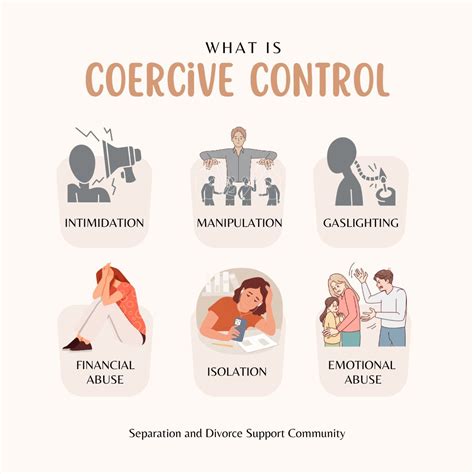
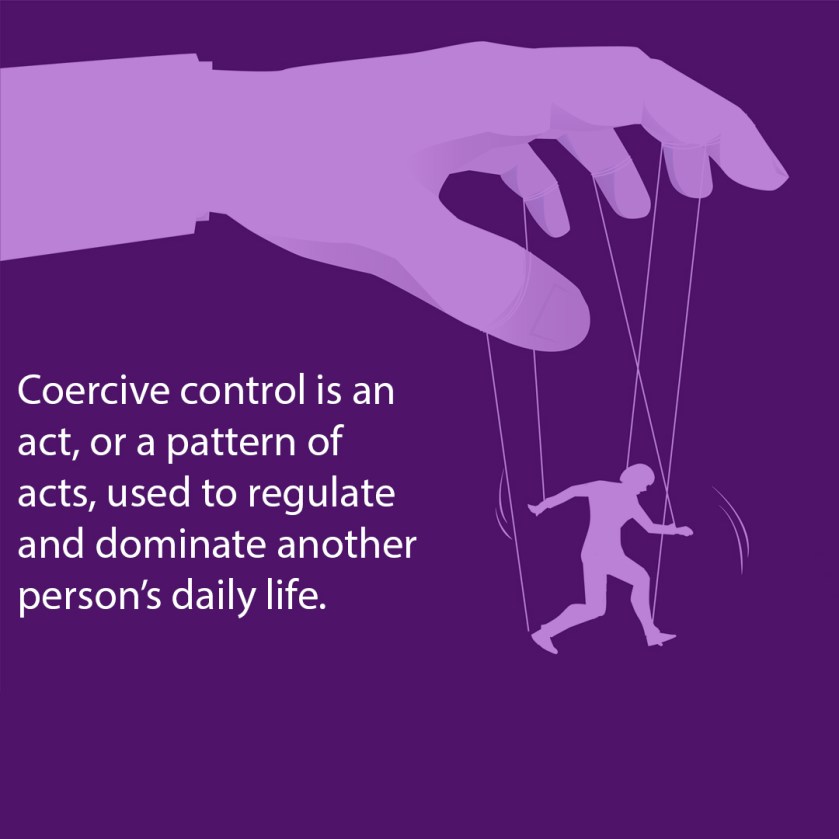
It’s ALL about Coercive Control.
“Abusive power and control is behavior used by an abusive person to gain and/or maintain control over another person. Abusers may utilize tactics such as devaluation or psychological projection, and may seek personal gain, personal gratification, and the enjoyment of exercising power and control. The victims of this behavior are often subject to psychological, physical, sexual, or financial abuse.”

What many may not yet know is that there are many strategies we can use as individuals to protect ourselves. Learning about manipulation in abusive relationships is just about the easiest solution, because this information is ubiquitous online and easy to witness and relate, as most of us have experienced coercive control tactics directly or indirectly at some point in our lives.

More difficult is applying this on a broader scale, but examples like this wee thought experiment help to demonstrate it.

The most difficult is understanding HOW this is happening on a global scale–how the entire globe has fallen prey to manipulation and abuse by the SYSTEM ITSELF and BY DESIGN.

“Today, if you have money, you can buy what you like. Assuming you use a credit card your balance is checked and the money withdrawn.
By 2029, the terminal checks a second balance — carbon, social, compliance — before the transaction clears. Fail the check, payment denied. It’s a permission system.
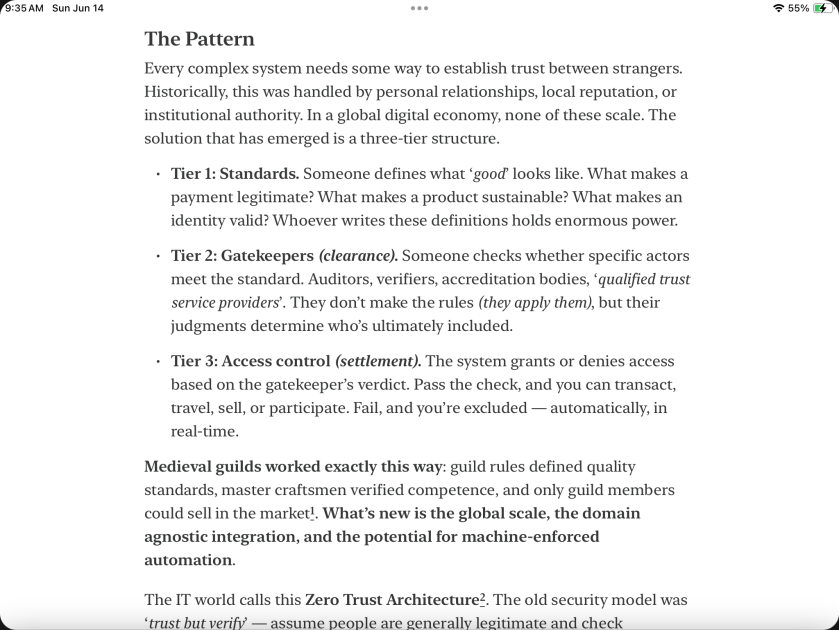
We covered the EU implementation in How Europe is Building a Carbon Currency — Digital Product Passports, Digital ID Wallets, and the Digital Euro. But Europe is just one implementation. The architecture is global.”
https://open.substack.com/pub/escapekey/p/conditional-existence?r=87pg2k&utm_medium=ios

Every major domain of global governance — finance, identity, health, trade, climate, and artificial intelligence — is converging on the same architecture.
And that architecture is perfect for automated governance at planetary scale.
https://open.substack.com/pub/escapekey/p/a-pattern-hidden-in-plain-sight?r=87pg2k&utm_medium=ios

The architecture escapekey identifies and explains is essential reading for anyone who wishes to grasp the big picture. But it’s not essential to understand the overarching effects of coercive control or how to minimize its impact on your personal life.

Recognizing it and eliminating it from your acceptable relationship criteria is the real escape key. What becomes intolerable to the individual will determine what becomes intolerable in the public sphere.

Choose your relations wisely and with utmost discernment and stoicism and you will know positive change in your lifetime. That is the next generation’s only hope to avoid their open-air prison.

It’s the Mindset, Stupid

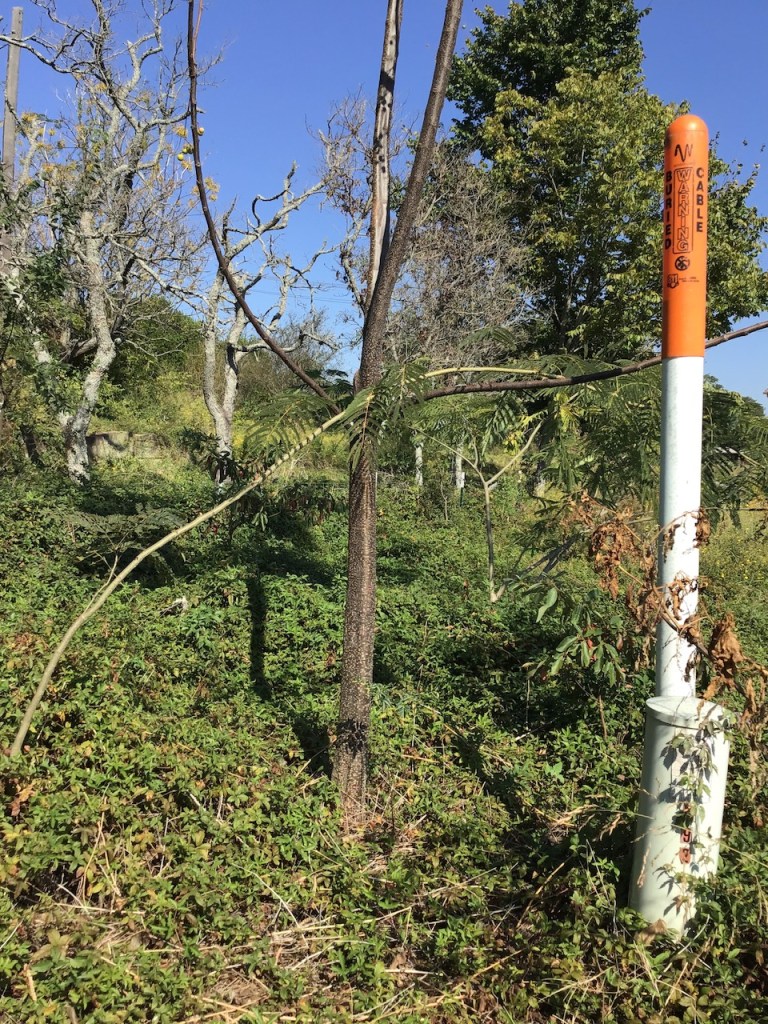
I nearly made the same mistake with the Chinaberry tree as I did a decade ago with the Mimosa tree.

I must make even greater efforts to De-institutionalize my mind.

It’s like with the official Farmer’s Market, in the small city 40 minutes away, which grows along with the city, but doesn’t get any better, because there aren’t enough farmers and there are too many regulations.

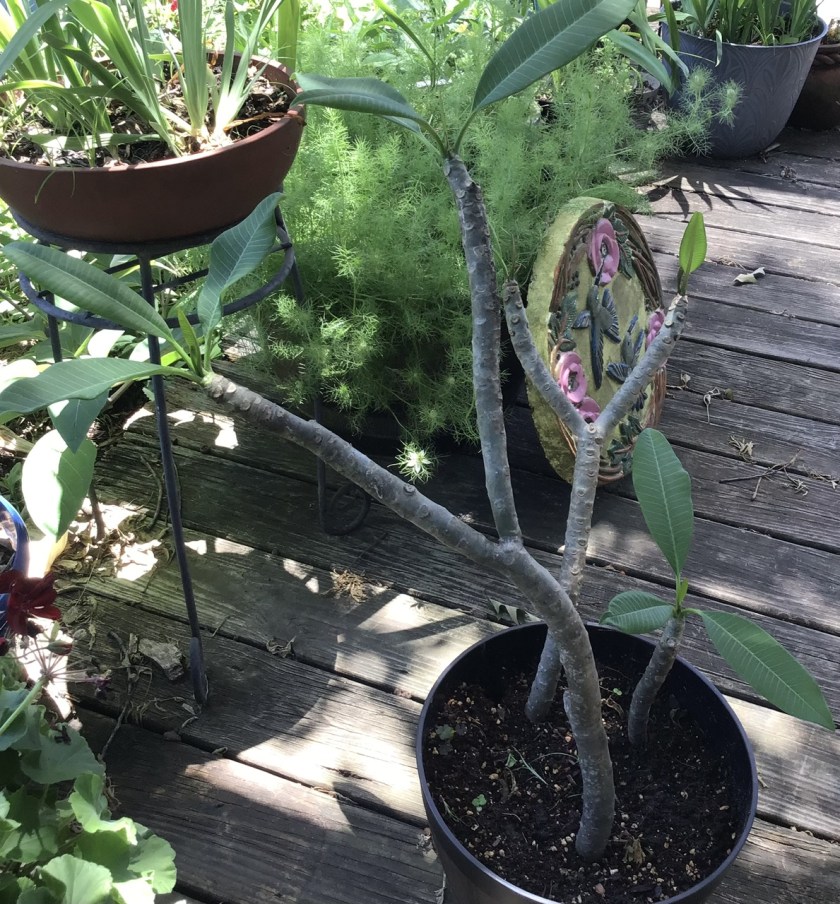
A treasure from a local plant swap now starting to bloom, Plumeria, how exciting!
how it will hopefully look one day! It’s the tropical delight used for making leys in Hawaii, with a delightful fragrance.

Meanwhile the very localized, small, rural events have been well worth the time. At one we got several new plants I’m still excited about.

Catalpa tree is another I’ve been longing to grow, but only found available through a local swap.

Catalpa blossoms, the ‘worm tree’ as it’s called in these parts I’ve just learned from a local angler

And at another we ate better tacos than we’ve had in years. And at the last one I gave away lots of cheese, because I’m still too apprehensive about selling or even bartering it. Giving it away to strangers felt a baby step closer to that potential future possibility.

So it goes with the Chinaberry, too. At least this time I didn’t waste an entire decade believing the official nonsense that these trees are invasive and toxic and in the case of Chinaberry, even illegal.

But I did still waste almost a year, and that’s why I’m complaining now.

I’m disappointed with myself. I thought I knew better by now. But damn if old habits don’t die hard.

It’s not the same story exactly, but it sure does rhyme, and the refrain harkens back to a very common problem, not just my own.

I still did not trust my instincts, wisdom and preferences quickly enough.

Put into perspective, and relatively speaking, I have come a long way. I’m much better than I used to be and considering I know folks who still think vaccines are safe and effective, I could afford to be a bit more self-forgiving.

But I’m not getting any younger and time’s a wastin’! Trees don’t grow overnight, you know!

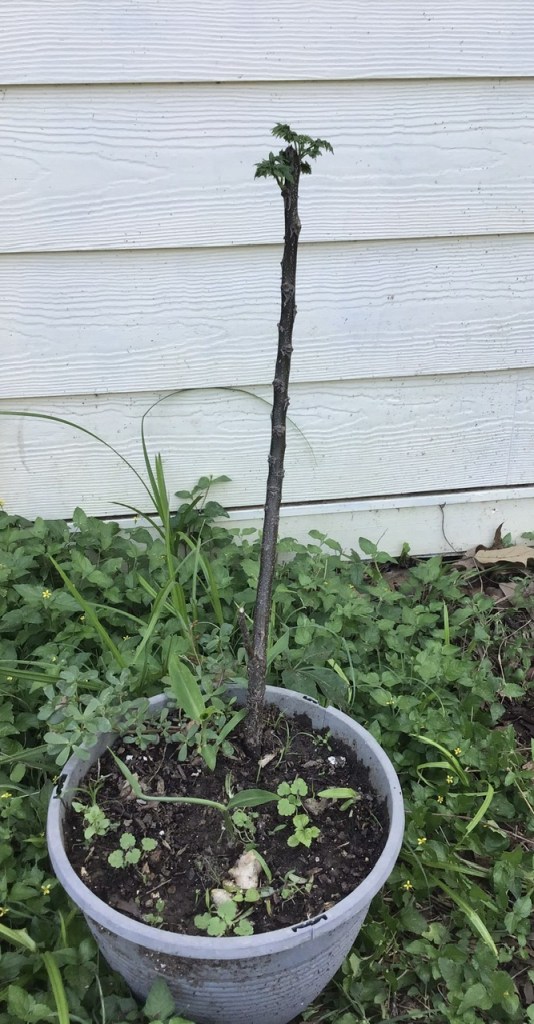
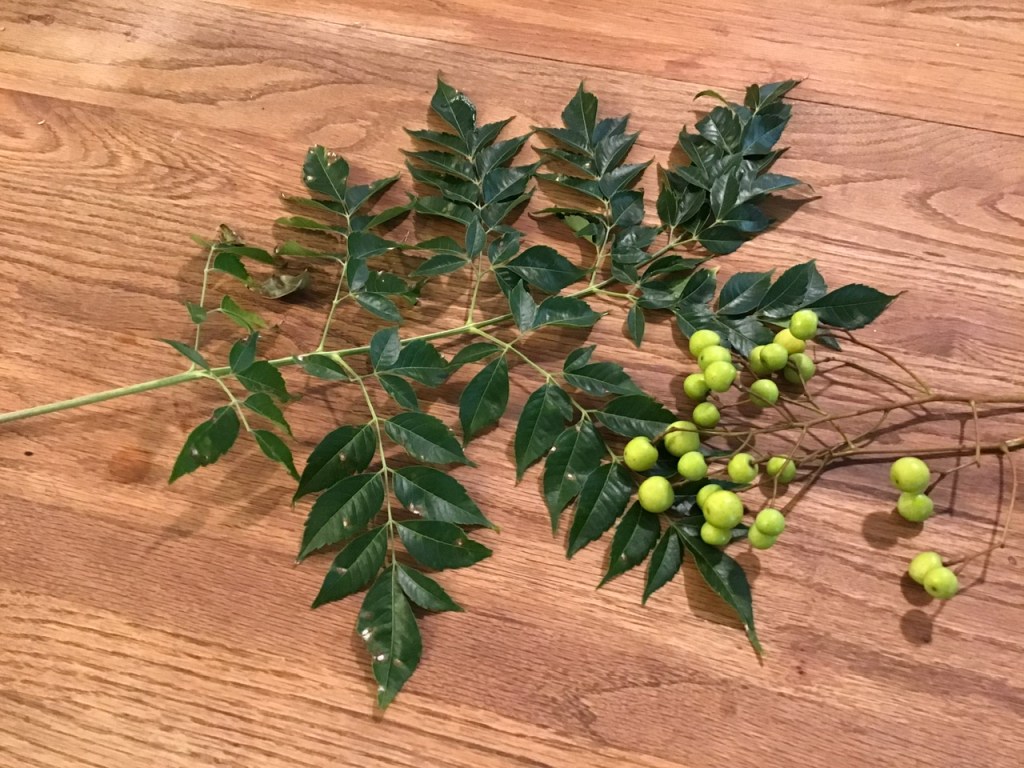
My little Chinaberry foraged/stolen from the abandoned lot where I first fell in love with it.

Instead of spending that year trying to identify the tree and wasting lots of precious time, I should’ve said at first sight–I love it, I want it, I will have it.

There is something magnificent about that speckled mahogany bark, those tropical-looking yellow berries, the glossy deep green foliage surviving even in drought in the dead of summer, that sleak curve of the trunk and the little grove it’s trying to form. I must have it. Pure instinct.

Instead of trying to germinate the berries, which is so much more challenging with many trees, I’d have taken cuttings right away. Instead of going to official sources, online and through various experts and professionals, I’d have gone to the most local source I could find, folks living in these parts for many generations.

I was given wrong identifications online, and from our university extension service that is the Master Gardeners, the usual Corporate-State fear propaganda of ‘invasive’ and ‘toxic’ and unsafe.

Because if they don’t sell it at Walmart or Lowes, it’s got to be bad. Because if it’s an ancient medicinal, it’s got to be poison.

They think they mean well, I suppose, sometimes.

But othertimes I think nope, not at all. They don’t mean to do well at all, they mean to stay compliant with the authorities. They mean to collect their paychecks and their pensions. They mean to think themselves well-meaning without ever examining themselves.

When we first came here and first becoming gardeners and stewards of this land, I vowed beyond our veggies I’d grow only ‘native species’. I didn’t know any better and that sounded to me like an admirable approach to a new venture.

I now think the term ‘native’ is itself highly suspect and what’s considered ‘invasive’ is highly relative and shifts with the breeze of the current oligarchy.

I will be satisfied when my intuition (I want that tree!) trumps my logic (what’s it called?) at the speed of the mind of a 3-year old.

It really is about the mindset, but not in the relentless Positivity sense of ‘everything is possible’ of the pop psychologists paid to entrain us to the status quo, but rather in the learn to Trust Yourself First mindset. Even in baby steps, even prolonged over decades, even against the tides more often than not.

No, not everybody, but enough to make it miserable for the few malcontents who just want to be left in peace and who care for truth and beauty over comfort, convenience, or malignant and uniformed collaboration.

Next post, all about the splendid, but illegal in Texas, Chinaberry tree.

Illegal beauty

Homestead Happenings: The Real Cheese

It was too much news last time for one post, and I didn’t care to skimp on the cheese bragging, especially!

But then I got sent off on a cheese tangent when trying to simply explain why most commercially-produced cheese on grocery store shelves should not even be called real cheese anymore.

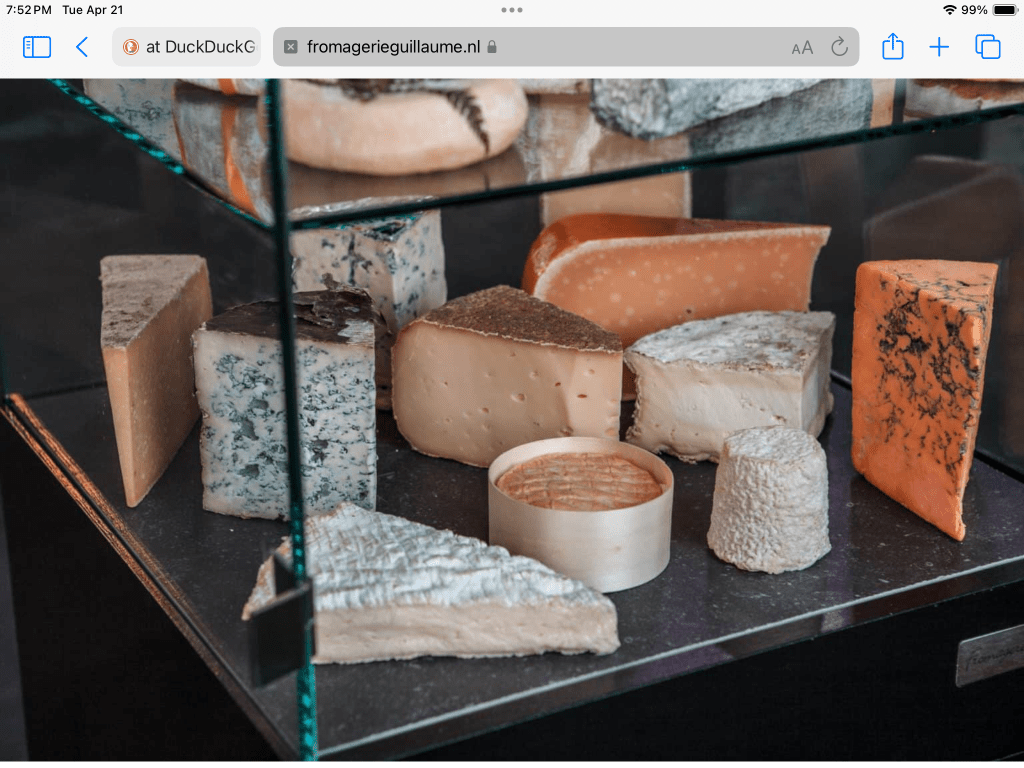
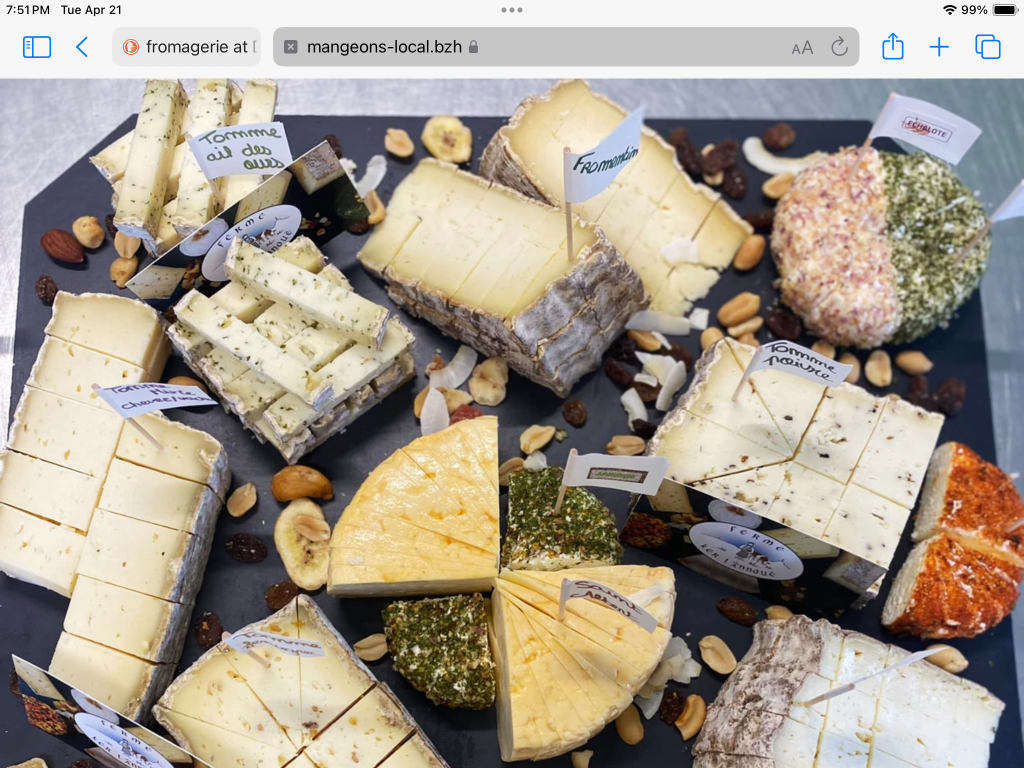
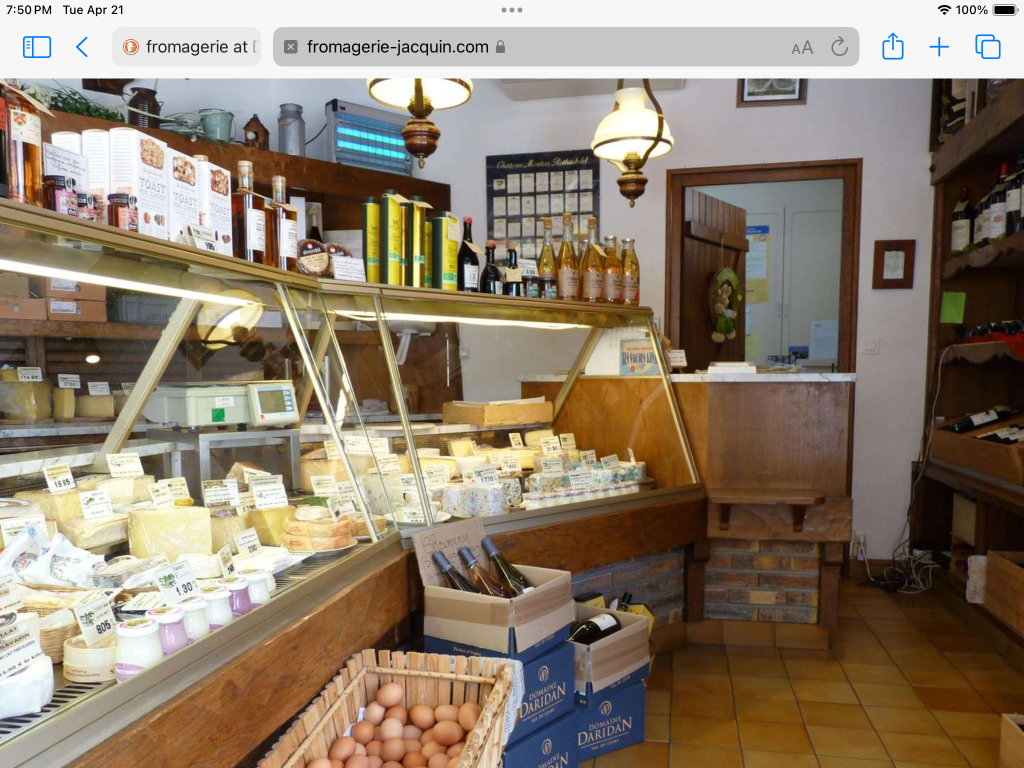
In fact, maybe even some of these fabulous-looking cheeses from traditional French fromageries like I used to love to frequent might also make the fake food list. I sincerely hope not, but France, like all of ‘the West’ are increasingly subjected to the same chemical onslought as we are in the US.

Making cheese is the best thing I’ve ever done.  In my life, without exception.  Thanks to it, I have uncovered some of the rarest, most simple, deepest and most common of universal life lessons.

No offense to Handy Hubby, marrying him is definitely a close second. 😆

I’ve heard similar magnanimous claims recounted only through such trials and tribulations as come through miracles such as child birth and motherhood. But I have not been a mother.  

Don’t cry for me though, because I found cheese!

From it I’ve delved into the practicalities–the art, the craft–of the most delicious hobby I can imagine.  I have also been either introduced, or expanded my knowledge on topics as diverse as vaccines, germ theory, pleomorphism, alchemy, modern chemistry, even math–some things which I rejected with ease or sometimes ferocity–which now claim me, my mind and passions and preoccupations, like one conquered, lured and pushed, exposed and protected, by some ultimate wisdom.  

Anyone who knew me in my younger years would be surprised, I’m sure, as my sister was, that I would willingly and repeatedly entangle my brain with math and science. Not that either is entirely necessary for traditional cheesemaking.

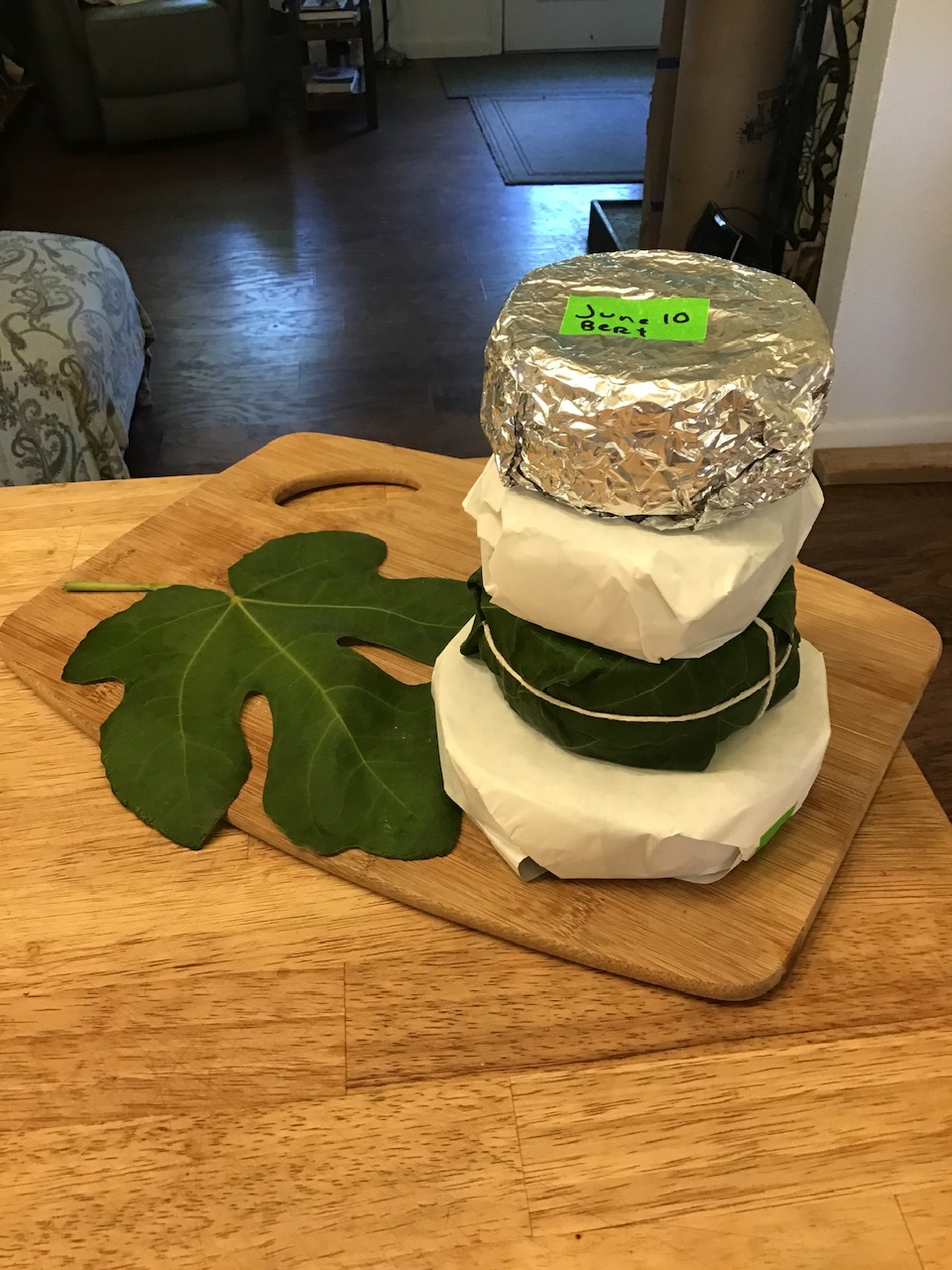
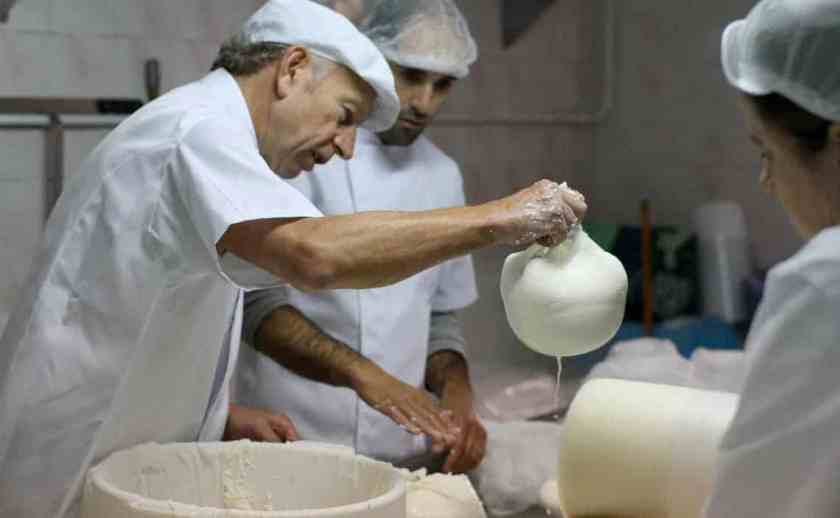
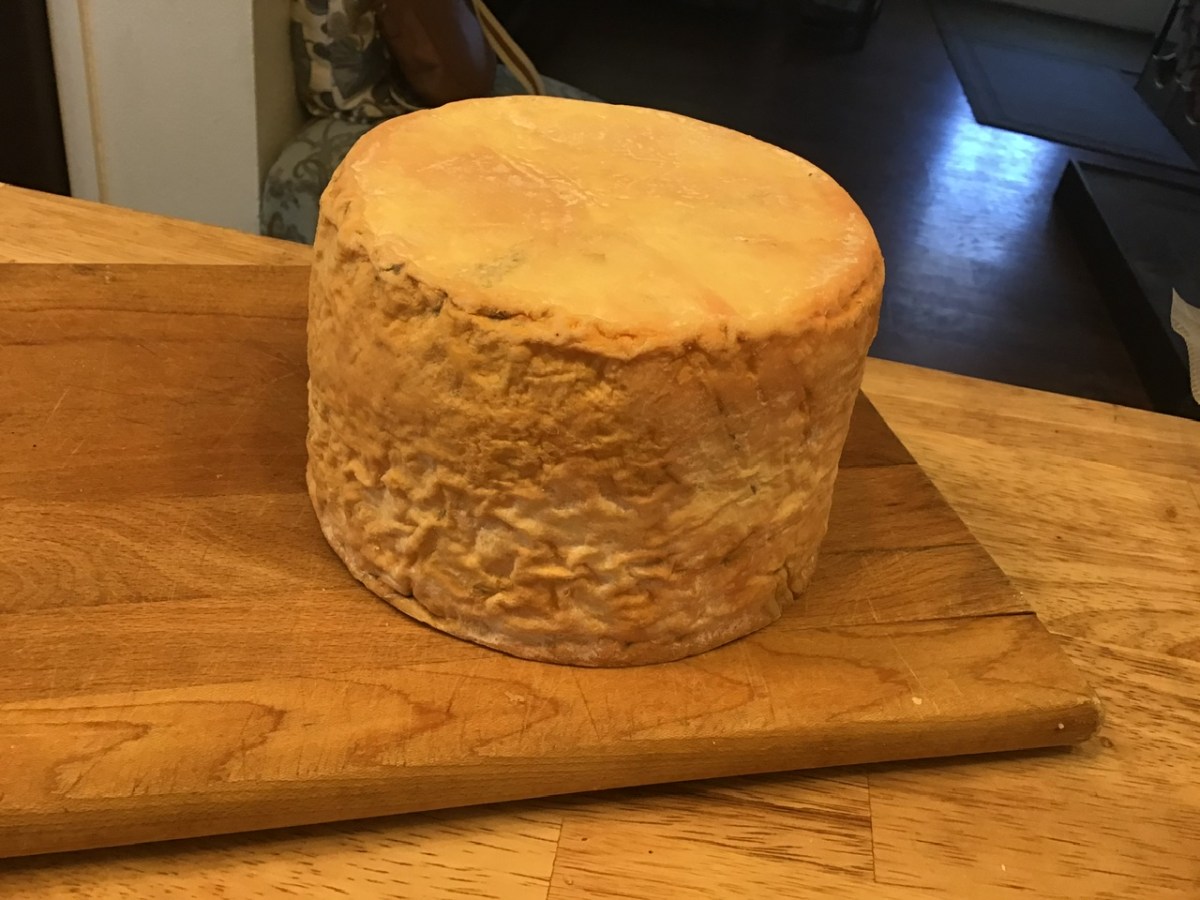
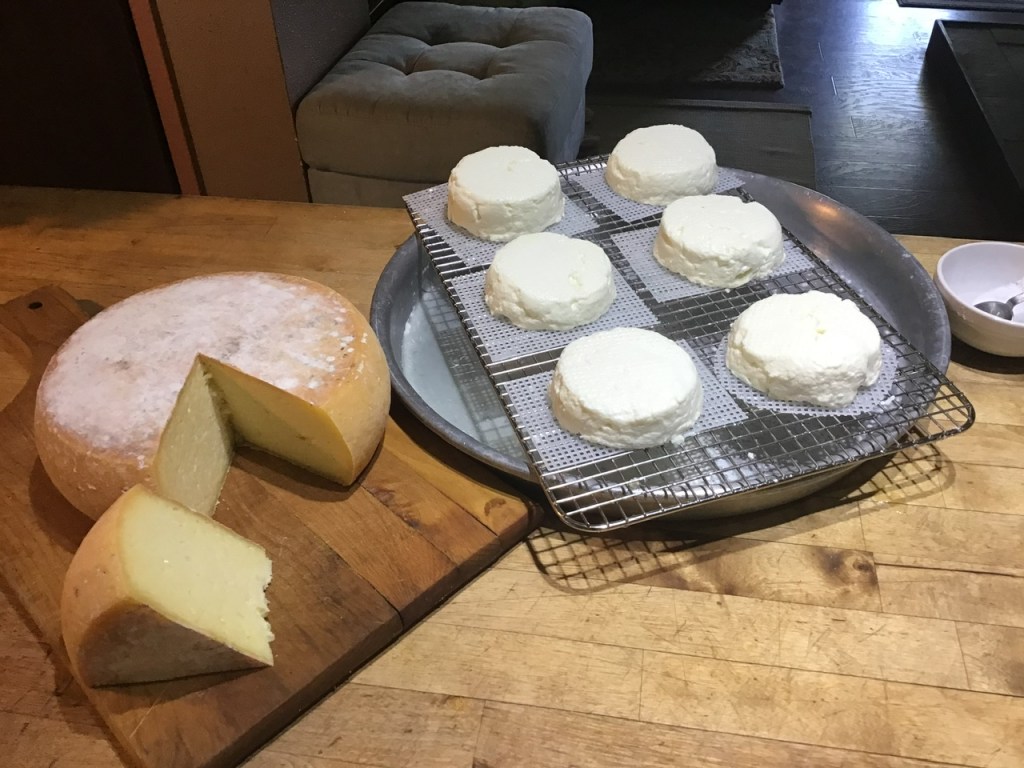
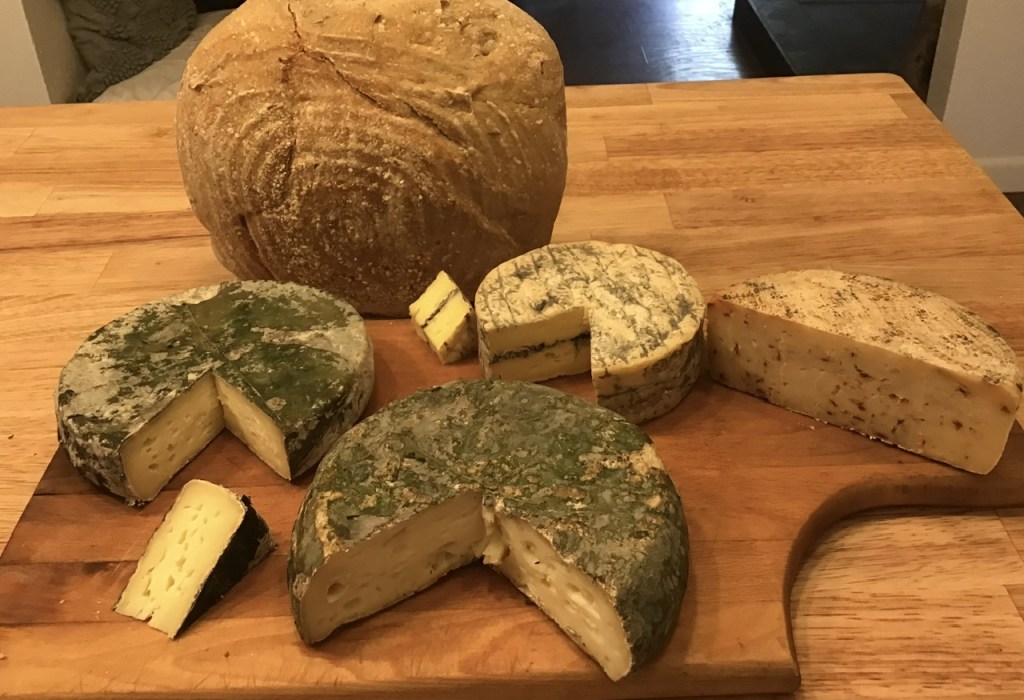
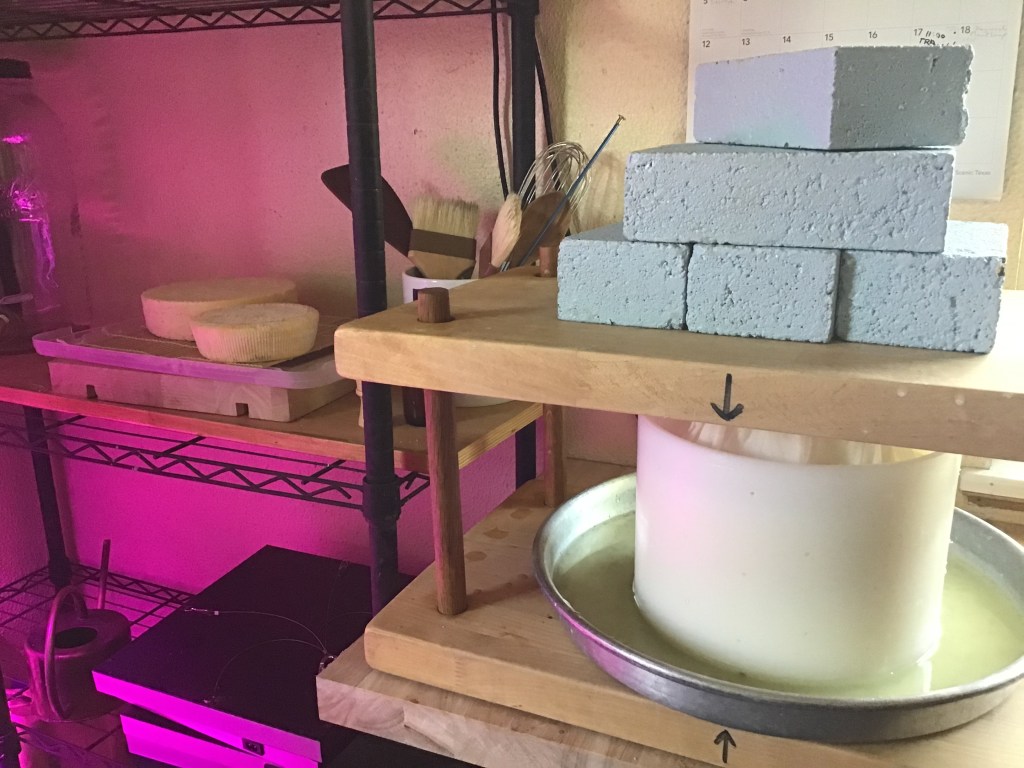
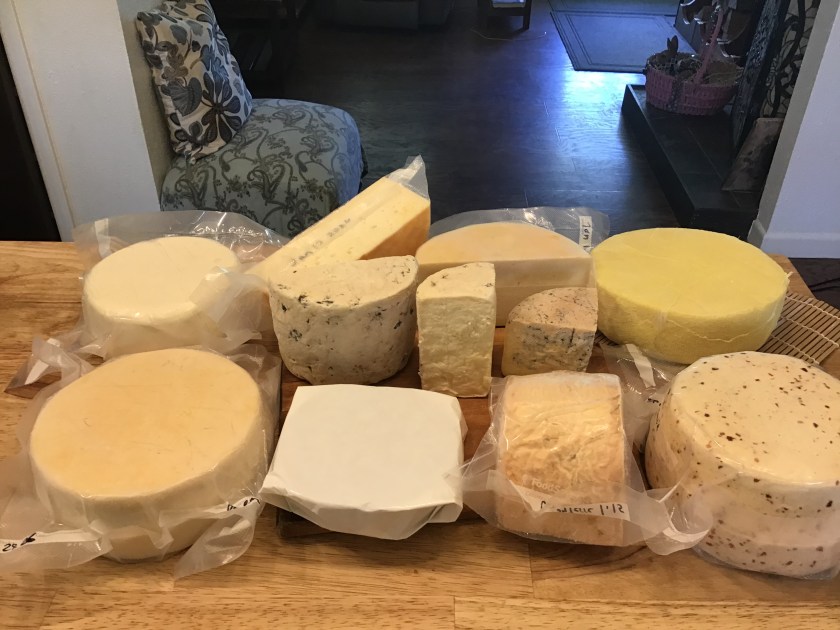
Every cheese pictured here, and plenty more that are not, I’ve made with the same 4 ingredients: locally-sourced raw milk, our own animal rennet, clabber and salt.

From David Asher’s fantastic tome, Milk Into Cheese: The Foundations of Natural Cheesemaking Using Traditional Concepts, Tools, and Techniques

Most commercial producers of cheese believe that packaged starters are the only option for cheese’s proper production; that milk is deficient in the appropriate microbes and rich in dangerous ones; and that they are incapable of realizing the work that is normally done by trained microbiologists.  DVIs (Direct Vat Innoculants–freeze-dried starters) are considered the only acceptable way to safely make cheese, and the most convenient option for producers, big or small.

He’s too polite and wise to say the industry has been completely captured, but I do believe he’d agree with me on that!

Industrial starters are by and large produced by multinational corporations. Danisco, the most prolific starter producer, is based in Denmark and is a subsidiary of DuPont.  This corporation and others like it profit off cheesemakers’ demand for a product that they do not truly need.

Industrial starters are monocultures of microorganisms that have no precedent in nature and need perfectly sterile environments in order to function correctly.  They are out of touch with the reality of cheese, which needs dozens if not hundreds of species of microbes to evolve according to their safest and most flavorful pathways.

The deception on the foundational level, resting on disproven science from the early 1900s, is bad enough.  But the consumer sees none of that, instead being swept up in extremely dubious marketing practices that call these starters natural and necessary.

And that’s even before we delve into the mass manufacturing of “vegetarian rennet” –that is the lab-derived coagulant now used by the vast majority of cheesemakers large and small around the West and perhaps the world, which also also claims to be natural.

Four ingredients.  Just think about that for a moment, please!  That is all it takes to delight, and/or to disgust, in a thousand different ways.  

Labeling, on cheeses as on GMOs, is simply another way to con the consumer.  The process is as important as the ingredients and changing the meaning of words is par for the course.  More on that next post as I delve into the “Nutrition” label of a popular cheese brand.

Fermentation and the art of putrefaction is the process.  Technically putrefaction is the wrong word, though it does sort of work!

Affinage is the correct term for the fine craft of cheese maturation.  According to AI the difference is:

“Putrefaction refers to the decomposition of organic matter, which can negatively affect cheese quality, while affinage is the controlled aging process that enhances the flavor and texture of cheese. Proper affinage prevents undesirable putrefaction by managing environmental conditions and microbial activity during cheese maturation.”

So it’s basically desirable putrefaction.  It’s like the difference between a weed and an herb, it depends on whose garden it is.

But still, think about that! Like aging fine wines and wiskeys, even hot sauces, this is proper fermentation, where territory REALLY matters.  Where some old-school crafters even insist no one else can touch their concoctions or they’re immediately spoiled.  True story!  

It’s POD taken to an extreme unknown even to our own extreme-loving culture.

POD, or DO (designation of origin) is to the cheese world what Provenance is to the art world.  It is, literally, about ‘savoir faire’ (know-how) –being able to trace the work, the process, back to its source.

Perhaps so that industry can try to capture a piece of that magic? Individual and smallscale crafters in the market are not allowed the same right to privacy as the Big Food manufacturers, who routinely get to claim “proprietary” status whenever they care not to divulge their special little secrets. 

Aging cheese, affinage, is an art, craft, indeed a profession, so ancient it predates our recorded history.  It has nothing at all to do with commercial pasteurization, or chemically-adulterated cheeses, which has absolutely compromised the craft.  Which has been further compromised by a negligence of public health standards and an indifference to territory and creating a GloboGlob culture that is so synthetic it now considers consuming chemicals as food ‘natural’.

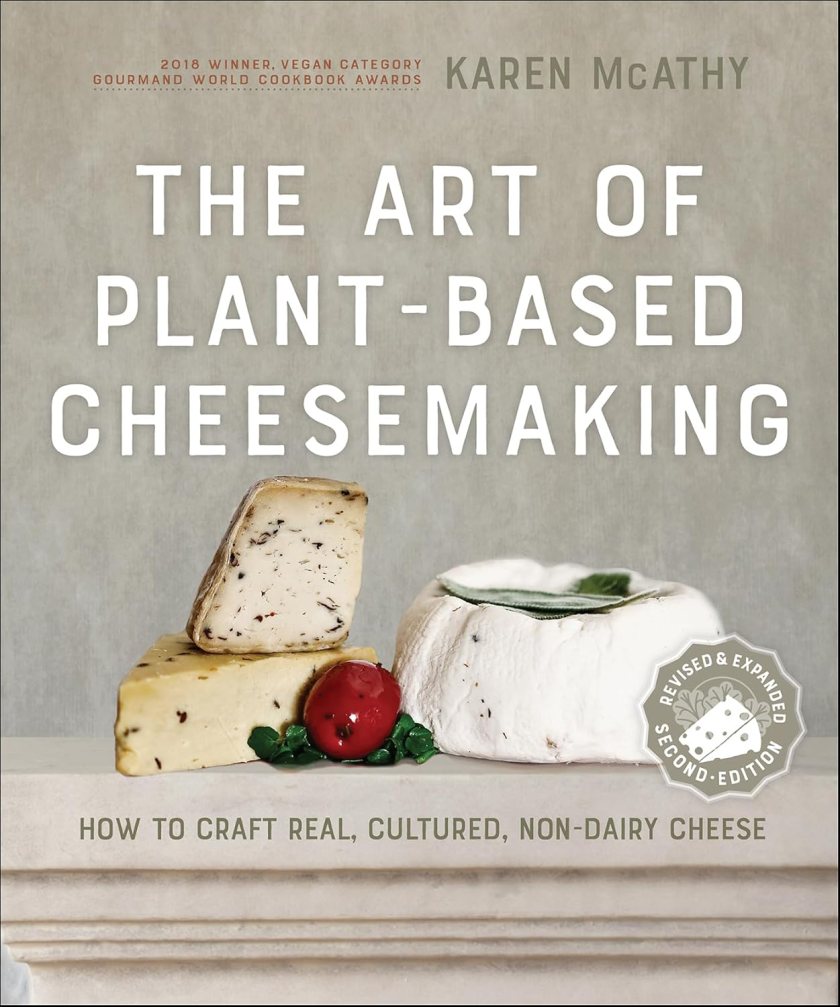
And if you are among the great many who are allergic, they don’t tell you it’s because they’ve completely adulterated the ingredients, the process, and even the meaning of words, oh no, they tell you ‘plant-based cheese’ is the next great thing they’re creating just for you!

The new ‘art’ eh? I think not. But time will tell.

Our tastes tell us a much bigger story than our grocery stores care to oblige.  And the ever-increasing health consequences and debilitating diseases point to our palates and our plates, which should take their rightful place at the top of that pyramid of problems.

Cheese is full of life and how each cheese is treated determines its outcome.  Kind of like children too.  It is not a source of disease, though like rearing anything, it can be a source of dis-ease! 

I also feel such a drive to protect these precious processes.  The downright bastardization of what’s considered natural in these times is only escalating toward greater absurdity.  “Natural” and “only possible to manufacture in a lab setting” should not be synonomous!

If that makes me a food snob, I am pleased to claim the title!  We’ll need an army of Queen Food Snobs to push back against this crazy.

Confessions of a Silicon Valley Dimwit

“Social justice and climate change, it gets progressive women 100% of the time.”

https://substack.com/@revealedeye/note/c-246898546?r=87pg2k&utm_medium=ios&utm_source=notes-share-action

And now they’re finally realizing climate change is the red herring of geoengineering. Finally. Finally, too late? Any mention of those of us screaming this for the last decade plus? Any apology forthcoming? Any change of heart or personal accountability? You decide, does she look ashamed as she giggles, talks in an ultra-feminine child voice and repeats ‘um’ over and over? Do you see remorse on her face as she confesses? I sure don’t!

“This is just mediocre banter about the lives of tech wives.” says one commenter who is spot on.

Soon it will be a new TV series I expect!

Real Housewives of Silicon Valley

Oh wait, that’s already a show. She’s probably on an audition!

Cartoon Reality

I grew up in the suburbs; I found it really boring; I watched a lot of TV, especially cartoons.

For better or worse, a good portion of my sense of justice came from Bugs Bunny.

Which is actually a lot more healthy than what passes for justice these days, I’d say!

During that time artificial reality did not blur so readily with actual reality. Now when I watch any media I see cartoons everywhere. I see cartoons when I look at people, too. So many have created caricatures of themselves it is clear there is too little authentic left to matter in them anymore. It’s like a return to the primitive, only plastic. Surface obsessed–the inner world collapsed in order to buttress the phony outer world of a manufactured jungle.

The following I copied and/or jotted down from still more media consumption, from a writer I imagine is real, who calls himself Stylman. Interesting name. I stopped following, despite his many wise expressions, when he wrote he thought the crazy weather is being controlled by the fears of the people who believe in geoengineering. A lunatic, obviously. And yet, some prescient views nonetheless.

“And it’s a road to nowhere—a few winners, millions of casualties, and an entire generation taught that their value lies in their ability to perform rather than create, to influence rather than contribute, to be seen rather than to matter.”

Now we live in an era where TikTok influencers who dance for thirty seconds make more than teachers, nurses, or the engineers who build our bridges. We’ve moved from celebrating skill to monetizing attention, from honoring achievement to rewarding performance and exhibitionism.

The fame machine isn’t just anti-human—it’s filling the void left by our disconnection from authentic community and natural guidance, while simultaneously being the logical response to living under constant surveillance.

But this isn’t cultural drift – it’s social engineering. The same institutional forces that have systematically replaced real information, real money, and real community are now replacing authentic human development with performance for strangers. This reflects a broader pattern: we live in an era where every essential human system has been replaced with artificial substitutes designed to harvest our energy rather than nourish our souls.

We’ve built a system that teaches them to treat their lives like content. That tells them: if you’re not being seen, you’re not really here. That your private self has no value unless it’s validated by strangers. We’ve stripped away something essential—the right to exist without an audience.”

While I agree, it’s actually much worse, in my experience.

The invasion of privacy of public systems and the individuals willing to force this state on everyone have deeply influenced inter-personal relationships as well–corrupting them, disfiguring them into parallel invasions–where expectation, extraction, exploitation has become the nauseating norm, and accountability has become entirely absent.

The public and private realities mirroring each other. Recently when I was visiting a dear friend who is Uber-Tech-Attached I had a Truman Show Moment, where she was gushing over her new air-fryer and I got the uncomfortable and uncanny sense I was unvoluntarily in an infomercial.

It’s a very creepy feeling I knew she would not understand.

Folks are faking their way through life, and this will have continued disastrous consequences.

The invasions will continue, until the trespasses are rejected and honor is restored to privacy and to nature.

The dangers of such a system, where access is assumed–access to your private spaces, your private thoughts, from your micro-expressions to your quotidian habits–is a culture of mutual parasitism, not even close to mutual understanding. This is not a culture more connected, it’s a culture more devolved. Incapable of boundaries, non-chalant around respect and autonomy, mocking of custom and structure, collapsing into a decaying emptiness. The nothingness of perpetually dissolving illusions, like the garish carricatures of a cartoonish, substanceless life.

A life perpetually romanticising illusion.

Even as its entire life support system slips away.

Even as the answer is so very simple.