I’ll be going down a deep rabbit hole for the next 4 posts into a topic I’ve done considerable research, have some periphery personal experience, and have become convinced over the years is a conspiracy of the most despicable order, and part of a plot to not only bring down American society, but as a key piece of a depopulation agenda.
I am pleased to have some additional support in this dive with a friend who agrees with me, usually, and as a recovering addict has an important added dimension to offer to the conversation.
It’s not just about the money, not by a long shot, which is where a lot of the discussion gets centered, and then stopped. That is not to say the economics of the issue is insignificant.
‘Legalization’ has led to a ‘marketing’ of natural products, like cannabis, and a bizarre ‘anti-marketing’ of manufactured products, like Fentanyl, which I believe get flooded all over the mainstream and social media in order to normalize, and even slyly promote, these highly-addictive and indeed dangerous drugs.
From ‘reefer madness’ to cannabis as the cure-allfor all woes and illnesses under the sun. And I smell another rat!
All this can’t help but make one question, what the hell happened to the War on Drugs?
Who won? Who lost? Is it over yet?
Did someone call a truce while I was sleeping?
For those as confused on the topic as I once was, there’s some essential learning needed to get y’all up to speed.
Lucky for us, a few very clever and creative folks have done all the hard work for us! These are both excellent works puzzling the many pieces together.
Essential learning:
The Real History of the War on Drugs by Richard Grove
This is a tome of damning evidence, explicitly-referenced, that I cannot recommend highly enough. I’ve listened to it twice and with another three times I still could not absorb all there is to know within this 18 hours of information.
He covers the well-known aspects of the early ‘war on drugs’ years, like Iran-Contra, the Bushes and Clintons, the CIA, and ties them in with the more obscure angles of the conspiracy, like the Mena connection and numerous cover-up attempts.
This more-approachable film-length content unpacks the agenda behind some of the reasons for the drug-pushing, which is mind control and social control. It goes well beyond the now common knowledge of isolated MK ULTRA tests into a very dark look at psychiatric and medical involvement and endorsement.
It covers the brainwashing, indoctrination, re-education on a level that will be staggering to even those who think they already know and how these connect to the realities of cybernetics, AI, the neural net, and far beyond.
In case you’re wondering why folks can’t wake up to the realities all around them, I hope you’ll explore with me for the next few posts, because I think it’ll become crystal clear.
Some not-so-random quotes and links, interspersed with happy homestead snaps for better digestion.
Cleaning up the acorns on the deck, so helpful!
“Power concedes nothing without a demand. It never did and it never will. Find out just what any people will quietly submit to and you have found out the exact measure of injustice and wrong which will be imposed on them.”
Frederick Douglass, former slave (1818-1895)
Despite a vast body of scientific knowledge, the issue of deliberate climatic manipulations for military use has never been explicitly part of the UN agenda on climate change. Neither the official delegations nor the environmental action groups participating in the Hague Conference on Climate Change (CO6) (November 2000) have raised the broad issue of “weather warfare” or “environmental modification techniques (ENMOD)” as relevant to an understanding of climate change.
The clash between official negotiators, environmentalists and American business lobbies has centered on Washington’s outright refusal to abide by commitments on carbon dioxide reduction targets under the 1997 Kyoto protocol.(1) The impacts of military technologies on the World’s climate are not an object of discussion or concern. Narrowly confined to greenhouse gases, the ongoing debate on climate change serves Washington’s strategic and defense objectives.https://archives.globalresearch.ca/articles/CHO201A.html
The card game called Spoons is a family tradition. We played it from my earliest memory at all Shepard get-togethers, no matter the season or occasion, along with other card games, like Go-Fish and Old Maid, but also on occasion ‘board’ games, like Monopoly and Yatzee.
No cyber world back then, no cell phones or Gameboys or X-Boxes, lord only knows how we managed to plow through the boredom, with only things like cards!
Grandma told us that she was forced by Grandpa to leave the Ice Follies at age 17, where she clearly had an illustrious career in the make, in order to become a respectable wife to him, and honorable mother of his progeny. It was all pretty cool to me, because she was even in the papers, and I had my own aspirations of dancing back then.
Respectable women with families are not show-girls. This was to my grandfather an automatic given.
That’s how I heard the story, when I could first understand it, wearing my favorite t-shirt that summer of about age 11, with a billboard sprawled across my still-flat chest: Anything boys can do girls can do better.
There was this grandfather, highly concerned about the respectability of his wife, and then the one who played Spoons with the family.
These were quite large gatherings, at least compared to what I knew from my mother’s side of the then-divorced families. The game of Spoons is very simple, all the players sit in a circle, 4 cards are dealt to every player, the dealer who passes the contents of the deck to the player to one side attempts to move with a high enough speed as to confuse and disorient the one picking up the discarded cards after him. The goal is 4 of a kind. If achieved, at that moment you silently strategize alone, as there are a line of spoons in the middle of the circle, enough for every player but one. So, once you have 4 of a kind, you grab one, or, you slyly sneak one, or you wait and watch as an opportunist of sorts, or, well that’s about all the strategy I was ever able to garner from this game, besides Grandfather’s.
The strategy my grandfather played was no doubt, by any set of rules, cheating. He would collect a pile of cards next to him, feigning slowness or incompetence, and turn them over in chunks, hoping to collect pairs more quickly, then the 4s, winning the position to select the first spoon. He would play this routine regularly, but we as children would forget, it was only a time or two a year we got together, after all. But after a hand or two each time we’d remember this trick, and rail on grandpa that he was cheating, which only made him and everyone else laugh, to the end result that everyone on the floor would start using (t)his trick.
It’s a very old and simple trick after all. There’s many names for it, but in these parts they call it country dumb, that is, shrewdly playing innocent. The old tricks are the best tricks. When we take even a cursory look at the culture we can see it clearly still works.
There’s a long precedent for this sort of player, most notably from the classic Czech work, The Good Soldier Sveikby Jaroslav Hašek, certainly the predecessor to the Hogan’s Hero’s character called Schultz, celebrated for his classic line, “I know NOTHING!”
There is always a healthy level of doubt as to whether Sveik’s actions are feigned well-executed sabotage or authentic (idiotic) enthusiasm, that’s essential in the classic fool/magician archetype.
“Hasek was a comic genius . . . his message was that war is not merely cruel, unjust and obscene, but ludicrous” Sunday Times
The Good Soldier Svejk is the classic novel of the ‘little man’ fighting officialdom and bureaucracy with the only weapons available to him—passive resistance, subterfuge, native wit and dumb insolence.”
If you were a corporate or military strategist watching our family play Spoons, you might recognize this as a somewhat sophisticated case of sabotage, a sort of coup d’etat, no doubt, because when the patriarch begins to openly cheat and play dumb, you’ve just opened up the entire troupe to the same acceptable level of behavior. Cheating, it seems and many have noted, is contagious. And that’s just how it happened with our family game of Spoons as well. Aunts, uncles, cousins and parents become instant co-conspirators with youngsters of all ages plotting against them, or sometimes, on their behalf.
Is this a ‘good’ lesson to teach children, or a ‘bad’ one?
I thought of this question again when I heard this recent interview with Sarah Westall and Nick Jankel. In it they discuss a bit the importance of “trauma” in a child’s upbringing and the ways this is both under-rated and over-utilized. In my opinion they broach the cutting edge question we now face in the so-called ‘Western modernity’–obviously to bubble-wrap our children is not working, but to go back to old ways of discipline is no longer acceptable either—how can we find the most fertile middle ground?
No doubt as youth we need to be taught to not only deal with, but also to survive and then to thrive within the existing culture, but not to the point we have come now, which is blind obedience, acceptance and acquiescence, generally speaking.
It’s very easy later in life to point fingers at Grandpa and condemn or condone the unhealthy moral principles he was manifesting to his progeny at those cheating moments, especially considering he was clearly loving it.
Did we learn a valuable life lesson, by overcoming a certain level of ‘trauma’? I hope that was his unconscious agenda. Because make no mistake, to learn as a child that your grandfather willingly cheats against you, and the entire family, and then laughs about it, is not an authentic happy moment in a child’s life.
I saw him differently, call it what you want, but ultimately it’s a loss of innocence, if you can bring it to consciousness. Whether conscious or not, Grandpa taught me in that moment about the real world. Whether we are 7 or 17 when that happens, is it better it happens where one has a soft place to fall, or with random strangers in a proverbial strange land?
I don’t know. I want to stress this fact, I really don’t know. This to me is a pivotal social question. Why are we not discussing it at the dinner tables and the board rooms and the political arenas is beyond me.
Is it better to learn your 60 year old grandfather would cheat against your 6 year old nephew, and embrace that as a valuable familial tradition, and then by extension to learn that is how the world actually works?
Or, would you rather learn it when you get blindsided by crooks out to steal your successful business when you finally wake up to reality at age 47?
Could it be that Trump is brilliantly playing this archetype now?
And what about all the shades of critical social gray there might be in-between that our progeny might need to learn? Are we learning how to create a better world with these life lessons, or are we learning only how to successfully play along?
While so many are focused on the doom and gloom of politics and environmental degradation and censorship and climate change and fake news and on and on, I am seeing glimmers of hope striking up everywhere.
Our honeybees love the morning glory in late summer, which is considered an invasive and highly undesirable weed among most farmers who kill it with herbicides and then complain there are no bees to pollinate their fruit trees in the spring. Things that make you say, hmmm . .
And this poor sod just doesn’t get it either!
“Taking joy in that suffering is more human than most would like to admit. Somewhere on the wide spectrum between adolescent teasing and the smiling white men in the lynching photographs are the Trump supporters whose community is built by rejoicing in the anguish of those they see as unlike them, who have found in their shared cruelty an answer to the loneliness and atomization of modern life.” https://www.theatlantic.com/ideas/archive/2018/10/the-cruelty-is-the-point/572104/
You don’t have to be waving a flag on the Trump train to appreciate a politician making a public sport of the ‘Deep State’–which is now a Front & Centerlabel in the global lexicon–thanks to his administration.
Will he manage to drain the swamp? Was that ever his intention at all?
It doesn’t matter now! He’s put language on it, he’s given the corruption a popular catch phrase, which will survive long after any degree of embarrassment or hate speech or lack of diplomacy under which the American left currently feels they are unduly suffering.
And still another delicious dose of Hopium:
This little team of prankster scholars not only provided us with some great laughs, but got some great work done in the process. This is creativity at its finest and an inspiring look at how sometimes the gatekeepers can be beaten at their own game. Some of these fake papers were then published in peer-reviewed academic journals, including a hilarious one about the rape culture inherent in dog parks.
“This process is the one, single thread that ties all twenty of our papers together, even though we used a variety of methods to come up with the various ideas fed into their system to see how the editors and peer reviewers would respond. Sometimes we just thought a nutty or inhumane idea up and ran with it. What if we write a paper saying we should train men like we do dogs—to prevent rape culture? Hence came the “Dog Park” paper. What if we write a paper claiming that when a guy privately masturbates while thinking about a woman (without her consent—in fact, without her ever finding out about it) that he’s committing sexual violence against her? That gave us the “Masturbation” paper. What if we argue that the reason superintelligent AI is potentially dangerous is because it is being programmed to be masculinist and imperialist using Mary Shelley’s Frankenstein and Lacanian psychoanalysis? That’s our “Feminist AI” paper. What if we argued that “a fat body is a legitimately built body” as a foundation for introducing a category for fat bodybuilding into the sport of professional bodybuilding? You can read how that went in Fat Studies.” https://areomagazine.com/2018/10/02/academic-grievance-studies-and-the-corruption-of-scholarship/
Of course we continue to have the usual misinformation and disinformation being shoveled out by the usual culprits:
These are miraculous times! On the wee homestead there’s always proof of that close on hand.
Mama Chop with 9 piglets just born
But in the attempted Globalist takeover of our cultures and our individuality it can be very tough sometimes to see past the fear-porn. And once that’s accomplished, it can be even tougher to get a personal clue as to what to do about it in whatever way one can.
But that’s happening!
Derrick Broze on 5G in Houston on DTube, not Youtube:
Folks are rapidly moving away from the corporate-sponsored programming.
They are organizing, creating new platforms, sharing ideas and truth and camaraderie. It’s now already passé to be only ‘woke’ — the new fashion is to break the chains altogether.
Folks are no longer satisfied with waking up and they are now standing up and those old neocons are dying off, but that doesn’t really matter, because it was never just about a group of white men. Just as it was never just about any one group, it’s not just the Jews, not just the Russians or Chinese, or the Communists, or the Nazis. The problem is, was and always will be the mindless, honorless order followers. That problem is being overturned on our watch and I am a thrilled witness and ardent participant in that sabotage.
What’s been revealed now en mass and which the masses have lapped up like starving kittens is the strategy. We have witnessed the Revelation of the Method and there’s no way to unsee it. Some don’t yet realize that’s what they are witnessing, they see only the chaos, they react in fear or trepidation. That’s ok.
Are you afraid of the future the technocratic Globalists have planned for us?
Sometimes it’s impossible in the moment to know what will imprint randomly on your Being as very significant, though in the moment it seemed totally insignificant.
I have reminisced on this blog before about the random young traveler at the airport who told me I was ‘on the list’ before I’d ever known there were any such lists in the United States. It took me another year and another two flights to fully register that encounter enough to make any inquiries.
There’s another one that haunts me in a similar way, nearly two decades later. This one I have not shared before, because there is so very little to share about it and it did not have any significance for me for a decade, and only makes full sense to me in the last few years.
I was teaching intensive leadership seminars for gifted and well-funded high school students in Washington, D.C. for a short while. There was a student whose face or name I don’t remember, nor anything else about him except he was male and mildly confrontational.
The curriculum of these seminars came from the Carnegie Institute, though I did not realize that at the time and found the material very engaging and totally new to me. The schedule we kept for these 1-week workshops was really tough though, 16 hour days, 6 days a week, for 2 months per contract. In each of these week-long workshops I was one of 20 other teachers or so, and we each led a couple dozen students each week.
Of all those students I remember no names, no faces, it’s all like a huge blur. Mostly I remember feeling drained, challenged, fascinated, reluctant, all at once, with no time to process any of it. Basically, I remember my own experience of this unusual experience. I have a couple of parting gifts still though, of students writing their appreciation, some of them very enthusiastic about their experiences, which I wonder today what they remember and where they are in their lives. But I don’t remember them as individuals.
The only singular contact with any of the students remains with that one slightly smart-ass kid who said to me something along the lines of: “You know this is brainwashing, right? It has nothing to do with leadership.”
And I replied, in reaction and nothing else: “Brainwashing?! It’s not brainwashing if it’s for you own good.”
And I meant it. In the time that I said it I honestly believed what I was saying, though I knew nothing of brainwashing and thought good intentions naturally lead to good results. This was good material, it was teaching mostly sociology and psychology and the art of assertiveness, what could possibly be the harm there?
Brainwashing?! Seriously, that’s what the military and communists do!
That’s not what I’m doing!
Now it’s actually embarrassing for me to realize how much less wise I was to the ways of the world than this student, 15 years my junior.
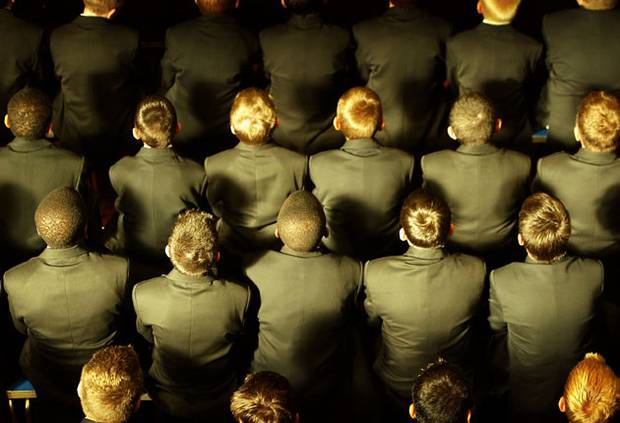
What I understand now is that it most certainly was a kind of brainwashing, established in elite think-tanks, training young minds in the Skinner fashion to mold themselves and others into pre-fashioned categories. It was indoctrinating students (and teachers!) into a mindset of collectivism, deferring to experts and to group-consensus, becoming a sort of professional ‘middle man’ and calling that leadership. There was no introspection, no down time, no unstructured fraternizing. No individualized guidance, at all.
“It’s not brainwashing if it’s for your own good.” Wow, where the hell did I come up with that line of auto-bullshit?
I said it last time, Pink Tyranny! I see it now so plainly, but it’s taken a lot of washing the lipstick off that pig for me to really get it. I’ve had to remove myself very far from the picture to get an objective lens and what I see that I participated in blindly, even enthusiastically at times, is not something that makes me proud today.
Sure, nobody died. It’s not like some big dramatic TV-worthy event. Just the small encounters of everyday life and work.
But, I think that’s what makes it so insidiously unforgettable now, with all the time and space and distance and research I’ve got behind me since then.
I’d rather spend another hour cleaning the duck shit off the deck than continue to participate in the on-going indoctrination camps we’re calling education.
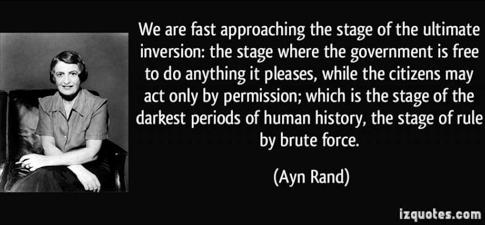
Rand had it part right for sure, she just didn’t realize the technology would replace the need for out-right brute force in this culture, and that the ‘pink tyranny’ of mass indoctrination could be so effective in cooperation with the right incentives and enough entertainment to subdue several continents and put the entire history of the circus to shame.
According to a definition on Wiki, I might be a pacifist, considering my lifelong anti-war views: “A pacifist rejects war and believes there are no moral grounds which can justify resorting to war. War, for the pacifist, is always wrong.” In a sense the philosophy is based on the idea that the ends do not justify the means.[6]
I’d agree in general, war is always wrong, and furthermore, it’s a racket.
Still, that does not make me a pacifist, not by a long shot. I do believe there are no moral grounds which can justify resorting to war, and that the ends do not justify the means. However, as mature, rational individuals sometimes immorality is the only responsible course of action. Simplistic, black and white thinking is the territory of adolescents, where unfortunately far too many adults today seem to be stuck.
Once upon a time in this country there used to be an ‘anti-war’ left. Maybe a few still remember that. Where that led was to a government who simply stopped declaring war. They started calling it ‘spreading democracy’ and ‘fighting terrorism’ and ‘regime change’ instead, and the once resistant left jumped right on board.
I’d suggest that was because the left had never based their policies on principles, they’d just duped a lot of folks into thinking that was the case. Now the left has become so desperate and diabolical that violence is committed by the very act of speaking, with subtle human behaviors suddenly deemed ‘micro-aggressions’ and popular entertainers de-platformed, and even your local weatherman under an illegal federal gag-order to keep you from the truth about Geoengineering and weather warfare. https://www.geoengineeringwatch.org/government-implements-illegal-gag-order-on-national-weather-service-and-noaa/
Pink Tyranny! Backdoor dealings with the public left in the dark.
Everyone is #metoo and #offended to a degree of public outrage fit only for a brothel. Sorry, omg, not to say anything bad about brothels, really, I’m sure they have their place in a civilized society and I don’t judge, really, sorry for my stereotypes and bigotry to any and all sex workers who may be reading this, and of course, any of their clients as well, be they legal or illegal, foreign or domestic. My bad, I take it back, I blame this brand of shameless, insensitive faux pas squarely on my really square grandfather, that is, on my mother’s side, just to be clear. Sorry! He was German, so, there you have it.
“Political correctness and the burgeoning movement to outlaw “offensive language” are merely tactics to: preserve groups’ separate identities; foment conflict between them; and ultimately foster their dependence on government authority.”
When confronted with the blatant hypocrisy, or the obvious double-standards and inherent corruption, they continue to perpetuate the charade and they cloak their cognitive dissonance in ready-made slogans provided to them by Empire: Always defer to the Authority, and there is always an Authority.
“I was just following orders.”
“That’s above my pay grade.”
“Let me get my supervisor.”
“The State and its allies are real oppressors who contribute mightily to creating real victims; but what I’m talking about here is growing numbers of people who voluntarily take on the victim-mantle and seek comfort in nests of self-promoting groups who exaggerate and distort their own claims to special status.
The State needs these people. The State wants these people. Increasingly, the State employs these people.”
Drought-Rage?! YES!!! Does he know it’s deliberate?
“If the development of civilization has such a far-reaching similarity to the development of the individual and if it employs the same methods, may we not be justified in reaching the diagnosis that, under the influence of cultural urges, some civilizations—or some epochs of civilization—possibly the whole of mankind—have become neurotic?” Sigmund Freud
Again from Jon Rappoport:
“Eventually, if lunatics have their way, every person on planet Earth will be designated a victim. That will be the group of groups.
It won’t matter why and how everyone supposedly turns out to be a victim. The reasons will be forgotten. People will “instinctively” sign on to the agenda.
And the management team running the world will put another check mark on their sheet of objectives:
“Earth is beginning to resemble one giant hospital/mental institution. Break out the champagne.”
There is only one problem. That plan is fraying at the edges. People are waking up and swimming to the surface through layers of deception. They’re returning to themselves. They’re recognizing group-ism for what it is: a meltdown into self-sabotage.
The artifact is the collective. The self is real.”
The Age of Information is locking down and it is now very difficult to find any criticism about Smart Cities. Unless you know exactly where to look, the search engines will lead you astray, into the mire of propaganda surrounding this latest attempt toward technological takeover in our society.
Tiny, temporary, expensive experiments that don’t address the underlying problems, but convince the public its problems are being solved.
Total Surveillance sold with a smile for ‘your protection’. Along with The Internet of Things, facial recognition technology and digital currency your life will be monitored like is currently being rolled out in China.
It will start mildly, build incrementally. Right now it is debtors who are being targeted, with no discretion on how/why the debt incurred, whether for a medical emergency or the propensity to overspend or the fact that you had to help your widowed mother does not matter a hoot to the Almighty Algorithms.
In short order it will become anyone who hasn’t kept up with the annual vaccine schedule, or those who criticized a government official, or those who didn’t put in the required hours of community service, and on and on.
When I lived in the Czech Republic and asked the elderly ladies about what it was like when the Soviet tanks rolled in, I heard the same sort of story repeated:
”We had no idea what they were capable of!”
It was not that long ago, there are still some folks around who remember. Not too much about human nature has changed, as far as I can tell, in the few generations that this just happened. Sometimes cliché becomes cliché because it’s true:
Those who forget history are doomed to repeat it.
Centralized Control: control the food, control the water, control the power, control the animal. It scares me most how many folks actually want this, human beings who actually prefer to be controlled by a distant authority. What does that say about an individual’s character when they trade liberty for security?
I’m not saying an old lady move unprotected into the wilderness, but surely the other extreme is equally foolish. The cost is life itself, because when you give that much control to another over your Being it then becomes their choice whether you live or die, that’s the plain and simple.
Do you trust your government that much? Are you sure they care about you all that much?
Buying a beggar lunch in exchange for her photo. Prague, Czech Republic 1999
Completely Regulated: Unbelievable power hidden behind algorithms!
Just let that sink in a moment.
Ever seen the Wizard of Oz? In today’s Smart City no amount of travel along the yellow brick road will lead you to the almighty Wizard.
Everyone will be following the dictates of The Algorithms. The more concentration of any population you have in any one space, be that populations of cattle or chickens or humans, the more strictly their behavior must be regulated for the safety of all. This is why in the factory farming of pigs, for example, they are forced to take drastic measures like cutting off pigs tails so other pigs don’t bite at them, creating wounds and therefore disease potential.
The number of vaccines the government now deems necessary is a direct reflection of this common sense fact. My grandparents as children had 0 vaccines, yet today the average toddler will have had well over 30 if their parents followed the CDC (Center for Disease Control) guidelines.
Resource Scarcity: It is a real shame to me that as a culture we have lost the skill-sets that provided our ancestors the ability to thrive as individuals, families and communities over thousands of years. This is the main driving force in our lives here on the wee homestead, to reclaim some of these skills and demonstrate that it is doable and even rewarding. The further removed one is from their food source the more vulnerable he is and that is a valuable piece of common sense which it seems to me too many folks these days have lost.
And just like we are now finding in the cyber world, there will be absolute control of information. Information is a very valuable resource. As fast as they can now pull Alex Jones off the cyber-grid, they will do the same to whatever or whomever they choose.
“You may find that your results in this thought experiment depend largely on where you place your trust. If you trust the dominating class more than you trust people as a collective, you probably find this idea terrifying. What if everyone starts thinking wrong thoughts and believing wrong beliefs? What if everyone decides that humans can fly when they leap from rooftops and running with scissors is safe? What if everyone decides the Holocaust never happened and says “Hell, that means we get a freebie! Let’s get our Final Solution on y’all! Yeehaw!”
If, however, you trust humanity as a collective more than you trust a small group of sociopathic, omnicidal, ecocidal oligarchs who killed a million people in Iraq, you might suspect that whatever happened would surely be better than what happens in the current paradigm.”
Disaster Vulnerability: High concentrations of any species in one area is antithetical to natural systems. ALL natural systems. Balance is nature’s formula and a Wise Citywould try to mimic that, not over-ride it. None of nature works like this, so from the start we are trying to swim upstream, so to speak.
A Wise City would be based on bio-diversity, not energy and technology. No matter how seduced folks become by the technological society and man merging with machine and cybernetics, robotics, transhumanism, and so on, we are still in this period of history made of flesh. Carbon-based creatures that we are, our primary focus, the first level of concern needs to be on our health.
Modern society has not brought us better health. The stressful environment, the poor nutrition, the poor healthcare of modern city life all contribute and everyone pays for such high concentrations of people in one area. It’s not just that they divert vast amounts of research and resources, they also create enormous amounts of waste that then have to be redistributed. New York City carts their waste off to the rural south! What is rational, or fair, or sustainable here?
After Hurricane Katrina in New Orleans there became a moment during the reconstruction phase when I realized what was happening was not ineptitude, not incompetence, but in fact organized disaster capitalism. You can call it collusion or conspiracy, but to me that’s unnecessarily splitting hairs.
I knew something bigger was happening, a sort of coup in slow motion, and today New Orleans is a prime prototype of the Smart City.
Run by Criminal Cartels masquerading as philanthropic organizations. The Rockefellers, Carnegies, Rothschilds, the tax-free foundations, the Royal families, the Dynastic rulers, they are not here to make the life of the common man better. That most folks still don’t realize this demonstrates how well they’ve played this Big Long Con based entirely on marketing, public relations, and the public’s general gullibility.
Just to be clear, I’m not anti-city at all. I’ve been to some gorgeous cities and lived in a few, too. But these Smart Cities aren’t wise, though they’ll be run by wise guys, no doubt, (bad pun intended!) and what’s even worse is giving away your power, your privacy, your proximity to real life (which is the natural world, not the man-made world), your self-reliance, the wisdom of our ancestors. What are you trading it all for, and have you really considered the entire cost, now and future?
Let me go out on a real limb here and suggest that the real goal of the Smart City is to create chaos and Scare-City, in order to create a Human Lab to study human behavior to such a minute degree for a Greater Agenda, which is to eventually do away with the bulk of us (aka eugenics), and make the entire World a streamlined People Farm, run by the same select few who are currently pulling the strings.
But . . . that’s just the conspiracy theorist in me, right?! In any case, if you move to one, or choose not to move away from it now, you can no longer say no one tried to warn you.
“Cities are part of the system we’ve invented to keep people alive on Earth. People tend to like cities, and have been congregating in them ever since the invention of agriculture, 10,000 or so years ago. That’s why we call it civilisation. This origin story underlines how agriculture made cities possible, by providing enough food to feed a settled crowd on a regular basis. Cities can’t work without farms, nor without watersheds that provide their water. So as central as cities are to modern civilization, they are only one aspect of a system. “
Really? I call hogwash! Cities developed to serve Empire. Period. They enslave far more than they enrich. And that Empire thinks it’s its job to ‘keep me alive’, thanks anyway, but NO THANKS! I do believe in some circles they call that racketeering.
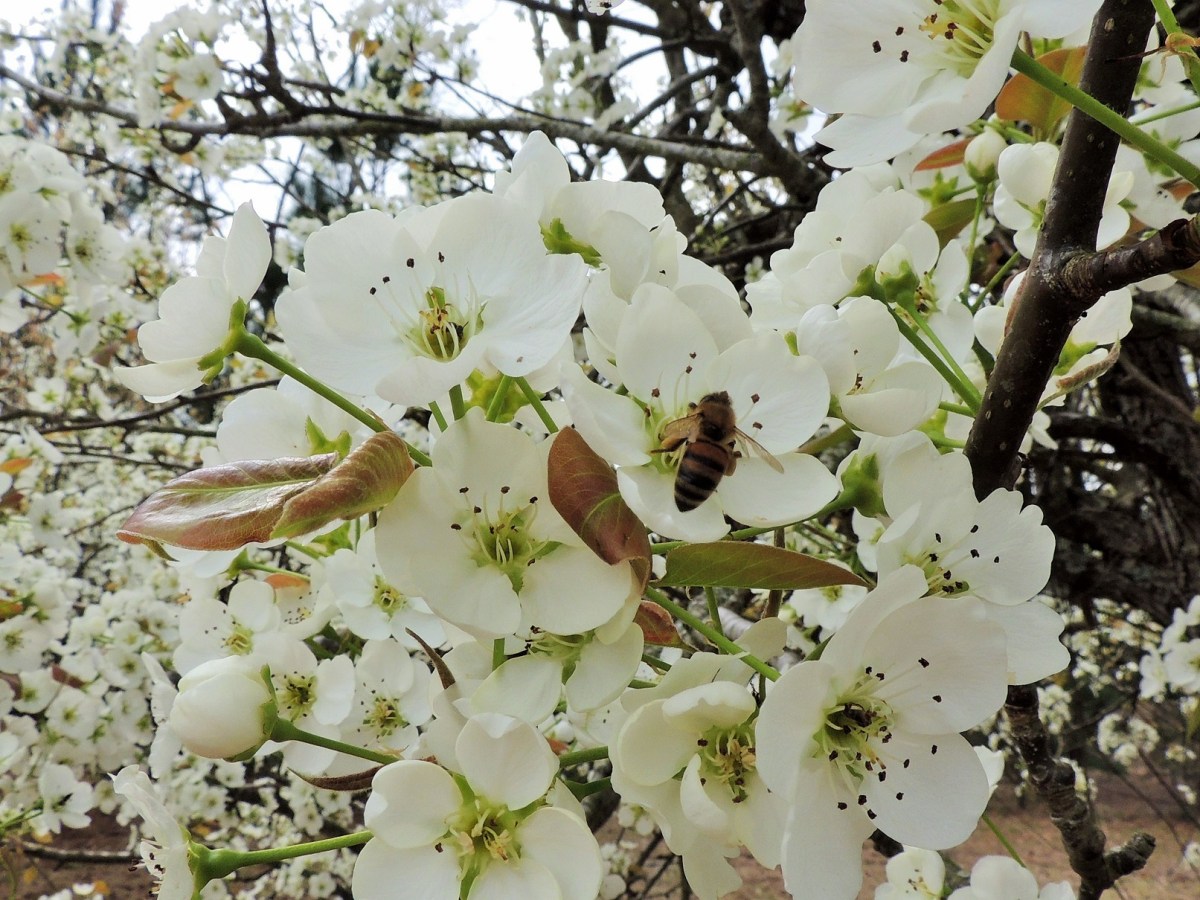
I lost my last hive just a few weeks ago, mysteriously. They dutifully pollinated the pears before their departure, sweet little creatures they are. Unfortunately, they didn’t leave a note, or much clue. I hope they swarmed and found a suitable new happy home, but I believe from what little evidence remained, that this was not the case.
The drama of the bees has been droning on now for decades. But of course, have no fear, technology comes to the rescue! First create the problem, then try to fix it while creating 3 new problems–that’s the modern, strategic, scientifically-advanced model at work.
Problem with disappearing bees? Solution, robot bees!
The next big thing according to TV’s famed Dr. Oz, is the RFID chip. Keep losing your Alzheimer parent? Get ’em the chip!
Steve Hoffman gushes over the new tech which will allow our minds to merge with one another. He calls it ‘almost like heaven’—a state of all-inclusiveness with others where our individuality is traded and usurped by the collective, to the extreme degree we can actually feel another’s pain as our own.
But, only if we choose it, of course. Right. That’s good, because mark my words, I don’t want to be in his mind, and I certainly don’t want him, or anyone, invading mine at will either.
Will we get to choose? I’m pretty doubtful on that point. Right now, do I get to choose whether my region is cloud-seeded, or not? Nope. https://weathermodificationhistory.com/
Do I get to choose whether Walmart creates robot bees? Nope.
Do I get to choose whether scientists experiment with technology meant to replace nature, meant to manipulate the environment beyond measure, meant to research consciousness with the intention of controlling it, even replacing it? Nope, nope and nope.
Dr. Andreagiovanni Reina, Research Associate in Collective Robotics in the University of Sheffield’s Department of Computer Science, said: “This study is exciting because it suggests that honey bee colonies adhere to the same laws as the brain when making collective decisions.
“The study also supports the view of bee colonies as being similar to complete organisms or better still, superorganisms, composed of a large number of fully developed and autonomous individuals that interact with each other to bring forth a collective response.
“With this view in mind, parallels between bees in a colony and neurons in a brain can be traced, helping us to understand and identify the general mechanisms underlying psychophysics laws, which may ultimately lead to a better understanding of the human brain. Finding similarities between the behavior of honey bee colonies and brain neurons is useful because the behavior of bees selecting a nest is simpler than studying neurons in a brain that makes decisions.”
Is it for a love of nature and mankind that science and technology seek to study it so thoroughly and in this particular direction? Or, is it with the intention of replacing nature and mankind for the benefit of god knows whom?
Do they ever ask themselves if we all have the same vision of a collective utopia?
As they preach for the essential Oneness of humanity, the love and light of unity, the exalted state of community, the Kumbaya collusion of the hive, the higher consciousness of the collective, do they consider as well the famed quote by a character in one of Jean Paul Sartre’s most read plays, “L’enfer, c’est les autres.” (“Hell, it’s other people.”)
As they profess their profound compassion and concern, do they care that some of us don’t care to live with robotized nature? Have they considered putting their intellectual efforts toward saving nature, co-creating with nature, relating equally to it, rather than commanding it, deconstructing it, subjugating it, destroying and replacing it?
Do they tread so shallowly in their own individuality that they cannot conceive of the notion that one’s relationship to oneself and to nature is by far greater, more fundamental and essential, than one’s relationship to any other?
Keep your robots, your synthetics, your hive mind, your Internet of Things, your technological collective Utopia, I don’t want it.
Many of us don’t want it, but we seem to have no choice in the matter.
If I weren’t an optimist, I’d feel we are doomed here on the wee homestead; doomed to watch as we are driven from the heaven of creating our own private Idaho into the hell of another’s version of ‘progress.’
My idea of progress:
Companion planting 3.0 (gardening by aesthetics) — cultivars co-existing with native volunteers (yes, I mean weeds); edibles among poisons; annuals with perennials with crops, seasonal ‘layering’. More on all that coming soon!
Handy Hubby’s idea of progress:
Spending his entire vacation building! Color me impressed. 🙂
Perhaps you will think this is just a battle of semantics. But, I do not think such battles are futile. Words matter. According to popular theories like Neuro-Linguistic Programming they matter significantly, much more than many of us realize.
But, the appropriate naming of a thing is conditional upon understanding this thing, especially when it is as abstract and ephemeral, as defined and debated, as love is.
Maybe sometime in prehistoric, more intuitive times, this was hardly necessary, but today it is. Since the ‘Positivity movement’ – an orchestrated top-down push by social engineering think-tanks like the Tavistock and Esalen Institutes, Theosophical Society, among many others—love has become a very loaded word in the West. By grand design.
Love is the answer. Love will save the world. Love conquers all. Love the one your with. Love your neighbor as yourself.
Yet love is far too loaded a word to make it the salvation of mankind, let alone the multiverse.
This love-pushing is yet another slight of hand by the power structure, and it seems some of most well-versed and well-intentioned in matters of social programming are still falling for this ruse.
Yes, I will name names, of some of my favorites, and boldly so. James Corbett, Ole Dammegard, Patrick Roddie are among those who have recently rekindled this fog of love. These men are working impressively hard to ameliorate the system, but still insisting love is the answer.
These love lovers come from a very long tradition, Martin Luther King preached constantly of love. From the ancient Greeks to Mary Baker Eddy to today’s New Agers who preach incessantly of agape all march right in step with loads of spiritual and even some secular doctrine to boot.
Crossing every musical genre, every soap opera, through environmental and social movements, through philosophers, preachers, psychiatrists, we have been brainwashed and further confused about what this world really needs.
All we need is love? Not by a long shot!
Here’s what I think: You are all terrifically wrong and embarrassingly so. Please allow me to elaborate.
First and foremost, ‘love’ does not translate well, even among Western languages. ‘Te quiero’ the expression most used in Spanish for ‘I love you’ actually translates better as ‘I want you.’ In French the verb for love is “aimer” translated both as ‘to like’ and ‘to love.’
Love does not translate well through time and space either, it evolves differently over time, place and circumstance. There are 4 kinds of love according to the Bible, 8 according to the ancient Greeks, 7 according to Psychology Today magazine.
Which type is it, I wonder, do we expect to work to solve the world’s ills?
There is the unrequited love of the troubadours, the erotic love equated with infatuation, platonic love, familiar love, and I could go on. And on! A single word with so many variables is a really bad idea for slogans and songs about saving the world. Or a really good one, if you want to remain pathetically ineffective.
Everyone understands love, they insist. We’ve all felt love, they assure us. But that too is a big fat lie. Unfortunately, there are many lonely souls in the world who do not understand love at all and who haven’t any capacity to either receive love, or to give it.
Love is passive, remarkably so. Love is a word over-used to the point of abuse and even contains what most of us today consider malevolent, as in the high form of love according to the ancient Greeks, pederasty, the love between a man and an adolescent boy. We must of course mention the unmentionable as well, in terms of love, that disgusting master of headlines and hatred, pedophilia, the ‘love’ of prepubescent children.
Clearly folks, the answer is not love, not familial love, or romantic love, or sexual love, or cosmic love, or love of man, freedom, god, king or country.
The answer is simply not, in any way, shape, or form, love!
The answer is care.
Care takes out the selfishness and passivity inherent in love. A universal word in the way love never will or can be. It is understood across borders and across generations. Care is independent of love’s baser quality of desire, many times we must care whether we desire it or not.
We care for, we care about, we care to, or not to. Care is a very active word, it embodies and requires action.
Give it a try, just to test my hypothesis. Next time you are inclined to use the word ‘love’ try ‘care’ instead. Instead of saying ‘I love nature’ say “I care about nature.”
Instead of saying “I love that child” say “I care for that child.”
It works especially well with my greatest pet peeve with the word—instead of saying ‘Love your enemy’ try ‘Care about your enemy.’
Does that not feel more right?
Because, I do! I can say that with full honesty and integrity—I care about my enemy. I care what he’s doing so I might prevent it. I care what he thinks, what he says, how he says it, where he goes, in fact, I care about every move he makes, so that I can triumph over him.
There is nothing triumphant about loving your enemy, it’s the equivalent of surrendering to him, because authentic love requires surrender, and everything else is just paying lip-service to love.
Food for thought: Let’s try some songs and preaches and speeches about care for a change.
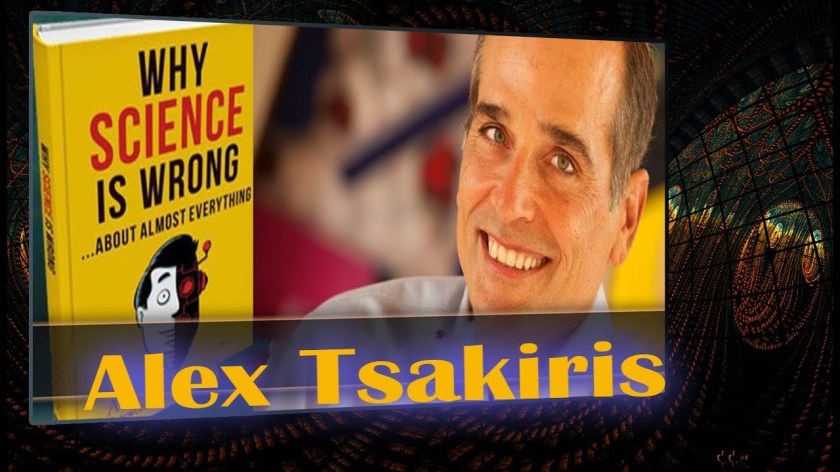
Why Science is Wrong . . . About Almost Everything by Alex Tsakiris
Entrepreneur, iconoclast, family man . . . those qualities alone might be enough to win me over.
So I started listening to Alex’s podcast at Skeptiko.com, including many years of past podcasts on the most controversial and fascinating topics largely left behind by mainstream science: near-death experiences, parapsychology, consciousness, and so on; as well as conversations that dare to question some of the oldest assumptions still clinging to modern scientism, in ideas about evolution, race, spirituality and healing/medicine.
I then got hooked on his forum, so it was only natural I buy his book. It also does not disappoint.
Alex’s mantra is not a unique one, it’s one I and many others share: ‘Follow the data, wherever it leads.‘ It has led him, continues to lead him, through some pretty rough terrain.
But in his interviews he comes off as fearless and fresh, in content and sometimes in attitude, as in the way my grandfather used the word with me, as an endearing synonym for wise-guy. He is known for not shying away from the challenging questions, which is completely contradictory to the ungodly number of weenies and yes-men who overwhelm podcasting cyberspace in my experience.
From the book’s introduction a provocative statement sets the tone and the overarching theme, “Science as we know it is an emperor-with-no-clothes-on proposition. It mesmerizes us with flashy trinkets, while failing at its core mission of leading us toward self-discovery.” He then weaves together pieces of various interviews interspersed with commentary, which makes the book not only a concise and interesting narrative to follow, but a key for further perusing the subjects at hand on his forum.
“How could this be?” he challenges early on in the book, “How could otherwise intelligent, competent, seemingly honest people be locked into a mindset that kept them from the kind of open-minded, objective, rational thinking they advocated?” He then proceeds to demonstrate the ‘defend-the-status-quo thinking’ that has become deeply ingrained in the scientific establishment.
Medium communication is one such taboo-type topic covered in the book. Alex surmises three main reasons why most scientists just won’t go there.
They are willfully ignorant of the research that exists;
They never personally investigated the topic themselves; and
They can’t accept any anomalies that challenge their carefully constructed mind-equals-brain paradigm.
But, could science be at a tipping point? Included in the book are portions of interviews from many leading researchers in what most still consider pseudoscience. Other interviews are with insiders doing cutting-edge research against-the-current, like Dr. Jeffrey Long, a radiation oncologist and near-death experience (NDE) researcher with a best-selling book, Evidence of the Afterlife: The Science of Near-Death Experiences.
The data tells us, says Dr. Long, “. . . what you see in the life changes of near-death experiencers is markedly consistent. In other words, it’s not just that they have life changes; it’s the consistency of those life changes. The substantial majority, if not overwhelming majority, of near-death experiencers believe that there’s an afterlife. They believe that there’s a God. They no longer fear death. They’re less materialistic. They value loving relationships more. The list goes on and on. This has been consistently observed not only in our study but in scores of prior scholarly studies of this phenomenon over 30 years.”
Alex’s interviews often include elements of more subtle and sensitive inquiry, which I find remarkably over-looked by most others–fundamental questions of ethics, the destructive powers of group-think, authentic vs. contrived compassion, leadership, hypocrisy and responsibility–those deeper aspects of a more spiritual nature.
I’d be willing to bet more folks have had experiences of inexplicable, or otherwise anomalous events than have not. These experiences range from things like the placebo effect in healing, paranormal-feeling synchronicities, even prophetic dreams or unusually strong connections with certain people or animals or places. All kinds of folks practice astrology, and Tarot, channeling, meditation, herbal healing, which mainstream science mostly dismisses as quackery.
Science today dismisses anything and everything it cannot directly observe. So we the non-experts, the general public, are left with gaping black holes in our knowledge, that morphs into mythology and fantasy-based reality, in all the corners where science fears to tread. Few of us really believe we are biological robots in a meaningless universe, yet that is where materialistic science seems to be permanently stuck.
The data eventually led Alex to the place where I found him, conspiracy theories. He had some predictable push back from some of his regular audience and it’s possible his forum has still not completely recovered the losses. To me, that speaks volumes. “Following the data wherever it leads” is not just lip service to him, he sticks to his guns; this is a man of principles.
He even dares to question a southern hot-button topic of the highest order–the theory of evolution–not so much the science aspect behind the theory, but the social engineering aspect of it, the conspiracy angle of it, my preferred angle.
After three interviews, Michael Flannery, Associate Director for Historical Collections at the University of Alabama and expert on Darwin and the theory’s co-discoverer Alfred Russel Wallace; evolution enthusiast Dr. Jerry Coyne of the University of Chicago; and Roy Davies, a former BBC filmmaker and journalist, Alex asks a few more of his compelling questions. “Do we really need to elevate this tiny bit of history to the untouchable status it has among many scientists and committed atheists? Does it really answer our deepest questions about who we are and where we came from? Or is the theory of evolution protected so fiercely because it’s a vehicle for propping up our absurd science-as-we-know-it, mind-equals-brain paradigm.”
To me being just a layman following the data, the answers look self-evident.
Alex concludes with a touching personal observation that parallels my own experiences, which demonstrates why I, and many others, believe conspiracy work is in fact, spiritual work.
“The Skeptiko interviews I’ve compiled have changed me. They’ve turned my world upside down more than once. But the knowledge I’ve gained has made me a better husband, father, and friend. I’ve discovered and re-discovered myself again and again and, in the process, I’ve gained a deeper connection with those I love and care about. Knowledge is power, and sharing knowledge, like so many of my guests on Skeptiko have done, is the ultimate gift one person can offer another.”
I have a hard-ball question of my own for Alex, but I’ll save it for a future date. 😉
















 Rand had it part right for sure, she just didn’t realize the technology would replace the need for out-right brute force in this culture, and that the ‘pink tyranny’ of mass indoctrination could be so effective in cooperation with the right incentives and enough entertainment to subdue several continents and put the entire history of the circus to shame.