I’ve added a new ‘weed’ to the Herbal Explorations pages. It’s long, but fascinating, at least according to me. 😁
I hope I can help you enjoy my favorite flower from afar!
Common names: Thornapple, Jimsonweed, Devil’s trumpet, Mad apple, Stinkweed, and many more
Scientific names: Datura fastuosa, sanguinea; D. Stramonium; D. Metel
Solanaceae family
Datura is one of those weeds with a very long and very sordid history, but that’s only part of the reason it is my very favorite.

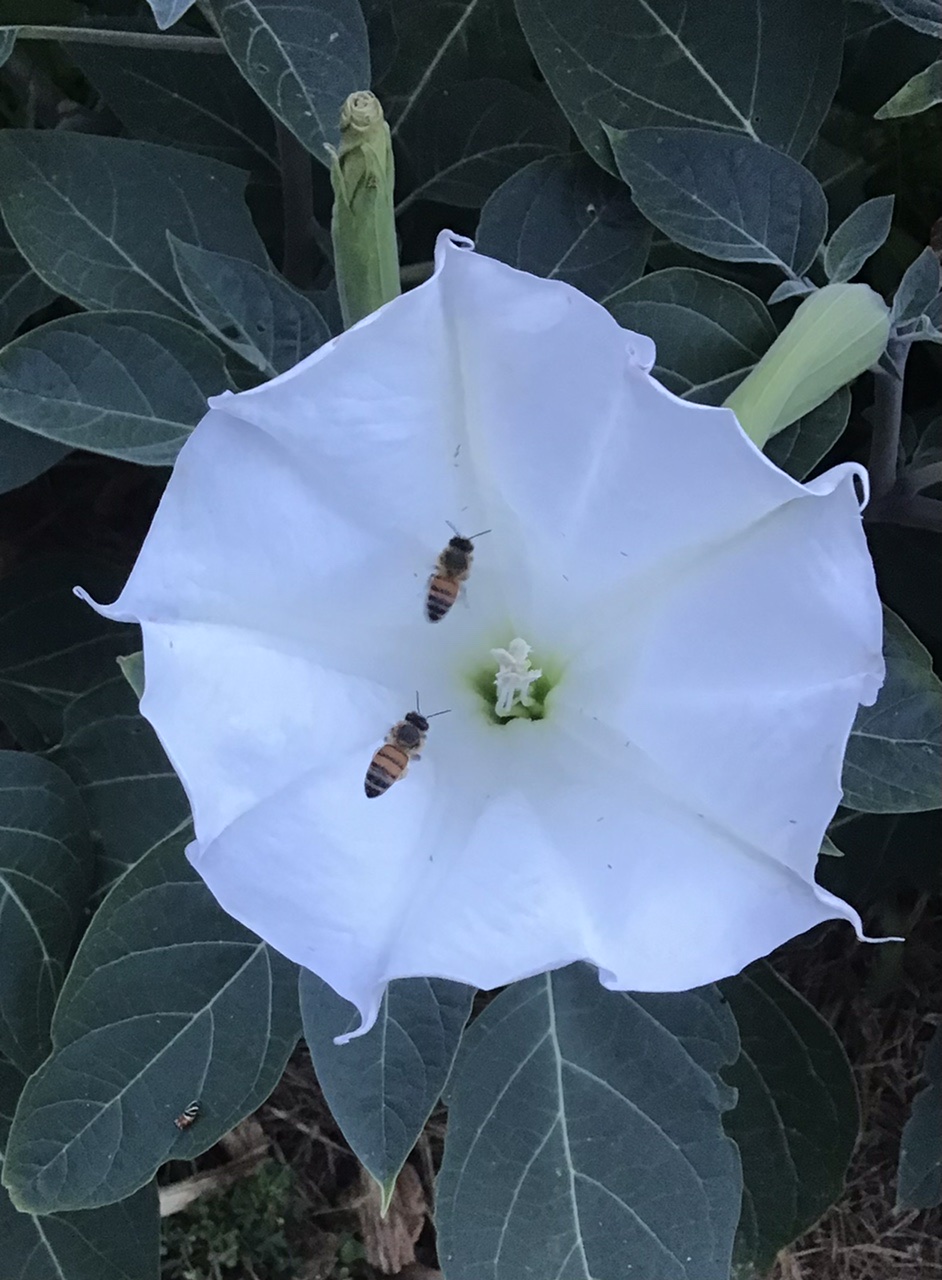
It’s a luxuriously soft bloom, thick and silky, opening at dusk. For a very short time while opening it emits the most seductive scent I could imagine. It makes me want to just dive in and drink it up!
And sometimes I do smother my nose right into the center of it and breathe deeply as the smooth velvety petals brush my cheeks, but the scent does not become stronger in such close proximity. It remains very subtle, almost dainty, like a sweet teasing, a slight flirtation that drifts into an unrequited mystique.*

Man has been tempted and fascinated by this weed since long before written history.
“The case of D. metel is unique in that not only is the plant not a true species at all, but an assemblage of ancient pre-Columbian cultivars created from D. innoxia in the Greater Antilles, but evidence is mounting that it was introduced to the Indian subcontinent no later than the second century CE – whether by natural or human agency is, as yet, unknown – making it one of the most ancient plant introductions (if not the most ancient) from the New World to the Old World (see Columbian Exchange).”

While there are many varieties, all with distinctive features, it is the scent especially that is said to vary dramatically among species—from noxious to intoxicating—sometimes dependent solely on the nose of the beholder.
From Wiki again:
“Datura is a genus of nine species of highly poisonous, vespertine-flowering plants belonging to the nightshade family (Solanaceae). They are commonly known as thornapples or jimsonweeds, but are also known as devil’s trumpets (not to be confused with angel’s trumpets, which are placed in the closely related genus Brugmansia). Other English common names include moonflower, devil’s weed, and hell’s bells. All species of Datura are extremely poisonous and potentially psychoactive, especially their seeds and flowers, which can cause respiratory depression, arrhythmias, fever, delirium, hallucinations, anticholinergic syndrome, psychosis, and even death if taken internally.”
From Reader’s Digest Magic & Medicine of Plants 1986:
“Jimsonweed: Although it has antispasmodic, painkilling, and narcotic properties, jimsonweed is a plant to be avoided. Every part of this weed, which is a member of the notorious nightshade family, is extremely poisonous and may cause death. (It) was once a popular asthma remedy. . . .The root and leaves were used externally in folk medicine to treat boils and cuts. The American physician and botanist Charles Millspaugh stated in his Medicinal Plants (1892) that jimsonweed was employed ‘as a narcotic, soothing drug’ for epilepsy and neuralgia. He also noted that it was recommended as an ointment for burns and scalds.” (P. 226)
~~~~~~~~~~
From Plant Intoxicants: A Classic Text on the Use of Mind-Altering Plants by Baron Ernst von Bibra (Die narkotischen Genussmittel und der Mensch by Wilhelm Schmid, Nuremberg, 1855)
(Datura fastuosa, sanguinea; D. Stramonium; D. Metel)
“An intoxicating drink called tonga is prepared from the seed capsules of this plant. This brew has a violent and powerful effect. Johann Jakob von Tschudi in his ‘Travels in Peru’ describes the effects as he saw them on an Indian who had taken the tonga.
‘Shortly after swallowing the beverage he fell into a heavy stupor. He sat with his eyes fixed vacantly on the ground, his mouth convulsively closed, and his nostrils dilated. In the course of a quarter of an hour his eyes began to roll, foam issued from his half-opened lips, and his whole body was shaken by frightful convulsions. After these violent symptoms subsided, a profound sleep of several hours followed. In the evening I saw the Indian again. He was relating to a circle of attentive listeners the particular of this silicon, during which he allegedly communicated with the spirits of his forefathers. He appeared very weak and exhausted.’
The name yerba de huaca (herb of the graves) thus derived from the peculiar idea of the Indians that they can communicate with the spirits of their forefathers, generally after consuming the thornapple plant.”
In former times the old Indian priests drank the thornapple if they wished to converse with their gods. Moreover, priests at the oracle of Delphi administered the prepared seeds of the thornapple to their seers to put them in the desired prophetic ecstasy. In the sun temples at Sogamossa, near Bogota in the Andes of New Granada a similar practice was carried out by the Indians.” (P. 77-78)
~~~~~~~~~~~~~~~~
From Witchcraft Medicine: Healing Arts, Shamanic Practices, and Forbidden Plants by Claudia Muller-Ebeling, Christian Ratsch, and Wolf-Dieter Storl

The famous Flying Ointment
“The ointments (Unguentum populeum) were not forbidden; they were officially used for the treatment of pain, as a numbing wound dressing, as an executioner’s salve, for rheumatism, and for hemorrhoids. The common people were also quite familiar with plants that move the spirit, and used them for love potions and as spices to make beer more inebriating. . . .The courts themselves made use of such ointments. The inquisitors used them to revive defendants after they had been thoroughly questioned and—due to the effects of scopolamine—used the ointments as ‘truth serums’ to break the resistance of tortured prisoners.” P.51
‘Witches’ markets’ in Mexico sell ‘pomada de toloache’ made from the leaves and petals using the variety Datura inoxia (Mill.,syn, datura meteloides DC)
~~~~~~~*More on scent*~~~~~~~~
I am so enamored with the scent of this flower, I wish I could find it in bottle! But so far, I don’t think it exists.
I wonder, how would they re-create a scent that smells differently to different people? Considering ‘smellovision’( a play on ‘television)’ is apparently already possible and coming soon to a computer near you, I dare say there are some scents science will never capture, and perhaps datura will be one of them.
“The concept of digital smell technology was already being discussed openly in mainstream news in 2018, and The Monell Center in Philadelphia, PA, is actively engaged in research to digitize chemosensory data. The notion of a mixed, augmented reality, integrating smell technology, is no longer in the sci-fi realm.” ~Stephers
Part 4: The Scent of Fear ~ Musings on Fear and Olfaction – Piece of Mindful
If I could upload the scent for you now, I would! 😊
~~~~~~~~~~~~~~~~~~~~
Here is some more interesting information on the psychoactive properties of Datura. Scopolamine, the so-called ‘mind control’ drug is an active ingredient.

From Wiki again: Psychoactive Use
“In Pharmacology and Abuse of Cocaine, Amphetamines, Ecstasy and Related Designer Drugs, Freye asserts: Few substances have received as many severely negative recreational experience reports as has Datura. The overwhelming majority of those who describe their use of Datura find their experiences extremely unpleasant; both mentally and often physically dangerous.
However, anthropologists have found that indigenous groups, with a great deal of experience with and detailed knowledge of Datura, have been known to use Datura spiritually (including the Navajo and especially the Havasupai) Adequate knowledge of Datura‘s properties is necessary to facilitate a safe experience. The ancient inhabitants of what became central and Southern California used to ingest Datura to “commune with deities through visions”. The Southern Paiute believe Daturacan help locate missing objects. In ancient Mexico, Datura also played an important role in the religion of the Aztecs and the practices of their medicine men and necromancers. It was reportedly used by the Aztecs for ritual sacrifice and malevolent purposes as well. In modern-day Mexico, some datura species are still used for sorcery and other occult practices, mostly in the southern region of Veracruz, specifically in the city of Catemaco.
Bernardino de Sahagún, in around 1569, called attention to Datura in these words: “It is administered in potions in order to cause harm to those who are objects of hatred. Those who eat it have visions of fearful things. Magicians or those who wish to harm someone administer it in food or drink. This herb is medicinal and its seed is used as a remedy for gout, ground up and applied to the part affected.”
Christian Rätsch has said, “A mild dosage produces medicinal and healing effects, a moderate dosage produces aphrodisiac effects, and high dosages are used for shamanic purposes”.
Wade Davis, an ethnobotanist, also lists it as an essential ingredient of Haitian zombie potion. In Western culture, the same species (Datura stramonium) has been said to have been commonly used by witches as an ingredient for their flying ointments and was regularly included in detailed recipes of magical ointments dating back as far as the early modern period, predominately in New England and Western Europe. During the anti-witchcraft hysteria of colonial times it was considered unlucky or inappropriate to grow D. stramonium in one’s garden due to its supposed reputation for aiding in incantations.”
~~~~~~~~~~~~
For more information on its psychoactive properties visit:

