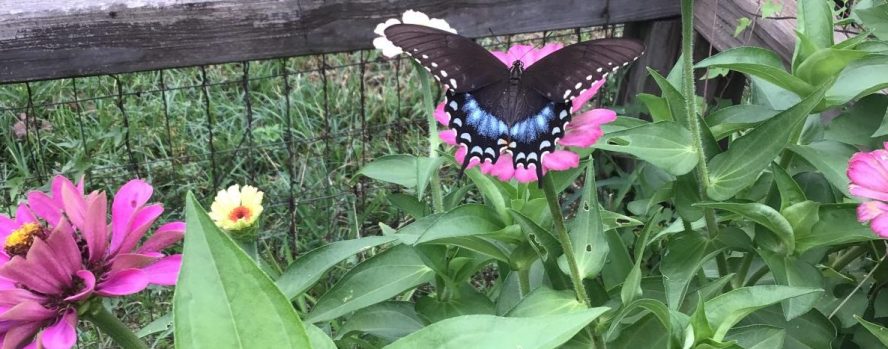
A wee break from my Science Fraud and Fantasy series of posts to encourage creativity over consumerism this holiday season.
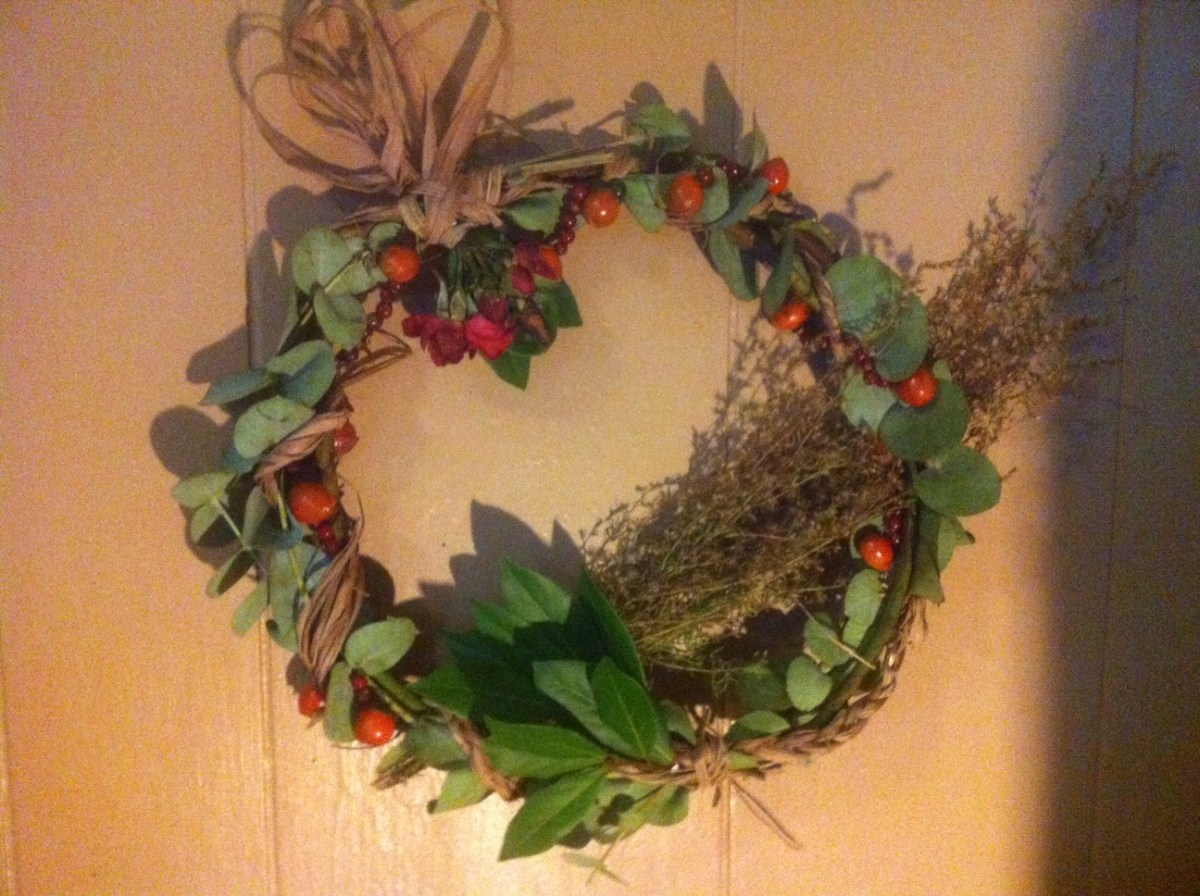
I’m not sure what spirits of the land ignited me yesterday, but I was suddenly driven to create my first wildcraft wreaths. We took a short walk and gathered my supplies: blackberry vines, eucalyptus, rosemary, bay laurel, lemongrass, rose hips and buds, and the ever-pervasive yaupon. (BTW, yaupon leaves browned and crushed makes a tea so similar to black tea it might even fool a real Englishman.) Within a few hours I’d crafted these little gems, no experience necessary.
I’m not saying they’d win any awards, but I had fun and I’m happy to be bringing in the natural beauty of the great outdoors and not be purchasing more imported artificial crap.
A few are convinced, as am I, that the creative force connects us to something greater than the self. There is an awareness that seems to imbibe a non-temporal, non-spatial state of being. I had no idea how to do this, yet I did it, without a coach, or a class, or any advice from the internet or my far more crafty sister. I did almost call her, I’ll admit. But then a still small voice said, “No, you’ve got this.”
I consider myself very lucky that my family and friends are not ones who expect gifts from me. But this Christmas I’m going to step it up a notch–I will purchase nothing, at all. I will forage and create. And who knows, in a few years maybe you will find me at the local Arts & Crafts fair, with my own stall, sharing my wildcrafts with other lovers of nature.
I invite y’all to rethink your purchases these holidays and consider getting crafty instead.
Attempt #1, a sort of Charlie Brown version perhaps only its creator could love. 🙂
I realize there is a war between the so-called “climate deniers” and the ‘global climate change’ enthusiasts and that both sides are trying to defend their positions with science. I am also trying to get my head around this science and following both sides of the argument and it is a heated argument indeed.
What makes me curious is why does such a complicated argument only seem to have two sides. Already this is a red flag for me. No complex issue has only two sides. If the Empire is using an ‘either/or’, it’s black or it’s white, it’s right or it’s left, they are trying to frame the conversation and stir up oppositional debate that is a diversion from the real issues. Climate change is real or climate change is a hoax, that’s the limits of the discussion. You are for, or you are against. You are with us, or you are with the terrorists. The entire public conversation is rife with fallacies and emotional triggers on both sides.
Lord Monckton calls himself “an outsider” in climate science, though he’s been publishing on the topic since 2011. He says he has made a breakthrough, a simple arithmetic error, that will prove once and for all we have nothing to worry about climate change at all. Poof! A simple math problem in the models! We’ve been throwing money and expertise at this problem for decades based on a simple math error. Oh well. We can move on now, thank heavens. Isn’t science wonderful! He makes sure to sprinkle in some good digs for those who are sure to disagree with his refined models, those “bed wetters” and “profiteers of doom.”
What’s left out of the various infomercials-called-interviews he gives, like this one with Stefan Molyneux, is the most important part, the context. In fact, the essence, the very relevance for us average Joes and Janes.
What’s most to fear is Environmental Totalitarianism, he cries! What he leaves out is that this is what both sides want, they just have differing ways of taking us there. The real problem, he declares, is those who haven’t learned logic and critical thinking. He repeatedly insists the scientists are following party lines, then proceeds to make all the science about politics. For or against. Color inside the lines, citizen-cum-consumer.
What about the spraying campaigns, Your Lordship? When can we expect the Solar Radiation Management programs, and the Stratospheric AerosolInjection procedures, and the other various Weather as Force Multiplier missions the military has been cooking up globally for over a decade, when might we expect those to end based on your new models? You know which ones I’m referring to, surely!
I can imagine Lord Monckton’s reply. “No, you are quite mistaken, those are only proposed projects.”
And I am Alice in Wonderland fallen into a time warp, apparently.
All the now well-documented programs the scientific community keeps saying are a conspiracy theory, while the data compiled by now hundreds of thousands of “average” folks around the globe more than suggests otherwise.
It sounds to me, your Lordship, like you might be suggesting they’ve been experimenting with our weather for decades for no good reason at all! And that maybe the major global corporations like Weathermodification, Inc., will soon be going out of business? Could it be?! Do you suppose their vast number of global clients know this yet? What about the curious spike in aluminum futures, might that have something to do with your new findings?
“Weather modification is not the same as climate engineering,” the good Lord might stammer.
Really?
What the scientists and the Empire want us to do is ignore our own sensory data. Ignore what your eyes are seeing, ignore what your ears are hearing, and stop saying anything we don’t want you to say. It’s all hoaxes and conspiracy theories, if and until we say otherwise.
As I committed in part two, I will take no man at his word, still some men I trust more than others. I especially tend to trust more the ones who repeat continually, ‘don’t listen to me, do your own research!‘ Like Dane Wiggington at Geoengineeringwatch.org. I follow-up on his claims, I’ve studied his site, clicked on some of the patent links, and listened to every one of his presentations and weekly radio shows. I do not take him at his word, but I listen and I see where it aligns with my own sense data.
What do I know, beyond what anyone tells me, beyond any guru, beyond any faith, beyond any miracles of science or gods, news reports or military propaganda?
These observations did not take any formal training in logic or critical thinking, go figure!
–the weather in my area has gotten warmer over the last five years, based on my own records, and there are more days with 40-50 degree temperature shifts within very short periods.
—winter has gotten shorter and more mild in my area, based on my own experience. The leaves are not falling off the trees as much, but rather dying while still on the branches, this is not typical here.
—the weather FEELS hotter, to my body. The thermometer reads higher temperatures consistently by 20 or 30 degrees compared to normal the last couple years, and rather than building fires in the woodstove this time of year, I have all the windows open and the fans on, and I’m still hot. Due to the fact that the thermometer corroborates my feelings, I do not think this to be the onset of menopause.
–the pond is not full as often and the creek is lower and floods the banks less often, according to the input of my two eyeballs.
–the plants are not well-adapted to these shifts or something else happening in tandem. Gardening over the last few years has become more unpredictable. Many of the plants that normally thrive this time of year look “scalded” or something, which became worse after the last rain. It seems to me the plants do not look happy. (omg, so unscientific!)
–the clouds are very different sometimes, they look different and don’t behave as the clouds of my youth (NASA brags about some of them as brilliant man-made clouds, I think they are gross, but that’s just my preference).
–there is SIGNIFICANTLY more air traffic over our rural area on certain days and in certain seasons. By significantly I mean from zero flights for many days and suddenly flights non-stop for days. This is based on auditory and sometimes visual data of my own mind-body.
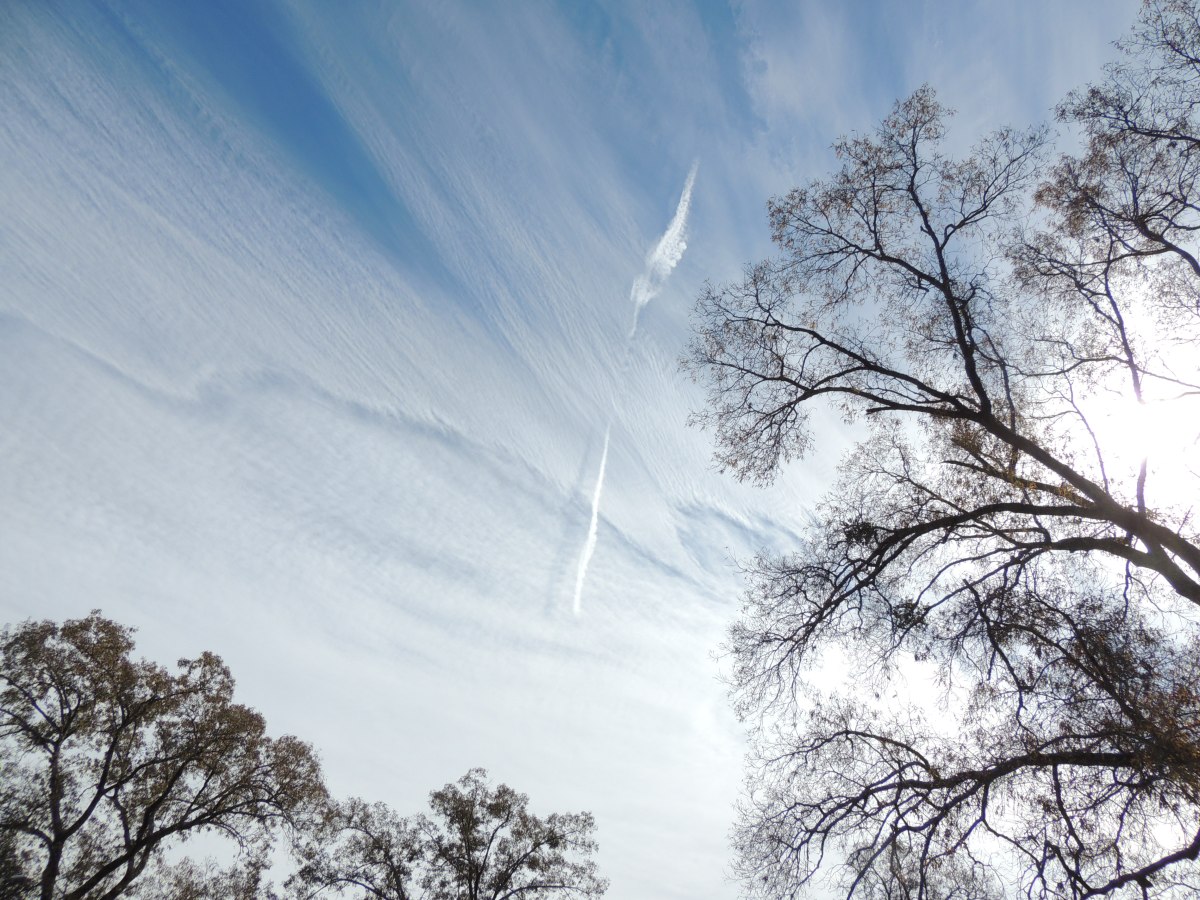
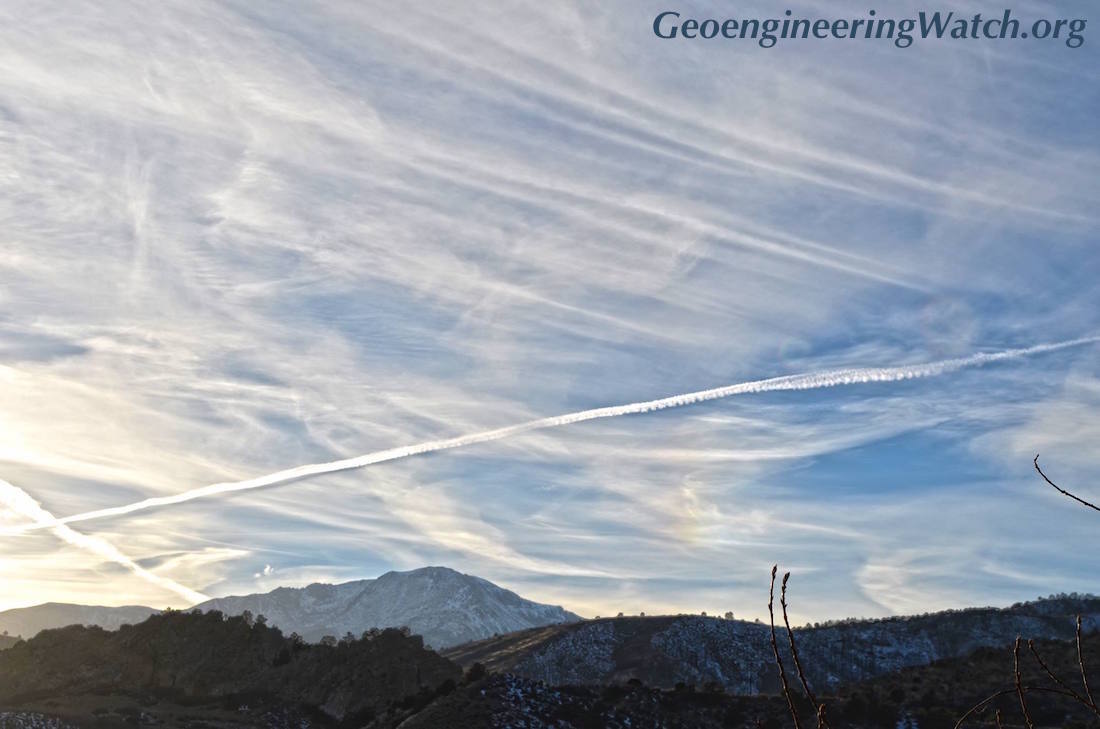
–the “contrails” of some of this air traffic do not look or behave as normal contrails, they do not dissipate, rather they expand, and eventually turn the sky a milky or hazy shade of very pale blue or silvery-white, occassionally turning irridescent in spots. I have taken many photos and they look like the photos I see online that “conspiracy theorists” are calling “chemtrails.” When I respond with my direct experiences, what I see and hear above my own head, I’m often told I’m crazy and/or irrational.
These “man made clouds” made by planes eventually covered the sky this day, though the temperature was over 80 degrees and fairly low humidity, making low hanging condensation trails SCIENTIFICALLY impossible.
They don’t “believe” in chemtrails or geo-engineering. They equate it with saying one has seen Bigfoot. Why? Because science says they do not exist. They are contrails, period, end of story. Stop being irrational!
The reason I, and many of us trying to find out the truth, become so passionate and often excessively agitated when we discuss this topic is because many scientists and loads of average folks blindly following them are asking us to ignore our own sensory data. They want us to turn a blind eye to our own knowing and believe what the scientists and media are telling us, or that science will save us, and that the truth will prevail, that we should all have faith in the scientific method.
Isn’t empirical evidence supposed to mean data gathered by one’s own senses? And yet, unless the Empire is the one dishing out such evidence it’s not really empirical evidence at all, it would seem.
Climate science sounds remarkably like religion, so it should be expected that there are those of us who will continue to address it with a certain fervor.
The Monckton-Molyneux infomercial noted above ends with these prophetic words, further cementing the “us vs them” social programming:
“It’s very difficult to get the truth out. Am I gloomy? No! Because we have the one thing they haven’t got . . .We have the truth and if we have the truth we have everything and they have nothing, and in due course the truth will assert itself as it always does.”
Molyneux replies with enthusiastic vows to do his very best and concludes, . . .to get more of the Lord’s work, visit . . .”
How do we get our “experts” to speak publically about the real issues we’re facing, like a vastly growing number of us are damn sick of being treated like Guinea pigs?
This is why I will continue to say science is failing us, and I will continue to do so until I can prove otherwise.
As I attempt to compile information and to uncover, recover, discover my own mind, I’m finding the gaps daunting. I must change the tone and the content of this series of posts on science to reflect my inner reality: I’m on a fool’s journey, alone, with hardly a map.
This makes me certain of only one thing, which I repeat from last post: Science is failing us.
I am alone on this journey, but not without guides. To discern between guides leading astray and those leading toward truth is futile. I will take no one at his word from this point forward. If there is truth to be known, I will find it and I will know it as the newborn knows to inhale and the body knows when to expel his last breathe. There is the mind that knows a thing when it’s told to him—God exists, God does not exist, the scientific method works, the scientific method does not work—this is indoctrination. There’s another ‘mind’ some call it the mind-body, which is a knowing that transcends, a knowing that inhabits the individual and is based in the etheric reasoning of the mind-body. Contrary to the objection any rationally-minded individual has based on that statement, this is not faith, at least not in the way expressed by religion. Might this be what science is hopelessly searching for . . . the God particle? Searching desperately in the material world for an immaterial force, they are, perhaps?
I’m not asking you to follow me, but still I feel compelled to leave a trail of bread crumbs, for you or me, just in case. It’s a sort of mind map of my fool’s journey. I’ve committed that during the next two months I will be in deep study and reflection and my already limited social life will move even further into the background of my existence. Still, I so appreciate any thoughts or comments, breadcrumbs of yours, that might inspire or not, but that I will promise to take in as more food for thought.
My guides will change, sometimes dramatically, and at the moment they include Michael Tsarion. The occult in general will be a primary topic, and how could it not be, now with all the disgusting pedo headlines seizing up our neural networks.
I’ve been a student of the Tarot already for some time, I will deepen into that work and all the so-called ancient mystery school teachings. The origins of science stem from alchemy, they say, so it seems only logical the journey should begin there. I’ve circled around these studies for years, dabbling wherever the truthstream takes me, but I’ve never approached them with intent, with an expectation and an itinerary, yet with the malleability of my nature and as a seasoned traveler.
My foremost commitment—I will take no man at his word and I will follow no gurus be they men of science or faith. I will know it for myself, in my mind-body, or it will not be known to me.
I spent 18 years in formal education, and another 20 as a teacher. How could it be that now, in middle age, I find the knowledge I gained in all that time to be so insignificant in navigating my reality as to be nearly useless.
I studied and taught foreign languages my entire young life, and never heard of gematria. Suddenly it’s everywhere I look. Is it all crazy conspiracy theory, really?
“In 1997, Teller publicly outlined his proposal to use aircraft to scatter in the stratosphere millions of tons of electrically-conductive metallic materials, ostensibly to reduce global warming.(32)
Shortly after Teller’s presentation, the public began seeing frenetic chemtrailing. In 2000, CBS News admitted that scientists were “looking at drastic solutions for global warming, including manipulating the atmosphere on a massive scale.” CBS confirmed that the plan to load the air with tiny particles would “deflect enough sunlight to trigger global cooling.”(33)
There is a special kind of euphoria that comes from harvesting my own food that I have not felt in any other productive endeavor. I read somewhere that the worst day working in cooperation with the land is better than the best day in the office, and I must wholeheartedly concur.
If only I’d learned that sooner, I would not have such steep learning curves to navigate in middle age!
Mushroom hunting is certainly on the top of that steep learning curve list, not to mention a potentially deadly hobby. While there are actually only a few truly deadly mushrooms, there are many that will make you sick and quite a few choice species that are so similar to poisonous species that even experts are occasionally fooled.
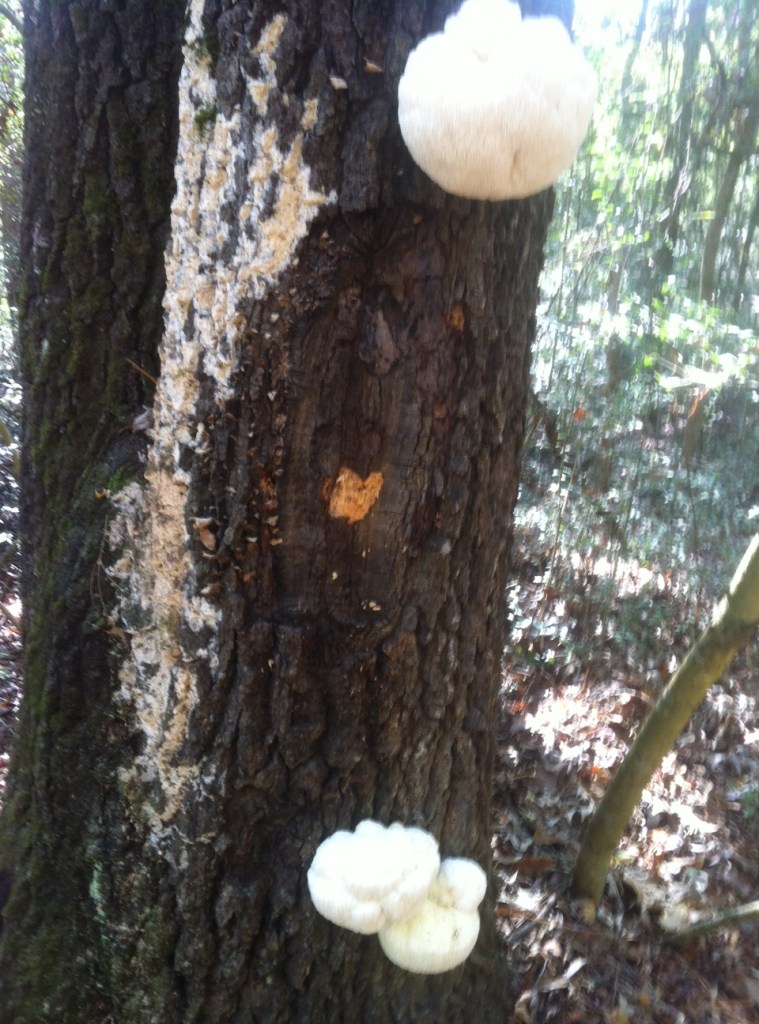
For the novice mushroom hunter there are only a handful of no-brainer finds, and as the dogs and I walked our trails this morning, I spotted one of the choicest of these, the Hedgehog. Actually there were three, and I took the biggest, a whopping one pound ten ounces. Interestingly, the season of these mushrooms is winter, which makes me wonder, when it’s still an unseasonal 85 degrees Fahrenheit here and hasn’t rained in many weeks, how do they judge winter exactly?
In the garden it’s the summer crops that are thriving—to accompany my Hedgehog mushroom I harvested some cucumbers, radishes, basil and Napa cabbage. The second crop of tomatoes this year are nearly ready too. If Handy Hubby were home I’d add to that some thinly sliced duck breast. Then I’d look at our plates and think wow, I can’t believe how often now our meals come from our own land, our own hands. What amazing peace of mind this is considering how unhealthful and/or expensive food in the grocery stores has become, with the distinct impression it’s only getting worse.
If I turn on the TV or read a newspaper I’m reminded I once considered the daily grind and the endless mindless consumption ‘reality’. Now I often watch and read the various panic porn channels online and sometimes they get me pretty riled up.
Then I walk out to our garden or through our woods and I remember what is really reality. Civilization is not realty. And what we are currently calling civilization is about as far from reality as it gets.
Y’all can keep it! My happiness is in the hunt and the harvest and of course, Handy Hubby. All the rest of it is worth less than a hill of beans.
Our faithful and exuberant foraging, hunting, harvesting companions. 🙂
After several grave posts it seems an upbeat update, some good news and great resources are in order. So, I will for a moment ignore that it’s still sweltering here and in the 90s with no decent rain for far too many weeks.
Normally we’d have flourishing fall crops by now, but many are struggling with the daytime heat. Two decorative/medicinal favorites that keep my spirits up with their beauty and endurance when so much is brown or perished are Datura and Castor Bean.
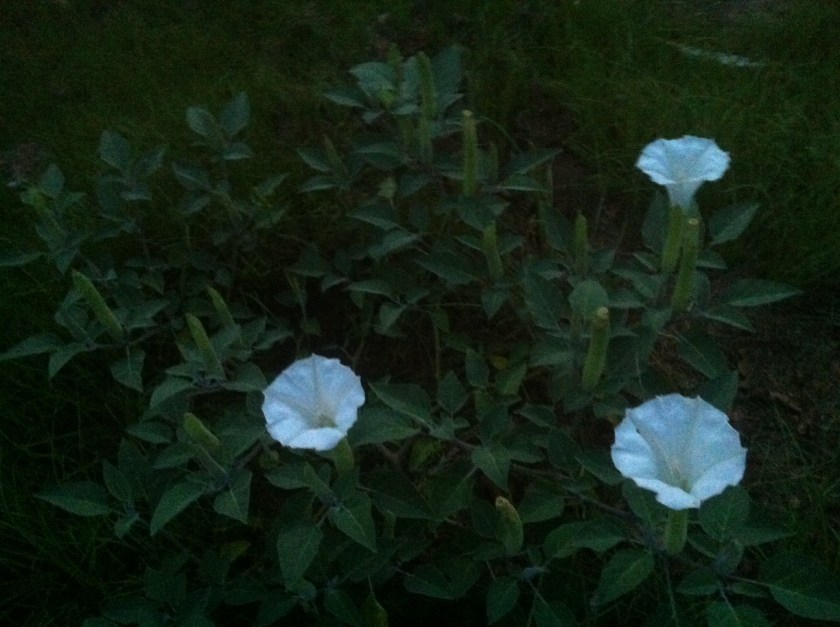
Datura Inoxia at dusk emits a sensual lemony fragrance
These old timers are highly under-rated in the garden, in my opinion. They are useful, rugged and gorgeous and so misunderstood in our modern culture as science labels them “poisonous” and horticulturists scare folks away from them simply because if your pets or children eat a handful of their seeds they’ll most likely vomit. Should they choke down entire sections of these plants, they could die.
Interestingly, there are very few documented cases of such stupidity. Our chickens scratch and peck all around under these plants and don’t get sick. And our Great Dane-Mastiff loves to sniff the just opened flowers at dusk, as do I, and our bees!
The bees also enjoy the arugula blossoms, which is another favorite heat-loving plant and my favorite lettuce. I have a great many books on plants, but two favs are: The Herbal Lore of Wise Women and Wortcunners by Wolf D. Storl and Witchcraft Medicine: Healing Arts, Shamanic Practices, and Forbidden Plants by Claudia Muller-Eberling, Christian Ratsch, and Wolf-Dieter Storl.
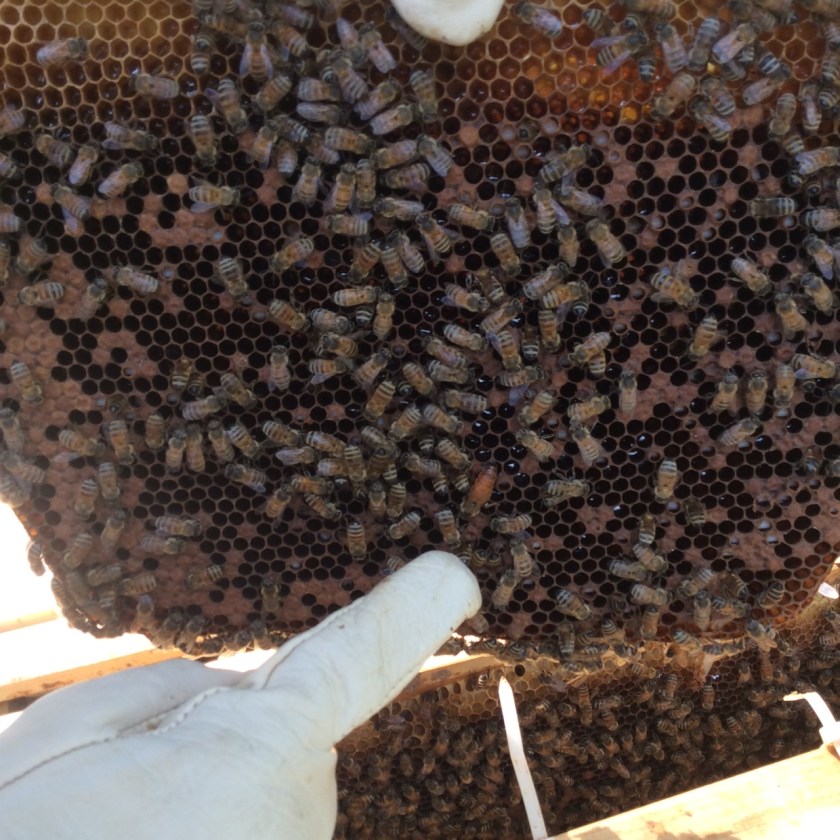
Speaking of our bees, the feral hive that was relocated from an old steel drum in the spring is still hanging in there. After some concern for their slow growth I was able to locate the queen. My first queen-spotting–it was a proud moment–it’s pretty tricky for us newbees!
Feral hive relocated to our top bar hives
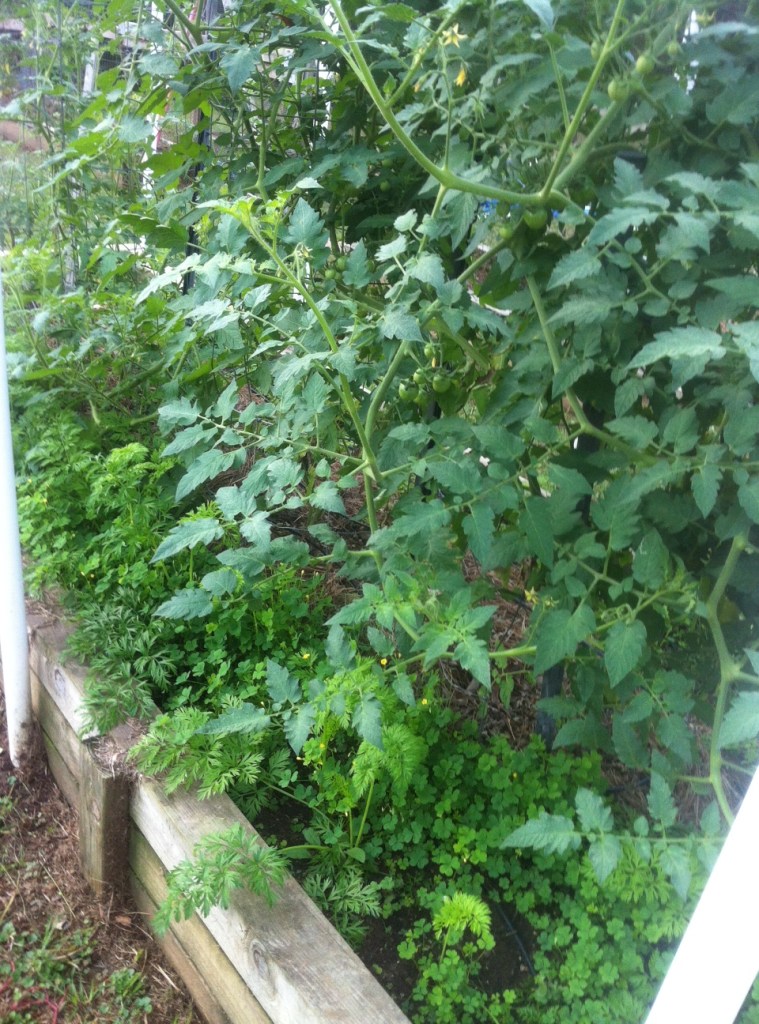
I’ve been experimenting with companion planting and it’s true, carrots really do love tomatoes and roses do love garlic. Not all of the companions or incompatibles from these books have proven correct for me, but those two definitely do. Roses Love Garlic and Carrots Love Tomatoes by Louise Riotte.
New favorite dish: duck confit–duck legs and thighs slow-cooked while submerged in duck fat, then fried in the fat before serving. For all those who might be thinking this sounds like a cholesterol nightmare, I say, don’t knock it until you read the research of The Weston A. Price Foundation.
Duck confit in the works–so delish!
Best resource this year: The Art of Natural Cheesemaking: Using Traditonal, Non-Industrial Methods and Raw Ingredients to Make the World’s Best Cheeses by David Asher. A shout out to the fantastic website Little Green Cheese for introducing me to it, it has absolutely been an eye-opener. I’ve been making cheese for a couple years now, and this is the book I should’ve read from day one.
This, in my humble opinion, is the way cheese was meant to be made. Most of the recipes use kefir, who knew, kefir as a cheese culture! Clabber cheese has become a new standby, which is really ironic, because it was a staple for so many of our ancestors. It’s basically raw milk spoiling on the counter-top.
Handy Hubby had to taste it to alleviate his automatic doubt and skeptical disgust. I learned a new expression from the famed Michael Pollan in his fascinating new series Cooked! He calls the miracle of cultures and molds and so forth,“The erotics of disgust.”
Unfortunately, for most folks’ health, their disgust-threshold is disastrously low.
By the way, the Clabber cheese got the thumbs up from Handy Hubby! 🙂
Another by the way, the above rose is La Duchesse de Brabant, another fav who fares well in the heat.
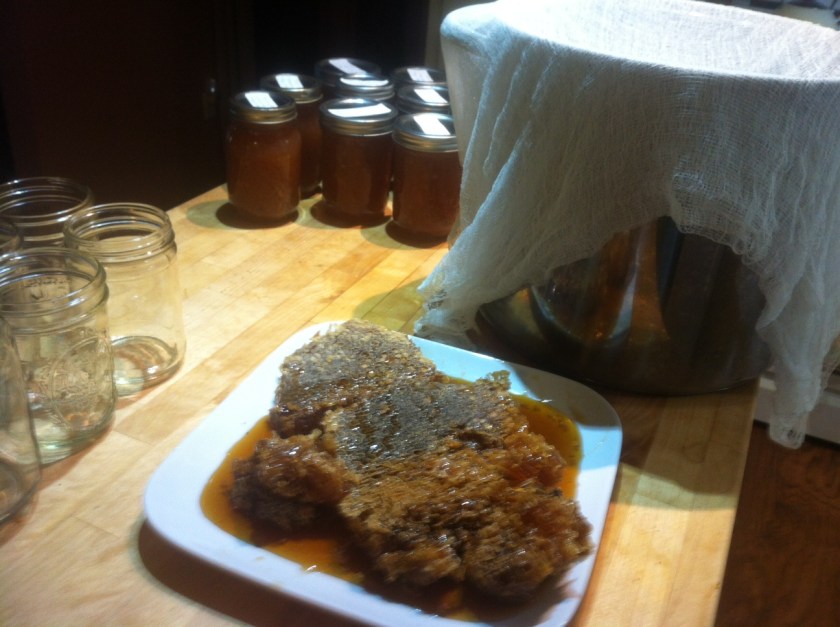
It’s been a busy few weeks processing all those pears—I canned over 30 jars of them, we’ve got 15 gallons of pear wine brewing and 9 jars of pear-ginger marmalade. I also harvested our first honey, a whopping 4.5 pints!
(I consider leaving out this part where I admit I did not mean to harvest so much, but I made the novice mistake of lifting out a bar full of capped honeycomb, which in a topbar hive should not be done in high heat, because the comb can pull right off the bar and fall into the hive, which is exactly what happened. It then smashed onto the neighboring comb, killed lots of bees, and meant I had to then harvest two combs and pull out dead bees with tweezers. Not my finest hour.)
Also, we’ve had another agoristic experience I’m happy to report: 3 wild hogs from a friend traded for a half-dozen dressed ducks. No cash exchanged, that means no cash to line the banksters’ pockets or to pay for more illegal wars. I love the idea of agorism, it makes so much sense to me. But, like with all things, the theory is always easier to come to than the practice.
In fact, I could have several more occasions for bartering if I felt more comfortable simply asking. We had a dump truck load of mulch delivered, the perfect missed opportunity. There are many skills involved that require me to up my game and learn things I’ve spent my life avoiding, because I’ve never liked doing them–like marketing, networking, various other entrepreneurial-type skills. I’ve never been that comfortable or concerned with money and I automatically zone out whenever numbers come up. New challenges pop up over the simplest things that hadn’t much occurred to me before, like how to assign value to things or services. What is a dressed duck worth compared to an undressed hog? This is a question a suburban girl never expects to ponder in her lifetime.
Also problematic is distance. I see that bartering sites are popping up quite a bit now in urban areas and folks are exchanging even more now using old standbys like Craigslist. But Austin, Dallas, and Houston are all about a 3-hour drive one way, which make regular trips there un-economical and far too time-consuming. While I’m thrilled to see how popular bartering is becoming, it’s not a decent short-term solution for us.
Now that I’m pleasantly and perhaps permanently unemployed I like the idea of trying to find other ways to exchange and earn that wouldn’t set us back so far that Handy Hubby would give up the plan of an early retirement. That’s our five-year plan. We don’t want to start a business, not in the traditional sense anyway. We like the simple, uncomplicated sort of life; we’ve adjusted to it now. I think it was once referred to as “subsistence farming,” maybe even without the negative connotation. That’s another concept I never expected to ponder in my lifetime.
I guess the criticism from a reader that I am a neo-luddite was valid after all. I’ve changed in our nearly seven years here. Our paradigm has shifted. Cities are too crowded, even social media is too crowded. I hate to think the only option for selling our surplus would be to go back into the matrix and try to navigate the (meta)physical marketplace. Not that I don’t appreciate it now and again, but I’d much rather go for inspiration than labor.
Such thinking of short-term solutions led me to surf the darkweb, to research the black and gray markets. It was a very educational journey full of potentialities. Unfortunately, I can’t tell you about that here.
I’d love to hear from y’all–your links, ideas, thoughts, ramblings, all welcome, both practice and theory!
🙂
Our first honey harvest was an accidental success, I learned so much about what not to do!
Of course it’s Handy Hubby who does the real heavy lifting. I’m one lucky unemployed redneck wannabe!
Sweet potato success two years ago was two wheelbarrows full. This year, not a one survived, though slips filled two healthy rows at one time in early June. Two years ago, no pears to speak of, in fact only one and a half crops in 4 years. This year, a bumper crop from a single tree that will fill my afternoons for the next week in processing. Peppers one year, tomatoes another, melons everywhere like weeds three years ago, to this year, where are all the damn melons?! I don’t see how the farmers do it. Or, did our farming ancestors count on such extreme variations, whereas today there is an unrealistic reliance on consistency? Hence all the hybrids and GMOs?
I wish I knew. I suppose this has long been the struggle of man and nature that dimwits and intellectuals alike try to grapple with. I read and observe and attempt eternal patience, but in truth it is terribly aggravating all this not-knowing.
It’s baffling and annoying and funny. I try to keep records, but half the time I have no clue why something succeeds or fails, so I don’t know what to record–the temperature and rainfall and seed source and planting dates, ok, but that does not seem to get me very far at all, even when I manage to do it. One year an invasion of squash bugs, another year white flies, another year some unidentified wilt, this year, five different persistent grasses growing like bamboo mats engulfing everything in their path. This has been the most depressing summer for the garden I’ve yet experienced, but I get the sense now I’m repeating that mantra in some form every year.
I get hunches sometimes, for better or worse, and this year I thank the pear success to our beehives. I know timing of the last frost and first good rains fit in there somewhere too, but don’t ask me how. Also failed this year were the figs, one, like sweet potatoes and okra, also failed, were all ones we once called a fail-proof crop for the south.
Back to the drawing board, green thumb. Success in one area, as temporary as it might be, leads to thoughts how to better benefit from such success in future, only in future to find that was quite futile.
If I can get myself past the programming to stop focusing on either success or failure, I might get closer to seeing the bigger picture. Or so they say.
Pear hooch is bubbling happily in the crock. That might be my zooming out solution. One good solution surely leads to another. 🙂
I have my cheese days and Handy Hubby has his days at the smoker. Usually it’s a Sunday, because we try to always take a day off for lounging in the hammocks and over-consuming adult beverages. Cooking, writing and researching deep politics we don’t typically consider work. It’s more that we just agree to ignore the heavy labor for a day.
It’s raining again today (thank heavens!) so we’ve got our real redneck on, swinging under the carport, dogs at our feet, noting we have too many roosters–we have to yell to hear each other over the crowing and the drops echoing off the tin roof.
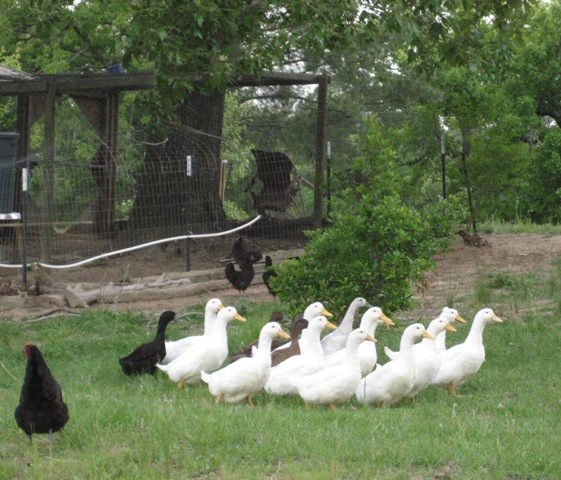
On today’s meat madness list: Hubby’s own pastrami, a couple of ducks, lots more duck necks for future soups, and some sausages. Yes, we are just two here. We cook in bulk, just like we shop. By the way, we are awash in ducks. I’m scouring every cookbook and online site for new recipes and hoping somewhere, somehow to find someone to trade with for something.
Today we are experimenting with our ‘hard-core homemade’ menu by crafting a Reuben to reckon with. The recipe comes from Julia Child, but we kick it up more than a couple of notches.
Everything about it is homemade—the rye bread, the pastrami, the Muenster cheese (I’ve been babying that baby for two and a half months now), the mustard, the mayo, the ketchup and the saurkraut. (As I side-note, I had no idea ketchup used to be a very healthy condiment, because it was fermented, and nothing like the corn syrup concoction with seemingly unlimited shelf-life sold today.) Before finding this recipe in the gorgeous cookbook Baking with Julia, I didn’t know a ruben had ketchup. The Eastern European rye bread recipe also comes from this book. Normally I make a sourdough rye, my own painstakingly-crafted recipe, that is delicious. But this one is made with yeast and looks so awesome in the photo (see below, mine is rising as I type, but I’m sure it won’t look quite that pretty), I just had to try it.
On the dark research front we have another score, and quite a synchronistic one.
Yesterday I was confronted with a compelling contradiction. I spoke with my mom on the phone and normally the conversation would not swerve into politics at all, but these days it’s front of mind for a lot more of the population than usual. She is concerned, as so many are, especially about ISIS. Her source of information is the mainstream news, known in ‘alternative’ circles as the lamestreamnews. I tried briefly to convince her that she is watching State-run propaganda and we might as well be living in the USSR, that’s how bad it’s gotten. She had not heard of false flags, of course, how would she?
Conversely, a friend on social media concluded this is a positively wonderful time for anarchists/voluntarists/agorists/libertarians and free-thinkers in general, because Americans are really wakingup en masse. People are engaged in the elections and Trump is spilling the beans that the whole game is rigged and folks are listening, was just a small portion of her lengthy don’t-be-so negative-and-see-the-silver-lining lecture.
To her, I would like to say the same thing I’ve been saying at the university where I’m thrilled to be teaching my last class ever: Engaged is not educated!
I tossed in my sleep considering this great rift in understanding and reactions, and to my very pleasant surprise when I woke a brilliant piece of insight had been posted on Youtube by Truthstream Media, which I promptly sent to Mom and re-posted across social media.
This couple does excellent work, and if folks are really waking up, it’s thanks to them and those like them, boldly and courageously speaking truth to power, and putting their youthful exuberance into righteous anger, expressing a proper amount of snark and frustration, usually, but always deliberate, creative action, and especially oh-so-many undeniable facts for the lamestream watchers to reckon with.
I used to consider myself a Liberal, back in the days before liberal politics officially embraced the Military Industrial Complex and the eternal war machine.
Then I called myself a Libertarian, until I realized the movement had been completely co-opted by the Right and been bought by the likes of the Koch brothers. The so-called “New Right” proved itself to be exactly the same as the old Right, not exactly the Neo-Con version of the last several decades, but harking back that of my grandfather’s generation. No thank you!
Then I called myself an Anarchist, because it was obvious to me no good was coming from politics at all. I stand by this still, as misunderstood as it is. Anarchy does not mean “no rules” it means “no rulers.”
It seems very much in line to me with Agorism, but I’m still learning and am not at all afraid to change my stance once again if I discover I’ve been misled or deceived or the movement has been co-opted. The concept of the counter–economy is particularly appealing to me, because I absolutely abhor the effects of my labor going toward such criminal endeavors as war and lining the pockets of elected criminals, banksters, and their very many minions.
“Agorists regard this counter-economy as a form of nonviolent direct action, a method of simultaneously challenging and evading state power, in the process building a free society based on the principles of unrestricted voluntary exchange. Counter-economics underscores the fact that given the volume of rules, regulations, and licenses already choking economic relations, almost everyone has already participated in the counter-economy in one way or another, perhaps quite unwittingly. By simply paying no heed to arbitrary rules that attempt to prohibit completely voluntary, mutually beneficial trade, agorists are engaged in an attempt to change society without resorting to political action, which agorism regards as capitulating to the existing power structure. Agorists believe that by becoming politically engaged, running candidates and attempting to reform governmental structures and lawmaking, libertarians fall into the trap of politics — the delusion that if we only elect the right person or pass the right law, we can attain freedom. For agorists, the processes and institutions of politics are inherently and unchangeably corrupt and coercive.”
I first learned the learned the word and the philosophy from my most-trusted news source James Corbett. His most recent article on the topic reassures me further that not only am I aligned with the message, but that it’s happening, for real. With his typical sardonic wit, he writes, Dear Government, Deliver Us From Freedom!
In this good news piece he highlights the booming peer-to-peer economy, community exchanges and the other fantastic efforts of like-minded folks doing all they can to get the corrupt government out of their lives and livelihoods. He lists many examples and resources, so I hope you’ll check out the entire article.
In the end he surmises sarcastically, “Do you realize what this means? It means that the plebs are actually starting to spontaneously organize in new and innovative ways to help each other. This is a disaster! What if they stop believing that all charity on earth must be provided by the government? What if they start creating self-sufficient communities? Or collaborating without corporate middlemen? Or transacting around the world without the knowledge or oversight of our tax collectors?”
Oh I do, James, I really do realize what this means! And thank you for your years of work and ‘leadership,’ in the way that leadership is meant to be. You have inspired me and millions, and our numbers are multiplying by the minute.
“Freedom. Terrible, terrible freedom. What if there’s no putting a lid on it?”
I’m not really sure why I love making cheese so much. My sister noticed one reason it’s not like me at all–‘it’s a lot like chemistry,’ she said. I know! I don’t like numbers, or recipes, or chemistry. At least, not that kind of chemistry. Or, maybe I do, but school sucked the pleasure right out of it for me.
Cheesemaking has a pretty high learning curve, which does suit me. I took three good courses not too far away in Waco, Texas and I’ve been at it a couple of years now.
What I’ve learned as most important in cheesemaking is a good life lesson for me, so maybe that’s why I’m so drawn to it. Most cheesemakers, if asked the most important aspect of cheesemaking, might say, sanitation, or quality of milk, or aging capacity. I don’t deny all these are crucial, but for me personally, it’s patience.
I’ve had some limited success with poor milk quality, though I don’t care to repeat it, because the failures far outweighed the success. Now I drive five hours round-trip to the nearest Jersey Grade A Raw Milk available in our region: Trimbel Farms. I do wish it were closer, but quality is not something I’m willing to forgo.
Aging capacity is always a challenge, unless you are lucky enough to have your own mountain cave, which is impossible in Texas, as far as I know. Affinage is the correct terminology, and if I wanted to do it correctly, I’d move to Switzerland. Not really an option.
Patience is the real challenge for me. Process is everything. This is not something that comes naturally to me. I’m a natural step-skipper, I don’t follow directions well, never have. My motto, what can I get away with not doing? So I always test the system. While this works for many things, it does not work for cheese. Typically, there are only four or five ingredients. You only really need four–milk, rennet, culture and salt–which account for a good chunk of all the cheeses there are.
Not only that, but to know if I’ve failed I must wait two or three months or longer, in most cases. So much for instant gratification. Of course, there is always 30-minute mozzarella, which for the beginner with no cheese press and no way to properly “affine” is an ideal way to go. And, it’s delicious, better than anything you’ll buy in your average grocery in this neck of the woods. I still make it regularly and it never disappoints. Three ingredients: milk, rennet, citric acid. Well, and water and salt, if those even count.
I’ve had limited success with my all-time favorite, Camembert, one for the more advanced cheesemaker. I’m still not sure why I can’t succeed consistently at it, though I use the same techniques each time. For those interested in trying, I direct you to my cheesemaking and beekeeping friend, the lovely Rashel of The Promise Land Farm, who has mastered this fine art.
Maybe I love cheesemaking because it requires undivided attention for a couple hours, and peripheral attention for days, or even weeks and months. I’ve tried to multi-task while in the process, like today. I had grading to do, I forgot the flame was still under the pot, and over-heated the milk by 15 degrees. Big mistake! One that cost me about three hours. Luckily, it was early enough in the process I didn’t ruin it altogether. A mistake to remind me: Patience dear one, focus, prioritize, slow down.
Listening, learning, forgiving myself. And never, ever giving up. Maybe it’s my commitment that drives me to succeed at it. But, why this commitment for this particular process?