A wee break from my Science Fraud and Fantasy series of posts to encourage creativity over consumerism this holiday season.
I’m not sure what spirits of the land ignited me yesterday, but I was suddenly driven to create my first wildcraft wreaths. We took a short walk and gathered my supplies: blackberry vines, eucalyptus, rosemary, bay laurel, lemongrass, rose hips and buds, and the ever-pervasive yaupon. (BTW, yaupon leaves browned and crushed makes a tea so similar to black tea it might even fool a real Englishman.) Within a few hours I’d crafted these little gems, no experience necessary.
I’m not saying they’d win any awards, but I had fun and I’m happy to be bringing in the natural beauty of the great outdoors and not be purchasing more imported artificial crap.
A few are convinced, as am I, that the creative force connects us to something greater than the self. There is an awareness that seems to imbibe a non-temporal, non-spatial state of being. I had no idea how to do this, yet I did it, without a coach, or a class, or any advice from the internet or my far more crafty sister. I did almost call her, I’ll admit. But then a still small voice said, “No, you’ve got this.”
I consider myself very lucky that my family and friends are not ones who expect gifts from me. But this Christmas I’m going to step it up a notch–I will purchase nothing, at all. I will forage and create. And who knows, in a few years maybe you will find me at the local Arts & Crafts fair, with my own stall, sharing my wildcrafts with other lovers of nature.
I invite y’all to rethink your purchases these holidays and consider getting crafty instead.
Attempt #1, a sort of Charlie Brown version perhaps only its creator could love. 🙂
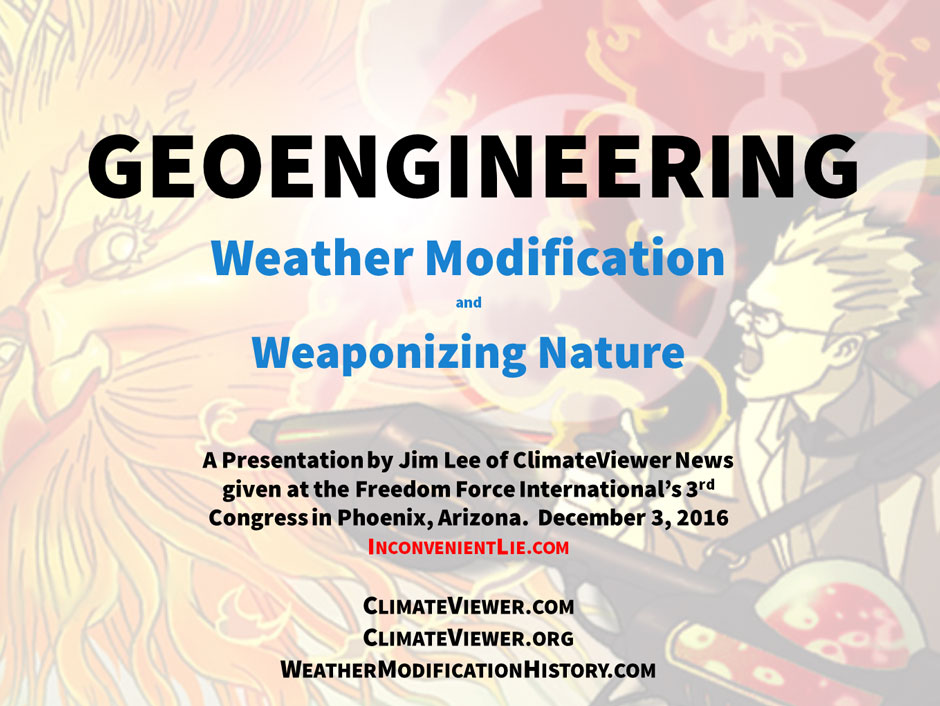
This PowerPoint presentation may be freely downloaded, distributed, and is intended to raise public awareness of a critical issue facing every organism on our planet: Geoengineering and Weather Modification. This presentation will shatter every conspiracy theory and educate you on the long history of hacking hurricanes, altering weather, and avoiding liability. Please download these files and share them with your representatives, the time for action is now!
I do not know what to make of the last “storm” that blew through East Texas. It was unusual, to say the least. I am not making any assumptions, just trying to describe it and find out more information. I’ve found some amazing sites the last few days, but much of the material is over my head. Pun intended, hehe. 🙂
But I won’t give up!
The winds of this storm were intense and the weather felt very hot and uncomfortable just prior to it. It was 78 degrees in the shade, according to my thermometer, but it felt hotter to me. It blew over quickly, there was very little rain, unfortunately, less than a quarter of an inch. I noticed the raindrops were very cold and large. By the time the storm passed the temperatures dropped significantly and the next morning it was 45 degrees. This is not the biggest drop we’ve had with recent storms.
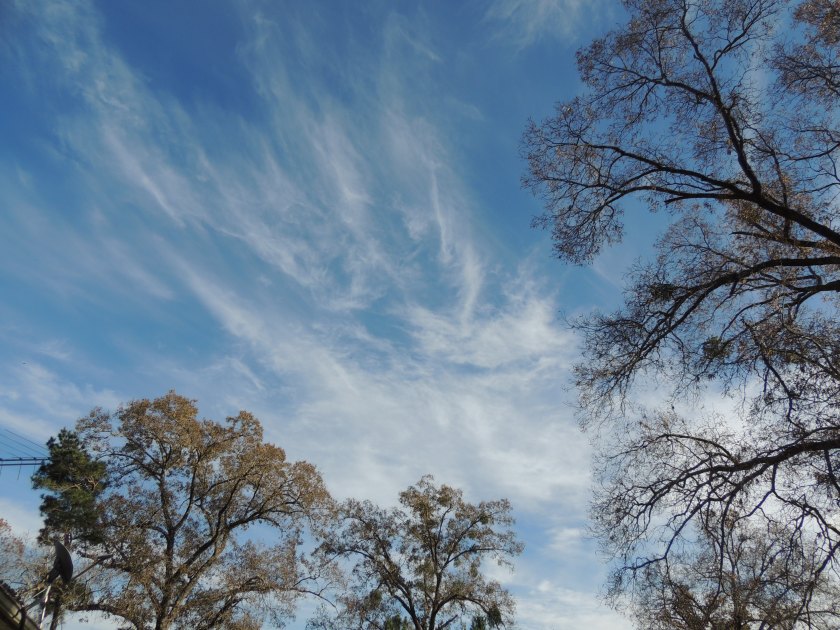
As the storm system was moving through I could see these clouds above it. They were extremely unusual, they had a cobweb look to them and they reminded me of iron shavings under a magnet.
I don’t know what, why or how these clouds form, I just know I haven’t seen the likes of them before, which got me thinking, and searching, and I found this man’s site, which is so complex I’m not sure if I’m on the right track at all, but it sure looks interesting.
Nanotechnology? Could that be what I’m seeing? I have no idea, but I’m trying to learn. Science classes in school didn’t seem to help me much. Nanotechnology with Pete Ramon.
“*The main effect would be to create cirrus clouds that contain more but smaller ice particles, which might resemble laser written contrails.*”
The plasma-channel is HAARP proof-of-concept technology. They both create the same type of plasma to produce plasma-evaporated ice crystals encapsulating MEMS/NEMS devices that can be directed in the atmosphere via radio frequencies.” http://www.pnas.org/content/110/25/10106.full
I realize there is a war between the so-called “climate deniers” and the ‘global climate change’ enthusiasts and that both sides are trying to defend their positions with science. I am also trying to get my head around this science and following both sides of the argument and it is a heated argument indeed.
What makes me curious is why does such a complicated argument only seem to have two sides. Already this is a red flag for me. No complex issue has only two sides. If the Empire is using an ‘either/or’, it’s black or it’s white, it’s right or it’s left, they are trying to frame the conversation and stir up oppositional debate that is a diversion from the real issues. Climate change is real or climate change is a hoax, that’s the limits of the discussion. You are for, or you are against. You are with us, or you are with the terrorists. The entire public conversation is rife with fallacies and emotional triggers on both sides.
Lord Monckton calls himself “an outsider” in climate science, though he’s been publishing on the topic since 2011. He says he has made a breakthrough, a simple arithmetic error, that will prove once and for all we have nothing to worry about climate change at all. Poof! A simple math problem in the models! We’ve been throwing money and expertise at this problem for decades based on a simple math error. Oh well. We can move on now, thank heavens. Isn’t science wonderful! He makes sure to sprinkle in some good digs for those who are sure to disagree with his refined models, those “bed wetters” and “profiteers of doom.”
What’s left out of the various infomercials-called-interviews he gives, like this one with Stefan Molyneux, is the most important part, the context. In fact, the essence, the very relevance for us average Joes and Janes.
What’s most to fear is Environmental Totalitarianism, he cries! What he leaves out is that this is what both sides want, they just have differing ways of taking us there. The real problem, he declares, is those who haven’t learned logic and critical thinking. He repeatedly insists the scientists are following party lines, then proceeds to make all the science about politics. For or against. Color inside the lines, citizen-cum-consumer.
What about the spraying campaigns, Your Lordship? When can we expect the Solar Radiation Management programs, and the Stratospheric AerosolInjection procedures, and the other various Weather as Force Multiplier missions the military has been cooking up globally for over a decade, when might we expect those to end based on your new models? You know which ones I’m referring to, surely!
I can imagine Lord Monckton’s reply. “No, you are quite mistaken, those are only proposed projects.”
And I am Alice in Wonderland fallen into a time warp, apparently.
All the now well-documented programs the scientific community keeps saying are a conspiracy theory, while the data compiled by now hundreds of thousands of “average” folks around the globe more than suggests otherwise.
It sounds to me, your Lordship, like you might be suggesting they’ve been experimenting with our weather for decades for no good reason at all! And that maybe the major global corporations like Weathermodification, Inc., will soon be going out of business? Could it be?! Do you suppose their vast number of global clients know this yet? What about the curious spike in aluminum futures, might that have something to do with your new findings?
“Weather modification is not the same as climate engineering,” the good Lord might stammer.
Really?
What the scientists and the Empire want us to do is ignore our own sensory data. Ignore what your eyes are seeing, ignore what your ears are hearing, and stop saying anything we don’t want you to say. It’s all hoaxes and conspiracy theories, if and until we say otherwise.
As I committed in part two, I will take no man at his word, still some men I trust more than others. I especially tend to trust more the ones who repeat continually, ‘don’t listen to me, do your own research!‘ Like Dane Wiggington at Geoengineeringwatch.org. I follow-up on his claims, I’ve studied his site, clicked on some of the patent links, and listened to every one of his presentations and weekly radio shows. I do not take him at his word, but I listen and I see where it aligns with my own sense data.
What do I know, beyond what anyone tells me, beyond any guru, beyond any faith, beyond any miracles of science or gods, news reports or military propaganda?
These observations did not take any formal training in logic or critical thinking, go figure!
–the weather in my area has gotten warmer over the last five years, based on my own records, and there are more days with 40-50 degree temperature shifts within very short periods.
—winter has gotten shorter and more mild in my area, based on my own experience. The leaves are not falling off the trees as much, but rather dying while still on the branches, this is not typical here.
—the weather FEELS hotter, to my body. The thermometer reads higher temperatures consistently by 20 or 30 degrees compared to normal the last couple years, and rather than building fires in the woodstove this time of year, I have all the windows open and the fans on, and I’m still hot. Due to the fact that the thermometer corroborates my feelings, I do not think this to be the onset of menopause.
–the pond is not full as often and the creek is lower and floods the banks less often, according to the input of my two eyeballs.
–the plants are not well-adapted to these shifts or something else happening in tandem. Gardening over the last few years has become more unpredictable. Many of the plants that normally thrive this time of year look “scalded” or something, which became worse after the last rain. It seems to me the plants do not look happy. (omg, so unscientific!)
–the clouds are very different sometimes, they look different and don’t behave as the clouds of my youth (NASA brags about some of them as brilliant man-made clouds, I think they are gross, but that’s just my preference).
–there is SIGNIFICANTLY more air traffic over our rural area on certain days and in certain seasons. By significantly I mean from zero flights for many days and suddenly flights non-stop for days. This is based on auditory and sometimes visual data of my own mind-body.
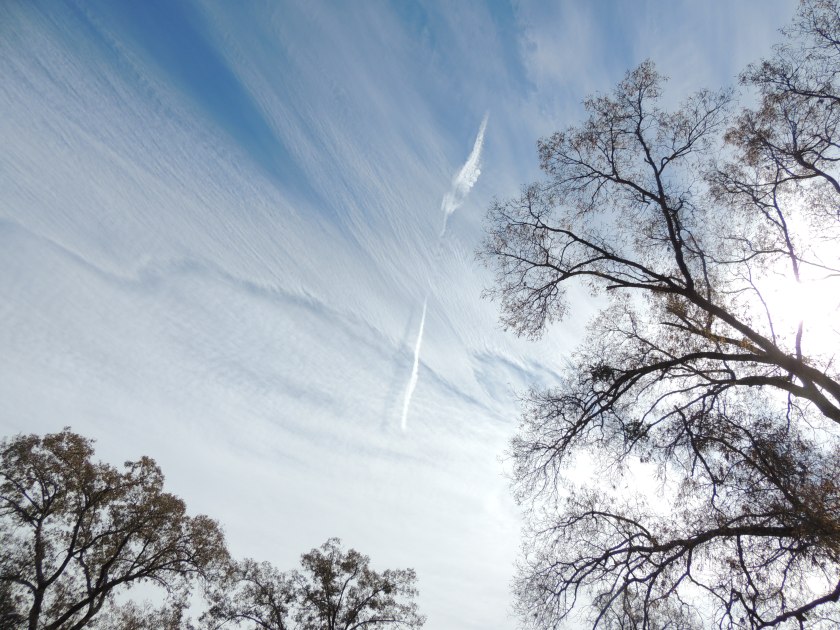
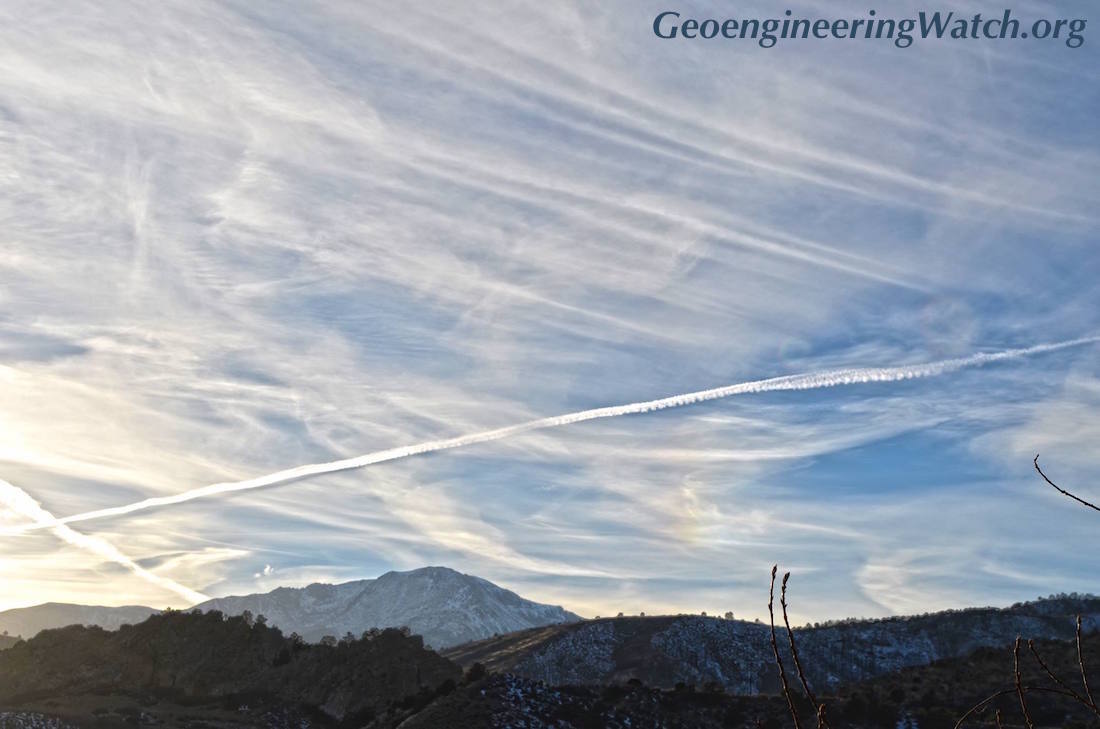
–the “contrails” of some of this air traffic do not look or behave as normal contrails, they do not dissipate, rather they expand, and eventually turn the sky a milky or hazy shade of very pale blue or silvery-white, occassionally turning irridescent in spots. I have taken many photos and they look like the photos I see online that “conspiracy theorists” are calling “chemtrails.” When I respond with my direct experiences, what I see and hear above my own head, I’m often told I’m crazy and/or irrational.
These “man made clouds” made by planes eventually covered the sky this day, though the temperature was over 80 degrees and fairly low humidity, making low hanging condensation trails SCIENTIFICALLY impossible.
They don’t “believe” in chemtrails or geo-engineering. They equate it with saying one has seen Bigfoot. Why? Because science says they do not exist. They are contrails, period, end of story. Stop being irrational!
The reason I, and many of us trying to find out the truth, become so passionate and often excessively agitated when we discuss this topic is because many scientists and loads of average folks blindly following them are asking us to ignore our own sensory data. They want us to turn a blind eye to our own knowing and believe what the scientists and media are telling us, or that science will save us, and that the truth will prevail, that we should all have faith in the scientific method.
Isn’t empirical evidence supposed to mean data gathered by one’s own senses? And yet, unless the Empire is the one dishing out such evidence it’s not really empirical evidence at all, it would seem.
Climate science sounds remarkably like religion, so it should be expected that there are those of us who will continue to address it with a certain fervor.
The Monckton-Molyneux infomercial noted above ends with these prophetic words, further cementing the “us vs them” social programming:
“It’s very difficult to get the truth out. Am I gloomy? No! Because we have the one thing they haven’t got . . .We have the truth and if we have the truth we have everything and they have nothing, and in due course the truth will assert itself as it always does.”
Molyneux replies with enthusiastic vows to do his very best and concludes, . . .to get more of the Lord’s work, visit . . .”
How do we get our “experts” to speak publically about the real issues we’re facing, like a vastly growing number of us are damn sick of being treated like Guinea pigs?
This is why I will continue to say science is failing us, and I will continue to do so until I can prove otherwise.
As I attempt to compile information and to uncover, recover, discover my own mind, I’m finding the gaps daunting. I must change the tone and the content of this series of posts on science to reflect my inner reality: I’m on a fool’s journey, alone, with hardly a map.
This makes me certain of only one thing, which I repeat from last post: Science is failing us.
I am alone on this journey, but not without guides. To discern between guides leading astray and those leading toward truth is futile. I will take no one at his word from this point forward. If there is truth to be known, I will find it and I will know it as the newborn knows to inhale and the body knows when to expel his last breathe. There is the mind that knows a thing when it’s told to him—God exists, God does not exist, the scientific method works, the scientific method does not work—this is indoctrination. There’s another ‘mind’ some call it the mind-body, which is a knowing that transcends, a knowing that inhabits the individual and is based in the etheric reasoning of the mind-body. Contrary to the objection any rationally-minded individual has based on that statement, this is not faith, at least not in the way expressed by religion. Might this be what science is hopelessly searching for . . . the God particle? Searching desperately in the material world for an immaterial force, they are, perhaps?
I’m not asking you to follow me, but still I feel compelled to leave a trail of bread crumbs, for you or me, just in case. It’s a sort of mind map of my fool’s journey. I’ve committed that during the next two months I will be in deep study and reflection and my already limited social life will move even further into the background of my existence. Still, I so appreciate any thoughts or comments, breadcrumbs of yours, that might inspire or not, but that I will promise to take in as more food for thought.
My guides will change, sometimes dramatically, and at the moment they include Michael Tsarion. The occult in general will be a primary topic, and how could it not be, now with all the disgusting pedo headlines seizing up our neural networks.
I’ve been a student of the Tarot already for some time, I will deepen into that work and all the so-called ancient mystery school teachings. The origins of science stem from alchemy, they say, so it seems only logical the journey should begin there. I’ve circled around these studies for years, dabbling wherever the truthstream takes me, but I’ve never approached them with intent, with an expectation and an itinerary, yet with the malleability of my nature and as a seasoned traveler.
My foremost commitment—I will take no man at his word and I will follow no gurus be they men of science or faith. I will know it for myself, in my mind-body, or it will not be known to me.
I spent 18 years in formal education, and another 20 as a teacher. How could it be that now, in middle age, I find the knowledge I gained in all that time to be so insignificant in navigating my reality as to be nearly useless.
I studied and taught foreign languages my entire young life, and never heard of gematria. Suddenly it’s everywhere I look. Is it all crazy conspiracy theory, really?
“In 1997, Teller publicly outlined his proposal to use aircraft to scatter in the stratosphere millions of tons of electrically-conductive metallic materials, ostensibly to reduce global warming.(32)
Shortly after Teller’s presentation, the public began seeing frenetic chemtrailing. In 2000, CBS News admitted that scientists were “looking at drastic solutions for global warming, including manipulating the atmosphere on a massive scale.” CBS confirmed that the plan to load the air with tiny particles would “deflect enough sunlight to trigger global cooling.”(33)
One of my favorite trees, the Sassafras, is flaming red now, one of the few to have changed so brilliantly in this unusually warm and dry fall in East Texas. Between now and winter is the best time to clip the leaves and dig up the tenacious roots so as to indulge in a couple of our ancestors’ favorite libations—root beer and Sassafras tea. Gumbo filé is also made from it, which is an essential ingredient in some Cajun cooking.
Our ancestors adored it, science calls it a carcinogen. At the same time vast groves of it are grown in regions of the globe more easily controlled, in order to mass extract their saffrole to make a version of the popular street drug called ecstasy.
Science is failing us. The case could be made in multiple disciplines, but can be witnessed most dramatically in plant/nutrition science, climate science, and quantum physics. It has become impossible over the last several decades to decipher the spin from the pseudo, the beneficial from the political, the real data and relevant studies from the marketing groups and the string-pullers.
Science has become reliant on disinformation and dogma, and driven almost entirely by warfare, which I’ll be discussing in the next several posts.
Climate engineering, including its many different angles like Stratospheric Aerosols, global dimming, Solar Radiation Management, etc. remains a topic so controversial among scientists even regular folks are starting to not believe their own eyes. They still question whether the expanding contrails above their heads and obvious to millions are even real. Trolls on social media claim ridiculous “scientific facts” that these trails and the chemical clouds and weather manipulation that ensues are totally normal. The scientific “community” is itself in denial, though the military has published multiple reports on these projects and it is discussed openly in think tanks, not to mention by millions on social media around the globe.
Here are some above our property, discussed in previous posts.
Scientific analysis, from those few scientists who are bothering to question beyond the mainstream narrative, is interspersed with language of the alienagenda. https://www.youtube.com/watch?v=wjzkEiO6AAc(recent chemtrails analysis, but who is to know at this point who is really using science!)
We have been trained to believe science and faith are opposites. Yet, the push in modern science is to unify these polarities in a similar way as the alchemists once did.
Jay Dyer deconstructs at length various films, especially sci-fi, including the newly released Dr. Strange, through the lens of the occult and the Ecumenical movement. Like in so many Hollywood films, we witness the marriage of science and spirituality, move effortlessly between these two ‘opposing’ worldviews, with “magic” and “science” having become once again interchangeable. While some may argue this is just fiction, a deeper study of fiction will quickly blur those thin lines. “Unity consciousness” is all-pervasive in some circles, especially among those New Age folks who consider themselves “enlightened” and these popular movements are influenced by the same worldview permeating science.
“Such is the mythology surrounding scientism, and its incorrect narrative of how history has progressed and how the scientific method is the only reliable, all-encompassing Rosetta Stone of gnosis. In reality, the global standardized university system is an epistemic cartel dogmatically committed to enforcing naïve empiricism and reductionist materialism, as well as centuries old, outdated “mass consumption” physics. Granted, not every “scientist” is party to this conspiracy, but without a doubt, no one graduates to international prominence without passing the qualifications of the Royal Society’s Holy Office of scientific inquisition. Nikola Tesla and his classified and confiscated work is a perfect example of this international materialist/monetarist control – but more on that later. . . .Yet so many operate under the assumption that funding and desired results somehow doesn’t determine the results of what studies get funded and are done! This is not to say all studies are funded for a specific purpose, but nowadays, almost everyone is familiar with the practice of certain megacorporations funding studies to achieve profitable results. Notable, famous examples of this include the pharmaceutical and GMO food industries. Failing to recognize this fact is simply not living in the real world, opting instead for the fantasy land of imagined objectivity for one special field, “science,” as if science were magically immune to the rest of human weakness.”
“Almost the entire academic world has, for centuries, been under the delusion that the “scientific method” is the best and only reliable means for arriving at an approximation of the natural world. Religion, speculation, emotions, etc., are all lumped into a similar dustbin, giving us no useful data relevant to science. Science, the argument goes, relies on some amorphous form of “reason” (though none of these pragmatists have any idea what exactly reason itself is), that provides us with calculable, generally mathematical results.”
Lots of science fraud has been uncovered by veteran journalist Jon Rappoport concerning disease. For example: declaring and promoting the existence of various epidemics, when the viruses purportedly causing them are not proven to exist or not proven to cause human illness (Zika, Ebola, SARS, West Nile, Swine Flu, etc.)https://jonrappoport.wordpress.com/category/science-fraud/
The “thinking” folk, the so-called rational ones, often try to distance themselves from those of faith. A Facebook friend recently made an astute comment when I wrote of my intention to question science.
“Science is the tool. Scientists are the craftsmen. There is definitely a difference between a carpenter and the hammer he uses to perform his trade. If he builds shoddy structures that collapse with the first moderate breeze, was it the fault of the hammer, or the one wielding it?”
Let’s take the analogy one step further. Considering it’s obvious that fraud and fantasy are embedded in the reality of these scientific craftsmen, how useful can we really consider the tool to be? As the old adage goes, when all you have is a hammer, everything becomes a nail.
There is a special kind of euphoria that comes from harvesting my own food that I have not felt in any other productive endeavor. I read somewhere that the worst day working in cooperation with the land is better than the best day in the office, and I must wholeheartedly concur.
If only I’d learned that sooner, I would not have such steep learning curves to navigate in middle age!
Mushroom hunting is certainly on the top of that steep learning curve list, not to mention a potentially deadly hobby. While there are actually only a few truly deadly mushrooms, there are many that will make you sick and quite a few choice species that are so similar to poisonous species that even experts are occasionally fooled.
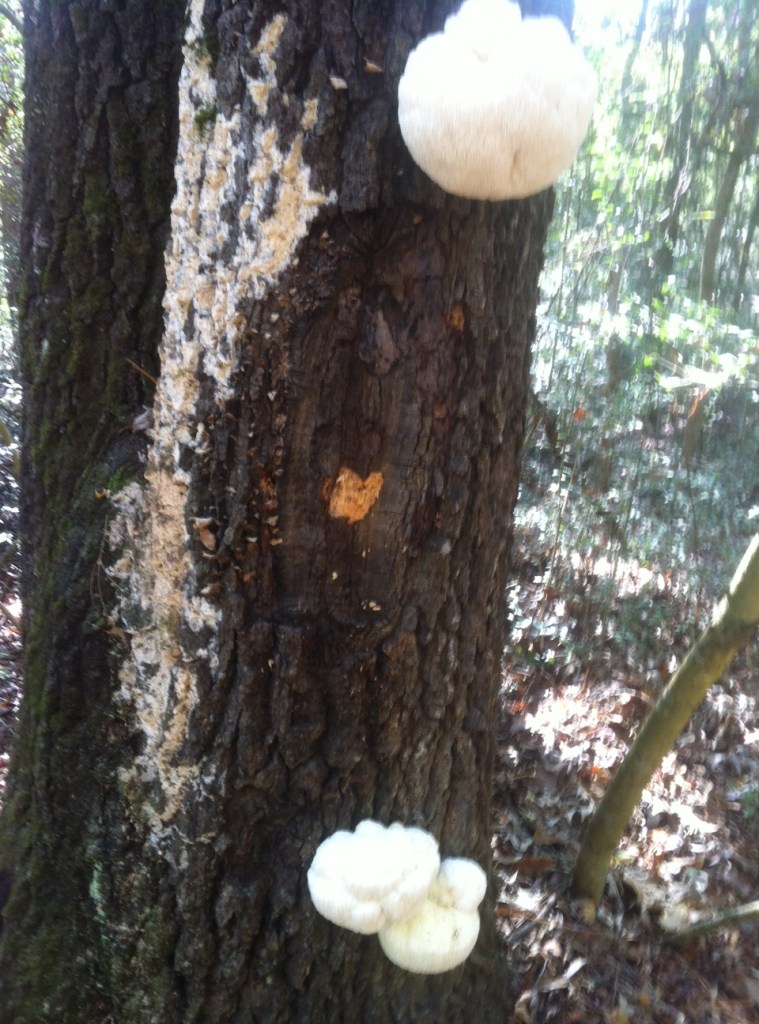
For the novice mushroom hunter there are only a handful of no-brainer finds, and as the dogs and I walked our trails this morning, I spotted one of the choicest of these, the Hedgehog. Actually there were three, and I took the biggest, a whopping one pound ten ounces. Interestingly, the season of these mushrooms is winter, which makes me wonder, when it’s still an unseasonal 85 degrees Fahrenheit here and hasn’t rained in many weeks, how do they judge winter exactly?
In the garden it’s the summer crops that are thriving—to accompany my Hedgehog mushroom I harvested some cucumbers, radishes, basil and Napa cabbage. The second crop of tomatoes this year are nearly ready too. If Handy Hubby were home I’d add to that some thinly sliced duck breast. Then I’d look at our plates and think wow, I can’t believe how often now our meals come from our own land, our own hands. What amazing peace of mind this is considering how unhealthful and/or expensive food in the grocery stores has become, with the distinct impression it’s only getting worse.
If I turn on the TV or read a newspaper I’m reminded I once considered the daily grind and the endless mindless consumption ‘reality’. Now I often watch and read the various panic porn channels online and sometimes they get me pretty riled up.
Then I walk out to our garden or through our woods and I remember what is really reality. Civilization is not realty. And what we are currently calling civilization is about as far from reality as it gets.
Y’all can keep it! My happiness is in the hunt and the harvest and of course, Handy Hubby. All the rest of it is worth less than a hill of beans.
Our faithful and exuberant foraging, hunting, harvesting companions. 🙂
After several grave posts it seems an upbeat update, some good news and great resources are in order. So, I will for a moment ignore that it’s still sweltering here and in the 90s with no decent rain for far too many weeks.
Normally we’d have flourishing fall crops by now, but many are struggling with the daytime heat. Two decorative/medicinal favorites that keep my spirits up with their beauty and endurance when so much is brown or perished are Datura and Castor Bean.
Datura Inoxia at dusk emits a sensual lemony fragrance
These old timers are highly under-rated in the garden, in my opinion. They are useful, rugged and gorgeous and so misunderstood in our modern culture as science labels them “poisonous” and horticulturists scare folks away from them simply because if your pets or children eat a handful of their seeds they’ll most likely vomit. Should they choke down entire sections of these plants, they could die.
Interestingly, there are very few documented cases of such stupidity. Our chickens scratch and peck all around under these plants and don’t get sick. And our Great Dane-Mastiff loves to sniff the just opened flowers at dusk, as do I, and our bees!
The bees also enjoy the arugula blossoms, which is another favorite heat-loving plant and my favorite lettuce. I have a great many books on plants, but two favs are: The Herbal Lore of Wise Women and Wortcunners by Wolf D. Storl and Witchcraft Medicine: Healing Arts, Shamanic Practices, and Forbidden Plants by Claudia Muller-Eberling, Christian Ratsch, and Wolf-Dieter Storl.
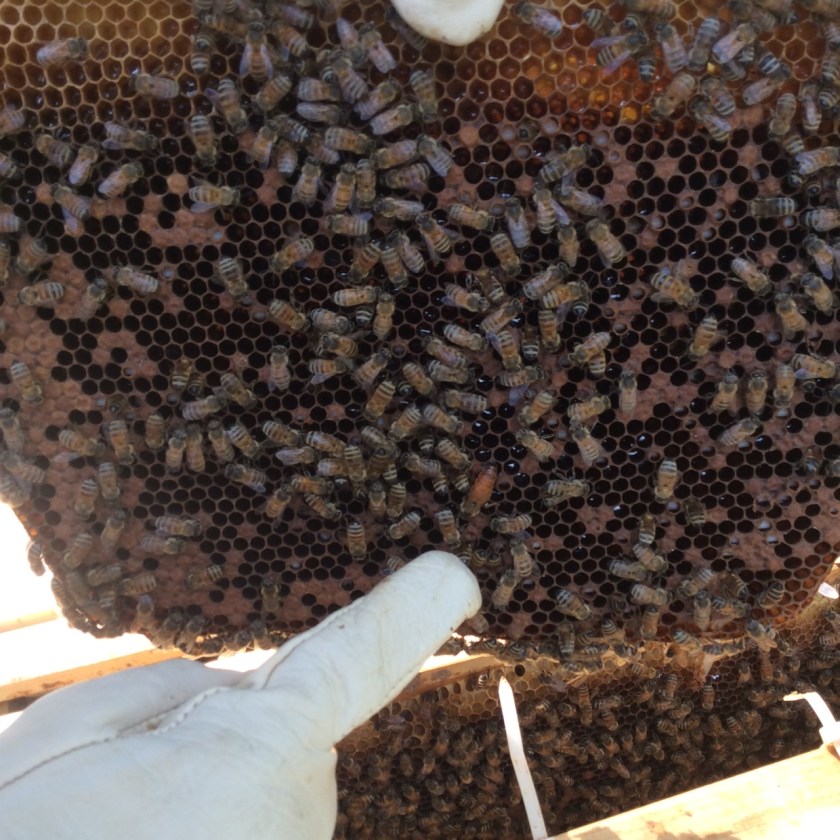
Speaking of our bees, the feral hive that was relocated from an old steel drum in the spring is still hanging in there. After some concern for their slow growth I was able to locate the queen. My first queen-spotting–it was a proud moment–it’s pretty tricky for us newbees!
Feral hive relocated to our top bar hives
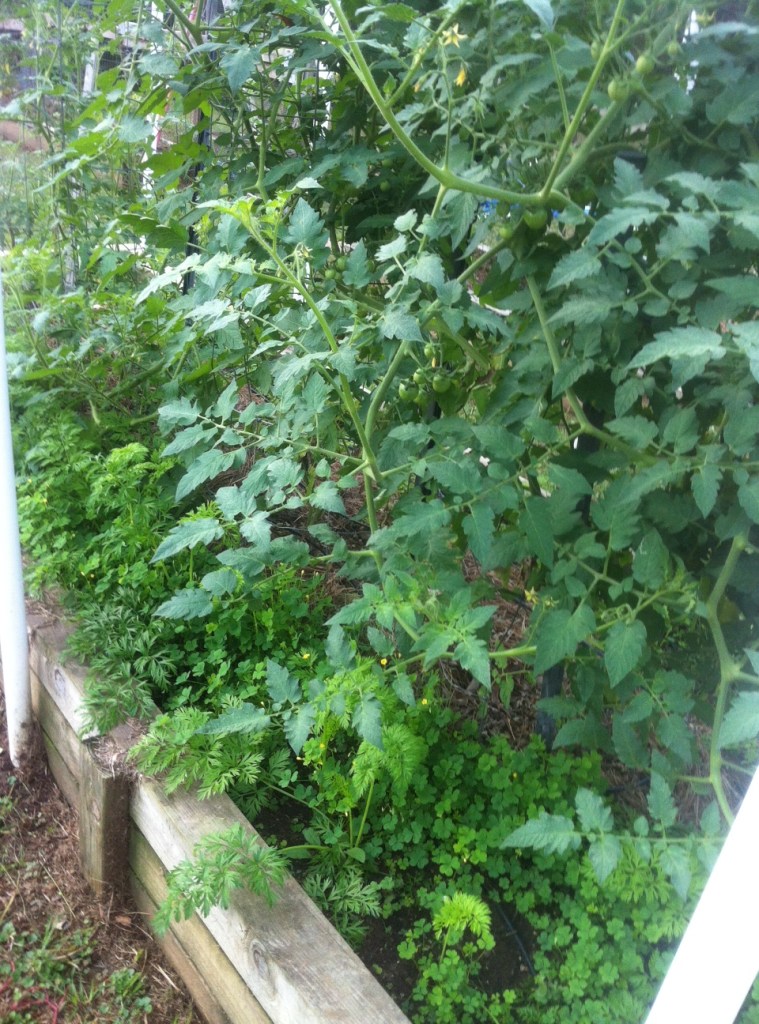
I’ve been experimenting with companion planting and it’s true, carrots really do love tomatoes and roses do love garlic. Not all of the companions or incompatibles from these books have proven correct for me, but those two definitely do. Roses Love Garlic and Carrots Love Tomatoes by Louise Riotte.
New favorite dish: duck confit–duck legs and thighs slow-cooked while submerged in duck fat, then fried in the fat before serving. For all those who might be thinking this sounds like a cholesterol nightmare, I say, don’t knock it until you read the research of The Weston A. Price Foundation.
Duck confit in the works–so delish!
Best resource this year: The Art of Natural Cheesemaking: Using Traditonal, Non-Industrial Methods and Raw Ingredients to Make the World’s Best Cheeses by David Asher. A shout out to the fantastic website Little Green Cheese for introducing me to it, it has absolutely been an eye-opener. I’ve been making cheese for a couple years now, and this is the book I should’ve read from day one.
This, in my humble opinion, is the way cheese was meant to be made. Most of the recipes use kefir, who knew, kefir as a cheese culture! Clabber cheese has become a new standby, which is really ironic, because it was a staple for so many of our ancestors. It’s basically raw milk spoiling on the counter-top.
Handy Hubby had to taste it to alleviate his automatic doubt and skeptical disgust. I learned a new expression from the famed Michael Pollan in his fascinating new series Cooked! He calls the miracle of cultures and molds and so forth,“The erotics of disgust.”
Unfortunately, for most folks’ health, their disgust-threshold is disastrously low.
By the way, the Clabber cheese got the thumbs up from Handy Hubby! 🙂
Another by the way, the above rose is La Duchesse de Brabant, another fav who fares well in the heat.
I was duped and that’s maddening, not to mention a bit humiliating too.
When I first heard of Globalism I was an avid world traveler fancying I could make it as a travel writer. I remember seeing some anti-globalist picketers in front of a large bank in some major European city and thinking “Wow, these folks are really afraid of McDonalds!”
I was no big fan myself, but didn’t consider any differing perspectives or a bigger picture than “Don’t they realize how much more pleasant it is for us travelers to use ATMs and credit cards all over the world rather than deal with cash or Traveler’s Cheques?
How very naïve I was and what a difference a decade can make. I imagined global government meant a global democracy. Really! What a slap in the face it was to witness the U.S. become far more like the formerly Soviet-bloc countries I’d known.
I remember once on an overnight train ride through a few countries in Eastern Europe I was awoken five times by fierce agents in differing uniforms to “Show your papers!”
It seemed so absurd to me, so pointless and paranoid. Not to mention how very annoying it was to have to perform this ritual throughout my sleepless night.
Then I got repeatedly frisked in my country’s own airports—required to go barefoot on filthy floors and to strip to my tank top in front of hundreds of passengers. I watched as cities transformed for military operations, boiled as I learned about the mass surveillance, screamed when I heard about the force-feeding of GMOs, and just when I thought it couldn’t possibly get any darker, yes quite naive once again, darker indeed it got—it’s called Global Dimming, http://www.pbs.org/wgbh/nova/sun/ and it’s part of the on-going global climate manipulation.
The spin agents in the mainstream media want to make it look, at best, like beneficial progress harmless to humanity and, at worst, as if it’s all one giant conspiracy theory invented by inconvenient crazies.
But how can any mind dismiss it all when it just doesn’t add up? When the military says one thing, and the weathermen another, and the public officials, the experts, the alternative media, social media are all aglow with speculation and hype, yet, it’s never on the mainstream news. Surely any rational mind revolts and roars–Something is very wrong indeed!
It requires extensive independent research to unravel. Luckily these days that can be done from the comfort of your bed or kitchen or living room. That may not be the case for much longer.
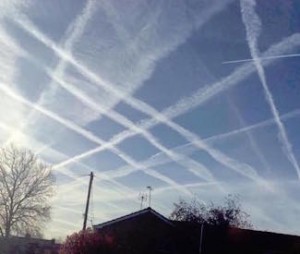
The mainstream media would have us think normal contrails are crisscrossing the sky at various locations around the entire globe. Greenpeace calls it a conspiracy theory. I actually volunteered for them once upon a time. Arghhh!
So, Greenpeace, we are to think the pilots are simply bored and playing Tic-Tac-Toe up there?
Please folks, I’m begging y’all here. Help us do the research and raise awareness. If we all stop being so naïve and self-focused and do a bit of study on behalf of future generations, we just might be able to take back control of our skies and our lives.
Thanks to the tireless work of so many the initial research can now be as easy as watching some Youtube videos. This is a new series that’s very approachable called In the Garden with Max Bliss.
And a few quotes to inspire your resolve. Thanks for reading y’all, please take action.
“The concept of national sovereignty has been immutable,
indeed a sacred principle of international relations.
It is a principle which will yield only slowly and reluctantly to
the new imperatives of global environmental cooperation.“ – UN Commission on Global Governance report
“Democracy is not a panacea. It cannot organize everything and
it is unaware of its own limits. These facts must be faced squarely.
Sacrilegious though this may sound, democracy is no longer well
suited for the tasks ahead. The complexity and the technical nature
of many of today’s problems do not always allow elected
representatives to make competent decisions at the right time.”
– Club of Rome,
The First Global Revolution
“Regionalism must precede globalism.
We foresee a seamless system of governance from
local communities, individual states, regional unions
and up through to the United Nations itself.”
– UN Commission on Global Governance
“The goal now is a socialist, redistributionist society,
which is nature’s proper steward and society’s only hope.”
– David Brower,
founder of Friends of the Earth
~~~~~~~~~~~~~~~~~~~~~~~~~~~~~~~~~~~~~~~~~~~~~~~
“If we don’t overthrow capitalism, we don’t have a chance of
saving the world ecologically. I think it is possible to have
an ecologically sound society under socialism.
I don’t think it is possible under capitalism”
– Judi Bari,
principal organiser of Earth First!
I have yet to hear a single politician currently in office discuss Geoengineering in public, yet it’s all over social media in a multitude of languages. hmmmm . . .