If you plan to join the growing number of hobby beekeepers the very first step should be to define your goals.I learned that the hard way.
It’s a wonderful thing to see the popularity of beekeeping keeps increasing.I love beekeeping for many reasons, but when I was first starting out the learning curve was very intimidating. And that’s coming from someone who usually adores learning.
Not only was there loads to learn about the bees themselves, but also about how to manage their colonies, which changes depending on your hive type, which is dependent on what your goals are as a beekeeper.
The first question to answer for yourself as a newbie is if you are interested in beekeeping as livestock or as habitat provider, or maybe both.
I had several mishaps in my first years because I hadn’t asked myself this most fundamental question.I hadn’t asked myself this because in all the books, forums, courses and club meetings I’d attended, no one asked this question.The general assumption is always that the beekeeper is interested in bees as livestock, because that’s what most want.
In this case, follow the commercial standards, using their Langstroth hives and peripheral equipment, their treatment schedules for pests and diseases, and their feeding programs and supplies, and you should be good to go.You can buy nucs (nucleus colonies) in the spring, and if all goes well you’ll have some honey before winter.This is by far the most popular route to take in beekeeping.
Our only Langstroth hive on the homestead, bedazzled with old jewelry.
But it’s not for everyone, including me, which took me a few years to figure out.Honey, pollen, wax, propolis, royal jelly, queen rearing, and other processes and products from beekeeping are the main goals of this style of beekeeping and there’s lots to learn from the commercial operators who have mastered many of these skills for maximum efficiency and profit.
However, if you are interested more in providing habitat and learning from the bees, and creating truly sustainable, long-term, self-sufficient colonies in your space, following commercial practices is really not the way to go, and can lead to a lot of expense, confusion and frustration.
In the hopes of encouraging more beekeepers to become honeybee habitat providers rather than livestock managers only, here are a few tips and resources.
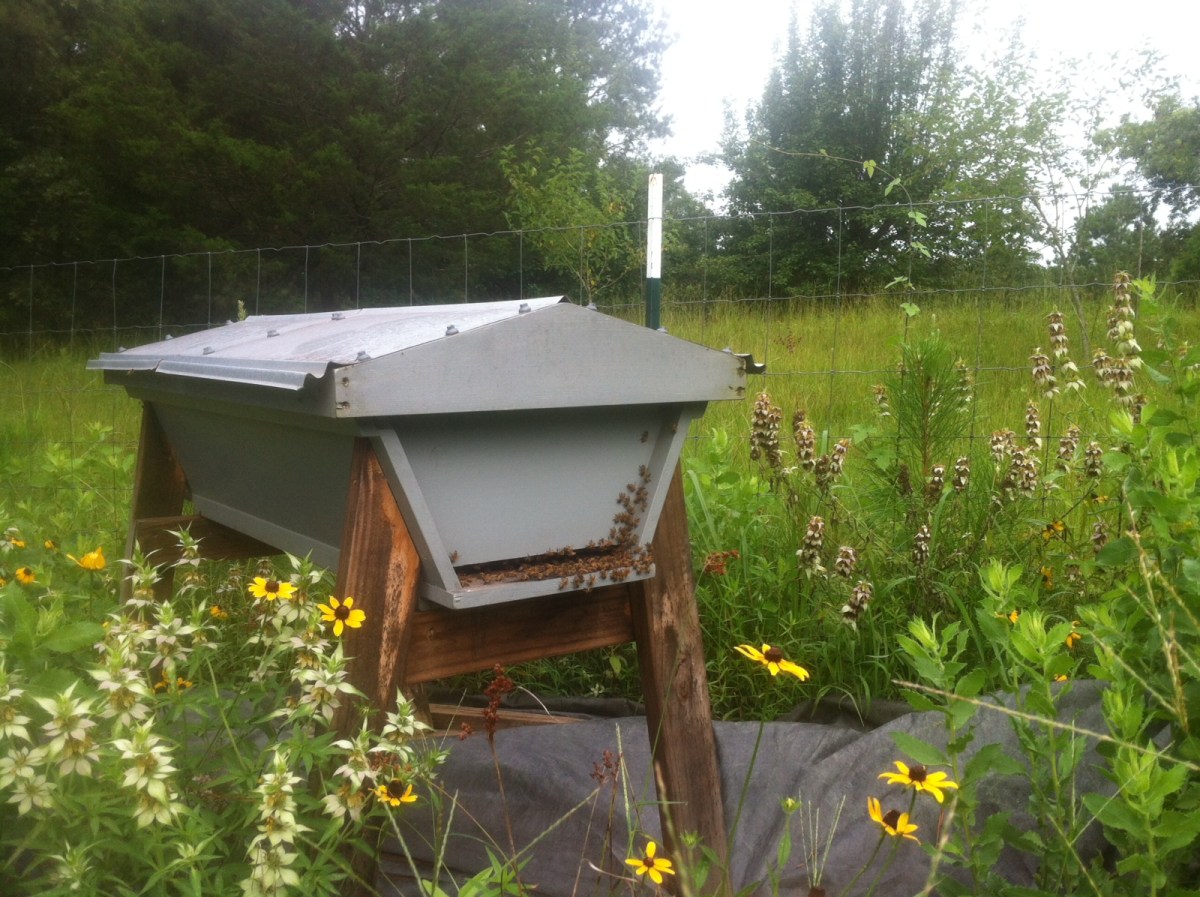
The bee yard of Dennis Kenney of Jackson-area Beekeepers Club, with his preferred horizontal hive style. Horizontal hives differ from Top-bar hives in that they have full frames with foundation. Benefits of full frames is ease of management and stability of comb. Drawbacks would be the added expense and the artificial, manufactured foundation and its potential contaminants.
The conventional practice is to keep all your hives in a ‘bee yard’ for reasons of convenience and space.This is antithetical to bee colonies’ natural proclivity to nest far from one another. It creates problems of diseases and pests that spread rapidly in conditions of overpopulation, which is why so many treatments are needed, and then feeding when nectar/pollen flow is scarce, as well as being hyper-vigilant in your regular hive inspections to find issues immediately before they spread.Now that I have spaced my 6 hives out around a very large area I’m having far more success. But, only time will tell!
What else I’ve learned:
The typical Langstroth hive is made for easy transport and standardization purposes for the industry mainly, but they are not ideal for the honeybee habitat provider, because they are made with thin walls in order to be lightweight. This means they are poorly insulated and so not suitable for the long-term stability of the hive—getting too hot in summer in southern climates and too cold in winter in northern climates. Our top-bar hives and nucs have thick walls and insulated roofs.
If you want your bees adapted to your area and climate you don’t want to do the conventional practice of buying new queens every couple of years.Ideally, you’ll want your colonies to produce their own queens.Queen-rearing will remain an essential skill for a more advanced beekeeper, because occassionally you may still want to make splits to increase your numbers or to replace weak colonies, or to re-queen another hive displaying poor genetic traits.
When the colonies are weak, depending on the issue, they may need to be culled. This is rarely suggested by professional beekeepers who promote regular treatments on which the weak colonies then become dependent, while still spreading their weak genes on to subsequent generations and their diseases and pests to other colonies.
Just like the faulty logic of ‘herd immunity’ in the vaccine debate among human populations, many commercial beekeepers use the same complaint about those of us who want go au naturel,that is, treatment-free, with our bees.
Many scientists and researchers are trying to raise public awareness that this is not how herd-immunity works, not in livestock or in humans, and I applaud their efforts. I personally find referring to populations of people as a herd to be insulting. I think it actually trains individuals through neuro-linguistic programming (NLP) to think of themselves and each other not as unique and separate individuals, but rather as cattle to be managed.
You’ll also want to mostly forgo the conventional practice of swarm prevention.The goal is for the bees to become self-sufficient, as in the wild, where colonies can live for decades with no hand from man to aid or to disturb.Some of these colonies are enormous, like one we found in an old oil barrel, there for over 15 years and thriving with multiple queens in the same colony, which most likely swarmed annually.
Swarming is a natural, bio-dynamic process performing many different functions for the colony, hygiene being an essential one. Everything the beekeeper takes away from their natural processes is a stress on them which must then be alleviated by other, most likely artificial, means.
Plant perennial and annual crops the bees like for your area and climate.Here in the south there are plenty of plants that bloom at different times most of the year, giving free bee buffets from early spring to late fall, like: bluebonnet, white clover, hairy vetch, wild mustard, vitek, morning glory, trumpet vine, yaupon, and lots of garden herbs and crops, too.It is my greatest pleasure to harvest cucumbers, peas, beans and arugula surrounded by forging bees—they love them as much as we do!
Experimenting and observing is the most fabulous feature of the honeybee habitat provider!
I know a homeschooling homesteader with an observation hive in their house that the children treasure.Not only do they learn from these fascinating creatures about how they operate in the hive, but how they are connected to the seasons and to their environment.They’re learning constantly from the colonies’ successes as much as from their failures.
I practice slightly different techniques with each hive to discover which methods work best here on the wee homestead: one hive has a screened bottom board, one I keep with a reduced entrance all year, one’s in full-sun and another partial shade, and so on.Not that this will necessarily solve the mystery of colony failure, but every bit of data helps!
Some unconventional resources:
Books
The Shamanic Way of the Bee: Ancient Wisdom and Healing Practices of the Bee Masters by Simon Buxton (2004)
The Dancing Bees: An Account of the Life and Senses of the Honey Beeby Karl von Frisch (1953)
Top-Bar Beekeeping: Organic Practices for Honeybee Health by Les Crowder & Heather Harrell (2012)
Natural Beekeeping: Organic Approaches to Modern Apiculture by Ross Conrad (2013)
I just love the high tech solutions and big global money that pours into problems once solved long ago before the oligarchs in control of the tape worm economy started sucking the world dry.
No, the problem is surely not that mass overpopulation in highly condensed areas is an obvious crisis for millennia, collapsing cultures repeatedly, because technology always has the next great solution. Really!
As this fascinating documentary on the history of the toilet demonstrates, the rural folk of Wales have had the best toilet all along. The composting toilet, no smell, no flies, then used to fertilize the garden. But Gates call their chemical plans for the perfect toilet ‘sustainable’ and ‘green’, of course. Because ‘green’ actually means $$$, for them!
Though you’ve got to leave it to the Japanese to take delicate matters to a whole new level.
This is well worth a watch, for those interested in crap that really matters.
Deconstructing the law of large numbers and the wisdom of the crowd, our new and forever hero. I am he. You are me. We’re all one big happy family.
At the mercy of a God, as we have always been. Only it’s a new God.
Similar to the old one, don’t worry. Same, same, but different.
You see, because AI can do it better than me, better than you, and that’s good. Feel comforted. AI will take care of you, of your pets, of your globe or plane or island, wherever you want to live, all One in the G-machine.
Queen calling, another ancient skill to soon go hi-tech?
Beekeeping Today Podcast
“Dr. Jerry Bromenshenk and Dr. David Firth from the Univerisity of Montana are working together on a new application for beekeepers called Bee Health Guru. The application uses artificial intelligence (AI) to listen to the sound and based upon complex algorithms and learned history, can provide a diagnosis of the colony’s health. Simply amazing. Jerry and David join Jeff & Kim on this episode to talk about the history of the technology and the ongoing research of the technology under-pinnings of the cell phone app. At the beginning of the podcast, you can hear Jeff listening to a audio clip of a 2-deep colony of bees at rest. Then suddenly, no… instantly, their tone changes. Could you tell what happened? The audio file was provided by Dr. Bromenshenk. In the recording, a colony of honey bees ‘at rest’ are given one (1) drop of toluene. The communication through the hive was instantaneous. Bees communicate more than we knew and the Bee Health Guruapp hopes to help us translate just what they’re saying!”
It’s better this way. Trust them. They’re on our side, as always.
Just sit there nice and cozy. Oops, lift your feet, the robo-vacuum coming through!
Can we get you more kool-aid, dear?
Or, might you consider taking an interest in an actual life, with living creatures, which AI is not and . . . ?
It’s not, right? We still know the difference, right?!
Honeybees know the value of their venom, they give their lives for it. We know how precious is the value of the honeybees’ venom, understanding it as both cure and poison.
In natural healing bee venom is used for all sorts of cures, a number of them painful.Honeybees can be merciless, even to each other, for the ‘greater good’.
What did I find today outside one of our hives but droves of drones, those are the males, kicked out by those bossy female workers who clearly decided they could no longer be supported. They will also kill and replace an unproductive queen without hesitation.
And me, being the opportunistic and cunning human that I am, collected these evicted dead bodies in order to make Podmore, considered an exceptional traditional medicine used to cure all sorts of ailments.
Quite unknown to American beekeepers, I wonder why, considering its value? Could it be they don’t like the thought or action of collecting dead bees? Podmore
This reminds me of another big related beef I have with our current cultural climate: Weakness is not a virtue.And neither is positivity.
I like the way Micheal Tsarion just put it in his last podcast, because I think it’s spot on. Our Prozac smile culture is in a “regressed state of animated autism.”
Optimistic bias undermines preparedness and invites disaster, according to sociologist Karen Cerulo.
In Barbara Ehrenreich’s 2009 book, Bright-Sided: How the Relentless Promotion of Positive Thinking Has Undermined America, she underscores how hard Americans have been working to adapt to the popular and largely unchallenged principles of the positivity movement, our reflexive capacity for dismissing disturbing news, whitewashing tragedy as a ‘failure of imagination’ and relentlessly spinning suffering as little more than a growth opportunity.
While in fact I am writing now out of a spirit of sourness and personal disappointment, unlike Ehrenreich according to her intro, I nonetheless find much value in her final paragraph: “Once our basic material needs are met—in my utopia, anyway—life becomes a perpetual celebration in which everyone has a talent to contribute.But we cannot levitate ourselves into that blessed condition by wishing it.We need to brace ourselves for a struggle against terrifying obstacles, both of our own making and imposed by the natural world.And the first step is to recover from the mass delusion that is positive thinking.”
The bees know.
One of the very many things that fascinate me about the bees is that the Freemasons so covet it as a symbol.I can imagine there are many reasons for this, most of which will probably remain a lifelong mystery to me.
At some point the bees simply refuse to adjust any more and they swarm, this is a natural, healthy, cyclical process, which most American beekeepers try to avoid at all costs.
We seem as a culture to abhor natural processes.
As cruel as this is sure to sound, could it be that maybe swarms and cullings are natural processes for humans as well as bees?
Moving colony from nuc to permanent hive. How you like my fancy paint job? 🙂Setting up a swarm trap. Open invitation to immigrants, move-in ready!
My new honeybee hero and virtual mentor: Dr. Leo Sharashkin!
The most famous place in East Texas to be demolished in the spring of weather chaos in our region is Caddo Mounds, also known as the George C. Davis site, a state historic site, at the intersection of Texas Highway 21 and U.S Route 69. Said to be Native American burial, ceremonial and residential mounds of the Caddoean Mississippi culture, it is a major archaeological discovery with what was once a popular museum and ‘living history’ gathering place for community and well beyond.
The date was 4/13/2019 during a Caddo cultural festival in the middle of the afternoon. There was one death and many injured taken to hospital by helicopter and bus.
The location is not Alto, as all sources report, it is Weeping Mary, population fewer than 50 people. The original story of the town’s founding is one of deceit, hardly uncommon, and I expect at play in this more recent sad story somewhere as well.
It goes the town was founded by freedmen after the Civil War. It ended up in the hands of a former slave named Mary, who needed to sell but did not want to sell to a white man. So the white man hired a black man to buy it for him, and when Mary discovered this she was left eternally weeping.