Because the world is an increasingly ugly and hostile place, our personal space must become increasingly beautiful and hospitable.
The marriage of opposites, which according to the AI YT Hermetic Tradition (wtaf?), is not in fact a comprimise as modern interpretation dictates, but more of a craft in augmenting tension tolerance.
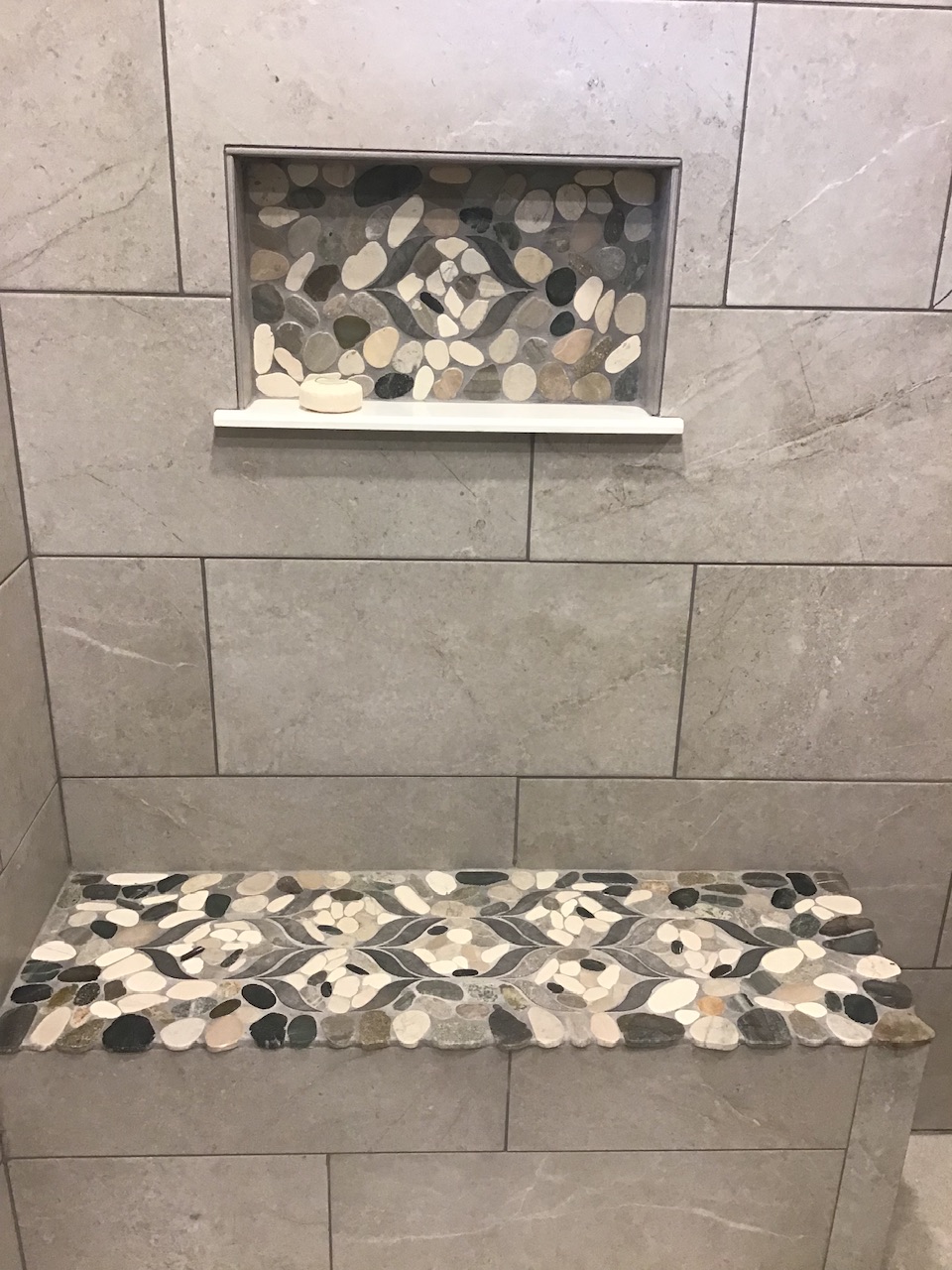
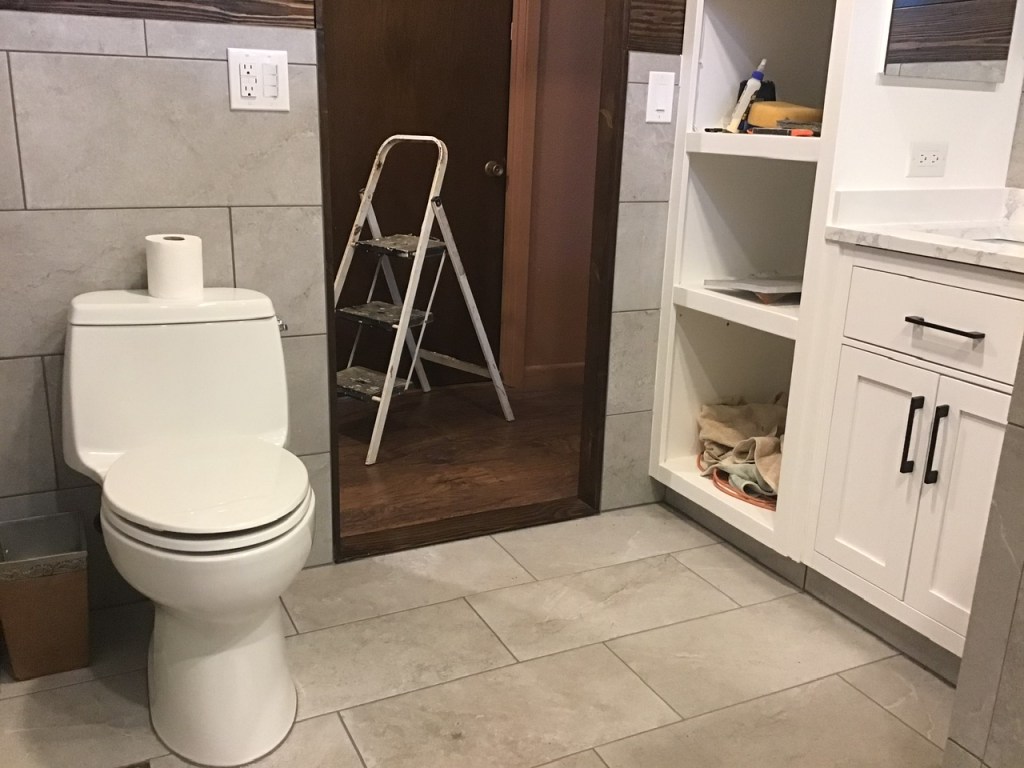
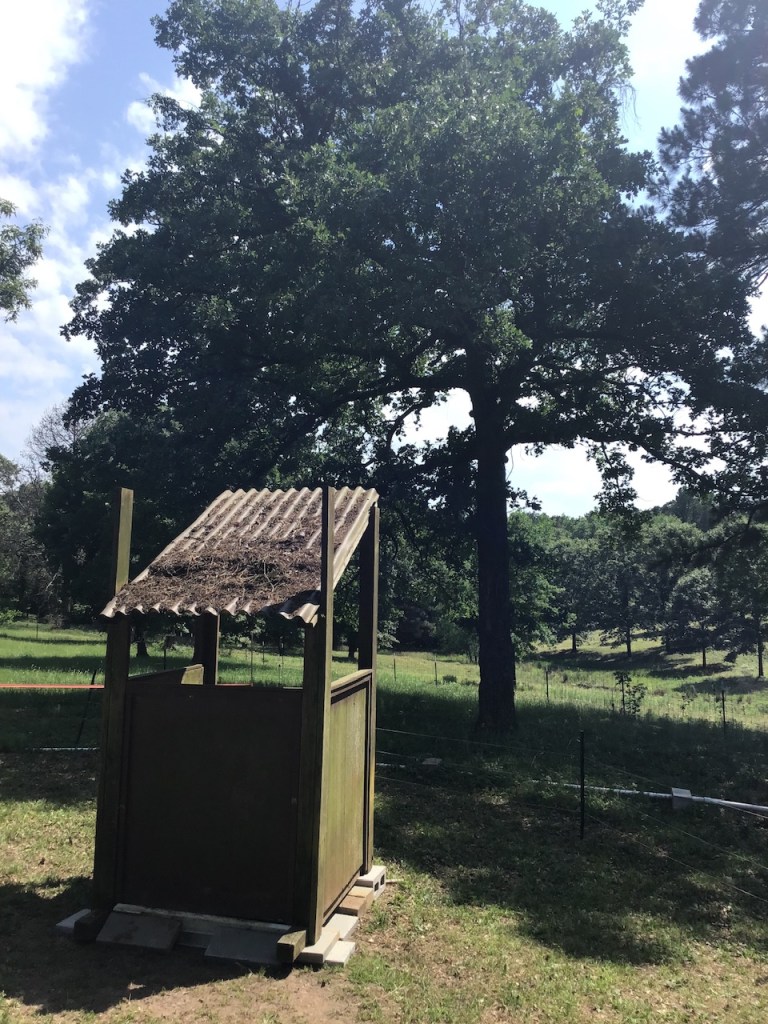
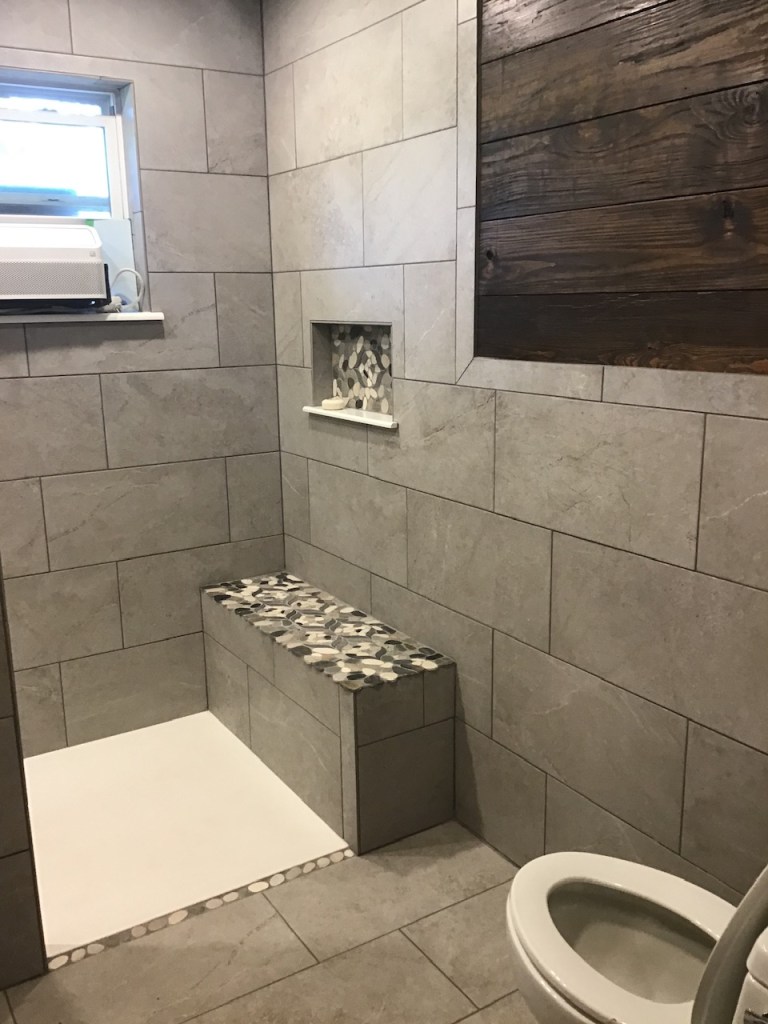
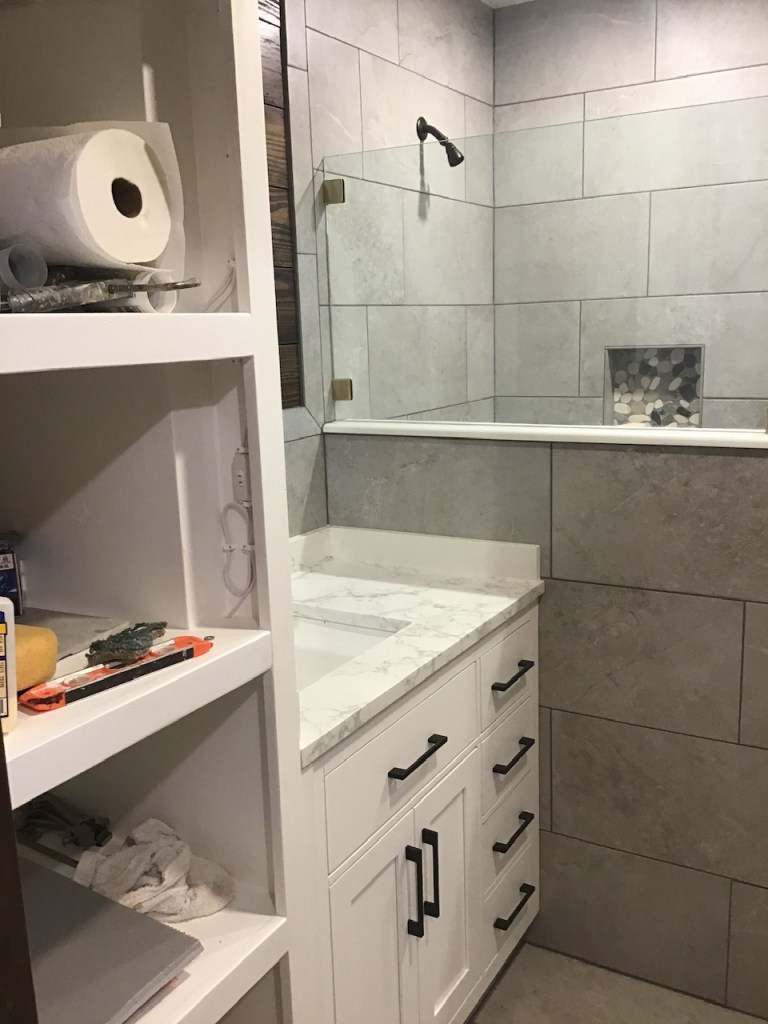
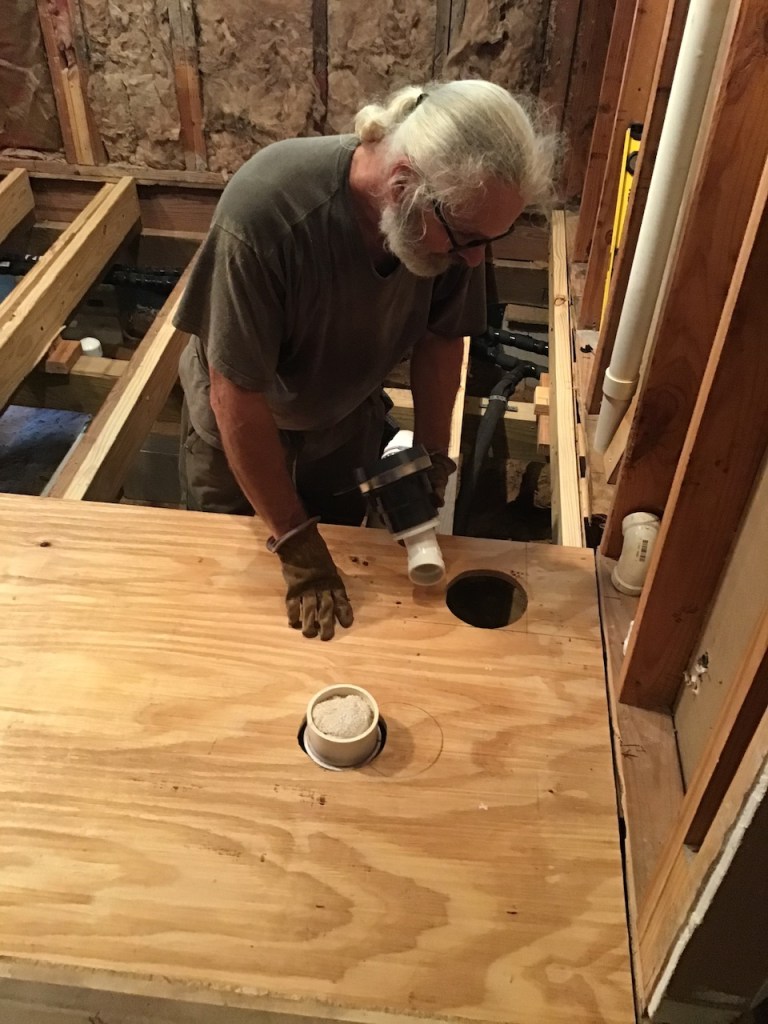
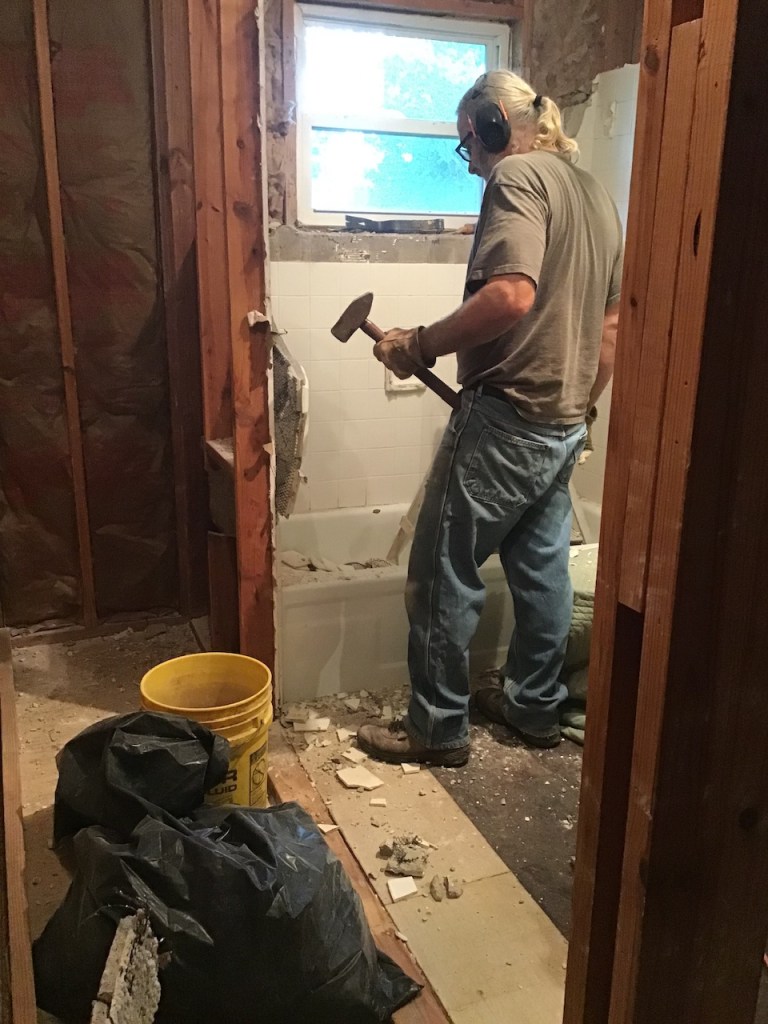
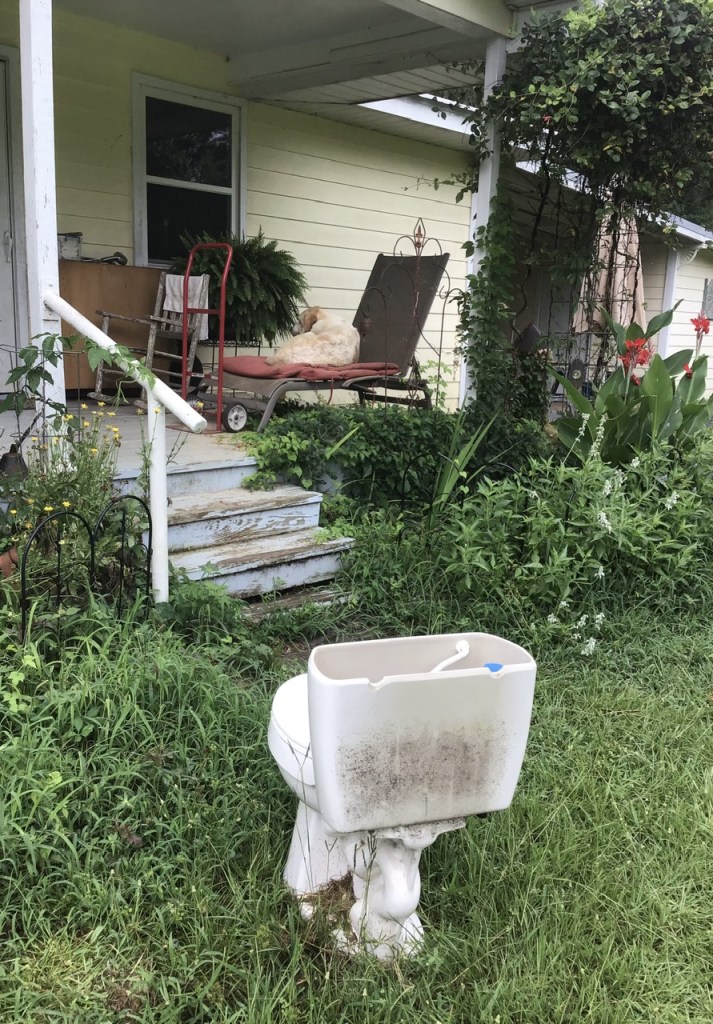
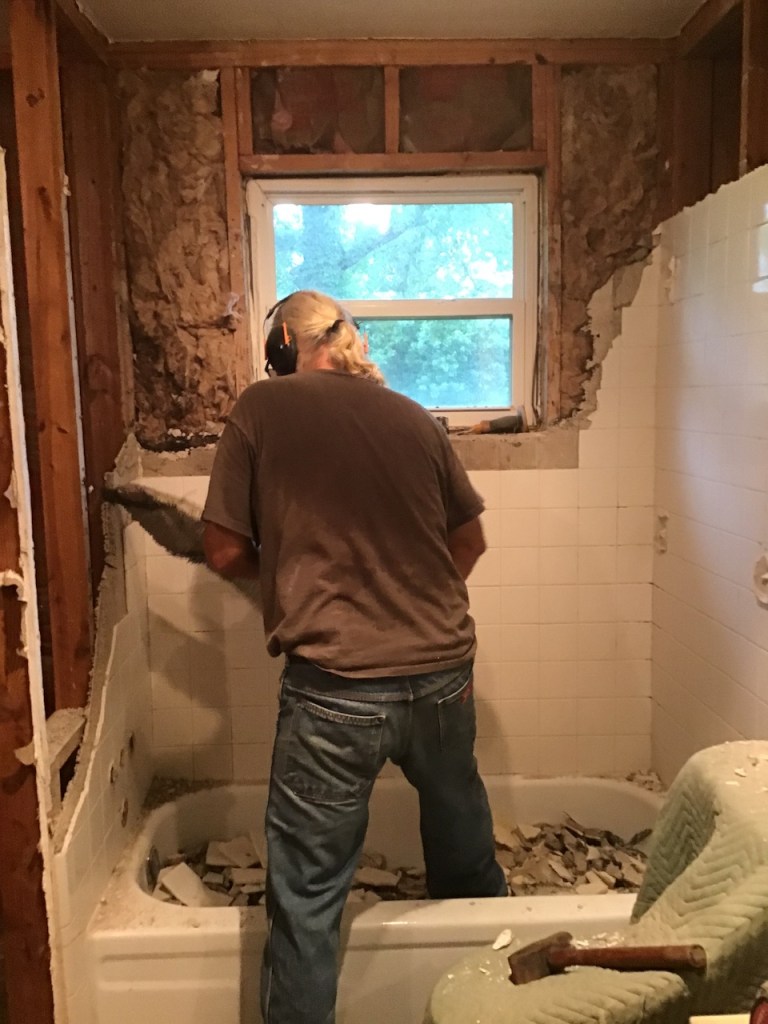
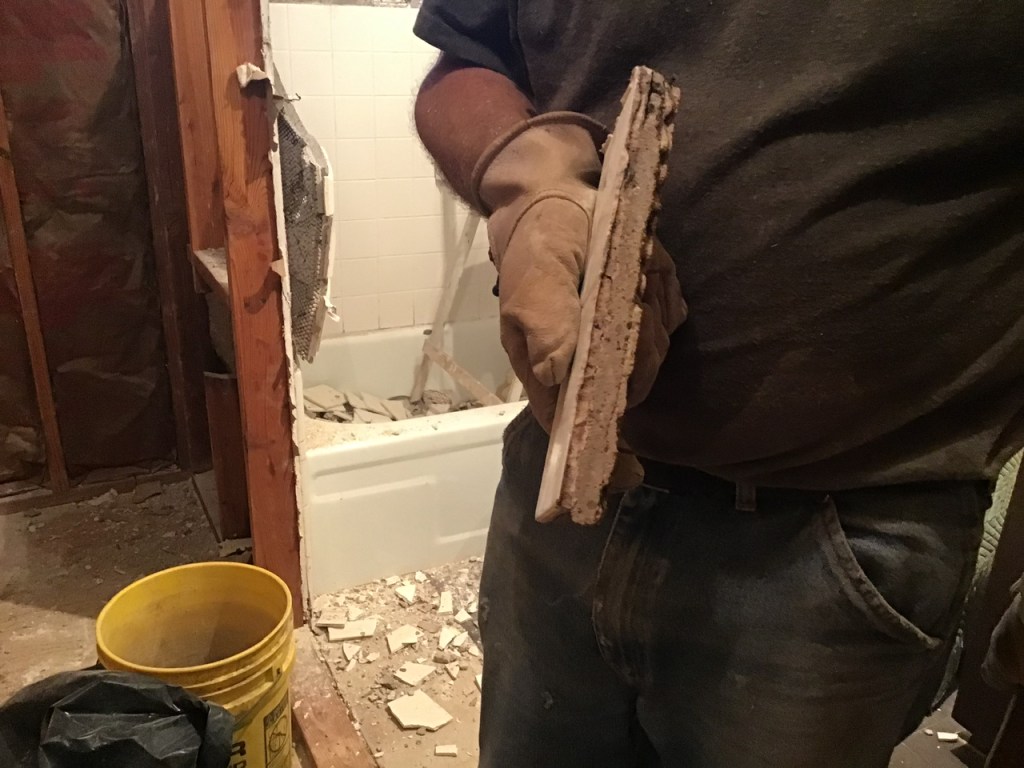
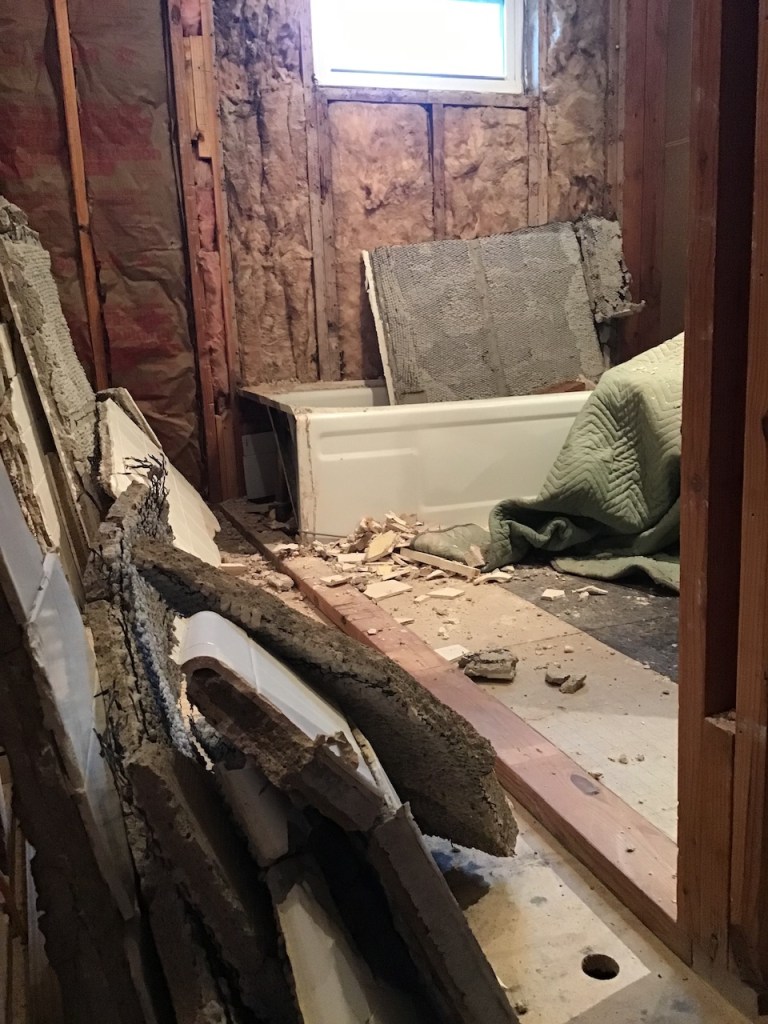
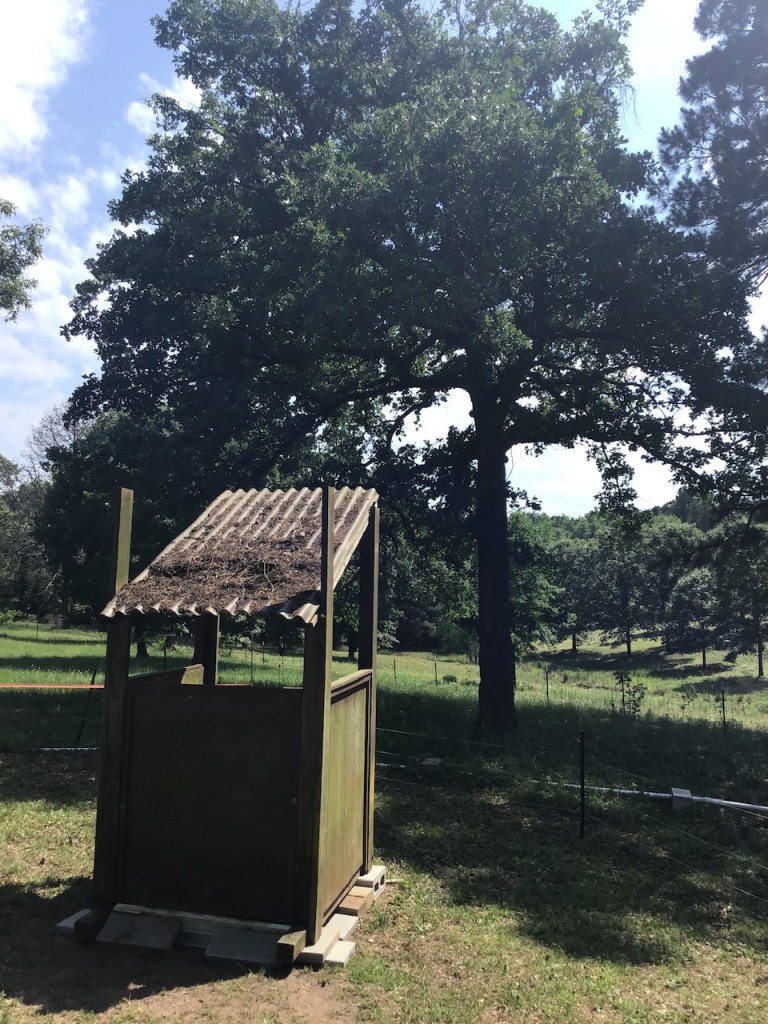
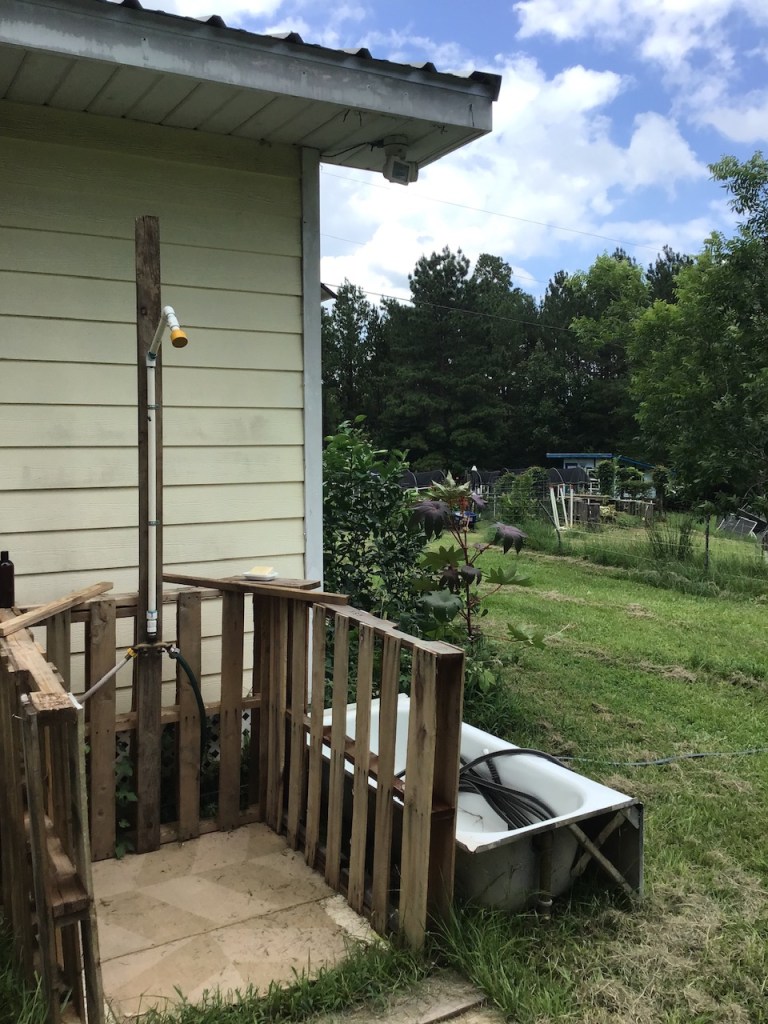
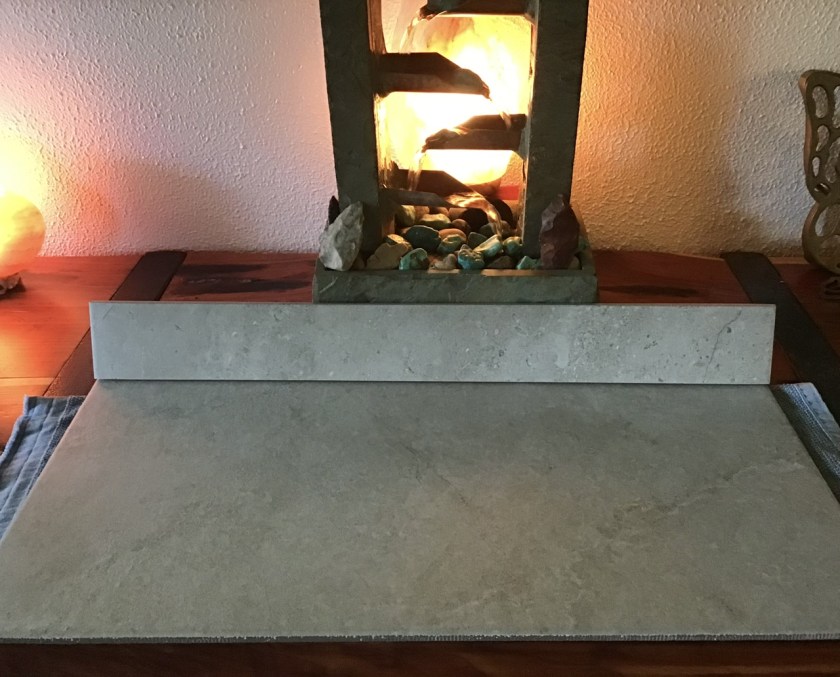
I spent from May to October appreciating our poop-with-a-view and now I appreciate Hubby’s fabulous handiwork. I have several posts in the works, including a full before and after spread. This is just the teaser, or more honestly, I don’t feel like it yet post.
The end of the world as we know it? And I feel fine? Must be that crazy marriage thing.
Then imagine grounding those dreams in our harsh reality.
Another of Gavin Mounsey’s provocative polls has me more deeply considering something I often daydream about.
What if money were no object? What if you could create anything you desired with a bottomless budget? Oh the possibilities!
In these daydreams my foundation point is naturally something I genuinely believe would be beneficial for the future of mankind, which naturally includes benefitting nature, as our earth and only home.
To that, Gavin’s added a couple of caveats:
Poll: If you were offered 100 million USD under the condition it must be used for benefiting the bioregion you live in and the 7th generation that comes after us, what would your plan be? September, 2026’s poll in the Mirrors For The Mind, Heart and Soul series
I will turn my perpetual daydreams into speculative plans, sounds like fun and something I naturally excel at!
Gavin: “So many on Earth today have cultivated their gifts of vision, intellect and heart that they could be channelled to make their communities, their watersheds and their bioregions so much more abundant, beautiful and healthy, and yet they tell me that their vision for gifting beauty, ecological regeneration, wholeness and empowerment to their communities is limited by their access (or lack thereof) financial resources.
Today, I would like to break those shackles from the minds of the good hearted and righteous by proposing a thought experiment. If (as some say) the only thing standing between what is and what can be is a clear vision, faith and belief (the law of attraction and manifestation) than I want to plant the seeds for clear visions, hopeful mindscapes and best case scenarios to take root in your hearts and minds.
Daydreams into Realities, this might take some periphery explaining. And, it includes a plea to share your ideas for ‘gifting beauty, ecological regeneration, wholeness and empowerment’ too, either here or at Gavin’s Newsletter.
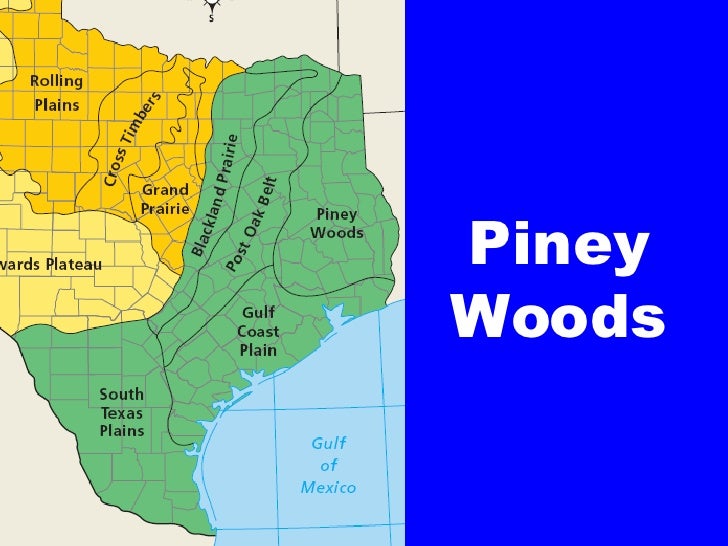
First, since this is bioregion-specific, that means folks should understand I’m talking about beginning right here where we live, East Texas, which many believe is something like the Texas they see in Hollywood movies, which is West Texas, and nothing like it here, so that faulty image needs to be corrected.
As a working title for my plan: Free the Waters
“The Piney Woods cover a 54,400-square-mile (141,000 km2) area of eastern Texas, northwestern Louisiana, southwestern Arkansas and the southeastern corner of Oklahoma.
The Piney Woods is a temperate coniferous forest terrestrial ecoregion in the Southern United States covering 54,400 square miles (141,000 km2) of East Texas, southern Arkansas, western Louisiana, and southeastern Oklahoma. These coniferous forests are dominated by several species of pine as well as hardwoods including hickory and oak. Historically the most dense part of this forest region was the Big Thicket though the lumber industry dramatically reduced the forest concentration in this area and throughout the Piney Woods during the 19th and 20th centuries. The World Wide Fund for Nature considers the Piney Woods to be one of the critically endangered ecoregions of the United States.[2] The United States Environmental Protection Agency (EPA) defines most of this ecoregion as the South Central Plains. In Arkansas, the region is sometimes called the Arkansas Timberlands.” Piney Woods – Wikipedia
This is a huge area, obviously, and I would never want to be confused with someone promoting any sort of central planning, so my focus is far more localized and set on slowly and consciously re-wilding nature and re-integrating communities with eco-friendly landscapes and lifestyles without relying on the current standbys for profiting from the land, which are: development, tourism, monocrop farming/ranching.
In this endeavor I would use my past professional experience in higher education and the example of Edward Slavsquat’s efforts on the other side of the world to create an Institute of Village Studies. I hope he does not expect me to name it after him. I would give him a small donation for the idea, or better yet, offer his children future dividends or some cool scheme like that. https://open.substack.com/pub/edwardslavsquat/p/how-many-persimmons-does-a-man-need?r=87pg2k&utm_medium=ios
Part of this idea also stems from an existing institute just west of us in Waco where I first learned cheesemaking and beekeeping, which also teaches many other traditional skills and crafts, like soap making, sewing, baking, animal husbandry, smithing, etc. Ploughshare Institute for Sustainable Culture.
My vision would be to organize the institute around a shared vision rather than a shared belief system–non-denominational, non-political. It also differs from a traditional sustainability model in that the focused goal would be ecological re-integration over current market expectations. By that I mean we would not be open to the general public, our mission would be to create a prototype others in our bioregion could follow, for complete economic seperation from the state. That is food, water, energy indepedence and autonomy.
Skills are important in my vision, but so is tech, the part that makes me especially excited, is the possibility of resurecting old tech, or what I believe was old tech, but have never seen it beyond my imagination.
For this we would need several key pieces of equipment I’ve seen available which can map the underground terrain. I believe geoscopes available here would do the trick, but I’d need expert advice on that. Environmental XPRT – The Environmental Industry Online
We will also need to purchase the adjacent land, which just happens to be for sale. We’d eventually expand to a few thousand acres in order to ideolological compete with the current large landholders in our region and to continue in our liberating the waters. I think acquiring the land would not be that difficult with such funding, because places are going up for sale around us routinely, and for the right price I’m certain other adjacent land could be fairly easily obtained.
Liberating the waters is the first order of the plan. By that I mean first right here at home, then to our surrounding area, then extending out as we accumulate more land.
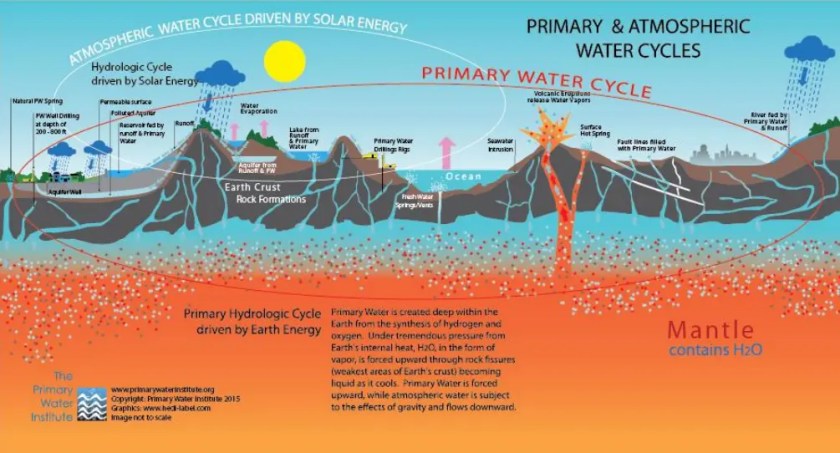
We will be locating TWO essential resources first, springs and salt. What most don’t realize is this region has plenty of both and most likely, even under just our 55 acres, we have both. With that information we will be able to locate and dig a ‘primary water’ well. Most folks don’t know about primary water, others think it’s some kind of a scam. I do not agree with those sceptics, but I’d hire this guy to find out for sure.
From his site: “There is in fact a lot of published science supporting the existence of water stored in the Earth’s crust. It’s been described as volcanic water, crustal water, juvenile water or what we call primary water. Below is just a fraction of the more recent scientific evidence: • 2022 Smithsonian Magazine – How the Earth’s Mantle Sends Water Up Toward the Surface: ”[…] within the first several hundred kilometers below the crust—there is another ocean. It is, most likely, the largest ocean in the world.” Primary Water Well Locators
The reason for starting with the water is first for health, then for power generation, and eventually for transport. For centuries travel and transport in this region relied on the rivers and their tributaries and I believe on a small scale that could be restored without having to appeal to the current establishment to release the dams on the resevoirs and recreational lakes which dried up so much of the adjacent landscapes.
Canoes are unobtrusive; they don’t storm the natural world, or ride over it, but drift upon it as part of its own silence. –John Graves, Goodbye to a River
There is plenty of water for all our needs and even most of our desires, I’d bet the ranch on it!
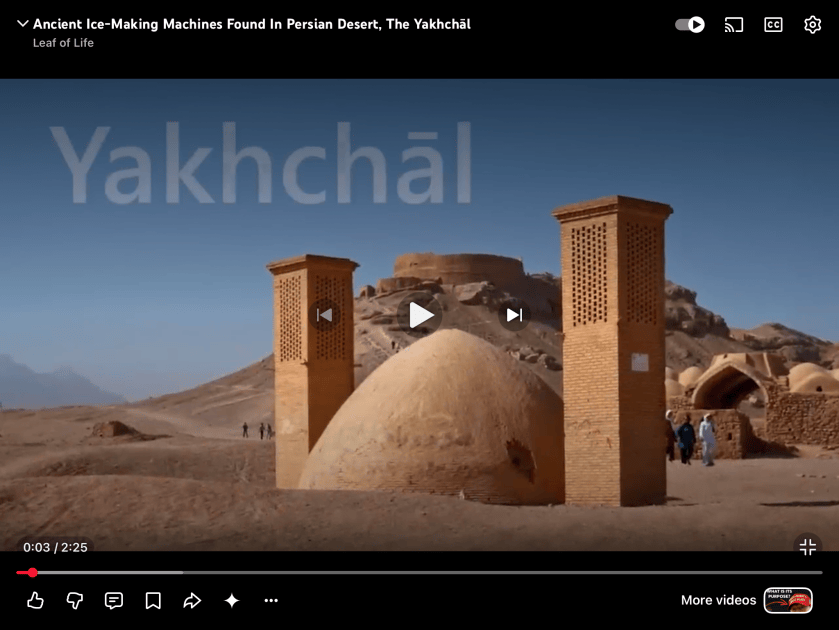
The most pivotal part of the plan is energy. My idea is to rehabilitate old tech based on spring houses, wind towers, yakchals, and other methods, some known, some suspected.
I don’t know how this exactly works in execution, I’m a dreamer playing a planner, looking for an engineer! And with that kind of budget, I bet I could find a few of them!
Here’s what I see. Moats around fortified castles and canals around and through cities were repurposed a few centuries ago and originally were not about protection from invaders. The towers with the slits were not about shooting the enemies, they were about air circulation. It was a system of water circulation and oscillation with the underground currents caused by the movement of the primary waters. I believe these existed in every country of the world. I have no proof of this. I understand it goes against every accepted hisorical and technical narrative of our age.
All I have is my imagination, some speculation by crazy conspiracy theorists on the internet, and some simple art. Like this favorite of mine, which I’ve posted several times.
What do you see? Just a man in a dress standing on a fish in some sort of canal? Would that be the sort of iconic art that survives for centuries?
Why is his dress bell-shaped? Why does his rod go into the fish-as-vehicle? A cavity resonator to produce oscillation, perhaps? Why is there steam coming out of the sun? Why do the tiny fishes and the hills appear to have motion? Why so much emphasis on the color green?
Does this strike you as a great piece of art, or as art conveying a specific meaning through symbolism?
Did the artist intend a 7th generation sort of purpose to his creation? How does my plan fulfill that criteria, considering my extensive limitations and the considerable budget?
I believe they need a new paradigm based on integration of time and space. I realize the ironies on the surface–use loads of fiat cash in order to escape the extractive economic slave system–how does that alter anything for the future of mankind or the bioregion?
Because right now the development in these parts is off the chain. Because otherwise we will continue to depend on oil, gas, tourism and ranching, none of which are creating healthy ecosystems. Because I believe folks would be happier and healthier if they lived more simply and closer to nature, but that most have already forgotten this due to generational amnesia, so they need a replicable model in order to envision it. We will be that model.
A model of man and nature reintegrated. A verdant and abundant oasis in the middle of the encroarching demands of the Texas Triangle*. Not an escape, not a destination, not a resource, but a newly restored relationship between small rural life living communities and the greater landscape. Not a return to an Amish idyllic dream, but the ideal place to build on a dream, eliminating, one by one, all exploitative ties to the existing failing system.
*”The Texas Triangle is a region of Texas that contains the state’s five largest cities and is home to over half of the state’s population. The Texas Triangle is formed by the state’s four main urban centers, Austin, Dallas-Fort Worth, Houston, and San Antonio.”
There’s no water for this type of dousing. We are deep in drought.
Our new normal.
It’s funny-annoying when I hear folks talk about the coming autumn ‘just around the corner’, these folks not living in Texas, obviously. They show boasting photos of their onion harvest or the growing masses in their pumpkin patch.
I gaze confused at their plans for weekend fall foliage drives as we daily read the thermometer at 90 to 100 degrees in the shade, with two months yet to endure before some reasonable relief is to be expected.
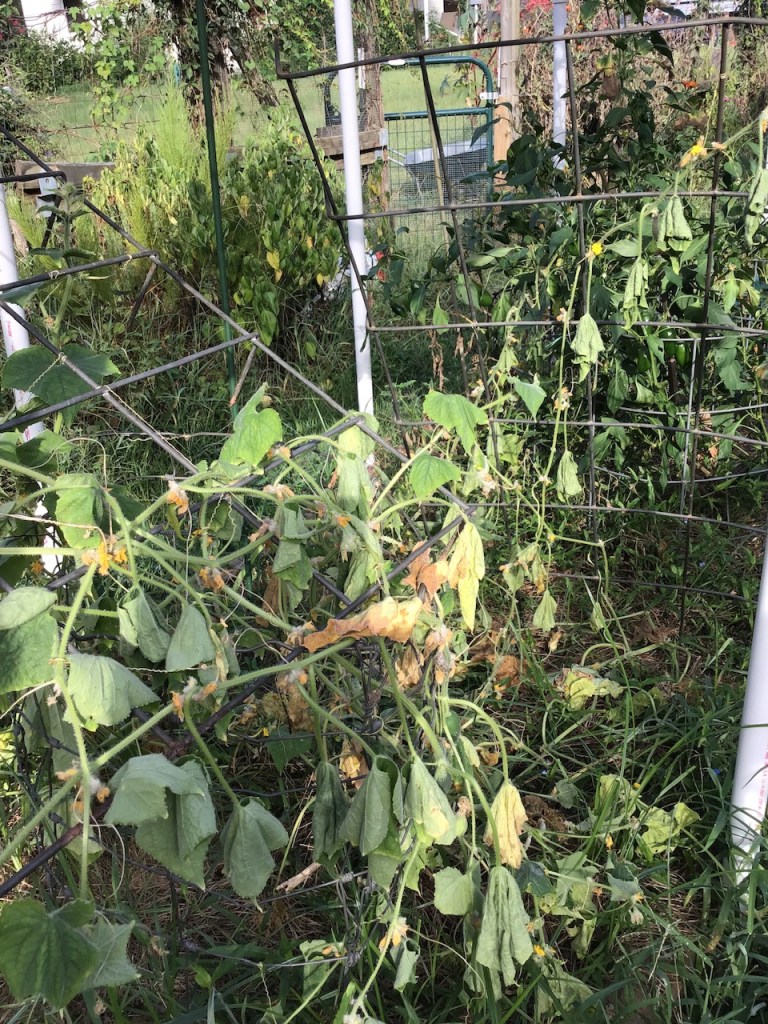
The late planting of cucs was a total flop
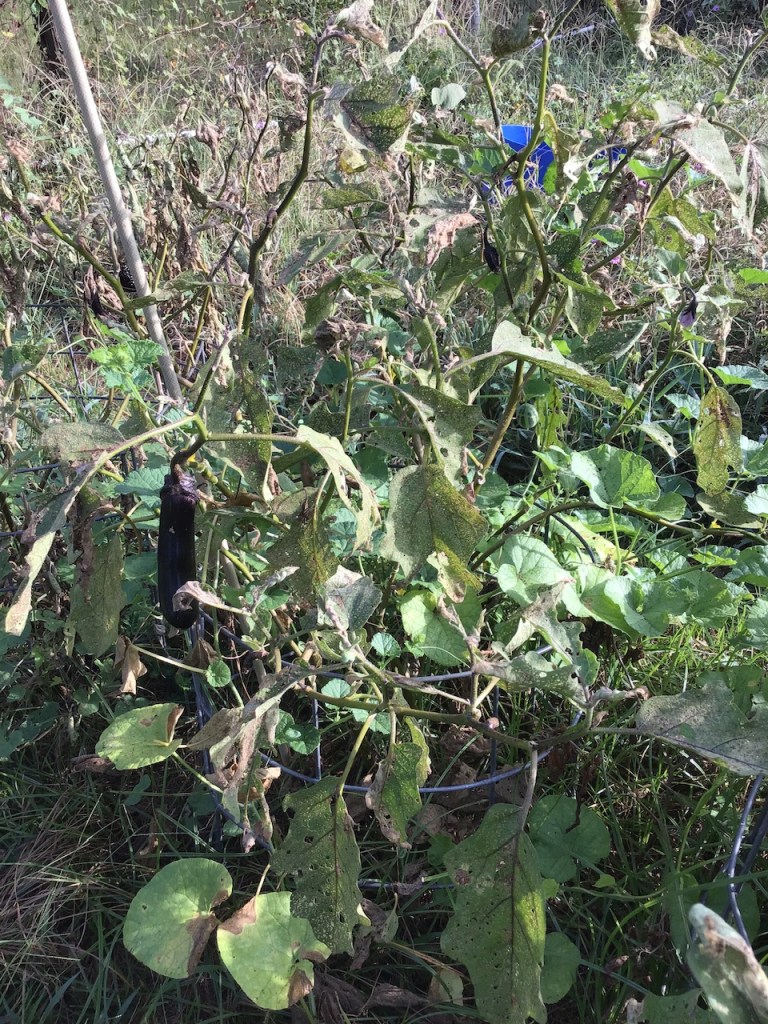
Even the eggplants are dead!
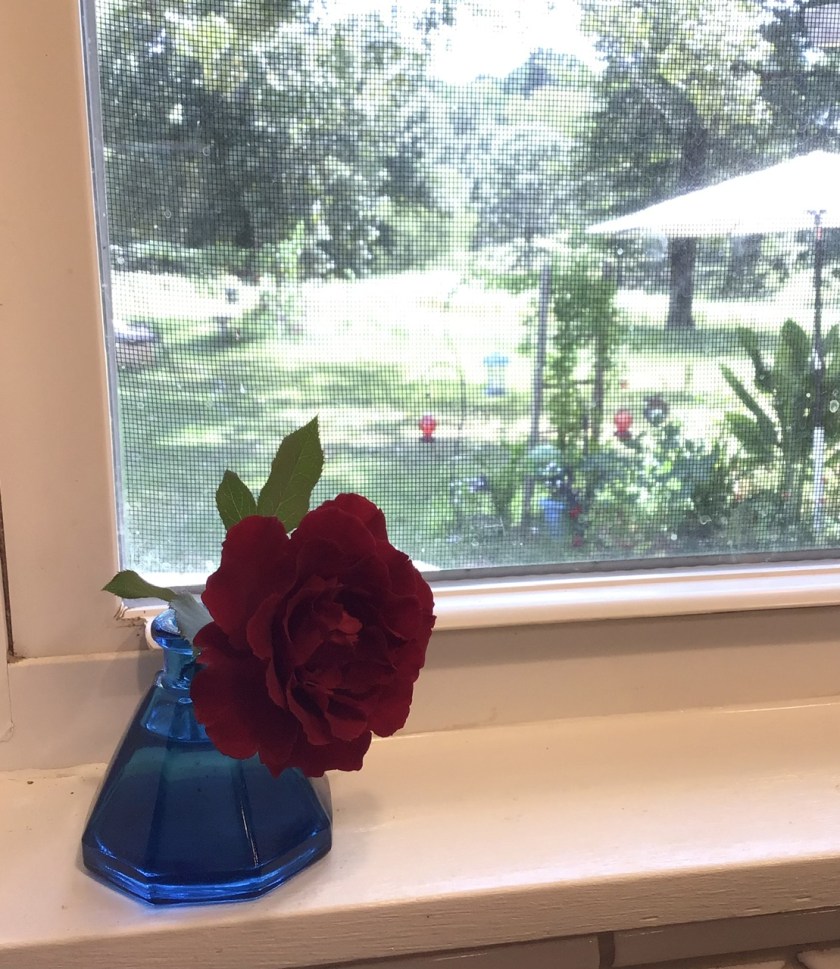
I feed my imagination while gazing out the window while doing the dishes. It’s much less of a chore these days, even while we are cooking almost constantly and have no automatic dishwasher.
View from the sink full of life!
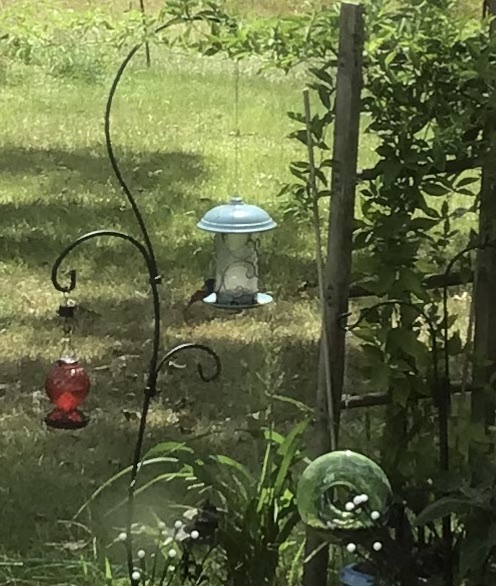
The birds and bees and the flowers that can survive in this misery are my refuge. I’ve made the mistake in the past of stopping the feeders well before the summer dirth, thinking the birds were more migratory and it was better for them to move on. I’ve completely changed my mind, we have constant activity at the feeders, which rejuvenates my mood sans cesse.
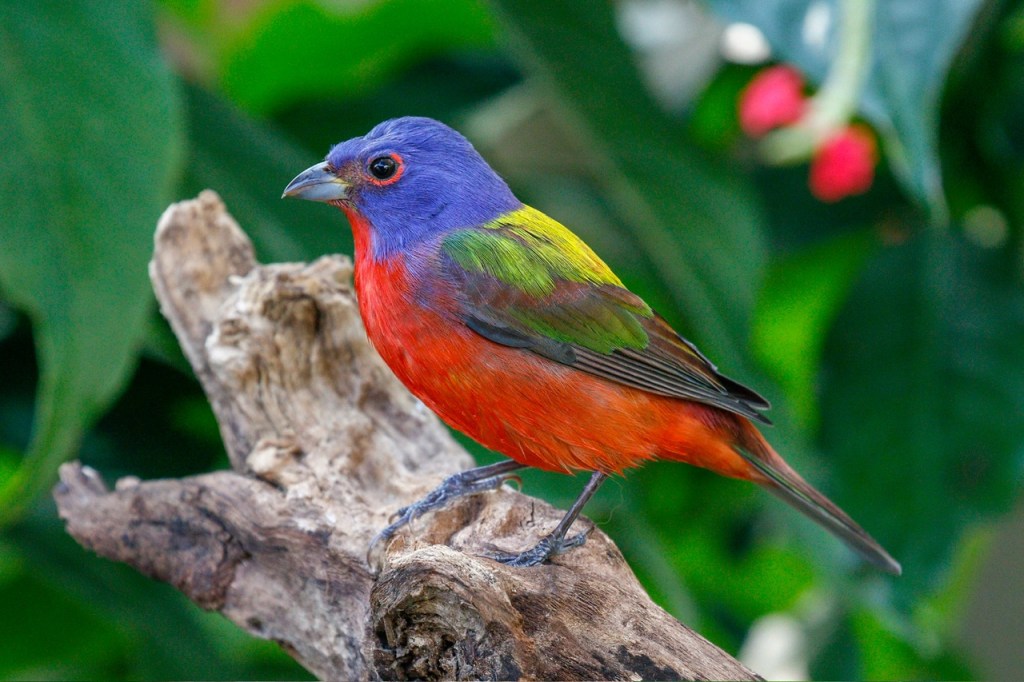
The bird at the feeder here is the gorgeous, but shy, Painted Bunting, I’m thrilled they’re coming so close.
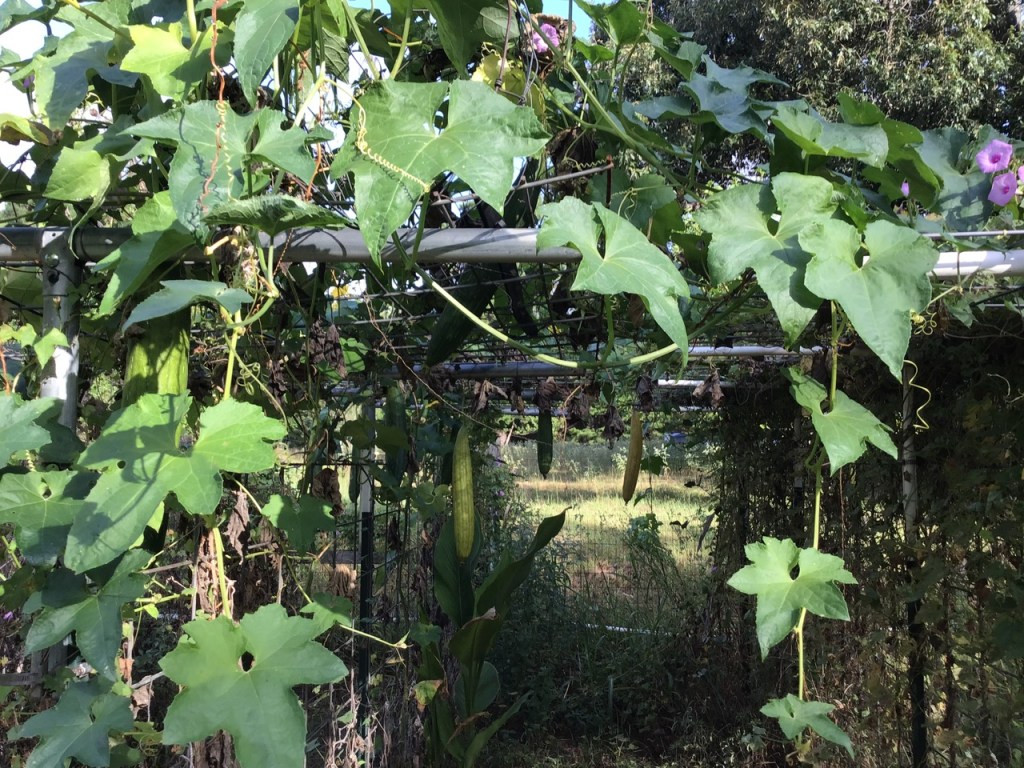
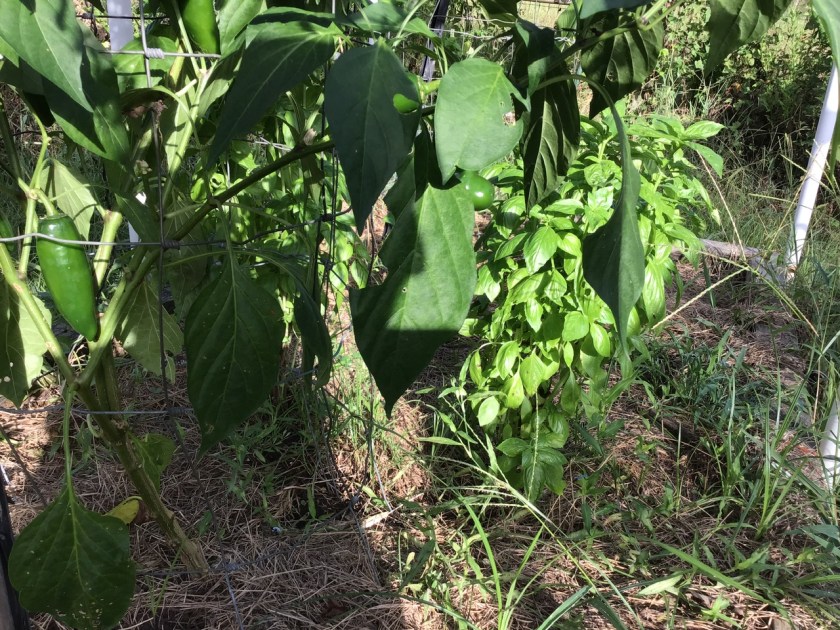
What’s not dead yet? The basil, which becomes such good pesto. The luffa, which is not irrigated presently, but still produces fruit for the pigs and for sponges, as well as continual pollinator forage.
The jalapenos, for making Hubby’s fantastic poppers, with our homegrown-homemade bacon, 2 different raw milk cheeses and baked till bubbly and brown.
So yum!
It’s almost impossible to believe our neighbors used to be able to grow peaches and pecans here without irrigation. Now even with irrigation we can’t grow them. Or plums and even pears are hit or miss. Figs as well, which is the biggest disappointment of all for me, because I so love figs.
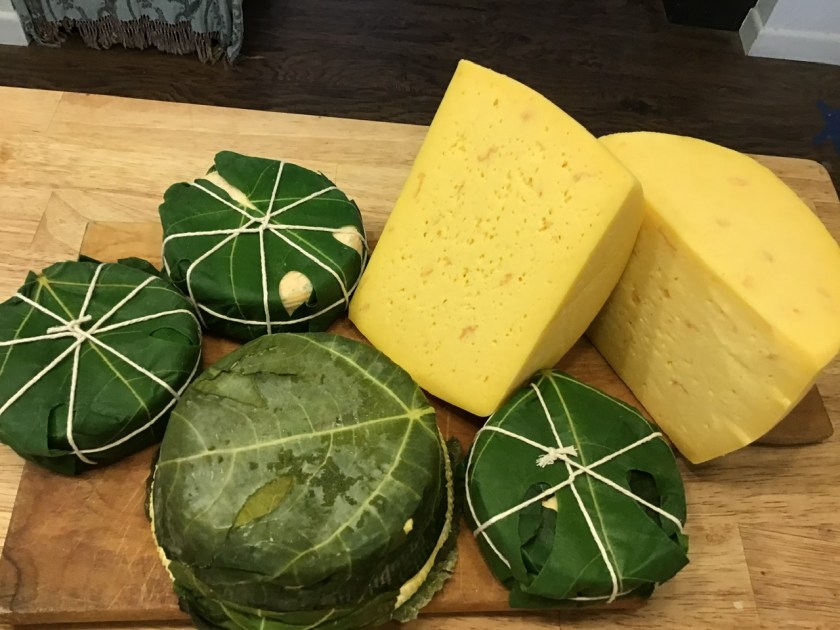
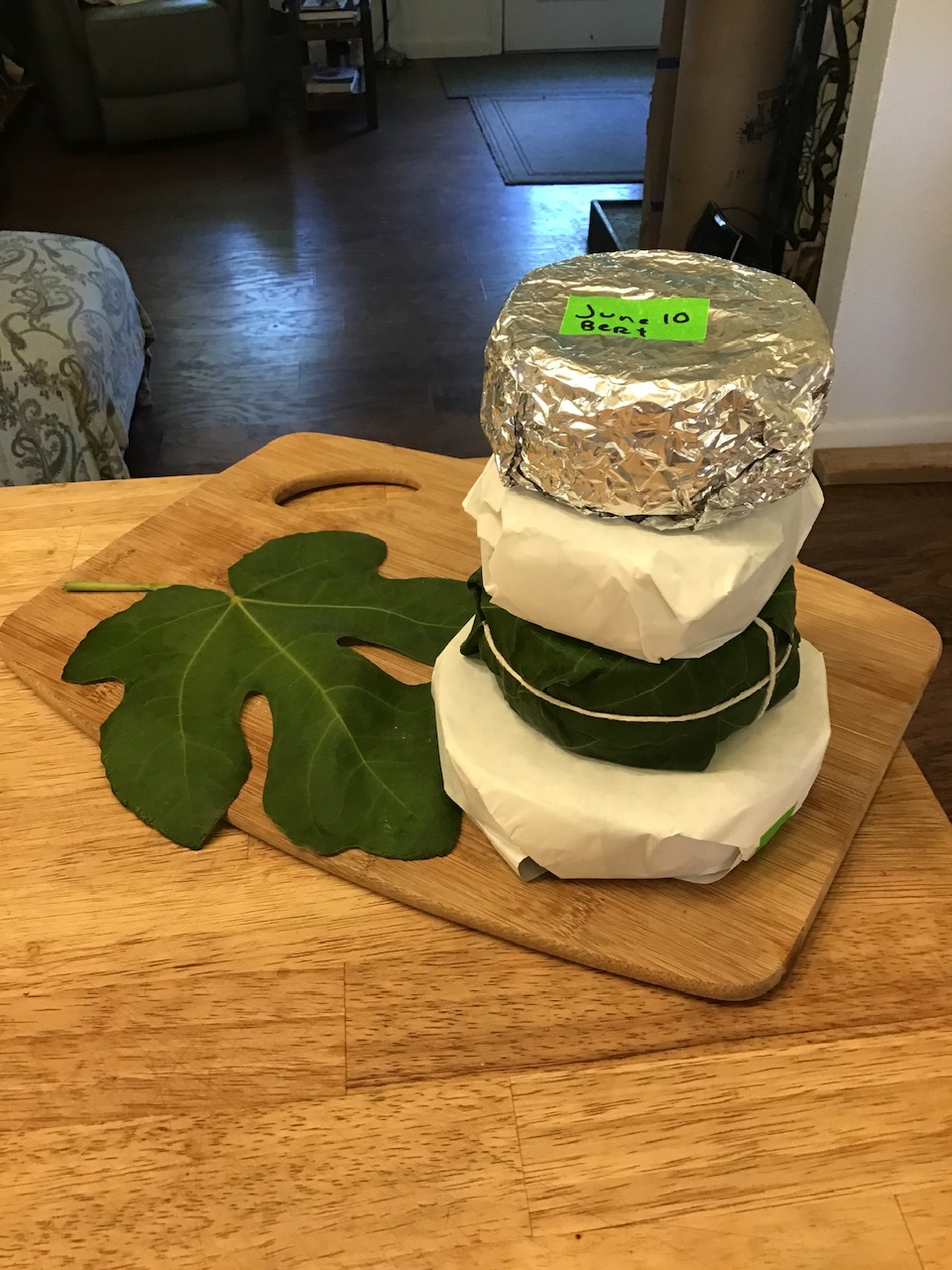
Luckily, we can still rely on plenty of fig leaves, which is my favorite way to age cheese this time of year. The leaves are also wonderful for flavoring ice cream, tea and kombucha. The scent is unique and unmistakable, slightly floral with undertones of coconut and vanilla, but not sweet, more like mildly grassy.
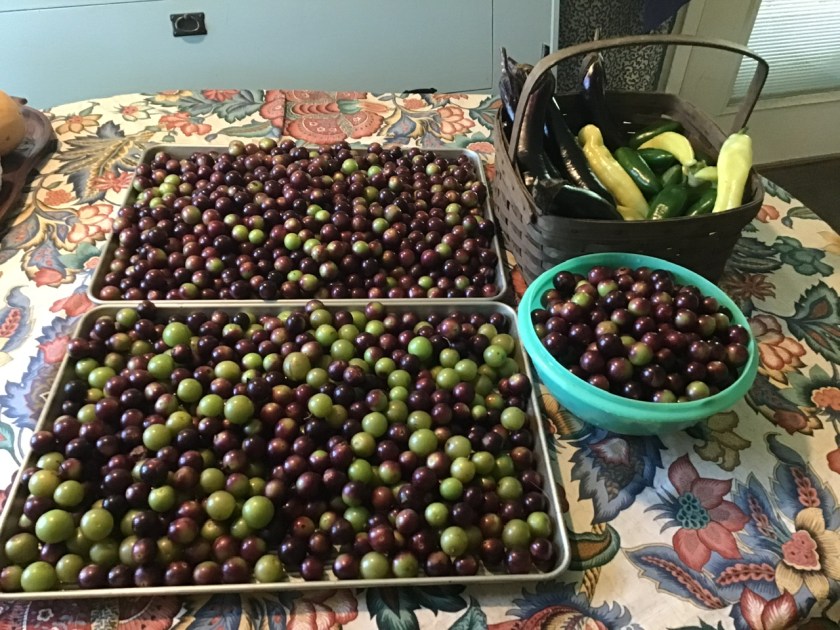
Of all the failed fruits this year, we were not disappointed by the grapes. Soon I’ll be making jam and wine while I hide from the heat in the cool kitchen. Cooking is definitely my main summer doldrum douser. I even got a trial subscription to America’s Test Kitchen, of which I’m taking full advantage.
They actually have a few interesting free episodes about cheese, my favorite topic. As much as I’ve followed in the footsteps of the cheese-snob in generally criticizing American cheeses and our popular preferences for pasteurization and manufactured faux-cheese-like substances, we do a few of the bad things really well, like mac and cheese.
Fun fact I learned, the trick behind the creamy, saucy American version of mac and cheese is all about the science, and the science spells NACHO. 😆
Seems to me what the science is actually attempting to trump is refinement.
The art and craft of maturing cheese, affinage, is typically translated as ‘aging’. In fact a better word would be ‘refining’. Refining is the difference between nacho cheese and aged Parmesan. It’s important to understand the difference, no matter which is preferred.
Is taste in the tongue of the taster? Or is there objectively refined taste, as refined art, and refined beauty? I say yes. One who prefers nacho cheese over aged Parmesan is fine, but would we want that taste setting the standards? I say no.
For me, the doldrums are doused mostly by refinement–by taste, art, craft, imagination, potential–wherever I can find it.
Refinement–exquisite and inspiring
Even here, where others might see sex and seduction, I see mainly refinement. I see taste, art, craft, imagination, and the enormous amount of discipline those take. I am awed and humbled by what’s possible. There’s absolutely no room for the doldrems in that place!
How about you, what’s your favorite recipe for dousing the doldrums?
It’s so important to find inspiration, for so many reasons. Sometimes it’s simply a needed morale booster, and that’s important. Othertimes it’s even more crucial, because without it, growth, expansion, mastery, can be much more difficult, if not impossible.
I’m thinking of when I learned to waterski as a kid. I’m not competitive by nature, and I’m introverted, so maybe that’s why inspiration is so crucial to my developmental process.
Introverts can be bold and adventurous, most folks don’t understand that, because they don’t push themselves into the public eye.
Just focus on making cool designs in the water? I’d totally be into that!
That’s not me, it’s a stock photo, but she would’ve inspired me had I seen her!
Once my mom and grandpa taught me the basics, encouraging me all the way to slolem, I didn’t really know what else to do with it anymore. Sure, it was still fun enough, but fun is quickly boring to me without growth. Without learning. Without challenge.
For a naturally competitve person stagnation is less of a problem, they will seek out others and join in, finding the skill-level and motivation to improve in their desired venture.
Our society is built for such types. Even the internet is being rearranged to further augment competition and extroversion, because a militarized, institution-worshipping culture must by necessity favor hierarchy over collaboration.
As a case in point, consider the popular expression, “Those who can . . . do, those who can’t . . . teach.” This condescension deliberately misses the mark to award ‘the doers’ as those ‘at the top’ who are amply rewarded with success and status.
In fact, a good teacher rarely has the same qualities as the high-achieving, status-seeking competitive types, because the skills and capacities required are very different. The best teachers often shun the limelight, and often competion, for good reason. Of course, there are always exceptions to the rule.
It’s not at all uncommon for professionals and lay folk alike to equate their child’s introversion with ‘shyness’ while wishing it will soon be thoroughly outgrown. In many cases a completely natural prediliction for deep-thinking, solitude, study, is suspicion for a mental disorder, as social anxiety, depression, anti-social, or even . . .a lone-wolf serial killer.
Maturity without the coercive social control of modernity demonstrates the opposite, more solitude should naturally be aligned with greater levels of introspection, thoughtfulness, observation, consideration, instead of illiciting derorgatory social criticism like unmotivated, passive, lazy, loner, dorky, awkward, and the like.
I hear that’s changing, but I’m not convinced. Think about it for a sec. How many derorgatory words do we have for the excessively competitive or extraverted in comparison? How often do we lecture extroverts on the importance of introspection as we push introverts to ‘get in the game’?
But, can we really say the obsessively competitive are socially safer than the obsessively reclusive?
I think not.
Highly competitive players, while I fully understand their value as motivators, are rarely good teachers or role models, yet we can’t seem to get enough of them.
They can sometimes be so extraordinarily good they compel admiration from a very great distance, like this dude, who is so mesmerizing, precisely because they can bring out the best, and the worst, in their audiences, as well as in their personal life and relationships.
Not a fan of sports, not particularly attracted to aggression and dominance games, but damn, too long watching him and that might shift somewhat! Lord have mercy!
And yet, while nothing has changed as far as society catering to the extroverted and competitive, before the internet and streaming services, someone like me had a far more challenging time connecting to a ‘master source’.
So, finally, the point of my post.
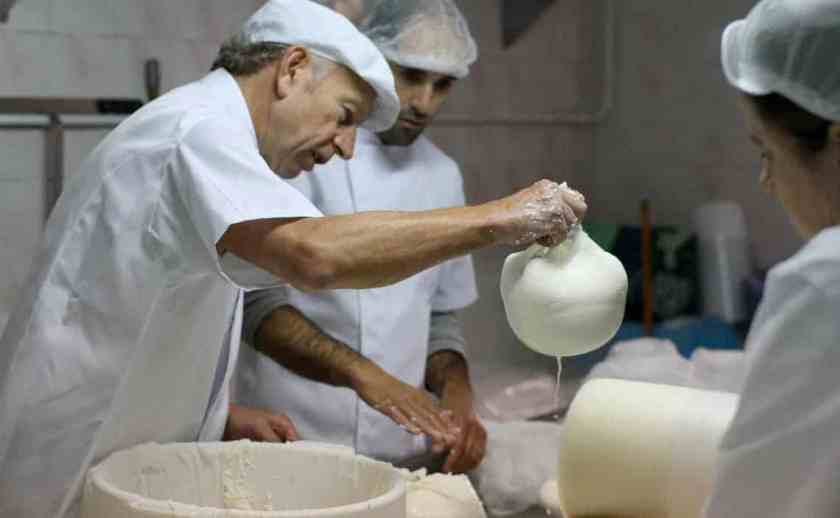
Cheese influencers, where would I be without them? I think I’d be still not far from my original cheese workshop learning from a decade ago. Instead I’ve been around the world in cheese wisdom, more than once.
Authors, teachers, creators, well, even simple bloggers, we should pat each other on the back more often.
Here’s two amazing cheesemaking inspirations in my wee world lately. I want to pat them on the back, because I am so very grateful to them! They’ve inspired me in so many ways– to up my game, to consider new angles, to experiment, to expand, to deeply appreciate, so, so many things.
“After establishing several delicatessens in central London in the 1970s, will migrated to Australia, where he has worked tirelessly to promote a greater understanding of what good cheese is all about, as well as championing the cause of traditional cheeses made from raw milk. Will is the author of two comprehensive cheese books, including Chalk and Cheese, which won ‘World’s Best Cheese Book’ at the Gourmand Awards in Paris. He is also executive producer and presenter of Cheese Slices, a 29-hour documentary series focused on artisanal cheese. Since its premiere in 2002, Will has filmed hundreds of dairies and cheesemakers in over two dozen countries.”
And on a smaller scale, a Youtuber, passionate and instructive, rather extroverted, possibly even competitive, who is now venturing into live online workshops, and more power to her!
In the year 2000, an Amish farmer named Amos Miller attended a Weston A. Price Foundation conference with his father. He listened to Sally Fallon talk about traditional food: raw milk, grass-fed meat, fermented vegetables, the way humans ate for ten thousand years before the USDA decided it was dangerous. He went home to Lancaster County, Pennsylvania, and started selling it. Twenty-six years later, his farm has been raided by federal agents, subjected to three consent decrees, slapped with $85,000 in fines, and dragged through nearly a decade of litigation across federal and state courts. His products have been blockaded, detained, and ordered destroyed.
If you need some good news, continue reading . . .
He’s still selling. His food club has over 4,000 members nationwide. And an appeals court just ruled that Pennsylvania can’t stop him from shipping across state lines. This is the story of the underground real food economy, and why the government keeps losing to a man who doesn’t use electricity.
I really mean it, for all, not just the government. You seriously over-estimate yourselves, all ye who cling to the coping, helping, giving categories.
At 12 I asked my ballet teacher to help me improve my lacklaster turnout. I have hip problems to this day from her suggested, prolongued, insufferable positions.
At 20 I asked my professor to help me with a chapter of my novel. That was asking a lot, but rather than saying ‘no’ she redirected me from my natural aptitude toward her personal literary preferences.
At 23 I asked a close friend to teach me to snow ski. Big mistake, I loathe downhill skiing to this day after he ‘accidentally’ led me down the black diamond run instead of the bunny hills.
At 33 I asked my sister for advice on a very sensitive issue. Big fucking mistake, again.
At 40, oh yes, more bad advice. Not long after that crisis I was given ‘help’ after asking for it, in the form of drama from disturbed individuals. Ask for help, receive drama, that’s the pattern.
And more at 45, indeed still at 55, plus!
The solicited advice is bad enough, then there’s the constant stream of unsolicited advice.
The latest offense coming laughably not too long ago. “Don’t say yes to things that will drain you.”
Classic condescending cuntery! From a so-called friend! That will be going on a permanent plaque in the forefront of my mind, forever.
So many (not) thanks!
Will I ever learn? Can I ever learn?!
Let me give y’all some really hard-earned, yet totally unsolicited advice.
Most advice sucks! Most advice proferrers are FOS.
We-means-I . . .
Hopefully, maybe overtime we recognize and can more easily sift the rare and precious advice from the . . . might we dare to say . . . the profane?
Self-satisfaction is king and his queen is self-delusion! And you can quote me on that!
And all that bitched, here’s my best-ever advice based on a lifetime of bad advice, and now featured eternally on Youtube: Choose reality over fantasy.
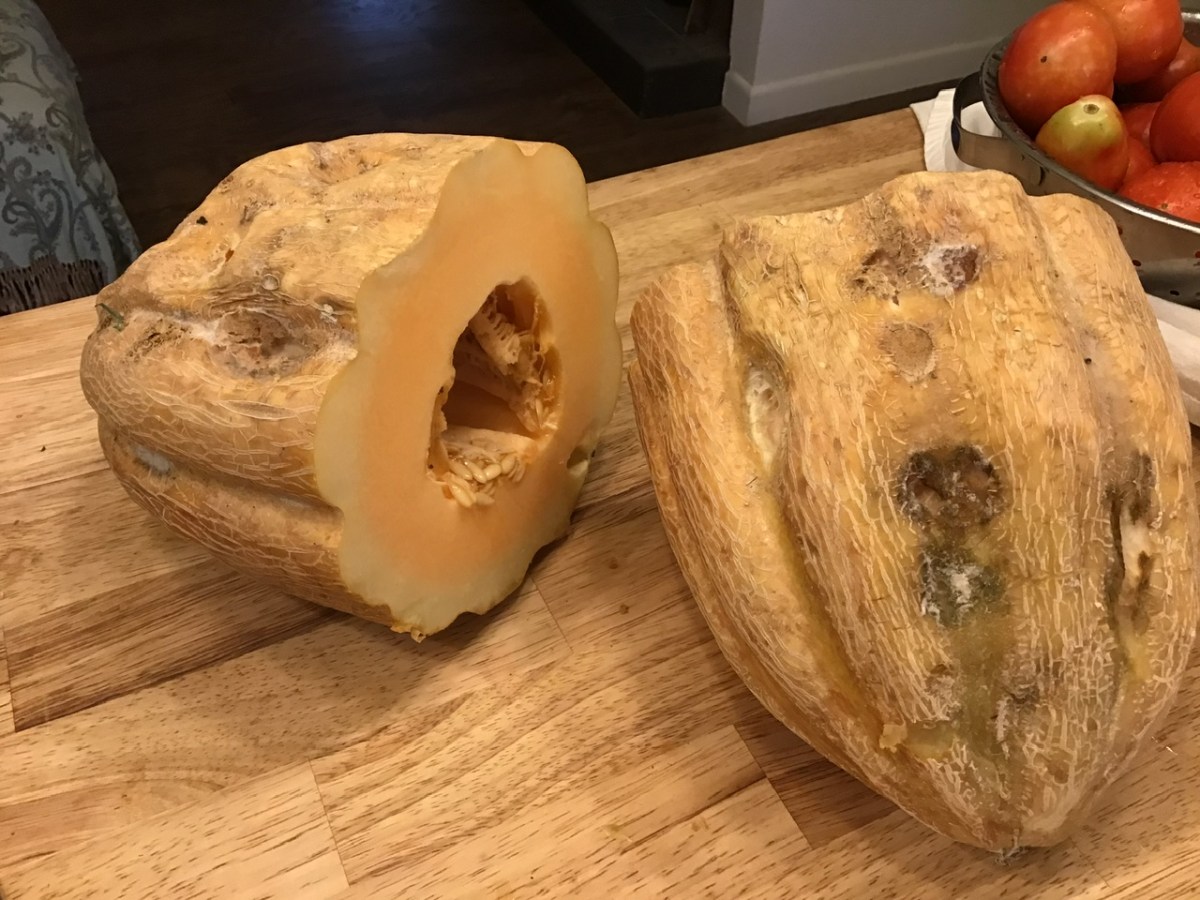
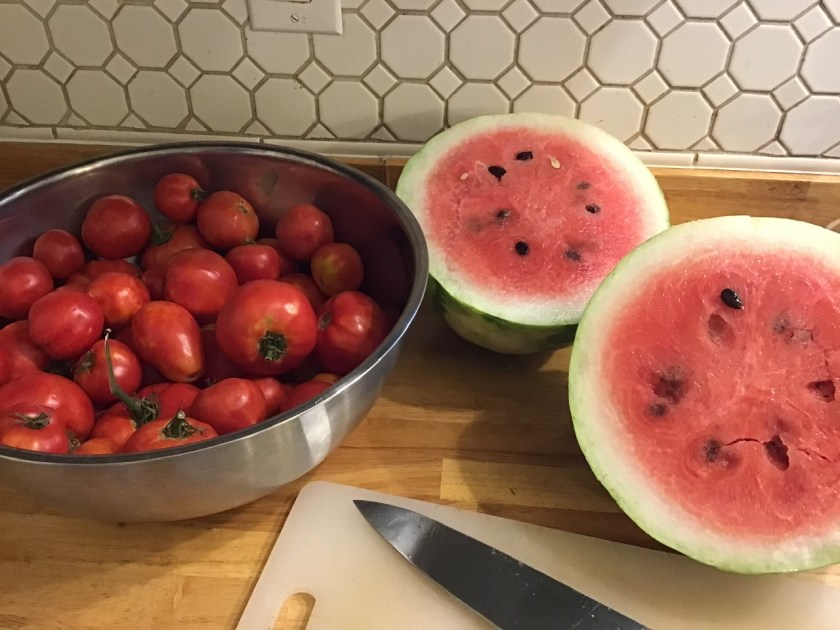
That disgusting-looking melon is the first one to be halfway decent this year. We nearly fed it to the pigs out of looks alone. Our cucs and melons have been crap. We don’t know why. The cucs were bitter by their first harvest, the melons are ripening in a most bizarre haphazard sort of way that half rots while the other half remains unripened.
It’s not quite the same as the old adage ‘don’t judge a book by its cover.’
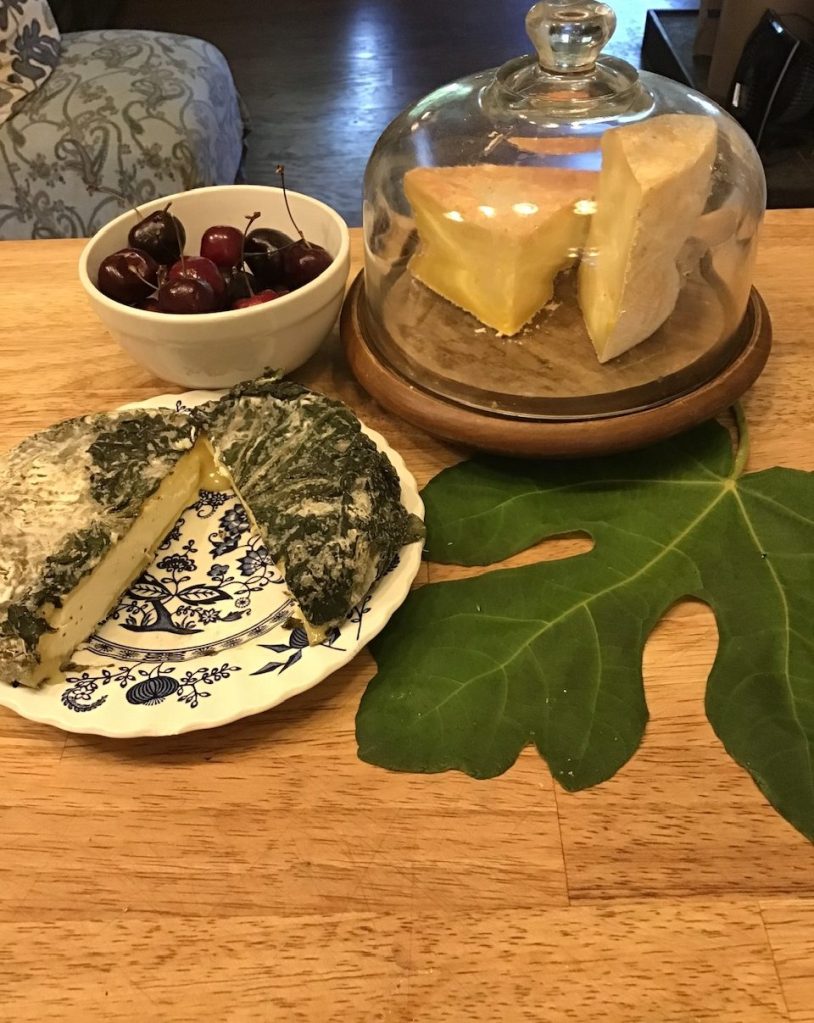
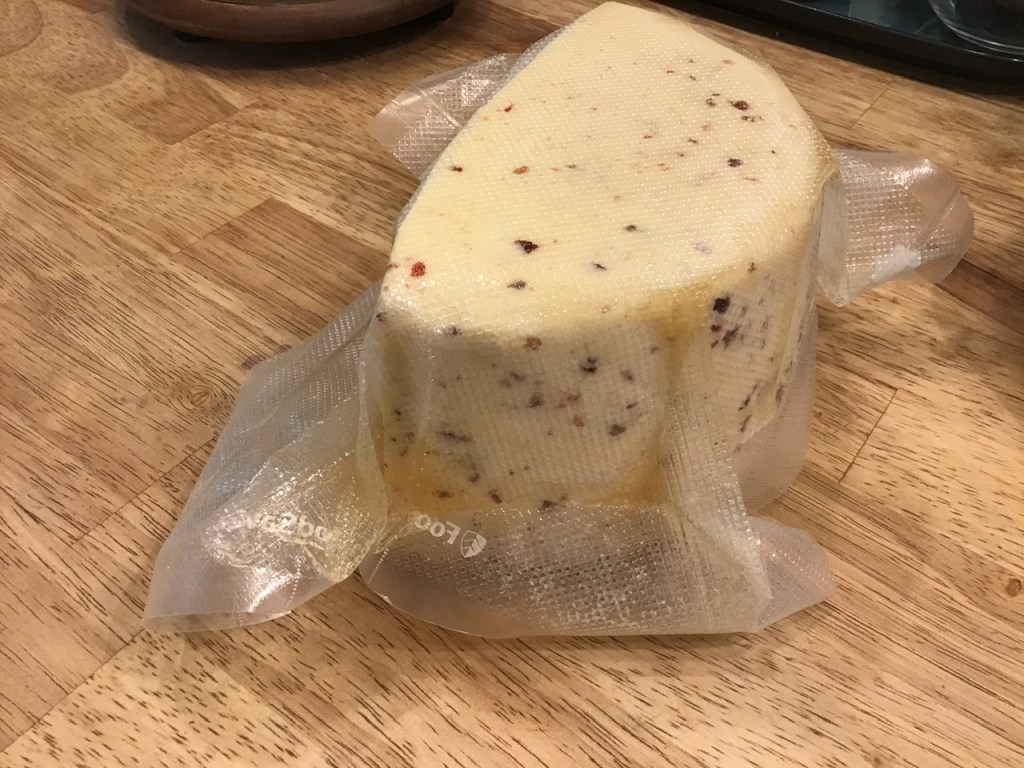
that ugle cheese on the plate is a first-time cheese experiment success. and damn how I needed that yesterday. a soft, non-renneted fresh cheese wrapped in fig leaf and aged for 6 weeks.
I love cherries so much I display them over our own grapes, also coming in half-ripe, half-spoiled, on the same bunch.
That is, cherries from Walmart, on special at an irrestible $2/pound! On my once-a-month town run, which I mostly loathe, especially when it includes Walmart!
We call it a ‘bad year’.
I’m exhausted.
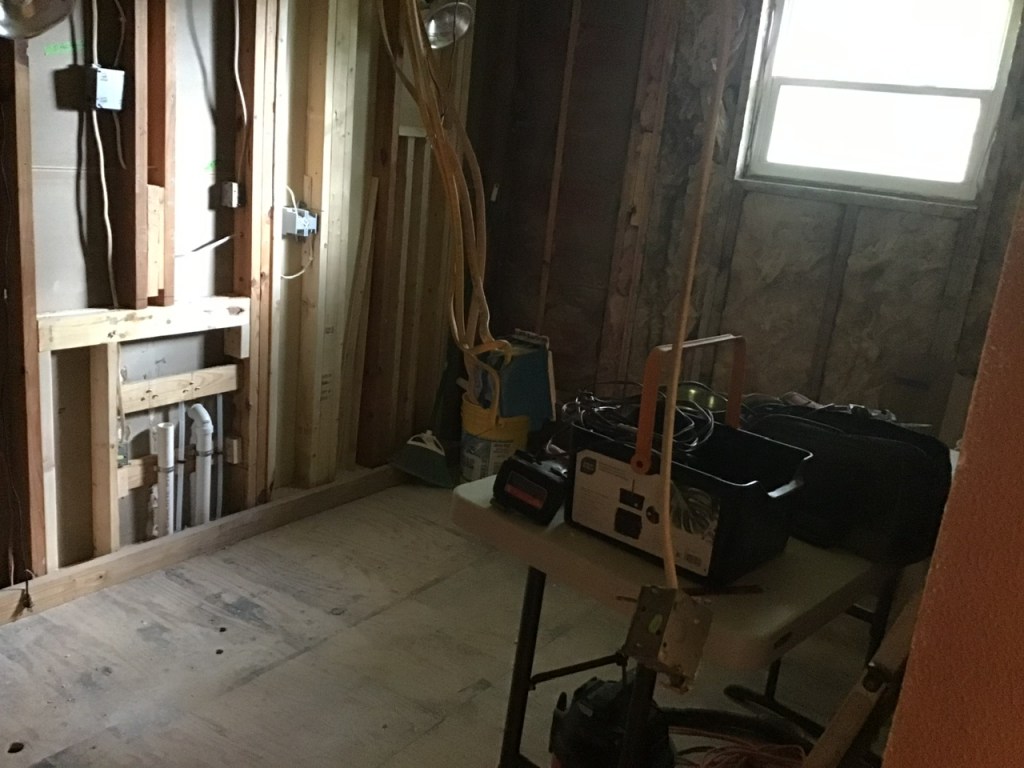
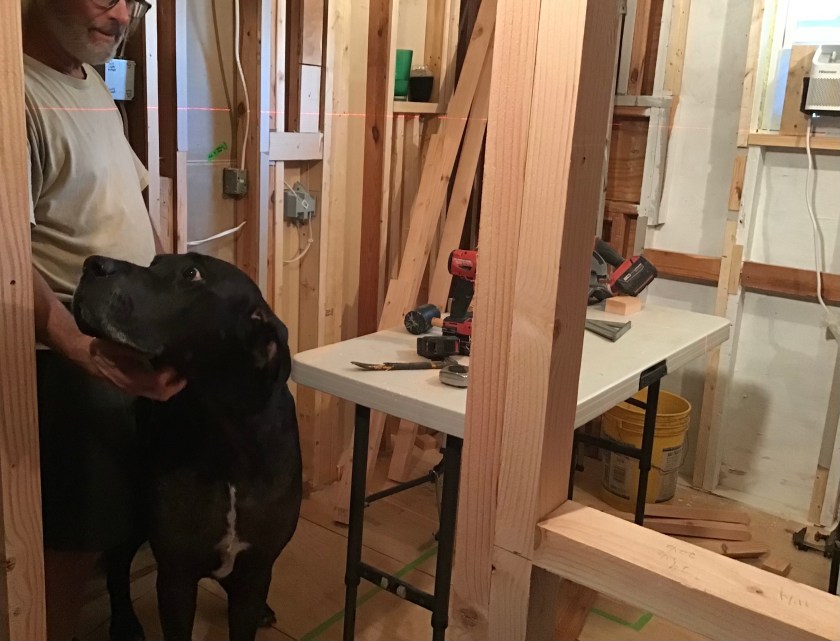
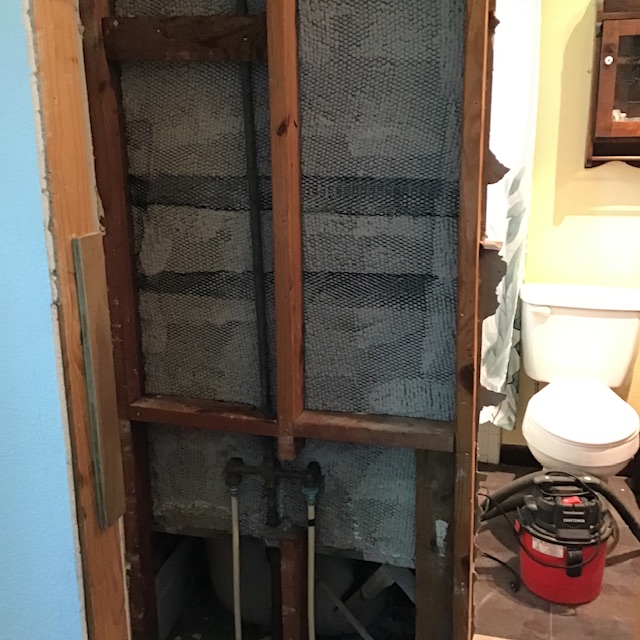
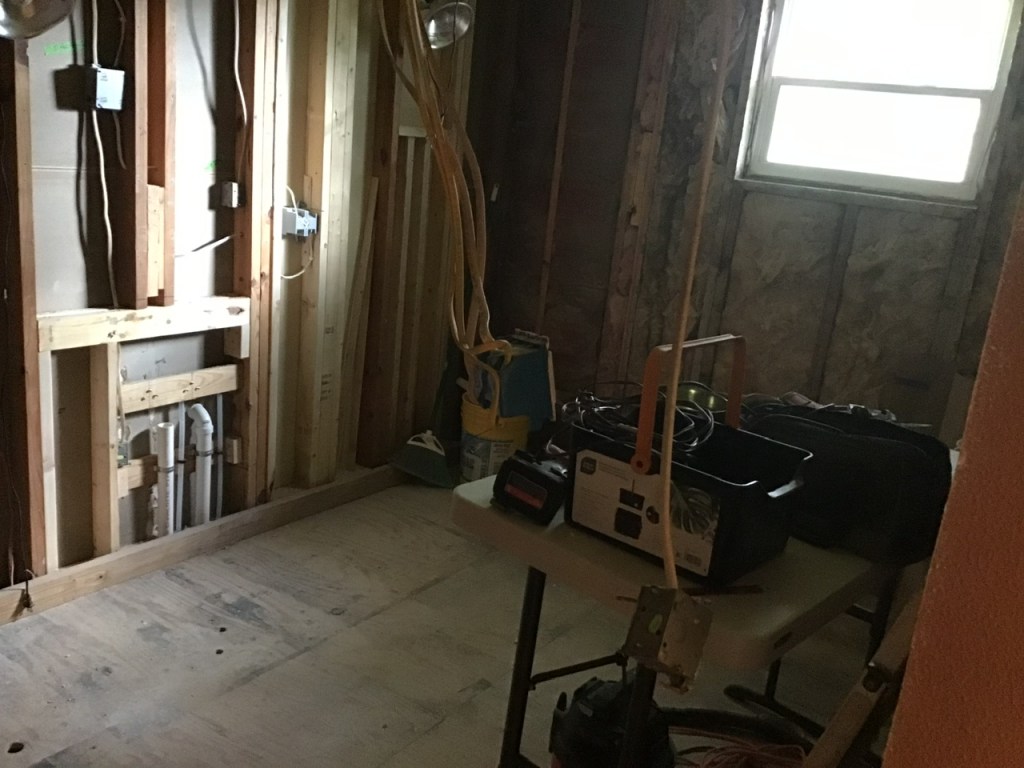
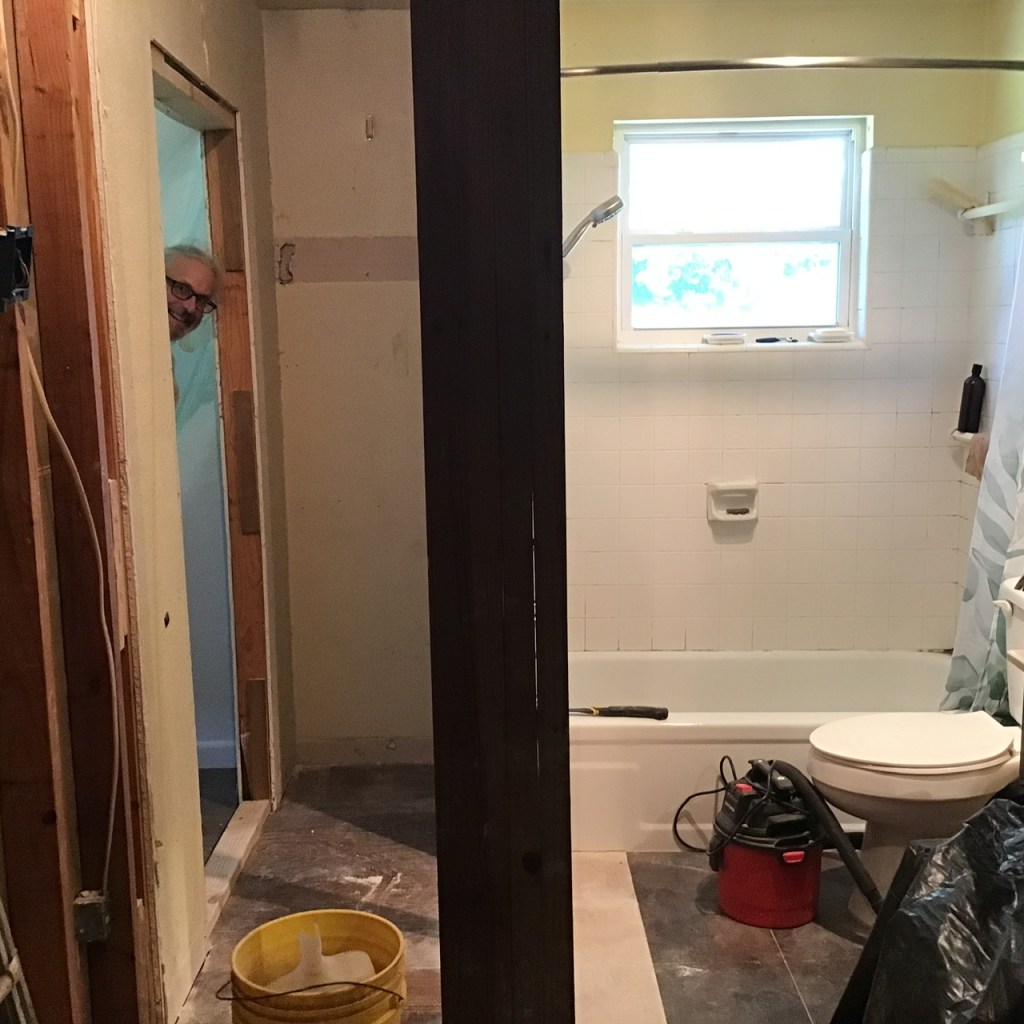
Hubby barrels on in the heat on our new bathroom, while I wither.
Bad years are to be expected, yet . . .
What will it take to see it through fresh eyes?
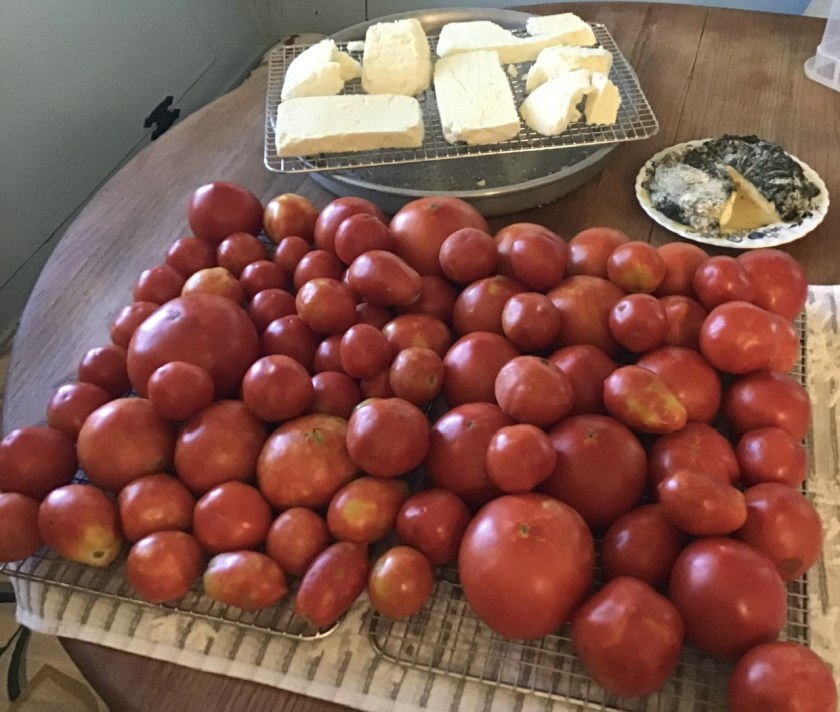
Tomatoes and feta, ugly, but still pretty tasty!
We don’t typically expect how that will feel.
Whether good or bad. It sort of molds into a morph-space best called ‘unexpected.’
I was not raised to be a ‘tough times’ sort of girl. I struggle every summer here, I complain in writing every summer. I think it helps, but, only because it helps me, to carry-on.
Seduced by slogans
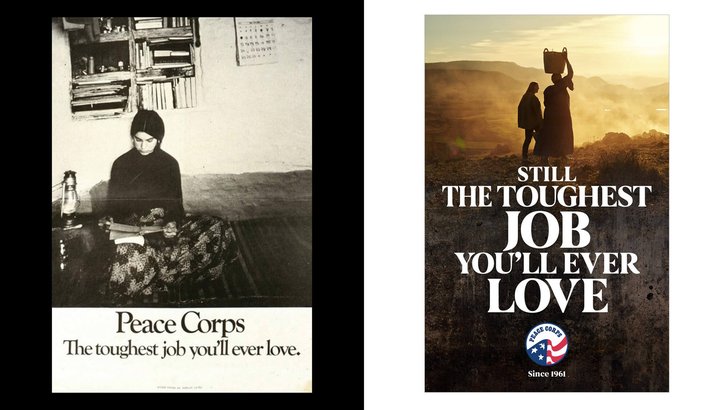
I only became a fantasy tough-times type through marketing. So, forty years later I really understand its power.
My maternal grandfather was a salesman who used to try to warn us about marketing. He used to turn down the commercials on the constantly-on TV. The commercials were often the only part of the selected programming that I liked.
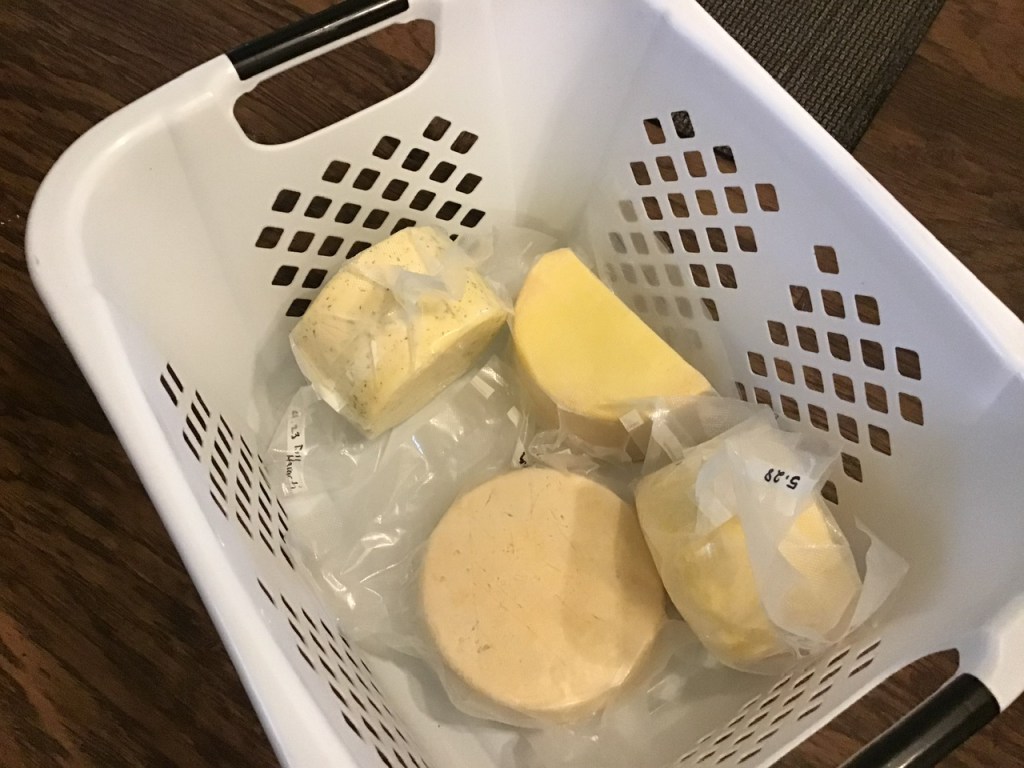
moisture in the cheese from fridge failureMajor cheese aging breakdown, a day’s unexpected work, severe frustration.
The more things change, the more they stay the same. Or, so the slogan says.
I liked this sewing lady’s take, she seems more aware and accepting of the times than I am. Sometimes inspiration comes from the oddest places. Thanks for that.
Luxury comes at great costs we rarely acknowledge, especially the appearance of it.
A homestead happenings post complete with dirty DIY pics, jungle-garden updates and my attempts at calm amidst the chaos.
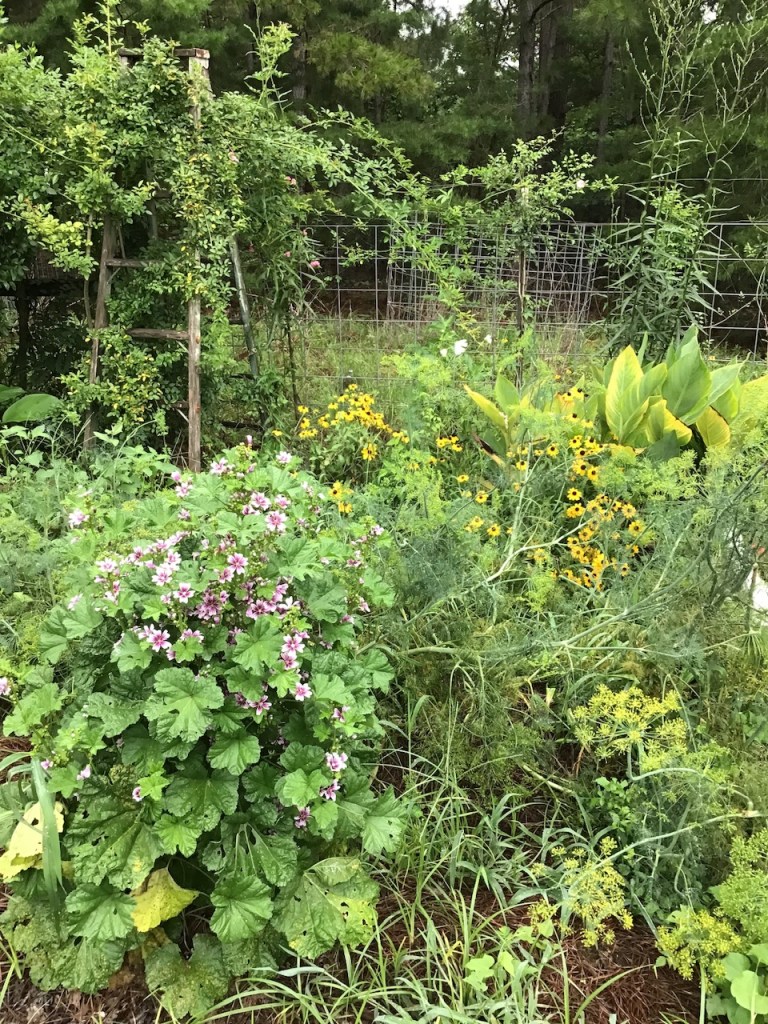
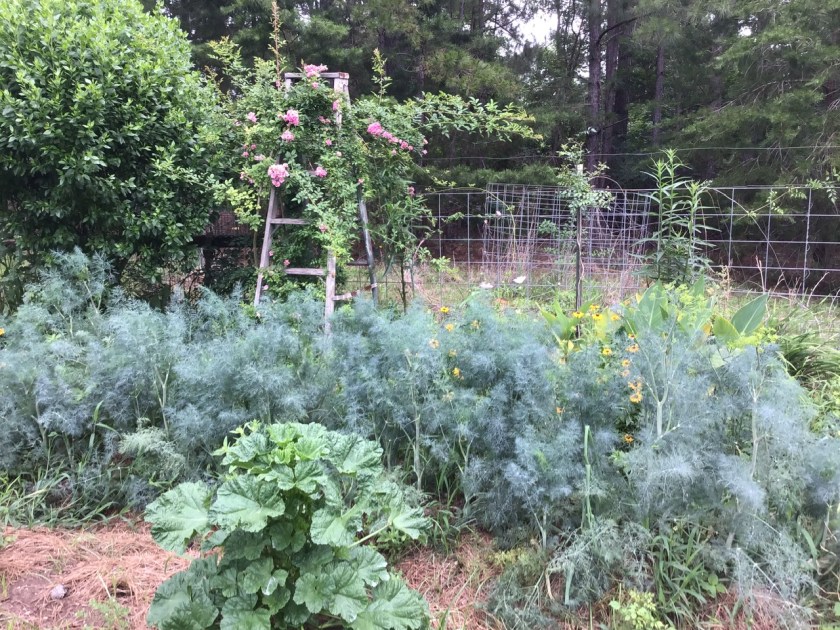
While I see others around the world are thrilled with finally warm temps and blossoming gardens, we’ve already hit the hot mess stage. I’m embarrased a bit to include pics of the jungle that just a few weeks ago had several brag-worthy elements.
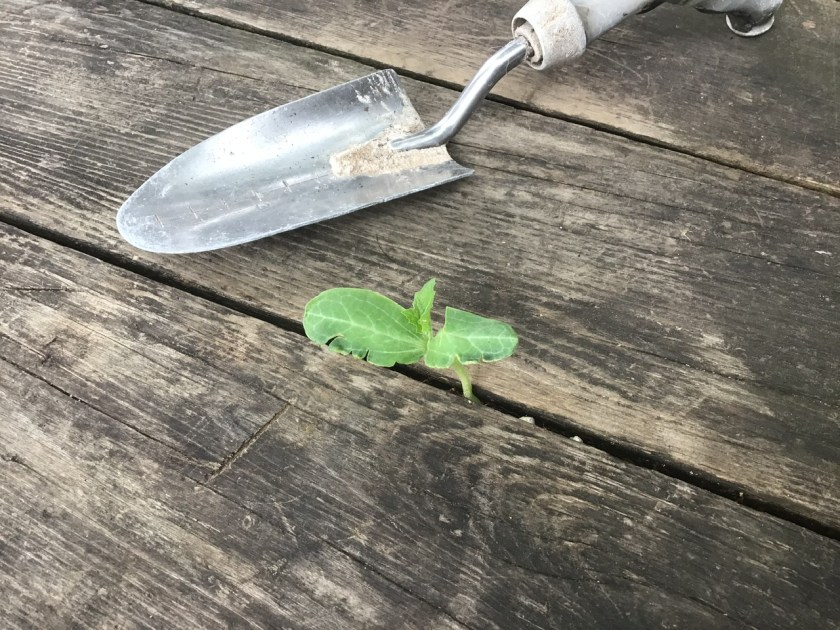
It’s so hot, wet and fertile here the seeds are coming up anywhere!
Oddly, not the cucumbers nor the onions. We’ve had bad onion years before, but cucs are our biggest no-brainer. I can’t recall ever having a bad year, normally they are so prolific they become pig food by this time, but this year we haven’t even had a big enough harvest to pickle, and they’re already dying back in the swelter. I’ve succession planted and can only hope whatever fluke has hit them, the youngens will bounce back by next month.
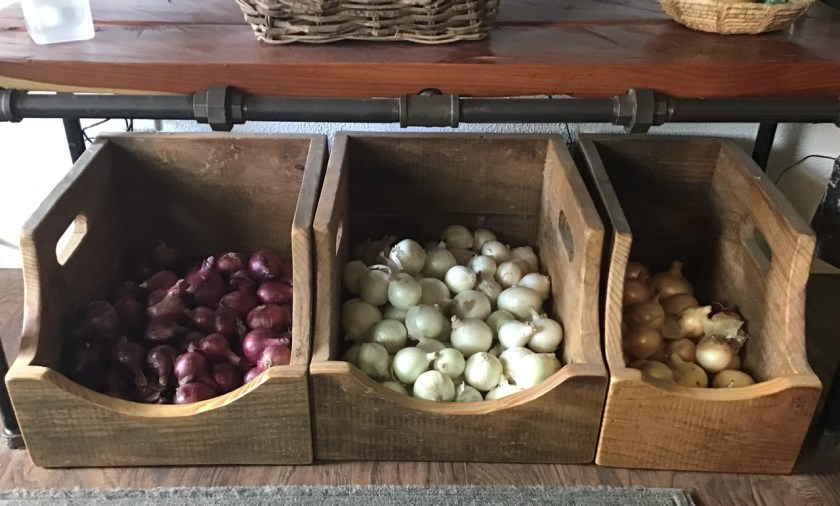
I guess it’s relative, when I see the onions displayed like that in Hubby’s hand-crafted bins, it seems ok.
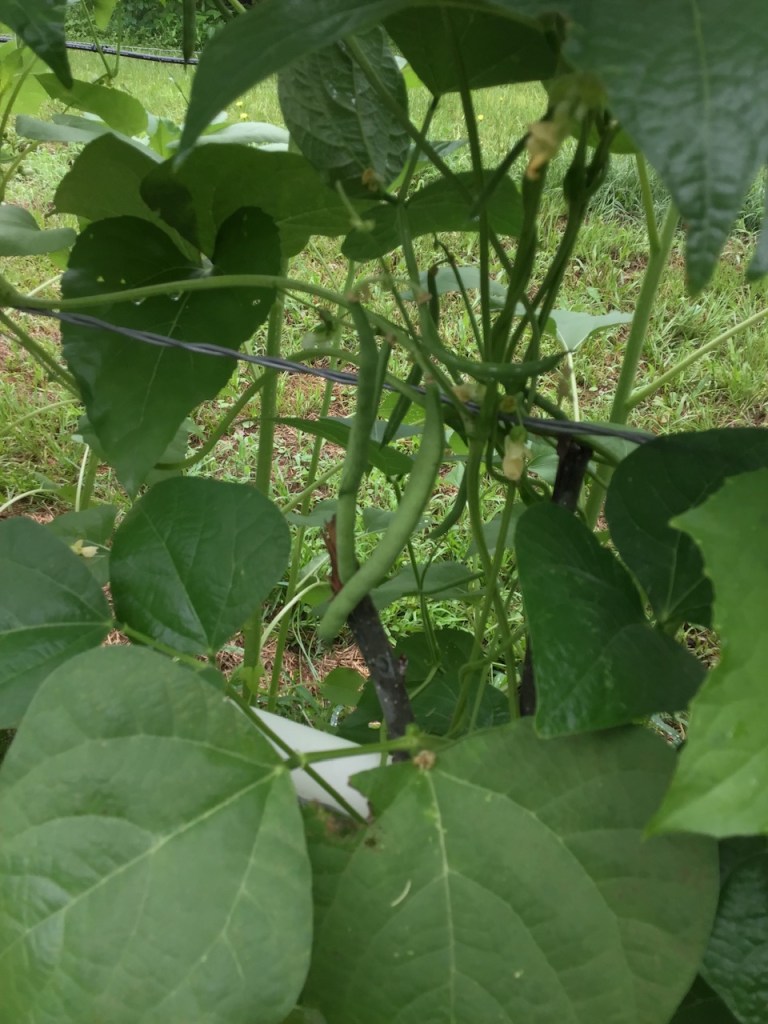
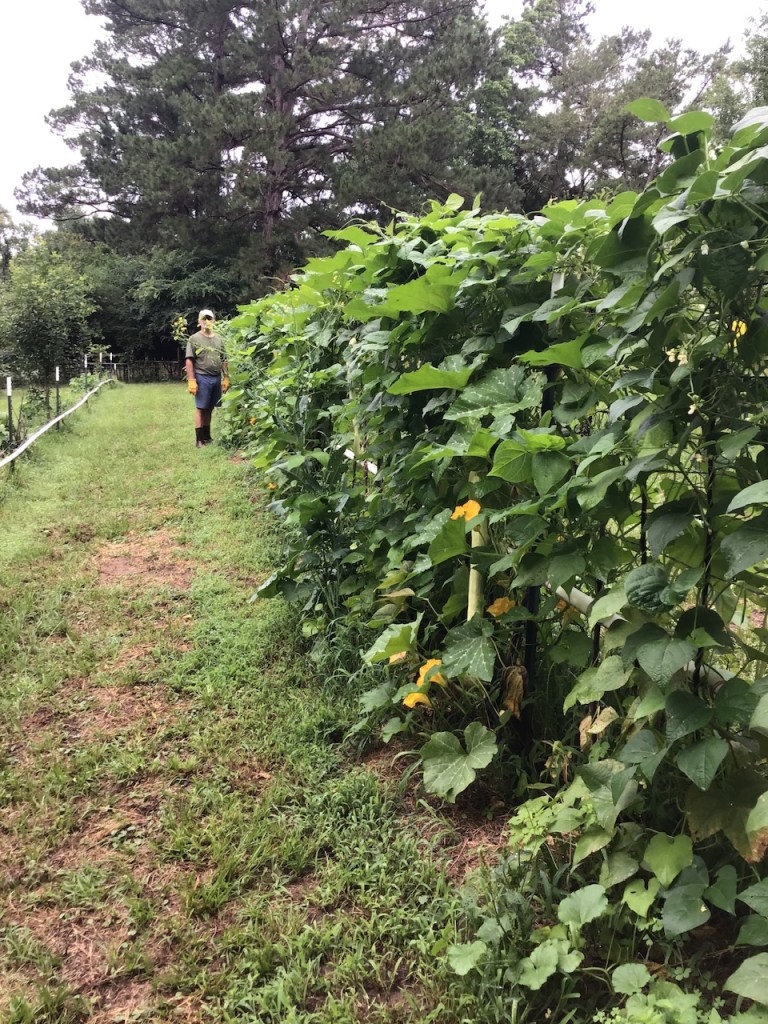
The green beans in Hubby’s monster row are producing by the bushel and I’m already sick of them. We’re too unsettled with the bathroom DIY to do any canning and have even stopped harvesting them. Such a shame, I do hate to see them go to waste, but it’s all I can do to keep up with all the other chores.
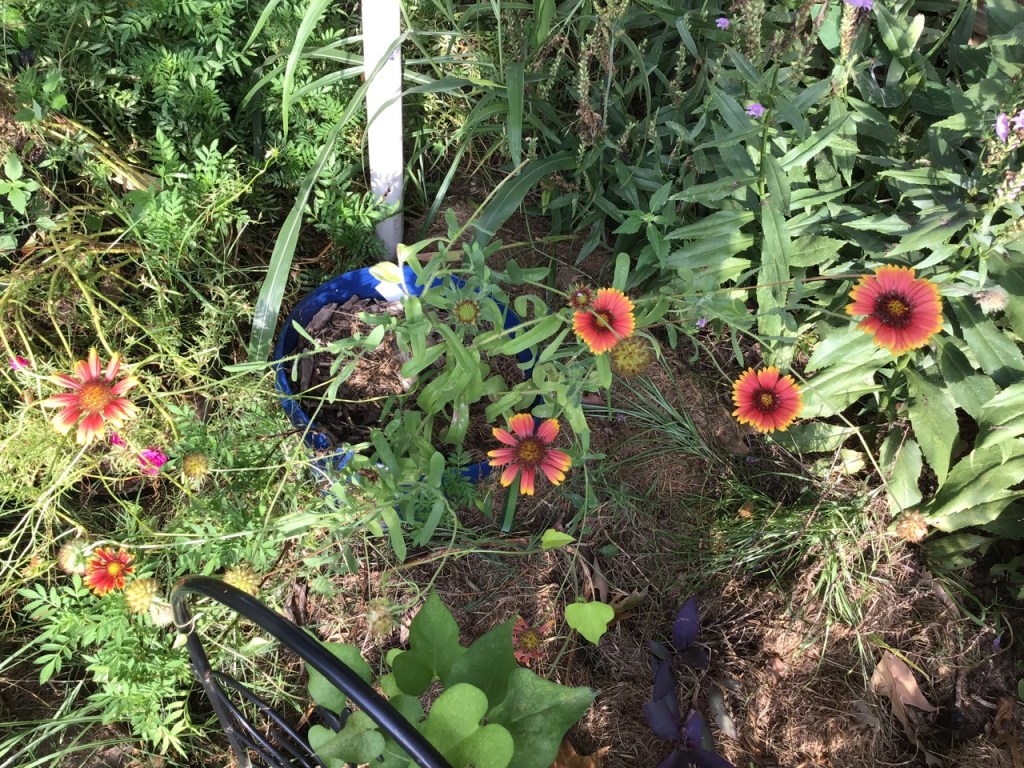
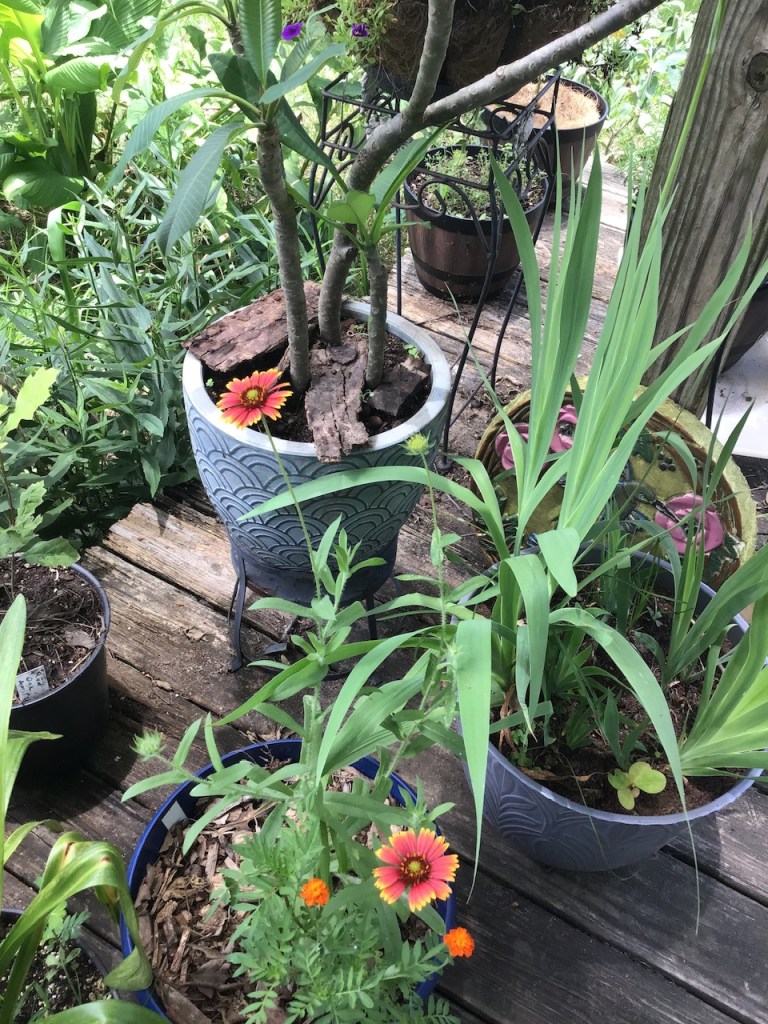
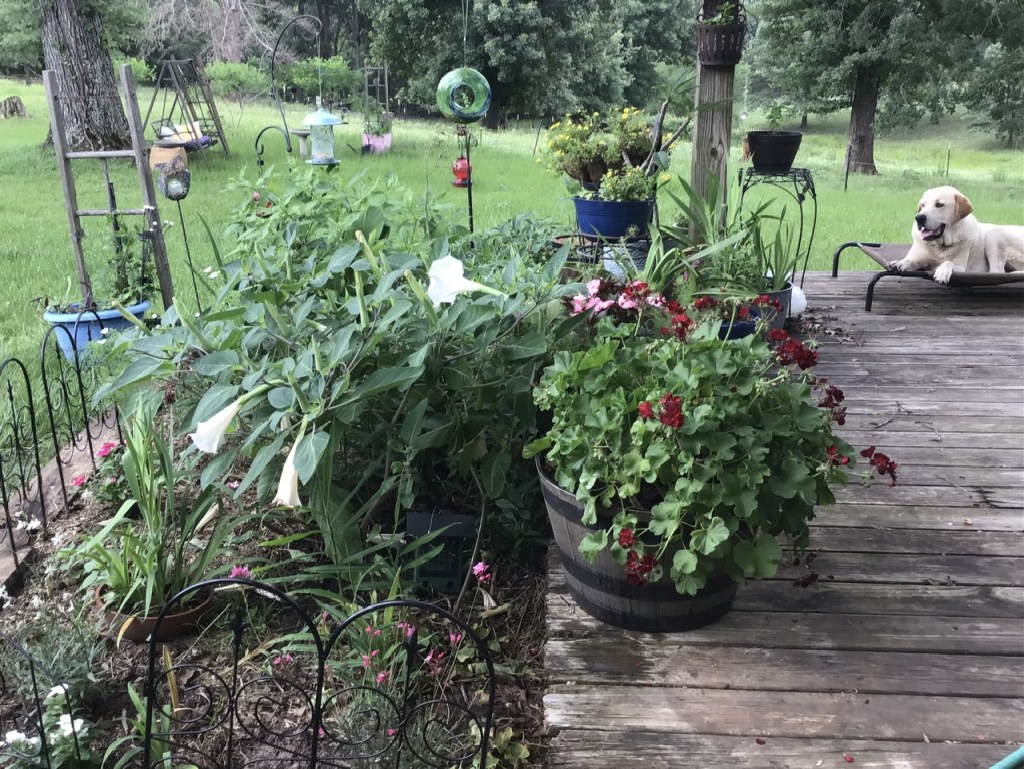
Like the flowers! I know, it sounds rather frivolous compared to beans, to devote my painfully precious hours of manual labor to flowers instead of food, but they make me so happy I’ve gotten over it.
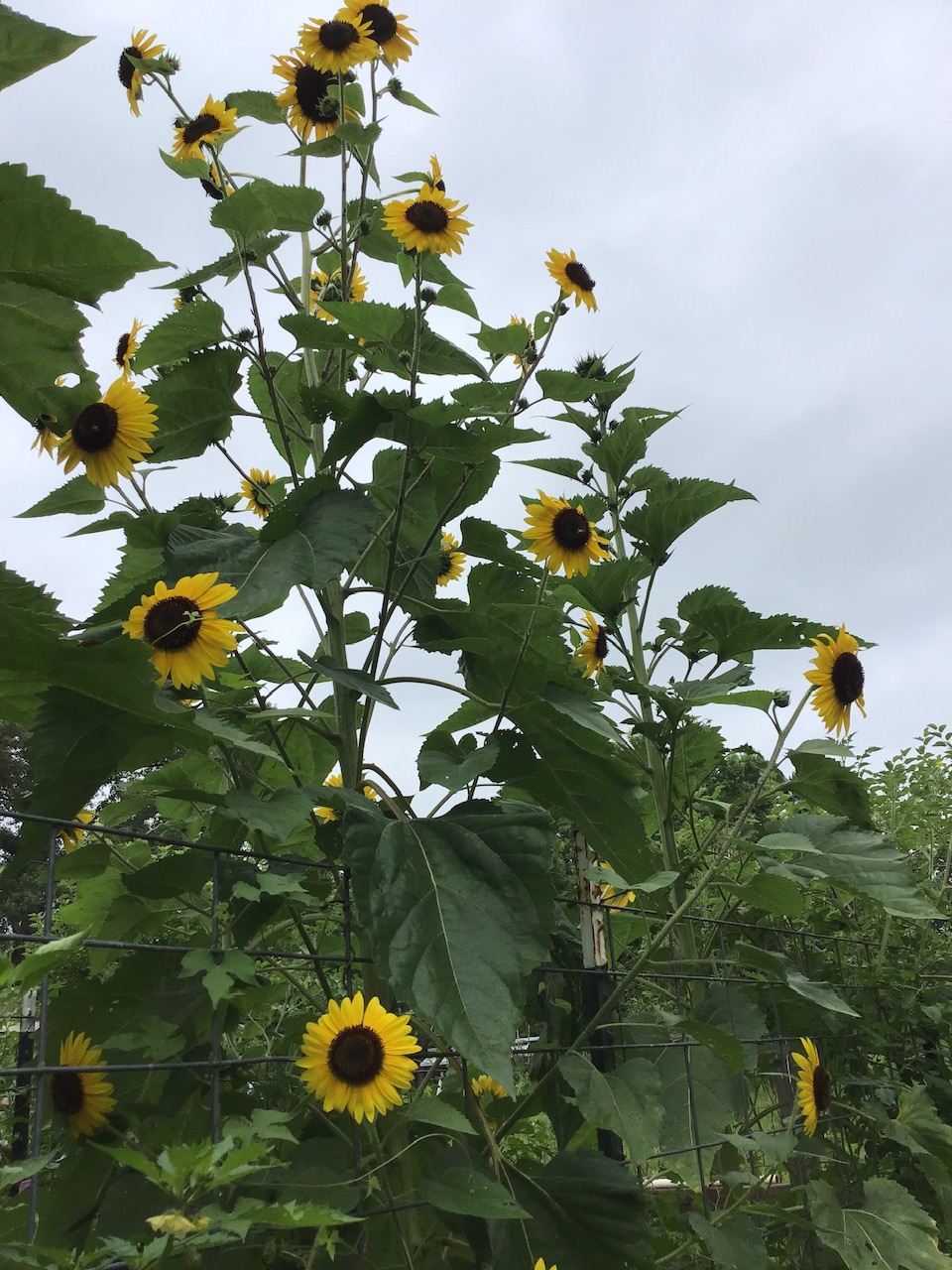
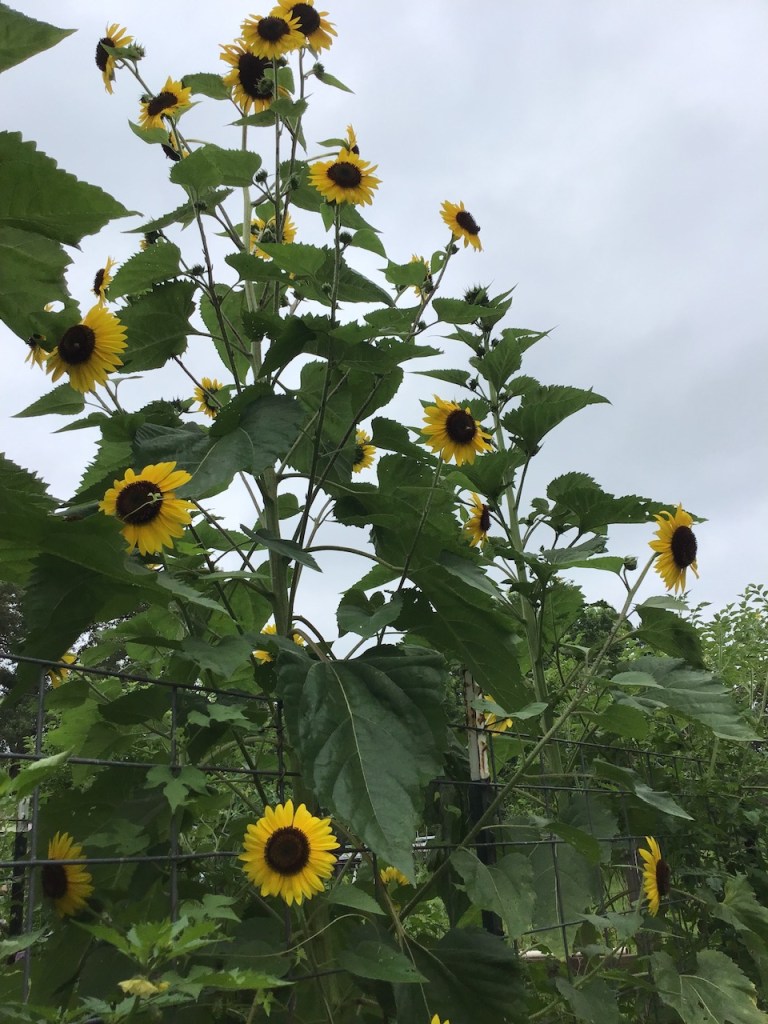
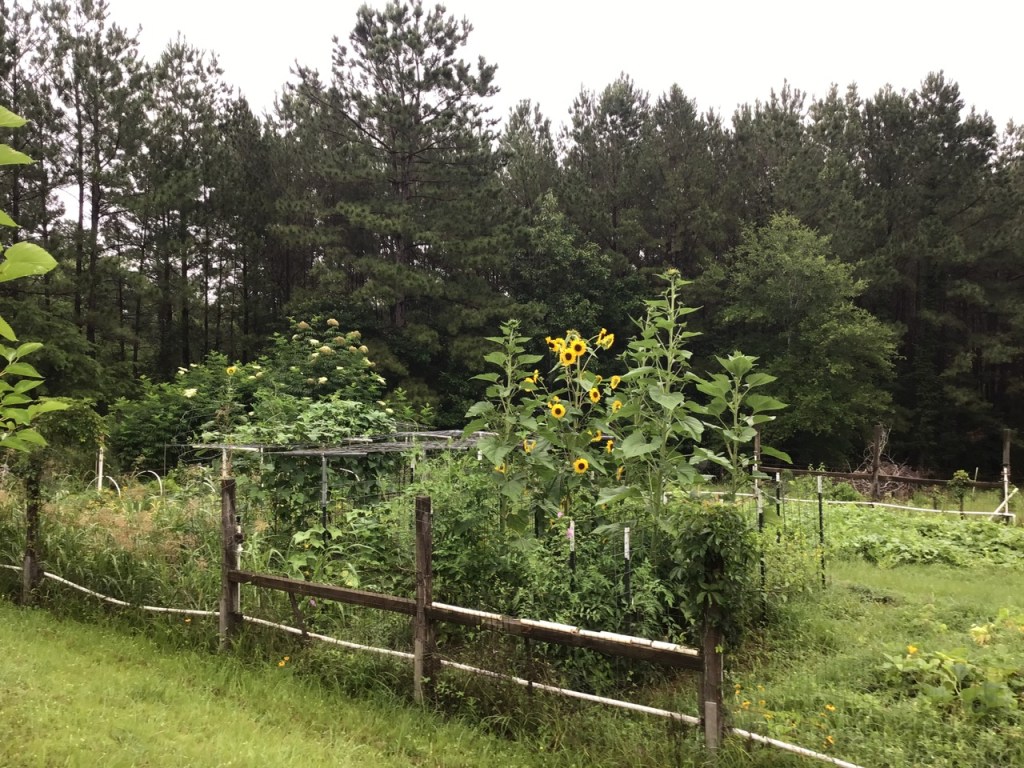
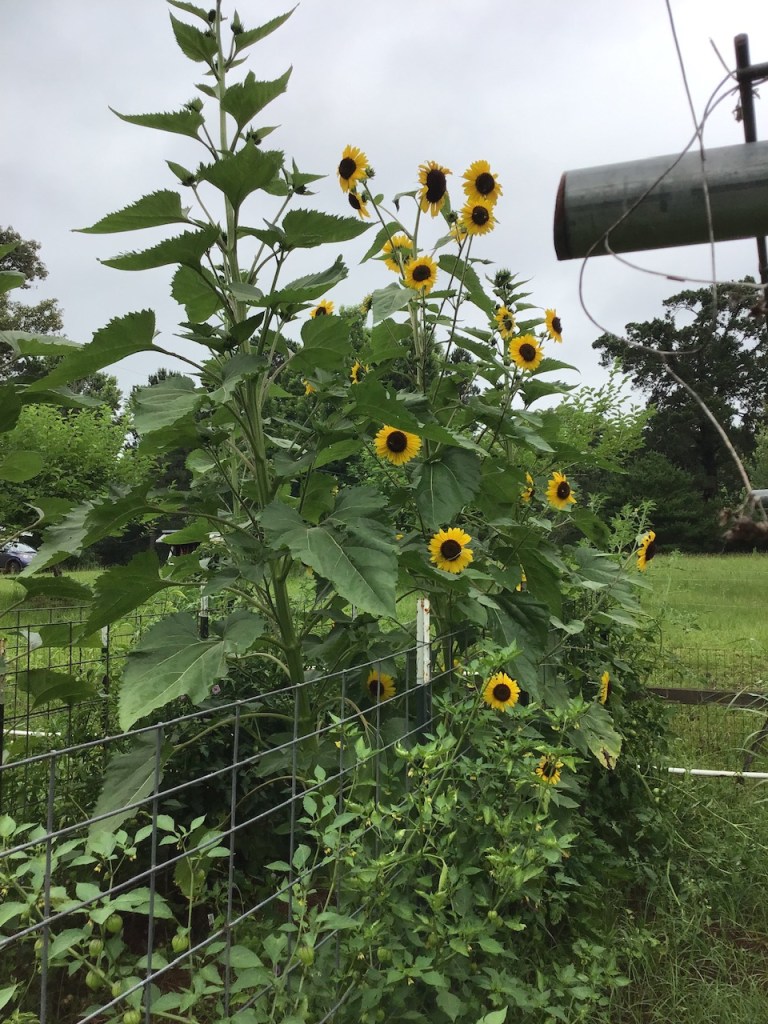
These Black Hopi sunflowers were actually volunteers from last year’s seed gift from Gavin Mounsey who sends heirloom seeds to those who buy his book or become a paid subscriber to his Substack newsletter–so worth it, a gift that really does keep giving! 😘
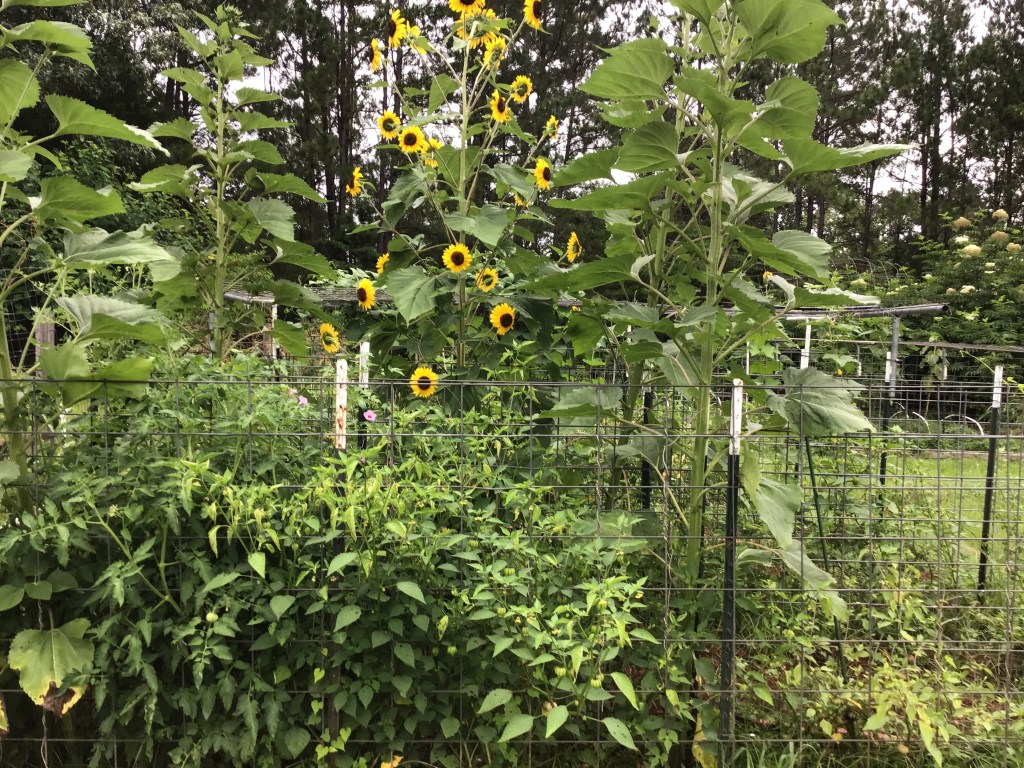
They are so rewarding and of course very functional as well. These giant sunflowers are not only gorgeous, but they serve as mid-day shading for the tomatoes and there are pollinators all over them. I even saw a squirrel up there eating the seeds. Too bad I didn’t have the tablet, it would’ve been a great shot, but I didn’t even see him until he started barking at me when I was picking tomatoes right underneath him.
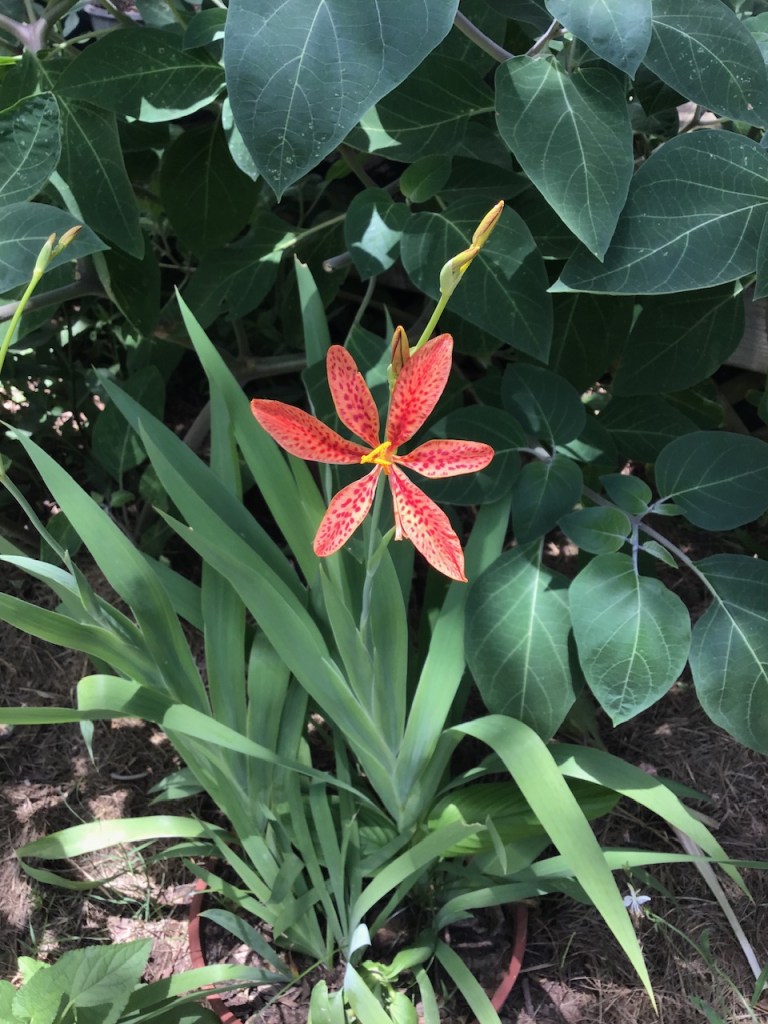
First bloom of the lovely Blackberry Lily
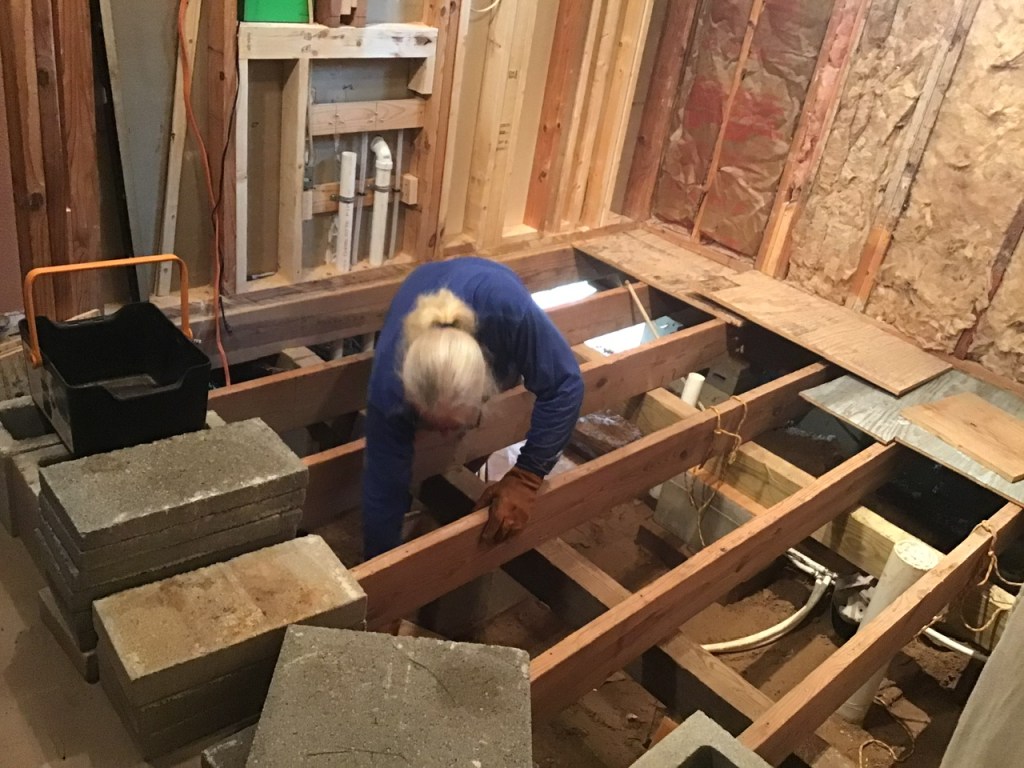
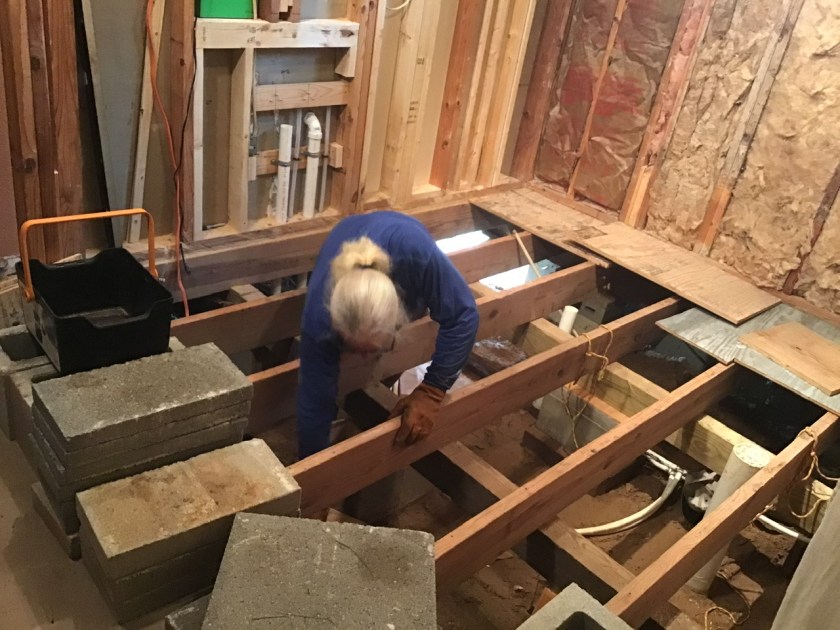
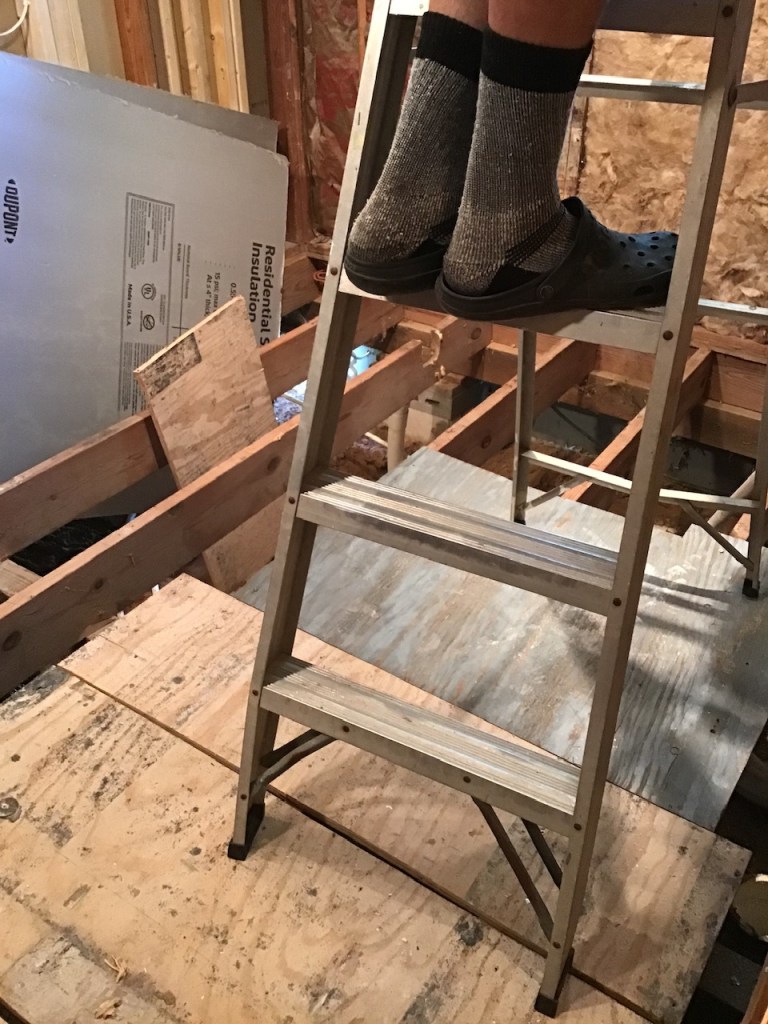
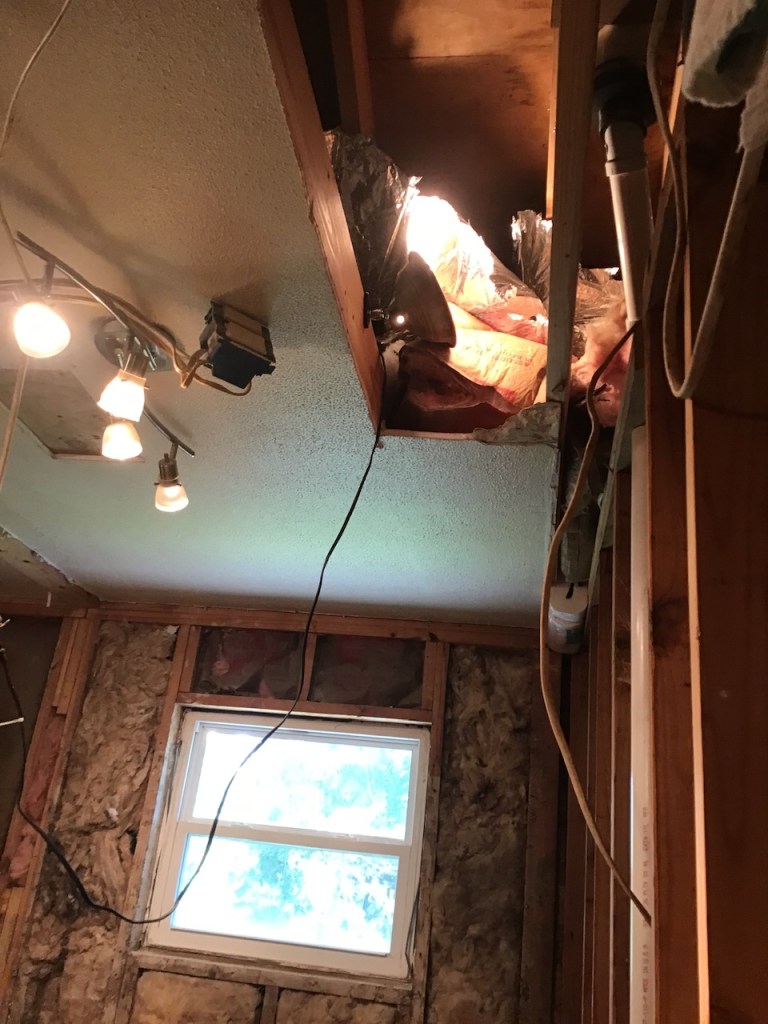
Meanwhile, while I’m goofing off, Handy Hubby gets to experience male priviledge. Mr. Know-it-All likes to impress me and the dogs with all his savoir-faire. I know he secrectly delights in sweating and rolling in the dirt under the house with Buttercup. He’s totally thrilled that the bathroom remodel has turned into dirt to rooftop overhaul and his fancy tile project has been delayed by a month and tidy unplanned sum.
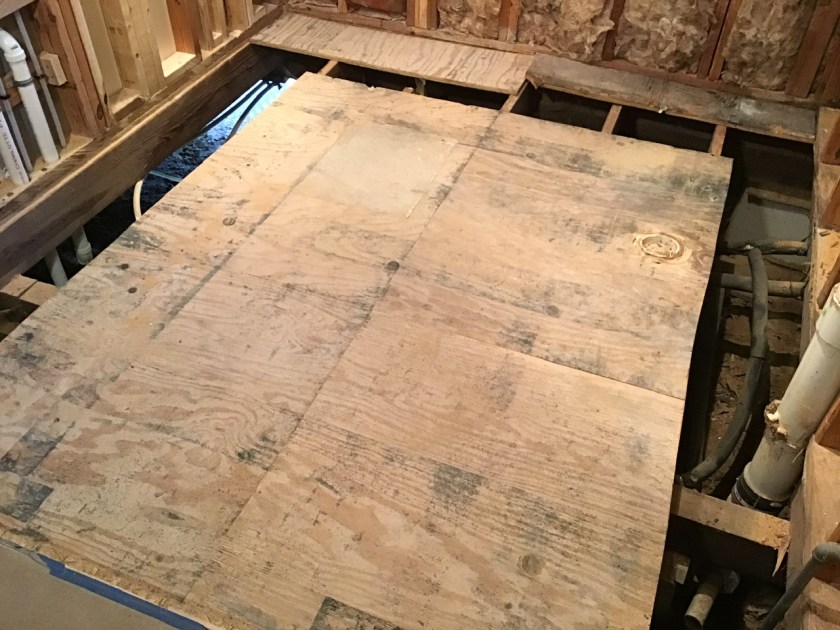
But not only was the subfloor coated in mold and mildew, but the piers and beams were sagging and unaligned and the drainage was partially blocked. He had to dig all that out and replace some and add more and while unexpected, it wasn’t terribly surprising. It was built as a camp cottage in the 80s, no one ever lived here full-time until us.
Considering that, Hubby says they did a good job and that the quality of materials for a camp cottage back then was leagues better than what goes into the pre-fab modern construction. We’re really lucky we got on this whim to remodel when we did, because that mess was only going to get more ugly with time.
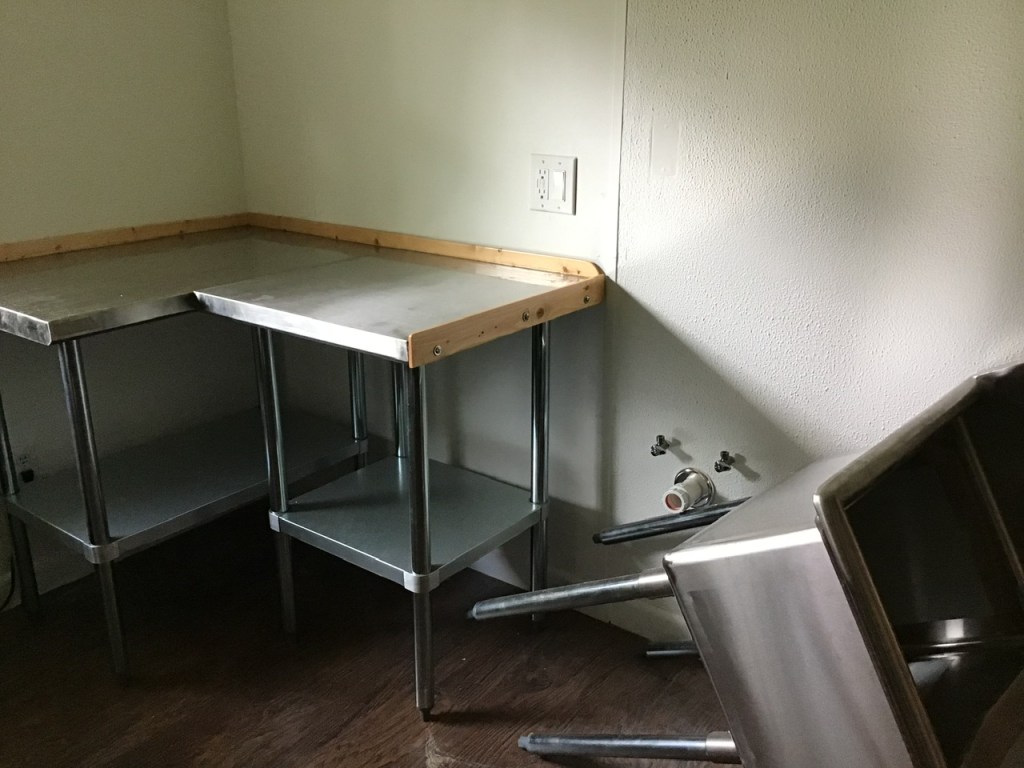
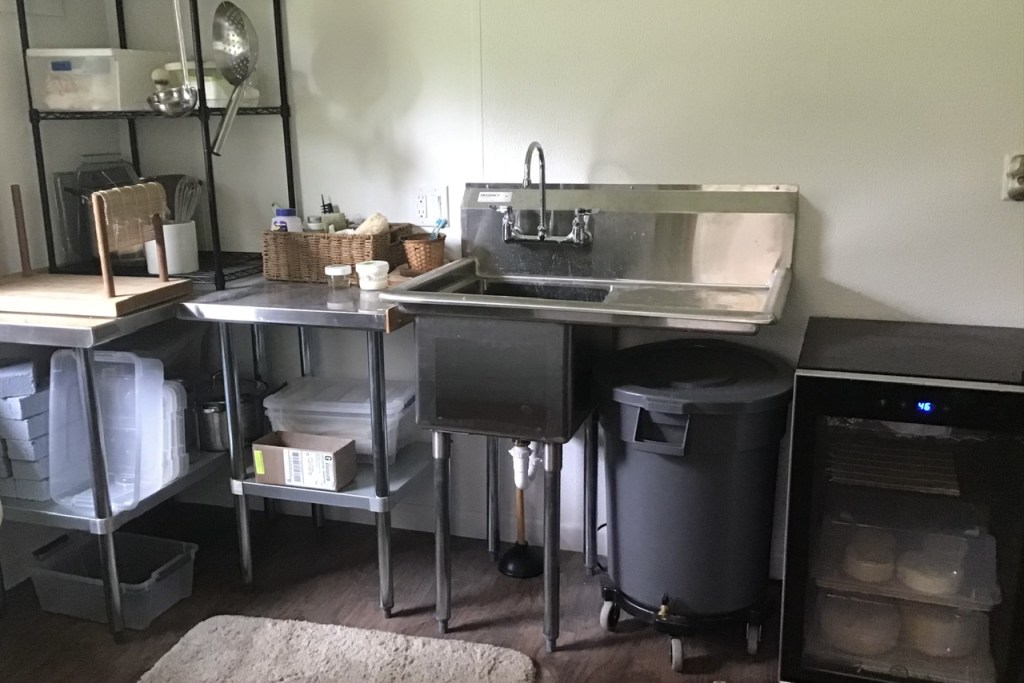
That’s the bad news. The good news is the other development that grew spontaneously out of this project–I now have a real flex-room–a place for fermenting and seedlings and maybe just lounging. Considering how small our place is, I know it sounds a little crazy, but considering we’ll most likely never move again, why not? There was a big bed in there that just made for useless space, now it’s full function. Or rather, it will be, whenever the bathroom gets done.
Hubby is never so impressive to me than when he is in Mission-Man-Mode. He has a single-minded, goal-oriented side to him that perks up with such vigor suddenly you’d think he was once again a 30-something in hot pursuit of a sexy young thang (and by that I mean me). 😂
Seriously though, it is impressive and he can work leagues past my breaking point when he’s in the zone. And Youtube is another godsend sometimes, the two of them in lockstep is like any DIYers dream couple. Between that and the regular influx of inspiration from the home shows on TV, there’s really nothing a devoted follower can’t learn, it seems. How marvelous to be learning so much still at our age!
That’s all this post, just some photos I like with a bit of commentary.
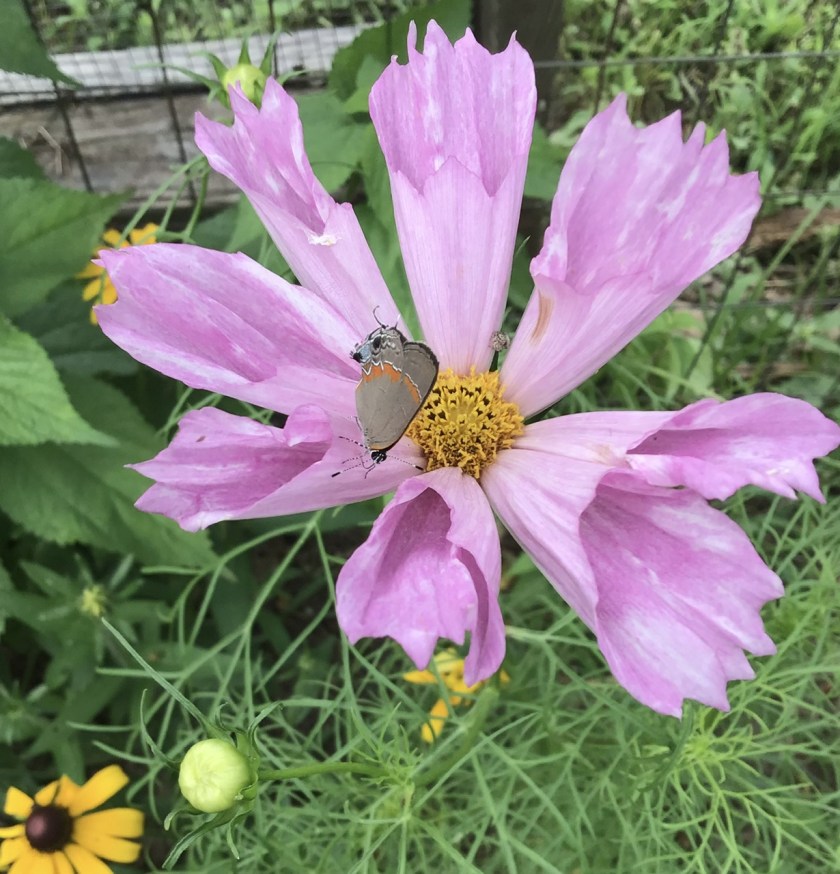
My first year growing Cosmos and I’m loving them!
I started to look up what sort of moth this is enjoying the Cosmos and I stopped myself. I’d like my first impulse to evolve from always wanting to name and label and define, often before I even truly and deeply experience. I think that chimes back to the old adage, ‘Stop and smell the roses.’
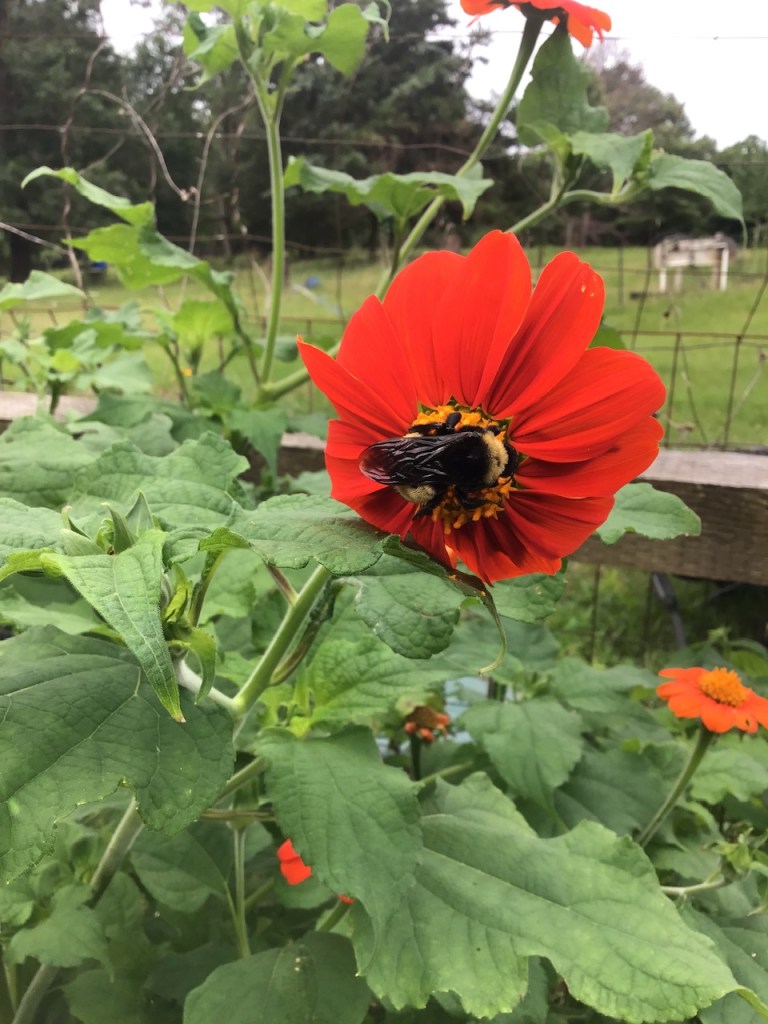
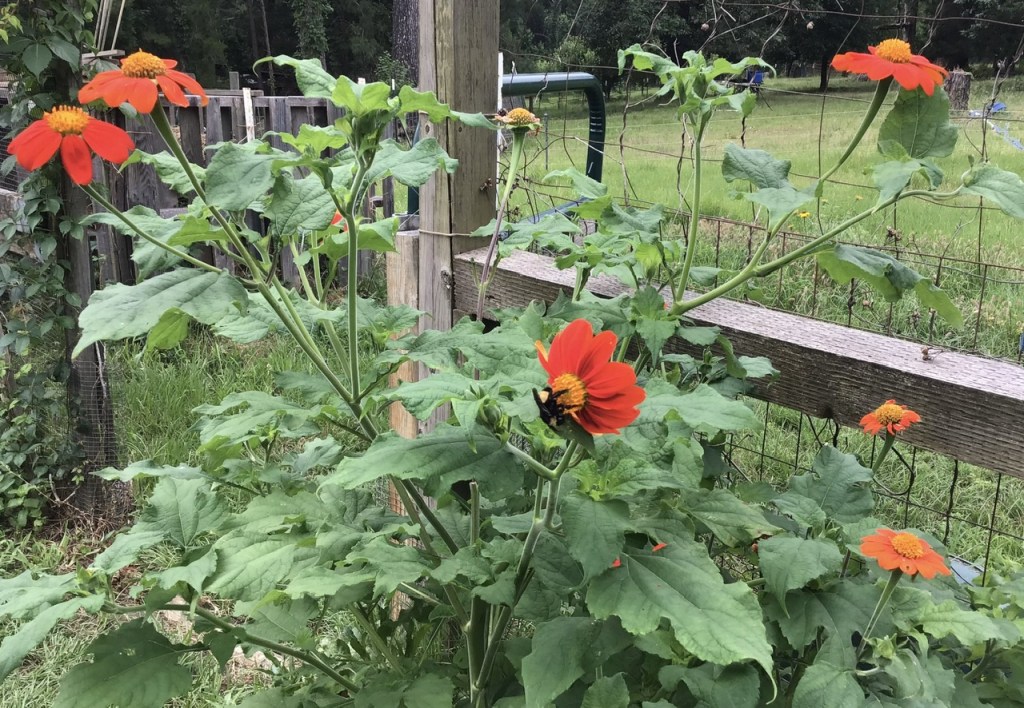
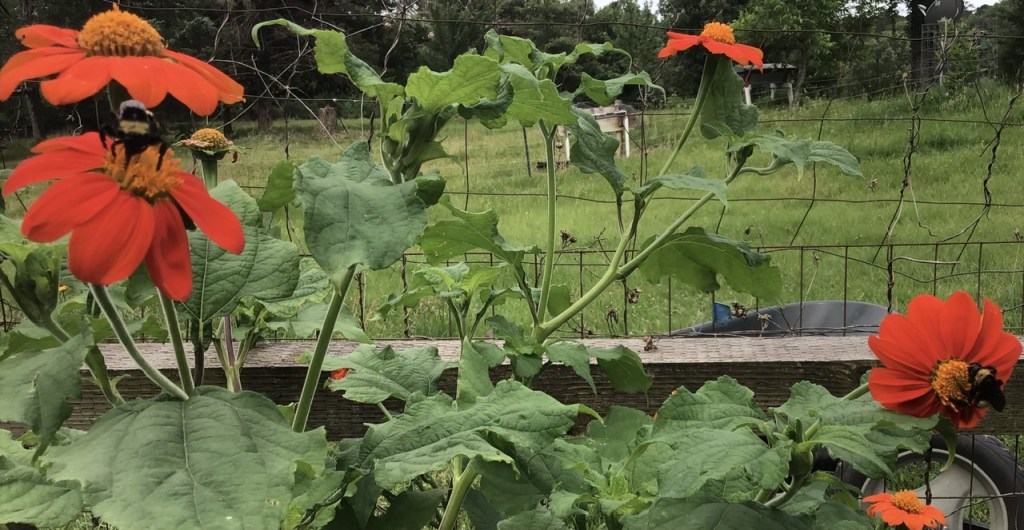
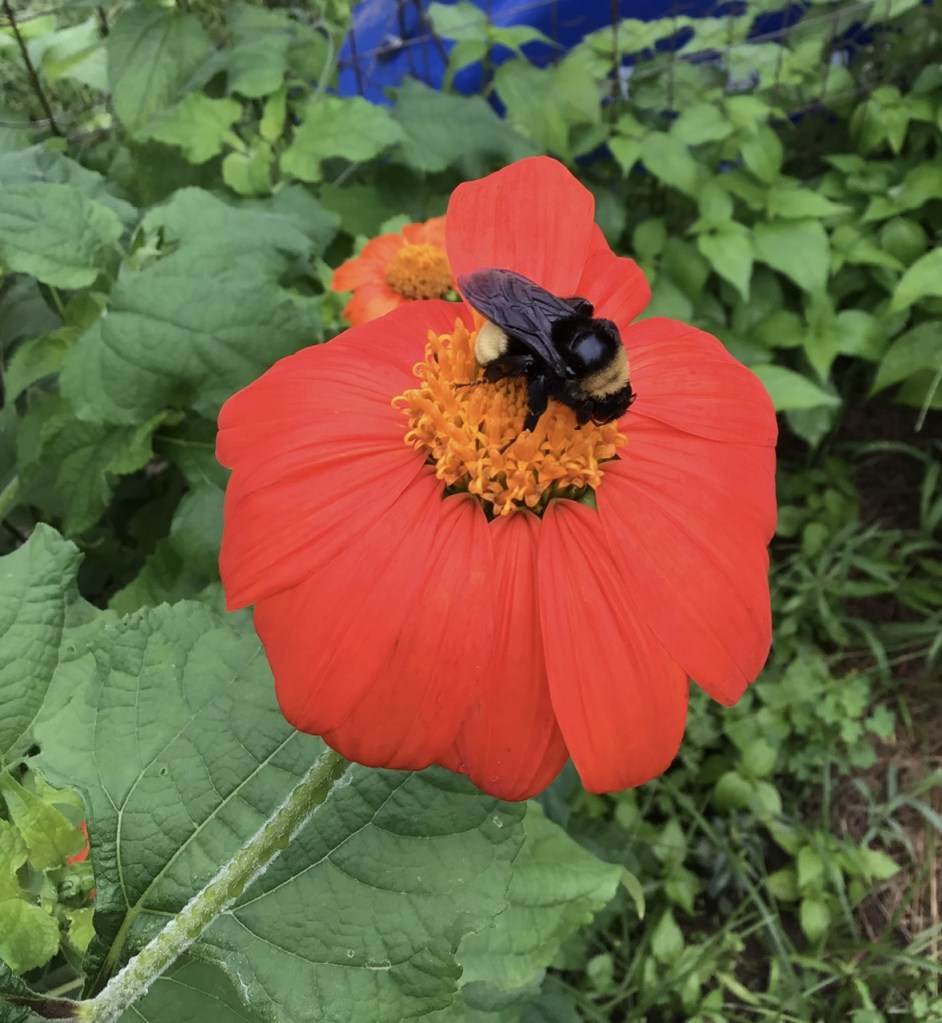
Another first flower for me in the garden–Tythia Mexican Sunflower–my how the bumblebees are loving it!
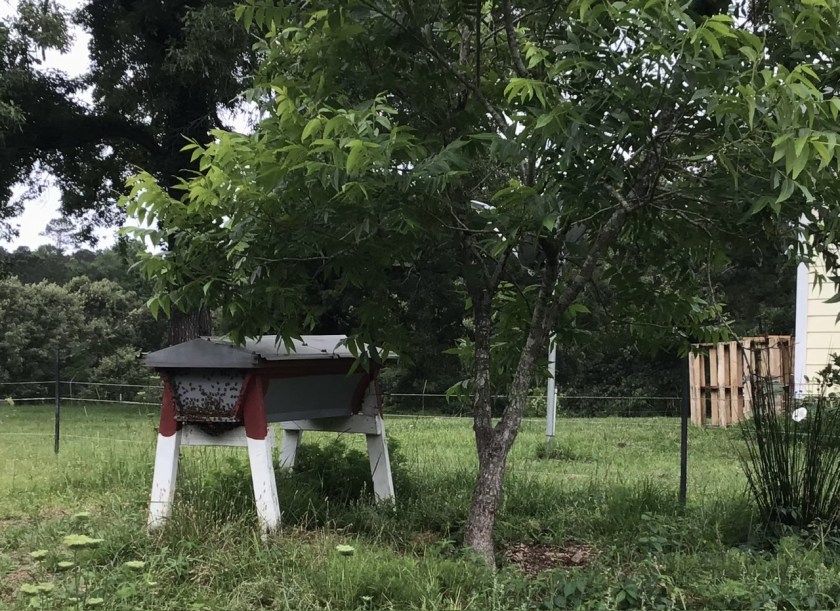
Our bees are remiss to allow me to split them lately, even though they appear to need more space.
In years past I’ve complained I have too little dill to last the year and it bolts so quickly in the heat. This year I swung in the opposite direction and have so much I don’t know what to do with it all.
We agreed to have an easier garden seadon since we are very busy remodeling the bathroom, which has already grown into remodeling the 2nd bedroom/office/cheese room/seedling space, but somehow that never works out.
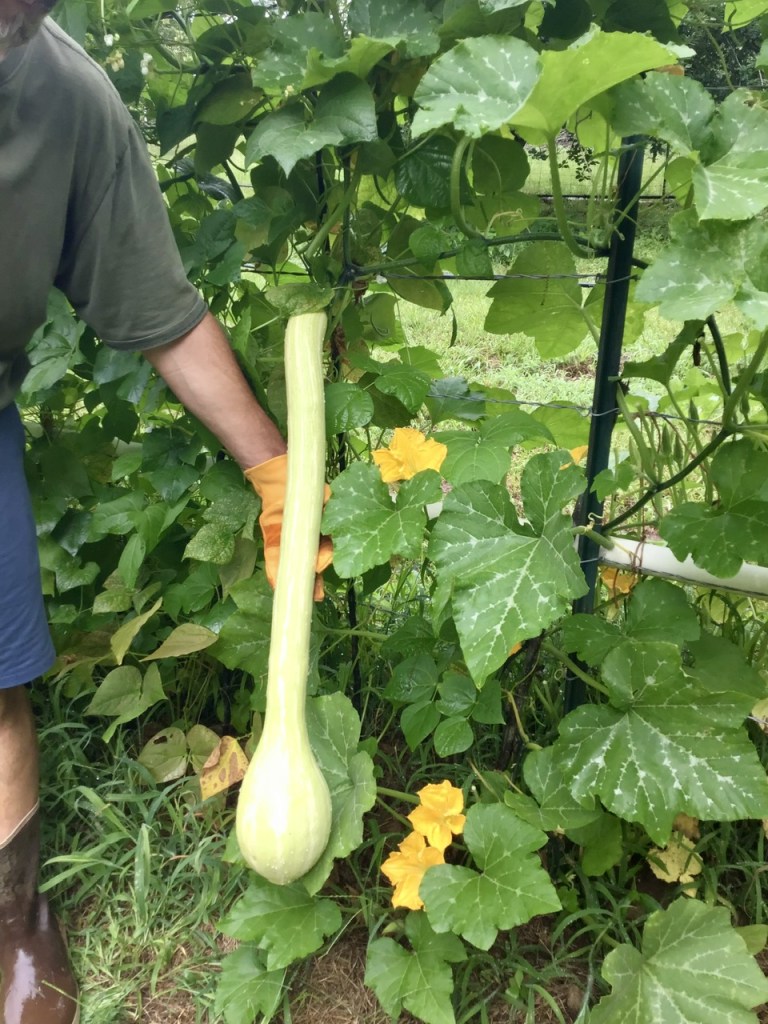
We’re getting loads of green beans from Hubby’s super green wall which also includes Trombetta squash, luffa, sunflowers and volunteer tomatoes.
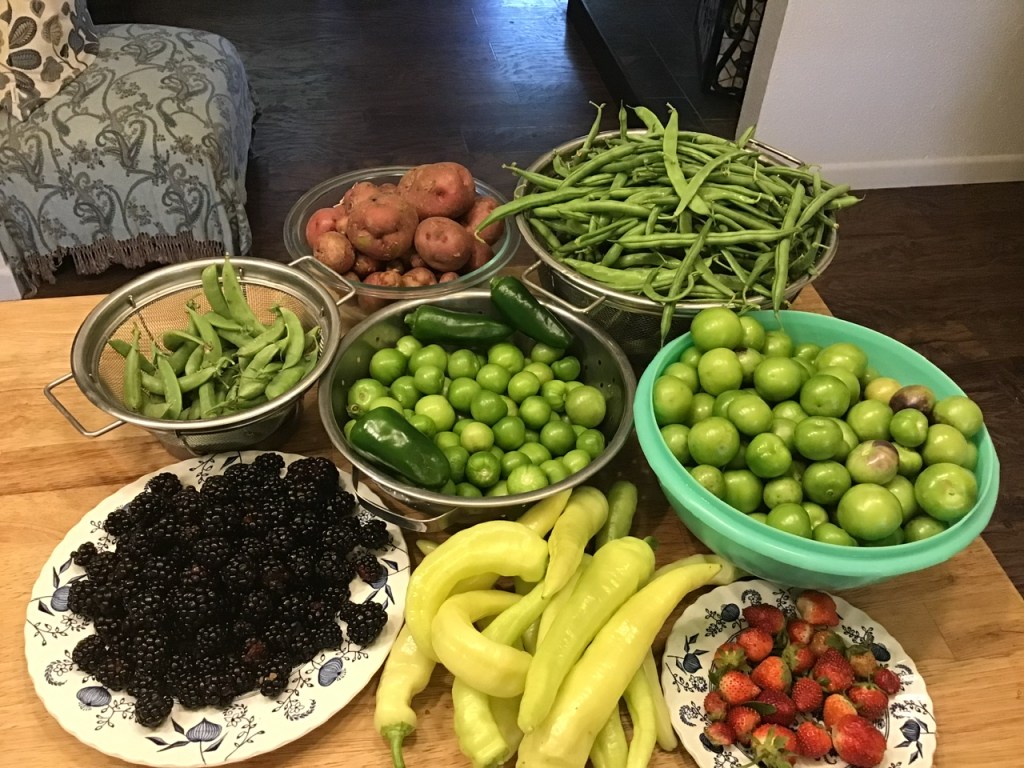
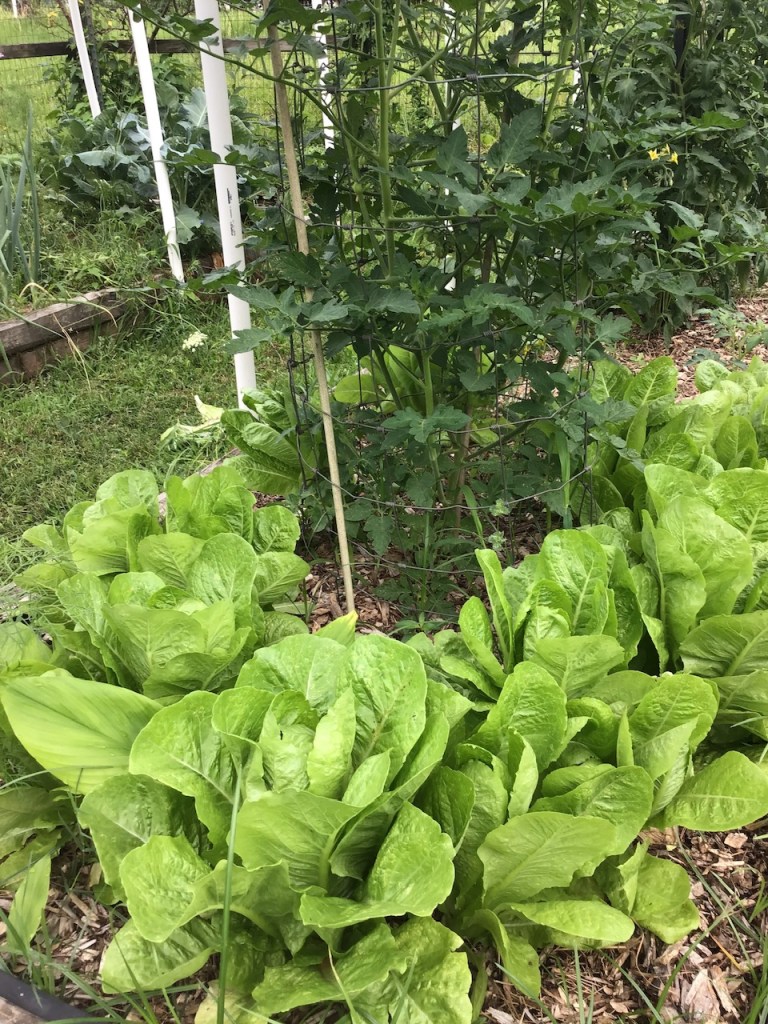
The lettuces and peppers are doing great and we’re getting loads of tomatillos already. We decided on those over tomatoes this year because the green salsa is so delicious.
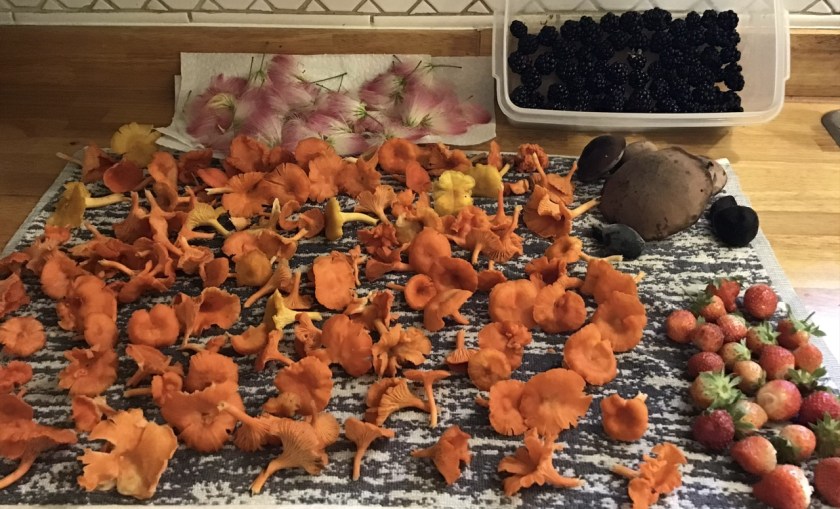
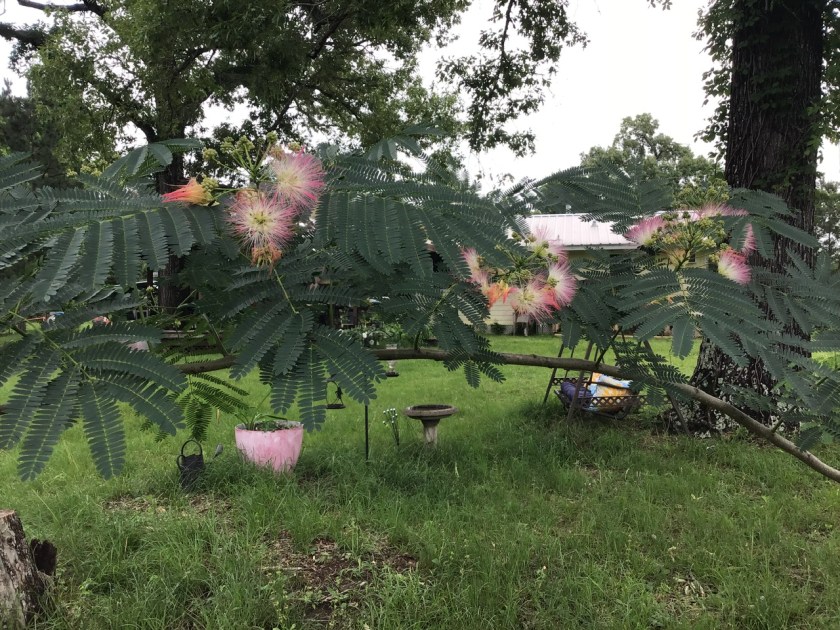
And the chanterelles are abundantand the Mimosas are blooming, and I just can’t resist.
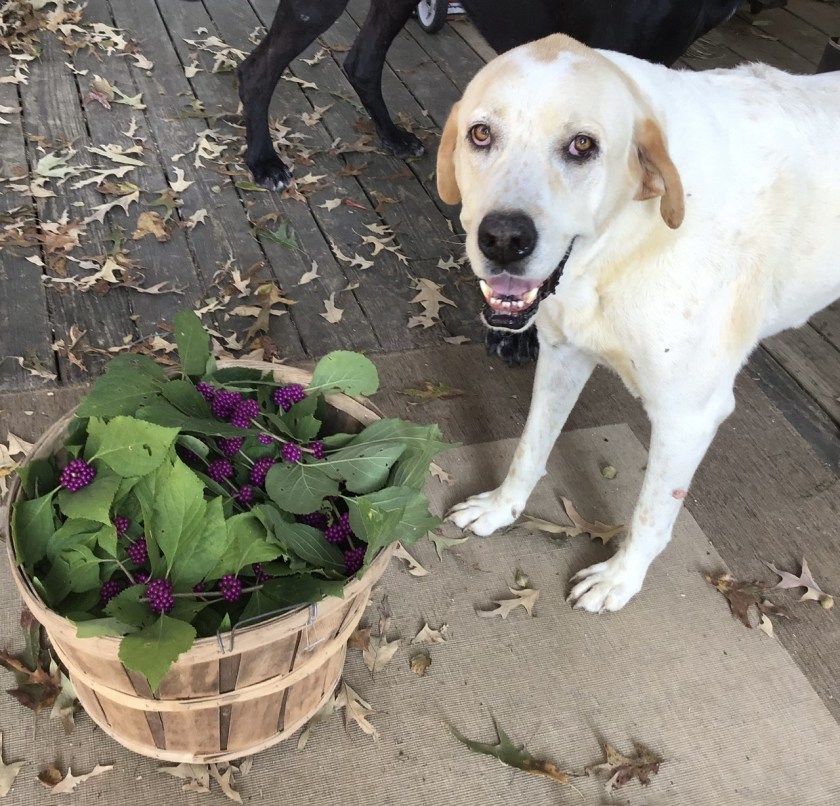
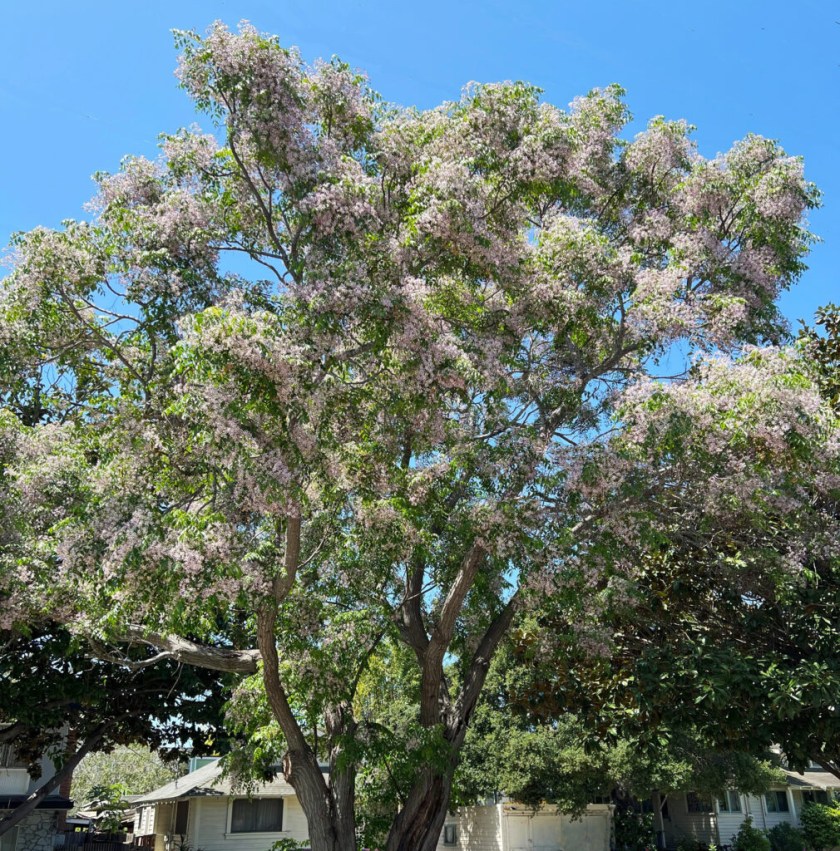
I’ve been working on the latest addition to the Herbal Explorations pages, another demonized tree I’ve finally been able to identify and start growing and I’m so excited, the Chinaberry tree, called invasive and deemed illegal to buy, sell or import into these parts. The usual official nonsense that attempts to destroy the reputation of yet another beneficial and medicinal species.
More on the gorgeous Chinaberry, of Persian lilac in the next post.
That’s a photo from online, but I hope mine looks like that someday!
Here is the happily growing young Mimosa I dug up from the road 2 years ago.
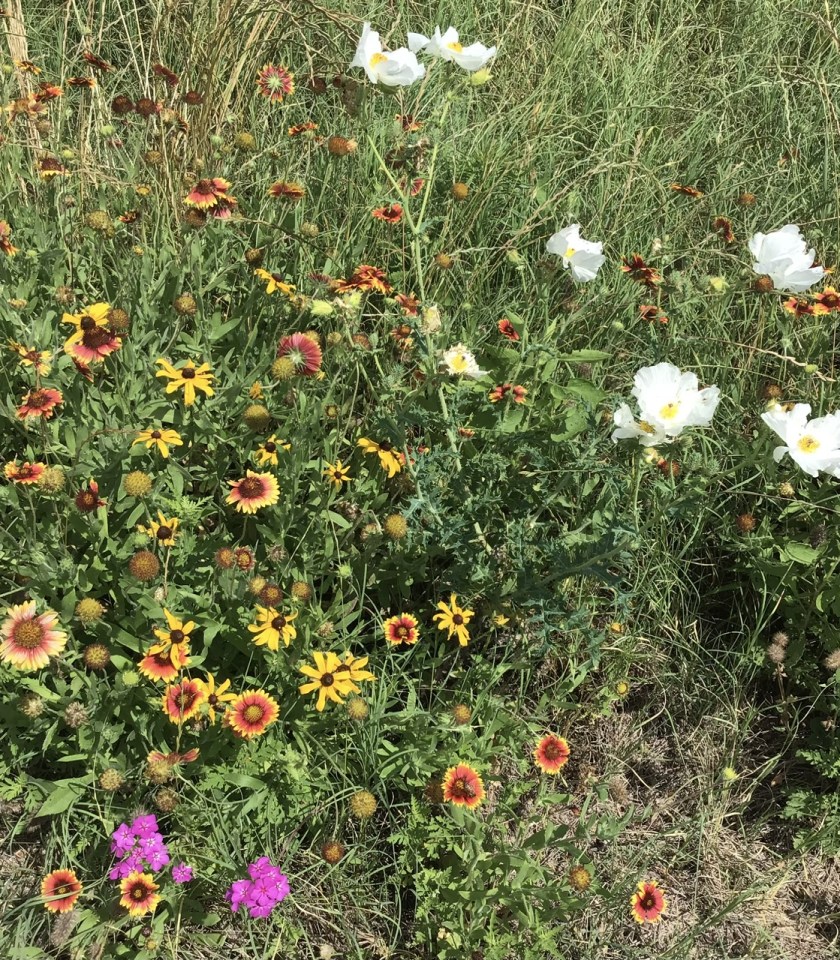
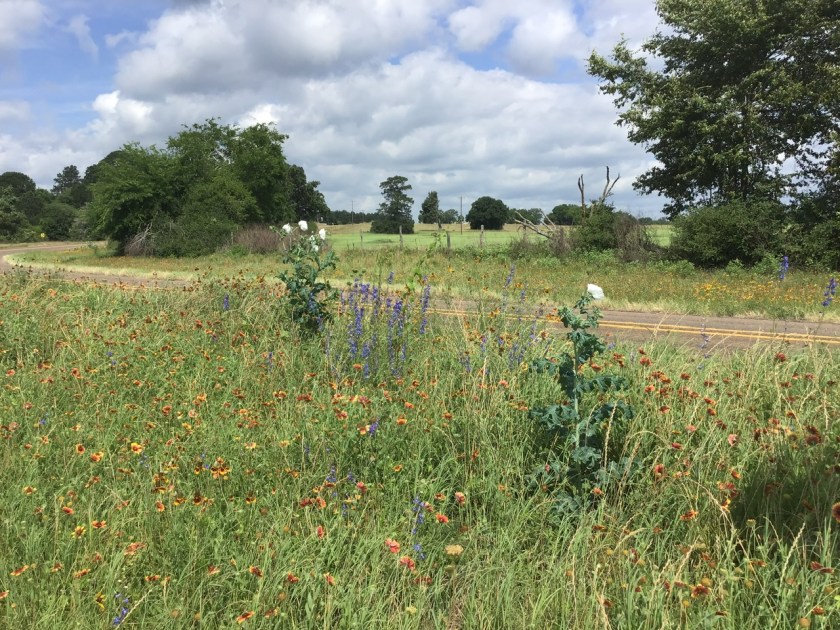
Some wild flowers on my route to my milk lady’s house.
Two odd ranch stories in one day, one a local tradition new to us, the other a strange sort of scam and also new to us.
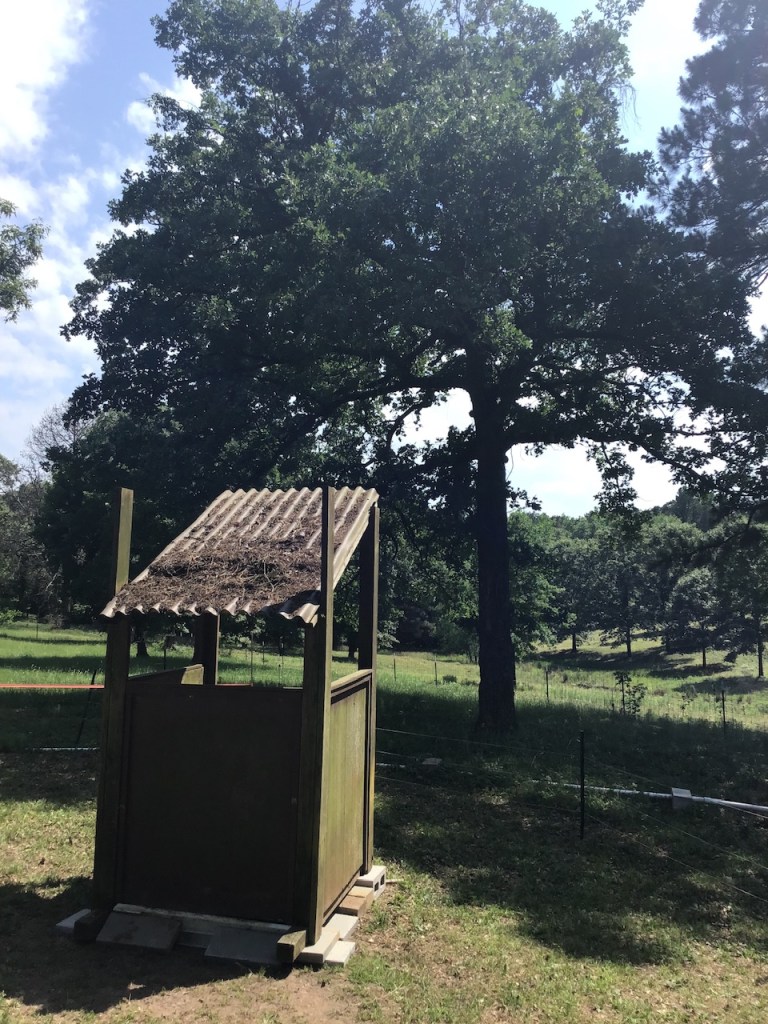
We don’t get out much, but when we do what fun it is to have a little impromptu adventure. We’re just about to start the bathroom demolition and have been scatter-brained with the necessary prep. We have only one bathroom, which means we go back once again to our early years here, needing an outhouse and outdoor shower.
Our old “poop with a view” re-employed
We headed to town yesterday to select the tile, but the shop was closed. We stopped by the Farmer’s Market, having heard it has recently grown, in step with the small city’s population.
Unfortunately, it hasn’t improved, only grown in vendors. It’s dissapointing to live rural and still not have a decent farmer’s market in any nearby town or city. I’ll refrain from complaining further, but one question first.
Should they be able to call it a farmer’s market when there are no farmers there? No fruits, no vegetables, no herbs, no dairy. One tiny ranch, not exactly local, offering beef shares, some jam and honey sellers, one stand selling really expensive breads, that was it besides the very many stalls of crafters.
Anyway, from those two disappointments we soon headed back home and along the way comes our fun ranch story.
We took the back route for a nicer country drive, one we’ve taken very often over the years. There are mostly woods and rolling hills dotted with small farms and ranches, cows mostly, very few people.
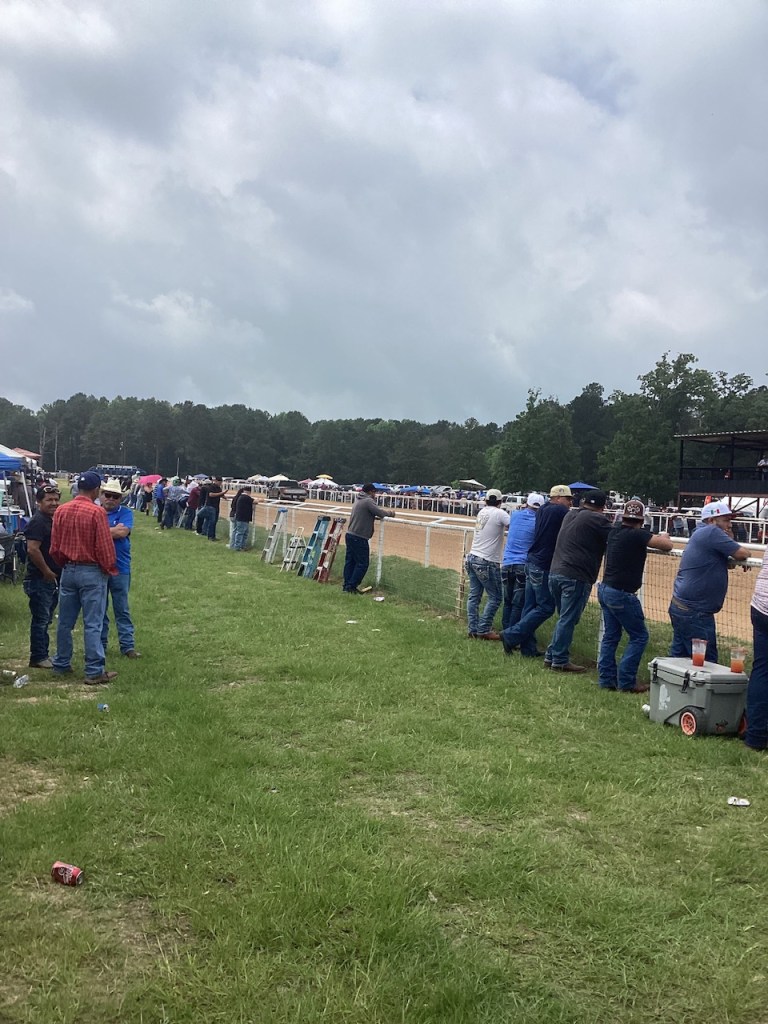
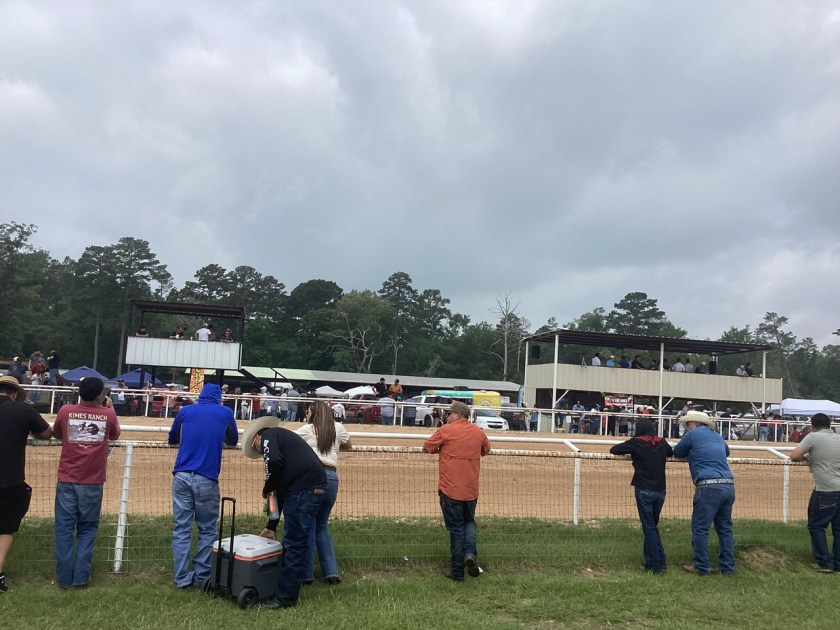
So when we caught sight of a parking lot full of trucks we got curious. Hubby pulls into Los Pinos Ranch, which we’ve never seen full of cars before, had hardly even noticed before among all the other ranches. We followed the line to a couple of security guards.
“Hi!” Hubby says to a well-built and well-kitted black man, “We’re just driving by and being nosy neighbors.”
Being we were still about a 10 minute drive from home, neighbors might sound like a stretch, but around here that’s still considered neighboring territory.
The man was cordial, not exactly friendly, but not at all off-putting, so Hubby continued his inquiry, and I also began to chime in, now with curiousity well-piqued since seeing how large this event actually was.
“What’s all the crowd here for, some sort of festival?” Besides the security duo we appeared to be the only gringos in sight, which later upon entering we learned to be true. There were no signs at all, in Spanish or otherwise.
Looking around while Hubby was speaking, I spotted a track, and horses, but still, it was all so foreign, while practically in our backyard. I interupted them.
“Oh, is it a horse show or training or something?” My confusion was probably obvious, but the guard’s reply only engendered more of the same. Neither Hubby or I had yet to clue in to the nature of the event.
The guard was attempting to tell us, but without speaking the precise words, I understood only later.
Well, he said, they like to compare.
Huh? OK. Still clueless.
Then he pointed to a couple of ladies down the path aways and said they were the organizers and we should talk to them.
So we did and they were very nice, just the one spoke English, but she was as friendly as could be and said we should go on in, they want more locals to participate, in fact. Participate in what, we did not know. And, there were food stands on the other side of the tracks, so we were sold.
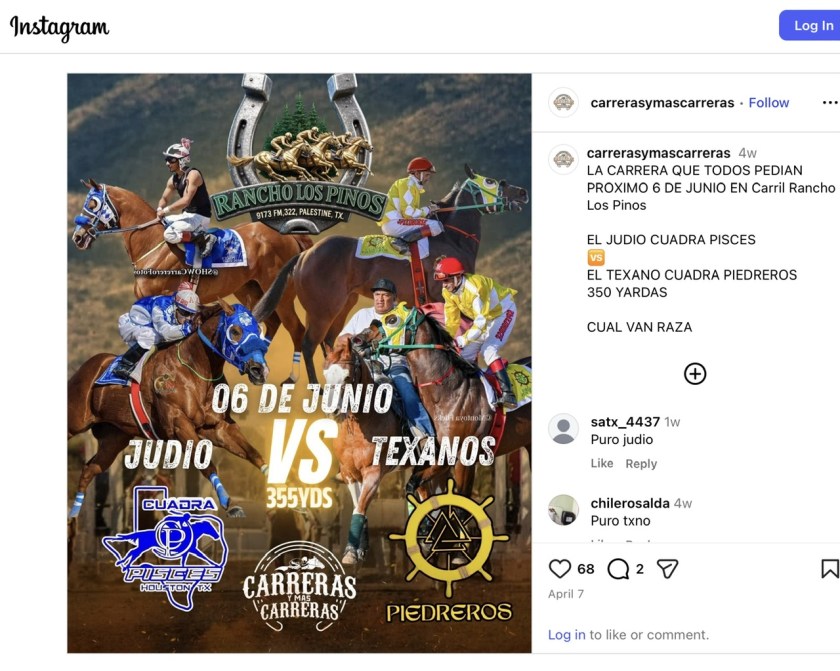
Then, crossing the track, it suddenly dawned on me. Horse racing, duh! And the odd words of the guard came back with a flash of clarity. They ‘like to compare’ was his gringo euphemism for ‘they bet on the races.’
We don’t gamble and we’ve never been to a horse race, so perhaps our severe ignorance can be excused?!
Although in hindsight it’s so obvious. Now, I’m not judging, but I do believe that sort of gambling is illegal in these parts. Not that we really care a hoot about that, especially once we got a whiff of the taco stand.
The simplest of setups you could imagine, why can’t they manage that at the farmer’s market? Charring beef, frying onions, our senses led us in a beeline. Fresh diced tomatoes, two kinds of salsa, cilantro, boiled potato side served with a chunk of grilled onion. Delish!
Better tacos than we’ve had at any establishment in town, cooked and served out of the back of a trailer.
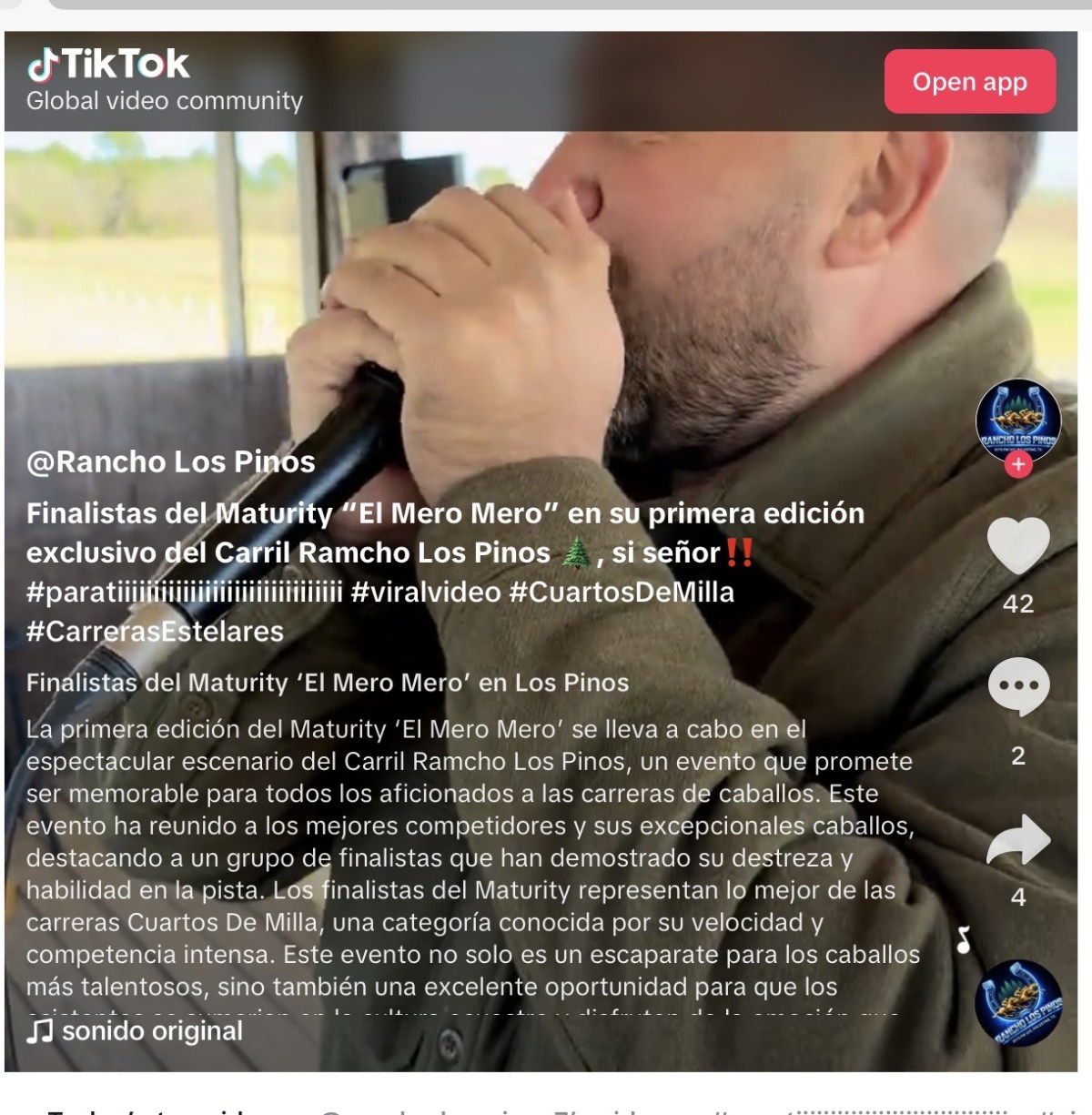
A bit of reasearch once home and the tradition is alive on social media (like we would know!) and we can look forward to more excellent tacos and racing festivities next month.
Think what you like about horse racing in general, or gambling in particular, but it’s a huge deal better than what was the thing among dudes where I grew up, which was car racing and monster truck pulls. Loud, noxious, destructive and, well, just REALLY loud.
This was fun! You could hear the music and it was catchy mariachi, not depressing country ballads like they play in the local farm and ranch stores.
Of course we did stick out like the gringo sore thumbs we are. Ball caps, not cowboy hats. Crocks, not cowboy boots. Cringy, I know. But we’re committed to taking it down a notch next time we go, for the tacos, of course, not the gambling.
For Hubby that will mean absolutely no shorts. Mexican men are not short-pant people. There seems to be a certain amount of pride attached to that fact, but it’s lost on me.
For my part, a bit of more feminine appeal would be in order, if I can muster that anymore. Case still open.
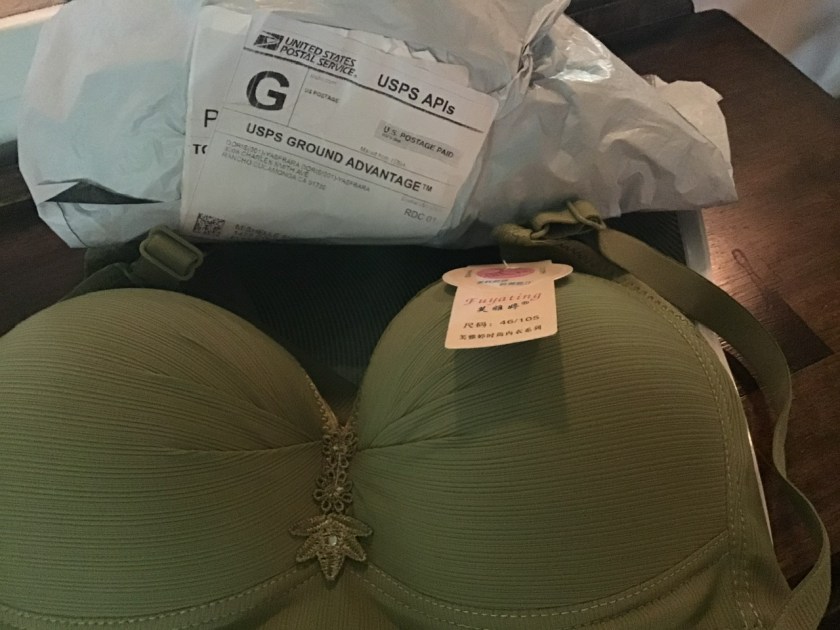
Which leads me to the next ranch story. And the mystery of the sexy bras I’d never have worn, or even purchased on a huge whim, even in my sexiest days full of youthful vigor.
I was not nearly as dumb-struck by this oddity as I was by the impromtu ranch races. Clearly it was some very strange mistake, not a surprise hinting gift from Hubby, who would know me far better, and never dare make such a vulgar assumption.
Green and bedazzled, come on! Meant for a harem girl, no doubt!
Come to find out after some perplexing Google searches that there is currently a large scam going on, and I’ve just been ‘brushed’. WTH?!
From the return sender’s address, it comes from a fancy ranch in California. Far too fancy for me! But according to the news, this scam, which is becoming more common, probably uses both fake addresses and fake names. Yasfara does sound kind of fake.
But what could they be after sending me free stuff? I now realize this happened already twice before, I just never chalked it up to a con.
Several years ago I received seeds I never ordered. So did a lot of folks. I often order seeds, folks sometimes me seeds, I just brushed it off. Brushed?
Then a couple months ago I got two pairs of shorts. Because I’d recently ordered shorts from Amazon, I figured it was them, just not exactly what I’d ordered. They weren’t too bad, so I kept them, only receiving the correct order weeks later.
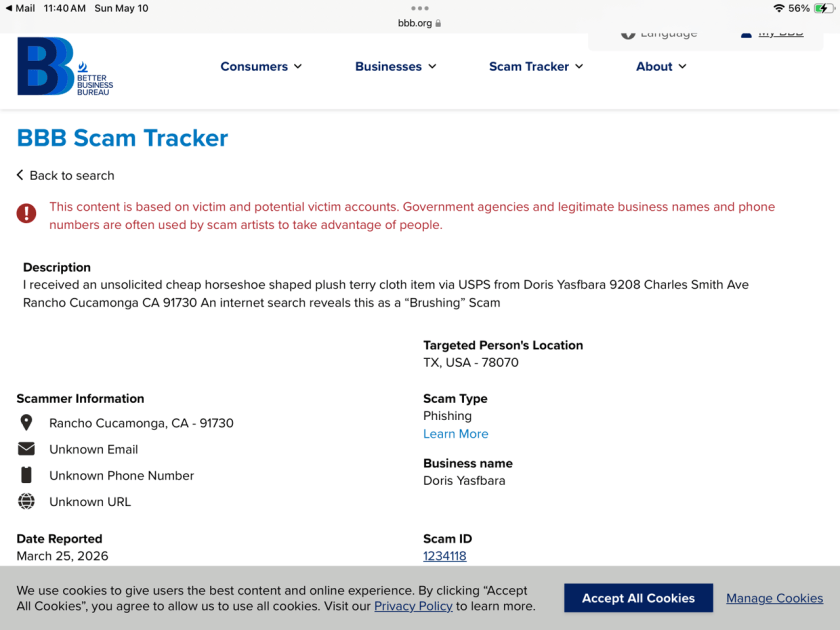
After Hubby’s sleuthing he discovered the “Brushing scam” with the objective of inflating the products’ ratings by collecting ‘verified purchases’ and giving fake reviews with them, apparently.
Here is our ‘Yasfara’ of the ‘Rancho Cucamongo’ reported on at the Better Business Bureau, along with a news clip about the fraud.
What to know if a mysterious empty white mailing envelope shows up at your house
Strange times, indeed. Just for the record, we don’t mind feeling like foreigners five miles from home, it’s rather a pleasant nostalgic feeling for us both, recalling our own pasts of living as illegal immigrants in other lands.
But, if you’re going to send me bras, please send the comfortable variety, padless, without jewels or sequince, cotton, white, for those rare occassions I still wear one.
Or, if that’s all you’ve got on hand, may I suggest sending them to a more appropriate recipient, like a still-young sexy lady at the Rancho Los Pinos right down the road?