More Bees Please!

I don’t follow this very popular homesteading channel, Off-Grid with Doug & Stacy, too chatty and hyperbolic for me, but that’s what gets the clicks, so more power to ’em. Yet somehow, the Algos knew to put this particular new episode prominently on my feed.

Natural beekeeping in horizontal hives!

It’s excellent! I first heard this beekeeper many years ago and am so glad to see he continues to promote natural beekeeping and adding to his informational website. He’s also added equipment, books and events, and if I still lived in Missouri, you can bet I’d have befriended him ages ago.

Dr. Leo Sharashkin
https://horizontalhive.com/index.shtml

It really is a thrill for me to watch the growth of treatment-free beekeeping over the last decade. It used to be not only terribly difficult to find good information, but also it was treacherous. I’m not joking either. Natural beekeepers are the anti-vaxxers of the beekeeping world, with all the bullying, ridicule, and obnoxious bloviating to prove it, which I experienced for years with this simple preference.

I do not want Big Pharma livestock. It’s really not a crime, though you will be treated like a criminal to suggest it or admit that it’s your practice to most mainstream and commercial professionals. According to many of them, the fact that treatment-free beekeepers exist at all explains why their colonies are filled with diseases. It’s blind faith in The Science. And The Science is not rational.

Folks might be surprised to learn that the lifespans of pets and livestock has decreased sharply over the decades. Bees, like all the animals, are basically treated as a disposible commodity. One disgusted veterinarian who turned his practice to homeophathy complained about this in milk cows, but actually it can be observed in ALL livestock:

“While my cow patients in Wisconsin often lived well into their teens, some to over 20 years, the average California operator culled cows at 2 years old. They’d been pushed with so much grain and ever higher production goals that their health suffered and they were literally dispensed with when they couldn’t keep up.”
(3) When “organic” dairy ain’t – by Will Falconer, DVMhttps://vitalanimal.substack.com/p/when-organic-dairy-aint

But that is clearly changing! It could be that more are recognizing the false science of Pig Pharma, finally. Or, that there is so much success now in the treatment-free circles, and so many more are starting to practice it, that the bullies in the business are starting to become outnumbered. That’s my hope anyway.

One commercial beekeeper replied to Leo’s inquiry with a common fact:

14:45 “If I stopped treating my bees, I’d lose 85% in a year . . .”

I would LOVE to try a skep hive!

That’s right! And plenty of beekeepers, commercial and hobby, have experienced that, unfortunately. I also had a very hard time in the beginning. It took a lot of failure and a lot of research.

Mostly it took conviction. Good health is not found in medications. It is achieved through wholesome practices, which are the same for bees as all of life: Clean living and being left to pursue the most natural ways as possible.

From the interview we learn Doug & Stacy had similar issues as I had when beginning in beekeeping, and it was through Leo’s work and presentations they understood why and began to change their practices with continued success. Leo insists, you don’t need to invest much money, contrary to popular opinion. You don’t need to keep buying bees to grow your apiary.

Treatment-free practices rely on the natural intelligence of the bees to care for themselves. We do not requeen when we make a colony split, requiring the bees to raise their own queen. This keeps all beekeeping local, as it should be.

One of our horizontal hives with an observation window.

Instinct of the local area grows in the colony from one generation to the next. Also contrary to popular opinion, the bees get more resilient with each generation when left to their own decision-making, ie. when to swarm, how much honey to store for the winter, when to build up brood in the local conditions, which queen to keep, and when to get rid of her.

Leo’s entire apiary was grown through trapping swarms and making splits. I’ve not had much success with swarms and will try to start following more of his advice for attracting them. You’ll actually have more success attracting swarms in less rural areas, as counter-intuitive as that might sound. But bees are a bit like deer in that regard, they are attracted to the closest and most abundant and varied food sources, which often means near where humans are residing.

While he uses horizontal hives, like I do, he also has some good advice for beekeepers in cold climates and hive designs which help keep colonies alive during long winters.

 LOVE SWARMS: The Complete Guide to Attracting Honeybees

by Dr Leo Sharashkin, Editor, Keeping Bees With a Smile

I once drove all the way to Arkansas on my search for treatment-free bees. This is what the car looked like when I arrived home! 😆

Unfortunately, after all that trouble, these bees also did not survive a full year. BTW, I was not stung once.

When I finally understood the importance of getting bees locally and allowing the weak colonies to die off, I finally had some success. But, it’s still a work in progress and I’m so happy for all the advice and expertise from those with more experience and success.

Live and learn!

Homestead Happenings

It’s been a challenging month on the wee homestead. We’ve had some successes and I am still hopeful for more positive outcomes, but I focus on them overly, because I’m being a bit avoidant, because really, I’m still concerned.

The determinate tomatoes are long gone already, but Hubby’s made many delicious jars of puttanesca and salsa for our future enjoyment. Must keep up morale!

So I’ll share about that this post, along with some happy snaps and surpluses, to help the medicine go down. I know it’s part of the lifestyle. Life, that is.

Yes, I’ve gotten better at it. That is, the death part of life. But also, we must understand our own limitations, and for that we must first broach them.

So if there are still any rose-colored glasses sort of readers remaining here, armor up.

Bye, bye Bluebonnet.*
(I share more about my observations on her death at the end, for those who choose to go there.)

I’m so sad to say we’ve lost one of our new mamas, and her mama, our herd queen Summer, has also been very ill. Several of the does are too thin and are not producing enough milk. This all happened quite suddenly. I was training them on the milk stand for a month, even getting a bit of milk from one, I had high hopes of daily cheese-making by now.

Instead I’ve turned suddenly nurse-maid/dietician/worry wort.

Summer and her daughter Bluebonnet, who I figured would one day replace her as herd queen.

The learning curve is so very high and I’ve set myself impossible standards. I do understand that, though that understanding changes little.

I want a treatment-free herd, or no herd at all. Like with the bees, which took me years of failures, I simply cannot stand the industry standard. I cannot abide such total reliance on pharmaceuticals and exotic inputs from far-off lands. I cannot trust the science. I refuse to believe the only way to raise healthy pets and livestock is to poison them with vaccines and parasite treatments and feed them full of processed foods.

There has got to be another way! A much better way!

And I aim to find it.

We are not directly poisoning our garden and still have plenty of success despite the manufactured crazy weather.

I truly believe a large part of the problem is the processed foods causing the need for the supplemental treatments. It’s a vicious cycle and I want off, and I want ALL I see around me every day off it also, including the land, the water, and the air and ALL the critters!

Is that so much to ask?!

But I already know the drill, thanks to the bees. Every professional and expert says that’s impossible. Like with the gardening when we first got here. Every farmer, every gardener, every Farm & Ranch professional, repeating—You’ve got to spray. You’ve got to treat.

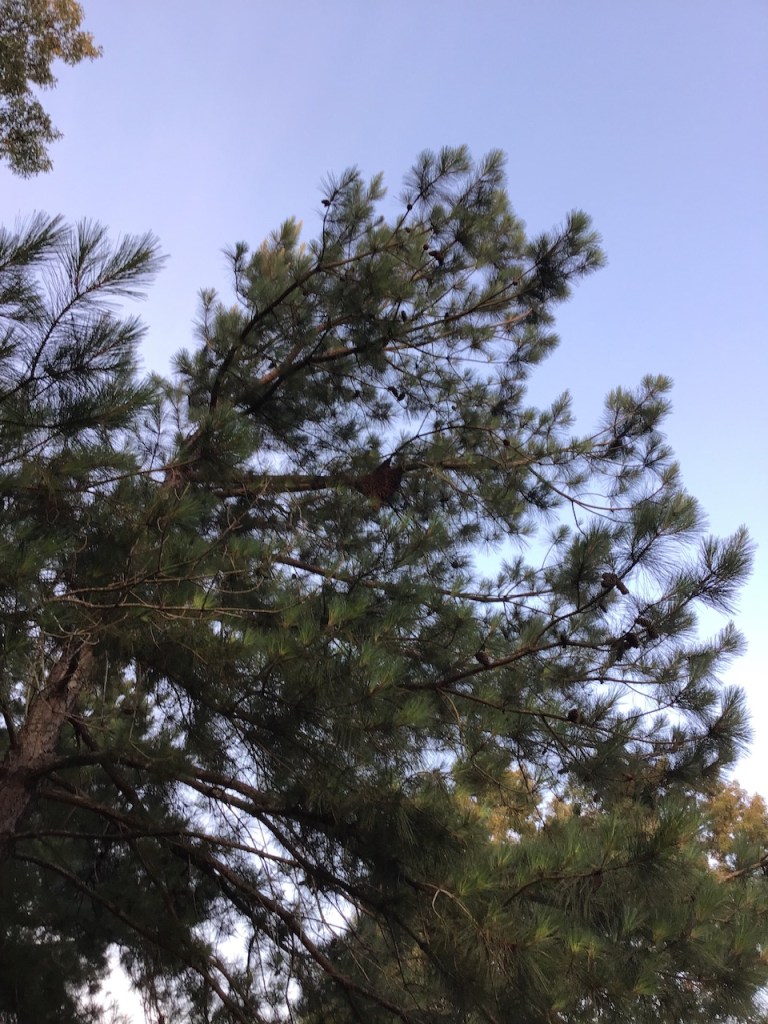
There’s a swarm up there, can you see it?
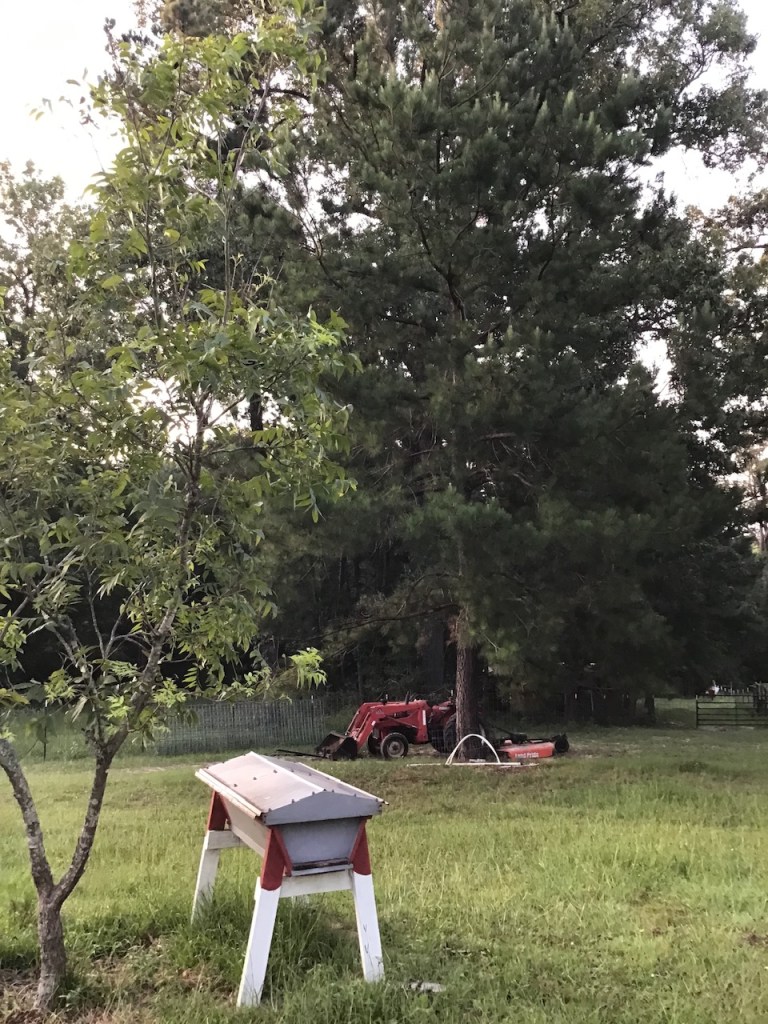
It came off this hive and we watched it, amazing! The large pine in front of the tractor is where it stopped. Too high up to catch, but I’m happy to report another totally treatment-free colony repopulating the county.

“Here, follow this quarterly poisoning routine, and all will be well.” NO!

Is it any wonder they all readily accept without objection whatever the hell is being sprayed over our heads at regular intervals?

We’re not giving up yet. As long as we have irrigation it will be a jungle out there. But without it we’d be screwed, that’s for sure. It hasn’t rained for nearly 3 weeks.

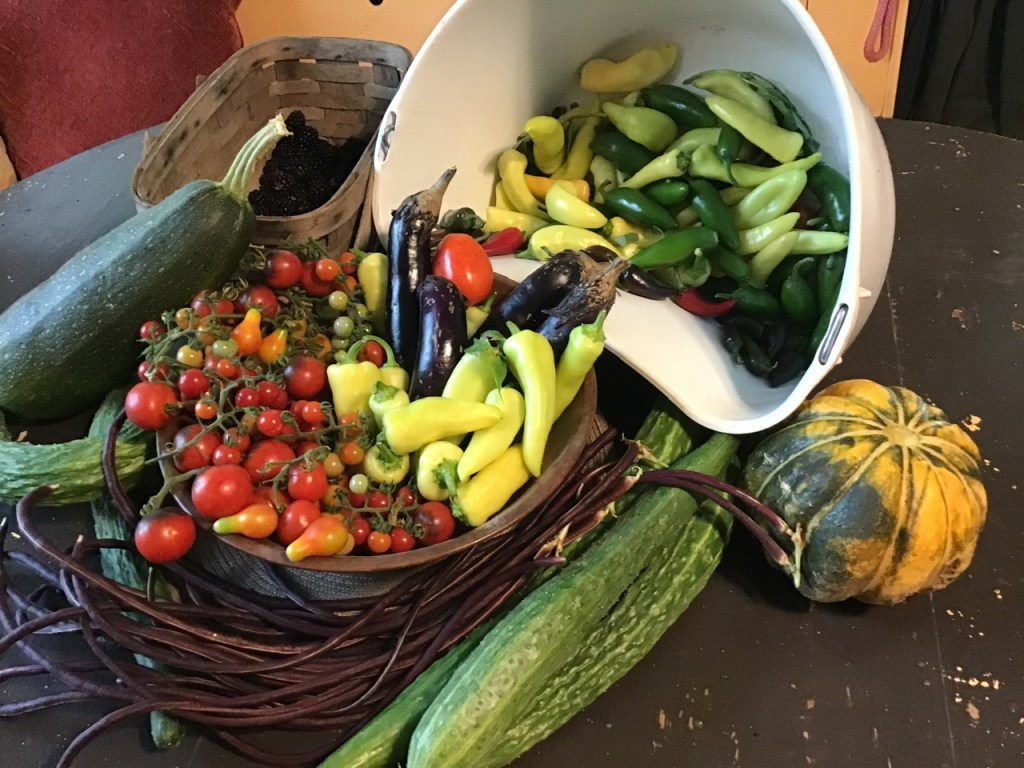
(Photos below Left to Right) The datura is a blessed monster. The sweet potato vines are prolific and a favorite snack of Summer’s. The melons and green beans are thriving. The indeterminate tomatoes and some of the peppers are doing fairly well under the shade cloth and I’ve been succession planting the cucumbers.

From the front: New cucumbers coming up with purslane to help cool the roots and shading from above, old screens protecting some struggling Romaine lettuce, and a growing grove of well-watered elderberries.

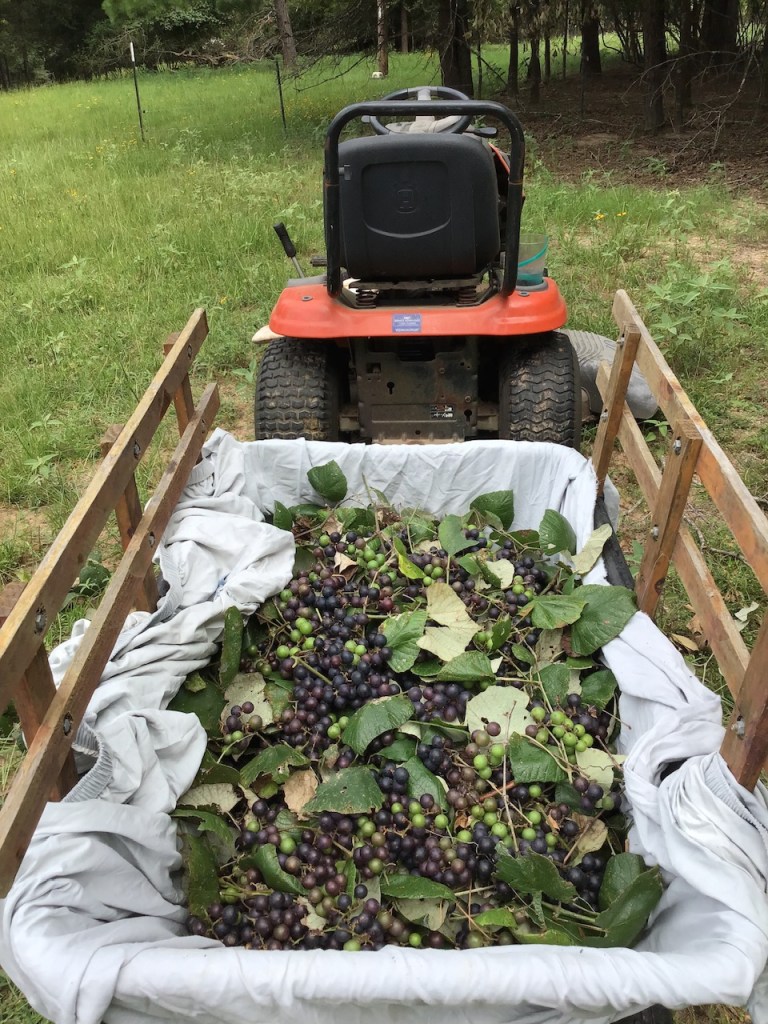
We’ve also been lucky to get some wild grapes, which are now fermenting along with the mead and the blackberry and mulberry wines.

He is literally Hubby’s Shadow!

It’s not an easy life, but it’s a life well-lived. Our first figs of the season, along with our last blackberries.

A Czech classic—so simple—Bublanina, made with blackberries or any number of fresh fruits in season. (Comment below if you want the recipe and I’ll post it. )

*The observation which I’ve found most interesting from Bluebonnet’s death, was that her kids adjusted immediately. She died the evening of the full moon last week. She left the corral with the rest of the herd in the morning, she seemed to be improving, I thought. But then in the afternoon she planted herself under a tree on a hill and wouldn’t leave, even when evening came and the rest of the herd returned to the corral. I went and sat with her there at sunset and stroked her neck and she laid her head on my shoulder. I wanted to be hopeful, but I felt she knew, and I felt horribly helpless. I hope that the feeling of helplessness is the worst feeling in the world. The next morning I woke before dawn and I went back to the tree in the dark, the full moon shining on her corpse.

There was a bit of relief for me that her kids adjusted so quickly. I find it odd really, it was like an immediate weaning. While her mama, Summer, is so ill she stopped producing milk, but her kids are still so attached to her their health is also suffering because they won’t go out and eat with the rest of the herd or accept being bottle fed. I’ve been mixing them special feed dosed with milk replacer and they are doing ok, and Summer today joined the herd again to forage, which I’m praying is a good sign. 🙏

Thanks for stopping by, even in the hard times!