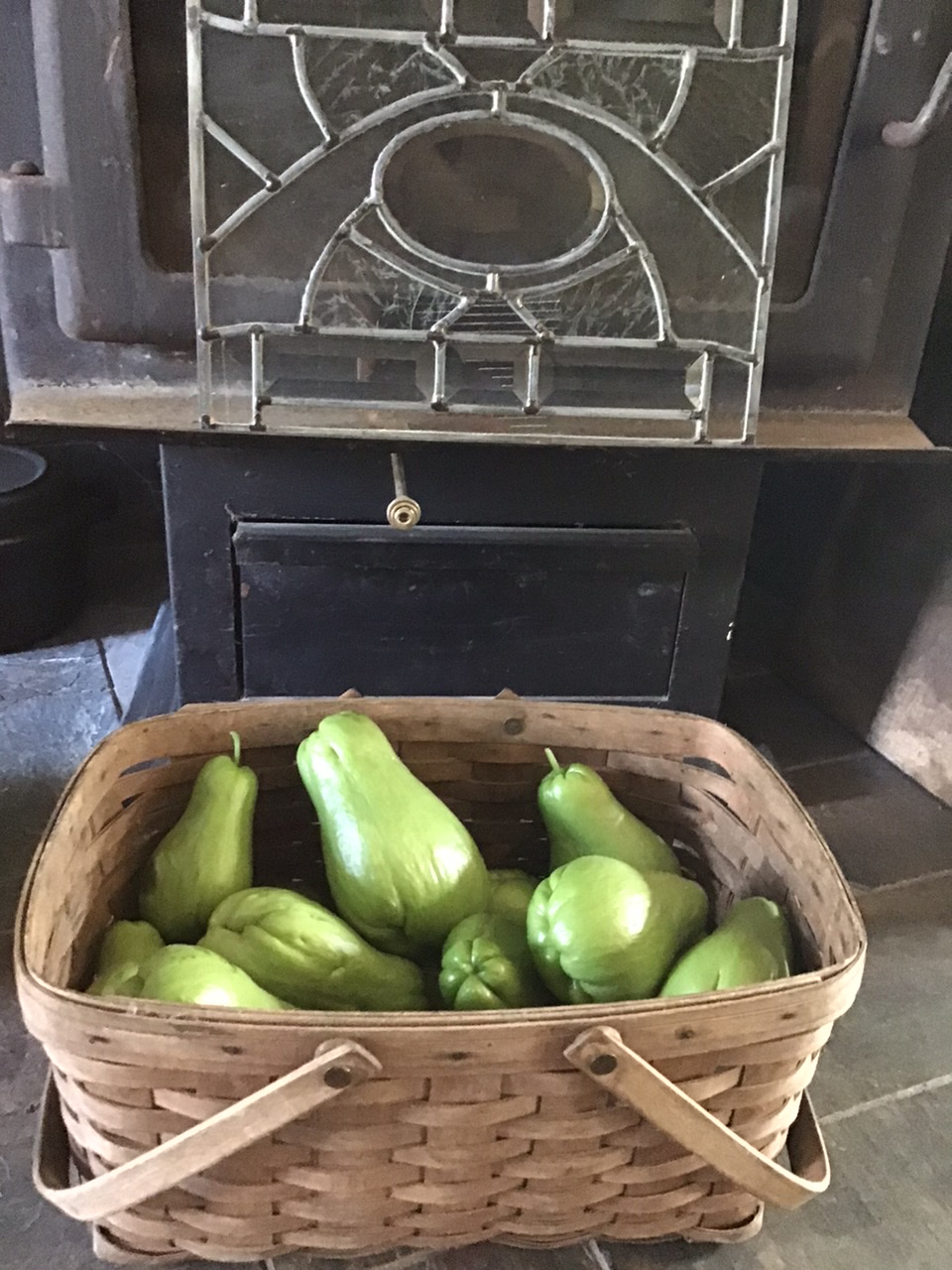
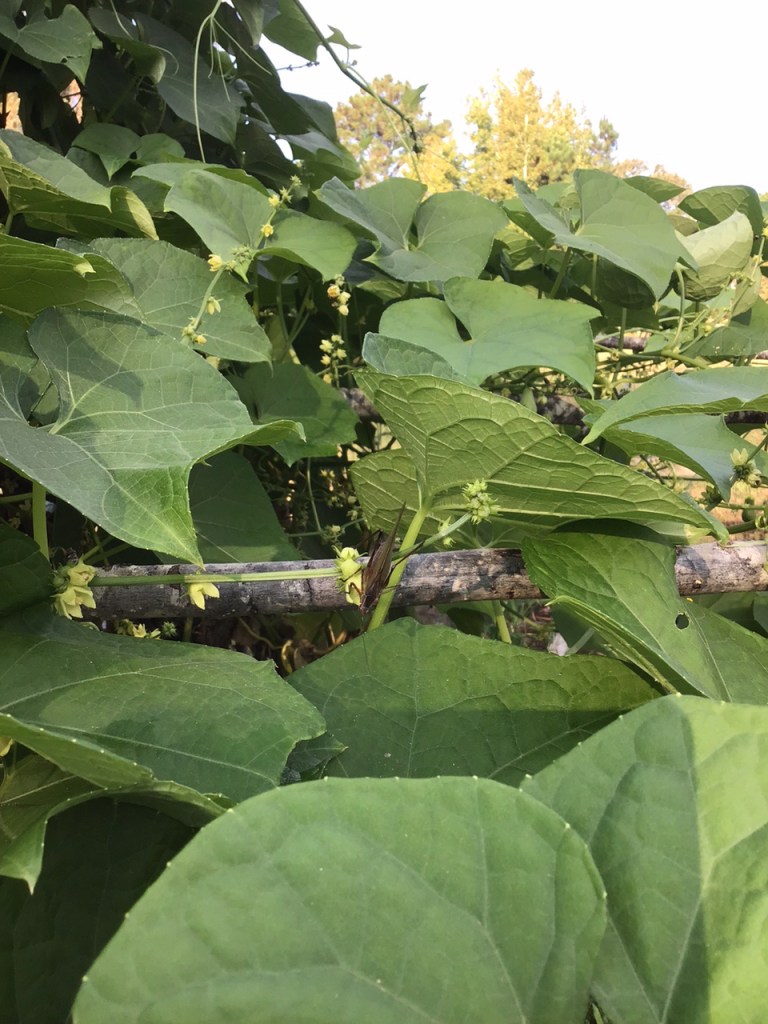
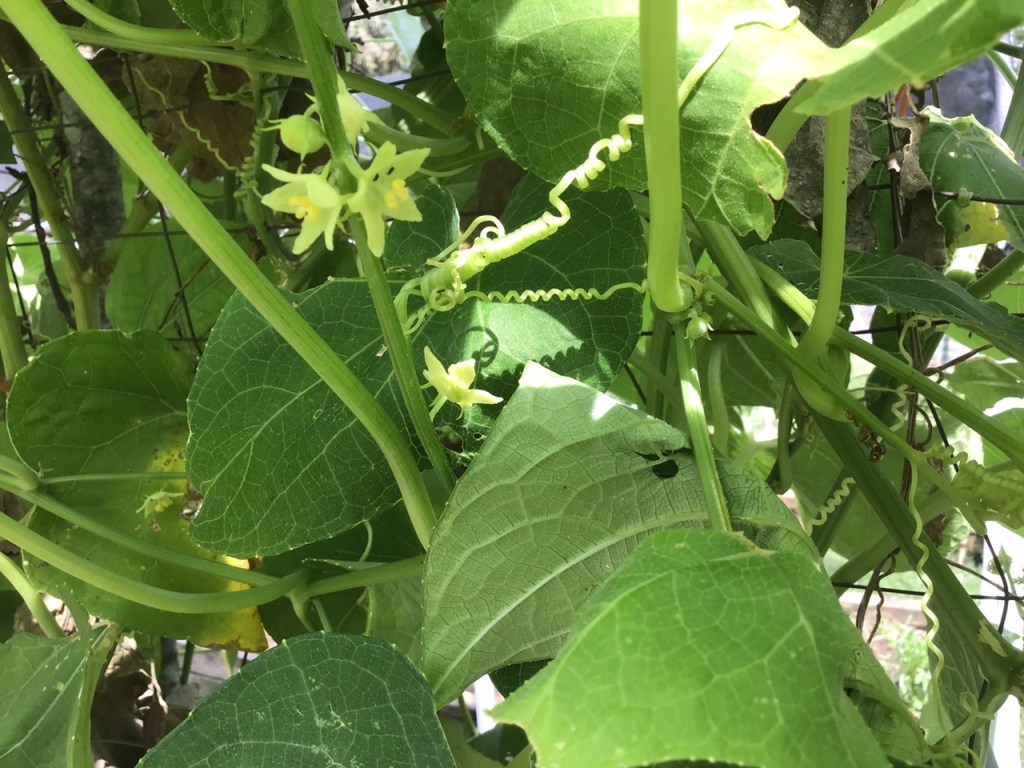
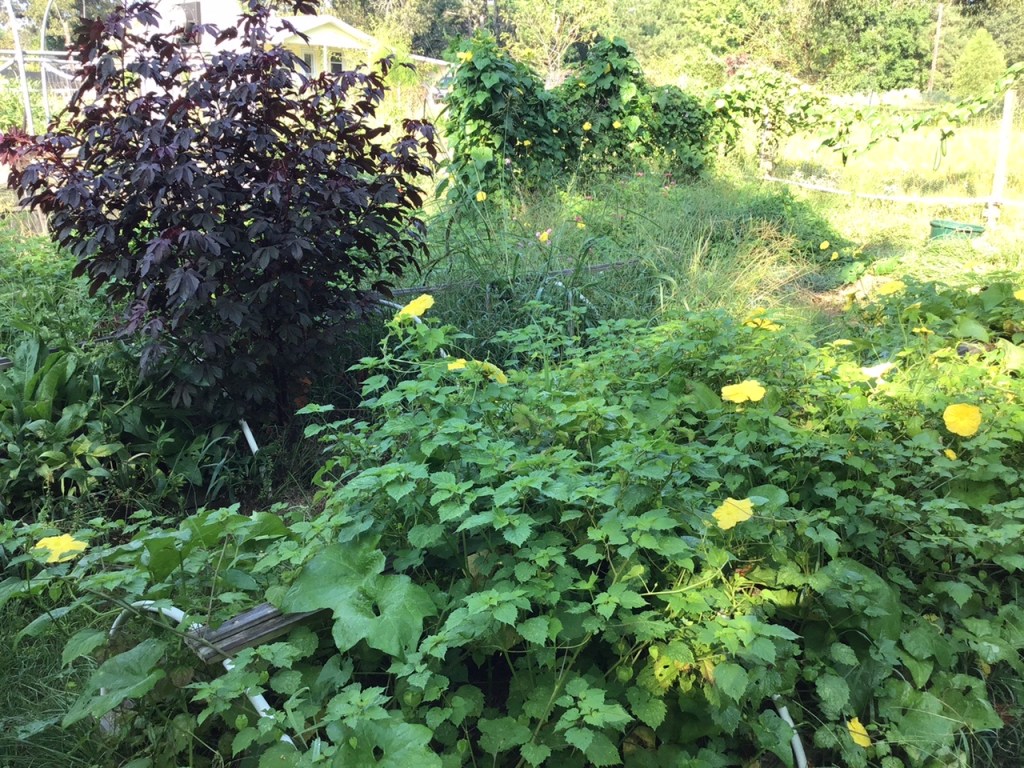
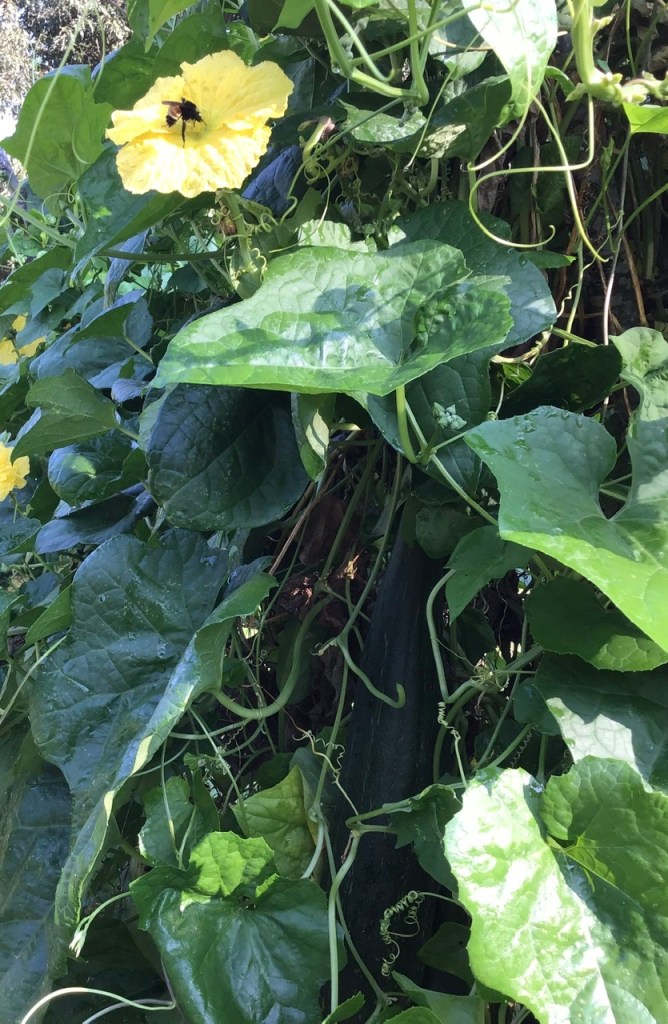
This post is just a quick plant profile because I’m so very pleased we’ve finely been successful growing this impressive and delicious squash. We’ve tried at least five times previously and they never lived through the summer and died long before producing fruit in early fall. I wish I knew how we got lucky this time!
A perennial with leaves, fruit and root all edible. One plant can easily produce 100 fruits a year. It’s a day-length sensitive plant grown in tropical and subtropical areas.
In Zone 8 it can come back from the roots if well-mulched. Fingers crossed here! It was first domesticated in southern Mexico and Central America. The fruits are used raw like a zucchini or cucumber, or cooked like potatoes.
It’s a very popular vegetable in Creole cooking. It’s used in fritters, stuffed, pickled and smothered.
We’ll be trying all of those!
Sources: Perennial Vegetables by Eric Toensmeier Louisiana Real & Rustic by Emeril Lagasse
Source – journal-neo.org “…The most damaging components of American agriculture since the 1990s has been the wholesale introduction of GMO crops—especially soybeans, corn and cotton and the highly carcinogenic Monsanto-Bayer Roundup with glyphosate. The Rockefeller report omits their direct role in fostering that devastation by their creating and promoting Monsanto and GMO for decades, knowing […]
No politics or unpleasant ponderings this post, I promise!
Just some homesteady happy snaps and a well wishing for a wonderful weekend. 🙂
A sea of sweet potatoes soon to be harvested.Mexican tarragon—an attractive replacement for French tarragon that does much better in the South.
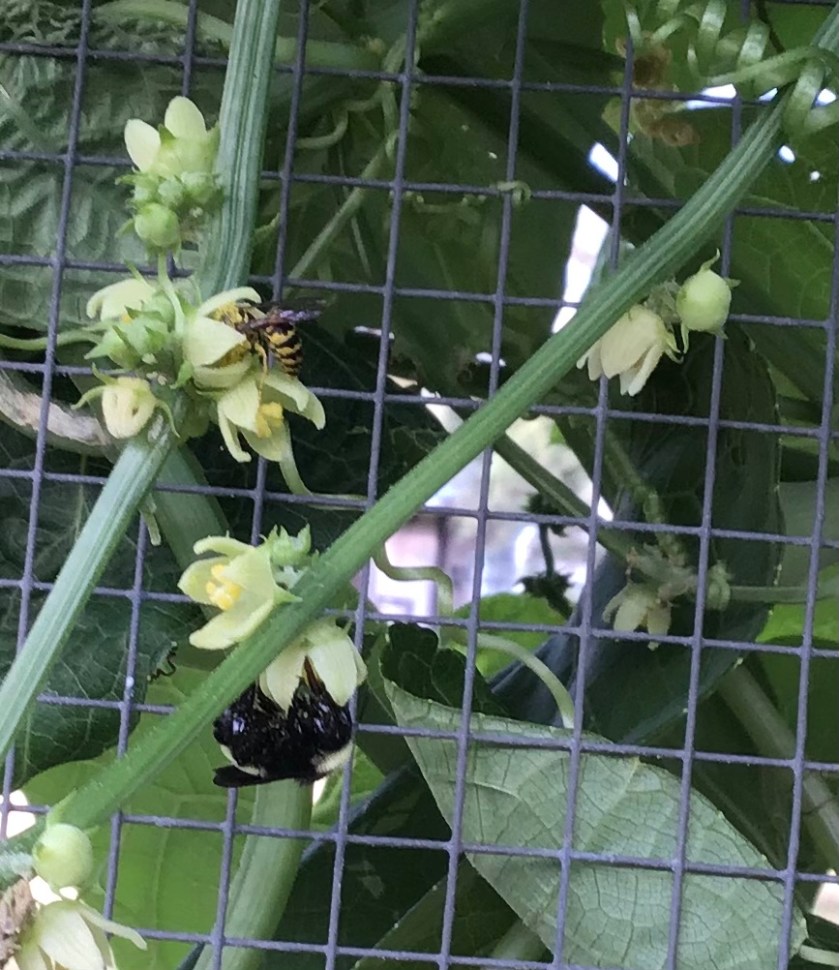
So excited for the mirliton (chayote squash)! It’s growing like mad, covered in flowers and fruit and providing perfect habitat for bees, wasps, crickets, etc.
Volunteer cherry tomatoes thriving on the old duck coop! We’ve never had tomatoes last all summer before, but now I can see how nature would have it done. This is almost an entirely shaded space and the entire coop is filled with volunteers: malabar spinach, datura, and these delicious little morsels.
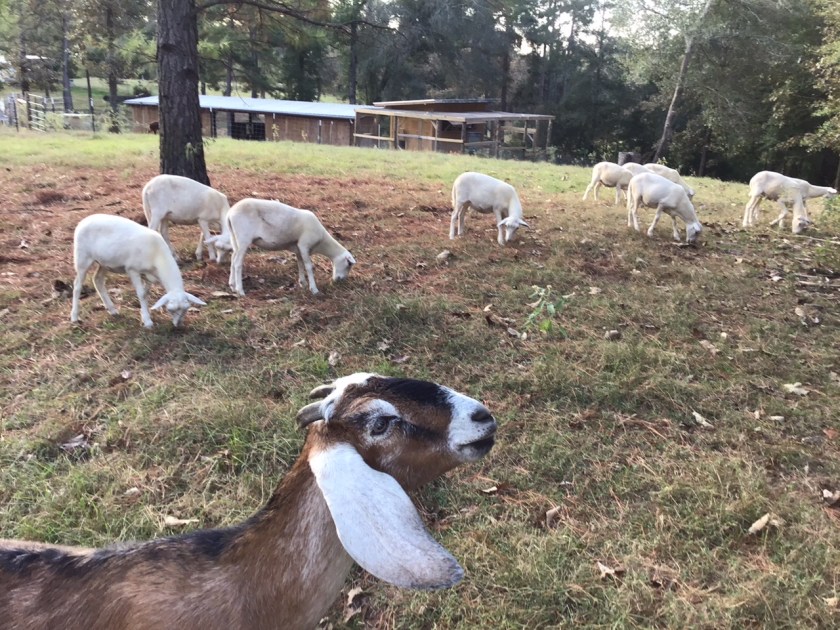
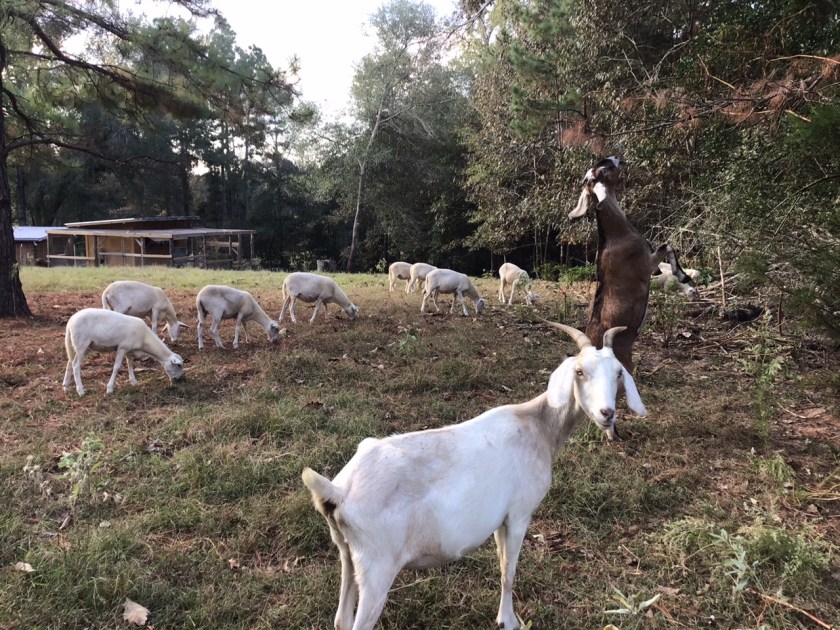
Time to wean the lambs. It was a loud couple of days as mamas and babies were separated, but with Summer as surrogate herd Queen everyone has mellowed down again. Phoebe, the goat pictured on the left, will have her first mating encounter next month. Her sister, Chestnut, jumped the gun, by jumping the fence to be near the rams, the little hussy! FYI—a goat crossed with a sheep is a Geep, very rare and not very desirable.
Drum roll, please, for this next rare shot . . . A Skittles sighting!
Our barn cat, Skittles, who we see about once a week and lives mostly in the trees.
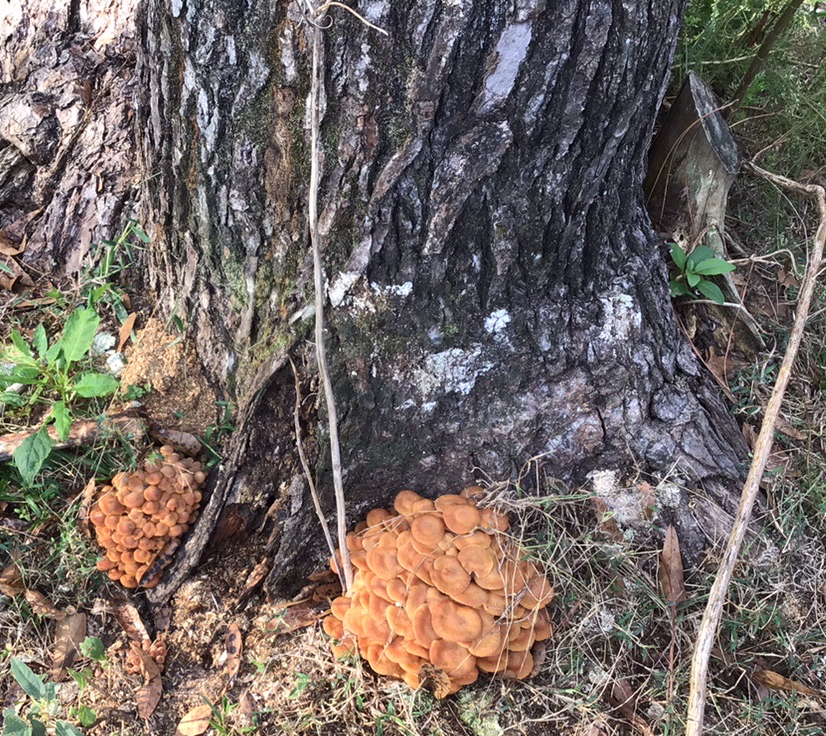
Mystifying mushrooms! These are quite common, honies (armillaria tabescens) claimed to be good by a good many foragers, but we haven’t tried them yet, because my mushrooming buddy and her husband got wretchedly ill on them once. Oops, I promised no unpleasantries. 😉
Buttercup paying homage to the pack leader, Tori, she does this multiple times a day.
I suppose these next snaps might be unpleasant to some, sorry! I do get that, I felt that at first too, but I was gradually desensitized as I realized how much economic sense it makes, what an amazing skill it is, and especially how magically delicious it is.
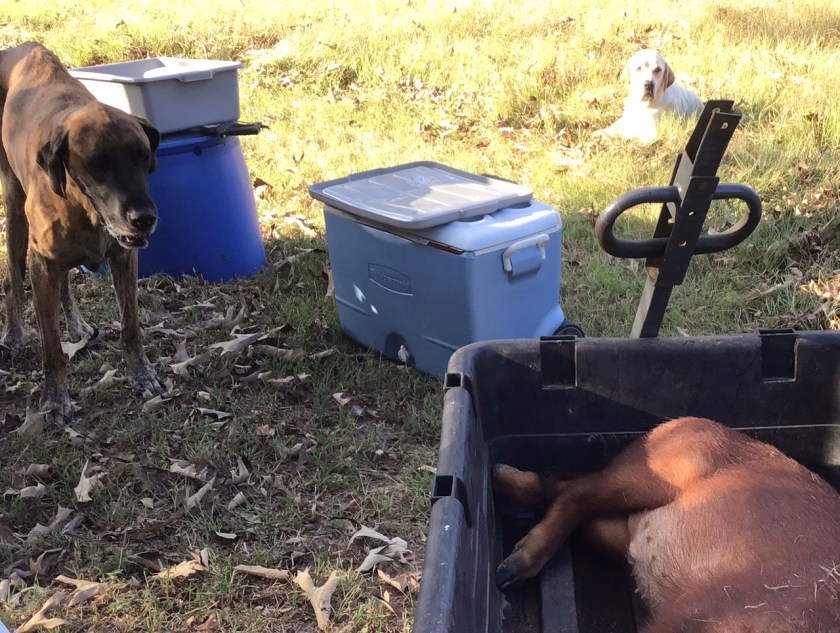
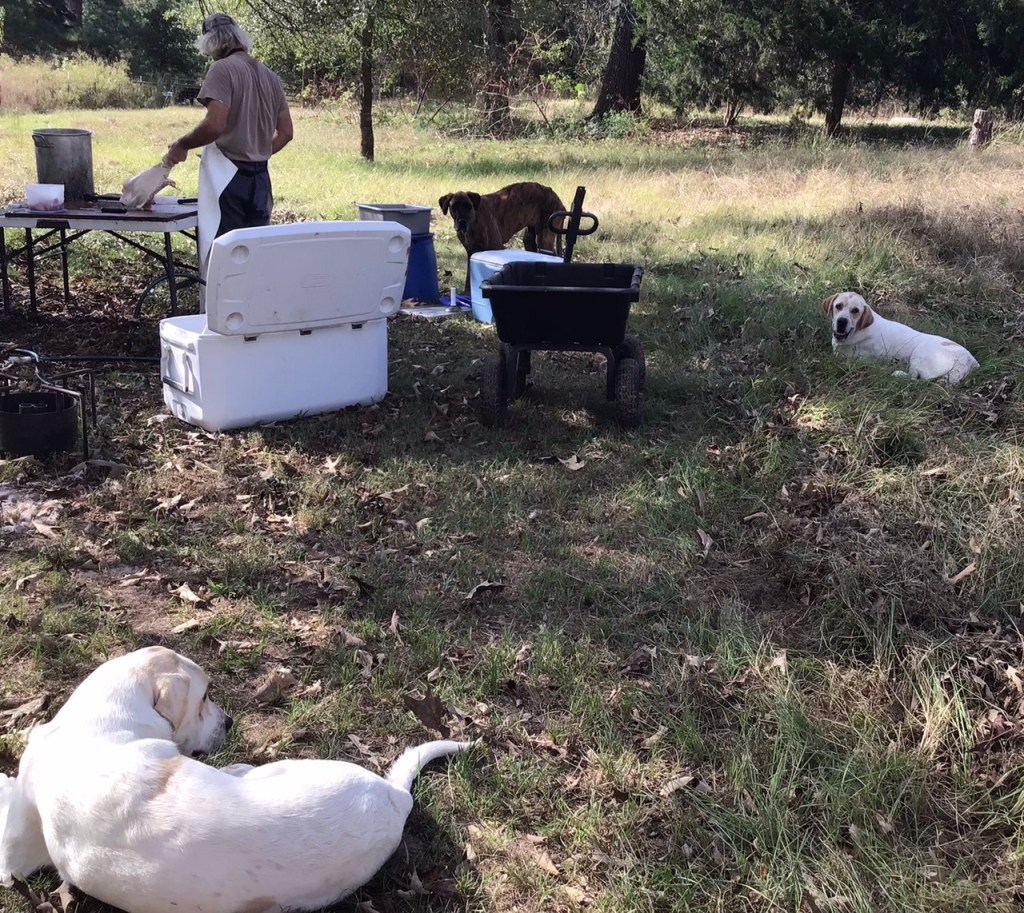
Always an attentive audience at slaughter time.
Our favorite foraging expert who we forayed with nearby this past spring has a great new website all about medicinals. Here’s a short podcast about it, and reminding me that now is the time I should be collecting some goldenrod before winter! Medicine Man Plant Co
We’ve been at this about a decade now, learning by trial and error. Because of a major health crisis in the family, I’ve been introspecting even more than usual these days. That’s why I haven’t been posting much lately.
I thought it high time to deeply consider what our own health futures might hold, Hubby and I, while we are not under the immediate duress of old age and poor health. Health is one of the main reasons why we committed to this homesteading lifestyle. Other reasons are political, esthetic, quality of life and, for me at least, a sense of urgency to hold on to something precious for future generations—nature—before it slips completely from our lives.
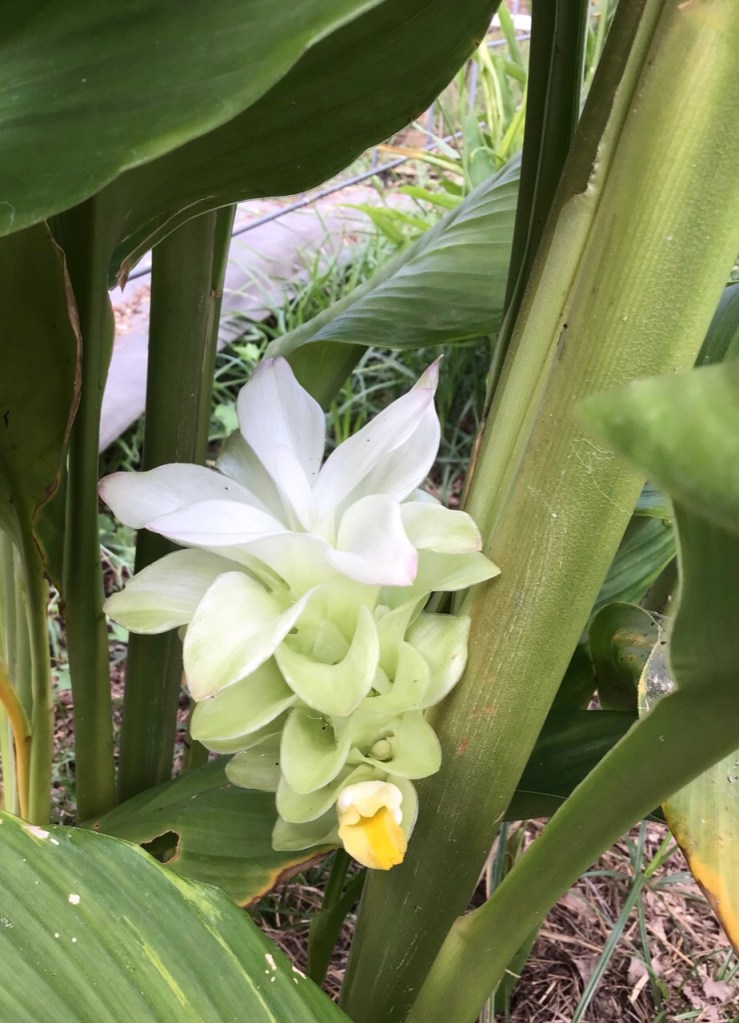
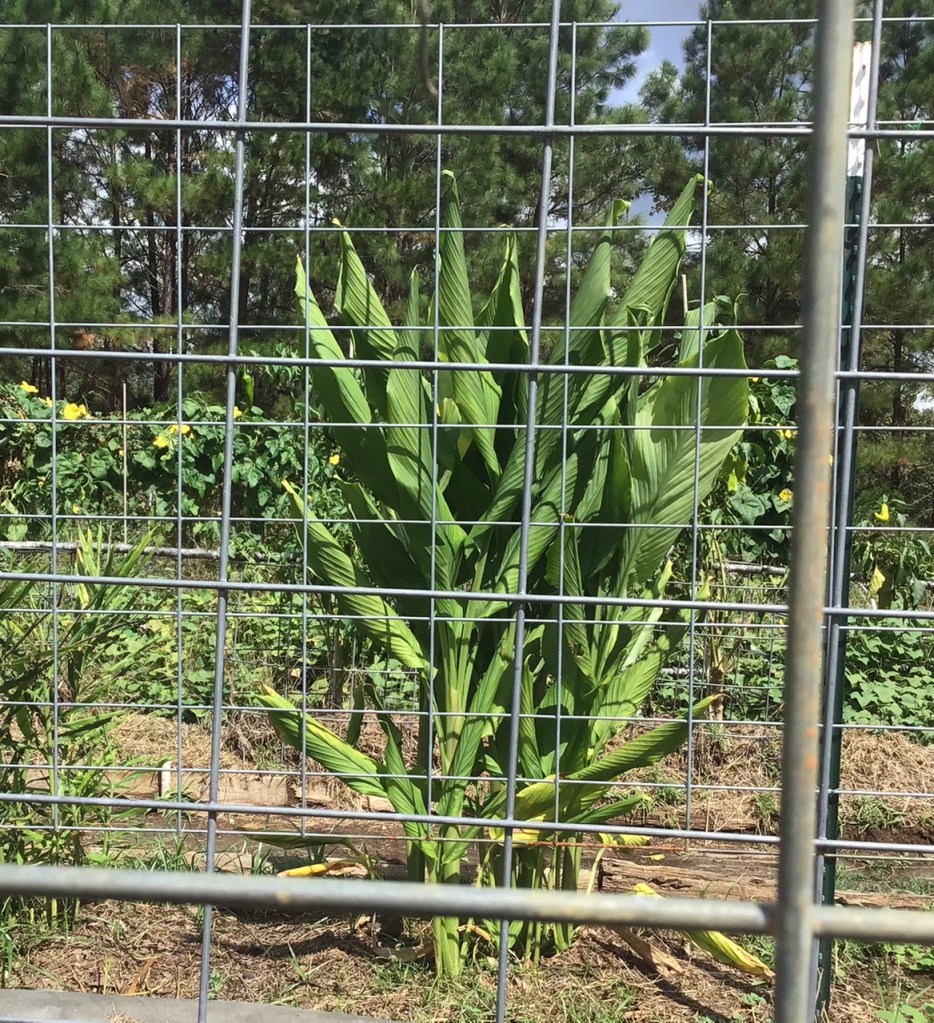
Tumeric flowering, didn’t know they do that!
Watching the impact of the Scamdemic not only on the economy, but also on our ‘health care’ system has demonstrated unequivocally that, despite the challenges and hardships, we’ve made the right choice.
Our ‘health care’ system, which is actually a disease promoting system, is beyond hope, in my estimation. (This one’s surely gone viral by now, but in case you haven’t seen it yet, it’s brilliant!) The DEVOLUTION of covid vaccine efficacy
I truly believe the only way out of the mess this country has become is by reclaiming our natural rights back from the government.
However, that first means reclaiming our natural responsibilities—those ‘unpleasant’ aspects of life we’ve come to outsource to the government (and their corporate partners in crime) in the first place, which has made it ridiculously powerful, as all governments (and their co-conspirators) are wont to be.
We are trying to accomplish that by first demonstrating to ourselves, and then hopefully to others, that such a thing is possible, and also desirable.
But what if, due to our increasing age, we had to choose? Limited strength, mobility issues, cognitive decline, all are serious potential threats to our continued lifestyle here.
Considering this I’ve made a few lists, ranking our current activities against future realities based on: Required inputs, health impact, pleasure principle, and bang for the buck.
It isn’t pleasant. I don’t want to give up any of it, ever! Bees, chickens, pigs, sheep, goats, veggie garden, fruit orchard . . . . But, here goes.
Kombucha, no caveats, it stands alone. If you can make tea you can make kombucha. It’s healthy, it’s fun, it’s delicious. Hubby no longer drinks beer or soda thanks to this amazing beverage, better for health and finances for us, and far better for the environment too, with almost no waste.
Sourdough bread, and already we have caveats. I know loads of folks think they are gluten intolerant; I used to think I was too. Grains properly prepared are nothing like most store-bought breads, for health and taste. Around these parts you can’t even find good bread. In other locales you may be able to find it, but I’d guess the prices are scary. Making your own sourdough bread is time consuming, but it’s not difficult. Same goes for sourdough cookies, brownies, pizza crusts, etc. And, let’s face it, gluten-free products are not tasty, so there’s some extra incentive.
Raised garden beds, and more caveats. Starting to garden at an advanced age is probably not going to be too successful. Of all we do here it claims the prize of Most: most expensive, most labor intensive, most greatest learning curve, most unreliable results. Still, I love it! So, continuing to garden with some foresight and adjustments is perfectly doable. I insist!
That short list makes me sad. It’s the bare bones and I hope such sacrifices will never be required of us—no more chickens, goats, big dogs, great big garden?!
I don’t even want to consider it, but there it is.
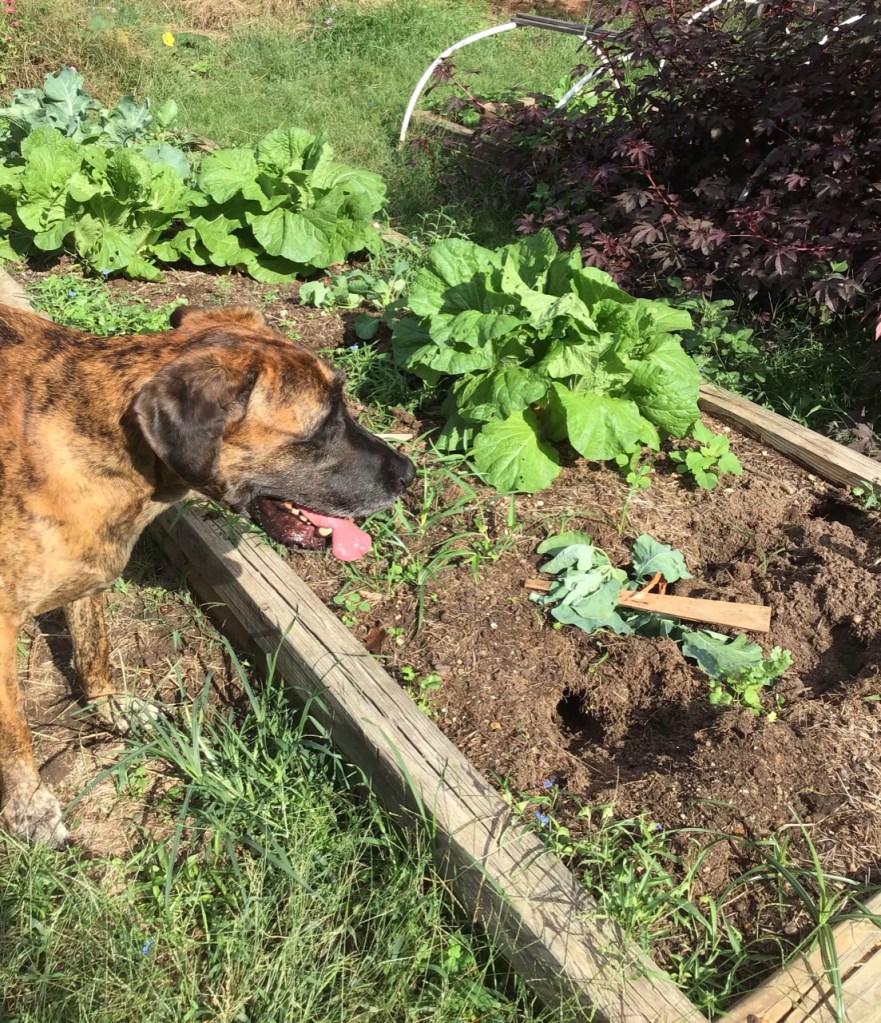
Tori surveying the gopher damage. Bad rodents!
There are also many projects still on my list to successfully accomplish, which are in trial and error mode now. Like making all our own body care and household cleaning products and herbal medicines. Hubby has future hopes of making furniture, if his current to-do list will ever allow it. No time for poor health here!
So, another short list is in order. The three things, in addition to those above, that I hope and pray we never get too old for: 1. Bees — not even for the honey necessarily 2. Chickens — they are easy enough to manage, but they attract predators 3. Goats — mostly for the cheese making, but they’re pretty good company too
And the three things we would most likely not be able to continue into old age: 1. Slaughtering — tough work, no doubt about it 2. Orchard — even established ones are a lot of work 3. Pigs — high maintenance, yes, but so delicious
We have no intention of ever rejoining urban life. And as far as intentions go, avoiding nursing homes and hospitals is right at the top of that list as well.
“The same pattern applies to what is called “mental health.” Thirteen years ago I wrote an essay, Mutiny of the Soul, which described various mental conditions like depression and anxiety as forms of rebellion against an insane world. By calling those conditions illnesses and treating them with psychiatric medications, we suppress the rebellion and adjust the individual to fit society as it is.”
“…Thirteen years ago I wrote an essay, Mutiny of the Soul, which described various mental conditions like depression and anxiety as forms of rebellion against an insane world. By calling those conditions illnesses and treating them with psychiatric medications, we suppress the rebellion and adjust the individual to fit society as it is”
Let’s say I’m addicted to prescription pain-killers. You are my concerned friend. “Charles,” you say, “you’ve really got to get off this medication. It’s ruining your health, and someday you’re likely to OD.”
“But I can’t stop taking it. I’m in pain all the time. If I don’t take it I can’t function at all. I have terrible back pain, and my doctor says there is nothing I can do about it.”
If you accept the premises of my response, you’ll have…
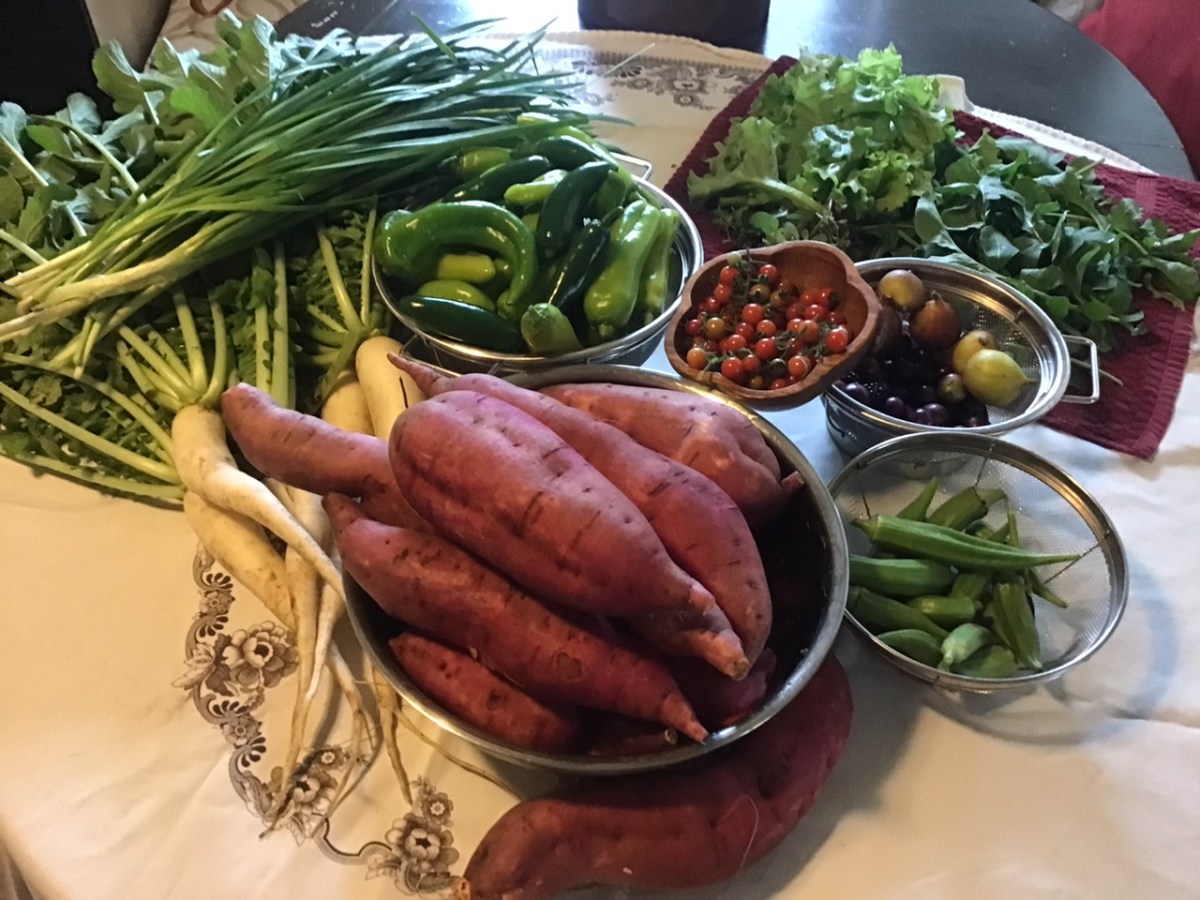
No rest for the weary around here! Our goal of year-round garden harvesting has been met and is every bit as rewarding, and exhausting, as I expected.
Living, working and eating according to the season is remarkably satisfying. In the last couple of years especially I’ve spent much less time learning from books and much more on direct observing and experimenting.
I’m thinking our next goal should be to throw the calendar and the clock out with the garbage. Show those Amish what a real Luddite looks like! HA! 🙂
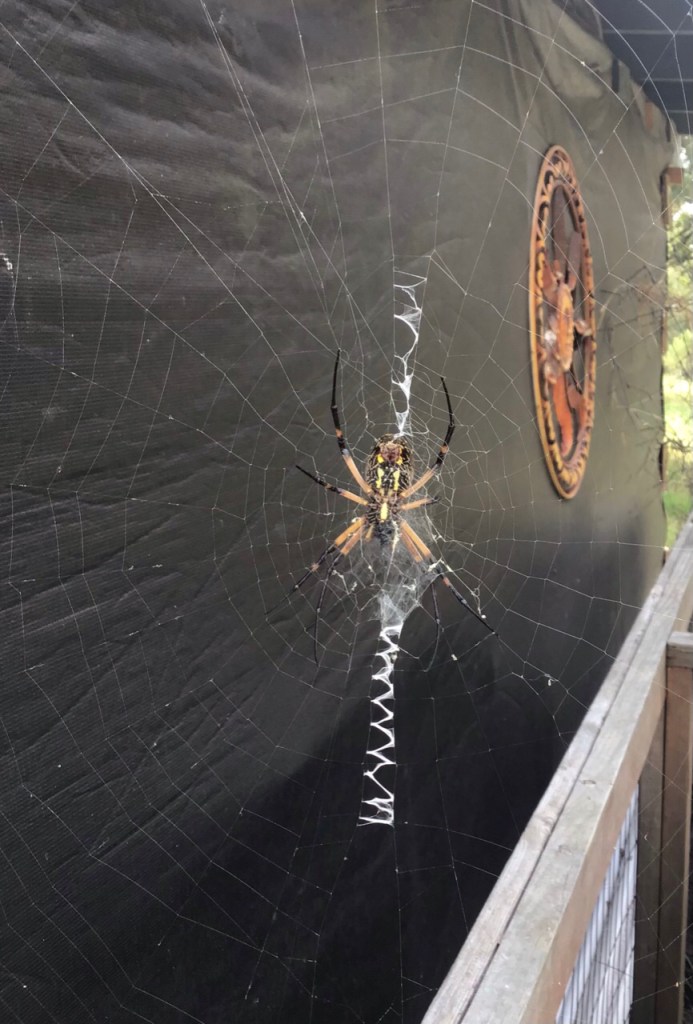
This time of year the spiders tell me it’s a good thing I’ve got the cool season crops out already. Many of them were started indoors, then transferred outside under shade cloth which will remain until the heat breaks, fingers crossed we don’t get an early frost.
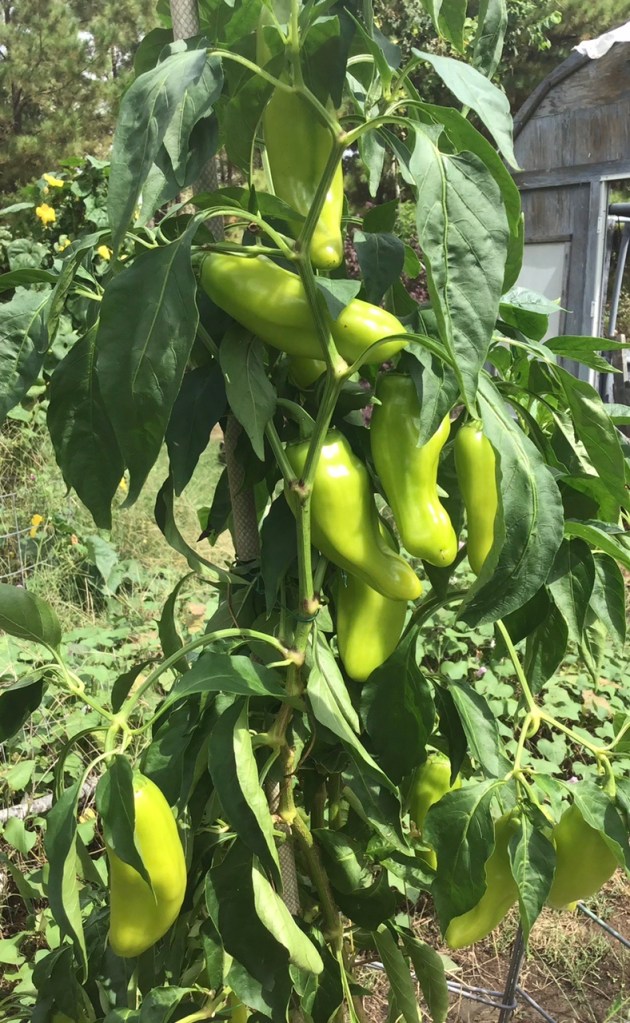
I’ve just started harvesting the sweet potatoes, the luffa and peppers are going crazy, the radishes, volunteer cherry tomatoes and lettuces are finally happy again and I’m most excited for the mirliton squash (chayote) that is finally getting its first flowers. This will (hopefully) be our first success with mirlitons following multiple failed attempts. I love this squash, but it thrives in southern Louisiana mostly, because it needs a very long warm season, even longer than we get here. I started these indoors in February, along with the turmeric, also a first for us this year.
As soon as it cools down I’ll also be harvesting honey, lots of herbs for drying and pesto, along with foraged leaves and roots for teas— sassafras, beauty berry, sumac—and once we finally get some rain, it’ll be time for mushrooms.
Hubby will be filling the freezer with lamb and pork and freshening our flock for spring lambs and a few to add to our growing herd of milking goats.
Hibiscus in May, hibiscus today . … still not blooming because I got a late start.
The honey bees love the Thai basil and the native bees especially love the salvia and the sweet potato and luffa flowers. We’ve decided next year to plant an entire row of luffa in the orchard just for the bees and pigs.
Hope you can enjoy a moment of piglet playtime! Surely there will be time for a wee rest in late winter?
“Opponents of vaccine mandates are muted with the label of “anti-vaxxers”, which in our post-Soviet society is seen as a person who is irrationally fatalistic, mystical, illiterate, selfish, anti-modern, and anti-science.’
Today I hand my blog over to Lithuanian, @gluboco, and as he is a messenger from God, let’s call him Angel. He even refers to his favourite food as “heavenly” though its origin is much more down to earth. He forages for mushrooms in the forests of Lithuania, and becomes ecstatic when he finds chanterelles.
Angel is married with two children. They are expecting a third. They are neither rich nor poor and he describes his family as being “very ordinary”. Since the Covid-19 farce hit the planet Lithuania has – not for the first time – been taken over by a totalitarian regime. It is the worst-hit country in Europe, and is most likely a testing-ground to see how such controls can be made to work elsewhere.
Restrictions imposed are reminiscent of former times under Soviet control, German occupation during both world wars, or 30 years of Tsarist…
One of the repeated lessons of history is that when Potemkin politics become standard operating procedure in a nation, no matter how powerful and stable that nation might look, it can come apart with astonishing speed once somebody provides the good hard shove just discussed. The sudden implosion of the Kingdom of France in 1789… Quote […]
“This is how we got twenty years of total failure in Afghanistan. Ours is a profoundly caste-ridden society, in which members of the privileged classes fondly pretend that they alone know what’s really going on in the world and can ignore any contradictory data that might filter up from below. Meanwhile the people who have to live with the consequences of the resulting policies face a torrent of abuse if they mention that the facts on the ground are not behaving according to plan. Nor was this effect limited to one overseas war. Keep in mind that the same elites who were responsible for those twenty years of total failure in Afghanistan are also responsible for the current state of affairs here at home, and a great deal suddenly makes sense.“
Sanity still reigns on the wee homestead and I thought maybe a few of y’all might need a decent dose of it during these crazy dog days of summer amidst continued global chicanery.
The garden looks more like a jungle, but there is a method to the madness. Mostly it’s called ‘too hot to bother’. Still, it looks better than it ever has this time of year (which is saying very little) so I’m proud of a few things worth sharing.
The pigs are eating well off the luffa, which does so well here it actually out-competes the grasses. I wish we liked to eat it too, but I do use the sponges. It’s widely consumed in some cultures, so I might keep trying recipes to see if anything can improve its very bland taste. Plus, the bees love it, so it’s definitely a keeper.
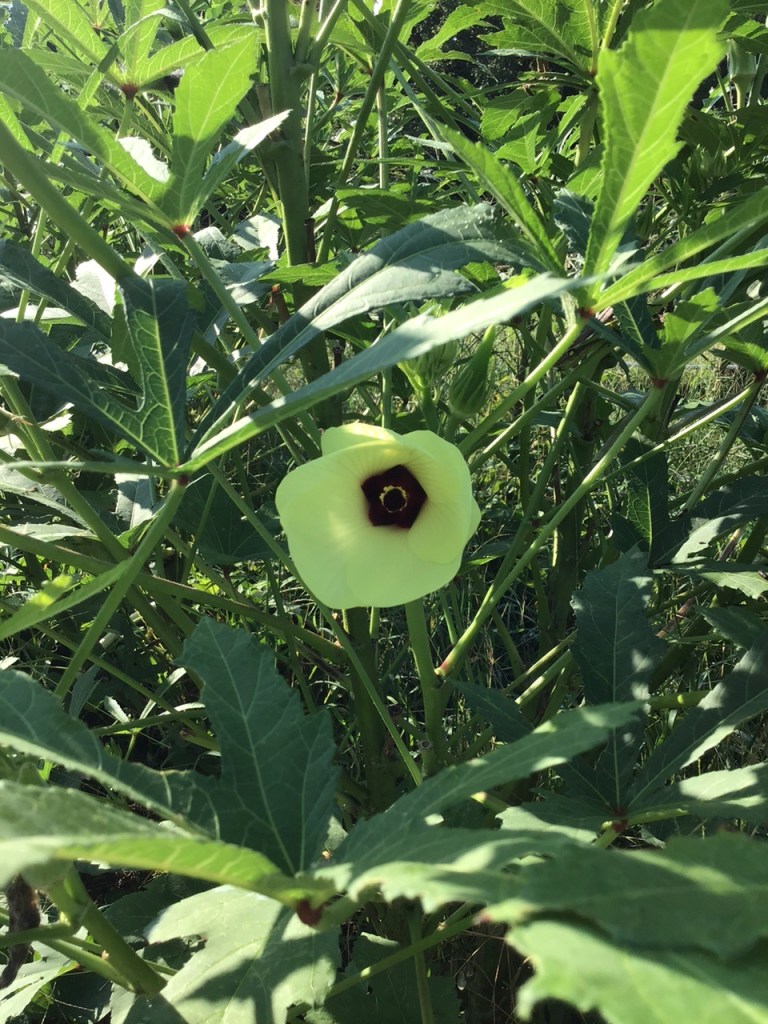
We’re pretty limited on the veggie harvest this time of year, which means eating okra almost daily. I’m really not a big fan and it’s not even a fun one to harvest. It’s prickly and the fire ants scout every inch of it waiting to fall into your gloves or onto your thighs as you cut the spears. Its only redeeming qualities, if you ask me, are that it thrives in the heat and the flowers are pretty.
Luffa and Okra, 2 heat lovers
It’s our first harvest of scuppernong grapes and I’ll soon be making some wine and jelly. I’m kind of sick of canning, after all the pickles and having tried several new canning recipes this year, but I must find the grit somewhere and get back to it. For my latest experiments we’ll soon be tasting pickled watermelon rind, melon butter, and some exotically flavored cucumbers. That’s in addition to all our usual staples of pickles and salsas and sauces.
Green scuppernongs, yum!
I’ve also made poke wine! It tastes pretty weird, but is supposed to be an excellent medicinal, so I thought it would be good to have on hand this winter. Despite popular hype, poke berries are not poisonous. Well, not exactly anyway. The seeds inside the berry are poisonous if chewed. You must extract the juice or swallow the berries whole.
Poke berries and poke wineButtercup decorated with Poke berry splotches 🙂
Our pear harvest was quite small this year, but those will be processed soon too, into cider and preserves. My favorite, figs, have been doing better after a couple years of total failure. Too bad we eat them too fast to preserve them!
I’ve settled into a nice routine with milking our goat Summer and am extremely pleased with the cheeses I’ve been making. It took some getting used to, fitting it all into a workable new plan, after making mostly large-batch cheeses for several years. I’m using only traditional methods now too, so no more expensive cheese cultures to purchase.
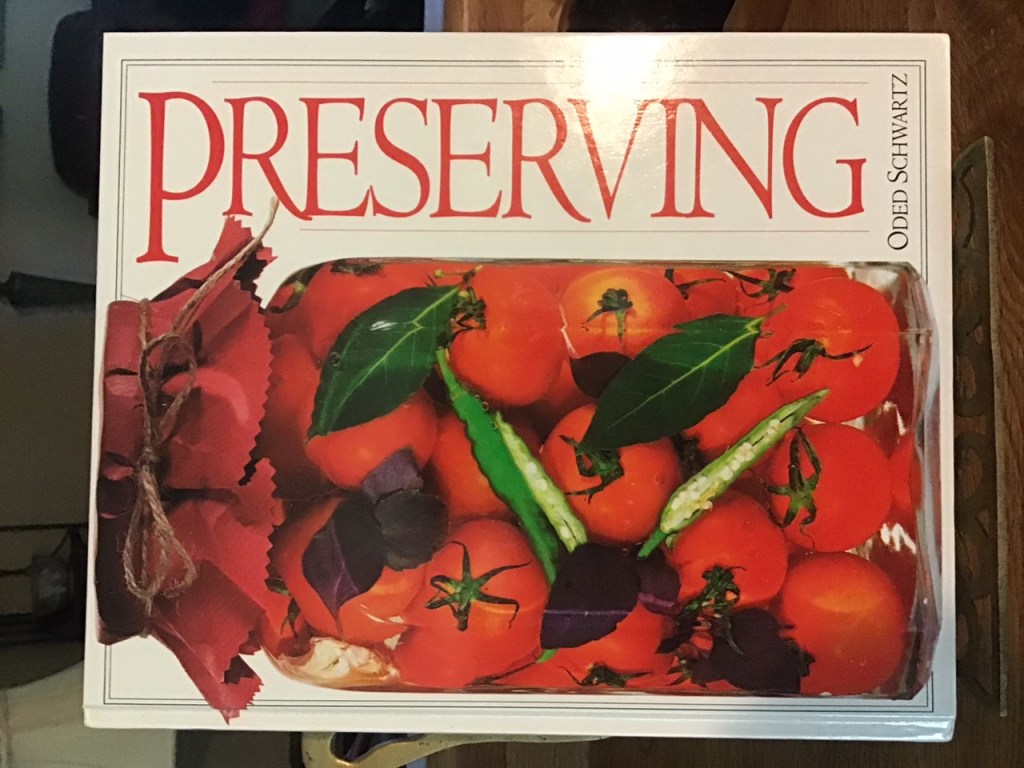
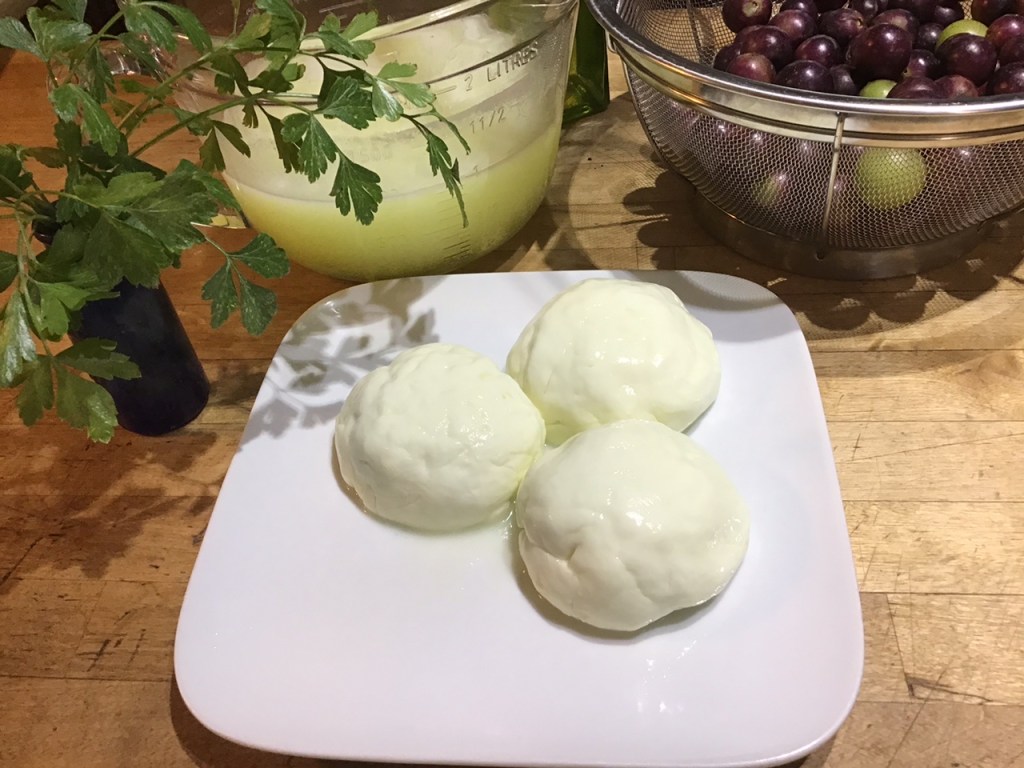
Making melon butter and goat cheeses. Pictured here: left: crottin; right: mozzarella Middle: my favorite preserving book
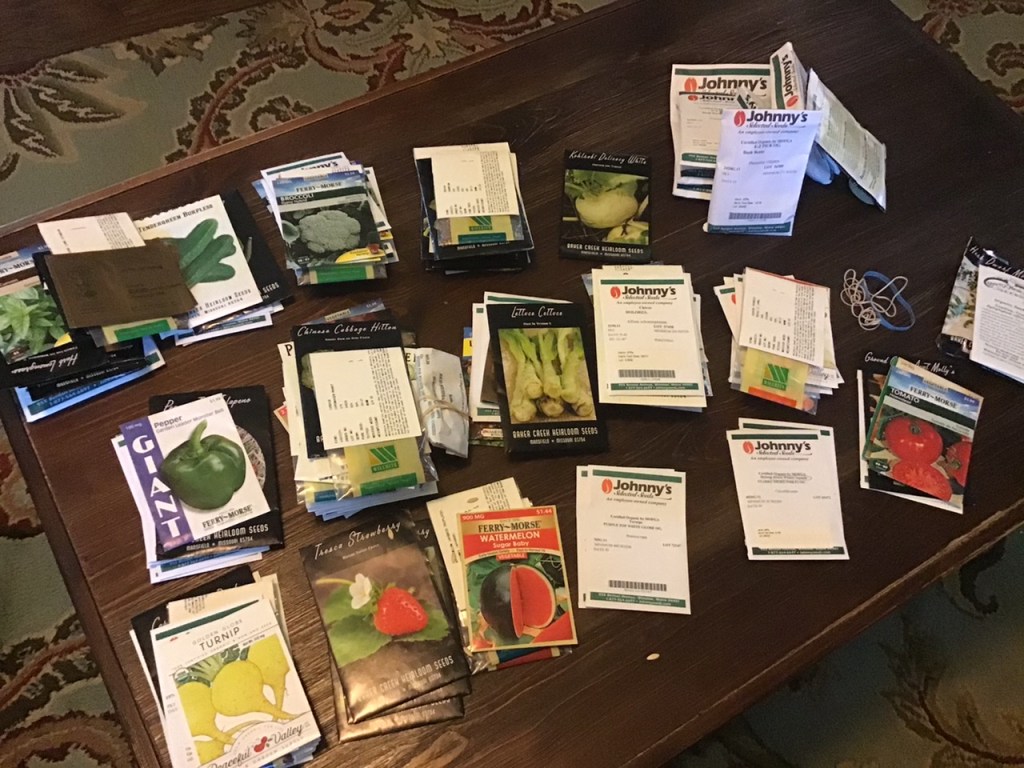
Organizing seeds and preparing the fall plantings are also in high gear. It’s a real challenge in 90+ degree temps to be considering the cool season crops. I’ve got some started indoors under lights and my direct sow method amounts to throwing a variety of seeds in the ground every week, waterIng liberally, and keeping fingers crossed. Usually, eventually, some seedlings get brave and make an appearance and if we’re lucky, will produce something before the first frost.
Handy Hubby’s still rockin’ the new utility room and it’s already looking fabulous! It’s been a 100% DIY project for him and he never fails to impress. Once done I’ll give him a proper staging and big kudos post.
‘Civil disobedience becomes a sacred duty when the state has become lawless or corrupt. And a citizen who barters with such a state shares in its corruption and lawlessness.’ — Mahatma Gandhi In our post […] The post Shutdowns and Covid Tyranny: Rubber Meets the Road for Resistance first appeared on Winter Watch.