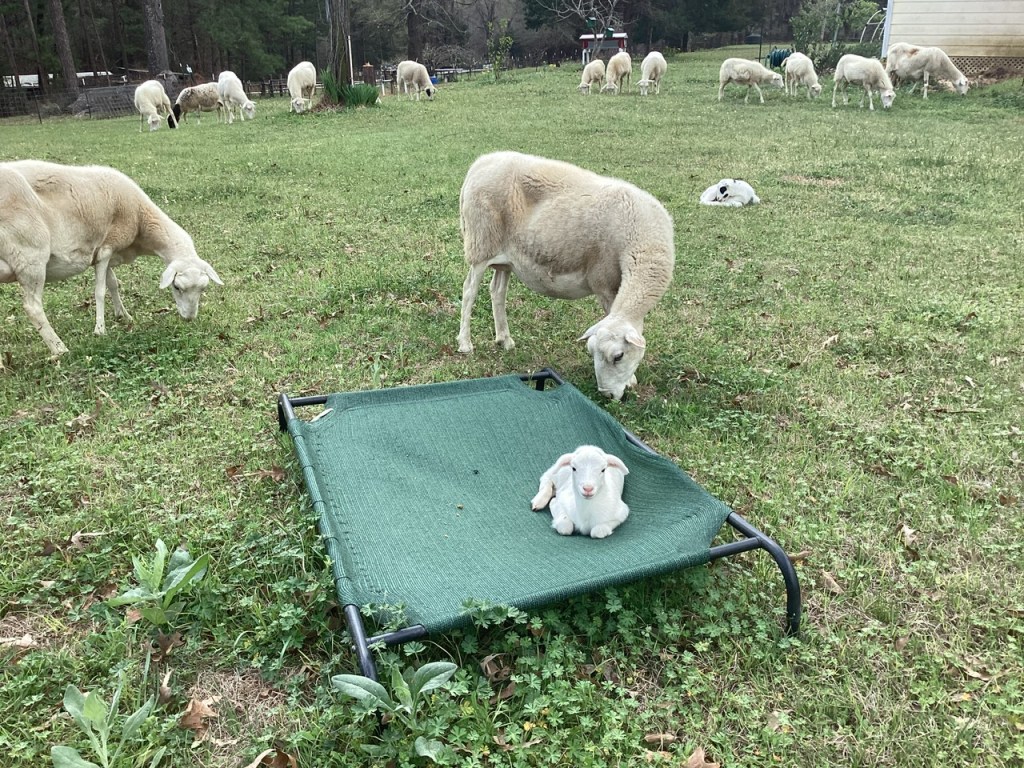
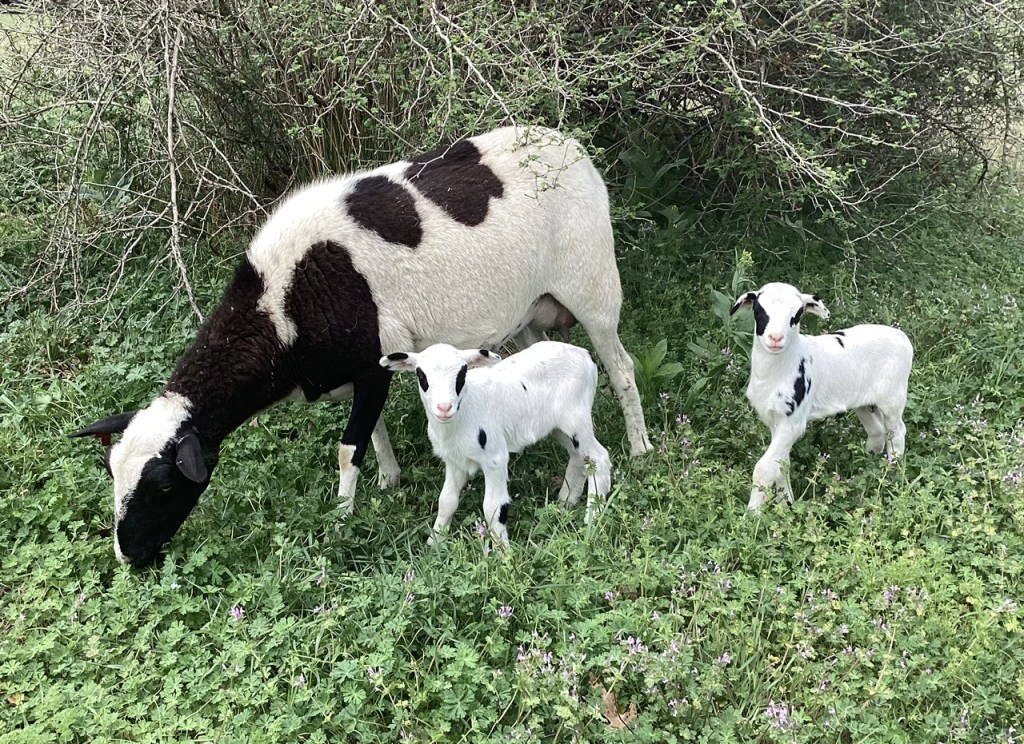
Such a synchronistic interview popped into my feeds, which I just have to share. Not only is our wee homestead full of young blood sucking down mamas’ milk, but I’m also teaching another cheesemaking workshop this week.
So, milk is big on my mind, nothing unusual there.
This interview from Weston A. Price is priceless! It really is such an awesome feeling for me when a new and powerful voice comes on the scene repeating what I sincerely believe and what we have been diligently cultivating on the wee homestead. We are losing too much of great value in our blind rush toward ‘progress’. We’ve got to work harder to keep hold of our wise traditions, or they will be lost forever.
Clearly this issue is getting lots more attention lately, but it has been on the radar of many cheese-lovers since the 90s, including yours truly, because I was so peeved to have to give up cheese, because I was suddenly ‘lactose-intolerant’, like loads of other people. But at that time it was only in the U.S. I couldn’t eat breat or cheese, not in Europe.
Today in Europe they have also been inundated with ‘vegetarian’ rennet and glyphosate and other chemical industrial products and processes, and when it comes to cheese, the vast majority are not labeled as such. I got suspicious, started asking a lot of uncomfortable questions, and found out A LOT about GMOs and our body’s reaction to them.
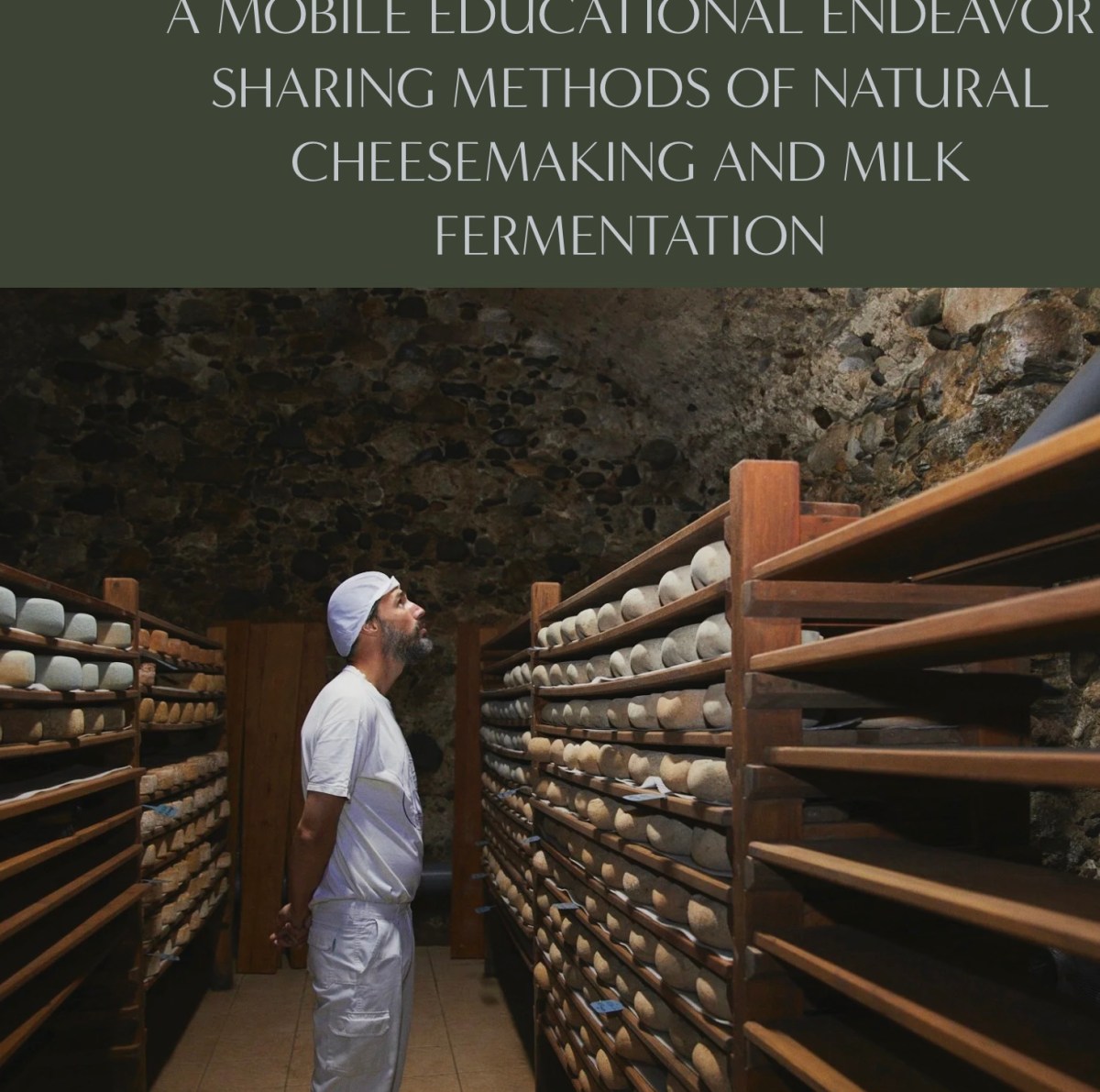
The interview summary and link for anyone interested in some fantastic cheese talk (he even talks about the maggot-ripened cheeses I’ve mentioned quite a few times on this blog!)
Traditional cheesemakers respect the process of cheesemaking. They honor the environment, the animal, its milk and traditional techniques – all of which lead to delicious, nutritious cheese. Industrial cheesemaking, in stark contrast, emphasizes sterile conditions, uniformity, and artificial inputs (including GMO-derived rennet). The cheese that results from the conventional approach is consistent… but misses a lot in terms of flavor profile and nutrients.
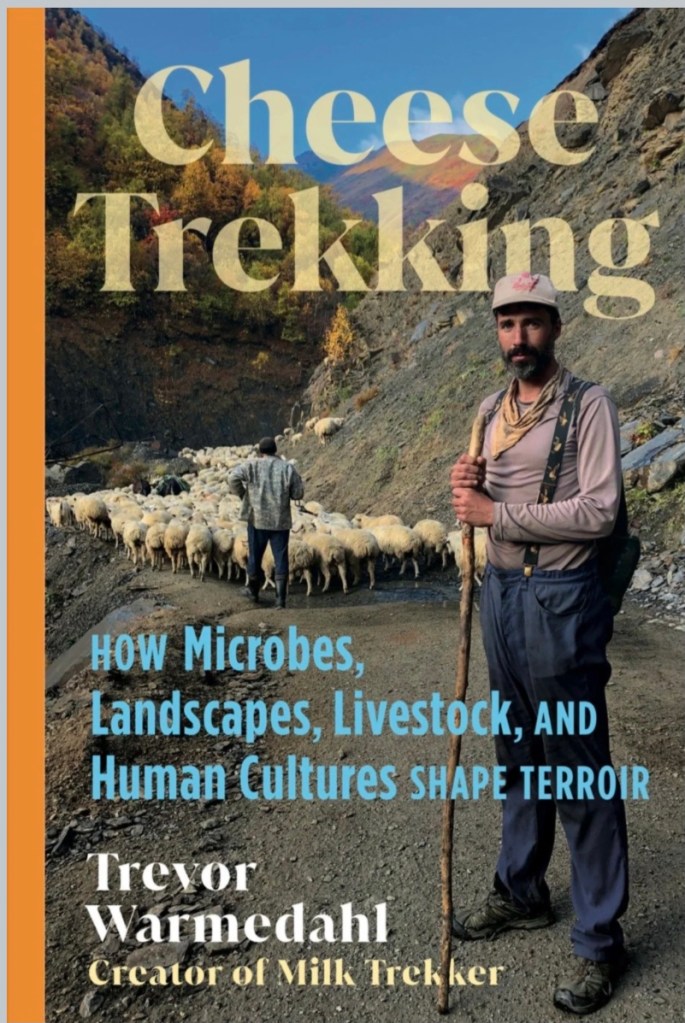
Trevor Warmedahl is a cheesemaker, fermentation educator and the author of Cheese Trekking. Today, he takes us on a cheese adventure, as we gain insight on traditional, artisanal cheesemaking. He gives us pause about what is in our fridge and where it comes from.
Trevor has trekked all over the world, working alongside artisanal cheesemakers, so he understands and shares the importance of working with (instead of against) microbes and nature. He describes cheeses you may have never heard of, along with unique approaches to making them. Trevor also helps us take stock of what has been lost in our modern approach to cheesemaking.
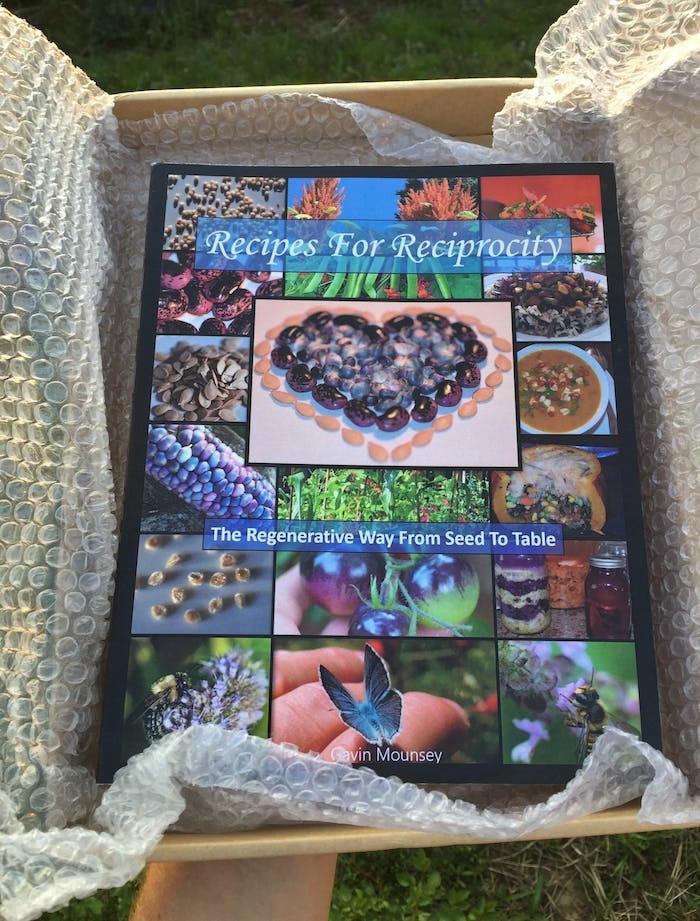
I wrote about Gavin’s book and gift of seeds recently, and now I’d like to share a bit about the recipes and his approach to gardening, food, cooking and life in general that I align with so much I can easily overlook our superficial differences–like we’re at nearly opposite ends of the gardening calendar, we’re decades apart in age, and I would normally never buy a vegetarian cookbook.
But as I already said, it’s much more than a cookbook. And I have too much respect for Gavin’s work to shun it just because it’s vegetarian! 😆
I’ve got a dozen pages marked of delicious-looking dishes I can’t wait to try. A number of dishes are already on our regular routine, like sourdough pancakes, heuvos rancheros, enchiladas with salsa verde and refried beans, and Greek salad (and we make it with homemade feta!)
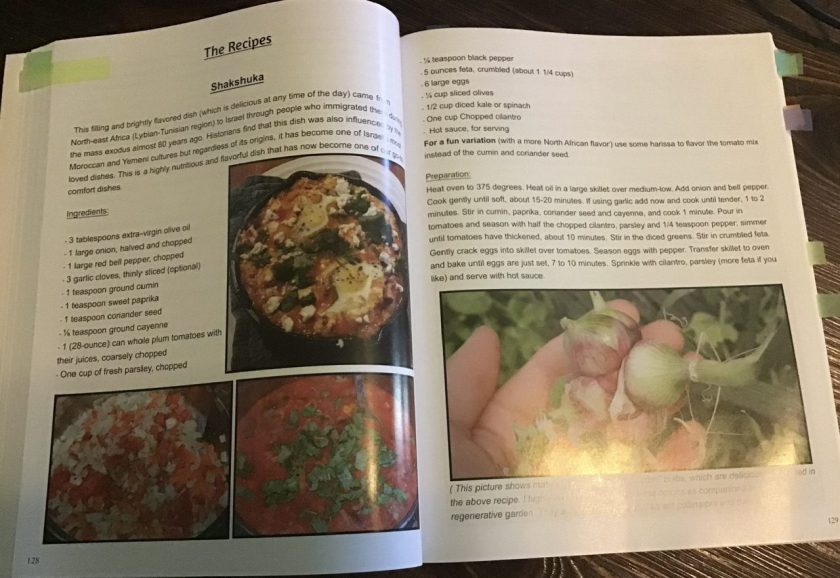
At the top of my ‘Must-Try’ List: Shakshuka. The name alone sounds alluring!
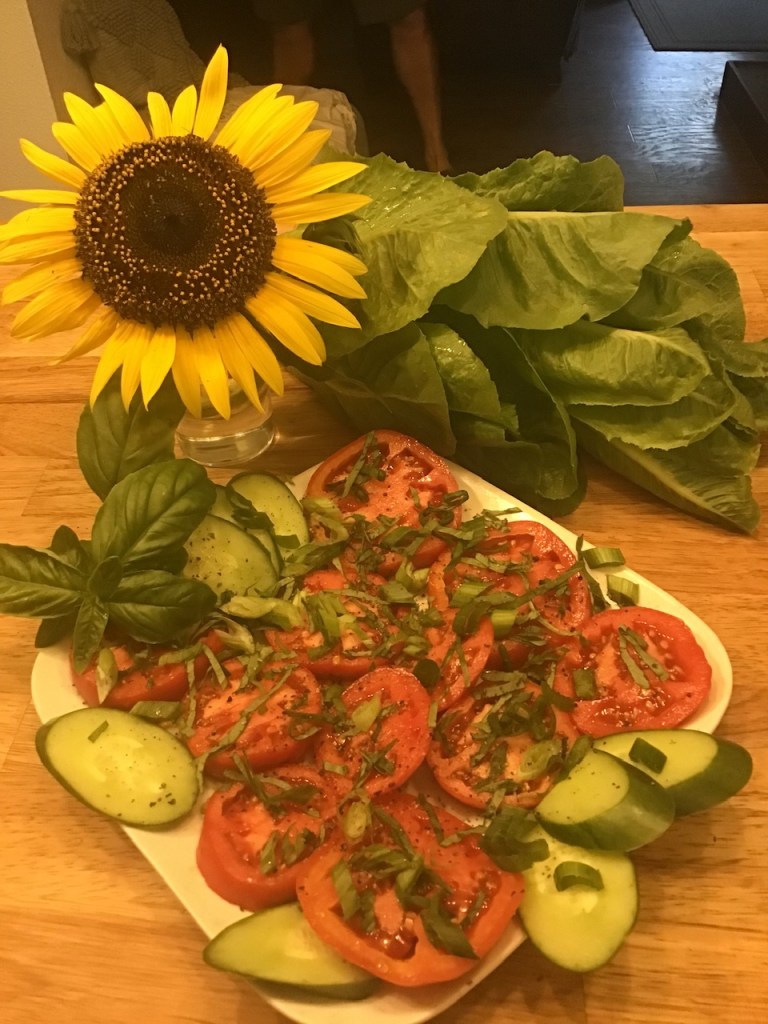
We do eat a lot of vegetables and we always have salad daily and I’ve gotten plenty of new ideas–combinations I hadn’t considered, like a zucchini salad with mint–I’m often wanting to use more mint, it grows like crazy here.
The recipes are very adventurous too, drawing from diverse cultures and culinary traditions–Ethiopia, Morocco, Bali, Mexico, Greece, Thailand –which I truly appreciate, because we tend to get stuck in a bit too much of a routine sometimes. When the garden produce is rolling in by the wheelbarrow, there’s not much time to get creative.
The lovely and edible Borage flower, used as a garnish in Gavin’s Gazpacho recipe on YT. (Photo credit: Kath-UK)
In fact, on the things that really matter, we agree completely.
Like on the importance of fermented dishes, and especially sauces, because the ones that are mass-produced are full of chemicals and highly processed garbage. It’s hard not to sound preachy, maybe even impossible, when telling folks how terrible their diet most likely is. But it’s the plain and simple truth.
I still go to the grocery store from time to time and I see what’s available and what’s in most folks’ carts and it’s pretty hard not to get judgy and to bite my tongue!
The difference a few dietary adjustments can make over time is really impressive–and it starts with naturally-grown fresh food.
Considering the vast majority of folks are outsourcing their health to Big Ag, Big Food and Big Pharma it’s not any wonder why our societies are collapsing under the weight of it all!
I’ve been enjoying goofing around with the free meme-maker ap using Gavin’s gorgeous photography and inspiring quotes. 😊
“In the past hundred years or so most people have forgotten about those ancient fermentation practices because of the advent of ‘instant gratification’ mass-produced products has allowed for entire generations of people to become completely dependent on corporations that supply them with the ‘food’ they need to survive. These ‘ultra-pasteurized’, pre-packaged, chemical-laden ‘food products’ are devoid of life, contain very little if any nutrients and are produced in ways that cause much damage to the planet’s ecosystems. Though eating prepackaged factory food (with unpronounceable ingredient lists) might be considered by some as ‘normal’ by today’s standards, it is certainly not a ‘norm’ that is conducive to longevity, sustainability or common sense.”
With thanks once again to Gavin, for his great many gifts, and for sharing them so graciously and generously. I’m already looking forward to his next book!
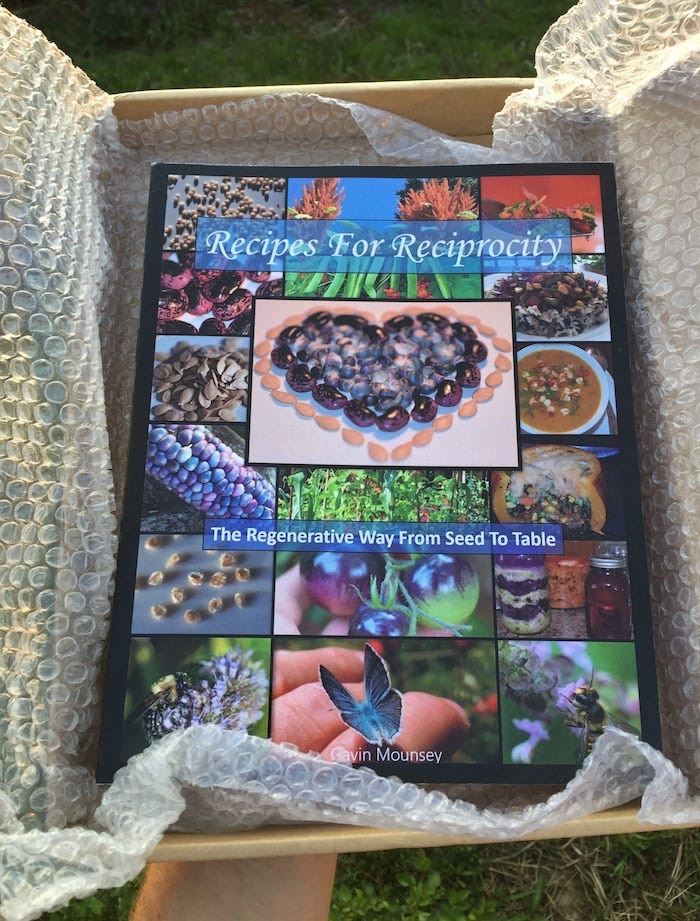
I’ve had a bit of challenge trying to simply label Gavin Mounsey’s book, “Recipes For Reciprocity: The Regnerative Way From Seed to Table” because it’s so much more than a cookbook. I have a great many cookbooks and my favorite type are what we might call ‘narrative cookbooks’ (though there may be an official sub-category name that I don’t know)–these are the kind where there’s a very present narrator telling you stories about the foods, and the places, and the people associated with the recipes and the author’s life. I might be inspired enough to write one of these myself someday.
Gavin’s book is not that, yet it is even more still. Rather than try to say it better myself, and fail, here’s an excellent description from the back cover: “This book is a magnificent achievement. It can help you learn pracical ways to grow and cook mouthwatering food-as-medicine, and build deeper and stronger community, but it is so much more than that. Gavin has written a love letter to humanity and the living world and a manifesto for workable hope, all with an unflinching honesty about the crises we face. Gavin uses the nuts and bolts skills in the garden and kitchen as a launchpad to reimagine our place in the world, and the result is a solid foundation in the chaos. His hope and love are infectious, and the applied knowledge shared in his book is encyclopedic. I highly recommend it to you.” ~ Jason Padyorac
Along with the two books, one I gave to a friend, Gavin sent lots of seeds, some I’m already growing, others I can’t wait to try.
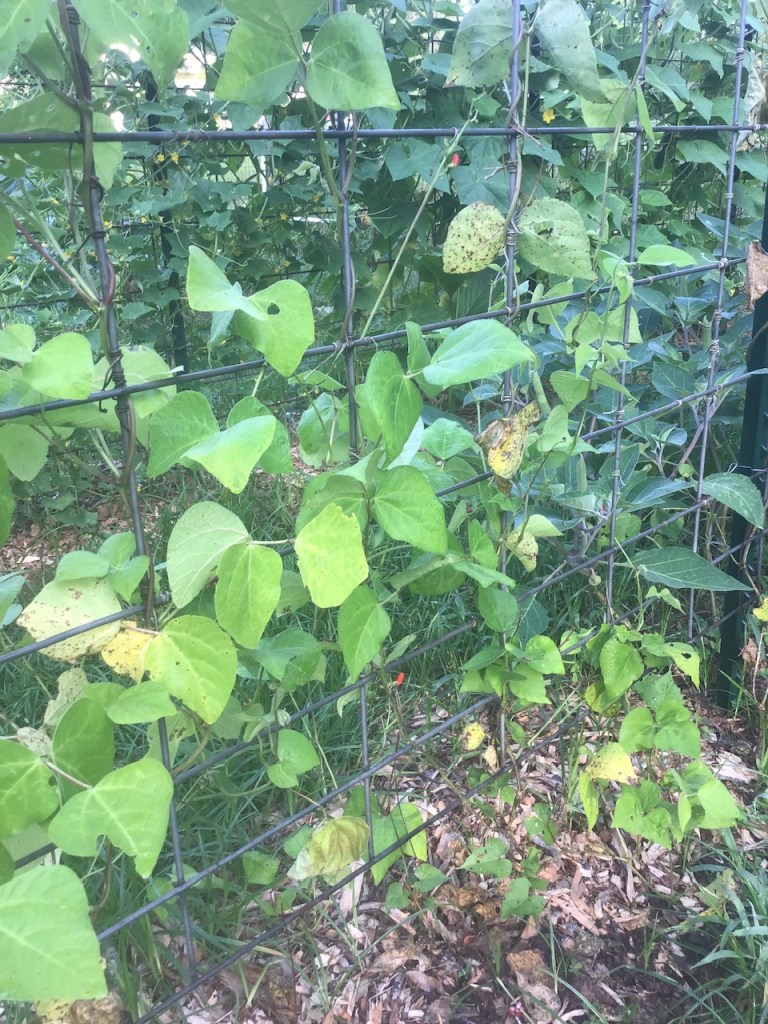
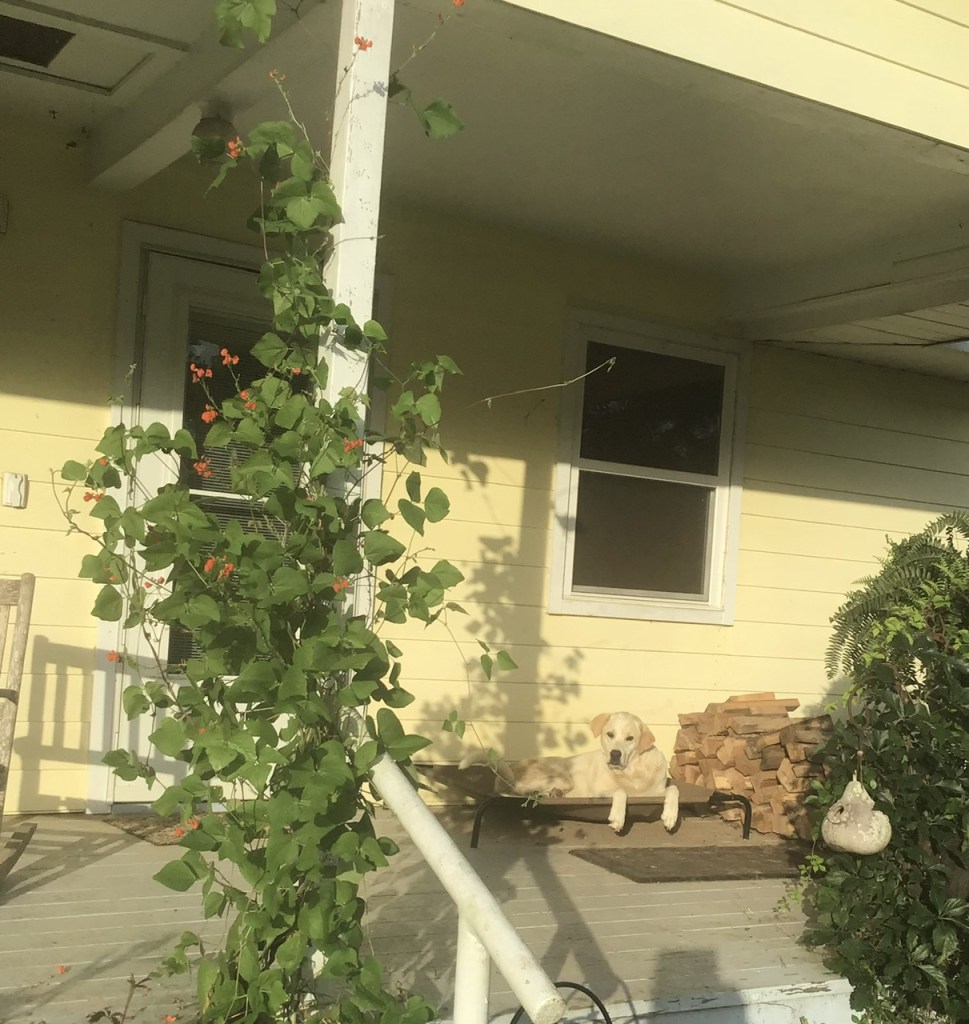
Scarlet Runner Bean in early summer, now dead.
Full Texas sun, not a happy plant.Bit of afternoon cover and is looking good.
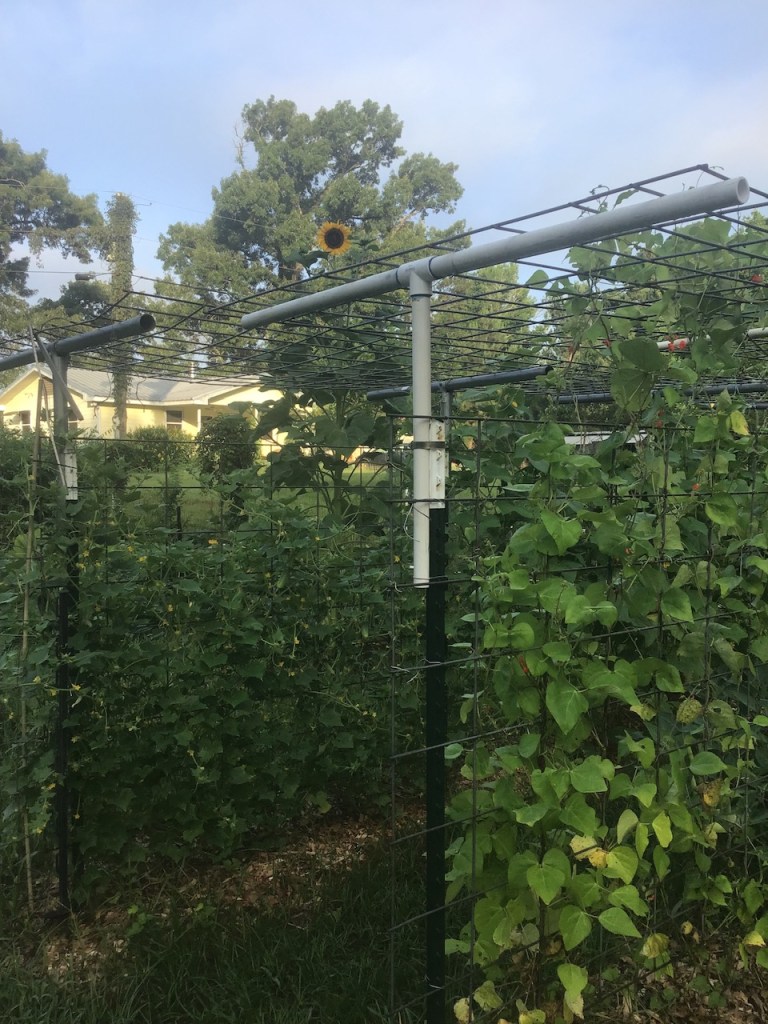
So far I’ve planted the Scarlet Runner Beans and the Black Hopi Sunflowers.
Gavin:
“These beans are among my all time favorites for their versatility in the kitchen and beauty as well as productivity in the garden. They are an amazing companion plant due to the plant’s roots having the ability to associate with rhizobia (nitrogen fixing bacteria) which not only allows this plant to fertilize itself by pulling plant food from the air, it also means this plant can help fertilize its meighboring plants with excess nitrogen. On top of that amazing benefit the scarlet runner bean has beautiful red flowers that attract pollinators such as ruby-throated hummingbirds and bumblebees.”
It is amazing to see how many fantastic plants can flourish in such varied climates. Because Gavin is in Canada and I’m in Texas I didn’t expect to find so many parallels in what we plant in our gardens, though certainly the timing and special needs vary quite a bit. The scarlet runner beans I’ve planted in full sun are perishing. But the others I planted which is shaded during the intense mid-day heat are hanging on. They’ve not produced yet, but I’m still hopeful and I like them anyway. I’m sure if there is any production and I can save the seed, it will acclimate to our area. Unfortunately, after a promising spring, the bumblebees and butterflies have been depressingly scarce in the garden lately.
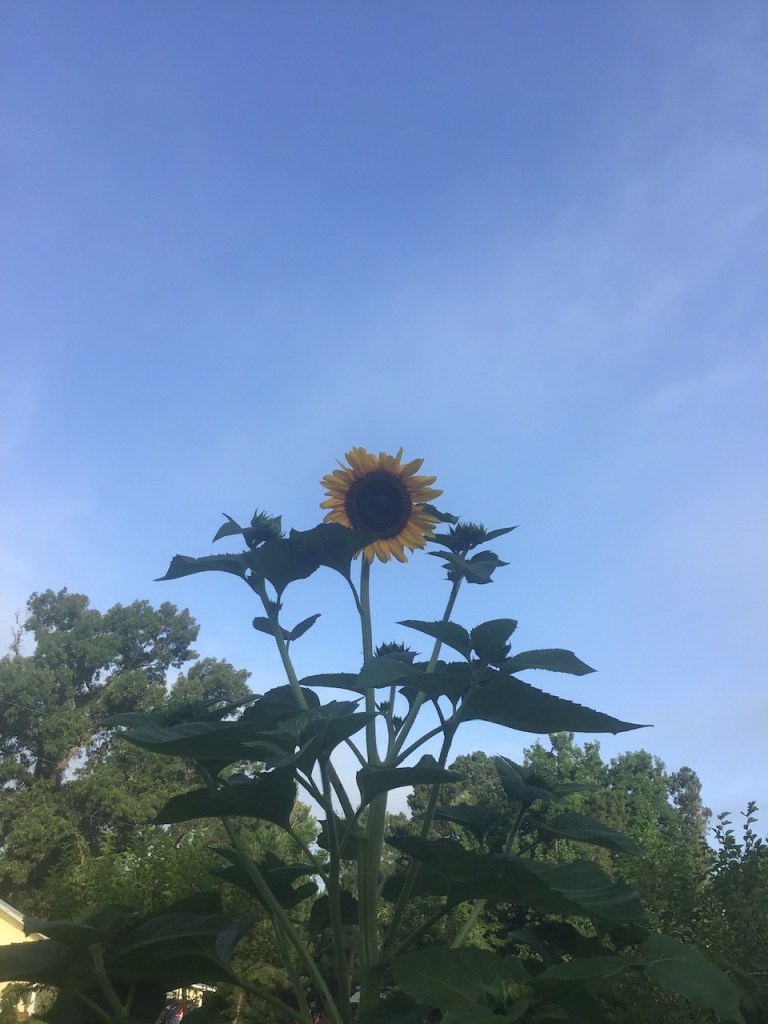
Gorgeous! Ugly pity for the chem-sky.
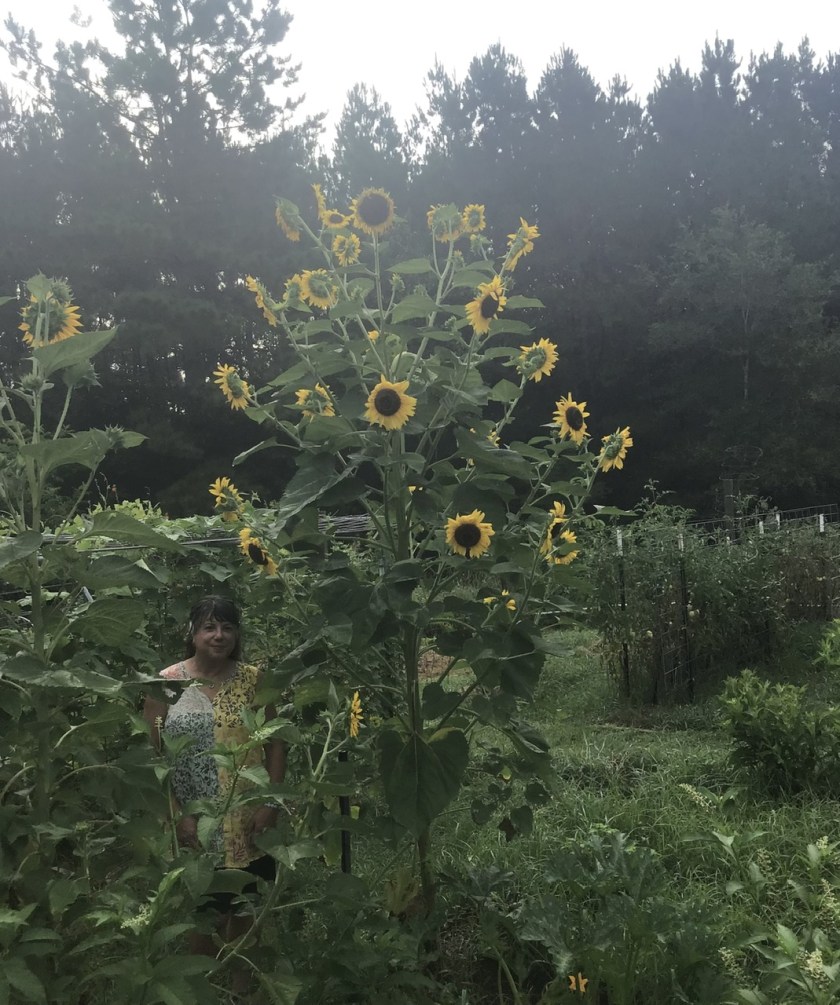
The Black Hopi sunflower has been the piece de resistance. It’s gorgeous and taller and fuller than any I’ve ever seen. I had several planted in several spots, and most of them got damaged in the high-wind storms we’ve had. But not this magnificent giant!
Gavin’s reciprocity in action is so inspiring, which is why I wanted to spend a couple of posts sharing about his book. Regular readers will probably remember I’ve shared some other of his work here in the past, especially in our Herbal Explorations pages, which come from his Substack newsletter.
In another post I’ll dive into a few of the recipes, but for now I’d like to expand on a few quotes which so align with my own learning and experience growing a garden and cooking seasonally from scratch. It has absolutely been the most rewarding journey of my life, with plenty of hope remaining for more of the same in the future.
From the section: Reciprocity in Action “Choosing to give our attention to nature is also a form of giving back. Observing and paying attention to the cycles and living systems in nature involves giving our time and our thoughts. When we closely observe nature we inevitably come to perceive countless expressions of beauty through our perceptions of the form, color, sound, scent, textures, tastes and relationships that are all around us. This leads us to caring, feeling gratitude for and feeling compelled to protect the amazing gifts nature shares with us. From the place of gratitude we engage in one of the most meaningful and powerful acts of reciprocity. We open our hearts, we feel content . . . we practice self-restraint, we choose to live more consciously and aware of how our life choices impact the living planet that sustains us and showers us with endless gifts.”
Gavin most certainly has an eye for beauty, his photography is stunning.
I know how daunting it can seem to dive into a new hobby like gardening, or even cooking nowadays, but there’s so many smaller and easier things that take so little effort or knowledge that might be just the momentum for many to kickstart a healthier life and society.
Just observing. I couldn’t agree more. It really does start that small and simple and while I have read loads of books on gardening and cooking and many adjacent subjects, I’ve learned far more from observing. Taking notes helps too, but considering how bad I am at that, it must not be totally necessary.
The other few very simple things that require no gardening and very little cooking is compost and ferments, both which Gavin discusses in the book.
Why those two, you might be wondering? Because in my experience, composting makes you far more conscious of waste, and fermenting shifts your attention to the weather and seasons. Both of these processes have enriched my life and health and outlook far more than I could’ve ever imagined.
A window sill of herbs would be enough to use up the compost produced by the average small household. Or donate it to a friend who gardens if you have such a black thumb or really no space. And who knows, maybe she’ll reciprocate with a zuccinni or two.
I had no idea what eating seasonally meant. Really. Until I went to the farmer’s markets in France on a high school exchange program, I had zero clue produce even had seasons, and considering how much is grown indoors today, that’s probably become more normalized than ever.
Considering I grew up eating like the vast majority of Americans–fast, frozen, canned, bagged–I know what easy looks like, and this is pretty darn easy. The shift really is more in attitude and attention.
Now I long for cucumber season as I long for tomato season as I long for melon season as I long for radish and lettuce season. It’s become that nuanced and I love it. Sure, there’s some cross-over and we can and ferment to save the bounty. But that limited time window of bounty becomes a season within a season, with all that entails–a change in primary food and focus–all with their unique gifts and challenges.
Surplus requires work, work requires rest and creates reward. 😊
The ebb and flow of surplus and scarcity becomes natural again, each bringing its own unique gifts and challenges.
My influences growing up–that of media, education, environment–worked synergistically as detachment mechanism. Nature was that which we were being systematically detached from, and that trend has only exaccerbated, to the growing dis-ease of ourselves and our environment.
“Within the last century, healthy, natural, organic food has been made more difficult to produce because of the chemical pollution, at first, and genetic pollution, more recently. A handful of companies have spread these toxins across our planet diverting US$ 400 billion of public money to subsidize their high cost chemical commodities to make them artificially ‘cheap’. The costs of this ‘cheap’ food are astronomical in terms of the health of people, the ecological damge it causes and its exploitation of farmers. If the true costs of chemical food were taken into account it would be unaffordable. Insead of subsidizing chemical food and creating epidemics of food-related diseases, public money, used for nourishment and the protection of public health through organic food, would save us billions in health care. Denying people their right to healthy, poison-free food by manipulating laws, policy, science and the use of public money to impose a non-sustainable, unhealthy food is food-dictatorship.”
It’s been so long since an update I don’t know where to start. Or where to end, or what to include. But I figure there have got to be a few readers out there hankering for some other news besides the shitstorm coming at us from the global mafia and the media cartels.
Mostly done, finally!
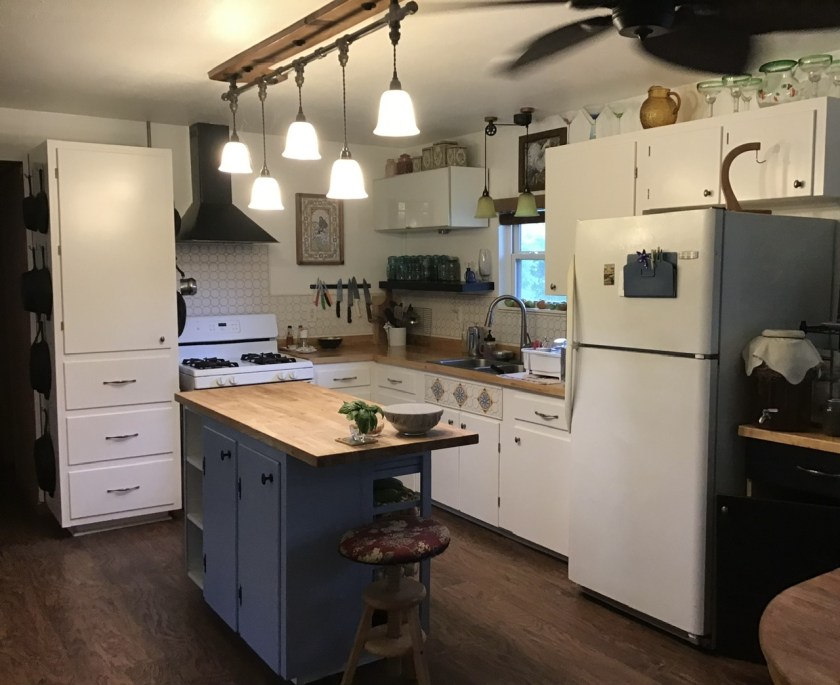
In my last update we’d started remodeling the kitchen. That was a very big DIY job, it took a very long time, and we’re still not totally finished. But we are very pleased with the results that were easy on the budget and tested our creativity, skill and resourcefulness.
I thought I’d include our first time redoing the kitchen, in 2009 when we first moved in, with the previous owners’ belongings to haul away before we could begin. It had been empty for many years and the mice and roaches had taken over. It was a disgusting experience, the worst of which we got to avoid this time, so that was a bonus.
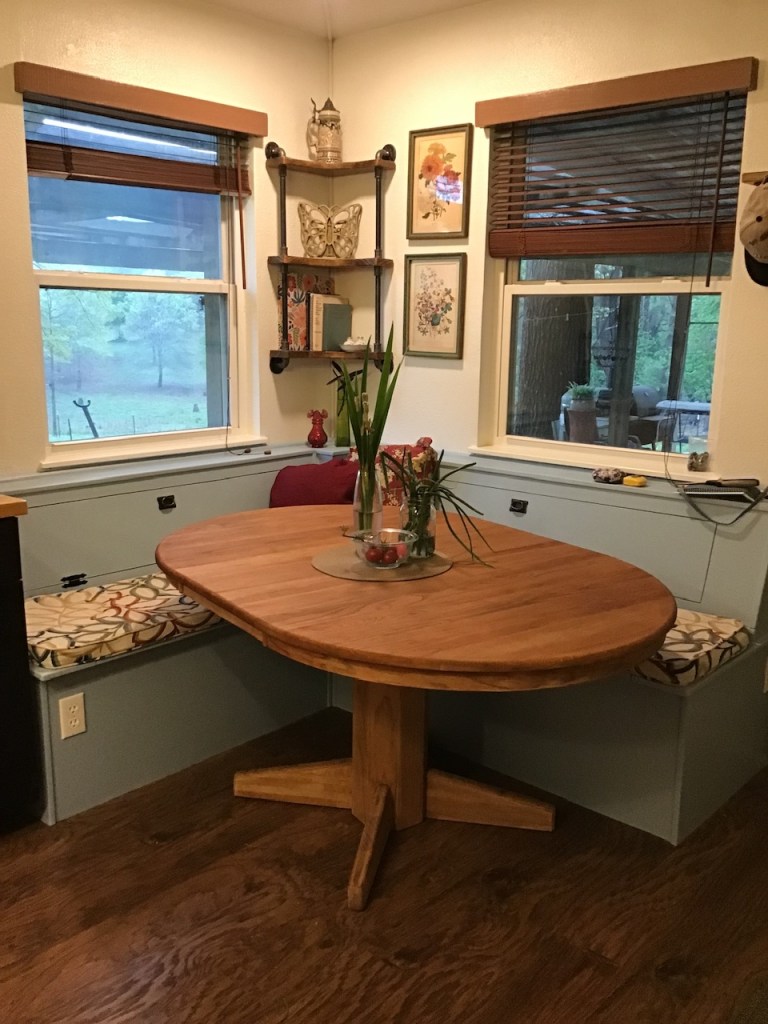
This time we also repainted the ceiling and walls and all the cabinets as well as the breakfast nook bench and storage unit Hubby had built previously. He also replaced the countertops and handcrafted new lighting and shelves, expanding on the same ‘steam-punk’ style as he used on the entryway table he built last year.
Work in progress:
Just installed butcher block countertops, quite the challenge when floors and walls aren’t level or plumb!
After way too many lost hours, I was not always a happy DIYer! But I am pleased with the result.
I spent a lot of time stripping and re-staining the kitchen table. I still want to dress-up the windows treatments and paint the doors and bases of the table and stool. But then we got too busy and had to devote our time to the garden and orchard.
The cucumbers and zuccini that were badly damaged by hail in late spring did make a bit of a comeback, but now are succumbing to the heat.
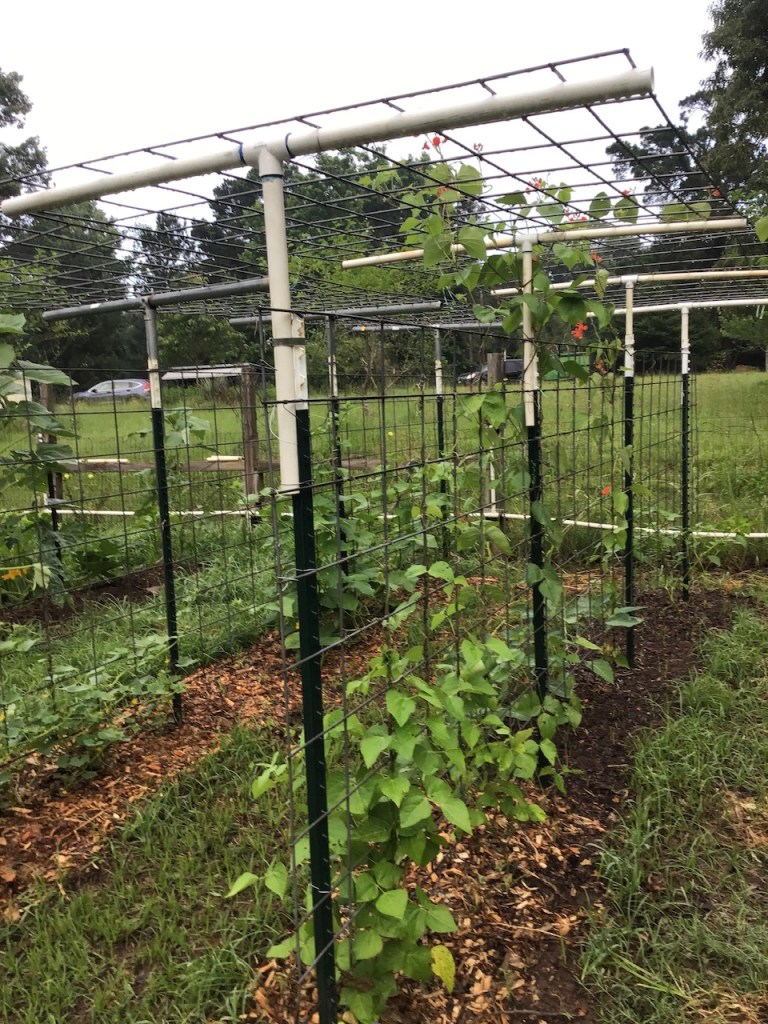
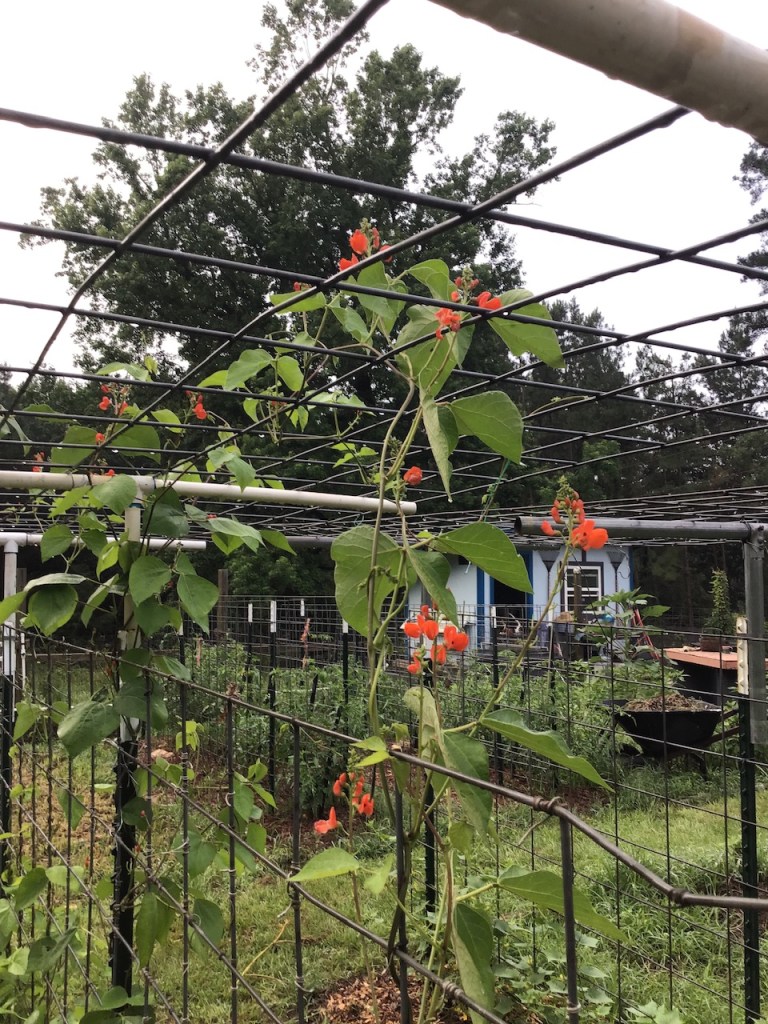
Unfortunately and as usual, a lot of the time devoted to the garden gets wasted because of crazy weather. This year has been no different and we had a lot of rain at the wrong time for some crops at some stages. The older peppers did fine with it, but the younger ones look terrible and are not recovering. Same with the tomatoes. The heirloom Scarlet Runner bean is struggling and not producing, but is still quite pretty as an ornamental.
I’ll be writing about those seeds, as well as the ones that grew this great big beautiful Black Hopi sunflower (the tallest I’ve ever seen!), in an upcoming post about Gavin Mounsey’s book Recipes for Reciprocity, because the seeds came from him.
These cucumbers were just the right age for survival and are going strong now.
I’ve gotten good at succession planting over the years for the reason of crazy weather. In very early spring I try to get tomatoes, flowers and herbs started, but am often disappointed by late frosts. Days of heavy rain and high humidity with overcast skies can easily cause damage to younger more vulnerable plants in early summer. By this time of mid-summer I’m sowing more cucumbers, herbs, and sometimes beans, but it’s often already too hot for them to get established. At this point, we get what we get until fall brings more hope.
But of course I can’t be satisfied with that and am always experimenting. Often it’s fall tomatoes or melons, which rarely work out. This year it’s the challenge of romaine lettuce through summer. I seriously doubt it’s possible, but I’ve got a tray that has just germinated under lights inside to give it a try. I’ll put them in a shaded box, with plenty of hardwood mulch in an attempt to keep the roots cooler. It’s been in the 90s everyday lately, humid and not cooling off much at night, but there’s still some growing that wasn’t smashed by the heavy rain and hail a couple of weeks ago.
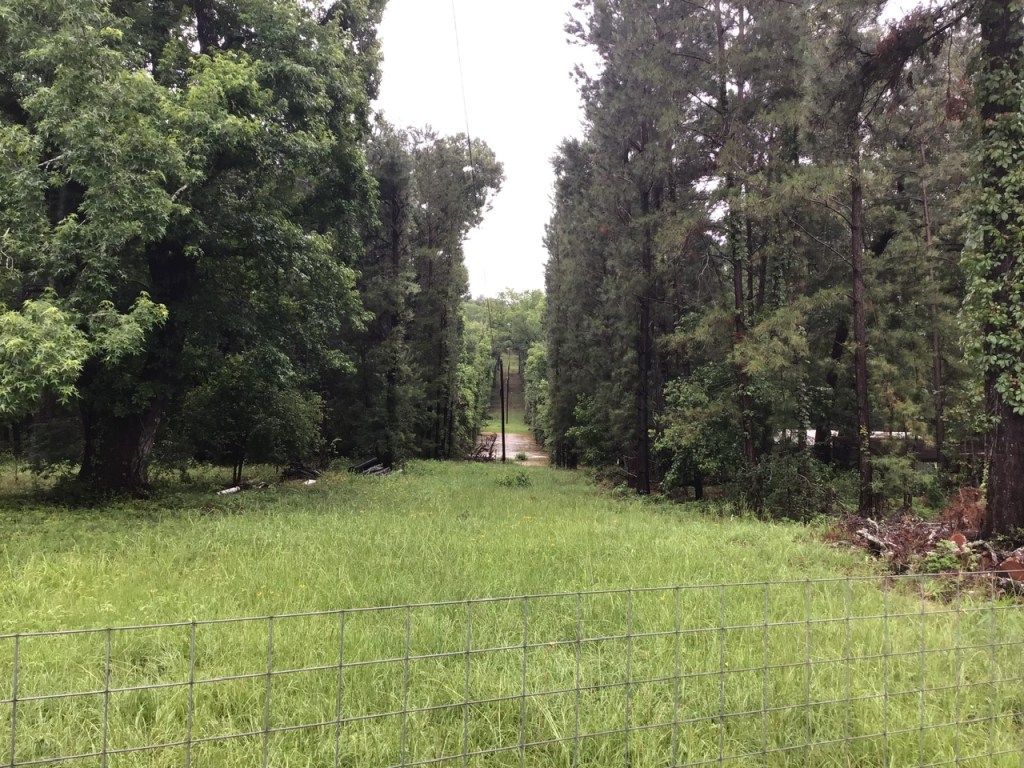
Left photo is view from garden, normally the creek is not visible at all. Right photo is walking along the power easement to the very flooded creek banks.
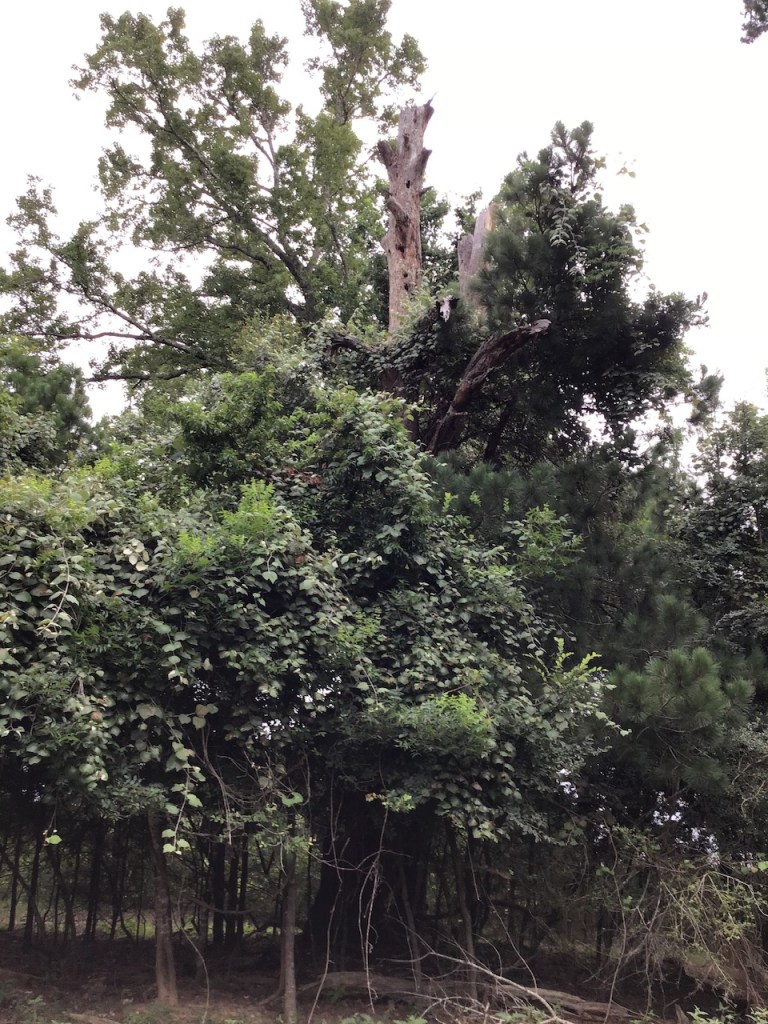
We also had another big oak tree die suddenly in the prime of life. The last one was just taken (partly) down by the electricity company’s crew because it risked falling into their cables. The latest one Hubby will have to fell himself, before it comes down on the fencing. That will probably be after he fixes his bridge to nowhere that he just built last year in response to flooding and was nearly taken out by this year’s repeat performance.
Sudden Oak Death Syndrome?
In the last two years, with no tornados or hurricanes to blame, we’ve had three large trees right around us flash out dead in a matter of days. Rather disconcerting to me, to say the least.
No such bounty this year I fear.
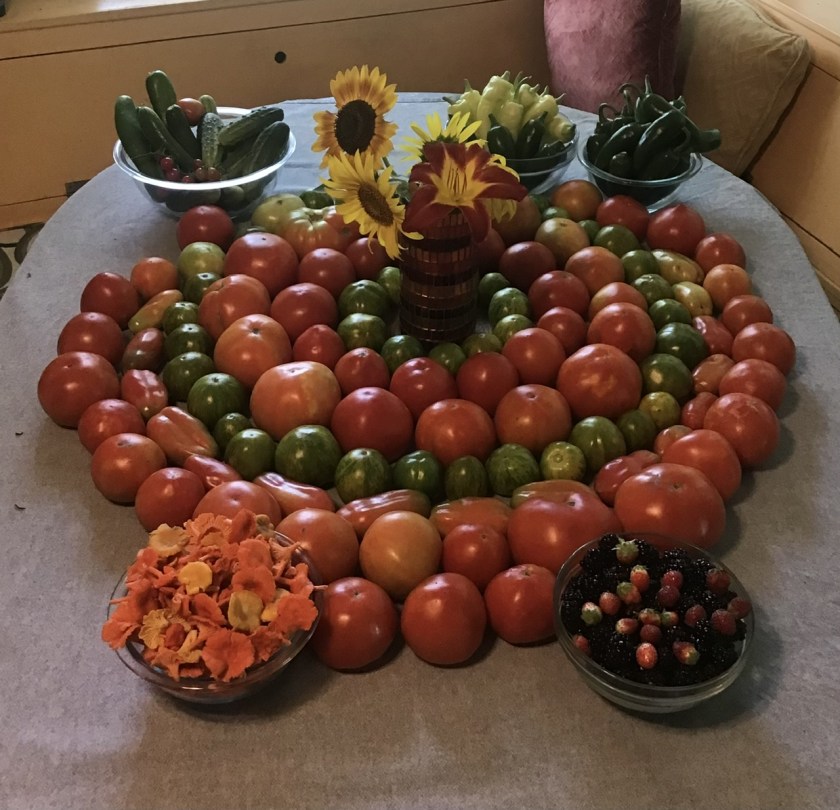
Still, let’s end on a positive note. Some years are better than others. We had an inexplicably bad blackberry year, but this year was excellent. Hubby made blackberry wine with much it, which was much better tasting as a young wine than the one I tried to make and age last year. Some years we have amazing tomatoes. Other years it’s great melons. Maybe this year it will be spectacular grapes?
It doesn’t take much for fabulous meals when food is fresh. Fermented herbs and veggies add flavor and nutrition with just a little garden surplus or foraging time. The chanterelles always do better with lots of rain. Hubby’s delicious young blackberry wine makes such a refreshing spritzer when mixed with kombucha. Eating seasonally from our land is so rewarding even when we don’t have a bumper crop.
I have a long list of content coming up during the swelter season, so all the more excuse to stay indoors. Thank Man for air condition! 😆
The Millennial Gardner gave a great little pep talk at the end of this confessional concerning his myriad gardening mistakes over the years. There should be more such vids as this. The positivity movement is dead, in my opinion, though MG is still a devoted adherent.
Positivity–Capitalism couldn’t survive without it!
He’s not yet reached the ripe age of bitterness. He thinks he will be able to continuously throw money at the problem, and I rather doubt that’s a viable long-term solution. I hope I’m wrong.
But overall I really appreciate his rejection of the typical appraoch to problems today: The Head in the Sand vs The Pie in the Sky. That’s what I see most often, and on that I think he’d agree with me.
So, more power to him!
We all need a pep talk now and then and Millennials especially it seems to me are inheriting the ends of the Shitshow and are expected to pull it all together again after the wrecking ball.
Hardly a lesson in equity, or perhaps the best lesson that could be.
The gist of his little pep talk is valid–anyone who excels at anything worthwhile has experienced, and learned from, the greatest teacher of all–Failure.
It’s not nice or pleasant or fun or comfortable to learn the lessons of failure. And we live in a culture addicted to nice and pleasant and fun and comfortable.
Not really a conducive atmosphere for learning.
Yet, sometimes the results of the lessons are far more pleasant than we might expect. Like, in my case, my greatest lesson in gardening so far has been flowers.
Flowers and ‘weeds’.
I had no idea the delight they offer when I first started gardening and I made little room for them in my garden, whether the classic garden cultivars or the wild weeds who long to make themselves welcomed. HUGE mistake!
I’ve been working on correcting that for many years now, and it’s absolutely paid off in myriad forms: more bees, more joy, more pleasure, more beauty, more sense of wonder.
The garden feels like less of a chore and more of a privilege with every bloom. The attraction is magnetic, to insects, to birds, to me. I observe better, I take more time, I allow my natural esthetic sense to align with the food crops and converge into a very satisfying balance of food and fancy.
Somehow, whether in my heart, or soul, or imagination, co-mingling the wild in with the crops has engaged me in a way that is a continual wellspring of curiousity and desire, even in the worst of times.
The rapture of emergent colors, the allure of fragrance on the breeze, the dance of the petals and the delight of the bees, I think what my early garden experience was missing was in fact the essence of ME. Because you don’t get that from books.
Learn from our failures dear ones, that’s why we tell y’all about them. Don’t let them dim your spirits, but use them in good faith, and find a way.
I don’t follow this very popular homesteading channel, Off-Grid with Doug & Stacy, too chatty and hyperbolic for me, but that’s what gets the clicks, so more power to ’em. Yet somehow, the Algos knew to put this particular new episode prominently on my feed.
Natural beekeeping in horizontal hives!
It’s excellent! I first heard this beekeeper many years ago and am so glad to see he continues to promote natural beekeeping and adding to his informational website. He’s also added equipment, books and events, and if I still lived in Missouri, you can bet I’d have befriended him ages ago.
It really is a thrill for me to watch the growth of treatment-free beekeeping over the last decade. It used to be not only terribly difficult to find good information, but also it was treacherous. I’m not joking either. Natural beekeepers are the anti-vaxxers of the beekeeping world, with all the bullying, ridicule, and obnoxious bloviating to prove it, which I experienced for years with this simple preference.
I do not want Big Pharma livestock. It’s really not a crime, though you will be treated like a criminal to suggest it or admit that it’s your practice to most mainstream and commercial professionals. According to many of them, the fact that treatment-free beekeepers exist at all explains why their colonies are filled with diseases. It’s blind faith in The Science. And The Science is not rational.
Folks might be surprised to learn that the lifespans of pets and livestock has decreased sharply over the decades. Bees, like all the animals, are basically treated as a disposible commodity. One disgusted veterinarian who turned his practice to homeophathy complained about this in milk cows, but actually it can be observed in ALL livestock:
“While my cow patients in Wisconsin often lived well into their teens, some to over 20 years, the average California operator culled cows at 2 years old. They’d been pushed with so much grain and ever higher production goals that their health suffered and they were literally dispensed with when they couldn’t keep up.” (3) When “organic” dairy ain’t – by Will Falconer, DVMhttps://vitalanimal.substack.com/p/when-organic-dairy-aint
But that is clearly changing! It could be that more are recognizing the false science of Pig Pharma, finally. Or, that there is so much success now in the treatment-free circles, and so many more are starting to practice it, that the bullies in the business are starting to become outnumbered. That’s my hope anyway.
One commercial beekeeper replied to Leo’s inquiry with a common fact:
14:45 “If I stopped treating my bees, I’d lose 85% in a year . . .”
I would LOVE to try a skep hive!
That’s right! And plenty of beekeepers, commercial and hobby, have experienced that, unfortunately. I also had a very hard time in the beginning. It took a lot of failure and a lot of research.
Mostly it took conviction. Good health is not found in medications. It is achieved through wholesome practices, which are the same for bees as all of life: Clean living and being left to pursue the most natural ways as possible.
From the interview we learn Doug & Stacy had similar issues as I had when beginning in beekeeping, and it was through Leo’s work and presentations they understood why and began to change their practices with continued success. Leo insists, you don’t need to invest much money, contrary to popular opinion. You don’t need to keep buying bees to grow your apiary.
Treatment-free practices rely on the natural intelligence of the bees to care for themselves. We do not requeen when we make a colony split, requiring the bees to raise their own queen. This keeps all beekeeping local, as it should be.
One of our horizontal hives with an observation window.
Instinct of the local area grows in the colony from one generation to the next. Also contrary to popular opinion, the bees get more resilient with each generation when left to their own decision-making, ie. when to swarm, how much honey to store for the winter, when to build up brood in the local conditions, which queen to keep, and when to get rid of her.
Leo’s entire apiary was grown through trapping swarms and making splits. I’ve not had much success with swarms and will try to start following more of his advice for attracting them. You’ll actually have more success attracting swarms in less rural areas, as counter-intuitive as that might sound. But bees are a bit like deer in that regard, they are attracted to the closest and most abundant and varied food sources, which often means near where humans are residing.
While he uses horizontal hives, like I do, he also has some good advice for beekeepers in cold climates and hive designs which help keep colonies alive during long winters.
LOVE SWARMS: The Complete Guide to Attracting Honeybees
I once drove all the way to Arkansas on my search for treatment-free bees. This is what the car looked like when I arrived home! 😆
Unfortunately, after all that trouble, these bees also did not survive a full year. BTW, I was not stung once.
When I finally understood the importance of getting bees locally and allowing the weak colonies to die off, I finally had some success. But, it’s still a work in progress and I’m so happy for all the advice and expertise from those with more experience and success.
I’ve written several times about this tree in past posts and have been meaning to include it in the Herbal Explorations for some time. Thanks once again to Gavin Mounsey for putting a bee in my bonnet! His contributions are featured below.
Photo credit: Gavin Mounsey
A quick peak at a couple of those previous posts of mine to set the stage:
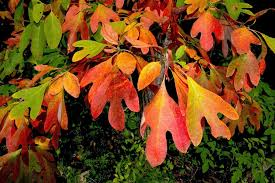
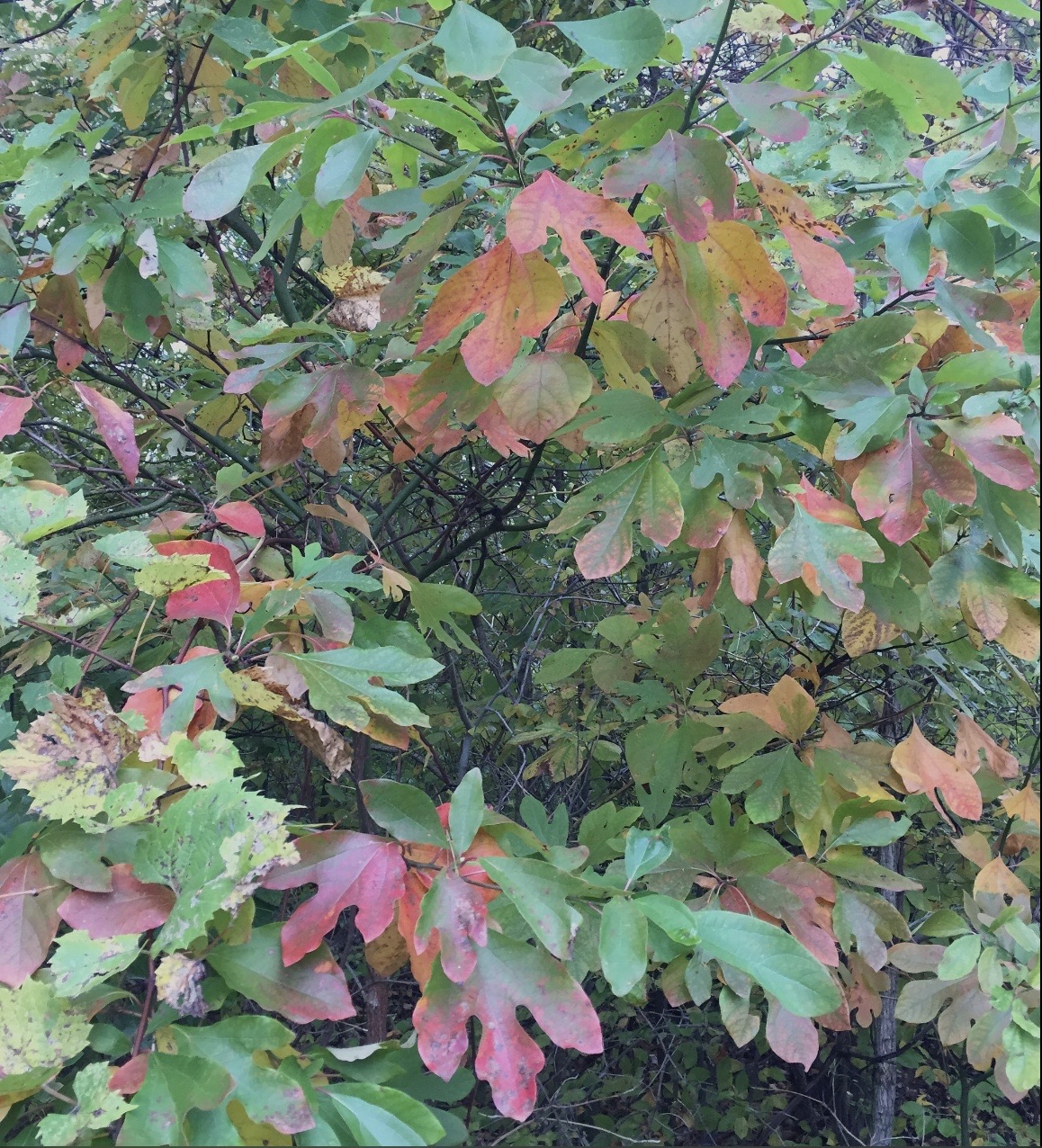
One of my favorite trees, the Sassafras, is flaming red now, one of the few to have changed so brilliantly in this unusually warm and dry fall in East Texas. Between now and winter is the best time to clip the leaves and dig up the tenacious roots so as to indulge in a couple of our ancestors’ favorite libations—root beer and Sassafras tea. Gumbo filé is also made from it, which is an essential ingredient in some Cajun cooking.
Our ancestors adored it, science calls it a carcinogen. At the same time vast groves of it are grown in regions of the globe more easily controlled, in order to mass extract their saffrole to make a highly concentrated and synthetic version of the popular street drug called ecstasy.
A quite undermined tree of the South, considering its illustrious origins and conspiratorial fate. It is a tree widely cultivated in Asia-Pacific as an essential ingredient to the popular drug, or versions of it anyway, generally called “ecstasy”.
At first, like cannabis, it was classified among the most harmful of substances by the FDA, though our ancestors had previously been very acquainted and attached to these and so many other suddenly ‘dangerous’ plants. Then while they were deemed “carcinogenic” by our government, simultaneously expanding was its cultivation in foreign countries for the manufacture of street drugs. This was actually before “Poppy Bush” but perhaps setting that very precedent for the former president?!
While I’ve no idea how to make the popular street drug, I can assure you it makes a deliciously fragrant tea, traditional root beer, and gumbo filé powder.
As for the drug version, I did come across this for any who wish to research further along those lines.
“The most common synthetic routes for production of MDA, MDMA, MDE (MDEA), and MDOH are from the precursor MDP-2-P. To get MDP-2-P first a natural source of safrole is acquired. Safrole can be extracted from sassafras oil, nutmeg oil, or several other sources which have been abundantly documented in Chemical Abstracts over the years. The safrole is then easily isomerized into isosafrole when heated with NaOH or KOH.”
Zubrick, James W. “The Organic Chem Lab Survival Manual: A Students Guide to Techniques.” ISBN #0471575046. Wiley John&Sons Inc. 3rd ed.
Some partial information from The Druid’s Garden, visit her post for much more!
“Sassafras has been called by many names and these names help teach us some of her power: auge tree, saxifrax, cinnamon wood, cinnamonwood, saloop, smelling stick, chewing stick, tea tree, winauk (Native American in Delaware and Virginia); Pauane (Timuca Indians); Kombu (Choctaw); and weyanoke (Algonquin).
Sassafras is typically a fairly small tree, growing 20-40 feet in height with a trunk 1-2 feet in diameter in the northern end of her range. In southern portions of its range, she can grow much larger, up to 100 feet high. Her wood is soft and light-colored with a faint aromatic Sassafras smell. Her wood is brittle, coarse-grained, and rot-resistant although it is not very strong. Typically, her wood has been commercially used for posts and lumber, but wood carvers also enjoy working with it. Sassafras is dioecious, that is, the male and female flowers appear on separate trees. The females will eventually have fruits ripen (which occur around midsummer) whereas the male trees will not.”
Medicinal Uses of Sassafras
“Sassafras Root Spring Tonic: As described above, the Sassafras was taken internally for a variety of healing purposes throughout the ages. Traditional herbalism recognizes Sassafras as a “spring tonic” or “blood purifying” or “blood thinning” herb and is used in the spring in quantity for this purpose. In 1830, Constantine Rafinesque wrote, “The Indians use a strong decoction to purge and cleanse the body in the spring” (Quoted in Wood, 315, New World Herbs). Wood notes that it “promotes clear thining in old age from good circulation to the brain, to improve the peripheral circulation to rid the joints of arthritic depositions, and to promote diuresis” (316). Euell Gibbons in Hunting the Wild Asparagus notes that traditionally, Sassafras Root tea was made with maple sap water for spring tonic. He noted that even in the 1950’s, when he wrote his book, that many folks still drink Sassafras tea “as a spring tonic, believing that it thins the blood and prepares the body to better stand the coming heat of summer.” Gibbons offers this medicinal tea: 3 tablespoons of honey, 3 tablespoons of vinegar (I would suggest a fire cider here) and 1 quart sassafras tea. Chill and serve as a spring tonic.
“Blood and Circulatory System: Today, herbalists recognize sassafras root as a warming, spicy, and aromatic herb that functions as an alterative (tonic) for the liver with mild antiseptic qualities. It has a specific action on the blood and circulatory system, stimulating blood flow and enhancing periphery circulation.”
Gavin Mounsey offers more interesting info in his recent note:
“The small tree known as sassafras (Sassafras albidum) was once one of the most prized plants of Turtle Island (aka “North America”). In 1565, Francis Drake returned to England with a cargo hold full of sassafras roots, and set off something of a craze for sassafras tea, or saloop. By the next century it had become a major export item, almost equal in value to tobacco. Europeans accepted the claims of most eastern Native American tribes about its effectiveness as an all-purpose medicine and tonic, and that combined with its wonderful taste and aroma — Thoreau called it “the fragrance of lemons and a thousand spices” — eventually guaranteed its place as the root in root beer. John Lawson, an early explorer of the southern Appalachians, wrote in 1709, “Sassafras was a straight, neat little tree… treasured by the Indians for its aromatic roots, from which, when pounded, a potion can be brewed to refresh or cure, according to his needs.”
“Early colonists consumed a lot of beer, and it probably didn’t take long before someone got the bright idea of adding sassafras roots to the mix of herbs and spices typically added for flavor and medicinal effect. It might seem strange to think of beer as a health drink, but for many centuries, it was far safer to drink than most available sources of fresh water, being first subjected to a prolonged boil and then made alcoholic. Weak beers were consumed in roughly the same quantities as Americans today drink Coke or Pepsi, but with less serious health risks, since the sugar was all turned into alcohol (and medicinal phytochemicals can be effectively preserved and delivered in a bioavailable format in naturally fermented alcohol based beverages).
“The modern herbalist Stephen Harrod Buhner (Sacred and Herbal Healing Beers, Brewers Publications, 1998) has this to say about brewing with sassafras:
“Sassafras was the original herb used in all “root” beers. They were all originally alcoholic, and along with a few other medicinal beers — primarily spruce beers — were considered “diet” drinks, that is, beers with medicinal actions intended for digestion, blood tonic action and antiscorbutic properties. The original “root” beers contained sassafras, wintergreen flavorings (usually from birch sap), and cloves or oil of cloves. Though Rafinesque notes [in 1829] the use of leaves and buds, the root bark is usually used, both traditionally and in contemporary herbal practice.
“Beer” was used loosely to refer to a variety of lightly alcoholic drinks made with whatever sugar was on hand; both the recipes Buhner offers, for example, use molasses instead of malted grain, as does this one I found in The National Farmer’s and Housekeepers Cyclopedia from 1888:
“Root Beer.—To make Ottawa root beer, take one ounce each of sassafras, allspice, yellow dock, and wintergreen, half an ounce each of wild cherry bark and coriander, a quarter of an ounce of hops, and three quarts of molasses. Pour boiling water on the ingredients, and let them stand twenty-four hours. Filter the liquor, and add half a pint of yeast, and it will be ready for use in twenty-four hours.
“I was excited to see the mention of wild cherry bark — something I had considered using in my own brewing, but hadn’t found any actual mention of until now. I have brewed with all the other substances mentioned, though not all at the same time. (I wasn’t terribly thrilled with the flavor of yellow dock in beer.) But I’m more of a purist than Buhner: I do insist upon using malted grain (or malt extract) as the primary source of sugar, though I will use molasses or honey as adjuncts, in small quantities.
“And I feel the early colonists probably made their root beers, spruce beers, and other healthful brews with malt, too, whenever they could. From an early date, many larger farmhouses had their own brewing operations, and taverns brewed beer in every town and village, first with malts imported from Europe, but quite soon from locally grown grain. A 1685 report from William Penn suggests that malt was substituted for molasses as soon as real brewing became practical:
“Our Drink has been Beer and Punch, made of Rum and Water: Our Beer was mostly made of Molosses, which well boyld, with Sassafras or Pine infused into it, makes very tollerable drink; but now they make Mault, and Mault Drink begins to be common, especially at the Ordinaries and the Houses of the more substantial People.
“In 1750, the Swedish botanist Peter Kalm, interviewing a nonagenarian for his book Travels in North America, learned that the early Swedish colonists of what is now eastern Pennsylvania, Delaware and New Jersey had been “plentifully provided with wheat, rye, barley and oats. The Swedes, at that time, brewed all their beer of malt made of barley, and likewise made good strong beer.” And of sassafras specifically, he wrote, “Some people peel the root, and boil the peel with the beer which they may be brewing, because they believe it wholesome.” He adds: “The peel is put into brandy, either while it is distilling or after it is made.” Nor was ordinary tea neglected: “An old Swede remembered that his mother cured many people of the dropsy by a decoction of the root of sassafras in water drunk every morning.”
“Kalm also mentions the preservative and antiseptic properties of sassafras, which must’ve played a role in its popularity as a brewing ingredient as well (hops were far from the only herb understood to help keep beer from going “off”):
“Several of the Swedes wash and scour the vessels in which they intend to keep cider, beer or brandy with water in which sassafras root or its peel has been boiled, which they think renders all those liquors more wholesome. Some people have their bedposts made of sassafras wood to repel the bed bugs, for its strong scent, it is said, prevents vermin from settling in them. … In Pennsylvania some people put chips of sassafras into their chests where they keep woolen stuffs, in order to expel the moths which commonly settle in them in summer.
“A slightly later (and much more famous) botanist-traveler, William Bartram, mentioned a very different root beer formula from the standard recipe, which makes me wonder how many other sassafras-based concoctions might have been made at one time. Writing about a southern Appalachian plant now known as Bignonia capreolata or crossvine, he wrote, “The country people of Carolina chop these vines to pieces, together with china brier [i.e. Smilax pseudochina] and sassafras roots, and boil them in their beer in the spring, for diet drink, in order to attenuate and purify the blood and juices.”
“Lo how the mighty have fallen. Safrole, the active compound in sassafras, has been banned by the U.S. Food and Drug Administration since 1976 as a supposed carcinogen, and as a consequence sassafras may no longer be prescribed by herbalists, though commercial brewers and root beer manufacturers may still use a safrole-free extract. For the homebrewer willing to ignore the FDA’s finding — which even the very conservative Peterson Field Guide to Medicinal Plants and Herbs of Eastern and Central North America rejects as absurd — it’s a matter of locating a thick stand of sassafras on some dry ridgetop and getting permission from the landowner to dig a few roots.
“The tree grows like a “weed”, and with its distinctive leaves it’s impossible to mistake for anything else. How will you be able to tell if a given root is sassafras, and not from a neighboring tree? Just scratch and sniff. If it has “the fragrance of lemons and a thousand spices,” you’ve hit pay dirt.
“This species along with a handful of others will be introduced to several community food forest projects I have in the works intended to both provide habitat for displaced Ontario Carolinian forest non-human inhabitants while also providing food, medicine and materials for humans in a regenerative way.”
That’s so great to hear, Gavin, let’s set The Science straight! 😊
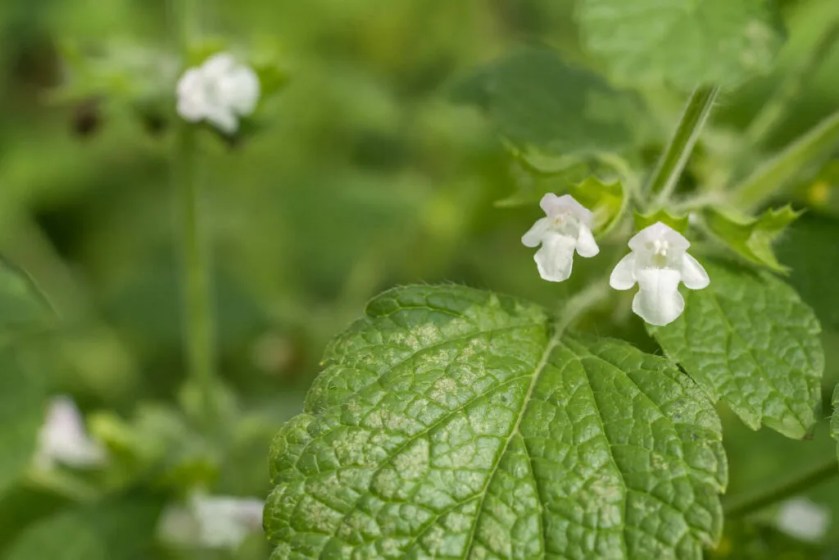
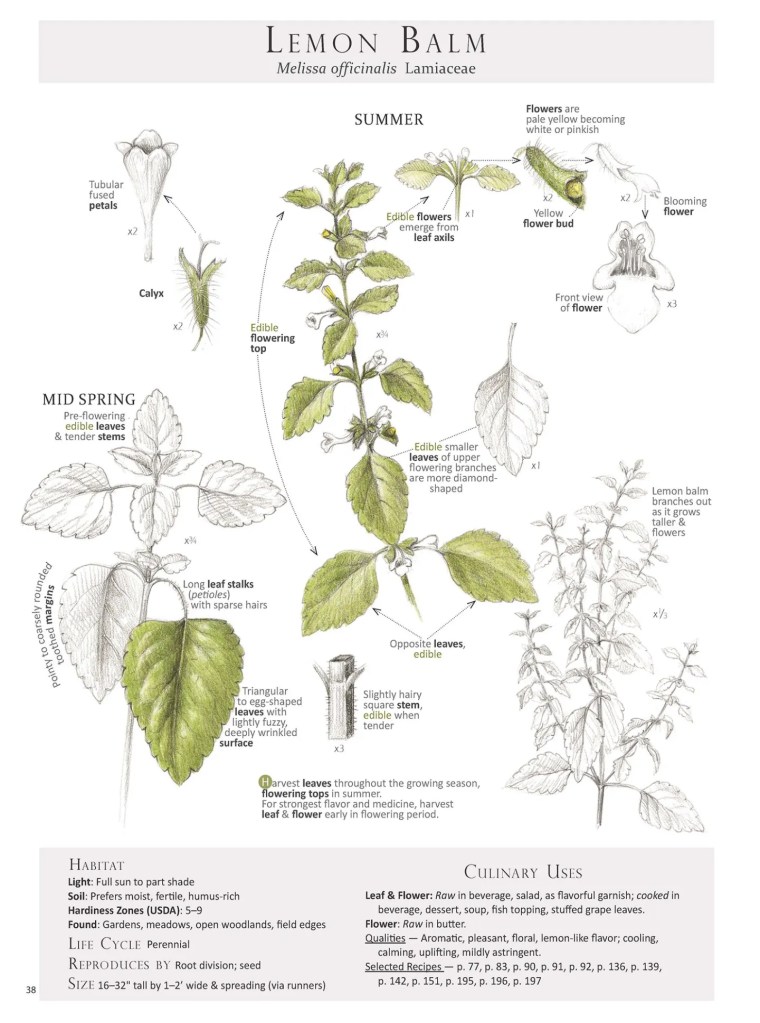
I’m adding another from Gavin’s Newsletter to the Herbal Explorations pages—the very popular Lemon Balm. Gavin does such a thorough job of covering it and I’m excited to start working with it more. I grow it, like mint, mostly for the bees, but like mint, I don’t use it nearly enough.
I’ve copied some favorite parts from his article below, but I’m sure I’ll be referencing it again directly in the future.
I really recommend viewing his full post and would love for any readers to add your own experiences with growing and using lemon balm as well, here in the comments section.
“I love this plant as it is very easy to grow (in fact, it now grows itself in our garden without any assistance) it provides forage for native pollinators while repelling mosquitoes and provides a long list of medicinal benefits. Lemon balm’s pain-relieving properties may make it an ideal choice for relieving muscle and toothache pain. In addition to drawing on its relaxing properties, this home remedy targets inflammation in the body.
“The leaves of lemon balm contain potent astringent and antibacterial properties useful for many things including cleansing wounds and pores to reduce blackheads. Due to rosmarinic acid, one of lemon balm’s key antioxidant ingredients, the herb also benefits the complexion. On top of all that, this herb is versatile in a culinary sense (providing fresh and enlivening flavors and aromas that lend themselves to enhancing creations in the kitchen).
“In the late 14th century, the nuns of the Carmelite Abbey in France began to make a “miracle water” using the lemon balm found in the monastery’s gardens. This is known as Carmelite water, which consisted of multiple herbs and spices with Melissa officinalis always as the main ingredient. This “perfume,” as it was called, was very fragrant and it was used to cover body odors as people seldom bathed in those days. This formula was also called “Eau de Melisse,” and it was revered by kings and nobles as well as commoners. It became a popular cure-all for various ailments and was used both internally and externally. Nicholas Culpepper, the 15th century English botanist and physician, praised the virtues of Carmelite water writing: “It causeth the Mind and Heart to becom merry, and reviveth the Heart fainting to foundlings, especially of such who are overtaken in their sleep, and driveth away al troublesome cares and thought…
“By the middle ages it was cultivated throughout all of Europe. Spiritually it is said in some cultures that lemon balm is known to balance feelings and emotions. It was used in ritual baths to invoke the Goddess, making you more appealing in the world of love and romance. Lemon balm has been associated with the feminine, the moon and water. It was considered sacred in the temple of the ancient Roman goddess Diana. It was first mentioned in medieval manuscript as “Herbe Melisse” in 1440. ( It’s botanical name, Melissa, stands for “bee” in Greek. Avicenna, a Muslim herbalist, recommended Melissa “to make the heart merry”. The Swiss physician and alchemist Paracelsus (1493-1541) believed that lemon balm was an “elixir of life” and would increase strength and lengthen life. After it’s introduction by settlers and subsequent naturalization (in what is now known as the United States) the Cherokee people used the herb as a remedy for fevers, colds, chills and typhus.”
“Lemon balm contains within it the virtues of a dozen other plants” ~ Hildegarde von Bingen 12th century mystic and healer of Germany
“Keep in mind that like mint, lemon balm grows incredibly fast in rich, well drained, moist soil that receives lots of sun. In the right conditions, it can even become massive. Once you discover all of the useful benefits of having this plant around, I’m sure you’ll be more than fine with that!
“Lemon Balm Repels Annoying Bugs This herb has the ability to repel ants, mosquitoes, and flies with its high amount of compounds that resemble the scent of citronella. Try making this easy herbal no bug balm to keep those pesky mosquitoes at range. Out on a hike and forgot to bring your bug balm? Find some lemon balm, crush the leaves, and rub them directly onto your skin! The same can be said of yarrow.
“As We Explored Above, Lemon Balm has Medicinal Benefits: Not only is this plant great in the garden, but it’s also an excellent gem to keep in your herbal remedy cabinet.
“Ancient Greeks used lemon balm steeped in wine to relieve the symptoms of fevers. Put together your own ginger and lemon balm cold/flu syrup to relieve those same symptoms today.
“This super healing lip balm uses the antiviral effects of lemon balm to quickly clear up cold sores. You can also use it in an herbal salve to speed healing of minor wounds. Lemon balm may also reduce menstrual cramps and premenstrual syndrome when taken daily for a prolonged period of time.
Lemon Balm also Attracts Beneficial Wildlife.
Traditional Medicinal Uses:
“Herbal Actions: Nervine: acts on the nerves. Sedative: calming agent. Mild Antidepressant: relieves feelings of depression. Mild Antispasmodic: reduces voluntary or involuntary muscle spasm. Carminative: gently calms the nerves. Lemon balm is a relaxing diaphoretic as opposed to a stimulating diaphoretic. Antiviral: destroys or suppresses growth of viruses, generally by supporting the immune system. Antioxidant: prevents free radical or oxidative damage. Specific use for dyspepsia associated with anxiety and/or a depressive mood. It is indicated for someone with symptoms typical of hyperthyroidism (inhibits TSH binding to receptors): anxiety, restlessness, palpitations, headache, and excitability and also is a mild anti-depressant. It strengthens the brain and its resistance to stress/shock, and lifts the spirits. It has tonic effects on the heart and circulatory system and can be used topically for herpes and other viral infections. Can also be used topically for gout and internally for rheumatism and neuralgias.
Practical Uses:
“What do you do with lemon balm? The most useful parts of this plant (and the way it found its name) are the leaves.
Compounds are extracted from the leaves and used to make lemon balm oil, tincture, salves and various medicines.
You can use the leaves in combination with other powerful herbs such as Yarrow in order to make effective (all natural, non-toxic and skin enhancing) mosquito repellant. Here is a link to an example of one such recipe: https://thenerdyfarmwife.com/lemon-balm-bug-spray/
Some of the most popular lemon balm uses include using the leaves in the kitchen to make tea and flavor dishes, as well as to create perfume oils and insect repellents. Some people even use it to make homemade toothpaste.”
Gavin’s article continues with many more pages of useful details about Lemon Balm, including lots of recipes and more detailed medicinal uses, loads of links and references and excellent images.
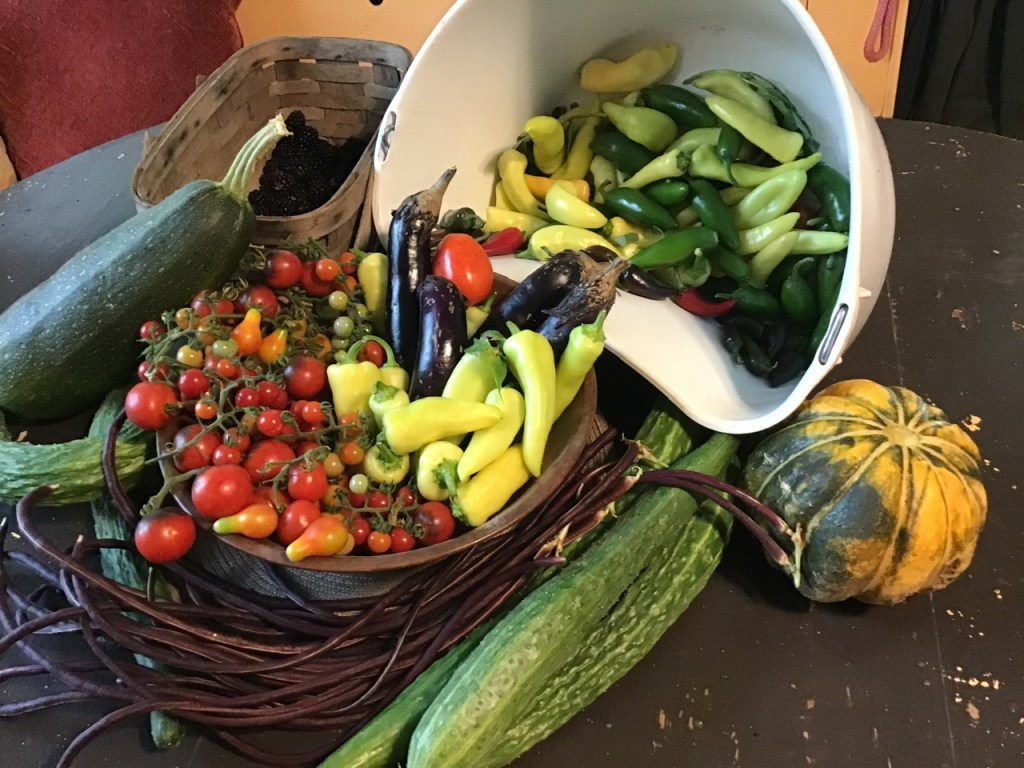
It’s been a challenging month on the wee homestead. We’ve had some successes and I am still hopeful for more positive outcomes, but I focus on them overly, because I’m being a bit avoidant, because really, I’m still concerned.
The determinate tomatoes are long gone already, but Hubby’s made many delicious jars of puttanesca and salsa for our future enjoyment. Must keep up morale!
So I’ll share about that this post, along with some happy snaps and surpluses, to help the medicine go down. I know it’s part of the lifestyle. Life, that is.
Yes, I’ve gotten better at it. That is, the death part of life. But also, we must understand our own limitations, and for that we must first broach them.
So if there are still any rose-colored glasses sort of readers remaining here, armor up.
Bye, bye Bluebonnet.* (I share more about my observations on her death at the end, for those who choose to go there.)
I’m so sad to say we’ve lost one of our new mamas, and her mama, our herd queen Summer, has also been very ill. Several of the does are too thin and are not producing enough milk. This all happened quite suddenly. I was training them on the milk stand for a month, even getting a bit of milk from one, I had high hopes of daily cheese-making by now.
Summer and her daughter Bluebonnet, who I figured would one day replace her as herd queen.
The learning curve is so very high and I’ve set myself impossible standards. I do understand that, though that understanding changes little.
I want a treatment-free herd, or no herd at all. Like with the bees, which took me years of failures, I simply cannot stand the industry standard. I cannot abide such total reliance on pharmaceuticals and exotic inputs from far-off lands. I cannot trust the science. I refuse to believe the only way to raise healthy pets and livestock is to poison them with vaccines and parasite treatments and feed them full of processed foods.
There has got to be another way! A much better way!
And I aim to find it.
We are not directly poisoning our garden and still have plenty of success despite the manufactured crazy weather.
I truly believe a large part of the problem is the processed foods causing the need for the supplemental treatments. It’s a vicious cycle and I want off, and I want ALL I see around me every day off it also, including the land, the water, and the air and ALL the critters!
Is that so much to ask?!
But I already know the drill, thanks to the bees. Every professional and expert says that’s impossible. Like with the gardening when we first got here. Every farmer, every gardener, every Farm & Ranch professional, repeating—You’ve got to spray. You’ve got to treat.
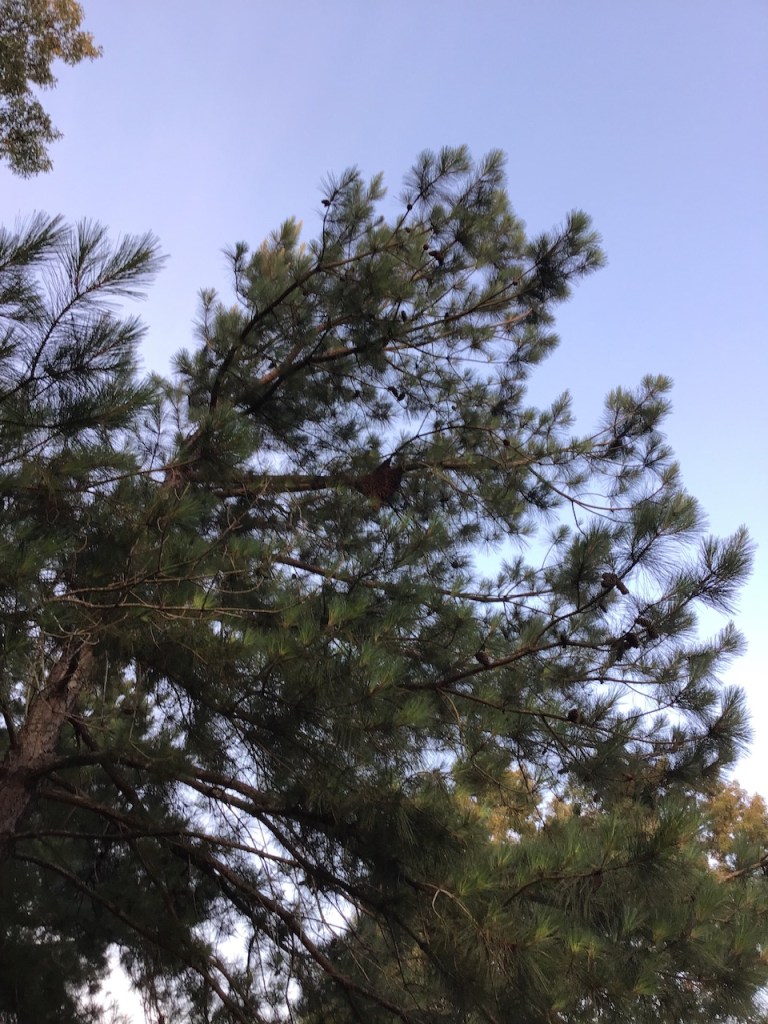
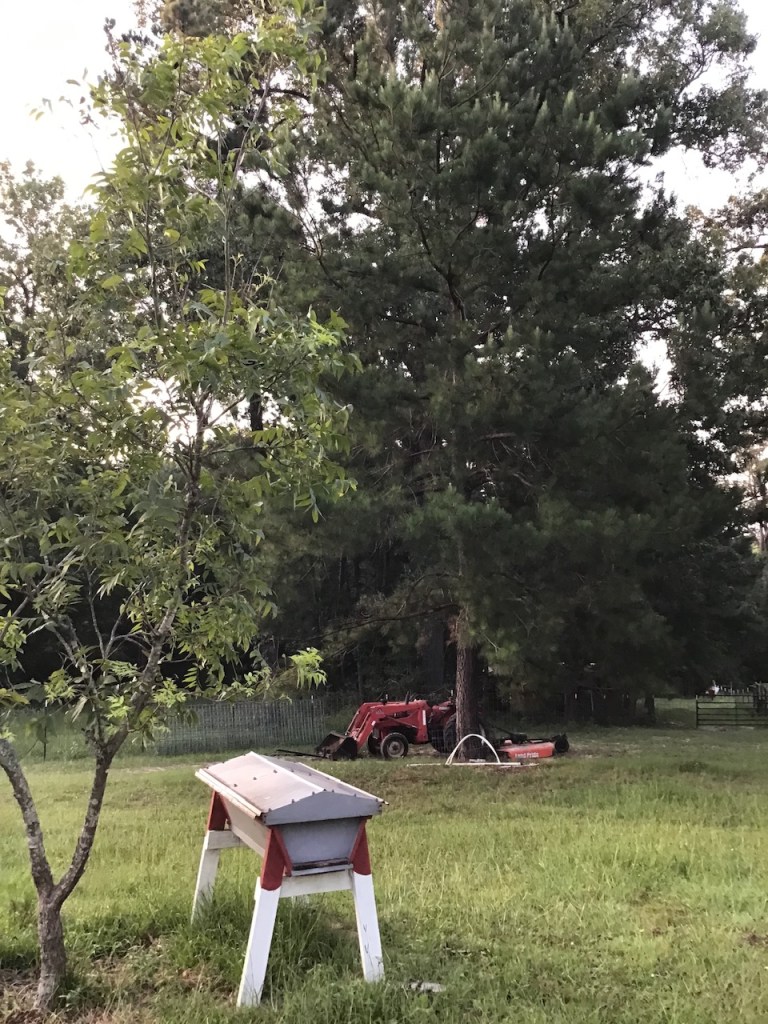
There’s a swarm up there, can you see it?It came off this hive and we watched it, amazing! The large pine in front of the tractor is where it stopped. Too high up to catch, but I’m happy to report another totally treatment-free colony repopulating the county.
“Here, follow this quarterly poisoning routine, and all will be well.” NO!
Is it any wonder they all readily accept without objection whatever the hell is being sprayed over our heads at regular intervals?
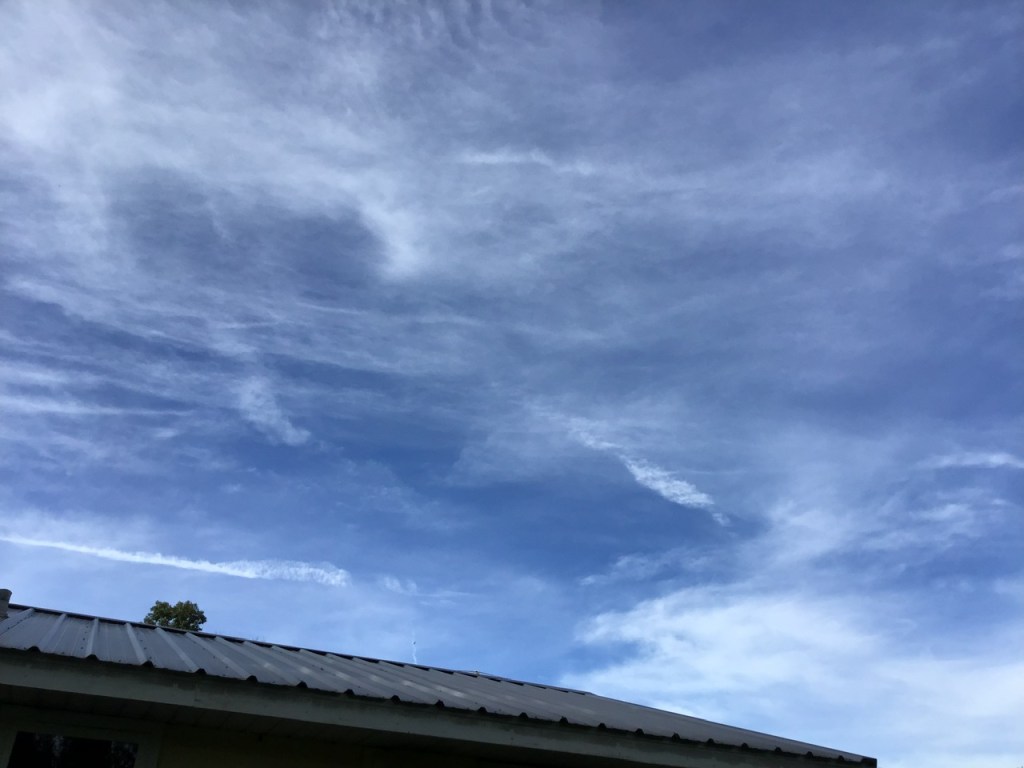
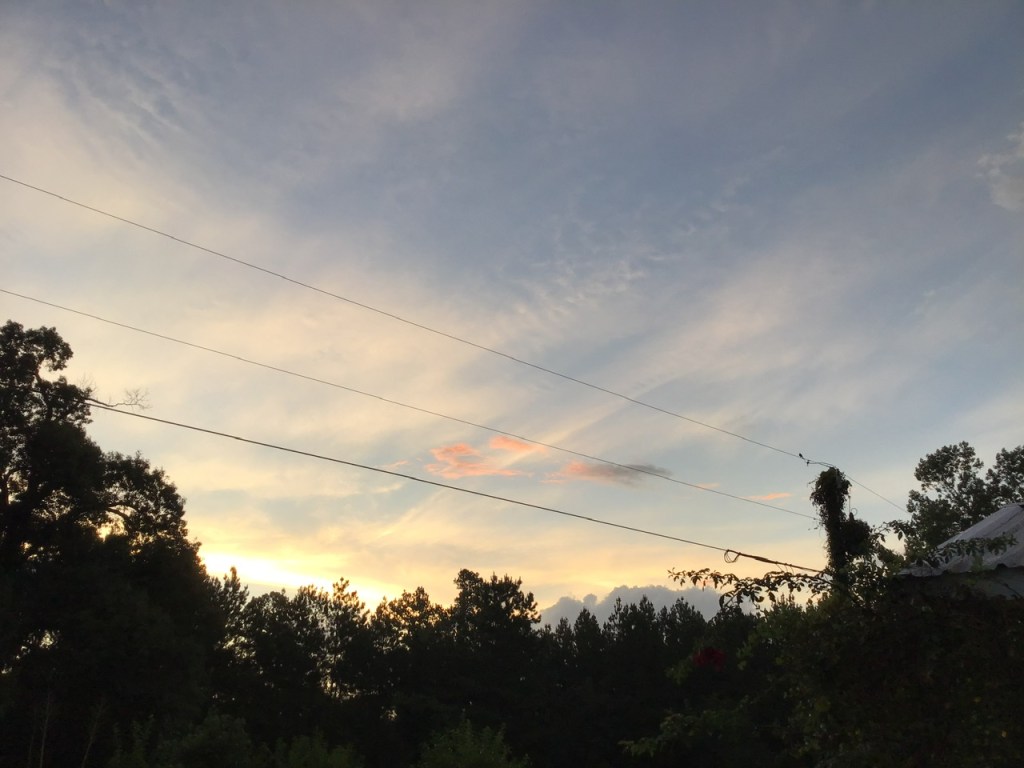
The latest geoengineered filth-filled skies over our property.
We’re not giving up yet. As long as we have irrigation it will be a jungle out there. But without it we’d be screwed, that’s for sure. It hasn’t rained for nearly 3 weeks.
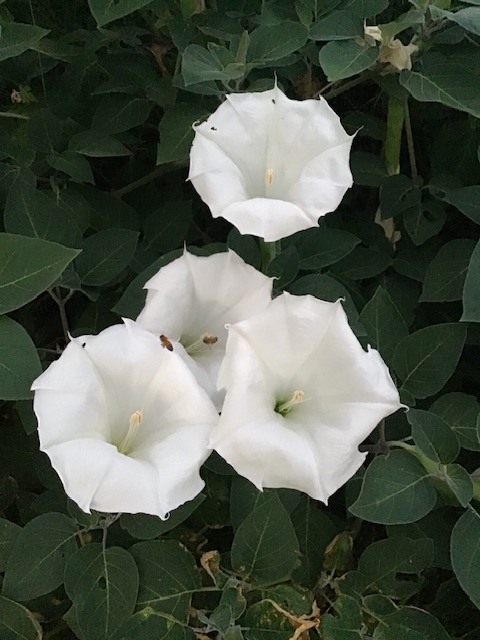
(Photos below Left to Right) The datura is a blessed monster. The sweet potato vines are prolific and a favorite snack of Summer’s. The melons and green beans are thriving. The indeterminate tomatoes and some of the peppers are doing fairly well under the shade cloth and I’ve been succession planting the cucumbers.
From the front: New cucumbers coming up with purslane to help cool the roots and shading from above, old screens protecting some struggling Romaine lettuce, and a growing grove of well-watered elderberries.
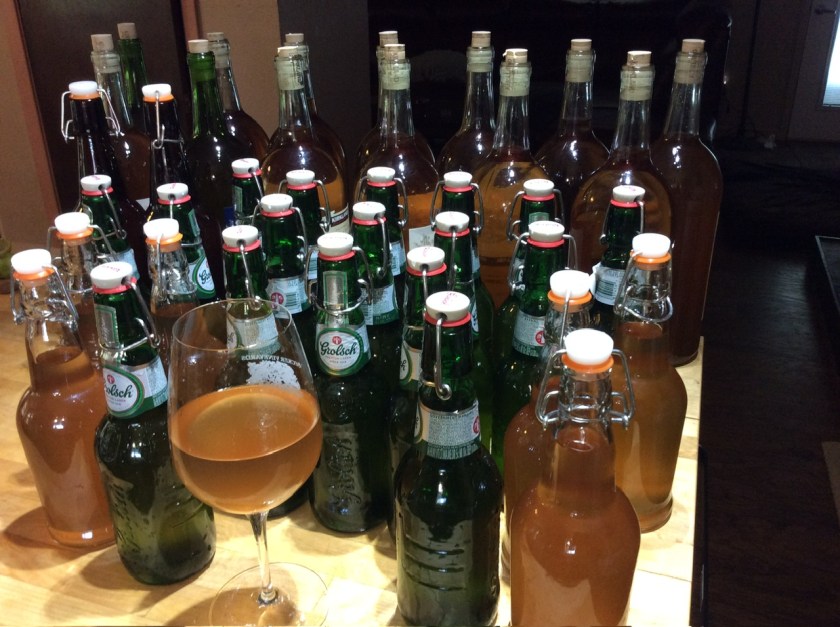
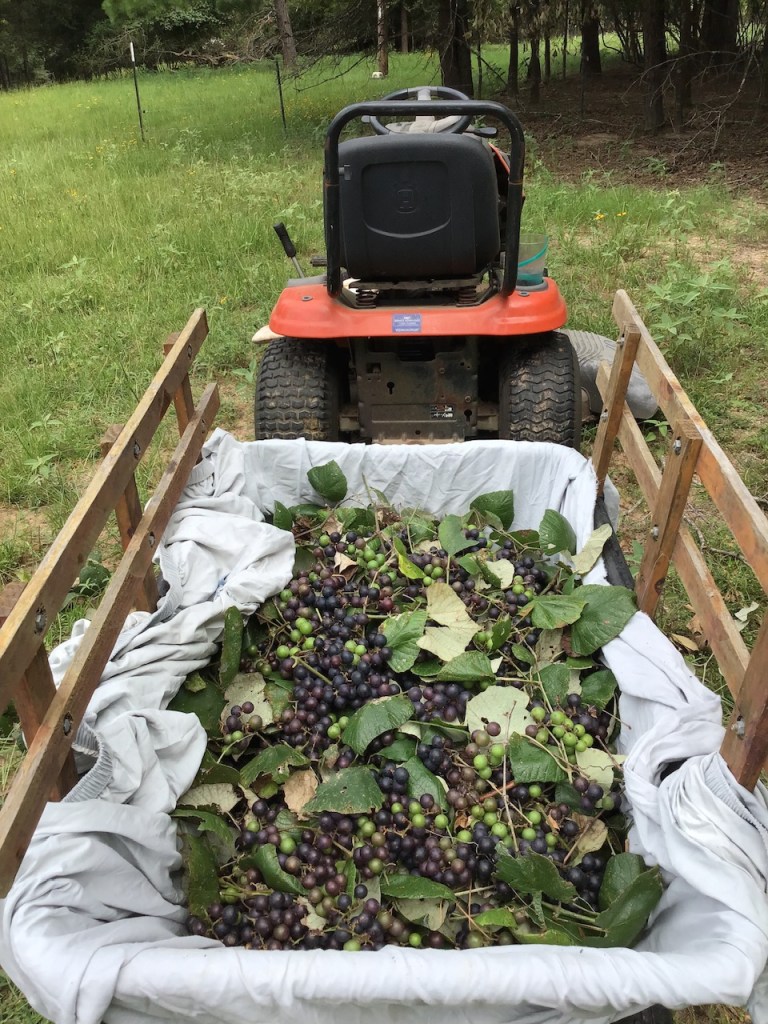
We’ve also been lucky to get some wild grapes, which are now fermenting along with the mead and the blackberry and mulberry wines.
He is literally Hubby’s Shadow!
It’s not an easy life, but it’s a life well-lived. Our first figs of the season, along with our last blackberries.
A Czech classic—so simple—Bublanina, made with blackberries or any number of fresh fruits in season. (Comment below if you want the recipe and I’ll post it. )
*The observation which I’ve found most interesting from Bluebonnet’s death, was that her kids adjusted immediately. She died the evening of the full moon last week. She left the corral with the rest of the herd in the morning, she seemed to be improving, I thought. But then in the afternoon she planted herself under a tree on a hill and wouldn’t leave, even when evening came and the rest of the herd returned to the corral. I went and sat with her there at sunset and stroked her neck and she laid her head on my shoulder. I wanted to be hopeful, but I felt she knew, and I felt horribly helpless. I hope that the feeling of helplessness is the worst feeling in the world. The next morning I woke before dawn and I went back to the tree in the dark, the full moon shining on her corpse.
There was a bit of relief for me that her kids adjusted so quickly. I find it odd really, it was like an immediate weaning. While her mama, Summer, is so ill she stopped producing milk, but her kids are still so attached to her their health is also suffering because they won’t go out and eat with the rest of the herd or accept being bottle fed. I’ve been mixing them special feed dosed with milk replacer and they are doing ok, and Summer today joined the herd again to forage, which I’m praying is a good sign. 🙏
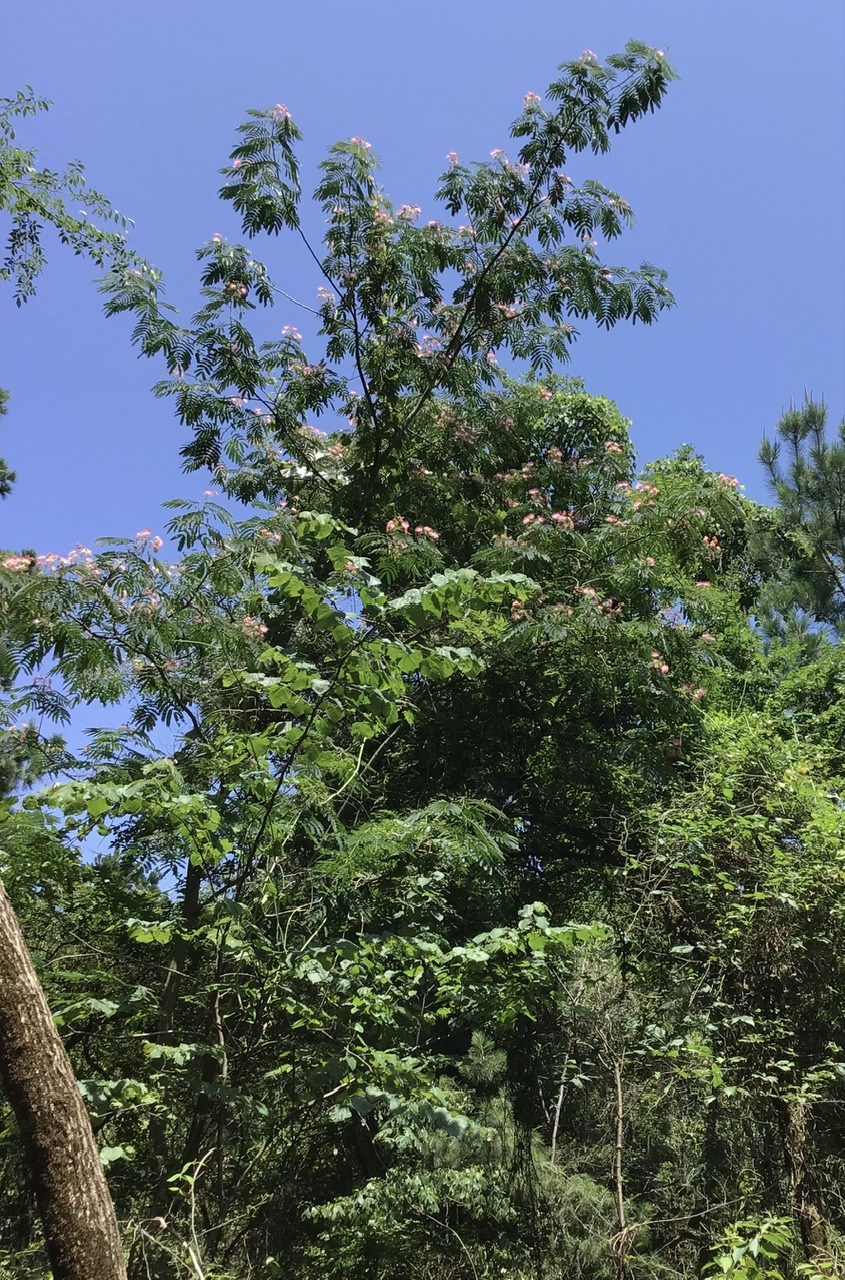
The gorgeous Mimosa tree is considered an undesirable and invasive species by many US experts, if you can believe that!
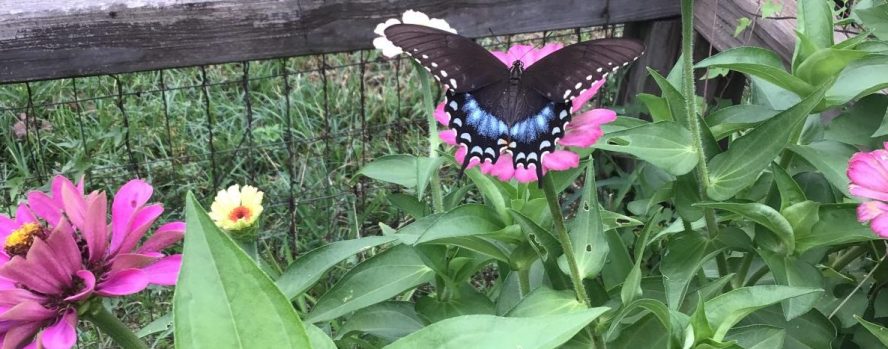
But to herbalists worldwide it’s a treasure. And to butterflies and bees it’s a feast!
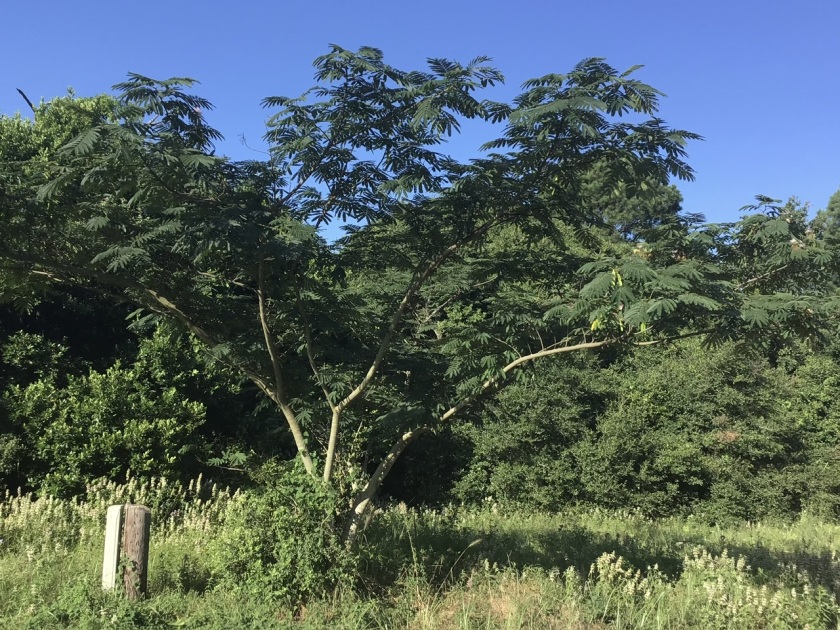
In the ditch, in the garden, or rising above the canopy and full of butterflies, it’s a striking specimen.
Another much maligned and misunderstood plant joins our growing list today. Hard to imagine calling this beauty a ‘trash tree’, but a great many experts call it that, and worse.
The Mimosa tree . . .
“Is another dog. Although beautiful when healthy, it never is. The root system is ravenous and destructive, and the tree is highly vulnerable to insects and disease. Shallow, destructive root system. Not even good for fire wood. Destructive roots, short-lived, crowds out good plants. Not a good tree for Texas,” he resolutely concludes.
Texas Gardening the Natural Way: The Complete Handbook by Howard Garrett “The Dirt Doctor”
Garrett is considered the foremost organic gardening expert in these parts, he has a popular radio show, has published several books and he has his own organic product line. He was the first gardener I learned from when I started gardening here.
And worse, he convinced me! I wanted one from the first moment I gazed upon it, but I resisted, for over a decade.
Luckily in recent years I’ve revisited that poor choice and lazy thinking to discover how wrong these experts can be.
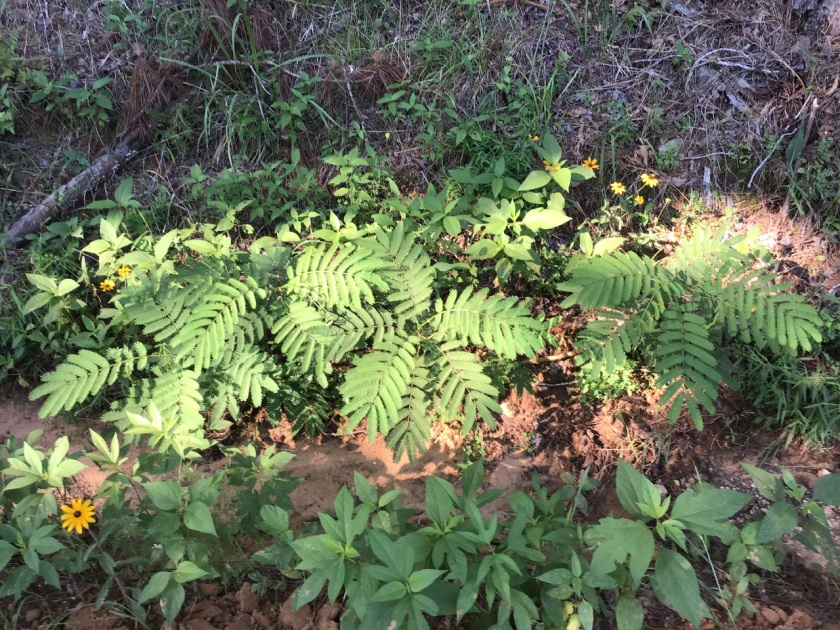
Baby Mimosa growing in the ditch near our house. I dug them up and planted them in our garden. The trick to getting them started is lots of water, but they will become drought tolerant with age. The growth habit is similar to Elderberry in our region.
What a (typical) shame to learn how very wrong they can be! Along with Wikipedia and a great many other popular info hubs.
“In the wild, the tree tends to grow in dry plains, sandy valleys, and uplands. It has become an invasive species in the United States, where it has spread from southern New York, New Jersey and Connecticut, west to Missouri and Illinois, and south to Florida and Texas. It is cultivated in California and Oregon. Its seeds are wind-dispersed and numerous, and they are fertile even over long periods of drought. Each pod, which resembles a flattened bean pod made of paper, holds about 8 seeds on average. The pod bursts in strong winds, and the seeds can carry over surprisingly long distances.”
It is certainly for the ‘mess’ they create with their seed pods that some may not find them suitable for their yard or garden. And naturally, farmers and ranchers malign any plants which dare to interfere with their livestock management preferences.
But, venture away from those slanted sources and the light shines on this ancient medicinal treasure.
Mimosa—The ‘night sleeper’ so nicknamed in Persian thanks to its usefulness as a cure for insomnia, among its many other medicinal and practical uses.
A bit of history: “The stem bark has been used as a sedative for hundreds of years as recorded in the Pharmacopeia of the People’s Republic of China(Nehdi 2011, Zheng 2006, Zheng 2010) and as an anti-inflammatory agent for swelling and pain in the lungs and to treat skin ulcers, wounds, bruises, abscesses, boils, hemorrhoids, and fractures, as well as to remove carbuncles. The dried stem bark is used as a tonic in China and Japan.(Ikeda 1997) Indigenous people living in the southern mountainous region of Korea prepare the root as an infusion for bone diseases.(Kim 2011) In India, a chloroform and methanol seed extract has been used to treat bronchitis, asthma, leprosy, and glands infected by tuberculous.(Gautam 2007) A bark extract to treat insomnia, diuresis, asthenia, and confusion has been used in Asia.(Nehdi 2011) The plant’s flowers have been used to treat symptoms associated with palpitations, anxiety, depression, and insomnia.(Nehdi 2011, Samwald 2010) It’s common name of Shabkhosb (good night’s sleeper) in Iran is indicative of its use to treat insomnia.(Ebrahimzadeh 2017)
Mimosa are used in gardens for ornamental purposes, in sandy areas to prevent erosion, and along roadways.(Chang 2011, Irwin 2003, Nehdi 2011, Pardini 2007)”
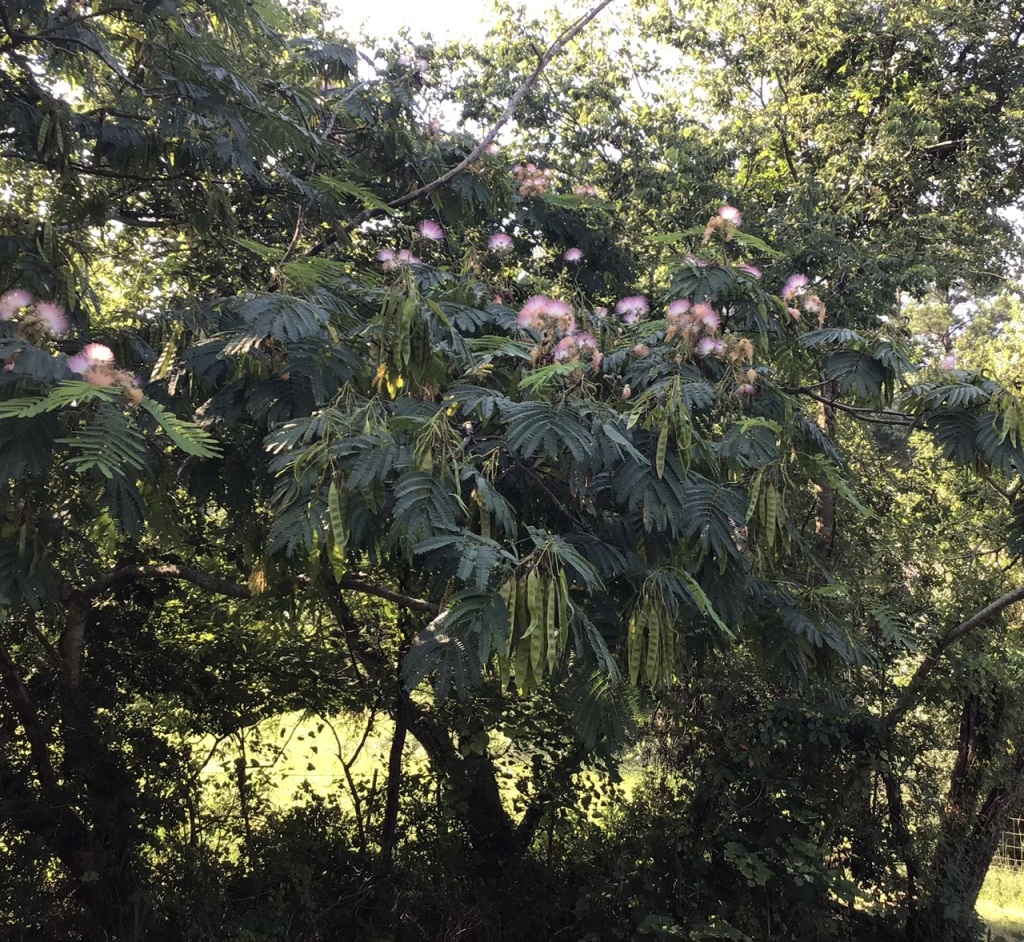
A Mimosa tree on a country road in East Texas just after its bloom cycle in late June.
“Albizia belongs to Mimosoideae and are native to Asia and Africa. It is a kind of multifunctional trees and they are always planted as ornamental trees. In addition to using it as foliage, green manure and timber for furniture production, the bark of Albizia is herbal medicine and the seeds are a source of oil. There are about 150 species in the genus and 17 of them can be found in the southern regions of China. Albizia julibrissin and Albizia kalkora are two familiar species, which are planted in China from tropic to temperate zones [69]. Although Albizia spp. are of great importance, little was known about the diversity of their microsymbionts. de Lajudie et al. [15] found that two strains isolated from Albizia falcataria grown in Brazil were Bradyrhizobium; Chen and Chen [5] classified five strains isolated from Albizia julibrissinin China as Bradyrhizobium sp. and Rhizobium sp. These results indicated that Albizia trees nodulated with both fast-growing and slow-growing rhizobia.”
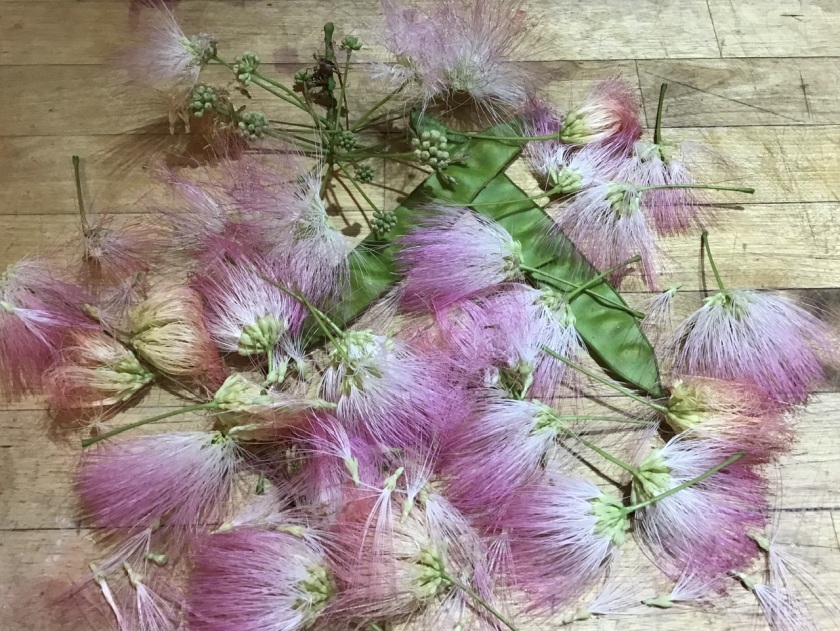
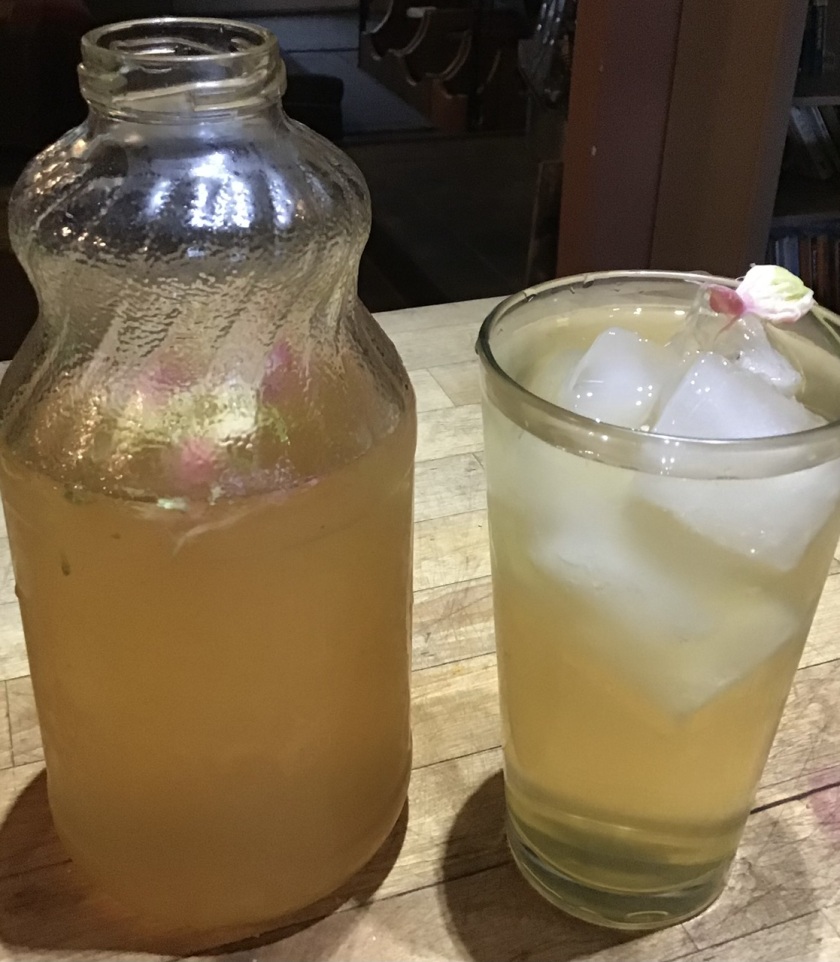
The petals make a delicious and refreshing flavoring for tea or Kombucha— a unique taste reminiscent of nectarines.
Gavin Mounsey, author of Recipes for Reciprocity, recently shared some of his knowledge and links about this amazing tree, which he’s cultivating in his food forest designs all the way up in Canada:
“Another interesting fact about this tree is that it is being investigated for it’s potential in Phytoremediation (for both heavy metal soil remediation and for it’s photocatalytic activity for cleaning up toxins humans put in the air) and a more specialized field in what is called “Phytomining” (it is a nasty industrial process used for profit but it hints at more holistic applications of this species for real time remediating/mitigating of geoengineering heavy metals in the air and soil.” (Read more: Regenerative Agriculture: Solutions Watch at Corbett Report)
The pods are plentiful and can be used for animal feed, according to TCPermaculture.
It’s notable umbrella shape when provided with plenty of space has me wondering if it might be the tree represented on some old gravestones in our area.
Mimosa? Are our ancestors trying to tell us something?