The Real Cheese, Finale

The Swiss Colony has still not answered my questions concerning which “enzymes” and “cultures” are used in their cheese, or who manufactures them.  

This is as close to a direct answer as they have come, after four attempts for clarification on my part.

“We do not give out our manufacturing information, as these may change depending on availability.

We hope this information is helpful to you.”

Let’s compare this to what is required, by law, for a small licensed dairy in most US states.  

They are the most stringent laws for just about any product sold in our country, with hefty fees, regular inspections, strict requirements for what can be produced and how, and to boot, with the name and the address of the farm (which in most cases means the farmer’s home address) to be printed on every label. 

Imagine if the CEO of every giant food conglomerate in this country was required to put their home address on everything they sold? 

Of course, that could become very confusing, which address would they choose with multiple McMansions to choose from?

Yet if you talk to the average consumer at the grocery store their assumption would most likely be that cheese bought by a local seller at the farmer’s market is of more questionable safety than the big name brands they’ve come to know, and trust.

Completely misplaced trust, created by fraudulent marketing practices and unfair laws in a food system that has been duping the public for half a century plus.

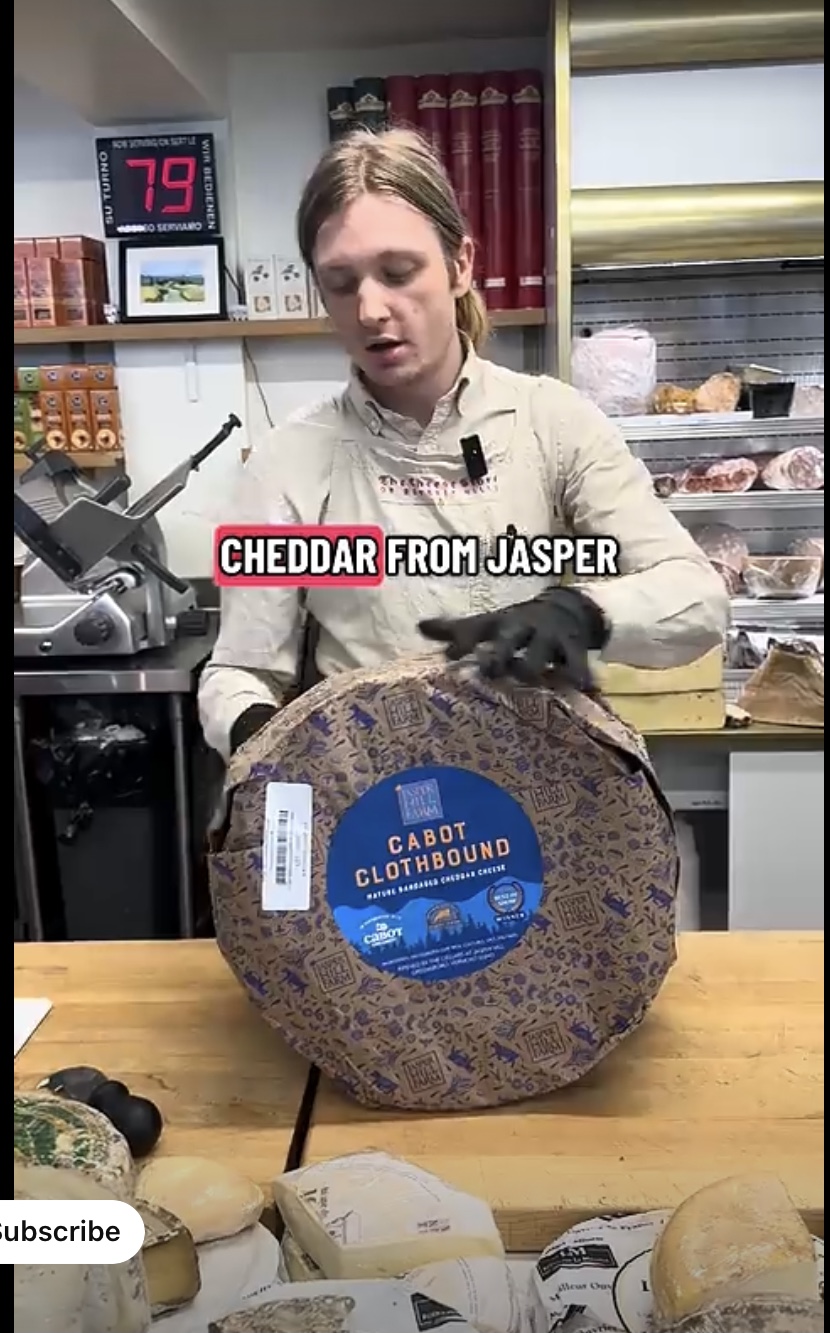
This goes for more upscale choices as well.  Here is one from the Cheese Store of Beverly Hills: The Cabot Clothbound Cheddar from Jasper Hill Farm in Vermont.

Looks very traditional in its cloth binding, which is laudable.  I also cloth bind cheddars.  And I’m not pleased to still be relying on plastic in many cases to make and age other cheeses, but it works and it’s readily available and relatively cheap, so until I can find another way, that’s my lot. But, I’m always looking for better, more traditional options.

On the Cabot Cheddar we have the typical ingredient list: pasteurized cow’s milk, starter culture, vegetable rennet, salt.

Are they required to declare their rennet and cultures are produced in a lab and have nothing to do with any farm? No. Is the consumer privy to who manufactures those ingredients, or where? No.

Though they do make a good show of cutting that big impressive cheese!

While I’m sure it’s healthier and tastier than the likes of The Swiss Colony cheeses, the label is still misinforming the consumer who probably assumes vegetarian rennet comes from vegetables and starter cultures come from other milk products on their farm, as once was the case with all cheeses.

In related Ag news, why is the news never good?
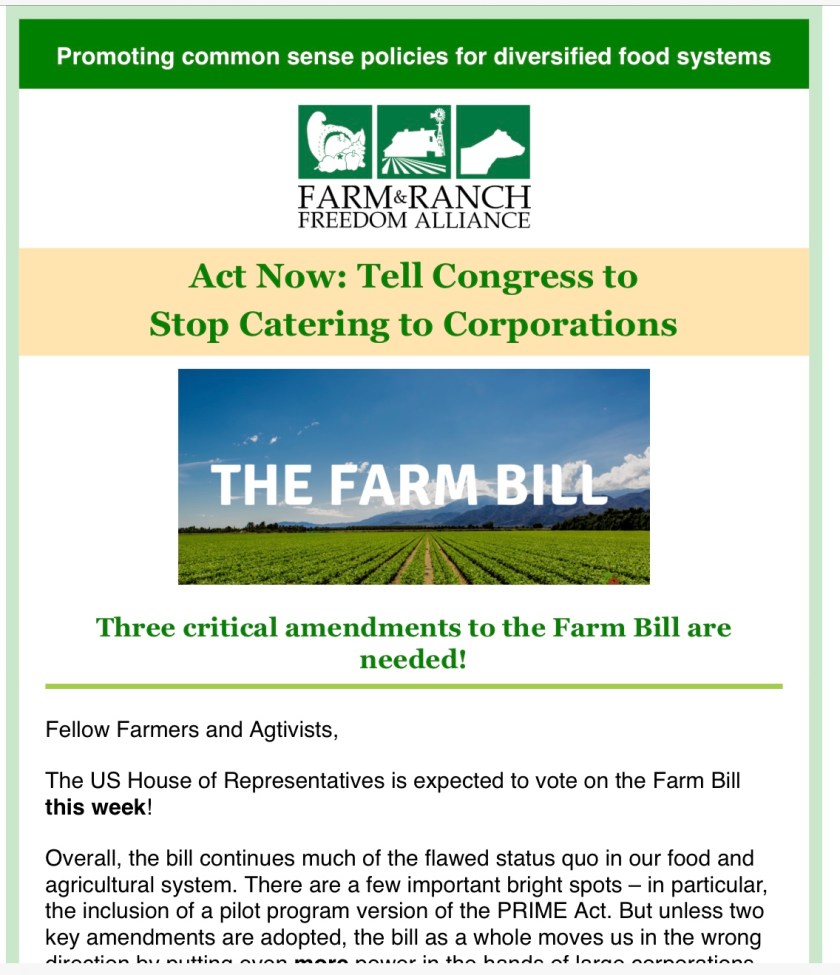
From the Farm & Ranch Freedom Alliance:

Act Now: Tell Congress to Stop Catering to Corporations

The US House of Representatives is expected to vote on the Farm Bill this week!

From AI: The Farm, Food, and National Security Act of 2026 is a comprehensive farm bill that aims to address agricultural and food policy in the U.S. It was reported out of the House Agriculture Committee on March 5, 2026, and includes provisions for nutrition assistance, crop insurance, and conservation programs, reflecting a significant update since the last farm bill in 2018.

Spoiler alert, not a peep is written about fake cheese or lab-produced cultures and rennet.  It’s not even on their radar.  

“Overall, the bill continues much of the flawed status quo in our food and agricultural system. There are a few important bright spots – in particular, the inclusion of a pilot program version of the PRIME Act. But unless two key amendments are adopted, the bill as a whole moves us in the wrong direction by putting even more power in the hands of large corporations … and putting your operation, your land, and your local decision-making at risk. There’s also a third important amendment, to empower consumers to support American-raised meat.

The Bottom Line:

This bill, as written, sticks farmers with more risk, less local control, and a system that favors consolidation.

That’s not a compromise—it’s a step backward.”

And from another source:

“Amidst rising farm bankruptcies and unprecedented economic and policy instability, the House bill chooses more of the same, neglecting the kinds of investments and policies that our farmers not only deserve but desperately need,” Mike Lavender, policy director at the National Sustainable Agriculture Coalition, said in a statement.

As House Moves Closer to Farm Bill Vote, Food and Ag Groups Push Back | Civil Eats

Lunatic Farmer Joel Salatin was one of the speakers at the People vs Poison Rally at the US Supreme Court to influence the votes.

The primary talking points are around glyphosate and similar pesticides and herbicides.
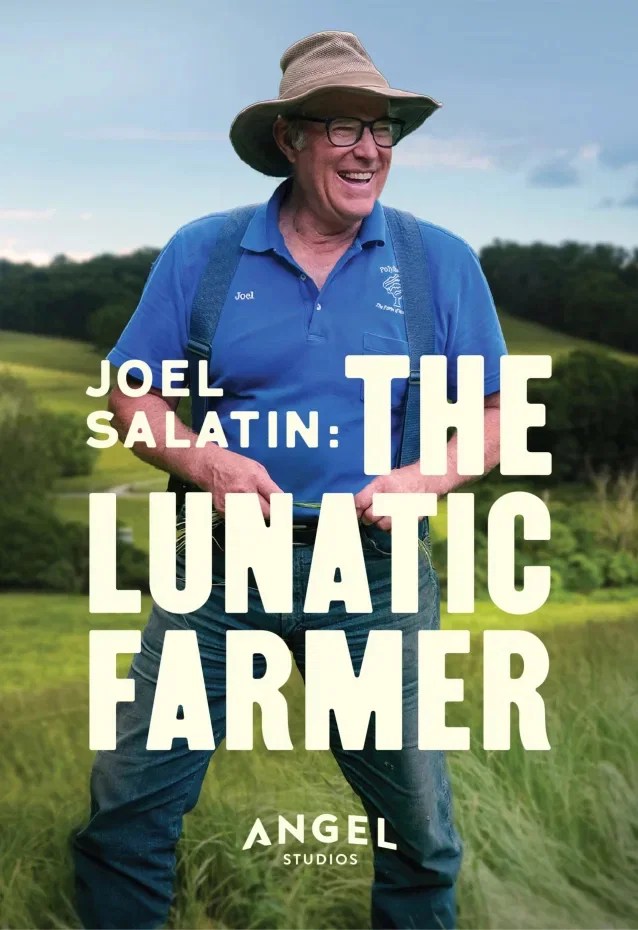
He says:

                  “The real question is what protocols would return the North American landscape to its pre-European productivity and abundance?  You see, 500 years ago this landscape produced more food than it does today, even with tractors, fertilizers, chemicals and new plant varieties.  Of course, it wasn’t all eaten by people.”

SCOTUS PRESENTATION — The Lunatic Farmer

I like reading his commenters, because there’s always a few I agree with and I so appeciate finding like-minds.  This one comes from Diane B. :

“So truthfully and eloquently stated. Sadly, SCOTUS is corrupt and mostly bought along with the rest of the government. We would be far better off if none of them existed. Government has proven it can only be dysfunctional. We don’t need to be governed. We need your speech circulated to the entire population, most will understand, and we need strong men and women who will stand up to corrupt corporations (without a government involved).”

I couldn’t agree more!

And yet, it’s only getting worse.

Maine Sets the Example

This is a repost from my favorite farmer: Joel Salatin
Blog: Musings From the Lunatic Farmer

I would also have been speechless at the response to his question at that California conference!


I’d love to hear what y’all think, too. 🙂

Second Amendment for Food

            A ballot initiative you may not have heard about in Maine late Tuesday created unprecedented freedom for voluntary food commerce.  This first-of-its kind constitutional amendment does what the U.S. Bill of Rights failed to do:  guarantee citizens the right to choose their food.

  The measure added language to the state constitution providing that individuals have a natural, inherent, and unalienable right to food, including the right to save and exchange seeds and the right to grow, raise, harvest, produce, and consume the food of their own choosing for their own nourishment, sustenance, bodily health, and well-being, as long as an individual does not commit trespassing, theft, poaching, or other abuses of private property rights, public lands, or natural resources in the harvesting, production, or acquisition of food.”

        What this does is give the individual legal standing to sue any entity–including a government entity–that stands in their way of acquiring the food of their choice from the source of their choice.  This language has been championed by the Farm to Consumer Legal Defense Fund for years and it’s truly wonderful to see that a state has finally adopted it into its constitution.

             Both the Farm Bureau Federation (you know, that outfit that says it’s a friend of farmers?) and the Maine Dairy lobby fought aggressively against it, charging that it would undermine food safety.  That’s always the argument, that choice is too risky.  Somebody might get bad milk, rotten chicken, or spoiled porridge.  Yes, that’s possible, but it’s also possible they’ll be able to get better milk, better chicken, and better porridge than heretofore available due to burdensome government regulations.

             I’m thrilled over this development and anticipate Maine now leading the nation in local food commerce.  It’ll be interesting to see if the federal government attacks the state like it did with the Food Sovereignty Act several years ago.  At that time, the federal government said that if the state didn’t rescind that freedom, it would pull all inspection from the state and nothing would be able to move outside state lines.  Maine buckled.

             Let’s hope Maine holds firm this time around because the same opposition is still very much in power, both at the industry level and the bureaucratic level.  Lest you think this is all academic, let me relate a quick story.  Several years ago I was speaking at a college in California and had about 300 people in a lecture hall.  I asked them “how many of you think that a government food safety official should inspect carrots and beets harvested from your own garden before you can eat them?”   One-third of the hands went up.  I’ll never forget the moment.  I literally was speechless (that’s a big deal for me) for a bit, trying to metabolize this reality.

             Are you in agreement with what Maine just did, or do you think this will fill the hospitals with folks suffering from tainted food?

~Joel Salatin

Celebrate Small

Some things are better small, even in Texas. Small markets, small steps, small farms, small solutions.

Get big or get out! That was the slogan of the last century that surely haunts loads of old farmers to this day.

“Many who got big to stay in are now being driven out by those who got bigger. The aim of bigness implies not one aim that is not socially and culturally destructive.”
The Unsettling of America: Culture & Agriculture by Wendell Berry (1977)

“We have always had to have ‘a good reason’ for doing away with small operators, and in modern times the good reason has often been sanitation, for which there is apparently no small or cheap technology. Future historians will no doubt remark upon the inevitable association, with us, between sanitation and filthy lucre. And it is one of the miracles of science and hygiene that the germs that used to be in our food have been replaced by poisons.”

That book was written when I wasn’t yet 10 years old. And it’s only gotten worse.

I ask myself regularly how this is possible. Now it’s not just small farmers, the attacks are against small business, in general.

But, then as now, the attacks are primarily psychological. Folks are lured by promises from thieves and liars, and that’s the better part of the story. Other times, and certainly increasing in our more modern times, they are lead senselessly, through fear and desperation, because they have medical bills, or student loans, or mortgage payments in the hundreds of thousands of dollars, and they see no other way to go on but to sell their souls to the State.

And yet, the seeds of the solutions have always been lying dormant all around us, waiting for our nurturing care and attention.

“Just stop building it.” Catherine Austin Fitts

Brilliant woman who is walking her talk!

“Just move to a smaller community.” Curtis Stone

Homesteading – #SolutionsWatch : The Corbett Report

“Just try it, you never know, you might like it!” me 🙂

One minute of wee piglets being piglets just might seduce you!

A culture is not a collection of relics or ornaments, but a practical necessity, and its corruption invokes calamity. A healthy culture is a communal order of memory, insight, value, work, conviviality, reverence, aspiration. It reveals the human necessities and the human limits. It clarifies our inescapable bonds to the earth and to each other. It assures that the necessary restraints are observed, that the necessary work is done, and that it is done well. A healthy farm culture can be based only upon familiarity and can grow only among a people soundly established upon the land it nourishes and safeguards a human intelligence of the earth that no amount of technology can satisfactorily replace. The growth of such a culture was once a strong possibility in the farm communities of this country. We now have only the sad remanant of those communities. If we allow another generation to pass without doing what is necessary to enhance and embolden the possibility now perishing with them, we will lose it altogether. And then we will not only invoke calamity — we will deserve it.” WB