The Real Cheese, Finale

The Swiss Colony has still not answered my questions concerning which “enzymes” and “cultures” are used in their cheese, or who manufactures them.  

This is as close to a direct answer as they have come, after four attempts for clarification on my part.

“We do not give out our manufacturing information, as these may change depending on availability.

We hope this information is helpful to you.”

Let’s compare this to what is required, by law, for a small licensed dairy in most US states.  

They are the most stringent laws for just about any product sold in our country, with hefty fees, regular inspections, strict requirements for what can be produced and how, and to boot, with the name and the address of the farm (which in most cases means the farmer’s home address) to be printed on every label. 

Imagine if the CEO of every giant food conglomerate in this country was required to put their home address on everything they sold? 

Of course, that could become very confusing, which address would they choose with multiple McMansions to choose from?

Yet if you talk to the average consumer at the grocery store their assumption would most likely be that cheese bought by a local seller at the farmer’s market is of more questionable safety than the big name brands they’ve come to know, and trust.

Completely misplaced trust, created by fraudulent marketing practices and unfair laws in a food system that has been duping the public for half a century plus.

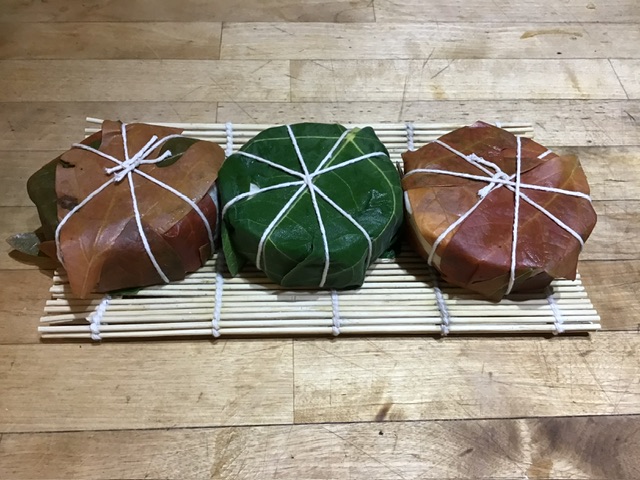
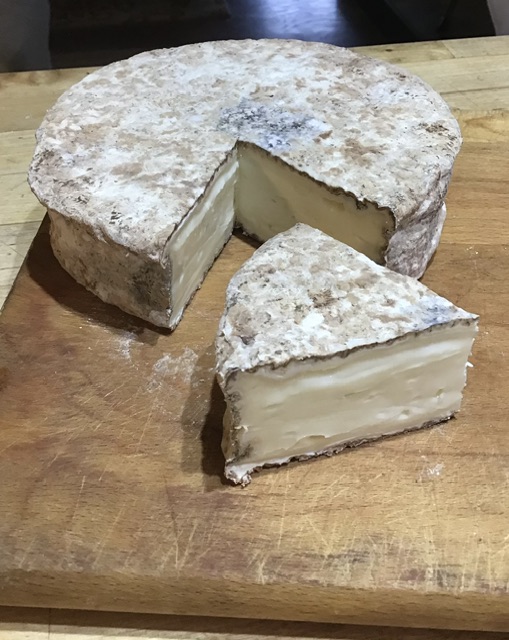
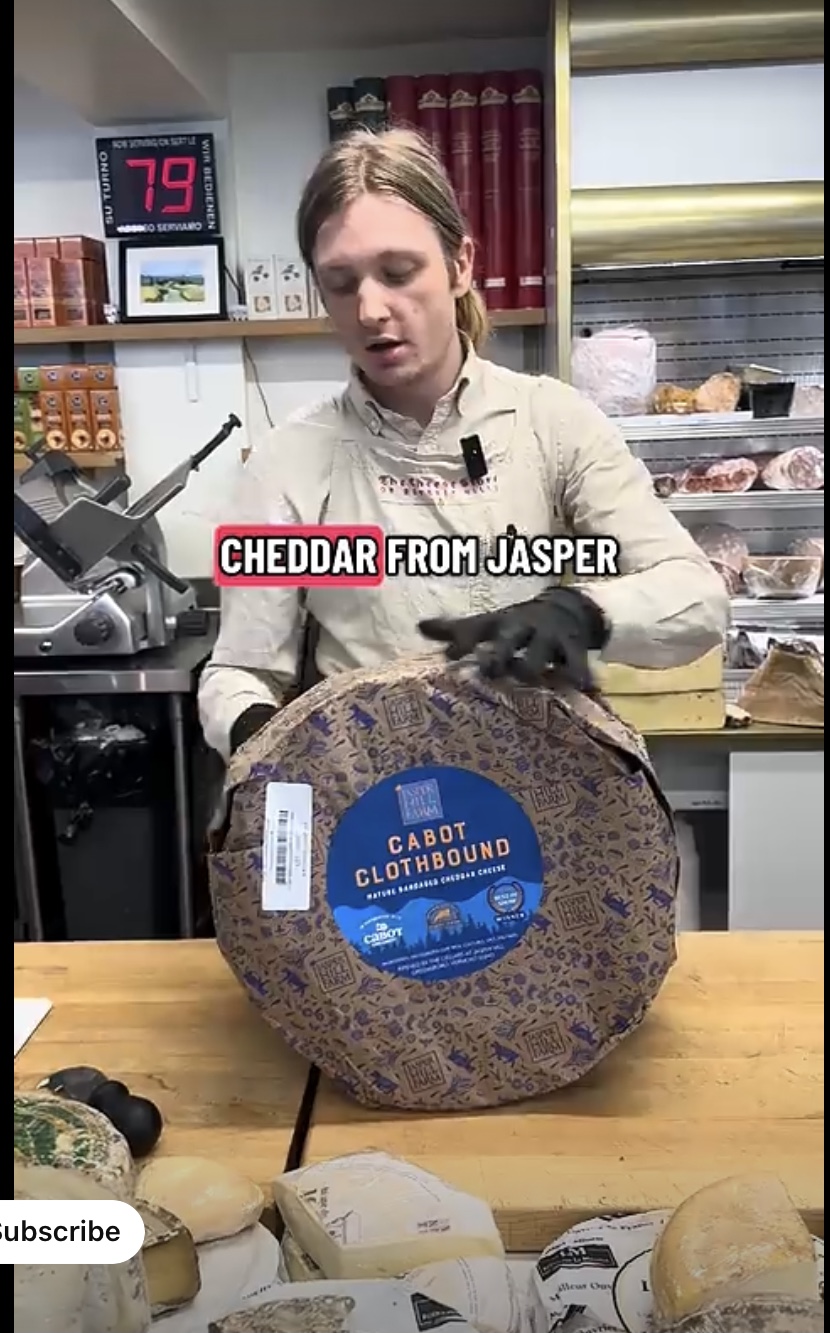
This goes for more upscale choices as well.  Here is one from the Cheese Store of Beverly Hills: The Cabot Clothbound Cheddar from Jasper Hill Farm in Vermont.

Looks very traditional in its cloth binding, which is laudable.  I also cloth bind cheddars.  And I’m not pleased to still be relying on plastic in many cases to make and age other cheeses, but it works and it’s readily available and relatively cheap, so until I can find another way, that’s my lot. But, I’m always looking for better, more traditional options.

On the Cabot Cheddar we have the typical ingredient list: pasteurized cow’s milk, starter culture, vegetable rennet, salt.

Are they required to declare their rennet and cultures are produced in a lab and have nothing to do with any farm? No. Is the consumer privy to who manufactures those ingredients, or where? No.

Though they do make a good show of cutting that big impressive cheese!

While I’m sure it’s healthier and tastier than the likes of The Swiss Colony cheeses, the label is still misinforming the consumer who probably assumes vegetarian rennet comes from vegetables and starter cultures come from other milk products on their farm, as once was the case with all cheeses.

In related Ag news, why is the news never good?
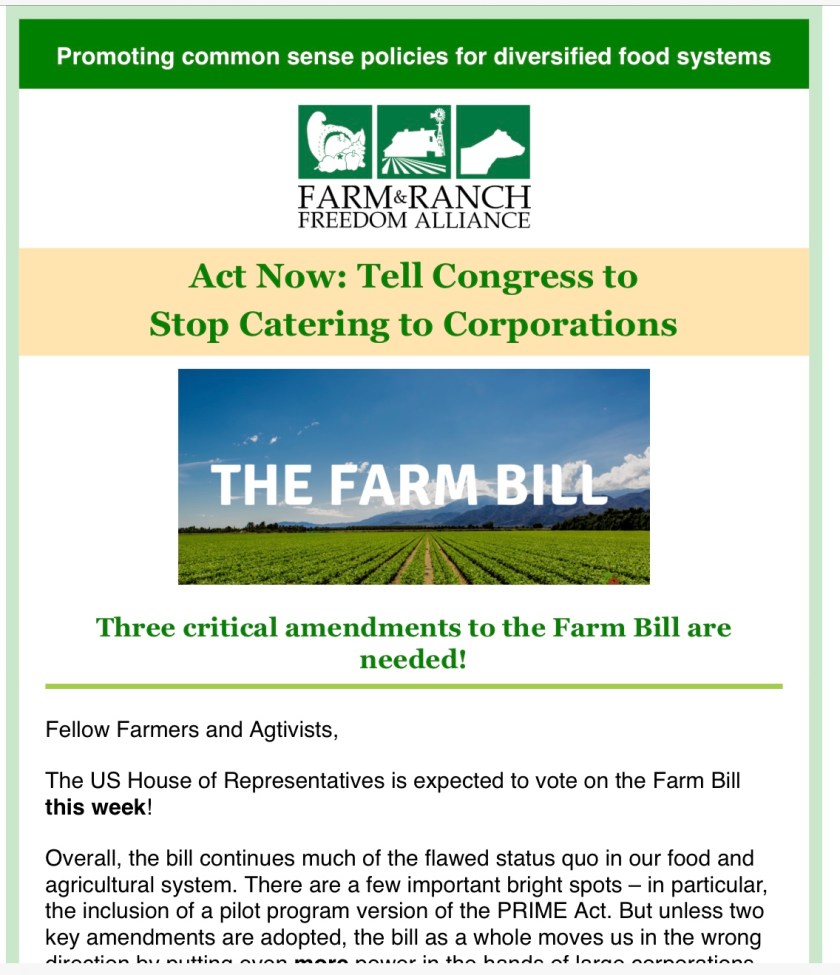
From the Farm & Ranch Freedom Alliance:

Act Now: Tell Congress to Stop Catering to Corporations

The US House of Representatives is expected to vote on the Farm Bill this week!

From AI: The Farm, Food, and National Security Act of 2026 is a comprehensive farm bill that aims to address agricultural and food policy in the U.S. It was reported out of the House Agriculture Committee on March 5, 2026, and includes provisions for nutrition assistance, crop insurance, and conservation programs, reflecting a significant update since the last farm bill in 2018.

Spoiler alert, not a peep is written about fake cheese or lab-produced cultures and rennet.  It’s not even on their radar.  

“Overall, the bill continues much of the flawed status quo in our food and agricultural system. There are a few important bright spots – in particular, the inclusion of a pilot program version of the PRIME Act. But unless two key amendments are adopted, the bill as a whole moves us in the wrong direction by putting even more power in the hands of large corporations … and putting your operation, your land, and your local decision-making at risk. There’s also a third important amendment, to empower consumers to support American-raised meat.

The Bottom Line:

This bill, as written, sticks farmers with more risk, less local control, and a system that favors consolidation.

That’s not a compromise—it’s a step backward.”

And from another source:

“Amidst rising farm bankruptcies and unprecedented economic and policy instability, the House bill chooses more of the same, neglecting the kinds of investments and policies that our farmers not only deserve but desperately need,” Mike Lavender, policy director at the National Sustainable Agriculture Coalition, said in a statement.

As House Moves Closer to Farm Bill Vote, Food and Ag Groups Push Back | Civil Eats

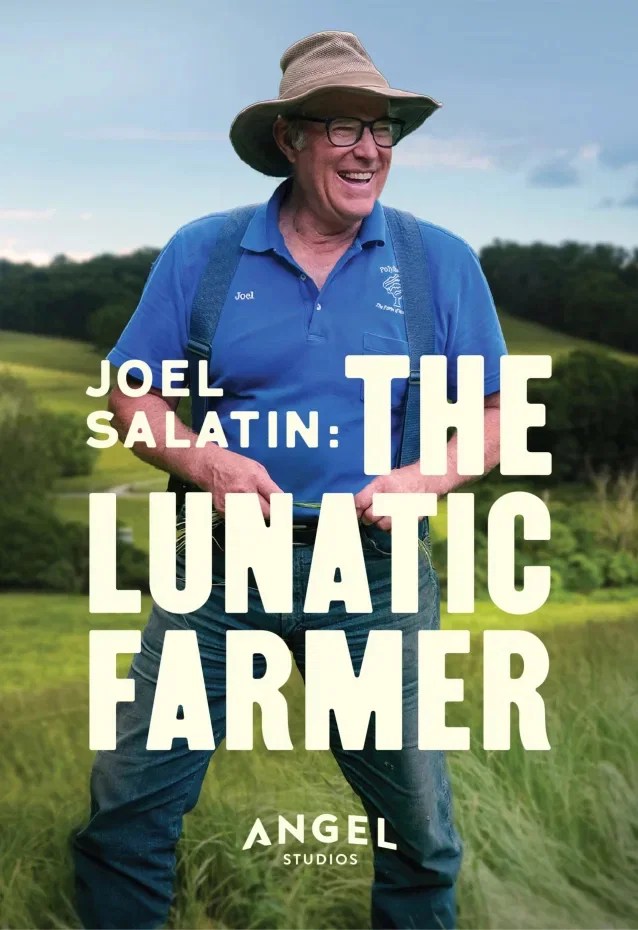
Lunatic Farmer Joel Salatin was one of the speakers at the People vs Poison Rally at the US Supreme Court to influence the votes.

The primary talking points are around glyphosate and similar pesticides and herbicides.
He says:

                  “The real question is what protocols would return the North American landscape to its pre-European productivity and abundance?  You see, 500 years ago this landscape produced more food than it does today, even with tractors, fertilizers, chemicals and new plant varieties.  Of course, it wasn’t all eaten by people.”

SCOTUS PRESENTATION — The Lunatic Farmer

I like reading his commenters, because there’s always a few I agree with and I so appeciate finding like-minds.  This one comes from Diane B. :

“So truthfully and eloquently stated. Sadly, SCOTUS is corrupt and mostly bought along with the rest of the government. We would be far better off if none of them existed. Government has proven it can only be dysfunctional. We don’t need to be governed. We need your speech circulated to the entire population, most will understand, and we need strong men and women who will stand up to corrupt corporations (without a government involved).”

I couldn’t agree more!

And yet, it’s only getting worse.
The Real Cheese, continued

“If you don’t read the news you’re uninformed, if you read the news you’re misinformed.” Mark Twain

The same can be said for labels.  While our “health freedom” advocates go after the most obvious chemical concoctions, or suffle around useless info about calories and so-called vitamins, folks who really do care about their health are getting duped by seemingly healthy foods.  

I believe we all know that counting calories is a fool’s errand. But for those who might still not get it, here’s a 2nd grade level demonstration.

Now let’s get to the graduate level.  Enzymes and cultures and rennet, are they all the same?  The modern cheesemakers would like you to believe they are, but they are certainly not.  

My issue is with the deception, just to be clear, that is always my issue.  If folks choose, with proper information and informed consent, to consume chemicals and lab-made food, I have no problem with that.  As the kids like to say, “You do you!”

But this is not what’s happening. These foods are being forced on consumers under an illusion of choice.  We are not even privvy to proper food labeling and cheese is a prime example.

Most cheeses sold today will have the same ingredient list as I do when making a 100% natural cheese: milk, culture, rennet, salt.  Looks simple enough, but it is far more complex than that.

Pasteurized milk or raw milk?  Natural cultures or lab-produced cultures? Animal rennet or the ‘new’ so-called vegetarian rennet?

Already we enter deceptive marketing practices on the topic of rennet, because most folks don’t know what it is or how it is acquired in nature.  

So the manufacturers of vegetarian rennet are relying on consumer ignorance rather than informed consent.

I claim this because they are insinuating, by appealling to vegetarians, that it is more humane than animal rennet.  When it comes to the modern abhorent feed lots and poor treatment of animals ina factory-farm setting I suppose they could be correct.

But in traditional dairy farm protocol this is completely false.  Hubby jokingly calls it “male privilege” because the practice is, only females are raised to maturity.  Boys are sold, castrated or not, or raised separately to be slaughtered for meat after a couple years in the field.  

Natural rennet is acquired by extracting the abomasum of the young ruminant animal’s stomach, which we have done here on the wee homestead, if you want to check it out.  

For the average farm this is not an issue, as there are plenty of males which can be slaughtered for this purpose.  Not that it takes more than one, because it will last a VERY long time, as is proven in “3rd world” dairy operations still today.  This is a process called ‘backslopping’ where a rennet-culture solution are reused for an entire season, similar to how sourdough starters are “grown” and reused.

But when it comes to huge dairy operations with fancy equipment and many rotating employees and assembly-line production this doesn’t work.  It’s not consistent and reliable enough, there are too many variables in such a living product and as the old adage goes, too many hands spoil the broth.

For the giant manufacturers these lab-created cultures and vegetarian rennet are a necessity–for them, not for the consumer.  However, their aim is to make it appear as if they are doing it for “consumer choice”.  Even as the consumer has no choice!

Vegetarian rennet is now the norm, used in the vast majority of cheeses sold in the US.  The same goes for the added starter cultures and “enzymes” used for flavoring and consistency, all produced in a lab.  As they are showing images of happy cows on lush green fields and quaint farmhouses on their labels and websites, this image is as deceptive and manufactured as those ingredients.  

While conscientious consumers rightly raise concerns over animal welfare and antibiotics in their milk, they’ve barely scratched the surface of the issue.  Even the “organic” label here is deliberately deceptive.

Rather than be honest with consumers, instead we get gaslit.  We are suddenly dealing with “allergies” and “intolerences” where none existed before.  We are informed we must take special “enzymes” if we insist on eating dairy foods.  We are directed to the new dairy-free products made by the same manufacturers and also produced in a lab.

And when we try to do our due diligence to understand what is in our food and why it now causes us health problems, as I have, we are given the runaround.

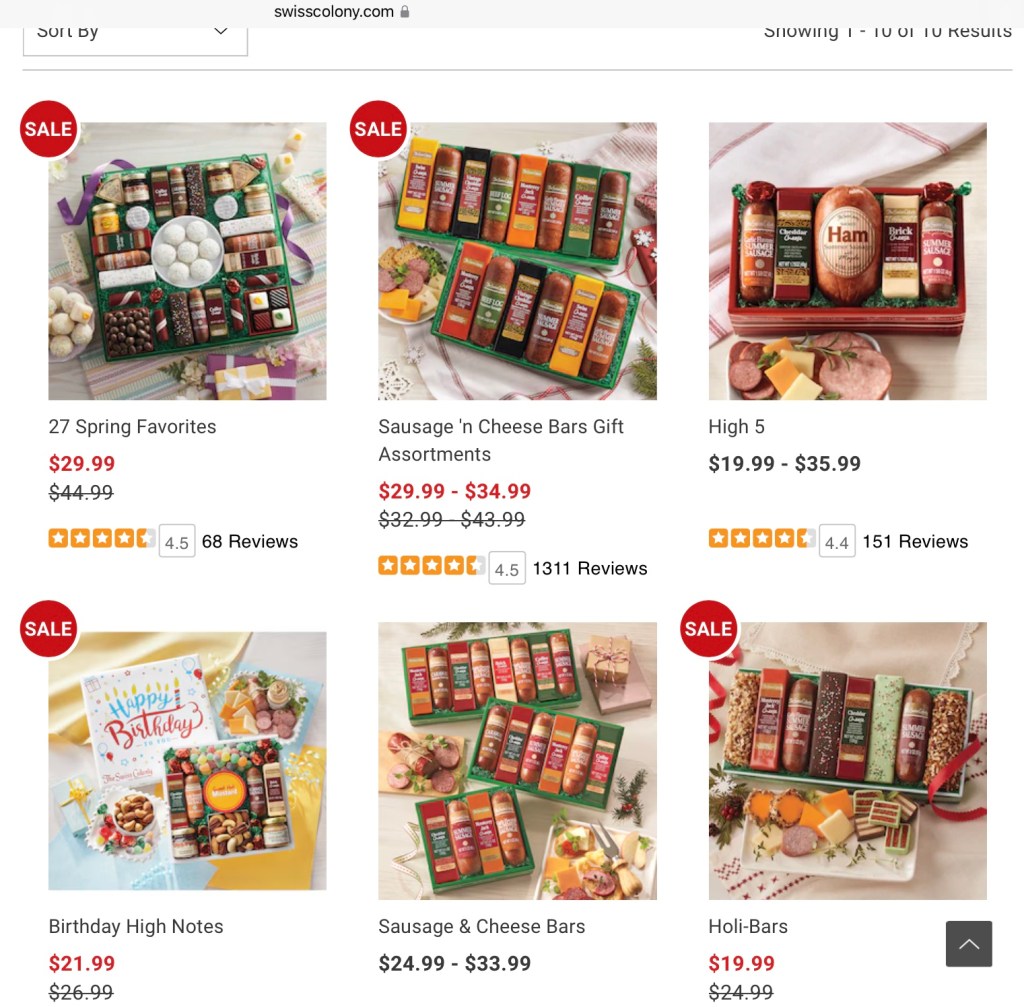
I’ve been on the runaround track for a week now by the Customer Service department of the popular brand Swiss Colony, a major seller of cheeses and meats.  They are clearly trying to run me down by being avoidant and evasive about a very basic question–what’s in your cheese?

After reading all the information on their website and getting no answers, I contacted them directly.  Yes, they use “vegetarian” rennet, which I already knew from their Q&A section.

My initial inquiry:

Hello,
please inform me of the complete ingredient list for your Baby Swiss Cheese, meaning the specific types of cultures and enymes being used, and if possible, the manufacturers’ names for those and as well as your vegetarian rennet.
thank you,

Their reply:

Thank you for contacting Customer Service.

We have forwarded your inquiry to the proper department and will reply with an answer as soon as we receive the information.

We appreciate the opportunity to be of service.

Then, the next day:

Our Baby Swiss uses vegetable rennet.  Please see below for the requested list of ingredients. 

INGREDIENTS: PASTEURIZED WHOLE MILK, CHEESE CULTURES, SALT, ENZYMES, CALCIUM CHLORIDE.

ALLERGY INFORMATION: CONTAINS MILK.

So, the obvious assumption here is, if you have allergies to this product, it’s because you have milk allergies.  Then you get their list of solutions to your problem, links to all their “alternatives”.

  • Dairy-Free, Vegan Mozzarella Cheese That Melts Perfectly, Plant-Based, 7 oz 6-PACK, Lactose Free Cheese with No Allergens, Non Dairy Cheese.
  • Never Better Foods Plant-Based Shredded Cheddar & Mozzarella Cheese Blend, 6 Pack (6 x 7 oz Bags), Dairy-Free, Vegan, and Allergen-Free, Ideal for Cooking, Melting, and Meal Prep
  • Empasta Vegan Cheeze Sauce – Dairy-Free, Gluten-Free, Nut-Free, Soy-Free – Creamy, Easy Melt, Low-Calorie Cheese Sauce Alternative for Dips, Pasta, Nachos, Burgers, Veggies & More – 12oz sustainable jar (Smoked)
  • Madly Hadley Plant-Based Parmesan Cheese, 2 packs – 16oz | Original Vegan Cashew Parmesan Grated Topping for Pasta, Salad, Sauces | Dairy-Free, Gluten-Free, Non-GMO, Soy-Free, Keto-Friendly

Clearly they did not answer my direct questions, so I tried again.  And again.  And again.  And I’m still waiting for my answers.

I will return with their answer, if I get any, in the next post, along with a more upscale brand, to demonstrate more money doesn’t always mean a more natural product.