Disenchanting Enchanted Rock

I was so excited when I found ‘an expert’ on Enchanted Rock, who had written an entire book on the monument and its surroundings and has a website too, with lots of details. I was sure to have found a great source, I thought.

Click pic for my previous post about Enchanted Rock called “My favorite Enchanting photo”

And with a name like Kennedy, it’s gotta be good, right?

In the spirit of disobedience, in a word, no. Two words: Hell, no! Three words: Big, Fat, Disappointment!!

Wow, I didn’t realize anyone can just throw any piece of nonsense together and call it history. Or anthropology. Or pretty much any ‘science’.

Way to spoil a miraculous destination, Kennedy, thanks bunches.

But I can’t really blame him alone, it’s more than a trend. The dumbing down of the public has been documented for decades, and this sort of material that is supposed to pass as educational is a perfect case in point. So, let’s take a few pokes at it from a few of those many angles.

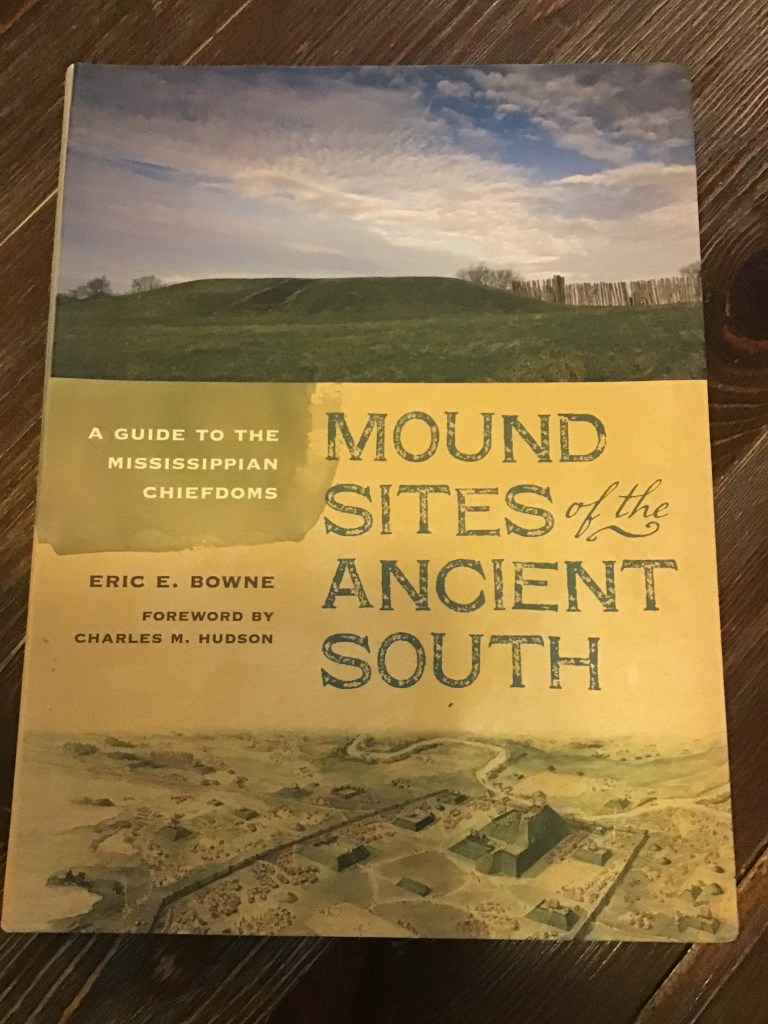
The History of Enchanted Rock in the Texas Hill Country by Ira Kennedy self-published in 2010 naming it https://www.amazon.com/HISTORY-ENCHANTED-ROCK-TEXAS-COUNTRY/dp/1456818783
“The Sacred Landmark of Central Texas”.

It is not sold as a children’s book and costs $21.99. According to the the Amazon page Ira Kennedy is:

“Considered as the state’s leading authority on Enchanted Rock, the sacred mountain of Central Texas, Ira has assisted the author’s of several published books, articles and the Thomas Evans mural of Enchanted Rock in the Austin-Bergstorm International Airport. IN 1992, Ira was awarded a Certificate of Appreciation from the Texas Parks and & Wildlife Department for providing numerous educational talks at Enchanted Rock Natural Area.” And it goes on.

The first Amazon review looked promising.
“Ira Kennedy is the world expert, in the opinion of many, of this beautiful Texas natural treasure. His knowledge comes from spending a great deal of his life on or near the rock. Ira is a creative genius and humble man who has written this amazing book, sure to answer all your questions about this geological wonder. Beautifully illustrated by Ira, you will keep this book among your special collections.”

The ‘book’ itself looks more like a coloring book. There are no references or citations, no bibliography or notes. While the author states he did multi-disciplinary research and himself has an advanced degree and was employed in Naval intelligence as a cryptographer, he must seriously understand what an ‘expert’ text would look like, and this one is the polar opposite of scholarly.

I can only assume ‘expert’ has taken on a new meaning sometime around the year 1999.

Let’s set the tone with his “Brief Historical Timeline” which begins his story in 12,000 B.C. and ends in 1978. With only a smattering of centuries missing, bless his heart!

We learn of a dubious-looking character named Jack Hays who was ‘an enigma’. We learn about a William Kennedy and his ‘flower-spangled’ landscape and ‘lost mines’ the ‘fueled the imaginagtion’. We learn about some immigrants from Germany in the 1840s.

We have the ‘First People’ myths and ‘The Imaginary Frontier’ of the Spanish explorer Alvar Nunez Cabeza de Vaca, who passed right through Mason County in the sixteenth century. And some childish stick figure drawings, some arrowheads and feather headdresses.

Later in the book are some drawings of angry indians who we learn may or may not have practiced human sacrifice.

And that about sums up my waste of money and time! Alas, the journey of discovery continues.

Poor, misunderstood ‘Enchanted Rock’ — I don’t even like your name anymore, so I think I’ll find a new one. And a new history to go with it. It would surely be better footnoted than this toilet paper, and good bit more entertaining I expect too!

I dare say, you there, intrepid traveler, can you smell anything beyond the boulders of bullshit?

My Favorite Enchanting Photo

I’ve gazed at it for what seems like hours, though its magic is hardly captured there. It is just reminiscent of the awe I felt.

That I took it, that’s fine enough for now. I’ll be back, no doubt about that. I’ve no idea still what I’ve seen, only that I don’t see what they say I should see.

This is the One! Amazing!

That we traveled so many miles, and after plenty of discouragement, to get so very fortunate in the end must’ve added to the enchantment. I will cling to it, for a long time to come, I’m sure.

Intrepid traveler, Kath

To be in good company, that helps, always. But I expect next time I’ll go alone, and I’ll stay a good long while, hoping that maybe a few more of its mysteries might come to present themselves to me. That’s how it seems to work.

If I’m patient enough, keen enough, present enough . . .
Perhaps.
Maybe. Or maybe not.
Already there are many obstacles.

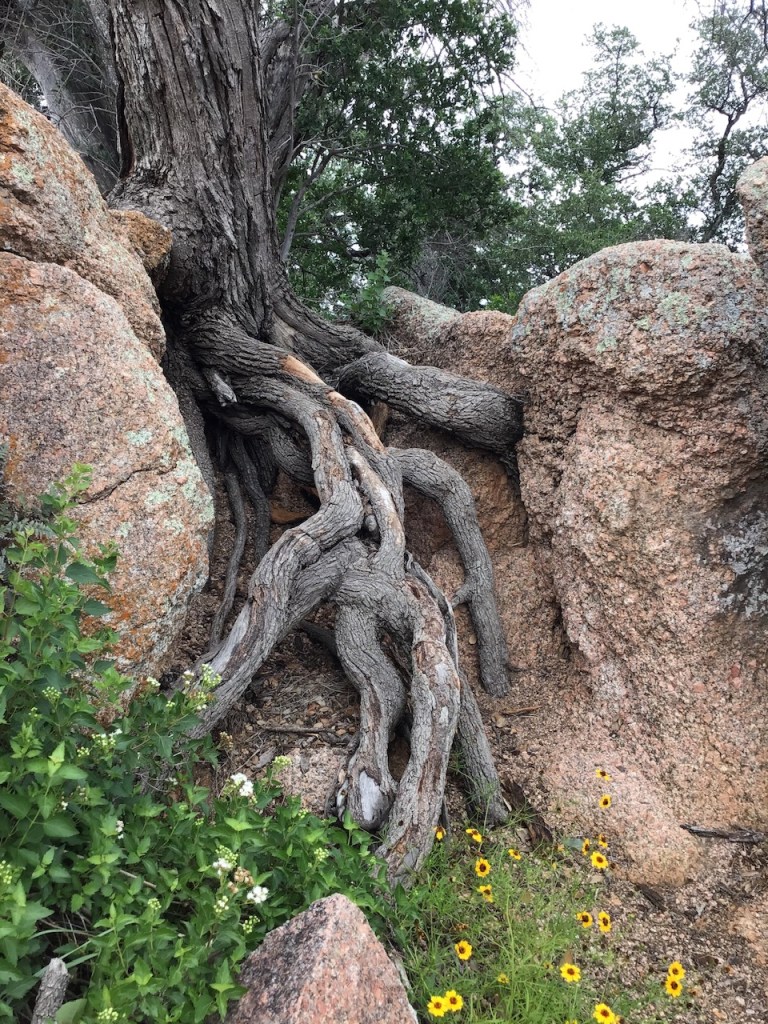
If only they would be, these many obstacles, as permeable as these rocks are to these roots.

If only I could hear their stories and know they were real.

If only I knew. What would I do?

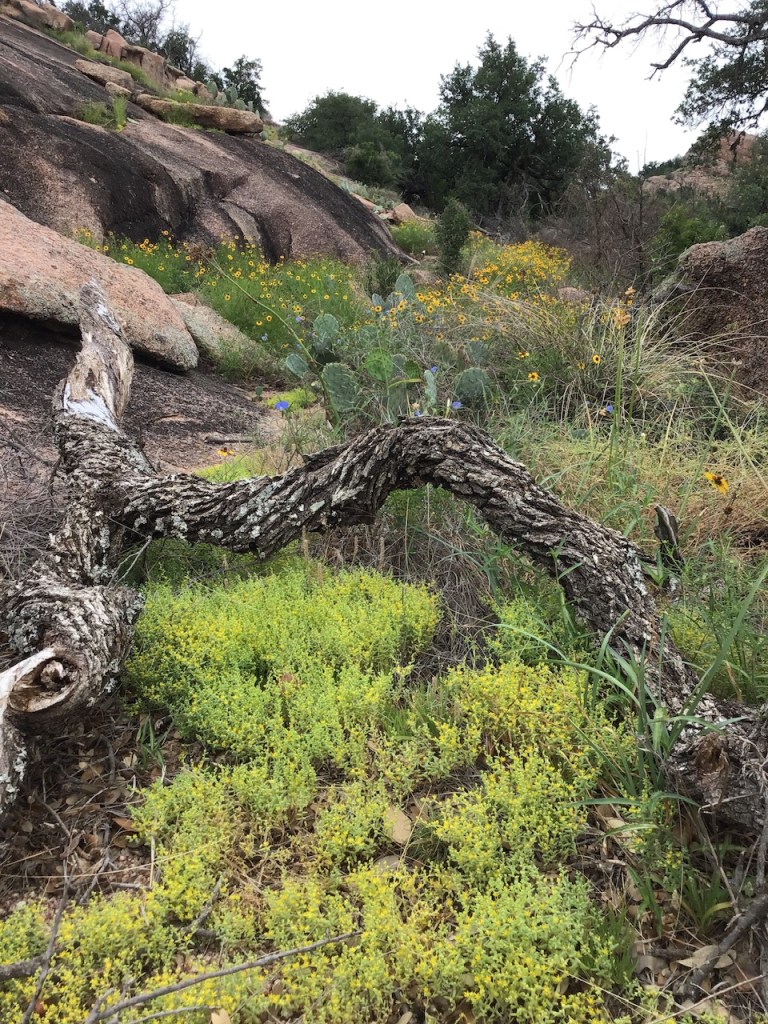
Creep among the rocks, disguised, like these little guys?

You can’t see me . . .

Or mock its odd monochromatic effect with bold color displays in every shallow pool or crevice?

What makes a sight worthy of seeing? Is worth only weighed in the eye of the beholder? How many eyes does it take to spoil a place?

Enchanted Rock is a pink granite mountain located in the Llano Uplift about 17 miles (27 km) north of Fredericksburg, Texas and 24 miles (39 km) south of Llano, Texas, United States. Enchanted Rock State Natural Area.

I don’t know much about rocks, but granite is one we’ve all heard of, thanks to its continued popularity in building, from the popular household granite countertops to Mount Rushmore and the Red Pyramid in Egypt.

This is said to be a testament to its durability, longevity, and resistance to weather.

According to Wiki, it’s quite hard:

“Granite is nearly always massive (lacking any internal structures), hard (falling between 6 and 7 on the Mohs hardness scale),[1] and tough. These properties have made granite a widespread construction stone throughout human history.”

Which makes me all the more curious about the intimate relationship between those roots and rocks. According to the official history, we’re only seeing the proverbial tip of the iceberg.

“Enchanted Rock is a small speck compared to the huge underground rock that spans over 100 square miles. That’s almost four times as big as Manhattan!”

It’s quite hard, and yet it ‘sheds’ kind of like a glacier ‘calves’?
“Eventually, weather and erosion shaped these rocks into the odd shapes you see today.”

How odd!

So, what kind of weather and erosion causes a lozenge shape? Inquiring minds want to know!

A partial official explanation can perhaps be found within worldwide examples of batholiths:

“Batholiths exposed at the surface are subjected to huge pressure differences between their former location deep in the earth and their new location at or near the surface. As a result, their crystal structure expands slightly over time. This manifests itself by a form of mass wasting called exfoliation. This form of weathering causes convex and relatively thin sheets of rock to slough off the exposed surfaces of batholiths (a process accelerated by frost wedging). The result is fairly clean and rounded rock faces. A well-known result of this process is Half Dome in Yosemite Valley.”

That explains the ‘thin sheets’ perhaps, and the rounded rock face, but not so much the lozenges. And the root-rock infusions!

Continuing with Wiki:

Lanite, a rare type of brown rhyolite porphyry with sky-blue quartz crystals and rusty-pink microcline feldspar, is found nowhere else in the world except in Llano County. Llanite can be found along a highway cut 9 mi (14 km) north of Llano on Texas 16. The largest piece of polished llanite in the world can be seen at the Badu House.

The Llano Uplift, a roughly circular geologic dome of Precambrian rock, primarily granite, covers about 50 miles along Texas Highway 29 and was 1.5 billion years in the making. Call it Rock Heaven: Geologists identify 241 rocks and minerals in Llano County, including llanite, a blue-specked dark granite found nowhere else in the world.”
Travel: Rock Heaven in Llano|April 2018| TPW magazine
Lovin’ Llano | October 2008 | TPW magazine

But apparently it was not the discovery of granite, but rather that of iron ore that transformed Llano into a boom town.

“Newspapers spread the word about Llano, recklessly playing up the magnitude of the region’s mineral resources. “Llano iron ore is the finest on the continent,” one story claimed. “Iron Mountain will produce 2,000,000 to 4,000,00 tons annually after the first year.”

“Little visible evidence remains of the Llano iron boom. A 1906 tornado destroyed some of the boomtown buildings north of the river. Other structures suffered a more mysterious fate.
“A number of buildings on the north side burned,” JoAnn McDougall explains. “The owners did it to collect insurance money. They needed cash and didn’t see any other way to get it. So many buildings burned, the insurance companies stopped insuring buildings in Llano, at least for a while.”
The Badu Building

The Badu Buildinghttps://rockandvinemag.com/2024/02/the-badu-building/

According to Wiki:
The geology of northeast Africa is very similar to that of Texas, and many of the two regions’ minerals and fossils are only found in these two locations.[2] A dike of llanite crops out on Texas State Highway 16 about nine miles north of the town of Llano.[3]
Llanite, which is similar to granite, is very strong, with a crushing strength of 37,800 lb/in2 or 26,577,180 kg/m2.[4] The mineral is also very similar in appearance to pietersite

Enchanted Rock was the absolute highlight for me on this road trip, and we almost didn’t make it. For one thing, I almost might not have been able to muster any enjoyment from it at all, being that I was wickedly hung over.

A hangover that dissippated in an instant, in a sudden and unexpected weather shift. The day before I’d been suffering in intense heat walking in a shadeless midday scrubby desert and I was attempting to muster the strength for the same again. For the first 45 minutes of the drive it was not looking promising. What fortune came then, in the last 10 minutes before the entrance, was the most welcome of weather whiplash …

Except that meant the main path of the Enchanted Rock might have to close any minute. Any amount of rain makes the rocks very slick, and they want no accidents. Best get climbing quick!

To be continued . . .

For more Enchanted Rock fact and fiction, begin at the 1:06 mark.


https://youtu.be/OO61UcJMHGw?si=4x33GYsB9oI3lbuF

A Stranger in a Strange Land

Just what are the Globalists and their minions taking from us, really?

They are stealing our wealth, that much is very clear. In that move they are accumulating enormous power, those two go hand in hand. They are creating a monoculture—their ideal “One World”—which on the surface to a great many around the world sounds like a nice thing.

These folks, mostly the young and those of ‘aspiring’ economies, expect to see more opportunities, a more equal distribution of resources, better access to education, a higher standard of living.

I want those things for them too.

This doesn’t sell as well in the U.S. and other Western countries. Our standard of living is already quite high, relatively speaking. So the promotion angle of their scheme is different with us. We get verbally spanked for being too successful.

We get optimal inflation and free training in resilience and a taste of tyranny and are expected to be grateful for it.

Whether you buy into the Globalist socio-economic vision or expect to benefit from it is the crux of most folks’ concern—either for or against—if they are concerned at all.

But what’s really being stolen, the root of the issue, as I see it, is much more serious than material gains or losses, or more convenient global commerce. Or mass immigration. Or even a totalitarian takeover.

Both Hubby and I were avid travelers when we met, and continued in that vein for many years afterwards. Most of this was before widespread use of the internet, when traveling alone was really traveling alone. If you got homesick you waited two weeks for a letter, or stood in line at the pay phone, or just suffered through it.

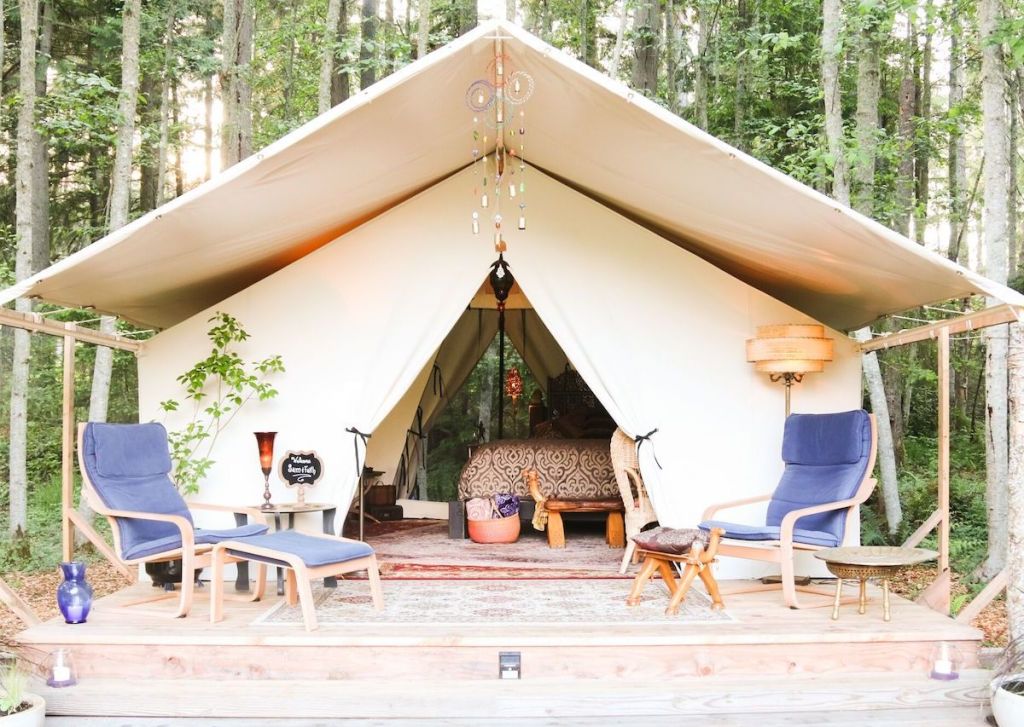
Mark Twain has supposedly said, “Traveling makes you humble.” I believe he meant the real kind of travel, not the group tours through Europe hitting ten capitals in ten days brand of modern tourism. No military base or corporate job or trust fund to cling to either. Those types are real traveling about as much as glamping resembles real camping.

To be a stranger in a strange land is a consciousness altering and life changing experience. When I saw McDonalds and signs in English and waves of expats, I got my fill of nostalgia quickly, and moved on. I experienced lots of loneliness. LOTS. I was scared sometimes. I put myself in some compromising positions, which I then had to navigate without the safety nets of language, cultural familiarity, kinship, or commraderie. “Travails” —that is the deepest purpose of travel and what separates a traveler from a tourist, or an occupier.

When I see signs in this country in Spanish or Chinese I feel sorry for those travelers, or immigrants. They are missing something essential through our obsession with making everyone feel safe and welcomed.

They are missing the life-changing opportunity to become ingratiated to another, in testing their own metal, in developing their own personal resilience and emotional fortitude. And ultimately, their ability to adapt to an environment, and to transform themselves.

We are not doing them any favors by denying them these opportunities and calling it welcoming and inclusive.

What we are actually doing is fostering weakness and projecting our own sheltered materialism onto all those who come here in order to experience cultural strength and conscious, courageous individuality—in us—and in themselves.

The Old World

Easter as a time of rebirth is far older than our Christian framework and in honor of this truth I’d like to share a relevant personal story.

I have never been a religious person and do not come from a particularly religious family. I’d label my religious influence in the ‘minimal’ category—I did go to Sunday school for a short time as a child, it was a Christian Science church that my grandparents attended for some of my young life. I remember my first experience of understanding that “JewIsh” was something different than “Christian” not until I was in high school. It made hardly an impact beyond a basic curiosity for me. What I learned then was that “the Jews” in our suburban Midwest milieu went to the high school in the rich suburbs, not ours in the middle-rent area of the burbs.

Then I went abroad and met a Jewish girl from this very high school, because all the high schools in our area shared the same overseas programs. We became friends for that short period and I consoled her when she burst into sobs upon visiting a Holocaust museum. I was moved by her pain and sorrow expressed for the suffering of a people she never knew, but still called her own. I had never experienced such a feeling before myself and the others in our group seemed annoyed or off-put by her overt signs of grief that were perhaps exaggerated, I don’t know, it’s possible, after all we were teenage girls, that does happen.

I had deep interests in language and culture from a young age that was not shared by others in my family. But my mom was open to my sense of adventure and supported my vagabond spirit as much as she could.

Traveling was the greatest rush of my life up until that time and I became quite obsessed with it. I expected my raison d’etre was to become a travel writer, which from the vantage point of today is almost humorous, considering I gave up traveling many years ago, as protest against Homeland Security measures of bodily harassment.

But for two decades I was ALL over the place. I still miss it. I still hope someday travel becomes what it once was to me, before the tyranny began in earnest and I chose to make a such a sacrifice in response.

By the time I’d visited Prague I’d seen many of the great cities of Europe. I loved Paris and Munich in particular; did not care for Berlin or Bern; would’ve moved to Amsterdam in a heartbeat.

I felt already as a seasoned traveler when the overnight train deposited me in Prague in the summer of 1990 at age 22. I knew enough to hang out on the railroad platform with my backpack until some suitable locals passed by offering a room for rent. Hotels were for aristocrats, not backpackers, and cheap lodging was not easy to come by, even in that still relatively cheap city.

I installed myself in the offered closet called a room. I got by on butchered German from my high school days and met only two other travelers who spoke English. It was the most foreign of cities I’d visited thus far, because the Soviet influence was still palpable everywhere, the Velvet Revolution had taken place the year before.

It really did feel like stepping back in time, everything felt old, and to me, drab. Gray and drab, bordering on depressing. The people seemed spent. The buildings looked dilapidated. The cars were rusty jalopies. The cafes were hardly the vibrant displays of conviviality as in Paris. But there was something else far more provocative to me than all which seemed missing having come from ‘the west’.

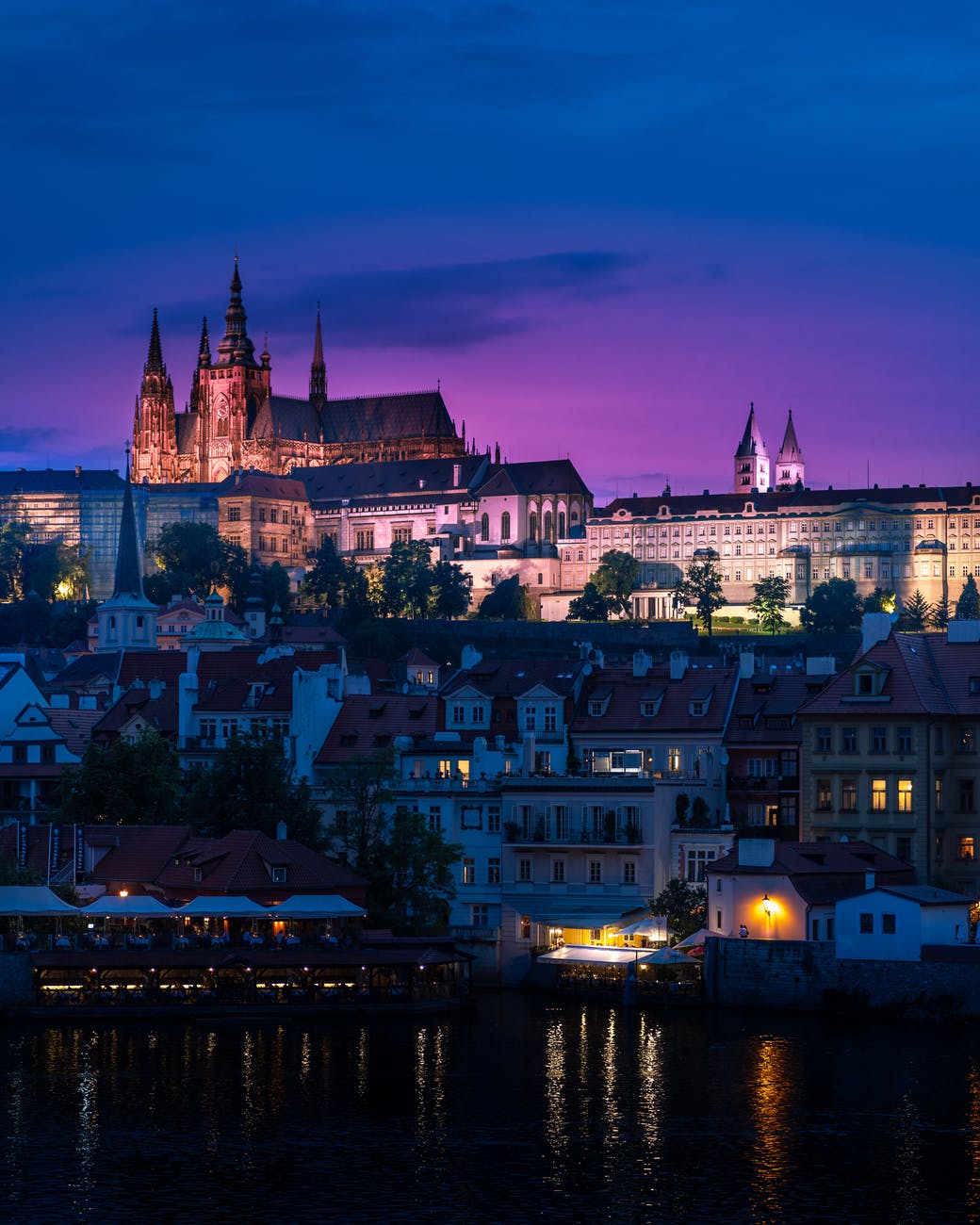
The first night I ventured out in tourist mode across the Charles Bridge I was stopped speechless in my steps. It was spring, but it was cold and drizzling and I was lured to an outdoor puppet show on the banks of the Vltava. I laughed because the children watching were laughing. I stayed for a while to watch them watching.

I didn’t think of my brief friendship with the Jewish girl, even in this most Jewish of cities. I’d read my guidebooks, I knew the city was seeped in old world culture and was beyond impressed with its architecture, a subject that had fascinated me already for a decade.

I integrate her now in this story for what happened next. I offered the backstory here in order to highlight that what happened next was completely outside of my influences and upbringing and any frame of reference beyond that one incident of that Jewish girl at the Holocaust museum.

When I gazed out over the Vltava from the Charles Bridge that night, quite alone in the cold and drizzle, an unknown and unforgettable emotion rolled over me. Like her, who that day could only express her emotion in tears, I could only express mine in awe. I felt as if my jaw had dropped and I stood cemented in place like one of the many towering statues.

I knew this place before, that’s all I felt. It was as if time and space had vanished and the people and the language and the events of that place, completely unknown to me, were instantly my own. It was the briefest of moments, come and gone as quickly as a dream, but more evocative than any lived experience. The past had invaded and embodied me, some sort of deep nostalgia had resurfaced, and the only word I could ever come up to try to describe it was Love, as lame as that is. Love, as in somehow, Magic.

That’s always made me curious. How could a foreign city evoke such an intense and inexplicable and ephemeral yet still fully embodied emotion?

I had no idea the answer then and still don’t have one. But something of what I experienced in that brief moment is as close as I am to a lived understanding of God.

Since the door of travel for me was closed by the tyrants, the window that opened is arm-chair traveling from the comfort of my hammock and it feels like a blessing.

That is thanks to technology (irony to the Luddite, right?) and to kindred spirits who show me that indeed, there is an old world magic that might have been built seeking rebirth through our eyes, and maybe that’s what I felt then, and maybe that’s what the Jewish girl felt, and maybe that’s happening right now to someone else at this very moment.

Thanks to Jon Levi for his fascinating work in re-imagining our history and re-igniting my nostalgia.