Finish Work

Finally, the fruits of Their/his labor move into the observable by the layman. I’m meaning both here at home, in our bathroom reconstruction, as well as on the grander stage, the Global Reset.

The temporary a/c unit has been so necessary! For the grunt work post, click here. https://kenshohomestead.org/2026/06/17/growth-vs-comfort/

the latest in moisture prevention, perhaps to become the next generation’s asbestos?

Once the global AI Governance is finally visible to the public at large, and we are ruled over officially by cartoon cutouts, at least we will have a gorgeous new bathroom in which to adjust to our Wizard of Oz overlords.

I think it’s fitting that this moment in the latest rewriting of global history we will forever connect it to these long sweltering months of bowel movements in our larvae-infested poop-with-a-view. It’s just too bad the long drop isn’t pasted with the photos of our current parasites-in-charge, that could become a new genre of target practice.

Global AI ‘governance’ aka surveillance, warned about for decades by many researchers whose work was then disseminated by a great many more for decades, is now being noticed by the masses and academia as the final act moves to the center stage.

Abstract
Artificial Intelligence (AI) now shapes many aspects of security and intelligence work. The European Union and NATO have moved in different directions in how they handle its use. The EU leans heavily on law and ethics to keep AI under democratic control, while NATO treats it mainly as a way to speed up operations and strengthen cooperation between allies. Drawing on policy documents and two case studies—biometric surveillance and automated signals intelligence (SIGINT)—securitization and co-production theory are used to show how these choices affect daily collaboration. Governance differences often create friction but can also lead to complementarity in intelligence practice. Coordination should be improved through shared certification standards, secure data-sharing protocols, and the establishment of a permanent EU–NATO working group on AI in security so that innovation supports, rather than divides, transatlantic cooperation.”
Artificial Intelligence Governance and Intelligence Interoperability: Diverging EU and NATO Approaches in National Security Contexts: International Journal of Intelligence and CounterIntelligence: Vol 39 , No 3 – Get Access
https://www.tandfonline.com/doi/full/10.1080/08850607.2025.2578461

In both cases . . .

The grunt work was longer and far dirtier than expected. There were clogged and sloped pipes, some caught only by chance, and luckily so, because they would’ve proven to be disastrous down the road for sure. I was actually a useful idiot more than once. There’s much to be said about the usefulness of a complete but curious novice asking stupid questions to see the hidden in plain sight yet somehow overlooked details.

In the political parallel I’m crafting, the grunt work has also been laid, the architecture of the system has moved from spy novels and science fiction flicks and of course, conspiracy theories, to a bonafide subject of academia, the final stage of normalization. The scafolding is replaced with bricks and cement. Now it will take far more than proverbial monster hurricanes to blow the house down. Ominous continuity. And now they no longer have to pretend they’re pretending!

“Performative power and strategic illusion in Russian foreign policy: geopolitical spectacle and the domestic construction of legitimacy”
Ana Jović-Lazić
https://www.tandfonline.com/doi/full/10.1080/08850607.2025.2578461

ABSTRACT
“Russia uses performance to project strength abroad and sustain legitimacy at home. This article analyses how the state stages media events, rituals and official narratives to construct power beyond its material capacity. Drawing on Bourdieu, Scott, Foucault, Ringmar, and Weber, it examines military parades, Putin’s speeches, state media coverage of the war in Ukraine, narratives of NATO encirclement, and the choreographed 2014 annexation of the Crimea. These performances create what Stoner calls a “myth of authoritarian competence”. Internationally, they signal great power status; domestically, they foster unity and normalise authority. Yet, economic strain and military setbacks expose this performative power’s fragility.”

Here and abroad, it’s all a very expensive and deadly charade.

The US Military is a paper dragon.
“If there’s one thing the war with Iran has revealed, it’s that the U.S. government is woefully underprepared for any sustained conflict, despite spending more on its military than China, Russia, and many more countries combined.
In the first few months of the war with Iran, the U.S. military used up over 1,000 tomahawk missiles, leaving only 2,000 in stockpiles. A third of its inventory, for a war with no strategic benefit to the U.S., that Americans are paying for at the pump and Iranians are paying for with their lives.
The U.S. military budget is now over $1.5 trillion dollars for 2027. An eye-watering amount for a nation running an annual deficit of $1.9 trillion, exceeding the entire annual spending of the British government.”
https://open.substack.com/pub/thelibertylookout/p/the-us-military-is-a-paper-dragon?r=87pg2k&utm_campaign=post&utm_medium=email

But, like our DIY project, in for a penny, in for a pound! Who really cares about budgets anyway?

Here’s what just one arm of our miitary industrial complex does with our tax dollars, develops weapons by experimenting on the defenseless public, with our own money! Oh the irony!

Department of War FY 2027 Budget Estimates ARMY

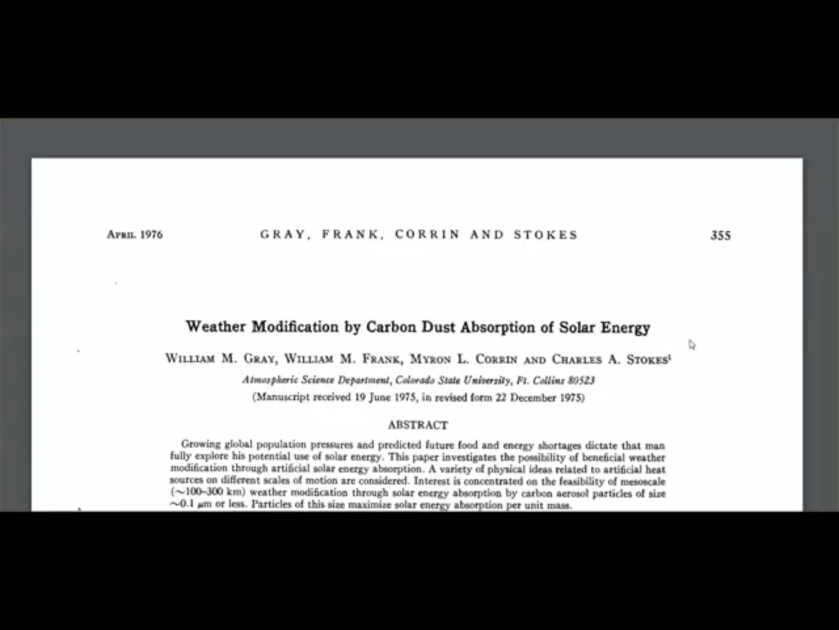
26 July 2026 | ZEROGeoengineering.com | Conflicts of interests due to U.S. Federal entanglements with foreign governments and foreign militaries make this funding particularly problematic. The following FY 2027 Army Research, Development, Test and Evaluation (RDT&E Program) budget plan through September 30, 2028, is $18,708,826,000.00. Funding “supports the Army’s collaboration in the Interagency Council for Advancing Meteorological Services (ICAMS), which was chartered in 2020 per the “Weather Research and Forecasting Innovation Act of 2017” (Public Law 115-25, April 18, 2017).”
Other research programs include: Unmanned Aerial Systems, applied research, research critical and unique to the Army and DoW (e.g., atmospheric modeling and meteorological technologies), open-air field experimentation, Air Platform Enabling University Applied Research, techniques, methods, and models for the characterization of ambient atmospheric and threat aerosols, aircraft systems, sensors, passive, persistent sensing technologies, novel micro-electromechanical system (MEMS) / aka “smart dust,” genomic research, High Power Microwave and Directed Energy weapons, Electronic Warfare Advanced Technology, 5G, Next G, antenna systems, Golden Dome, Global Navigation Satellite System (GNSS), Artificial Intelligence and Machine Learning (AI/ML) technologies, Radar Digital Twin (EXHILARAMA), classified programs, and many more areas of experimentation.
Department of War FY 2027 Budget Estimates ARMY – Zero Geoengineering

Those doing the grunt work have been at it for over a century, usually with no questions asked, all for a paycheck and a pension.

The governance channel has always been subservient to the financial channel, and we have never been a democracy. Can we call it good news that at least the masks have fallen?

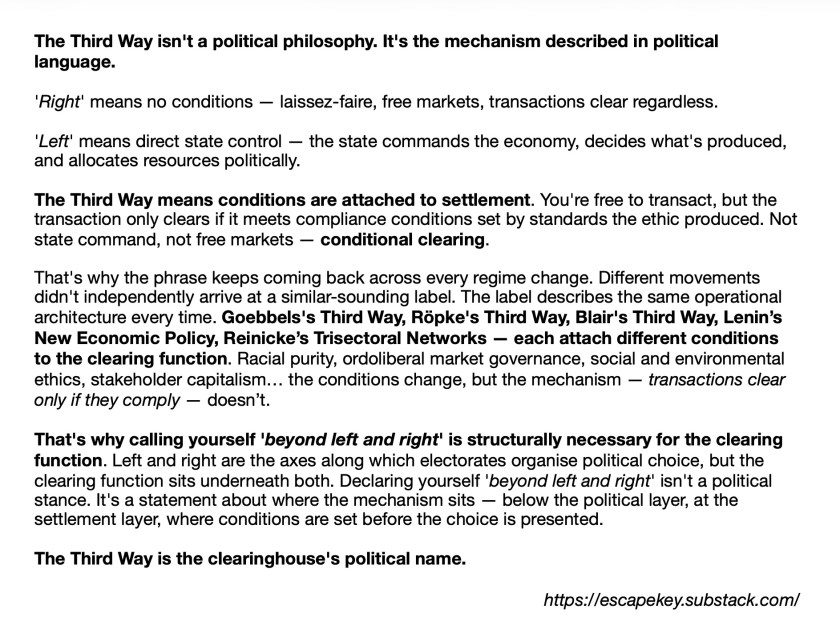
“The clearing architecture reached the post-war institutions through a different route as well, one that had been turning the logic of clearing from finance into governance since before the First World War.
In 1916, Leonard Woolf published International Government, a blueprint for permanent international bodies to manage trade, communications, health and labour standards through functional co-ordination above national governments. His key insight was that once essential functions became international, national governments would gradually lose their grip on the day-to-day running of economic and social life. He proposed that these organisations would work through ‘soft law’ — international recommendations that would steadily harden into binding obligations, because participation would eventually require compliance with international standards. It was clearing logic applied to governance rather than money: membership was voluntary on paper, but functionally impossible to avoid.”
https://open.substack.com/pub/escapekey/p/the-foundational-myth?r=87pg2k&utm_medium=ios

“Quinn Slobodian’s Globalists documents what Röpke and the Geneva School were building: supranational institutions designed to shield economic governance from national electorates, permanently. Their aim was deliberate and unapologetic. These economists believed that democratic populations would make economically foolish choices — protectionism, inflation, capital controls — so the solution was to place the rules governing economic life in institutions that electorates could not touch. Slobodian calls this ‘encasement’. He maps the walls but does not identify what they protect: the clearing function, operating through conditional settlement, safely beyond democratic revision.”

The public observes, but are ignorant as to what they are observing, as ignorance has become a weapon of war against us.

“The third is ignorance as active construct — the deliberate manufacture of doubt, uncertainty, and confusion by parties with an interest in keeping the public unclear. This is the tobacco strategy, the climate-denial strategy, the manufactured uncertainty of product-defense firms. It is ignorance as engineered achievement, and it is the type this volume most wants to make visible.”

The fourth, It is ignorance produced not by concealment but by exhaustion.
https://open.substack.com/pub/unbekoming/p/agnotology-the-making-and-unmaking?r=87pg2k&utm_medium=ios

Question (8): How large is the classified universe of documents, and how does its acquisition rate compare to the open literature held in libraries?
Answer: The classified universe is not a small strongbox in the corner of human learning. It is, on the best available estimates, five to ten times larger than the entire open literature held in the world’s great libraries. The Library of Congress holds roughly 7.5 billion pages across 120 million items. Estimates suggest that as many as a trillion pages may be classified in the United States alone — the equivalent of two hundred Libraries of Congress. In 2001, some 33 million classification actions were taken, adding roughly 330 million pages to the closed archive that year alone. By comparison, the entire Harvard library system, comprising over a hundred libraries, adds about 60 million pages of unclassified material per year. Five times as many pages enter the classified realm as enter the world’s great open depositories combined.
The people involved match the paper. Roughly four million Americans hold security clearances, against about 500,000 college professors in the country. The Information Security Oversight Office reported spending $5.5 billion in 2001 just to keep classified documents secure. The commonsense picture — that a modest domain of state secrets sits adjacent to a vast open commons — is inverted. The open literature is the modest information booth. The vast classified empire sits behind it, unseen, its contents unknowable by definition. This is not a marginal fact about modern knowledge. It is the shape of modern knowledge.”

The on-screen constant political theater and media circus has been so stupidly surreal and exhausting, not only to divide and distract, but also so the pubic welcomes their AI replacements. Anything will be better, right? ‘Voluntarily’ led from the frying pan into the fire by State-manufactured ignorance.

Try to focus on the pretty tiles, not the brick wall

Well, when it comes to our bathroom remodel, it’s definitely going to be a huge improvement and I’m SO excited to finally be seeing the finish work. Finally my hard-earned observation skills and esthetic sensibiities can be put to good use.

I do not have a parallel certainty for life under global techno-fascism, unfortunately.

The Psychology of AI

I made up a wee thought experiment for the automated answer system that passes for logic in our modern era.

I asked the machine a question with only a one word variable to learn what sort of mind-bending nonsense it would generate.

Here was my question: “Why are (XX) so exploitative?” For the ‘XX’ variable I inserted the following labels one at a time: Jews, Christians, Muslims, Bhuddists, Germans, Americans.

I wonder what the average reader might guess would be the results of such a series of inquiries? Would you expect a certain degree of objectivity? Of universality? I wonder also, would every individual in any location get the same string of answers?

I encourage everyone to give it a shot. In my case, as a U.S. citizen residing in Texas, in only one circumstance was I given an answer that completely ‘flipped the script.’

What do I mean by that? It uses a psychological weapons tactic referred to as DARVO–Deny, Accuse, Reverse Victim and Offender.

In abusive relationships this tactic is what keeps victims confused and trapped in their own demise, sometimes not even realizing they are in an abusive relationship. It is the tactic often used in cults and to create in victims the familiar Stockholm Syndrome.

In the public arena the tactic is the same, but the delivery is often more subtle and sophisticated. It can be very useful in spotting this type of manipulation in the public arena by studying it in interpersonal dynamics.

In the case of my wee AI psychology experiment we see the more subtle and sophisticated version playing out. Instead of direct ‘Denial’ we observe redirection. Instead of direct ‘Accusation’ we observe excuses, inferences, insinuations. And in the case of ‘Reverse Victim and Offender’ the person asking the question becomes the offender.

In only one case am I, as the one asking the question, inferred as being somehow hostile-adjacent for simply asking, and schooled about ‘hate speech’ and Antisemitism.

“The history of antisemitism, defined as hostile actions or discrimination against Jews as a religious or ethnic group, goes back many centuries, being called “the longest hatred”. Jerome Chanes identifies six stages in the historical development of antisemitism: 1. Pre-Christian anti-Judaism in Ancient Greece and Rome that was primarily ethnic in nature 2. Christian antisemitism in antiquity and the Middle Ages that was religious in nature and has extended into modern times 3 Continued in Wikipedia”

Every link after that for two pages seeks to teach me about the ancient and on-going plight of a tiny group of people.

Other ‘XX’ inputs have a broader range of links, but each comes with its own bias and redirection. In the case of Americans I’m redirected toward considering the class struggle against the poor. In the case of Muslims I’m informed of their inherent violence. In the case of Christians I’m given many links of Bible verses demonizing exploitation, and in fact the only search results that stay on point, that is, address exploitation directly and at length, including the meaning of the word.

In the case of Bhuddists as well, I’m again redirected toward ‘violence’. But I did not ask AI about violence in my query at all, the word choice was ‘exploitative’ and in the case of Jews the only violence inferred is against them. In reference to Germans I’m redirected to ‘Stereotypes of Germans’ wiki page where nothing about exploitation is mentioned. NAZIS get a tiny blurb, that was a bit unexpected, I expected much more.

In any case, what does this mean? What’s my point exactly?
It’s probably not news. Most folks know by now we are pawns in an information war that uses psychological operations against the public as a driving tactic of sociopolitical manipulation.

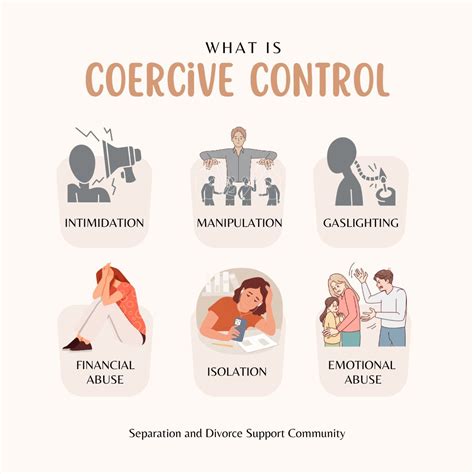
It’s ALL about Coercive Control.
“Abusive power and control is behavior used by an abusive person to gain and/or maintain control over another person. Abusers may utilize tactics such as devaluation or psychological projection, and may seek personal gain, personal gratification, and the enjoyment of exercising power and control. The victims of this behavior are often subject to psychological, physical, sexual, or financial abuse.”

What many may not yet know is that there are many strategies we can use as individuals to protect ourselves. Learning about manipulation in abusive relationships is just about the easiest solution, because this information is ubiquitous online and easy to witness and relate, as most of us have experienced coercive control tactics directly or indirectly at some point in our lives.

More difficult is applying this on a broader scale, but examples like this wee thought experiment help to demonstrate it.

The most difficult is understanding HOW this is happening on a global scale–how the entire globe has fallen prey to manipulation and abuse by the SYSTEM ITSELF and BY DESIGN.

“Today, if you have money, you can buy what you like. Assuming you use a credit card your balance is checked and the money withdrawn.
By 2029, the terminal checks a second balance — carbon, social, compliance — before the transaction clears. Fail the check, payment denied. It’s a permission system.
We covered the EU implementation in How Europe is Building a Carbon Currency — Digital Product Passports, Digital ID Wallets, and the Digital Euro. But Europe is just one implementation. The architecture is global.”
https://open.substack.com/pub/escapekey/p/conditional-existence?r=87pg2k&utm_medium=ios

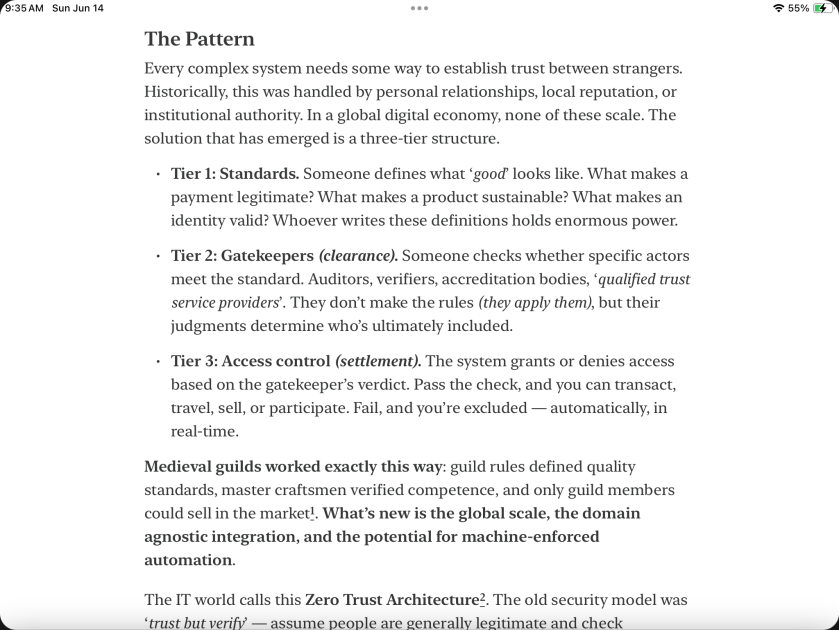
Every major domain of global governance — finance, identity, health, trade, climate, and artificial intelligence — is converging on the same architecture.
And that architecture is perfect for automated governance at planetary scale.
https://open.substack.com/pub/escapekey/p/a-pattern-hidden-in-plain-sight?r=87pg2k&utm_medium=ios

The architecture escapekey identifies and explains is essential reading for anyone who wishes to grasp the big picture. But it’s not essential to understand the overarching effects of coercive control or how to minimize its impact on your personal life.

Recognizing it and eliminating it from your acceptable relationship criteria is the real escape key. What becomes intolerable to the individual will determine what becomes intolerable in the public sphere.

Choose your relations wisely and with utmost discernment and stoicism and you will know positive change in your lifetime. That is the next generation’s only hope to avoid their open-air prison.

It’s the Mindset, Stupid

I nearly made the same mistake with the Chinaberry tree as I did a decade ago with the Mimosa tree.

I must make even greater efforts to De-institutionalize my mind.

It’s like with the official Farmer’s Market, in the small city 40 minutes away, which grows along with the city, but doesn’t get any better, because there aren’t enough farmers and there are too many regulations.

A treasure from a local plant swap now starting to bloom, Plumeria, how exciting!
how it will hopefully look one day! It’s the tropical delight used for making leys in Hawaii, with a delightful fragrance.

Meanwhile the very localized, small, rural events have been well worth the time. At one we got several new plants I’m still excited about.

Catalpa tree is another I’ve been longing to grow, but only found available through a local swap.

Catalpa blossoms, the ‘worm tree’ as it’s called in these parts I’ve just learned from a local angler

And at another we ate better tacos than we’ve had in years. And at the last one I gave away lots of cheese, because I’m still too apprehensive about selling or even bartering it. Giving it away to strangers felt a baby step closer to that potential future possibility.

So it goes with the Chinaberry, too. At least this time I didn’t waste an entire decade believing the official nonsense that these trees are invasive and toxic and in the case of Chinaberry, even illegal.

But I did still waste almost a year, and that’s why I’m complaining now.

I’m disappointed with myself. I thought I knew better by now. But damn if old habits don’t die hard.

It’s not the same story exactly, but it sure does rhyme, and the refrain harkens back to a very common problem, not just my own.

I still did not trust my instincts, wisdom and preferences quickly enough.

Put into perspective, and relatively speaking, I have come a long way. I’m much better than I used to be and considering I know folks who still think vaccines are safe and effective, I could afford to be a bit more self-forgiving.

But I’m not getting any younger and time’s a wastin’! Trees don’t grow overnight, you know!

My little Chinaberry foraged/stolen from the abandoned lot where I first fell in love with it.

Instead of spending that year trying to identify the tree and wasting lots of precious time, I should’ve said at first sight–I love it, I want it, I will have it.

There is something magnificent about that speckled mahogany bark, those tropical-looking yellow berries, the glossy deep green foliage surviving even in drought in the dead of summer, that sleak curve of the trunk and the little grove it’s trying to form. I must have it. Pure instinct.

Instead of trying to germinate the berries, which is so much more challenging with many trees, I’d have taken cuttings right away. Instead of going to official sources, online and through various experts and professionals, I’d have gone to the most local source I could find, folks living in these parts for many generations.

I was given wrong identifications online, and from our university extension service that is the Master Gardeners, the usual Corporate-State fear propaganda of ‘invasive’ and ‘toxic’ and unsafe.

Because if they don’t sell it at Walmart or Lowes, it’s got to be bad. Because if it’s an ancient medicinal, it’s got to be poison.

They think they mean well, I suppose, sometimes.

But othertimes I think nope, not at all. They don’t mean to do well at all, they mean to stay compliant with the authorities. They mean to collect their paychecks and their pensions. They mean to think themselves well-meaning without ever examining themselves.

When we first came here and first becoming gardeners and stewards of this land, I vowed beyond our veggies I’d grow only ‘native species’. I didn’t know any better and that sounded to me like an admirable approach to a new venture.

I now think the term ‘native’ is itself highly suspect and what’s considered ‘invasive’ is highly relative and shifts with the breeze of the current oligarchy.

I will be satisfied when my intuition (I want that tree!) trumps my logic (what’s it called?) at the speed of the mind of a 3-year old.

It really is about the mindset, but not in the relentless Positivity sense of ‘everything is possible’ of the pop psychologists paid to entrain us to the status quo, but rather in the learn to Trust Yourself First mindset. Even in baby steps, even prolonged over decades, even against the tides more often than not.

No, not everybody, but enough to make it miserable for the few malcontents who just want to be left in peace and who care for truth and beauty over comfort, convenience, or malignant and uniformed collaboration.

Next post, all about the splendid, but illegal in Texas, Chinaberry tree.

Illegal beauty

Confessions of a Silicon Valley Dimwit

“Social justice and climate change, it gets progressive women 100% of the time.”

https://substack.com/@revealedeye/note/c-246898546?r=87pg2k&utm_medium=ios&utm_source=notes-share-action

And now they’re finally realizing climate change is the red herring of geoengineering. Finally. Finally, too late? Any mention of those of us screaming this for the last decade plus? Any apology forthcoming? Any change of heart or personal accountability? You decide, does she look ashamed as she giggles, talks in an ultra-feminine child voice and repeats ‘um’ over and over? Do you see remorse on her face as she confesses? I sure don’t!

“This is just mediocre banter about the lives of tech wives.” says one commenter who is spot on.

Soon it will be a new TV series I expect!

Real Housewives of Silicon Valley

Oh wait, that’s already a show. She’s probably on an audition!

What’s Been Lost III

When I first started watching alternative history Youtube channels I was skeptical, and I still am. I want the truth, not more redirection. Not more fantasy. Not more illusion. Not more heavily curated or mediocre nonsense.

So far, I don’t sense I’ve found it, but I’ve become ok with never finding it. I’ve resigned myself to what’s as close to the truth as I’ll be able to manage to get to in this lifetime, which is: I’ll never know the truth, but I may be able to manage truth-adjacent with enough study and discernment. I can confidently opt-out of the lie, permanently. That’s a big improvement to the path of blind acceptance I was, and most are, still on.

The first step toward truth was achieved pretty easily, it began with calling bluffs. As long as I don’t allow it to frustrate me, which isn’t exactly easy, this alone feels pretty empowering. For me, as usual, I had to experience it directly, no Youtube influencers, no professors, no self-styled experts can convince me, not without applying my own eyes and ears and reason.

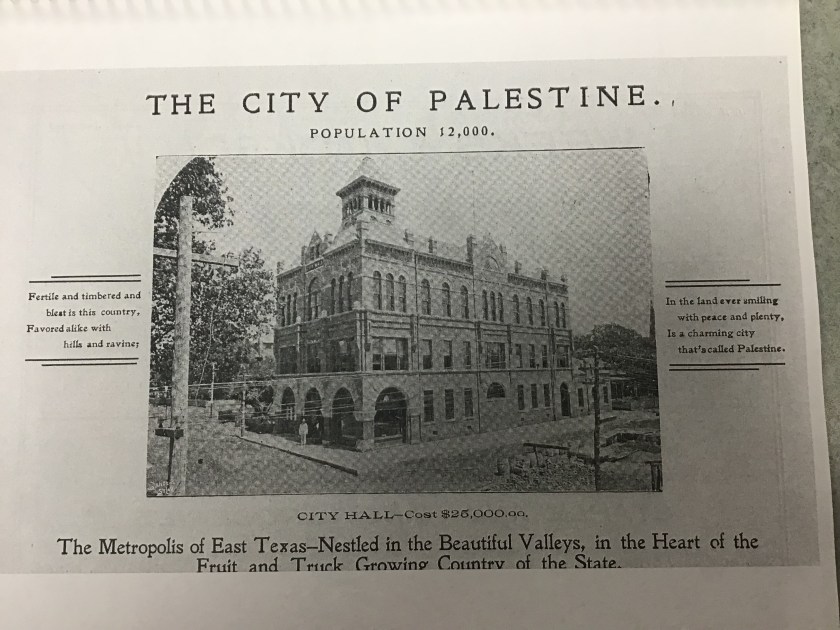
I looked to the architecture because that’s what’s visible, and only then to the official history, because that’s what’s accepted as truth. I started in my own neighborhood, that is, the small city closest to us, called Palestine. It’s actually easier I think to consider the small city, rather than the large ones, because there’s been less tampering more likely, more holes in the narratives that can be more easily noticed by the novice.

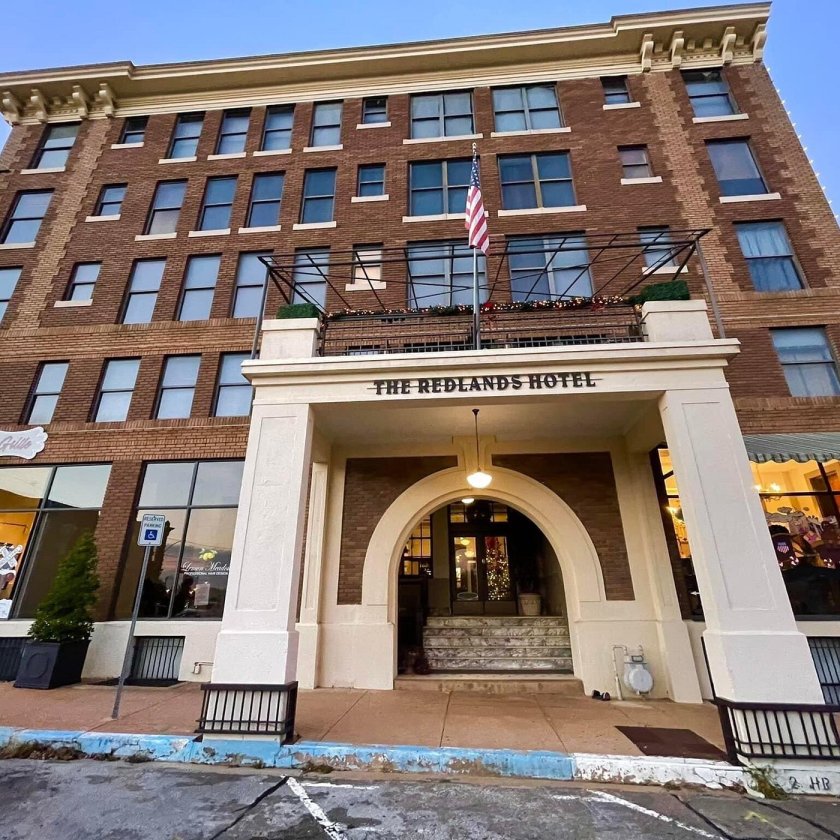
The well-maintained Redlands Hotel today.

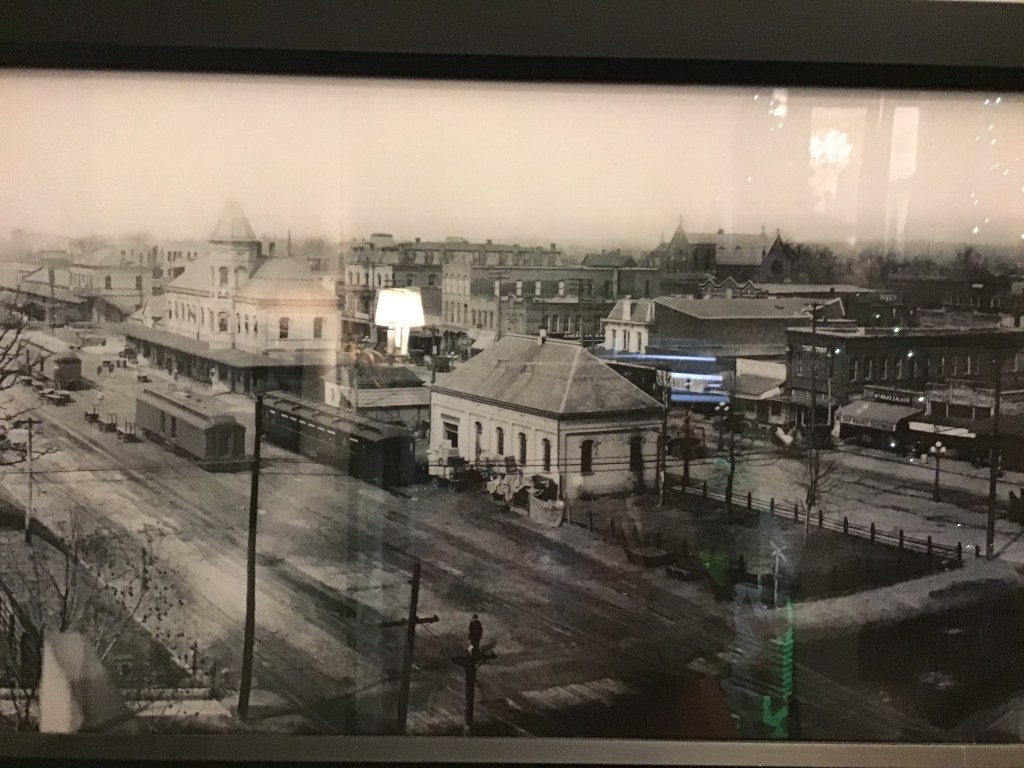
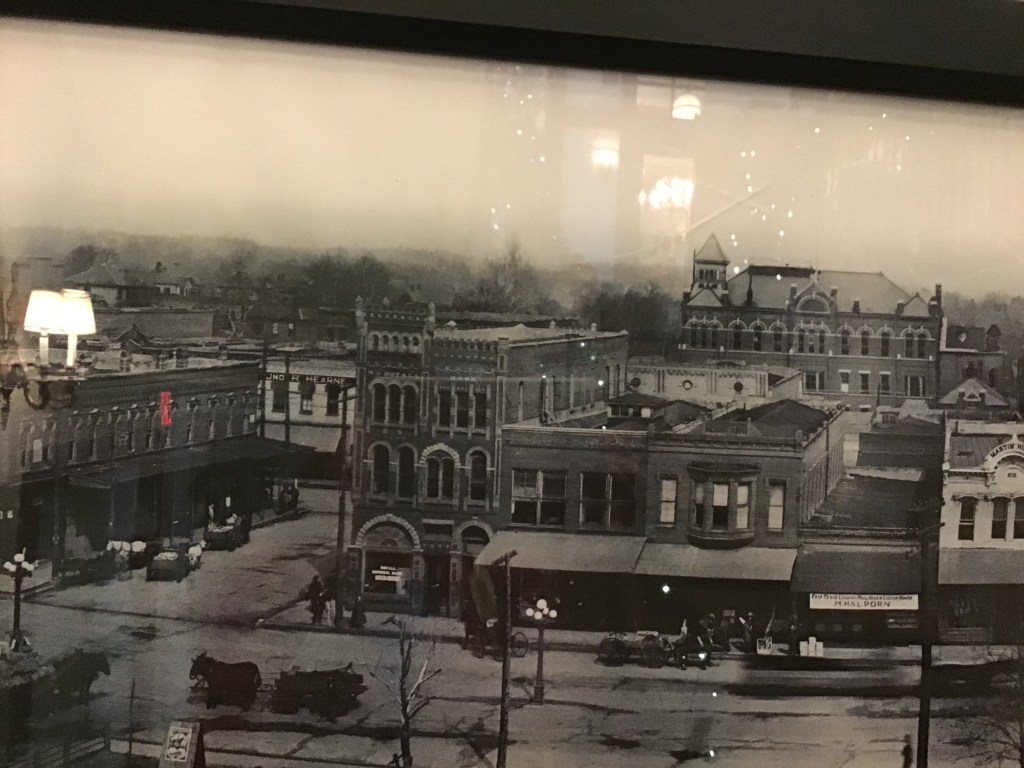
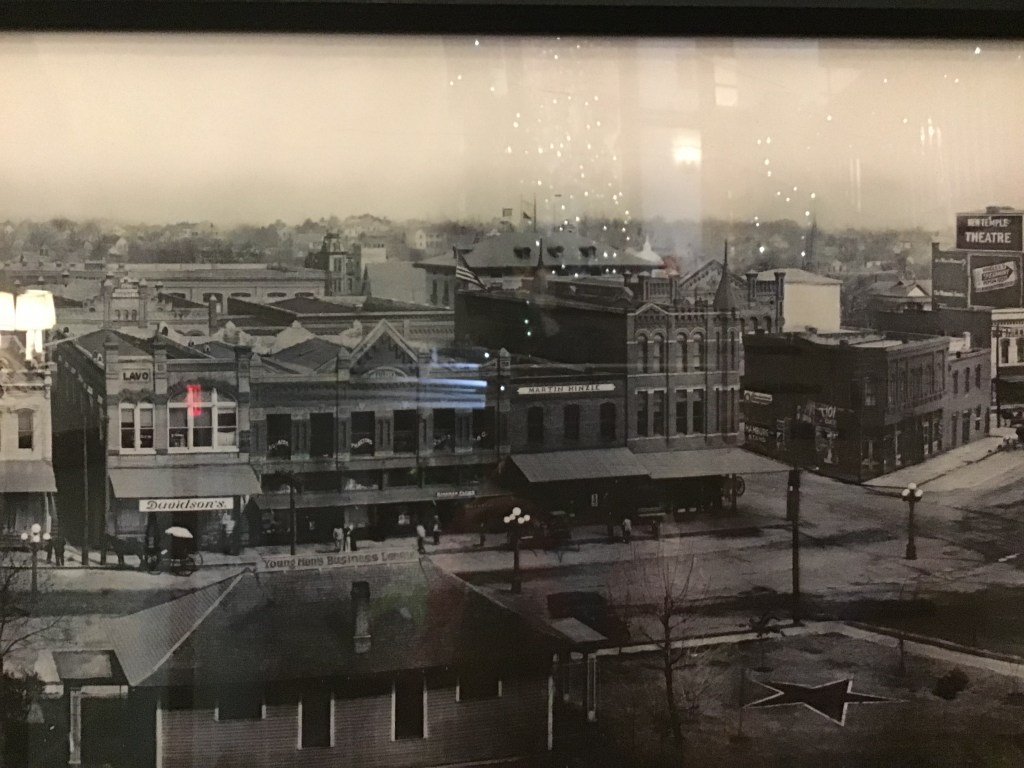
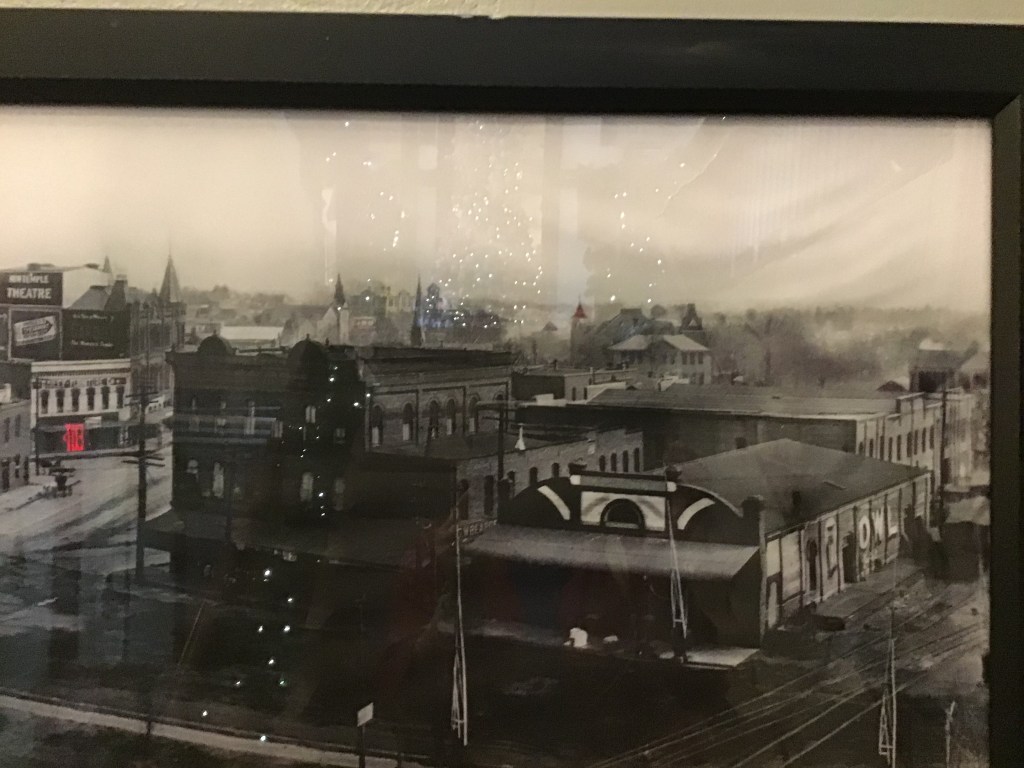
Like, the story of the popular Redlands Hotel, where I sometimes go for lunch on my rare trips to town. It’s a lovely old building that they’ve done a relatively decent job of keeping up, especially considering the condition of the vast majority of the downtown area.

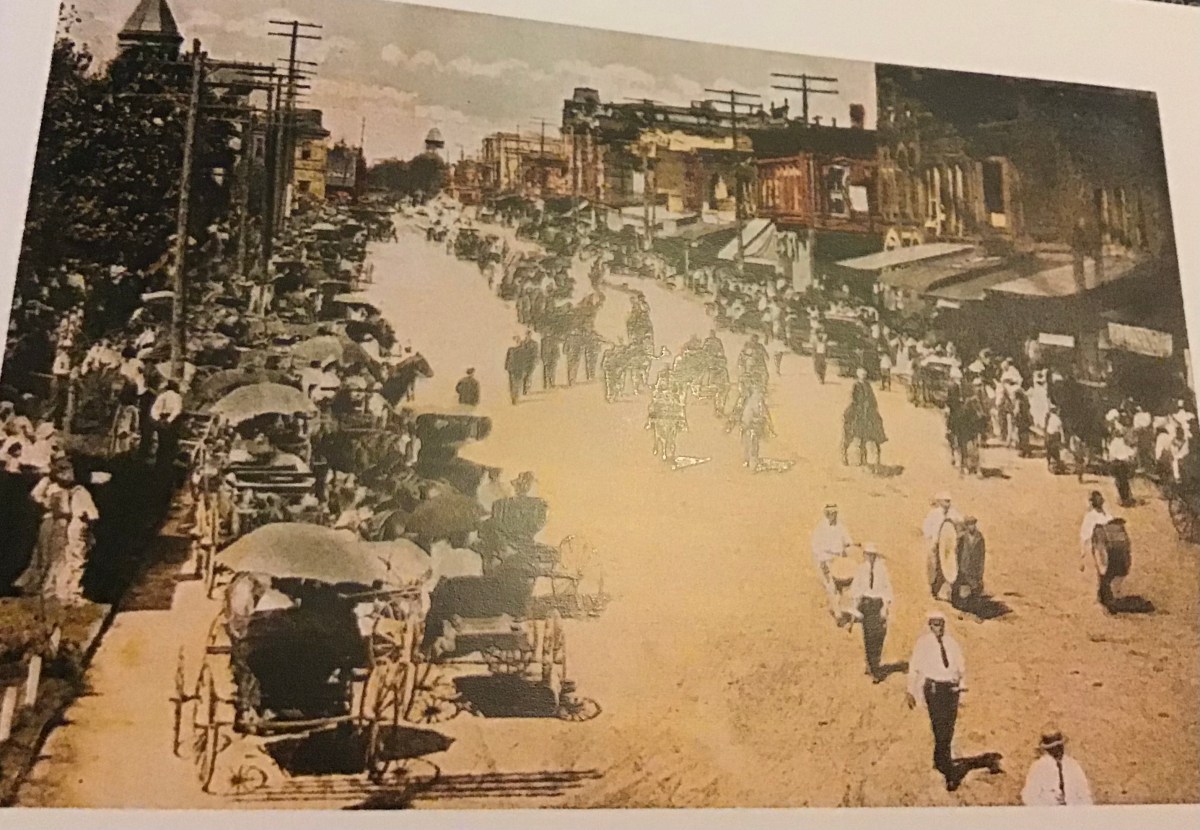
Interestingly, they have a panaramic photo of the early years of the city on display.  As you follow the railroad tracks from left to right in the photo, you end up at graffitti painted on the side of a building.  That is, the word OWL.

That’s my cue to start calling bluffs.

The owners of this hotel are deep into the official history, which is superficially helpful. As it goes, in 1914 when stockholders rushed to build the brown brick building, it was oxen that delivered the sand for the concrete. That is, sand from the Trinity River, 30 miles away. Are you kidding me?! That’s a pretty big bluff.

And even with that serious transport challenge, on supposed dirt roads, they managed to complete the five story building in a year.  Apparently dirt roads weren’t effected back then by rain or snow, neither were the human builders, or the oxen.  Amazing.

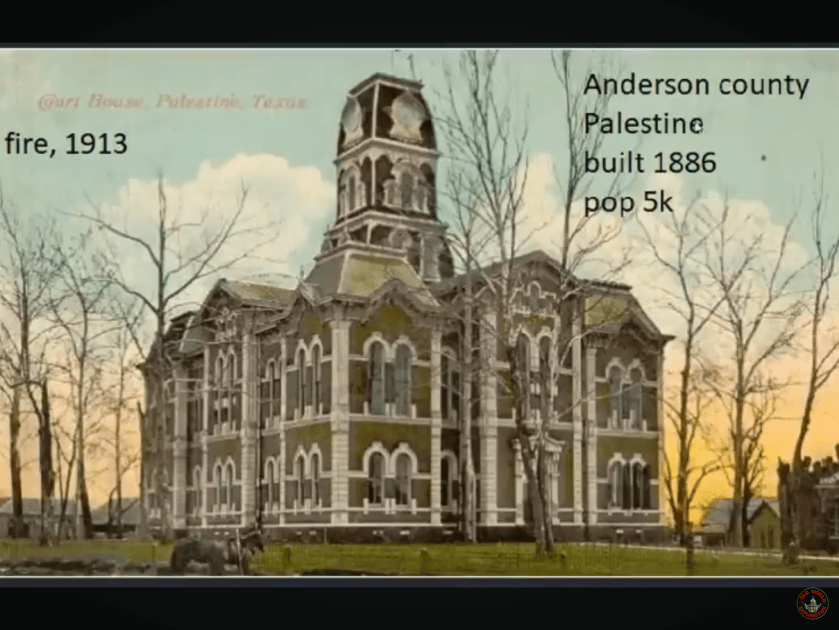
Even more amazing was that another striking building was going up on the other side of town, that is, the County Court House. The two structures apparently shared Italian artisans who installed hexagon tile to both buildings.

The original burned court house, depending on which source cited. Another source states the original courthouse was a small building made of wood.

“Considered one of the most modern constructions of its era, and built to withstand the challenges of time, its walls are made of concrete, masonry blocks, sheetrock, and metal studs—evident in the structure today.”

My those were some busy boys and oxen!

In fact, with just a bit of digging, we learn there was in fact another town at the Trinity River junction where the cherished sand came from, now missing from both the land and the history books. But, there remains one hand-drawn map available in the archives, Magnolia was the town’s name, and it was apparently so bustling with commerce and activity according to one source that they called it the ‘St. Louis of the South”.

One of the many demolished structures of the non-existent town once called Magnolia, according to the official history.

“Magnolia was established in the early 1840s as a Trinity River cotton port and was named for a large magnolia tree in the center of the townsite. Magnolia had a post office from 1851 to 1871. William A. Haygood was one of the principal property owners in the community and operated cotton gins, a hotel, a livery stable, a general store, a blacksmith shop, and a local ferry. Among other businesses in the community were a drugstore and John McClannahan and son’s warehouse. Magnolia was reported to have a population of 800 at its peak around 1863, when the town had thirty-three blocks of residences and businesses. Most shipments from the port went to Galveston, but on May 5, 1868, a steamboat traveled up the Trinity to Dallas. After it was bypassed by the International and Great Northern Railroad in the 1870s, Magnolia declined rapidly. By the 1930s it was no longer shown on the county highway map, though its name was preserved in that of the two schools that stood on the site of the former town. In 1932 the Magnolia school for whites had an enrollment of forty-three and the Magnolia school for blacks, thirty-four. A 1982 map showed only the Magnolia Cemetery at the townsite.”
Magnolia, Texas

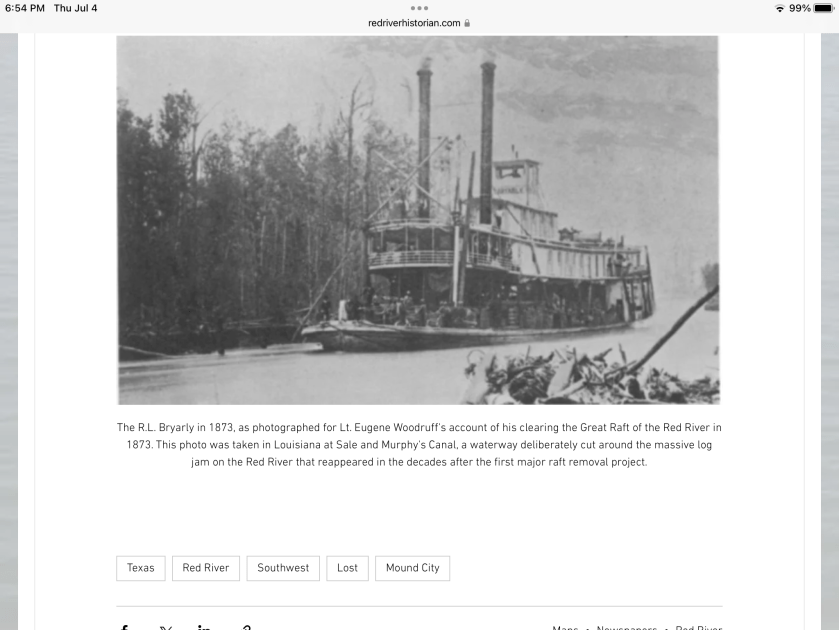
This is the sort of vessel which would have been traveling the Trinity River through Magnolia.

Nothing remains of this supposed river hub besides the hand-drawn map of the area where it was supposed to have been, where is now located some simple family houses, an intersection and the cemetery. I couldn’t even locate the river, or the supposed subsequent railroad.

Several other beautiful structures were also said to have been destroyed in this small city of Palestine not long after they were constructed.

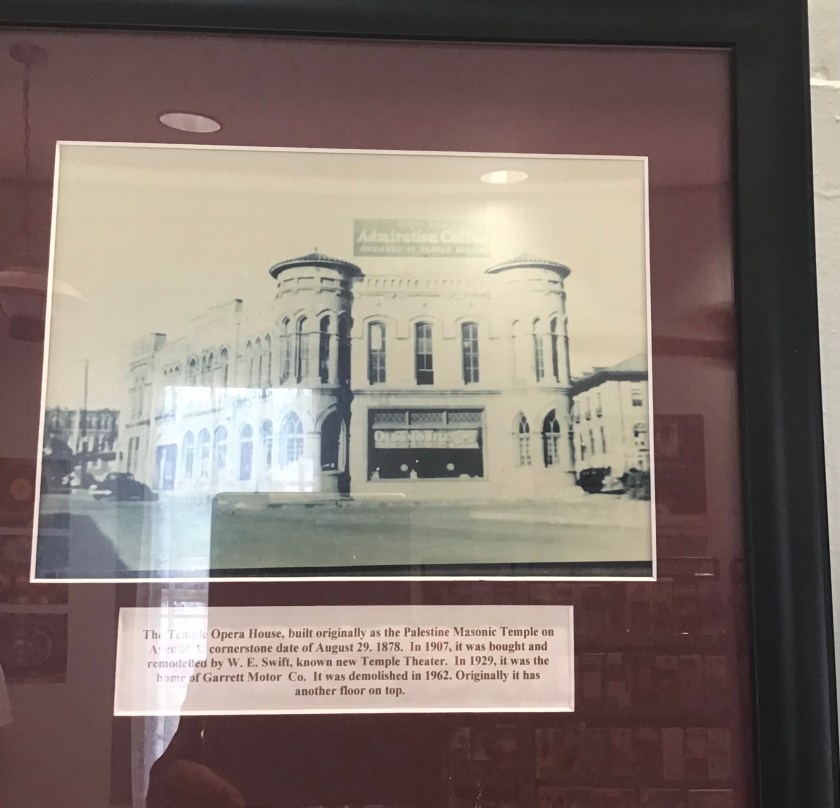
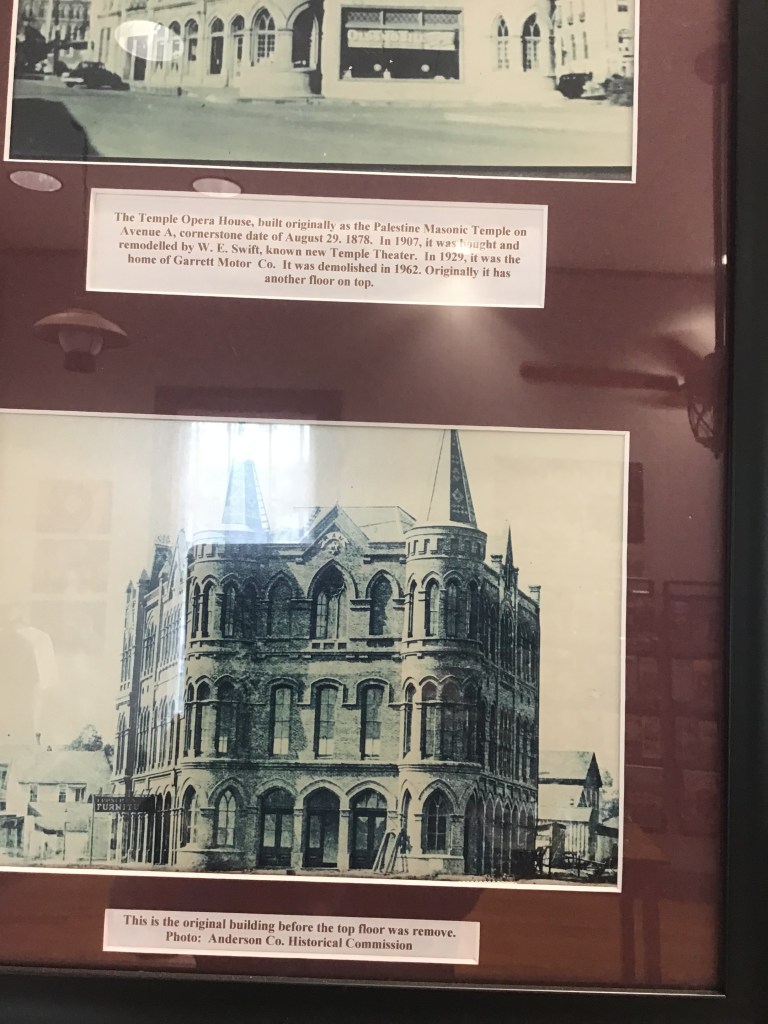
The Temple Opera House was built originally as the Palestine Masonic Temple with the cornerstone date of August 29, 1878. In 1907, it was bought and remodeled by W.E. Swift and known as the New Temple Theater. In 1929, it was the home of Garrett Motor Company, Palestine’s first Ford Motor Car Agency. It was demolished in 1962. It originally had another floor on top, but this was removed at some point.

At some point? Not even the official historians can tell us more specifically.

Exquisite building of multi-functions which didn’t have enough value to the small city to remain for a full century. The small box building housing a liquor store in that location now is so much better, I’m sure.

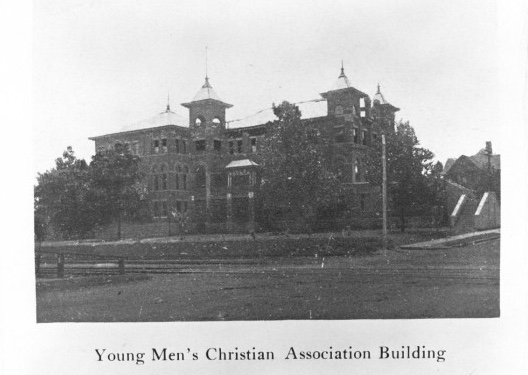
The “Railroad YMCA Building” was another one.

The Railroad YMCA opened in April of 1903 and continued as the YMCA until the building burned in the mid 1950’s. Interestingly, there seems to be no recorded photos available of this horrid fire event of a huge BRICK building. Nothing to see here! (In fact, I believe this to be another building altogether, more on that in a future post.)

As I searched the stacks of the local history at the library I was surprised to find several ‘fake books’ — that is supposed local history written by a source who cannot be located and is listed in the local phone book with phone numbers that don’t work and at addresses which never existed.  Three different phone books, three different addresses, I actually went to all of them personally.  Nothing.  The books appear to be written by AI!  I brought this to the attention of the library board, and no one cared.  At all.  I never heard back, though I went personally to the board meeting with evidence in hand.  They didn’t even care to know which books it was with these obvious falsities, possibly written by an unaccountable AI, and sitting in their stacks posing as actual local history written by a fake person.

And now I feel frustration setting in, so enough for now, to be continued . . .

Surveillance Capitalism Comes With a Side of Atmospheric Tampering

“Papers, please!” was a running joke among Western expats living in Eastern Europe. I wonder how many of them now carry a permanent spying device with great pleasure or perhaps even cheerfully signed on to the digital passport program, first in line, buying into the ploys of safety and convenience.

The Globe was supposed to move in the other direction entirely! We won the Cold War, supposedly, in order to NOT be treated like the perpetual citizen-criminals of Kafka’s stories.

Eastern Europe in 1989 was a surreal place for a young university sophmore voyaging long distances by train alone for the first time. It was at once charming and derelict, welcoming and suspicious, familiar and mysterious.

On the one hand I never felt physically threatened, not even as flaneuse on the city streets at night. On the other hand the decrepid state of the infrastructure whispered danger somehow, because neglect itself is a dark force.

On the one hand the relative poverty was palpable, though my midwest suburban upbringing was middle class, great food variety and consumer goods were far more available. On the other hand their resourcefullness has had a lifelong impact on me and was my first critical look at the innate and corrupting consumerism of my little world.

I didn’t speak the languages and there were very few English speakers. I got by, barely, with French, rudimentary German and smiling, mostly. Americans were considered automatically suspect, so some travelers would claim to be Canadian at any venue not requiring their passports.

Already on the issue of passports I was laughingly naive.

A variety of stamp collecting, or paving the way for the Global digital gulag? It was an especially exciting moment in the expats life when your passport got so full of stamps you had to go pronto to the nearest embassy to get new blank pages stapled into the back of the official document.

Interestingly, while Americans were considered automatically suspect, there was still a sort of cult following that adored America and those who were positively thrilled to meet one, and I made it a point of meeting those unique sorts.

I went on to be a Peace Corps volunteer there a few years later precisely because of my immediate attraction to this region. I felt compelled to know it better and the fact I had the opportunity to spend three more years there, mostly in Czech Republic, but traveling the region extensively, was in fulfillment of my deepest desires and longings at that time.

For all that I loved it, there I also felt my greatest repulsions.

The dystopian Kafkaesque bureaucrocy I experienced was not just fiction. The general acceptance of the populace, while not exactly Stolkholm Sydrome toward their Soviet occupiers, was still a quiet resignation which struck me as particularly pathetic considering their far more astute knowledge of history.

My old passports are the best symbol with which I can try to express my current level of despair seeing my greatest repulsions come to fruition all around me, even as we ‘the Capitalist West’ were the supposed winners of the Cold War.

What did we win? A military industrial complex acting against the best interests of its people. A Corporatocracy run by corrupt public-private partnerships which pretends not to be a fascistic system. Progress that is defined entirely by blind acceptance of anything stamped with the Technocrat seal of approval. Endless paving over of the countryside for roads and minimalls and condos and tourist traps in the ugliest construction ever known to ‘civilized’ man.

Civilization itself has morphed into something totally uncivil, hideous and expanding entirely out of control.

I, like many other intrepid travelers, thought of the passport merely as the modern equivalent of the old travel trunks stamped fashionably with destinations. We thought of them as a collection of strange signs and symbols we’d forever associate with our new memories of far-off places. They were the paper images of our wanderlust we planned to show one day to the grandkids, not knowing they would be holding a digital scrolling device we’d rarely be able to pry from their clutches.

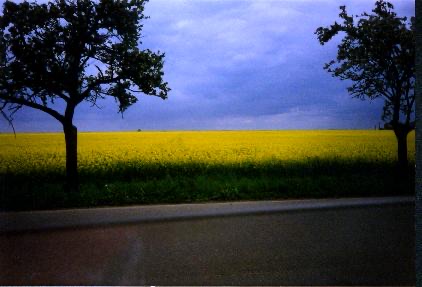
Just a decade ago this was all ranch land

“Once traditional farming systems have been destabilised by the debt-trap of subsidised loans, structural adjustment policies, corporate input regimes, global supply chains, patented seeds and monocultural production, mass migration to cities becomes an inevitability engineered from above. The city thus absorbs the displaced because the countryside has been systematically stripped of opportunities or carved up for infrastructure or real estate schemes.”

What if we’d been given the actual choice, not the strategically invented one, between our current paradigm of progress as a global militarized surveillance state and the ‘stagnation’ where the Eastern Bloc resided for half a century?

This, or this?
Electric prison bars or progress?

Do folks really think WHEN this whole shitshow goes tits-up there will be government funding for the clean-up and restoration of this once beautiful land?

That I don’t want this EVER, for ANYONE makes me some kind of bitter-clinger communist?

“ALA’s annual State of the Air report found that 156.1 million people—46 percent of the population—now live in counties with failing grades for ozone or particle pollution, nearly 25 million higher than last year. Previously less-affected areas, such as Minneapolis, saw significant spikes in unhealthy air days tied to climate-exacerbated wildfires and particle pollution, such as dust.”

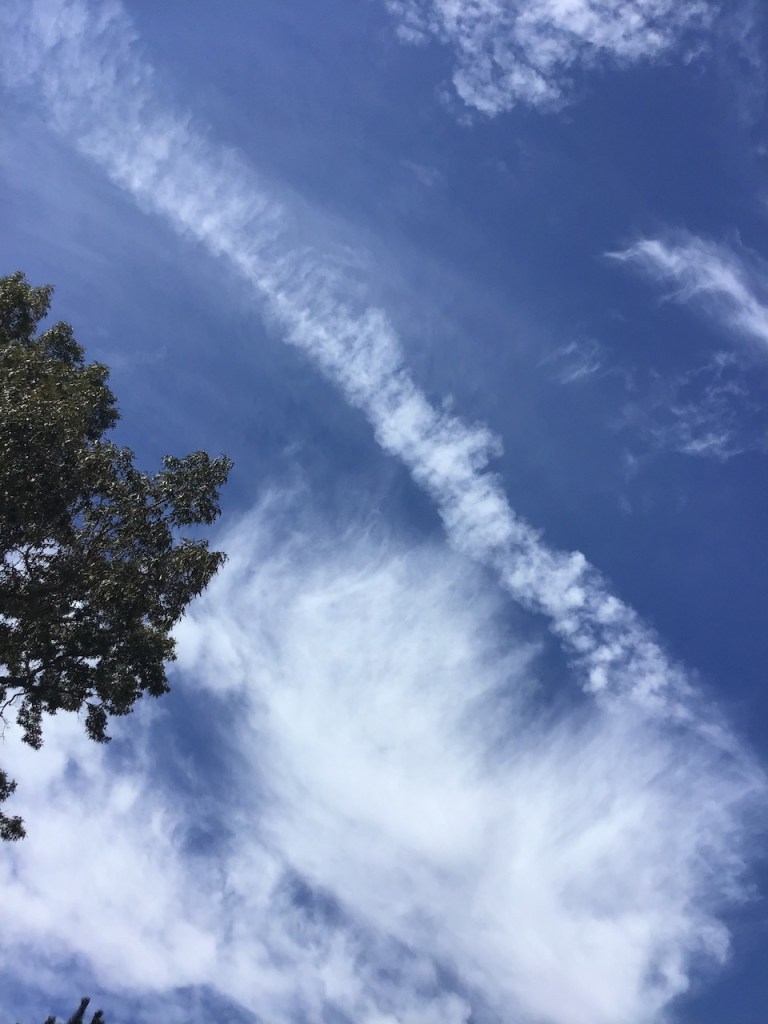
Universities funded by public-private partnerships clandestinely tamper with our atmosphere using euphemistically-named scientific jargon like ‘Plume dispersions’ as if this is not mass poisoning?

A fairy tale of citizen safety in the form of acoustic weapons for
city-wide crisis alerts?

https://newbraunfels.gov/m/newsflash/Home/Detail/3762

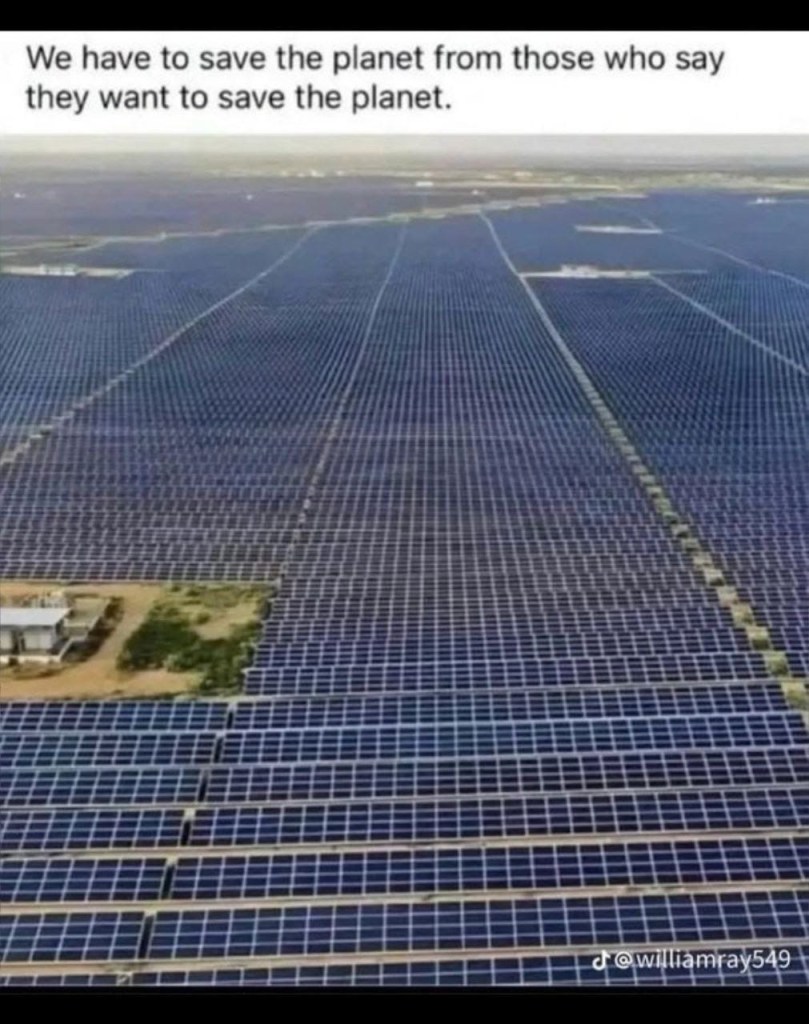
A hellscape of ‘progress’ in the form of the most ugly, extractive and intrusive landscapes imaginable?

How did ‘WE’ win in this global game that began long before I was born?

What kind of twisted minds call this progress? We have 70 years of documented atmospheric tampering while officialdom continues in denying its impact, which is now going into overdrive while the voices of the livid citizenry, especially those losing their livliehoods in the rural regions, get squashed. Same as it always was.

“Similarly, Gerard Winstanley, writing in the 17th century, envisioned a society in which land and labour were shared as a common good, not commodities to be exploited. His insistence on communal responsibility and ecological justice underscores the radical, enduring potential of agrarian ethics against the logic of extraction and profit.

In this light, the critique of urban-centric development becomes more than an economic critique. It represents a challenge to the very definition of progress. The rejection of the celebratory narrative of neoliberal modernity is a philosophical insistence that a society cannot be judged by its technological prowess while its ecological foundations crumble and its people are alienated from the sources of life.

The modern city, therefore, becomes a battleground where two visions of civilisation confront one another: the dominant model of corporate-led, centrally managed growth and the fragile but persistent ethic of stewardship, locality and shared responsibility. As made clear in my new open access book, The Agrarian Imagination: Development and the Art of the Impossible (available here), genuine human development cannot be measured by urban skylines or GDP figures but by the survival of relationships between people, land and community that give meaning to life.”

https://figshare.com/articles/book/The_Agrarian_Imagination_Development_and_the_Art_of_the_Impossible/30589238?file=59624783

Beneath the Concrete, the Soil Still Whispers – OffGuardian

Texas Weather Modification Report–1964 – Zero Geoengineering

Geoengineering Update

Just a couple of vids to share today. I have not (yet) done any sort of deep dive on the Hill Country flooding. I have heard some of the speculation and I’m sure readers could guess my opinion to any question of whether this was a ‘natural’ disaster.

I was confused by this first video showing how quickly the flooding happened in an area that was getting no rain at the time. It looks like something from an amusement park. But, I did hear they opened certain dams in some areas to divert the intense water flow, so maybe that could help explain it. I’m going to look into this part of the operation in future.

What’s far easier to see is the current government propaganda drive, and it’s thick and multi-layered. We’ve got promises of disclosure coming from stooges and patsies being played as blame gets shifted and terminology gets altered.

We will not be led into their narrative spin cycle. That’s why I’ve included the 2nd video. The Spinners want the public blaming small, local cloud-seeding operations, not the global military operations.

NOLAButterfly is the researcher of the 2nd video and has been active for a very long time. Notice how few views she gets, how little exposure. I’ve seen her kicked off multiple channels over the years and get in heated arguments with top researchers like Jim Lee, who definitely looks to me like he’s joined the dark side.

I cannot say if her theories are correct. I can say her silencing speaks volumes to me. From what I’ve experienced and seen myself, I believe she has some very plausible ideas backed by research. She explains clearly in the vid what she sees happening and it’s worth a listen.

Click on the link for the 2nd video, because the embed doesn’t work properly with Rumble videos.

NOLAButterfly Texas Hill Country flooding, radar explanationhttps://rumble.com/v6vzs4m-radar-analysis-leading-up-to-the-texas-flood-massacre.html

Stress Test USA: Failed!

I can relate, I fail them all the time. But that’s not this post.

Here we have two excellent essays that make me think, if this is the new level of social programming, I finally might abide!

Can they teach this in the schools? I might even go back to teaching! (Ok, let’s not exaggerate. We prefer our wee homestead life, even through the weather disasters, great many failures and physical pain.)

I’ve selected my favorite bits, there’s much more to appreciate on each of these Substacks, just follow the links.

The Coward’s Bargain: How We Taught a Generation To Live In Fear by Josh Stylman

“This wasn’t an accident or an overreaction. This was a stress test of how quickly a free society could be transformed into something unrecognizable, and we failed spectacularly. Anyone who actually followed the science understood the only pandemic was one of cowardice. Worse, most people didn’t even notice we were being tested. They thought they were just “following the science”—never mind that the data kept changing to match the politics, or that questioning anything had somehow become heretical.
The beautiful thing about this system is that it’s self-sustaining. Once you’ve participated in the mob mentality, once you’ve policed your neighbors and canceled your friends and stayed silent when you should have spoken up, you become invested in maintaining the fiction that you were right all along. Admitting you were wrong isn’t just embarrassing—it’s an admission that you participated in something monstrous. So instead, you double down. You disappear when confronted with inconvenient facts.

Raising Prisoners
And this brings us back to the children. They’re watching all of this. But more than that—they’re growing up inside this surveillance infrastructure from birth. The Stasi’s victims at least had some years of normal psychological development before the surveillance state kicked in. These kids never get that. They’re born into a world where every thought might be public, every mistake permanent, every unpopular opinion potentially life-destroying.
The psychological impact is devastating. Research shows that children who grow up under constant surveillance—even well-meaning parental surveillance—show higher rates of anxiety, depression, and what psychologists call “learned helplessness.” They never develop internal locus of control because they never get to make real choices with real consequences. But this goes far deeper than helicopter parenting.
The ability to hold unpopular opinions, to think through problems independently, to risk being wrong—these aren’t just nice-to-haves. They’re core to psychological maturity. When you eliminate those possibilities, you don’t just get more compliant people; you get people who literally can’t think for themselves anymore. They outsource their judgment to the crowd because they never developed their own.”

The COVID Conformity Test
This is how totalitarian thinking takes root—not through jackbooted thugs, but through a million small acts of self-censorship. When a venture capitalist whispers his concerns about immigration policy like he’s confessing to a thought crime. When successful professionals agree with dissenting views privately but would never defend them publicly. When speaking obvious truths becomes an act of courage rather than basic citizenship.
Orwell understood this perfectly. In 1984, the Party’s greatest achievement wasn’t forcing people to say things they didn’t believe—it was making them afraid to believe things they weren’t supposed to say. “The Party seeks power entirely for its own sake,” O’Brien explains to Winston. “We are not interested in the good of others; we are interested solely in power.” But the real genius was making citizens complicit in their own oppression, turning everyone into both prisoner and guard.”

Neutralization: How Bureaucracies Silence Dissent Through Legal Fuses and Narrative Control by Luc Lelievre

Institutional power rarely reveals its full mechanics in one stroke. Instead, it unfolds in sequences—calculated, procedural, and often cloaked in the language of neutrality. Neutralization, the fourth installment in Luc Lelièvre’s Unbekoming series, dissects this final movement in the choreography of bureaucratic suppression. Building on prior analyses—Heresy, which outlined how dissent is ideologically framed as deviant; Suppression, which explored institutional mechanisms of exclusion; and Omission, which detailed the structural design behind silencing—this essay turns its attention to the silent sophistication of neutralization: the use of legal fuses, narrative gatekeepers, and administrative dead-ends to reroute dissent and erase its public trace.

7. Administrative Gaslighting and the “Fuse Effect”: When Bureaucracy Becomes Theatre

Modern bureaucracies rarely operate through overt acts of repression. Instead, their preferred mode of silencing is procedural — a form of administrative gaslighting that cloaks itself in language of due process while subtly eroding the dissident’s credibility. This technique is not accidental; it is designed.

One illustrative method is what could be termed the “fuse effect”: low-visibility actors within the institutional machinery are positioned to execute decisions that carry legal or symbolic consequences, thus absorbing the potential fallout. These operatives — often legal clerks, junior lawyers, or regional representatives — function as buffers. When the dissident challenges a structural injustice, it is these intermediaries who respond, allowing higher-level decision-makers to remain untouched by controversy. The system insulates itself from reputational risk while continuing its work of marginalization.

But when these “fuses” begin to fail — either through overreach or exposure — institutions escalate. They deploy higher-profile agents, such as communications directors or legal executives, who are tasked with closing the file definitively. In my own case, the surprising intervention of a top-level official from a legal commission — someone with no adjudicative mandate — reveals just how far the institution was willing to go to protect the official narrative. Rather than engage the constitutional merits of my claim, it chose to obscure them through authority signaling and symbolic closure.

This bureaucratic theatre plays out under the guise of objectivity. But for those of us who have documented each step, the pattern is unmistakable: delegitimize the voice, dilute the argument, displace responsibility. These are not failures of oversight; they are evidence of design.

The question, then, is no longer whether the dissident is “right” or “wrong” by institutional standards. It is whether he can endure — and expose — the machinery that seeks to erase him. In that sense, the public record becomes not only a site of resistance, but a form of protection.

8. Conclusion: Toward a Reckoning

Art, Culture, Sponteneity Forced

A flock, it is not.  There will never be a revolution in America.

More like, when I say jump . . .

Kinda like Bugs Bunny getting his feet shot at while Yosemite Sam demands he ‘Dance!’. . .

It’s a relationship.

Americans will never revolt. They will never rebel. I’m not talking our military here, I’m talking the people, the masses, who will gladly vote for war if they are commanded by their team, but who will never en masse lift a finger in inconvenience to support it. A placard, perhaps. But not a pinky finger otherwise.

Why?  This man nails it and it’s so spot on I fear reposting it.  Truth bombs this huge are usually dropped by assets.  Even listening can get you on a list, I’m sure.  Because, America is so damn free.

But this murdering convert to Islam is correct nonetheless.  Our guns can’t save us from, or in, this battle.  We have already lost.  We were conquered from within long before this current administration.  We do not have the heart to rebel because rebellion and revolution require artists, the kind of artists, and warriors, who cannot be bought.  We don’t have that, we haven’t had that for a long time now.  We have conformity, collusion, corruption and therefore we’ve got what we deserve.  Politics is downstream from culture.

Start at the 1:15 mark, it’s only about 10 minutes, and it’s brutal. Not for the feight of heart, I’m afraid, but absolutely the truth as I see it. Listen and weep, or not.

Art As Transformative?

What do you think? Have you had a personal experience of transformation through art?

I wrote my Master’s thesis on social engineering in 90s, before I had any idea what social engineering was. I didn’t know at the time that’s what I was writing about. The thesis was about women writers of francophone West Africa using their novels as a means to catalyze social change. Liberation through literature, I called it, where practices like polygamy, female genital mutilation, and lack of educational opportunities were voiced in fictional form by the otherwise voiceless.

Certainly it is not at all uncommon for writers to use their works toward such ends. And yet, something about the timing of my thesis, or perhaps the content, resonated less with others than I expected.

I found that instead ‘Art for art’s sake’ had become the more popular mode of the times and works that were considered to be ‘too pedantic’ (which seemed to mean any fictional work with a purpose other than sheer entertainment) were heavily criticized.

I tried for years to pitch similar ideas for publishing to various entities and could find no interest and quite a lot of criticism. Folks wanted to be entertained, not taught. If they had to learn something, they wanted it tightly obscured in a bubble of excitement, like a Dan Brown novel.

But times seem to have changed again and authors and artists with a serious message, with deep societal concerns, seem to be able to find, or are perhaps themselves creating, a growing audience hungry for their transformational content.

It reminds me of some of the criticisms I heard in the 90s—art is not meant to transform or educate, but rather has the sole purpose to simply express the subjective worldview of the creator. Any feelings of universality in a work of art is essentially meaningless coincidence. Art should not be held in the clutches of meaning-making. Beauty is in the eye of the beholder. Art cannot be personally or socially transformative, except to the artist himself, that is an establishment myth of conformity.

I even had an artist friend, with an art degree, who assisted at a gallery, try to insist to me that the glass flask full of the artist’s excrement (I’m not joking) was to be considered art just as much as any old famous painting.

So I’m very pleased to see this more recent ‘re-formation’ to art with purpose. But, I wonder, can it actually be transformative? Or were all those critical voices in the 90s correct?

What do y’all think?

Here’s a couple of amazing pieces which might have such power. Do you know of others to share? If so, please do link below!

In Shadow: A Modern Odyssey

Kingdom

These works are both by: Lubomir Arsov and you can find an excellent interview with him here: