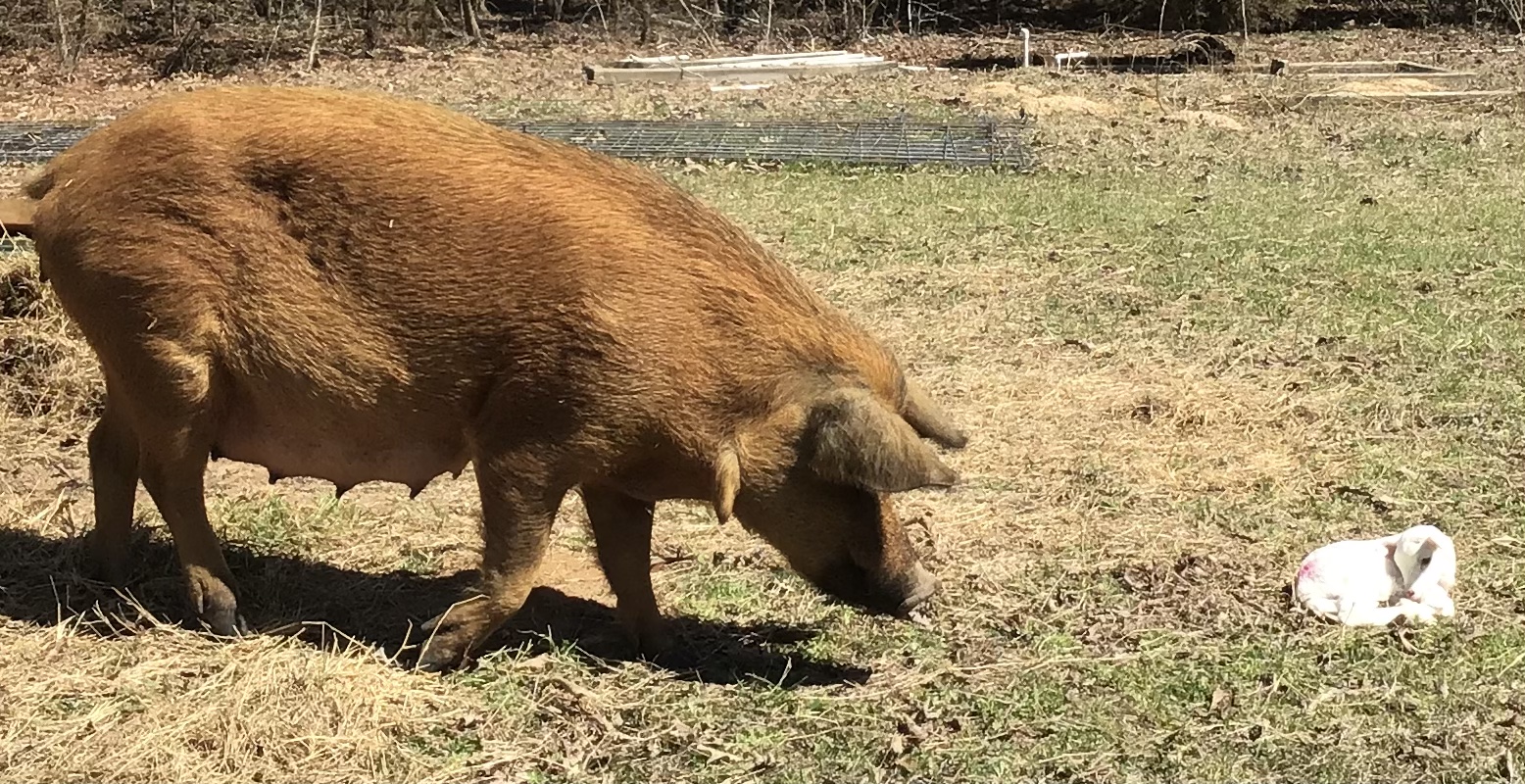
Huge days on the wee homestead! The pigs and sheep have all had successful births without a single hitch. Mama Chop did lose a couple, but she has such large litters that’s not such a bad thing. We were very concerned about her as she crushed her last two litters, literally, not in the new way of the term—She crushed it! Nope, in the old way, as in she smooshed them all.
Hubby was able to prevent that sad ending this time by clearing out her corral space of every last twig. She was in the habit of building huge nests, full of branches and twigs and so steep the piglets would roll right off it, falling between branches and getting pinned whenever she moved around. We were worried with another total loss we’d have to get rid of her because we like her so much, she’s so gentle and good-natured. She loves company and will even go on walks with us. It is truly amazing how graceful these huge creatures are around those tiny, squirmy little things!
I did not mean to hit ’slo-mo’ during this video, oops! Need to work on my skills.
Virginia had a similar setup to Momma Chop, but she wanted nothing of it. She went off into the woods to build her own nest, her way. Luckily she doesn’t have such a penchant for branches and twigs. She’s got more of the wild side in her attitude as well as her nesting preferences. And she certainly does not appreciate prying eyes and will come after anyone who gets too close to her brood!
Peek-a-boo! Yes that is Hubby running away from one irritated mama!
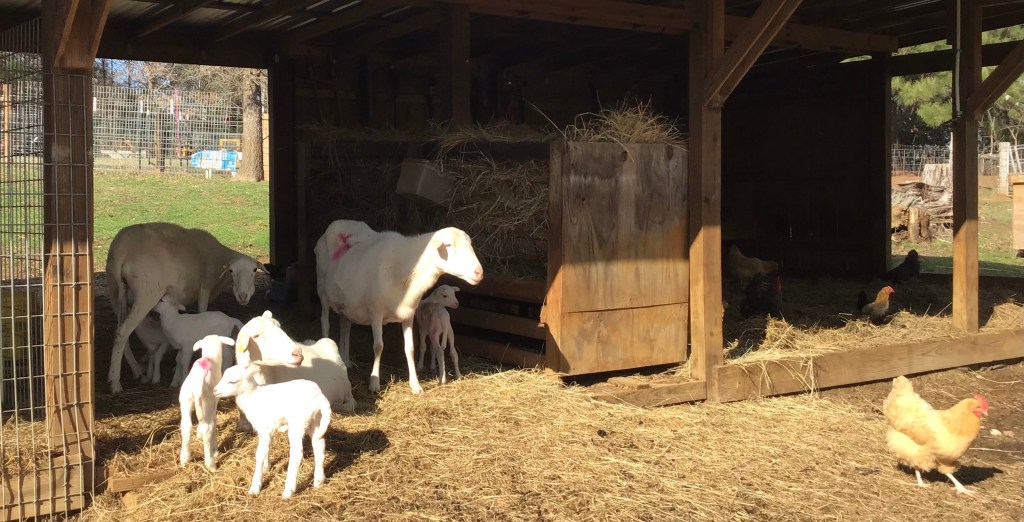
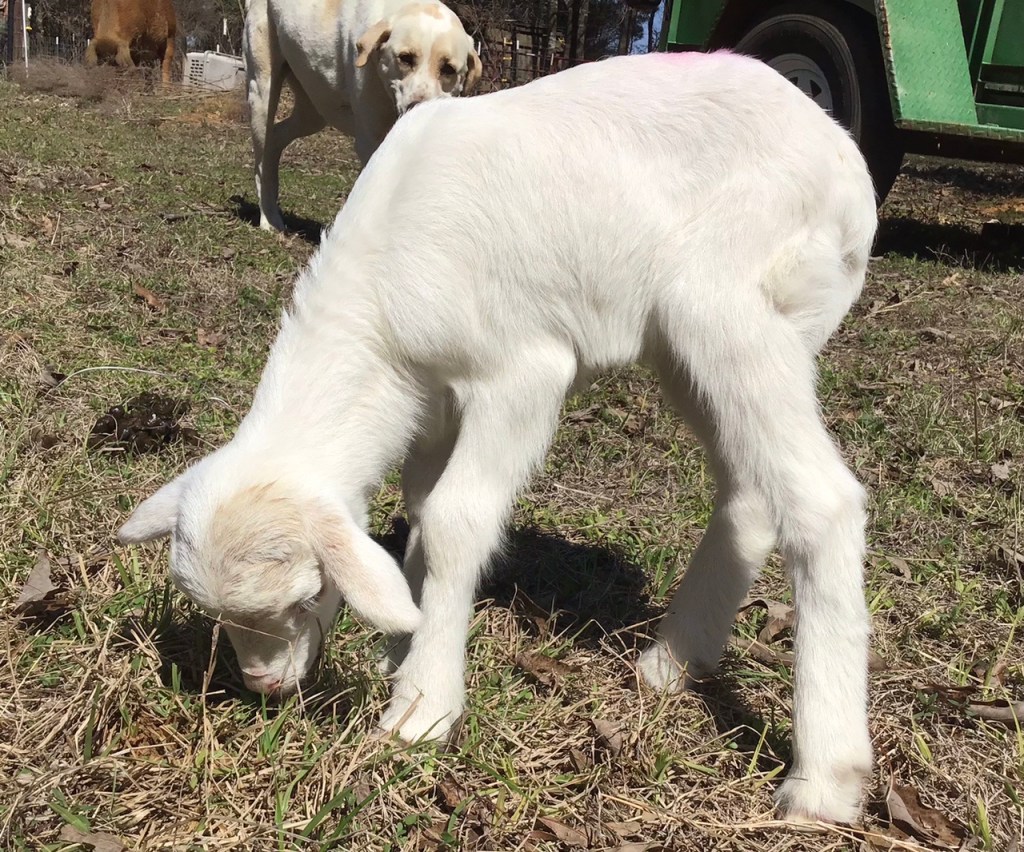
Watching the little lambs play, and sleep, is so cute. But I expect when the kids come next month we’ll really be in for a comic treat! It will be our first experience with goat births and I hope it goes as smoothly as the sheep did this time.
Getting friskier by the day!
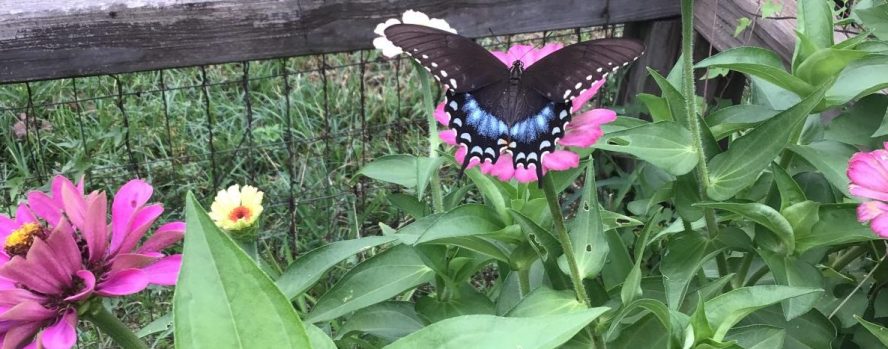
We have a new visitor to the garden which surprised us.
It’s been there every day now for about a week and I’ve never seen one like it around here before. It flies just like a hummingbird and had us quite confused. It was darting all around so fast and so far that it took me about 10 minutes and 30 attempts to get one decent shot of it. After some searching we learned it is some kind of hawk moth. Fastest moth in the west? Sometimes I undervalue the usefulness of the Internet, I might’ve been left baffled on that simple identification for a lifetime!
Not to mention the joy of sharing these simple pleasures with y’all!
Not bound to exploit. Not obsessed with production. No concern for profit extraction. Not driven by expansion. Treatment-free. Liaisez-faire. Non-industrial, anti-commercial beekeeping practices.
Beauty. Synergy. Cooperation. Respect. Reverence.
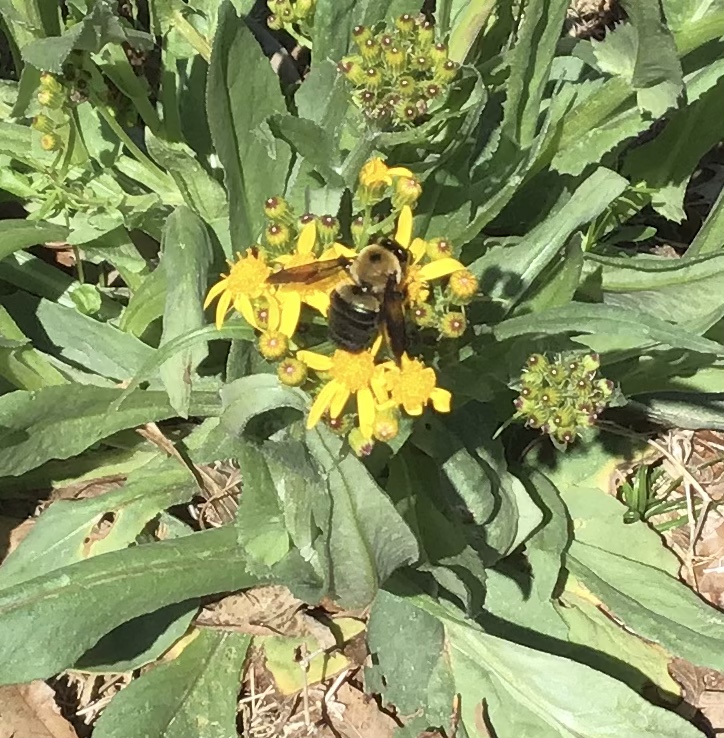
Not my bee, but the first native bee of the season enjoying the Texas squaw weed—plenty of forage for all around here!
If you guessed these unconventional methods are far from popular around here, you’d be correct.
I don’t even have a bee yard. I do have 5 strong, sustained colonies (aiming for 7) scattered around several acres, which is the best beekeeping decision I’ve made in about 5 years.
It is the intense crowding of many colonies into one space that is so unnatural that it then commands chemical treatments for bee health. Artificial solutions are never the best solutions. I rarely even feed my bees, I consider that a treatment. On those rare occasions I do, because my observations have led me to suspect they are without reserves, sometimes I’ve been wrong, and the bees aren’t remotely interested in my offerings. They prefer to forage over taking my junk food.
Not my gorgeous photo, unfortunately! Taken by a friend with the latest IPhone, WOW, color me impressed!
By observing intently over time and looking to mimic nature in every way possible, I’ve come to realize how hopeless is commercial-style beekeeping for the small holder, just like all our industrial ‘solutions’ are a never-ending Ferris wheel of problems and solutions, all the way around. Industry comes to drive the entire tradition-turned-enterprise right into the ground.
Well, no thank you! And I haven’t had to buy bees for several years now, thanks to my new-old methods, which is certainly another motivator for commercial beekeeper’s scorn, considering they often make a good chuck of their profits from returning customers—that is beekeepers who follow commercial methods even for their handful of hives—buying nucs and packages and queens from the ‘Big Guys’ who sell themselves as the experts on all things bees.
In other words, the beekeeping industry strongly resembles the pharmaceutical industry, and pretty much every other global commercial industry. One model for all endeavors. One noose for all necks.
All but one of my hives is top-bar, another source for mocking by conventional beekeepers of all ages. But it does seem like alternative types are squeezing their way in through the cracks. And plenty of cracks there are. Not just top-bar fans.
Hard to tell from my bad photo, but this is an observation window on a top-bar hive. I hear other beekeepers pooh-pooh this regularly. I love it! And the bees don’t seem to mind either.
I’m not on any of the popular social media sites, but I know there are treatment-free groups, full of curious kindred spirits, some with bee-loving pseudonyms instead of their real names, like poor, paranoid anti-vaxxers. Oh, lovely lurkers, come out of the shadows to stake your claim! You dare to brave the bees’ stings, surely some stings of misplaced criticism can’t scare you away?!
The bees are just one of many bustling with spring’s promises.
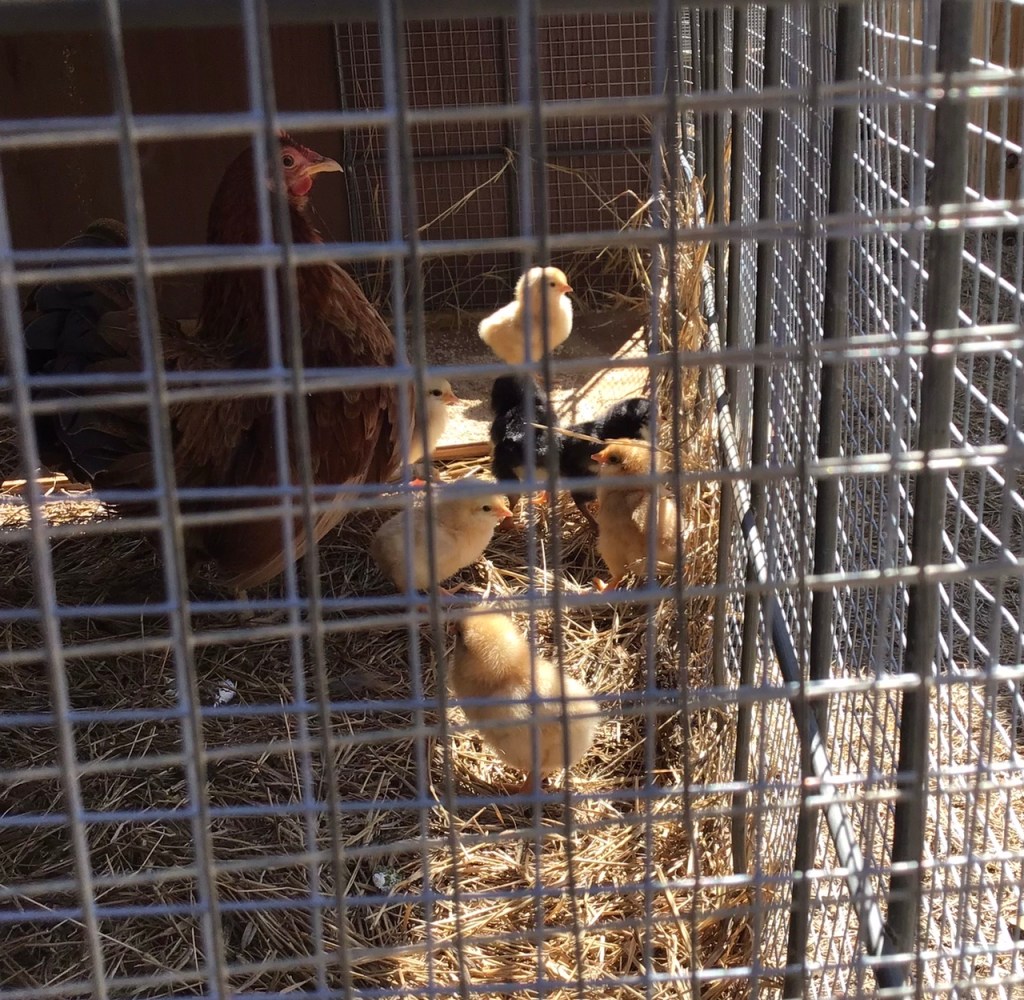
In other news, happy chicks are here, with no snakes in sight. (In the new, ultra-high security coop within coop, 100% snake-proof. Right?)
We are still waiting on the piglets, the rest of the lambs, and the kids, while trying not to let our anticipation get the best of us!
I LOVE cheese day and it’s been a very long while.
It’s been several months since I’ve been milking our ‘old’ goat, Summer, and it will be a few months more before I start milking her again, along with Phoebe and Chestnut, intending that all will go well with their first kidding, and I will be able to train them on the milkstand, which will be as new to me as it is for them. Big intentions!
Friendly PhoebeChilly Chestnut
I’m not too worried about Phoebe, she’s much more tame and mellow and loves to be petted. Chestnut darts off as soon as you try to touch her and is even skittish when hand feeding.
The first lamb of the season has just arrived! Now that Handy Hubby is ‘retired’ he gets to handle all the stressful parts while I pop in for the awes and photo ops. Big win for me! It’s not that things are constantly going wrong, but it does take preparation and attention and concern, because sometimes things do go wrong.
But not this time! While Hubby runs around, making sure the little lamb latches on in due time, gets the feed and stalls prepped and ready for a bunch more births, I make cheese.
It’s a very slow process, traditional mozzarella, it takes all day. Yesterday I experimented with a new cheese of my own invention, which is just about my favorite thing to do in the world. I would bore you with the details, but I fear you’d be really bored.*
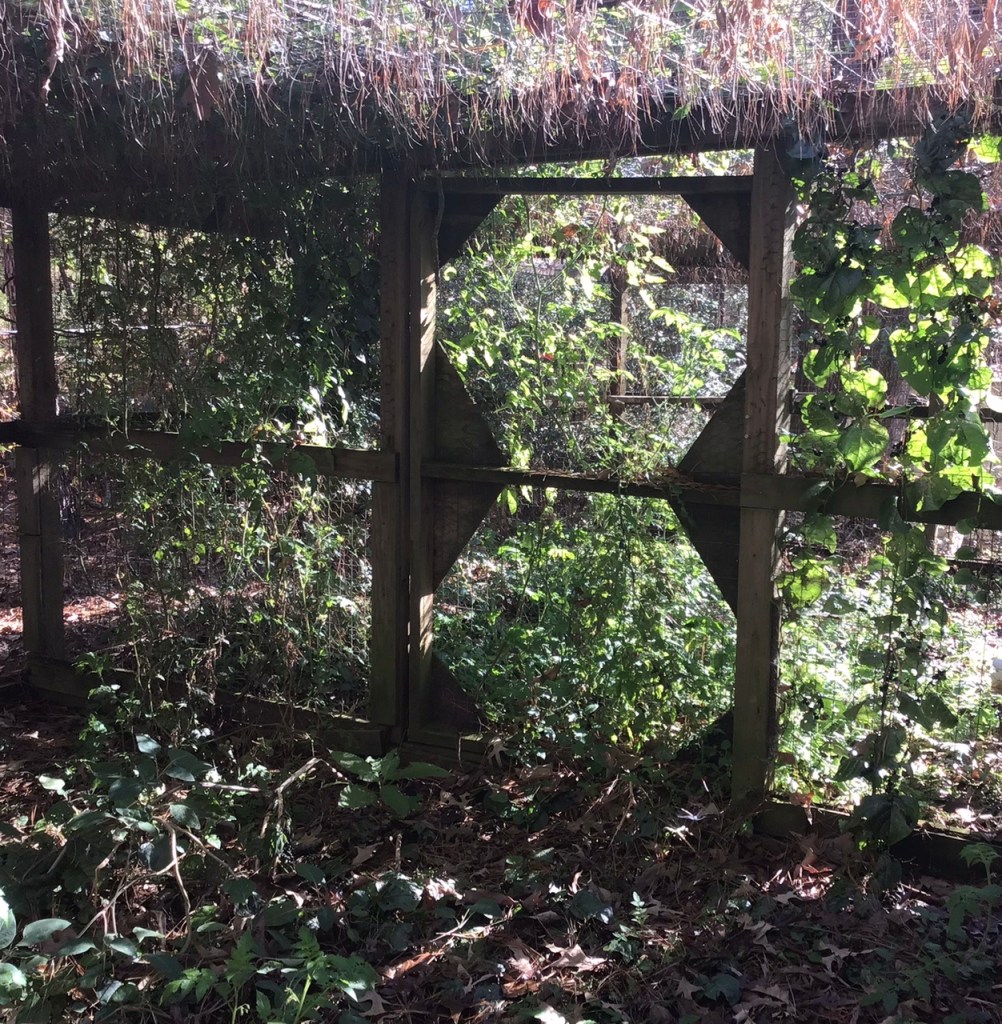
Another new Hubby project has been the ultra-high security broody fortress. Walls within walls. He’d finished the Tajma-coop and hoped our predator problems were solved. He’d planned for practically every type of previous invader—raccoons, hawks, possums, coyotes—with the exception of snakes. He’d hoped between one cat, 4 dogs and constant hoof traffic the reptilian raiders would retreat. No such luck. We lost lots of chicks and Bantams to snakes.
Surely this will be the ultimate solution?
Hubby sporting his wild side, which I much prefer to his straight-laced pilot persona. Though of course I have deep gratitude for his professional efforts too, not just the relieving of them, or we’d never be where we are now. (Thanks, Brandon?! And, where else shall I send the thank-you notes??)
I used to have regular cheese days. I would drive four hours round-trip for the only raw milk available in the vicinity and get up to 20 gallons and have a cheese-making marathon for four days straight. It was perhaps a bit obsessive.
That was a few years ago, now it’s a real luxury. Since then the cost per gallon of raw milk at that farm has gone from $6 to $9. Add to that the cost of gas and time (and my personal waning energy), we really can’t afford it anymore.
Instead I’ll be milking goats and making mostly small batch cheeses, including all my favorites, which is pretty much all of them, especially Camembert, Muenster, and traditional styles of aged chèvre. I do believe I’ll be very satisfied with my new arrangement!
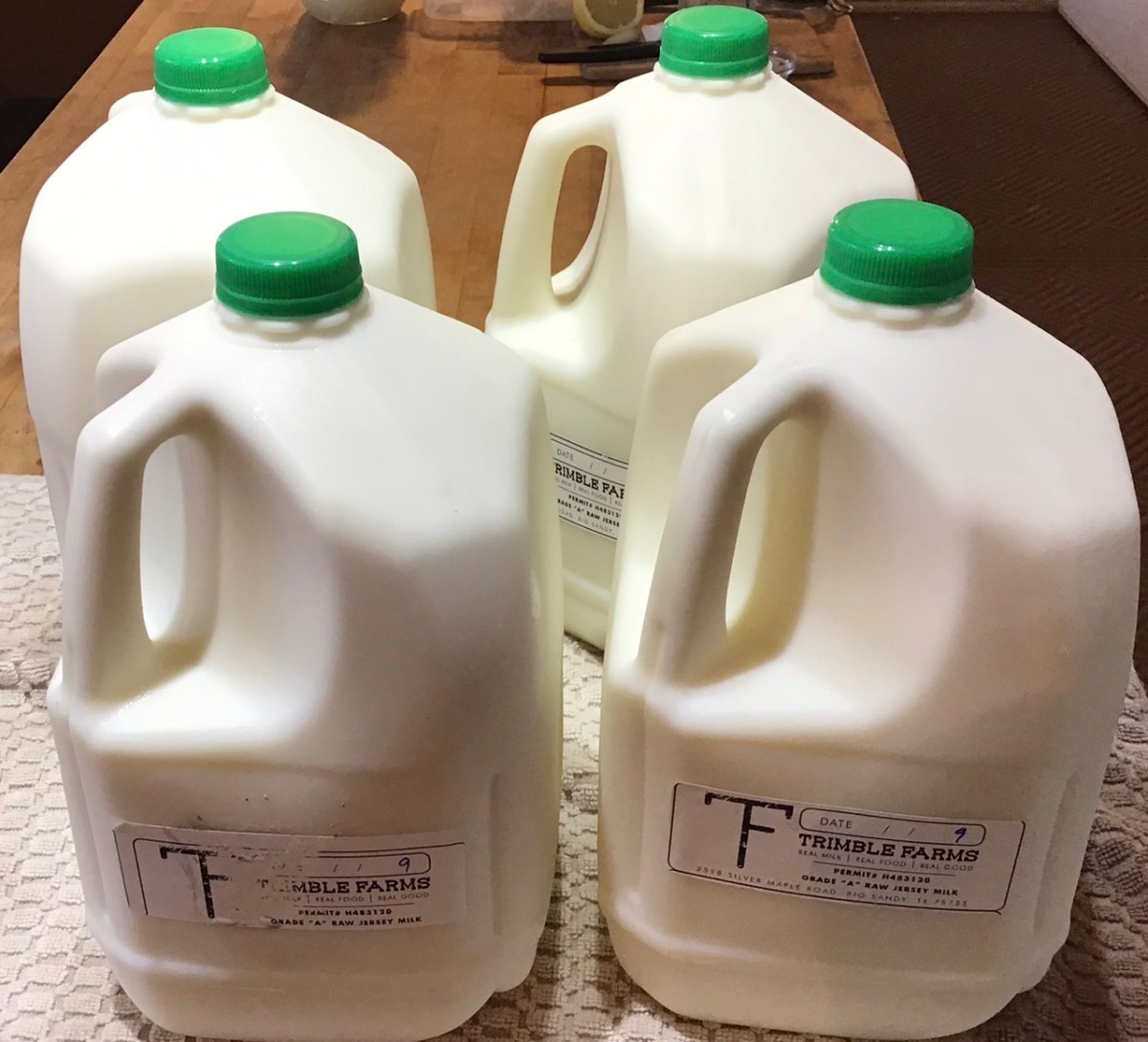
This time I got 10 gallons and a friend did the pick up, another win for me. She, like me, started making cheese and bread mostly out of snobbery—we are ‘foodies’ (I prefer the French term ‘gourmands’) and the selection of these staples in these parts was akin to an inner-city food desert. Industrially-produced, plastic-wrapped crap only, of the lowest quality.
Like I said, it’s a luxury at that cost, but from it we will get better cheeses, yogurt and buttermilk than money can buy.** Not only do we get the cheeses, but the whey goes to great use too, for ricotta, for soaking grains, and for the critters at just the time they are in need of extra nutrition.
Incidentally, mozzarella is not a raw milk cheese. Still, the flavor of the traditional home-made style is far superior to those which are industrially-produced, including the ‘fast mozzarella’ that most home cheese-makers prefer, since it takes about an hour versus all day. That version is also delicious, and I make it sometimes too, but the flavor and texture between the two is very different.
Our semi-feral cat, Skittles, comes around regularly now that our house dogs are no longer a constant threat. She’s getting her day in the sun at last, enjoying her curds and whey.
As there is a lot of kitchen downtime with traditional cheese-making methods, I make sourdough bread and pizza dough between steps.*** Or sometimes pestos, or condiments, or Kombucha (my latest fantastic flavor is pine needle), or soups and salads. Before I know it, an entire day in the kitchen has swooped by, me barefoot and content, and still in my pajamas.
And very happily not pregnant!
*Actually, I’d be happy to bore you in the comments section if you have any cheesey comments or questions.
**Sorry to say, but the raw milk cheeses you think you are buying at the grocery store are actually semi-pasteurized, they just changed the definition. As per usual.
***While listening to podcasts, usually. Richie Allen was on the list today, a good choice as it was a call-in show on the subject of prepping. https://podcasts.apple.com/us/podcast/the-richie-allen-show/id1090284266?i=1000553479020 I don’t identify as a prepper myself, necessarily, even though pretty much any American who looked at our lifestyle would say we are. The third caller on the show is a self-identified ‘doomsday prepper’ in Alaska. She was great, shared lots of good info and talked about how she grew up that way, as did her parents. I don’t really consider that ‘doomsday prepping’ either. This is a lifestyle to me, one that deserves to be continued through the generations, not just during precarious times, and I’m sure she would agree. Being prepared is important and I think everyone should make a concerted effort on that front, especially in times such as these. But I see this lifestyle is a special sort of calling and it’s not going to appeal to many folks, and it doesn’t have to. It’s enough for those so inclined to preserve it and to treasure it and to keep that flame of living intimately with nature alive. It sets an example that is much needed these days as it is not in the modern Western way of a recreational relationship with nature or the profit-driven exploitive relationship with it, but a real, old-fashioned, hands-in-the-dirt sort of cooperation. You’ve gotta really love it, really want it, or it will never work for you.
Busy days on the wee homestead as spring moves in. The seasons change, alas the chemtrails do not. The weather whiplash as well. But I must admit, I take quite a bit of hope and satisfaction that in the many years I’ve been bitchin’ about this, folks seem to finally be taking some serious notice. Either that, or my scope is conveniently narrowing. No matter. However the media tries to distract us, what’s truly important is happening in and all around us, not out there somewhere.
Insert ’gross face’
Handy Hubby has been busy in the back 40 clearing more pasture and getting the various spaces ready for the soon-to-be coming babies—piglets and lambs and kids and chicks. I’ll be posting lots of those pics when the time comes!
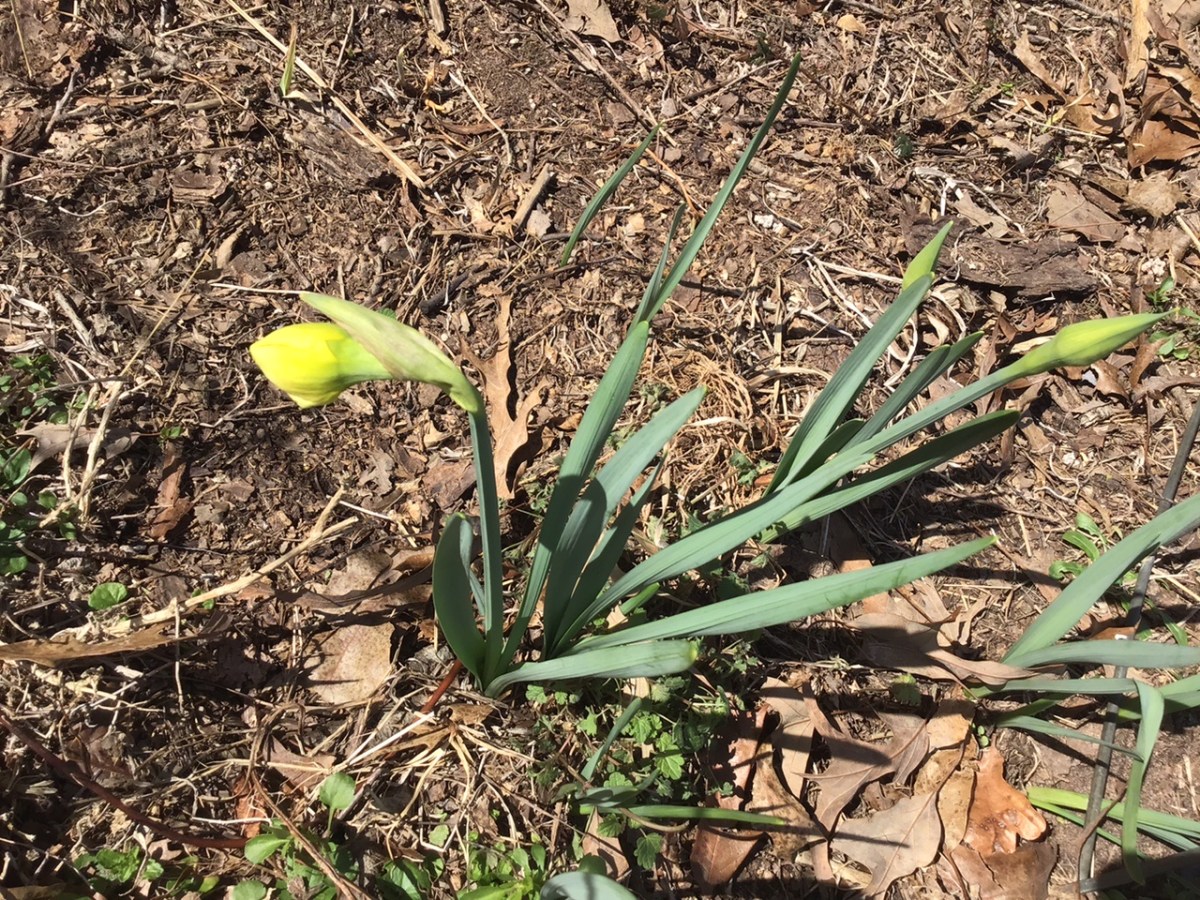
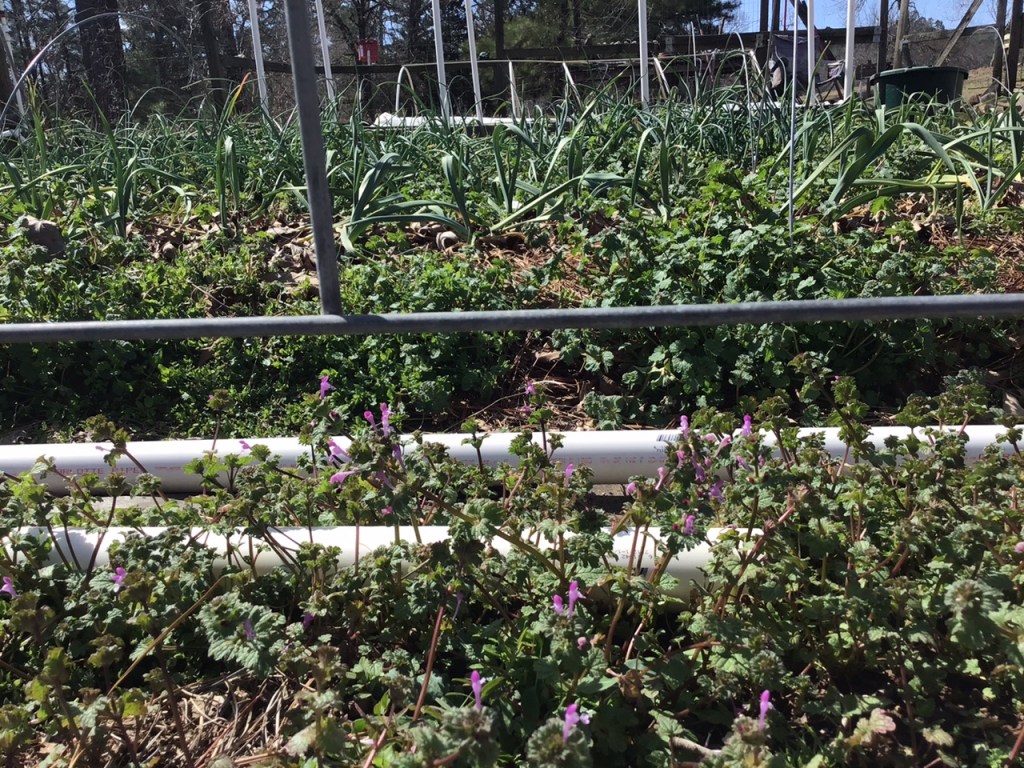
I’ve been busy in the garden and the bees are just starting to get busy, too. Only one colony failed over the winter, so that’s looking promising. We have loads of henbit blooming, but the bees seem to be preferring the chickweed so far. I have seen them enjoying the henbit on other occasions, so I keep plenty of it around. Such fickle little fairies. 😇
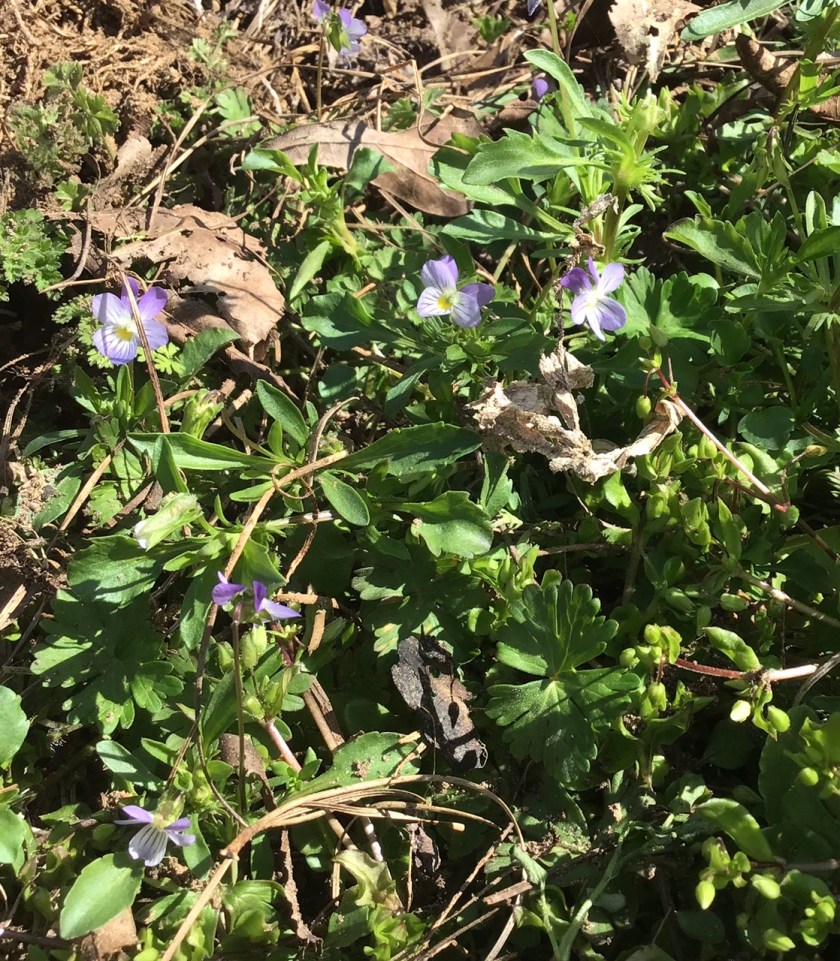
Chickweed and henbitWild violets, deliciousHenbit and garlic
The perfect pesto can be created from those three ’weeds’—henbit, chickweed and violets. It takes some patience, but it’s well worth it.
The box that kept us in salad fixings all the cold season, covered with row fabric on the frosty nights and days.
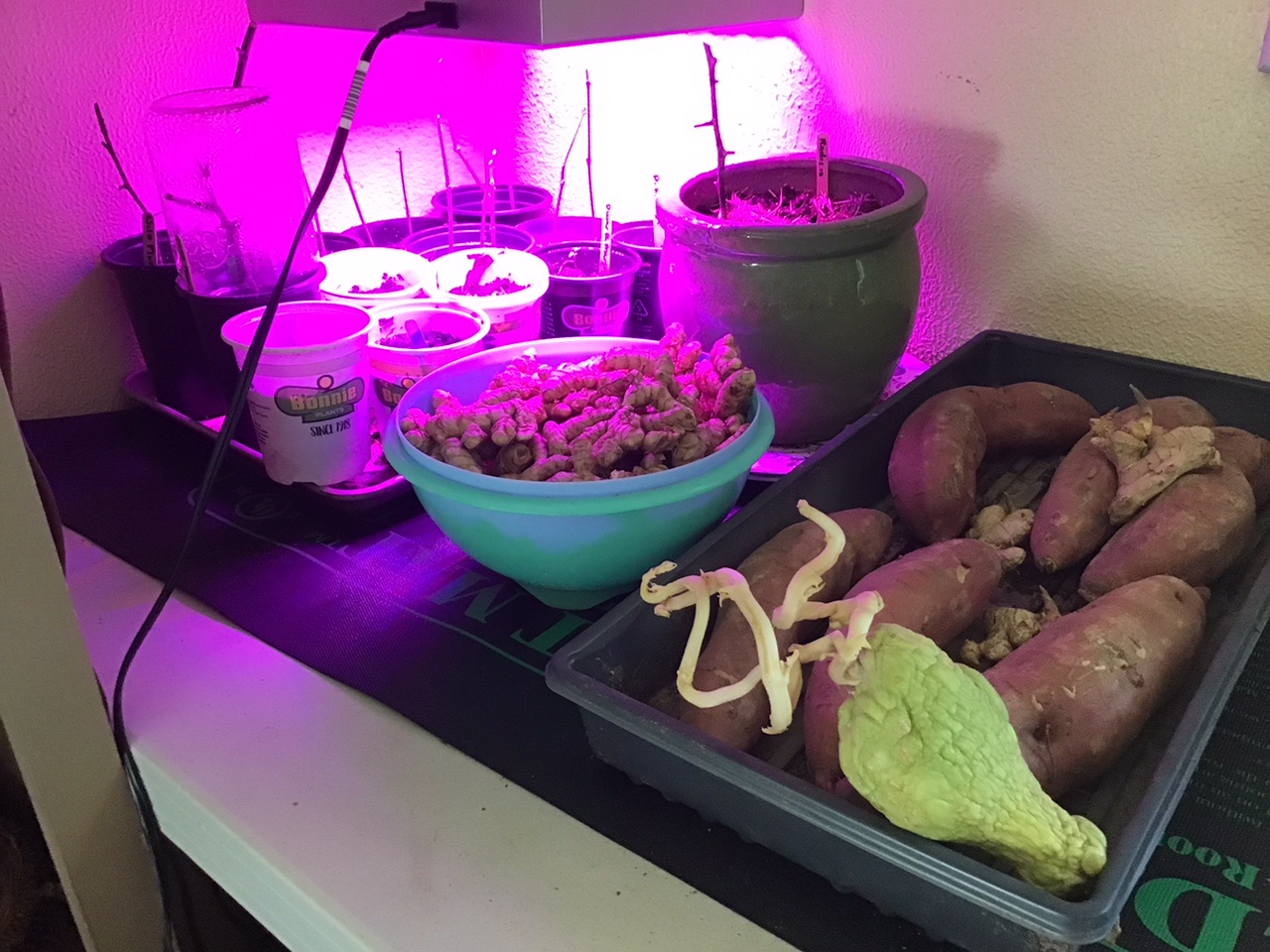
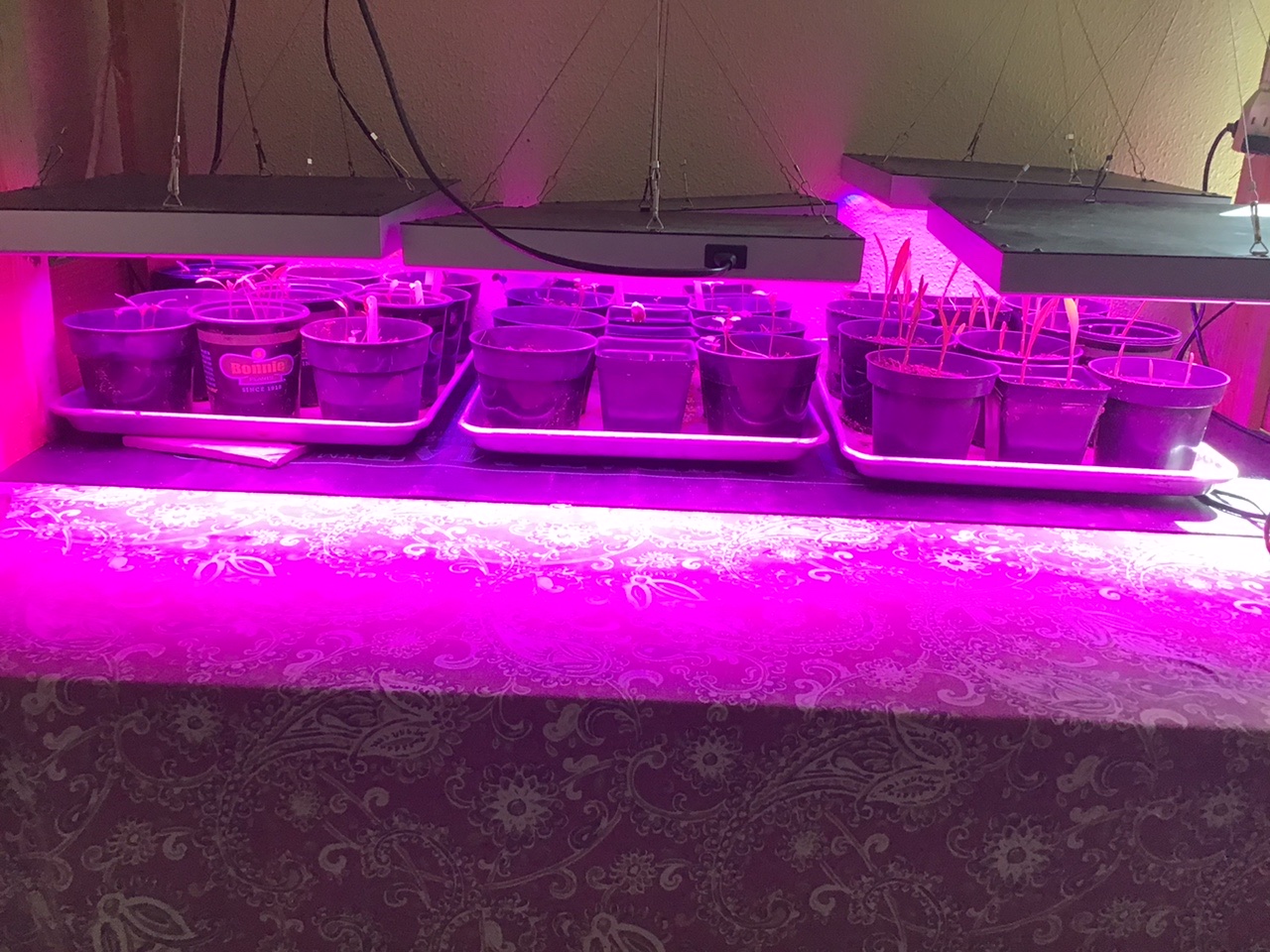
I’m pleased that the avocado and mirliton squash I over-wintered inside did really well. Of course, I’m not counting my fruits before they hatch! I’m also trying sweet corn inside under lights for the first time. We often go so quickly from frost to 90 F degrees that it’s a ’beat the clock’ situation. In the middle photo are the sweet potatoes, ginger, tumeric and another mirliton warming up on a heat mat before putting them in soil to warm some more under lights before transplanting.
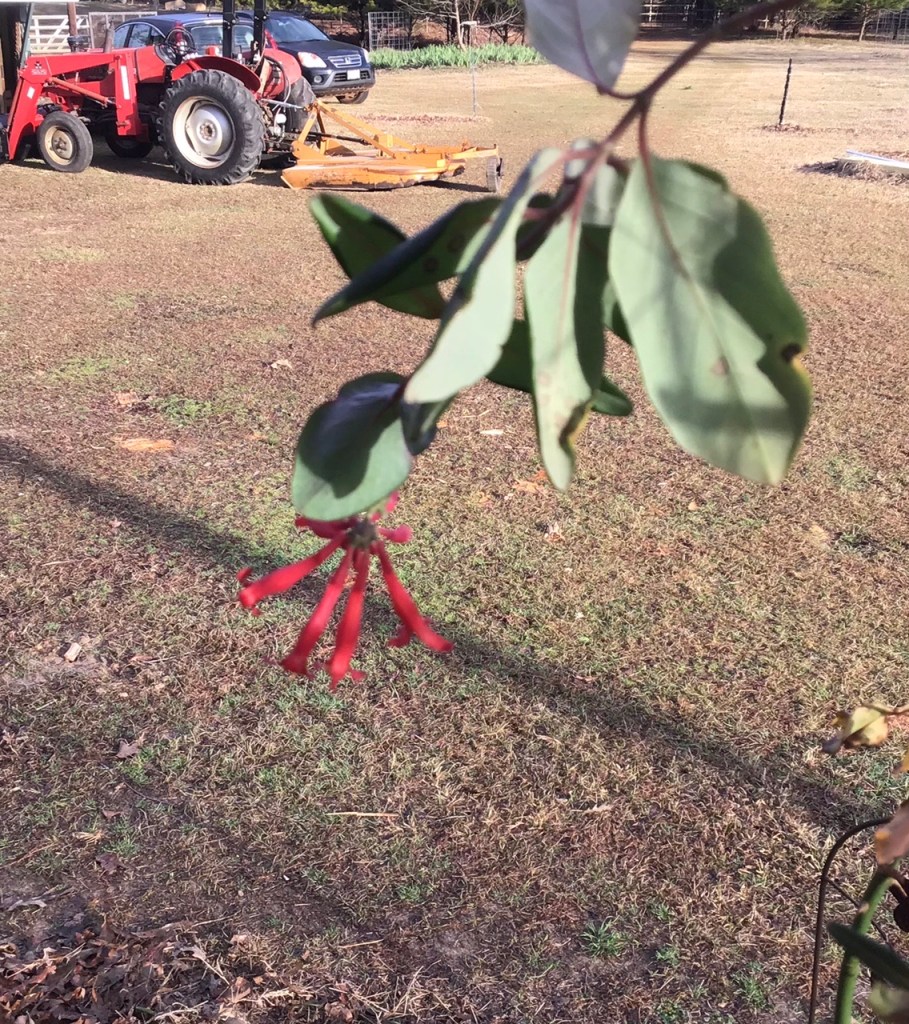
Coral honeysuckle—kinda proud of this one because I propagated it from one found in the woods. I’m experimenting with a lot of propagation ‘from the wild’ these days, time will tell, I mostly fail so far. Hubby’s old tractor in the background, it’s seen an enormous amount of work but keeps on ticking, with constant upkeep and much frustration on Hubby’s part sometimes. 😩
Garlic, shallots and a few types of onions going strong! That’s row cover on the right of the photo, for the weather whiplash. On the right you can see the garden from a distance, completely fenced, with a makeshift green house (the cover destroyed during the tornado a couple years ago) that will soon make it to the top of Hubby’s to-do list, I hope! 😏
I remember well the first time I heard the expression ‘learned helplessness’. My mom used the term and I didn’t understand it. I asked her to explain, which went something like, “As if a man is actually incapable of doing the laundry.”
Some time later I heard it used again, only this time in reference to a woman who wouldn’t dream of changing a tire because she might break a freshly manicured nail.
These are benign examples of a much more serious issue. A little co-dependency amongst family and friends can be a very good thing. It reminds us we need each other, and it’s nice to be needed, as long as it’s not too needy. 🙂
But there is a much more nefarious kind of learned helplessness that is proliferating in our society and because it’s being sold by some very slick salesmen it goes on, continually championed by those who should know better. US.
This is the kind of dependency that fosters anxiety and dis-ease, because it promotes frustration, alienation, victimhood, powerlessness. Under the guise of convenience, comfort, safety, and even fun, we have allowed ourselves to become dependent on criminals, sociopaths, martyrs, tyrants dressed up as experts and beneficent leaders and stars.
Food, water, shelter, health, energy, entertainment, protection. These are all crucial aspects of human life we’ve willingly outsourced to others. Gone are the days for the vast majority who cooked from their own gardens, played and sang tunes around the fire pit, cared for their own ill, built their own homes. How many generations must we go back to know a time before politicians were household names and stock markets dealt only in livestock?
How many folks believe we have it so much better in our ultra-civilized modern world because they’ve bought the propaganda of their oppressors, those who actively promote and celebrate our dependency as progress?
There is a wellspring of peace of mind knowing that if you ever dare say “Take this job and shove it” you won’t end up homeless and hungry.
If you could do one thing in the new year to release the yoke of dependency just a bit, or a bit more, what would you do?
Happy New Year from the wee homestead, y’all, thanks for reading!
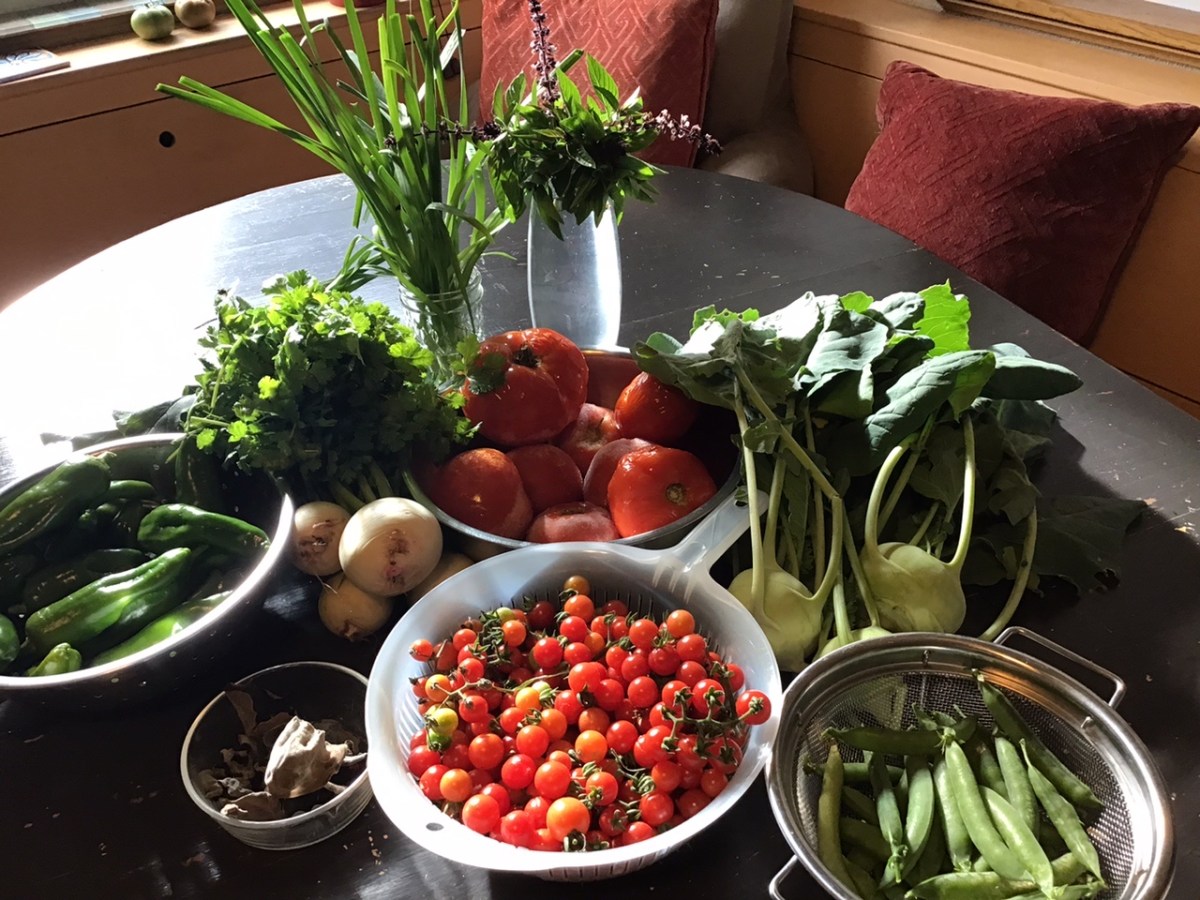
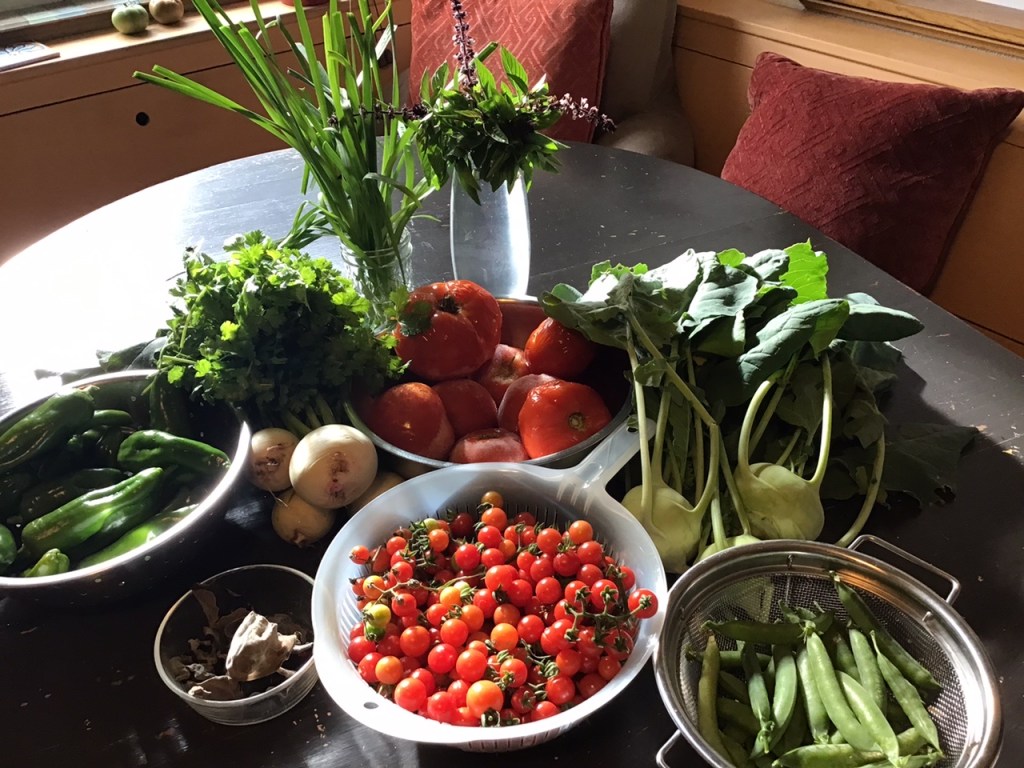
It’s been unseasonably warm for us so far, with regular episodes of more mild weather whiplash than in recent past years. I suspect that’s about to change, so here’s the garden as it’s growing now.
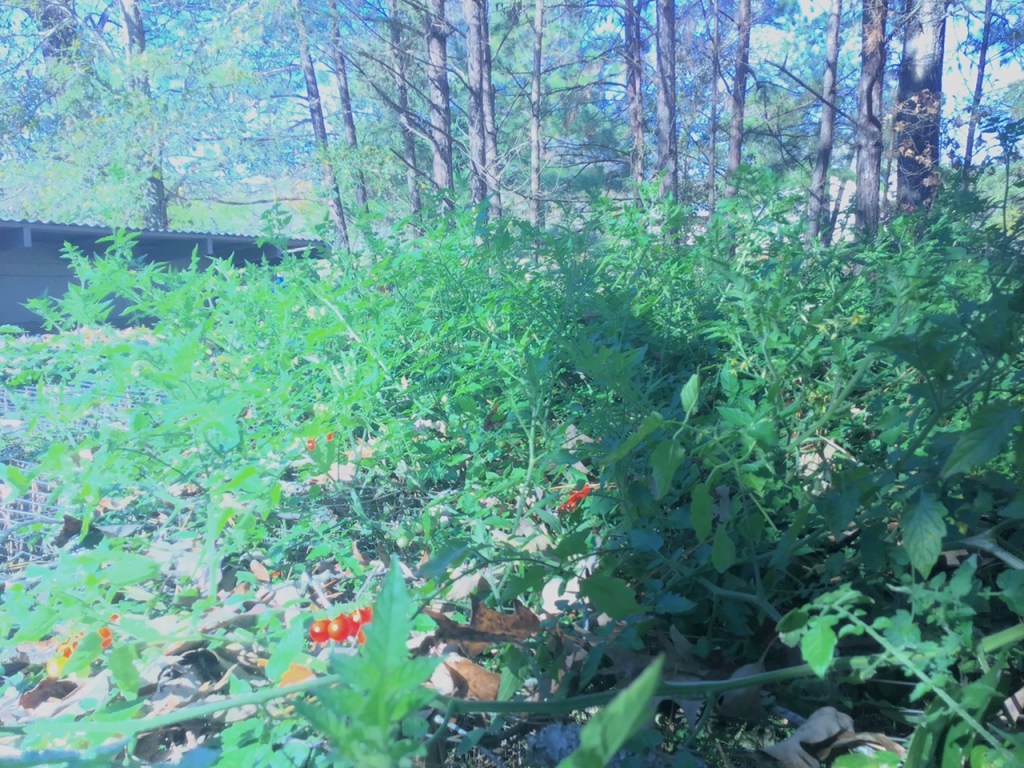
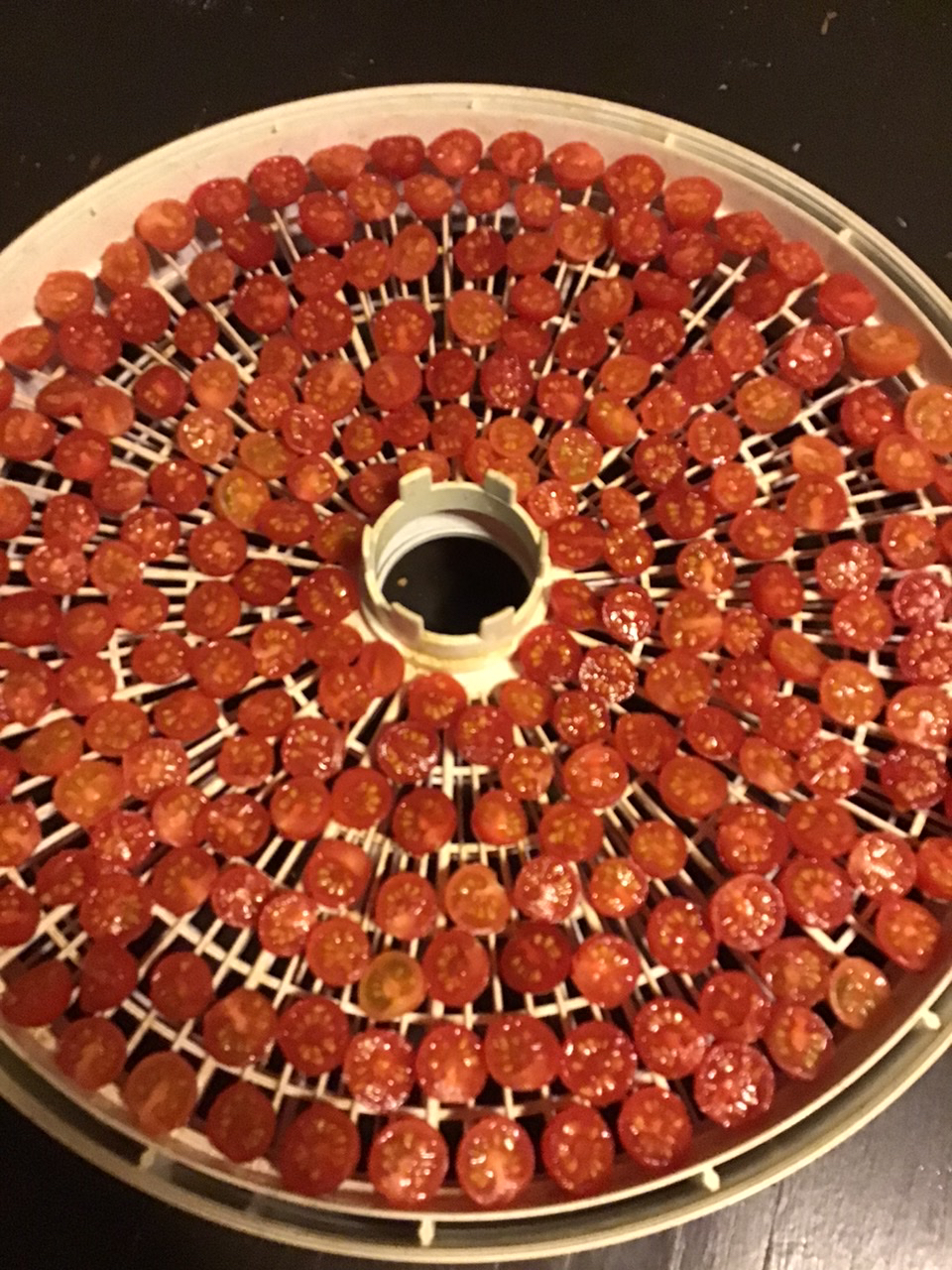
It’s a first for fresh tomatoes in December around here! We are still harvesting from the ‘volunteer’ tomato jungle growing in the duck coop. It looks so pretty and is producing much more than we can munch. Even though it’s tedious work, I dry them. They come out delicious that way and can be added to all sorts of dishes or made into a pesto.
The large tomatoes pictured here are previously frozen. Freezing the surplus in summer solves one big problem around here: the tomatoes come ripe after the cilantro has gone to seed. To me, salsa without cilantro is like a bed without pillows! Now the cilantro is growing like gangbusters, and we still have fresh peppers (another first!), so we get nearly fresh salsa in December too.
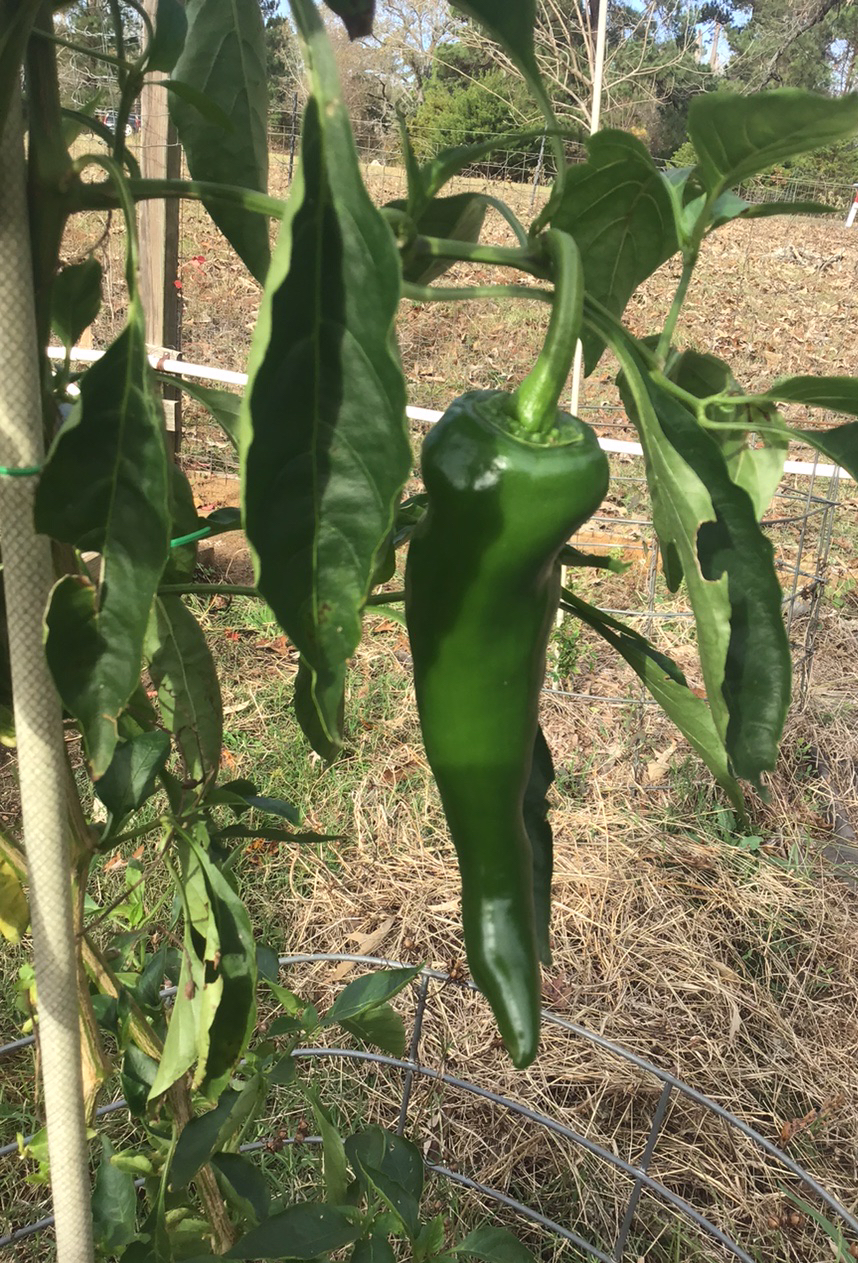
With the peppers still growing strong that means in 20/20 hindsight I should not have moved a couple of them last month to winter them indoors after all. Where’s my crystal ball when I need it most?!
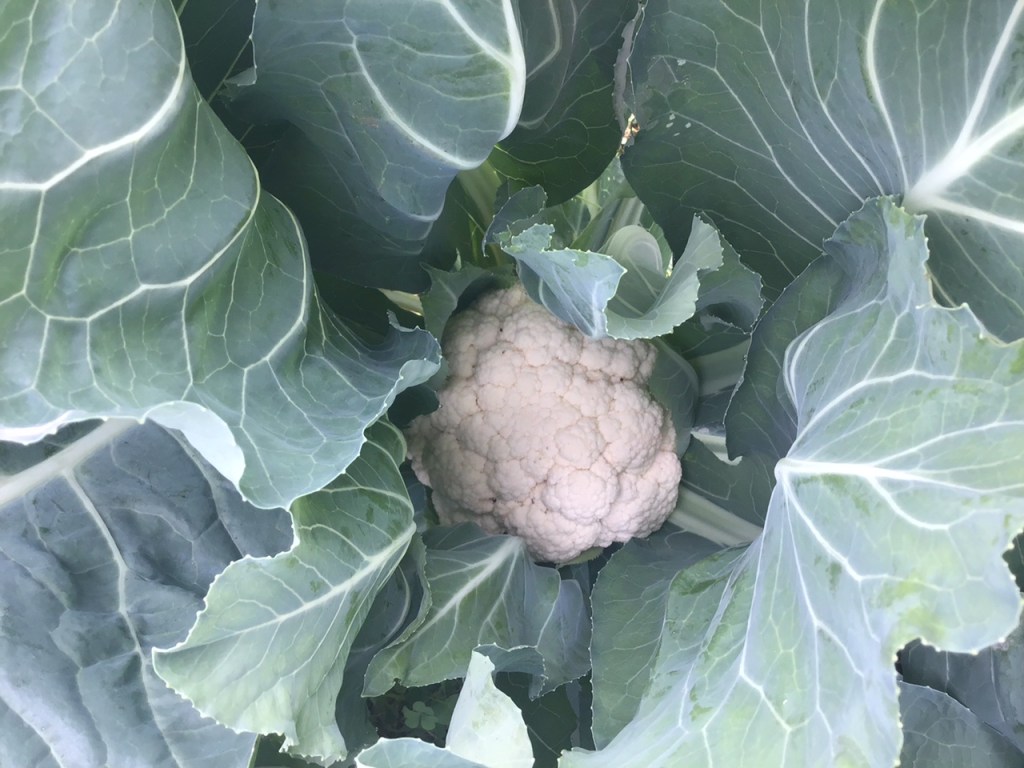
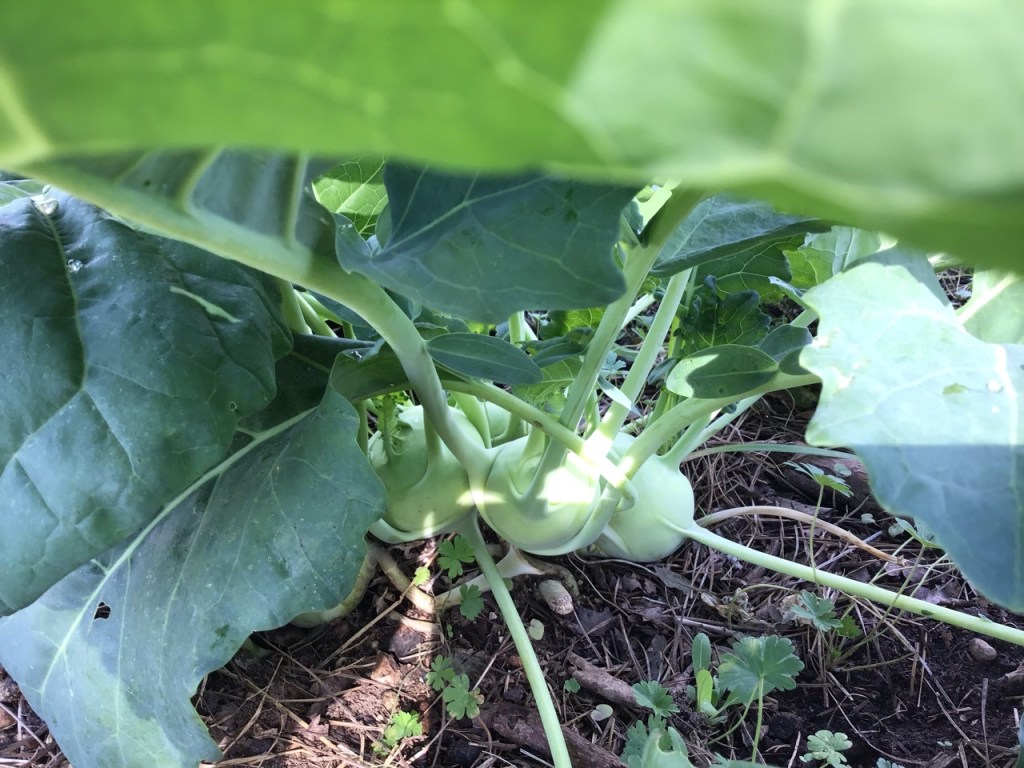
Turnip greens are growing faster than I can keep up! I over plant so the sheep and goats get some extra greens and the pigs love the roots.Happy garlic started sprouting All our favorite fall crops are doing fabulously! I plant very heavily then thin when they are still small, but big enough to enjoy. Can’t do that on a factory farm! I also don’t weed out the ’weeds’ —like chickweed and hen-bit—unless they are badly encroaching on the crops. They are edible after all and once they flower the bees love them too, at a time when very little else is available to them. This has the added benefit of habituating the bees to scout the garden all year round.
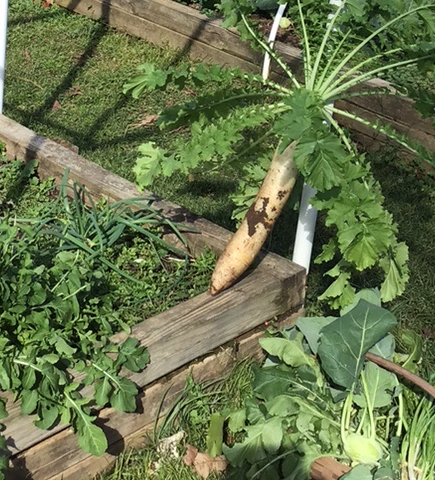
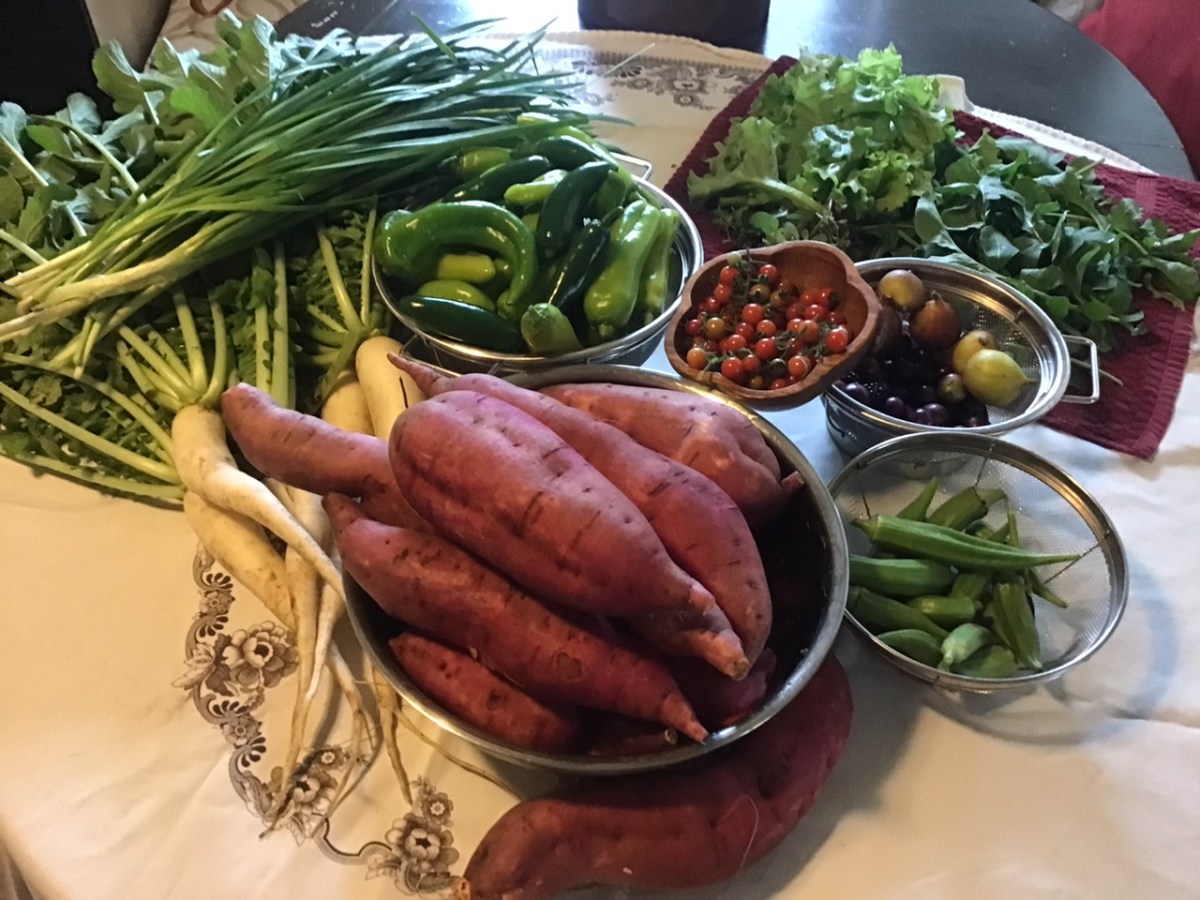
Now that’s a radish! I love all radishes, but the Korean radish is seriously impressive.
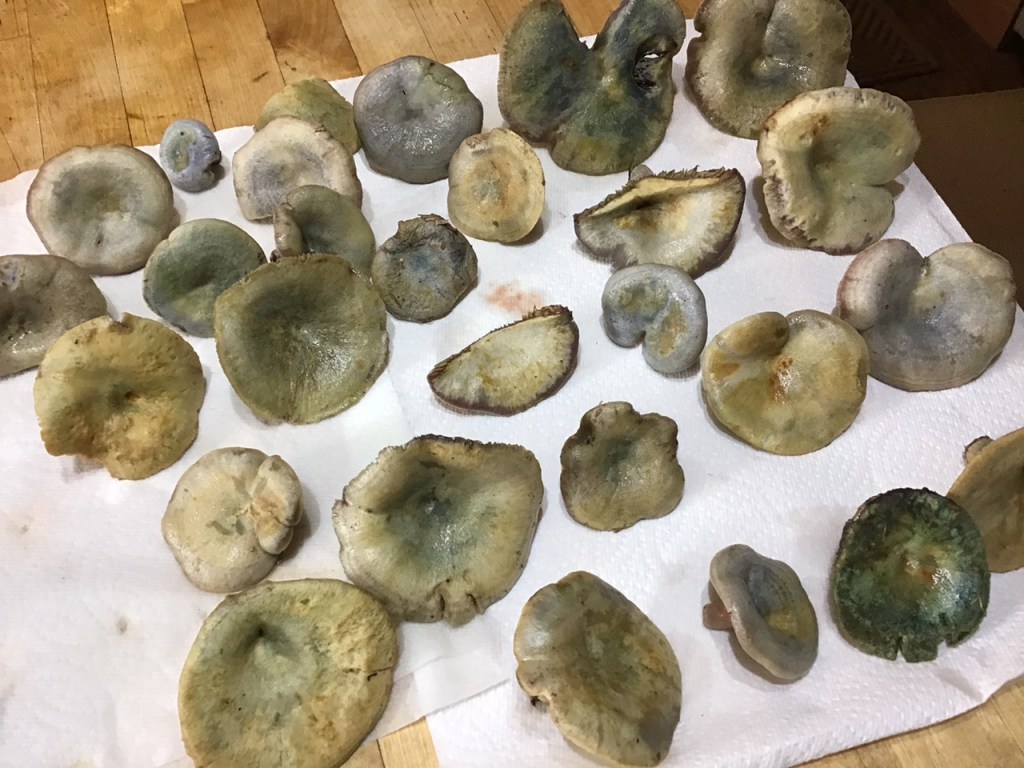
The mushrooms continue to marvel me! First we had chanterelles nearly all summer, now we have delicious ’wood blewits’ (clitocybe nuda—ok that sounds a bit pornographic, no?!) and tabescens, and lactarius paradoxus. Also pictured are either the hallucinogenic ’laughing Jims’ (Gymnopilus spectabilis) or the highly toxic ’Jack-o-lanterns’ (Omphalotus olearius). The latter I give to a friend who uses them to dye yarn. The former, if I were 100% sure of my identification, I might be inclined to try! Apparently you can tell from the spore print color, either orange or white. But, what about when it comes out whitish-orange? Too risky for me!
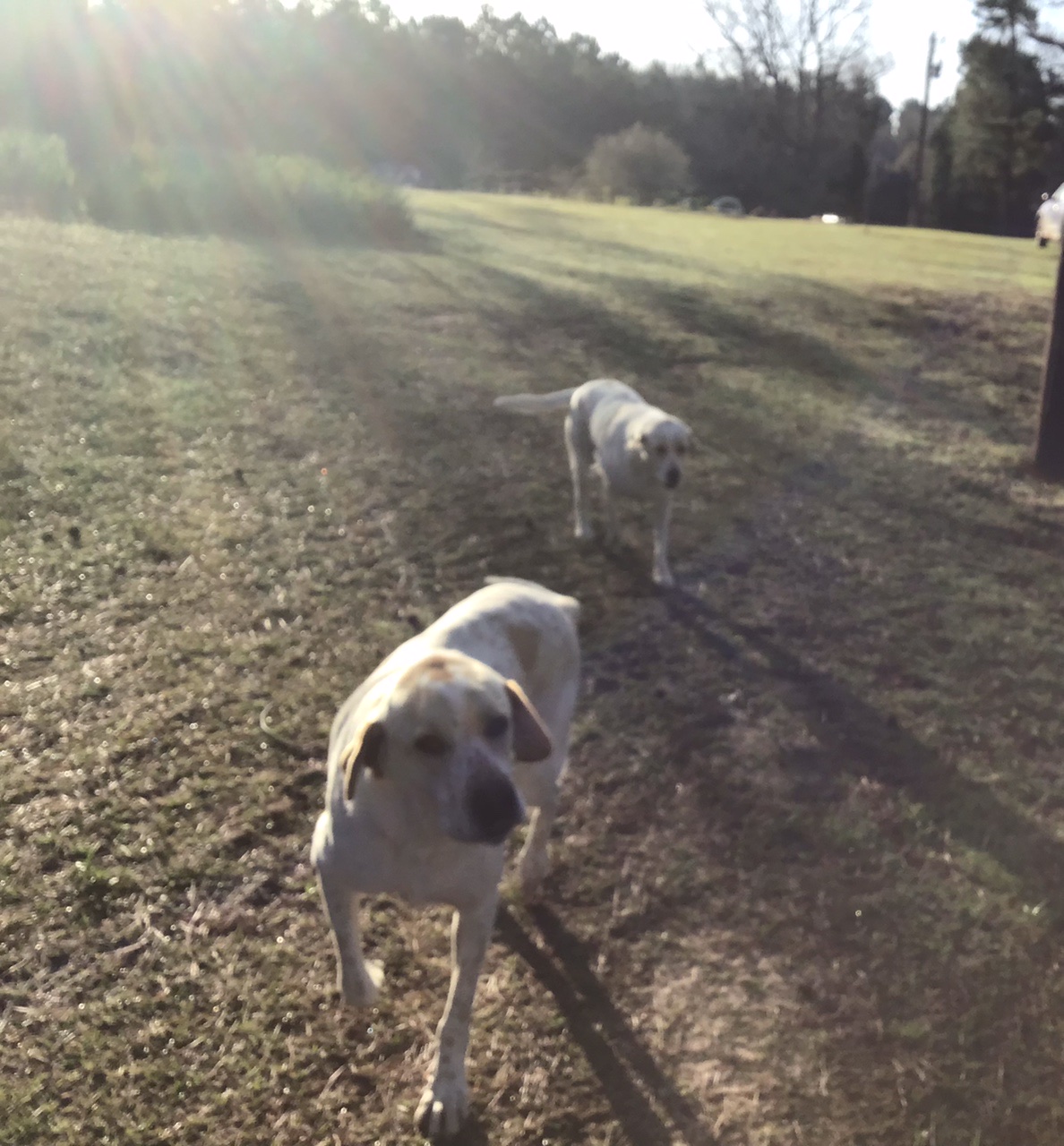
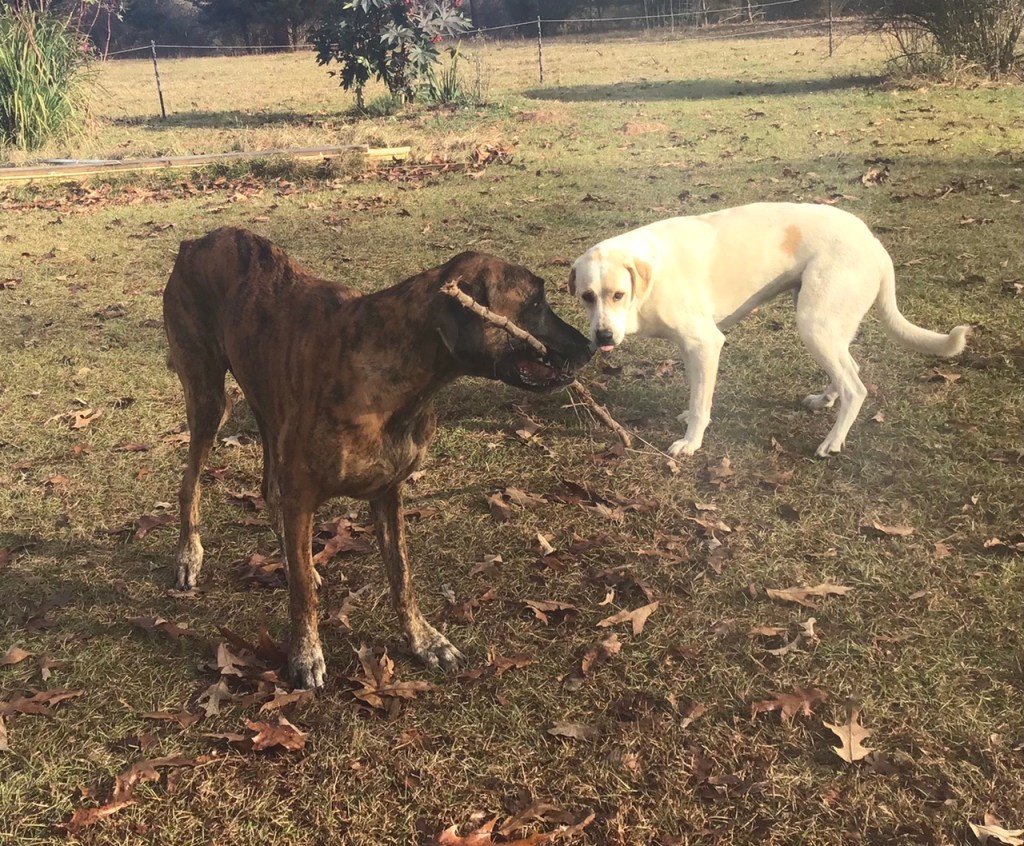
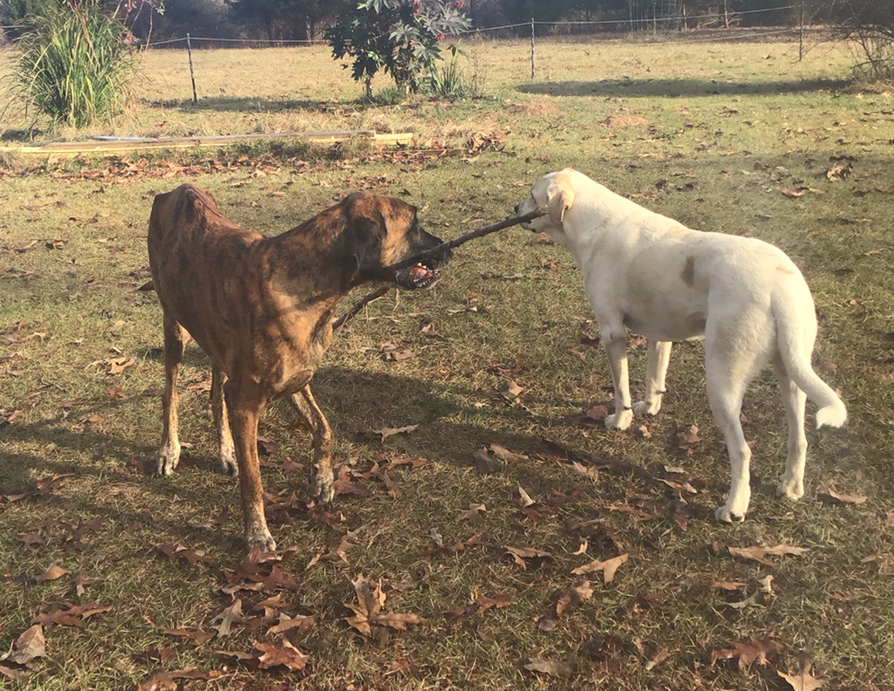
The cooler temperatures make even our old dogs feel a little frisky!
Play time!Who’s gonna take me on!Come on, chump, make my day!Just as I expected, you wouldn’t dare! 🙂
Another brief plant profile this post, as it’s our first experience of persimmons!
The first thing you learn is absolutely do not eat them when they look pretty enough to eat. With the persimmon, the uglier, the better! If you eat one when it looks like this, you might think you just stuffed your mouth full of dead rodent fur.
If you eat one that looks like these below, you might cringe a little at first thinking you’re about to taste something rotten, but you’d be quite wrong—it’s magically delicious!
Let this funny lady tell you all about it!
It is often claimed that American persimmons are only edible after a frost and that you cannot ripen them off the tree. Luckily, this is not the case. However, most persimmons you can purchase at the grocery store are of a Chinese variety. It seems American producers have decided our own varieties don’t ship well enough.
Preserving ’wild’ persimmons is also a bit peculiar as cooking it will bring the astringent taste back. Making fruit leather was the solution for Native Americans according to this article by Mother Earth News. “When desired, the persimmon leather can be cut into small pieces and eaten like candy. It is much relished by small children this way. Or, the dried pulp can be mixed like raisins with cornmeal and other cereals to make Native American puddings, various cakes and biscuits.”
Time for us to give persimmon leather a try! And persimmon cookies, clearly. I already made persimmon kombucha and it’s positively divine! 🙂
We’ve planted a bunch of persimmon trees in recent years, but only females produce fruit. The ratio of male to female trees is 10 to 1 and you can’t tell them apart until they start fruiting, in about 7 years. Nature’s way of teaching us patience and planning!
No politics or unpleasant ponderings this post, I promise!
Just some homesteady happy snaps and a well wishing for a wonderful weekend. 🙂
A sea of sweet potatoes soon to be harvested.Mexican tarragon—an attractive replacement for French tarragon that does much better in the South.
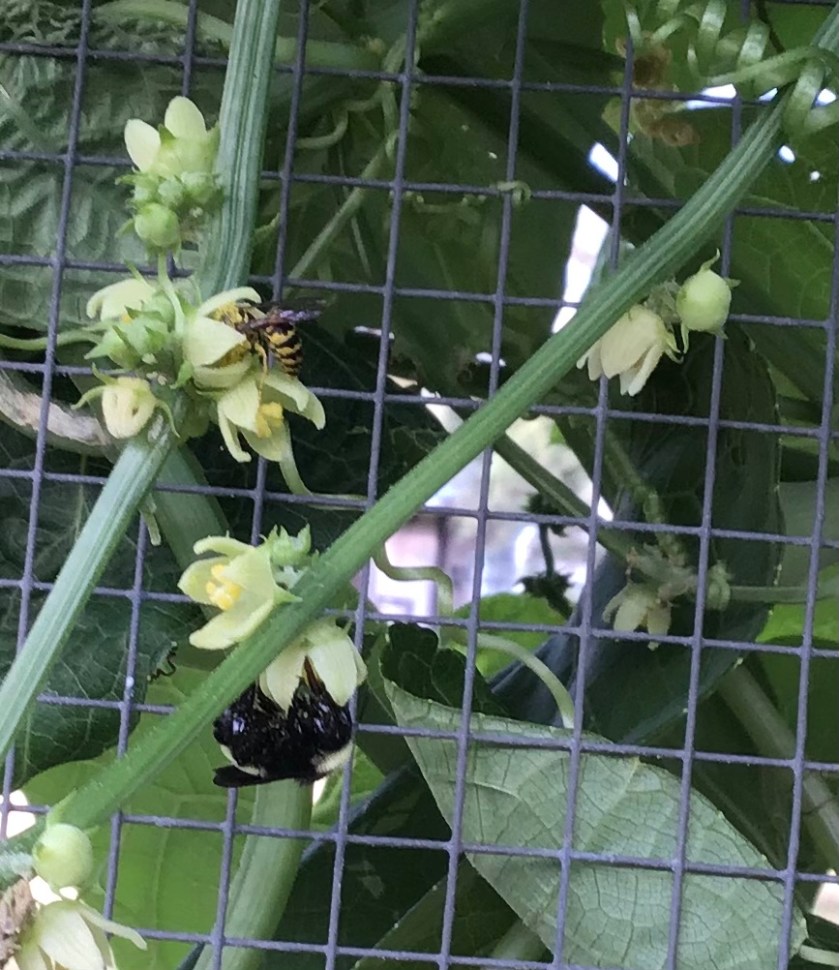
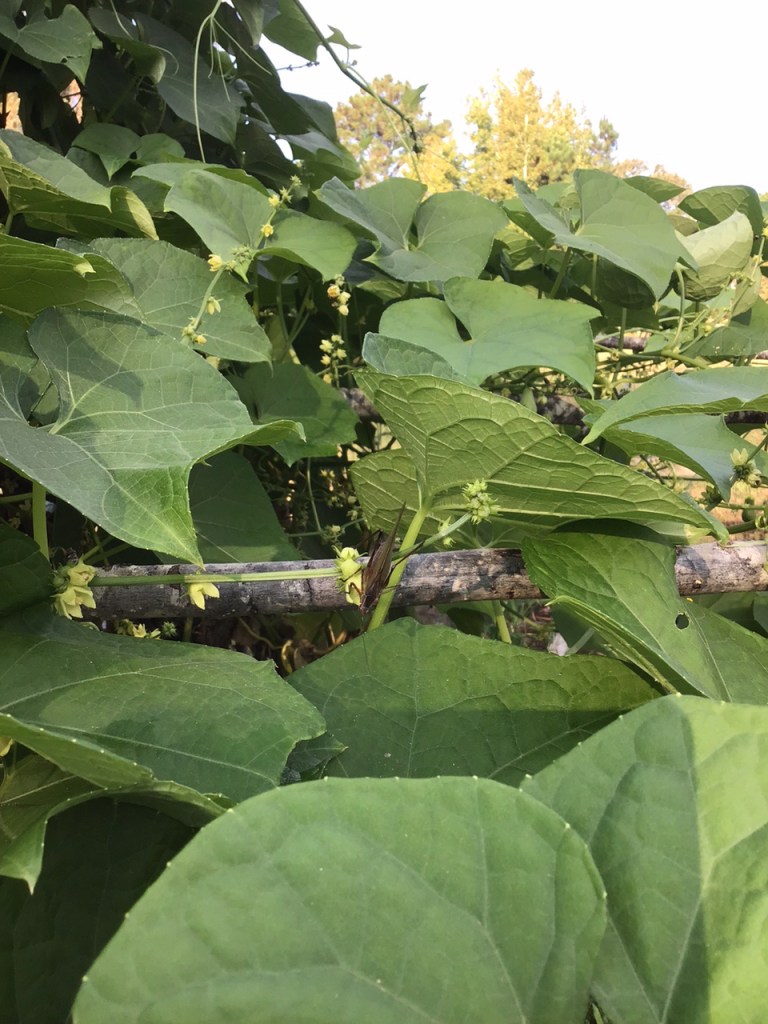
So excited for the mirliton (chayote squash)! It’s growing like mad, covered in flowers and fruit and providing perfect habitat for bees, wasps, crickets, etc.
Volunteer cherry tomatoes thriving on the old duck coop! We’ve never had tomatoes last all summer before, but now I can see how nature would have it done. This is almost an entirely shaded space and the entire coop is filled with volunteers: malabar spinach, datura, and these delicious little morsels.
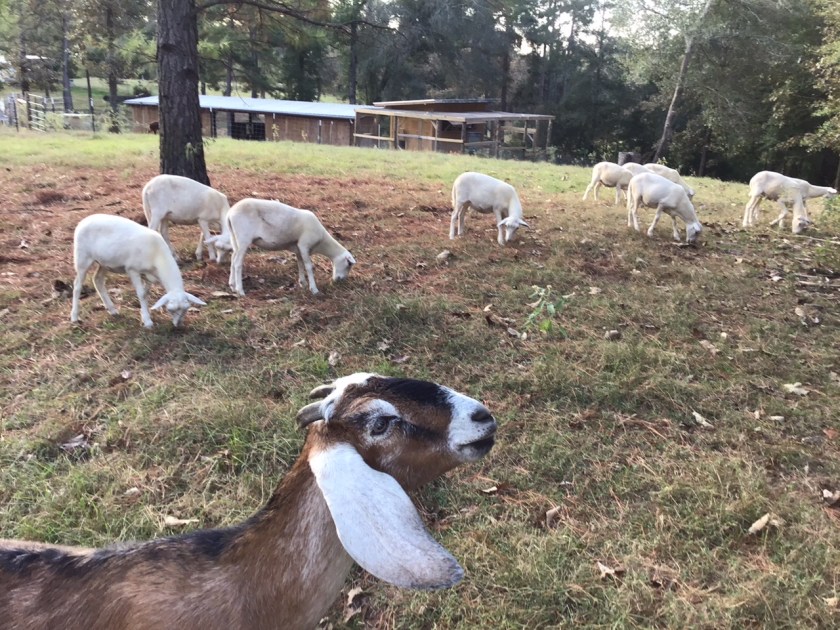
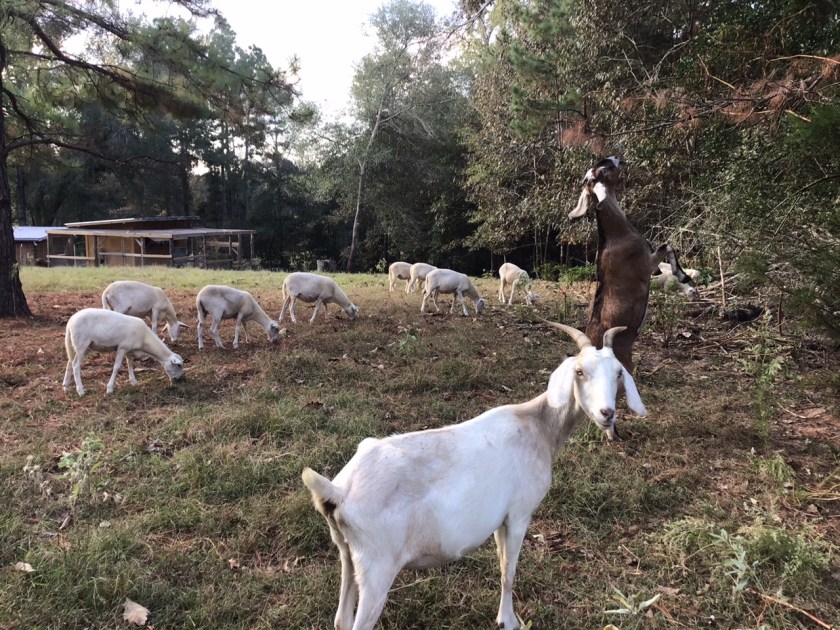
Time to wean the lambs. It was a loud couple of days as mamas and babies were separated, but with Summer as surrogate herd Queen everyone has mellowed down again. Phoebe, the goat pictured on the left, will have her first mating encounter next month. Her sister, Chestnut, jumped the gun, by jumping the fence to be near the rams, the little hussy! FYI—a goat crossed with a sheep is a Geep, very rare and not very desirable.
Drum roll, please, for this next rare shot . . . A Skittles sighting!
Our barn cat, Skittles, who we see about once a week and lives mostly in the trees.
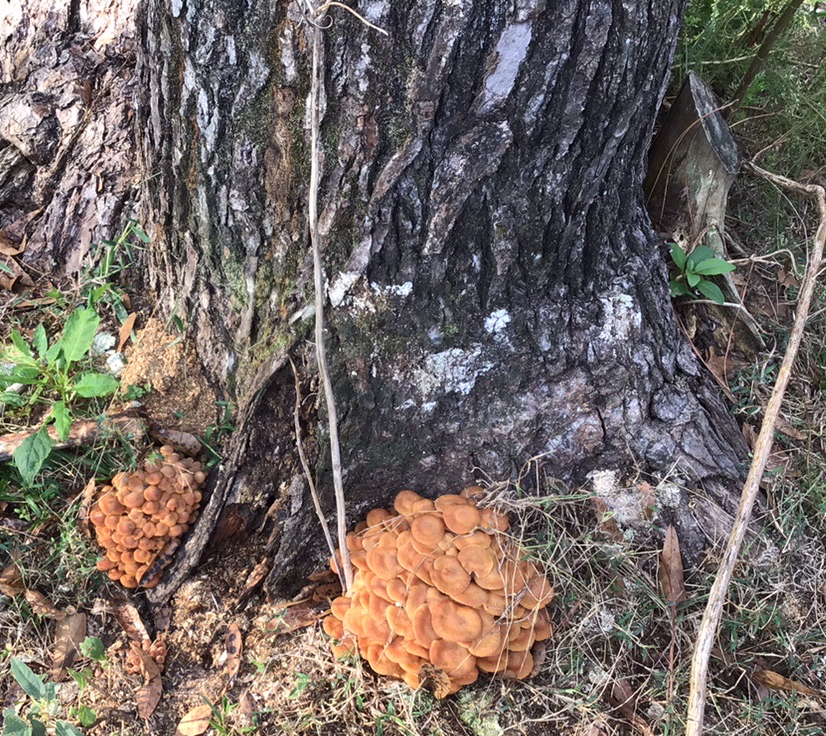
Mystifying mushrooms! These are quite common, honies (armillaria tabescens) claimed to be good by a good many foragers, but we haven’t tried them yet, because my mushrooming buddy and her husband got wretchedly ill on them once. Oops, I promised no unpleasantries. 😉
Buttercup paying homage to the pack leader, Tori, she does this multiple times a day.
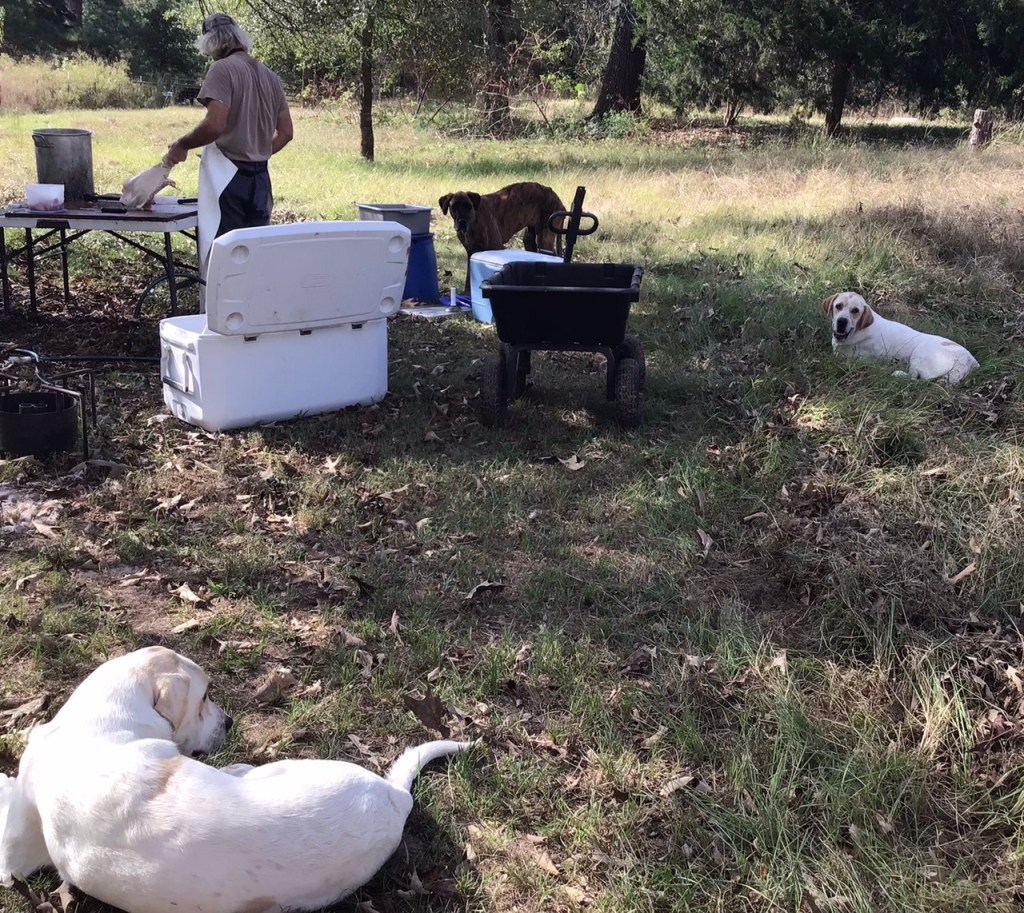
I suppose these next snaps might be unpleasant to some, sorry! I do get that, I felt that at first too, but I was gradually desensitized as I realized how much economic sense it makes, what an amazing skill it is, and especially how magically delicious it is.
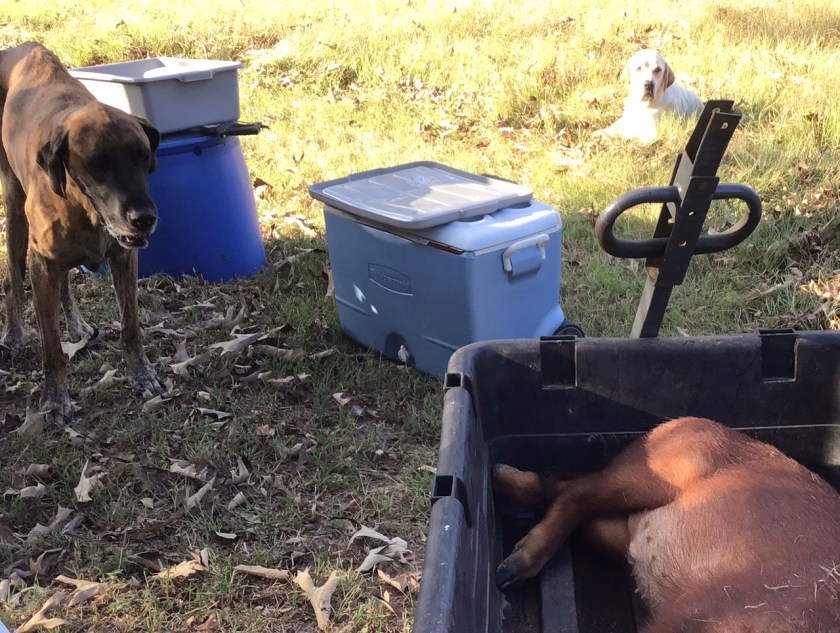
Always an attentive audience at slaughter time.
Our favorite foraging expert who we forayed with nearby this past spring has a great new website all about medicinals. Here’s a short podcast about it, and reminding me that now is the time I should be collecting some goldenrod before winter! Medicine Man Plant Co
We’ve been at this about a decade now, learning by trial and error. Because of a major health crisis in the family, I’ve been introspecting even more than usual these days. That’s why I haven’t been posting much lately.
I thought it high time to deeply consider what our own health futures might hold, Hubby and I, while we are not under the immediate duress of old age and poor health. Health is one of the main reasons why we committed to this homesteading lifestyle. Other reasons are political, esthetic, quality of life and, for me at least, a sense of urgency to hold on to something precious for future generations—nature—before it slips completely from our lives.
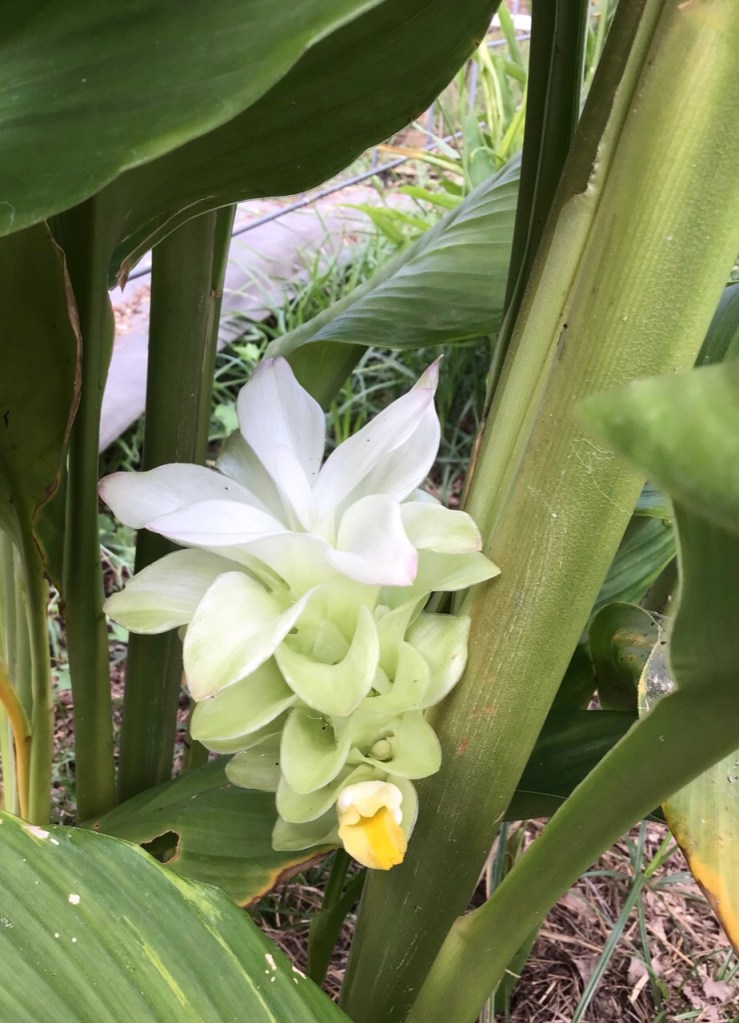
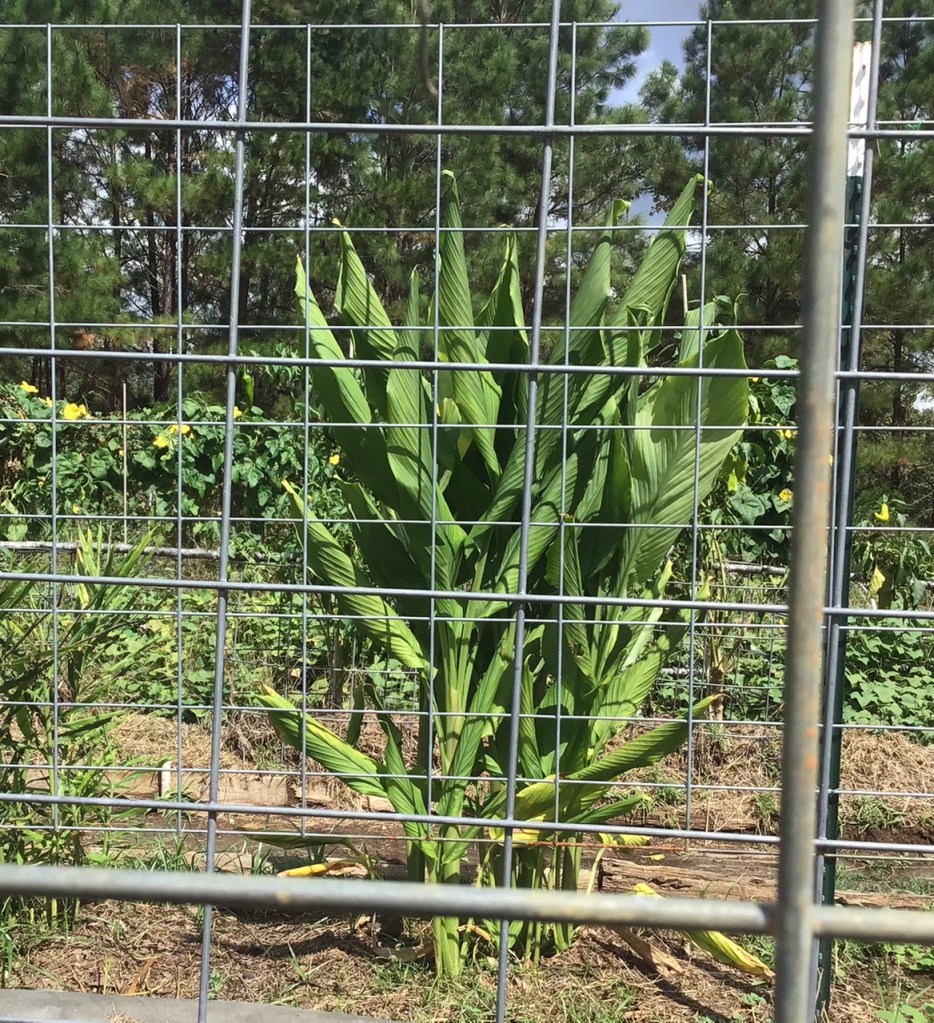
Tumeric flowering, didn’t know they do that!
Watching the impact of the Scamdemic not only on the economy, but also on our ‘health care’ system has demonstrated unequivocally that, despite the challenges and hardships, we’ve made the right choice.
Our ‘health care’ system, which is actually a disease promoting system, is beyond hope, in my estimation. (This one’s surely gone viral by now, but in case you haven’t seen it yet, it’s brilliant!) The DEVOLUTION of covid vaccine efficacy
I truly believe the only way out of the mess this country has become is by reclaiming our natural rights back from the government.
However, that first means reclaiming our natural responsibilities—those ‘unpleasant’ aspects of life we’ve come to outsource to the government (and their corporate partners in crime) in the first place, which has made it ridiculously powerful, as all governments (and their co-conspirators) are wont to be.
We are trying to accomplish that by first demonstrating to ourselves, and then hopefully to others, that such a thing is possible, and also desirable.
But what if, due to our increasing age, we had to choose? Limited strength, mobility issues, cognitive decline, all are serious potential threats to our continued lifestyle here.
Considering this I’ve made a few lists, ranking our current activities against future realities based on: Required inputs, health impact, pleasure principle, and bang for the buck.
It isn’t pleasant. I don’t want to give up any of it, ever! Bees, chickens, pigs, sheep, goats, veggie garden, fruit orchard . . . . But, here goes.
Kombucha, no caveats, it stands alone. If you can make tea you can make kombucha. It’s healthy, it’s fun, it’s delicious. Hubby no longer drinks beer or soda thanks to this amazing beverage, better for health and finances for us, and far better for the environment too, with almost no waste.
Sourdough bread, and already we have caveats. I know loads of folks think they are gluten intolerant; I used to think I was too. Grains properly prepared are nothing like most store-bought breads, for health and taste. Around these parts you can’t even find good bread. In other locales you may be able to find it, but I’d guess the prices are scary. Making your own sourdough bread is time consuming, but it’s not difficult. Same goes for sourdough cookies, brownies, pizza crusts, etc. And, let’s face it, gluten-free products are not tasty, so there’s some extra incentive.
Raised garden beds, and more caveats. Starting to garden at an advanced age is probably not going to be too successful. Of all we do here it claims the prize of Most: most expensive, most labor intensive, most greatest learning curve, most unreliable results. Still, I love it! So, continuing to garden with some foresight and adjustments is perfectly doable. I insist!
That short list makes me sad. It’s the bare bones and I hope such sacrifices will never be required of us—no more chickens, goats, big dogs, great big garden?!
I don’t even want to consider it, but there it is.
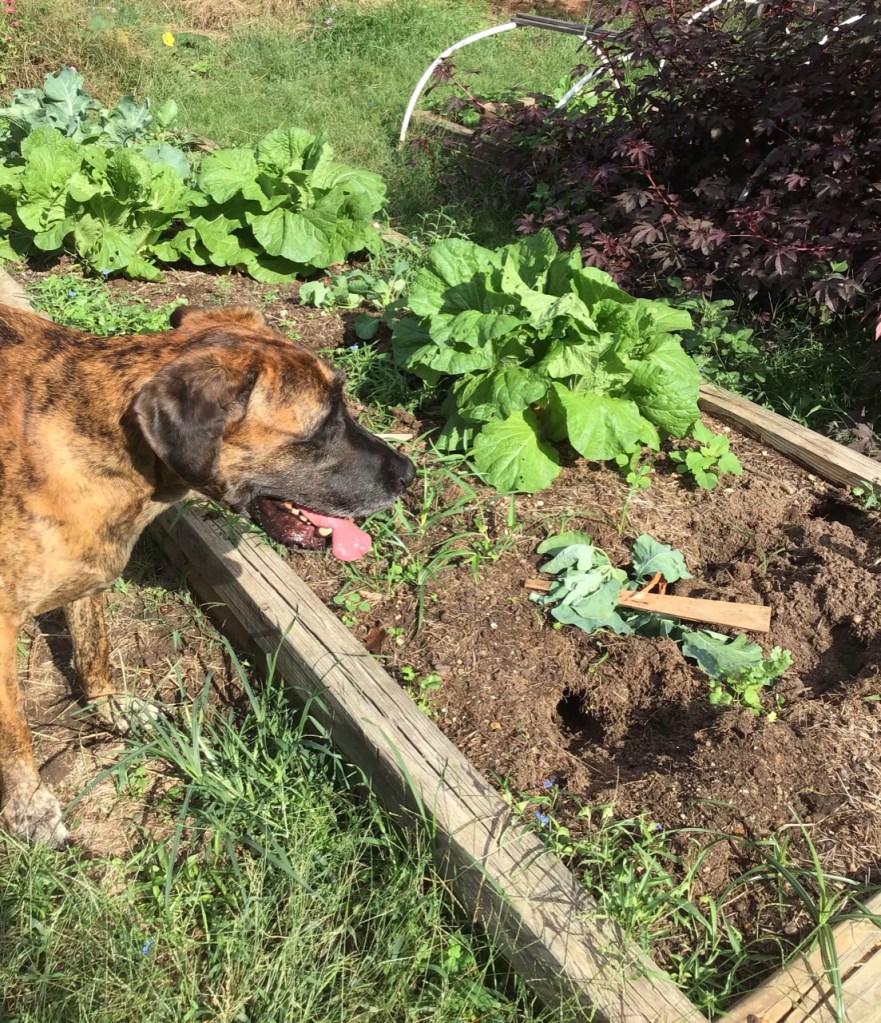
Tori surveying the gopher damage. Bad rodents!
There are also many projects still on my list to successfully accomplish, which are in trial and error mode now. Like making all our own body care and household cleaning products and herbal medicines. Hubby has future hopes of making furniture, if his current to-do list will ever allow it. No time for poor health here!
So, another short list is in order. The three things, in addition to those above, that I hope and pray we never get too old for: 1. Bees — not even for the honey necessarily 2. Chickens — they are easy enough to manage, but they attract predators 3. Goats — mostly for the cheese making, but they’re pretty good company too
And the three things we would most likely not be able to continue into old age: 1. Slaughtering — tough work, no doubt about it 2. Orchard — even established ones are a lot of work 3. Pigs — high maintenance, yes, but so delicious
We have no intention of ever rejoining urban life. And as far as intentions go, avoiding nursing homes and hospitals is right at the top of that list as well.
No rest for the weary around here! Our goal of year-round garden harvesting has been met and is every bit as rewarding, and exhausting, as I expected.
Living, working and eating according to the season is remarkably satisfying. In the last couple of years especially I’ve spent much less time learning from books and much more on direct observing and experimenting.
I’m thinking our next goal should be to throw the calendar and the clock out with the garbage. Show those Amish what a real Luddite looks like! HA! 🙂
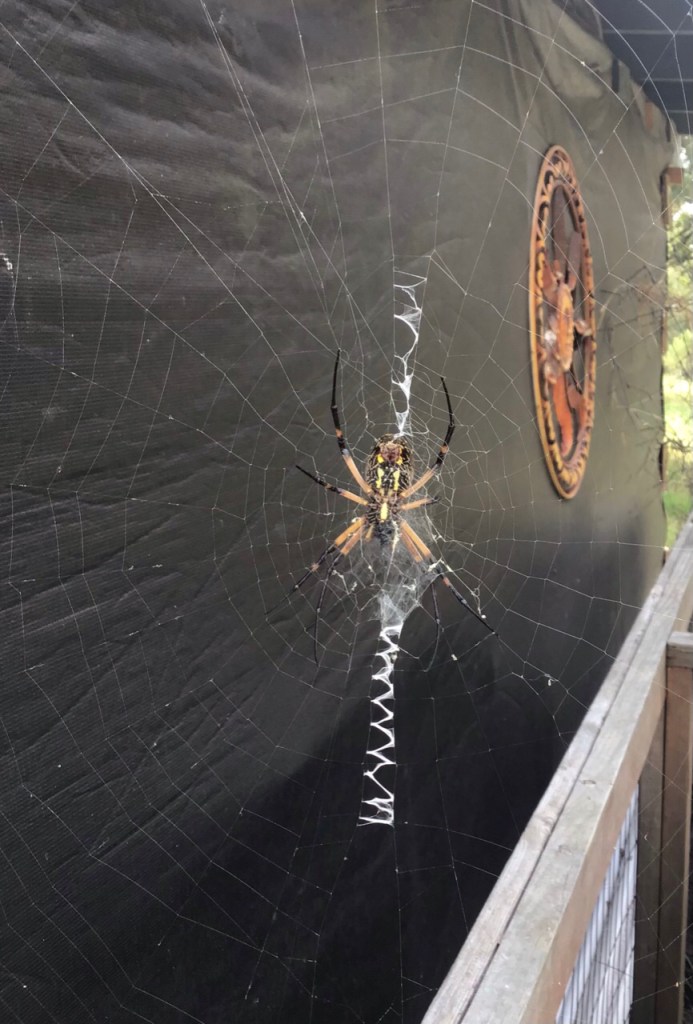
This time of year the spiders tell me it’s a good thing I’ve got the cool season crops out already. Many of them were started indoors, then transferred outside under shade cloth which will remain until the heat breaks, fingers crossed we don’t get an early frost.
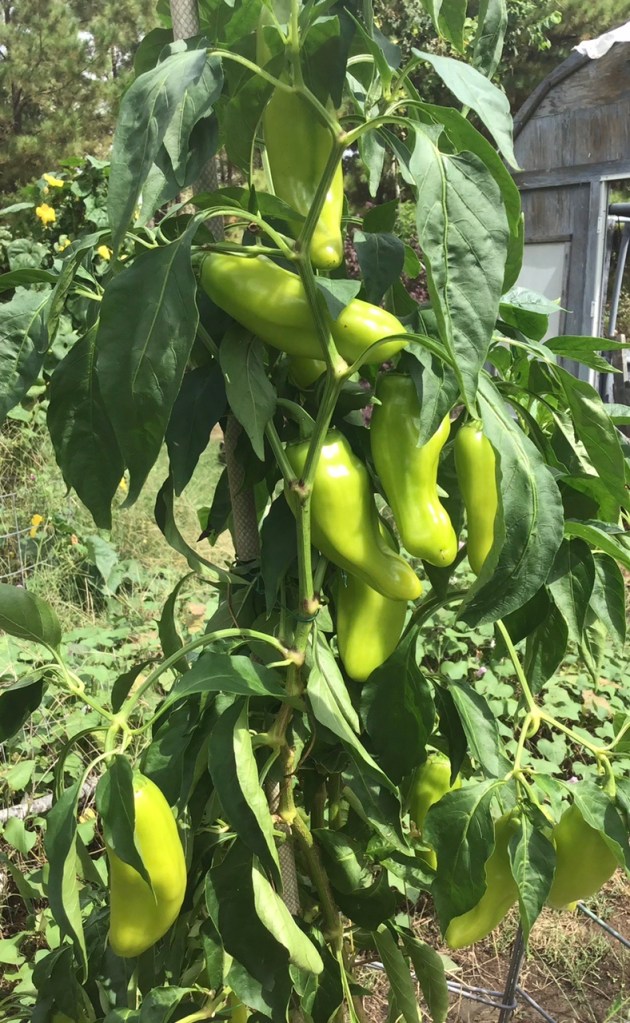
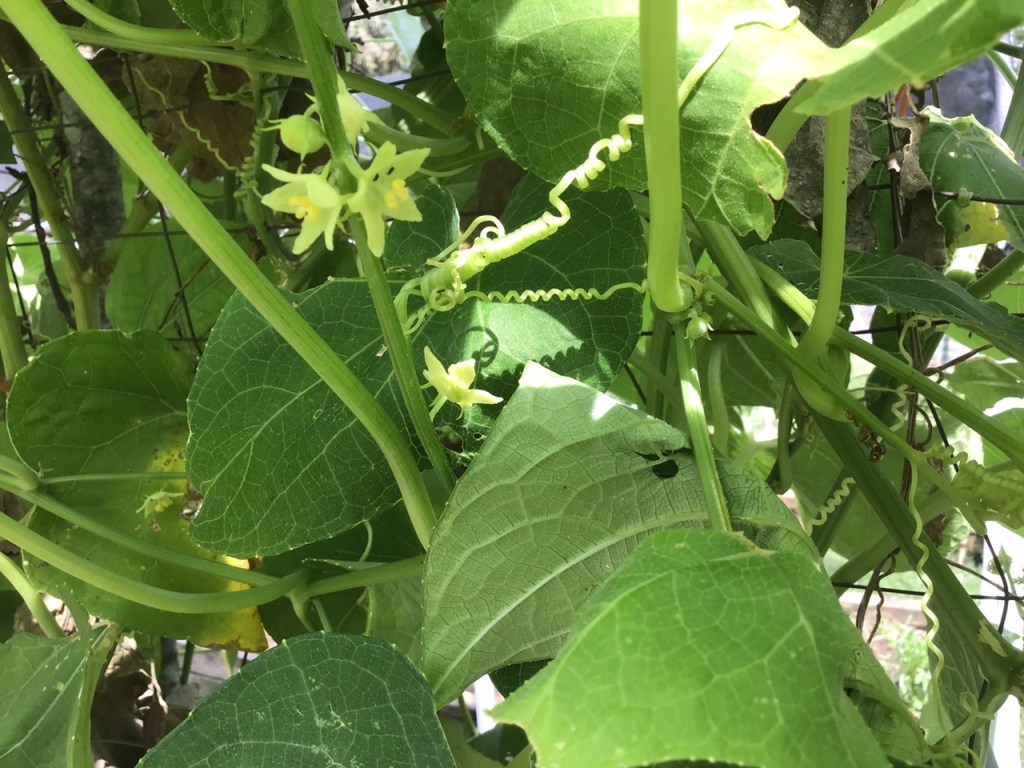
I’ve just started harvesting the sweet potatoes, the luffa and peppers are going crazy, the radishes, volunteer cherry tomatoes and lettuces are finally happy again and I’m most excited for the mirliton squash (chayote) that is finally getting its first flowers. This will (hopefully) be our first success with mirlitons following multiple failed attempts. I love this squash, but it thrives in southern Louisiana mostly, because it needs a very long warm season, even longer than we get here. I started these indoors in February, along with the turmeric, also a first for us this year.
As soon as it cools down I’ll also be harvesting honey, lots of herbs for drying and pesto, along with foraged leaves and roots for teas— sassafras, beauty berry, sumac—and once we finally get some rain, it’ll be time for mushrooms.
Hubby will be filling the freezer with lamb and pork and freshening our flock for spring lambs and a few to add to our growing herd of milking goats.
Hibiscus in May, hibiscus today . … still not blooming because I got a late start.
The honey bees love the Thai basil and the native bees especially love the salvia and the sweet potato and luffa flowers. We’ve decided next year to plant an entire row of luffa in the orchard just for the bees and pigs.
Hope you can enjoy a moment of piglet playtime! Surely there will be time for a wee rest in late winter?