So. Much. Milk

A sudden mini-miracle has occured and has turned the month I completely intended to be an exceptionally lazy one into a whole big mess of work.
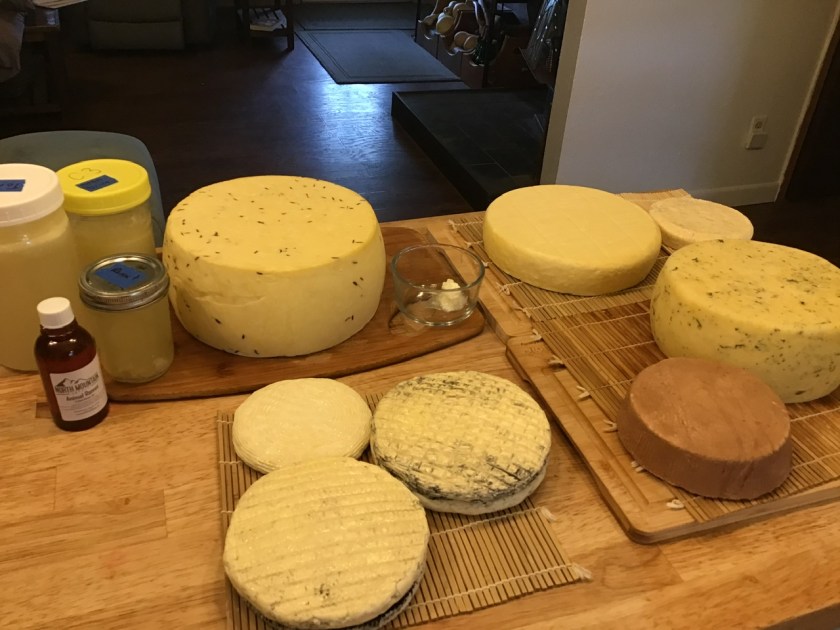
What’s in your cheese cave?
A portion of the cheeses I’ve made in the last two weeks, the largest was from 9 gallons, which was transformed into a Caraway Gouda. The smallest was made right in the half-gallon Mason jar with milk directly from the cow, never cooled and ‘backslopped’ from our own homemade goat rennet. Backslopping was a traditional method used on the farm to carry the culture and rennet combination from day-to-day, similar to keeping a fresh starter culture for sourdough bread.

While it’s work I love, the problem-solving has been endless and my shoulder is an on-going issue. After such a long search, this was so unexpected and has caught me off-guard, unprepared and re-injured. Why am I not surprised?

My milk-quest for cheesemaking has been a decade-long challenge. For the briefest of run-downs I’ve watched raw milk prices double in that time, tried and failed at goat rearing, and for the past couple of years I’ve been herdshare hopping, with prices far too high for cheesemaking.

A few weeks ago I tried another herdshare–closer, nicer, and so much cheaper. Finally, I can make cheese to my heart’s content, to hell with my aching shoulder! And thanks to Hubby on early retirement, who is willing and available for all the heavy lifting.

And who also helps with the redneck innovations–having just made me a new collapsible cheese-hanger unit and also made my cheese-press.

I’ve even been able to experiment again it’s so reasonable, at just $3.50/gallon. Not since the goats have I managed to pay so little for such cheese pleasures. My new milk lady is short on customers, half her milk is going to her neighbor’s pigs every day.

All I can think is, how crazy is that? That precious milk goes to the pigs, because it’s illegal to sell it anywhere but at her farm and to process it into cheese to sell is also illegal. While I can imagine those are some very happy pigs, I still wish I could sell cheese.

Actually, not so much the selling part, just the making part. I do often give it away as gifts and I get rave reviews. I’m often asked why I don’t sell it at the Farmer’s Market, because so few know how illegal it actually is. The requirements for licensing are very strict, not a chance a home kitchen would pass, (Great Dane not included!) and even with all the proper paperwork and a professional kitchen, many cheeses are still illegal to sell.

Various whey beneficiaries on the homestead:

I don’t want to run a cheese business anyway. I want a HWB (Hobby with Benefits) with those benefits being financial as well as delicious.

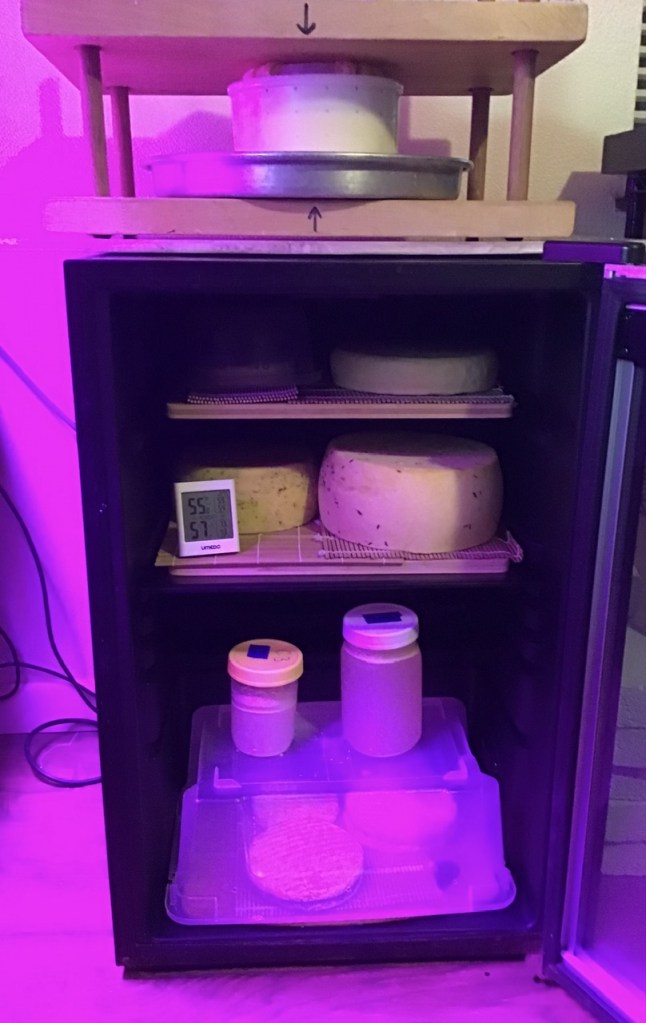
For now, I’m already out of room in my mini-aging fridge. I bought a second one, but once I got all the cheeses in it I had an impossible time getting a steady temperature. I gave up after 3 days of trying, to a mess of 70 degree cheeses sweating and dripping and starting to smell bad. The fridge regularly swings by 30 degrees, a cheesemaking nightmare.

I can work with a steady 50-55, and control humidity using plastic bins, not exactly a cave in the Loire Valley, but I can make it work well enough for a short Redneck affinage.

The non-existent affinage fridge of my dreams would be humidity controlled. The one that’s close enough costs a mere $700 and has temperature control in two sections (nice!). It’s technically for wine but home cheesemakers who can afford it often convert them with great success, or so I’ve read.

Let me just put that up on my vision board and see if it arrives in a timely fashion!

Also on my wishlist, David Asher’s latest book. His first book is my go-to resource and changed everything I was doing in making cheese, “The Art of Natural Cheesemaking: Using Traditional, Non-Industrial Methods and Raw Ingredients to Make the World’s Best Cheeses.”

Despite the struggle for a reliable raw milk source I have come to the wonderful place in my cheesemaking skills that I no longer follow recipes. I still read plenty of recipes, of course. But I read them to glean new techniques, learn cultural differences and especially pre-industrial methods, and imagine new combinations, in order to try them in my own way, like the rest of our cooking here. Hubby works the same way with his culinary craftiness.

It is the key to turning cooking from drudgery to joy, imo. It’s ‘the zone’ like they talk about in sports, or artists in their creative flow. Who wants to do that in their sterile industrial kitchen rather than in the comfort of their own home? Some, I know, but definitely not me.
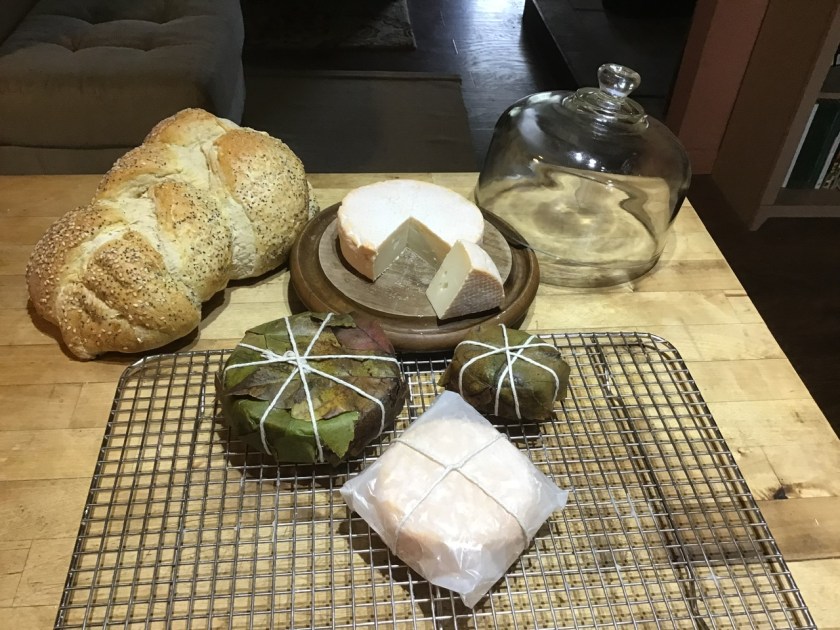
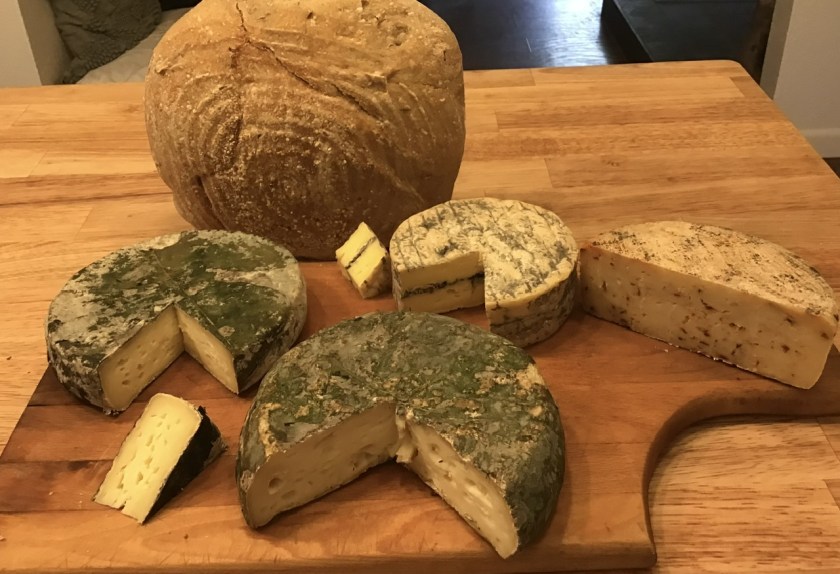
Some previous cheeses “Kenshobert” in my territoire version of Camembert.

Turning a favorite hobby into a business is the joy-killer. Being well-rewarded for a favorite hobby is the goal. That’s magical like milk transforming into 1,000 cheeses is magical. Some call it alchemy, but really it’s just fermentation, maybe the most ordinary and natural process in the world.

Cheesemaking is also economical and beneficial to more than just our health and palette. The dogs and the pigs get all the whey after the ricotta is made–whey ricotta is a delicious ‘by-product’ from making hard cheeses. So from each gallon we get the heavy cream for coffee and ice cream, milk for cheeses, and whey for other recipes and very contended critters.

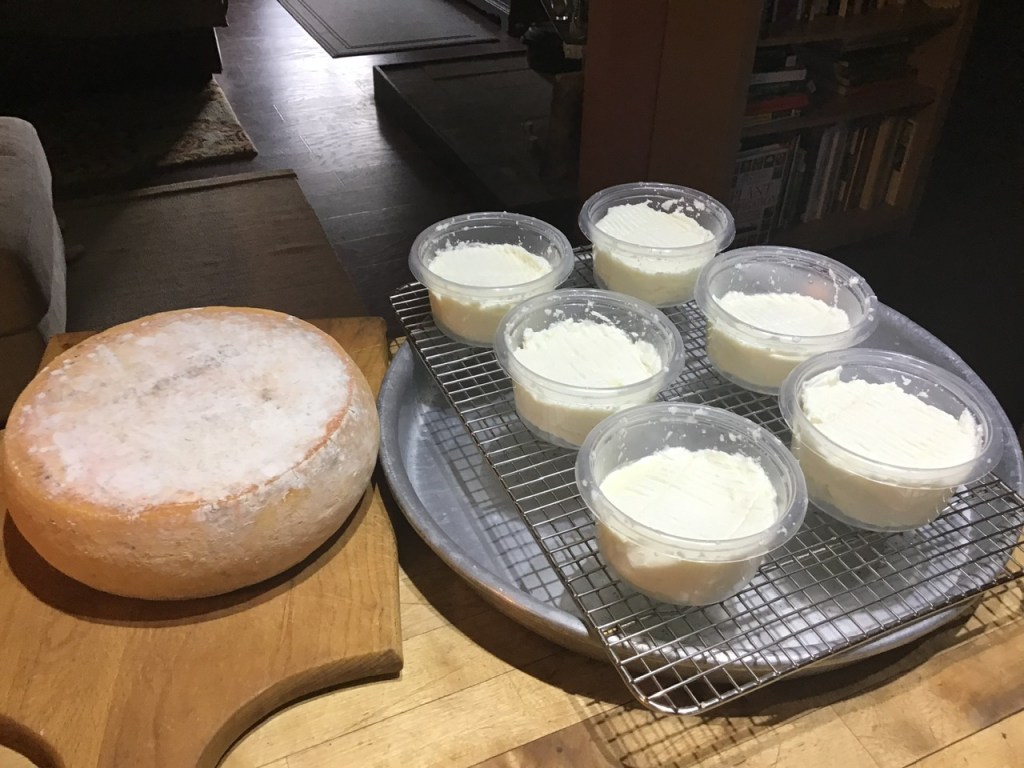
Ricotta pressed overnight then soaked 3 days in homemade hard pear cider. Eaten fresh, with fruit or crackers, it’s mild, slightly sweet and tangy.

The critics of course think it a lot of wasted work when cheese from the grocery store is cheap and plentiful, and there’s a growing network of artisanal cheesemakers who craft excellent cheeses (for a hefty price). I’ve had plenty of such cheeses and they are indeed delicious and worth the money.
But, they are all subject to the laws, which usually means: pasteurization, medicated animals, artificial lab-produced rennet (brought to you by Pfizer!), and freeze-dried cultures, also lab-made.

All that is exactly what I’m trying to get away from, in order to craft the most natural, local cheeses as possible. It’s an impossible task while remaining inside the laws.

Yet, there are folks still alive today who can remember when the laws weren’t so intolerably squashing to taste, creativity and economy. Just as there are old-timers here in Texas who can remember the days when they were allowed to raise, kill, process and sell their own livestock to the public, there are cheesemakers up north (no traditional cheese country in the south, too hot) who can still remember a time they could sell their handmade cheeses produced on farm in their own kitchens. Now most cheeses sold in this country are essentially fake, already lab grown, like the ‘meat’ they keep trying to push on the public.

Somehow there are still the majority who continue to call this freedom and progress.

Assessing Value

Back to this unpleasant subject again. It’s been a very long loop; I haven’t considered it much since first attempting to barter goods from the wee homestead.

It’s something we really do take for granted in our modern economy, whether one takes that as an inherent good or evil.

The good part is that it’s comfortable and I prefer it, on the surface. I hate bartering. I SO suck at it. I suck at it for reasons that are so deeply-seated (seeded?) that no logic can ever possibly be applied.

On travels to some countries barter was the norm and I was told to keep practicing as I’d get better at it. Some seem to enjoy it. These sorts always baffled me. They say, “Treat it like a game!” But that is really stupid, isn’t it, because I did not go out shopping in order to play a game. I already don’t like shopping much, to think I’d like it more by making it game-like is to make it ever closer to hellish.

So while it may not sound like it, this is the good side of money. It took me a long time to learn that. Not until I had to consider such exchanges as, which was of better or equal value, the handcrafted Top bar beehive, or the wormy, bossy, but still a good milker, Summer, a 7-year old goat?

Money, in partnership with “the Market”, make such exchanges far more simple. Since none of us has a crystal ball, and I have no idea how long Summer will live and there are no guarantees, and my friend has no idea if she’ll enjoy beekeeping, or be able to keep bees alive in our chemskies and YoYo climate, our exchange is made more simple by imagining what would be the ‘market value’ of each of our offerings.

The dark side of money it seems to me relates quite easily to the dark side of most things—like religion, or science, or even education—it provides, by its very nature, an endless potential for ‘middlemen’. It becomes a profession, then a vast sea of professions, then an institution, then an institution ‘too big to fail’.

It’s convenient and comfortable, no doubt about it. It’s easy enough for a child to use, but complex enough to build empires upon. Try to imagine living without it.

Do we really consider how we, as individuals, would place value upon goods and services anymore?

What about once money is replaced with tokens. It’s pretty much the same thing already, right? Tokens as a medium of value exchange—your massage is worth 2 dozen yard eggs. Right?

Well, the market value of your massage today is 20 tokens, but the value of my eggs is 10 tokens, today, and 15 tokens last week, and is projected to be 25 tokens tomorrow. That’s the real problem with the market, right? For you and I, as individuals deciding value between us, the eggs and massage exchange didn’t fluctuate vastly over a matter of days, or even weeks. It’s pretty steady, really. You use 2 dozen eggs per week, I like 1 massage per week, stable value exchange.

But I’ll bet you 5 economists in the room with us would tell us 50 ways it’s not really a stable value exchange. And, why be stable at all if there might be a profit to make? Then a dozen lawyers will tell us why those economists are right. And a nation full of universities will continue to produce a fat muffin top of middlemen to stuff between every simple interpersonal transaction in every tiny hamlet around the world.

I’m bothering to restate the obvious at this moment because I’m trying to re-assess the value of technology in my life. It started with the recurring headaches of social media many years ago, then moved to Smart phones, and lately it’s WordPress.

Then a cyber-friend shared a dream, which caused this spark of inquiry.

“Imagine if we could create an Agrarian world again, using technology as a tool to help us,  but not control or surveil us.” 

Can we make a more agrarian life through technology? Which I understand as, can technology help us to get back to basics? And by basics we mean an understanding of nature, an appreciation of its organic processes, a “re-enchantment” as I’ve heard it lovingly expressed, with the natural world. Working with our hands again, I presume, creating items of value to exchange with one another. A slower life perhaps, where we have the great luxury of time to enjoy our lives and our nature world to a greater degree than afforded to most in the modern world.

A ‘re-enchantment’ with nature, I like the sound of that.

An ‘agora’ that’s not corrupted by fiat, usury, taxes, violence and coercion, perhaps?

Technology in our private life here on the wee homestead has benefitted us in a few crucial ways—helping us to learn new skills has been the most significant. But keeping us from feeling terribly remote and unconnected and uninformed has also been very important. I’ve made a few good friends thanks to the internet and I’m very grateful for that. Feelings of isolation and loneliness can be significant spiritual hurdles for some of us living rural for the first time.

And I have seen promising shifts over the years. Homesteading is clearly a bonafide cultural movement at this time, I think primarily thanks to technology, as oxymoronic as that sounds. Herbalism has become more appealing as Pig Pharma breathes heavier down our necks. Pockets of interest and learning are all over the cyber world, every craft, trade or skill imaginable is available somewhere with a few clicks, I’m sure.

But I have seen and heard some really concerning trends lately, which makes me realize that the time to be re-assessing the value of the tech in our lives is reaching a crescendo.

For example, the young entrepreneurial types who are coming in to fill the needs of the rural communities with essentials like raw milk, homegrown veggies at the farmer’s market, small service businesses and the like, well they aren’t like us in some really fundamental ways.

They trust The Science, for the most part, evident in their willingness to vaccinate, medicate, use the latest supplements and vitamins, and not question any of it. They also love the tech and fully embrace the insane trifecta of the Global Grid: Surveillance cameras, Smart phones and digital payment systems.

How is that value assessed? Who is benefitting more?

My guess would be, more often than not, the middlemen. Like any pyramid scheme a few must be making good for anyone else to follow. For a while.

Seems to me these young entrepreneurs are setting themselves up for certain failure. I met one of these ambitious young women last week on my quest for raw milk, now that my goats are mostly gone. I really miss making cheese. The price of raw milk, not even organic, has gone through the roof as demand has perked up—$11/gallon around here. It’s too much for us to afford.

What did I learn from this experience? Her surveillance cameras everywhere tell me she doesn’t trust her customers or neighbors. Her vaccination schedule tells me she does not do her due diligence in caring for her animals. Her price and her preferred payment by QR code tells me she prefers dealing with middlemen over direct transactions and getting to know her clientele.

I will not be doing any business with her, that’s for sure.

So, while I still have a lot to learn about assessing value, there is a point to this rather rambling post: The goat is dead, no bees have yet to make that hive a home—but no one else profited or lost from that private exchange—and our relationship stayed in tact to trade another day despite these apparent failures. I think nations have gone to war for less.

And that’s something so far social media, Smart phones, WordPress, and indeed money, all fail to assess a proper value.

I’d love to hear any thoughts or ramblings about my cyber-friend’s dream, what do y’all think, is it possible? Would you want such a world?

“Imagine if we could create an Agrarian world again, using technology as a tool to help us,  but not control or surveil us.” 

How long before this field gets paved over for yet another Vape Shop, or Dollar Store, or Walgreens? Is it considered an improvement if it’s a Smart Farm run from Brussels by robots?

Homestead Happenings

Sometimes I look at Handy Hubby and whine, “Please, make it stop!”

Then I think of the shrimp scene in the film Forest Gump—you got your boiled shrimp, your fried shrimp, your grilled shrimp, shrimp creole, your gumbo . . . .

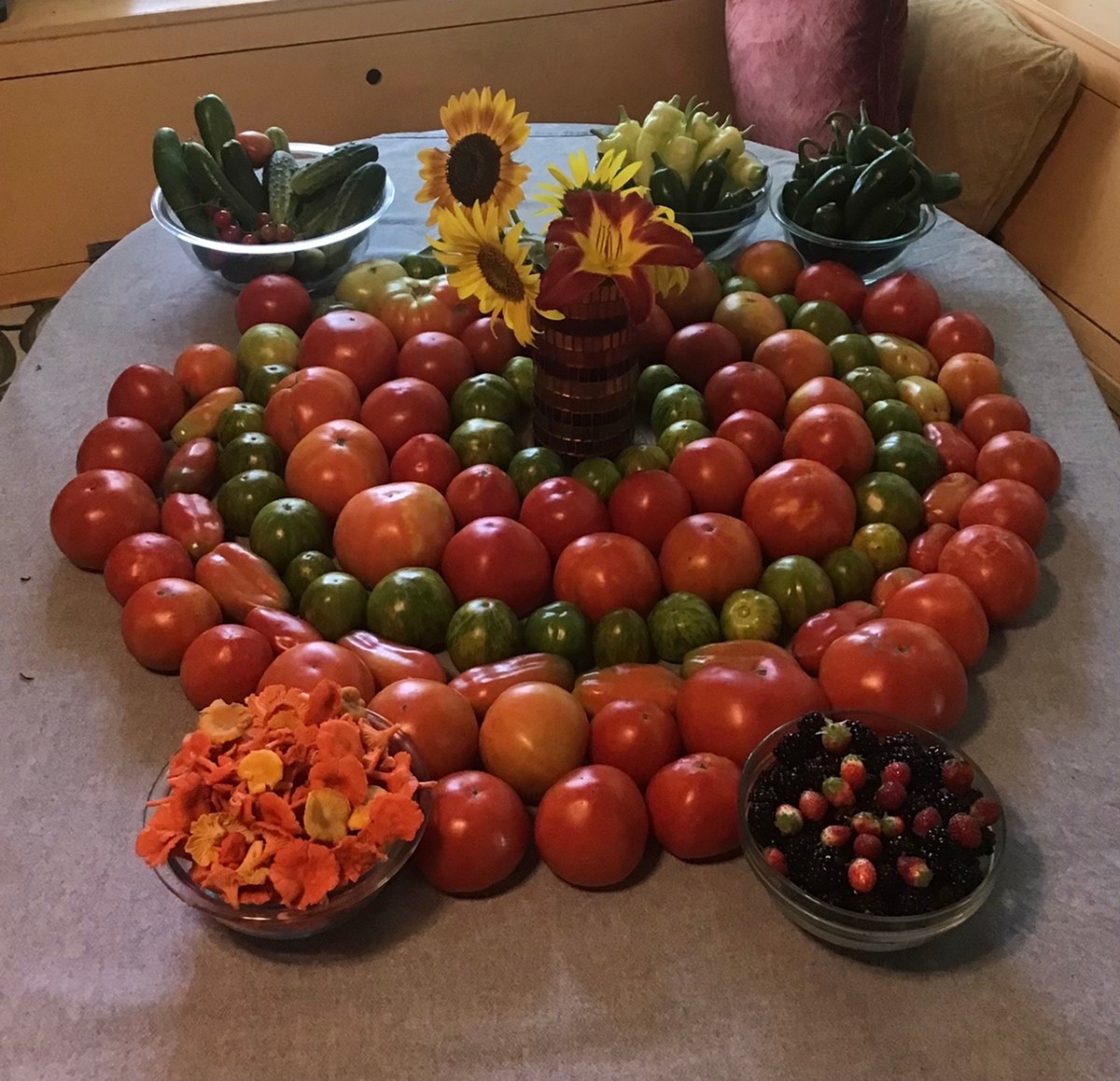
Only with me it’s tomatoes.

In my defense I planted so many tomatoes because last year was not good for tomatoes, so we didn’t can up nearly as much as we wanted and were way short on salsa. The crop burned up so fast, it was pathetic, even though I planted just as many, we got far less.
So this year I was really determined. Decidedly, way too determined.

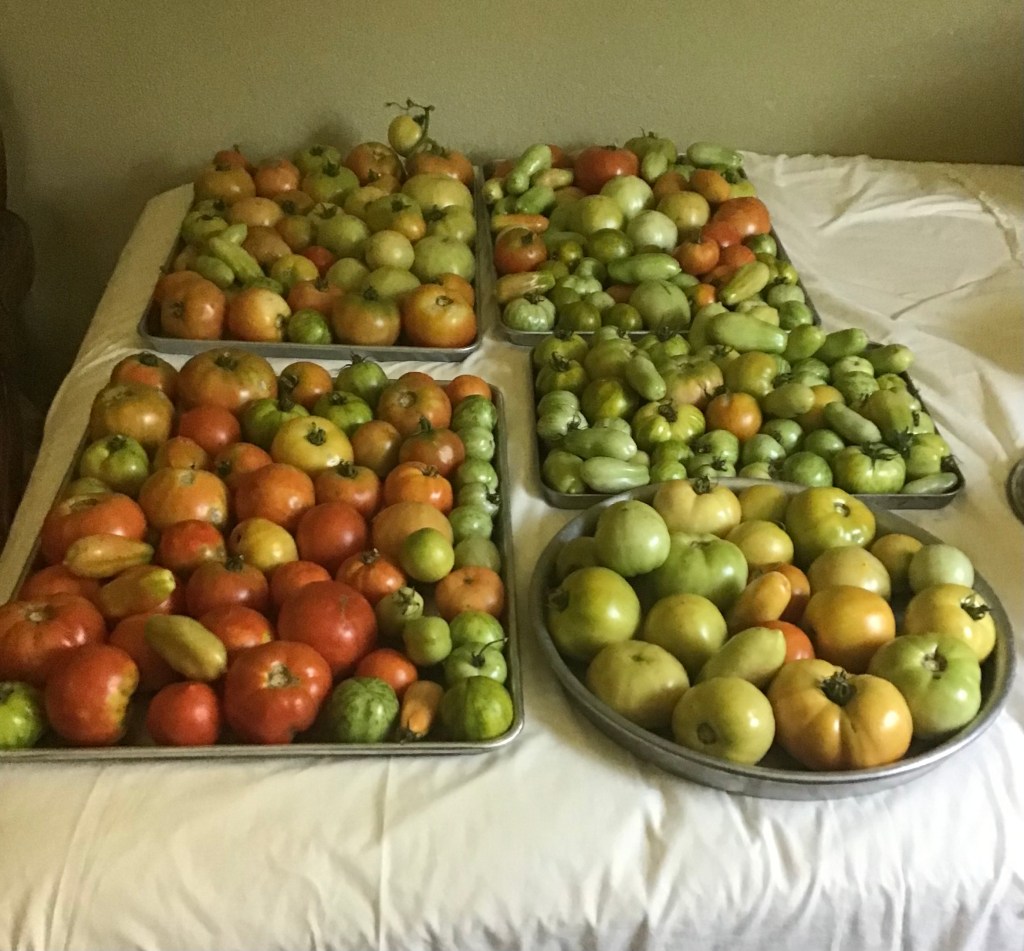
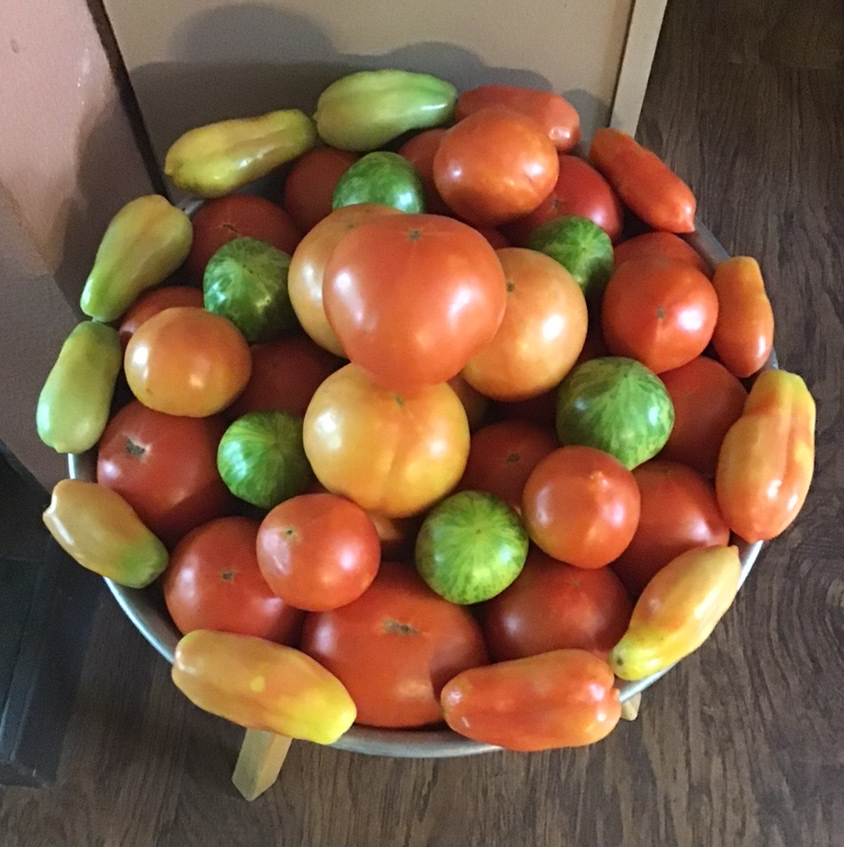
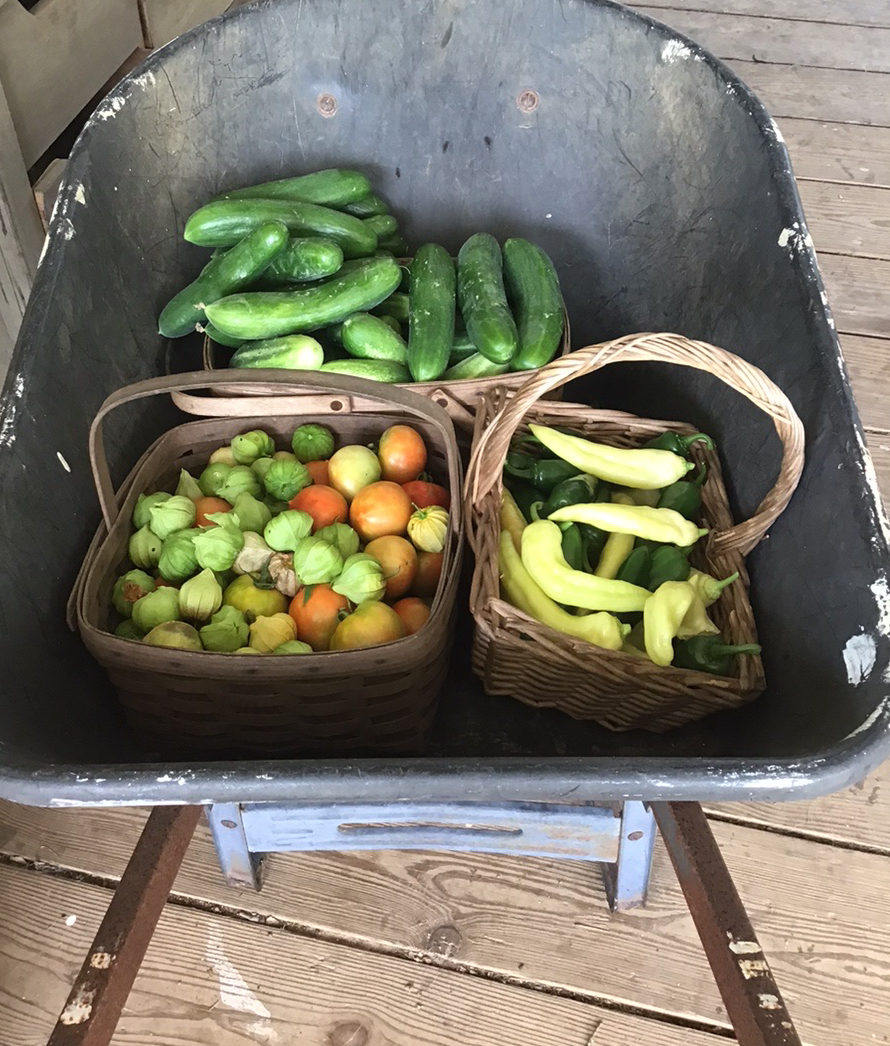
And, while we do (still!) have a bumper crop, it’s not exactly ideal, because once again, it’s so hot so fast that they are burning and exploding on the vine if I try to let them ripen properly. So, I have to bring them in to ripen, which means I’m really, really sick of looking at them everywhere.

Due to excessive heat we have uneven ripening, sun scald and plants dying while still full of unripened fruit.

But they are good, so, so good! My very favorite way to enjoy them is so simple—sliced and liberally doused with salt and pepper and served with— Everything!

We can chow through a good many this way, and it lasts for just a month or two, which makes our enjoyment all the sweeter.

So garden fresh you can eat them naked!

Then you got your salsas, your chutneys, your marinaras, your tomato soup, your creamed tomato soup, your plain canned, your Rotella style, spicy juice for cocktails, ketchup, barbecue sauce . . .. 😆. Did I miss anything?

And the cucumbers. Oh please, don’t get me started on the cucumbers! How I long for them all winter, and within two months can hardly stand to harvest them any longer.

I purposely planted fewer this spring, planning to stagger them more, for a longer season. In fact, there should not be so many cucumbers at all based on my inputs, and the sad fact that there are NO bees on them. By that I mean our own honey bees are not visiting our garden, though there are two colonies within 75 feet of it.

Speaking of bees, half of my colonies, that’s 3 out of 6, have perished this summer. I’m not surprised when I lose a colony over the winter or early spring, but 3 that were going strong into the summer, this is unheard for me, and super depressing.

I also notice far fewer native bees, and the ones I am seeing are much smaller. The wasps seem to be doing very well, so maybe that’s who is keeping us in bushels of cucumbers at the moment?

And of course we’re offering the surplus to anyone! We give it to neighbors, bring it to gatherings, get the word around that it is available, for free. What we can’t eat or give away goes to the goats and pigs and they need to eat too!

So, when I get the occasional comment that we should sell it at the farmer’s market or somewhere equivalent, I understand the well-meaning at heart. But, what I’m actually self-censoring myself from saying does stray a bit from the habitual and expected smile and nod.

Because what I sometimes hear, though I’m sure was not at all the intentioned meaning is:
It’s really not enough that you work your fucking ass off to produce all this fine produce, you should now go out and spend money on gas hauling it to town and suffer through the rules and regulations and pay for a booth and market it to a public who mostly doesn’t give a shit what they eat, and let’s face it, mostly just wants it cheap and convenient. So, don’t just plant it, nurture it, harvest it, sort it, wash it, package it, but now haul it to a market 20+miles away and stand there in the blazing heat all day so you can clear about $30.30 a truckload.

Sounds so awesome! Sign us up! 😳

On a brighter note, here’s something you’ll really like, because the world really does need one more cute kitten video!

Oh and Happy Independence Day y’all, thanks for stopping by!

Homestead Happenings

Busy days on the wee homestead as we try to maximize our production with the swelter season clock ticking. The scheduled weather is HOT and DRY for us for the foreseeable future and just staying on top of the watering is a big task.

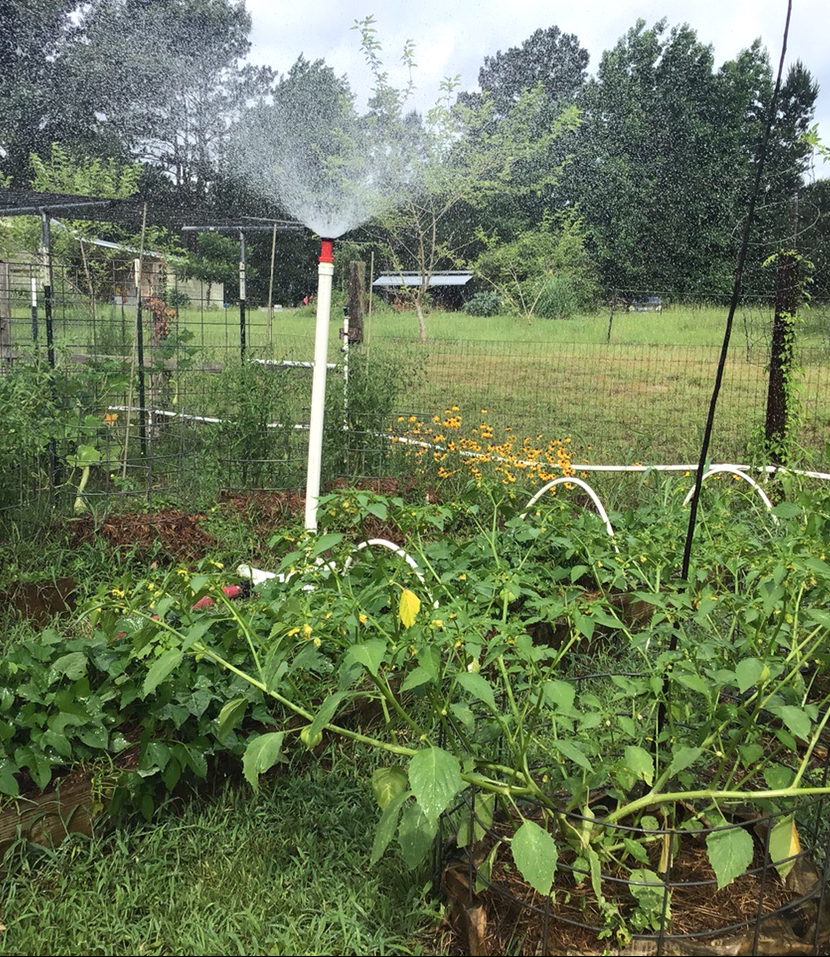
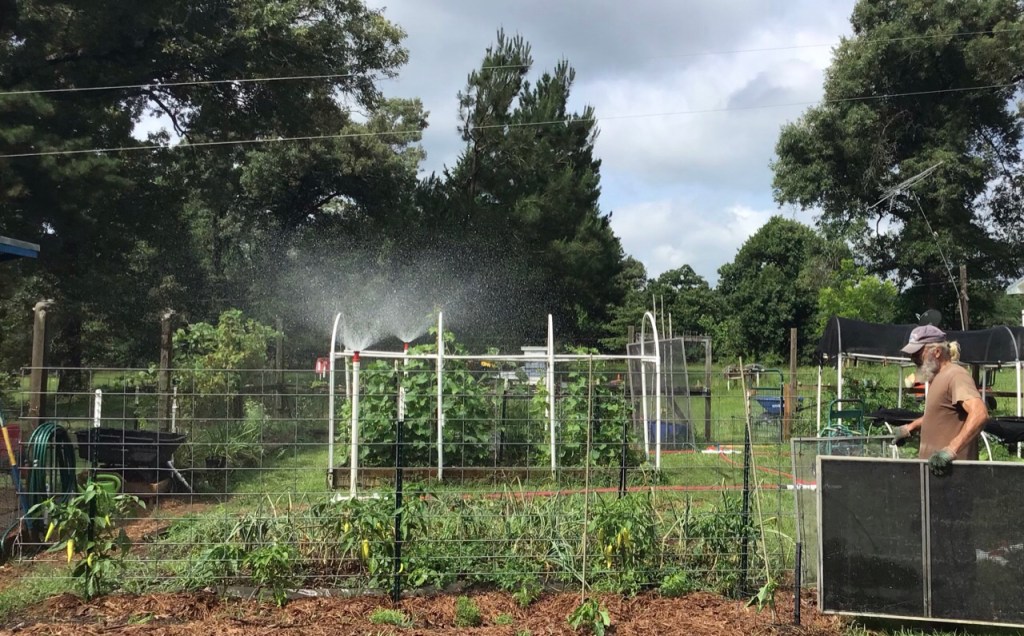
Hubby’s pond water pumping system is a life saver for the plants, but it still requires an entire morning per section in the garden, around the house, in the orchard, which means he’s walking back and forth, moving hoses, rearranging sprinklers, and sweating. It’s not easy, or free, but comparatively it’s our best option and I’m very grateful for it!

Adding shade cloth and screening wherever we can.

And, while I’m on the gratitude train, let’s give a big cheer and thank MAN for the air condition! We’ll be spending much more time indoors for a while, me especially.

Welcome new additions to the garden this year, Poppy and Nigella. Very happy for these, I’ve tried many times for poppies with no luck, and the nigella was gifted from a friend and the blue and white flowers are so darling and the seeds so delicious!

We continue to experiment with different preserving techniques and flavor combinations and it’s SO much more enjoyable for me to have his company and help in this endeavor, now that he’s home all month long!

Last year’s experiments of watermelon rind pickles and melon butter were a fine success we hope to repeat again this summer. Lately he’s also been making cream of mushroom soup from our foraged chanterelles that is SO delicious, as well as blackberry preserves. He’s also canned a bunch of potatoes and made a huge batch of ratatouille for the freezer. That’s a first for both of those, so we’re looking forward to the taste test.

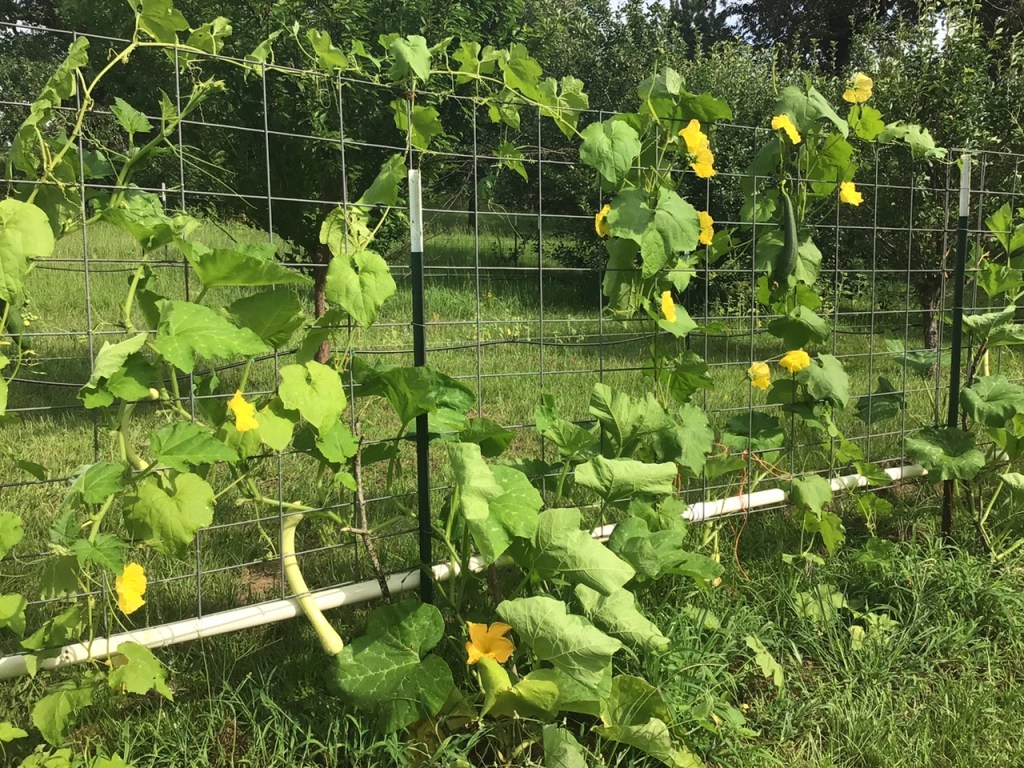
The cucumbers are coming in well, the melons still looking very promising, but the heat is definitely taking its toll on the tomatoes already. That is disappointing because we do love tomatoes and needed to re-stock our marinara this year. Hopefully we’ll find some neighbors with a bumper crop who are willing to trade for some of our prolific squash!

Lots more to share, on another day! 😁
Thanks for stopping by!