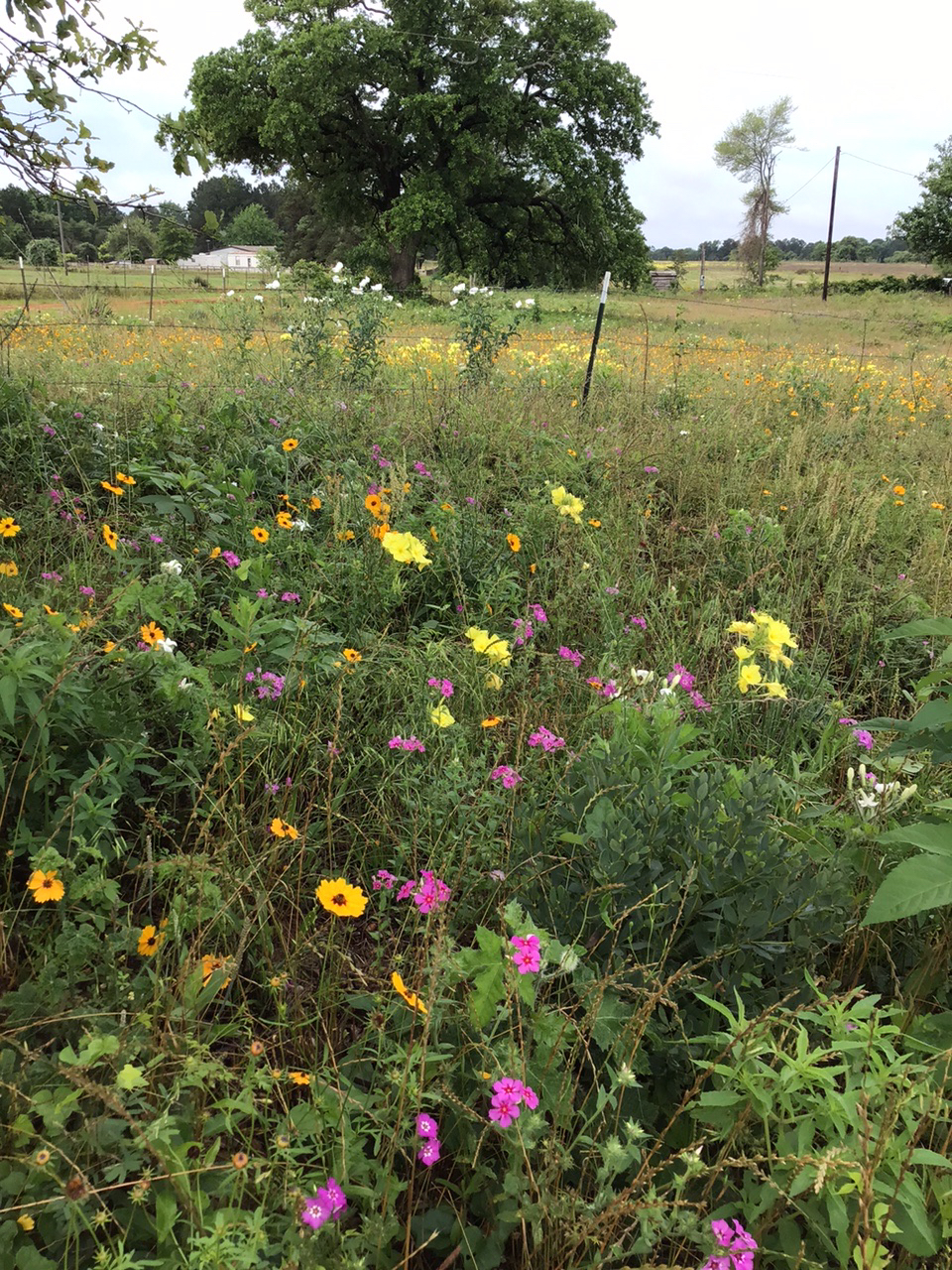
Another one from the deep archives, 9 years ago this month. In reflection what I wish is that I’d had more time to elaborate and get better photos. Noted, but probably not improving much in all these years. Maybe that’s why it had zero likes besides my own?! Room for improvement.
I know in these old posts formats and links are screwy. Sorry about that, but hope it’s still of value to someone, somewhere, sometime, besides me.
3.20.2017
Some iconic lines in films imprint on the psyche collectively and I know you could think of one right now that instantly crosses several generations and continental divides.
“You can’t handle the truth!” Name that film, name that actor. Could you even name his co-star in that blockbuster?
Somehow, somewhere, as a collective, we’ve given ourselves over to worship and celebrity and fantasy and distraction in the most destructive ways. I am not resolved from that influence and never will be. I watched TV constantly for years in high school, only to give it up for years later in exchange for an exhaustive social life, only to give that up more years later for work I found most of all, exhausting.
I had/have this secret fantasy I’m going to share right now (again). After hurricane Katrina, right after, when I heard on the news the city was more or less safe, and me many hours away in a quaint bed and breakfast drinking wine with lunch, the hurricane widely reported as much less dangerous than anticipated, but that residents would need to stay away for a few days at least for safety precautions, I was glad. Nearly giddy, and not from the wine.
I had just started a new position at Tulane university and already I didn’t really want to go back. It took a day or so more before all hell broke out and select areas of the city flooded terribly and all residents had to stay out indefinitely. In our case, we were allowed to go back after two months. For some, it was never. We lived in a trendy and relatively upscale area right on Audubon Park. It was a beautiful spot, both before and after the hurricane. Some were far from so lucky and they’d been there many generations, not just two weeks, like us.
I do hold shame for this secret fantasy, because I still feel it. When I dwell, necessarily, in the dark places of my life and the world, I know there is much sickness, far too much. Far too much destruction, voluntary and deliberate and needless. Still, I have dwelt in destruction.
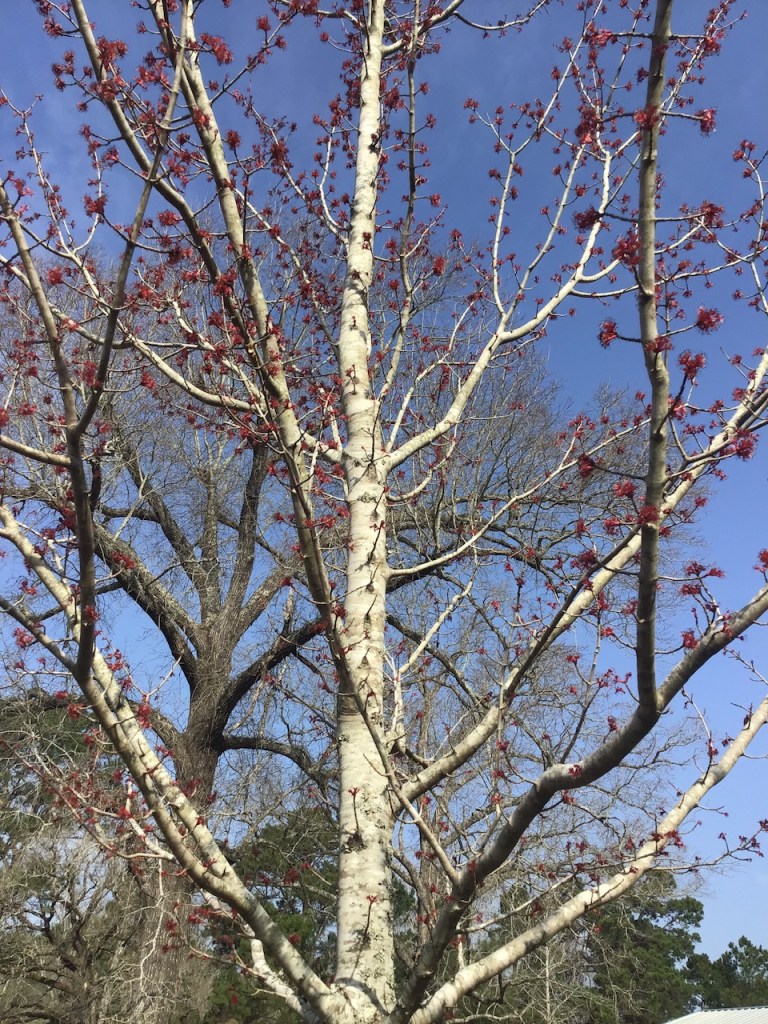
And there is too much wind, dammit, all around me lately seeming to get worse every year. It’s bloody annoying! We had no winter and now no spring. The plants and animals struggle with it far less than I, but still, I know, they do.
Wind is really stressful! This makes me smile, because there was a time I lived in Chicago and worked downtown and yes, the wind was legendary, but it was mostly something I peered at from the window and got annoyed at how it affected my hairdo.
But the wind is far more powerful and penetrating than I had, and I think most, ever realize. Is that not what blew down the house of each of the three little pigs?
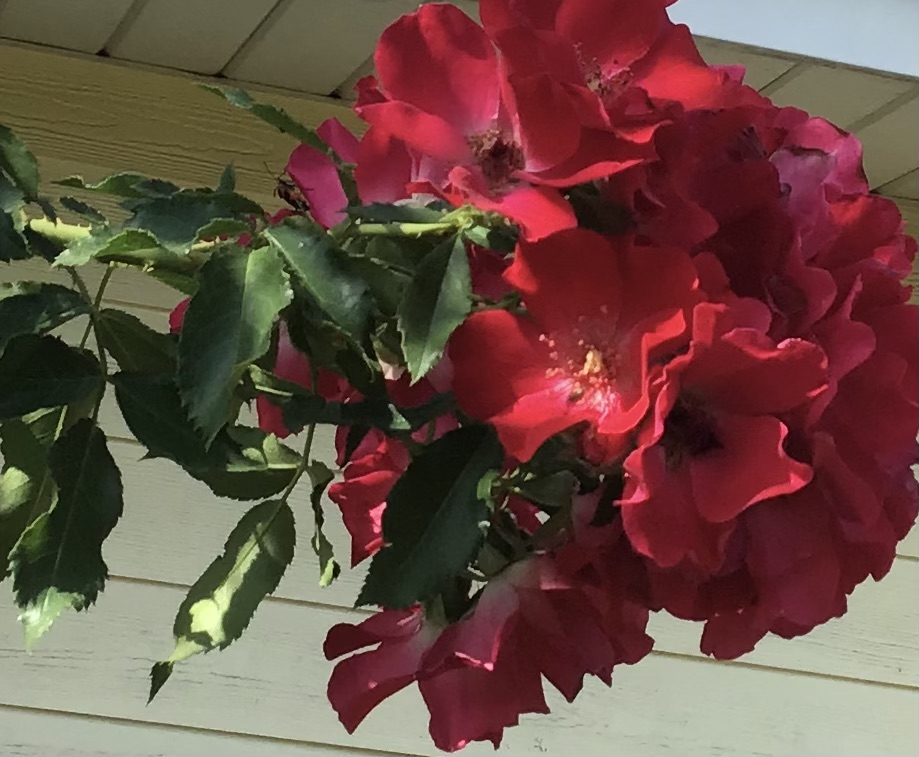
They are blowing, those wolves, our weather right now is as manipulated as the currency market. And in my secret fantasy I sometimes can’t help but wonder—would we all be better off in the long run if they would just blow it all down? Roses blooming at the same time as the dogwood?! It just ain’t right.
This week’s breadcrumb, I’ve got so many I’d love to share this week, but this one is so essential it needs to stand alone.
Unslaved podcast, exploring the self in the work of Ayn Rand and others.
As the world reboots, this is where the rubber will meet the road.
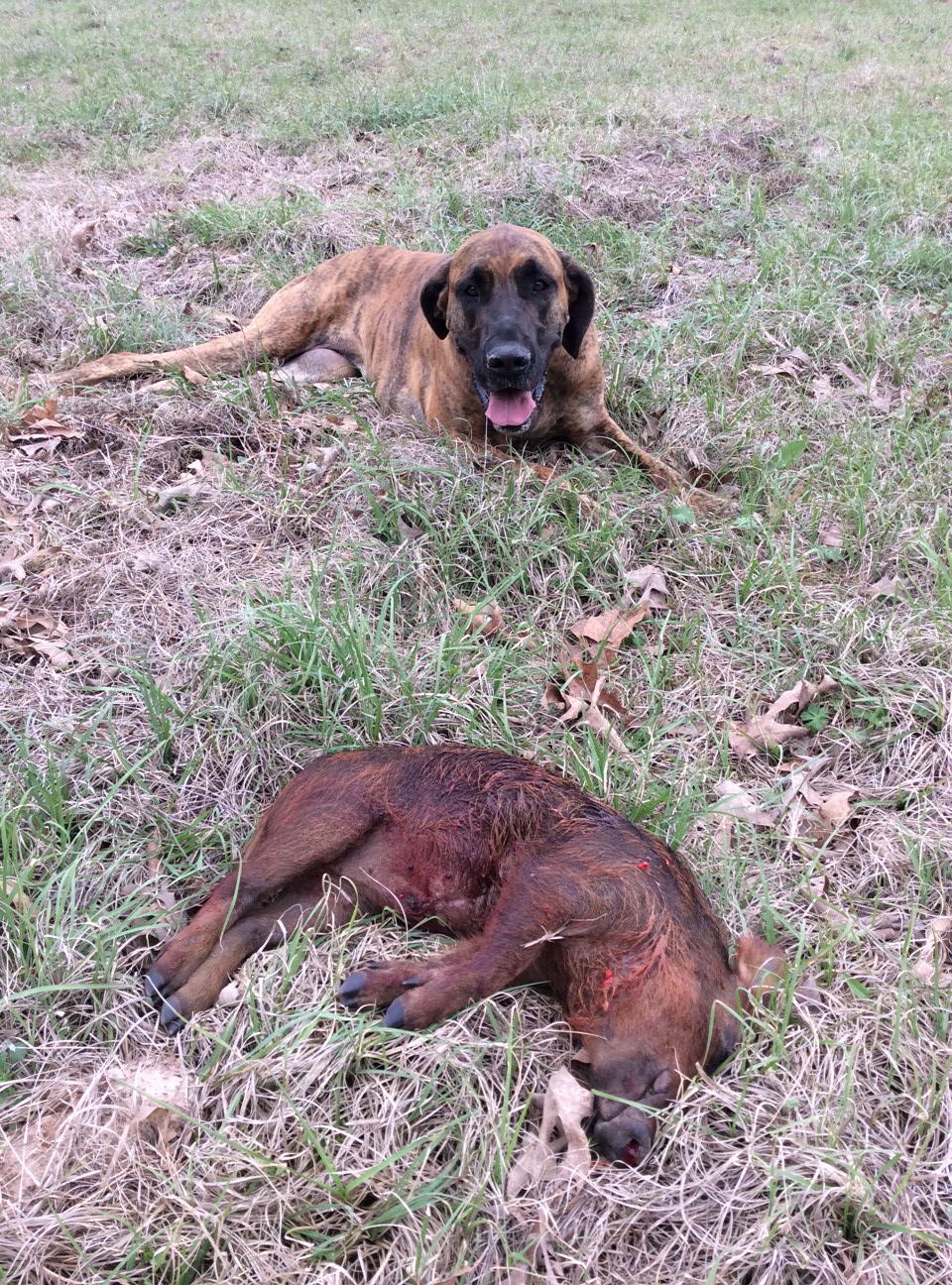
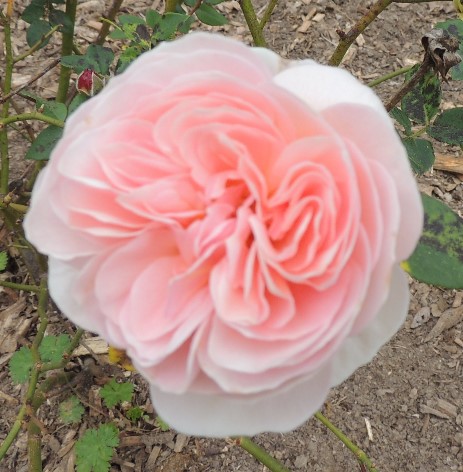
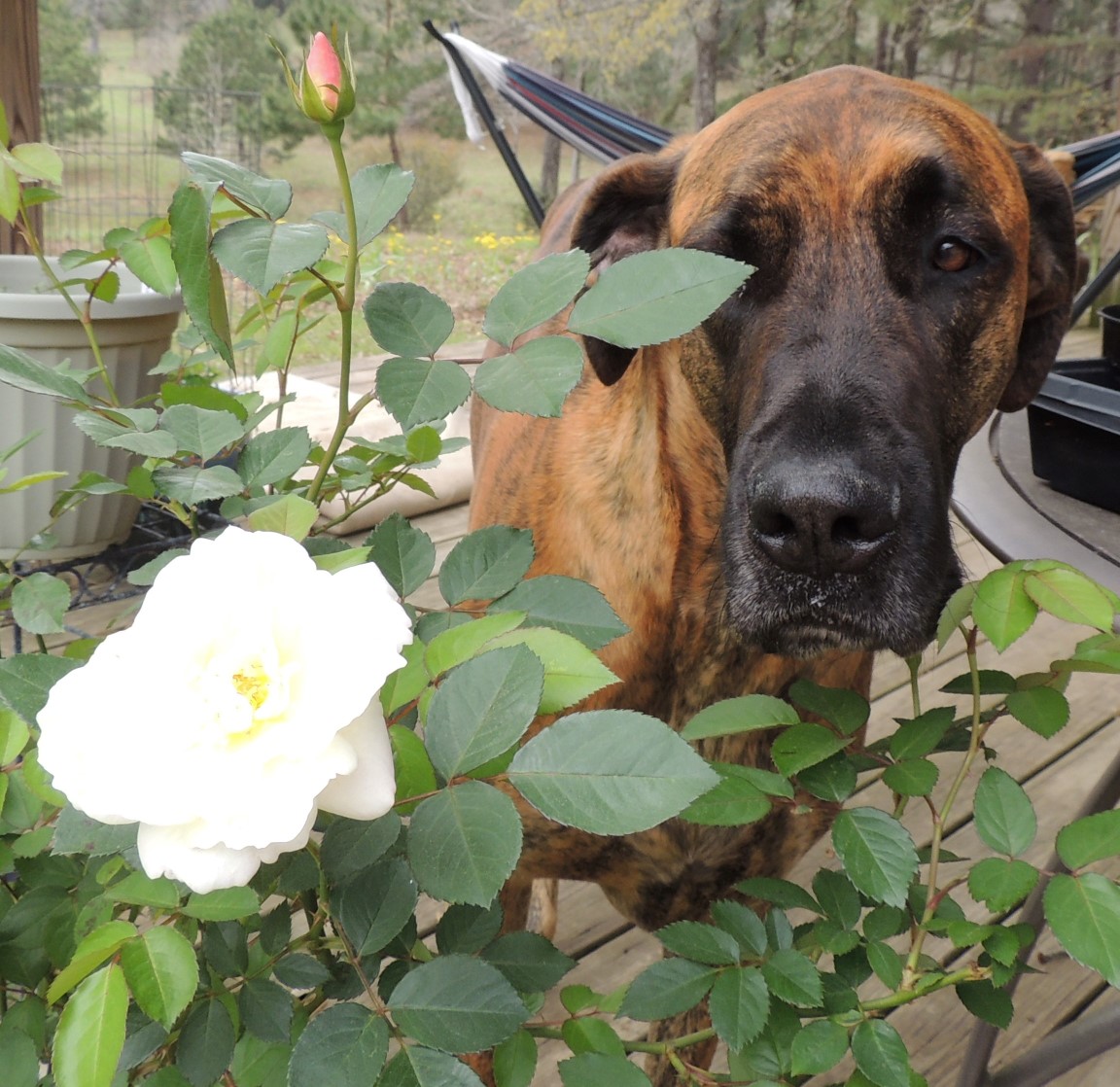
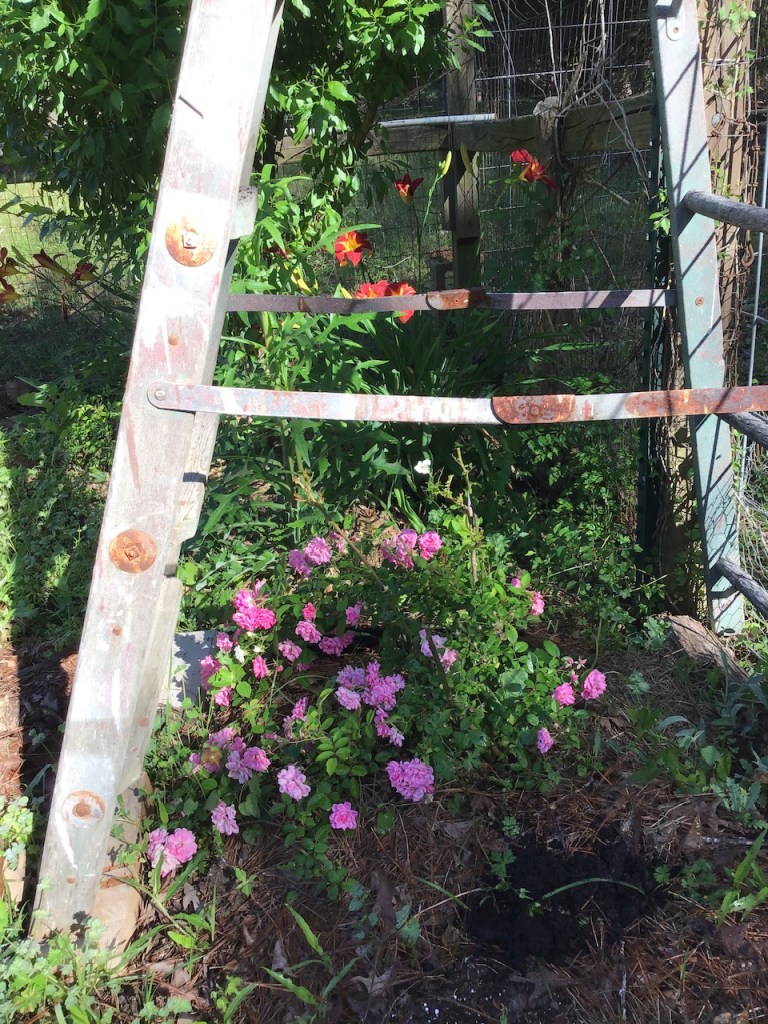
After I got over the shock of hearing the squeals of a drift of wild hogs crashing through the forest, and the fear that I’d lost our dearest Tori, I was amazed to see her come through the trees clearly proud of herself. Still a fav, La Duchesse de Brabant, unfortunately with a bad case of ‘black spot’ but which I’ve been treating with whey, banana peels and chicken poop. Tori’s ‘Illuminati’ pose, hehehehehe!
A combo post–a bit of Homestead Happenings with a bit of my favorite conspiracy theory.
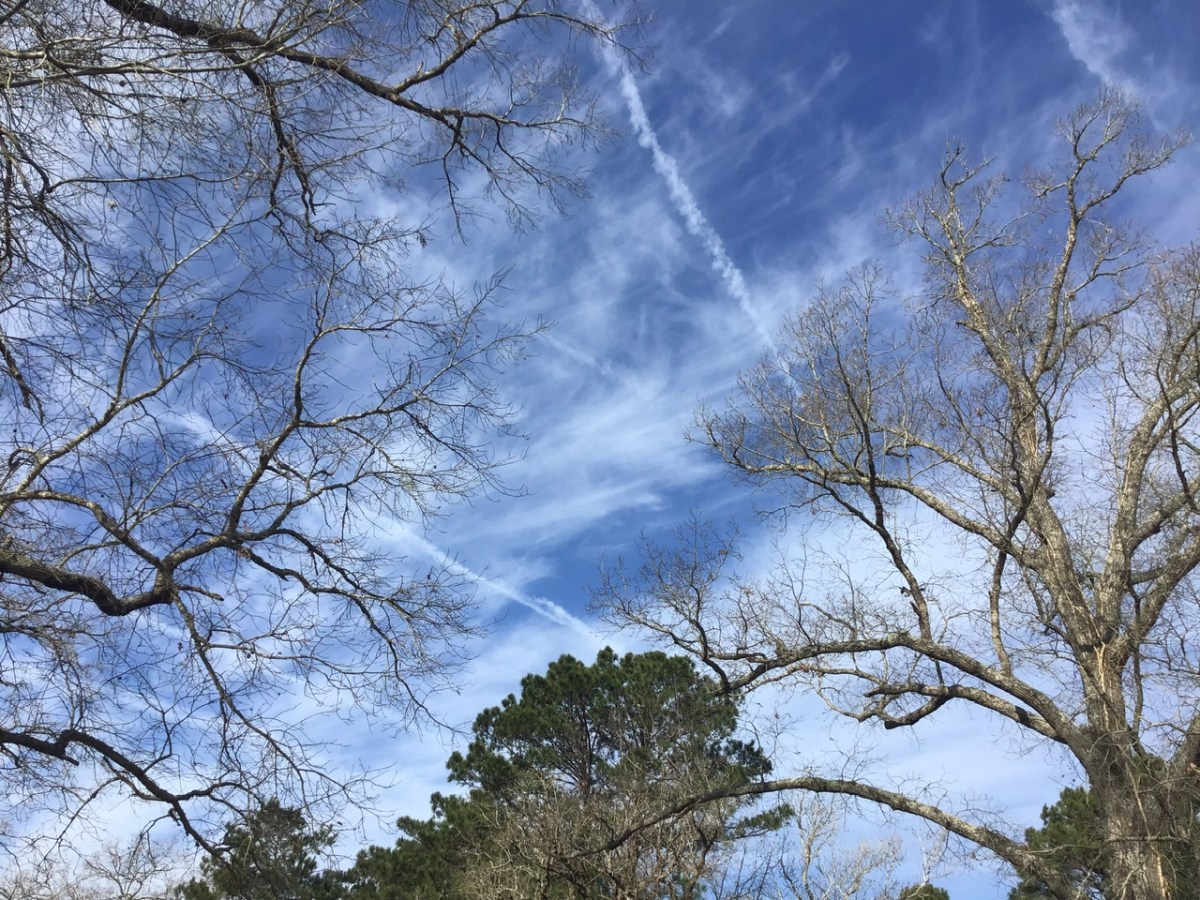
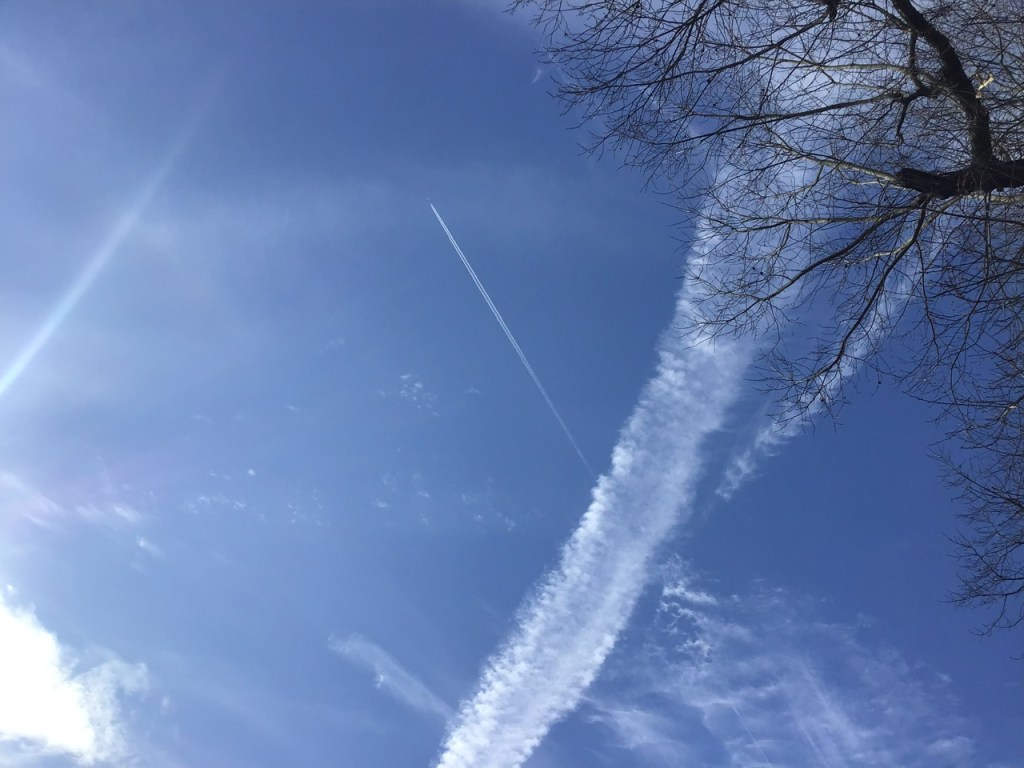
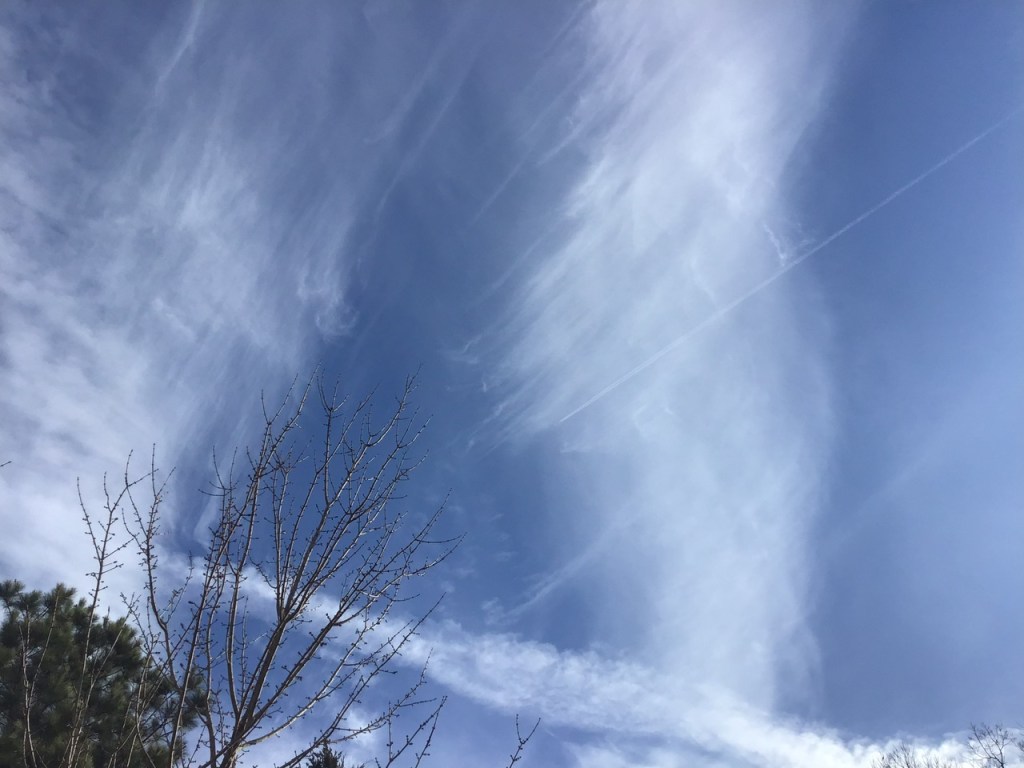
We are having our New Normal weather whiplash where 1/4 of the population pretends the weather has always been like this; another 1/4 couldn’t care less about it, normal or otherwise; 1/4 who think it’s all manmade, but not by tech, by carbon pollution; 1/8th who LOVE the idea of man controlling the weather; and the final 1/8th who believe one of the following: it’s NAZIS controlling the weather, aliens are controlling the climate, a global ice age is coming, too many paranoid plebs are actually causing climate change through their malignant minds, or, the world’s militaries have been using weather tampering against the public for many decades.
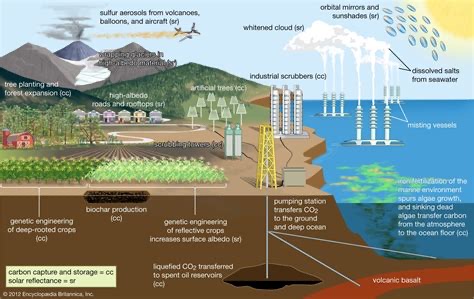
23 February 2026 | ZEROGeoengineering.com | Report below published in 2021 by the Land Forces Academy Review evaluates the use of weather influencing technologies and their impact on global security. The authors discuss potential damage resulting from weaponized weather changing activities: “artificially increasing the level of precipitation in order to cause floods and paralyze the enemy’s transport communications; artificially reducing the level of precipitation, in order to cause drought in enemy territories and difficulties in the supply of fresh water; the creation of unfavorable weather conditions that impede the conduct of hostilities (increased wind speed, deterioration of visibility); violation of radar and radio communication by direct impact on the Earth’s ionosphere. The use of technologies for changing the weather for military purposes leads to the destruction of infrastructure, paralysis of the economy, losses in agriculture, disruption of the work of state and commercial structures, mass casualties, large financial losses and demoralization of the local population.” Olena Shevchenko and Kira Horiacheva, Impact of Weather Change Technologies on Global Security, Land Forces Academy Review, Vol. X XVI, No. 4(104), 2021, DOI: 10.2478/raft-2021-0042
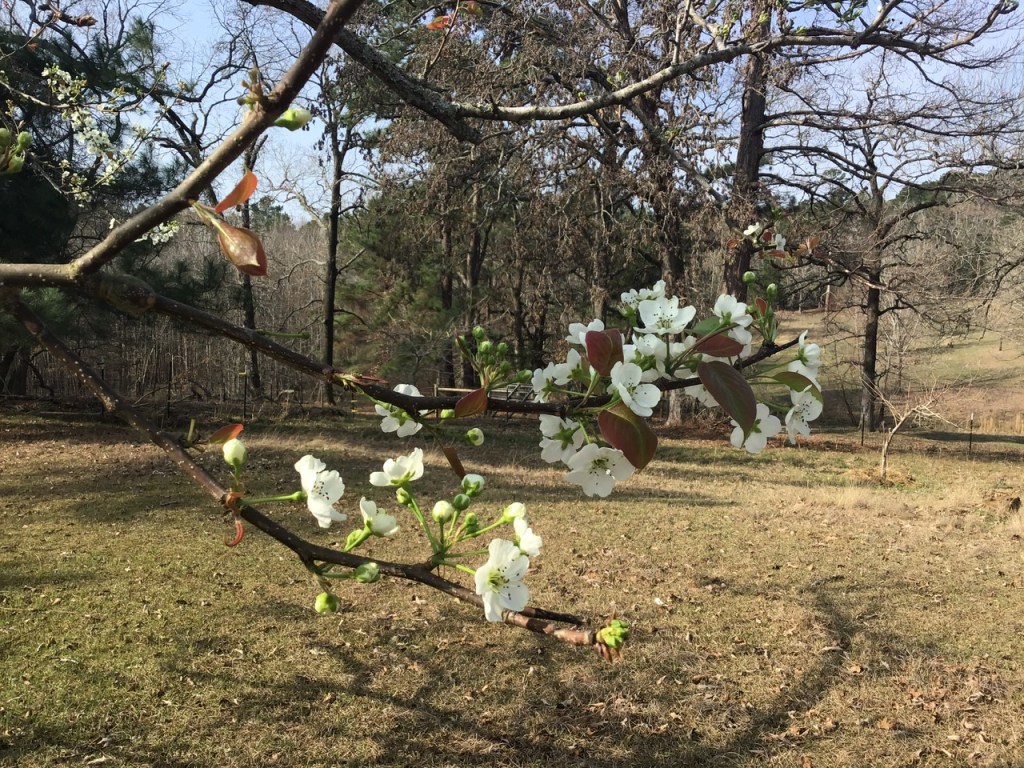
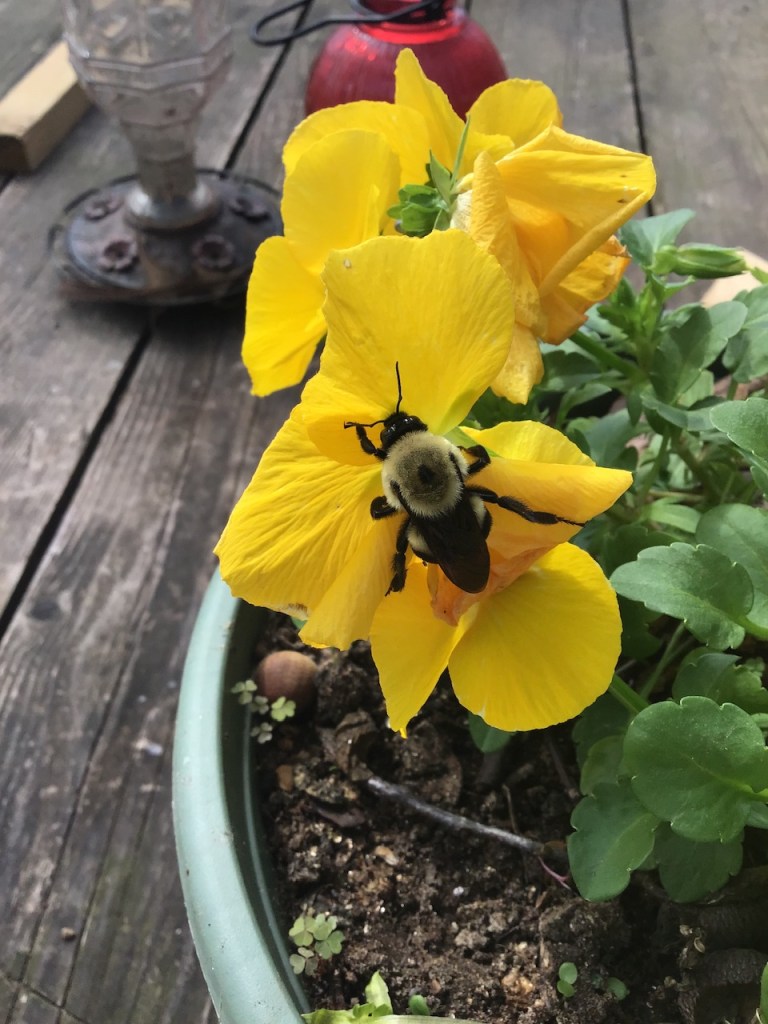
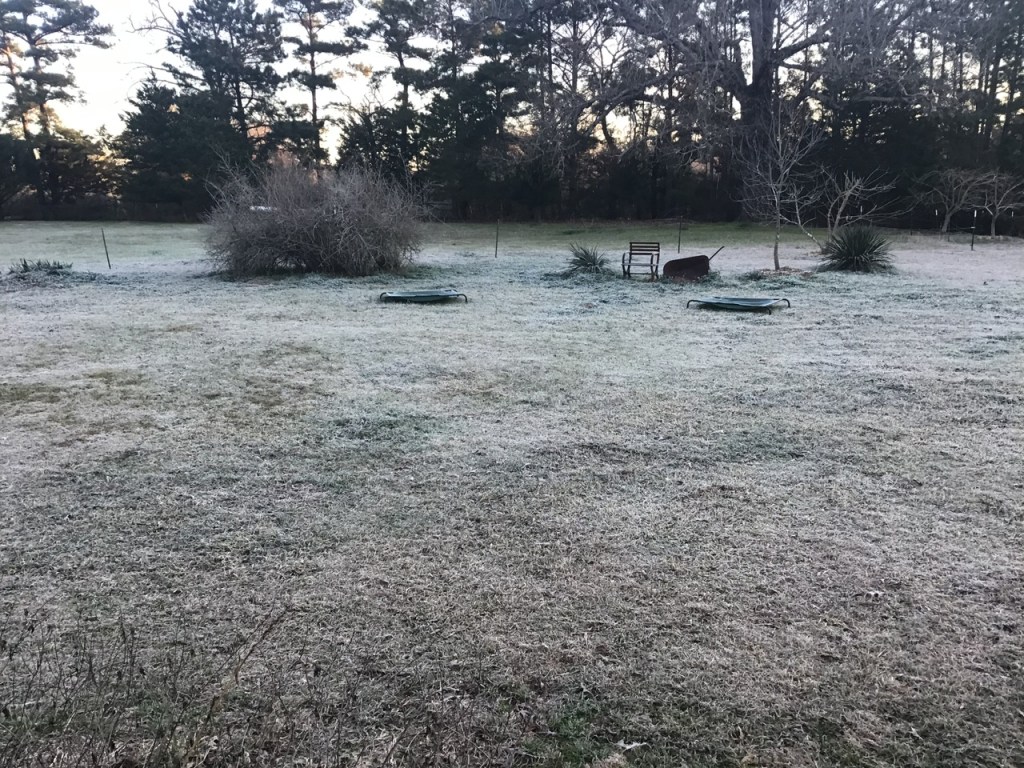
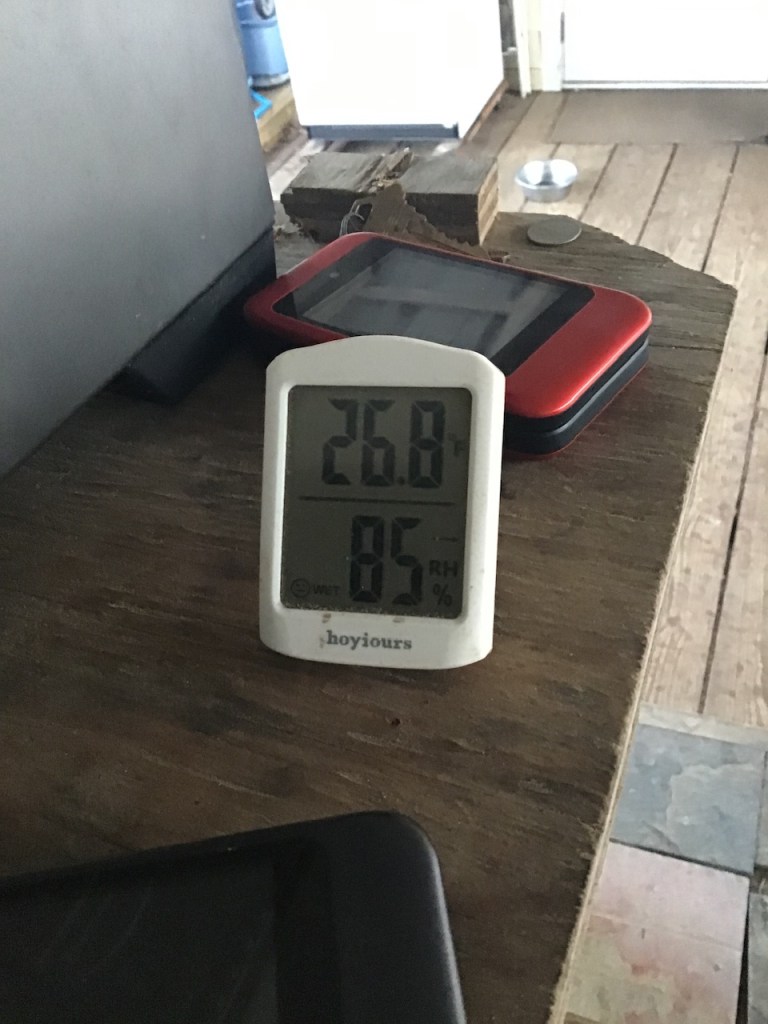
“increased wind speed?” check “unfavorable weather conditions?” check “artificially reducing the level of precipitation, in order to cause drought?” check “demoralization of the local population” check, check and check! Well they can certainly count me in! It’s indeed demoralizing to see the bumblebees out because it’s over 80 degrees for a week and all is blooming, only to then frost and kill all the buds. Including the fruit trees. Or to be told by a young gardener that ‘winter is our dry season’. What? Since when?! So I guess all seasons now are our ‘dry season’. Except for when it suddenly floods in one county while the neighboring county stays bone dry. Or the crazy winds that make these sudden and highly unnatural shifts with storm-level gusts that continue for days making any outdoor activity really unpleasant, if not impossible. Soon every five mile radius will have its own climate, and the technocrats will cheer, even if it makes vast swaths of the world uninhabitable by all but the scorpions and robots and data centers.
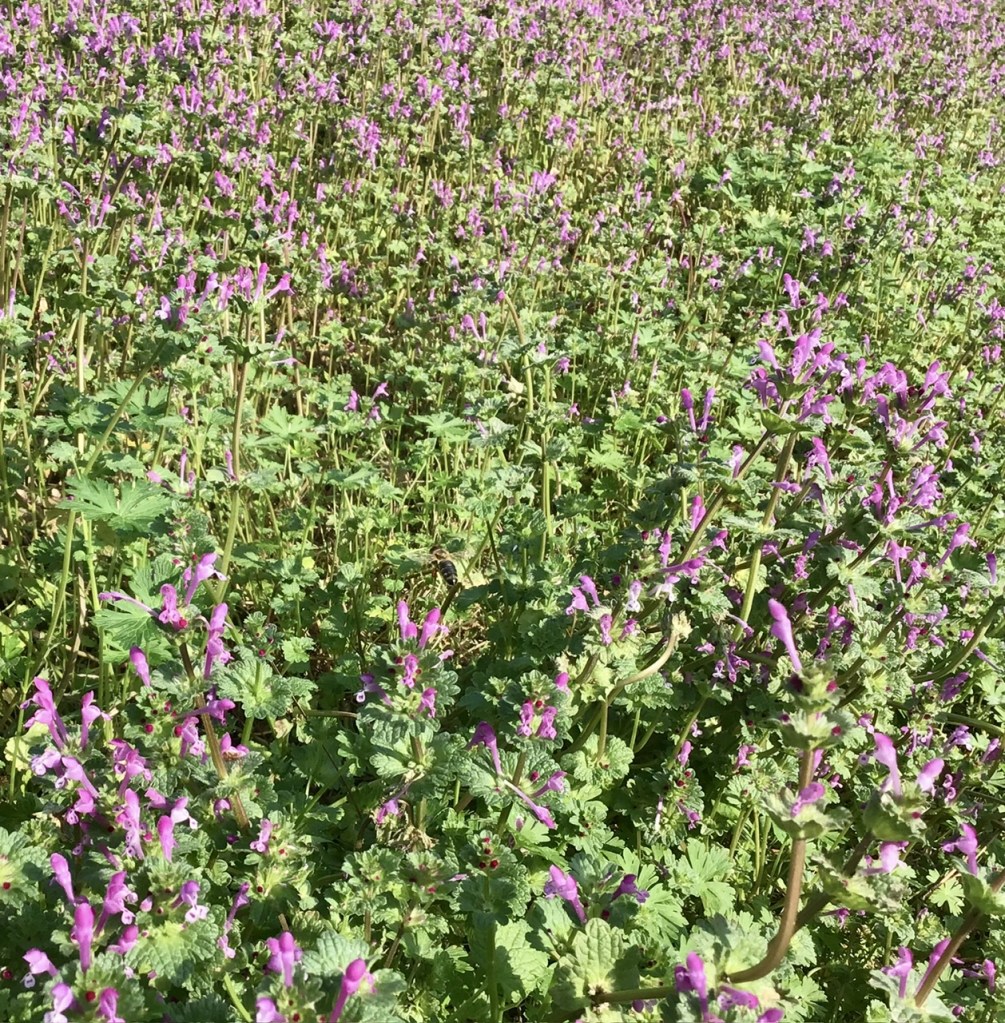
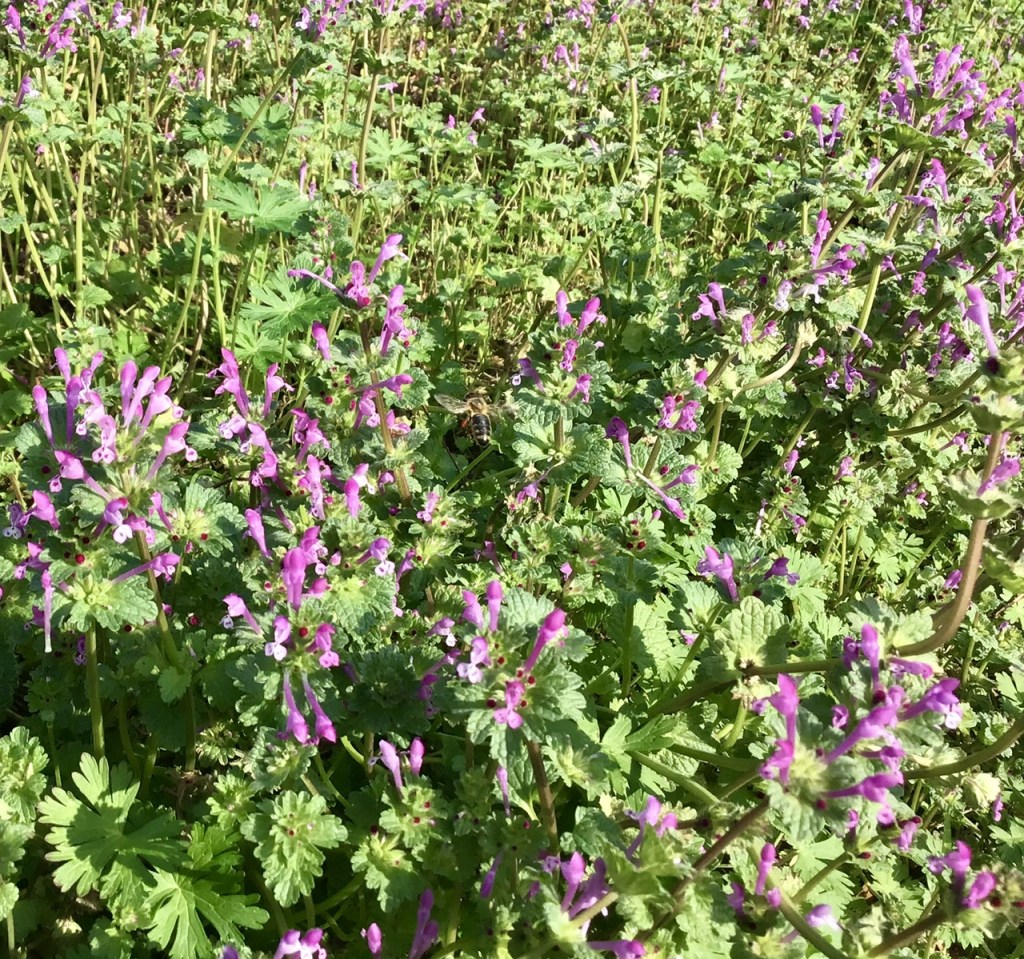
Can you see the honeybees on the henbit? The henbit does really well as a groundcover even through our last ‘wintery mix’ (used to be called snow). They also like the other early bloomers and I LOVE to see them. But, for bee sustainability it’s not a good thing, necessarily. If they build up their colonies too quickly too early there will be a lot of starvation of the young brood if (when) the temperatures plunge again killing off the buds.
Until that time I guess we’re stuck here counting our blessings.
We did get that frost, and now we’re going right back up to the 80s.
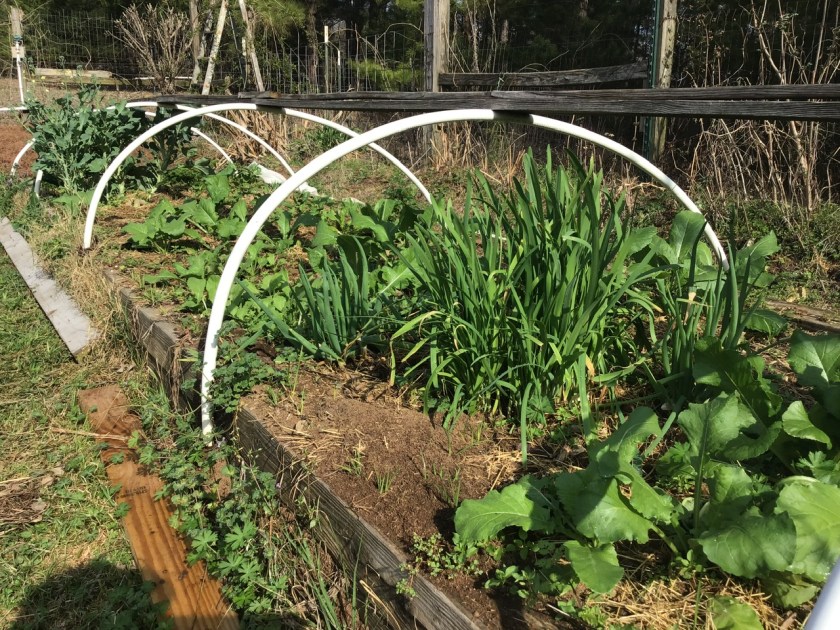
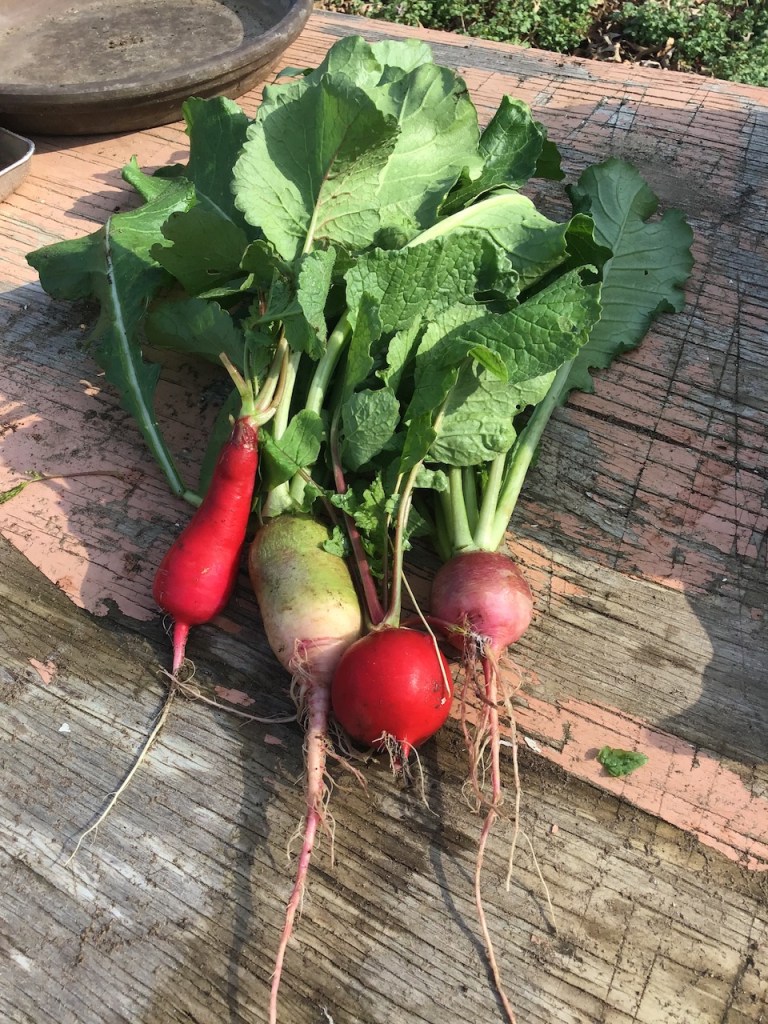
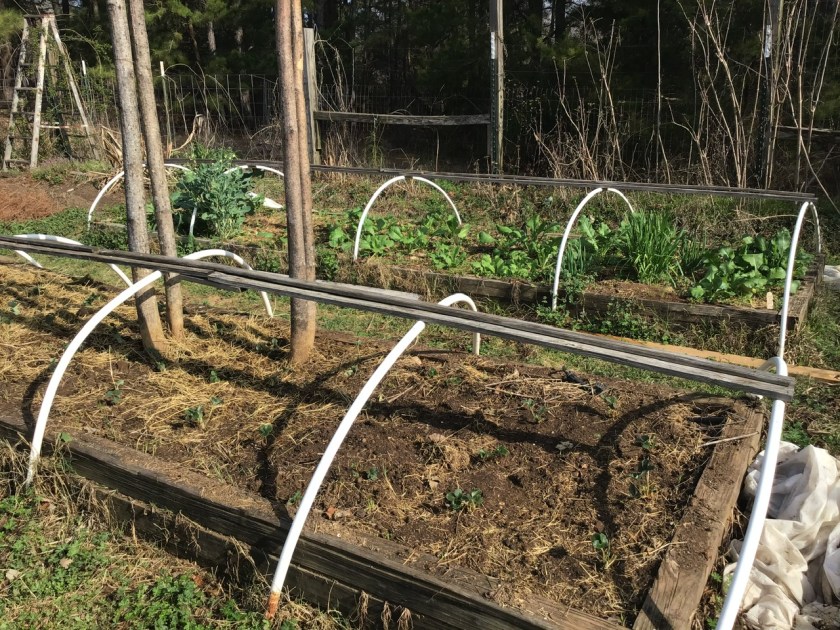
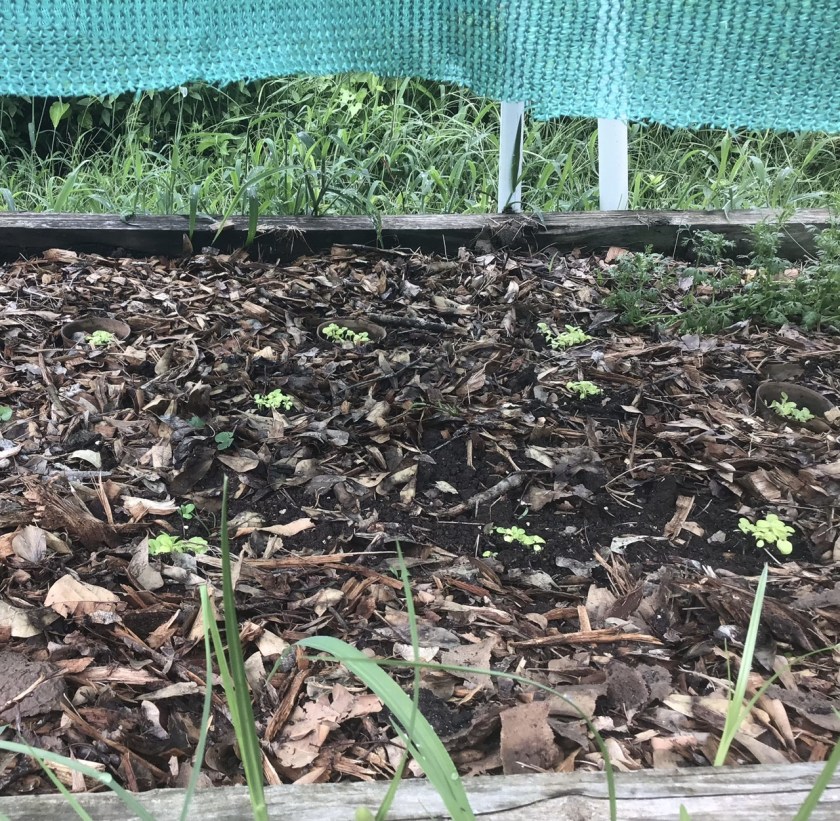
A few garden blessings doing well, one box under protection with lettuces, radishes, the last of the crucifers, some parsley and cilantro
Crucifers, like many veggies, do not like weather whiplash
Atleast if we can share some credible and valuable information while it’s available to us, the next generation might know more what they are in for when they move to the country thinking they’ll start a farm or homestead in order to escape the rat race. Newsflash, you might want to research underground gardening, because between the inclement weather and the cost of energy you won’t be able to garden, indoors or out!
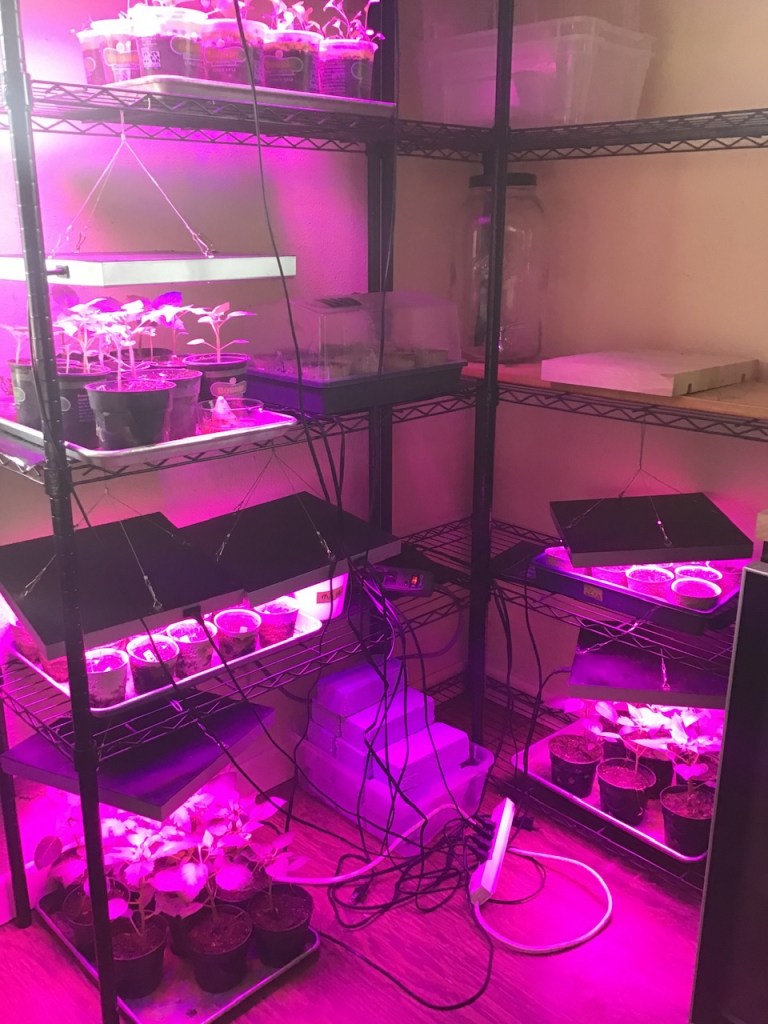
It really helps to start seed indoors, an extra protection from weather whiplash season, but it’s not exactly economical these days. Growing here are lots of tomatillos, my garden mission this year, and more broccoli, flowers, squash and lettuce.
Everybody’s doing it, nowhere to escape!
Oldfield, J. D., & Poberezhskaya, M. (2023). Soviet and Russian perspectives on geoengineering and climate management. WIREs Climate Change, 14(4), e829. https://doi.org/10.1002/wcc.829
“Soviet science contributed significantly to our understanding of anthropogenic climate change and, as part of this, played a central role in the emerging science underpinning climate modification and geoengineering initiatives. A key focus of discussion was the use of stratospheric aerosols linked to the innovative ideas of Mikhail Budyko and colleagues. This work had its origins in what has been termed the theory of aerosol climatic catastrophe, which gained prominence in the Soviet context during the early 1970s.”
Onions also don’t like weather whiplash, but we usually get a decent crop I finally got most of the strawberries replanted. They multiplied like rabbits last summer and I gave wheelbarrows full to the neighbors and still plenty went into the compost. It’s taken quite a lot of effort to get the strawberries to multiply during our summers, but I think I finally figured it out. We’ll have to wait and see how well they produce in a couple of months. I’ll keep y’all posted!
Thanks for stopping by, and be sure to watch your skies!
When I first started watching alternative history Youtube channels I was skeptical, and I still am. I want the truth, not more redirection. Not more fantasy. Not more illusion. Not more heavily curated or mediocre nonsense.
So far, I don’t sense I’ve found it, but I’ve become ok with never finding it. I’ve resigned myself to what’s as close to the truth as I’ll be able to manage to get to in this lifetime, which is: I’ll never know the truth, but I may be able to manage truth-adjacent with enough study and discernment. I can confidently opt-out of the lie, permanently. That’s a big improvement to the path of blind acceptance I was, and most are, still on.
The first step toward truth was achieved pretty easily, it began with calling bluffs. As long as I don’t allow it to frustrate me, which isn’t exactly easy, this alone feels pretty empowering. For me, as usual, I had to experience it directly, no Youtube influencers, no professors, no self-styled experts can convince me, not without applying my own eyes and ears and reason.
I looked to the architecture because that’s what’s visible, and only then to the official history, because that’s what’s accepted as truth. I started in my own neighborhood, that is, the small city closest to us, called Palestine. It’s actually easier I think to consider the small city, rather than the large ones, because there’s been less tampering more likely, more holes in the narratives that can be more easily noticed by the novice.
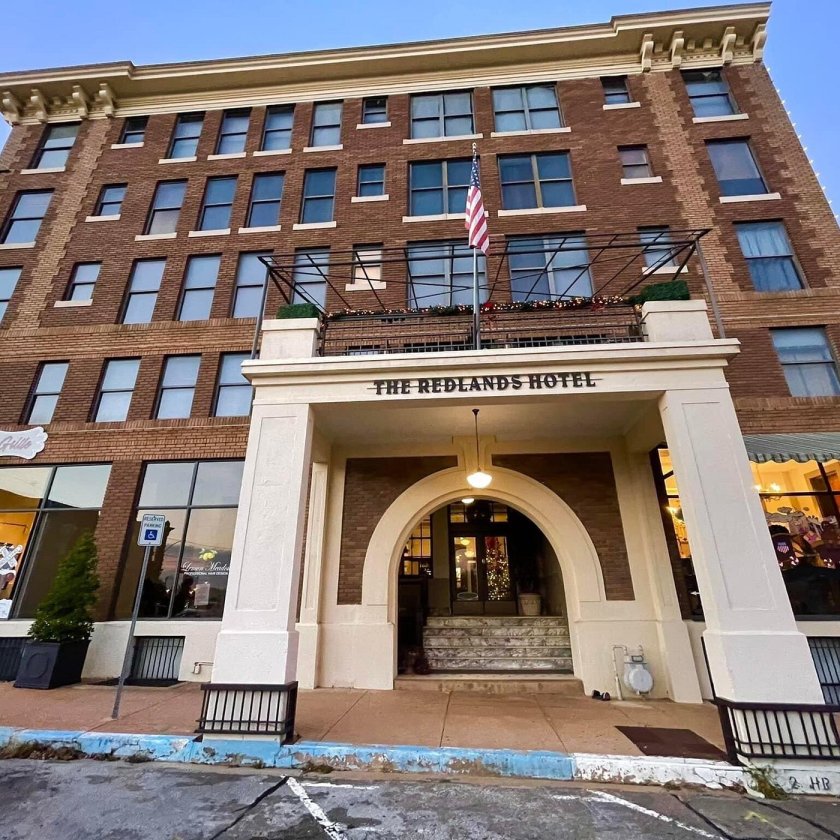
The well-maintained Redlands Hotel today.
Like, the story of the popular Redlands Hotel, where I sometimes go for lunch on my rare trips to town. It’s a lovely old building that they’ve done a relatively decent job of keeping up, especially considering the condition of the vast majority of the downtown area.
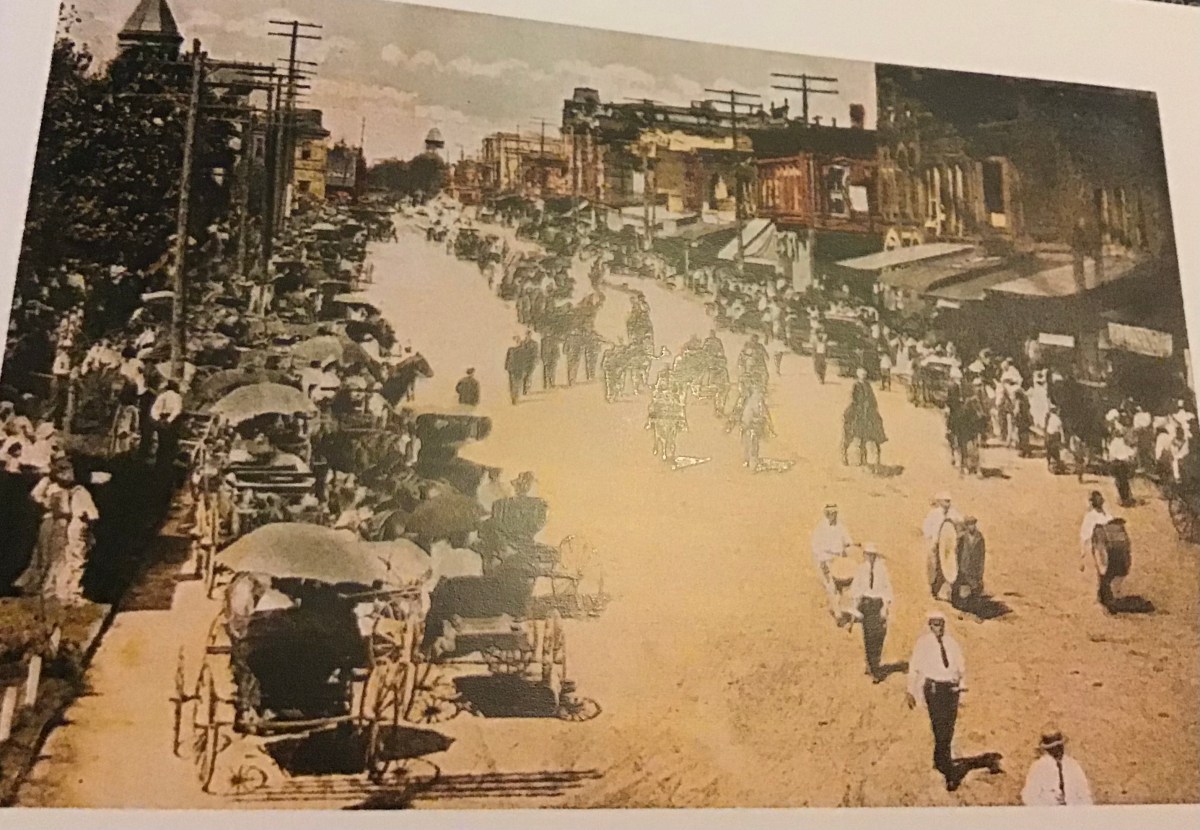
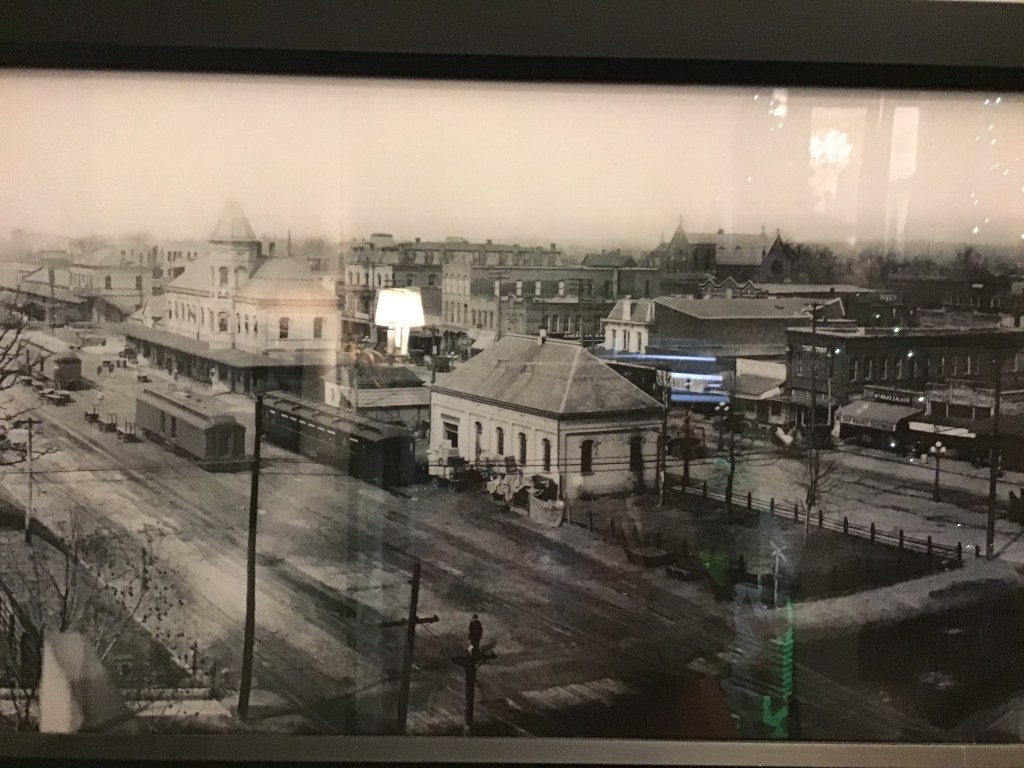
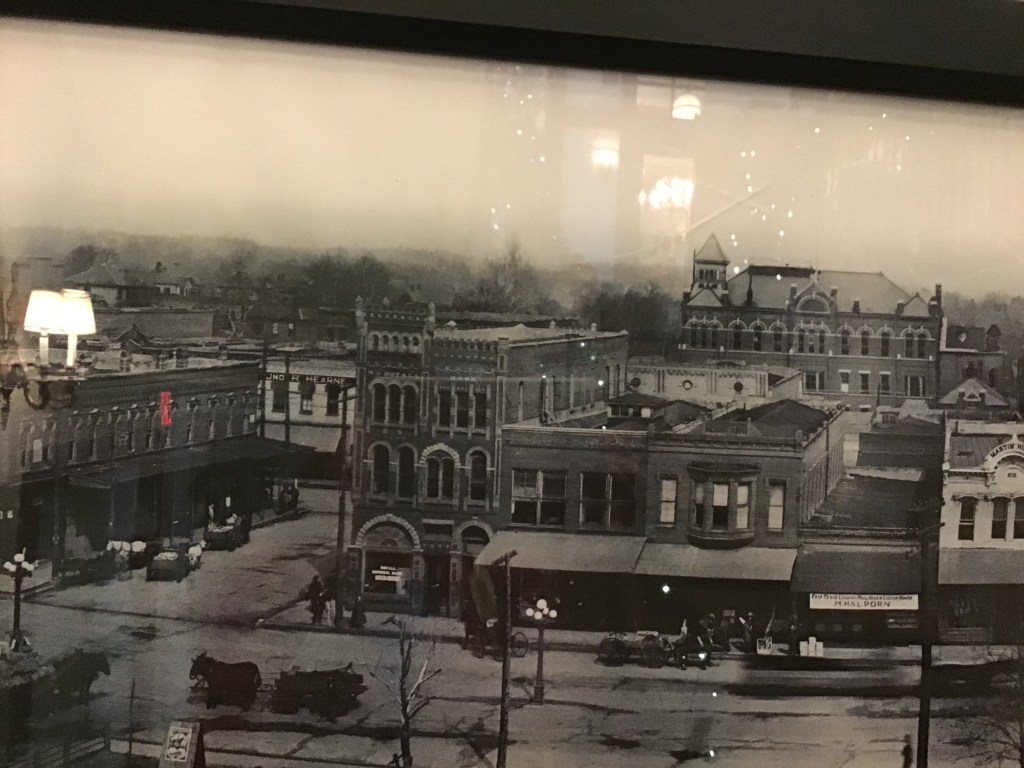
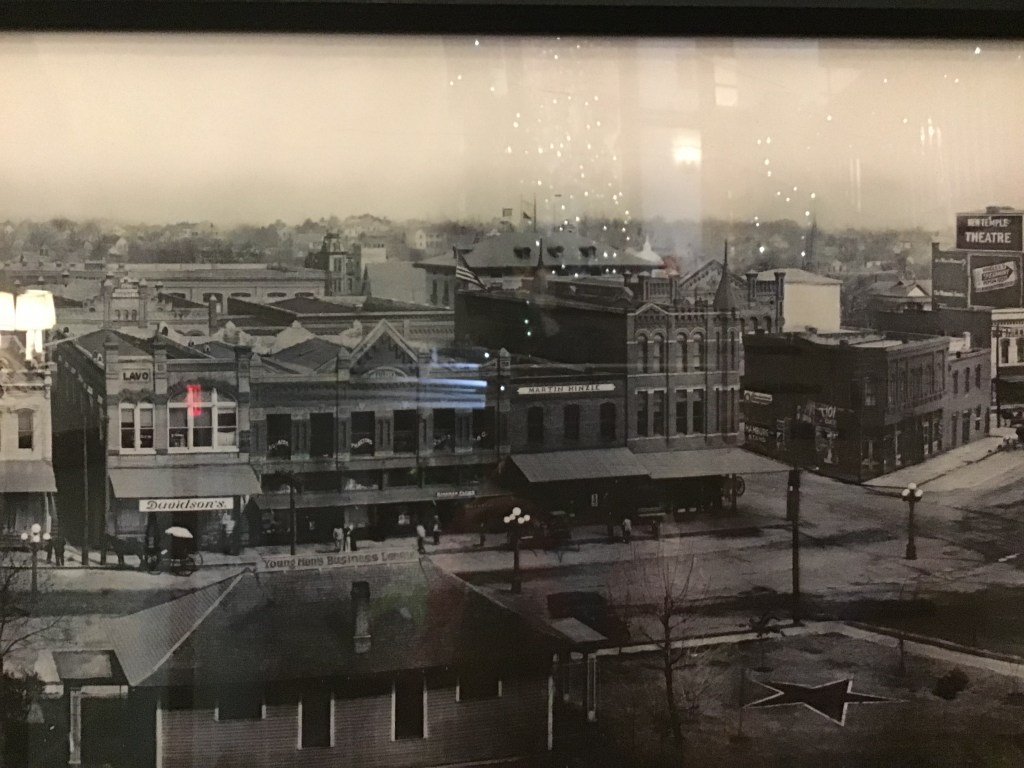
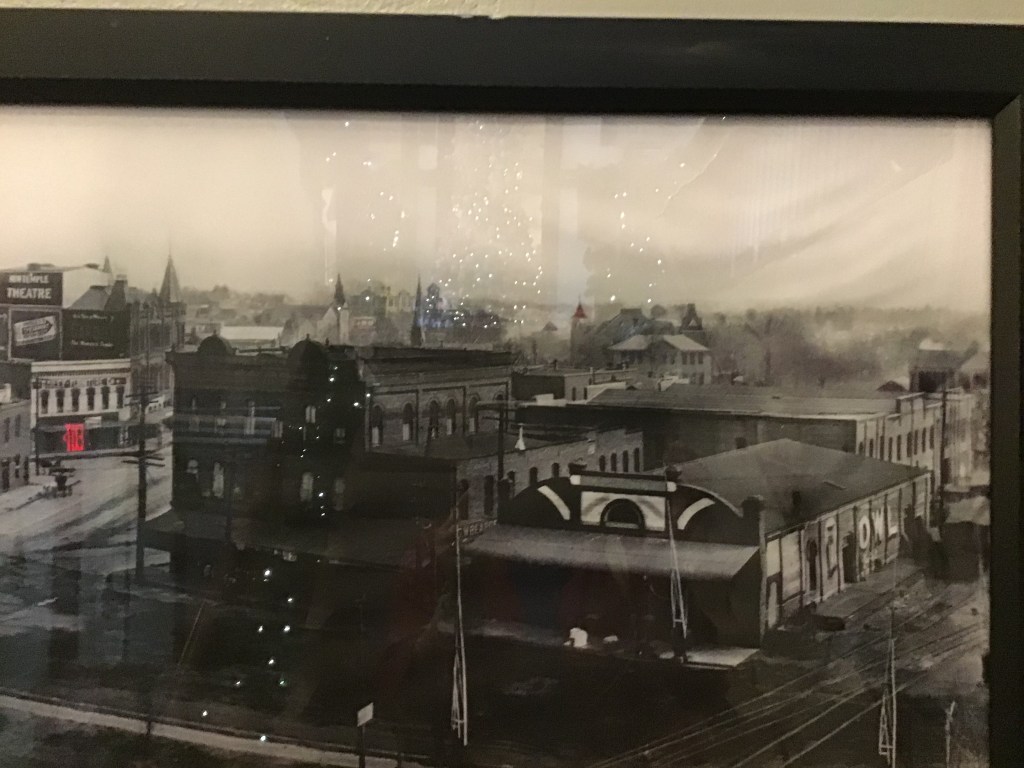
Interestingly, they have a panaramic photo of the early years of the city on display. As you follow the railroad tracks from left to right in the photo, you end up at graffitti painted on the side of a building. That is, the word OWL.
That’s my cue to start calling bluffs.
The owners of this hotel are deep into the official history, which is superficially helpful. As it goes, in 1914 when stockholders rushed to build the brown brick building, it was oxen that delivered the sand for the concrete. That is, sand from the Trinity River, 30 miles away. Are you kidding me?! That’s a pretty big bluff.
And even with that serious transport challenge, on supposed dirt roads, they managed to complete the five story building in a year. Apparently dirt roads weren’t effected back then by rain or snow, neither were the human builders, or the oxen. Amazing.
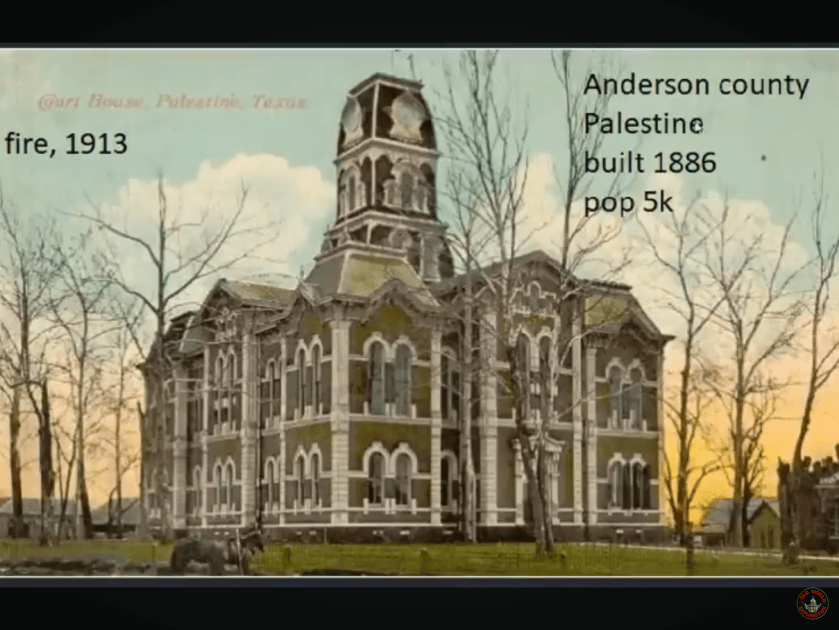
Even more amazing was that another striking building was going up on the other side of town, that is, the County Court House. The two structures apparently shared Italian artisans who installed hexagon tile to both buildings.
The original burned court house, depending on which source cited. Another source states the original courthouse was a small building made of wood.
“Considered one of the most modern constructions of its era, and built to withstand the challenges of time, its walls are made of concrete, masonry blocks, sheetrock, and metal studs—evident in the structure today.”
My those were some busy boys and oxen!
In fact, with just a bit of digging, we learn there was in fact another town at the Trinity River junction where the cherished sand came from, now missing from both the land and the history books. But, there remains one hand-drawn map available in the archives, Magnolia was the town’s name, and it was apparently so bustling with commerce and activity according to one source that they called it the ‘St. Louis of the South”.
One of the many demolished structures of the non-existent town once called Magnolia, according to the official history.
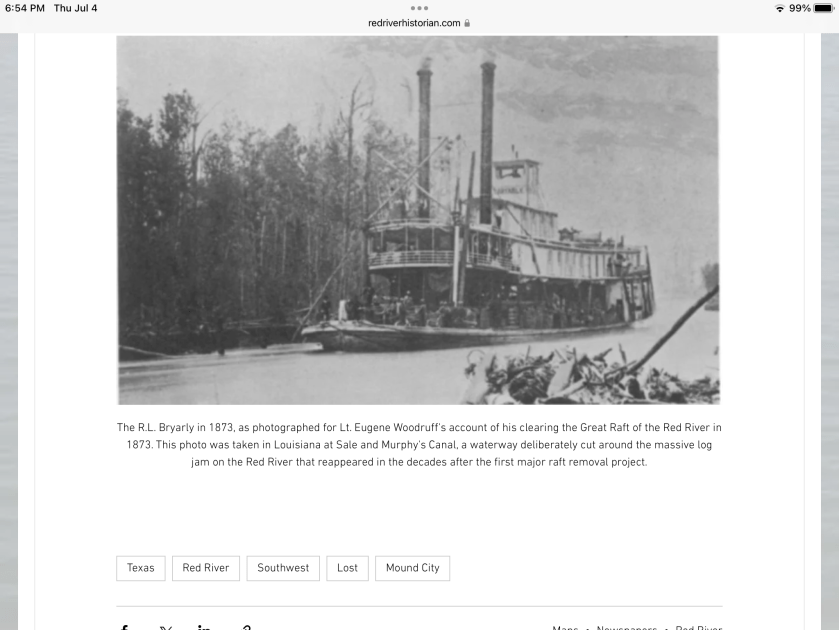
“Magnolia was established in the early 1840s as a Trinity River cotton port and was named for a large magnolia tree in the center of the townsite. Magnolia had a post office from 1851 to 1871. William A. Haygood was one of the principal property owners in the community and operated cotton gins, a hotel, a livery stable, a general store, a blacksmith shop, and a local ferry. Among other businesses in the community were a drugstore and John McClannahan and son’s warehouse. Magnolia was reported to have a population of 800 at its peak around 1863, when the town had thirty-three blocks of residences and businesses. Most shipments from the port went to Galveston, but on May 5, 1868, a steamboat traveled up the Trinity to Dallas. After it was bypassed by the International and Great Northern Railroad in the 1870s, Magnolia declined rapidly. By the 1930s it was no longer shown on the county highway map, though its name was preserved in that of the two schools that stood on the site of the former town. In 1932 the Magnolia school for whites had an enrollment of forty-three and the Magnolia school for blacks, thirty-four. A 1982 map showed only the Magnolia Cemetery at the townsite.” Magnolia, Texas
This is the sort of vessel which would have been traveling the Trinity River through Magnolia.
Nothing remains of this supposed river hub besides the hand-drawn map of the area where it was supposed to have been, where is now located some simple family houses, an intersection and the cemetery. I couldn’t even locate the river, or the supposed subsequent railroad.
Several other beautiful structures were also said to have been destroyed in this small city of Palestine not long after they were constructed.
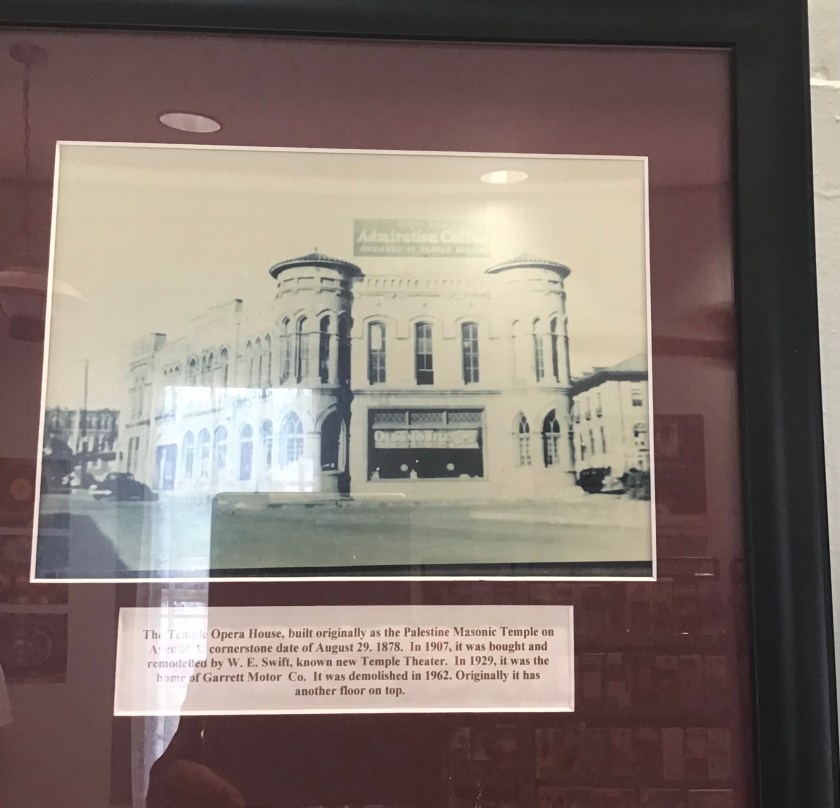
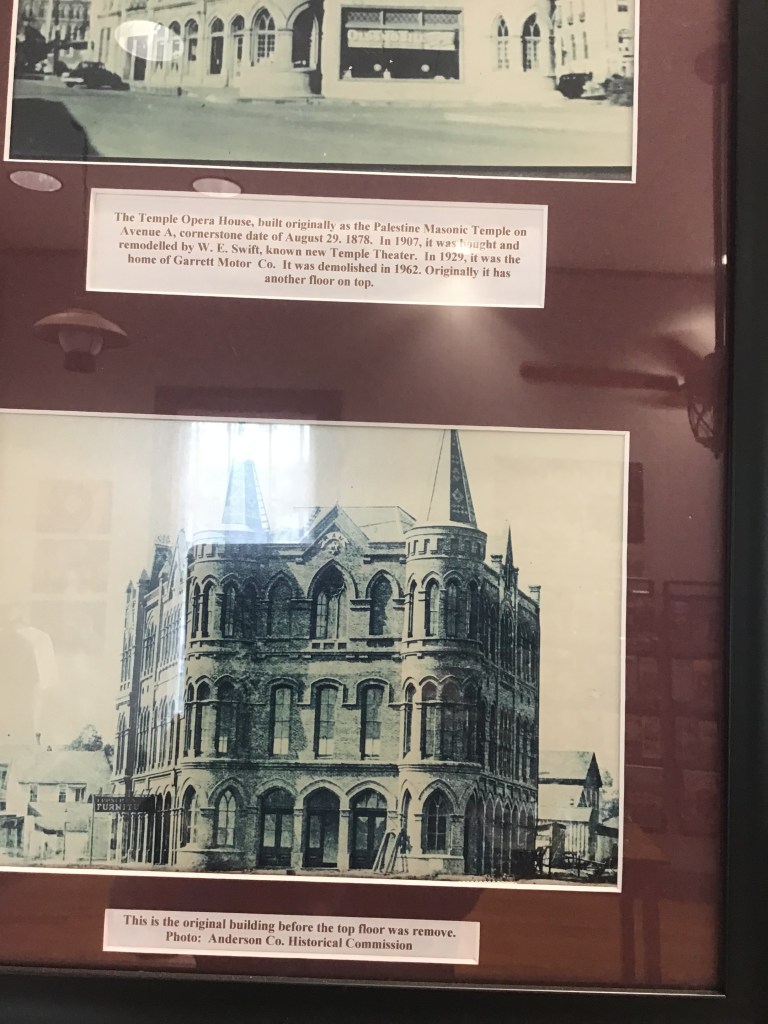
The Temple Opera House was built originally as the Palestine Masonic Temple with the cornerstone date of August 29, 1878. In 1907, it was bought and remodeled by W.E. Swift and known as the New Temple Theater. In 1929, it was the home of Garrett Motor Company, Palestine’s first Ford Motor Car Agency. It was demolished in 1962. It originally had another floor on top, but this was removed at some point.
At some point? Not even the official historians can tell us more specifically.
Exquisite building of multi-functions which didn’t have enough value to the small city to remain for a full century. The small box building housing a liquor store in that location now is so much better, I’m sure.
The “Railroad YMCA Building” was another one.
The Railroad YMCA opened in April of 1903 and continued as the YMCA until the building burned in the mid 1950’s. Interestingly, there seems to be no recorded photos available of this horrid fire event of a huge BRICK building. Nothing to see here! (In fact, I believe this to be another building altogether, more on that in a future post.)
As I searched the stacks of the local history at the library I was surprised to find several ‘fake books’ — that is supposed local history written by a source who cannot be located and is listed in the local phone book with phone numbers that don’t work and at addresses which never existed. Three different phone books, three different addresses, I actually went to all of them personally. Nothing. The books appear to be written by AI! I brought this to the attention of the library board, and no one cared. At all. I never heard back, though I went personally to the board meeting with evidence in hand. They didn’t even care to know which books it was with these obvious falsities, possibly written by an unaccountable AI, and sitting in their stacks posing as actual local history written by a fake person.
And now I feel frustration setting in, so enough for now, to be continued . . .
It’s Shoulder Season on the wee homestead, and by that I mean a few things.
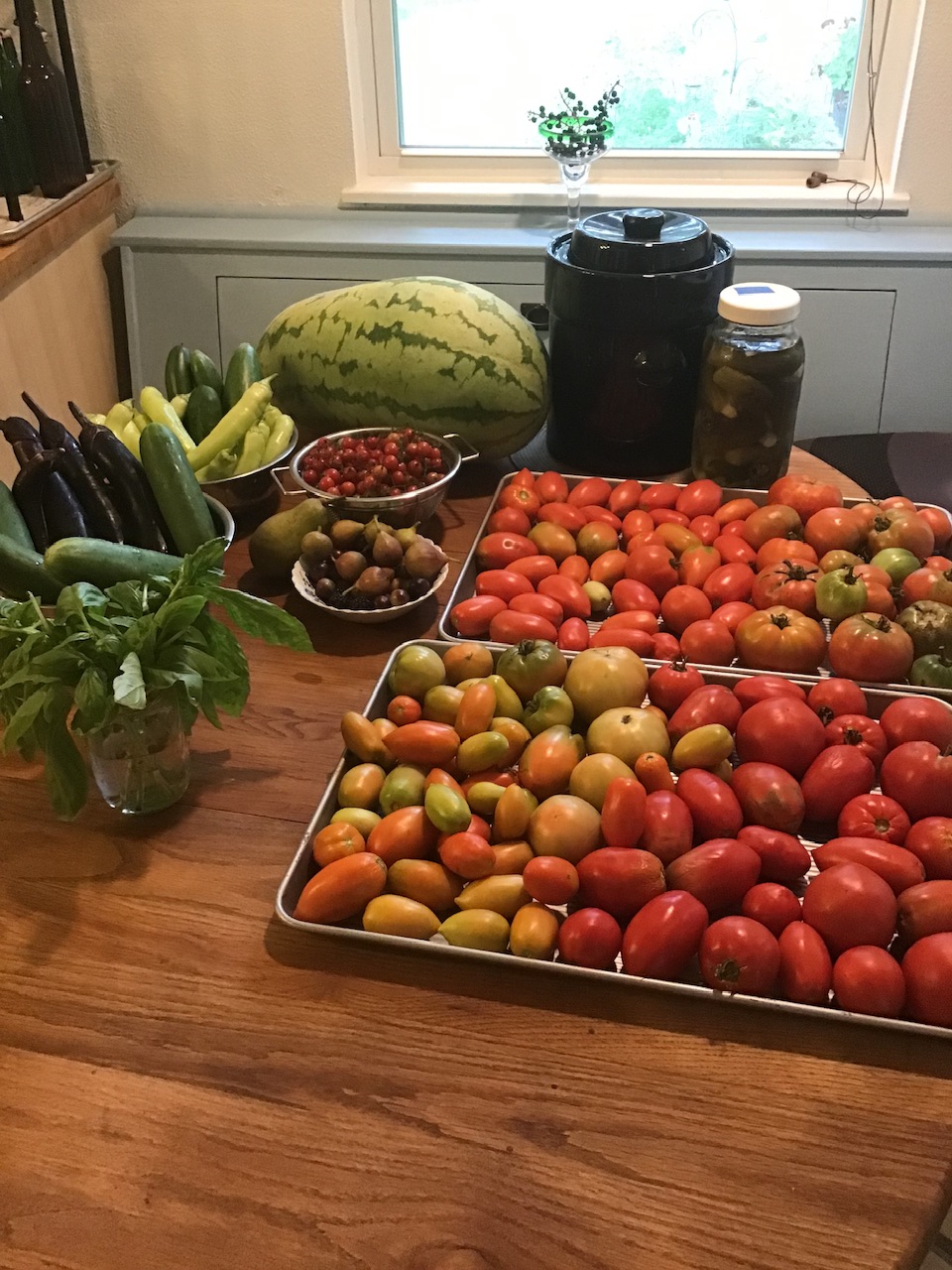
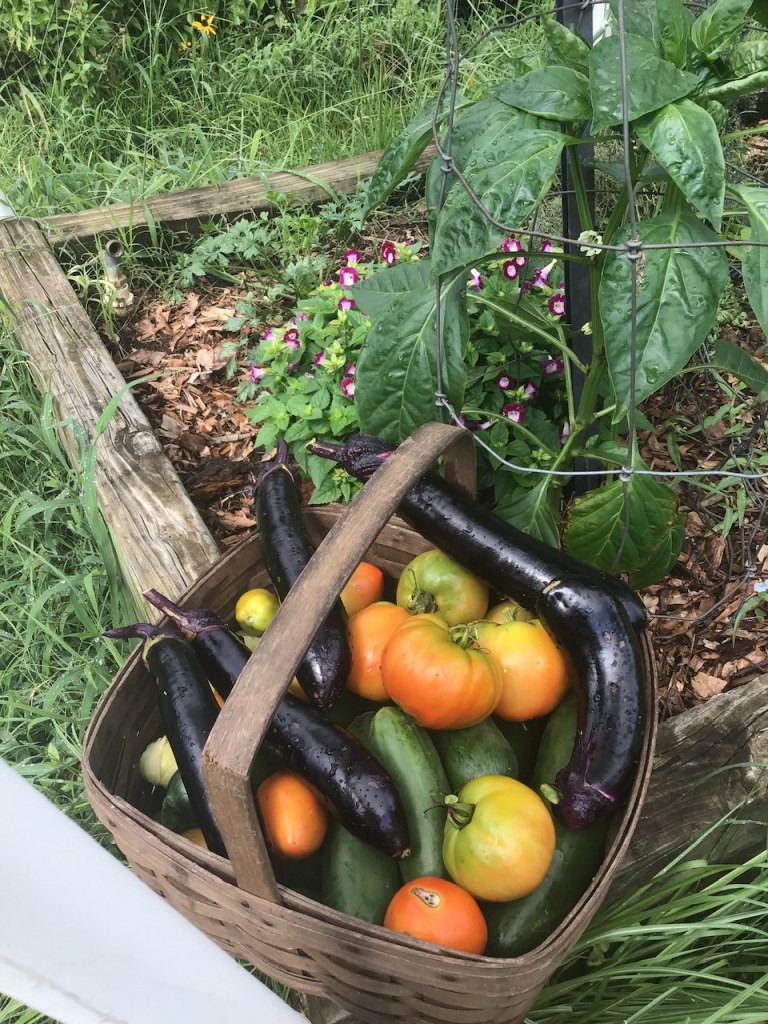
Tomatoes on their way out, eggplant just coming inAssorted melons and squashes
Shoulder season, for those who maybe new to the phrase, has a specific meaning in tourist trades, meaning between high season and low season. Savvy travelers and those who dislike crowds or who are just cheap or nearly broke try to travel in the shoulder season.
As far as I know it doesn’t have a parallel meaning in the gardening world.
But for me it does. It’s the time we move between seasons in the garden and since we garden all year, it happens twice, once in Swelter Season (now) and once in YoYo Season (formerly known as winter).
The key summer crops in the garden are either long gone–onions, garlic, crucifers, or mostly dead–tomatoes, squash, melons. And normally the cucumbers too, except those are, so far, successfully secession planted, with the new generation just coming up as the last one is dying. Good timing there, tiny bow to me!
Old cucs on left, dying fast, on right a couple of tomatillos in the back, also dying and a volunteer datura, doing great.
New cucumber plants looking good, but will they produce?
And big bow to Handy Hubby for growing this 27 pound beauty!
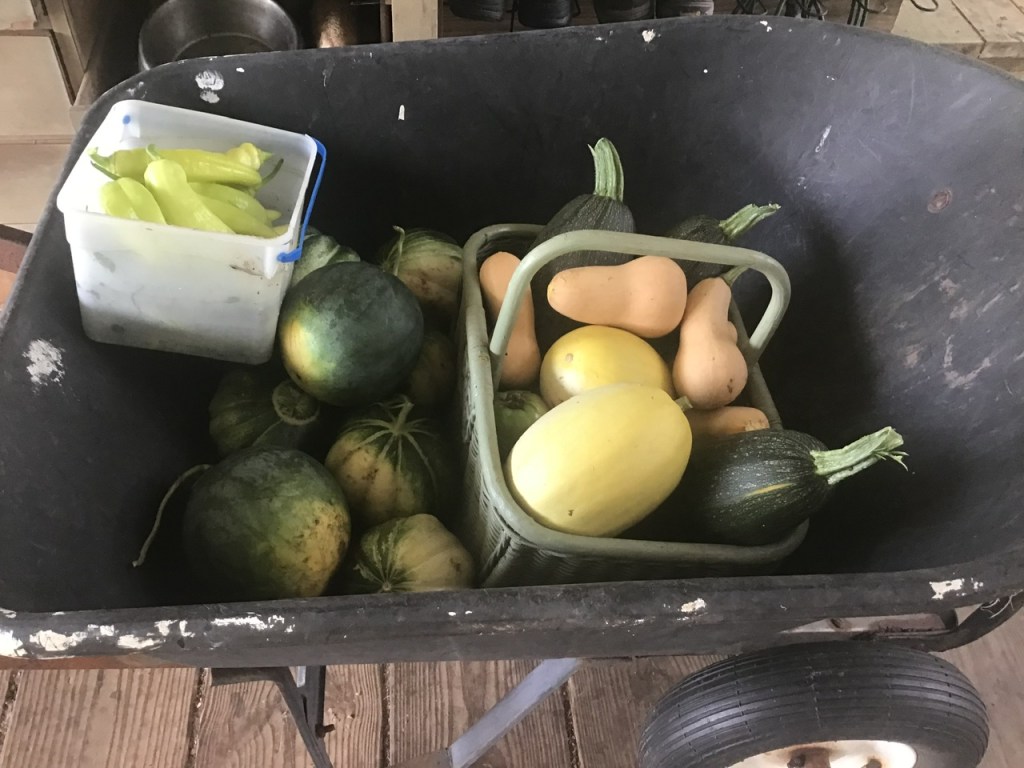
A nice variety of melons and squashes, we are quite pleased.
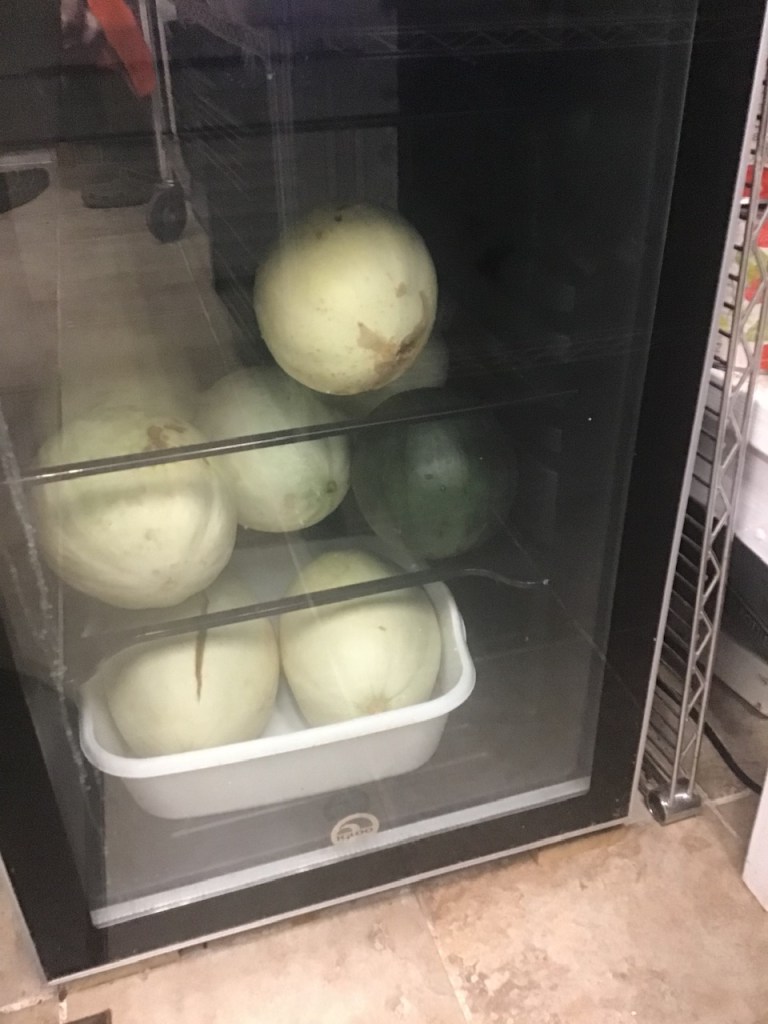
And still more, a mini-fridge of melon
And still more squash!
And cider.
While it could be Vacation Season for some more sane types, for us it’s the work of Shoulder Season. We keep the minimum that will survive our high heat for the next two months and baby most of them best we can.
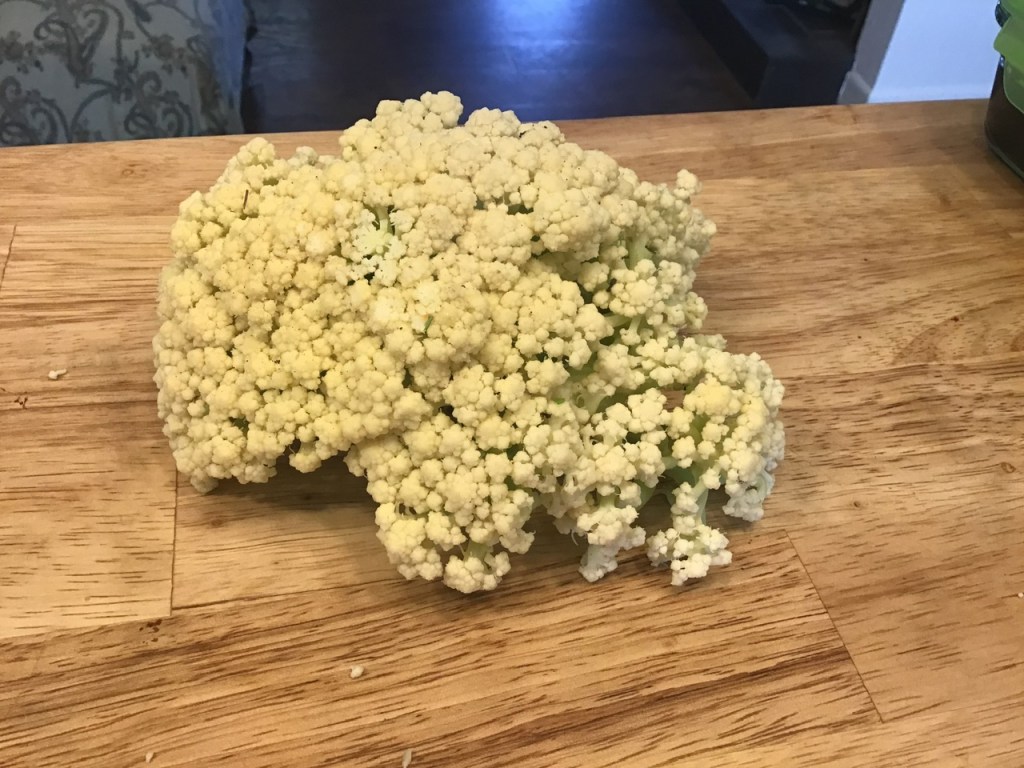
But under lights inside the fall/winter garden is on its way. There’s already another crop of tomatoes coming up, as well as broccoli, cauliflower and arugula.
In the ‘babying’ bed I continue my lettuce experiment, starting romaine indoors under lights and moving under double shade cloth to transplant, then removing one level of shade cloth after a few days to adjust. They are still alive, yay!
Also in the ‘baby’ bed under shade cloth: some parsley barely hanging on, some dill trying to seed, 2 peppers, 2 dying tomatoes and lots of very happy basil.
Tomatoes, peppers and basil for marinara. And in back left is cured lamb.
There’s processing to be done still, the marinara stockpile is done thanks to Hubby, but there’s still ketchup and bar-b-que sauce. And we still call this a bad tomato year!
stockpiling marinara
Ah, the gifts and curses of relativity. And surplus.
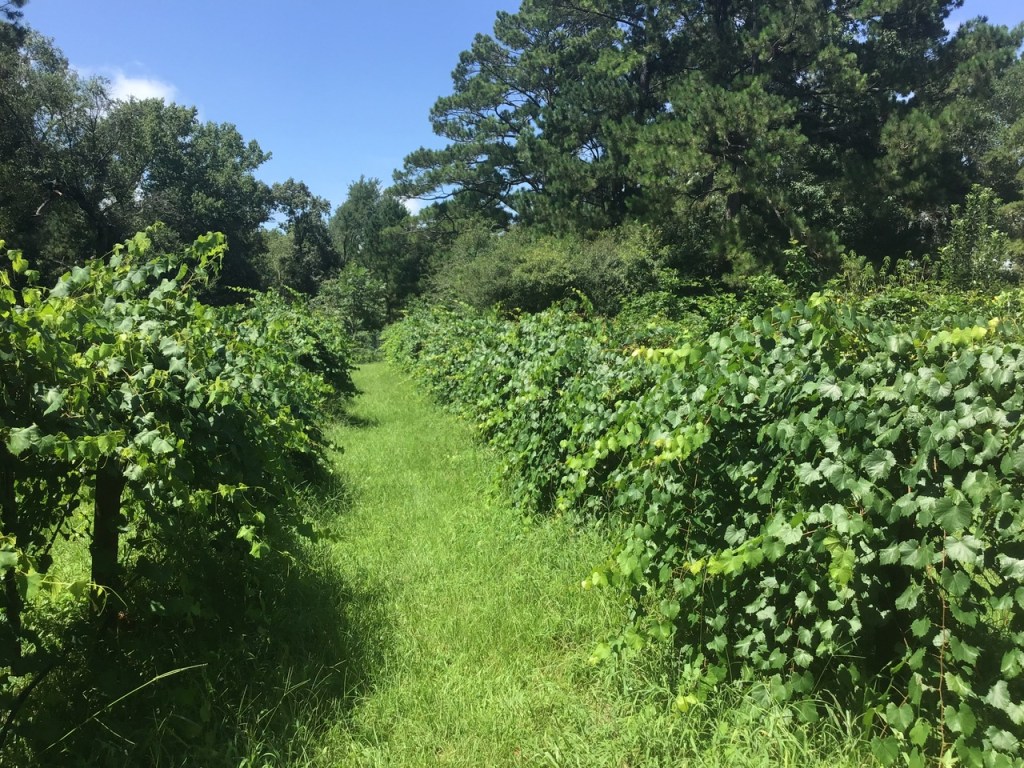
The pears are looking promising, and the grapes–which will be the next big project–wine and cider-making season. Blackberries and pears are our easiest fruits here; everything else seems to struggle. Though we have had years of good figs, and some neighbors still do. The grapes are looking good too, but there’s no guarantee.
And I think I finally got the trick for strawberries. It seems most everything that is most delicious is high-maintenance. What can -we do, if we like high maintenance produce but to contend with the high costs of creating them?
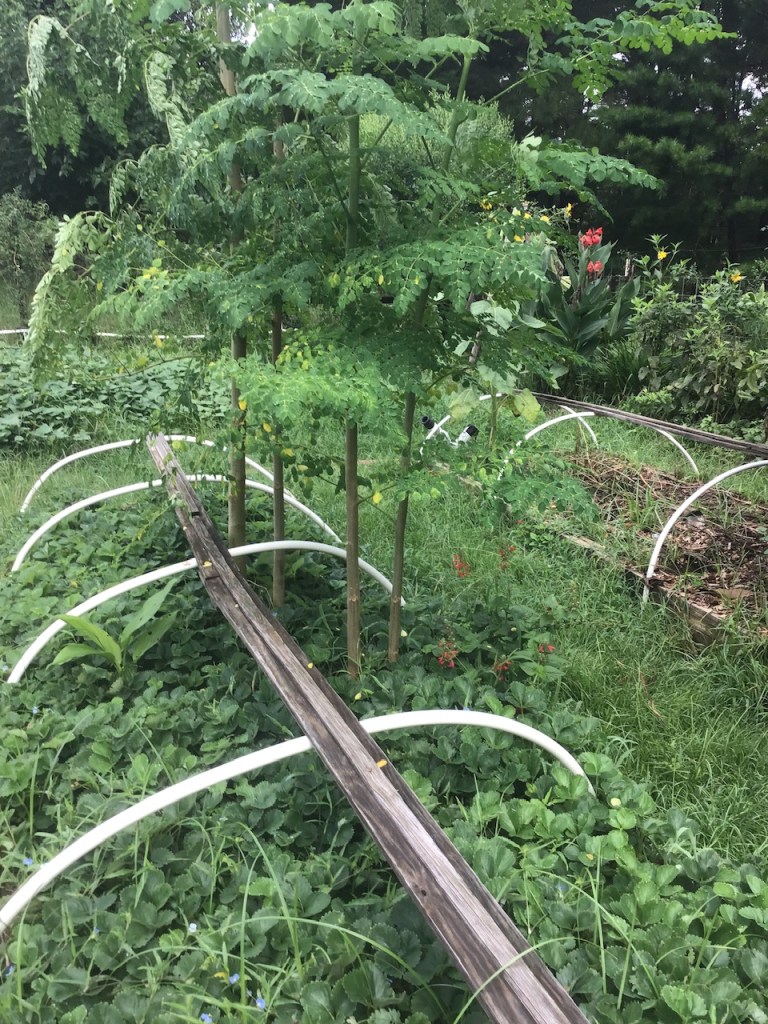
Many years of failed strawberries, but this year was a great success in comparison. Now the runners are going crazy and taking over this bed, so next year promises to be better still.
I’m planning for more low-maintenance in future, but those might be high hopes.
Because, my choice would be to spend my dwindling number of pain-free hours working with the flowers!
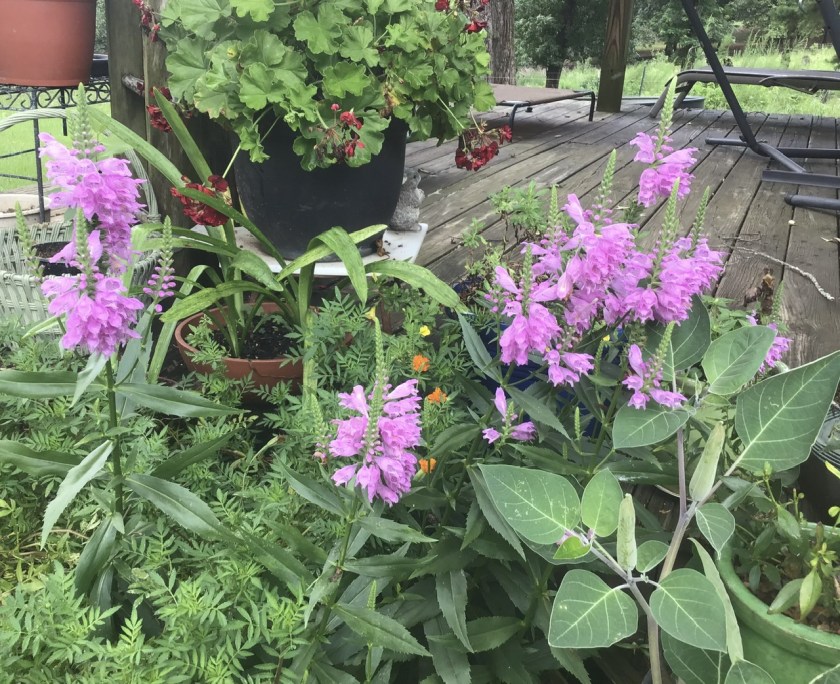
I’ve seen a few butterflies and bees on the pink ‘Obedience plant’, such a welcome sight!
Which brings up my other meaning for Shoulder Season. So much shoulder pain! And I am not good at staying stationary, it drives me nuts actually. So it’s between physical anquish, or mental, and I do far better with the former.
I’ve been planting more flowersAnd trying to attract the birds and the bees
It’s as unwelcome a kinked, knotted, crippling invasion as this mystery fruit I posted about last year. I unknowingly caused quite a crisis in the garden and lost almost all the melons I planted.
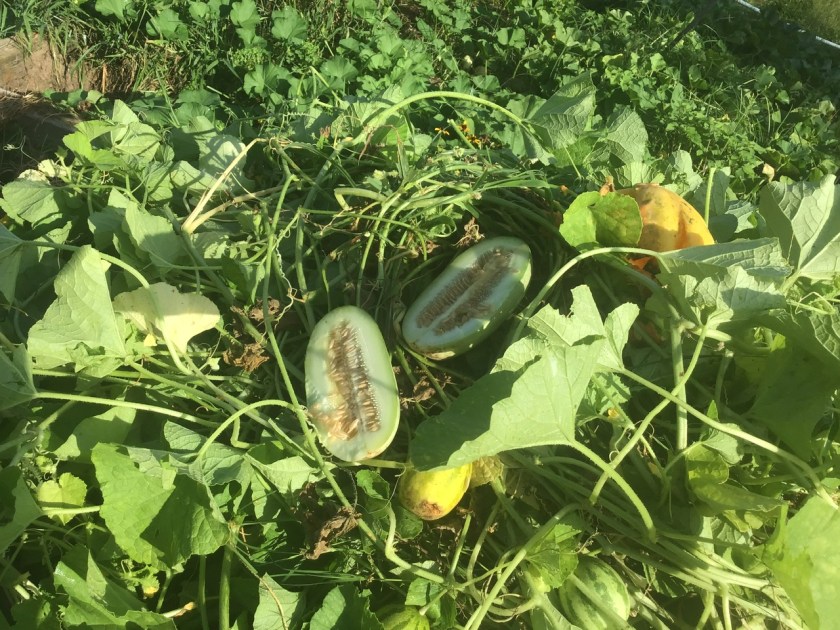
What is this imposter which choked out all my melons?!
Just when I was insisting to Hubby we need to be thinking about reducing our garden plots in order to reduce our workload and water usage, I stand corrected. The orchard squash didn’t produce well at all, for some unknown reason; the garden melons were choked out by the wild cucumber; so without the third space we’d have no watermelons or honeydews, which would mean a mostly melonless summer after lots of work and wait, as the main garden produced about half a dozen sub-par cantaloupe.
A sweet, cold watermelon is the best morale booster in the hot, humid Texas summer garden jungle!
Two wheelbarrows full of vines and fruit the pigs don’t even like.
Wild cucumber vs melons and the melons lost bad. I have still not been able to figure out what these things are, which I brought into the garden under false pretenses. I have heard suggested they may be lemon cucumbers or mouse melons, but they are not the right size, shape or color for either of those.
I really get the frustration of invasive species now. I realize I’ve been a bit cavalier on that front in the past, for good reason, but I have definitely been humbled this time as these bitter, seedy imposters are still popping up everywhere.
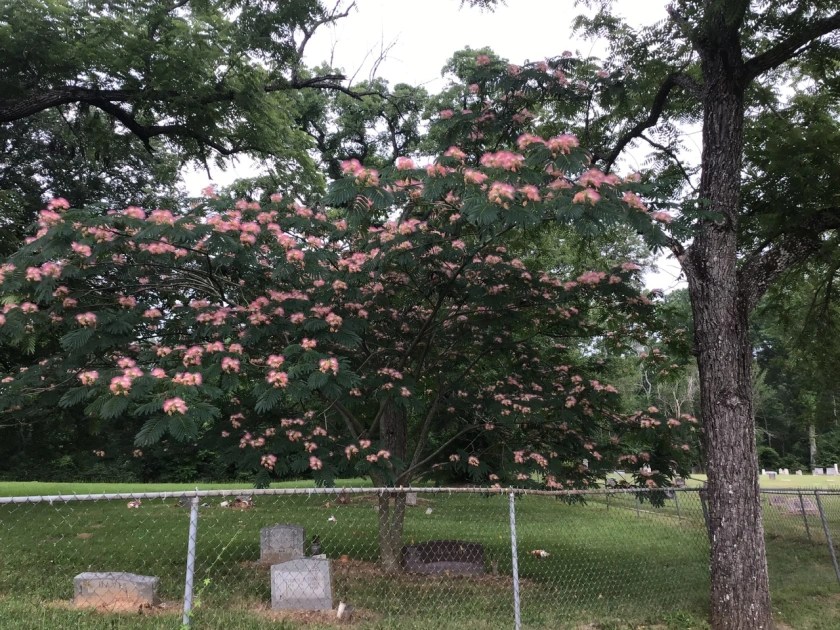
Please, give me an invasion of the supposedy invasive Mimosa trees, and I’d be thrilled!
You have my permission to invade my gorgeous Mimosa!
The plants that thrive here in the long high heat and humidity are so impressive, even when invasive, but it helps my morale considerably to consider the non-invasive ones as often as possible.
A couple of young zuccini with the sweet potatoesA mini-jungle of cherry tomatoes growing under the elderberry
The sweet potatoes are almost effortless. Once they get established and as long as they get a good head start over the bindweed (another ‘invasive’ relative) they are pretty reliable. Eggplant and okra are others, and we’re learning to like eggplant. Maybe even a lot.
Eggplant, peppers, tomatoes, green beans and tonnato sauce over rice noodles, delish!Eggplant, basil ferment in the back and bread and muffins baked in the toaster oven outside, because it’s too hot to bake inside.
The bountiful basil takes center stage as the parsley, dill and cilantro take early retirement and don’t even bother to seed, it’s so damn hot.
Whether and which tomatoes will survive, or thrive, from one year to another is anyone’s guess.
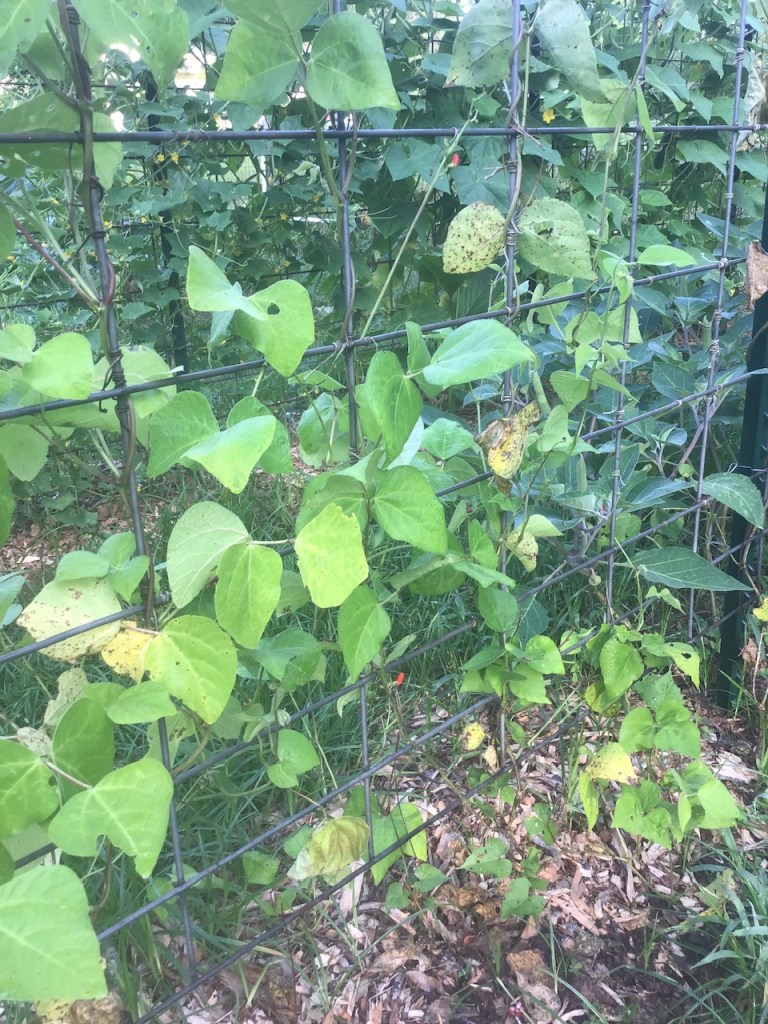
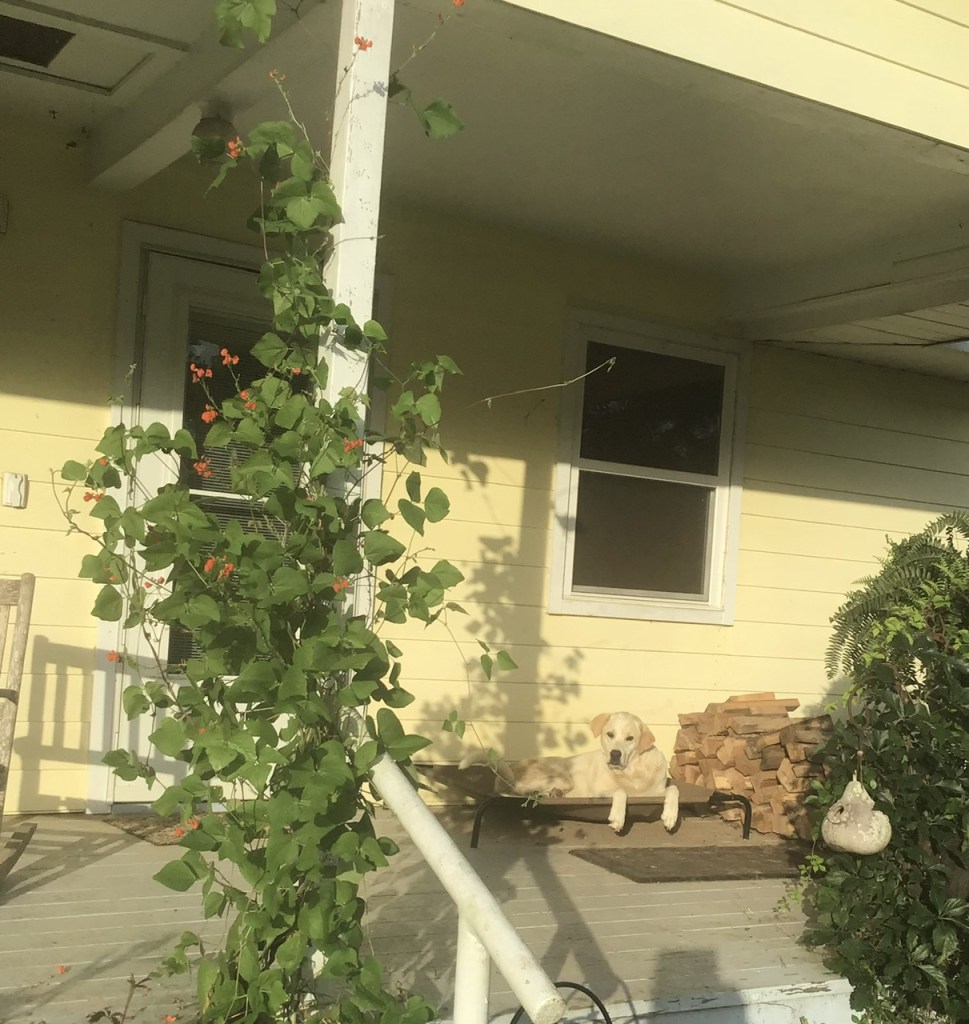
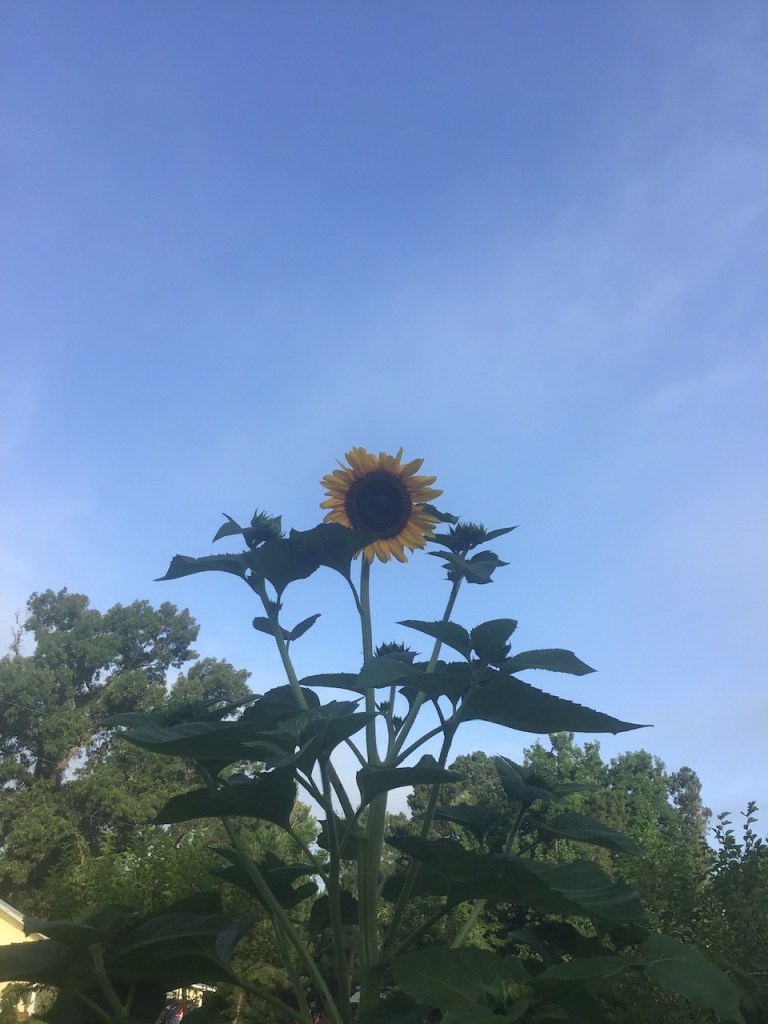
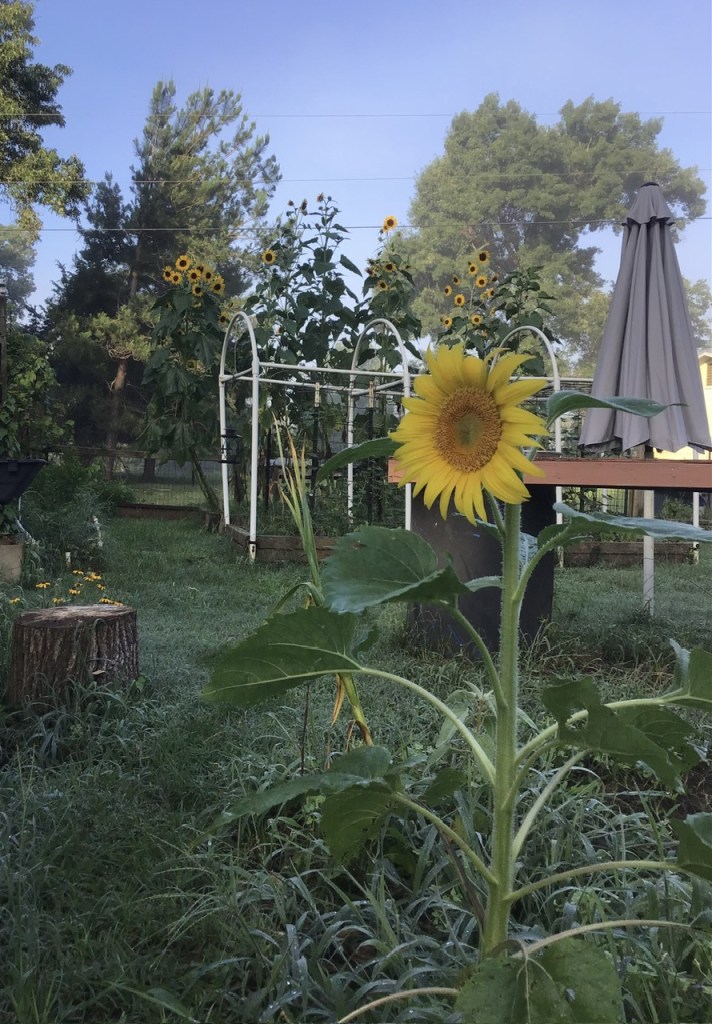
Gavin’s seeds, the Scarlet Runnerbean (barely) and Black Hopi Sunflower, are hanging on still, very impressive.
The black Hopi sunflower behind a mystery weed that smells medicinal. Any idea what it is, anyone?
The two out of three citrus planted last spring are doing well–they look healthy and their growth has more than doubled since spring.
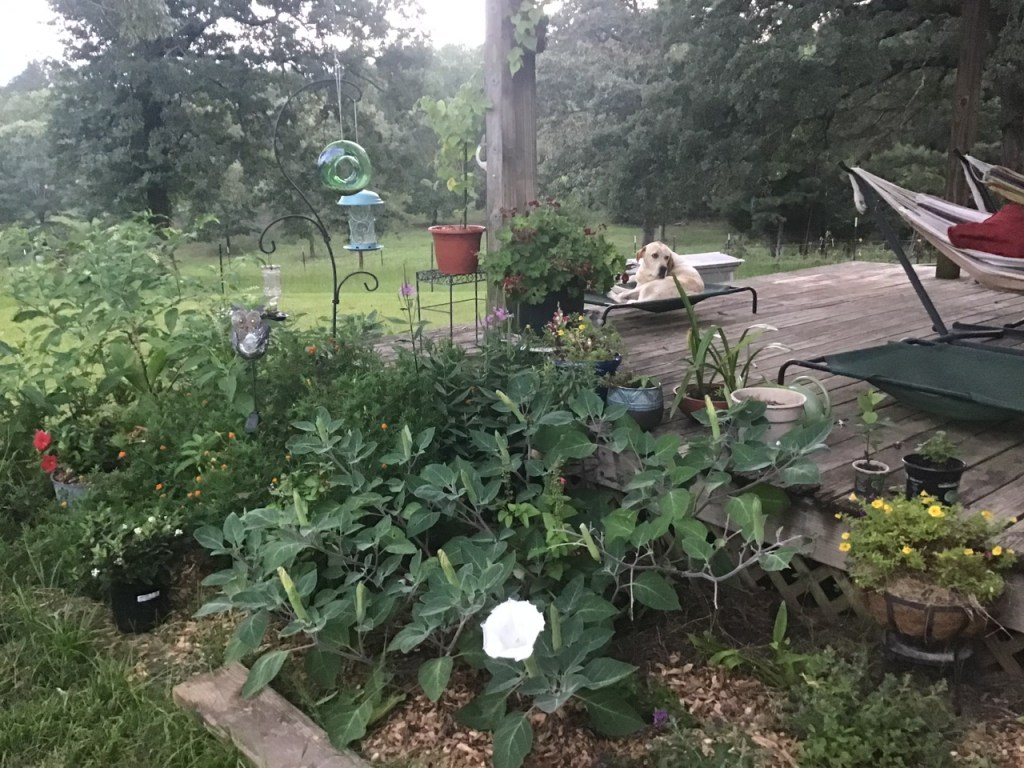
The poke weed, the datura, don’t get me started, such beautiful and amazing plants!
But, the mystery weeds, what are these?
What is it?Kinda pretty, very hardy, smells medicinal.Inquiring minds want to know!
It’s been so long since an update I don’t know where to start. Or where to end, or what to include. But I figure there have got to be a few readers out there hankering for some other news besides the shitstorm coming at us from the global mafia and the media cartels.
Mostly done, finally!
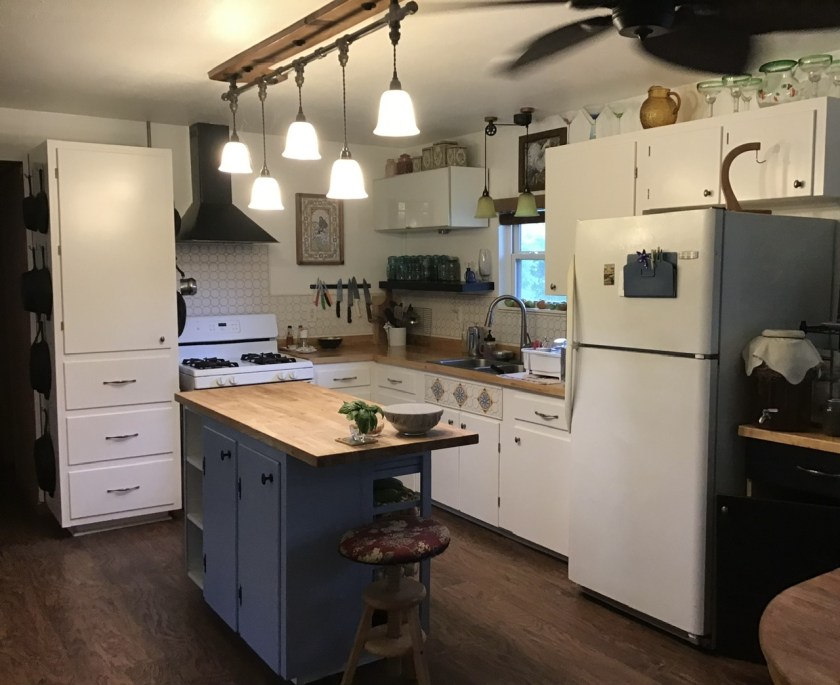
In my last update we’d started remodeling the kitchen. That was a very big DIY job, it took a very long time, and we’re still not totally finished. But we are very pleased with the results that were easy on the budget and tested our creativity, skill and resourcefulness.
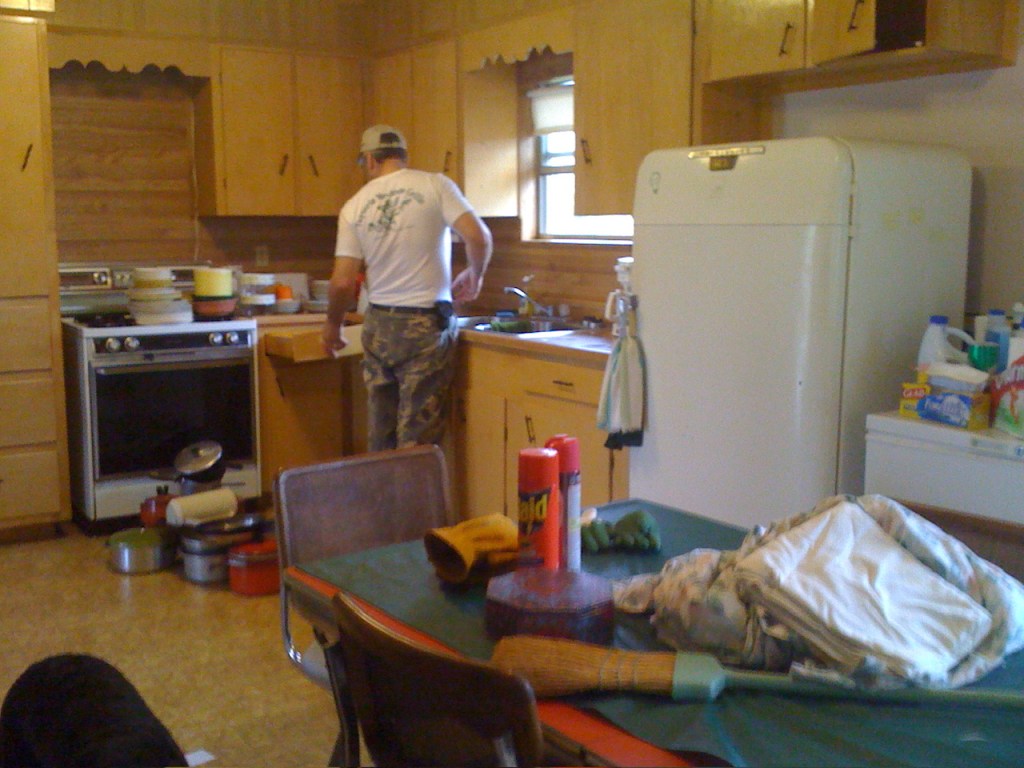
I thought I’d include our first time redoing the kitchen, in 2009 when we first moved in, with the previous owners’ belongings to haul away before we could begin. It had been empty for many years and the mice and roaches had taken over. It was a disgusting experience, the worst of which we got to avoid this time, so that was a bonus.
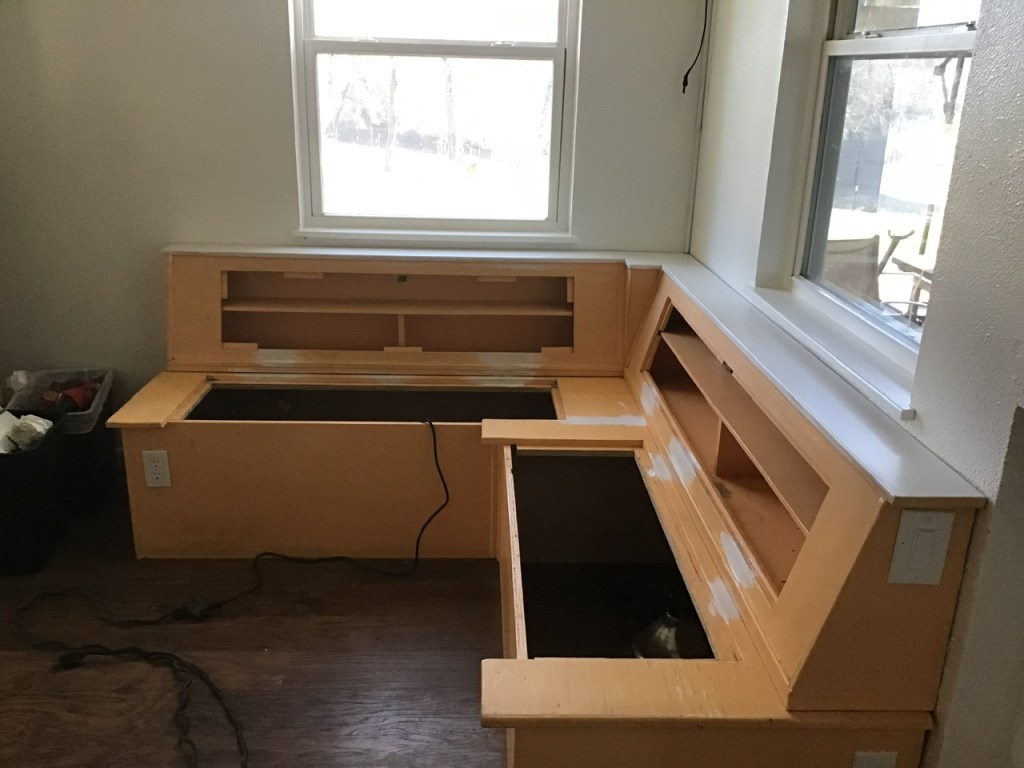
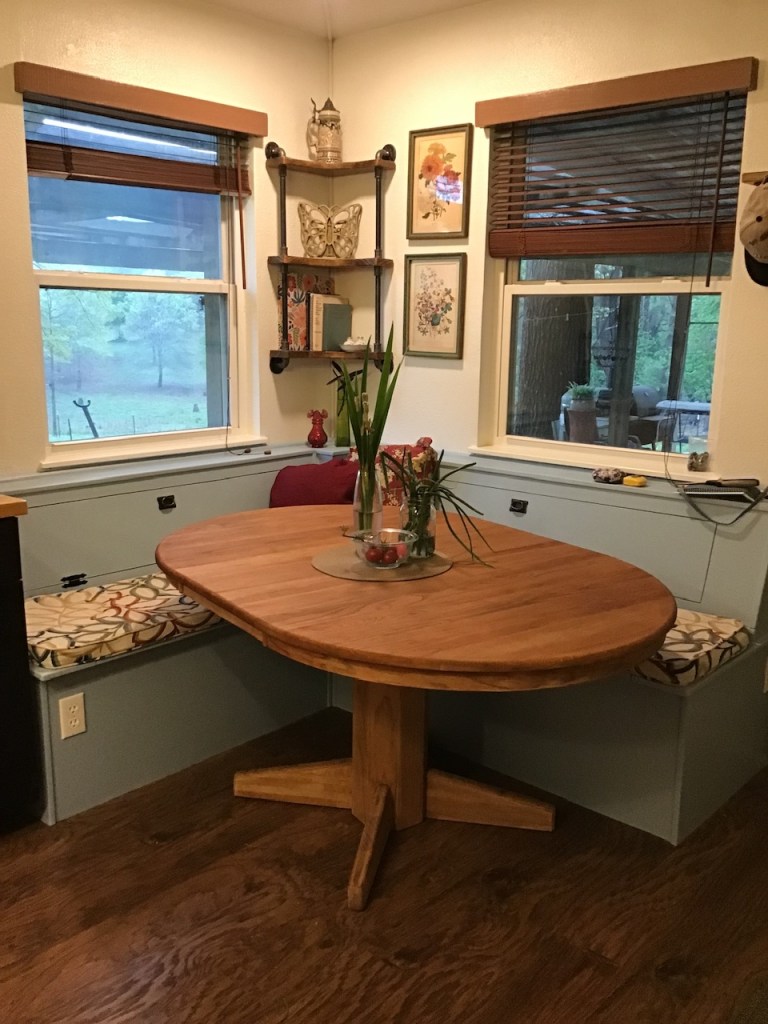
This time we also repainted the ceiling and walls and all the cabinets as well as the breakfast nook bench and storage unit Hubby had built previously. He also replaced the countertops and handcrafted new lighting and shelves, expanding on the same ‘steam-punk’ style as he used on the entryway table he built last year.
Work in progress:
Just installed butcher block countertops, quite the challenge when floors and walls aren’t level or plumb!
After way too many lost hours, I was not always a happy DIYer! But I am pleased with the result.
I spent a lot of time stripping and re-staining the kitchen table. I still want to dress-up the windows treatments and paint the doors and bases of the table and stool. But then we got too busy and had to devote our time to the garden and orchard.
The cucumbers and zuccini that were badly damaged by hail in late spring did make a bit of a comeback, but now are succumbing to the heat.
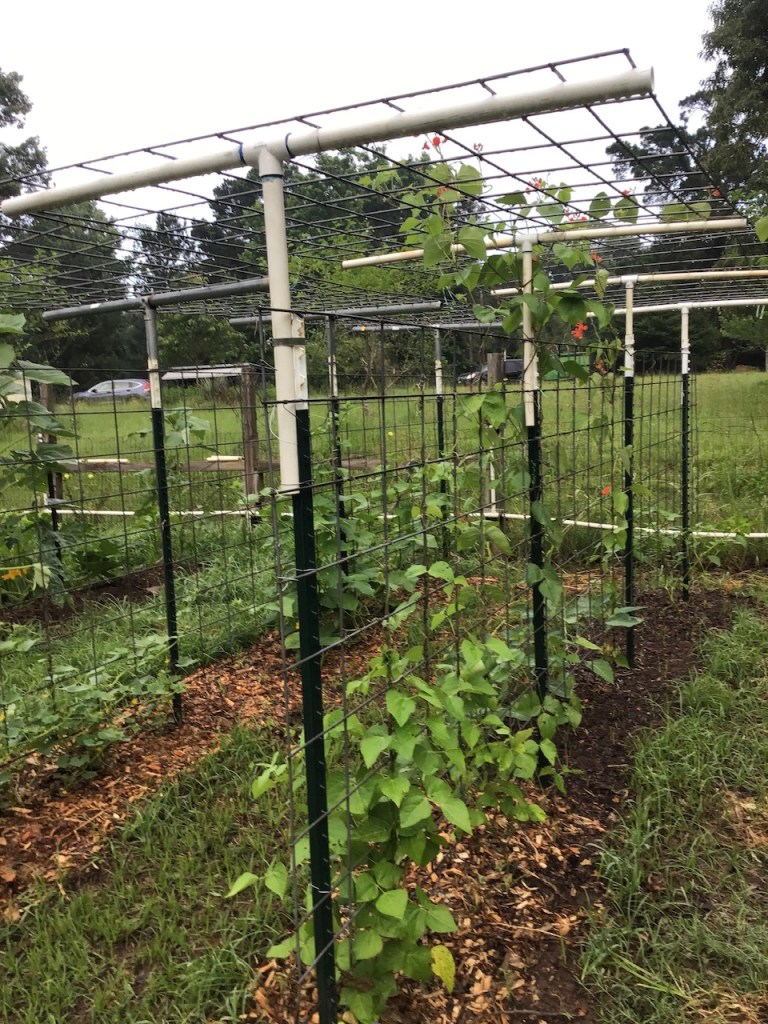
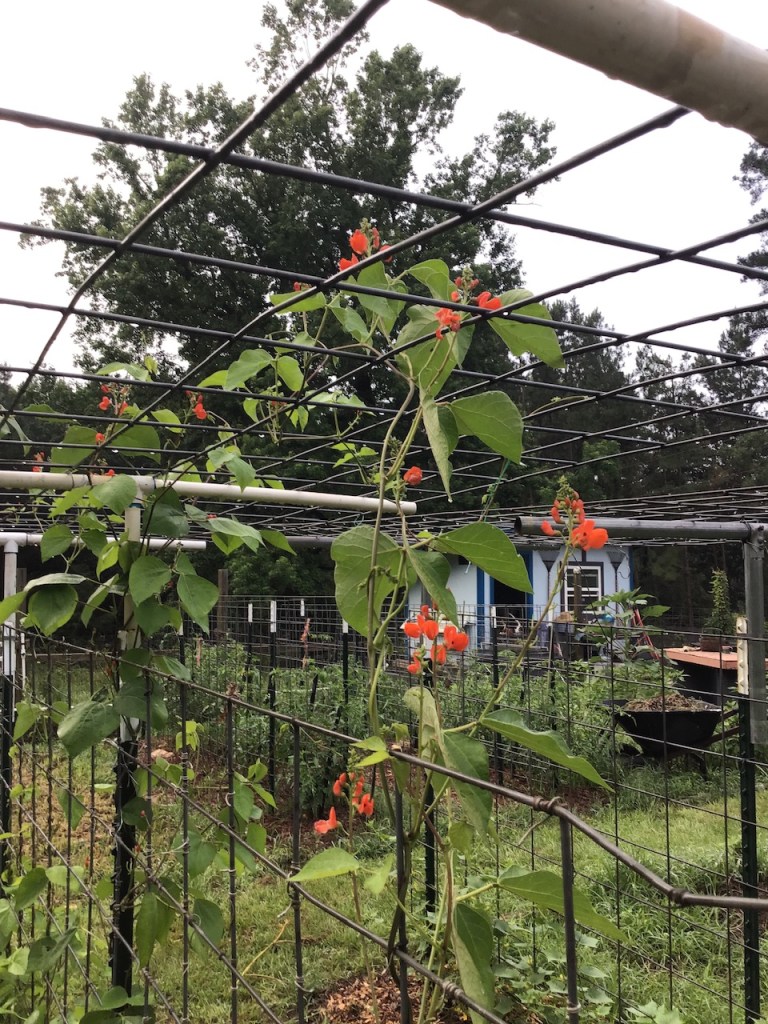
Unfortunately and as usual, a lot of the time devoted to the garden gets wasted because of crazy weather. This year has been no different and we had a lot of rain at the wrong time for some crops at some stages. The older peppers did fine with it, but the younger ones look terrible and are not recovering. Same with the tomatoes. The heirloom Scarlet Runner bean is struggling and not producing, but is still quite pretty as an ornamental.
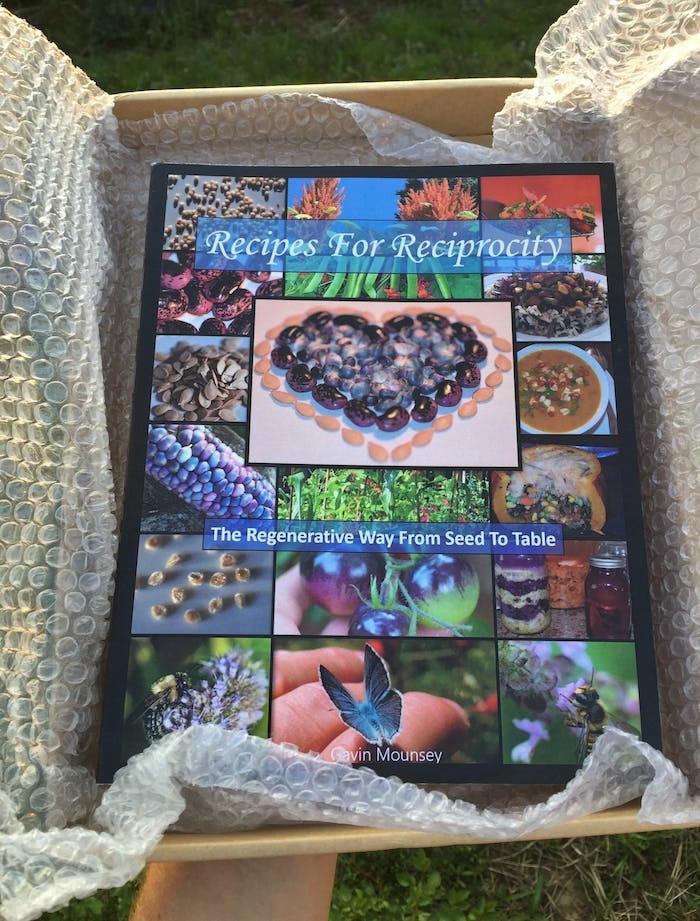
I’ll be writing about those seeds, as well as the ones that grew this great big beautiful Black Hopi sunflower (the tallest I’ve ever seen!), in an upcoming post about Gavin Mounsey’s book Recipes for Reciprocity, because the seeds came from him.
These cucumbers were just the right age for survival and are going strong now.
I’ve gotten good at succession planting over the years for the reason of crazy weather. In very early spring I try to get tomatoes, flowers and herbs started, but am often disappointed by late frosts. Days of heavy rain and high humidity with overcast skies can easily cause damage to younger more vulnerable plants in early summer. By this time of mid-summer I’m sowing more cucumbers, herbs, and sometimes beans, but it’s often already too hot for them to get established. At this point, we get what we get until fall brings more hope.
But of course I can’t be satisfied with that and am always experimenting. Often it’s fall tomatoes or melons, which rarely work out. This year it’s the challenge of romaine lettuce through summer. I seriously doubt it’s possible, but I’ve got a tray that has just germinated under lights inside to give it a try. I’ll put them in a shaded box, with plenty of hardwood mulch in an attempt to keep the roots cooler. It’s been in the 90s everyday lately, humid and not cooling off much at night, but there’s still some growing that wasn’t smashed by the heavy rain and hail a couple of weeks ago.
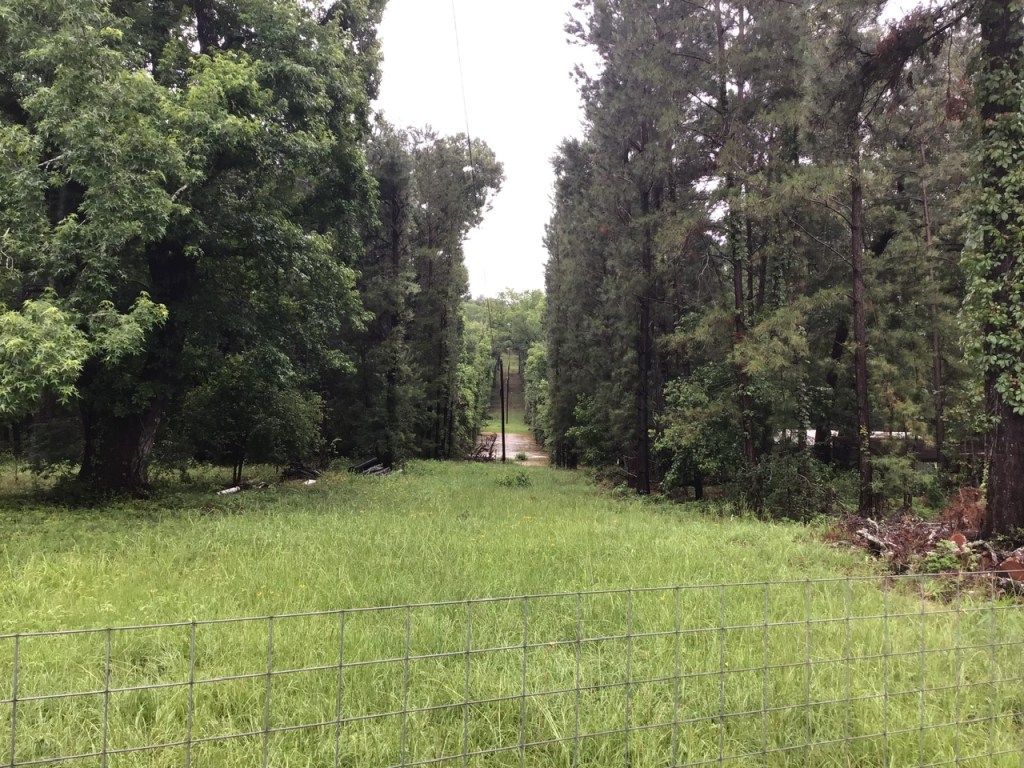
Left photo is view from garden, normally the creek is not visible at all. Right photo is walking along the power easement to the very flooded creek banks.
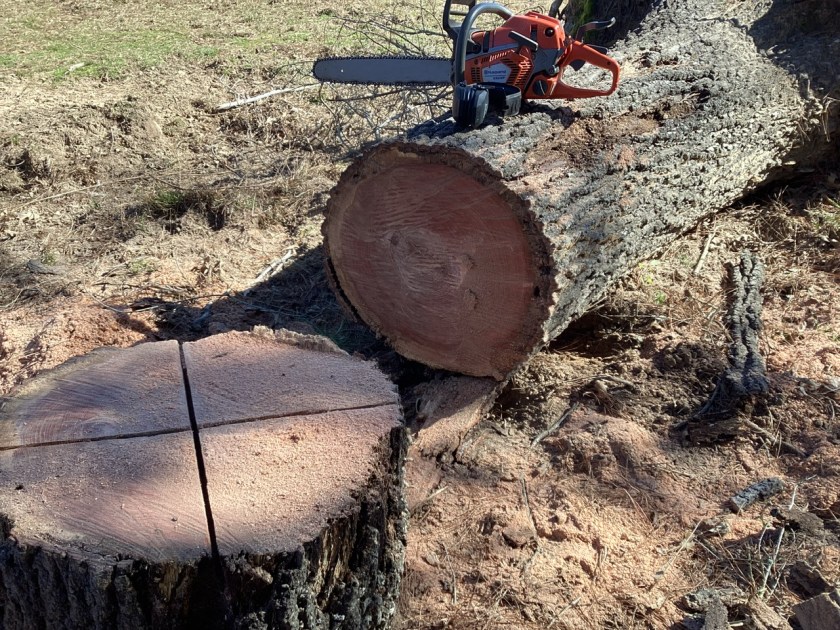
We also had another big oak tree die suddenly in the prime of life. The last one was just taken (partly) down by the electricity company’s crew because it risked falling into their cables. The latest one Hubby will have to fell himself, before it comes down on the fencing. That will probably be after he fixes his bridge to nowhere that he just built last year in response to flooding and was nearly taken out by this year’s repeat performance.
Sudden Oak Death Syndrome?
In the last two years, with no tornados or hurricanes to blame, we’ve had three large trees right around us flash out dead in a matter of days. Rather disconcerting to me, to say the least.
No such bounty this year I fear.
Still, let’s end on a positive note. Some years are better than others. We had an inexplicably bad blackberry year, but this year was excellent. Hubby made blackberry wine with much it, which was much better tasting as a young wine than the one I tried to make and age last year. Some years we have amazing tomatoes. Other years it’s great melons. Maybe this year it will be spectacular grapes?
It doesn’t take much for fabulous meals when food is fresh. Fermented herbs and veggies add flavor and nutrition with just a little garden surplus or foraging time. The chanterelles always do better with lots of rain. Hubby’s delicious young blackberry wine makes such a refreshing spritzer when mixed with kombucha. Eating seasonally from our land is so rewarding even when we don’t have a bumper crop.
I have a long list of content coming up during the swelter season, so all the more excuse to stay indoors. Thank Man for air condition! 😆
It’s been quite a long time since an update on the wee homestead projects and activities; it’s hard to know where to start! How about, for consistency sake, I bitch about the weather for a bit, and then move along to better tidings.
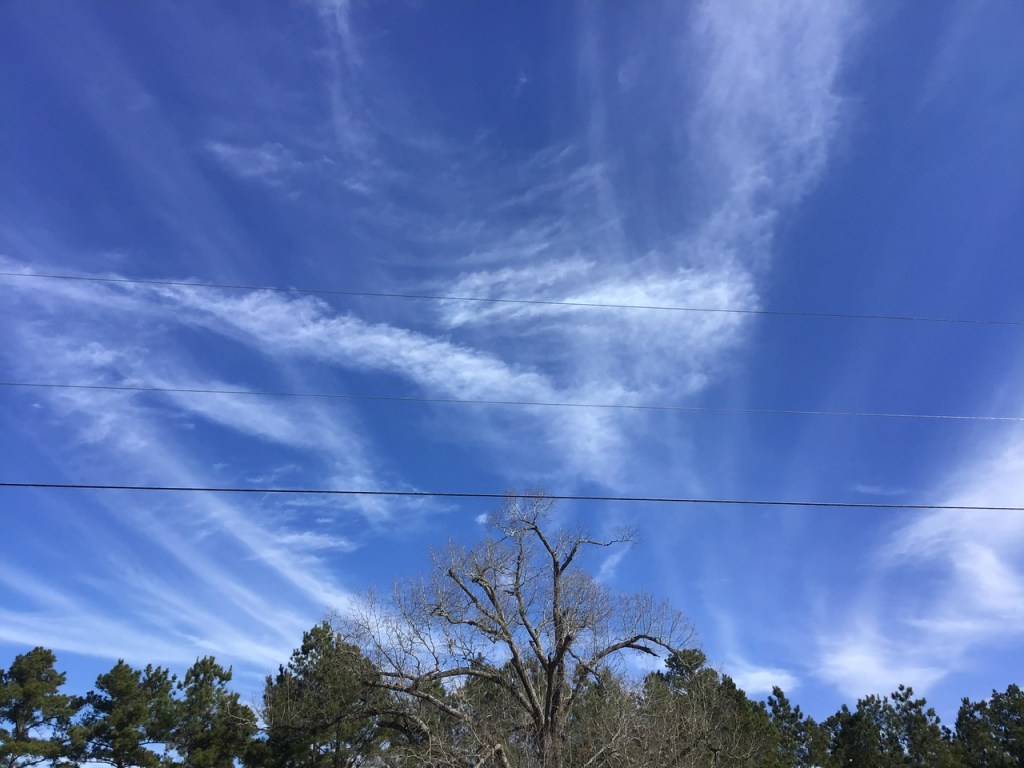
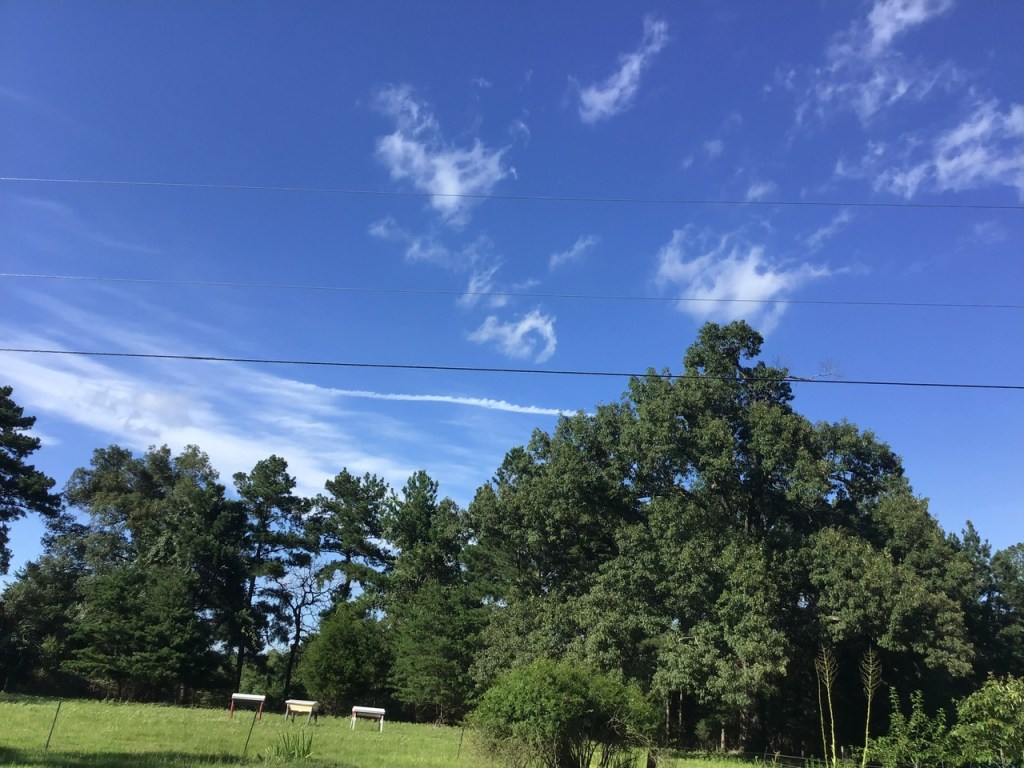
Of course the geoengineered chem-filled skies continue, as does our Yo-Yo season (formerly known as winter). We are using the air conditioning now, it’s been 80 degrees for days.
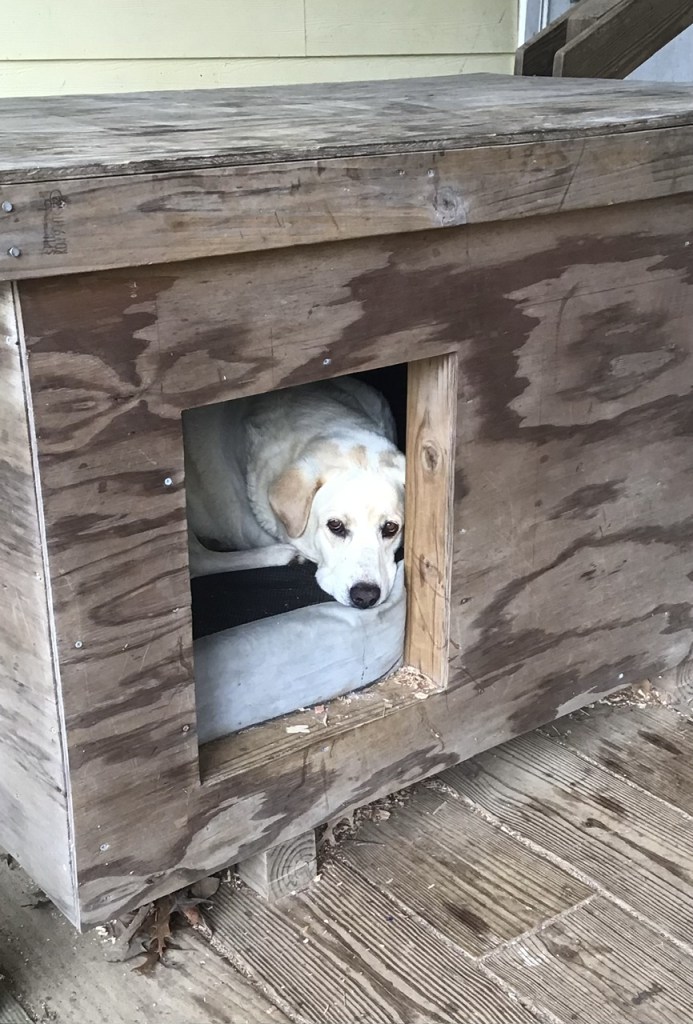
Buttercup is especially sensitive to the YoYo, to the point of regular getting seizures at such times, also lethargic and losing her appetite.
Buttercup hiding in her box all day.
There was of course the lows not long ago in the 20s and I was very concerned for the newly planted citrus. We employed quite the set up of lights and covers and they faired very well, I’m happy to report.
Invasion of Asian beetles on the citrus cover
But there has been a bad invasion of these awful beetles, which we’re vacuuming off the ceiling multiple times a day. Not to be confused with the garden-friend, the lovely little lady bugs, NO, these little beasts are really nasty. They infest, as obvious from the photos, and they bite, and as if that’s not enough, they stink.
I don’t like when folks call them lady bugs, they are not at all ladylike, so I try to correct them anytime I hear complaints, which is more often than you might think. The reaction I get is much more open and accepting than when I inform them about the manufactured weather.
Old lettuce bolting, replacing with new lettuce started under lights indoors, along with broccoli and cauliflower.
It does keep us on our toes, dealing with the Yo-Yo. Lettuce and herbs bolt prematurely quite often, seedlings come up then freeze or wither. We never know from week to week what to expect or how to plan.
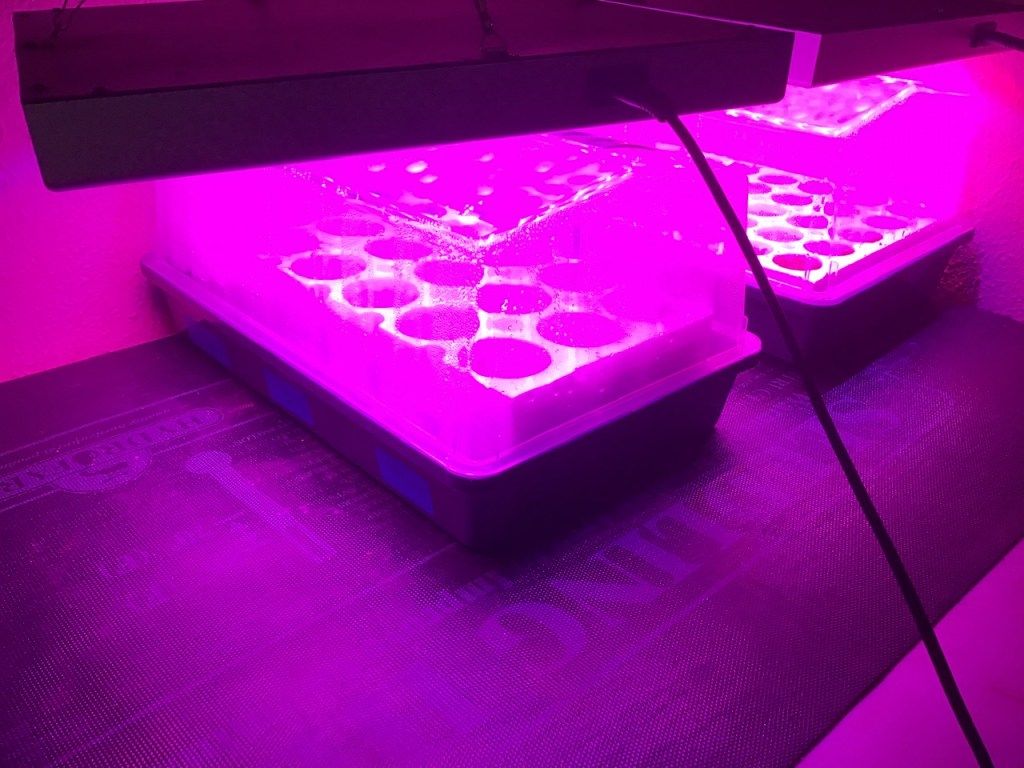
I don’t normally have such a fancy setup, but these trays were gifted to me and they’re working quite well germinating some lobelia and snap dragons.
My indoor lights and heating mats make things easier, as does the row cover in the garden, but it is constant juggling. And if I miss a beat, death. Like happened with the Mexican oregano I was so proud of. I forgot about it outside one night when it frosted. Very disappointing considering our long journey of discovery, and how long I babied those few little sprouts, trying to anticipate their every need, carting them inside for warmth, then outside for sun and wind, and just when they were getting their legs, gone. All my fault.
Well, except for the geoengineers, because I wouldn’t be doing this constant refrain if our weather was consistent or predictable or seasonal.
I’ve tried twice since then to sprout the herb again with no luck. I will succeed eventually, of course, we’ve come too far in our quest to fail. The Mexican oregano has a long tale in these parts. Failure is not an option. More on that in the last HH post, if you like. https://kenshohomestead.org/2024/11/14/homestead-happenings-43/
I’d like to say it was the same with the milk quest. Unfortunately, I’m not nearly as confident; I feel failure is probably inevitable and maybe even imminent. For the time being I’m counting my blessings I’ve found another (perhaps temporary) source. Last time I was complaining about the cost, this one is even more expensive at $15/gallon. At that price I’m not going to be experimenting with any new cheeses, that’s for sure. To make cheese at all is not really feasible, except for the most delicious of selections—Camembert. Otherwise the precious commodity goes toward morning coffee, ice cream, and buttermilk for recipes and the extended expiration date.
Camembert to be draining before salting
I’ve been doing continued research on the topic of raw milk and what’s available and in general, where’s the market vibe. I found one young entrepreneur with a private herdshare selling cheese for $25 a pound. (A Herdshare Agreement or a Grade A license from the state are the only ways to sell raw milk in Texas legally.).
With my new herdshare deal I can buy more milk for cheesemaking, if I’m willing to pay $15/gallon. Considering the hard cheeses I typically made were 5 gallons ideally (better for aging in less than optimal conditions), that’s a really expensive cheese.
Certainly what can be made on-site are far better cheeses than can be bought at the store; that’s why I started making cheese in the first place. But still, it’s really hard to justify all that work, and expense, when we can still buy organic cheese for about $8/pound.
I will splurge one time in late spring, if possible, when the grass is thick and so the milk most rich. And we do still have two goats, hopefully pregnant, so there’s a small hope of cheesemaking in my future, if all goes well.
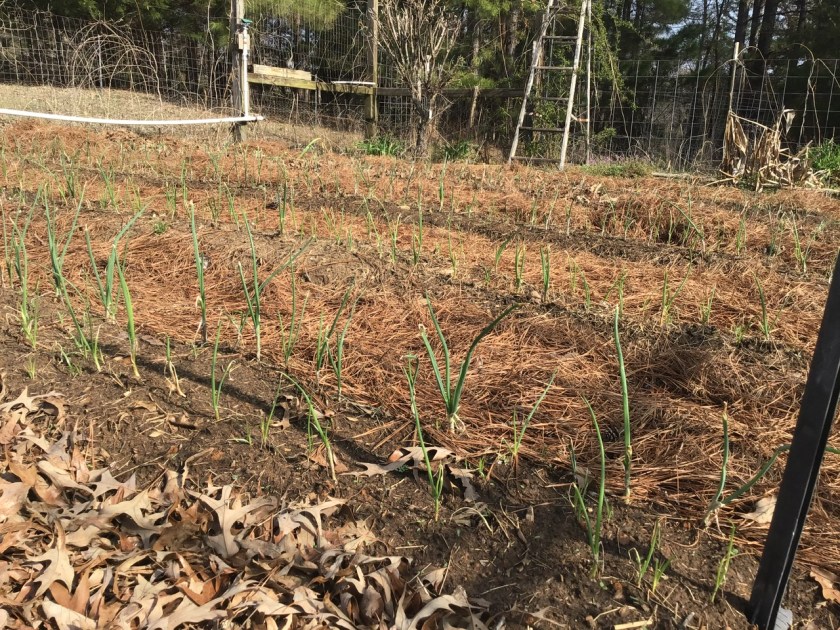
Moving on to the garden, the garlic is going strong and I’ve just got the onions in, 3 big rows of each. The garlic we plant is elephant garlic which does so much better here than any other variety I’ve tried, and I’ve tried lots. These are local for over a decade now and their productivity has yet to disappoint.
The onions are from purchased sets and they normally do well, though some years are a bust, like last year. I also started some from seed under lights, to compare if they are more consistent and adaptable, because the sets have gotten pricey in recent years and it’s irritating to pay good money for possible failure. Onions do not like Yo-Yo weather, but then again, who or what really does?
At least some seem to tolerate it better than others. We’ve got a couple of ‘oyster trees’ that are bringing us regular tasty gifts.
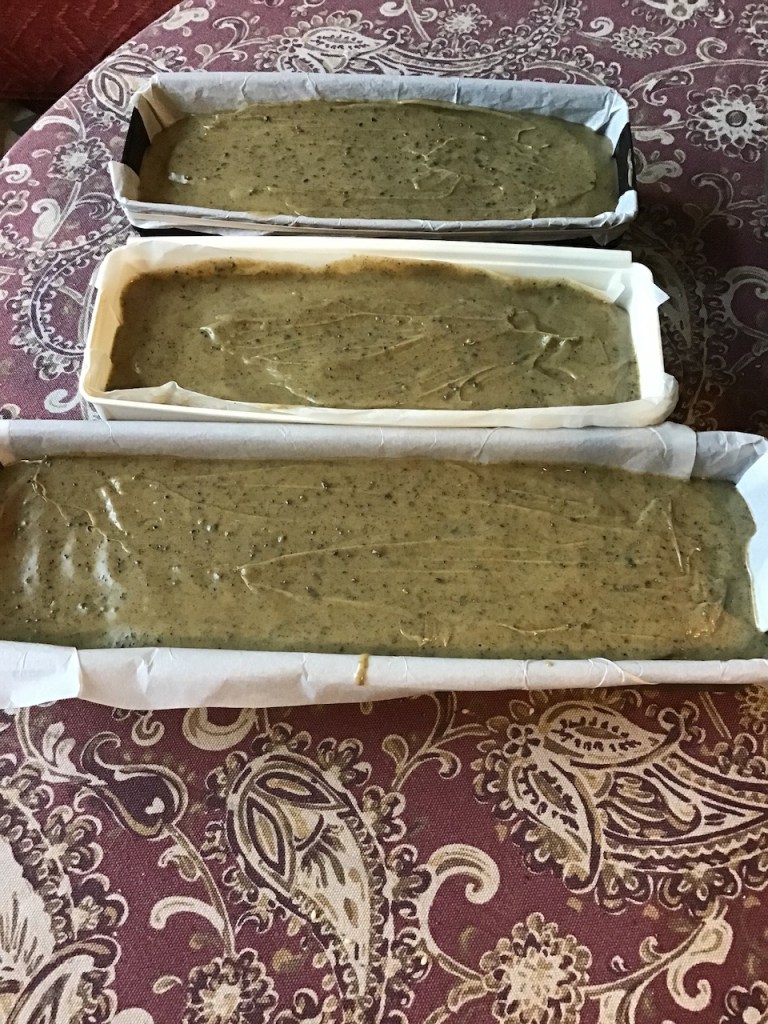
I’ve also tried a couple new things that have been long on my list. There’s the soap that’s just now cured, a bit earlier than I’d read is typical. I’m really pleased with it! It lathers very well and the scent is rather sensuous. My intention was something earthy and erotic, and I think I succeeded.
I got the sensual part down, now I need to up the aesthetic! Trust me, looks are deceiving here, I just need better molds! Never underestimate the power of packaging, eh?
After finishing up slaughter season and chopping up downed trees for a month, Hubby has moved on to a far more desirable and needed project, according to me, our kitchen! Yippie!
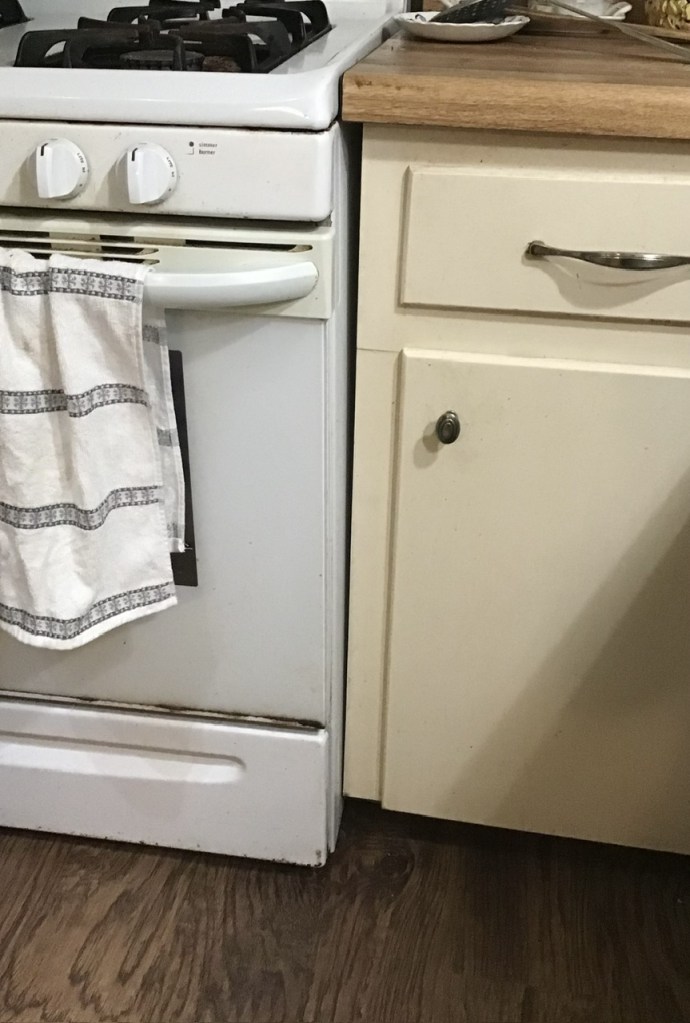
We’ve needed new countertops badly for many years, ours have been well-worn in 40 years, especially since we’ve gotten here and the space went from softly used a few times a year, to a daily year-round assault. It’s actually pretty impressive the counters aren’t near dust by now, considering how quickly more modern materials fall apart.
New island done, now for the hard part.
Old, ugly, not square or plumb . . . Good times coming in Hubby’s near future!
New countertops got us on a roll and now we’re planning new light fixtures and maybe even a new paint job. Big ideas, perhaps not backed up by time or commitment.
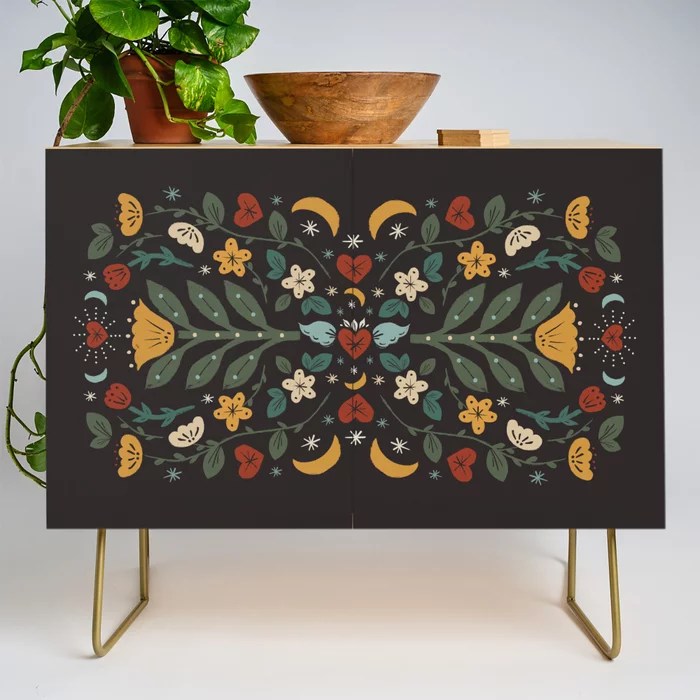
Those big ideas, I’m full of ‘em! In my mind the kitchen’s already painted and my next project is to paint the table, which I’ve wanted (and once tried) to do for as long as we’ve had it. I can imagine I might have a table with a surface that looked something like this . . .
But I’d be perfectly willing to settle for this . . .
Or this . . .
So, after I repaint the kitchen in the few spare moments between juggling plants in YoYo season, I acquire the skills of an artist, and paint something I can really be proud of . . .
Whenever I’m finally able to manage that, y’all will be the first to know!
In the meantime, here’s where we were at in the last update . . .
Mostly happy snaps this post, plus a few weather woes.
Hubby’s gorgeous melon patch is starting to produce more than just a feast for the eyes. He’s come up with quite an integrated system there and when I expressed how impressed I was with his companion planting scheme (and wondered whether he’d been taking a permaculture course on the sly) he informed me it was all a matter of frugality.
His penny-pincher logic is: the melon mounds have a lot of water run-off and sometimes erosion, so he added a ring of clover at the base of them. It’s just a bonus they are also good for the soil and the bees. The sunflowers are fodder for the goats and the chickens, plus they help shade the melons. The sea of black-eyed Susan’s just turned up there, apparently as impressed as me with the space.
Hopefully the melons don’t go the way of the onions, which has been our worst year yet. Luckily the garlic still did fine, which is from our saved seed, which previously came from a nearby friend’s saved seed. That has become a theme.
Elephant garlic does much better here than anything else, and I’ve tried many others for many years. I think I’ll give up that practice now and stick with what works, avoiding future costs and frustrations.
The success of the tomatoes and peppers so far has also been thanks to saved seed. I bought several varieties of each from the store, just for more variety, and those are the ones suffering more from the rain and high humidity. Several have already died, a few aren’t growing at all, and several of the others have bad issues.
Ours on the left, theirs on the right.
The purchased squash is already full of pests before giving us even a single fruit.
At least we got a few zucchini off our own saved seed before it too is already beginning to succumb to some kind of mold.
But other saved seed, the Trombetta squash and the mystery squash from last year, have proven to be more resilient than the popular varieties.
The filth-filled skies continue and not even the regular rains clear them up for long. I’m sure the sorry state of the skies has nothing to do with the crazy storms, right? The intense lightening, sudden flooding rain bursts, intolerable humidity, hail, tornadoes, and so on, that folks are experiencing across the country?
Just ‘mother nature’ they tell us. OK.
Well, too much ‘mother nature’ is not so good for the garden. It looks plenty green and lush, so that’s nice. But, look a little closer and we find it’s not so pretty below the surface.
But we’ve been relatively fortunate so far this year, just lots of rain and some wind gusts. Others have had far worse.
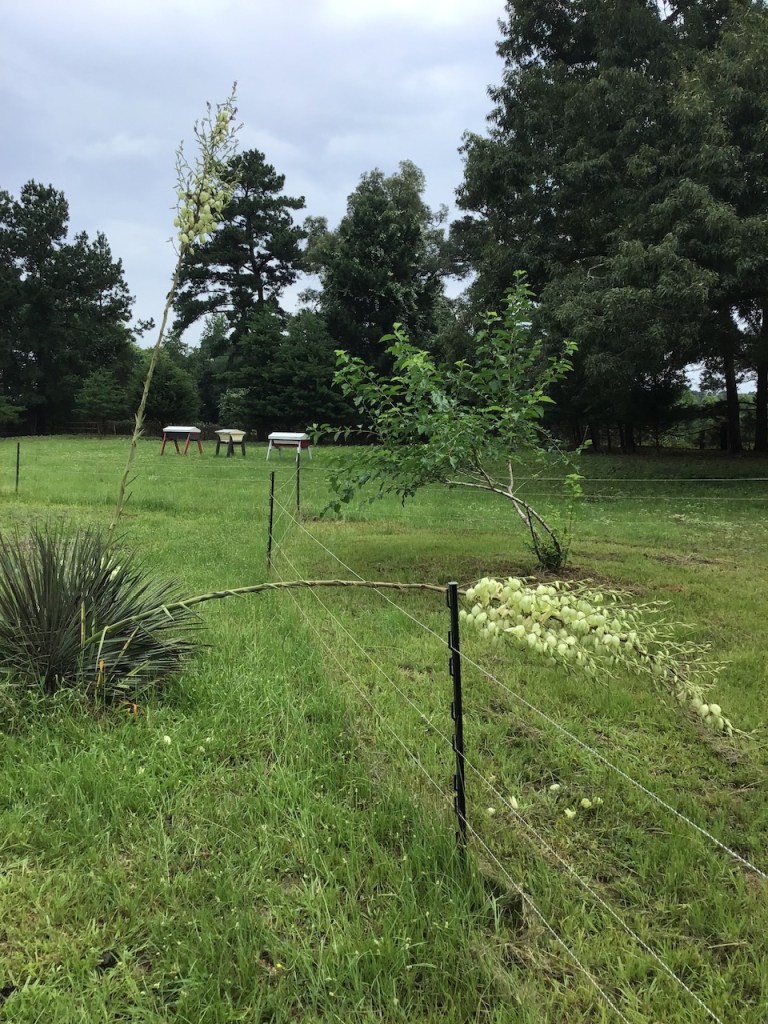
The yucca didn’t get lucky, but the blossoms are still lovely, even on the ground.
There’s some long-term requirements that fall on Hubby, which I mentioned last update, an upgraded culvert is required now in order to drive to the back half of our property. He’s already gotten started on that, a huge undertaking for sure. After that he can look forward to tackling the pond that’s now washed out.
In better news, there’s been some amazing growth in just one week.
A side by side comparison of 8 days growth.
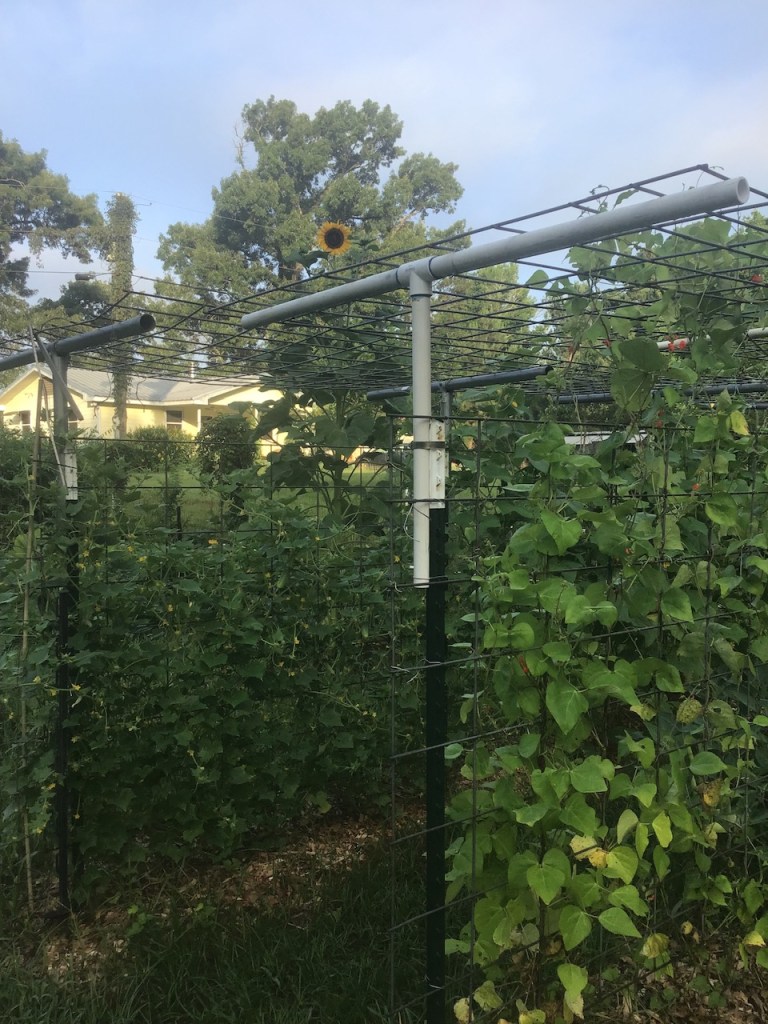
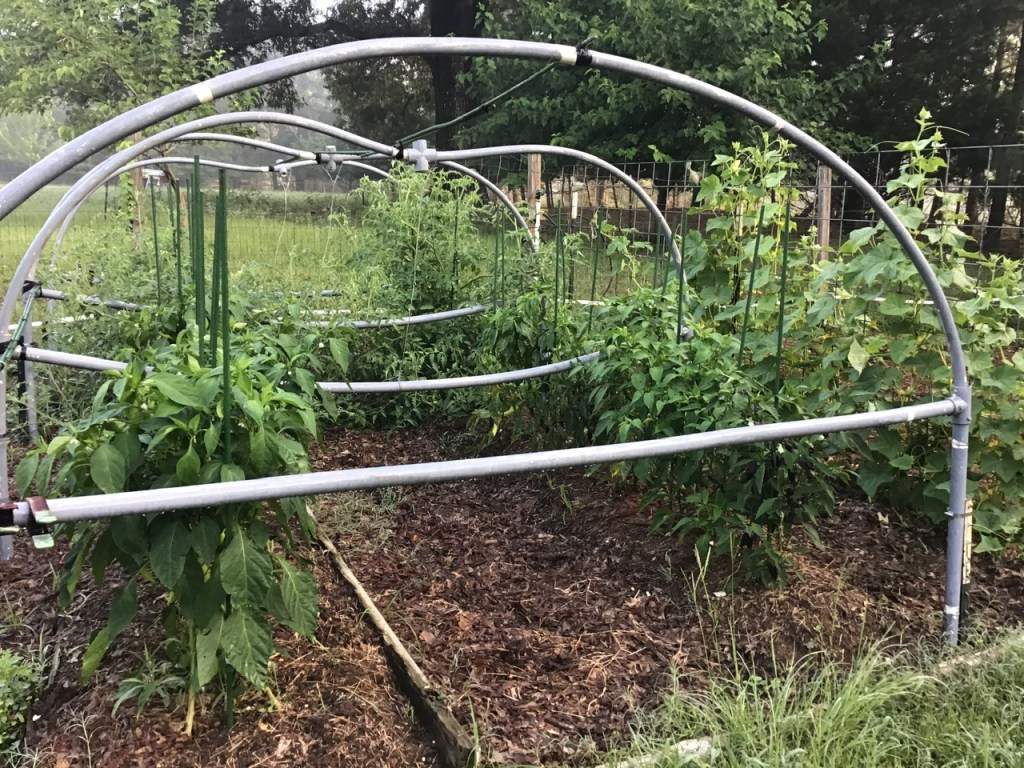
We’ve prepared for the swelter season by crafting another shading system where these tomatoes and peppers should be much happier into late summer. It’s recycled from another project and a bit awkward to move through, but it should do the trick just fine for supporting the shade cloth.
The asparagus beans, a first timer here, have really taken off in the last week. I’m excited to try them!
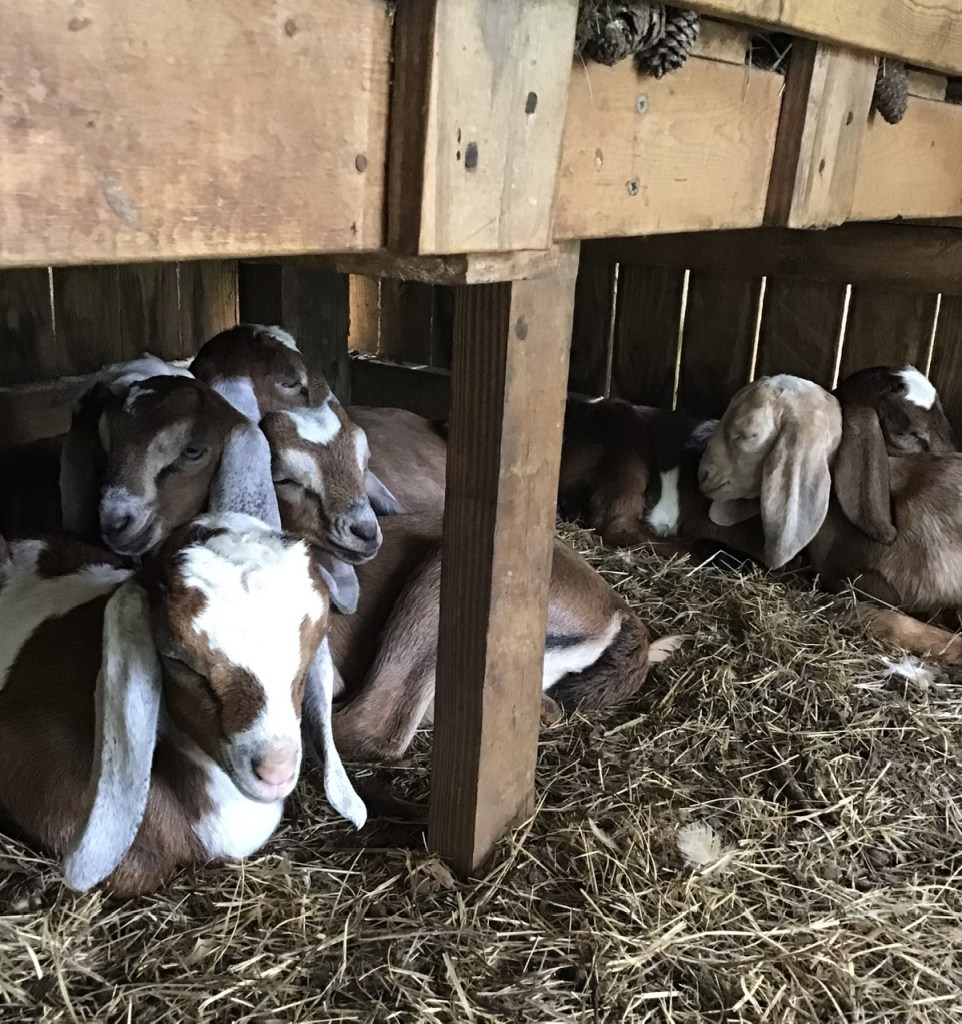
In even better news, the mamas and kids are growing well. We’ve started forcing them out of the corral during the day so I was able to give that space a much needed refreshing.
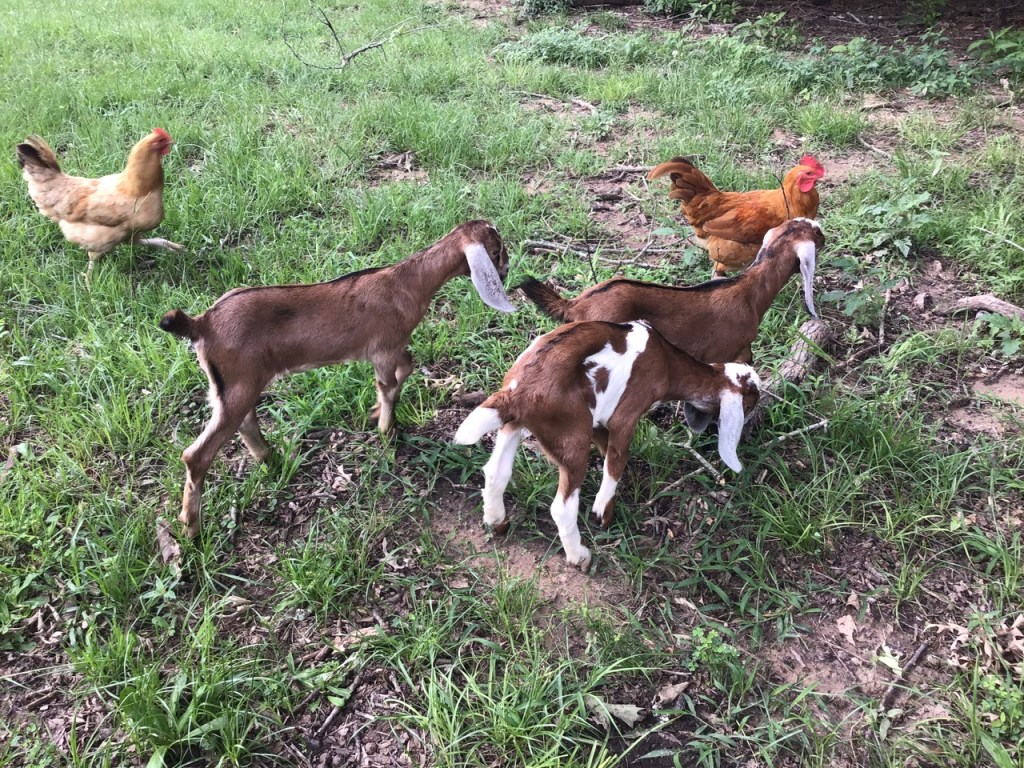
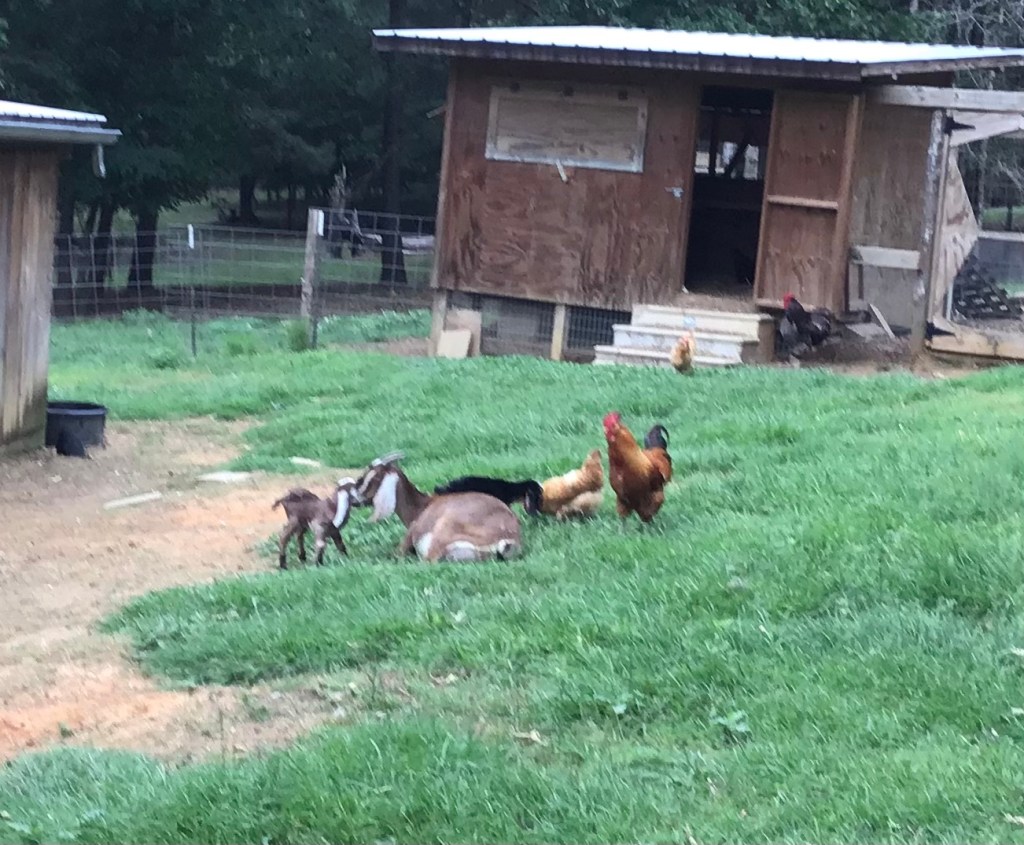
It seems they sometimes prefer following the chickens instead of their mamas. 😆
I’m getting the first fresheners ready for milking by training them on the milk stand. Soon it will be time to start separating them at night so I can milk them in the mornings before putting them back together again during the days. It’s not a happy time for anyone and I’m not looking forward to it.
But, I am looking forward to making lots of cheese again. We’re getting a bit of milk from Chestnut, who rejected her boy, and her girl is only nursing from one side. So, if I weren’t milking her she’d become even more lopsided than she already is.
It’s not a lot of milk, but enough for a little mozzarella now and then. I’ve found another method from my new favorite YT channel which is completely natural and far more tasty than the vast majority of those found online.
Raw milk mozzarella, mmmmm!
Unfortunately, the 2nd time I tried it was a failure. But, 99.9 % of the time a failed cheese can always become another delicious cheese. Some of my best cheeses have been from failures.
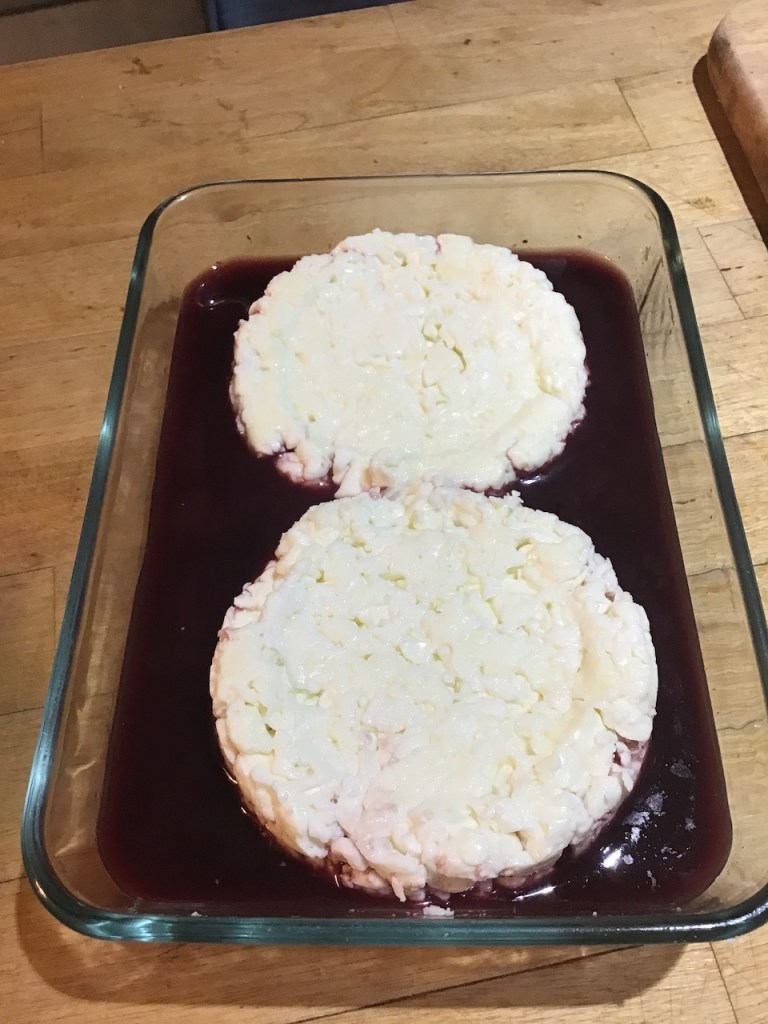
Not necessarily the case with failed wine. This cheese ‘failure’ will be soaked for a couple of days in the leftover must of the now fermenting wine, another tip I learned from my new fav YT channel.
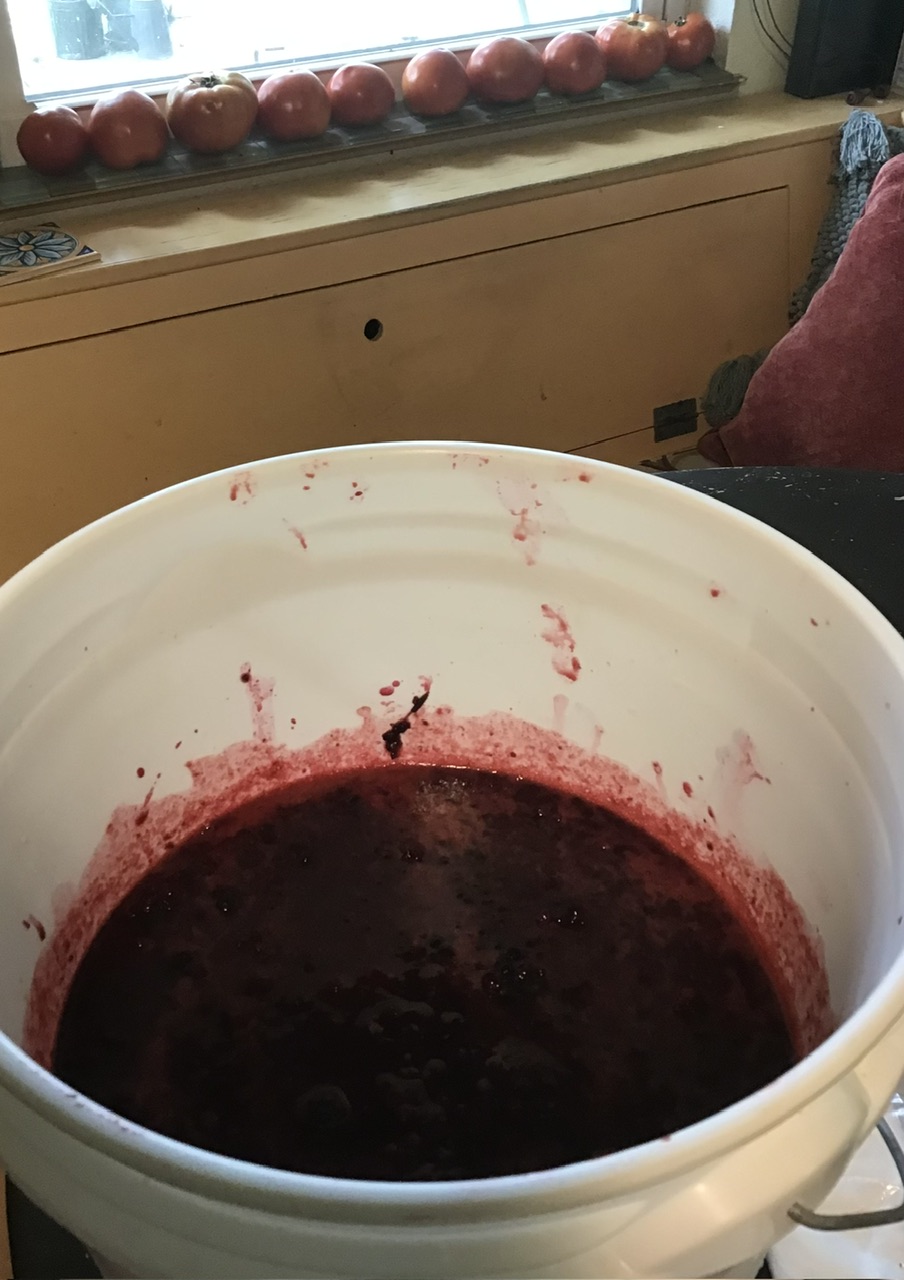
This one was mulberry and I’ve also started a blackberry.
The blackberries seem to very much appreciate the extra rain and our harvest has been great, inspiring me to make blackberry wine for the first time. Last year’s harvest was very disappointing after getting some kind of strange disease right after their flowering period. (Not normal development, despite what several folks claimed at the time.)
I’ve decided to try more natural, traditional methods with the wine-making, like with the cheeses. Modern methods require all kinds of chemically-obtained inputs, which most insist are necessary for a fool-proof product.
Yet, last year we had a major failure using that method and ended up with several cases of vinegar. Very disappointing after all that work. We have had great success in the past or we might be too discouraged to try again.
Blackberries, banana peppers and Nigella seed pods
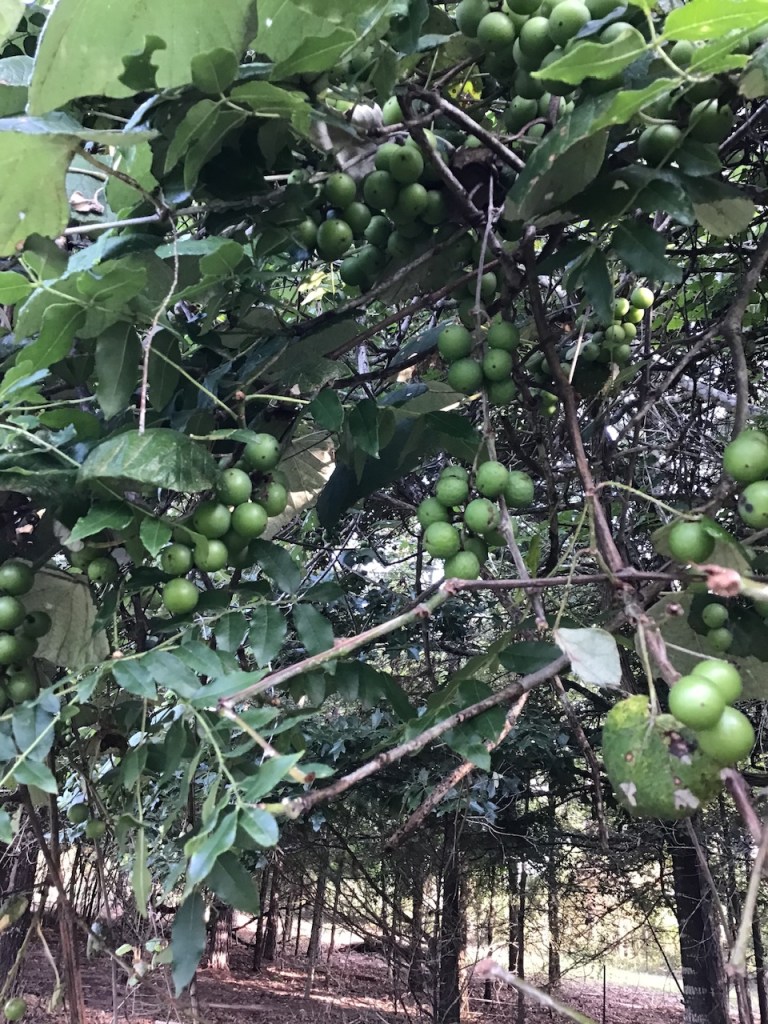
Traditionally, country wines were not made with all those foreign yeasts and I don’t really want my blackberry wine to taste like merlot anyway. While we may not have a decent cultivated grape harvest this year, the wild grapes look promising again. Also the pears are looking good, could be a bumper crop like we get only every few years.
If so, I’m going to do some side-by-side experiments, traditional methods vs. modern methods, and make a real project of it.
Blackberry wine in the making, hopefully
It’s easy to find lots of instruction using the identical modern method. For that I’ll rely on this book.
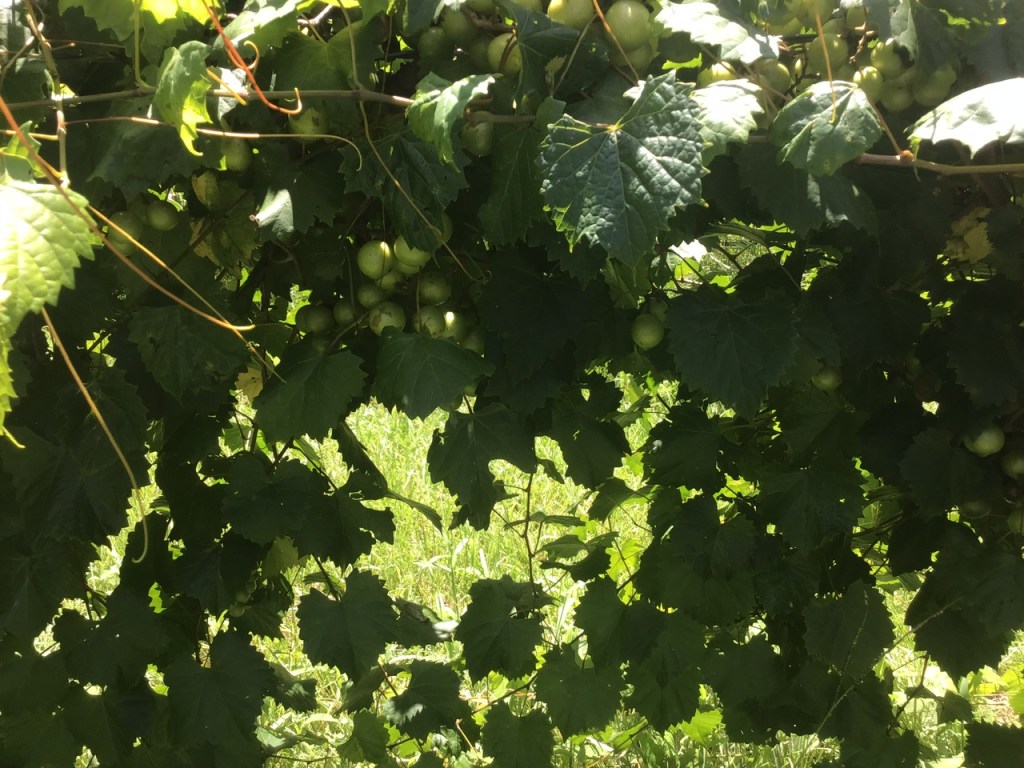
The wild grapes are looking promising. Our cultivated grapes still uncertain.
It’s not as easy to find good instruction on traditional methods, no surprise there. But this channel has a lot to offer and she uses nothing but a homemade fruit fermentation starter for her wines.
A teetotaler who makes wine, don’t see that everyday!
She also teaches how to make natural sodas and mead on her channel which I’m also very eager to try.
Blackberries fermenting beautifully after 36 hours.
The elderberry is also liking the extra rain. I might even try to make elderberry wine too. The blossoms are excellent in kombucha and will make an effervescent ‘champagne’ like beverage or flavor a cordial. And the goats love it. It’s just an all-around fantastic plant that is popping up everywhere now, so I’m going to create a big grove of them trailing down the hill.
And other news this post, including Hubby’s big mistake, lots of garden snaps, critter updates and the new normal weather chaos.
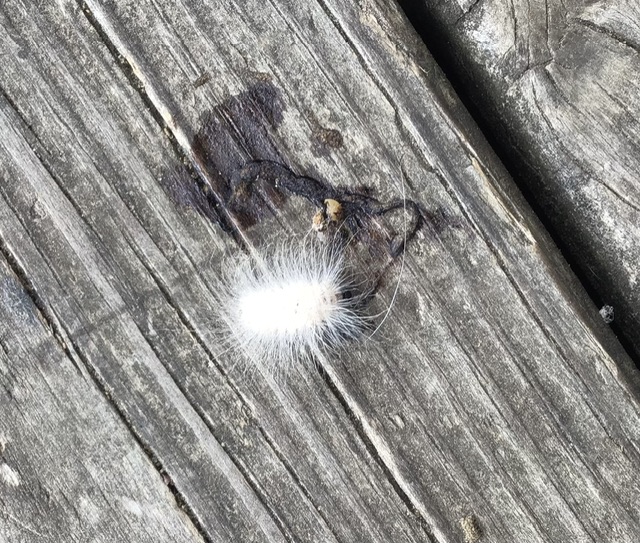
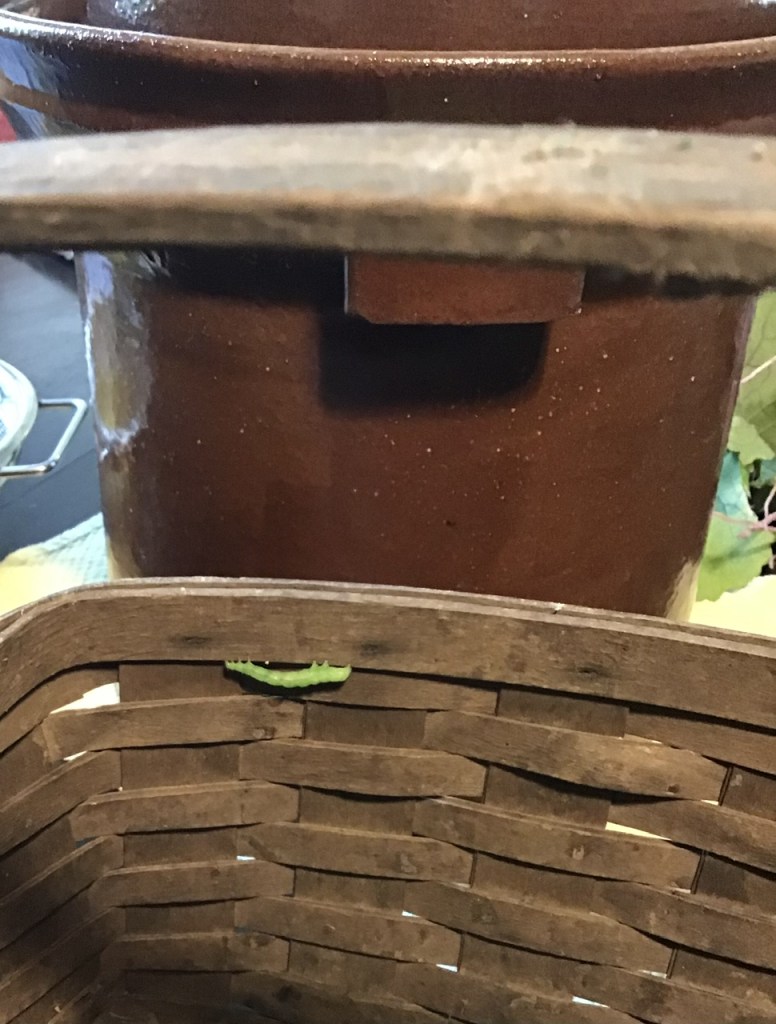
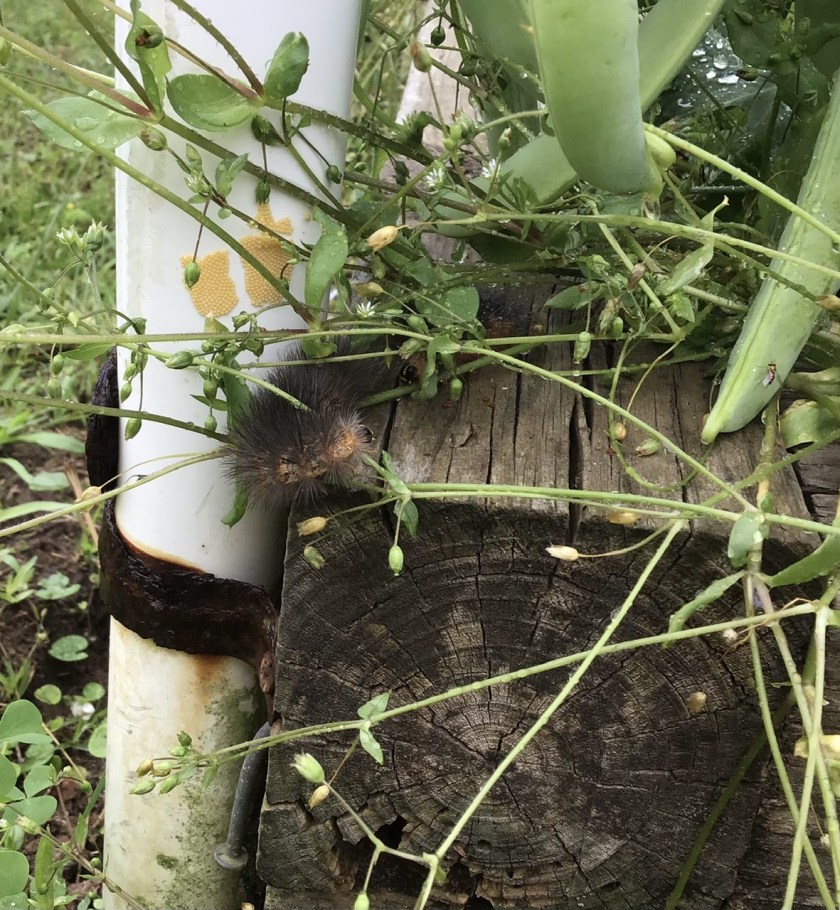
Big ones, small ones, skinny ones, fat ones . . .
Black ones, white ones, green ones, yellow ones . . .
Let’s see, perhaps a bit of 80s pre-conditioning before our current day “You vill eat ze bugs!”?
We’ve never seen so many, and such a variety. They do not look the least bit appetizing and clearly the birds agree, or there couldn’t possibly be so many.
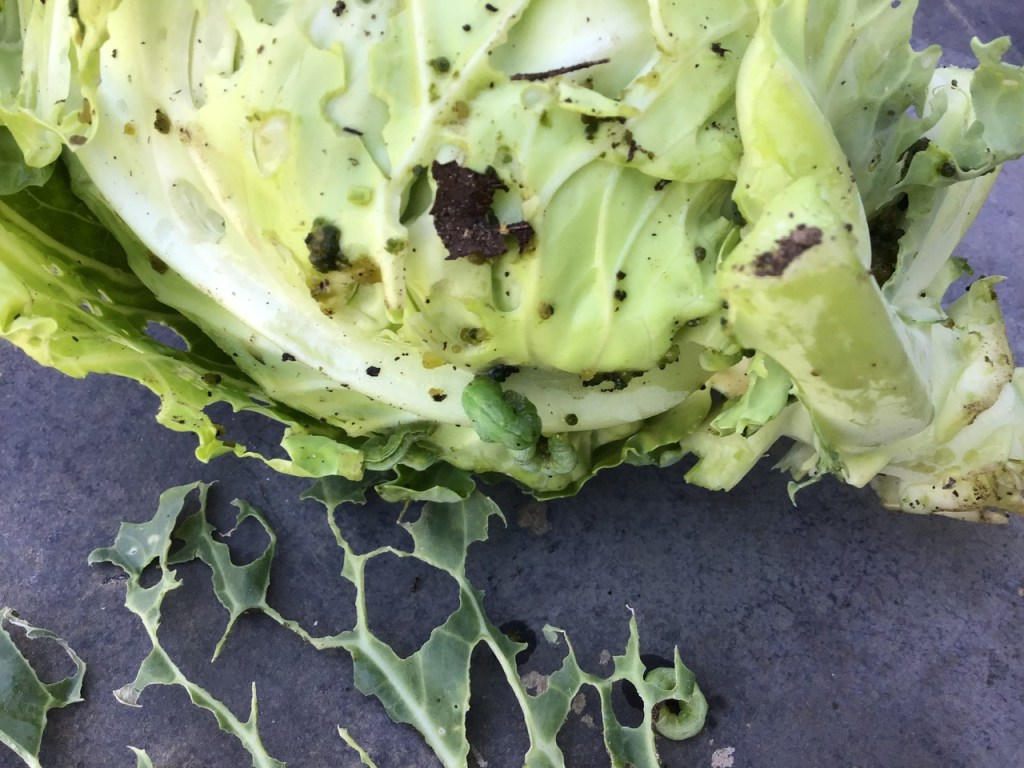
I’m not exaggerating when I say you cannot take a step without seeing one. I’m hoping they turn into gorgeous butterflies and soon we’ll have a garden full of them. But I haven’t looked them up yet and they could easily become some voracious relative of horn worms for all I know, about to attack the tomatoes.
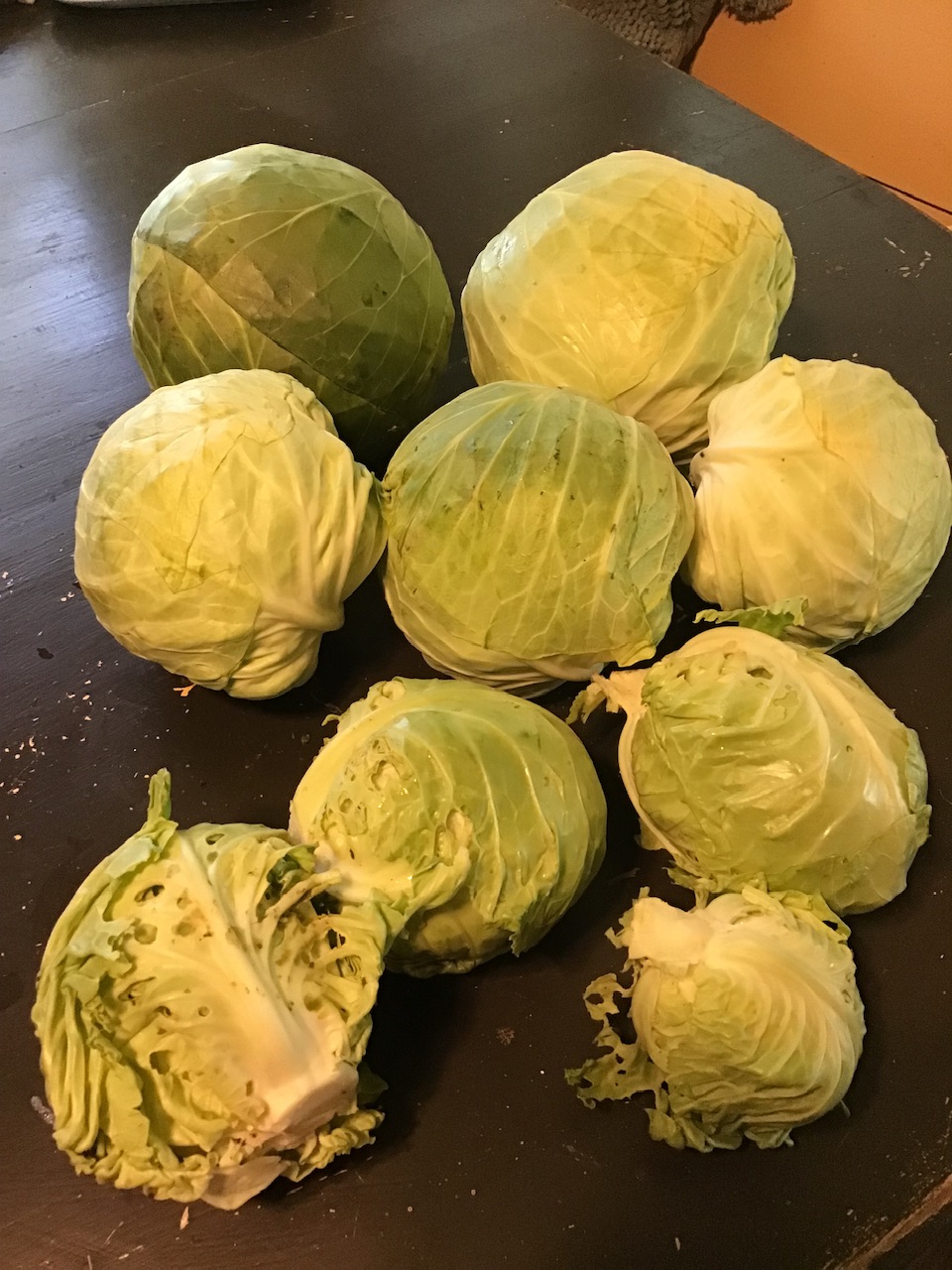
They’ve destroyed my spring cabbages and are working on the fava beans and snap peas now.
Fall cabbages in the back compared to spring cabbages up front
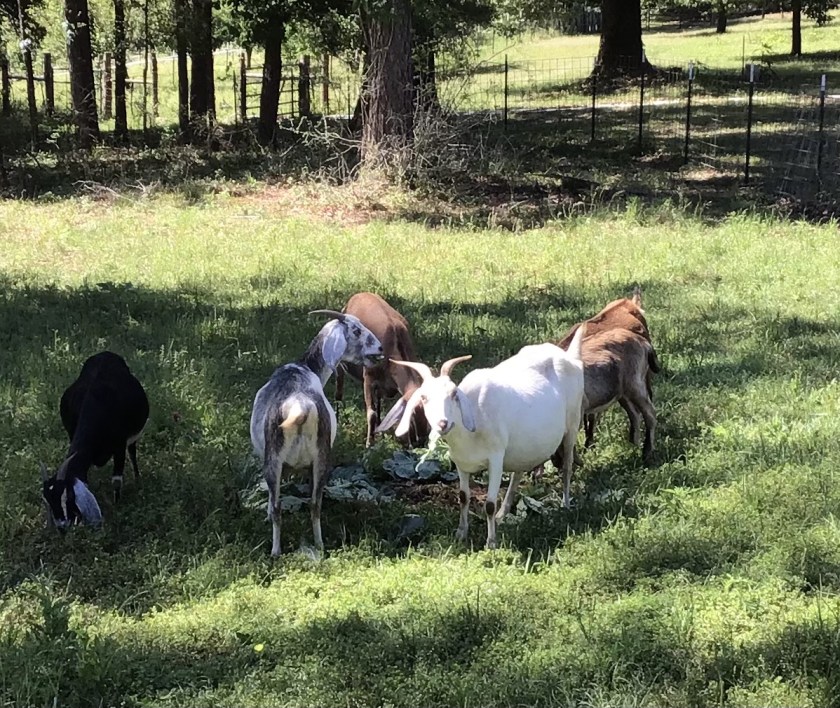
At least the goats appreciated all those Swiss cheese-like leaves.
Snap peas don’t last long here anyway and while those creepy crawlers get the leaves of them, and those of the radishes, at least they leave us the fruits.
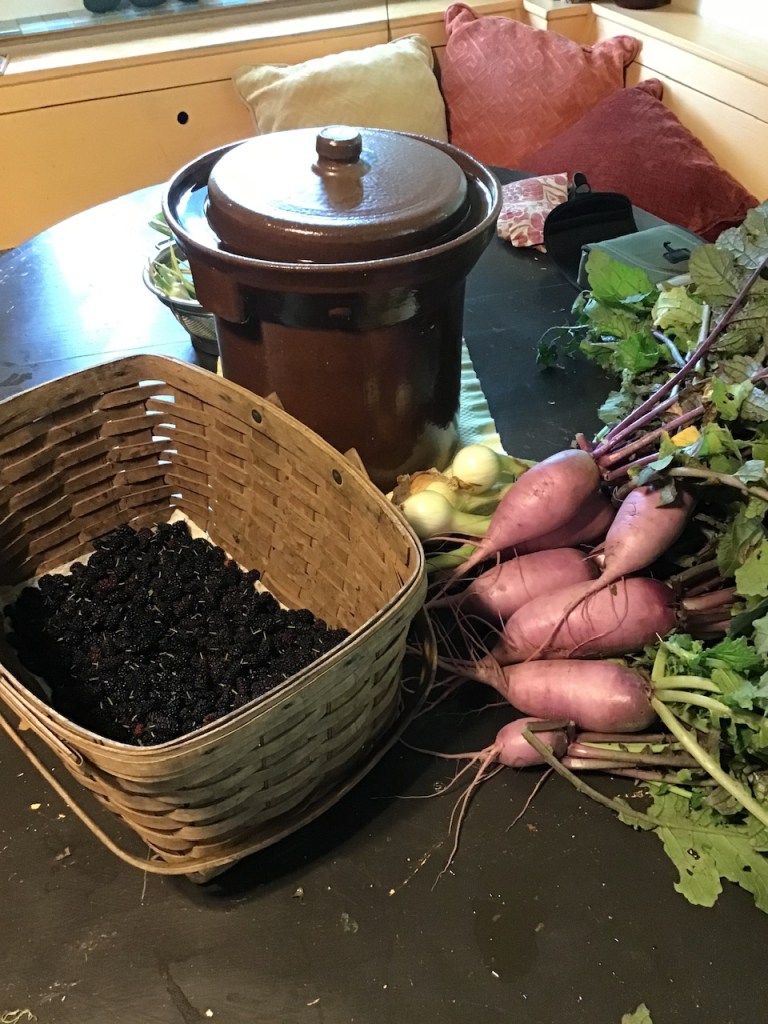
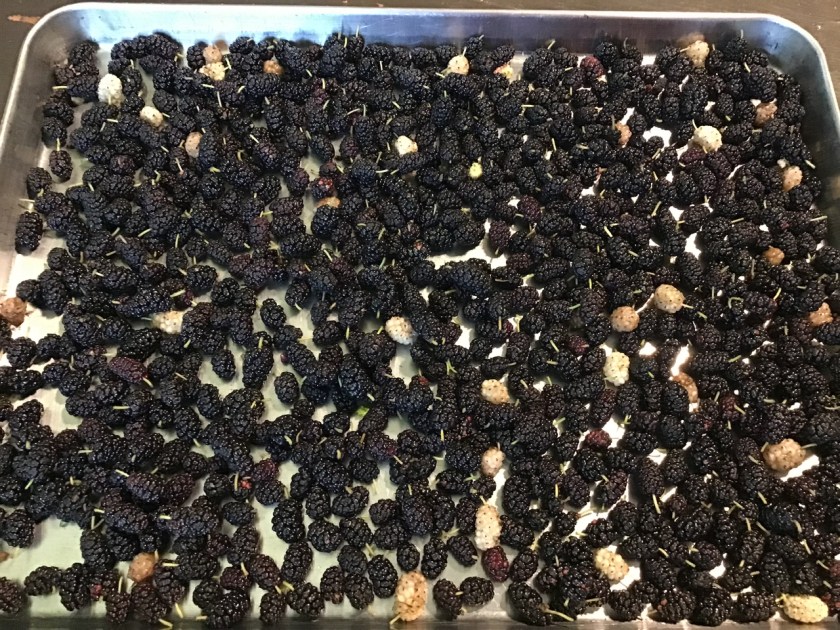
I’ve already made a large crock of sauerkraut and a quart of fermented radishes. Plus we’ve been getting loads of mulberries thanks to Hubby who has been destroying the tent worms that have been appearing all spring. Those little buggers love the wild cherries too and can easily destroy all leaves and fruits in a matter of days.
So, big kudos to Hubby for coming to the rescue, and spending a fair amount of tedious time harvesting these little beauties as well.
But, Hubby is also responsible for the misdemeanor crime of killing our potatoes! I should’ve caught it. I know, he was just trying to help. So, he filled our potato buckets with too much compost too fast and now we have potato disaster.
Lesson learned, you can only add a couple inches at a time, even if the greens are much taller than that.
I’ve got lots of herbs companion planted with the tomatoes that are all looking great.
Thyme, cilantro and dill growing between tomatoes
One of the best garden decisions I’ve made is far more flowers in the garden. Not only to attract pollinators, but to attract us too. It’s a far more inviting space than just rows of crops and makes me want to go in and play. 😊
The Peggy Martin rose just one year after planting a cutting from a friend.
And the Burr rose, many years old, huge and seemingly indestructible, even from constant nibbling by the sheep and goats.
And one of my garden favorites, which my photo doesn’t do justice at all: Nigella, a delicious seed and lovely tiny blooms in blue and white.
Their seeds have a grape-like flavor and are delicious in bread and kombucha.
A larger garden view
Another fruit that so far seems successful are the persimmons. We have both Virginia and Asian planted and the flowers on them are so unique, just like their fruits.
I’ve also got the citrus planted at last and I’m so excited! I cannot fail! (Says no one but me and I’ve gotten quite a few discouraging words from others on this venture.)
Planted along with the new ‘kiss me under the garden gate’ flower which is doing quite well, and the still unfinished wattle fence.
In the best news we have our first kids just born this morning. Milking season approaches too quickly!
The weather madness continues, unfortunately. Big surprise.
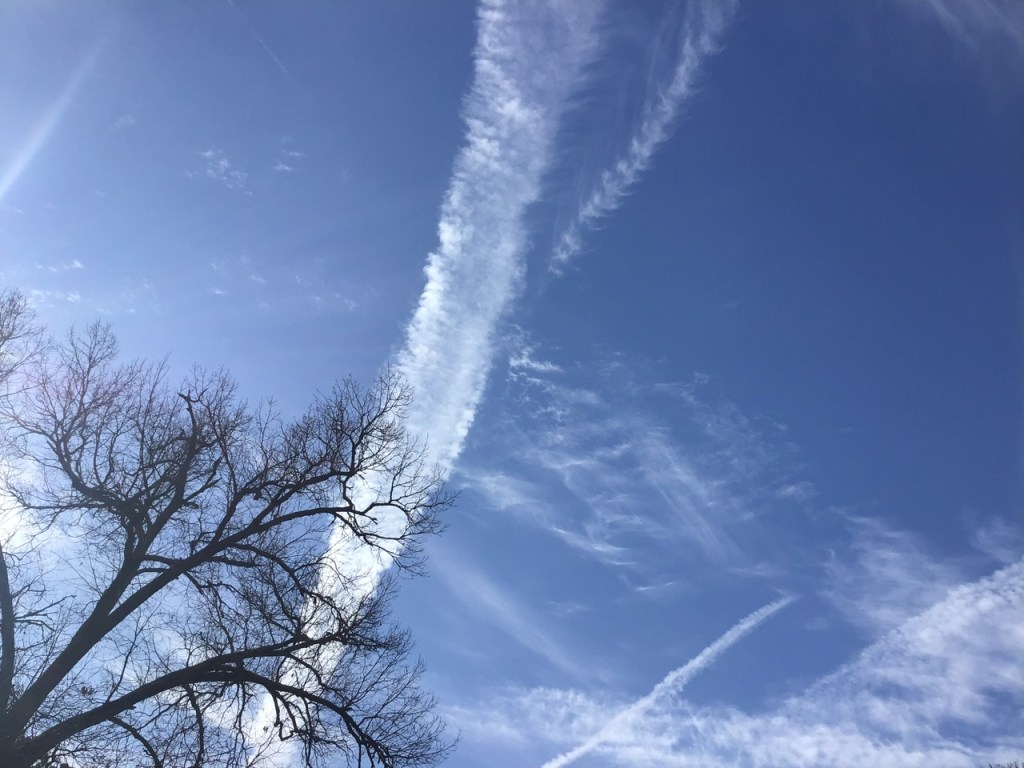
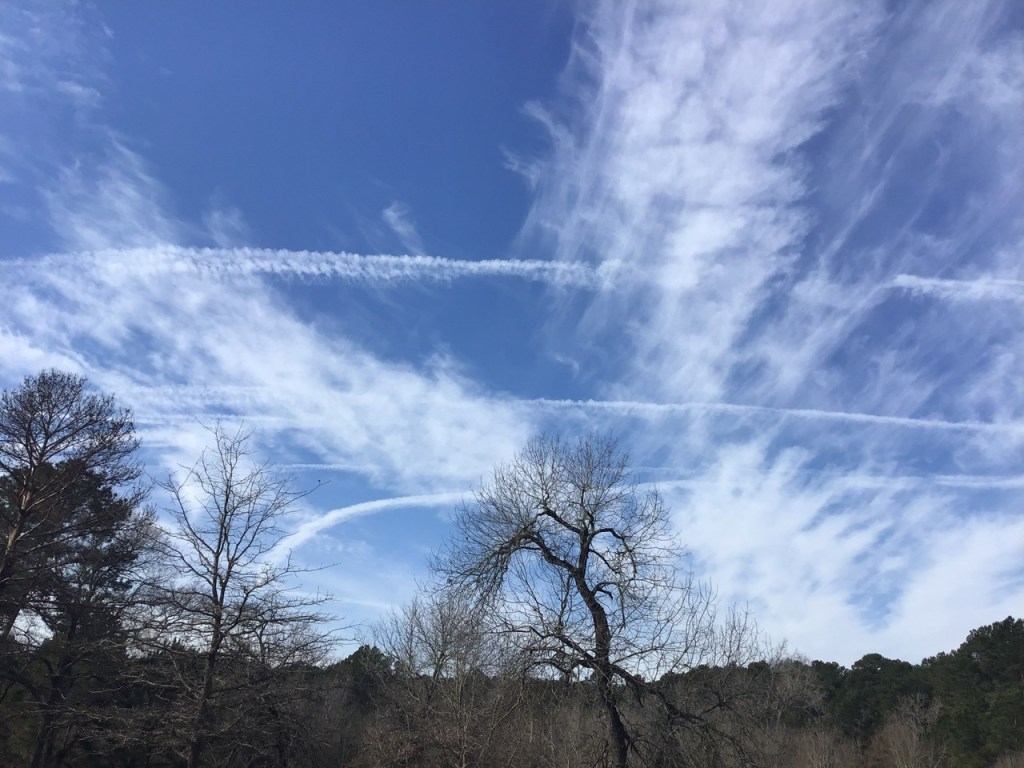
Some still think these are contrails! Good grief!
This weekend’s forecast looks like a drop-down menu: 1/16th inch rain possible, or severe storms, or flooding, or hail, or tornadoes. Try planning for those options, peasants! 😩
Hope life is a little more predictable in your neck of the woods!
A quick reprieve from ruminating about technology for some recent happy snaps. I’ll try to not do too much complaining about the weather. But I know how hard that’s going to be so, here’s a deal, for every complaint I will offer one bonus. 😁
Dortmund climbing rose makes a surprise appearance
The extreme heat, and drought, is not normal, so I really wish folks would stop saying it is.
Bonus! It’s reassuring how remarkably resilient some plants and animals are.
Hibiscus for tea, to be blooming soon With plenty of irrigation and shade cloth the re-seeded cucumbers are coming in, lots of okra, eggplant, peppers. And sweet potato vines, which the goats especially love.
One green melon from one surviving plant, I think I’ll name those saved seeds the Miracle Melon.
Not much harvesting happening, but at least something. A few figs and grapes, some herbs and elderberries for flavoring kombucha.
Bonus! We can fully appreciate how precious water is to all of us.
Pretty obvious where the sprinkler spray stops
Man changing the climate? Perhaps.
Man changing the weather? Definitely. Do they care how toxic and dangerous that is? Seems like no.
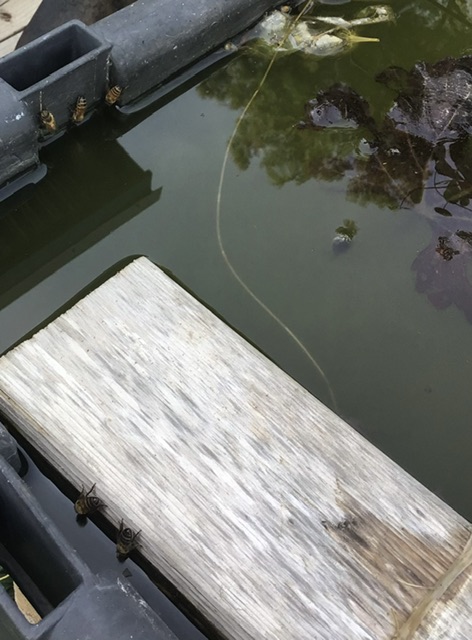
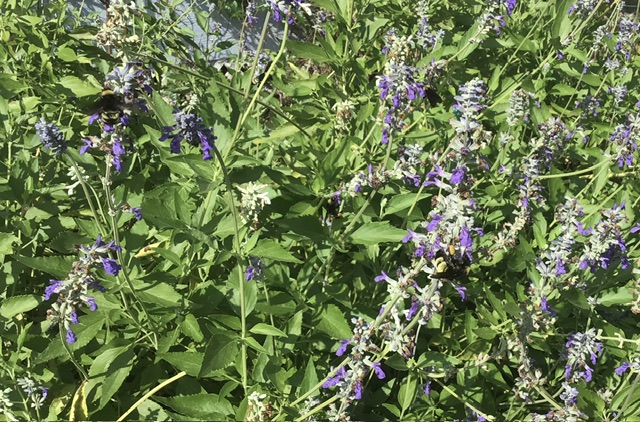
Bonus! We can observe different species peaceful tolerance of the other under times of stress, as well as which critters are more heat tolerant. The honeybees only appearance in the garden at the moment is at this water trough where I feed some tadpoles. But, bumblebees are going crazy on the salvia, wonderful!
It’s so hellishly hot by 10 am we can’t stand to be outside anymore.
Bonus! We can feel like heroes as we try to keep the critters as comfortable as possible.
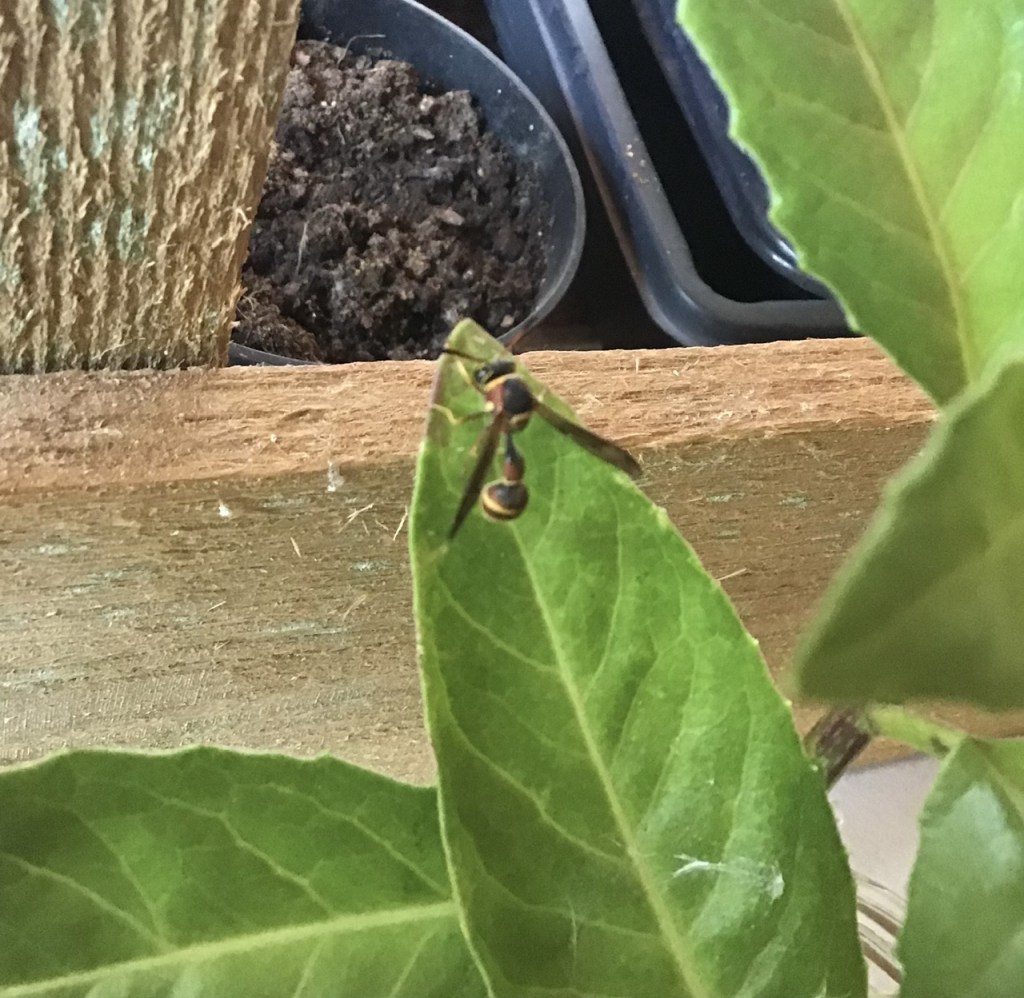
This cool-looking wasp followed me inside, maybe hoping to keep cool? It’s been living happily on this ‘longevity spinach’ (gynura procumbens) for nearly a week. I didn’t realize they could live so long alone, indoors and with no nectar. The wasps must eat something on the leaves, there’s loads of wasps on the okra leaves too.
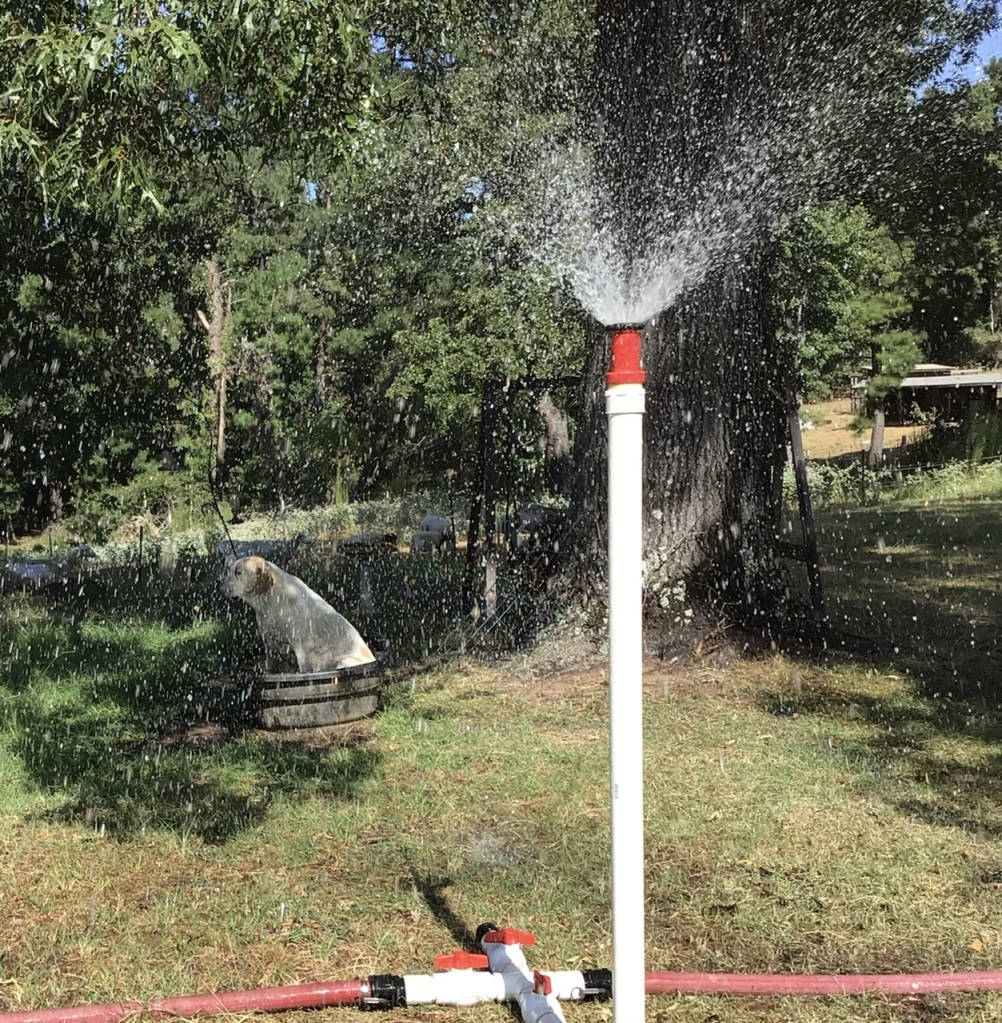
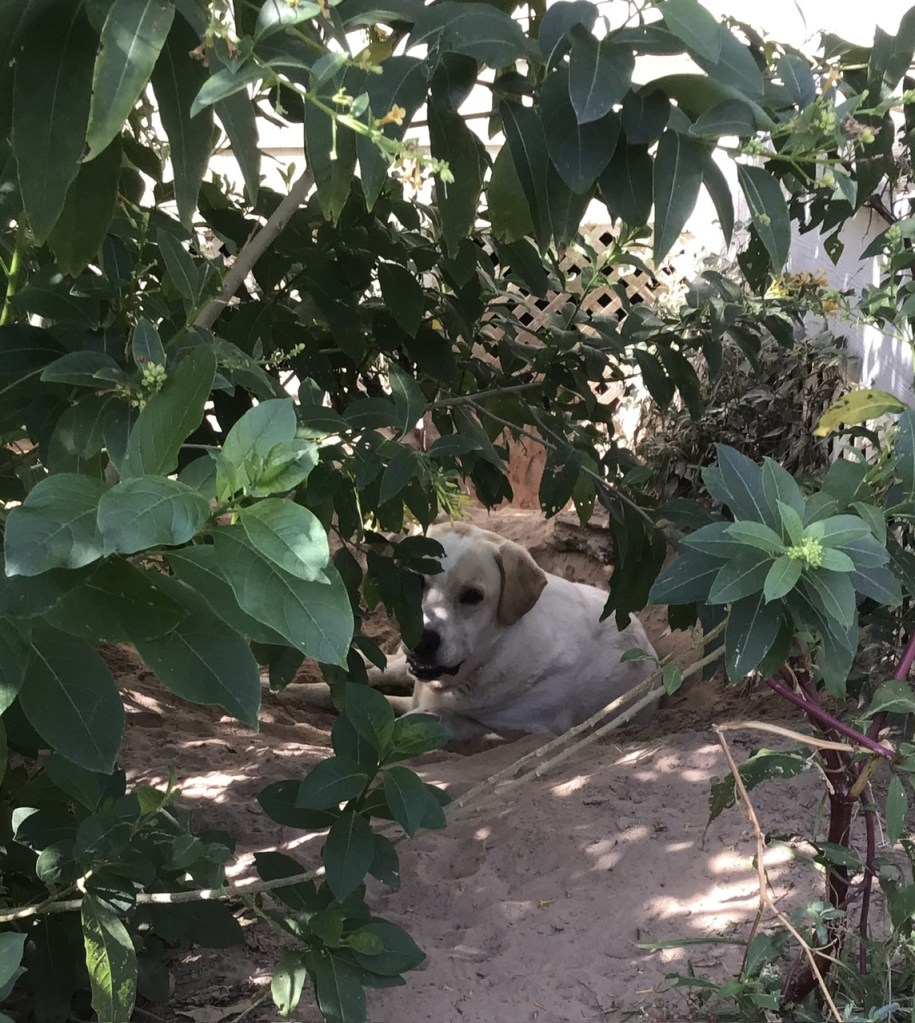
Here we come to save the day! Bubba in his tub and Buttercup in her sand hole.
The final bonus of bonuses! I can tackle all kinds of indoor projects I’ve been neglecting, like organizing the closets, washing the windows and floors, attending to the neglected pile of sewing . . .
The only true bonus of that list is that I find it so objectionable I’ll instead be reaching for another novel I’ve been meaning to read. 😆
Weird scenes inside the homestead! What have we to add to the big wide web of weird today? A couple of things only, along with some sad news and some happy snaps. Successes and failures, as usual. Trying to keep them all in stride, which with the wild flowers and a short country drive, isn’t too big a challenge at the moment.
Creepy visitor appearing everywhere after the rains
Best to get the crap out of the way first, I prefer. We’ve got seemingly severe blackberry failure and an established bee colony suddenly lost. I could write exhaustively on just those two, but since I’m already exhausted, I’ll keep it brief. And continue the relentless churning in my mind alone.
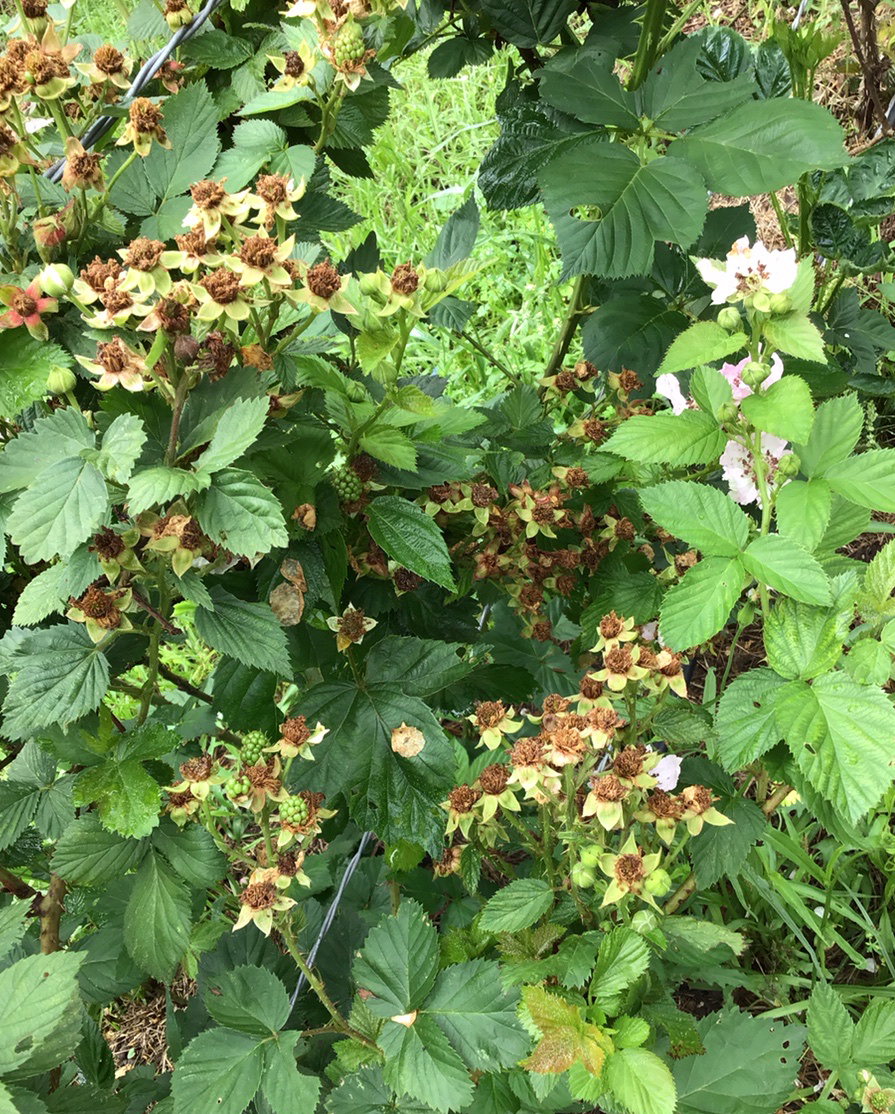
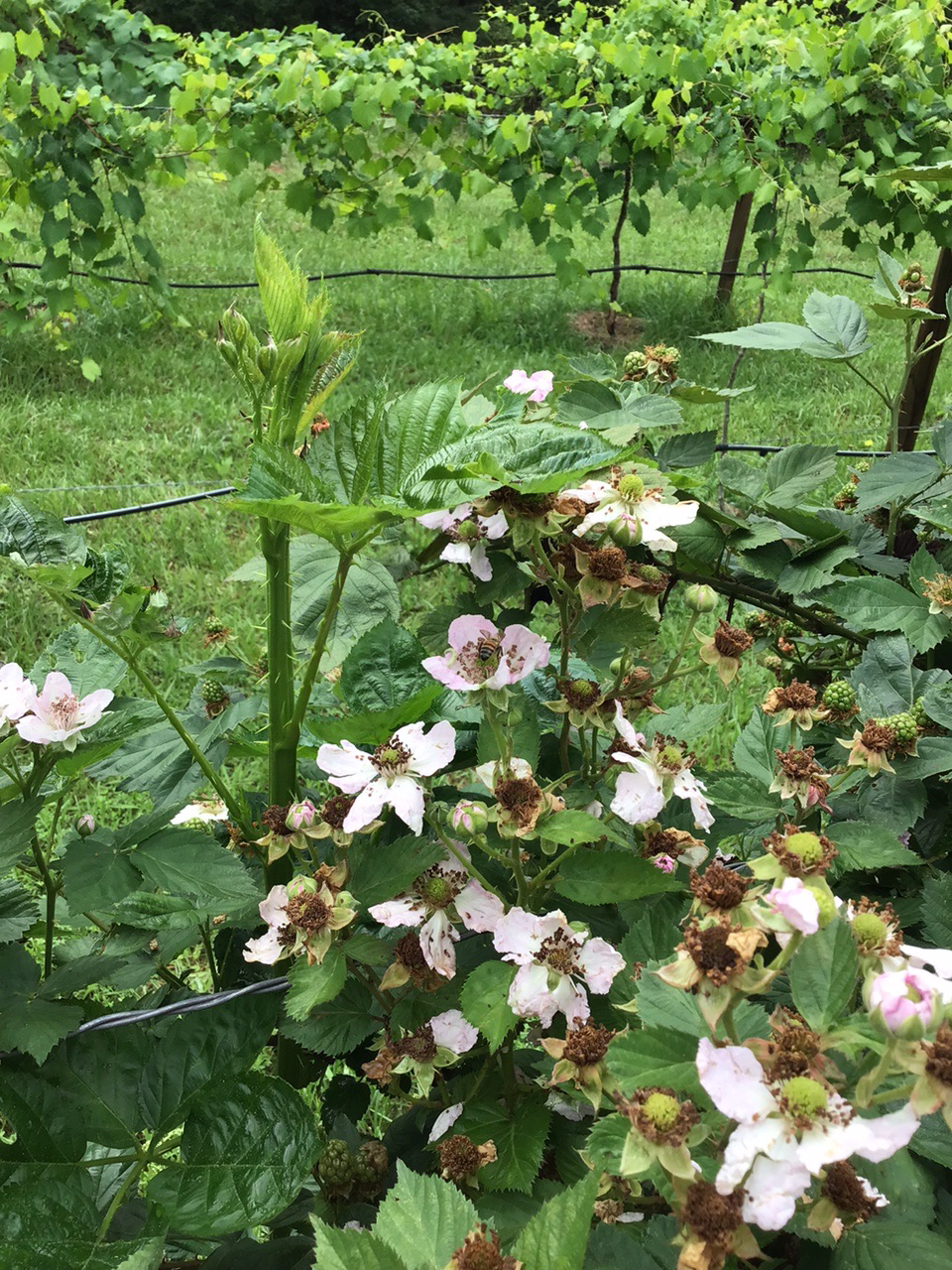
These photos and several more have seen the cyber rounds this week, let me assure you! And the cornucopia of responses we’ve received is rather astounding. Long story short—we’ve had some lovely rains, finally. But it sent our blackberries from thriving and gorgeous, to this brown, crispy-looking horror nearly overnight.
Not just a few bushes either, the entire row, a dozen bushes easy. It looks terrible. So we got a bit frantic and have been sending photos to Ison’s Nursery, where we got them. Also, to various friends and forums, where we’ve had answers to run the gamut: too dry, a virus, a fungus, a blight, Botryosphaeria canker, empty pocket syndrome, aphid damage, and then the kicker . . . This is totally normal development.
Wait, whaaat??
You mean to tell me these could be normally progressing blackberries and after many years of growing blackberries we just never noticed it before?!
Well that would certainly be a big and welcomed WOW! Yes please!
But unfortunately, I don’t think so. They look brown and shriveled beyond anything I’ve seen in any of the online photorama. And there’s no sign of aphids, and it’s not cane blight, and it’s certainly not too dry, although I totally understand that guess, since that’s exactly what it looks like.
And I do so appreciate all the speculation, seriously! It gets me thinking and exploring every time and I do so love all the effort and camaraderie inherit in it. Be wrong, it’s not the end of the world!
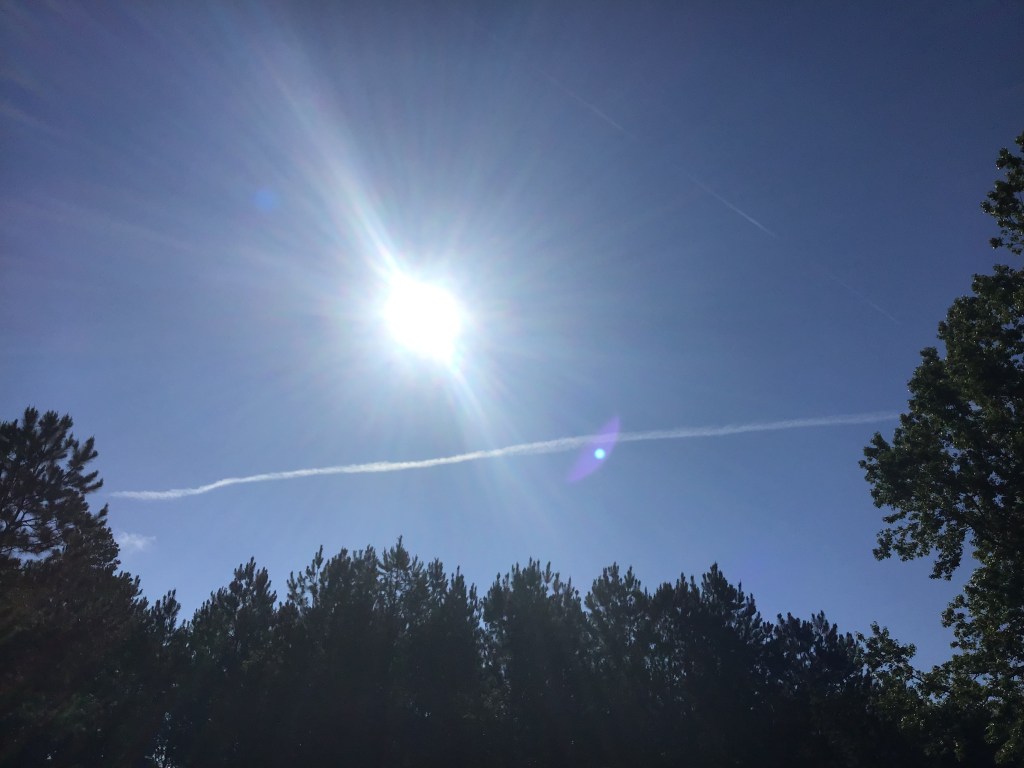
Of course, what I did so notice among the seeds of speculation was the one that was, unsurprisingly, totally missing. Toxic rain perhaps? Some other oddities in the atmosphere, perhaps? Not on anyone’s radar? Really?
No idea what’s happening in this photo with the blue dot-purple ring, I just snapped the shot with the tablet as soon as I saw the trail while busy in the garden.
On better themes . . .
I also took some lovely happy snaps of the wild flowers blooming along the road, which was so much more gorgeous than what I was able to capture here. But I tried, and that should count for something, no?
And on that note, this post will have a Part 2 to finish later, cause that’s all I can manage at the moment. More to follow, so much more!
Thanks for stopping by!
I leave with a song that motivates me when I really need it most. Hope it works for y’all too!