“Patients no longer complain of inferiority feelings or sexual frustration as they did in the age of Adler and Freud. Today they come to see us psychiatrists because of feelings of futility” – Viktor Frankl
“Daft sensational types have no problem thinking of nature as one big theme-park, there expressly to satisfy their every tawdry infantile desire. Their interest in nature’s welfare is insincere and supeficial. Most people’s attitude toward nature (umwelt) is gnostic in complexion. Nature is not to be loved and understood, it’s to be escaped. While we are here on the planet, we might as well have fun at nature’s expense. We’re on our way somewhere better, where happiness is guaranteed. Nature denies us a lot, and makes us suffer. God grants all my wishes and bestows eternal pleasure. Millions of people have this outlook. It’s the main reason they do what they do, and accounts for a great deal of the irrational nonsense going on in the world. Delicate senses are taxed and sullied by the incessant irrational demand for “more.” In the end one prostitutes themselves to the senses and pays dearly for doing so. One becomes decadent, discontented and compulsively outer-directed.”
“Like spoiled brats we just can’t accept that the ride comes to an end. This is why we aren’t satisfied with one or two versions of any product. There must be hundreds of brands and dozens of flavors and alternatives. We’re never satisfied, but rarely ask why? We never inquire into what sensations are, or that maybe it’s a good thing we’re not in a world of constant sensual edification. What kind of beings would we become if it were otherwise? Are we to take it that we, as humans, simply wish to have pleasure and avoid pain? Or is it more accurate to say that without opposites there can be neither pleasure nor pain?”
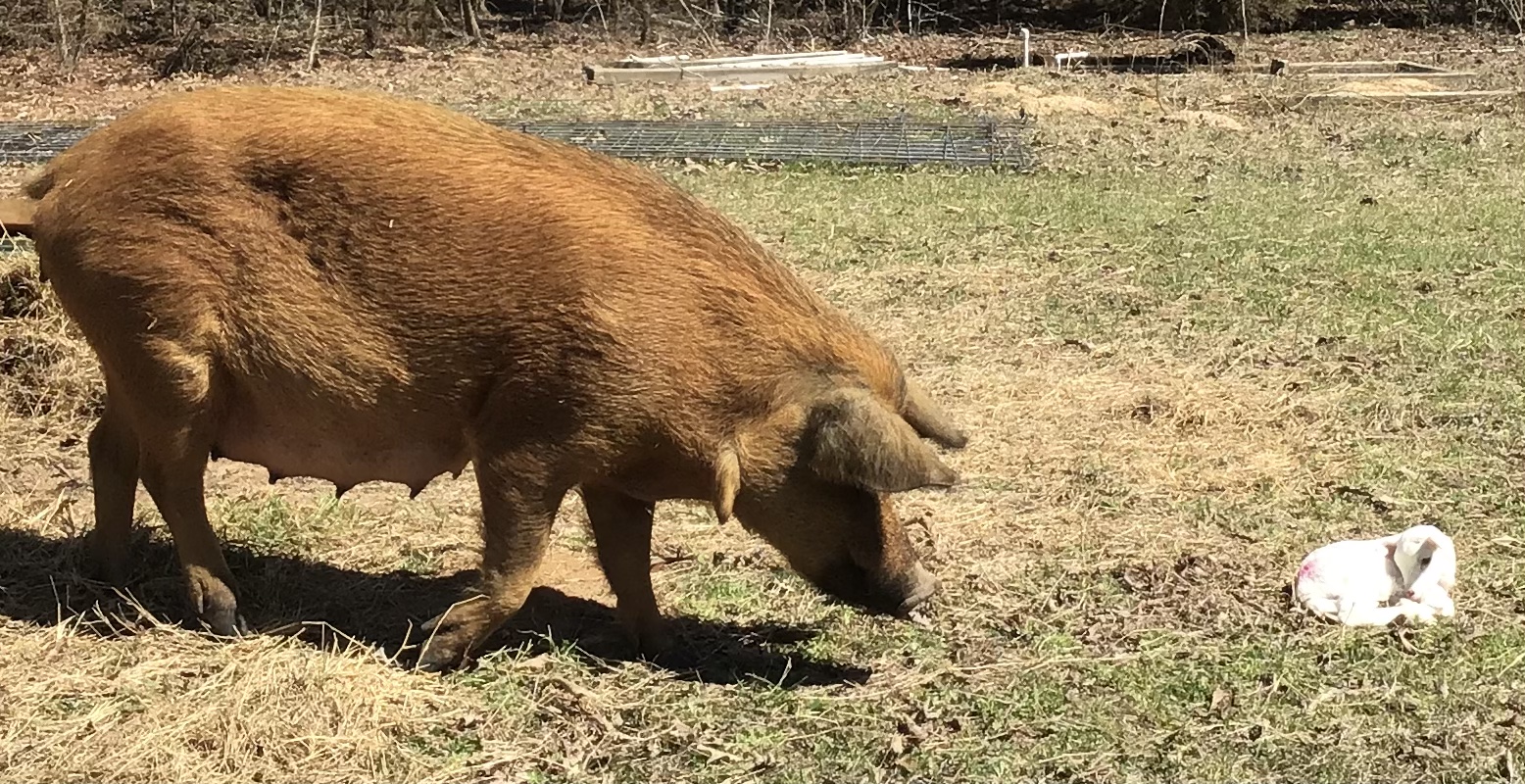
Huge days on the wee homestead! The pigs and sheep have all had successful births without a single hitch. Mama Chop did lose a couple, but she has such large litters that’s not such a bad thing. We were very concerned about her as she crushed her last two litters, literally, not in the new way of the term—She crushed it! Nope, in the old way, as in she smooshed them all.
Hubby was able to prevent that sad ending this time by clearing out her corral space of every last twig. She was in the habit of building huge nests, full of branches and twigs and so steep the piglets would roll right off it, falling between branches and getting pinned whenever she moved around. We were worried with another total loss we’d have to get rid of her because we like her so much, she’s so gentle and good-natured. She loves company and will even go on walks with us. It is truly amazing how graceful these huge creatures are around those tiny, squirmy little things!
I did not mean to hit ’slo-mo’ during this video, oops! Need to work on my skills.
Virginia had a similar setup to Momma Chop, but she wanted nothing of it. She went off into the woods to build her own nest, her way. Luckily she doesn’t have such a penchant for branches and twigs. She’s got more of the wild side in her attitude as well as her nesting preferences. And she certainly does not appreciate prying eyes and will come after anyone who gets too close to her brood!
Peek-a-boo! Yes that is Hubby running away from one irritated mama!
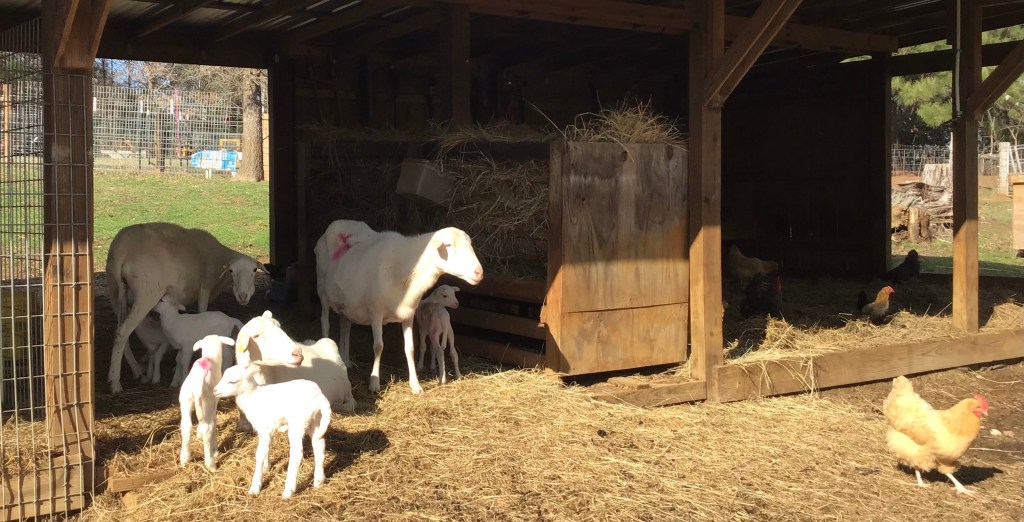
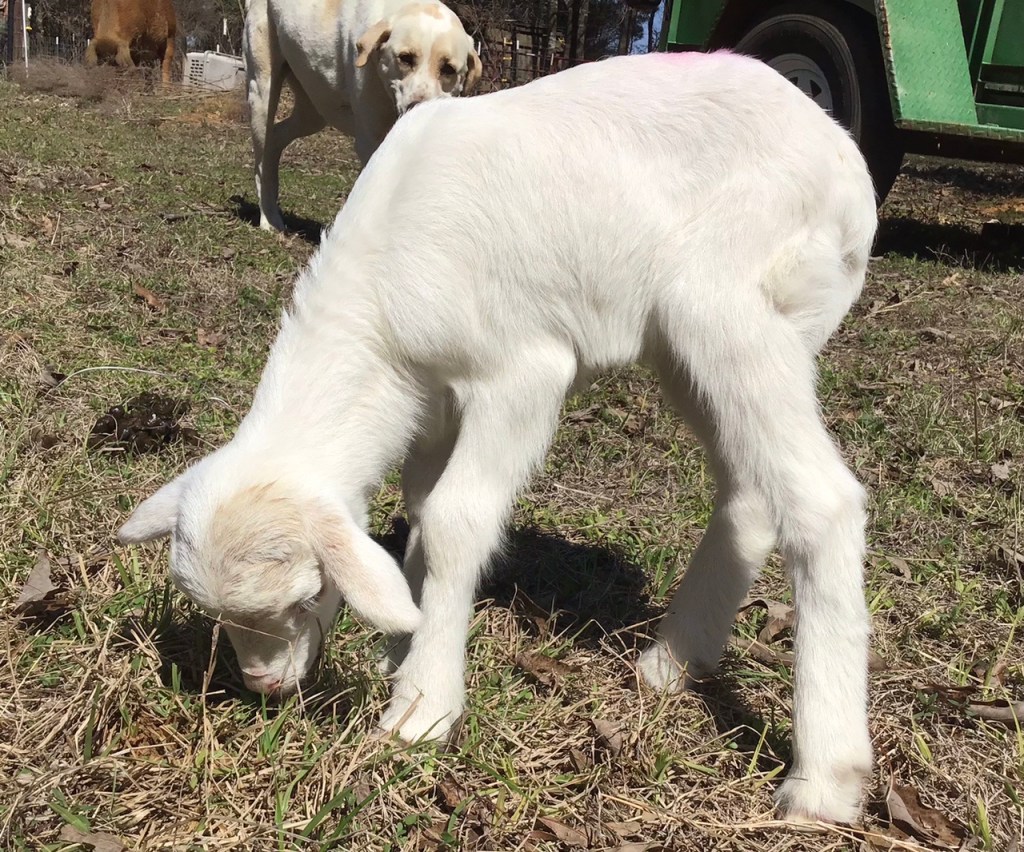
Watching the little lambs play, and sleep, is so cute. But I expect when the kids come next month we’ll really be in for a comic treat! It will be our first experience with goat births and I hope it goes as smoothly as the sheep did this time.
Getting friskier by the day!
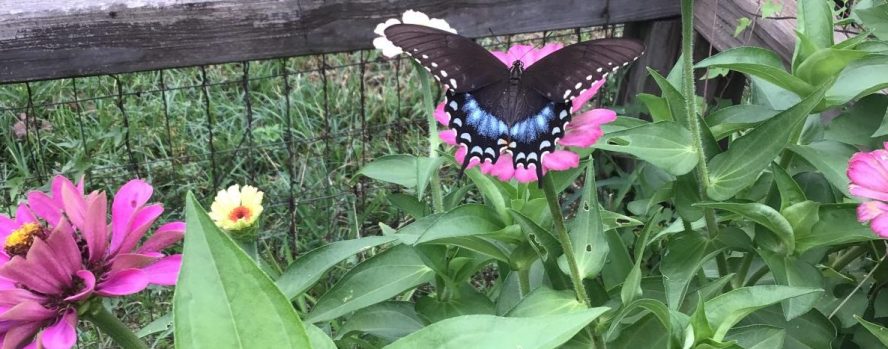
We have a new visitor to the garden which surprised us.
It’s been there every day now for about a week and I’ve never seen one like it around here before. It flies just like a hummingbird and had us quite confused. It was darting all around so fast and so far that it took me about 10 minutes and 30 attempts to get one decent shot of it. After some searching we learned it is some kind of hawk moth. Fastest moth in the west? Sometimes I undervalue the usefulness of the Internet, I might’ve been left baffled on that simple identification for a lifetime!
Not to mention the joy of sharing these simple pleasures with y’all!
Not bound to exploit. Not obsessed with production. No concern for profit extraction. Not driven by expansion. Treatment-free. Liaisez-faire. Non-industrial, anti-commercial beekeeping practices.
Beauty. Synergy. Cooperation. Respect. Reverence.
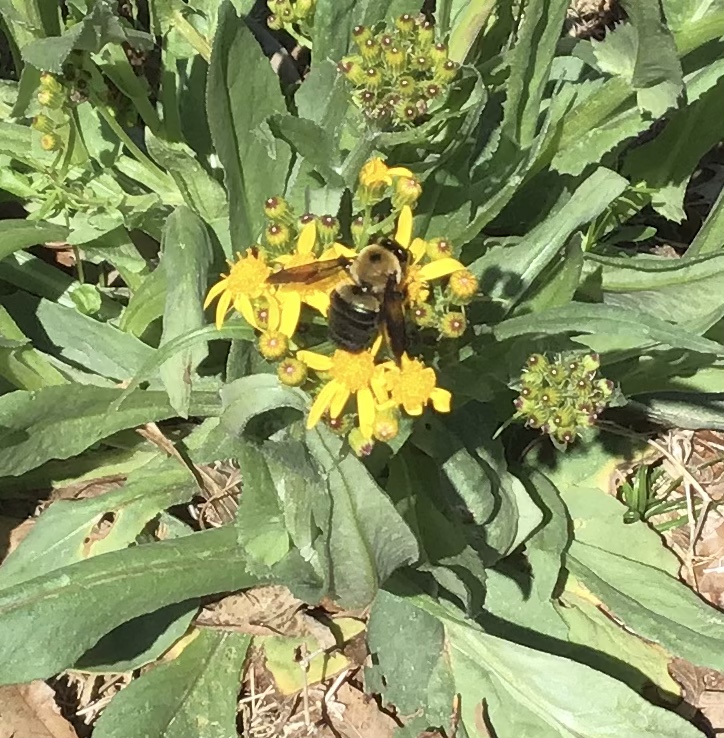
Not my bee, but the first native bee of the season enjoying the Texas squaw weed—plenty of forage for all around here!
If you guessed these unconventional methods are far from popular around here, you’d be correct.
I don’t even have a bee yard. I do have 5 strong, sustained colonies (aiming for 7) scattered around several acres, which is the best beekeeping decision I’ve made in about 5 years.
It is the intense crowding of many colonies into one space that is so unnatural that it then commands chemical treatments for bee health. Artificial solutions are never the best solutions. I rarely even feed my bees, I consider that a treatment. On those rare occasions I do, because my observations have led me to suspect they are without reserves, sometimes I’ve been wrong, and the bees aren’t remotely interested in my offerings. They prefer to forage over taking my junk food.
Not my gorgeous photo, unfortunately! Taken by a friend with the latest IPhone, WOW, color me impressed!
By observing intently over time and looking to mimic nature in every way possible, I’ve come to realize how hopeless is commercial-style beekeeping for the small holder, just like all our industrial ‘solutions’ are a never-ending Ferris wheel of problems and solutions, all the way around. Industry comes to drive the entire tradition-turned-enterprise right into the ground.
Well, no thank you! And I haven’t had to buy bees for several years now, thanks to my new-old methods, which is certainly another motivator for commercial beekeeper’s scorn, considering they often make a good chuck of their profits from returning customers—that is beekeepers who follow commercial methods even for their handful of hives—buying nucs and packages and queens from the ‘Big Guys’ who sell themselves as the experts on all things bees.
In other words, the beekeeping industry strongly resembles the pharmaceutical industry, and pretty much every other global commercial industry. One model for all endeavors. One noose for all necks.
All but one of my hives is top-bar, another source for mocking by conventional beekeepers of all ages. But it does seem like alternative types are squeezing their way in through the cracks. And plenty of cracks there are. Not just top-bar fans.
Hard to tell from my bad photo, but this is an observation window on a top-bar hive. I hear other beekeepers pooh-pooh this regularly. I love it! And the bees don’t seem to mind either.
I’m not on any of the popular social media sites, but I know there are treatment-free groups, full of curious kindred spirits, some with bee-loving pseudonyms instead of their real names, like poor, paranoid anti-vaxxers. Oh, lovely lurkers, come out of the shadows to stake your claim! You dare to brave the bees’ stings, surely some stings of misplaced criticism can’t scare you away?!
The bees are just one of many bustling with spring’s promises.
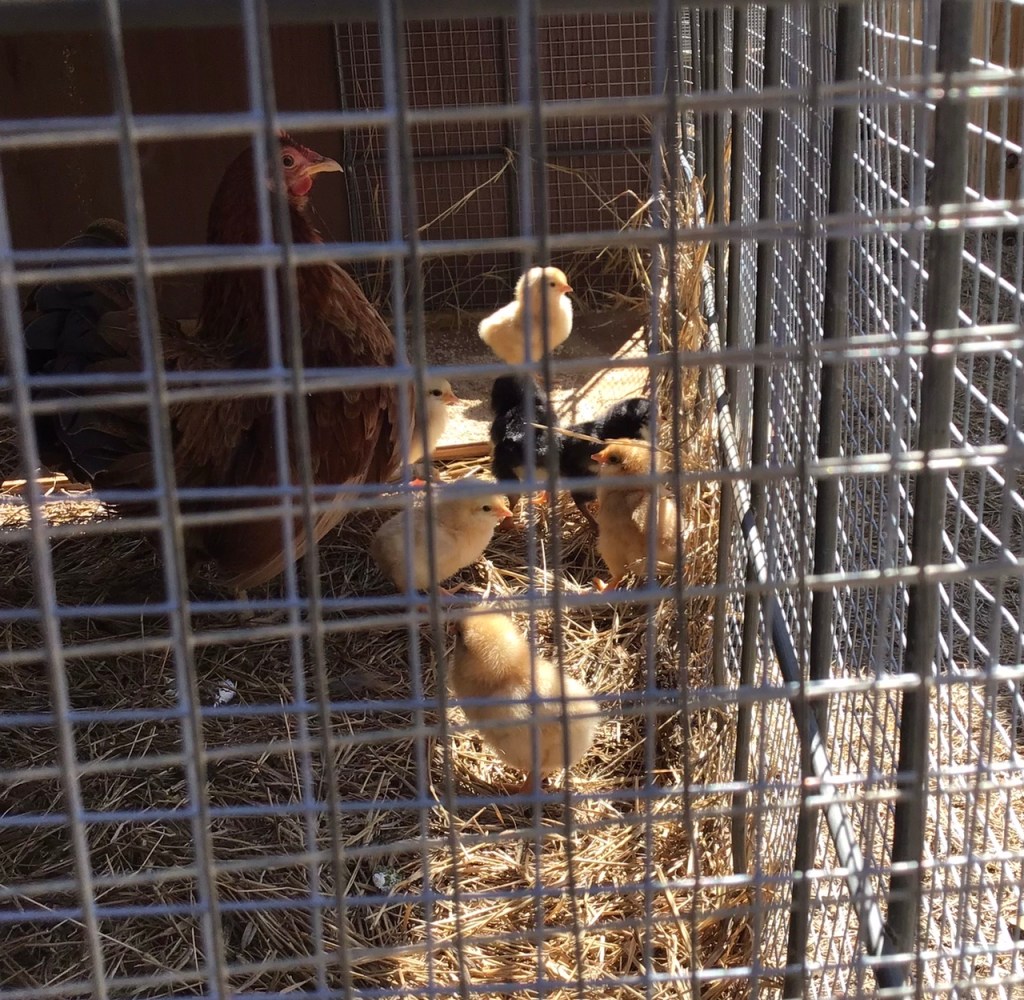
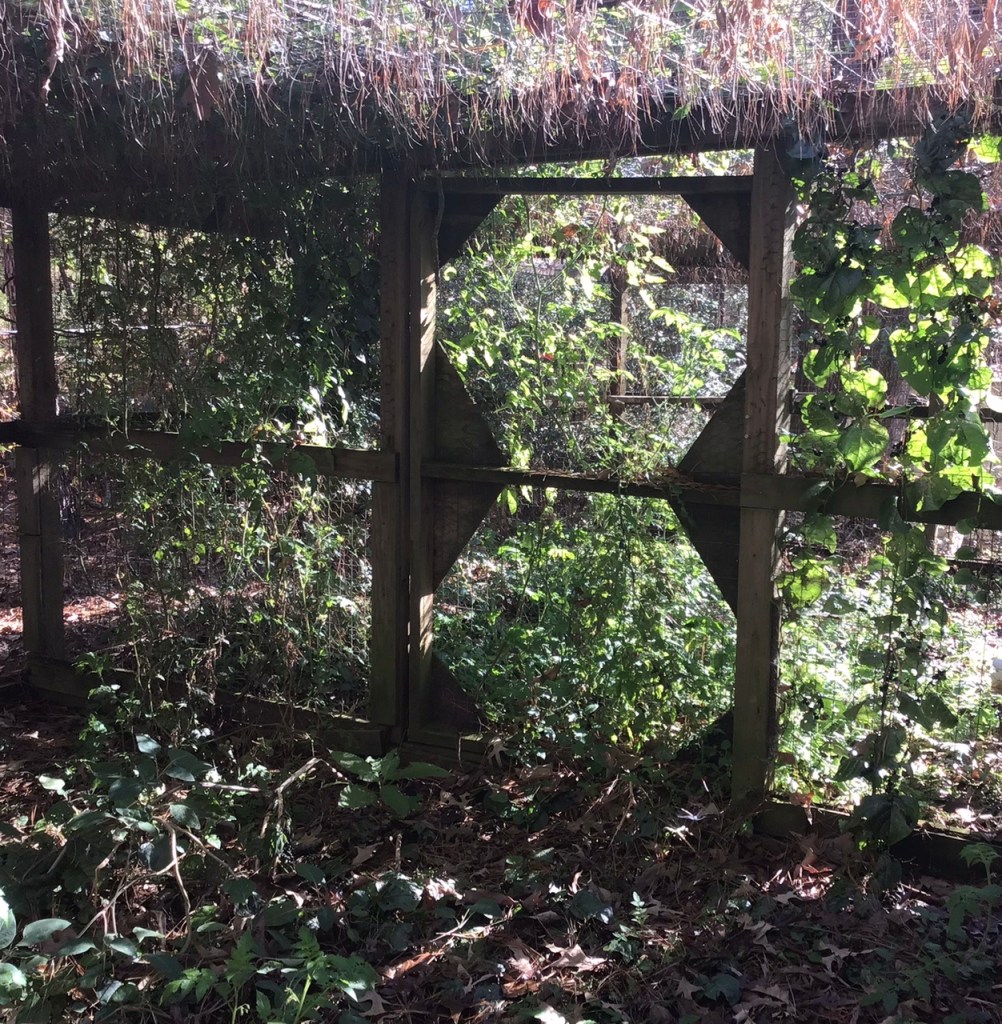
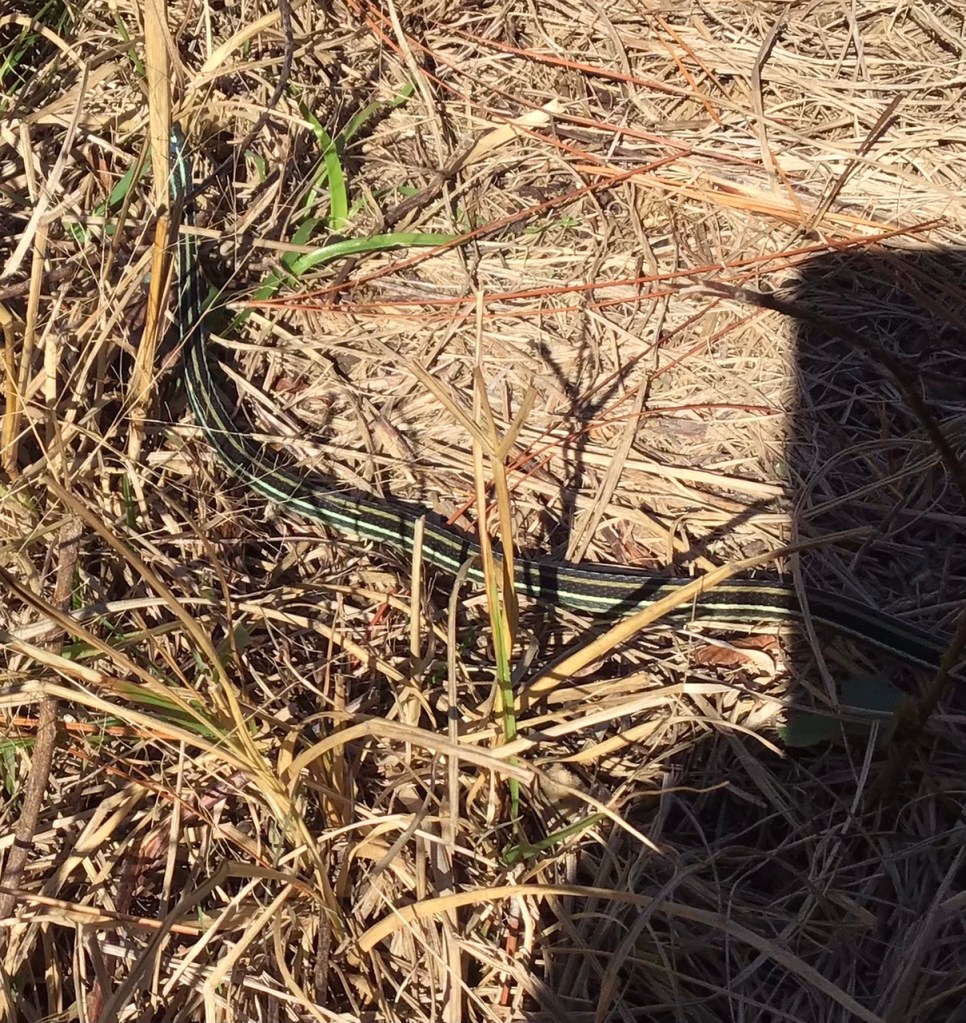
In other news, happy chicks are here, with no snakes in sight. (In the new, ultra-high security coop within coop, 100% snake-proof. Right?)
We are still waiting on the piglets, the rest of the lambs, and the kids, while trying not to let our anticipation get the best of us!
~~~Weather to resemble something remotely near natural.
12.25.2021 Not natural or normal!
~~~Science to reflect a true concern for natural life, not just a study of our abuses of it. For instance, as they study the effect of this crazy atmospheric tampering on insects (see study quote below), perhaps they might consider shedding some light on the animal and human behavioral consequences—like our dear Tori— bred and raised as a mighty protector, who paces, shakes and cowers during these manufactured weather whiplash events.
She’s never taken a bath here, yet here she hides ONLY during (manufactured) yo-yo weather, that is, weather modification by electro-magnetic frequency manipulation.
https://zone.biblio.laurentian.ca/handle/10219/2267 “This series of studies investigated the effects of applied, low-intensity electromagnetic fields on the behaviour of several species. To cover a range of species; the eusocial harvester ants (Pogonomyrmex sp.), solitary orb-weaving spiders, and aquatic planarian (Dugesia tigrina) were examined for behavioural consequences associated with applied electromagnetic fields. An additional component examined these effects on various volumes of water. In all species examined, significant behavioural consequences were observed. Intensities of the used fields ranged from nanotesla to millitesla, and their patterns included a fixed-pattern 60 Hz field, and a more complex-patterned field. A separate component also analyzed the effects of light and polarity, where additional effects were evident. For the experiments with the harvester ants, significant changes in tunneling behavior were observed; for the spiders, significant changes in the structure of the web were observed; for the planarian, significant effects on t-maze arm selection occurred; and for water, significant changes in pH were detected.”
In other words, frequency affects everything, all of Life, right down to whether my sourdough is a failure or success!
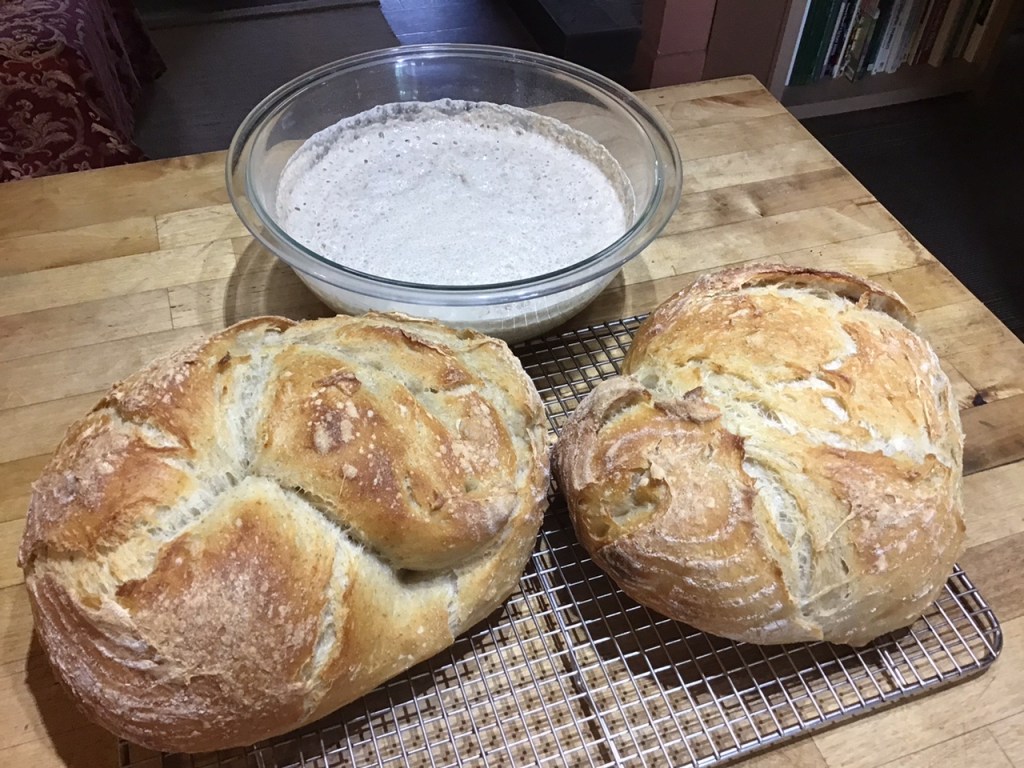
Natural yeasts also respond to frequency manipulation, as of all of Life. None of these sourdough breads acted as usual during yo-yo weather. Fortunately, those loaves pictured left are the best I’ve ever made, taste perfection, which I’ve no idea how to recreate, since it was crazy weather that made them that way! (Even so, not worth the cost!)
~~~countrymen would deal their Kayfabe* reality obsessions before the delusions destroy us all.
(*kayfabe: portraying staged events as real. Wrestling terminology meeting Western reality.)
I have NO HOPE whatsoever any of these hopes will manifest in my lifetime!
But I do still hold out hope that some folks, maybe even just a few, will realize the technology does not make the man. And the true man can and will walk away from his man-made abominations whenever he chooses.
And he will reawaken to God’s mysteries rather than drown in the absurdities of his own ephemeral creations.
Merry Christmas, y’all, thanks for being here. Please do share your Christmas wishes too, if you are feeling so inclined!
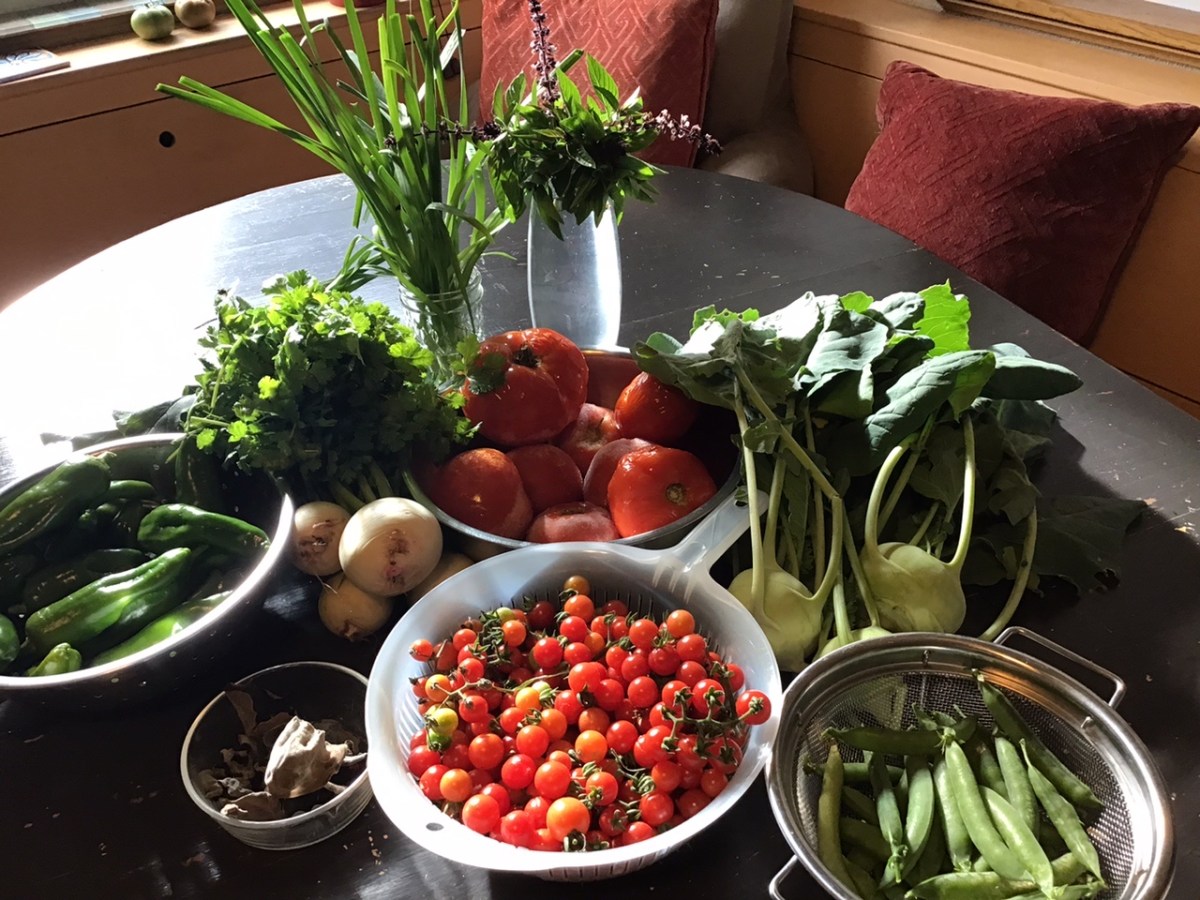
It’s been unseasonably warm for us so far, with regular episodes of more mild weather whiplash than in recent past years. I suspect that’s about to change, so here’s the garden as it’s growing now.
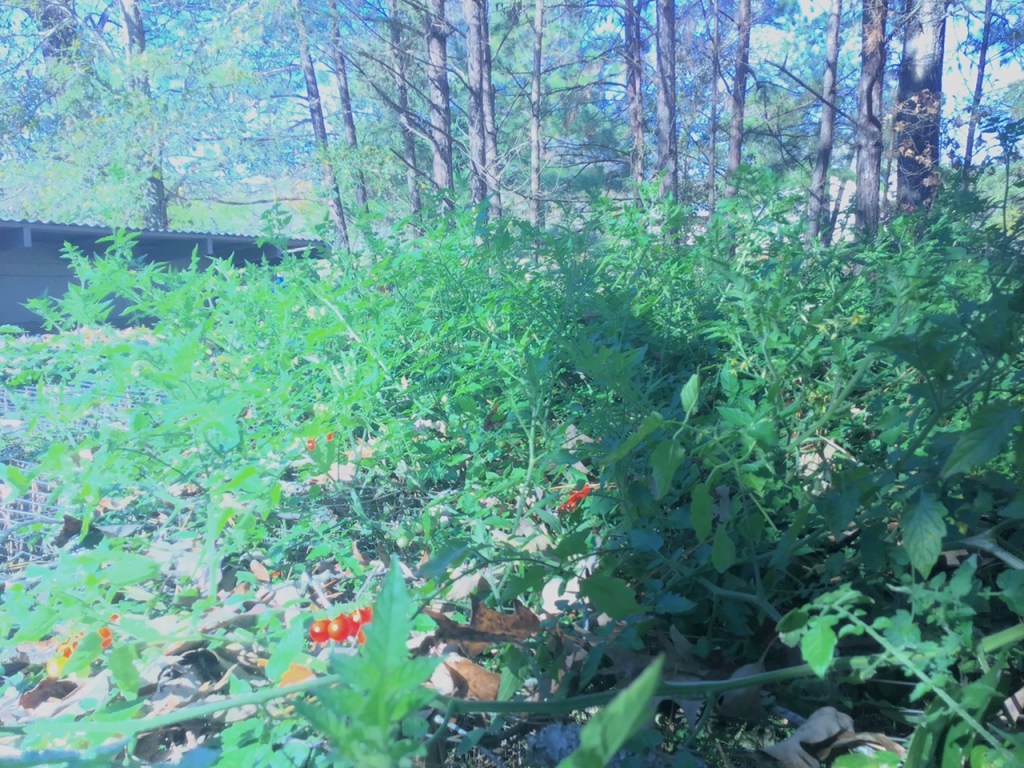
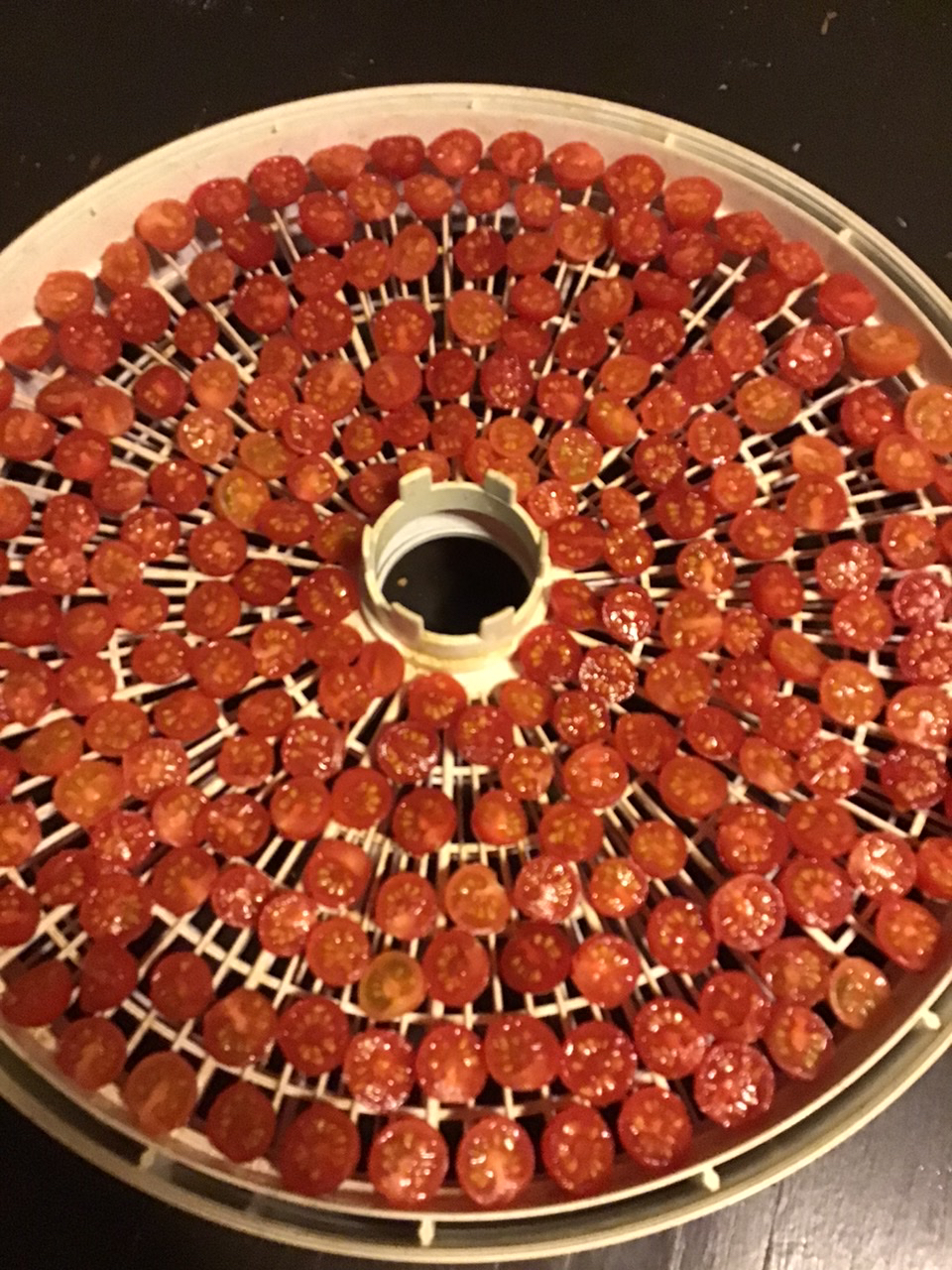
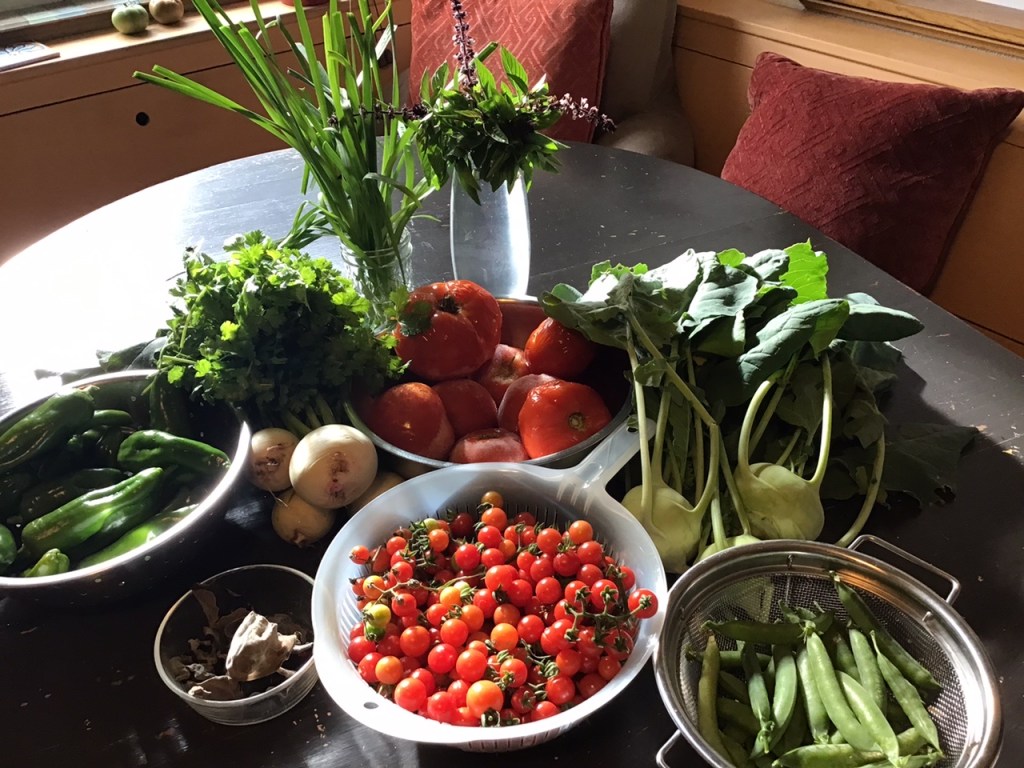
It’s a first for fresh tomatoes in December around here! We are still harvesting from the ‘volunteer’ tomato jungle growing in the duck coop. It looks so pretty and is producing much more than we can munch. Even though it’s tedious work, I dry them. They come out delicious that way and can be added to all sorts of dishes or made into a pesto.
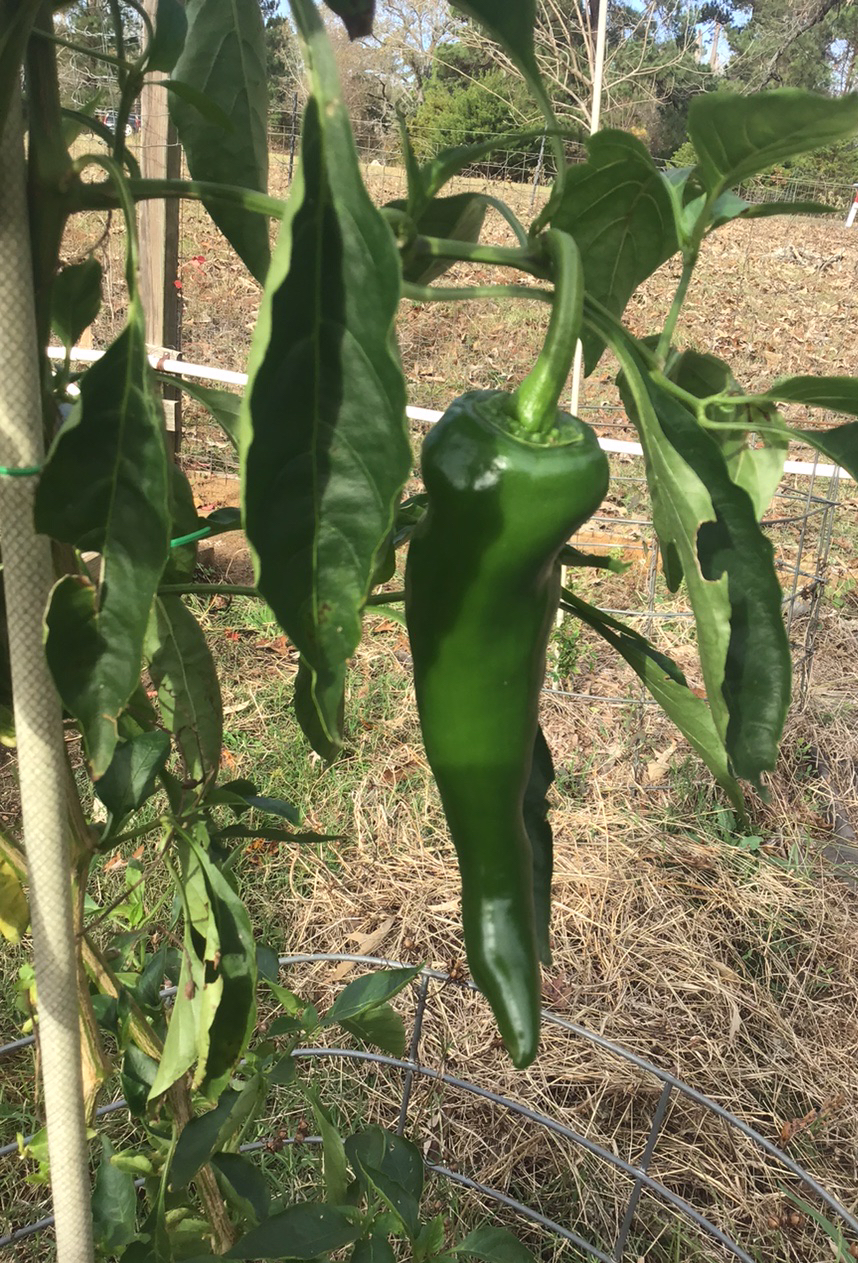
The large tomatoes pictured here are previously frozen. Freezing the surplus in summer solves one big problem around here: the tomatoes come ripe after the cilantro has gone to seed. To me, salsa without cilantro is like a bed without pillows! Now the cilantro is growing like gangbusters, and we still have fresh peppers (another first!), so we get nearly fresh salsa in December too.
With the peppers still growing strong that means in 20/20 hindsight I should not have moved a couple of them last month to winter them indoors after all. Where’s my crystal ball when I need it most?!
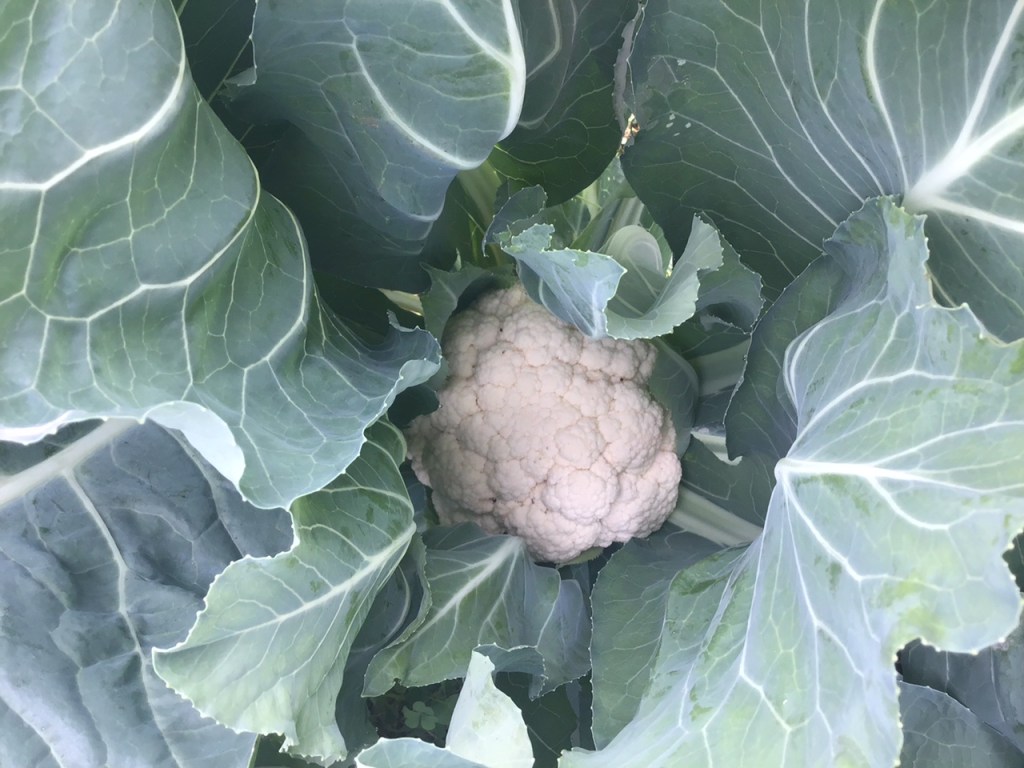
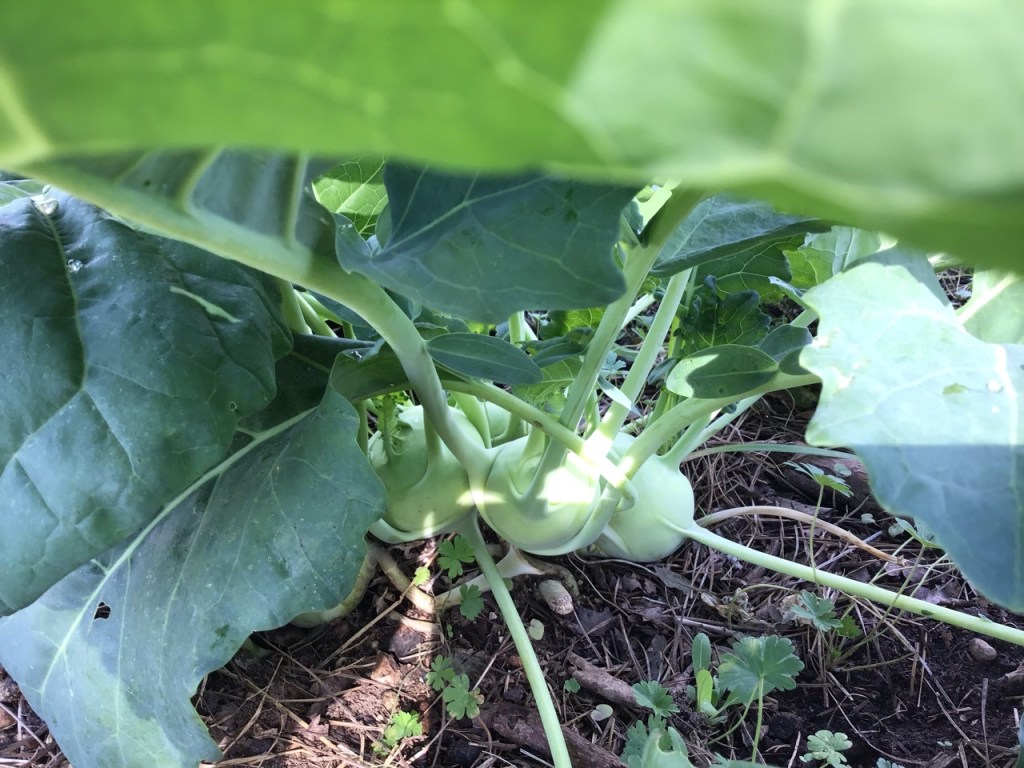
Turnip greens are growing faster than I can keep up! I over plant so the sheep and goats get some extra greens and the pigs love the roots.Happy garlic started sprouting All our favorite fall crops are doing fabulously! I plant very heavily then thin when they are still small, but big enough to enjoy. Can’t do that on a factory farm! I also don’t weed out the ’weeds’ —like chickweed and hen-bit—unless they are badly encroaching on the crops. They are edible after all and once they flower the bees love them too, at a time when very little else is available to them. This has the added benefit of habituating the bees to scout the garden all year round.
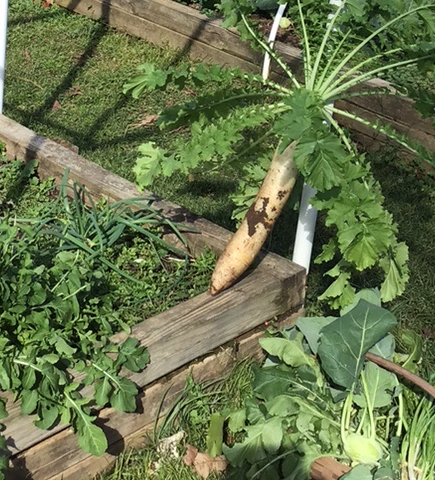
Now that’s a radish! I love all radishes, but the Korean radish is seriously impressive.
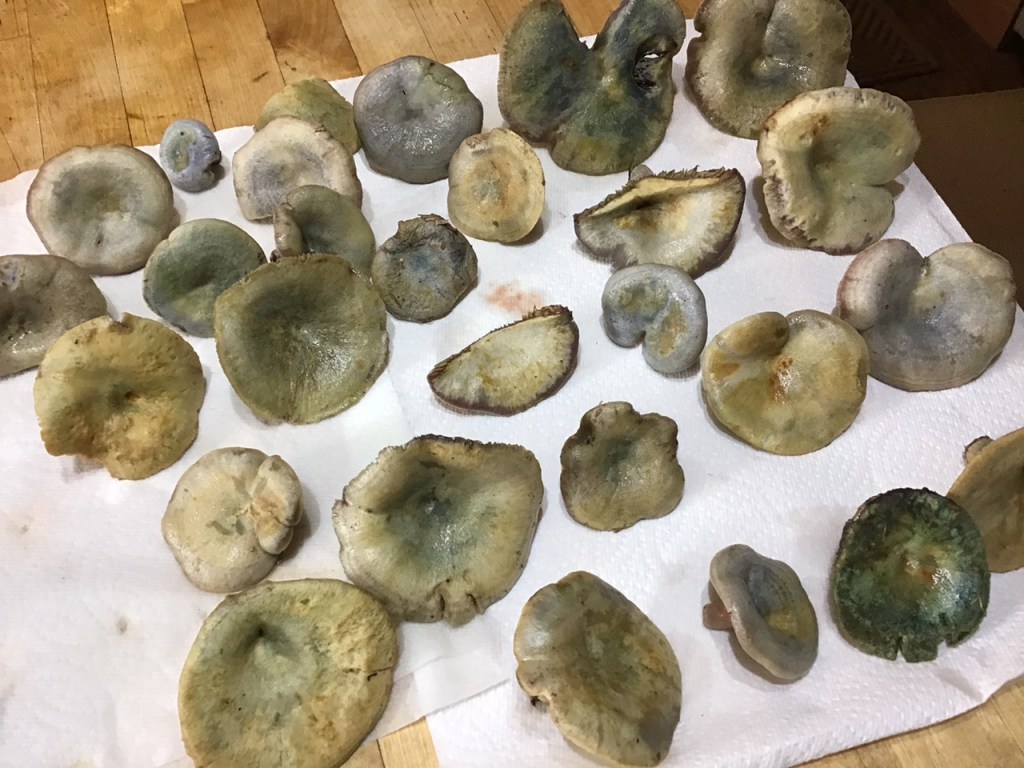
The mushrooms continue to marvel me! First we had chanterelles nearly all summer, now we have delicious ’wood blewits’ (clitocybe nuda—ok that sounds a bit pornographic, no?!) and tabescens, and lactarius paradoxus. Also pictured are either the hallucinogenic ’laughing Jims’ (Gymnopilus spectabilis) or the highly toxic ’Jack-o-lanterns’ (Omphalotus olearius). The latter I give to a friend who uses them to dye yarn. The former, if I were 100% sure of my identification, I might be inclined to try! Apparently you can tell from the spore print color, either orange or white. But, what about when it comes out whitish-orange? Too risky for me!
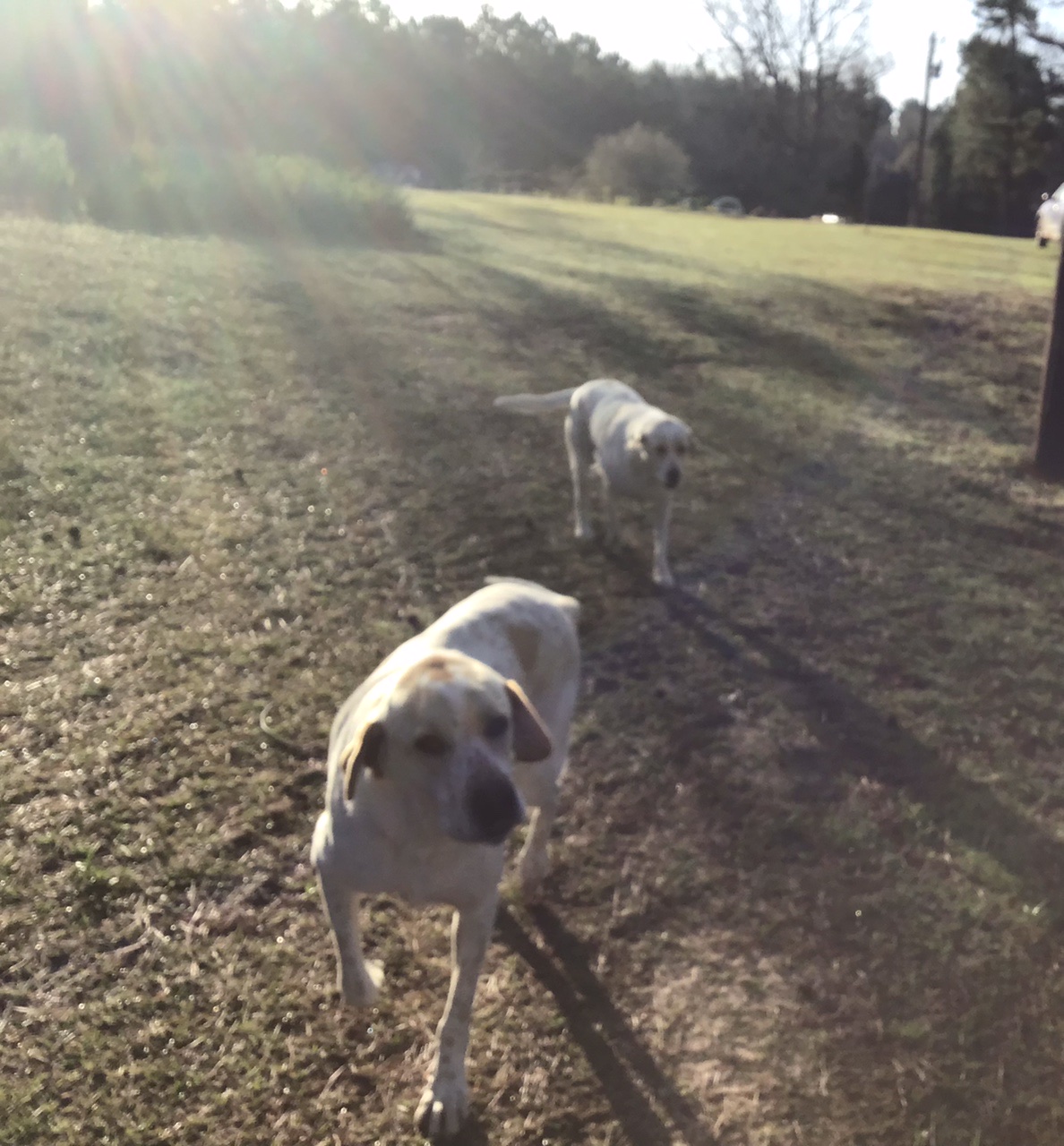
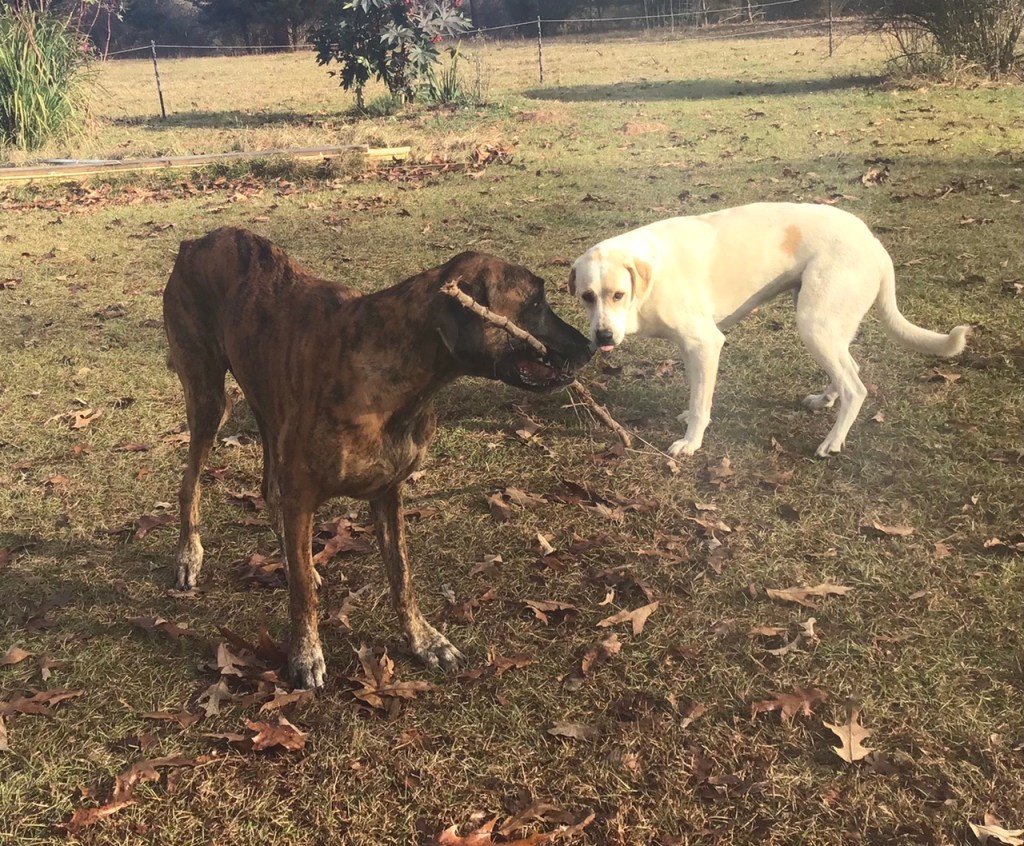
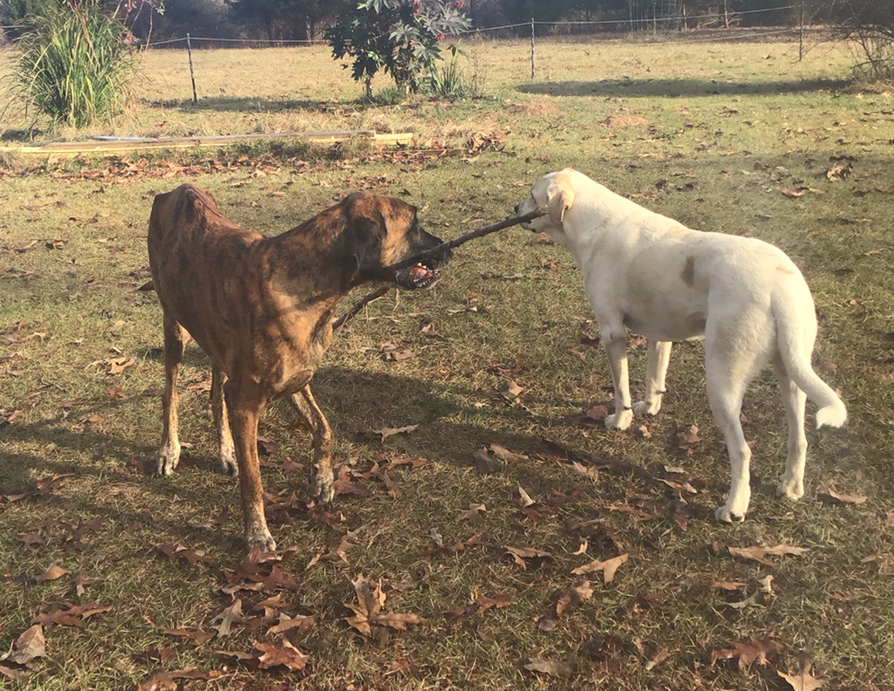
The cooler temperatures make even our old dogs feel a little frisky!
Play time!Who’s gonna take me on!Come on, chump, make my day!Just as I expected, you wouldn’t dare! 🙂
For I hold that which is more fascinating than all the revelations on the Worldwide Web.
For I know what’s more delectable than the greatest feast any queen was ever fed.
Home-raised and home-made by just little ol’ us: 2 cheeses, pig liver pate, sourdough rye, olive oil pickles, radishes and green onions, persimmon kombucha.
For I have felt the pleasure of the task done only for her most dear.
For I have touched the archaic wisdom without fear.
For I have sensed the eternal crafted long before His key.
For fascination is my daily bread living this great mystery.
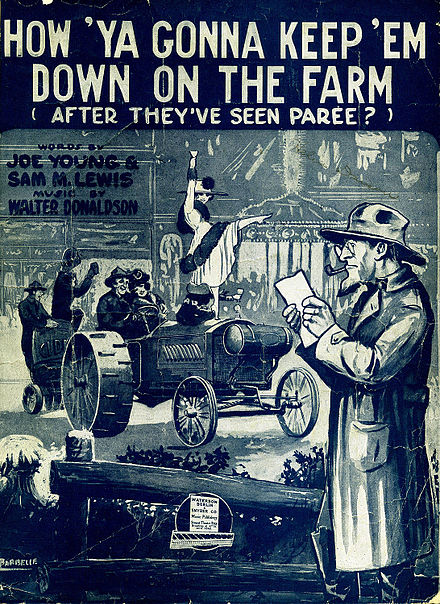
How ya gonna keep them wrapped in illusion once they’ve touched reality?
Another brief plant profile this post, as it’s our first experience of persimmons!
The first thing you learn is absolutely do not eat them when they look pretty enough to eat. With the persimmon, the uglier, the better! If you eat one when it looks like this, you might think you just stuffed your mouth full of dead rodent fur.
If you eat one that looks like these below, you might cringe a little at first thinking you’re about to taste something rotten, but you’d be quite wrong—it’s magically delicious!
Let this funny lady tell you all about it!
It is often claimed that American persimmons are only edible after a frost and that you cannot ripen them off the tree. Luckily, this is not the case. However, most persimmons you can purchase at the grocery store are of a Chinese variety. It seems American producers have decided our own varieties don’t ship well enough.
Preserving ’wild’ persimmons is also a bit peculiar as cooking it will bring the astringent taste back. Making fruit leather was the solution for Native Americans according to this article by Mother Earth News. “When desired, the persimmon leather can be cut into small pieces and eaten like candy. It is much relished by small children this way. Or, the dried pulp can be mixed like raisins with cornmeal and other cereals to make Native American puddings, various cakes and biscuits.”
Time for us to give persimmon leather a try! And persimmon cookies, clearly. I already made persimmon kombucha and it’s positively divine! 🙂
We’ve planted a bunch of persimmon trees in recent years, but only females produce fruit. The ratio of male to female trees is 10 to 1 and you can’t tell them apart until they start fruiting, in about 7 years. Nature’s way of teaching us patience and planning!
No politics or unpleasant ponderings this post, I promise!
Just some homesteady happy snaps and a well wishing for a wonderful weekend. 🙂
A sea of sweet potatoes soon to be harvested.Mexican tarragon—an attractive replacement for French tarragon that does much better in the South.
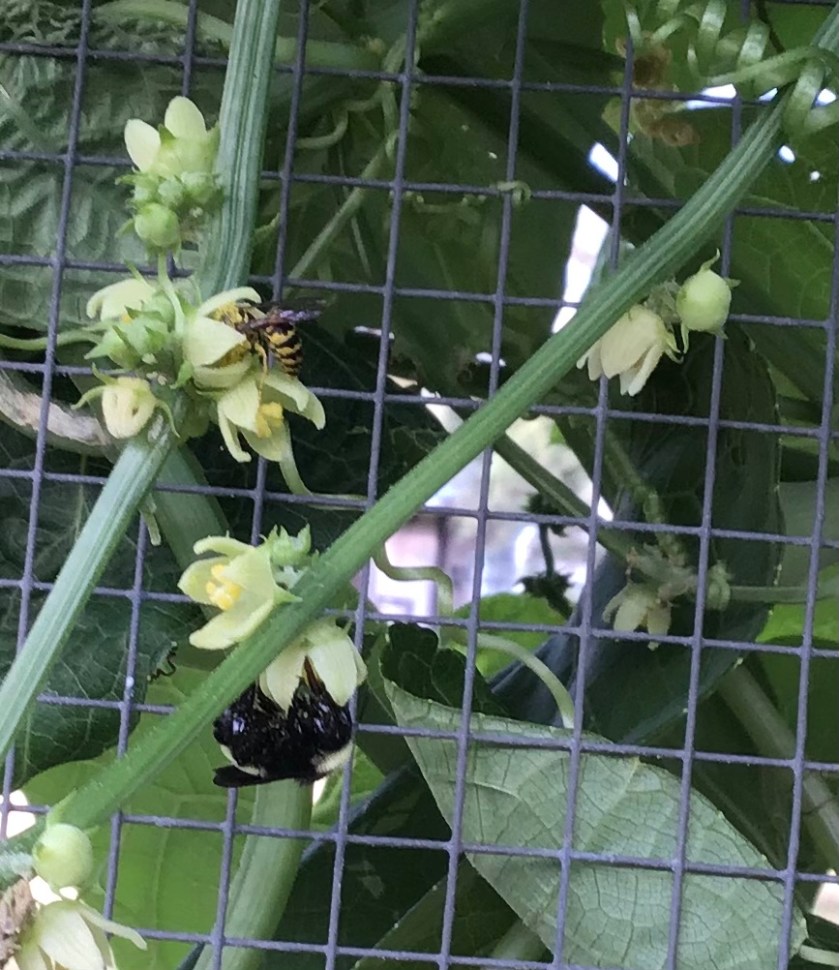
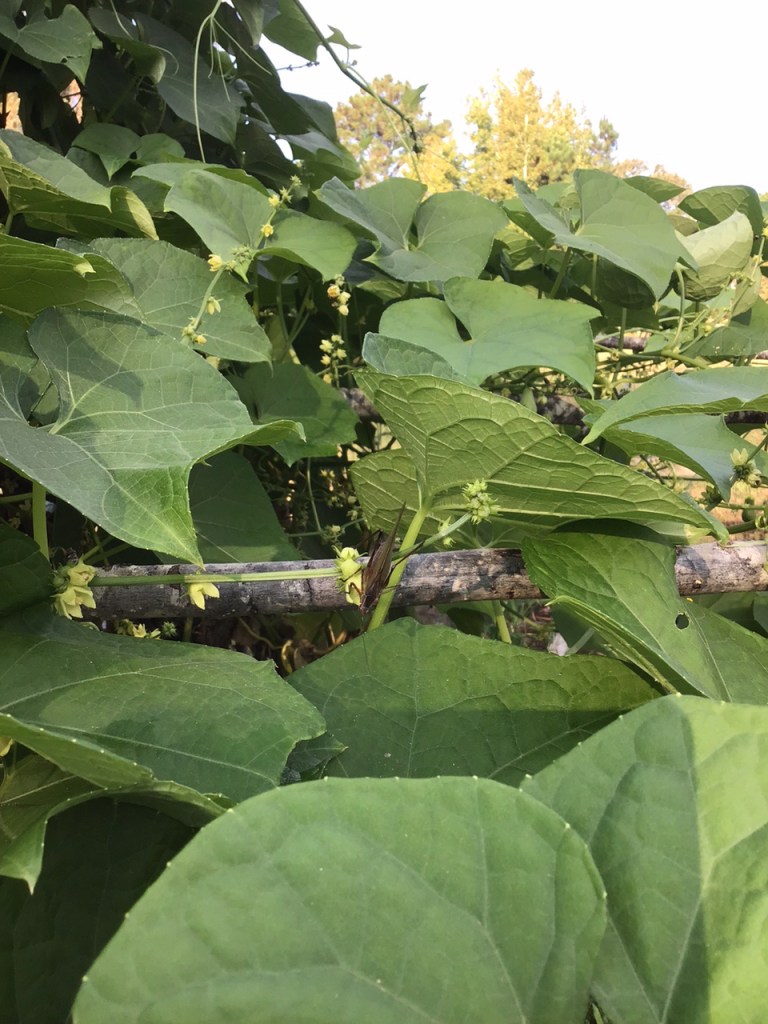
So excited for the mirliton (chayote squash)! It’s growing like mad, covered in flowers and fruit and providing perfect habitat for bees, wasps, crickets, etc.
Volunteer cherry tomatoes thriving on the old duck coop! We’ve never had tomatoes last all summer before, but now I can see how nature would have it done. This is almost an entirely shaded space and the entire coop is filled with volunteers: malabar spinach, datura, and these delicious little morsels.
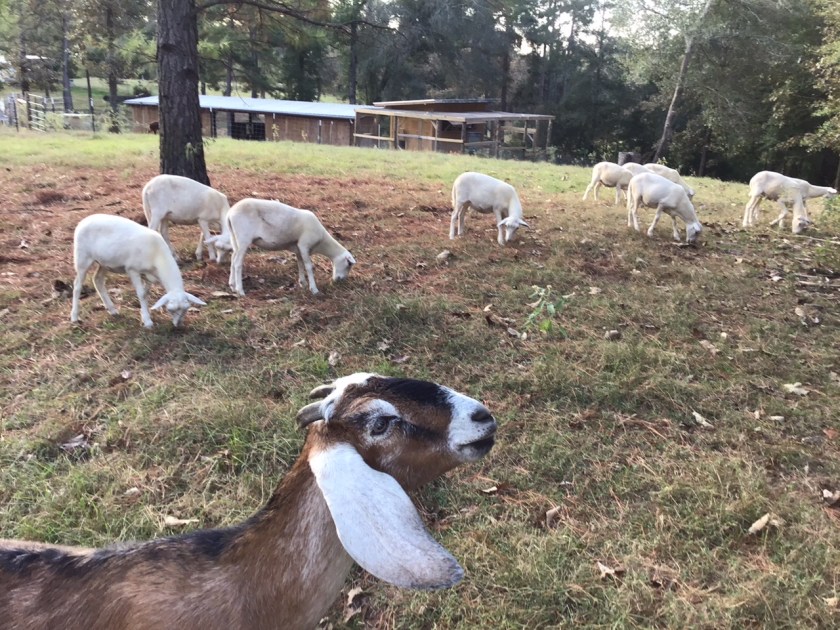
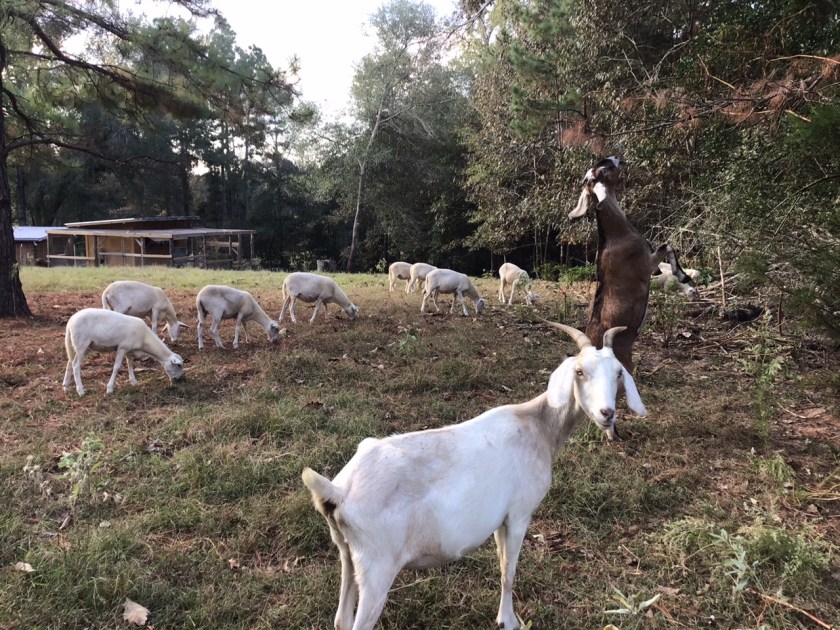
Time to wean the lambs. It was a loud couple of days as mamas and babies were separated, but with Summer as surrogate herd Queen everyone has mellowed down again. Phoebe, the goat pictured on the left, will have her first mating encounter next month. Her sister, Chestnut, jumped the gun, by jumping the fence to be near the rams, the little hussy! FYI—a goat crossed with a sheep is a Geep, very rare and not very desirable.
Drum roll, please, for this next rare shot . . . A Skittles sighting!
Our barn cat, Skittles, who we see about once a week and lives mostly in the trees.
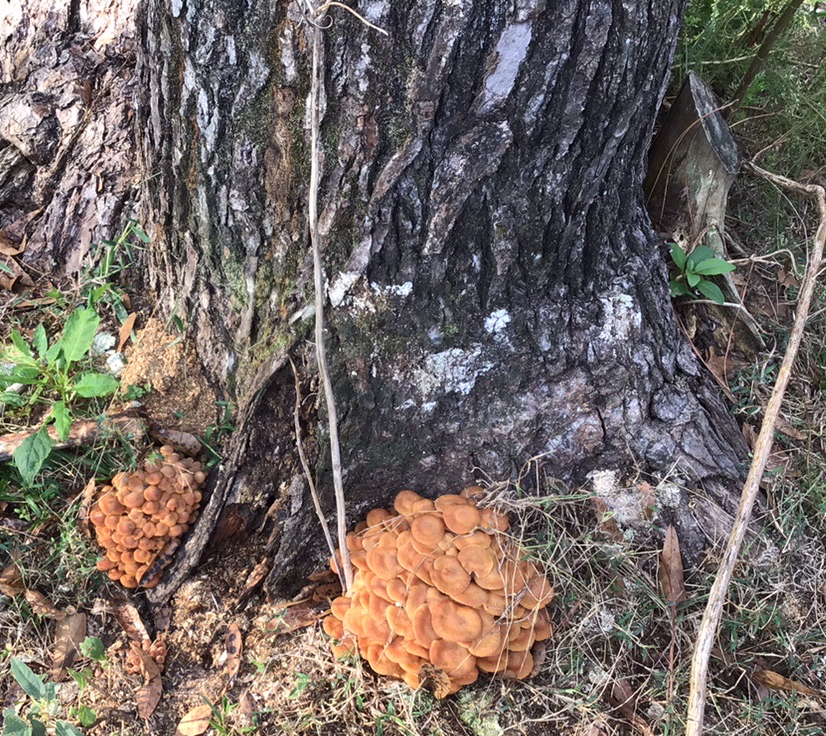
Mystifying mushrooms! These are quite common, honies (armillaria tabescens) claimed to be good by a good many foragers, but we haven’t tried them yet, because my mushrooming buddy and her husband got wretchedly ill on them once. Oops, I promised no unpleasantries. 😉
Buttercup paying homage to the pack leader, Tori, she does this multiple times a day.
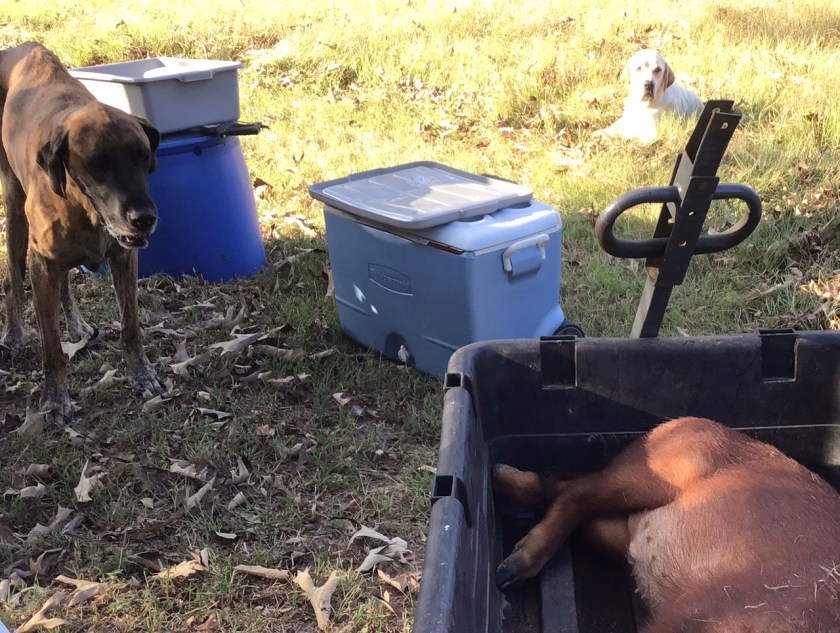
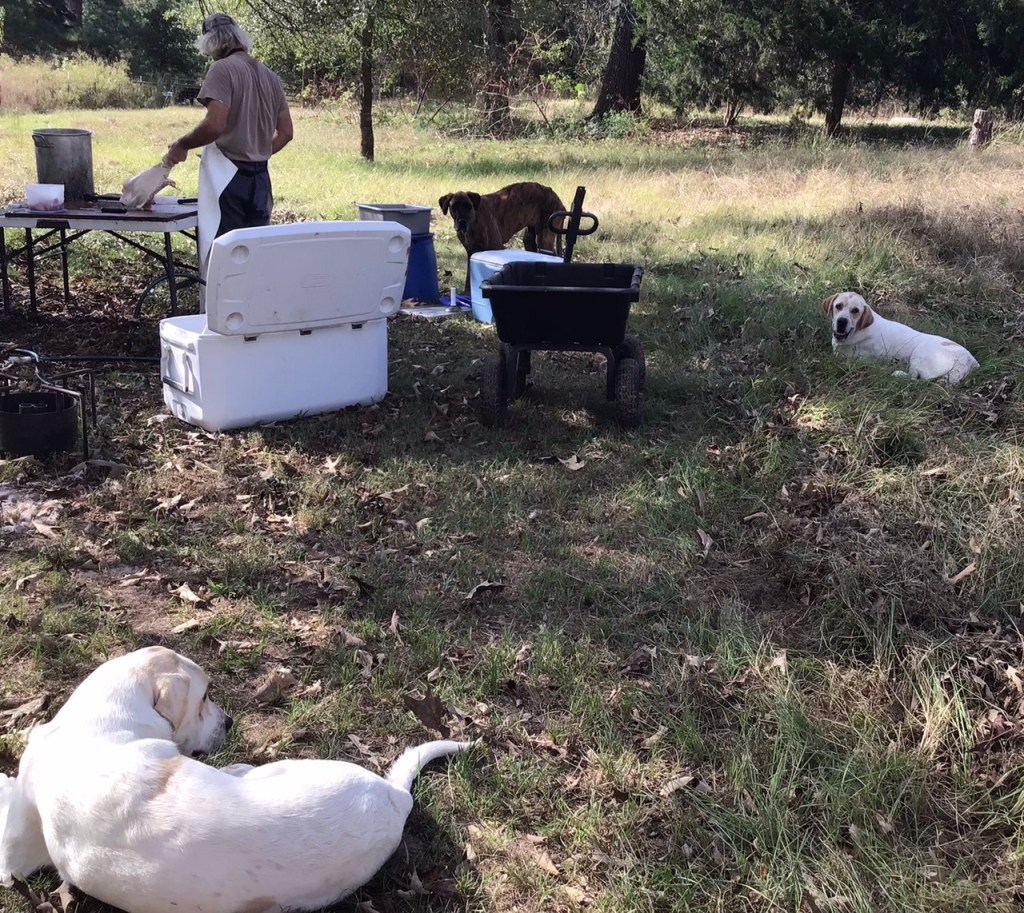
I suppose these next snaps might be unpleasant to some, sorry! I do get that, I felt that at first too, but I was gradually desensitized as I realized how much economic sense it makes, what an amazing skill it is, and especially how magically delicious it is.
Always an attentive audience at slaughter time.
Our favorite foraging expert who we forayed with nearby this past spring has a great new website all about medicinals. Here’s a short podcast about it, and reminding me that now is the time I should be collecting some goldenrod before winter! Medicine Man Plant Co
We’ve been at this about a decade now, learning by trial and error. Because of a major health crisis in the family, I’ve been introspecting even more than usual these days. That’s why I haven’t been posting much lately.
I thought it high time to deeply consider what our own health futures might hold, Hubby and I, while we are not under the immediate duress of old age and poor health. Health is one of the main reasons why we committed to this homesteading lifestyle. Other reasons are political, esthetic, quality of life and, for me at least, a sense of urgency to hold on to something precious for future generations—nature—before it slips completely from our lives.
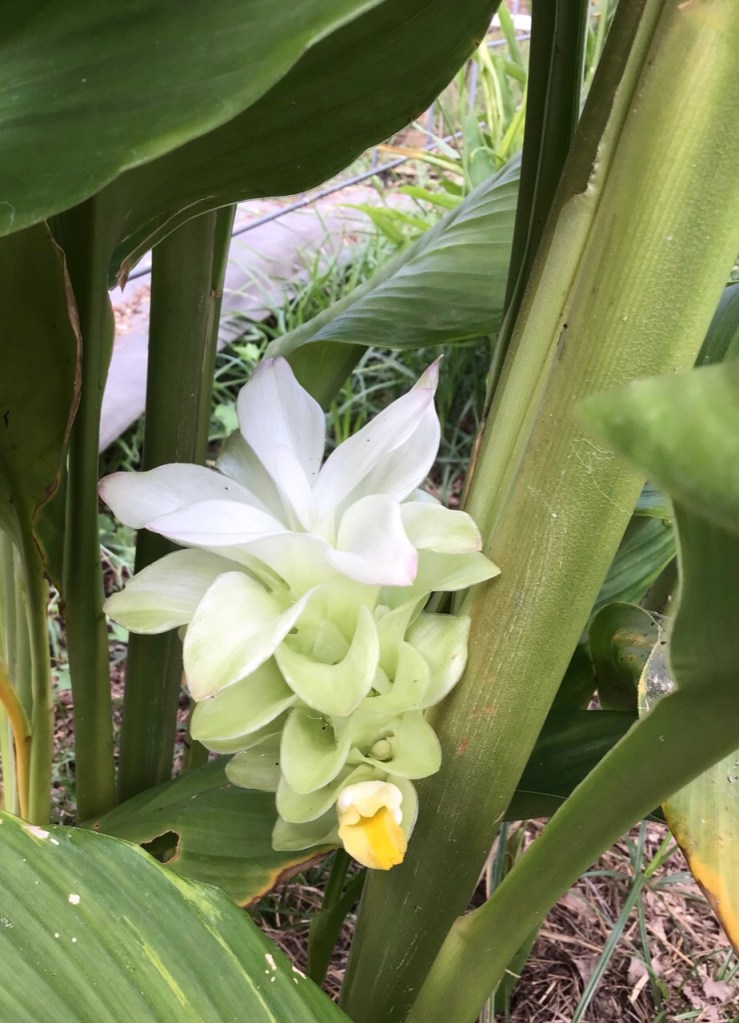
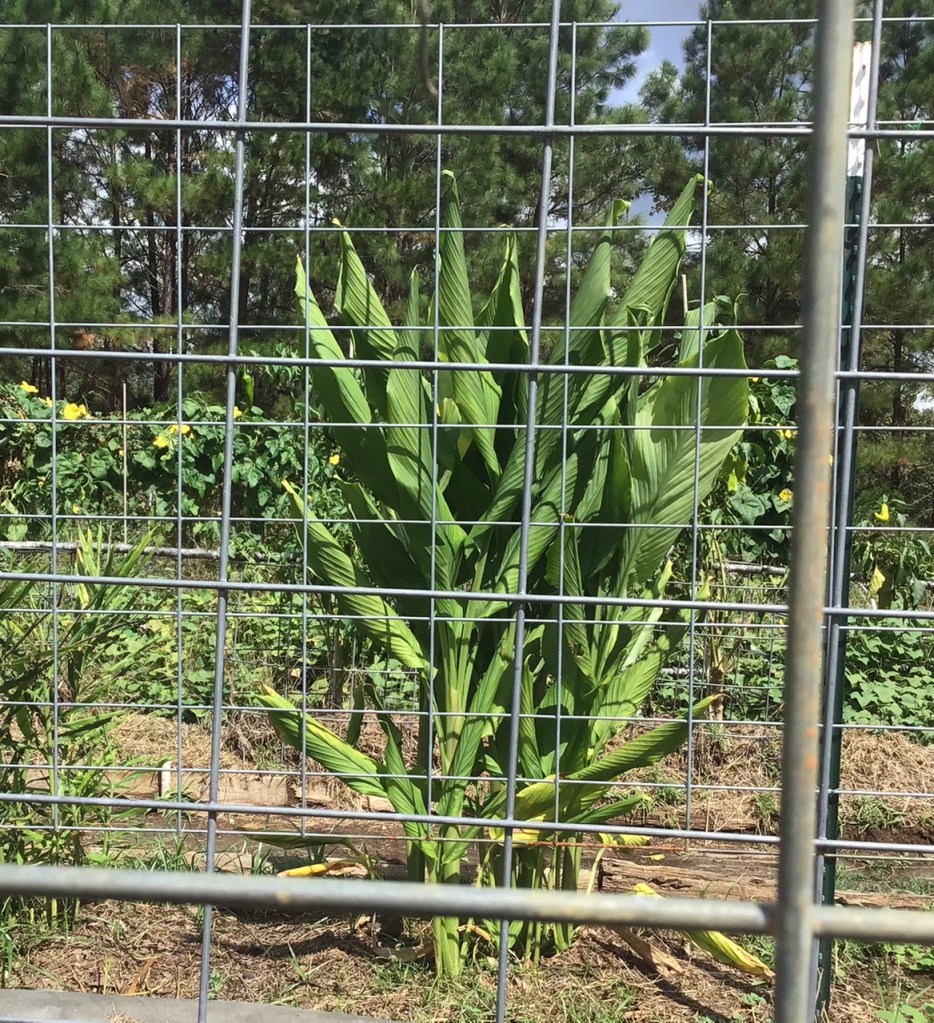
Tumeric flowering, didn’t know they do that!
Watching the impact of the Scamdemic not only on the economy, but also on our ‘health care’ system has demonstrated unequivocally that, despite the challenges and hardships, we’ve made the right choice.
Our ‘health care’ system, which is actually a disease promoting system, is beyond hope, in my estimation. (This one’s surely gone viral by now, but in case you haven’t seen it yet, it’s brilliant!) The DEVOLUTION of covid vaccine efficacy
I truly believe the only way out of the mess this country has become is by reclaiming our natural rights back from the government.
However, that first means reclaiming our natural responsibilities—those ‘unpleasant’ aspects of life we’ve come to outsource to the government (and their corporate partners in crime) in the first place, which has made it ridiculously powerful, as all governments (and their co-conspirators) are wont to be.
We are trying to accomplish that by first demonstrating to ourselves, and then hopefully to others, that such a thing is possible, and also desirable.
But what if, due to our increasing age, we had to choose? Limited strength, mobility issues, cognitive decline, all are serious potential threats to our continued lifestyle here.
Considering this I’ve made a few lists, ranking our current activities against future realities based on: Required inputs, health impact, pleasure principle, and bang for the buck.
It isn’t pleasant. I don’t want to give up any of it, ever! Bees, chickens, pigs, sheep, goats, veggie garden, fruit orchard . . . . But, here goes.
Kombucha, no caveats, it stands alone. If you can make tea you can make kombucha. It’s healthy, it’s fun, it’s delicious. Hubby no longer drinks beer or soda thanks to this amazing beverage, better for health and finances for us, and far better for the environment too, with almost no waste.
Sourdough bread, and already we have caveats. I know loads of folks think they are gluten intolerant; I used to think I was too. Grains properly prepared are nothing like most store-bought breads, for health and taste. Around these parts you can’t even find good bread. In other locales you may be able to find it, but I’d guess the prices are scary. Making your own sourdough bread is time consuming, but it’s not difficult. Same goes for sourdough cookies, brownies, pizza crusts, etc. And, let’s face it, gluten-free products are not tasty, so there’s some extra incentive.
Raised garden beds, and more caveats. Starting to garden at an advanced age is probably not going to be too successful. Of all we do here it claims the prize of Most: most expensive, most labor intensive, most greatest learning curve, most unreliable results. Still, I love it! So, continuing to garden with some foresight and adjustments is perfectly doable. I insist!
That short list makes me sad. It’s the bare bones and I hope such sacrifices will never be required of us—no more chickens, goats, big dogs, great big garden?!
I don’t even want to consider it, but there it is.
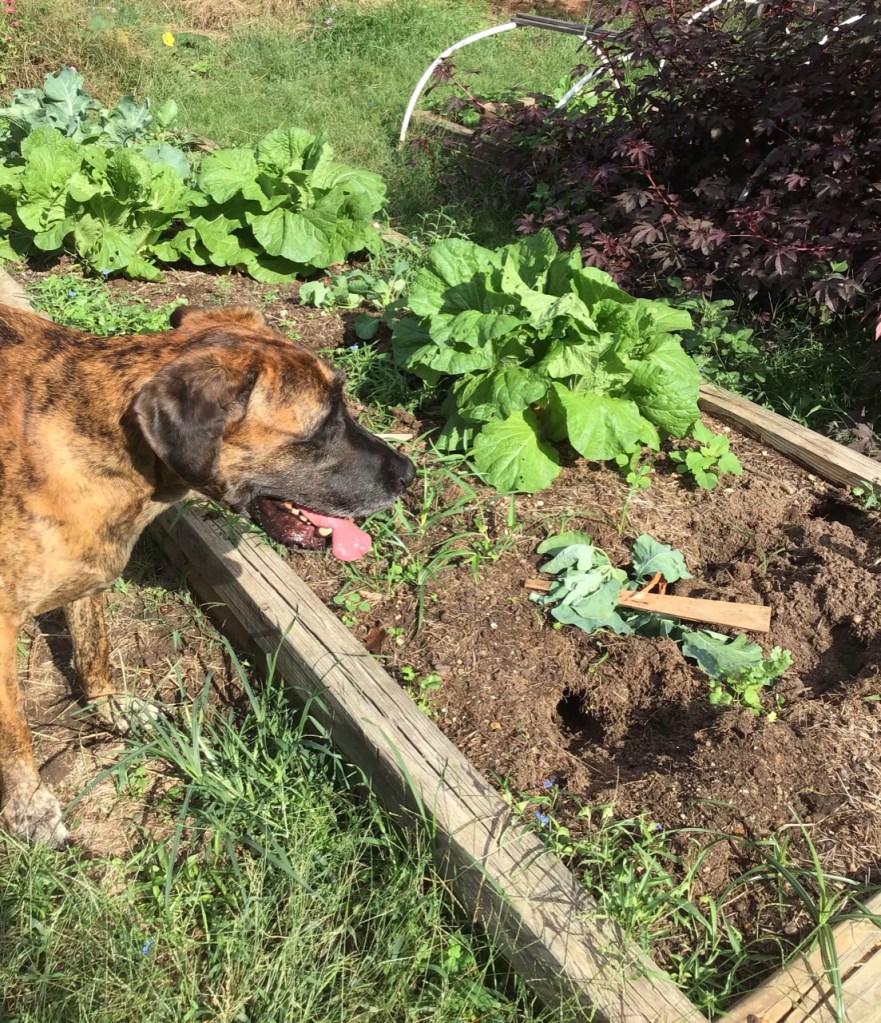
Tori surveying the gopher damage. Bad rodents!
There are also many projects still on my list to successfully accomplish, which are in trial and error mode now. Like making all our own body care and household cleaning products and herbal medicines. Hubby has future hopes of making furniture, if his current to-do list will ever allow it. No time for poor health here!
So, another short list is in order. The three things, in addition to those above, that I hope and pray we never get too old for: 1. Bees — not even for the honey necessarily 2. Chickens — they are easy enough to manage, but they attract predators 3. Goats — mostly for the cheese making, but they’re pretty good company too
And the three things we would most likely not be able to continue into old age: 1. Slaughtering — tough work, no doubt about it 2. Orchard — even established ones are a lot of work 3. Pigs — high maintenance, yes, but so delicious
We have no intention of ever rejoining urban life. And as far as intentions go, avoiding nursing homes and hospitals is right at the top of that list as well.
No rest for the weary around here! Our goal of year-round garden harvesting has been met and is every bit as rewarding, and exhausting, as I expected.
Living, working and eating according to the season is remarkably satisfying. In the last couple of years especially I’ve spent much less time learning from books and much more on direct observing and experimenting.
I’m thinking our next goal should be to throw the calendar and the clock out with the garbage. Show those Amish what a real Luddite looks like! HA! 🙂
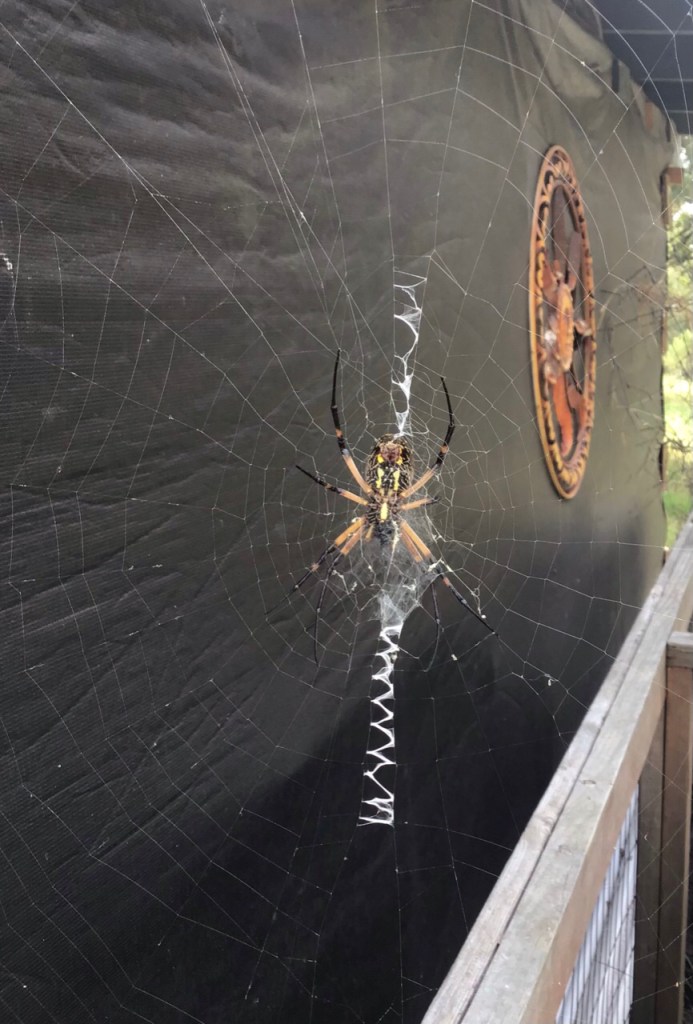
This time of year the spiders tell me it’s a good thing I’ve got the cool season crops out already. Many of them were started indoors, then transferred outside under shade cloth which will remain until the heat breaks, fingers crossed we don’t get an early frost.
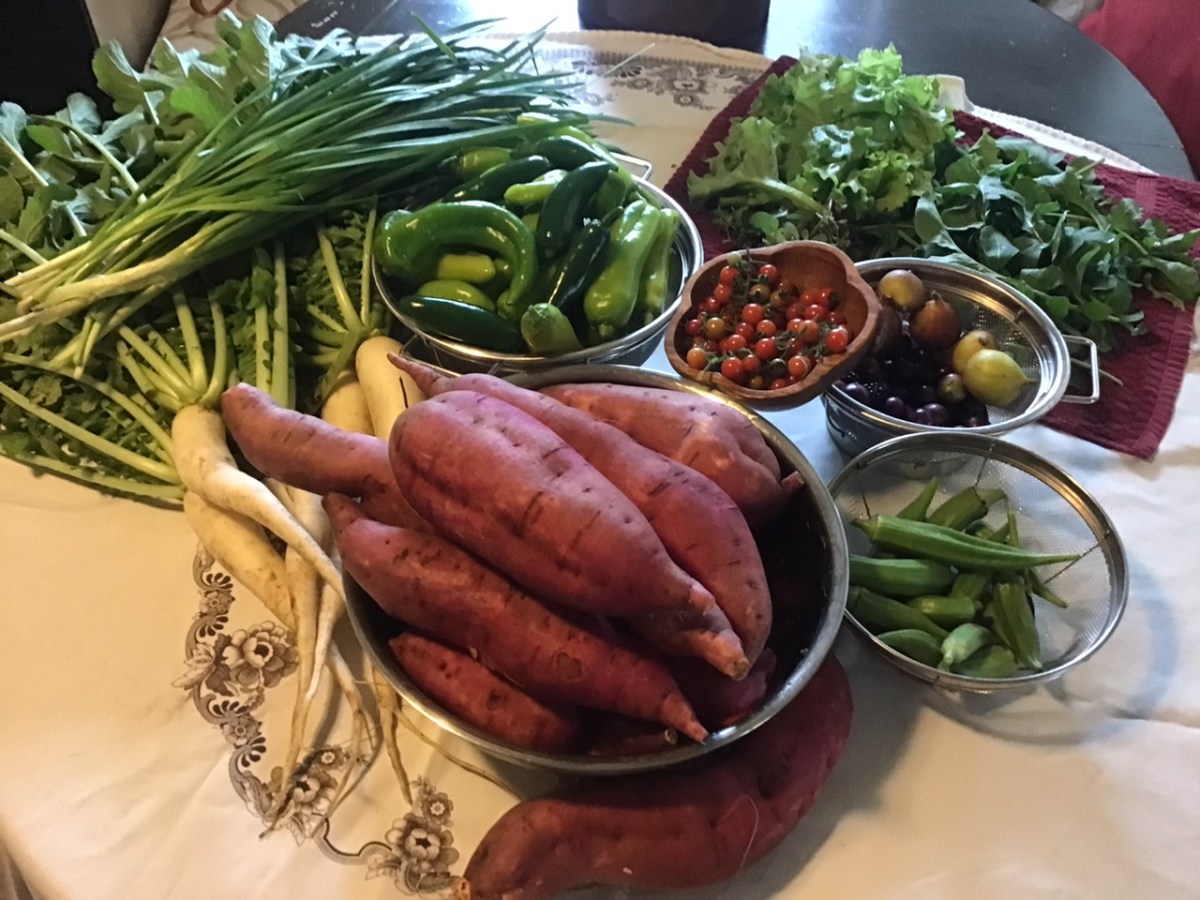
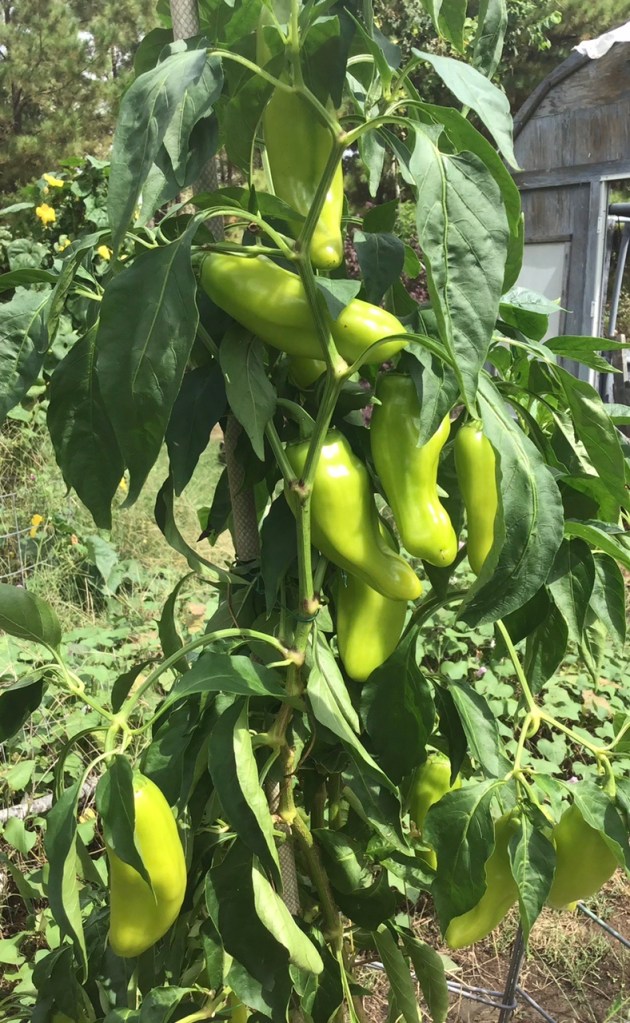
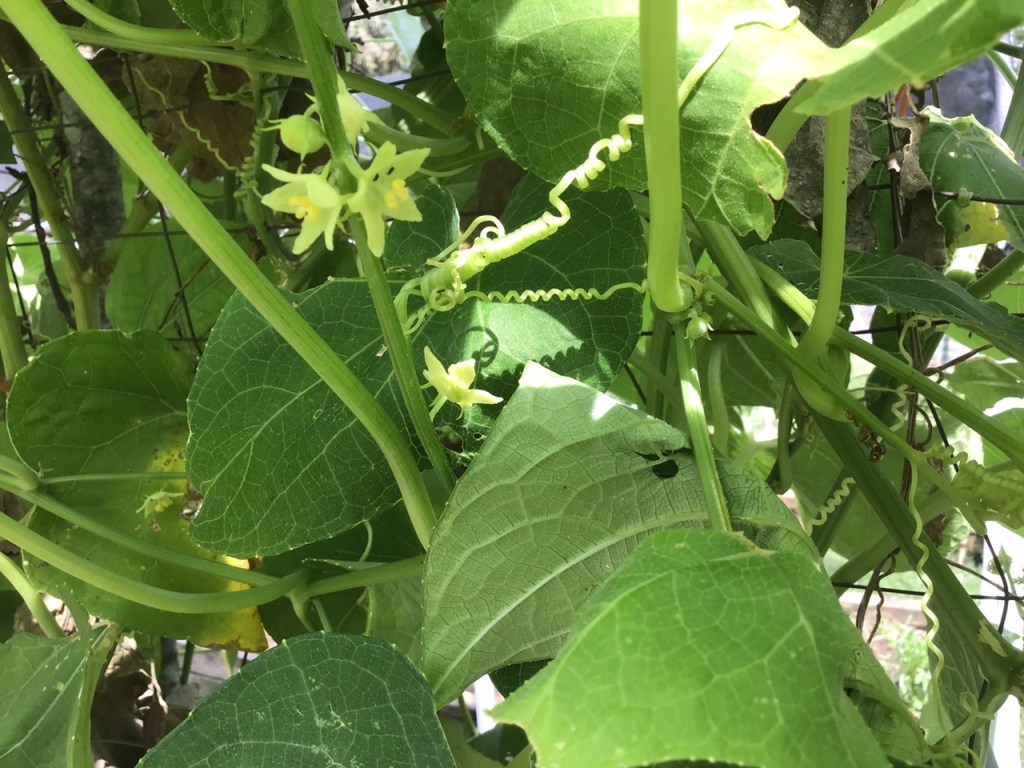
I’ve just started harvesting the sweet potatoes, the luffa and peppers are going crazy, the radishes, volunteer cherry tomatoes and lettuces are finally happy again and I’m most excited for the mirliton squash (chayote) that is finally getting its first flowers. This will (hopefully) be our first success with mirlitons following multiple failed attempts. I love this squash, but it thrives in southern Louisiana mostly, because it needs a very long warm season, even longer than we get here. I started these indoors in February, along with the turmeric, also a first for us this year.
As soon as it cools down I’ll also be harvesting honey, lots of herbs for drying and pesto, along with foraged leaves and roots for teas— sassafras, beauty berry, sumac—and once we finally get some rain, it’ll be time for mushrooms.
Hubby will be filling the freezer with lamb and pork and freshening our flock for spring lambs and a few to add to our growing herd of milking goats.
Hibiscus in May, hibiscus today . … still not blooming because I got a late start.
The honey bees love the Thai basil and the native bees especially love the salvia and the sweet potato and luffa flowers. We’ve decided next year to plant an entire row of luffa in the orchard just for the bees and pigs.
Hope you can enjoy a moment of piglet playtime! Surely there will be time for a wee rest in late winter?