It’s been quite a long time since an update on the wee homestead projects and activities; it’s hard to know where to start! How about, for consistency sake, I bitch about the weather for a bit, and then move along to better tidings.
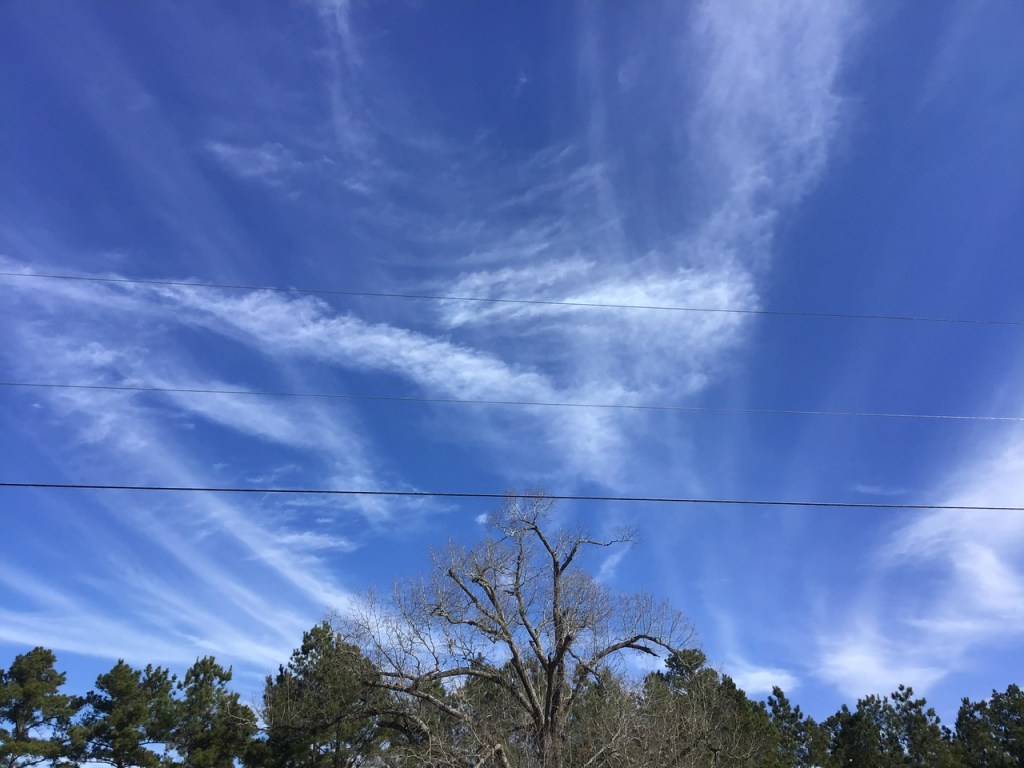
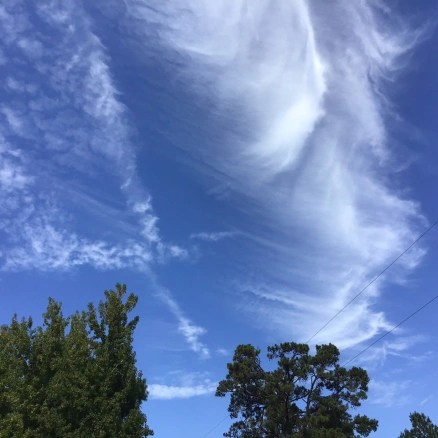
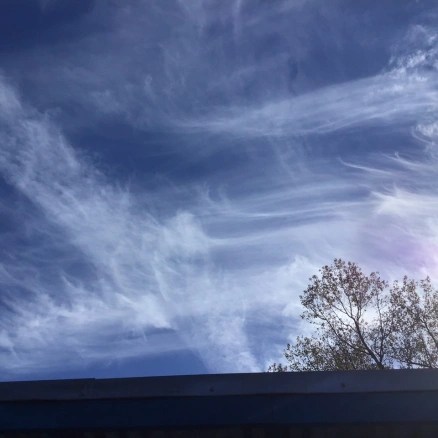
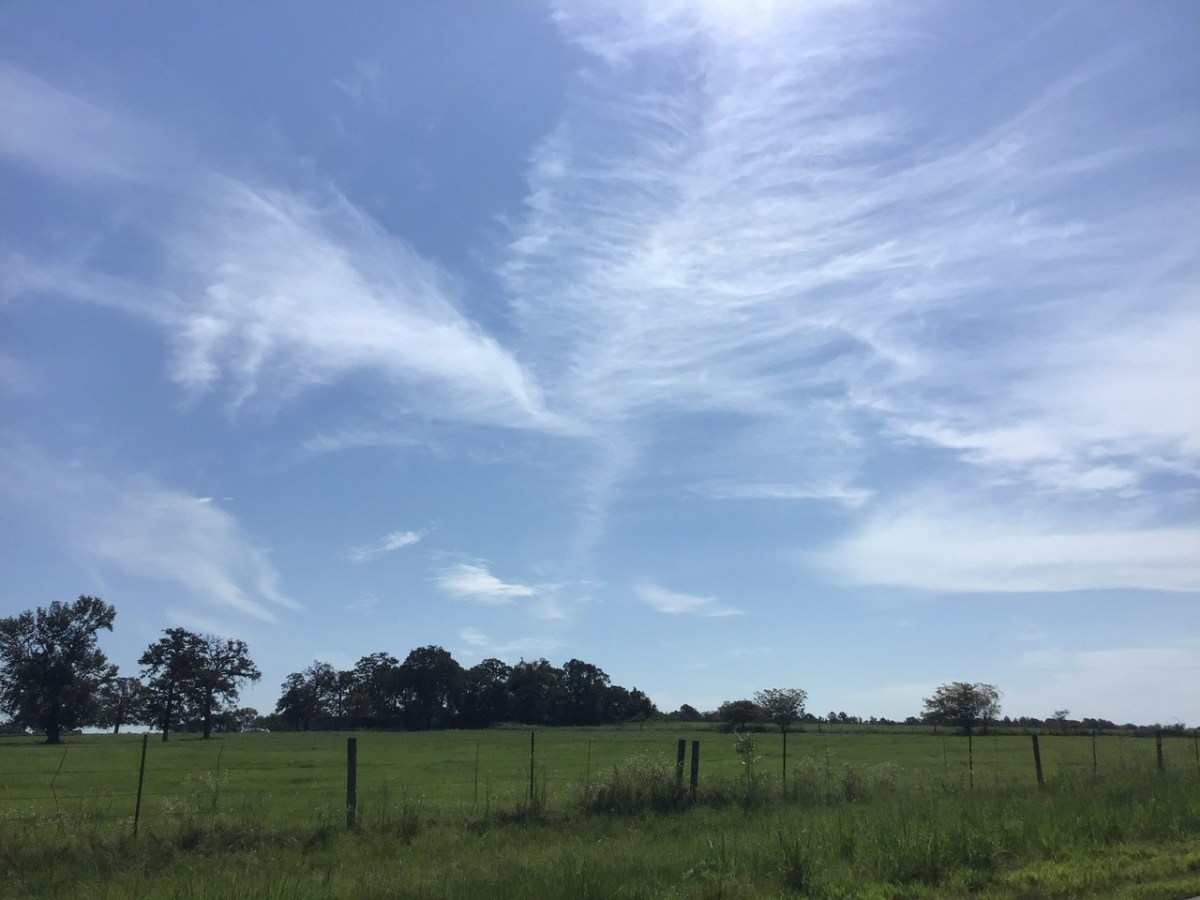
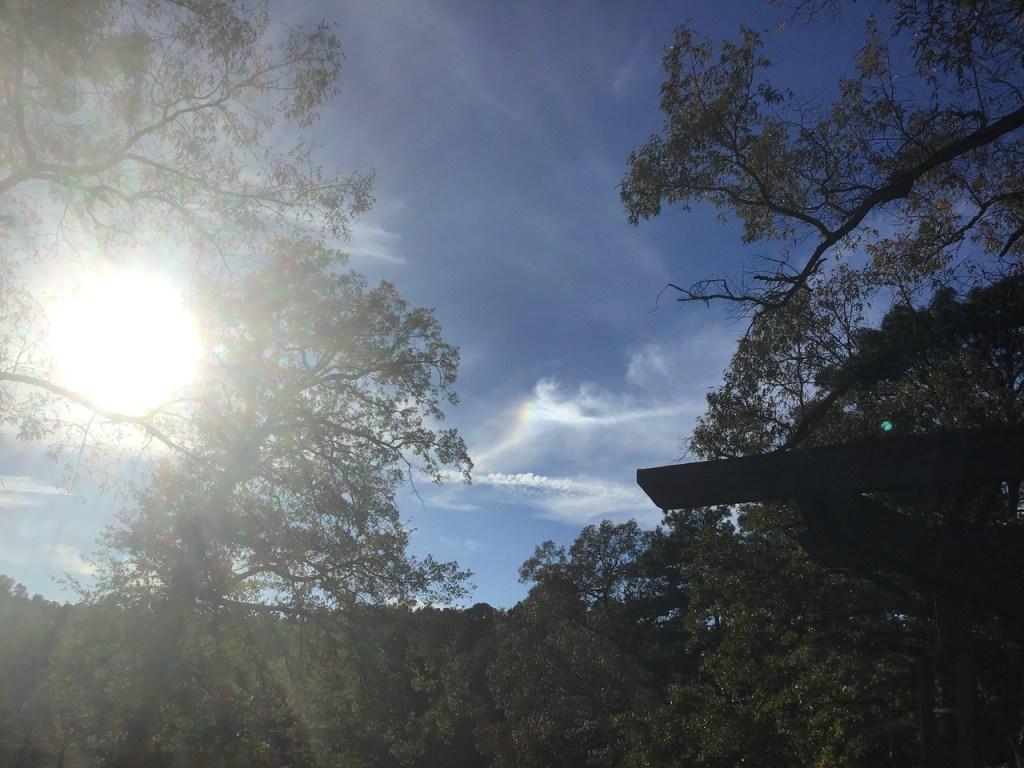
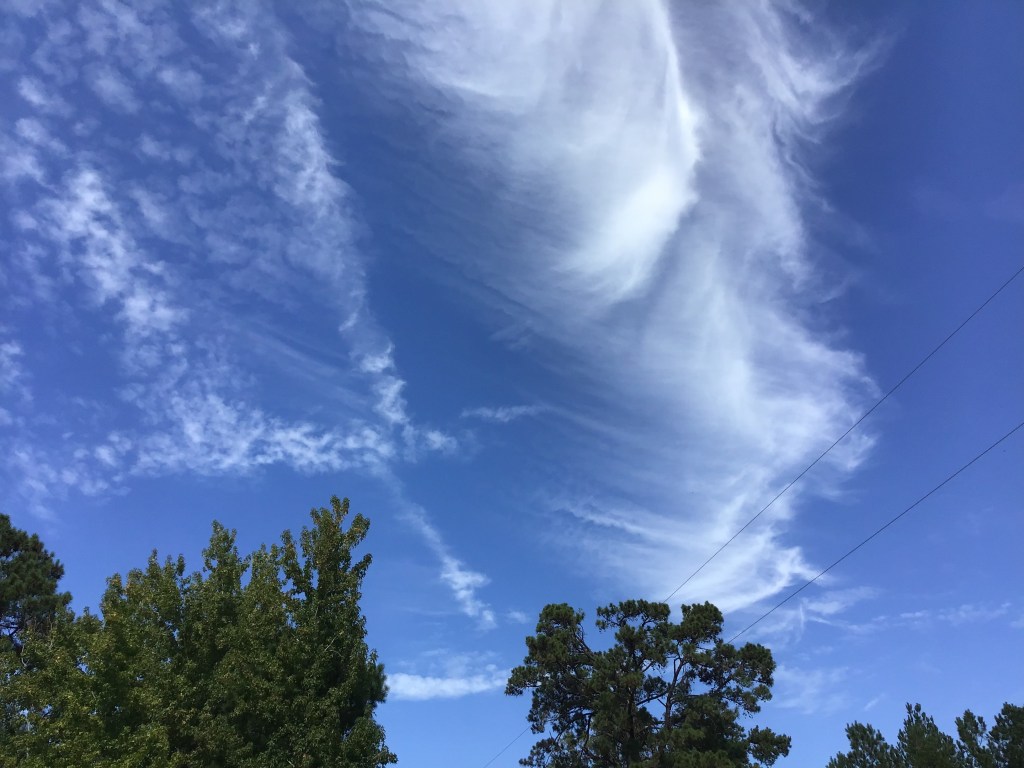
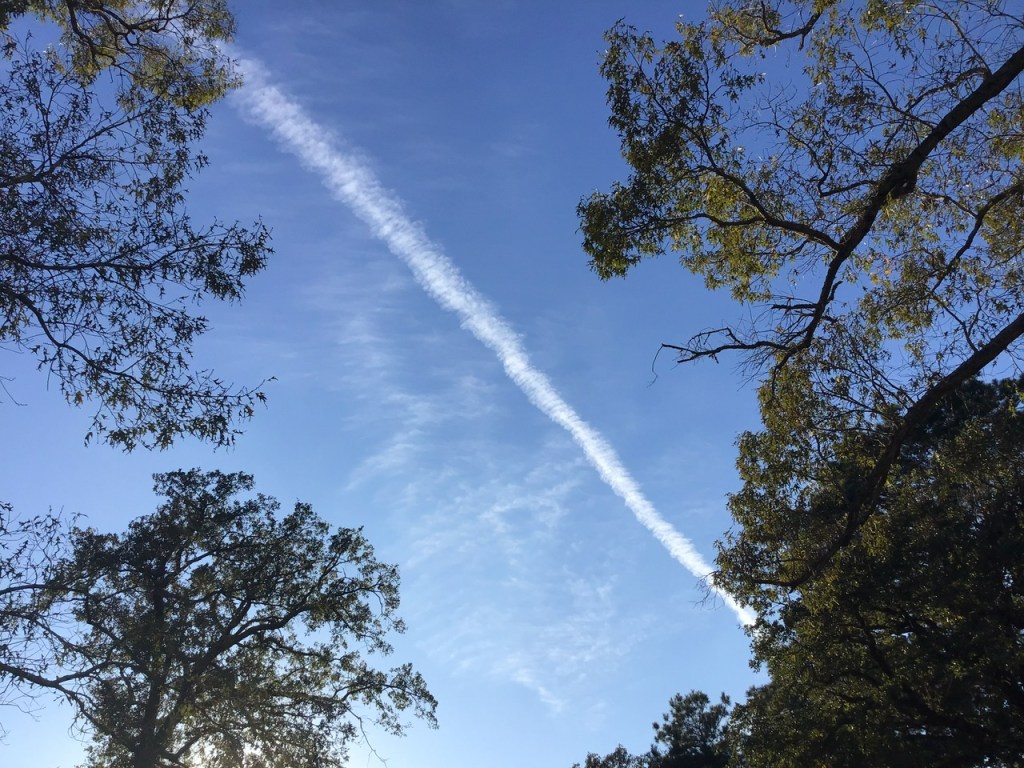
Of course the geoengineered chem-filled skies continue, as does our Yo-Yo season (formerly known as winter). We are using the air conditioning now, it’s been 80 degrees for days.
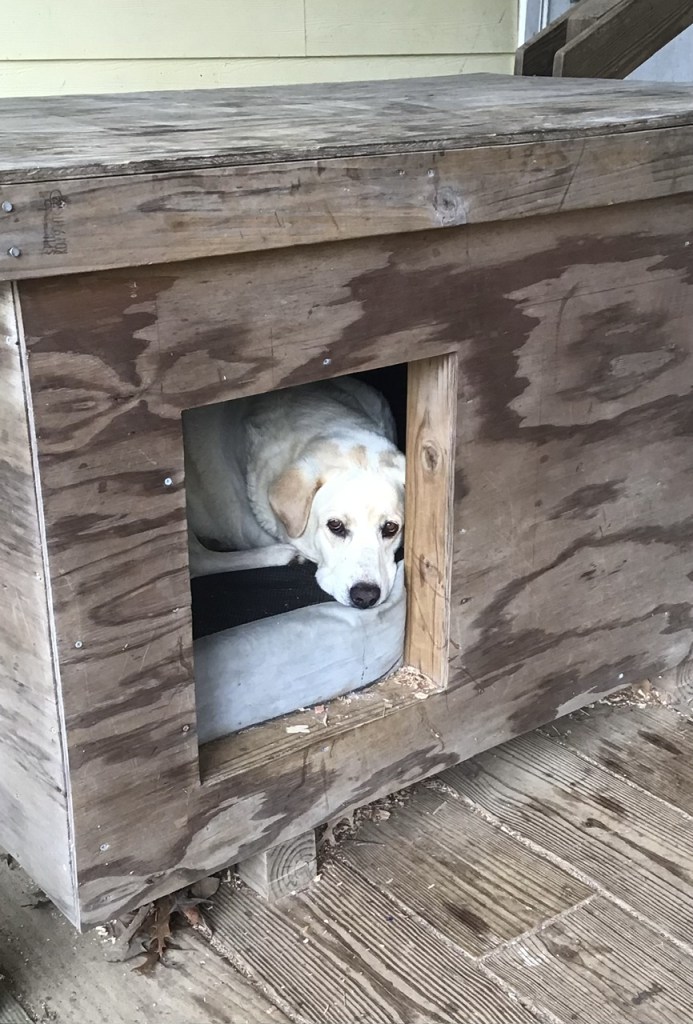
Buttercup is especially sensitive to the YoYo, to the point of regular getting seizures at such times, also lethargic and losing her appetite.
Buttercup hiding in her box all day.
There was of course the lows not long ago in the 20s and I was very concerned for the newly planted citrus. We employed quite the set up of lights and covers and they faired very well, I’m happy to report.
Invasion of Asian beetles on the citrus cover
But there has been a bad invasion of these awful beetles, which we’re vacuuming off the ceiling multiple times a day. Not to be confused with the garden-friend, the lovely little lady bugs, NO, these little beasts are really nasty. They infest, as obvious from the photos, and they bite, and as if that’s not enough, they stink.
I don’t like when folks call them lady bugs, they are not at all ladylike, so I try to correct them anytime I hear complaints, which is more often than you might think. The reaction I get is much more open and accepting than when I inform them about the manufactured weather.
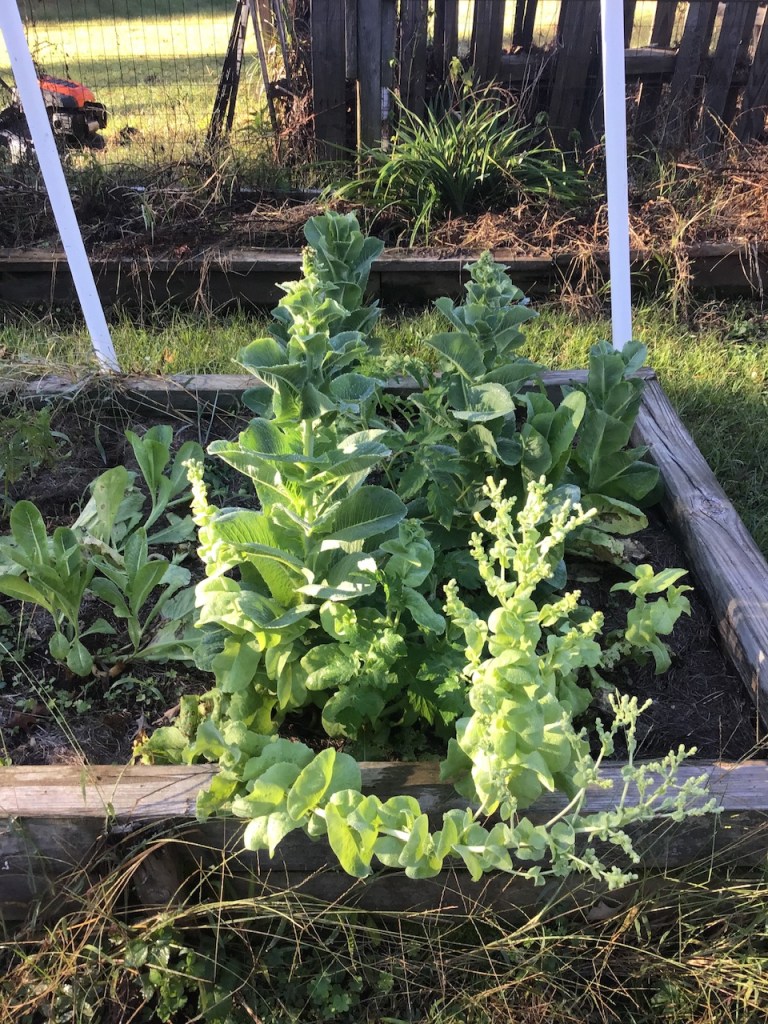
Old lettuce bolting, replacing with new lettuce started under lights indoors, along with broccoli and cauliflower.
It does keep us on our toes, dealing with the Yo-Yo. Lettuce and herbs bolt prematurely quite often, seedlings come up then freeze or wither. We never know from week to week what to expect or how to plan.
I don’t normally have such a fancy setup, but these trays were gifted to me and they’re working quite well germinating some lobelia and snap dragons.
My indoor lights and heating mats make things easier, as does the row cover in the garden, but it is constant juggling. And if I miss a beat, death. Like happened with the Mexican oregano I was so proud of. I forgot about it outside one night when it frosted. Very disappointing considering our long journey of discovery, and how long I babied those few little sprouts, trying to anticipate their every need, carting them inside for warmth, then outside for sun and wind, and just when they were getting their legs, gone. All my fault.
Well, except for the geoengineers, because I wouldn’t be doing this constant refrain if our weather was consistent or predictable or seasonal.
I’ve tried twice since then to sprout the herb again with no luck. I will succeed eventually, of course, we’ve come too far in our quest to fail. The Mexican oregano has a long tale in these parts. Failure is not an option. More on that in the last HH post, if you like. https://kenshohomestead.org/2024/11/14/homestead-happenings-43/
I’d like to say it was the same with the milk quest. Unfortunately, I’m not nearly as confident; I feel failure is probably inevitable and maybe even imminent. For the time being I’m counting my blessings I’ve found another (perhaps temporary) source. Last time I was complaining about the cost, this one is even more expensive at $15/gallon. At that price I’m not going to be experimenting with any new cheeses, that’s for sure. To make cheese at all is not really feasible, except for the most delicious of selections—Camembert. Otherwise the precious commodity goes toward morning coffee, ice cream, and buttermilk for recipes and the extended expiration date.
Camembert to be draining before salting
I’ve been doing continued research on the topic of raw milk and what’s available and in general, where’s the market vibe. I found one young entrepreneur with a private herdshare selling cheese for $25 a pound. (A Herdshare Agreement or a Grade A license from the state are the only ways to sell raw milk in Texas legally.).
With my new herdshare deal I can buy more milk for cheesemaking, if I’m willing to pay $15/gallon. Considering the hard cheeses I typically made were 5 gallons ideally (better for aging in less than optimal conditions), that’s a really expensive cheese.
Certainly what can be made on-site are far better cheeses than can be bought at the store; that’s why I started making cheese in the first place. But still, it’s really hard to justify all that work, and expense, when we can still buy organic cheese for about $8/pound.
I will splurge one time in late spring, if possible, when the grass is thick and so the milk most rich. And we do still have two goats, hopefully pregnant, so there’s a small hope of cheesemaking in my future, if all goes well.
Moving on to the garden, the garlic is going strong and I’ve just got the onions in, 3 big rows of each. The garlic we plant is elephant garlic which does so much better here than any other variety I’ve tried, and I’ve tried lots. These are local for over a decade now and their productivity has yet to disappoint.
The onions are from purchased sets and they normally do well, though some years are a bust, like last year. I also started some from seed under lights, to compare if they are more consistent and adaptable, because the sets have gotten pricey in recent years and it’s irritating to pay good money for possible failure. Onions do not like Yo-Yo weather, but then again, who or what really does?
At least some seem to tolerate it better than others. We’ve got a couple of ‘oyster trees’ that are bringing us regular tasty gifts.
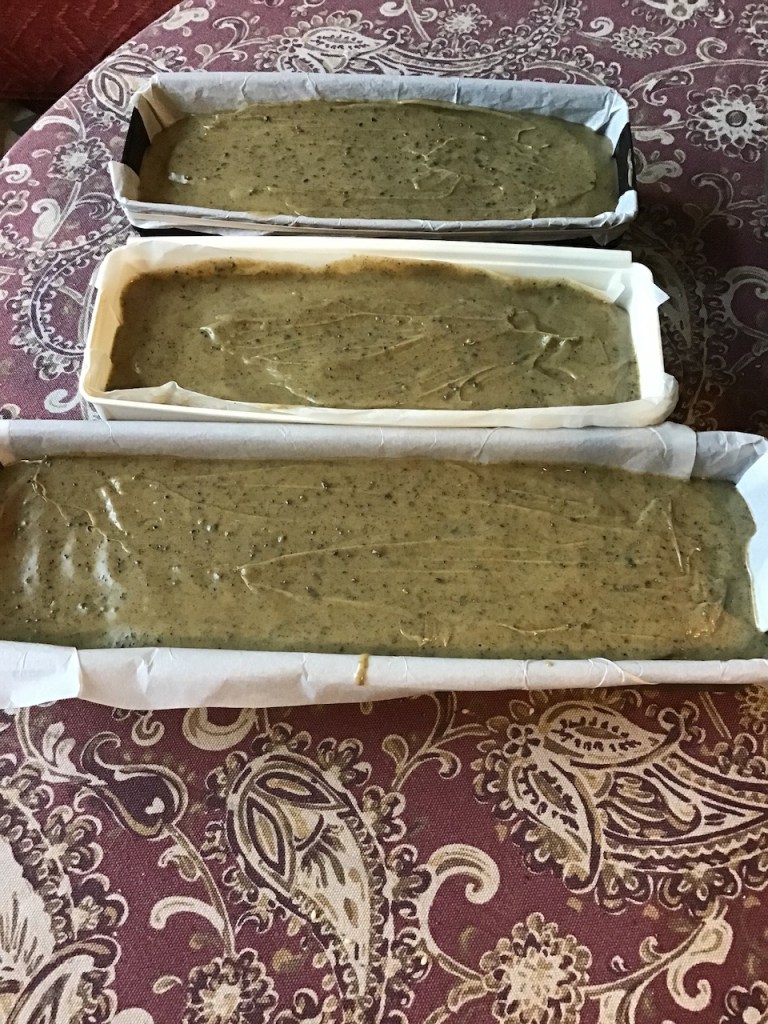
I’ve also tried a couple new things that have been long on my list. There’s the soap that’s just now cured, a bit earlier than I’d read is typical. I’m really pleased with it! It lathers very well and the scent is rather sensuous. My intention was something earthy and erotic, and I think I succeeded.
I got the sensual part down, now I need to up the aesthetic! Trust me, looks are deceiving here, I just need better molds! Never underestimate the power of packaging, eh?
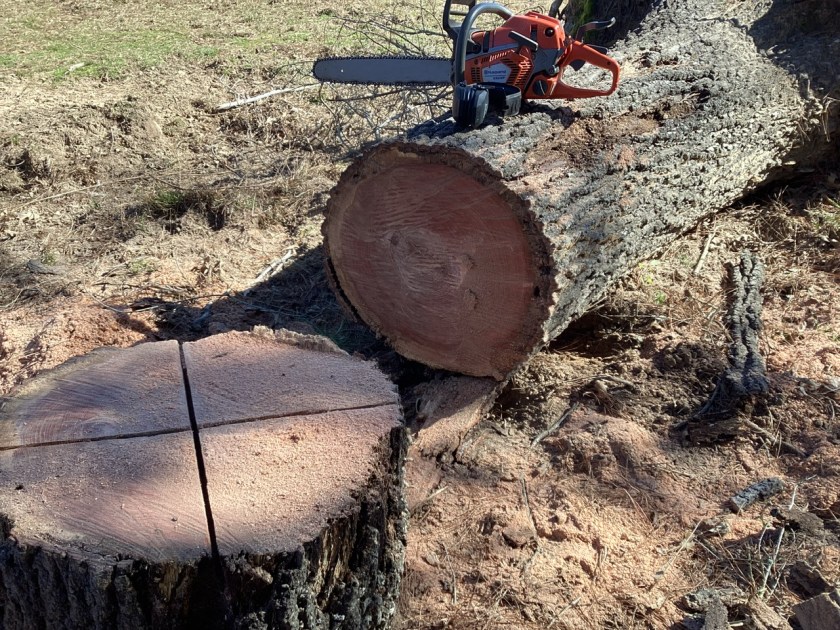
After finishing up slaughter season and chopping up downed trees for a month, Hubby has moved on to a far more desirable and needed project, according to me, our kitchen! Yippie!
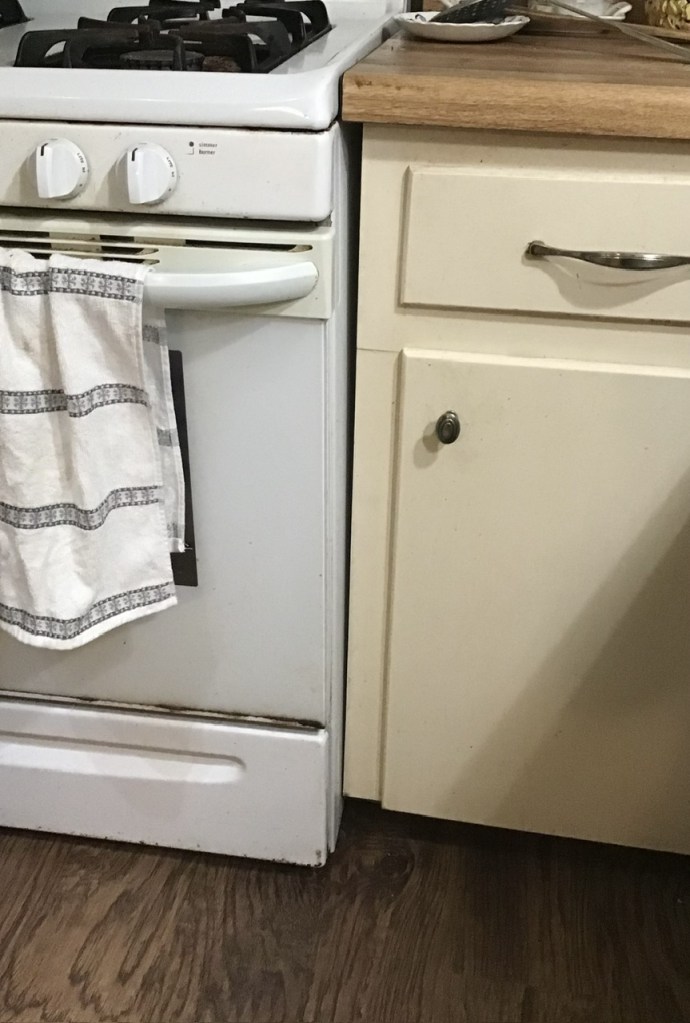
We’ve needed new countertops badly for many years, ours have been well-worn in 40 years, especially since we’ve gotten here and the space went from softly used a few times a year, to a daily year-round assault. It’s actually pretty impressive the counters aren’t near dust by now, considering how quickly more modern materials fall apart.
New island done, now for the hard part.
Old, ugly, not square or plumb . . . Good times coming in Hubby’s near future!
New countertops got us on a roll and now we’re planning new light fixtures and maybe even a new paint job. Big ideas, perhaps not backed up by time or commitment.
Those big ideas, I’m full of ‘em! In my mind the kitchen’s already painted and my next project is to paint the table, which I’ve wanted (and once tried) to do for as long as we’ve had it. I can imagine I might have a table with a surface that looked something like this . . .
But I’d be perfectly willing to settle for this . . .
Or this . . .
So, after I repaint the kitchen in the few spare moments between juggling plants in YoYo season, I acquire the skills of an artist, and paint something I can really be proud of . . .
Whenever I’m finally able to manage that, y’all will be the first to know!
In the meantime, here’s where we were at in the last update . . .
Folks keep sipping on their Hopium bottles despite all evidence pointing to a big, fat, juicy Nothing Burger.
The States are outlawing Geoengineering! Even Texas has jumped on board! Nonsense. This will have zero impact, not even the Texas Weather Modification Association cares about these new ‘laws’ or proposals, because they know they won’t stop anything, or go anywhere.
Individual states continue to ‘ban’ Geoengineering. Dane Wiggington continues to pretend this will make some great awakening happen and folks will begin brandishing their proverbial pitchforks after decades of silent tolerance and cowardly sniveling.
This is nothing more than posturing and stalling and making themselves feel better. It may also be their opportunity to file lawsuits against the chaos-creating of these public-private partnerships poisoning the atmosphere, destroying infrastructure and ruining people’s lives.
If they happen to profit from continuing to sell their airspace to the highest bidder we can rest assured that Ordinary folk will never see a dime from those lawsuits.
“I live in TN and have been emailing the governor regarding the fact that they are definitely still spraying and today emailed Steve Southerland who sponsored the bill. Here was his response. Thank you for reaching out about SB 2691. The Tennessee Department of Environment and Conservation has notified us that they will not be enforcing this law. I recommend that you reach out to Governor Lee’s office to voice your support for the bill. This is his office number: (615) 741-2001. I would say unbelievable, but I can’t say that I’m surprised. I knew it seemed too good to be true.”
Too good to be true? Read that again: “The Tennessee Department of Environment and Conservation has notified us that they will not be enforcing this law.” They can’t even get the cooperation of their own State’s environmental protection agency! Come on people!
NOAA does not recognize any “spraying” EVER. Even when they are actually spraying for “legitimate” weather modification. That is, for the operations they recognize, which is primarily cloud-seeding for snow augmentation and hail/fog suppression.
From their own Q & A section:
“What if I see streaks in the sky and I think someone is modifying the weather? These are contrails, produced by planes. Contrails are the condensed products of combustion and vapor generated by airplanes traveling at higher altitudes where the atmosphere is colder. They have been prominent atmospheric features since the beginning of jet plane travel in the early part of the twentieth century. Official observations of contrails were made just after World War I as planes began to fly at high altitudes. NOAA does not have federal responsibility for regulating airplane exhaust, and we do not manage the National Air Space. The Environmental Protection Agency establishes aircraft emissions standards for any air pollution that could endanger public health and welfare, pursuant to the Clean Air Act. The Federal Aviation Administration administers and enforces emissions standards FAA factsheet (pdf)”
Weather Modification Project Reports – Weather and Climate Collections – NOAA Library at National Oceanic and Atmospheric Administration
One need only to recognize the typical pattern of the Federal/State/Local deliberate, yet unofficial, quagmire which we see at play at any level we choose to observe.
For example, something as simple as cannabis laws. For another example, any crime against humanity ever committed.
Politics as usual, it’s a game of Hot Potato, like when Clinton was governor of Arkansas and claimed the Iran-Contra “Scandal” was a Federal issue and then when he became President declared it to be a State issue. After many, many millions of taxpayer funding was spent on ‘investigations’ and nothing changed and no one implicated got more than a slap on the wrist. (Or murdered, for those who found themselves on the wrong side of their game.)
In fact, it was International Organized Crime, just as Geoengineering is. That the “environmental” agencies play along just shows they know what’s really at stake and aren’t willing to lift even a pinkie finger for the public good.
They will continue to play Hot Potato with these international crimes against humanity.
And it’s about far more than just the weather, as if that wasn’t enough already.
For those willing to do some due-diligence:
death by aluminum – the toxic aluminum thread that connects vaccines, 5G, dew’s, geoengineering and ‘wildfires’
After my little lecture at the end of the last post about teaching the younger generations real life skills I was listening to an interview that gave a bit more perspective to that personal plea.
It’s with a 60 year old grandma trying to do exactly that on YouTube, and she’s got over a million subscribers, a huge website and a new cookbook. She is bursting with passion and purpose, but it’s well-tempered by her realization that in America, for most folks, we still have a very long way to go.
Folks are intimidated, she insists. And for those of us who have been doing it for the last decade already, we have a tendency to forget where we came from.
She is of the rare breeds who grew up cooking and eating this way, whereas her first students were her friends, who couldn’t even imagine making homemade bread at the time, let alone mastering sourdough. They never bought a whole chicken before, let alone broke the carcass down for a nutritious bone broth. They were not accustomed to shopping on a budget, or to filling their pantries with essentials for emergencies.
She really is the ‘Starting From Scratch’ guru, with the patience, positivity and personality it takes to succeed in such a position.
In a recent Wise Traditions interview, “Why Cooking Traditional Foods From Scratch Is Worth It”:
“Do you get overwhelmed thinking about making sourdough bread from scratch? Or homemade broths and soups? Mary Bryant Shrader of Mary’s Nest is a YouTuber and educator who has a knack for demonstrating how simple (and tasty and economical) traditional cooking can be! Today, she shares some of her own story (including successes and failures along the way) of how she got into becoming a “modern kitchen pioneer”. She goes over the biggest hurdles we face (like feeling too busy or too intimidated to get started), how to overcome them, and even what inspires her to keep going with traditional food cooking.” https://podcasts.apple.com/us/podcast/wise-traditions/id1072618042?i=1000681385872
Her YT channel has loads of content, not all for beginners either. Here’s an intriguing one I plan to watch: The 10 Best Survival Foods for your prepper pantry
If you’re one of those who believe the commercial hype, and think that all food is the same, and what nutrition you aren’t getting from your junk food diet is no big deal, because you take vitamins and supplements, here’s the really bad news from someone who once thought along similar lines, and paid dearly for those mistakes through his poor health at a relatively young age. Something we are witnessing far too often in this country.
Unlike our above super upbeat, positive Granny, Agent is snarky and sometimes downright intolerant—so, much more my style—except he doesn’t like to cook, poor fella.😆
“I get a lot of emails and questions about if a specific product is good to take – in my opinion it is all poison because nutrients come from clean foods, not bottles, but I don’t want you to take my word for it, I want you to know how to find out for yourself so nobody can ever dupe you again. With that being said, today I am going to show you how you can easily learn about any chemical in any product and its health effects, real safety data and more. You can then use the information you found to make an informed decision and never have to rely on a podcaster, famous doctor or Substack author again.”
Become your own master of health! YES, that’s the ticket!
“A Manufacturers Safety Data Sheet (MSDS or SDS) is the easiest way to get real information because, while Google can selectively show you search results to fit an agenda, and while doctors-turned-online-show hosts can recommend a product they are making a kickback off of, the MSDS can’t lie. The reason is because the manufacturer of the chemical must present honest information to avoid being sued out of existence by those who purchase their product and use it to manufacture supplements to sell to the plebs.”
He has a series of articles breaking down the reality of America’s most commonly used vitamins and supplements. You probably already know that some of the chemicals Americans consume routinely are banned in other countries. And A LOT of it comes from China and other far off places where we have little to no oversight.
Not that government oversight is on our side, at all! They pretend to be on our side, only to make more absurd and expensive regulations to ‘solve’ the problems they previously created.
This is a home kitchen, seriously? 🤪
As an example here’s a ‘solution’ of several states that is a complete non-solution for those who don’t like to cook and can’t afford to out every meal, yet are tired of the grocery store ready-meal options.
Micro enterprise Home Kitchen Operation (MEHKO), a way for the government to further interfere in your kitchen and your health.
Frequently Asked Questions — The COOK Alliance
How do you get a MEHKO permit? 1. Pass a Food Protection Manager Certification exam. 2. Submit your application, including your menu and a Standard Operating Procedures (SOP) form. 3. Pay the permit fee. 4. Schedule and pass a home inspection.
And once you do all that, you still cannot serve the most nutritious meals, because they are on the ‘dangerous’ list (with oysters!) including all raw milk products, smoked or cured products, any food that has been vacuum-sealed, and even homemade ice cream. So. Not. A. Solution.
But let’s at least try to end on a positive note today!
If you have plenty of money, live in a popular urban environment, frequent the very best grocery stores, but don’t like cooking, you have plenty of options available for healthy choices these days, because the ‘free market’ has answered the call and made available all kinds of healthy and natural pre-made meals.
If you live anywhere else in America, or are feeling the economic pinch as we are here, well . . .
May this Season’s Greetings lead to new paths of traditional healthy eating for you and your family!
Our Christmas watermelon—not exactly seasonal, but still pretty tasty!
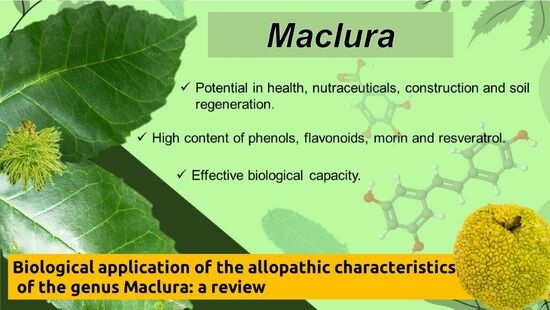
Maclura pomifera (Moraceae family) has a great many common names besides Osage Orange: bois d’arc, bodark, horse apple, hedge apple, murier du Texas
It’s in the same family as mulberry and has a similar growth habitat and widespread adaptability.
For our ancestors it was a highly prized tree that went out of favor in late Colonial times after the widespread use of barbed wire and later heavy harvesting machinery. Before that time it had multiple crucial uses as a wind break, in preventing soil erosion and especially for creating living hedges for livestock containment. It was also used for it’s very hard but flexible wood in making bows and rot-resistant building materials.
It was also used as a rodent and insect repellant and many still use it for this purpose.
But here we are most interested in its many medicinal uses.
The seed is edible, and often enjoyed by squirrels, but not easily obtained.
“The fruit of M. pomífera has shown an effect on human cancer cells (kidney, lung, prostate, breast, melanoma, and colon) as an inhibitor of histone deacetylase (HDAC) via the prenylated flavonoid pomiferin, showing antiproliferative activity in the six cell lines evaluated [23]. In this sense, the compound pomiferin (contained in the fruit of M. pomífera) has been shown in tests with cancer cells to behave as an inhibitor of cancer stem cells from a human glioma [22], showing a reduction in the expression of genes associated with stamina (the ability of the cell to reproduce repeatedly and form stem cells). Also, M. pomífera has been helpful as a marker in the diagnosis of cancer since it allows the distinguishing of patients with prostate cancer from those patients who present benign prostatic diseases and normal subjects, this being through the high affinity of the sera of patients with prostate cancer towards the M. pomífera lectin [21].
Additionally, the fruit, bark, leaves, root, and seed have been reported to have a high content of oils, sugars, and compounds such as isoflavones, xanthones, triterpenes, and stilbenes, with isoflavones being the most representative [15].”
“The seeds are edible and the heartwood, bark and roots contain many extractives of actual and potential value in food processing, pesticide manufacturing, and dye-making. Various parts of the Maclura species are used in folkloric medicine worldwide. Decoction prepared from the roots of M. pomifera is used for the treatment of sore eyes by Comanche Indians in the North America (Carlson and Volney, 1940). The bark of Maclura tinctoria has been reported to be used against toothache by Kaiowa and Guarani indigenous people living in the Caarapo Reserve in Brazil as well as the in the other parts of Amazon region, it was also recorded to be used in Southern Ghana for dental health (Elvin-Lewis et al., 1980, Elvin-Lewis and Lewis, 1983, Bueno et al., 2005).
The fruit of M. pomifera is also well-known for its rich isoflavonoid content as well as a content of xanthones (Delle Monache et al., 1984, Delle Monache et al., 1994, Toker and Erdogan, 1998). Several biological activities of the plant were reported up to date including antimicrobial, estrogenic, anti-inflammatory and antinociceptive activities (Mahmoud, 1981, Maier et al., 1995, Küpeli et al., 2006). Antioxidant activity of the major flavonoids of M. pomifera has also been studied (Tsao et al., 2003, Vesela et al., 2004).”
Native Americans used M. pomifera for the treatment of cancer [2]. In Bolivia, the plant sap is used for the treatment of tooth pain, and the bark and leaves are used for uterine hemorrhage [3]. Comanche Indians in North America used the Osage orange roots decoction to treat sore eyes [4]. M. pomifera and its components possess several biological activities including cytotoxic, antitumor, antibacterial, estrogenic, antifungal, antiviral, and antimalar-ial activities [5–13]. Recently, isofavones isolated from Osage orange have been demonstrated to protect brain cells, or neurons, from the toxic effects of amyloid beta peptide, which is believed to be responsible for the degeneration of neurons in Alzheimer’s disease patients.” M.pomifera produces several secondary metabolites belonging to diferent chemical classes including prenylated favonoids. Teprenylated favonoids possess diferent biological activities such as antifungal, antibacterial, antitumor, and antioxidant activities.”
We have a few still around in our area and I’ve been propagating them from seed in the hope of creating a living hedge. Unfortunately our summers have been so severe lately I’ve only managed one survivor, now 3 years old. I’ll keep trying!
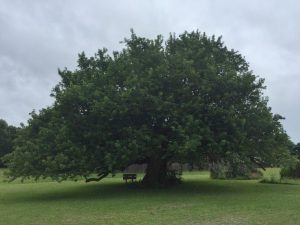
A very old specimen at a neighbor’s house in East Texas.
A neighbor’s old Bois d’arc tree Spring 2023
A beautiful shade tree with so much to offer, I hope it becomes popular once again in our countryside.
A couple more impressive Bois d’arc photos from the Internet:
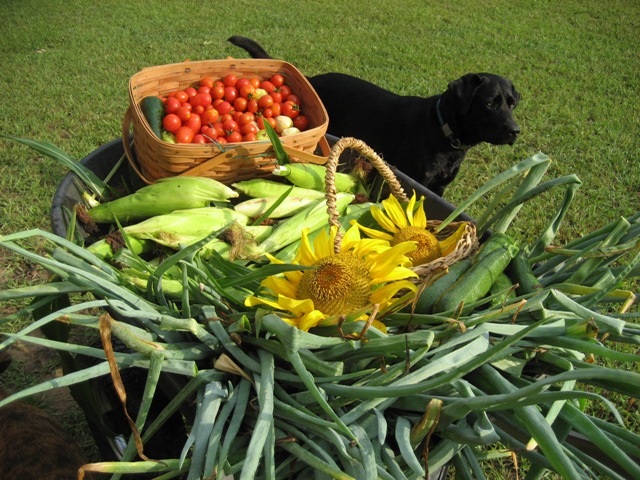
A celebration of fresh food in photo! Because it is a true pleasure for both of us to produce our own food as much as possible; it is the main appeal of this labor-intensive lifestyle.
To think, it all started with a hurricane, and then a garden. We didn’t even have a dream or a plan.
Or a clue!
Left: Hot peppers and turmeric, dried luffa for sponges Right: fresh from the garden—lots of lettuce, radishes, cilantro, dill, thyme, celery and roasted garlic.
The peppers are becoming a couple of sauces, one made by Hubby, chili garlic sauce, and was pressure canned for long term storage. It’s a copycat recipe of Huy Fong Brand and is fantastic.
Another will be made by me, inspired by Gavin Mounsey’s kitchen.
Photos by Gavin Mounsey
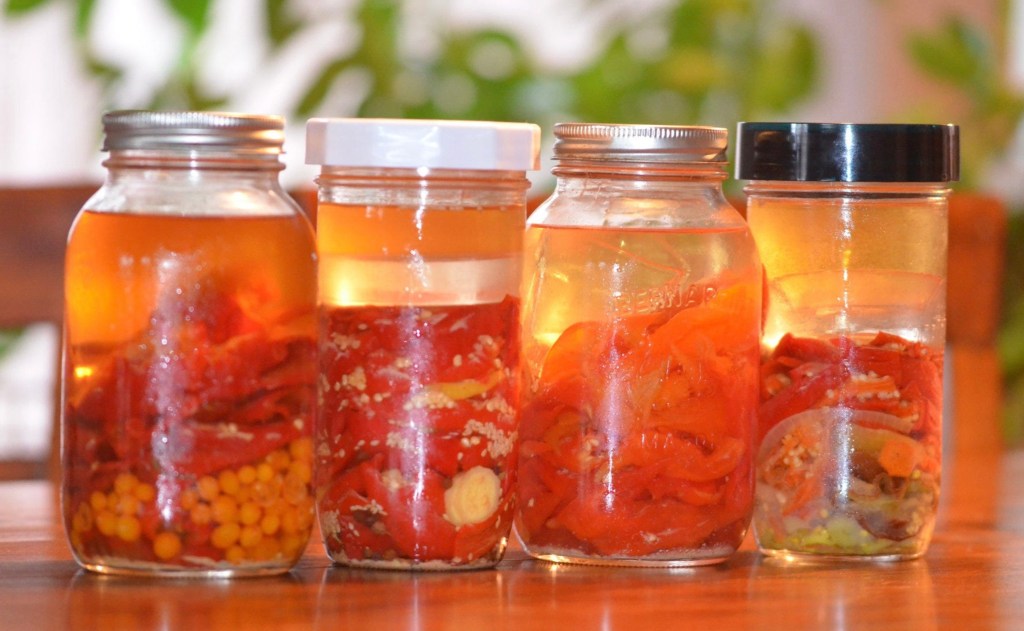
The peppers, garlic, elderberry, onion and other herbs will first be fermented and later made into a Sriracha-type sauce that will store about 6 months in the refrigerator. For amazing food photos and recipes, Gavin’s are spectacular, along with so much other refreshing content.
Previous year’s garden goodies.
From the pasture to the plate. It’s a very rewarding feeling!
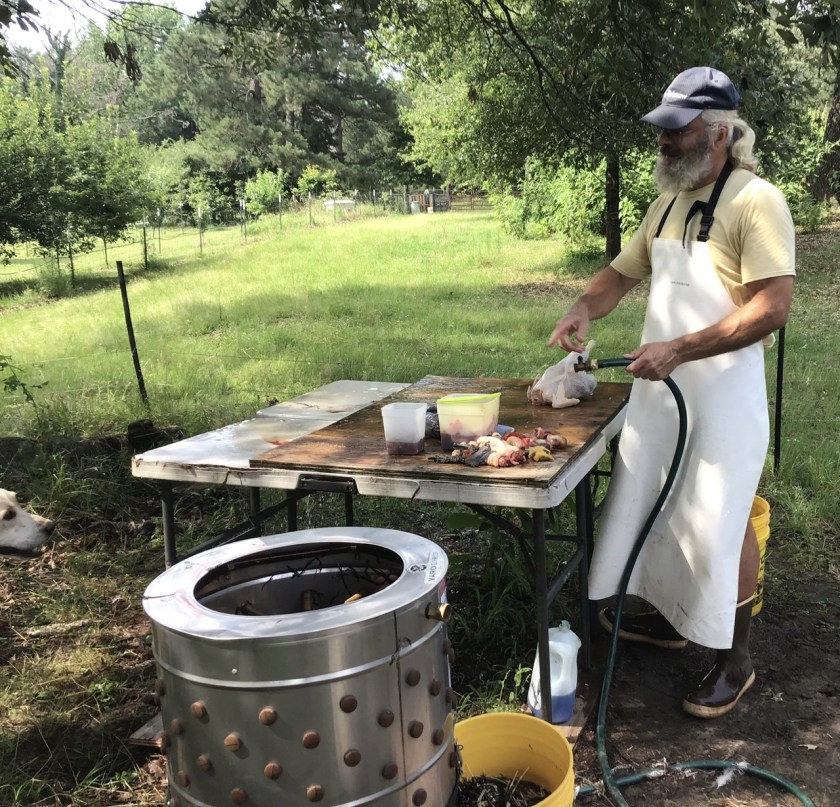
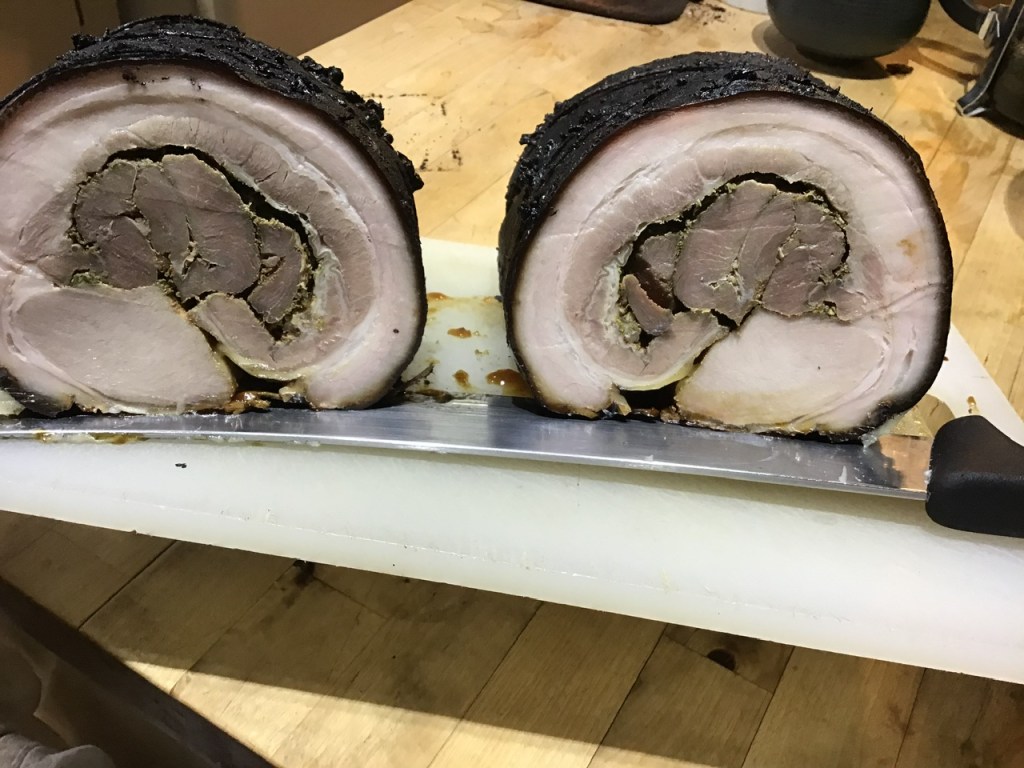
Above: Hubby processing chickens with machine plucker. Below left: smoking bacon Right: Pork roll just off the smoker
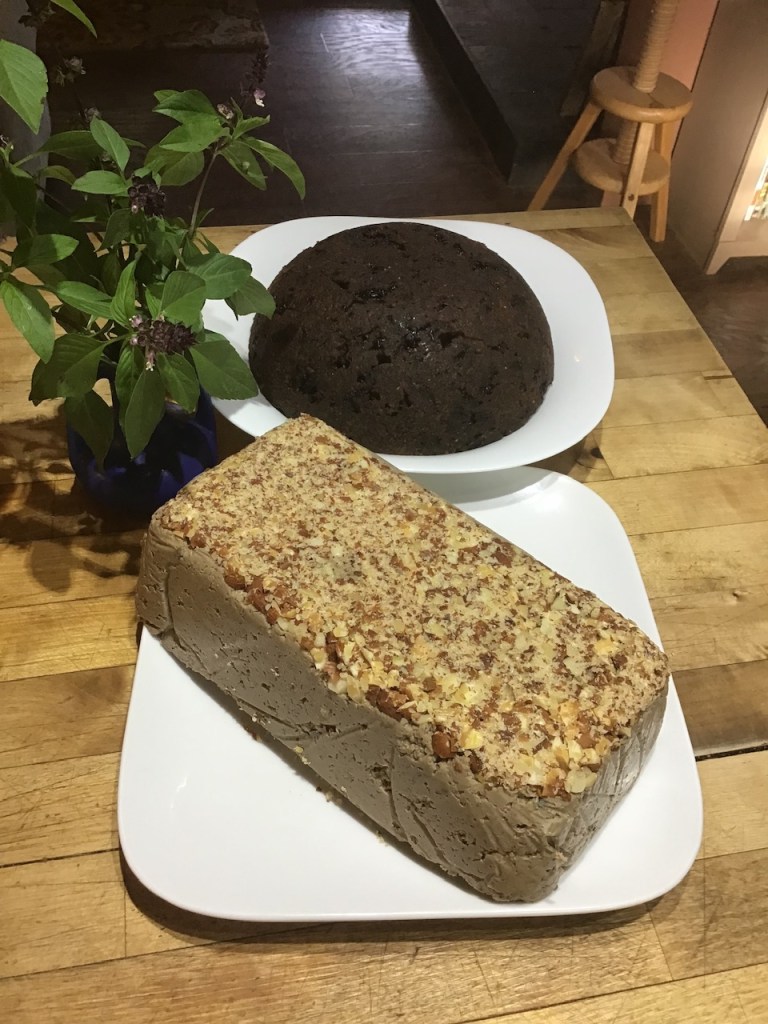
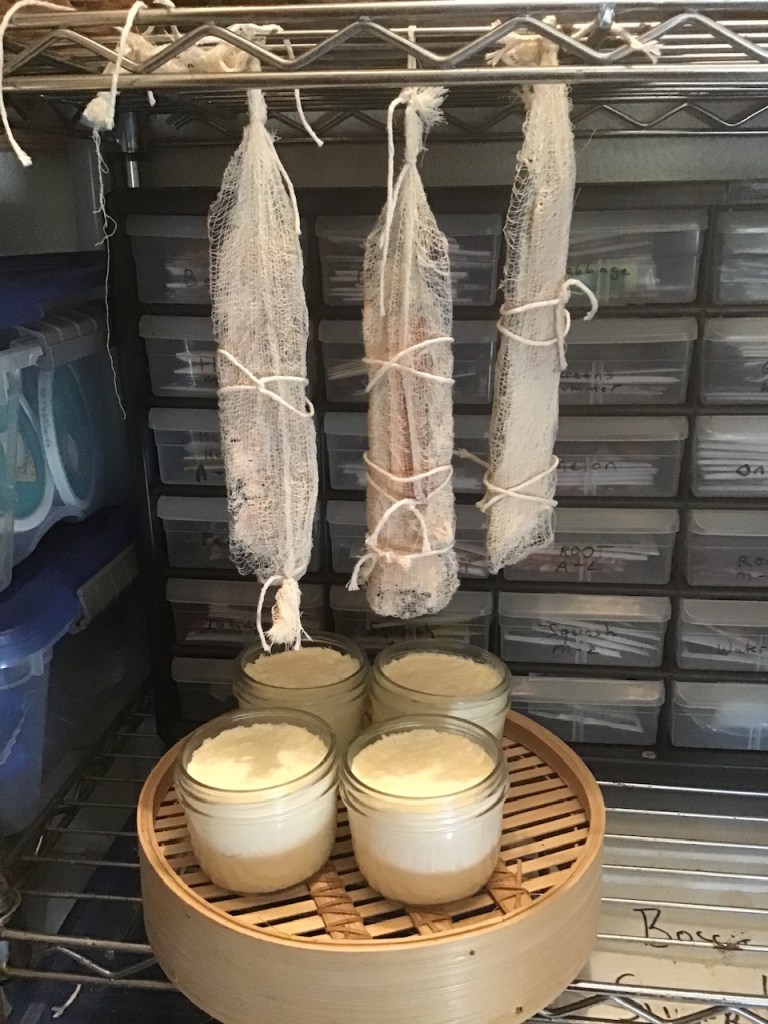
Left: Christmas pudding, a British classic and my first attempt. (Thanks Kath for the recipe!) We will see in a month or so if I succeeded. Also liver sausage, made from lamb liver and topped with roasted almonds. It’s not everyone’s thing, I know, but you might be surprised, I was never a fan of liver either. Right: Cured lamb and Mason jar Marcelin cheese, aging. Yes, you can put them in the same small space, I cover the cheese with a bamboo mat, in a closet with my seed storage, for about a week before moving to cold storage.
The cured lamb can be done from many different types or cuts of meats. This one is taken from the easy-to-follow recipe for Cured Venison Loin at wildharvesttable.com
The cured lamb thinly sliced with soft cheese and sourdough bread is better than anything store-bought in these parts.
We have learned so much about growing and cooking and preserving and the learning never ends.
But all the hard work has excellent rewards!
I’ve learned a lot about homemade wines and cured meats from this Italian YT channel. It’s amazing what you can do with just a little bit of space and minimal equipment and good ingredients. I’ll be trying this simple salami next.
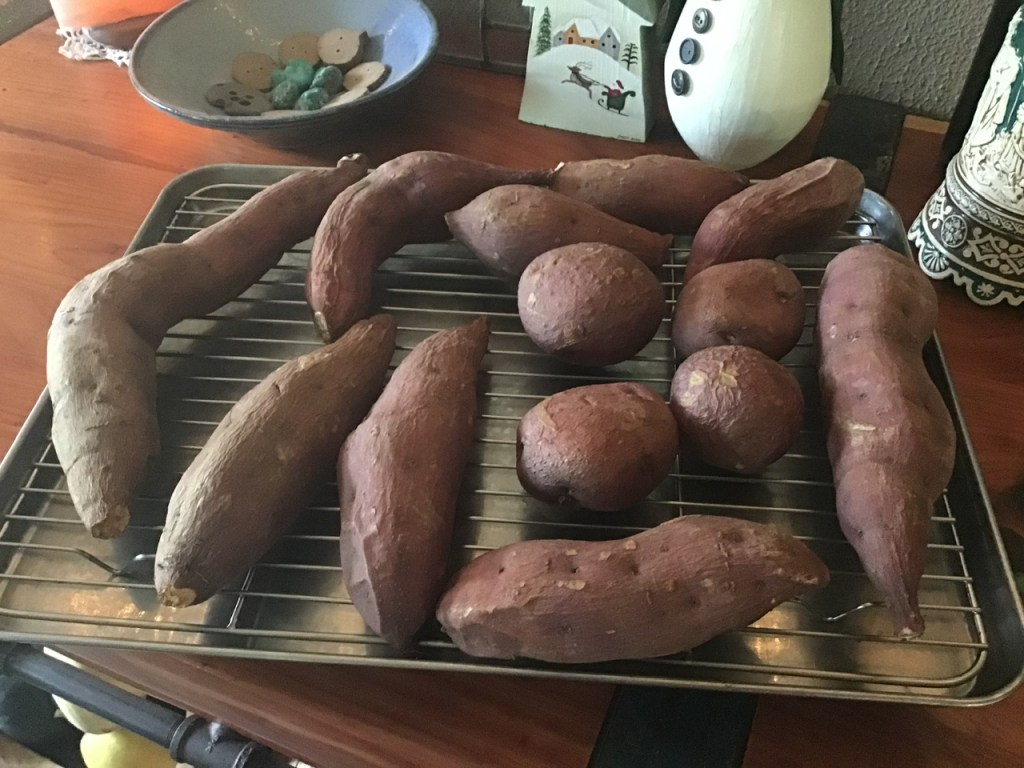
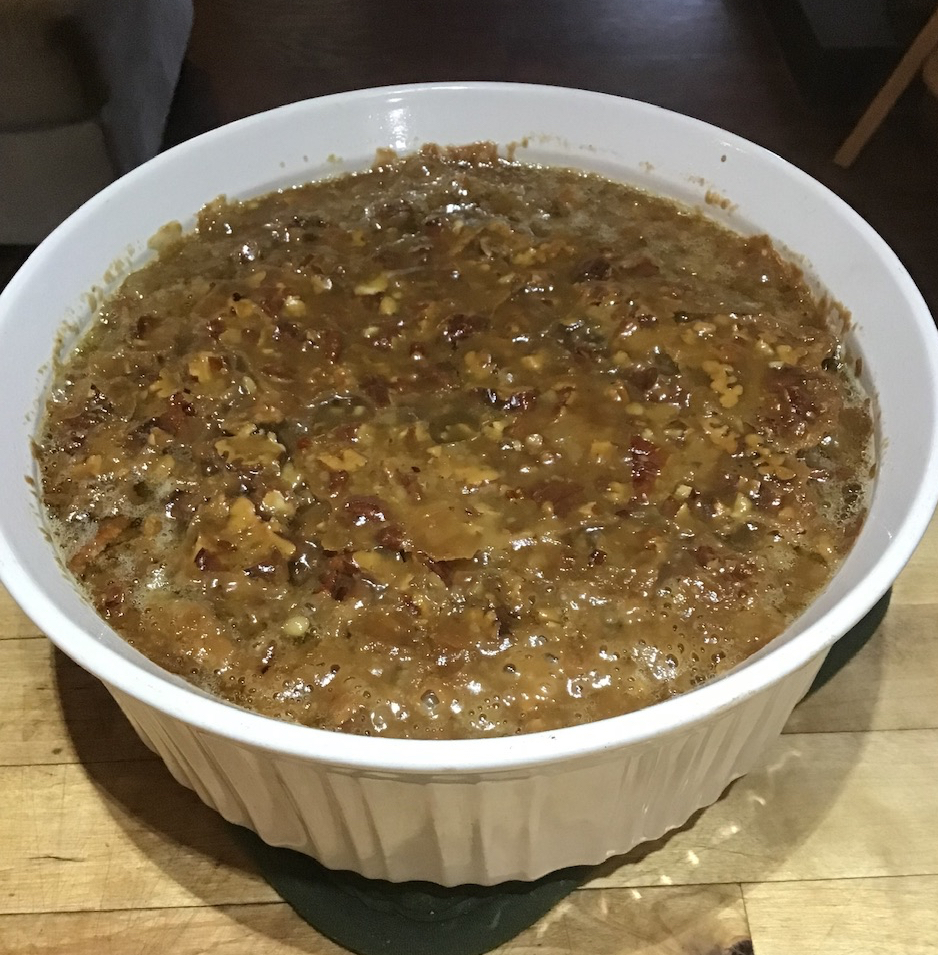
Roasted sweet potatoes become Sweet Potato
Roasted sweet potatoes from this year’s harvest become a favorite dessert: Sweet Potato Praline served with fresh whipped cream and homemade chocolate liqueur.
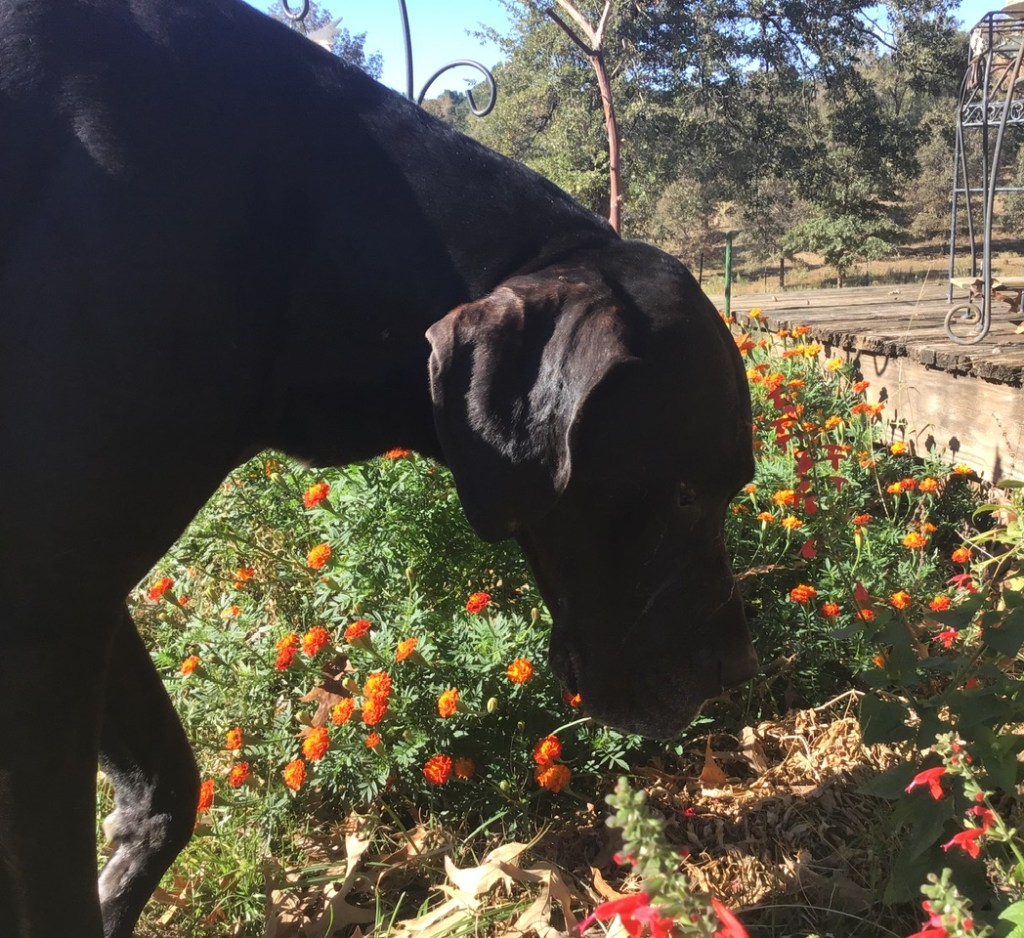
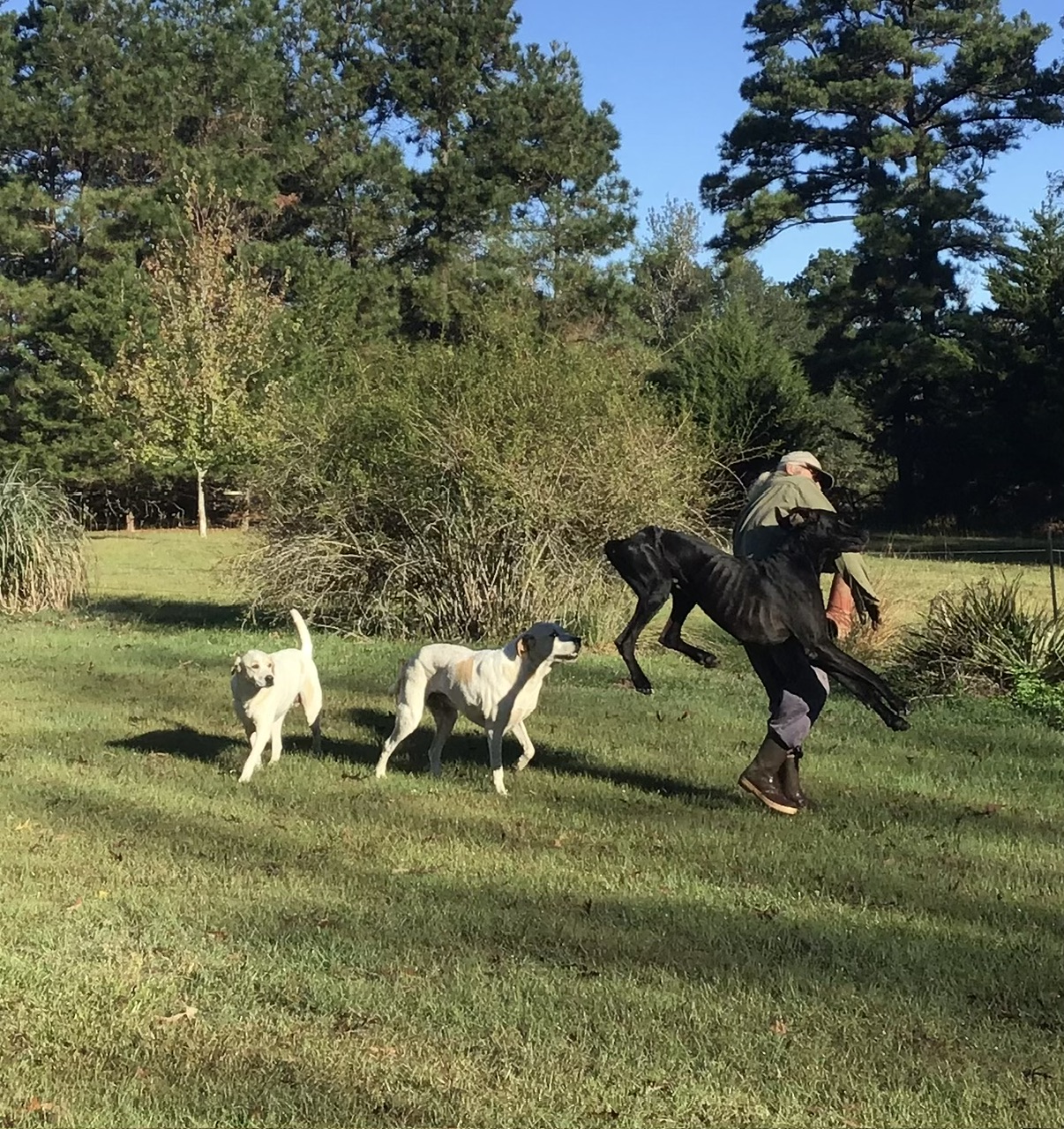
Cooking is a wonderful way to spend the day, even when it’s just for the dogs!
A big pot of dog food, fit for a Great Dane
Hope you’re enjoying your cooking time, too! Thanks for stopping by!
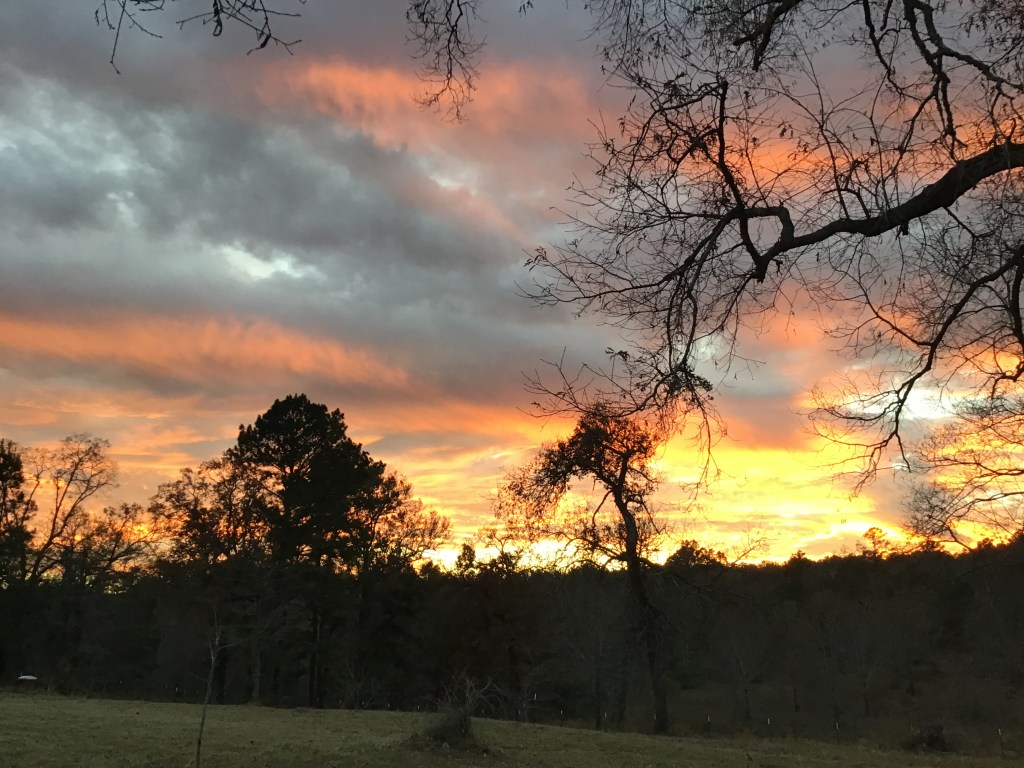
The chem-filled skies continue into our Yo-Yo Season, formerly known as fall and winter.
I suppose art students are now learning to draw filth-filled skies as fine and normal the way we used to draw puffy clouds as kids before the 90s.
Scientists will be taught that aluminum, barium, strontium are all to be expected in our snow and rain and soil.
We’ve been talking about it for a decade, providing all the proof we could get our hands on, and the government put their blinders on like good little minions and the greedy scientists and corporate media spinners did as they were told in order to keep collecting their paychecks and pensions.
And now it’s all coming out. Officially, finally. “Conspiracy theory” is no longer an out for them. IT’S OFFICIAL!
IT’S NOT JUST CONSPIRACY CRAZIES POSTING PHOTOS OF CONTRAILS. WOW!
SO THESE REALLY AREN’T JUST BEAUTIFUL SUNSETS AND FUN CLOUD FORMATIONS MADE BY THE WEATHER GODS FOR OUR ENJOYMENT?
WOW!
So now what? What does it all mean? Trump’s here to fix it all, right?
No silly! Now comes the part where we get Global Governance, through more war and manufactured disasters blamed on nature. The big reveal, the book Behind the Green Mask was published 13 years ago.
Looks like it’s all happening right on schedule. With the exact same people hiding information for the last 50 years leading the show.
22 November 2024 | ZeroGeoengineering.com | Planning, development, and implementation of weather interventions and atmospheric experimentation are funded by Congress and directed by interagency groups including those in partnership with the U.S. Global Change Research Program (USGCRP).
The USGCRP was established by Congress in 1990 to coordinate ‘global change research’ and collaboration with international and federal agencies.
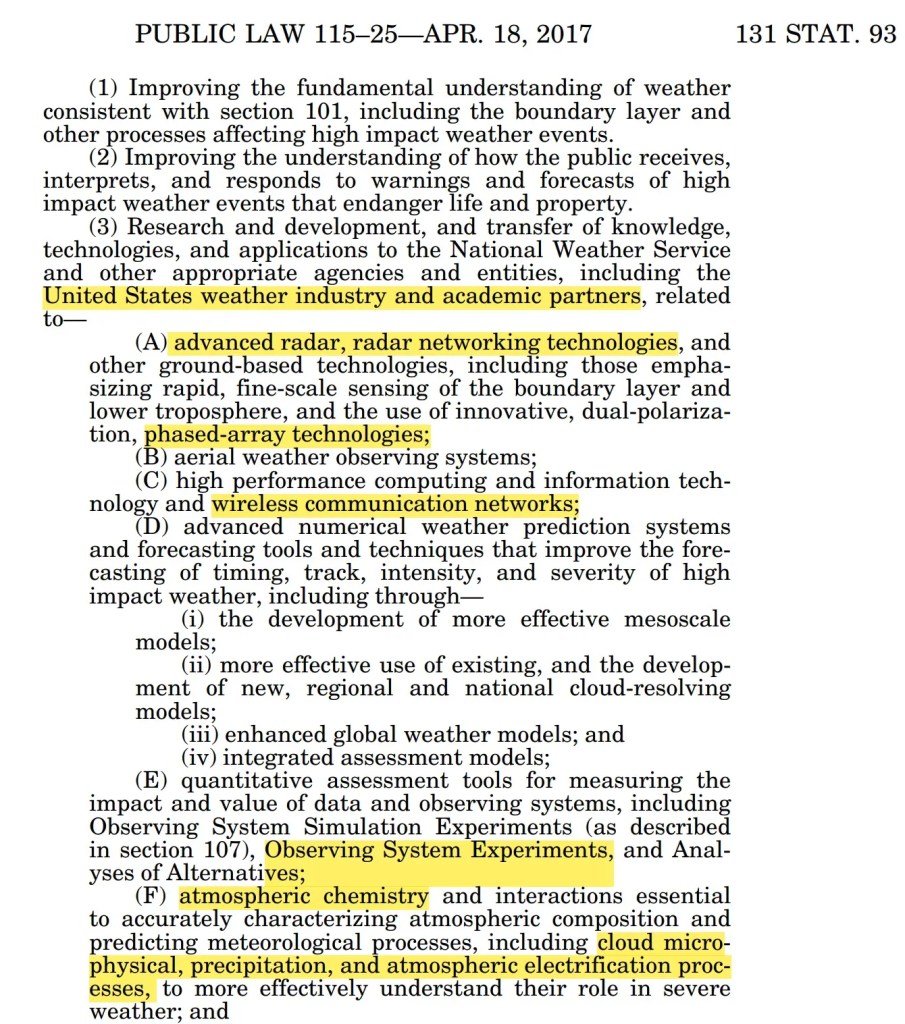
Ending USGCRP interventions will require repealing federal laws including but not limited to, the National Weather Modification Policy Act, the Global Change Research Act (GCRA) of 1990, the National Oceanic and Atmospheric Administration Authorization Act of 1992 and Trump’s Weather Research and Forecasting Innovation Act of 2017 (Public Law No. 115-25, Title IV, sec. 402, 15 U.S.C. § 8542.
I’m sure our crafty disaster capitalists will be filled with hope and solutions. Anti-radiation suits. Fancy new protective devices.
I’m sure the high fashion industry and the home and garden gurus will have plenty of new high-tech solutions to save us all. And the ‘detox’ solutions, of course. So many solutions! Don’t worry!
“Did you know radiation is a central component of weather control?
At the heart of weather experimentation is NEXRAD, or NEXt-generation RADar and the transmission of microwave radiation pollution. The cell phone you hold in your hand and the cell phone towers it’s communicating with are transmitting and receiving microwave radiation. Shown below, definitions of pollution and pollutants from Verizon and AT&T”
It’s been a while since any update, but not because nothing is happening on the wee homestead. It’s still the same story—the biggest news-worthy thing is the one I’ve been avoiding writing about.
As usual, there are the latest piglets and chicks and harvests and garden woes and ‘unseasonable’ weather. Rest assured, we’ve had all that again this summer.
I did imagine if I ever run out of blogging content to share I could start a new quiz show . . . Here we are in East Texas folks, so let’s play Guess The Season!
Come on down, step right up, where your chances to win are a remarkable 1 in 4, WOW!
But it might be more challenging to win than you think. How about it, ready to give it a try?
The roses and geraniums and wildflowers are blooming, volunteer tomato plants are coming up, the lettuce is bolting and the dogs are shedding, what season is it?
Well, if you guessed springtime, tough luck loser!
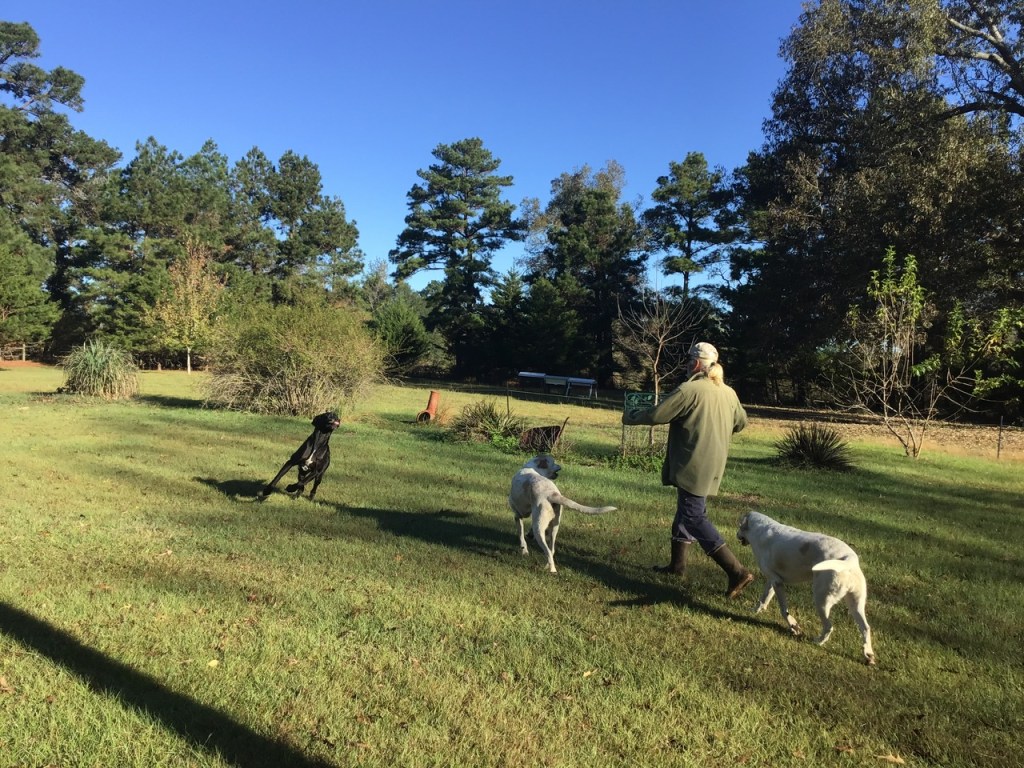
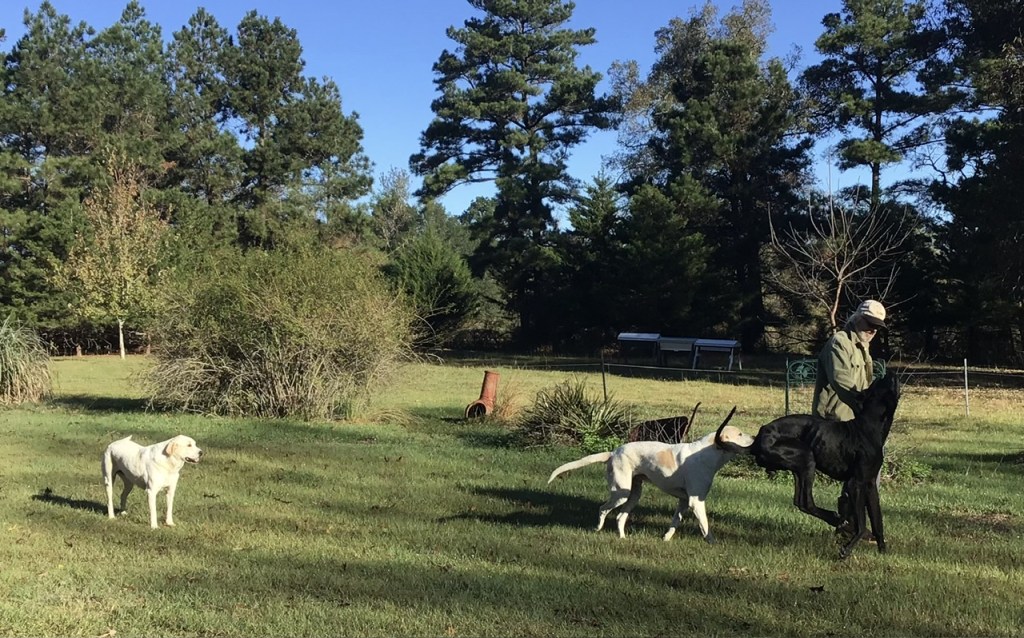
Let me give you another clue, Rambo, Teaky and Papa Chop are horny, but the girls are all already knocked up. Poor fellas!
Rambo, still chasing the girls! If you look closely in the distance, past the downed tree, you’ll see Hubby’s recently finished ‘bridge to nowhere’.
What else is new, or not? We have entered slaughter season, my fall transplants are dying in the heat, the moles and voles and gophers have taken over the garden, and I have only two bee colonies which survived the summer, again.
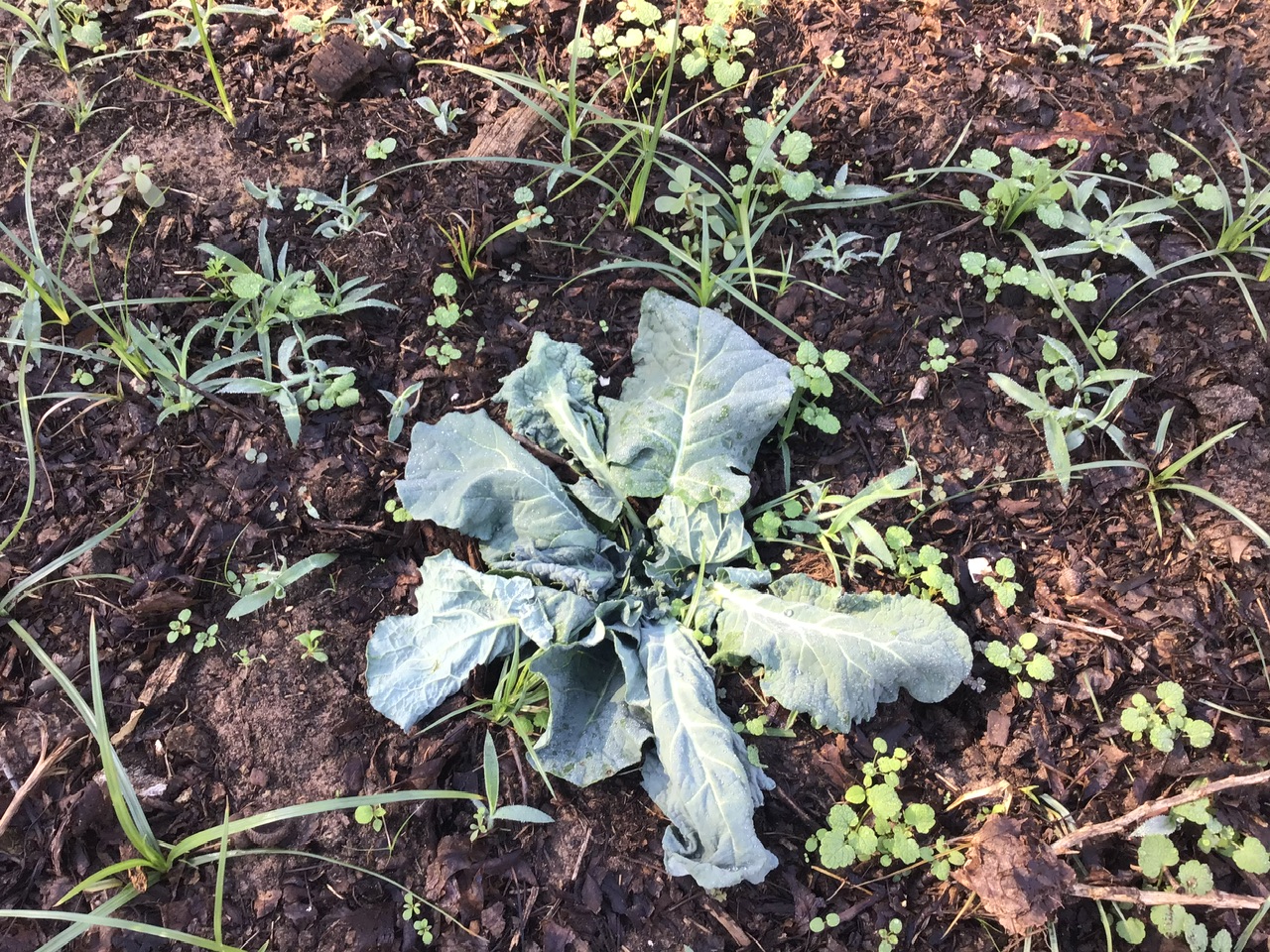
An entire bed of baby broccoli, cauliflower and cabbages lost to rodents! Argh! 😖
It’s well past time to plant garlic, Hubby prepared the rows a month ago, but I don’t dare do the deed. It’s still far too warm. They will start growing too soon, putting all their energy into a fine green shoot that will then die when the inevitable frost comes again, and the remnants of the bulb will then likely rot in the ground.
Lots of elephant garlic (harvested in May) left for re-planting and enjoying through the YoYo season. Behind it is about 1/3 of our sweet potato harvest. Both did very well, though the Irish potatoes and the onions did terrible.
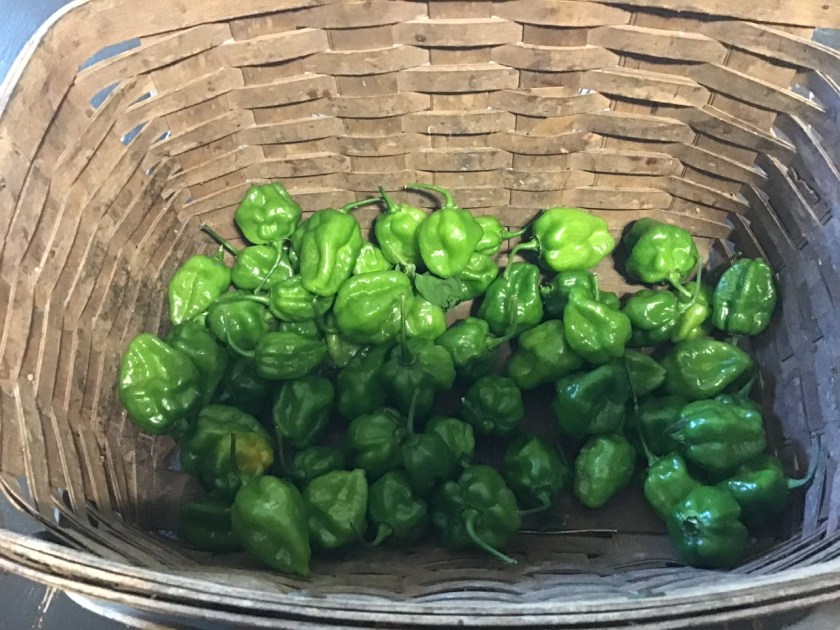
As far as general garden results for the year, a mixed bag, as is typical. The peppers did not do well and I had such high hopes. Last year we had amazing peppers all summer and fall, so I really have no idea why this year was so poor. It was my hope to experiment with spicy ferments and pimientos. No such luck. We have dismally few jalapeños and green peppers coming in, plus one prolific plant that magically survived, producing these beauties, which will hopefully ripen quickly. I had to pull off one entire branch, which is where these green ones originated, because it was overtopping its cage and becoming unruly.
The squashes also did not do well and I attribute this to the wet spring followed quickly by excessive heat and drought. I’ve heard from several nearby gardeners who had the same problem.
Very few squashes this year, not even luffa did well, and that’s usually easy and prolific. In the center are persimmons, we got about a dozen off the young tree. And, a surprise . . . Watermelon!
The cucumbers were another disappointment, but that was my own fault. My goal was to prolong the season by succession planting, so I planted fewer cucumbers than usual at peak time, thinking we’d have them fresh and fermented for the entire summer and fall, so no need for canning surplus.
Unfortunately, even the young plants could not thrive in our summer temps, so old ones which were past their main production, along with new but not yet producing, all died. Then I got lucky and some volunteers showed up in late August, so I nurtured them along, and right after they started producing, we got a super early frost, one night only. It killed them off.
Six ‘winter’ watermelons!
Surprisingly, the quick frost did not kill off the few remaining peppers, or the watermelons, which I planted late after starting them indoors, on a whim, because the best part of the summer garden this year was definitely the watermelons.
And now, we’ve got more!
Thanksgiving watermelons, that’s a first. There’s also a few volunteer tomatoes I’ll be digging up soon to move inside under lights.
Between the bolted Romaine, one of several tomato volunteers.
The baby citrus trees have all survived their first summer, I’m so hoping that’s a sign of continued success. They aren’t looking so good, but they’re hanging in there. I’ll take that as a win, as temporary as it may be.
The young citrus planted in early spring, not looking great, but still hanging in there!
I’ve also been babying a few graveyard treasures. Perhaps as a distraction from my misery, I’ve been visiting all the cemeteries in the area and have found in them a few spectacular specimens I want to grow.
There was the healthiest, largest Turk’s cap aka Mexican apple (Malvaviscus arboreus var. drummondii) I’ve ever seen, and in the middle of drought still bright and beautiful. I’ve been wanting one not only because they are drought-tolerant and attractive, but also because they are a popular medicinal and a perennial edible. (I’ll definitely be covering it in a future Herbal Explorations post.)
I did manage to get one cutting, out of 6, to take root. There’s also a wild pink rambling rose that I got rooted, and some gorgeous Magnolia trees, which I hope I can get started after stratification and scarification of their seeds.
A baby Turk’s Cap and a Mexican oregano (I hope!)
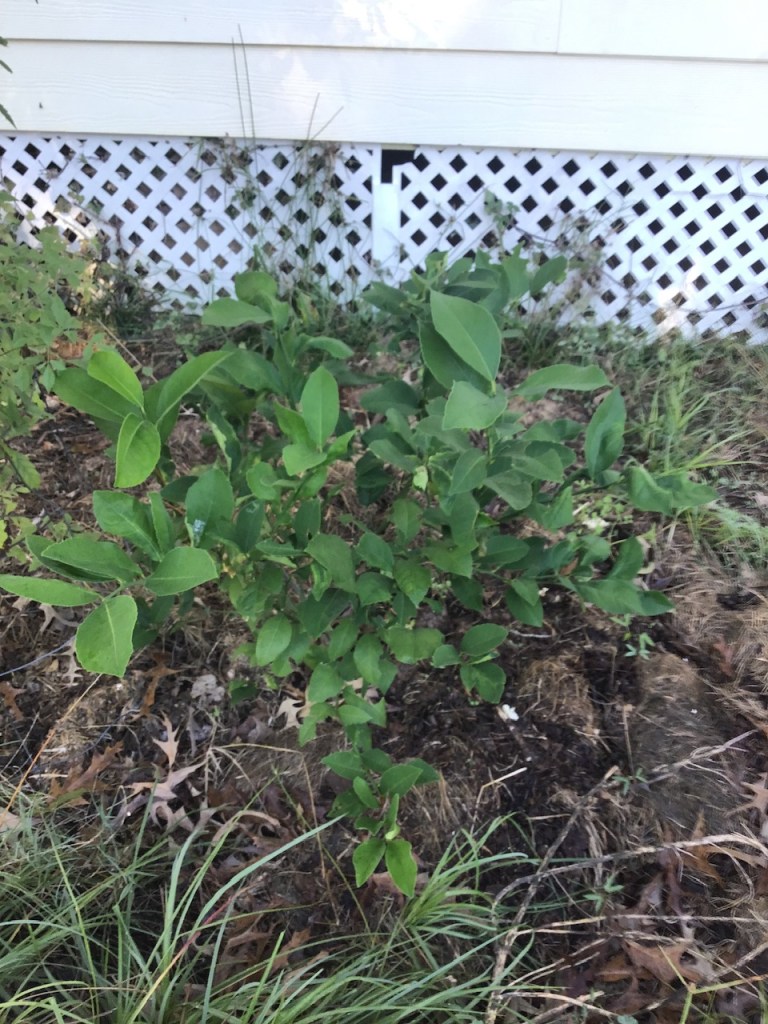
Plus, I’m excited that 1 of the 3 Mimosa trees I dug up from the gutter in early spring, and have been doting on all summer, is doing beautifully; I think she’s going to make it! Last year’s attempt failed by this time of year, I think because the spot I chose was too shady.
A young Mimosa tree recently transplanted after growing in a pot in part-sun all summer. Again in the distance, behind the sheep, Hubby’s ‘bridge to nowhere’.
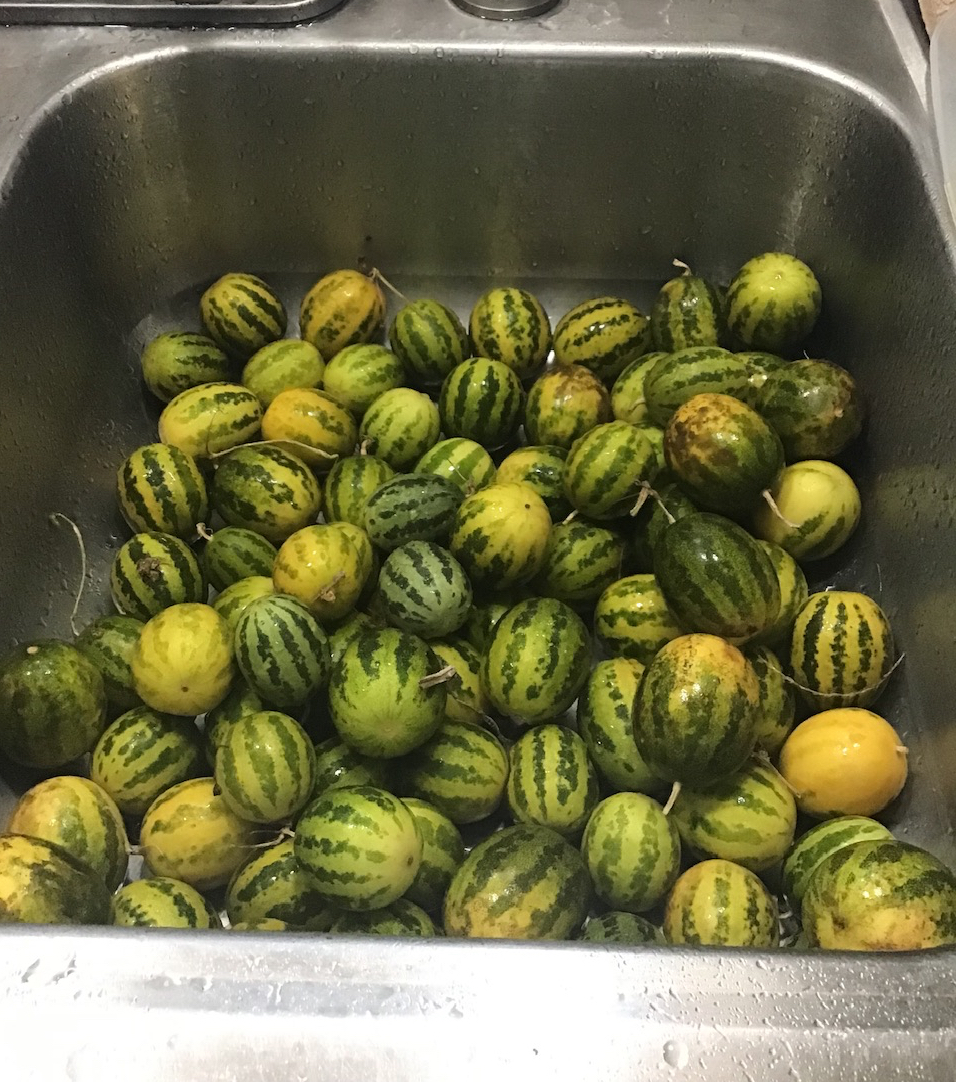
Another noteworthy piece is we’ve had a mystery fruit invade the garden.
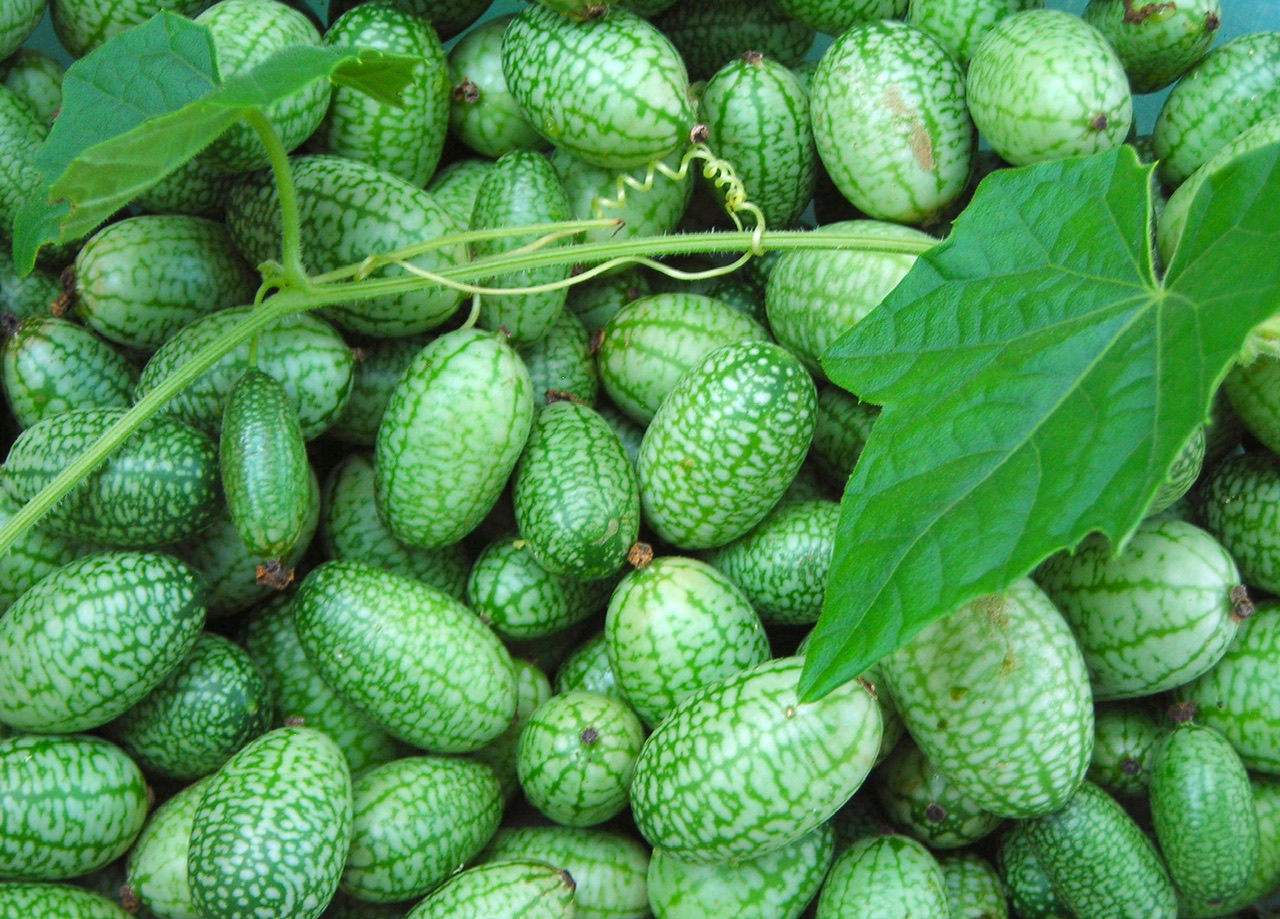
Mouse melons gone wild? I did plant store-bought mouse melon seed, also called cucamelon, for a couple of summers. I called it my ‘crop of the year’ in 2018.
They were a novelty item I thought I’d try, and while they are so cute and a fun addition to the summer produce, they are super tiny and tedious to harvest, so not a lot of bang for the buck.
Online stock photo: Mouse melons, about the size of my thumb nail.
Mouse melon from Wiki: Melothria scabra is native to Colombia, El Salvador, Guatemala, Honduras, Mexico, Nicaragua, Panama, and Venezuela,where it grows in forests and thickets.
That is the closest fruit I can match to our mystery fruit, which does come with a more interesting backstory.
Two years ago I found five of these fruits on the road near the creek with no plant attached to them. I figured they were part of a squirrel’s stash that had flooded out, or had dropped from an unknown tree, a wild variety of something I’d never heard of before. I was so intrigued!
I looked all around for the potential tree and couldn’t find any. But, somehow I got it stuck in my head that I’d just found wild kumquats. When my local gardening friends laughed and told me that was impossible, I said, well, we will see.
The following spring I gave some of the seeds to a friend and planted some in our garden. Within two months I’d regretted it; it was no tree. The vines had very quickly begun to take over a large section of space with the most tenacious tendrils and prolific foliage I’d ever seen.
I told my friend to pull them out, immediately, as they were very invasive and she has very limited garden space. She laughed and said, “I told you they weren’t kumquats!” 😆
The vines are so tough they’re like pulling thick rope. They readily re-root from the vines as well, and I came to discover this year, re-seed with great abandon.
While I pulled them up that first year before seeing any fruits on them, there must’ve been some hidden, because this year another plant formed, rather late in the season, and in a spot where we could afford to leave it to its natural inclinations.
Wow, what a giant beast it grew into! In the dead of summer, in severe heat and drought, without any supplementary water, it grew, and grew, and has produced so many golf ball sized fruits I could’ve easily filled a wheelbarrow with them more than once.
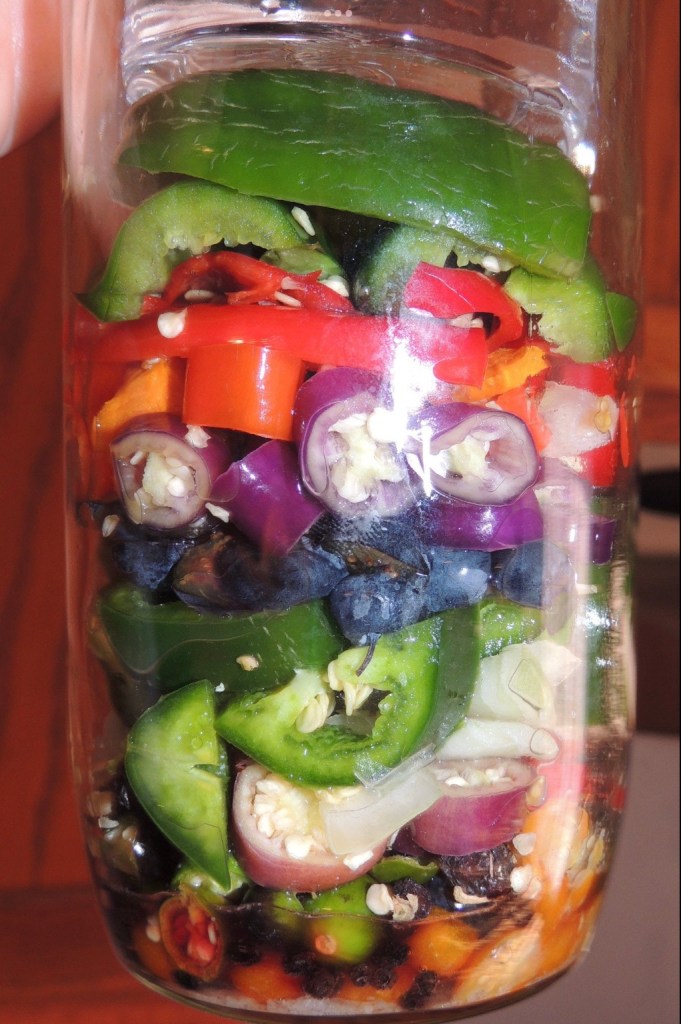
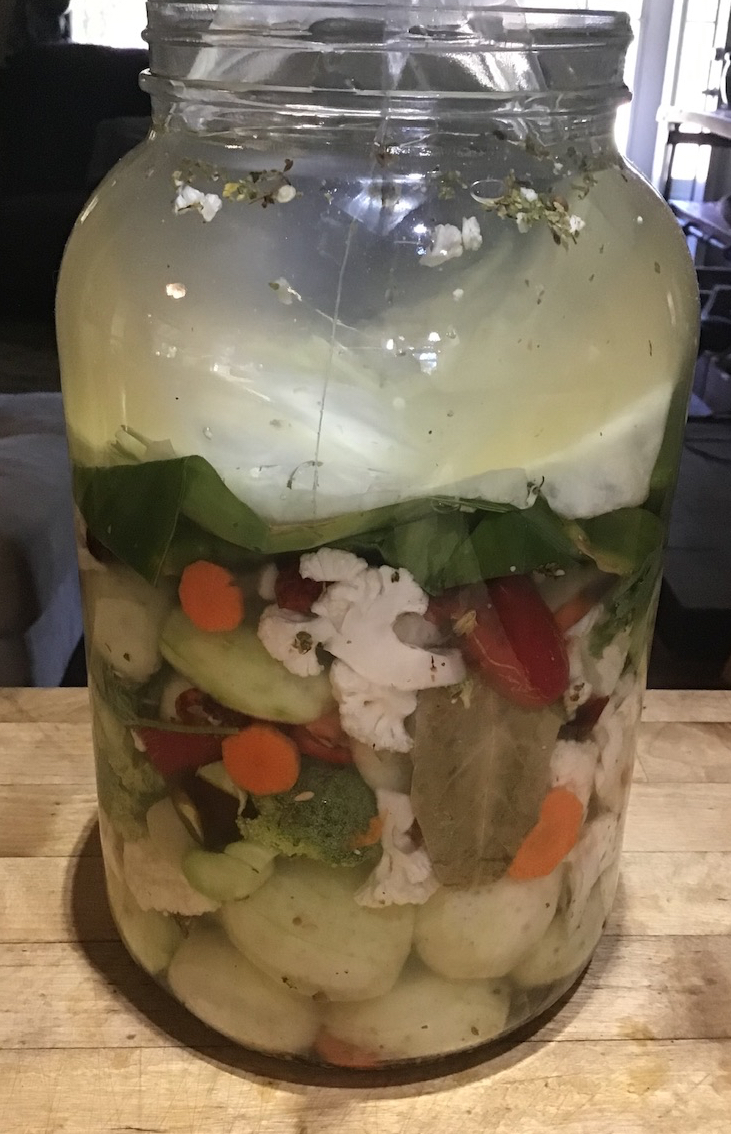
Except the fruit is quite sour, exceptionally seedy and with tough skin. It was a labor intensive process, but after peeling and deseeding, I made a few ferments and I was impressed with the results.
Ferment with mouse melons and varied veggies and herbs.
But, the vines were taking over, moving into our pathways, climbing up fences, choking out everything in its path. So we started pulling it, mowing over it, and generally abusing it on a daily basis.
It lived on! All through the late summer and into our faux fall. It actually started regrowing under the brush pile of leaves and grass we piled on top of its last remaining vines.
While most of the fruit became pig fodder, I’m still impressed with its determination and tenacity and will be finding some wasted space to keep the mystery fruit in our summer rotation. Maybe with the okra, which we aren’t crazy about either, but keep growing as a ‘just in case’ survival crop.
There’s been another ancient garden mystery, which we may have finally solved. I mean ancient in the modern sense, that being over five years in the making. It concerns the herb popularly named ‘Mexican oregano’.
Many years ago I started looking to plant this herb, one of my all-time favorites in the kitchen, and that’s when the quest began.
Now, one would certainly think this herb to be readily available in these parts, considering every year I can find in the garden stores many different varieties of oregano—Greek, Italian, Cuban, Golden, variegated, ornamental, Syrian. Really, Syrian?
No Mexican. And yet, that’s right over our border, certainly a lot closer than Syria. Why can we not find seeds or plants of Mexican oregano?
Years ago this put a bee in my bonnet loud enough to get Hubby on the hunt. Between the two of us we’ve spent many hours calling around, searching online, trying to sift through the mounds of misinformation and redirection.
Yes, it would seem that’s happening not only in politics and history, but even in culinary herbs!
Once we were able to identify the basics of the problem, we honed in on the solution. There are actually two different types of (commercially unavailable) plants called Mexican oregano. We’ve been buying the herb in bulk for years without any problem, but we really want to be growing it ourselves.
~Mexican Bush Oregano (Poliomintha longiflora) Mint family
~Mexican Oregano (lippia graveolens) Verbena family
Of the 2 types, we want to grow the latter, lippia graveolens. It’s a marvelous oregano and not just in Mexican cuisine. The flavor is much less intense than Greek, more like marjoram, but with notes of citrus and thyme. It’s quite unique as far as oregano’s go, which makes sense, since it’s in the verbena family and not the mint family, as most are.
After discovering we cannot find plants or seeds anywhere around here or online, we were really wondering why this is. It’s a very popular herb after all, used in lots of Mexican dishes. We did come across a few sites that claimed to sell the seedlings and small plants, but they were always out of stock.
Finally, Hubby stumbled on a potential answer in an online forum. It was suggested that they don’t sell the seeds because they are too small. We had never thought of this! It was suggested to simply sprinkle some of the herb purchased from the store onto some soil! Wait, what . . . ?
So, I’ve been trying that a couple of times now, and I may have just gotten some positive results.
Baby Mexican Oregano? I’m hoping! Also rooting some lemon-scented geranium, which has done pretty well all summer.
Back to the bad news. We continue to lose trees, old and young, at a dismal rate. This one flashed out dead within one week in July. It’s one of four equally large ones that have come down just this summer. I honestly can’t imagine how that happens so quickly outside of being poisoned. The dead leaves continue to hang there, almost 3 months later, while branches full of dead leaves come down in the slightest wind.
Branches come down, but not the dead leaves.
The spring floods that forced Hubby to rebuild our culvert then turned into the two-month plus drought that made his efforts futile. Still, it had to be done, as the washout was really significant.
Big job for one old man and his old tractor!
The previous culvert was our first job when we bought this property. That time I was a big helper, right alongside Hubby, digging dirt and dragging debris. It was necessary in order to get the car to our camping spot, where we spent many months building the cabin. Hauling in water, no electricity, sleeping in a tent. Ah, the good ole days!
This time I didn’t lift a finger, not even to take photos. He was able to successfully replace the culvert with a structure which we call our ‘bridge to nowhere’.
But, it was still necessary even though we aren’t camping over there anymore, in order to get the tractor to the back half of the property for other reasons—fence repair, any necessary tree felling, or getting to the cabin that’s become an unusually attractive storage room. 😏
Hopefully this one will do the trick for another 15 years or so.
Slaughter season may not sound so appealing, but if you could smell our kitchen when Hubby is cooking up the meats and broths for canning, or making his marvelous split pea soup or sampling sausage mixes before freezing, I think you’d change your tune.
Which reminds me of a bit more news worth sharing. Canning potatoes has been a surprisingly good choice I’d not have expected. Fried potatoes are such a popular food and we eat them weekly. But it’s a pretty labor-intensive process to make good fried potatoes, because you’ve got to cook them twice to get them crisp. This is probably why so many folks rely on the wide variety of frozen French fries and other convenience potato products on the market.
A couple jars of Hubby’s pressure canned potatoes.
While we never get large potato harvests here (besides sweet potatoes that is) Hubby is an excellent sale shopper. When he spots them for really cheap, like they are now at just 19 cents a pound, he’ll buy a big load of them and get prepping.
By getting the first part of the potato prep done in bulk, these canned potatoes are so quick and versatile and delish. It does take a lot of initial time and effort—peeling, chopping, pressure canning, but it’s well worth it.
All you have to do then for perfectly crisp ‘fries’ is drain and rinse and dry a bit, then toss them in your hot oil or fat of choice and in minutes you’ve got a cheaper, healthier, quicker version than most convenience products.
And would you look at that! Such a long and newsy post which I managed without ever mentioning the elephant in my head.
That is the goats. My great summer sorrow. I lost 9 of them; there are just 4 left. And I still can’t face up to it without tearing up.
So, it seems I can be as avoidant, bypassing, stalling, redirecting, minimizing and gaslighting as the best of them, when it suits me. 🥲
Just protecting myself from facing reality, right? How very common.
I failed. I miss them. That dream became a nightmare.
But I can’t end on that sad note, not now. The summer has been hard on the sheep and the dogs, too. We lost several lambs and Hubby was once again nursing Shadow issues for weeks. That’s quite another story, for another time.
Suffice it to say, he’s doing fine now, hurrah!
Better watch out, Shadow’s in loop position, he’s about to pounce!
What an athlete!
And right back to lounge position.
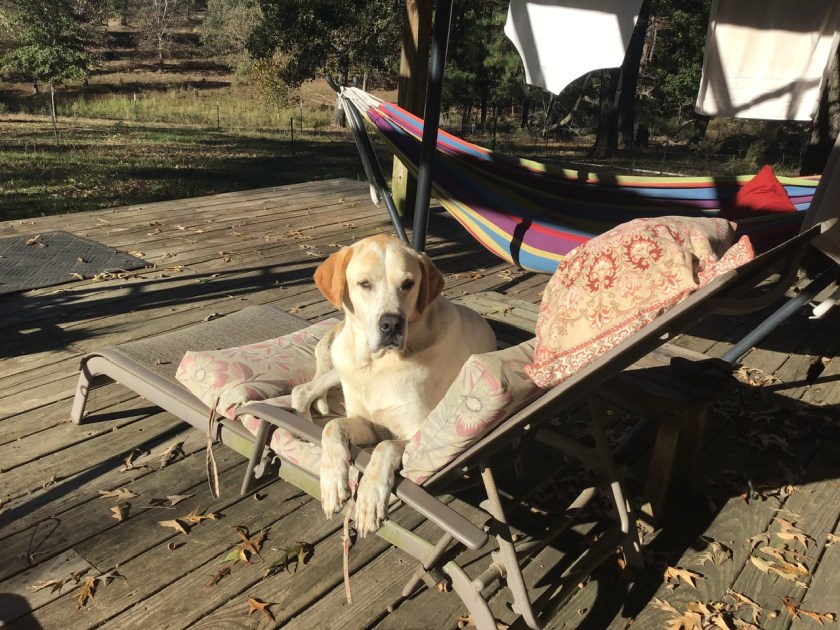
There’s always Bubba, giving free hourly lessons in lounge.
Thanks for stopping by!
Do you have any idea what our mystery plant could be?
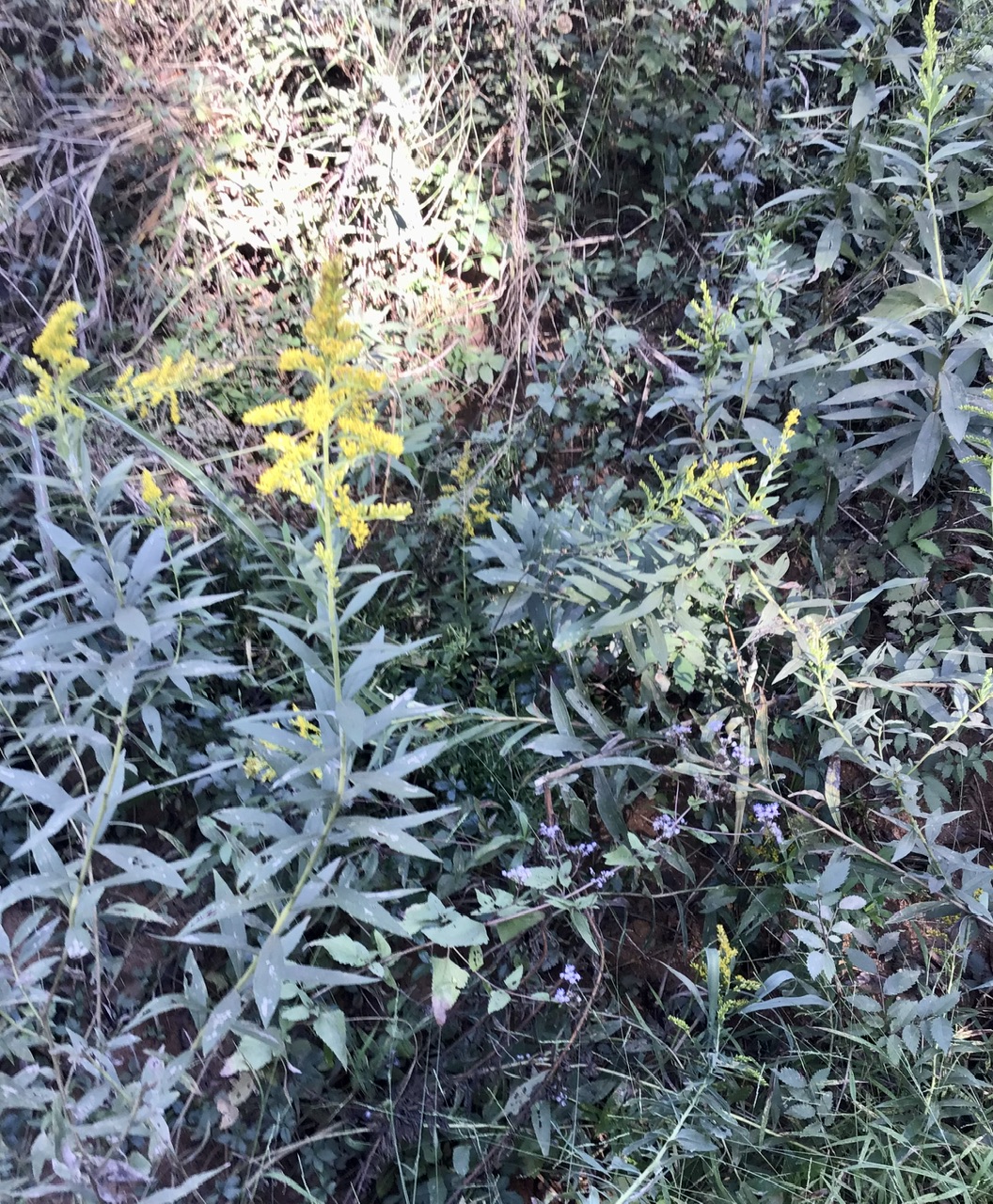
This is a ‘weed’ I’ve been wanting to learn more about for a long time. It’s a very popular plant for foragers, right up there with Mullein, but I first learned about it as a preferred late season food for the bees.
In East Texas it seems to prefer roadsides and creeks to open fields and often appears nearby mistflower (conoclinium coelestinium) both in the family asteraceae.
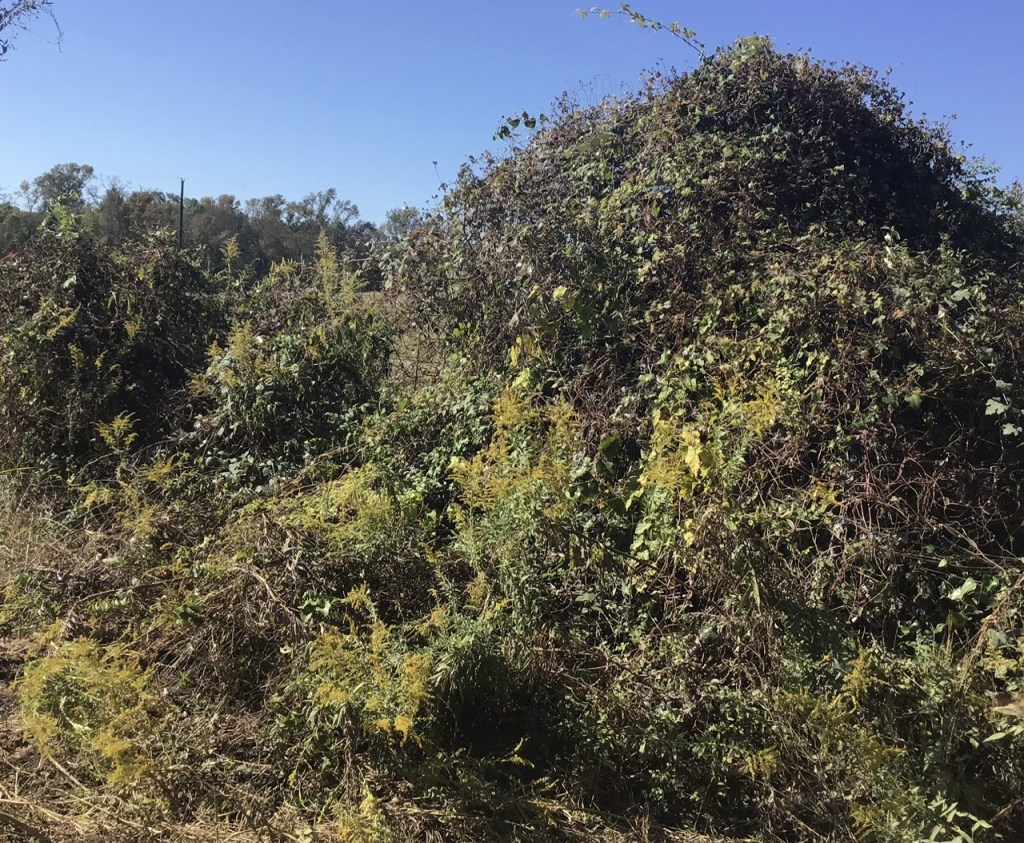
Goldenrod and mistflower growing by the creek October 2024
Surprisingly (or perhaps not) Wiki has little info on this popular medicinal, and it wasn’t listed on a longtime foraging go-to of mine, Merriwether of Foraging Texas.
I can’t imagine why not! It’s a well-known medicinal in many countries and is plentiful in Texas even during extremely hot and dry summers.
According to The Medicinal Flora of Britain and Northwestern Europe, ”It’s first reliable record of medicinal use dates from the Southern Europe of the 13th century. It became much prized in Tudor England but, being imported, was very expensive.” (Julian Barker)
“Goldenrod was formerly prized as a wound herb as it is, indeed, astringent and antiseptic. Its principal internal use is for the kidney and bladder. I have found some justification for the BHP recommendation against naso-pharayngeal catarrh (and chronic sinusitis) but some skepticism has been expressed against this use. I think much of the variability in its efficacy may be due to the extreme polymorphism of the species which will lead, I am sure to the future recognition of subspecies.
”The aromatic leaves of the American S.odora make a once popular drink known as Blue Mountain Tea.”
“The flowering tops are used medicinally. Their constituents include tannins, saponins, bitter compounds, an essential oil and flavonoids. These substances give Goldenrod diuretic, astringent, vulnerary, anti-inflammatory, expectorant, antispasmodic, and carminative properties. In herbal medicine an infusion is used to treat kidney and bladder disorders, to improve kidney and prostate function, for flatulence and indigestion, and for chronic bronchitis, coughs and asthma. Externally Godenrod is used in poultices, ointments and bath preparations for varicose ulcers, eczema and slow-healing wounds.”
I’ve written several times about this tree in past posts and have been meaning to include it in the Herbal Explorations for some time. Thanks once again to Gavin Mounsey for putting a bee in my bonnet! His contributions are featured below.
Photo credit: Gavin Mounsey
A quick peak at a couple of those previous posts of mine to set the stage:
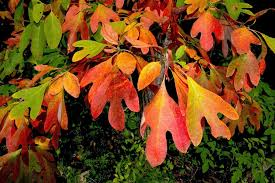
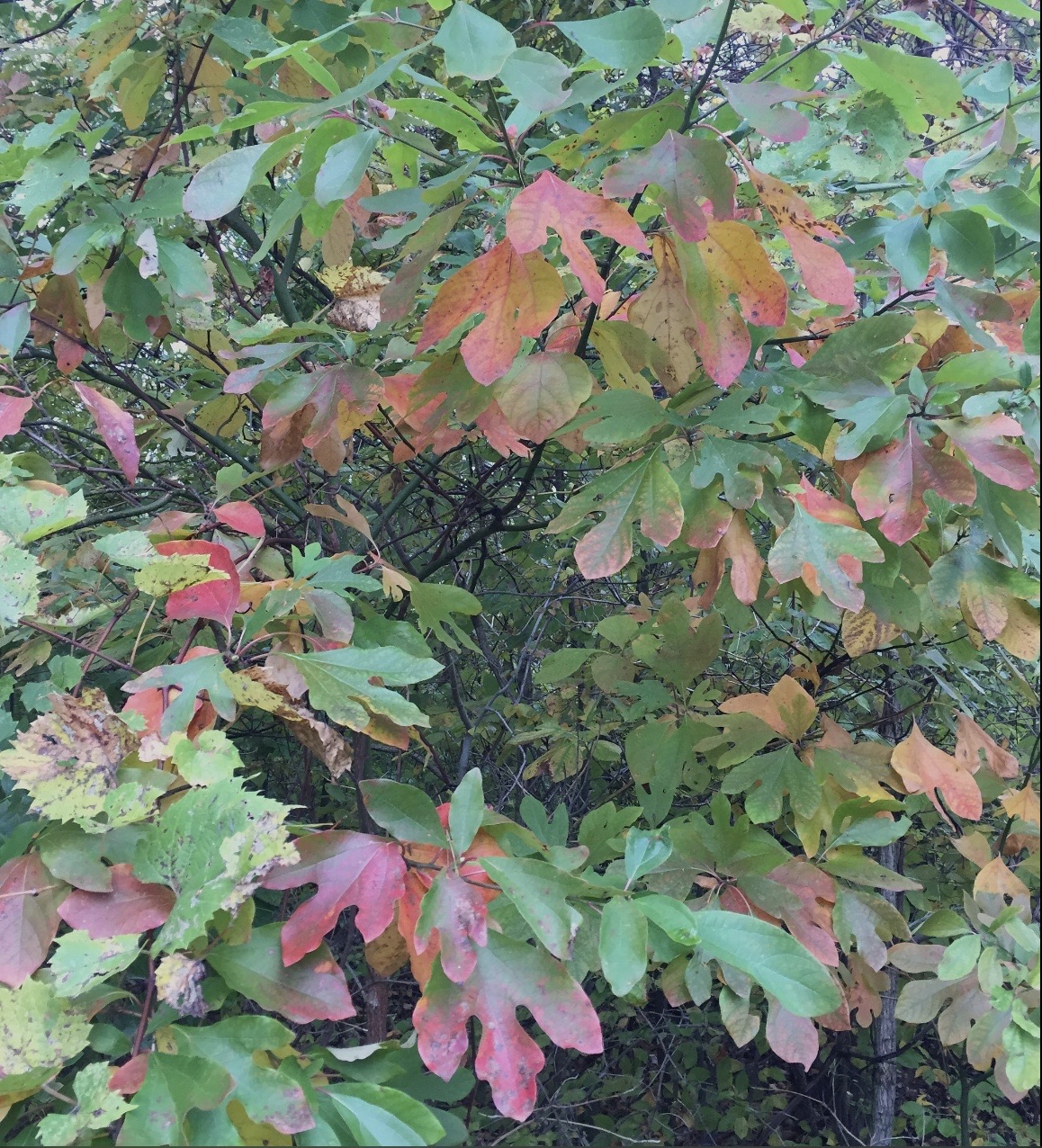
One of my favorite trees, the Sassafras, is flaming red now, one of the few to have changed so brilliantly in this unusually warm and dry fall in East Texas. Between now and winter is the best time to clip the leaves and dig up the tenacious roots so as to indulge in a couple of our ancestors’ favorite libations—root beer and Sassafras tea. Gumbo filé is also made from it, which is an essential ingredient in some Cajun cooking.
Our ancestors adored it, science calls it a carcinogen. At the same time vast groves of it are grown in regions of the globe more easily controlled, in order to mass extract their saffrole to make a highly concentrated and synthetic version of the popular street drug called ecstasy.
A quite undermined tree of the South, considering its illustrious origins and conspiratorial fate. It is a tree widely cultivated in Asia-Pacific as an essential ingredient to the popular drug, or versions of it anyway, generally called “ecstasy”.
At first, like cannabis, it was classified among the most harmful of substances by the FDA, though our ancestors had previously been very acquainted and attached to these and so many other suddenly ‘dangerous’ plants. Then while they were deemed “carcinogenic” by our government, simultaneously expanding was its cultivation in foreign countries for the manufacture of street drugs. This was actually before “Poppy Bush” but perhaps setting that very precedent for the former president?!
While I’ve no idea how to make the popular street drug, I can assure you it makes a deliciously fragrant tea, traditional root beer, and gumbo filé powder.
As for the drug version, I did come across this for any who wish to research further along those lines.
“The most common synthetic routes for production of MDA, MDMA, MDE (MDEA), and MDOH are from the precursor MDP-2-P. To get MDP-2-P first a natural source of safrole is acquired. Safrole can be extracted from sassafras oil, nutmeg oil, or several other sources which have been abundantly documented in Chemical Abstracts over the years. The safrole is then easily isomerized into isosafrole when heated with NaOH or KOH.”
Zubrick, James W. “The Organic Chem Lab Survival Manual: A Students Guide to Techniques.” ISBN #0471575046. Wiley John&Sons Inc. 3rd ed.
Some partial information from The Druid’s Garden, visit her post for much more!
“Sassafras has been called by many names and these names help teach us some of her power: auge tree, saxifrax, cinnamon wood, cinnamonwood, saloop, smelling stick, chewing stick, tea tree, winauk (Native American in Delaware and Virginia); Pauane (Timuca Indians); Kombu (Choctaw); and weyanoke (Algonquin).
Sassafras is typically a fairly small tree, growing 20-40 feet in height with a trunk 1-2 feet in diameter in the northern end of her range. In southern portions of its range, she can grow much larger, up to 100 feet high. Her wood is soft and light-colored with a faint aromatic Sassafras smell. Her wood is brittle, coarse-grained, and rot-resistant although it is not very strong. Typically, her wood has been commercially used for posts and lumber, but wood carvers also enjoy working with it. Sassafras is dioecious, that is, the male and female flowers appear on separate trees. The females will eventually have fruits ripen (which occur around midsummer) whereas the male trees will not.”
Medicinal Uses of Sassafras
“Sassafras Root Spring Tonic: As described above, the Sassafras was taken internally for a variety of healing purposes throughout the ages. Traditional herbalism recognizes Sassafras as a “spring tonic” or “blood purifying” or “blood thinning” herb and is used in the spring in quantity for this purpose. In 1830, Constantine Rafinesque wrote, “The Indians use a strong decoction to purge and cleanse the body in the spring” (Quoted in Wood, 315, New World Herbs). Wood notes that it “promotes clear thining in old age from good circulation to the brain, to improve the peripheral circulation to rid the joints of arthritic depositions, and to promote diuresis” (316). Euell Gibbons in Hunting the Wild Asparagus notes that traditionally, Sassafras Root tea was made with maple sap water for spring tonic. He noted that even in the 1950’s, when he wrote his book, that many folks still drink Sassafras tea “as a spring tonic, believing that it thins the blood and prepares the body to better stand the coming heat of summer.” Gibbons offers this medicinal tea: 3 tablespoons of honey, 3 tablespoons of vinegar (I would suggest a fire cider here) and 1 quart sassafras tea. Chill and serve as a spring tonic.
“Blood and Circulatory System: Today, herbalists recognize sassafras root as a warming, spicy, and aromatic herb that functions as an alterative (tonic) for the liver with mild antiseptic qualities. It has a specific action on the blood and circulatory system, stimulating blood flow and enhancing periphery circulation.”
Gavin Mounsey offers more interesting info in his recent note:
“The small tree known as sassafras (Sassafras albidum) was once one of the most prized plants of Turtle Island (aka “North America”). In 1565, Francis Drake returned to England with a cargo hold full of sassafras roots, and set off something of a craze for sassafras tea, or saloop. By the next century it had become a major export item, almost equal in value to tobacco. Europeans accepted the claims of most eastern Native American tribes about its effectiveness as an all-purpose medicine and tonic, and that combined with its wonderful taste and aroma — Thoreau called it “the fragrance of lemons and a thousand spices” — eventually guaranteed its place as the root in root beer. John Lawson, an early explorer of the southern Appalachians, wrote in 1709, “Sassafras was a straight, neat little tree… treasured by the Indians for its aromatic roots, from which, when pounded, a potion can be brewed to refresh or cure, according to his needs.”
“Early colonists consumed a lot of beer, and it probably didn’t take long before someone got the bright idea of adding sassafras roots to the mix of herbs and spices typically added for flavor and medicinal effect. It might seem strange to think of beer as a health drink, but for many centuries, it was far safer to drink than most available sources of fresh water, being first subjected to a prolonged boil and then made alcoholic. Weak beers were consumed in roughly the same quantities as Americans today drink Coke or Pepsi, but with less serious health risks, since the sugar was all turned into alcohol (and medicinal phytochemicals can be effectively preserved and delivered in a bioavailable format in naturally fermented alcohol based beverages).
“The modern herbalist Stephen Harrod Buhner (Sacred and Herbal Healing Beers, Brewers Publications, 1998) has this to say about brewing with sassafras:
“Sassafras was the original herb used in all “root” beers. They were all originally alcoholic, and along with a few other medicinal beers — primarily spruce beers — were considered “diet” drinks, that is, beers with medicinal actions intended for digestion, blood tonic action and antiscorbutic properties. The original “root” beers contained sassafras, wintergreen flavorings (usually from birch sap), and cloves or oil of cloves. Though Rafinesque notes [in 1829] the use of leaves and buds, the root bark is usually used, both traditionally and in contemporary herbal practice.
“Beer” was used loosely to refer to a variety of lightly alcoholic drinks made with whatever sugar was on hand; both the recipes Buhner offers, for example, use molasses instead of malted grain, as does this one I found in The National Farmer’s and Housekeepers Cyclopedia from 1888:
“Root Beer.—To make Ottawa root beer, take one ounce each of sassafras, allspice, yellow dock, and wintergreen, half an ounce each of wild cherry bark and coriander, a quarter of an ounce of hops, and three quarts of molasses. Pour boiling water on the ingredients, and let them stand twenty-four hours. Filter the liquor, and add half a pint of yeast, and it will be ready for use in twenty-four hours.
“I was excited to see the mention of wild cherry bark — something I had considered using in my own brewing, but hadn’t found any actual mention of until now. I have brewed with all the other substances mentioned, though not all at the same time. (I wasn’t terribly thrilled with the flavor of yellow dock in beer.) But I’m more of a purist than Buhner: I do insist upon using malted grain (or malt extract) as the primary source of sugar, though I will use molasses or honey as adjuncts, in small quantities.
“And I feel the early colonists probably made their root beers, spruce beers, and other healthful brews with malt, too, whenever they could. From an early date, many larger farmhouses had their own brewing operations, and taverns brewed beer in every town and village, first with malts imported from Europe, but quite soon from locally grown grain. A 1685 report from William Penn suggests that malt was substituted for molasses as soon as real brewing became practical:
“Our Drink has been Beer and Punch, made of Rum and Water: Our Beer was mostly made of Molosses, which well boyld, with Sassafras or Pine infused into it, makes very tollerable drink; but now they make Mault, and Mault Drink begins to be common, especially at the Ordinaries and the Houses of the more substantial People.
“In 1750, the Swedish botanist Peter Kalm, interviewing a nonagenarian for his book Travels in North America, learned that the early Swedish colonists of what is now eastern Pennsylvania, Delaware and New Jersey had been “plentifully provided with wheat, rye, barley and oats. The Swedes, at that time, brewed all their beer of malt made of barley, and likewise made good strong beer.” And of sassafras specifically, he wrote, “Some people peel the root, and boil the peel with the beer which they may be brewing, because they believe it wholesome.” He adds: “The peel is put into brandy, either while it is distilling or after it is made.” Nor was ordinary tea neglected: “An old Swede remembered that his mother cured many people of the dropsy by a decoction of the root of sassafras in water drunk every morning.”
“Kalm also mentions the preservative and antiseptic properties of sassafras, which must’ve played a role in its popularity as a brewing ingredient as well (hops were far from the only herb understood to help keep beer from going “off”):
“Several of the Swedes wash and scour the vessels in which they intend to keep cider, beer or brandy with water in which sassafras root or its peel has been boiled, which they think renders all those liquors more wholesome. Some people have their bedposts made of sassafras wood to repel the bed bugs, for its strong scent, it is said, prevents vermin from settling in them. … In Pennsylvania some people put chips of sassafras into their chests where they keep woolen stuffs, in order to expel the moths which commonly settle in them in summer.
“A slightly later (and much more famous) botanist-traveler, William Bartram, mentioned a very different root beer formula from the standard recipe, which makes me wonder how many other sassafras-based concoctions might have been made at one time. Writing about a southern Appalachian plant now known as Bignonia capreolata or crossvine, he wrote, “The country people of Carolina chop these vines to pieces, together with china brier [i.e. Smilax pseudochina] and sassafras roots, and boil them in their beer in the spring, for diet drink, in order to attenuate and purify the blood and juices.”
“Lo how the mighty have fallen. Safrole, the active compound in sassafras, has been banned by the U.S. Food and Drug Administration since 1976 as a supposed carcinogen, and as a consequence sassafras may no longer be prescribed by herbalists, though commercial brewers and root beer manufacturers may still use a safrole-free extract. For the homebrewer willing to ignore the FDA’s finding — which even the very conservative Peterson Field Guide to Medicinal Plants and Herbs of Eastern and Central North America rejects as absurd — it’s a matter of locating a thick stand of sassafras on some dry ridgetop and getting permission from the landowner to dig a few roots.
“The tree grows like a “weed”, and with its distinctive leaves it’s impossible to mistake for anything else. How will you be able to tell if a given root is sassafras, and not from a neighboring tree? Just scratch and sniff. If it has “the fragrance of lemons and a thousand spices,” you’ve hit pay dirt.
“This species along with a handful of others will be introduced to several community food forest projects I have in the works intended to both provide habitat for displaced Ontario Carolinian forest non-human inhabitants while also providing food, medicine and materials for humans in a regenerative way.”
That’s so great to hear, Gavin, let’s set The Science straight! 😊
These used to be my favorite clichés growing up. I miss that sometimes now that I’m growing old and cynical. I miss that crazy big picture dreaming like we do as kids with seemingly the expanse of the world and infinite days ahead of us. My mom really did often repeat that we could do or be anything we wanted.
Prima ballerina even though you’re short and curvy? Sure, why not!
I never really believed it, but I do agree that to dream big is a good thing, and not just for kids. The older we get though, the more that critic steps in even before his queue, the inner voice of impossibility. A necessary ally, no doubt, in his strict adherence to the practical and well-tested norms.
Let’s call him Jack, from another of the well-worn clichés, “All work and no play makes Jack a dull boy.”
What if we put Jack in the box for now, where he prefers to be anyway, and we enjoyed some precious time without him?
It seems like a lot of folks have dreams they would call big that center around money. They want a new house, for example. And that’s true for me, too, I would like a new house.
But I think of that as a small dream. When we first moved here we didn’t expect we’d stay in this house. It’s not where we would choose to have a house on this property, and it’s not the kind of house we would choose as far as style either. We thought we could make this one into a ‘project house’ where we did all our work and hobbies, then we could have another small one more suited to us, off the road, on a more picturesque part of the property with views all around.
Then after making so many improvements over the years and spending so much time, money, energy on the surroundings, we downsized that dream. Jack won that one, as usual.
But that doesn’t mean he’ll always win, right? Back in the box he goes!
Dream BIG! It’s not that easy. I used to have lots of big dreams and many of them I wrote down and some of them have come to pass. At least partially.
Like, I always said I wanted a small house on a big piece of land. I just had no idea that would be in rural Texas, or there would be the whole menagerie attached. I was thinking more like an acre in Corsica or Guadeloupe overlooking the sea.
Guadeloupe, French West Indies 1997
Sometimes I dream we could still do that if we really wanted. But, Jack doesn’t have to bother getting out of his box for that one, that’s how little chance of it there is.
But, what if we could bring some of what I love about that dream into this dream we’re already creating?
A spring-fed pond, that would be a good start. No, make that a lake!
There are properties all around us that may soon be for sale. We’d buy them all!
And then what? (Back in the box, Jack!)
I heard a friend talk behind my back once a few years ago when she first visited here. Directed at her hubby, as we were driving them in the tractor to their lodging in the still-unfinished cabin we built, she said, “Why would anyone need so much property?”
I didn’t, but wanted to say, “But, you see, but we would have, could have, SO much more!” Why not?!
Hubby used to joke about our paltry 50 acres, “In Texas, 50 acres buys you a front yard.”
It’s not a matter of need, obviously. How much land does the Queen of England own?
It’s not even about what one might accomplish with a few hundred (or a few thousand) acres. I don’t imagine we’d aim to accomplish much at all. Jack would want to put a name on it of course—a nature preserve, or a dude ranch, or a future botanical garden, or a (God forbid!) another of the popular ATV parks.
I think in my biggest dream I’d invite some cherished friends to our rural sanctuary, with the spring fed pond (lake!) and wooded paths strewn with pine needles, and secret herb gardens, where we’d enjoy some homemade wine on a fine pergola made of bamboo watching the birds . . .