
Feeling Churlish

Churlish:
“boorish, rude, uncivil, peasant-like, difficult to work with”

I like it, a lot! As a word it’s just fun, like most words that end with ‘ish’. I often put ‘ish’ on the end of words, adding a connotation of ‘sort of’, it’s quite common.
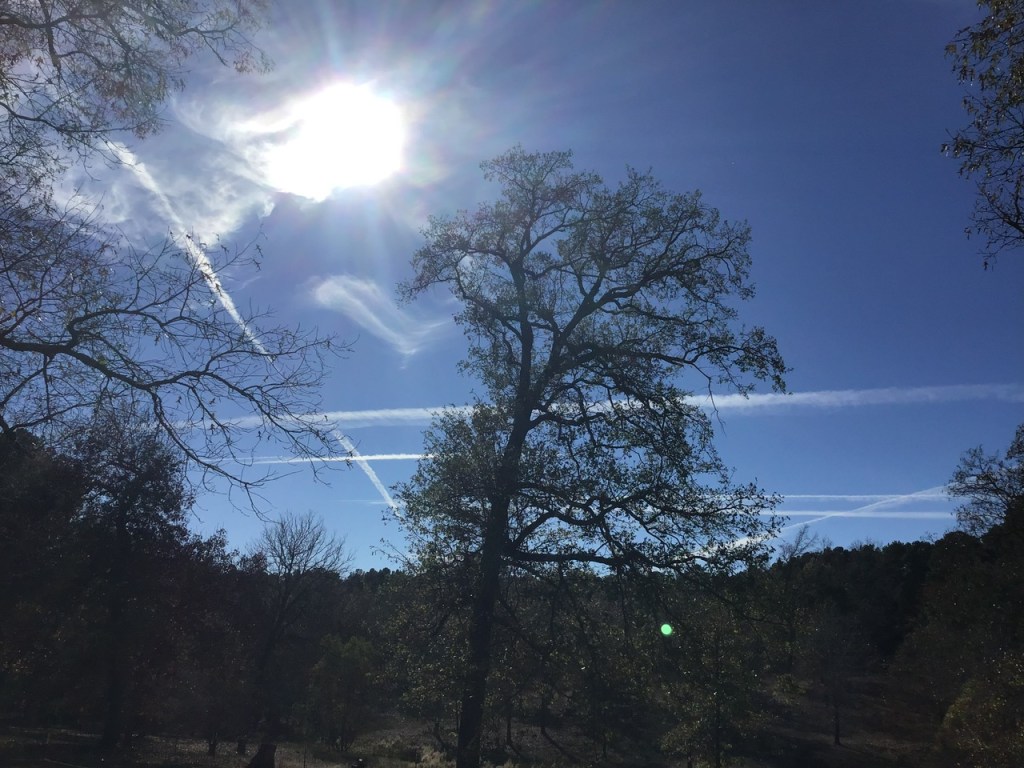
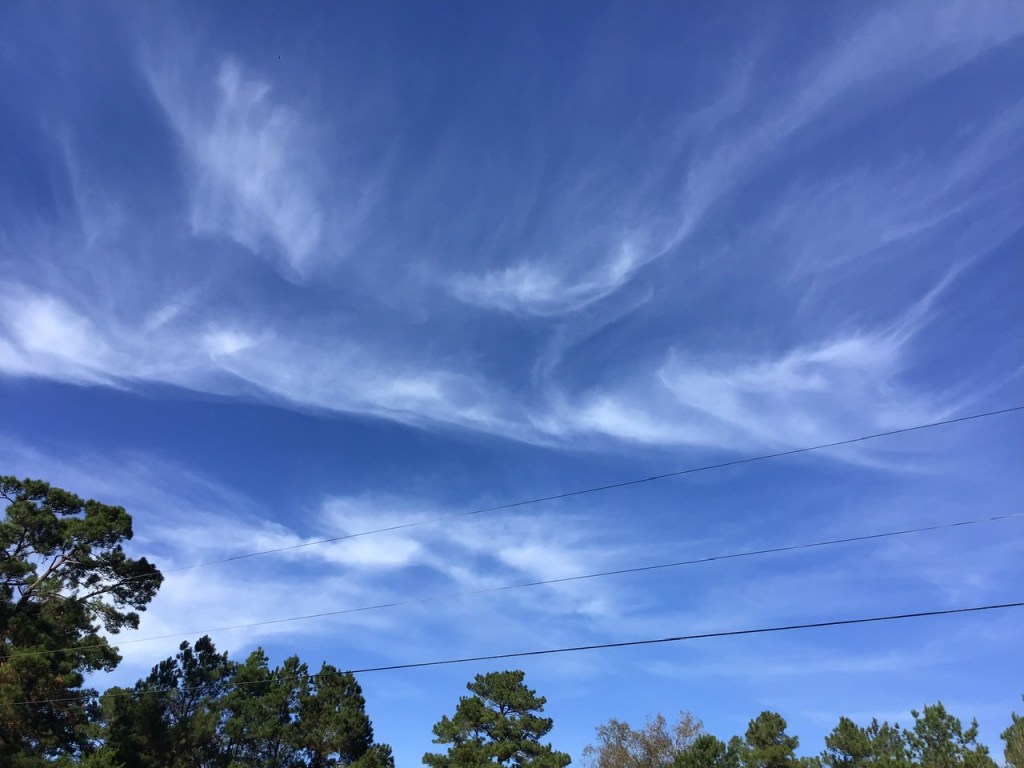
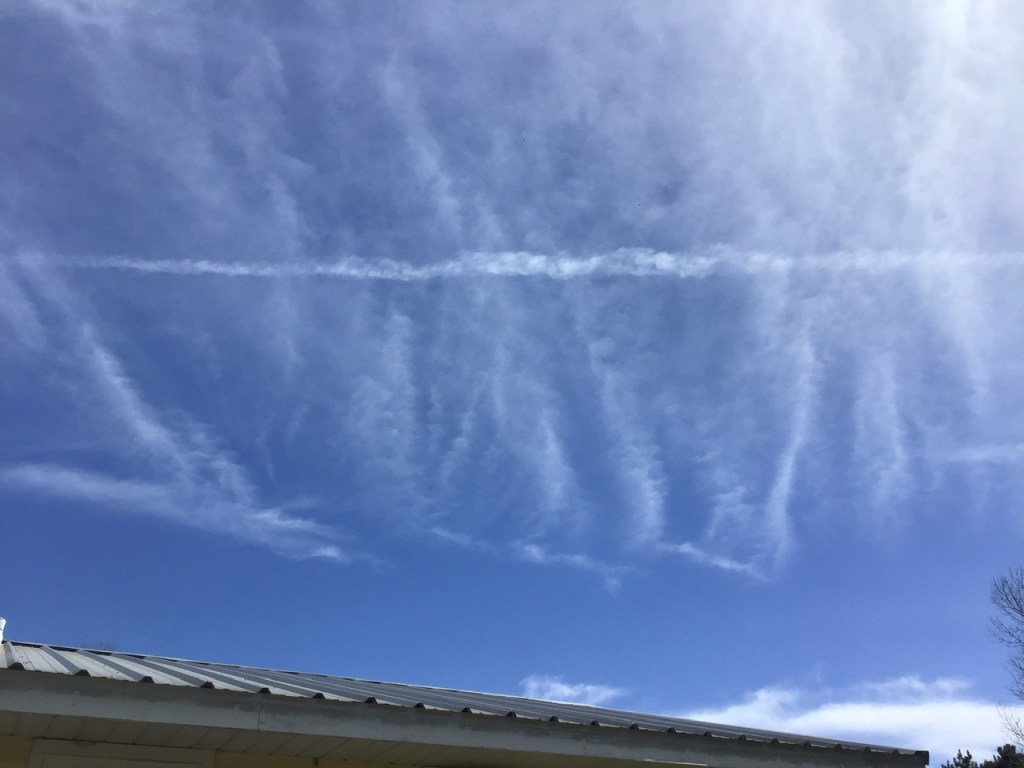
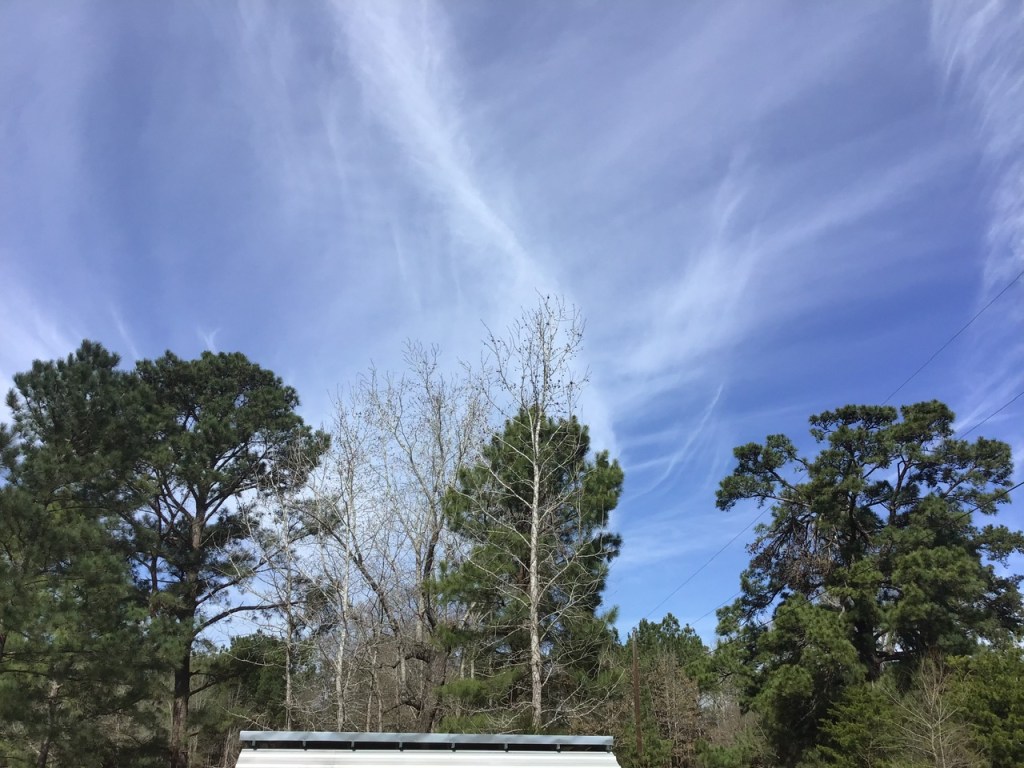
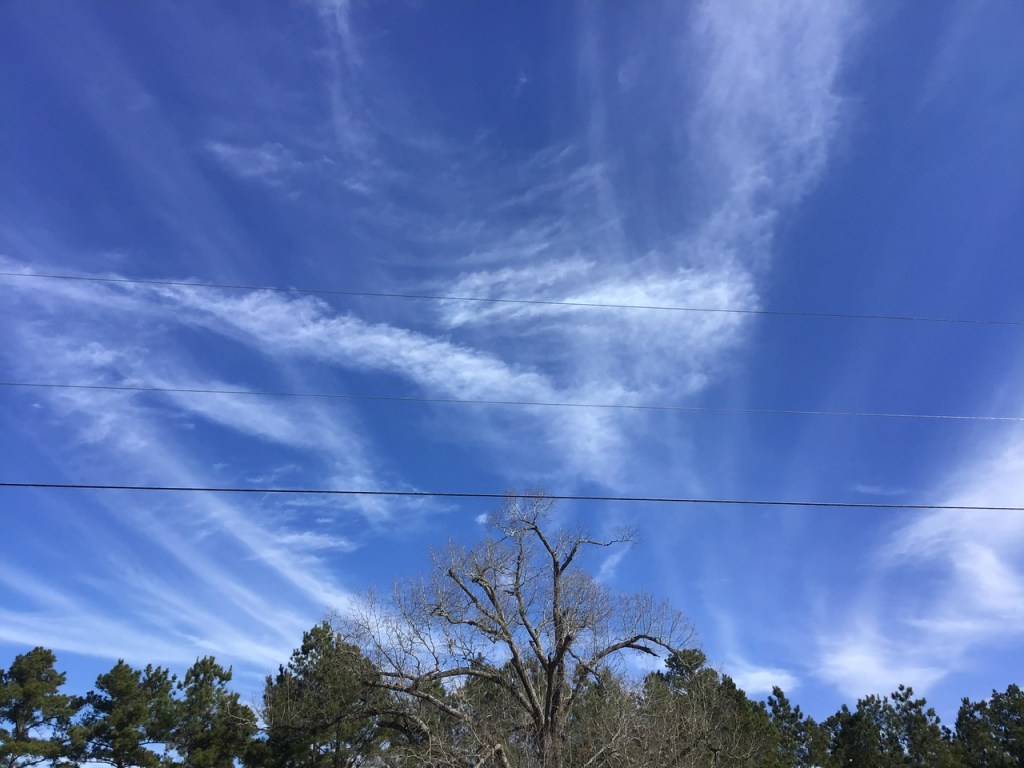
“Fun-ish” not quite fun (like living under a chem-sky producing Yo-Yo weather); Slave-ish is in the vicinity of slavery (like paying income tax and having zero say in your own government).

I have a new cheese I call “Swissish” since it’s in the Swiss style, but obviously, I’m not in Switzerland. It’s just a really handy little diminutive.

But, what is a ‘Churl’ you might wonder? It’s a good question because the meaning has changed over the centuries quite significantly.

A churl is a peasant, or a rude, boorish or stingy person. In English history it meant — “A freeman of the lowest rank”.

I believe that label suits me! Well, not exactly the ‘freeman’ part, but I can relate to the peasant part. I haven’t always thought of myself as a peasant, but since becoming one I’ve definitely adopted some of their so-called uncivil, rude and boorish behaviors.

In many ways it works like the term ‘country dumb’ like in the great work of fiction by Jaroslav Hasek, “The Good Soldier Svejk.” The beauty of being churlish is a direct parallel, because you never can tell when it’s an act, and for what purpose. Playing dumb, or churlish, can be very effective.

Hasek’s narrative, along with the character of Svejk, was most certainly the inspiration for the well-known American television sitcom Hogan’s Heroes.

The original Sargent Schultz and company

That makes perfect sense, because those behaviors go hand-in-glove with how much respect one has for those who would have us all be feeble, pleasant and co-operative workers, loyal citizens of party politics, and happy, obedient tax cattle, unable to accumulate inter-generational wealth, just like peasants and slaves.

I’ve been saying for decades we are slaves on a corporate plantation and not citizens in a so-called free country, and whether you call it a republic or a democracy completely misses the point. We are forced to pay taxes while having zero control over what those taxes fund, that’s a slave system we cannot opt out of, so I really never needed to read any so-called legal codes or any essays of the great thinkers who’ve already noticed this a century ago, because it’s painfully obvious.

For those who need more proof, here’s another good one rehashing the same points again with excellent clarity, for the hard of thinking.

BUT INCOME TAX FUNDS THE SERVICES WE NEED!
Mark Everson, IRS Commissioner, stated he has been paying his taxes ever since he had his first job and that it’s a “fundamental construct of our nation that those of us who expect and demand services from our government… we must pay for those services,” therefore, there is an obligation to contribute. Ok, great! I like services, and I do believe people should pay their fair share for services they use. So how about we play a little game of “trust but verify” by looking at how our services are funded:
PROPERTY TAXES are primarily used to support local services such as public schools, police and fire departments, road maintenance, libraries, and sanitation services. (check all of those off the list)
SALES TAX funds a variety of public services, including education, healthcare, transportation, public safety, and infrastructure projects. (add a whole bunch of checks.)
SCHOOL TAXES are paid by everyone, even people without children. We are told the school tax funds are primarily used to finance public education, covering expenses such as teacher salaries, school facilities, educational materials, and student services. (check, check, check.)
ROAD TAXES are funded through taxes on motor fuel, such as gasoline and diesel taxes, as well as vehicle registration fees and tolls.
LICENSE PLATE TAXES fund state transportation projects, including road maintenance and infrastructure improvements.
CAR REGISTRATION TAX funds various state and local services, including road maintenance, public transportation, and infrastructure improvements. (Sure are a lot of roads and a whole lot of money going toward them.)
I figured I’d throw this one in here: Utility companies are funded through banks and investors, then they rape us on services (seriously, look at your electric bill). The astronomical rates we pay are set by our so-called “elected officials”. Point being, the utility companies don’t need taxes, but sometimes our governments choose to hand them money. This is a huge, rigged monopoly game.
BUSINESS INCOME TAX, meaning the legal tax on profits derived from the sale of goods over cost, is what funds the government. Again, this tax on profits is 100% legal. If you own a business, you owe taxes on the profits (gains) you generate. This includes stock market gains or gains from other financial investments.
As you can see, there is nothing on our list that requires the sample server at Costco to pony up 20% of her weekly paycheck to fund. This is why the Grace Commission, officially known as the Private Sector Survey on Cost Control (established by President Ronald Reagan in 1982 to identify waste and inefficiency in the US federal government) produced a shocking report. When referring to income tax collected from every working individual in the United States, they stated, “100% of what is collected is absorbed solely by interest on the federal debt; all individual income tax revenues are gone before one nickel is spent on the services taxpayers expect from government”. Folks, 100% of what we give the government out of our paychecks is being handed to the banks as interest payments – that means all of our taxes become the bank’s profit. People don’t understand how the Rothschilds, the Morgans, and so on run the world; it’s because the entirety of what we pay is funneled to the banks, and they own the banks. G. Edward Griffin, author of Creature from Jekyll Island, stated,
“The main purpose of the income tax is not to raise revenue but to redistribute wealth to control society.”

SLAVERY
Listen closely: “Article 1 (1) of the 1926 Slavery Convention defines slavery as ‘the status or condition of a person over whom any or all of the powers attaching to the right of ownership are exercised’. This definition signifies that a person is considered a slave when another individual holds absolute control over them, treating them as property or chattel, and depriving them of personal liberty and most rights ordinarily held by free persons. The exercise of these powers includes control over the person’s life, labor, movement, and private affairs, with the intent of exploitation.” We work to obtain money in pursuit of life, liberty, and happiness. We are then forced, against our will, to hand the mafia a never-ending portion of our money. If we don’t, our possessions that we have rightfully earned are seized, or we are jailed. It is the definition of slavery. The worst part is, in this case, the government doesn’t even “need” this money. It doesn’t go toward making our cities beautiful and making our water clean. It is all handed to the banks – but it’s way worse than this.
According to Bilderberg, the IRS makes available to the programmers of society “much information” which they can then use to create situations that allow them to maintain control over us. To quote Bilderberg, “This information consists of the enforced delivery of well-organized data contained in federal and state tax forms, collected, assembled, and submitted by slave labor provided by taxpayers and employers.” They go on to say, “Furthermore, the number of such forms submitted to the I.R.S. is a useful indicator of public consent, an important factor in strategic decision making….” They add, “When the government is able to collect tax and seize private property without just compensation, it is an indication that the public is ripe for surrender and is consenting to enslavement and legal encroachment. A good and easily quantified indicator of harvest time is the number of public citizens who pay income tax despite an obvious lack of reciprocal or honest service from the government.” So, they laugh at us for being so gullible that we pay into their wretched system, yet if we resist and don’t pay, they seize our assets and force us to waste our lives behind bars instead of spending time with those we love. The one thing I agree with them on is that this is slavery.
Bilderberg, when discussing the political landscape of America, stated that both lawyers and CPAs (accountants) are [unknowingly] licensed spies and saboteurs. These individuals are overseen by judges, “who shout orders and run the closed union military shop for whatever the market will bear” and “the presidential level of commander-in-chief is shared by the international bankers.”

To end on a good note, here’s the young and gorgeous Helena Bonham Carter in my favorite film, “Room With a View” who after playing Beethoven gets peevish, naturally, but not to be confused with churlish.


I Have a Dream!

I have a dream that when asked where I sell my delicious locally-produced raw milk cheeses my response will be one of beaming pride instead of deflated frown.

Instead of–“Sorry, I can’t sell them, it’s illegal”–in my dream I reply instead:

“I have an assitant who delivers our homemade cheeses twice a week to the community Farmstead Store in town. You probably should call her and make arrangements because she always sells out by lunch. We have Farmstead Stores in every small town in our region who send out drivers to exchange with one another. Our free-range pork and our neighbor’s beef sell out even faster than the cheeses. They’ve also got year-round fresh produce there, eggs of course, honey, wine, kombucha–all sourced and produced from within 15 miles.”

Instead of my dream, in my reality I get asked, “Can’t you get a license?”

No! No, of course I cannot get a license! Instead of dream-speak I get the nightmare reality.

It’s not only impossible to get a license for a home cheesemaking operation, it just happens to also be against my philosophy.

“An agorist is one who applies the principles of libertarianism consistently through counter-economic practice. They aim, that is, to bring about the voluntaryist society not through political (in)action but through direct counter-economic action.”

No, I cannot get a license. Since we are in the South, I wonder if another appeal might be in order?

Imagine if instead of ‘philosophy’ I said ‘religion’. So my reply becomes:

“Appealing to State and Federal officials for what I, and my neighbors, choose to purchase for consumption is against a fundamental aspect of my religion which preaches the gospel that God chooses my food through my tastebuds.”

“This is not a trivial point. A free society is not merely an ideal society to be philosophically formulated, but a process to be enacted through conscious action. Thus, the idea of separating the free society from the actions that free human beings must (or must not) engage in is self-contradictory. What else defines a free society except for those actions?” James Corbett

“Furthermore,” I continue in my dream space, “I’m allergic to paperwork and authoritarian nincompoops and I refuse to spend what little time I have left on this spinning green insane asylum kissing the arses of Velvetta-eating officials mansplaining me what I must do to make safe cheese.”

Also from Corbett
In “An Agorist Primer” Konkin explains:
“We see that nearly every action is regulated, taxed, prohibited, or subsidized. Much of this Statism — for it is only the State that wields such power — is so contradictory that little ever gets done. If you cannot obey the (State’s) laws and charge less than [because of “Fair Trade” laws], more than [because of “Anti-Trust” laws], or the same as [because of laws against cartels] your competitor, what do you do? You go out of business or you break the law. Suppose paying your taxes would drive you out of business? You go out of business — or you break the law. Government laws have no intrinsic relationship with right and wrong or good and evil. Historically, most people knew that the royal edicts were for the king’s good, not theirs. People went along with the king because the alternative looked worse. [. . .] But everyone is a resister to the extent that he survives in a society where laws control everything and give contradictory orders. All (non-coercive) human action committed in defiance of the State constitutes the Counter-Economy.”
In effect, Konkin takes the plight of the modern-day citizen, stuck in a web of ridiculous, contradictory, and impossible-to-follow laws, rules and regulations, and flips it on its head. It is not a source of shame to be acting against the arbitrary whims of the state, but a virtue. Economics is the realm of white markets: legal, licensed, sanctioned and regulated exchanges in the aboveground economy. Counter-economics is everything else: black market and gray market activity either specifically outlawed by the state or not licensed or approved by it.
People tend to get squeamish when they hear “black market,” but we’re not just talking about gunrunning, counterfeit smuggling or drug dealing here. Any (non-violent) activity that doesn’t have the blessing of the state is counter-economic.

“Of course, individually, these actions seem unimportant, even trivial. But in combination they drain significant resources away from the clutches of the state and toward the people participating in the actual productive economy. It is estimated that 20% to 30% of Americans fail to report taxable income. In some parts of Latin America it’s closer to 80%. Can you imagine if it were 100%? A few isolated counter-economists acting in a disorganized haphazard faction is a minor inconvenience to the powers-that-shouldn’t-be. Millions of people acting in concert in a deliberate undermining of state authority is a revolution. This is the promise of counter-economics.”

The quotes that are not in my dream are taken from the following 2 articles by James Corbett, well worth the read.

https://substack.com/redirect/ba0aa4ad-e65c-49d6-889b-40771af20c61?j=eyJ1IjoiYXBsankifQ.vij_GSi8NAkTixijJIkYbmIMsSylddJaDImehSkL3TQ

Do you have a dream, too? Care to share?? 😁🤗

A Tale of Two Cheeses

This is a repost of a few of my first cheesemaking adventures way back in 2015. I decided to repost it since not only is it Hubby’s favorite, but also because my cheesemaking workshop is right around the corner, so my cheese posts are getting more views lately.

From the archives:

I’ve now made nearly two dozen different cheeses. When I started out, my only raw milk source was a five-hour round-trip drive, I was aging them in the veggie drawer of the fridge, and I was following the recipes to the letter.

I now have an aging fridge packed with cheeses, my raw milk source is at least in the ballpark, I’m creating my own recipes, and I may even spring for a pricey PH-tester. It’s been a long, fun road with a steep learning curve made in a relatively short time, which is what I say about pretty much everything in our adopted rural lifestyle.

But the best cheese I’ve made so far was the third one I attempted, and it started out as a smelly, rather disgusting potential disaster.

In our cheese-making class, we were strongly encouraged to take notes on our every hard cheese-making venture and being the diligent student I usually am, I do. This time was no exception.

Has odd fishy odor” is at the top, middle and end of the third cheese’s entry. I was a bit reluctant to include the less-than-savory details as to why that might be.

First, a bit of background on my past experiences with stinky cheese. I am no expert, I can’t even call myself a true aficionado, but I’m more cheese-fearless than most, especially most Americans. After all, I did live in France for a while, and spent a few months in Corsica, where I met the only cheese that scared me off.

The Corsican cheese is quite popular and, being a sensitive traveler attracted to regional specialties, I was anxious to give it a try. I went to the farmers’ market, found the oldest, roughest-looking cheese-monger of all the vendors and marched right up to examine his wares. He looked like an ex-sailor with wrinkled, sun-burnt skin, black patterns on his forearms where I assume tattoos were once legible, and an easy-going, toothless grin. He eyed me as I pretended to know what I was doing. I glanced over his table and tried to make out the curious handwriting to learn what I might be able to pronounce well-enough to order.

My eyes went right to the group of words I was searching for – traditional Corsican cheese – how easy was that? I felt already triumphant. In my best French, I tell him I want that cheese, and he replies, “Avec ou sans habitants?” At that point I feel certain I saw a glimmering in his eyes. He points down to the sign below the ‘traditional Corsican cheese’ sign, which reads just as he has stated: “AVEC OU SANS HABITANTS.”

Instead of triumphant, I’m instantly befuddled. I had no idea what that meant, and the question so baffled me I thought I clearly did not understand. I said quite sincerely, “I don’t understand.” But, in retrospect, I think I kinda did, I just didn’t want to believe it. “With or without inhabitants,” it was clear and easy to understand even for a non-French-speaker.  This was not a linguistic block I was having, it was a reality check.

At that moment my market companion attempted to come to my rescue. She didn’t speak English, but understood my dilemma apparently without words exchanged, being French and rather snobbish about her cheeses. “Inhabitants …,” she repeated to my complete horror, “as in maggots.” After which she pinched up her nose slightly and gave a nearly imperceptible shake of her head, like she was trying to reassure me – ”Don’t worry, on the mainland we don’t eat that sort of cheese.”

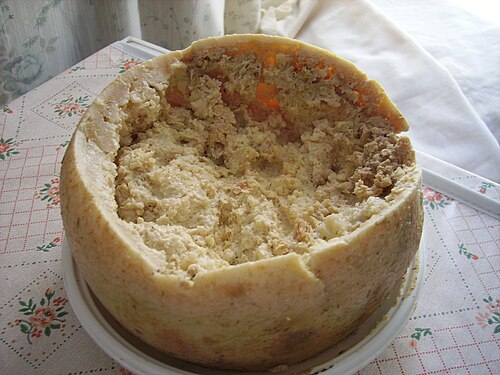
Maggots, I’ve since discovered, is just one of may unsavory methods of ripening, there are many, like ‘cheese mites’ and they are still deliberately used to ripen certain cheeses in various parts of the world, like Casu martzu – Wikipedia.

Wiki image of maggot-ripened cheese

So, back to my Cheese No. 3. The first two times I followed two different farmstead cheese recipes to the letter, wrapped them to age, and made my notes, nice and clean, without any question of potential perfection in outcome. This third time I found a recipe online that was so vague in steps, measurements and temperatures, I had to wing it a bit for the first time.

To make matters worse, this particular day had a pronounced increase in kitchen traffic. After I’d muddled through the recipe and began the pressing process, Handy Hubby had a dramatic building challenge of the electrical variety that required him to tear into the wall in the vicinity of the press. He’d just been on the roof cleaning up mice nests, and they’d managed to chew through some of the wires, which he now had to replace.

I wondered momentarily if that was something I should include in my notes. Nah, best forgotten, I decided.

But I could not forget, and what I’d hoped would be a quick in-and-out project around the press turned into an hour, going on who knew how many more. With Hubby going in and out, meant the dogs are following him. They think this is a game and don’t understand Hubby’s irritation as he curses the mice only under his breath … and … is sweating through his T-shirt. Right over the press!  

Tori and Papi, our dogs at the time, who were often guilty of playing games around the cheese press.

Finally, the straw to break this camel’s back – I glance over from the sink as Tori’s tail brushes over the press. Tori is our Dane-Mastiff and about 6 feet from nose to tail tip. In a flash I imagine it snake-like engulfing the entire cheese.

“Stop, stop, oh my god, stop the pressing!”

I neither wanted to perceive myself as excessively anal nor offend Hubby’s already delicate mood any further, but my stomach was churning and my mind screaming at me for what I was allowing to happen to that poor cheese. I immediately disassembled the press, moved it to the office, and, with trepidation, examined the cheese, slowly unwrapping it from the muslin.

Just as I had suspected, dry-wall debris, dog hair, and who knew what other invisible entities had found their way onto the surface of Cheese No. 3.

In a moment of panic and disgust, I nearly threw it in the garbage. Then I thought, no, wait, chill, this will be the perfect testing ground. I’ll continue to do everything wrong, according to all things science and sensibility, and see what happens.

So, I stopped following the vague directions and followed instinct instead. What would the Corsican cheese-monger have done, I repeated to myself as I decided not to wrap it, to leave it at room temperature uncovered for days, then put it in with the others to age in the drawer of the fridge.

Not only did it look completely different from the others, it also smelled completely different. The fishy smell had stabilized, mold started growing on the air-dried, uncovered rind, and the texture softened inside until it began to sort of pooch out around the middle like love handles.

I felt some encouragement then, thinking, “Might good cheeses be like good dogs and begin to resemble their masters?”

A couple weeks more and it began to look and smell so delicious the temptation was starting to weigh on me. It was becoming irresistible. On Christmas Eve, I could wait no longer. The vague directions said it would be ready in two months, but my instincts were saying, ”Dig in, woman!”

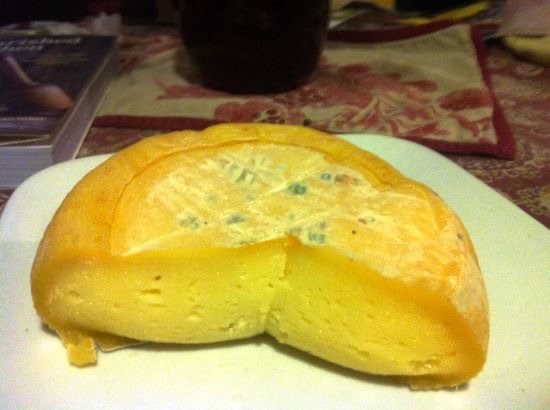
The luckiest mistake: Cheese #3

So I did, and it was delicious! I am now convinced the best cheeses were discovered quite by accident and our ancestors turn over in their graves every time we get squeamish over a few dog hairs or even . . . maggots.

The only problem is, I have no idea how to imitate it.

The latest cheese ‘failure’ supposed to be a pepper jack– story and tasting coming soon!

Fast forward to last week, October 2025, and we have another crazy cheese mistake, which may turn out to be just as delicious!

Here’s the ‘pepper jack’ after further aging abuses, looking and smelling full of potential!

Only time will tell.

So. Much. Milk

A sudden mini-miracle has occured and has turned the month I completely intended to be an exceptionally lazy one into a whole big mess of work.

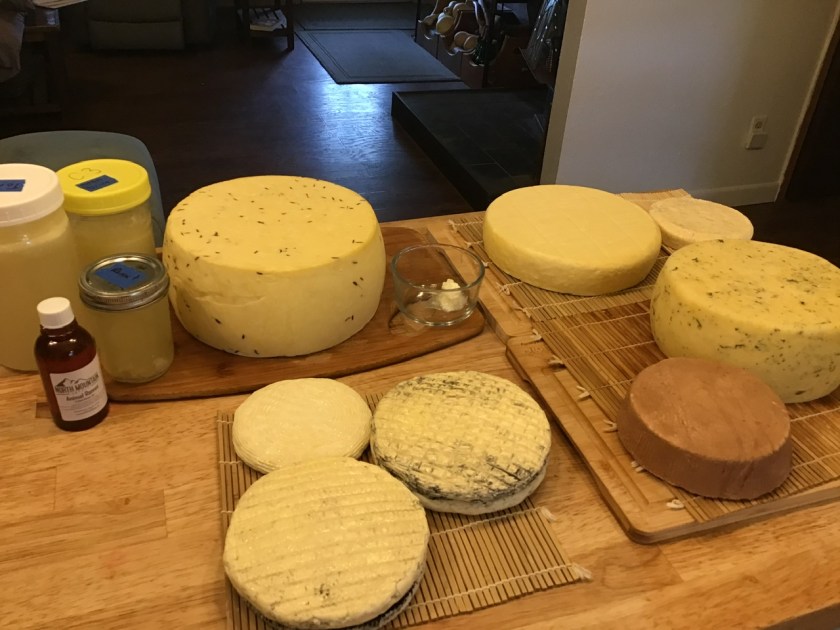
What’s in your cheese cave?
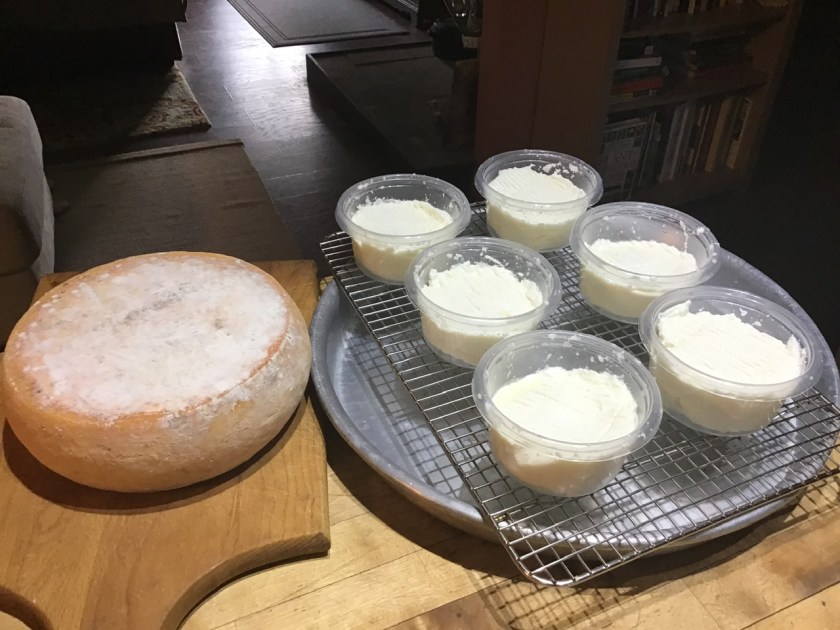
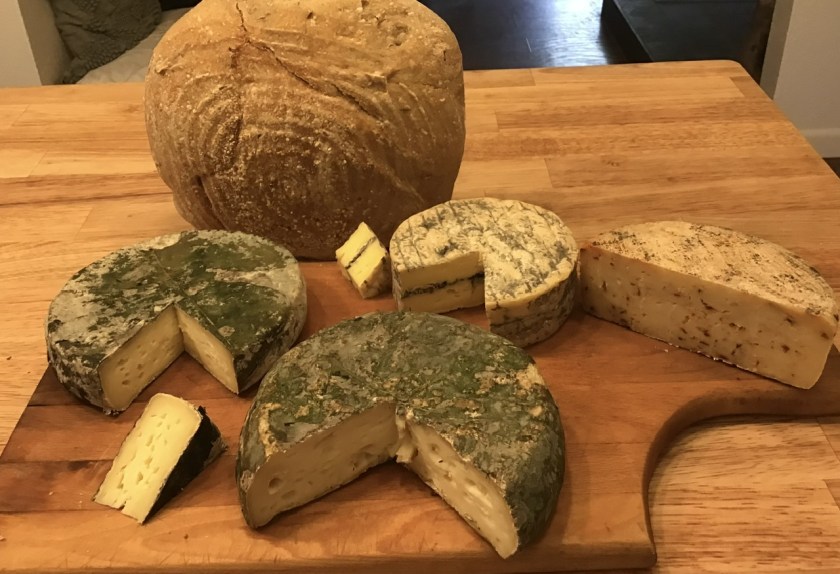
A portion of the cheeses I’ve made in the last two weeks, the largest was from 9 gallons, which was transformed into a Caraway Gouda. The smallest was made right in the half-gallon Mason jar with milk directly from the cow, never cooled and ‘backslopped’ from our own homemade goat rennet. Backslopping was a traditional method used on the farm to carry the culture and rennet combination from day-to-day, similar to keeping a fresh starter culture for sourdough bread.

While it’s work I love, the problem-solving has been endless and my shoulder is an on-going issue. After such a long search, this was so unexpected and has caught me off-guard, unprepared and re-injured. Why am I not surprised?

My milk-quest for cheesemaking has been a decade-long challenge. For the briefest of run-downs I’ve watched raw milk prices double in that time, tried and failed at goat rearing, and for the past couple of years I’ve been herdshare hopping, with prices far too high for cheesemaking.

A few weeks ago I tried another herdshare–closer, nicer, and so much cheaper. Finally, I can make cheese to my heart’s content, to hell with my aching shoulder! And thanks to Hubby on early retirement, who is willing and available for all the heavy lifting.

And who also helps with the redneck innovations–having just made me a new collapsible cheese-hanger unit and also made my cheese-press.

I’ve even been able to experiment again it’s so reasonable, at just $3.50/gallon. Not since the goats have I managed to pay so little for such cheese pleasures. My new milk lady is short on customers, half her milk is going to her neighbor’s pigs every day.

All I can think is, how crazy is that? That precious milk goes to the pigs, because it’s illegal to sell it anywhere but at her farm and to process it into cheese to sell is also illegal. While I can imagine those are some very happy pigs, I still wish I could sell cheese.

Actually, not so much the selling part, just the making part. I do often give it away as gifts and I get rave reviews. I’m often asked why I don’t sell it at the Farmer’s Market, because so few know how illegal it actually is. The requirements for licensing are very strict, not a chance a home kitchen would pass, (Great Dane not included!) and even with all the proper paperwork and a professional kitchen, many cheeses are still illegal to sell.

Various whey beneficiaries on the homestead:

I don’t want to run a cheese business anyway. I want a HWB (Hobby with Benefits) with those benefits being financial as well as delicious.

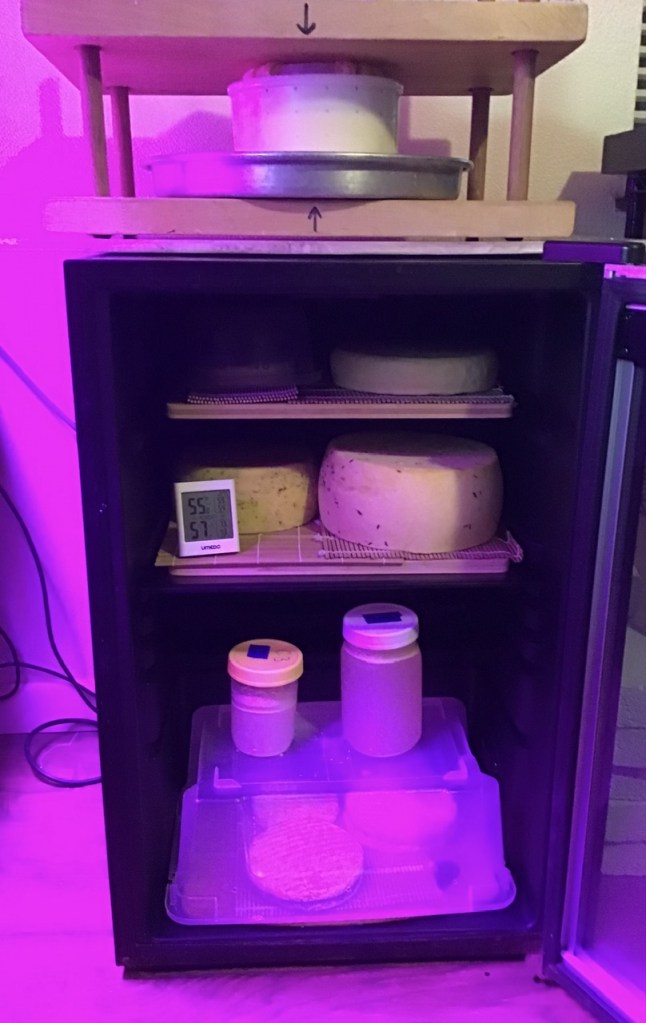
For now, I’m already out of room in my mini-aging fridge. I bought a second one, but once I got all the cheeses in it I had an impossible time getting a steady temperature. I gave up after 3 days of trying, to a mess of 70 degree cheeses sweating and dripping and starting to smell bad. The fridge regularly swings by 30 degrees, a cheesemaking nightmare.

I can work with a steady 50-55, and control humidity using plastic bins, not exactly a cave in the Loire Valley, but I can make it work well enough for a short Redneck affinage.

The non-existent affinage fridge of my dreams would be humidity controlled. The one that’s close enough costs a mere $700 and has temperature control in two sections (nice!). It’s technically for wine but home cheesemakers who can afford it often convert them with great success, or so I’ve read.

Let me just put that up on my vision board and see if it arrives in a timely fashion!

Also on my wishlist, David Asher’s latest book. His first book is my go-to resource and changed everything I was doing in making cheese, “The Art of Natural Cheesemaking: Using Traditional, Non-Industrial Methods and Raw Ingredients to Make the World’s Best Cheeses.”

Despite the struggle for a reliable raw milk source I have come to the wonderful place in my cheesemaking skills that I no longer follow recipes. I still read plenty of recipes, of course. But I read them to glean new techniques, learn cultural differences and especially pre-industrial methods, and imagine new combinations, in order to try them in my own way, like the rest of our cooking here. Hubby works the same way with his culinary craftiness.

It is the key to turning cooking from drudgery to joy, imo. It’s ‘the zone’ like they talk about in sports, or artists in their creative flow. Who wants to do that in their sterile industrial kitchen rather than in the comfort of their own home? Some, I know, but definitely not me.

Some previous cheeses “Kenshobert” in my territoire version of Camembert.

Turning a favorite hobby into a business is the joy-killer. Being well-rewarded for a favorite hobby is the goal. That’s magical like milk transforming into 1,000 cheeses is magical. Some call it alchemy, but really it’s just fermentation, maybe the most ordinary and natural process in the world.

Cheesemaking is also economical and beneficial to more than just our health and palette. The dogs and the pigs get all the whey after the ricotta is made–whey ricotta is a delicious ‘by-product’ from making hard cheeses. So from each gallon we get the heavy cream for coffee and ice cream, milk for cheeses, and whey for other recipes and very contended critters.

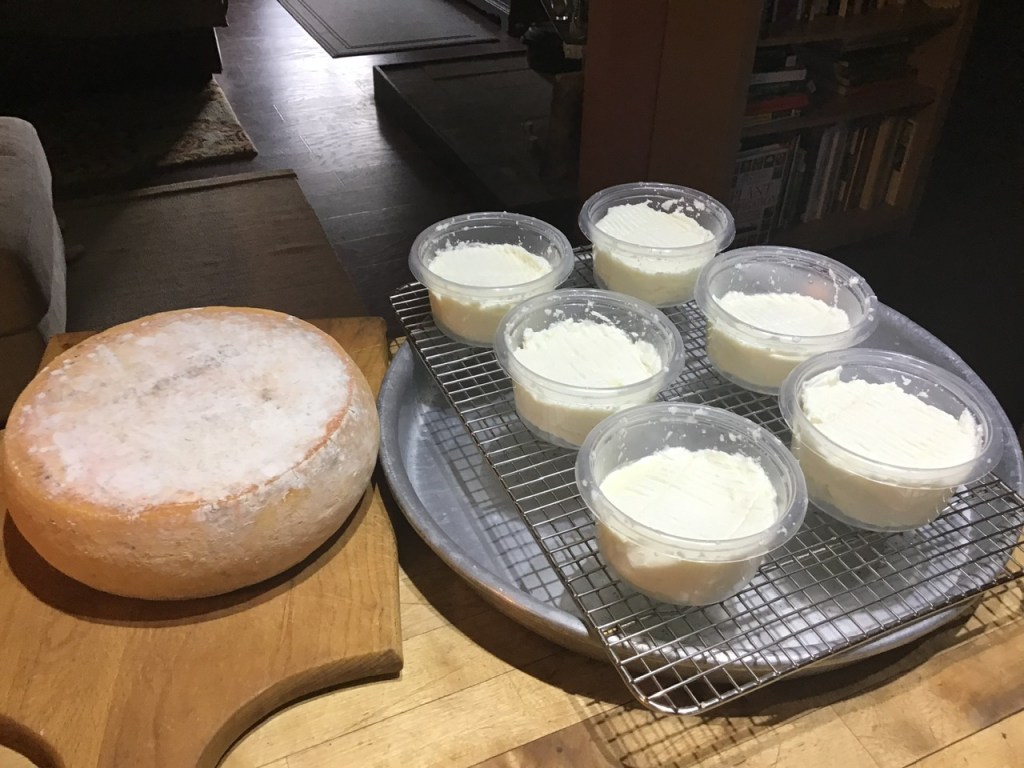
Ricotta pressed overnight then soaked 3 days in homemade hard pear cider. Eaten fresh, with fruit or crackers, it’s mild, slightly sweet and tangy.

The critics of course think it a lot of wasted work when cheese from the grocery store is cheap and plentiful, and there’s a growing network of artisanal cheesemakers who craft excellent cheeses (for a hefty price). I’ve had plenty of such cheeses and they are indeed delicious and worth the money.

But, they are all subject to the laws, which usually means: pasteurization, medicated animals, artificial lab-produced rennet (brought to you by Pfizer!), and freeze-dried cultures, also lab-made.

All that is exactly what I’m trying to get away from, in order to craft the most natural, local cheeses as possible. It’s an impossible task while remaining inside the laws.

Yet, there are folks still alive today who can remember when the laws weren’t so intolerably squashing to taste, creativity and economy. Just as there are old-timers here in Texas who can remember the days when they were allowed to raise, kill, process and sell their own livestock to the public, there are cheesemakers up north (no traditional cheese country in the south, too hot) who can still remember a time they could sell their handmade cheeses produced on farm in their own kitchens. Now most cheeses sold in this country are essentially fake, already lab grown, like the ‘meat’ they keep trying to push on the public.

Somehow there are still the majority who continue to call this freedom and progress.

Homestead Happenings

It’s Shoulder Season on the wee homestead, and by that I mean a few things.

Shoulder season, for those who maybe new to the phrase, has a specific meaning in tourist trades, meaning between high season and low season. Savvy travelers and those who dislike crowds or who are just cheap or nearly broke try to travel in the shoulder season.

As far as I know it doesn’t have a parallel meaning in the gardening world.

But for me it does. It’s the time we move between seasons in the garden and since we garden all year, it happens twice, once in Swelter Season (now) and once in YoYo Season (formerly known as winter).

The key summer crops in the garden are either long gone–onions, garlic, crucifers, or mostly dead–tomatoes, squash, melons. And normally the cucumbers too, except those are, so far, successfully secession planted, with the new generation just coming up as the last one is dying. Good timing there, tiny bow to me!

Old cucs on left, dying fast, on right a couple of tomatillos in the back, also dying and a volunteer datura, doing great.
New cucumber plants looking good, but will they produce?

And big bow to Handy Hubby for growing this 27 pound beauty!

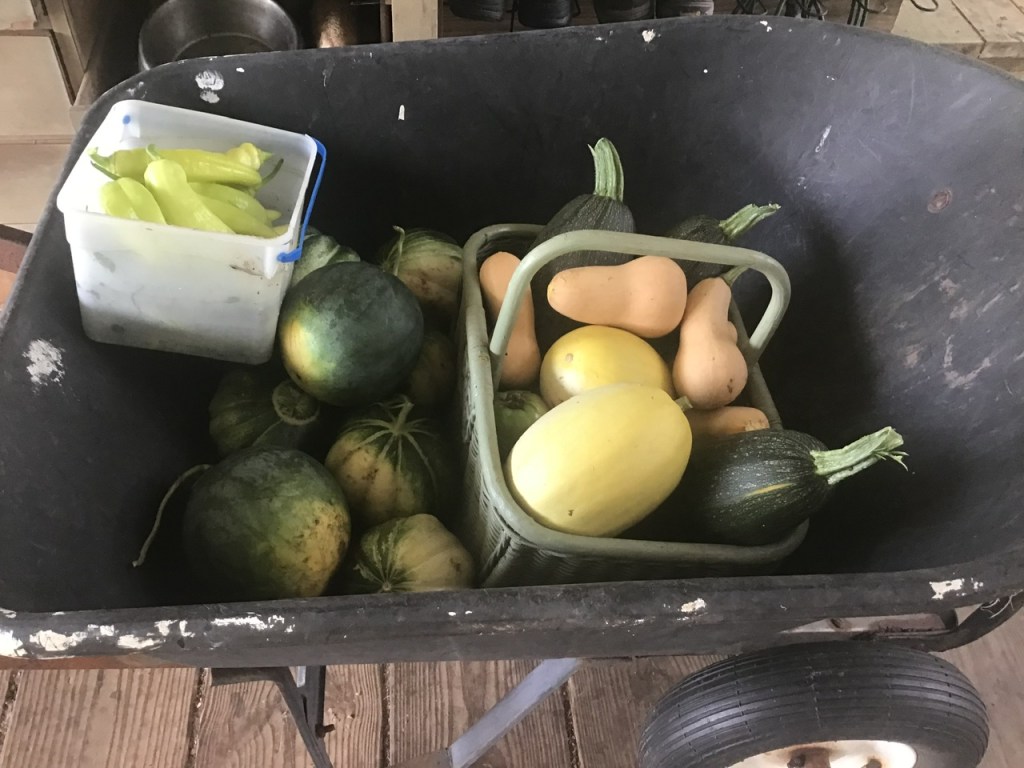
A nice variety of melons and squashes, we are quite pleased.
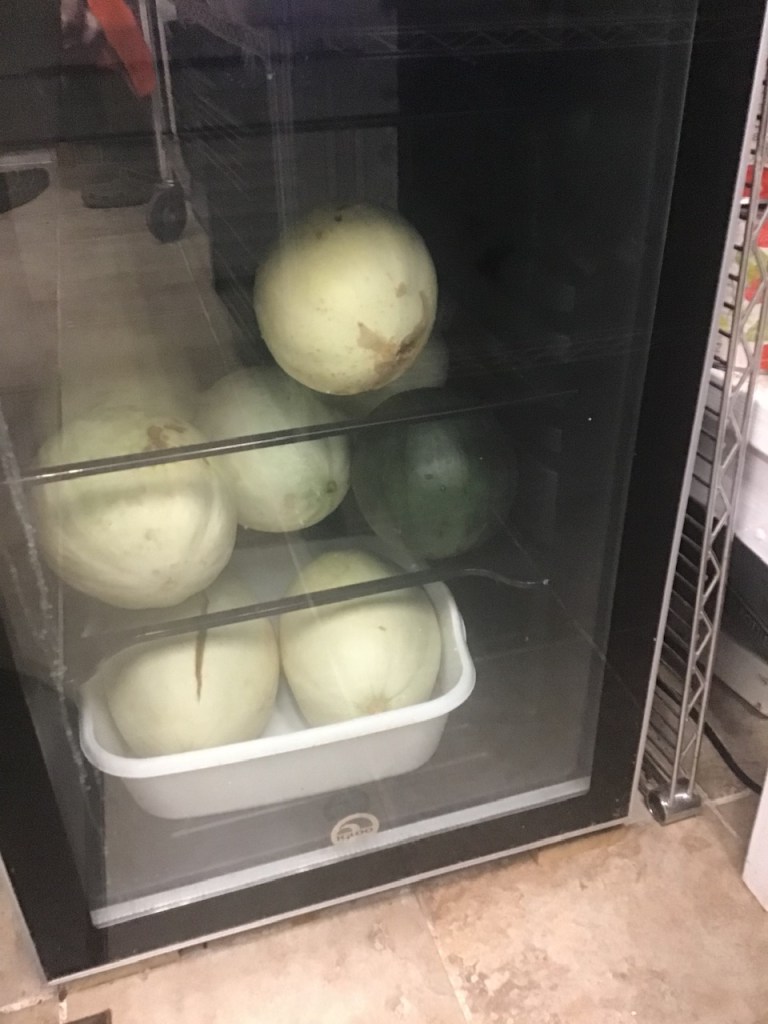
And still more, a mini-fridge of melon
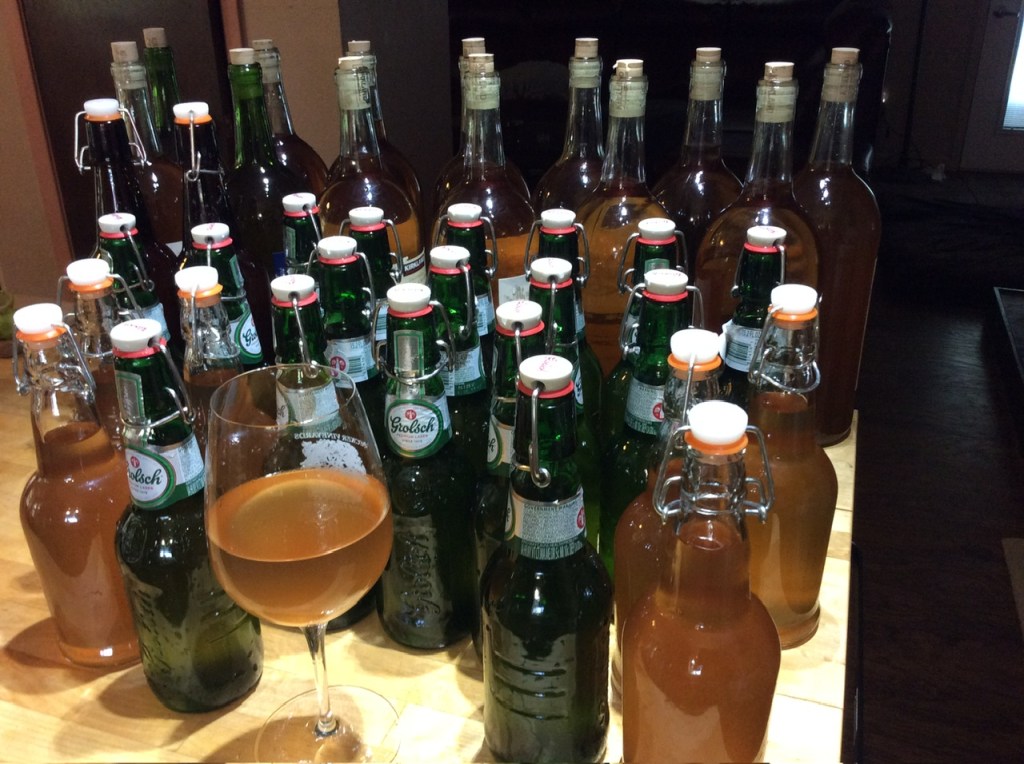
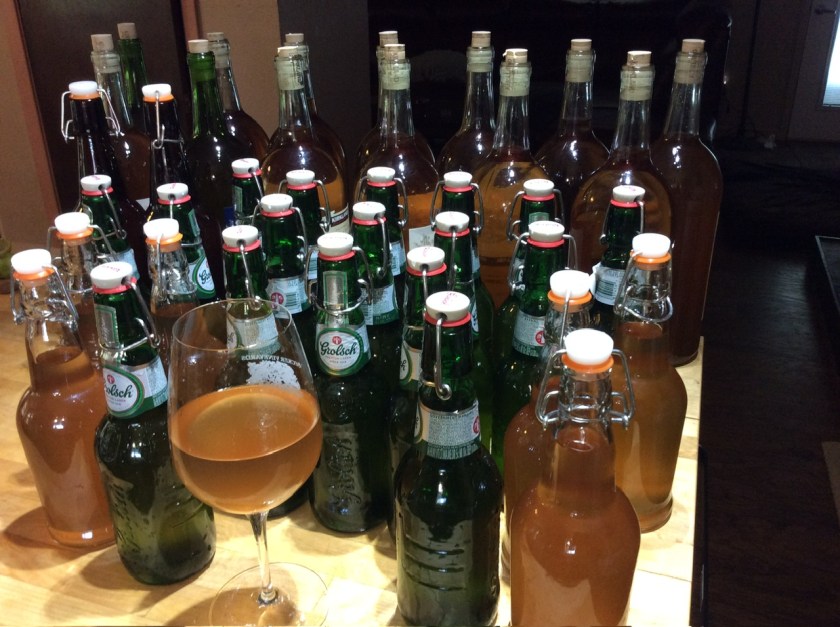
And still more squash! And cider.

While it could be Vacation Season for some more sane types, for us it’s the work of Shoulder Season. We keep the minimum that will survive our high heat for the next two months and baby most of them best we can.

But under lights inside the fall/winter garden is on its way. There’s already another crop of tomatoes coming up, as well as broccoli, cauliflower and arugula.

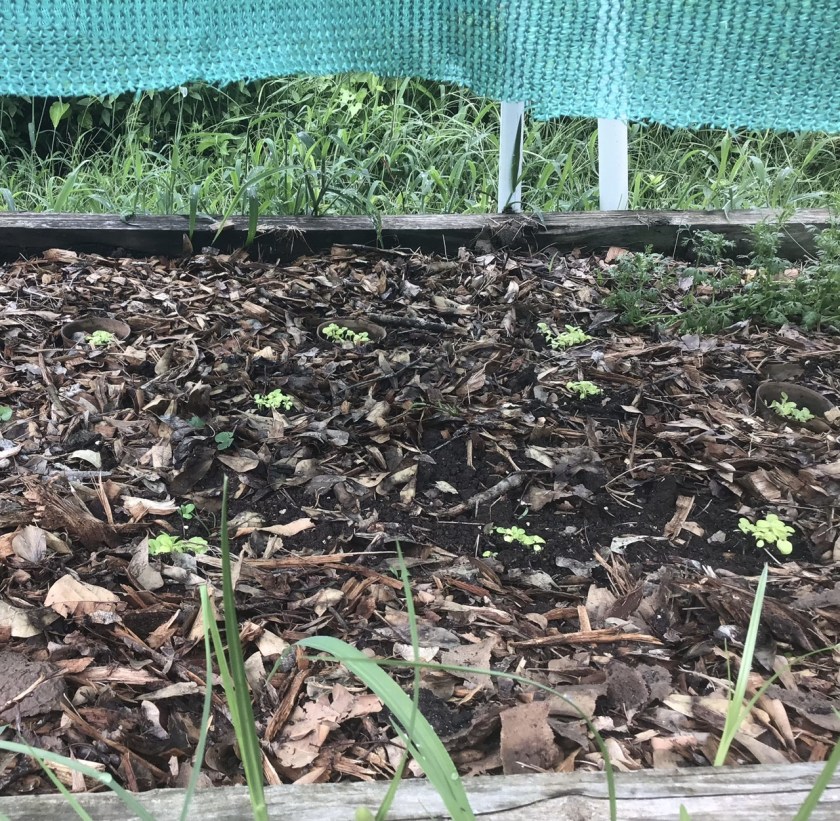
In the ‘babying’ bed I continue my lettuce experiment, starting romaine indoors under lights and moving under double shade cloth to transplant, then removing one level of shade cloth after a few days to adjust. They are still alive, yay!
Also in the ‘baby’ bed under shade cloth: some parsley barely hanging on, some dill trying to seed, 2 peppers, 2 dying tomatoes and lots of very happy basil.
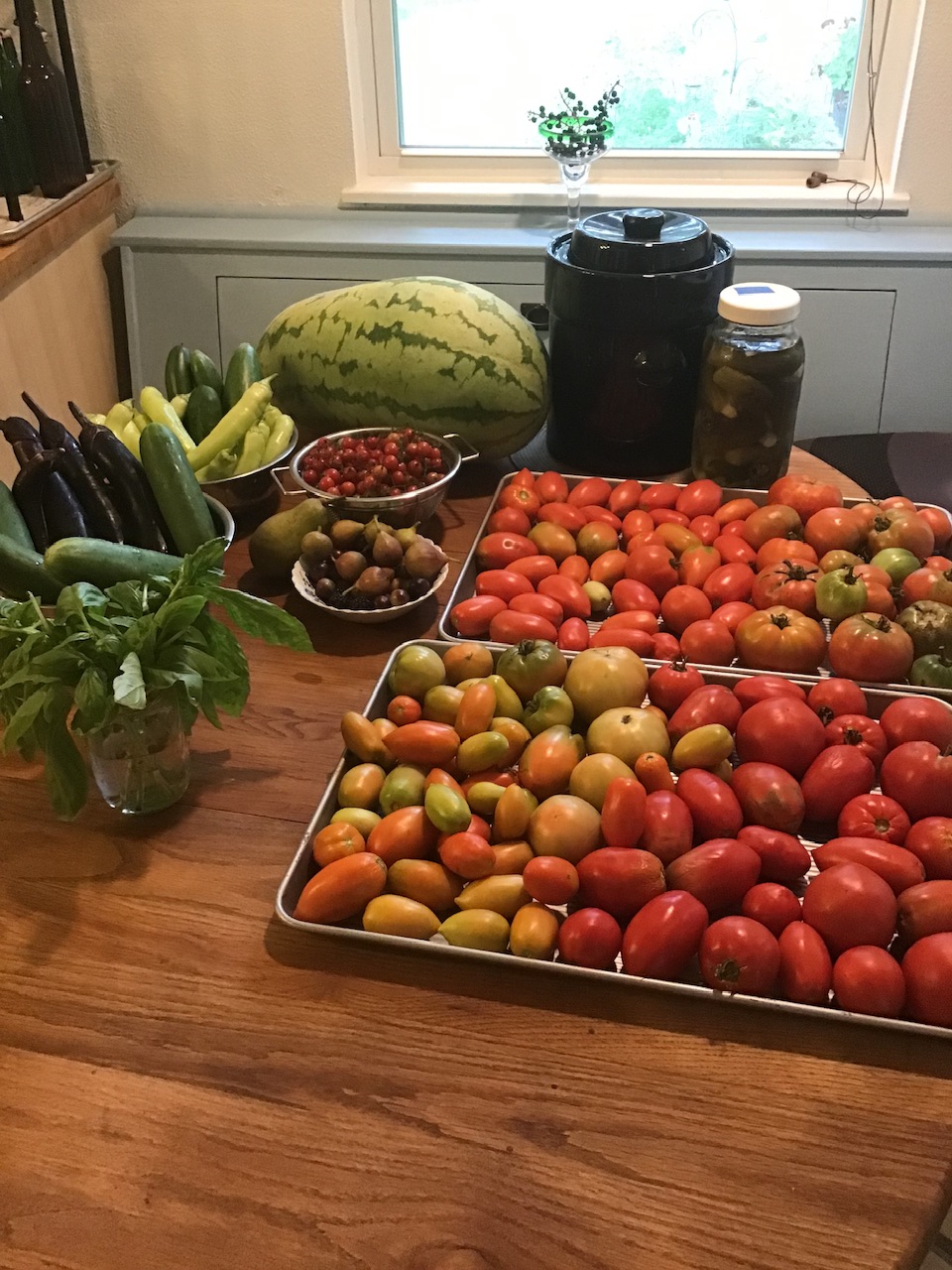
Tomatoes, peppers and basil for marinara. And in back left is cured lamb.

There’s processing to be done still, the marinara stockpile is done thanks to Hubby, but there’s still ketchup and bar-b-que sauce. And we still call this a bad tomato year!

stockpiling marinara

Ah, the gifts and curses of relativity. And surplus.

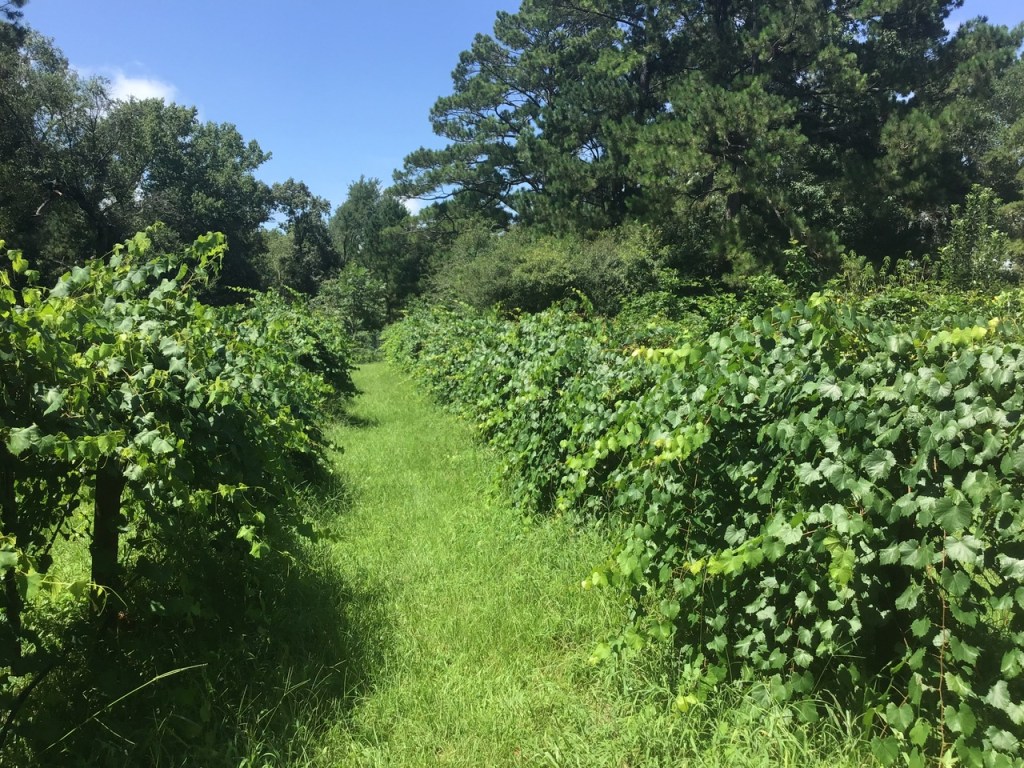
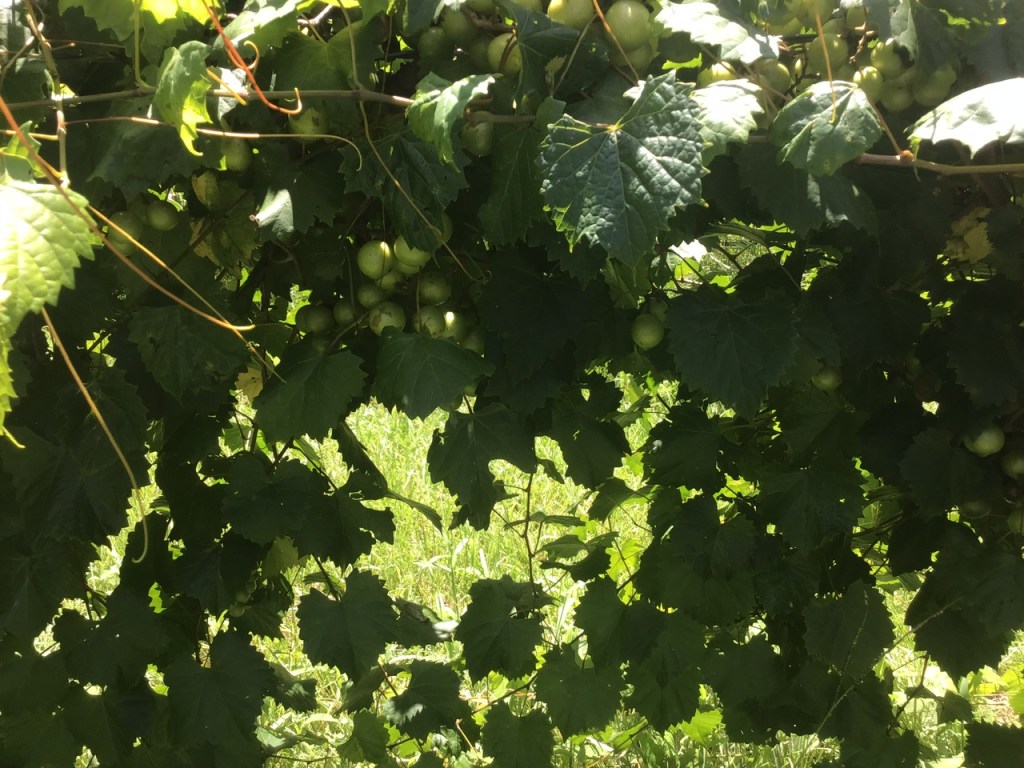
The pears are looking promising, and the grapes–which will be the next big project–wine and cider-making season. Blackberries and pears are our easiest fruits here; everything else seems to struggle. Though we have had years of good figs, and some neighbors still do. The grapes are looking good too, but there’s no guarantee.

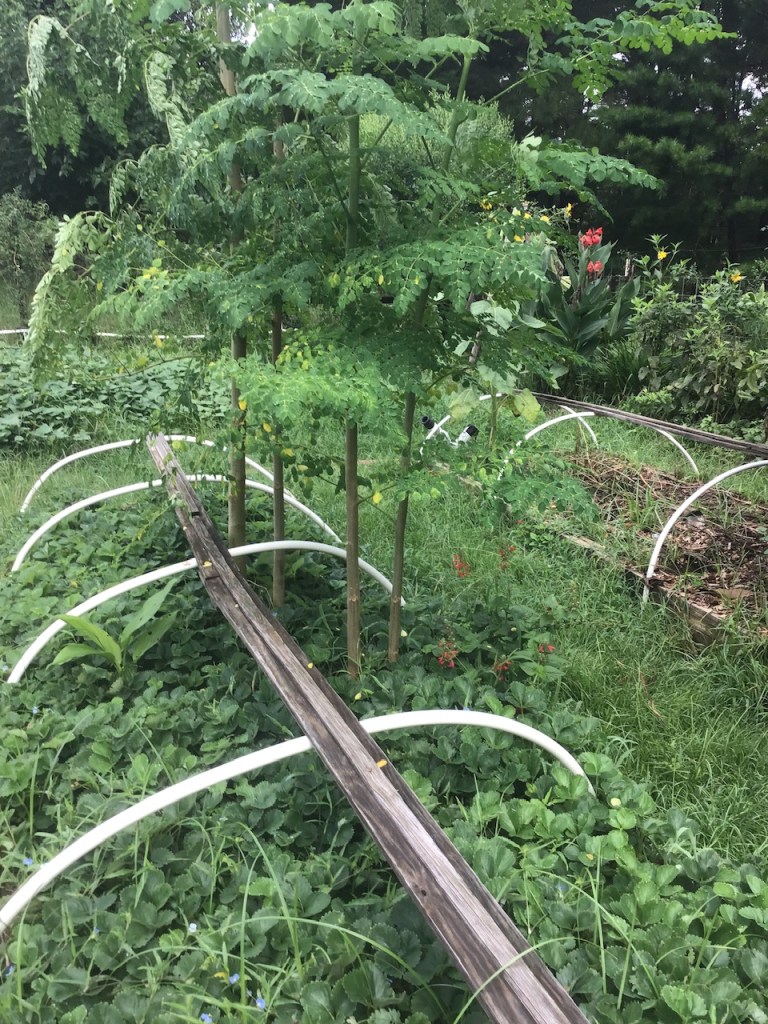
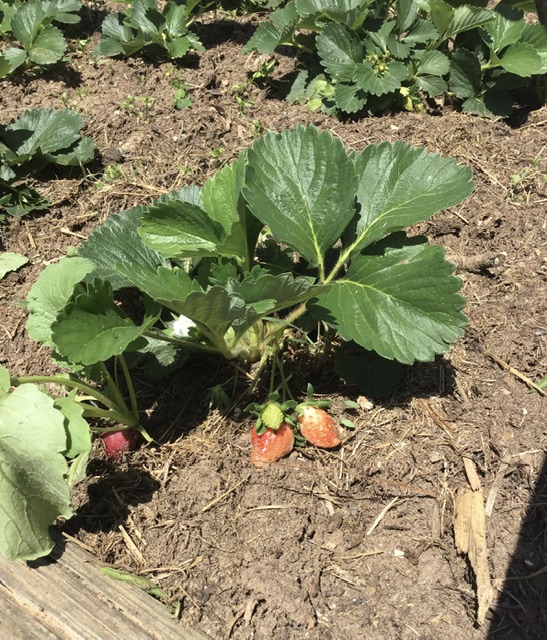
And I think I finally got the trick for strawberries. It seems most everything that is most delicious is high-maintenance. What can -we do, if we like high maintenance produce but to contend with the high costs of creating them?

Many years of failed strawberries, but this year was a great success in comparison. Now the runners are going crazy and taking over this bed, so next year promises to be better still.

I’m planning for more low-maintenance in future, but those might be high hopes.

Because, my choice would be to spend my dwindling number of pain-free hours working with the flowers!

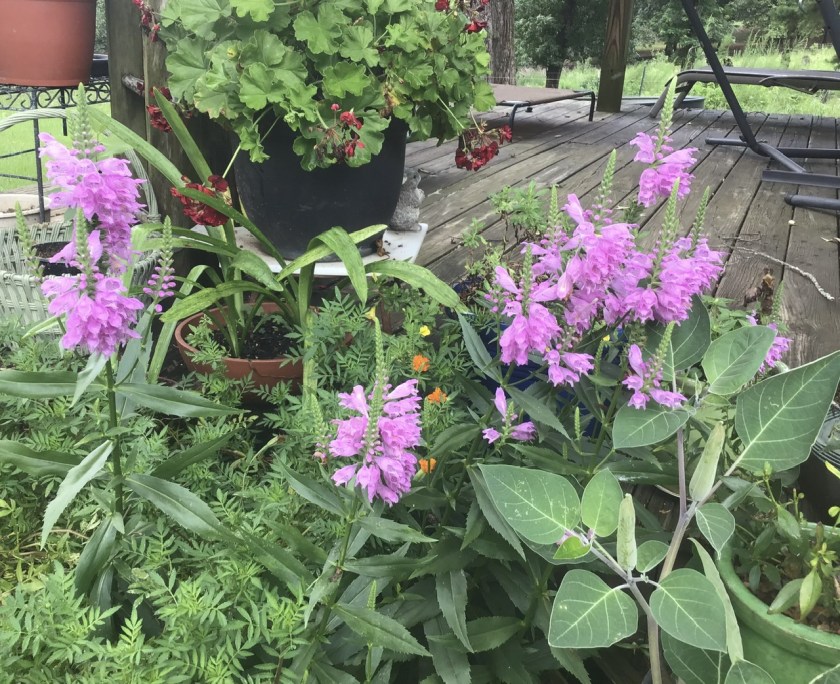
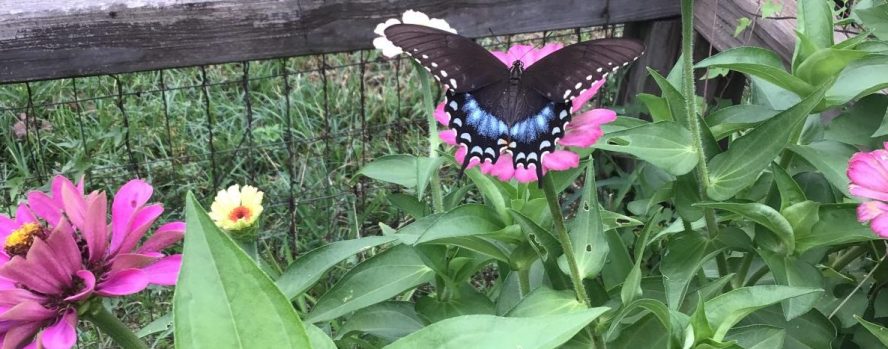
I’ve seen a few butterflies and bees on the pink ‘Obedience plant’, such a welcome sight!

Which brings up my other meaning for Shoulder Season.
So much shoulder pain! And I am not good at staying stationary, it drives me nuts actually. So it’s between physical anquish, or mental, and I do far better with the former.

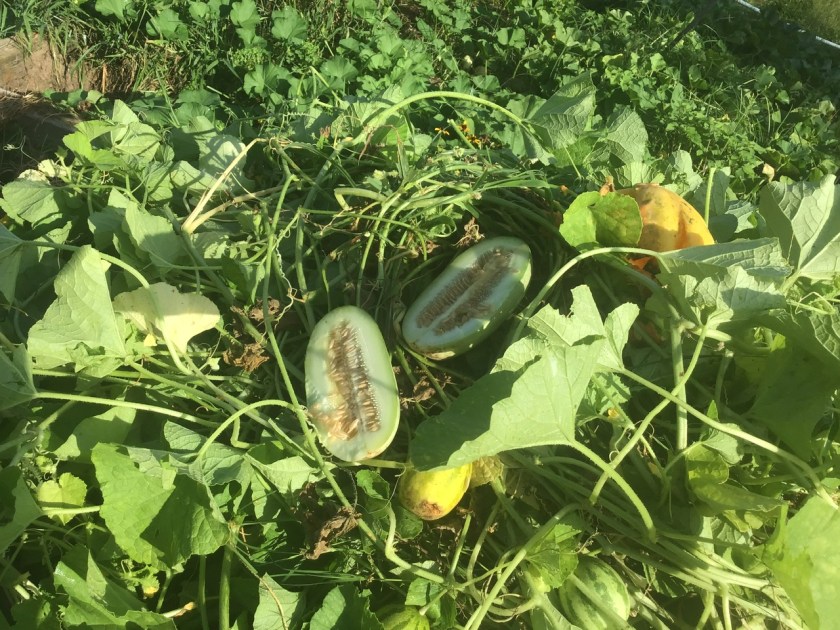
It’s as unwelcome a kinked, knotted, crippling invasion as this mystery fruit I posted about last year. I unknowingly caused quite a crisis in the garden and lost almost all the melons I planted.

What is this imposter which choked out all my melons?!

Just when I was insisting to Hubby we need to be thinking about reducing our garden plots in order to reduce our workload and water usage, I stand corrected. The orchard squash didn’t produce well at all, for some unknown reason; the garden melons were choked out by the wild cucumber; so without the third space we’d have no watermelons or honeydews, which would mean a mostly melonless summer after lots of work and wait, as the main garden produced about half a dozen sub-par cantaloupe.

A sweet, cold watermelon is the best morale booster in the hot, humid Texas summer garden jungle!

Two wheelbarrows full of vines and fruit the pigs don’t even like.

Wild cucumber vs melons and the melons lost bad. I have still not been able to figure out what these things are, which I brought into the garden under false pretenses. I have heard suggested they may be lemon cucumbers or mouse melons, but they are not the right size, shape or color for either of those.

I really get the frustration of invasive species now. I realize I’ve been a bit cavalier on that front in the past, for good reason, but I have definitely been humbled this time as these bitter, seedy imposters are still popping up everywhere.

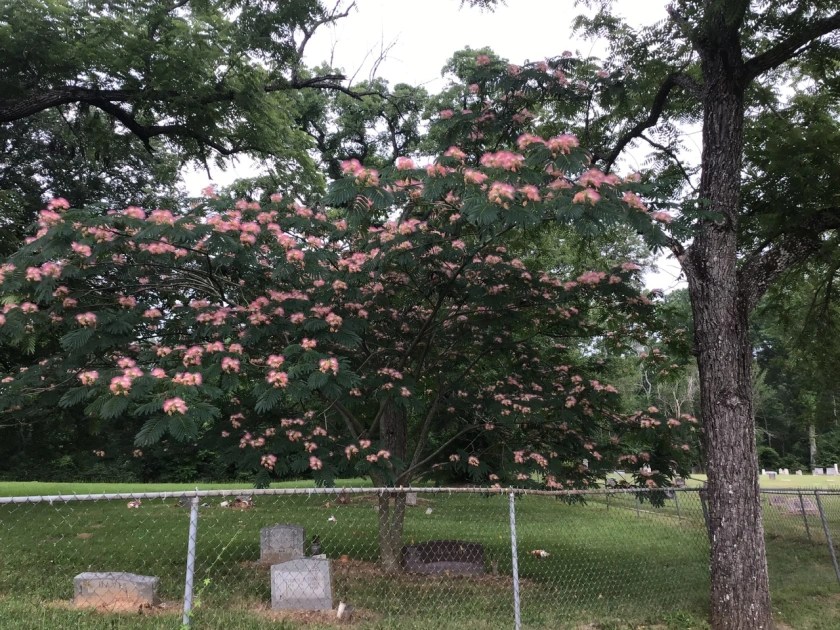
Please, give me an invasion of the supposedy invasive Mimosa trees, and I’d be thrilled!

You have my permission to invade my gorgeous Mimosa!

The plants that thrive here in the long high heat and humidity are so impressive, even when invasive, but it helps my morale considerably to consider the non-invasive ones as often as possible.

The sweet potatoes are almost effortless. Once they get established and as long as they get a good head start over the bindweed (another ‘invasive’ relative) they are pretty reliable. Eggplant and okra are others, and we’re learning to like eggplant. Maybe even a lot.

The bountiful basil takes center stage as the parsley, dill and cilantro take early retirement and don’t even bother to seed, it’s so damn hot.

Whether and which tomatoes will survive, or thrive, from one year to another is anyone’s guess.

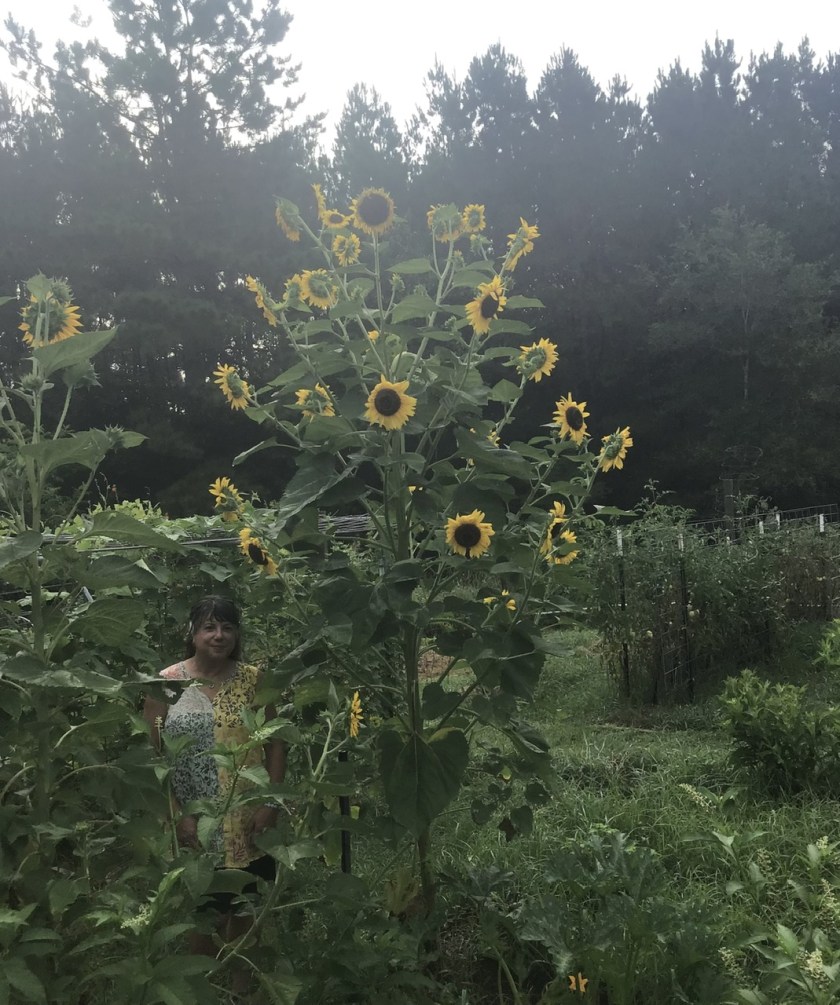
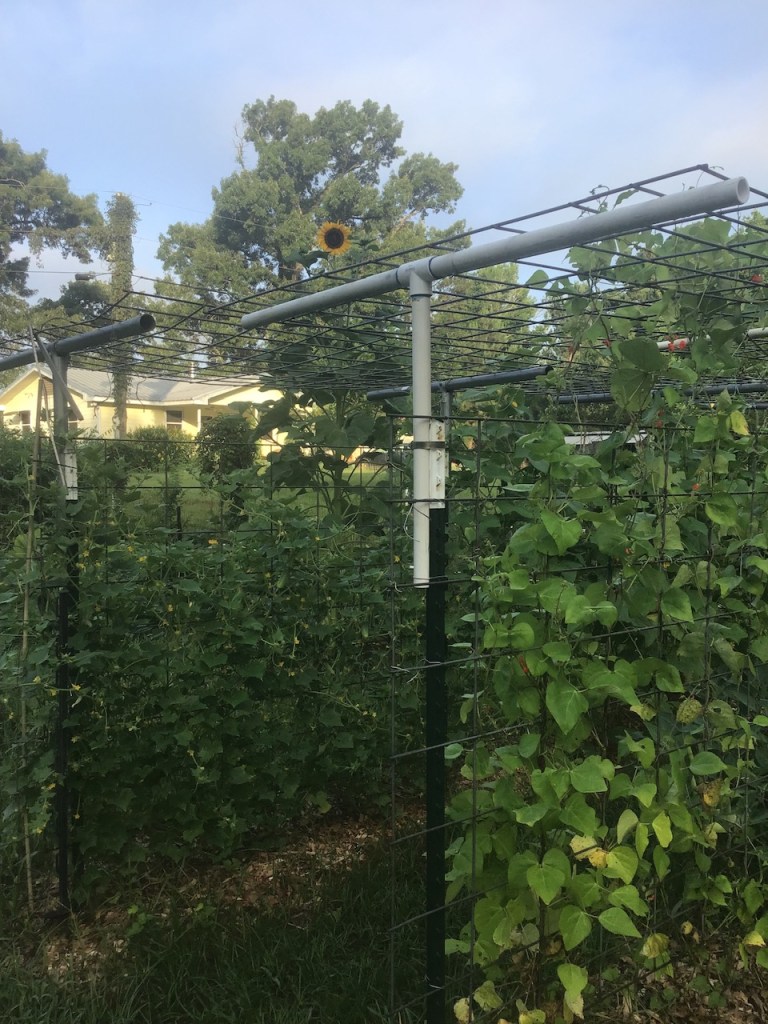
Gavin’s seeds, the Scarlet Runnerbean (barely) and Black Hopi Sunflower, are hanging on still, very impressive.

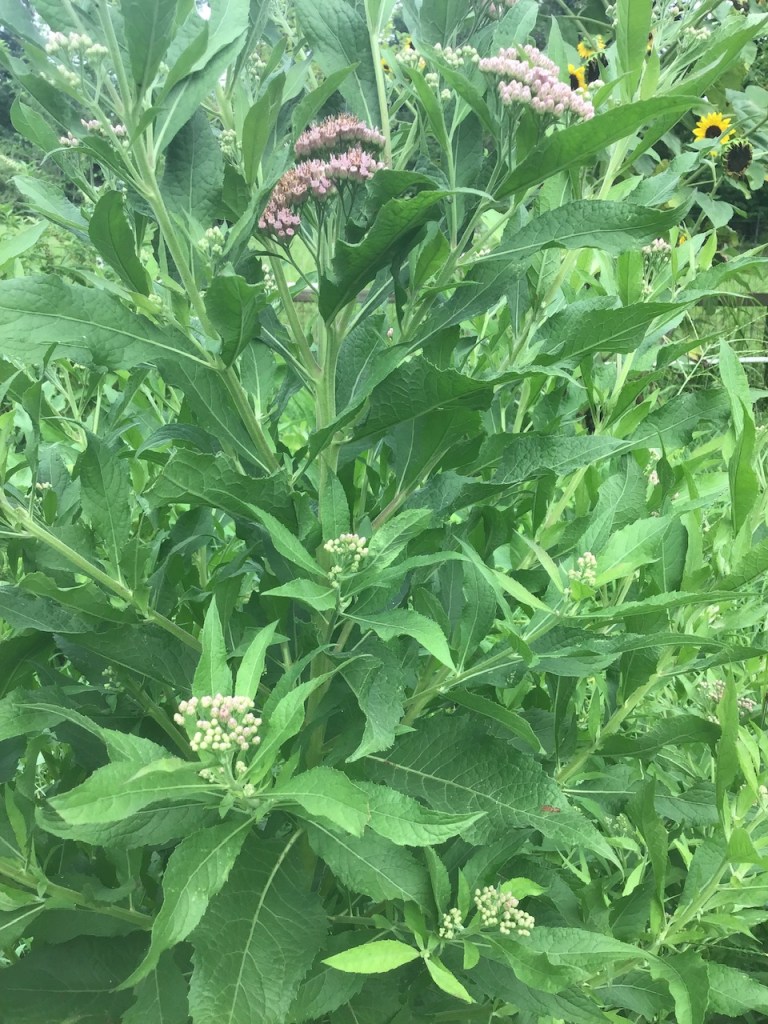
The black Hopi sunflower behind a mystery weed that smells medicinal. Any idea what it is, anyone?

The two out of three citrus planted last spring are doing well–they look healthy and their growth has more than doubled since spring.

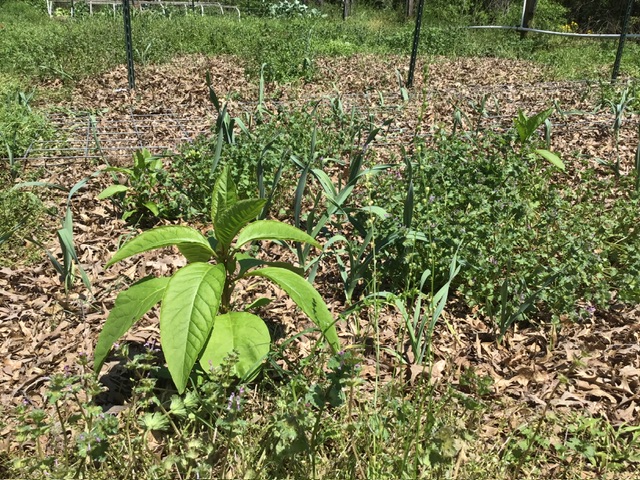
The poke weed, the datura, don’t get me started, such beautiful and amazing plants!

But, the mystery weeds, what are these?

Inquiring minds want to know!

Thanks for stopping by!

Gavin’s Reciprocity

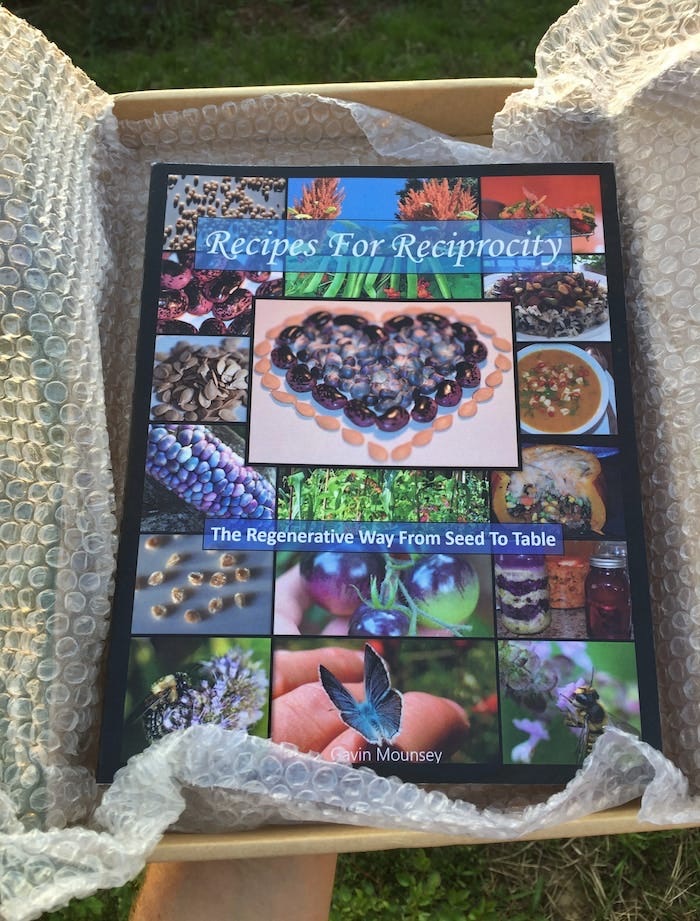
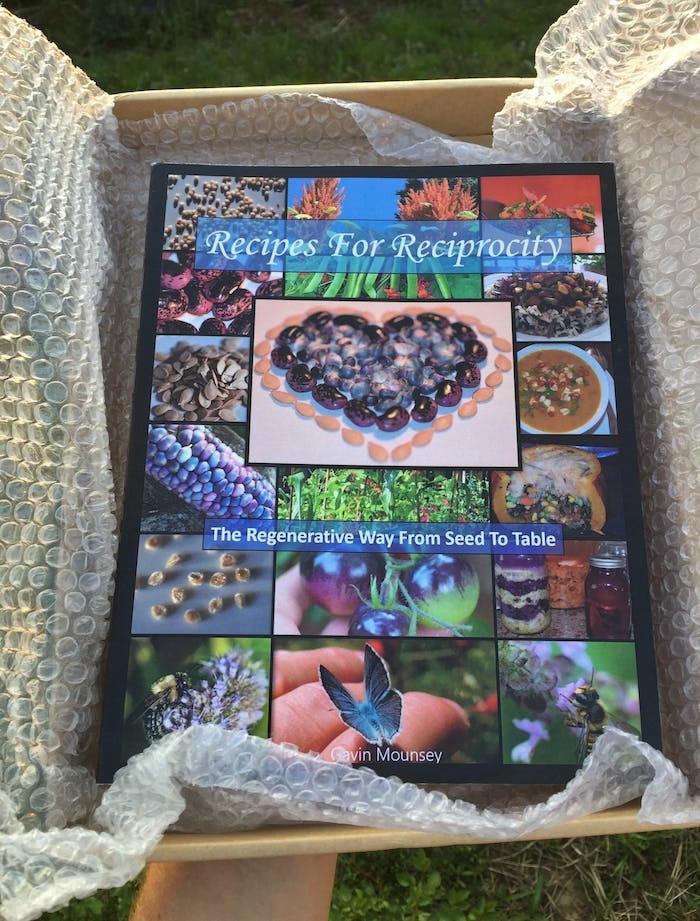
I’ve had a bit of challenge trying to simply label Gavin Mounsey’s book, “Recipes For Reciprocity: The Regnerative Way From Seed to Table” because it’s so much more than a cookbook. I have a great many cookbooks and my favorite type are what we might call ‘narrative cookbooks’ (though there may be an official sub-category name that I don’t know)–these are the kind where there’s a very present narrator telling you stories about the foods, and the places, and the people associated with the recipes and the author’s life. I might be inspired enough to write one of these myself someday.

Gavin’s book is not that, yet it is even more still. Rather than try to say it better myself, and fail, here’s an excellent description from the back cover:
“This book is a magnificent achievement. It can help you learn pracical ways to grow and cook mouthwatering food-as-medicine, and build deeper and stronger community, but it is so much more than that. Gavin has written a love letter to humanity and the living world and a manifesto for workable hope, all with an unflinching honesty about the crises we face. Gavin uses the nuts and bolts skills in the garden and kitchen as a launchpad to reimagine our place in the world, and the result is a solid foundation in the chaos. His hope and love are infectious, and the applied knowledge shared in his book is encyclopedic. I highly recommend it to you.” ~ Jason Padyorac

Along with the two books, one I gave to a friend, Gavin sent lots of seeds, some I’m already growing, others I can’t wait to try.

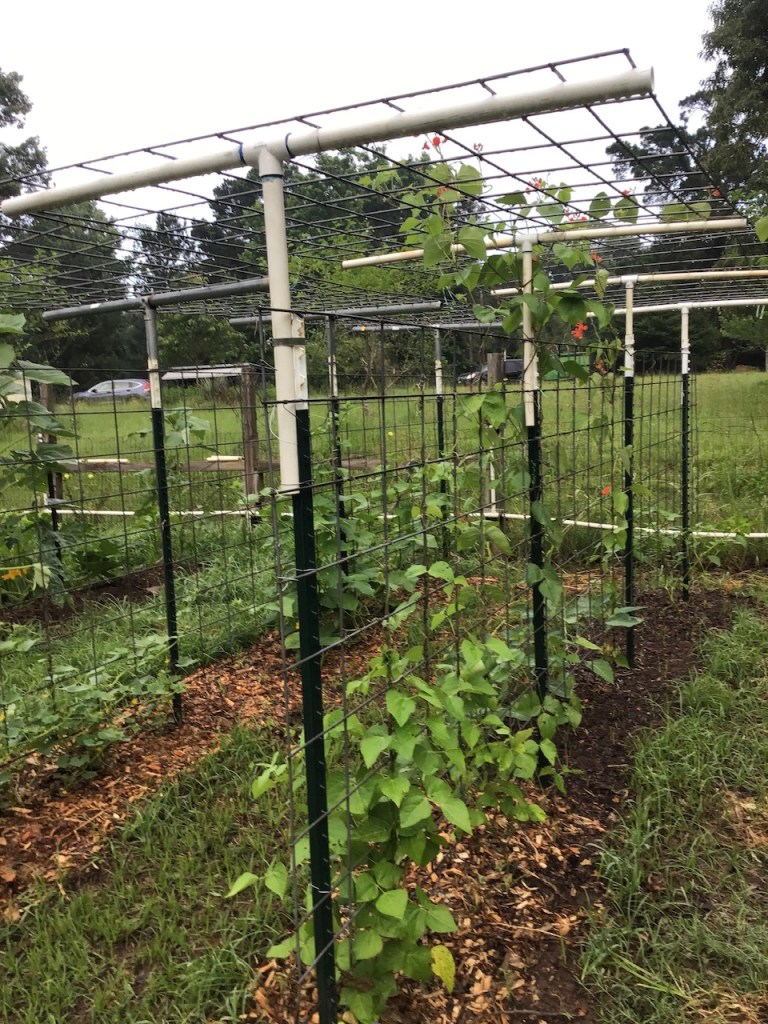
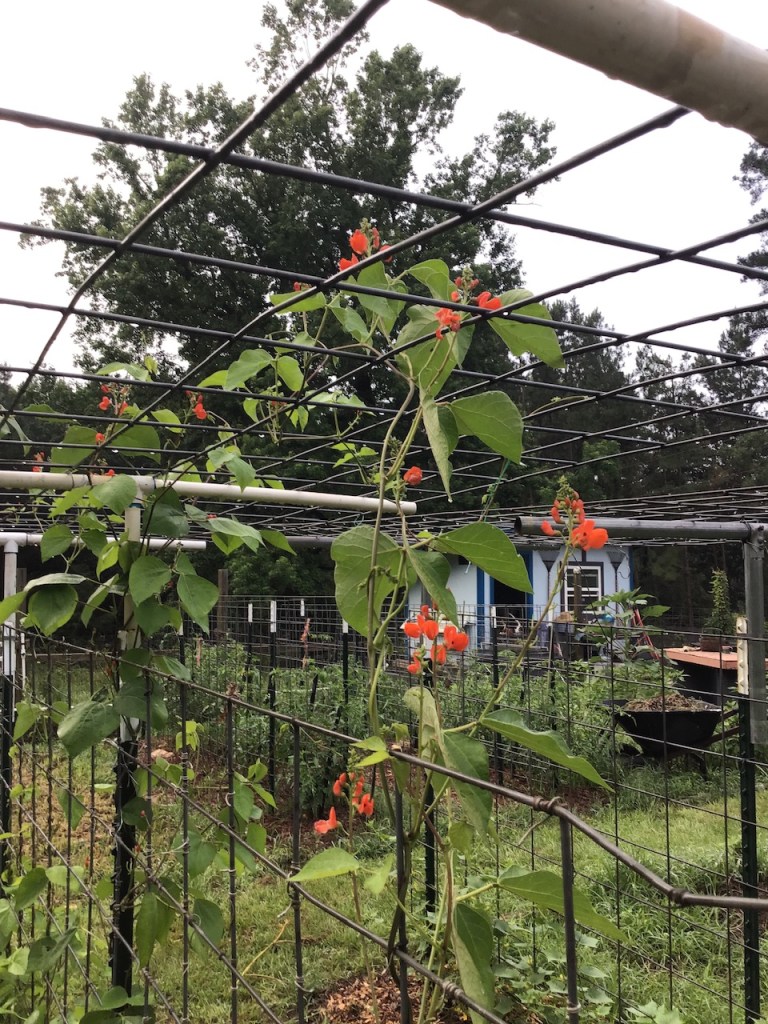
Scarlet Runner Bean in early summer, now dead.

So far I’ve planted the Scarlet Runner Beans and the Black Hopi Sunflowers.

Gavin:

“These beans are among my all time favorites for their versatility in the kitchen and beauty as well as productivity in the garden. They are an amazing companion plant due to the plant’s roots having the ability to associate with rhizobia (nitrogen fixing bacteria) which not only allows this plant to fertilize itself by pulling plant food from the air, it also means this plant can help fertilize its meighboring plants with excess nitrogen. On top of that amazing benefit the scarlet runner bean has beautiful red flowers that attract pollinators such as ruby-throated hummingbirds and bumblebees.”

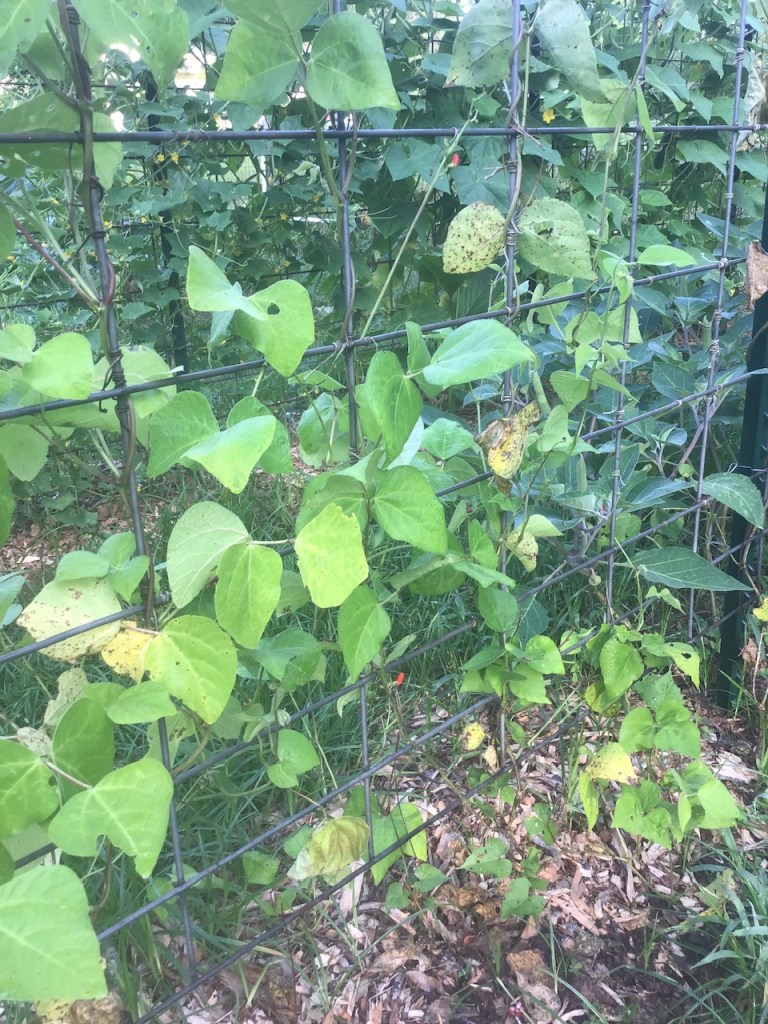
It is amazing to see how many fantastic plants can flourish in such varied climates. Because Gavin is in Canada and I’m in Texas I didn’t expect to find so many parallels in what we plant in our gardens, though certainly the timing and special needs vary quite a bit. The scarlet runner beans I’ve planted in full sun are perishing. But the others I planted which is shaded during the intense mid-day heat are hanging on. They’ve not produced yet, but I’m still hopeful and I like them anyway. I’m sure if there is any production and I can save the seed, it will acclimate to our area. Unfortunately, after a promising spring, the bumblebees and butterflies have been depressingly scarce in the garden lately.

Gorgeous! Ugly pity for the chem-sky.

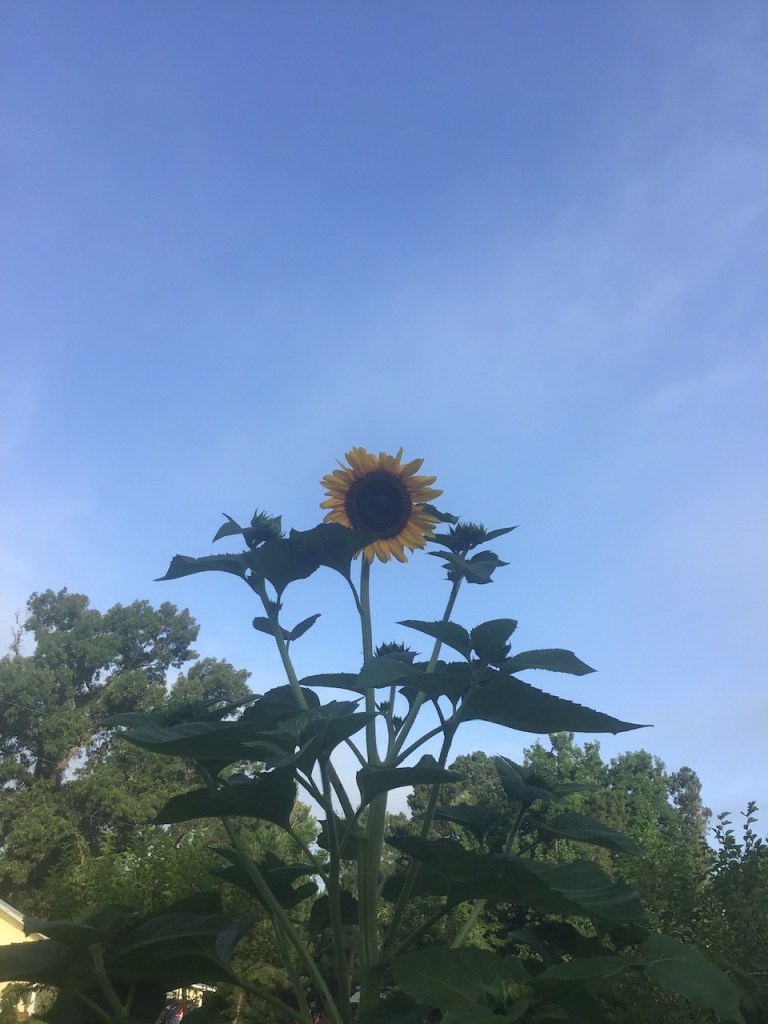
The Black Hopi sunflower has been the piece de resistance. It’s gorgeous and taller and fuller than any I’ve ever seen. I had several planted in several spots, and most of them got damaged in the high-wind storms we’ve had. But not this magnificent giant!

Gavin’s reciprocity in action is so inspiring, which is why I wanted to spend a couple of posts sharing about his book. Regular readers will probably remember I’ve shared some other of his work here in the past, especially in our Herbal Explorations pages, which come from his Substack newsletter.

In another post I’ll dive into a few of the recipes, but for now I’d like to expand on a few quotes which so align with my own learning and experience growing a garden and cooking seasonally from scratch. It has absolutely been the most rewarding journey of my life, with plenty of hope remaining for more of the same in the future.

From the section: Reciprocity in Action
“Choosing to give our attention to nature is also a form of giving back. Observing and paying attention to the cycles and living systems in nature involves giving our time and our thoughts. When we closely observe nature we inevitably come to perceive countless expressions of beauty through our perceptions of the form, color, sound, scent, textures, tastes and relationships that are all around us. This leads us to caring, feeling gratitude for and feeling compelled to protect the amazing gifts nature shares with us. From the place of gratitude we engage in one of the most meaningful and powerful acts of reciprocity. We open our hearts, we feel content . . . we practice self-restraint, we choose to live more consciously and aware of how our life choices impact the living planet that sustains us and showers us with endless gifts.”

Gavin most certainly has an eye for beauty, his photography is stunning.

(3) The Jubilation Of June – by Gavin Mounsey

https://gavinmounsey.substack.com/p/the-jubilation-of-june-d41

I know how daunting it can seem to dive into a new hobby like gardening, or even cooking nowadays, but there’s so many smaller and easier things that take so little effort or knowledge that might be just the momentum for many to kickstart a healthier life and society.

Just observing. I couldn’t agree more. It really does start that small and simple and while I have read loads of books on gardening and cooking and many adjacent subjects, I’ve learned far more from observing. Taking notes helps too, but considering how bad I am at that, it must not be totally necessary.

The other few very simple things that require no gardening and very little cooking is compost and ferments, both which Gavin discusses in the book.

Why those two, you might be wondering? Because in my experience, composting makes you far more conscious of waste, and fermenting shifts your attention to the weather and seasons. Both of these processes have enriched my life and health and outlook far more than I could’ve ever imagined.

A window sill of herbs would be enough to use up the compost produced by the average small household. Or donate it to a friend who gardens if you have such a black thumb or really no space. And who knows, maybe she’ll reciprocate with a zuccinni or two.

I had no idea what eating seasonally meant. Really. Until I went to the farmer’s markets in France on a high school exchange program, I had zero clue produce even had seasons, and considering how much is grown indoors today, that’s probably become more normalized than ever.

Considering I grew up eating like the vast majority of Americans–fast, frozen, canned, bagged–I know what easy looks like, and this is pretty darn easy. The shift really is more in attitude and attention.

Now I long for cucumber season as I long for tomato season as I long for melon season as I long for radish and lettuce season. It’s become that nuanced and I love it. Sure, there’s some cross-over and we can and ferment to save the bounty. But that limited time window of bounty becomes a season within a season, with all that entails–a change in primary food and focus–all with their unique gifts and challenges.

Surplus requires work, work requires rest and creates reward. 😊

The ebb and flow of surplus and scarcity becomes natural again, each bringing its own unique gifts and challenges.

My influences growing up–that of media, education, environment–worked synergistically as detachment mechanism. Nature was that which we were being systematically detached from, and that trend has only exaccerbated, to the growing dis-ease of ourselves and our environment.

“Within the last century, healthy, natural, organic food has been made more difficult to produce because of the chemical pollution, at first, and genetic pollution, more recently. A handful of companies have spread these toxins across our planet diverting US$ 400 billion of public money to subsidize their high cost chemical commodities to make them artificially ‘cheap’. The costs of this ‘cheap’ food are astronomical in terms of the health of people, the ecological damge it causes and its exploitation of farmers. If the true costs of chemical food were taken into account it would be unaffordable. Insead of subsidizing chemical food and creating epidemics of food-related diseases, public money, used for nourishment and the protection of public health through organic food, would save us billions in health care. Denying people their right to healthy, poison-free food by manipulating laws, policy, science and the use of public money to impose a non-sustainable, unhealthy food is food-dictatorship.”

to be continued . . .

Thanks for reading!

Homestead Happenings

It’s been so long since an update I don’t know where to start. Or where to end, or what to include. But I figure there have got to be a few readers out there hankering for some other news besides the shitstorm coming at us from the global mafia and the media cartels.

Mostly done, finally!

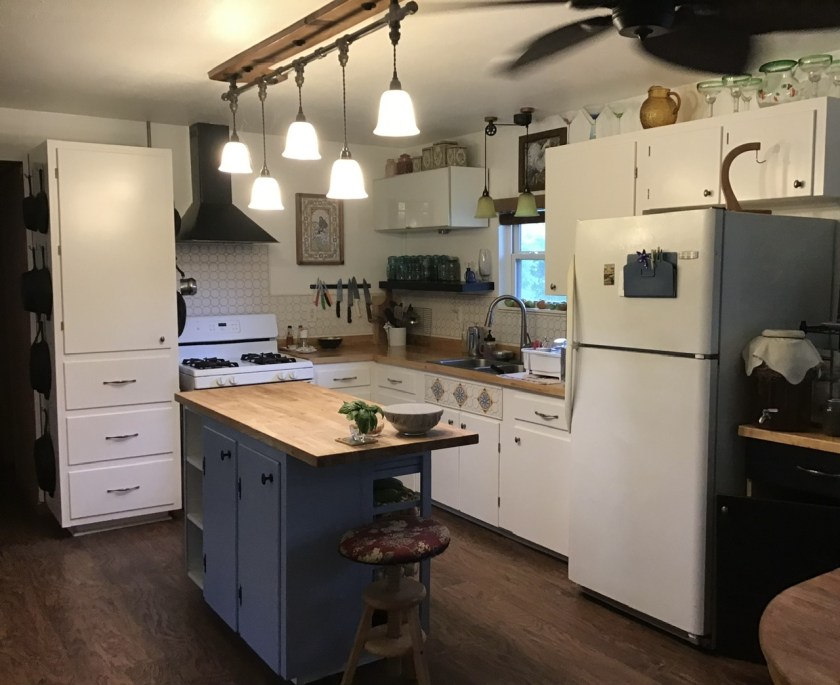
In my last update we’d started remodeling the kitchen. That was a very big DIY job, it took a very long time, and we’re still not totally finished. But we are very pleased with the results that were easy on the budget and tested our creativity, skill and resourcefulness.

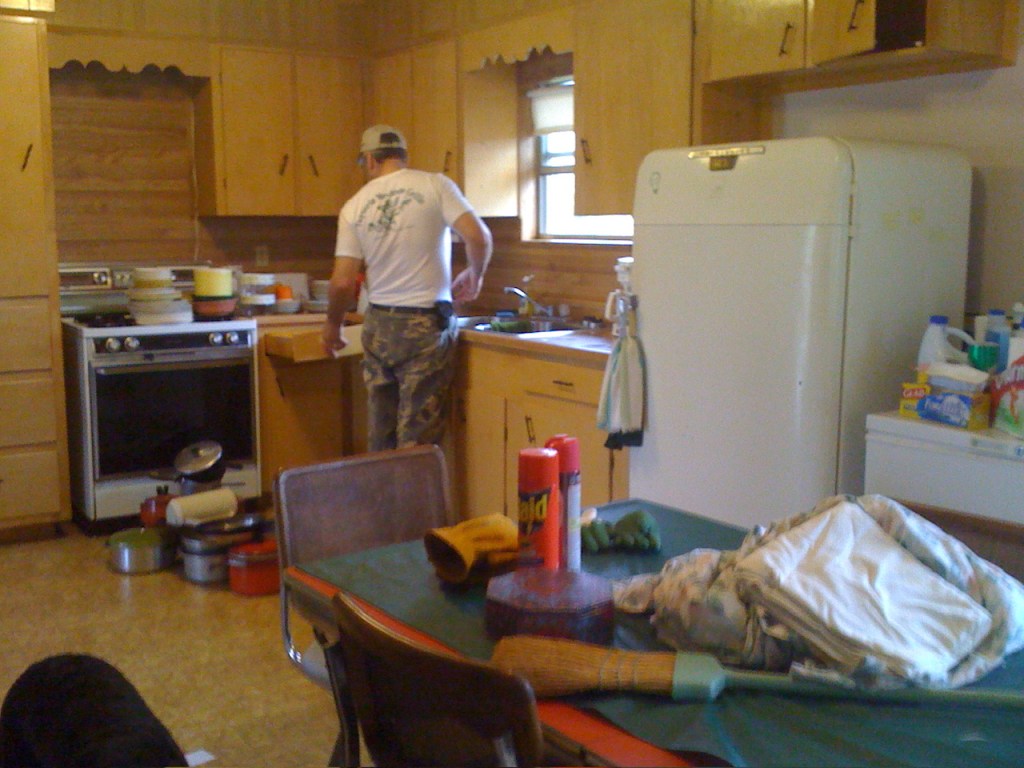
I thought I’d include our first time redoing the kitchen, in 2009 when we first moved in, with the previous owners’ belongings to haul away before we could begin. It had been empty for many years and the mice and roaches had taken over. It was a disgusting experience, the worst of which we got to avoid this time, so that was a bonus.

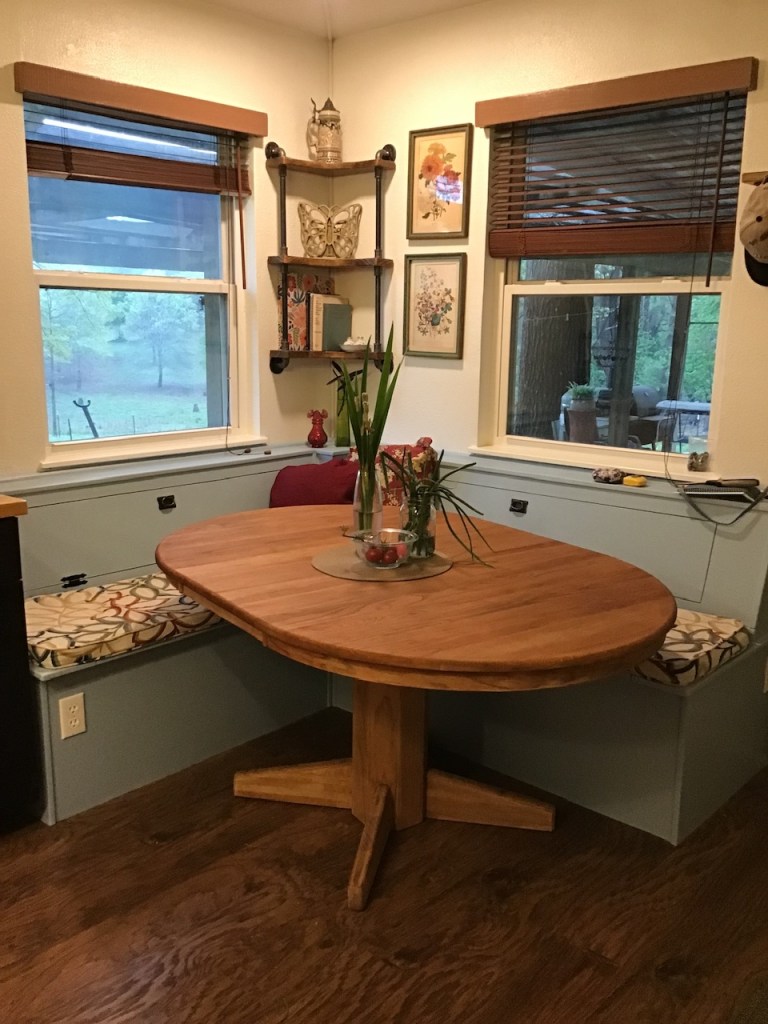
This time we also repainted the ceiling and walls and all the cabinets as well as the breakfast nook bench and storage unit Hubby had built previously. He also replaced the countertops and handcrafted new lighting and shelves, expanding on the same ‘steam-punk’ style as he used on the entryway table he built last year.

Work in progress:

After way too many lost hours, I was not always a happy DIYer! But I am pleased with the result.

I spent a lot of time stripping and re-staining the kitchen table. I still want to dress-up the windows treatments and paint the doors and bases of the table and stool. But then we got too busy and had to devote our time to the garden and orchard.

The cucumbers and zuccini that were badly damaged by hail in late spring did make a bit of a comeback, but now are succumbing to the heat.

Unfortunately and as usual, a lot of the time devoted to the garden gets wasted because of crazy weather. This year has been no different and we had a lot of rain at the wrong time for some crops at some stages. The older peppers did fine with it, but the younger ones look terrible and are not recovering. Same with the tomatoes. The heirloom Scarlet Runner bean is struggling and not producing, but is still quite pretty as an ornamental.

I’ll be writing about those seeds, as well as the ones that grew this great big beautiful Black Hopi sunflower (the tallest I’ve ever seen!), in an upcoming post about Gavin Mounsey’s book Recipes for Reciprocity, because the seeds came from him.

These cucumbers were just the right age for survival and are going strong now.

I’ve gotten good at succession planting over the years for the reason of crazy weather. In very early spring I try to get tomatoes, flowers and herbs started, but am often disappointed by late frosts. Days of heavy rain and high humidity with overcast skies can easily cause damage to younger more vulnerable plants in early summer. By this time of mid-summer I’m sowing more cucumbers, herbs, and sometimes beans, but it’s often already too hot for them to get established. At this point, we get what we get until fall brings more hope.

But of course I can’t be satisfied with that and am always experimenting. Often it’s fall tomatoes or melons, which rarely work out. This year it’s the challenge of romaine lettuce through summer. I seriously doubt it’s possible, but I’ve got a tray that has just germinated under lights inside to give it a try. I’ll put them in a shaded box, with plenty of hardwood mulch in an attempt to keep the roots cooler. It’s been in the 90s everyday lately, humid and not cooling off much at night, but there’s still some growing that wasn’t smashed by the heavy rain and hail a couple of weeks ago.

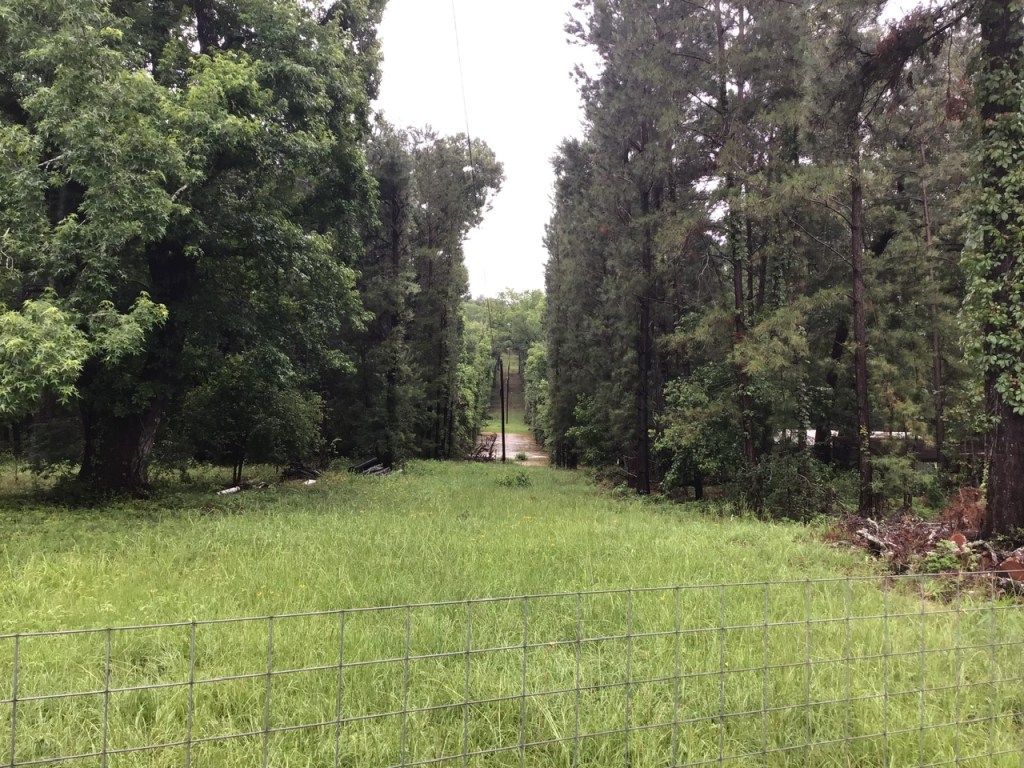
Left photo is view from garden, normally the creek is not visible at all. Right photo is walking along the power easement to the very flooded creek banks.

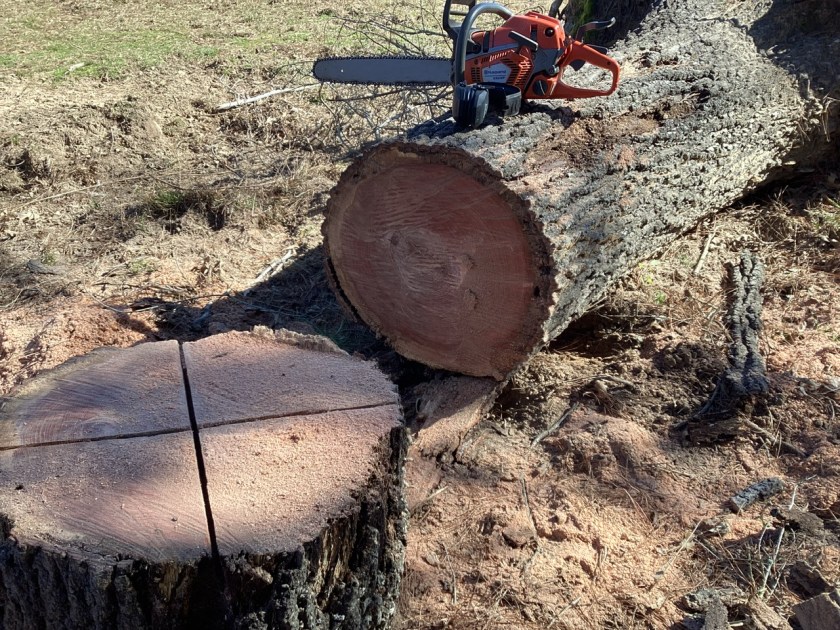
We also had another big oak tree die suddenly in the prime of life. The last one was just taken (partly) down by the electricity company’s crew because it risked falling into their cables. The latest one Hubby will have to fell himself, before it comes down on the fencing. That will probably be after he fixes his bridge to nowhere that he just built last year in response to flooding and was nearly taken out by this year’s repeat performance.

Sudden Oak Death Syndrome?

In the last two years, with no tornados or hurricanes to blame, we’ve had three large trees right around us flash out dead in a matter of days. Rather disconcerting to me, to say the least.

No such bounty this year I fear.

Still, let’s end on a positive note. Some years are better than others. We had an inexplicably bad blackberry year, but this year was excellent. Hubby made blackberry wine with much it, which was much better tasting as a young wine than the one I tried to make and age last year. Some years we have amazing tomatoes. Other years it’s great melons. Maybe this year it will be spectacular grapes?

It doesn’t take much for fabulous meals when food is fresh. Fermented herbs and veggies add flavor and nutrition with just a little garden surplus or foraging time. The chanterelles always do better with lots of rain. Hubby’s delicious young blackberry wine makes such a refreshing spritzer when mixed with kombucha.

Eating seasonally from our land is so rewarding even when we don’t have a bumper crop.

I have a long list of content coming up during the swelter season, so all the more excuse to stay indoors. Thank Man for air condition! 😆

And thanks for stopping by!

Beauty & Bounty

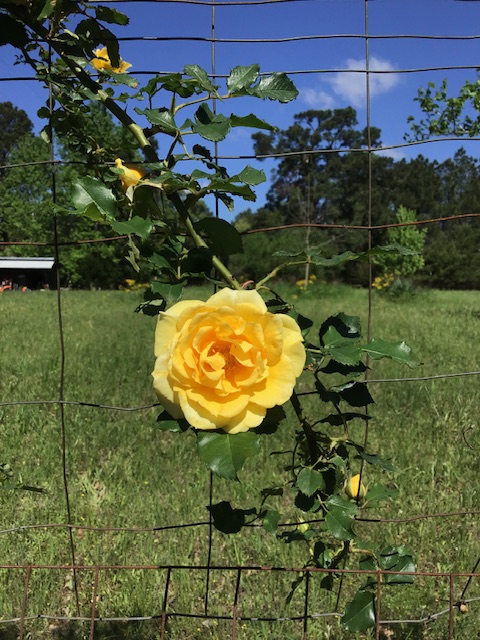
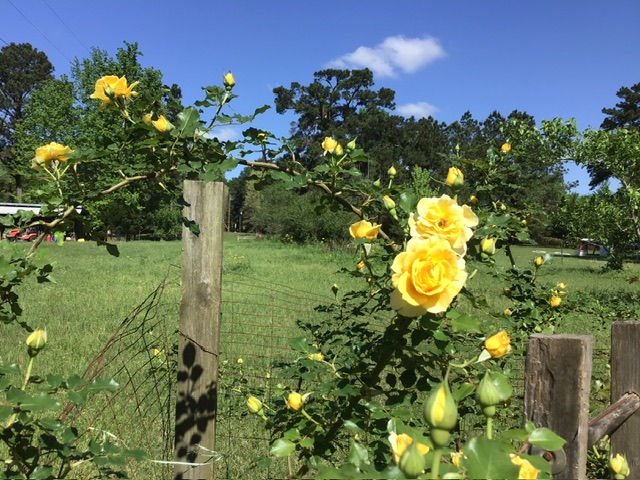
Such a busy time of year already, made busier with our remodeling projects, but we always make time to stop and smell the roses.

And bow to the weather gods, or geoengineers, who have spared us this time, and after so much barking, we are grateful there was no bite. Before I sing our praises, let me acknowledge those further north who are biting the bullet this time around. Our picture perfect skies are so very rare, I don’t like to think about all that means.

We did prepare all we could for the worst, annoying as that was. Out came the row cover fabric again and the wheelbarrows full of logs to hold it down, after just having cleaned all that up and took it to storage the week before.

We expected a frost for sure.

All the pots had to be gathered to cover all the peppers and tomatoes. And considering it was so hot and humid and over 8o degrees when we were doing all of this, it felt more incongruent than snow along the coast of the Gulf of America. 😂

But, I can’t complain, because as I just said, we got very lucky. No hail, tornados, landocaines, flooding and we just barely scratched by the frost threshold.

Just look at that sky! I can’t tell you how long it’s been since seeing such a sight!

There is so much beauty and bounty, in nature, and in cyberspace too!

Just yesterday I was scrolling through my Youtube feed and about every 100 suggestions up pops a true gem, like this old Mexican lady cooking her heart out and sharing it with the world. This is the very best of the power that’s right at our fingertips, I truly believe that: The world’s people sharing about their cultures. The cuisines, the histories and myths, the music, the dance, the landscapes, the languages, the gardens, the architecture–and the ordinary folks sharing them. Unfortunately, as the AI gods have demonstrated, for every such miracle there are about 100 curses.

Make food not war!

There are the tiniest gems not to be missed through all the noise and all the neon glare.

And it seems like they are beckoning me to slow down and notice them.

What would you rather do . . . follow me around the garden, or do more of that thing you call work?

A plot of volunteer poke weed and garlic, as if they’re just screaming, we are here for your good health, so happy to be here, we keep returning for you!

Sometimes, when I least expect it, we learn how to grow together better. Like I was thinking of the old Southern trick to set out red-painted pebbles to fool the birds into keeping off the strawberries. I thought, I bet some well-placed breakfast radishes would have the same effect, and sure enough, it’s working. The birds have moved off that bed ever since those radishes started showing their little red tops, and bonus, we adore radishes, maybe even as much as strawberries.

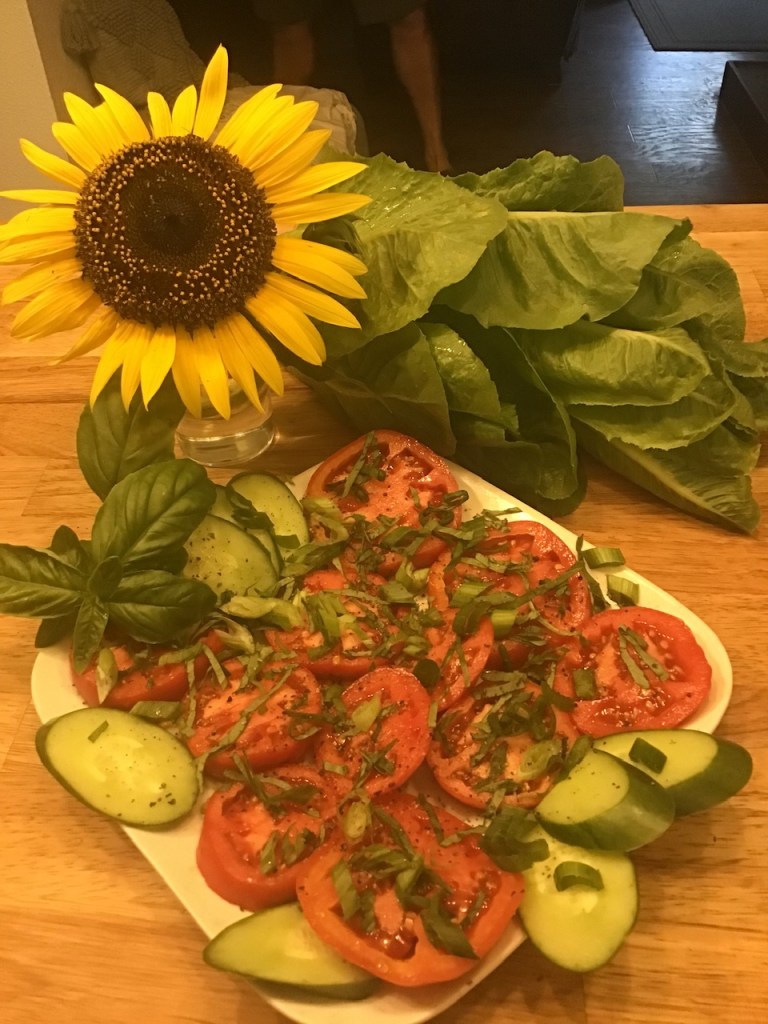
We have been eating giant salads every day, with enough surplus for our neighbors.

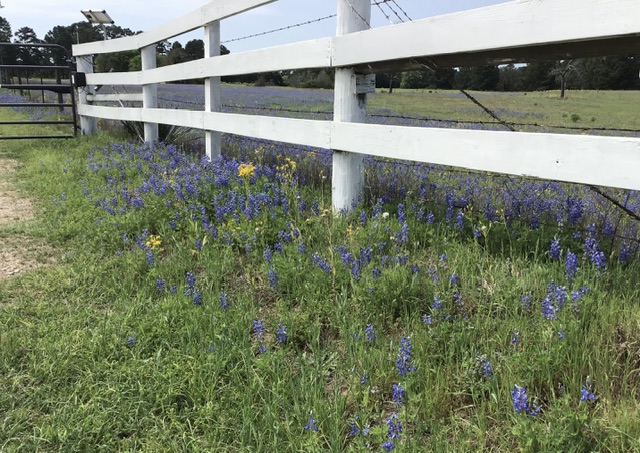
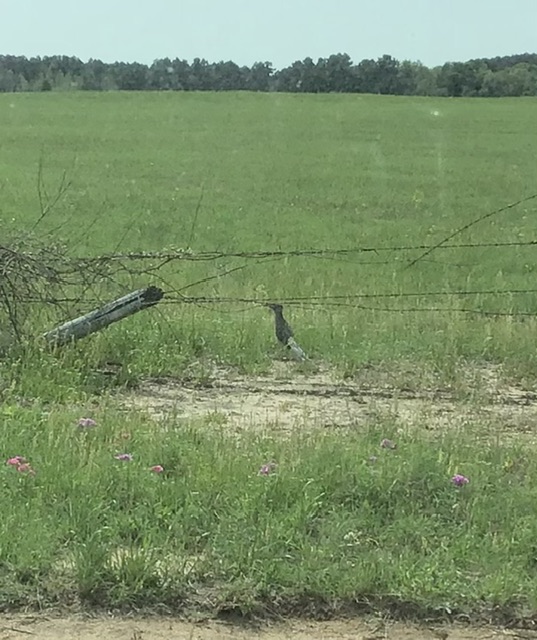
Along the country roads all is flourishing. The bluebonnets are brilliant and I even caught a roadrunner, just barely.

Such gifts of beauty and bounty! What a precious, ephemeral time to infuse their bursting energy into our year ahead. What we put into it is what we’ll get out of it, just like life.

I hope your spring is being beautiful to y’all, too! Thanks for stopping by!

Homestead Hope(ium?)

What is the difference between Hope, and Hopium? There’s a fuzzy line and it’s very easy to misjudge, but it’s located somewhere between: “Yay, Trump will save us all from $11/dozen eggs!” And “We should start a chicken mega-ranch.”

If those two meet in the middle of the road, might creative minds find that they’ve absent-mindedly crossed with logic and conclude a few laying hens might be just the ticket? A bit of self-sufficiency, why not? After all, it’s not rocket science . . .

Joel Salatin exposes the WEF agenda!
“Josh Sigurdson talks with Joel Salatin of Polyface Farms, an entrepreneur and farmer who for years has fought against Monsanto, factory farming and dependence pushing for people to homestead and/or farm and not be dependent on the system.
We previously interviewed Joel in 2017 regarding Monsanto. Now, 8 years later, we delve into the massively expanded technocratic grid as more than ever, people are dependent on grocery stores, the grid and AI, weakened by design.
The World Economic Forum agenda is to destroy self sustainability and make people weak slaves to technocracy. Eventually they want food rations and carbon credit scores. They’re already being rolled out to some degree and with the 2024 United Nations Pact For The Future, this problem is encroaching quicker than ever.
The climate lobby attempting to bring down farms is more alive than ever. There are solutions however which Joel Salatin has spent decades teaching people.
There is also a rumor circulating that Joel Salatin was picked to head the USDA. He explains this and more in this interview.”

https://www.bitchute.com/video/xp8FhgIdgdHh

Though it is the gateway livestock, and that’s official, I’ve even heard it repeated by the official fact-checkers at NASA.

Don’t worry, more government will save us! They will VAXX this FLU away, similar to the way they spray on the weather!

Respiratory diseases? I can’t imagine how that might be happening! So baffling!

But as James Corbett points out, chickens are the simple solution, but not necessarily the Easy one.

Most folks will take the easy way out, drink the Kool-aid, puff the Hopium, and exclaim RFKJ is here to save the day. Cheap eggs and healthy injections on the way!

To Hope is to Hopium as to Smoke is to Suffocate.

Resilience their way?

Moving Aussie’s to Smart Cities:

They got you by the balls! Now what’s a bit of responsibility for a few hens compared to that?

Homestead Happenings

It’s been quite a long time since an update on the wee homestead projects and activities; it’s hard to know where to start! How about, for consistency sake, I bitch about the weather for a bit, and then move along to better tidings.

Of course the geoengineered chem-filled skies continue, as does our Yo-Yo season (formerly known as winter). We are using the air conditioning now, it’s been 80 degrees for days.

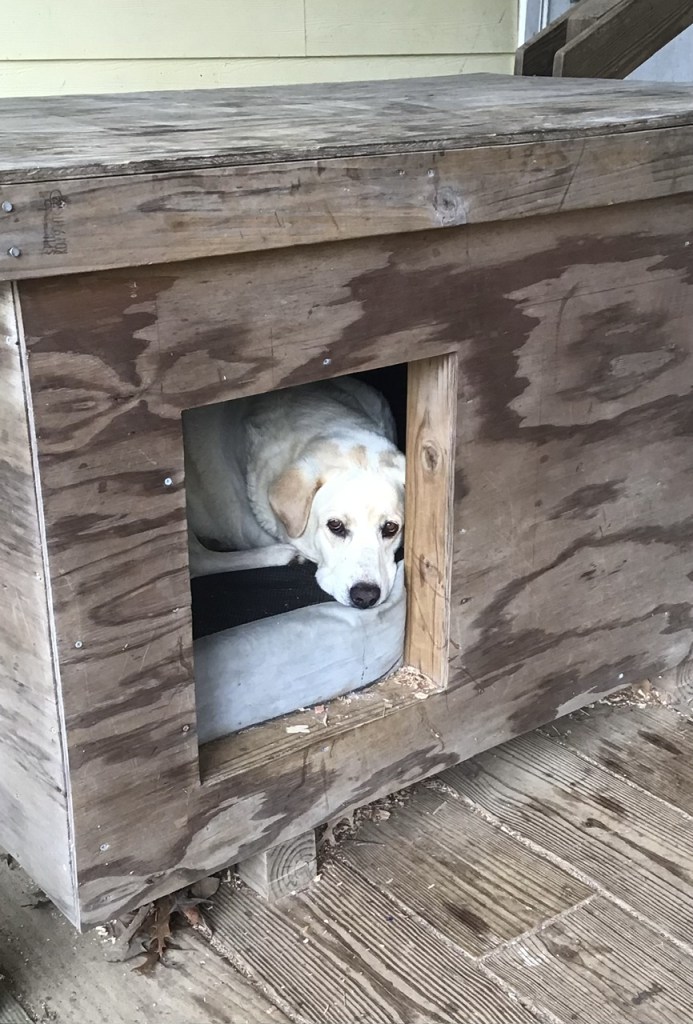
Buttercup is especially sensitive to the YoYo, to the point of regular getting seizures at such times, also lethargic and losing her appetite.

Buttercup hiding in her box all day.

There was of course the lows not long ago in the 20s and I was very concerned for the newly planted citrus. We employed quite the set up of lights and covers and they faired very well, I’m happy to report.

Invasion of Asian beetles on the citrus cover

But there has been a bad invasion of these awful beetles, which we’re vacuuming off the ceiling multiple times a day. Not to be confused with the garden-friend, the lovely little lady bugs, NO, these little beasts are really nasty. They infest, as obvious from the photos, and they bite, and as if that’s not enough, they stink.

I don’t like when folks call them lady bugs, they are not at all ladylike, so I try to correct them anytime I hear complaints, which is more often than you might think. The reaction I get is much more open and accepting than when I inform them about the manufactured weather.

Old lettuce bolting, replacing with new lettuce started under lights indoors, along with broccoli and cauliflower.

It does keep us on our toes, dealing with the Yo-Yo. Lettuce and herbs bolt prematurely quite often, seedlings come up then freeze or wither. We never know from week to week what to expect or how to plan.

I don’t normally have such a fancy setup, but these trays were gifted to me and they’re working quite well germinating some lobelia and snap dragons.

My indoor lights and heating mats make things easier, as does the row cover in the garden, but it is constant juggling. And if I miss a beat, death. Like happened with the Mexican oregano I was so proud of. I forgot about it outside one night when it frosted. Very disappointing considering our long journey of discovery, and how long I babied those few little sprouts, trying to anticipate their every need, carting them inside for warmth, then outside for sun and wind, and just when they were getting their legs, gone. All my fault.

Well, except for the geoengineers, because I wouldn’t be doing this constant refrain if our weather was consistent or predictable or seasonal.

I’ve tried twice since then to sprout the herb again with no luck. I will succeed eventually, of course, we’ve come too far in our quest to fail. The Mexican oregano has a long tale in these parts. Failure is not an option. More on that in the last HH post, if you like. https://kenshohomestead.org/2024/11/14/homestead-happenings-43/

I’d like to say it was the same with the milk quest. Unfortunately, I’m not nearly as confident; I feel failure is probably inevitable and maybe even imminent. For the time being I’m counting my blessings I’ve found another (perhaps temporary) source. Last time I was complaining about the cost, this one is even more expensive at $15/gallon. At that price I’m not going to be experimenting with any new cheeses, that’s for sure. To make cheese at all is not really feasible, except for the most delicious of selections—Camembert. Otherwise the precious commodity goes toward morning coffee, ice cream, and buttermilk for recipes and the extended expiration date.

Camembert to be draining before salting

I’ve been doing continued research on the topic of raw milk and what’s available and in general, where’s the market vibe. I found one young entrepreneur with a private herdshare selling cheese for $25 a pound. (A Herdshare Agreement or a Grade A license from the state are the only ways to sell raw milk in Texas legally.).

With my new herdshare deal I can buy more milk for cheesemaking, if I’m willing to pay $15/gallon. Considering the hard cheeses I typically made were 5 gallons ideally (better for aging in less than optimal conditions), that’s a really expensive cheese.

Certainly what can be made on-site are far better cheeses than can be bought at the store; that’s why I started making cheese in the first place. But still, it’s really hard to justify all that work, and expense, when we can still buy organic cheese for about $8/pound.

I will splurge one time in late spring, if possible, when the grass is thick and so the milk most rich. And we do still have two goats, hopefully pregnant, so there’s a small hope of cheesemaking in my future, if all goes well.
Moving on to the garden, the garlic is going strong and I’ve just got the onions in, 3 big rows of each. The garlic we plant is elephant garlic which does so much better here than any other variety I’ve tried, and I’ve tried lots. These are local for over a decade now and their productivity has yet to disappoint.

The onions are from purchased sets and they normally do well, though some years are a bust, like last year. I also started some from seed under lights, to compare if they are more consistent and adaptable, because the sets have gotten pricey in recent years and it’s irritating to pay good money for possible failure. Onions do not like Yo-Yo weather, but then again, who or what really does?

At least some seem to tolerate it better than others. We’ve got a couple of ‘oyster trees’ that are bringing us regular tasty gifts.

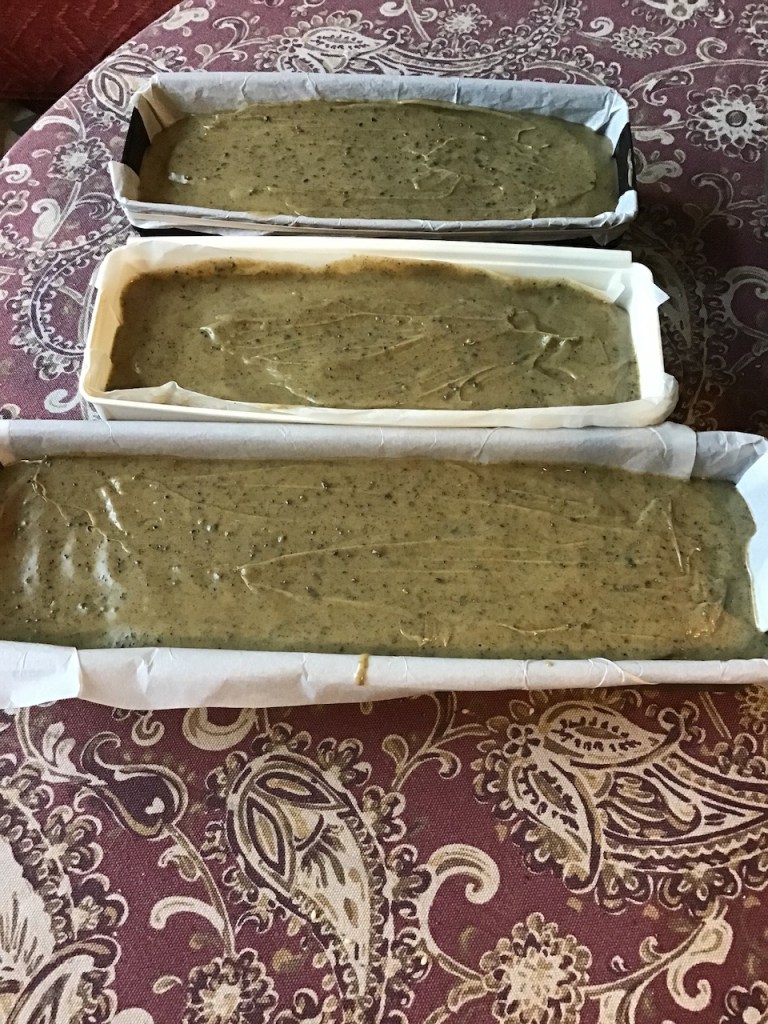
I’ve also tried a couple new things that have been long on my list. There’s the soap that’s just now cured, a bit earlier than I’d read is typical. I’m really pleased with it! It lathers very well and the scent is rather sensuous. My intention was something earthy and erotic, and I think I succeeded.

I got the sensual part down, now I need to up the aesthetic! Trust me, looks are deceiving here, I just need better molds! Never underestimate the power of packaging, eh?

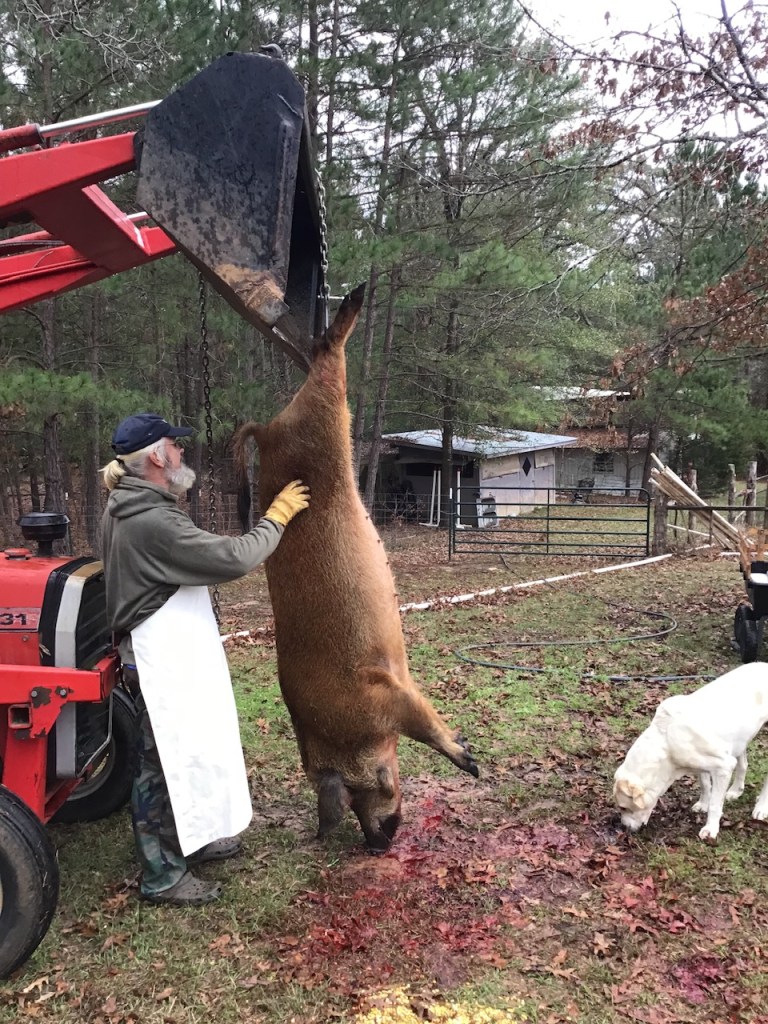
After finishing up slaughter season and chopping up downed trees for a month, Hubby has moved on to a far more desirable and needed project, according to me, our kitchen! Yippie!

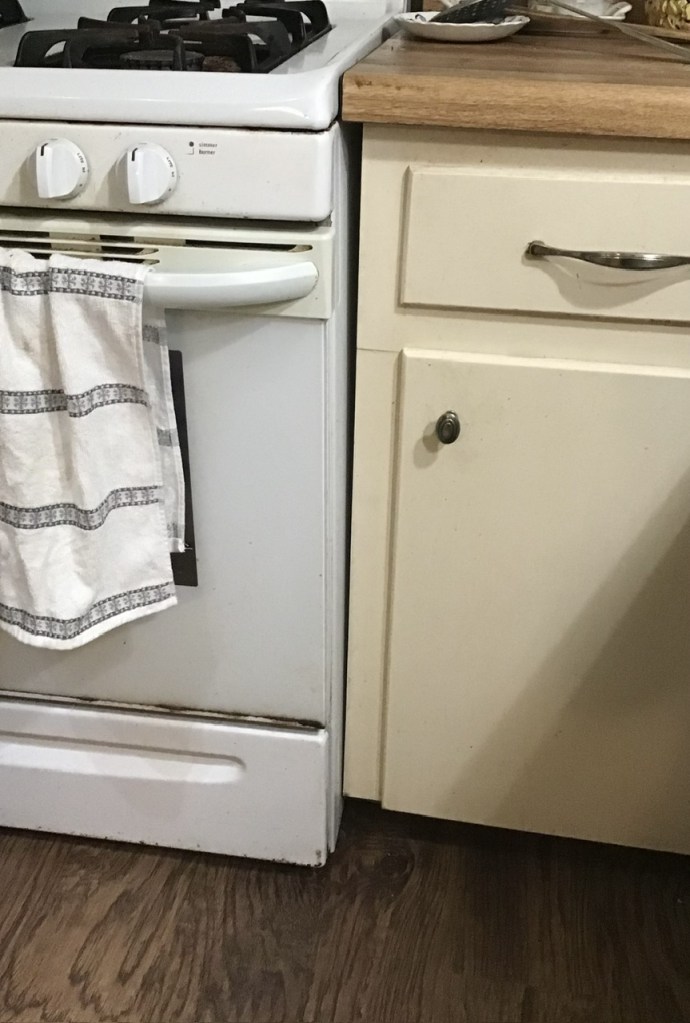
We’ve needed new countertops badly for many years, ours have been well-worn in 40 years, especially since we’ve gotten here and the space went from softly used a few times a year, to a daily year-round assault. It’s actually pretty impressive the counters aren’t near dust by now, considering how quickly more modern materials fall apart.

New island done, now for the hard part.

Old, ugly, not square or plumb . . . Good times coming in Hubby’s near future!

New countertops got us on a roll and now we’re planning new light fixtures and maybe even a new paint job. Big ideas, perhaps not backed up by time or commitment.

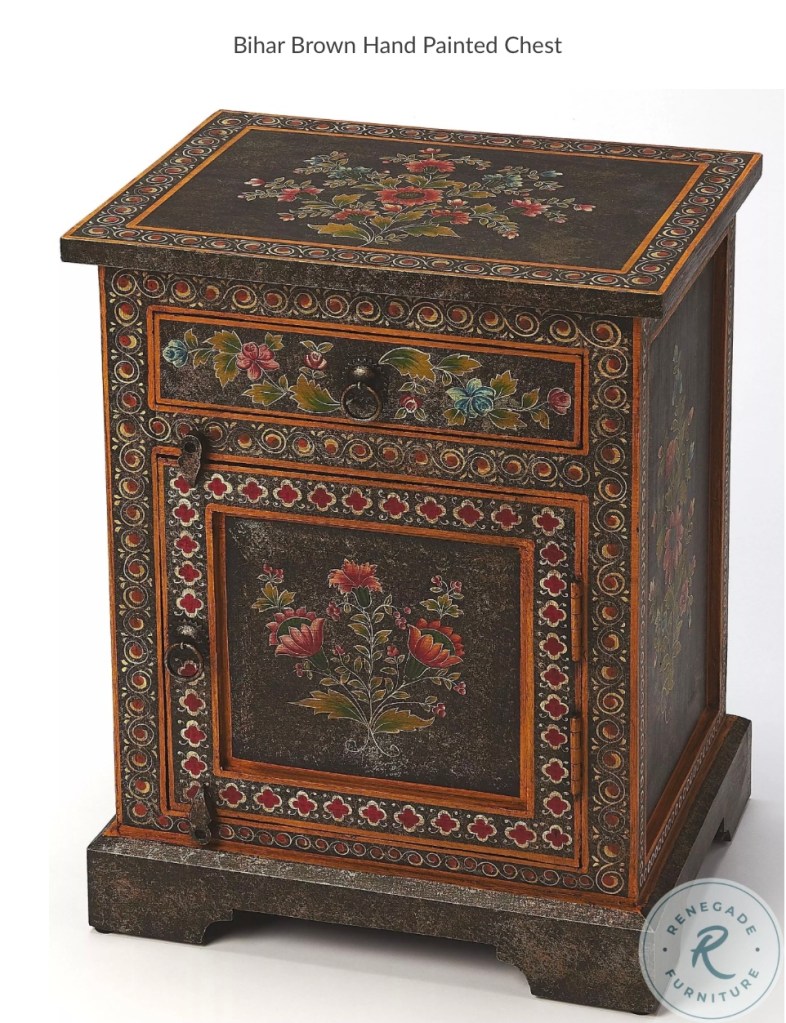
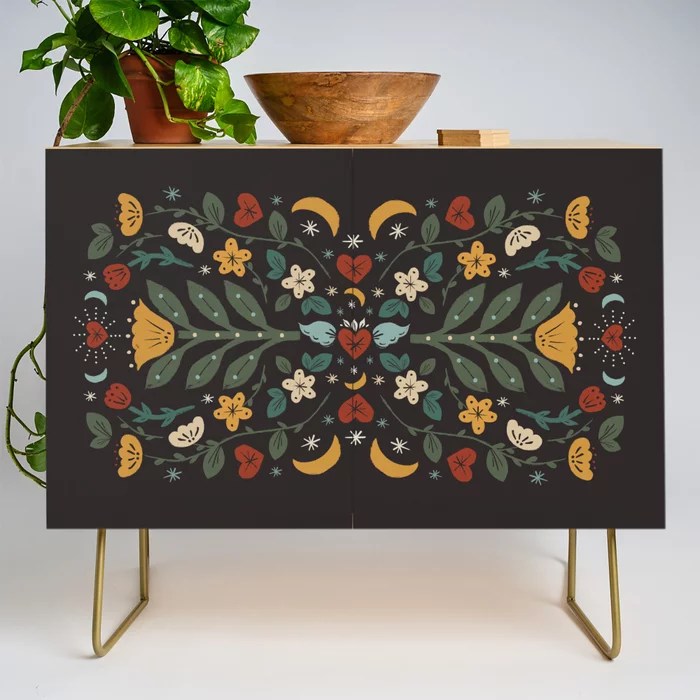
Those big ideas, I’m full of ‘em! In my mind the kitchen’s already painted and my next project is to paint the table, which I’ve wanted (and once tried) to do for as long as we’ve had it. I can imagine I might have a table with a surface that looked something like this . . .

But I’d be perfectly willing to settle for this . . .

Or this . . .

So, after I repaint the kitchen in the few spare moments between juggling plants in YoYo season, I acquire the skills of an artist, and paint something I can really be proud of . . .

Whenever I’m finally able to manage that, y’all will be the first to know!

In the meantime, here’s where we were at in the last update . . .