ALL For Sale

When I lived in Europe in the 90s it was not too uncommon to see an amazing castle for sale for a pittance. I do mean a real castle, or a vast country estate that included a structure that once was a castle.

And I do mean a pittance, as in, they were not able to give these places away.

Vauburg, France (not my image), bit of a multi-generational hodge-podge.

Sometimes that was because they came with strings attached, so I can understand. Or it was designated for a specific purpose or with strict regulations. You had to restore it, for example, which was something that cost so much that the just wealthy could not afford it.

I had a French boyfriend for a while, who boasted some aristocratic lineage and took me to the castle where his aunt still lived. I marveled at the exquisite property and at the lingering formality of his kin who addressed each other, that is as husband and wife, in the formal, using ‘vous’.

Maybe the uber-wealthy could afford it, if they cared to, but they just didn’t have the interest?

Or, which I’m actually more inclined to think these days, even with their fortunes, they would not be able to restore it. Because the skills to accomplish such an extraordinary endeavor have been lost to time.

A single example of the dozens of architectural marvels which have been destroyed in our little city, with more on the chopping block all the time.

In those days I dreamed of becoming a travel writer, or a writer of historical fiction. So, it’s not a huge stretch for me now to covet an interest in such parallel stories here, today, locally.

This is the closest real city to us, Palestine. What I’d call a small city today, though growing steadily. It was never more than a small city, as far as population goes. Just how it amassed such an amazing amount of great architecture is a real mystery to me. Though there are official stories.

I knew there was some interesting history there, and all around here, but it’s not like I’ve had a lot of time for exploring such idle pastimes, with all the work trying to build up a homestead.

But lately I’ve been squeezing in some time and loving it!

And of course, you’ve got to blossom where you’re planted. I used to tour every castle or abbey or old walls or ruins I could find, whether in the Old Town of any European city or hamlet, or a day hike away from the nearest bus stop.

This Old World has entered center stage for me again thanks to the Cyber World, which is really kinda crazy. But, true.

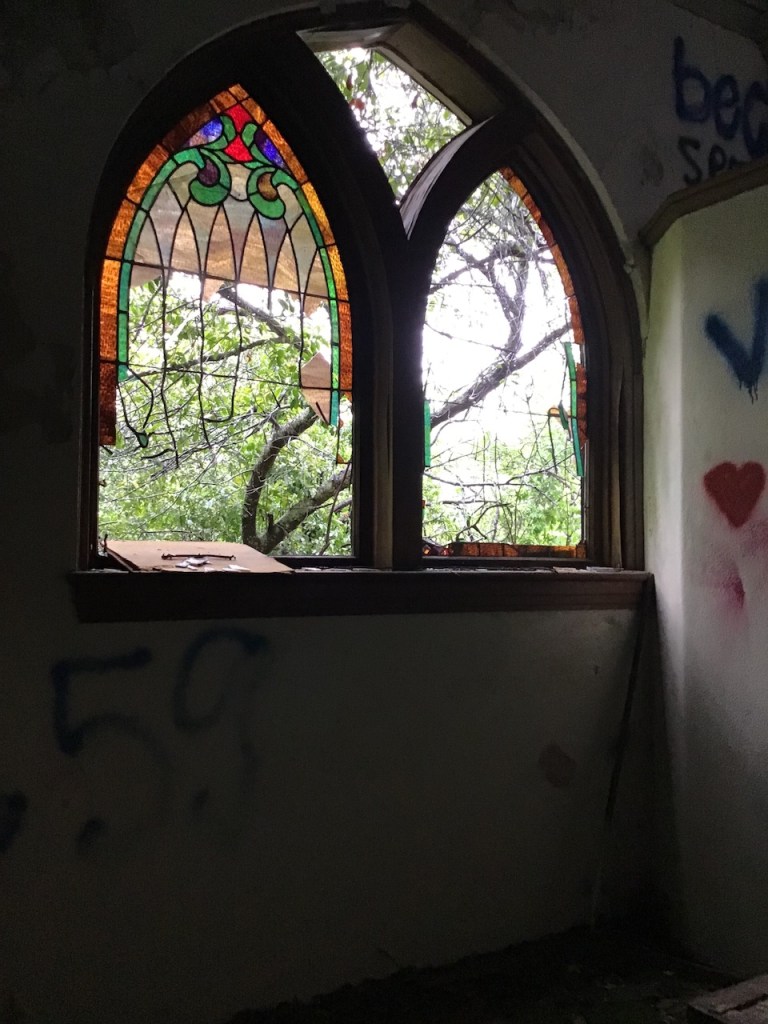
I’ve seen this old church for sale the last few times while driving through the downtown streets marveling at the old buildings.

I stop for lunch, and at a favorite antique shop, where I see tourists, which I find delightful. Though they only have much interest in the antique shops and the cafes and the provided entertainment. Still, it’s fun hearing German in the tourist office and hearing ladies from places all around the region, even in a rainstorm, there to peruse what our little city has to offer.

I was a novice travel writer, until I met the love of my life, who I managed to lure from the beaches of Thailand to a trailer park in Mena, Arkansas.

Hubby and I at ‘Roman ruins’ in Spain 2003—note our cute matching outfits—that was not planned.

And look who returned the favor by luring me into the deep woods of East Texas to spend an exceptional amount of time doing menial labor. 😏

I was also a beginner tour guide, Mayflower Tours. I lasted about two weeks, until I realized how unsuited I was to a job hosting a bus full of retirees for four-day trips to and around Branson, Missouri three times a month.

I think they weeded out a lot of us that way. There must be a trick to how many bossy seniors and cowboy theaters can be stomached for minimum wage, but I couldn’t figure that out quite fast enough. Another potential career option in the toilet.

And yet . . .

When I see precious gems like this my imagination sparks just like those days in Spain, France, Germany, UK, Czech Republic, Poland . . . Ok, everywhere, just about everywhere. I was very much a Europhile. Still am.

And yet . . .

I’m so struck by the lack of general interest. And knowledge. And, frankly, care.

I see the collapsing remnants of a structure worth saving. I see a history worth understanding and passing forward.

That’s the shot to inspire a buyer’s creative juices? Yikes. What about its real history, does anyone care? And, where’s the roof?

But the Realtors, who are there to sell this precious gem, see little of that world, neither the past nor the true potential. It’s such a shame. Such a very common, and so very confusing, big fat shame.

Will it become an ‘event venue’ as they suggest? It’s hard to imagine the kind of events that would make such a renovation effort worthwhile, or particularly palatable. Is there even such skilled workmanship available today?

Dare I question, true philanthropy, if it ever existed at all, is it dead?

There are many such gems in our little city, which suggest but mere clues to the true treasures in our midst, in plain sight—all teetering in a world of nearly forgotten but, dare I hope, at least a cyber-revival?

A taste of the hidden history in plain site, he’s getting to all the states eventually, and beyond, one of a great many channels sparking my renewed interests . . . 😁

Creating the Global Citizen

“Alvin Toffler predicted ‘demassification’: a process ‘in which a relatively homogeneous social collectivity (or one conceptualized as such) is broken down into (or reconceptualized in terms of) smaller, more diverse elements’. This is the prize for big social networks: compartmentalize people into echo chambers and bombard them with confusing distractions and dead ends.”

Confuse the words, creating a smokescreen of misunderstanding: Like: community=network=market
Obviously these words used to mean very different things in the actual world, before the virtual environment muddied the waters. The market wants all kinds of personal details about you and so they pretend they are in a community with you. Your network of friends and acquaintances and business relations may indeed form a community at some basic level, but to expand this concept out in an attempt to create from this a sense of ‘global community’ is preposterous. It is a Benetton ad, not a community.

Yet it has infiltrated and infected the actual world as we’ve all experienced. The great Convid is example enough. But, there’s more. 

Even small local shops in rural Texas feel entitled to ask shoppers for their phone number, to use video surveillance indiscriminately, to appeal to shoppers for ‘community’ donations and to shove their mailing list and ‘loyalty card’ at you. I seriously doubt they will draw the line at the next big thing the big box markets teach them.

Please take a sensor bracelet at the entrance, this will ensure you a positive shopping experience.”

That is no community for me!

Deb Filman does a fine job of ranting about this, and an even better job breaking it down for folks, especially parents, because it really is the kids they are after. They always start with the easiest targets.

Are We Educating Children or Training Bots? That is the question!

More concept confabulation: Training=programming=learning
Deb has some choice words to share about this, so I’ll be brief. These words and concepts are being deliberately confused in order to create cognitive dissonance in order to get us to comply. Social engineering has become an acceptable system for indoctrination of populations and is being normalized and implemented by the United Nations and cooperating global partners through our institutions, and directly into our LOCAL communities, all of them.

The U.N.: Creating child social activists all over the country on our dollar.

More muddying of words and concepts happens all the time. This is to be expected. This is not a new tactic at all. If they still teach Animal Farm in school, let’s hope the correct message is still being taken from it. The rules written on the barnyard wall keep shifting. (Therefore, it must be my job to keep shifting with the rules, right?)

More word meshing:
Individuals=collectives
Regulate=Control=Master=Suppress

“It is the responsibility of civil society to experiment with models of effective global citizenship.”

To experiment with models! It is our responsibility, as global citizens, to experiment with our populations through education, to create good global citizens.

That is, for one, to train children in ‘Emotional Regulation’ in order to make good ‘Global Citizens’. Soldiers are trained in emotional regulation. As much as you might get annoyed at the Hobby Lobby with the number of emotionally unregulated children, this is not something that we want as institutional directives aimed at children. Why? Because as the establishment experts know very well, it leads to neuroticism. One kind of behavior required at school, another one at home, another one in public, another one at church, another one here and there and everywhere, and what the kids end up with is not an education, but the essential life skill required of a psychotic society: Mask Juggling.

In other words, become better adjusted at nebulous, shifting, always uncertain unreality. Who does that serve?

From Wiki, the ‘experts’, right?!

“Psychodynamic therapy uses the idea of a Faustian bargain to explain defence mechanisms, usually rooted in childhood, that sacrifice elements of the self in favor of some form of psychological survival. For the neurotic, abandoning one’s genuine feeling self in favour of a false self more amenable to caretakers may offer a viable form of life, but at the expense of one’s true emotions and affects. For the psychotic, a Faustian bargain with an omnipotent self can offer the imaginary refuge of a psychic retreat at the price of living in unreality.”

I can’t help but wonder, as illogical as all this obviously is, could it actually be the setup for the next great fall?

“We had created a global civilization, and for what? So the whole thing could come crashing down into the ocean, bringing unimaginable misery upon the earth? What purpose could such suffering possibly serve? The answer—in truth, the loss, death, despair, desolation, sickness, ill-treatment, indignity and, as Nietzsche wrote, ‘profound self-contempt, the torture of self-mistrust and the wretchedness of the vanquished’ rarely change ordinary men and women. Extraordinary people change through the good thing, and through the self-mastery that yokes them to it; the joyous source of the world. But such types are few and far between. For the masses, there is no hope because all they have is hope, and habit, and expectation, and desire, and possession, and progress, and business, and money, and all the other illusions of the egoic system.
That man had to be disillusioned was not, quite obviously, a message which could find very much popular support in a world of illusions, but then no message worth hearing ever does. The individual knows that the evil and pain and suffering she has gone through has not been for naught. Being sensitive and kind—those rarest of qualities in the civilized system—the individual finds no pleasure in the idea that everyone has to go through hell to reach heaven.”
 33 Myths of the System by Darren Allen

Virology’s Death March

It couldn’t make me happier to see that the pseudoscience of virology is on its way out! I don’t need a Utopia to be happy, I just need to know the bullshit sciences are going down, kicking and screaming of course, as useless as that will soon prove.

The top 3 on my Shit-Sciences list: virology, nutrition and climate — all pseudosciences full of con artists passing themselves off as scientists while getting public approval, respect and major funding as real science—with detrimental effects on life.

So, I just have to share the latest, copied entirely from DPL’s Newsletter on Substack. For the full-article with all links, comments, formatting and memes, read it directly here, this copied version is incomplete, meant for your quick perusal.

Hacking At the Root of the Virus Issue

Introduction
Starting out on the No Virus topic, I was introduced to the isolation issue. Cowan mentioned that the 1954 Enders paper showed a failed control and I searched for this paper to confirm it for myself. At the back of the paper under “Other agents isolated during the study” Enders discussed the failed control and this was enough to know that virology was dead (refer to an earlier article here). The below meme was born from this knowledge.

A further two years of study and I was confident enough to start chasing down the Mutton co trolls and the 77th brigade on Twitter. I joined some sharp peeps and a team of people are now confronting these twitter sewer dwellers on a daily basis. One thread has been ongoing since 10 March this year, believe it or not! You can have a look at that thread here.

For the longest time my focus was on the isolation process because this seemed to be the best angle to take down virology seeing as this same method is still being used today with some small changes in the process. Being new to the subject I did not really question this angle because the entire movement was talking about the isolation issue.

However, the most fundamental assumption of virology is that a viral agent can be transmitted by means of natural pathways for a sick person to make a healthy person sick. If there is no proof to support this assumption, then virology is well and truly dead. The meme obviously had to be updated as seen below.

Latest Update

The idea of hacking away at transmission was recently given a very good update with two presentations by Cowan.
Firstly
The true issue of where the idea or theory of virology comes from was well divined in a presentation discussing Inductive vs Inventive theories (the full length presentation can be seen here).

Conclusion

Every single transmission study that we have reviewed has shown that transmission has never been successfully demonstrated. Most of these studies include the injection of ground-up spinal fluid into the brains and lungs of animals and the remaining studies are observational, where there is little to no control over a large number of variables that can influence the results.
The virus pushers hate addressing this point because it cannot be addressed with the current body of peer reviewed publications.

I hope you’ll pay him a visit on his Substack, he’s got a small team there and they’re doing some great work!

Chop Wood, Carry Water

Trip to town, so sad. Two machines tried to rip me off and no working humans looked capable of anything.

Don’t load, don’t count, don’t smile. What do ya do?

Hostessing was once a thing, like customer service. I was a really good hostess once, let me assure y’all!

It’s more than charm and service, it’s an art and a craft.

So, it’s no mystery to me why the cats eat with the dogs on our back porch: Good food + Good vibes= Good company.

Being a good hostess is similar to being a good teacher—observation, agility, ingenuity—are higher qualifications than even empathy, discernment and a sense of propriety—all already a challenge for most.

A teacher cannot play the same role as a bouncer, though that is mostly what is required these days.

My greatest failures in the classroom mirror my greatest failures in life. I’d sum them up to a kind of mis-navigation of the cherished Comfort Zone. As an example I offer a brief recap of my worst classroom lesson ever.

It was taken from a book of suggested lessons for EFL/ESL (English as a Foreign/Second) students and it was called: ‘Dog or Wolf?’

These are lessons designed to generate conversation in the target language, so students learn new vocabulary, practice old expressions, participate with one another, and ultimately create a student-centered learning environment. Sometimes it works, sometimes it doesn’t, occassionally it’s a classroom catastrophe.

This is where the observational and flexibility skills of the teacher can really shine. Or, really, not.

I thought I knew these students well enough to pull it off. NOT!

Was it my mood? My confidence? My lack of fluidity that particular day? I really can’t say, even now, but oh how that failure, just that one day out of how many other lesser failures, who knows, but that particular one has stuck in my craw still 2+decades later.

They were mostly Japanese students, from various cities, all college-aged. The caliber of student willing and able to travel to the desert US to immerse themselves in American life, indoctrination, and university culture. We had a good rapport, they were good students. Their English was at a level I knew they could perform well with the material.

I presented it, gave the requisite handouts, grouped them in fours as per the instructions and posed the preliminary question:

If you could choose, would you choose to be a dog or a wolf?

There were follow-up questions about culture and civilization, surplus vs scarcity, independence and hierarchy. In my mind it generated a brilliant potential conversation and I was looking forward to it.

The question was meant to lead to an exchange between group members who would discuss the merits of their choice, as opposed to the deficiencies of the other option. It was based on the assumption there would be some who would choose dog and others who would choose wolf, for various reasons, creating an atmosphere for debate.

Except all the students agreed on dog at the preliminary question, leaving me standing there with my mouth agape and no further game plan.

I nudged, painfully, at my more philosophical follow-up questions and got crickets. Obviously, everyone would be a dog—comfort, ease, predictability, discipline, training—DUH!

The ‘best’ student, a relatively large young man from Okinawa, who was more bold and out-going than the rest, immediately intuited my dilemma. He raised his hand and said he wanted to change his answer.

But, I was stuck in my own personal baffledom. I tried to go with it, push through, take the ball he’d so generously tossed me and run with it, but I remained, I don’t know, just sort of, stranded there, for way too long a moment.

And then I couldn’t get it back.

Anyone who has never stood in front of a classroom most likely underestimates the skill it takes to be good at it. And when I say good, I don’t just mean popular. And I don’t just mean effective. I mean the kind of good where one can walk the line between popular and effective, because it is impossibly narrow. Those who pull off that level of impossible should be studied and duly rewarded and I’m sure there are more than a few. So, it’s not actually impossibly narrow. Just too narrow for me that day, that lesson.

They should also study bombs like mine that day.

After missing the generous handoff, I was so tongue-tied and disgusted, with it all—them, myself, the lesson—that I dismissed the class early.

The Okinawan student stayed there, obviously to discuss it with me. He wanted to make me feel better about the clear and dismal failure, I think. It was a really sweet gesture and very appreciated, even in the moment, but it didn’t really help me make sense of it all.

Like, why was I so confident that lesson would work? So confident, in fact, that I didn’t even have a Plan B. Bad teacher! So confident, in fact, that I became rigid. And frankly, still feel judgmental of those students (so passive, so acquiescent, so like, totally lame!).

Not really like me. So stuck in my own thinking that it’s not conceivable to me every student would choose dog over wolf that I could not, in fact still feel challenged to, mentally adjust from my misperceptions. Yes, even now.

A room of 30 students and only one wolf, and that one only under pressure, and with a savior complex no less.

What happens in world become so ‘civilized’ we’ve all become obedient dogs? And, obedient to what, and to whom?

Don’t think, don’t fight, don’t roam, what do we do? What happens when man becomes too civilized? Too domesticated? Too content?

I still don’t know what to do with such a muddle. Would you?

Eye-Opening Quotes: R. Hutchins

“The countries of the West are committed to universal, free, compulsory education. The United States first made this commitment and has extended it further than any other. In this country 92.5% of the children who are fourteen years old and 71.3% of those between fourteen and seventeen are in school. It will not be suggested that they are receiving the education that the democratic ideal requires. The West has not accepted the proposition that the democratic ideal demands liberal education for all. In the United States, at least, the prevailing opinion seems to be that the demands of that ideal are met by universal schooling, rather than by universal liberal education. What goes on in school is regarded as of relatively minor importance. The object appears to be to keep the child off the labor market and to detain him in comparatively sanitary surroundings until we are ready to have him go to work.

“The results of universal, free, compulsory education in America can be acceptable only on the theory that the object of the schools is something other than education, that it is, for example, to keep the young from cluttering up homes and factories during a difficult period of their lives, or that it is to bring them together for social or recreational purposes.”

“Education is supposed to have something to do with intelligence. It was because of this connection that it was always assumed that if the people were to have political power they would have to have education. They would have to have it if they were to use their power intelligently. This was the basis of the Western commitment to universal, free, compulsory education. I have suggested that the kind of education that will develop the requisite intelligence for democratic citizenship is liberal education, education through great books and the liberal arts, a kind of education that has all but disappeared from the schools, colleges, and universities of the United States.”

~The Great Conversation: The Substance of a Liberal Education
by Robert M. Hutchins, 1952

More by Hutchins . . .

“Because of experimental science we know a very large number of things about the natural world of which our predecessors were ignorant. In the great books we can observe the birth of science, applaud the development of the experimental technique, and celebrate the triumphs it has won. But we can also note the limitations of the method and mourn the errors that its misapplication has caused. We can distinguish the outlines of those great persistent problems that the method … may never solve and find the clues to their solutions offered by other methods and other disciplines.”

“Liberal education was aristocratic in the sense that it was the education of those who enjoyed leisure and political power. If it was the right education for those who had leisure and political power, then it is the right education for everybody today.”

Zuckerkandl! a comic book Hutchins published in 1968, later made into a cartoon short, narrated himself. It’s about disentanglement and living guilt-free and is said to be a parody of Freud.

Neuroeducation via Learning Standards to force Neuroliberalism: Such a Fruitful Site for Intervention — Invisible Serfs Collar

Brainwashing is not education! Fortunately, good educators are seeing through the top-down conspiracy to mold social behavior rather than teach critical thinking in our school systems. Here’s one of them . . .

The original title for this post on the admissions about Psychological Governance (PG) and its declared ties to ‘standards-based’ education reforms and ‘competency frameworks’ was going to be “Shaping Citizen Identity and Social Practice so that Governance is Inside-Out, not a Building”. That gets at the function nicely and what must be, and is being,…

Neuroeducation via Learning Standards to force Neuroliberalism: Such a Fruitful Site for Intervention — Invisible Serfs Collar

Understanding Our Living-Death CultUR

Another installment of excellent links. Little time these days for more thoughtful posts, and that’s a good thing, since it’s spring! The real world of my garden trumps the cyber world of my words every time.

I do continue to research the State of our Global Enslavement, and find it more logical by the day. More on that soonish.

In the meantime, in case you care to follow some of the threads in our collective web of lies, here’s a few I find of value.

“Suppression of LIFE, in order to stop a purported germ, is institutionalized death.” Rejecting Rockefeller Germ Theory By Jon Rappaport

“This entire process has extremely interesting parallels with the theme of space fakery whether it’s propagated by NASA or the space agencies of other nations. We don’t have verifiable images of viruses; we don’t have verifiable whole (non-composite) images of the Earth, or many other space bodies such as moons, planets, etc. Instead we are fed CGIs and told not to question authority Is this science or is this faith-based Scientism? To what extent are we being manipulated when we are denied real and true photographs of the world around us, both on a micro and macro level? I would argue to a massive extent.”

Research as you dare.

Virus Misconception: 2020 Article by Dr. Stefan Lanka Reveals Truth

Is Germ Theory True – Here are tons of links to prove it’s not

Short and sweet, my dears, because I stand by the great old adage: The best teachers show you where to look, not what to see. (And certainly not what to buy!). 🙂

These guys know what I mean, I’m sure. Would love to have them over for our homemade hard cider! 🙂

Structural Extortion: Resources

It’s becoming nearly impossible to find resources that question official narratives with the various search engines. My own increasing frustration prompts me to start sharing periodic lists with excellent articles and videos because there is a wealth of ever-increasing information that’s being hidden and suppressed.

How Conspiracy Theorizing May Soon Get You Labelled a ‘Domestic Terrorist’ – The Mad Truther

Questioning Covid – Clinicians, Researchers, & Health Experts from Around the World Interrogating the Mainstream Narrative Around the Pandemic

James Corbett : How Can a Global Conspiracy Work?

On Teachers & Students

Some of us are compelled by learning and therefore find ourselves comfortable in lifetime roles as teacher and student in tandem.

I left formal education with a Master’s degree in order to become a teacher, which I did do, for two decades. I’d probably still be teaching, but I became too disgusted by the system to continue in it. First, I witnessed as students became little more than commodities and teaching became not about learning, but about customer service. That was higher education, but once testing became the anchor of achievement in high school education, it’s the same thing in a different mask.

I used to encourage my students to challenge me, to “talk back” because I saw that was a serious lack in my own upbringing and education and vowed not to pay it forward. Students found me challenging, but fair, and I took that as the highest compliment that can be awarded to a teacher.

As the curriculum noose continued to tighten around our necks I watched as 99% of my colleagues went with the new and ever-tightening program for a few more years. Then I gave up. The system had sucked out everything I’d loved about teaching and was actively trying to turn me, and my students, into automatons, robots. When I lost the joy in it I was no longer good at it.

It was a blow to my ego and our bank account, but I knew I’d made the right choice for my soul. It’s been a few years now and surprisingly to myself, I don’t miss it. I embraced the student role fully again—on all things homesteading and conspiracy theory. An odd match, one might think, but to me it makes perfect sense.

Conspiracy theory is the study of power, that’s it in a nutshell. It’s not nearly as scary as the mainstream news, social engineers and politicians make it out to be. I was forced out of education for my own lack of power—it seems obvious to me then to restore my individual power I needed to understand much more about how power functions. I’ve been blown away by my own ignorance on that front.

To seriously study conspiracy theory one needs a firm grasp on two fundamental topics: psychology and social engineering. The essential sub-groups stem from there: history, religion, spirituality, politics, philosophy, linguistics, folklore, and more.

Like with homesteading, there’s FAR more to learn than can be done in a single lifetime or by a single individual. And for that, I find them both absolutely enthralling and a perfect marriage—the essentials of the practical and the esoteric bound together forever.

I know there will come a time I move once more from the student role to the teacher role in these endeavors. That time is not in my near future. I’m waiting for something, or someone, but I can’t tell you for what, or for whom.

But with leaving my formal, former student/teacher career came the most valuable lesson of my life, which I see now is becoming increasingly pertinent for loads of folks: When to walk away. Like the old song goes: “You’ve got to know when to hold ‘em, know when to fold ‘em . . . .“

For anyone truly dedicated to their roles, this is going to be seriously challenging. You’re going to create a huge, empty space in your life that you’ll then have to guard like a bulldog so that chicanery and nonsense are not then sucked into the gap.

Discernment will become your best friend. Attempts to manipulate your re-emerging Self with group-think or calls to obedience will become intolerable. You will lose friends at a rapid clip.

But you will become an expert student and the expert student needs to know only one thing: When to walk away.

Be brave.

Nature=Master Deceiver

“There’s no lie in nature.”

I’ve heard this repeated so many times now, from so many different and I believe well-meaning voices, that I decided it’s high time to add my own voice to this nonsense.

Nature doesn’t deceive. Nature doesn’t try to fool you.

Today this is repeated by quite a few philosophers, conspiracy theorists and ‘truthers’ as a way to elevate nature above man’s conning and cunning ways and to condemn our current fantasy-based reality. I agree our so-called civilization deserves plenty of condemning. But, I do not intend to trade one set of illusions for another.

Apparently this attitude goes way back, to the likes of Walter Russell and an entire camp of German Idealists. I love nature as much, maybe even more, than these guys, that’s for sure. Yet my experience is there are no greater deceptions to be found anywhere else, the worst of man’s worm tongue included, than there are to be found in nature.

You wouldn’t dare!

There are mushrooms so similar that not only a spore print, but a microscope is needed to tell them apart. Poisonous Amanita spissa or delicious Amanita rubescens? Chlorophyllum molybdites, lepiota Americana or macrolepiota procera? Do you want a nice dinner or an evening hugging the toilet? Don’t be fooled, choose wisely!

“Destroying Angel”
the deadly Amanita virosa

Man got his idea for camouflage directly from nature, obviously. In some cases the camouflage is so stealth you could be staring directly at a living creature and not even know until it moves.

Take a walk in the woods and you’ll see sticks that look like snakes and insects that look like sticks. There are spiders that look a lot like bats and bugs that look more like birds.

There are plants like poison ivy, my greatest garden nemesis, that look completely benign, leave no feeling or trace at all in the moment, but 12-24 hours later, long after you’ve forgotten all about it, can elicit a rash so severe you’ll be begging for relief even if it takes the form of a cocktail of toxic pharmaceutical drugs.

That horror story is my arm, on too many occasions to count.

The possum plays dead so effectively he’ll fool nearly any predator.
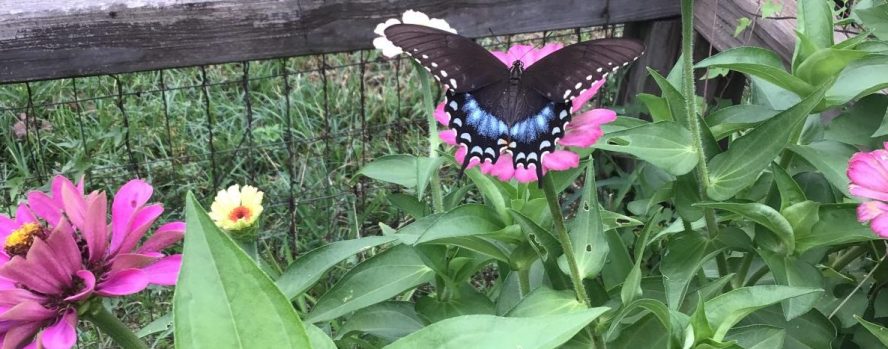
The most beautiful flowers can kill you.

Datura inoxia

The most disgusting and unappetizing swamp insect can be delectable.

In fact, to say nature is THE Master Deceiver is even an understatement if you ask me. Nature is a raving, lying bitch at least half the time.

Living so close to nature, growing food, co-creating with the land has offered me the greatest single lesson of my life: Cute and nice are the camouflage of prey and pets.

Nature does not play nice. Nice is for ninnies.

It’s considerably more deceptive when man’s hands meddle in nature’s mix as well, quite impossible sometimes to tell where one ends and the other begins.