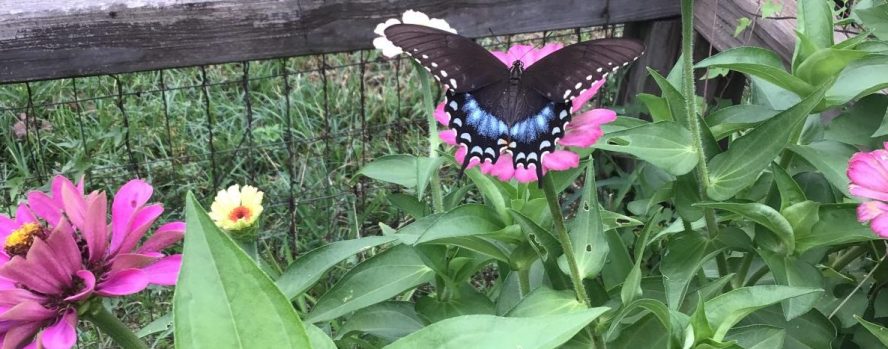
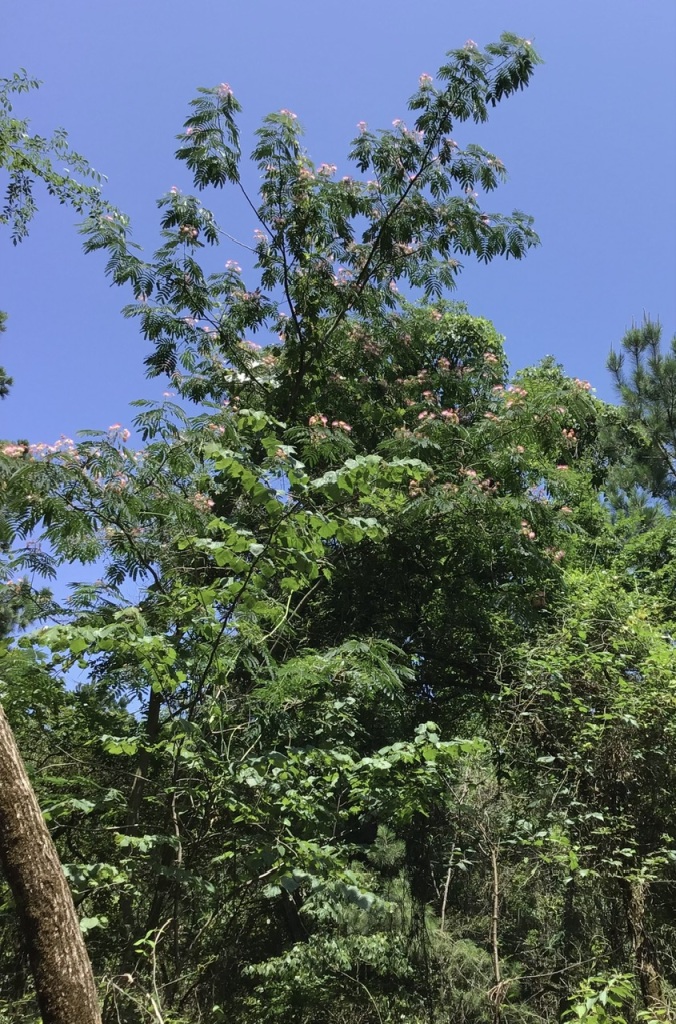
I’ve been working bit by bit on the Herbal Explorationspages and hope to add several more medicinal plants very soon—including the lovely Mimosa tree and the very popular Chasteberry—both which grow wonderfully here, even in the extreme heat and drought.
The mimosa tree and flower, (on the left) rising above the canopy along the road and full of butterflies, which unfortunately were too far up to catch with my camera. In the middle photo a fine specimen from our neighbor’s garden, where I gathered some blossoms for kombucha. They smell delightful, a bit like honeysuckle.
Also in our neighbor’s garden near the mimosa tree—I just love old hodgepodge structures like this!
It’s not giving up yet!
Also coming soon: Above, the chasteberry in our garden, also commonly called monk’s pepper or Vitek, which has a completely different scent, but one I adore so much I’m hoping to make soap with it some day very soon. And the bees love it, too!
Aspiring herbalists (like me!) must find inspiring teachers!
A big motivator for me to learn herbalism has been our critters. They all have special needs! It’s hard not to worry about them, but I’d rather have faith in nature than in Big Pharma.
I am way out of my depth, but I know one thing for sure: the pharmaceutical model of our modern-day veterinarians is not for me. Not for animals, not for people.
Information that eschews this model is not easy to come by, so when I find something or someone special, I hone in.
I’ve found this book helpful, so I looked to see what else I might find from this author, and wow, is she ever fascinating.
From the foreword: “Such ailments as the now prevalent ones of scrapie in sheep and ‘mad cow’ in cattle are not going to find a place in this Herbal Handbook for Farm and Stable, despite the fact that many thousands of cattle in the UK have now been diagnosed as suffering from Bovine Spongiform Encephalopathy (BSE). My book teaches natural care of animals and totally shuns their exploitation (wherein they are treated as machines, instead of as living, sensitive and loving creatures).
This book wholly condemns the force-feeding of unnatural foods to any creatures. If a diet is unnatural, disease will keep company with those subjected to it: that is a fixed law. I state force-feeding because, when animals through hunger are driven to eat foods entirely unnatural to their species, such as giving meat offal to cows and sheep, that, to me, is force-feeding. . . As I write this, when visiting England, television is showing cats suspected of having a similar disease to BSE in cattle. I do hope this fear proves to be unfounded. In any case, it is terrible that human acceptance and connivance in forcing the unnatural on our domestic animals bring much misery, pain and fear, all of which could be avoided.”
This book was published in 1952, and she has several others about dogs and cats.
I wonder what she would’ve made of our new bird flu?!
She lead quite the unique life, having been born into wealth, but choosing to live a simple life, exploring nature, living as a nomad among gypsies in many countries, and learning their ways.
There’s a documentary about her life and work, and though I haven’t found a full copy yet, here’s a good clip.
I looked for some of her other books as well, seems they are mostly out of print, so I was so pleased to find this one painstakingly retyped by another WP blogger.
Almost entirely happy snaps and almost no complaining at all, really! The garden is mostly great, the weather mostly fine, summer in full swing already, ready or not.
It’s been busy around here, as usual. But, busy in the country way, which is very different. Our preservation season has already begun, and it’s fixing to get very busy very soon. I have mixed feelings about that, but here it is anyway.
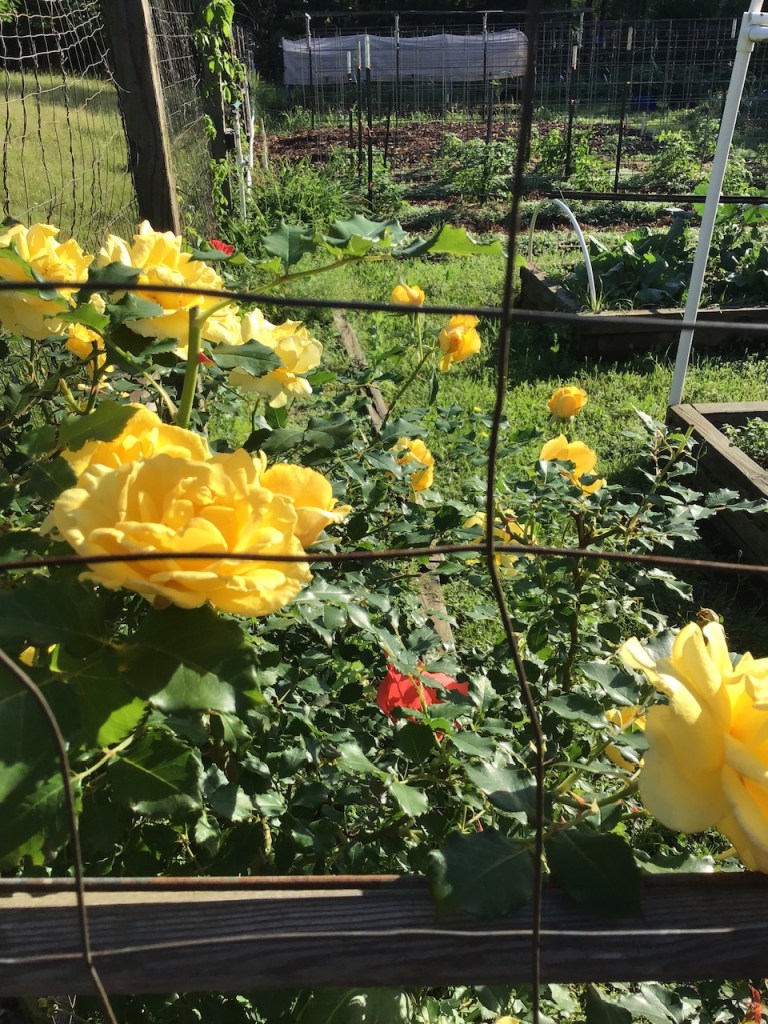
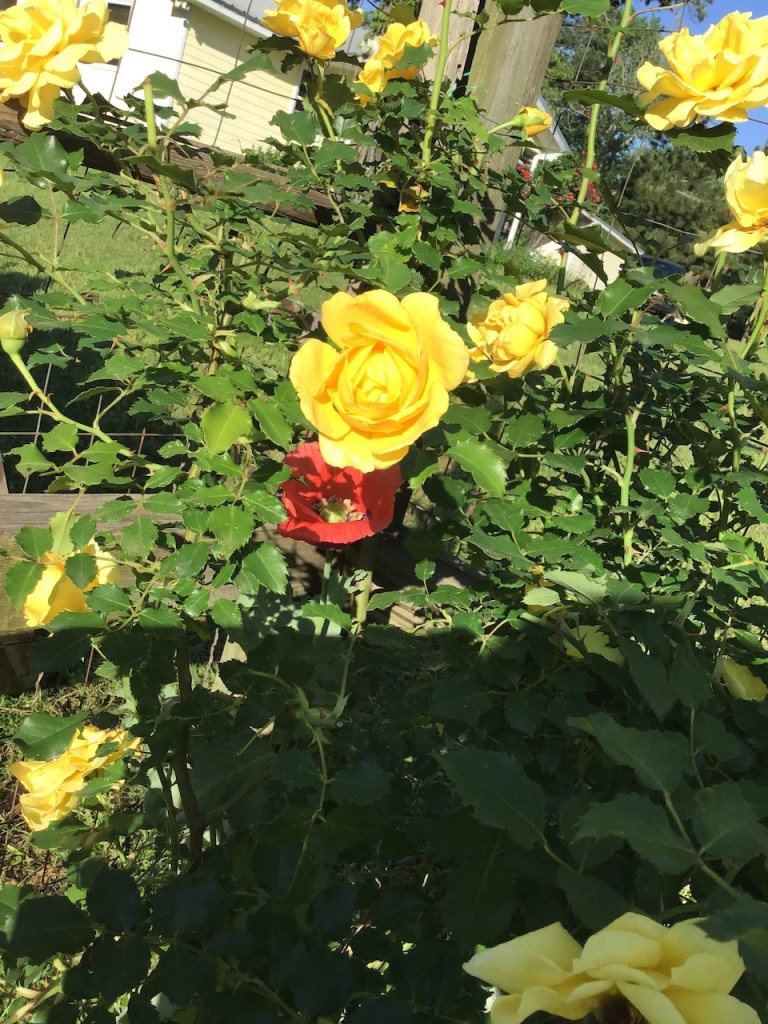
I’ve been saving the rose petals for drying and kombucha after admiring their scent and beauty in many lights and angles.
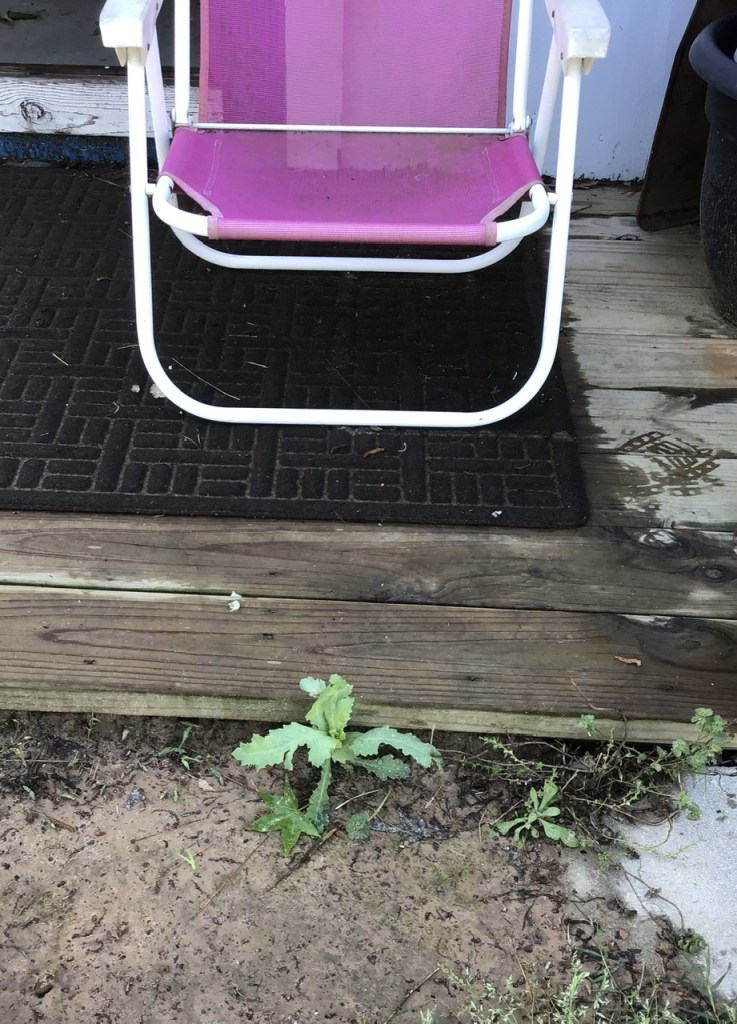
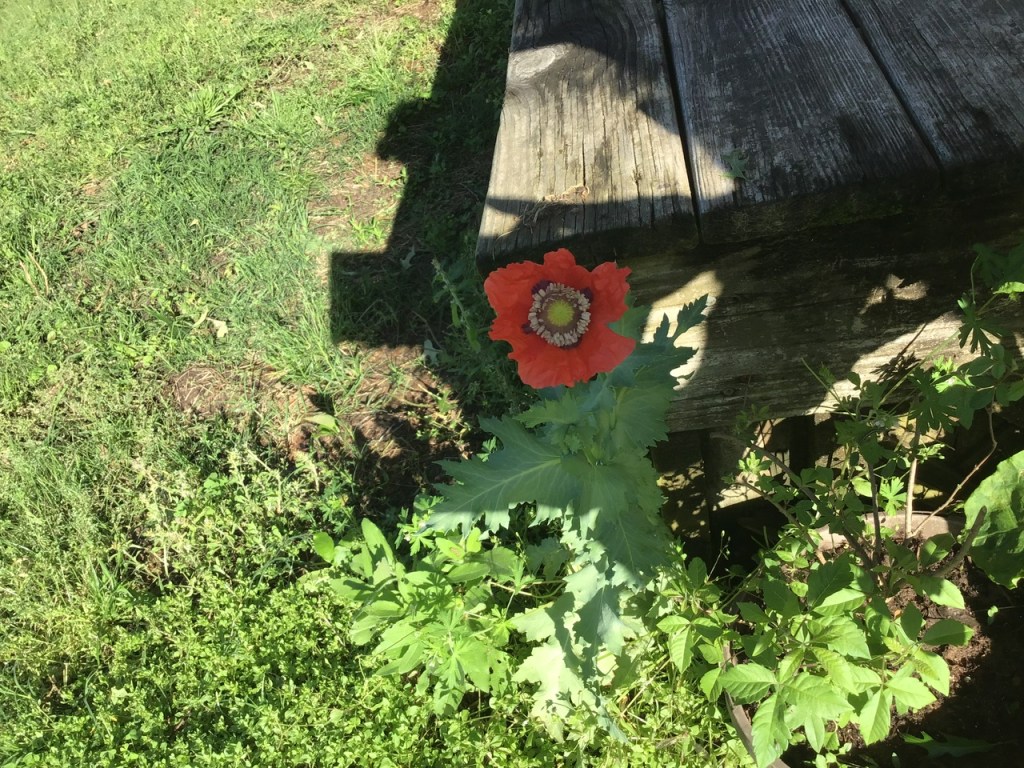
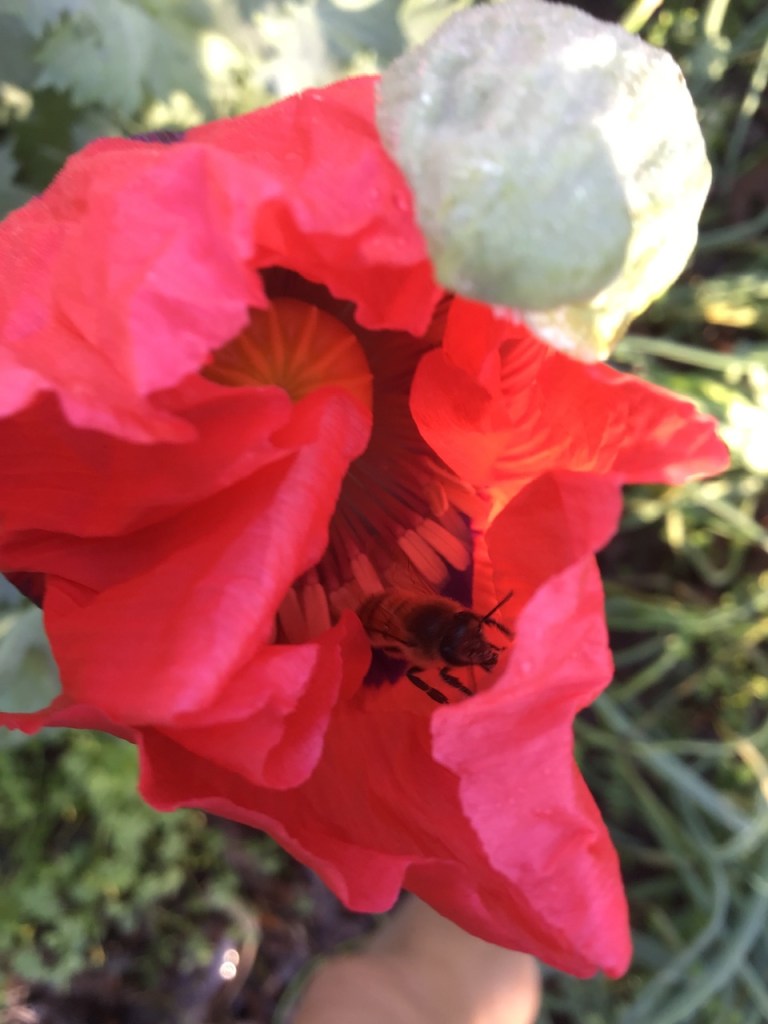
The poppies continue to pop up in random places, among the roses and in cracks and crevices, like dandelions.
And the bees love them as much as I do.
Another rose variety, the thornless Peggy Martin, I just planted last year, is now getting its first blooms.
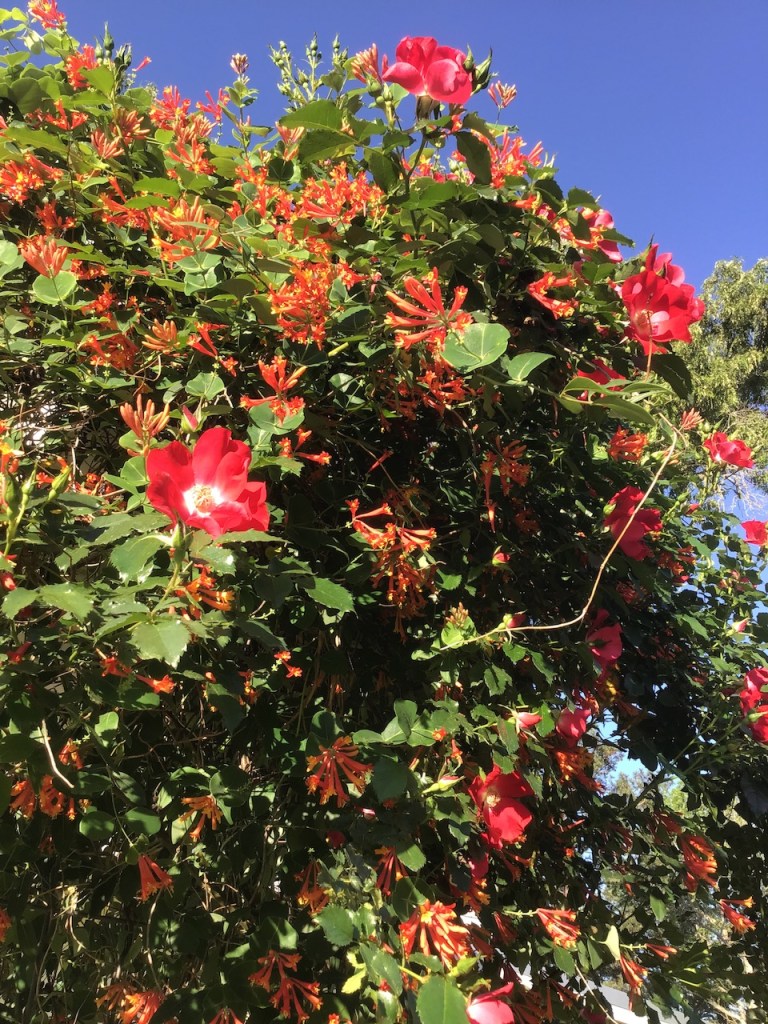
I’m so very pleased with the transition from cool-season coral honeysuckle blooms to the Dortmond rose takeover, lovely! I especially like the short spell they co-habitat.
The wattle fence I began with the best intentions is languishing due to too many other priorities. It has been a sheep deterrent at least, since the mamas and lambs have taken over the front yard. And even Shadow doesn’t dare stand in their way!
This is where the citrus will go, my new big project. I’m even considering throwing an avocado in there too. I know, very ambitious! But, I want to give some of the new methods a try and it seems like a good time. This side of the house is ideal, the house breaking the north wind and the heavy late afternoon sun. Plus, there’s the extra warmth accumulated in the walls of the house to help in cold snaps, along with the extra heating and draping methods that seem to be working for others.
Ooohhh, anticipation!
Just like the tomatoes and cucumbers coming so soon, right around the corner, and I can hardly wait. The last fermented cucumbers we used up a week ago, amazingly, and they were still crispy and flavorful. I plan to continue and expand my fermenting efforts this summer and fall. More herb pastes, more tea blends, more spice mixes.
The lambs are still doing fine, my how fast they grow.
Spring lambs on springs! 😆
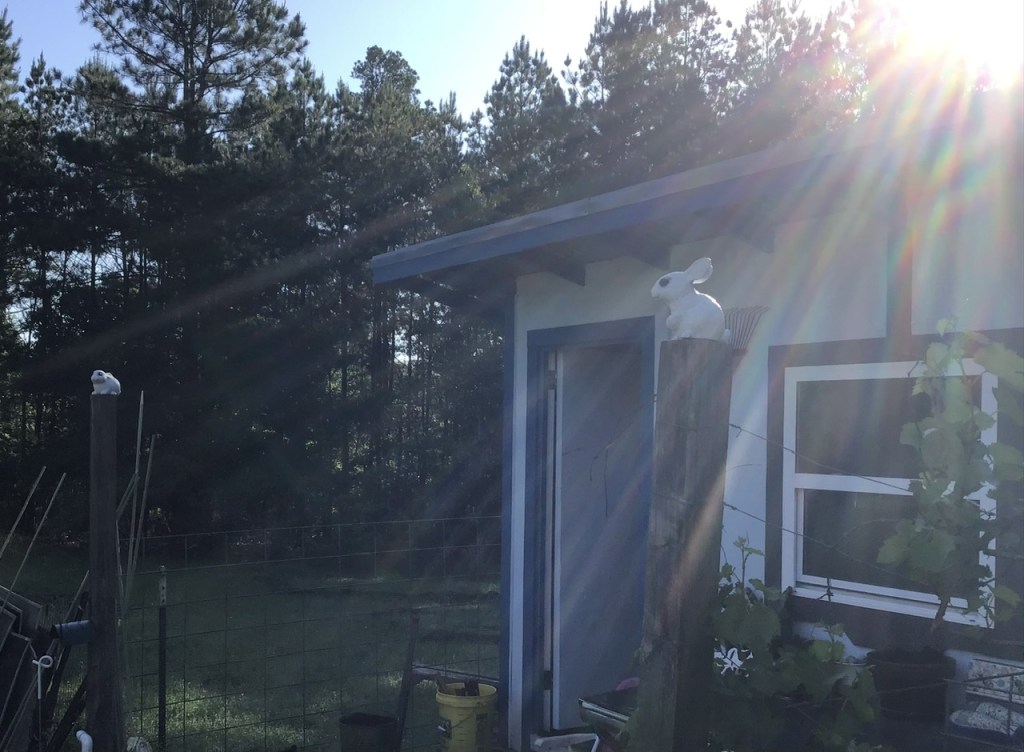
My garden mascots, two white rabbits.
And my single complaint—the spray continues to ruin our beautiful days.
Is this why we can so clearly see these colors, because we have an atmosphere saturated with reflective particulate matter?
Cool pic, or chem-filled haze?
“I’m no prophet Lord, I don’t know nature’s ways.” ‘Anticipation’ by Carly Simon
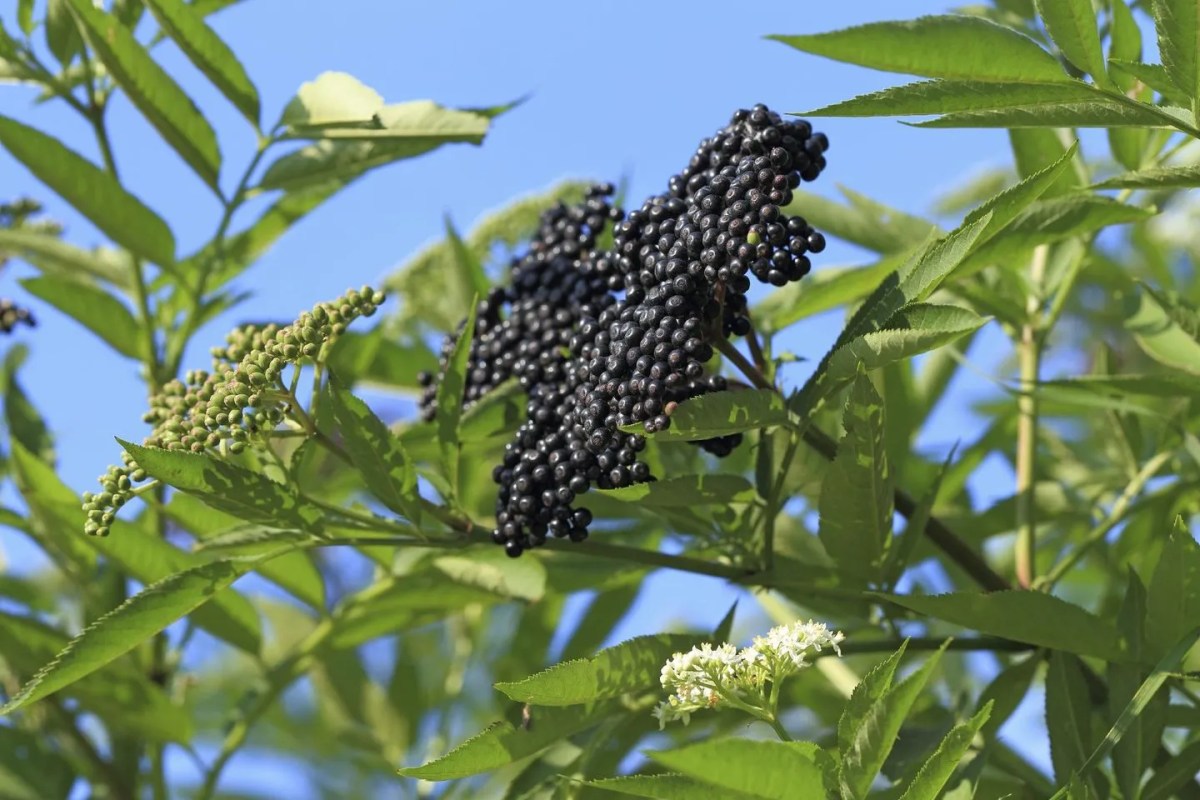
I’ve just added a new page to our Herbal Explorations section, Elderberry, thanks to Gavin Mounsey’s excellent work.
This is only an excerpt, so I encourage a full reading of his article!
Medicinal use of Elderberry:
Elder has a very long history of household use as a medicinal herb and is also much used by herbalists. The plant has been called “the medicine chest of country people”. The flowers are the main part used in modern herbalism, though all parts of the plant have been used at times. Stimulant. The fresh flowers are used in the distillation of “Elder Flower Water”. The flowers can be preserved with salt to make them available for distillation later in the season. The water is mildly astringent and a gentle stimulant. It is mainly used as a vehicle for eye and skin lotions. The dried flowers are diaphoretic, diuretic, expectorant, galactogogue and pectoral. An infusion is very effective in the treatment of chest complaints and is also used to bathe inflamed eyes. The infusion is also a very good spring tonic and blood cleanser. Externally, the flowers are used in poultices to ease pain and abate inflammation. Used as an ointment, it treats chilblains, burns, wounds, scalds etc. The fruit is depurative, weakly diaphoretic and gently laxative. A tea made from the dried berries is said to be a good remedy for colic and diarrhoea. The fruit is widely used for making wines, preserves etc., and these are said to retain the medicinal properties of the fruit.
Some of the medicinal benefits of Elderberries include:
One of the most well-studied elderberry syrup benefits is its powerful immune-boosting properties. The berries contain chemical compounds called anthocyanidins, which are known to have immunostimulant effects.
Research actually shows that elderberry is a safe, efficient and cost-effective treatment for the common cold and flu. A 2021 systematic review screened 1,187 records and five randomized trials on elderberry for the treatment or prevention of viral respiratory illness. Researchers found that elderberry may reduce the duration and severity of symptoms related to colds and influenza, and there’s no evidence that it overstimulates the immune system.
A 2016 study published in Nutrients showed that elderberry supplementation was able to reduce cold duration and symptoms in people using air travel. People using this herb from 10 days before travel until four to five days after arrival overseas experienced, on average, a two-day shorter duration of their colds as well as a noticeable reduction in cold symptoms.
Several studies have found benefits to support the use of elderberry syrup for flu symptoms as well. Specifically, the flavonoids in the extract bind to the H1N1 human influenza virus as well as the H5N1 avian influenza virus.
A 2009 study randomized patients into two groups. One group was given four doses of 175-milligram proprietary elderberry extract daily, and the other group received a placebo for two days. The group treated with the extract showed significant improvement in most flu symptoms, while the placebo group showed no improvement in symptom severity. Researchers conclude that the extract is effective in controlling influenza symptoms.
The group treated showed significant improvement in most signs of flu, while the placebo group showed no improvement in symptom severity. Researchers concludedthat the extract is effective in controlling influenza symptoms.
Another study published in the Journal of International Medical Research referenced above suggests that when elderberry is used within the first 48 hours of the onset of signs of flu, it can shorten the duration of flu symptoms by an average of four days.
With elderberry’s anti-inflammatory and antioxidant properties, it makes sense that it can help treat sinus issues. A sinus infection is a condition in which the cavities around the nasal passages become inflamed, and this antiviral herb has promise as a sinus infection natural remedy.
A study conducted by the Institute of Complementary Medicine’s Department of Internal Medicine at the University Hospital in Zurich, Switzerland examined the use of a product called Sinupret, which contains elderberry extract. The researchers used Sinupret to treat bacterial sinusitis along with an antibiotic (doxycycline or vibramycin) and a decongestant. Interestingly enough, those who took the combination did better compared to those who did not take Sinupret at all.
In addition to using elderberry syrup for colds, the flowers of the elder plant are also known to be an effective herbal allergy remedy. Since allergies involve an overreaction of the immune system as well as inflammation, the herb’s ability to improve immune function and calm inflammation can help provide allergy relief.
Some herbalists put black elder flower on the list of most effective herbs used for treating hay fever-like symptoms. It can be used for allergies on its own or in combination with other herbs and natural remedies.
Edible berry extracts like elderberry extract are rich in anthocyanins and have been shown to have a broad spectrum of therapeutic, pharmacologic and anti-carcinogenic properties. In vitro studies specifically indicate that the elderberry has some chemopreventive properties, which can help inhibit, delay or reverse cancer formation.
One study published in the Journal of Medicinal Food compared the anticancer properties of European and American elderberry fruits. European elderberry (Sambucus nigra) is known for its medicinal use and contains anthocyanins, flavonoids and other polyphenolics, which all contribute to the high-antioxidant capacity of its berries. American elderberry (Sambucuscanadensis) has not been grown or promoted as a medicinal plant like its European relative.
This study tested extracts of both berries to assess anticancer potential and found that both demonstrated significant chemopreventive potential. Additionally, the American elder extract showed inhibition of ornithine decarboxylase, which is an enzyme marker related to the promotion stage of cancer formation. Thus, elderberries show potential as cancer-fighting foods.
Although studies have found mixed results, some research suggests that elderberry extract may improve heart health. For example, one animal model showed that giving mice with high cholesterol and HDL cholesterol dysfunction anthocyanin-rich black elderberry extract helped reduce hepatic cholesterol levels and improved HDL function. This may be due to the presence of anthocyanins, which are polyphenols that have demonstrated antioxidant and anti-inflammatory activities.
Another study found that elderberry extract may have beneficial effects on high blood pressure. When polyphenols extracted from the plant were administered with renin inhibitors to rats with hypertension, they reduced arterial pressure.
Researchers suggest that using polyphenols to lower blood pressure may also help reduce the side effects of blood pressure-lowering medications and improve overall quality of life.
The calcium, iron, and potassium in the berries are known to strengthen bones and increase bone mineral density, cutting the risk of osteoporosis as a result.
Experiments show the benefits of natural polyphenols extracted from the Elder (Sambucus nigra) fruit on osteoporosis regression. Extremely low bone mineral density is improved by polyphenol delivery. Thus, a dietary intake rich in natural polyphenols helps lead to the regression of osteoporosis. Osteoporosis regression due to the Sambucus nigra extract shows us how powerful these berries are for preventing bone degradation and speeding up bone healing.
Being rich in vitamins A and B6, elderberries can help prevent serious vision ailments like glaucoma and macular degeneration. The antioxidant activity of elderberries also helps ensure vision health in the long run.
One study talks about how the anthocyanins in berries (including elderberries) can help treat cognitive impairment and the resultant conditions like Alzheimer’s.
Elderberries are also replete with quercetin, which is an important flavonoid critical for brain health. Quercetin reduces the harmful inflammation at a cellular level. It also activates the mitochondria in your cells – which are powerhouses that boost cell health.
As mentioned above, Mitochondria are the powerhouses of your cells, generating energy to fuel your cells’ biochemical reactions. Via optimizing their function and promoting their rates of regeneration within your body you are building a solid foundation for health, vibrancy and longevity from the cellular level up.
Sufficient mitochondrial biogenesis (the process by which cells increase mitochondrial numbers) is necessary for efficient cell function and haemostasis, which is dependent on the regulation of ATP generation and maintenance of mitochondrial DNA (mtDNA). These procedures play a primary role in the processes of inflammation, aging, cancer, metabolic diseases, and neurodegeneration. Polyphenols (such as anthocyanins) are considered as the main components of plants, fruits, and natural extracts with proven therapeutic effects during the time. These components regulate the intracellular pathways of mitochondrial biogenesis.
The studies available also support the ability of anthocyanins to prevent damage to mitochondria and to sustain its function. Berry extracts also demonstrated positive outcomes in different models of neurodegeneration, endothelial dysfunction, myocardial damage, metabolic disorders, longevity, and cancer. At the molecular level, major anthocyanins can modulate the expression and activity of mitochondrial proteins, apoptotic and biogenesis factors, antioxidant defenses, inflammation, and the AMPK pathway. Noteworthy, anthocyanins could balance abnormalities in ROS production, respiration, and mitochondrial fragmentation in cells exposed to toxicants or oxidizing agents.
…..
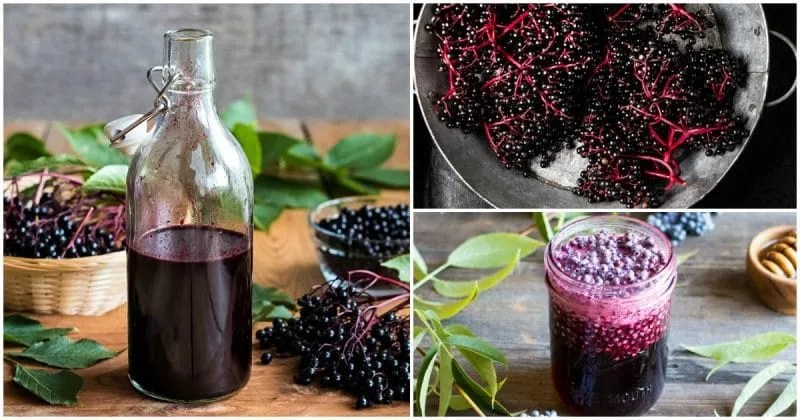
Here on the wee homestead I use elderflowers and elderberries in kombucha with delicious results! I’ve also made syrup and St. Germain.
Please visit Gavin’s full article for so much more on this ancient medicinal plant, including history, myth and folklore, habitat, recipes, and beautiful photography.
Elderberry blossoming in the garden with pumpkin, inviting lots of pollinators.
This post we’ve got some happy snaps, the usual weather bitching, a bit of pre-planning and some good news on two healing fronts.
(From bottom left: mini-mustard greens and new lettuce germinated inside about to be transplanted to replace all we’ve eaten; several types of onions and elephant garlic (which does best here, by far); and turnips for us and the pigs. 😋)
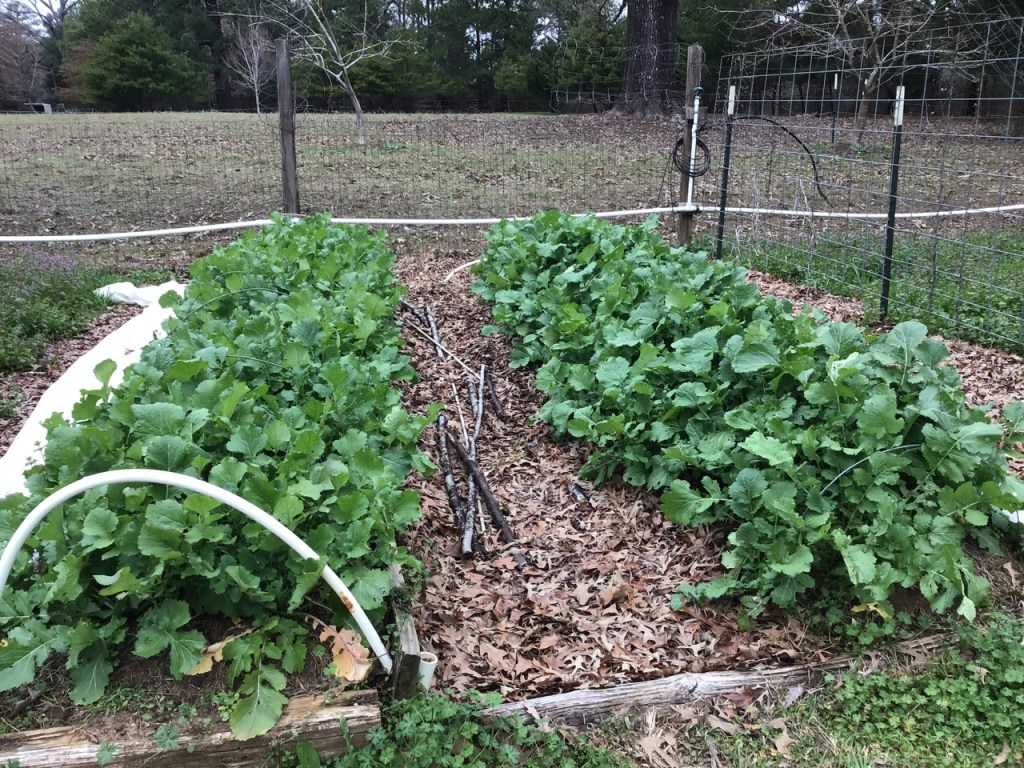
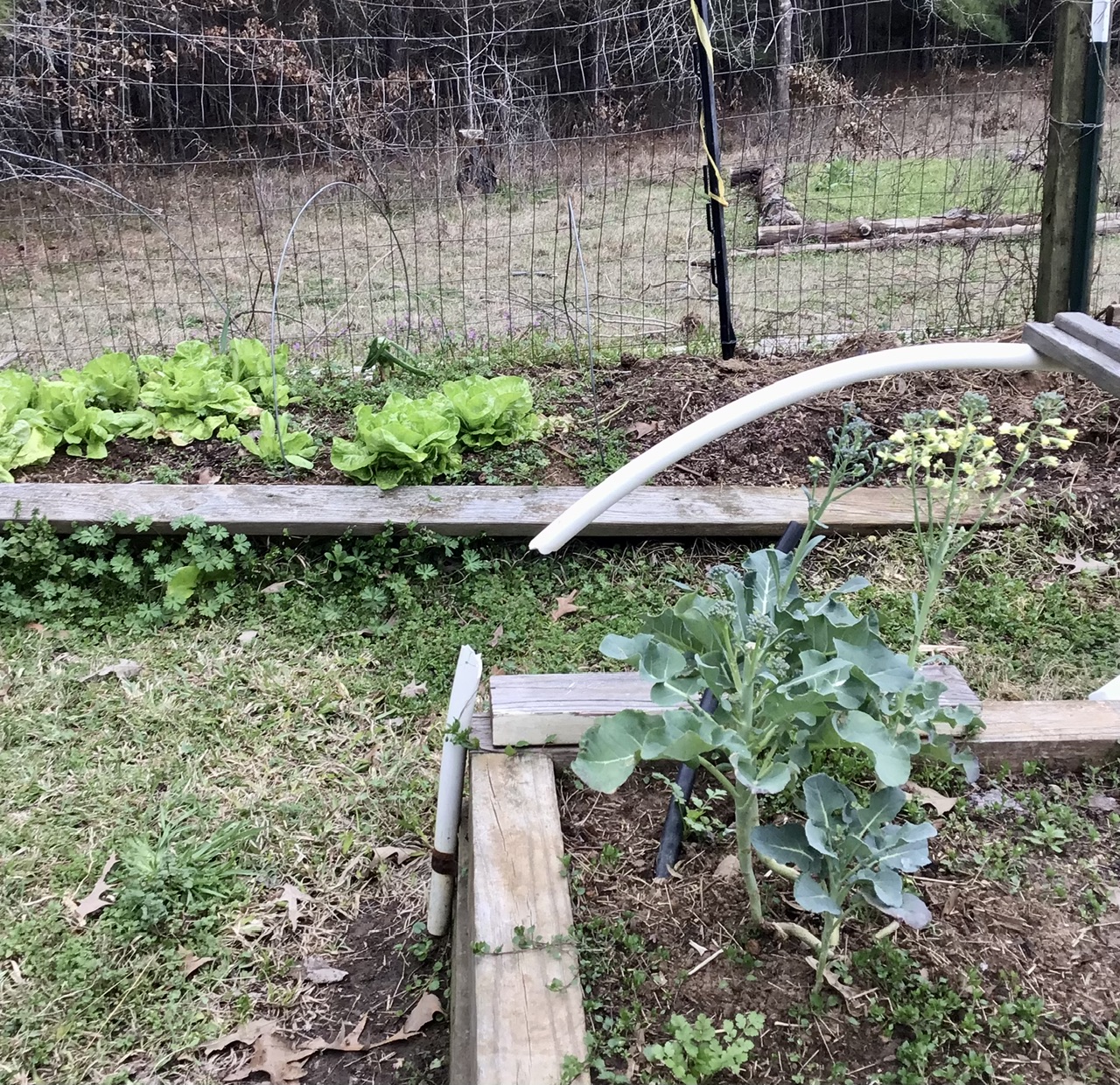
The cauliflower is long gone, the broccoli nearly so, but a new crop is already in the works inside on a heat mat. Succession planting has its limitations in our East Texas Yo-Yo Season (formally known as ‘winter’). Sometimes you get lucky with a warm stretch and get a nice surprise (yay, third times a charm, the carrot seeds finally germinated!) other times you get premature bolting (that dumb broccoli didn’t even produce a good head yet!).
Premature bolting 😖 But some nice butter lettuce still doing well by covering during cold swings
I do not appreciate it, and I think it stresses us all at some level, not just me, not just the more sensitive 4-legged and 2-legged, but all of life. Five warm days go by, in the 70s (but feeling hotter), with an unseasonal and hot stinking wind coming from the south, then suddenly, the very next day, it’s 40, lows in the 20s, and the dogs are shedding, also unseasonably.
Our ‘Arctic chicks’ — confused broody hens confusing weather whiplash for spring
Yes, we get the surprise arctic chicks on occasion. It’s nice to see a bee or two about. We get early daffodils. But we also get another lost fruit crop because it is sure to frost and now, again, everything is blooming far too early.
And it seems to me, the more folks are catching on, the more the establishment pushes back, with the gaslighting and the misdirection and the normalizing.
Going back to the 1800s! And how’s that working out for us?
Despite the man-made manipulation, or maybe because of it, I’ve come to appreciate the old adage ‘Let nature take its course’ on a whole new level. We’ve had two overlapping critter health issues these last months, both with their unique challenges.
Shadow’s blood-spurting ear was by far worse, but still, in every case, I don’t like not knowing what to do, stressing about my lack of knowledge, feeling useless, and that’s how I felt during Chestnut’s ordeal as well.
Please allow my whine for just another moment, it’s been illuminating for me, in a way.
Self-reliance is a cornerstone goal for us. Relying on vet care is not an option for a number of reasons, beginning with the cost, ending with the lack of trust we have for the medical establishment, and with a very long and convoluted journey in between where we try to figure out how to bridge this enormous gap, with no training.
We are lucky for the internet, but you know how that goes. One problem, a dozen conflicting pieces of advice. We ask around as well, we are certainly grateful the many suggestions offered, but still it’s nerve-racking making ill-informed decisions, and no matter what anyone might pretend, health is not an exact, one-size fits all kind of science.
Chestnut was acting strangely, very suddenly. She went from just fine to a few hours later she was lethargic and not eating much and separated herself from the herd.
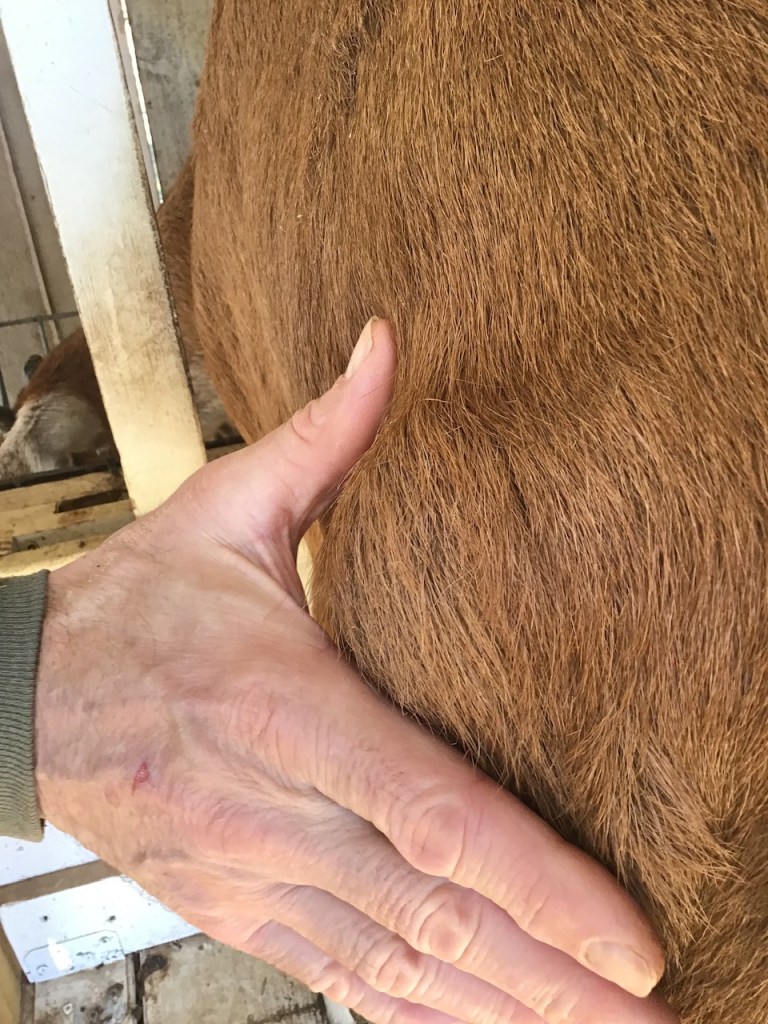
My goat friend suggested Ivermectin and it seemed to work fine. Then she quickly developed an abscess on her side. Related? No clue. It looked terrible, but it was not bothering her at all. I read lots of advice, but decided to let nature take its course after reading one description that sounded most similar to what I was seeing. Though they recommended lancing it at the end stage to avoid ‘infection’. (In the above photo you can see the ‘before and after’, the photo on right taken yesterday, sorry for the blurriness.). It got very large and it was not easy to do nothing!
It’s been over a month now, and it is healing nicely. Patience was the correct remedy, not lancing. I think we have an addiction to unnecessary interference in our culture.
The ordeal with Shadow was a serious challenge. You might recall the middle of the story from our last Happenings post. It started all the way back in November with a little nick on the tip of his ear. The cat?
Who knows, but it was shockingly difficult to get the blood flow under control.
We had much advice, some of it new and excellent (thanks again Kath and Zoe!), but wow, did that take some patience and perseverance, which mostly landed on Hubby, as per usual. (Male privilege! 😂)
Three months later and it is completely healed and all’s well that ends well, thank heavens!
What exuberance, no one around here can keep up with him! He runs circles around us all, then sits patiently by Hubby’s side until the next round.
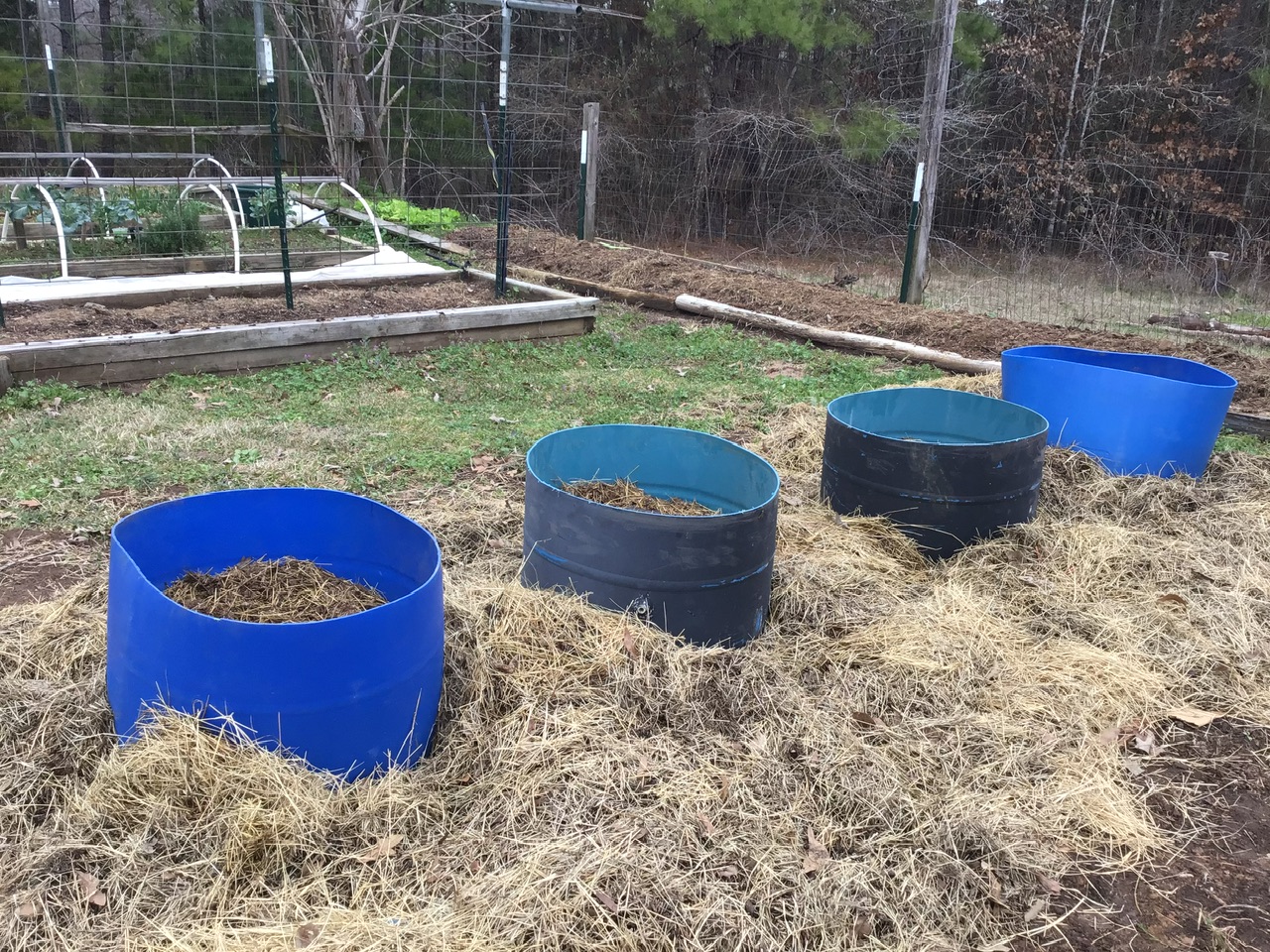
We LOVE potatoes, but they aren’t the easiest to grow here. This ‘barrel-layering’ technique has proven to be more successful.
We love potatoes so much we also buy them in bulk when they’re on sale and Hubby cans them up and they fry up in tallow so quick it’s like a delicious fast food that’s a cheaper and healthier alternative to the industrially processed varieties.
It is a long and labor-intensive project, that’s 45 pounds of potatoes there, it took him the best part of a day to do, but we’ll be appreciating the effort for 28 delicious meals. 😊
Looking ahead we’re doing a bit of planning—I’ll be giving another beginner’s fermentation course next month and Hubby’s got some good livestock trades in the works, we’re committed to foraging more for mushrooms and cultivating our own.
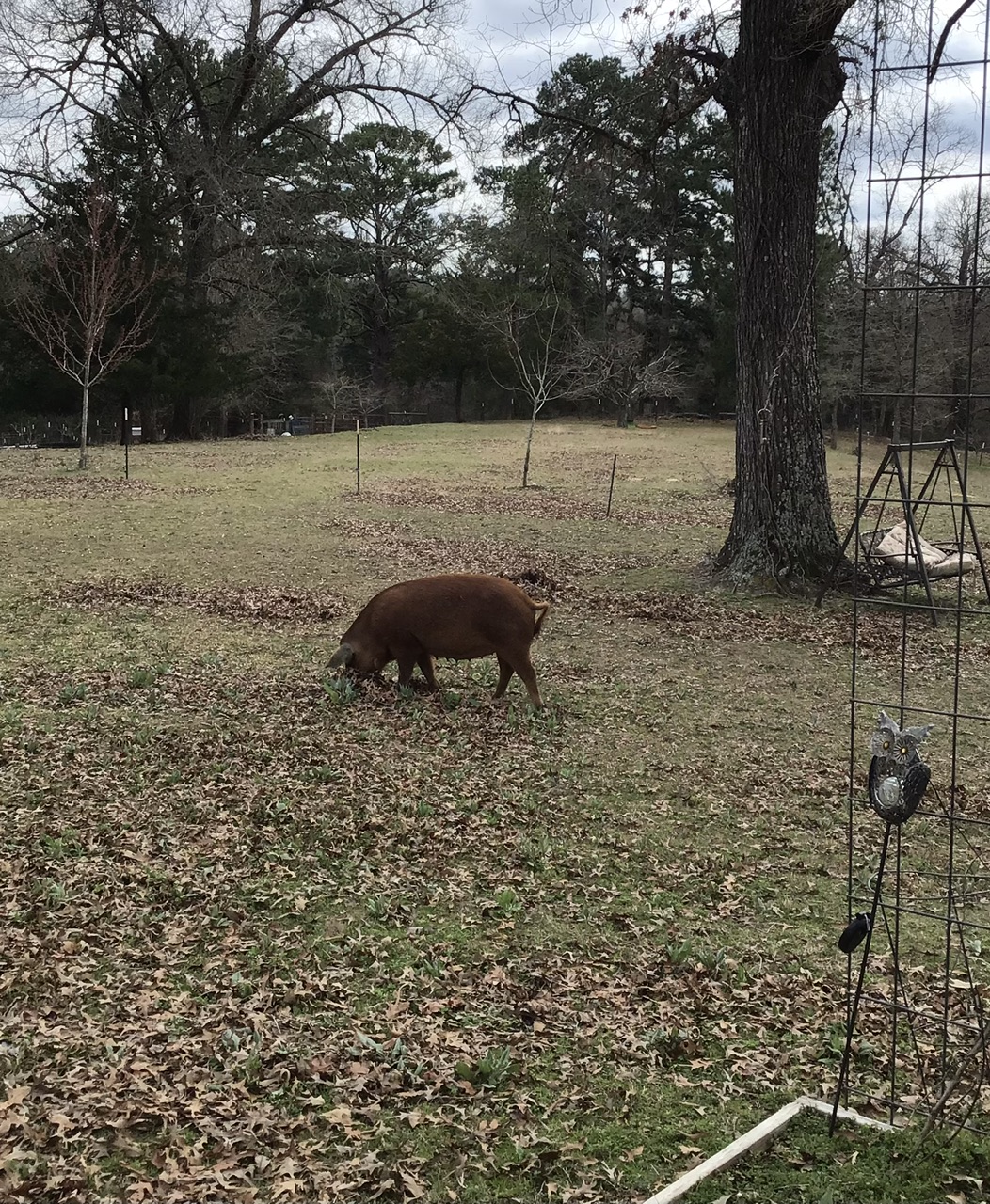
Patty, our mama-to-be, eating up the last acorns. Already many of her piglets claimed for bartering deals. 😁
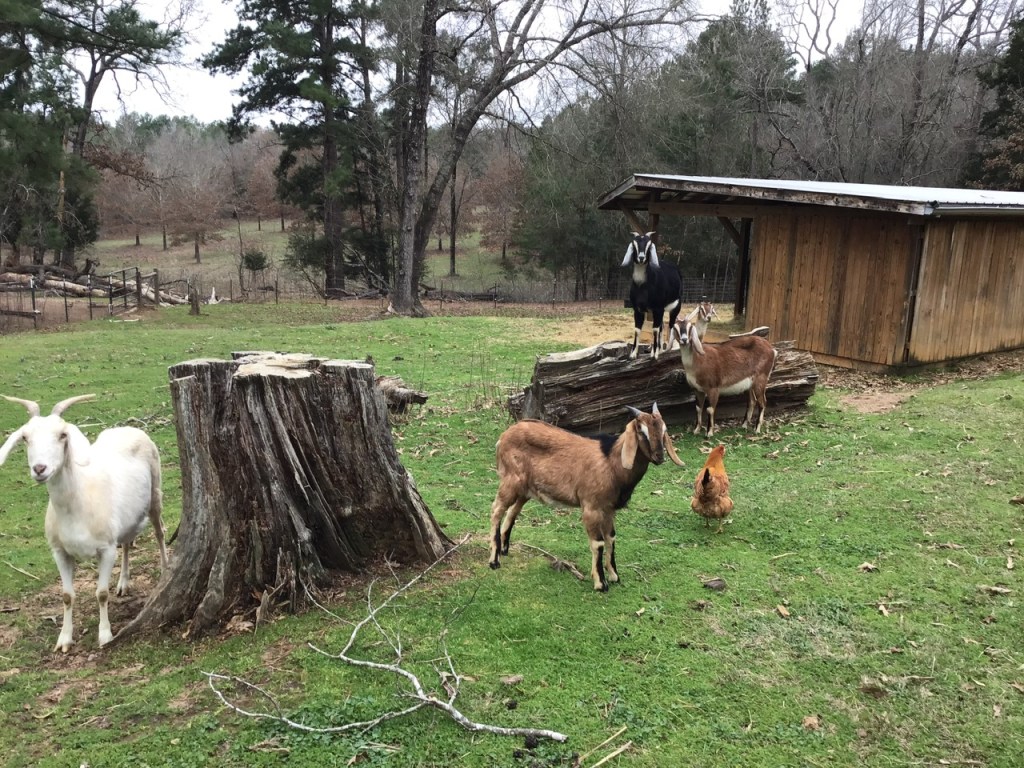
Here’s a current little visit with our herd, including, hopefully many healthy, expectant mamas with kids growing fine.
Not that little guy, he’s our first buck, we call him Teaky.
5 expectant mamas among our St. Croix-Dorper flock
Incorporating more permaculture design in the garden and orchard is an on-going big goal. We have a couple spaces empty and I’d love to try something really unique like this:
Permaculture-Inspired image I’m dreaming about!
Where I’d be including my fun garden-art projects, like these:
Lots of grand plans in the works, always, but it’s the simple things that make the hard stuff worth while.
Some are shocked and appalled by this, as they should be, according to me. Others think it will be a fantastic improvement to human life, or a great way to make more fiat, or a solution to the burden on the caring professionals, or they love tech for tech’s sake, or whatever.
Those of us who love history and dwell constantly on the question ‘how has it come to this’ were well aware of this potential because we study the trajectory of modern life. I could begin with the first critics centuries ago, but for brevity sake, I’ll start instead with my own life, the only history available to me to know thoroughly enough.
Working mother, divorced parents, step parents, then step siblings, professional daycares, neighborhood babysitters, after school programs, junk food, convenience food, lots of TV. Family history of: diabetes, heart disease, obesity, cancer, vision problems, depression, eczema, alcoholism, Parkinson’s, and, you get the picture.
And I would not say my family life was bad. It was the typical American suburban life of a great many growing up in the 70s and 80s. Neither particularly good, nor bad, just normal. Normal, as in well-normalized.
Like most families my parents would joke about voting for the ‘lesser of two evils’. They probably learned that from their parents. My mom went to community college and got her degree once we were gone, in sociology. She worked full-time all her adult life and didn’t regret it. My dad remained ‘upwardly mobile’ as his Protestant father taught him to be.
In fact, we have retired before him, and he has just had his first heart attack.
They are both still with us, but they do not read this blog, so I could say whatever I wanted. 😏. But, that’s not the point of this particular post.
Let’s leave it at this—in hindsight, my unique perception of growing up this way is, in a nutshell—there was not a lot of parenting happening. The results of this having widespread and devastating effects.
It is from these original seeds of pseudocare that have been not only consistently irrigated in our own territories, but have been dispersed throughout the world these last five-plus decades which has ensured the trajectory to the ridiculous place where we now find ourselves: Drowning in pseudocare so deeply we can scarcely recognize what real care looks like anymore.
Another quick peak at the fruits those seeds have produced.
Yet even facing all of this, I’m still optimistic, as I have been all my life. Even at the worst of times, even during a few prolonged worst of times, I must’ve still learned something vital from my half-assed upbringing and collapsing culture.
So, here it is, in another nutshell:
Believe in yourself, believe it can change, but don’t practice in sidestepping the hard stuff. And the hardest of the hard stuff is care, real care—for yourself, for others, for the future—that is why we are here. How you go about that is your personal journey and your only real duty to discover and live. That is all there is to do in a life well-lived.
Which is why I want to once again quote an obvious example of someone doing exactly that, Gavin Mounsey, who is rocking the real care like a hurricane these days! Wait . . . What?? Ok, terrible simile aside . . .
I believe he knows what needs to happen next and is becoming the living manifestation of that in his own life first, and passing it around. Leading by example, it’s the only way. It’s the same cardinal rule as storytelling—Show, don’t tell.
“I want to give my energy to improving and increasing the resilience of my local community, not your hyper centralized one size fits all infrastructure.
“Freedom is not a consolatory prize that can be given to us to reward our obedience and capitulation to a system of violent coercion. It is not something that can be granted or provided to you by some government that wrote some thing on a piece of paper. Freedom is your birthright, and you either live it and embody it, or you allow yourself to be put in a mental cage by statists and other abusive institutions or individuals. My ancestors bloodlines are traced back to a people described in today’s terms as The Gaels. “Saoirse” is Irish Gaelic word for “Freedom”. Saoirse is an ancient concept that comes from the original Brehon laws of the Druidic (and eventually Celtic) world before the time of Christ. In the times when that word was created, my ancient ancestors lived without a centralized state, without prisons and without police.
“Saoirse means many things to different people. For some it means freedom to think, express and freedom to learn, for others it’s the freedom of imagination and the freedom of the spirit. And for some it also means freedom to set up parallel societies.
“This is one of the reasons that I included glimpses into two historical cultural cross sections of ancient cultures that existed without a centralized state and police/prison system in my essay as I feel that we can glean wisdom from stateless societies that existed for centuries to millennia in how to design more ethical, equitable, honest, Regenerative and practical ways to organize community, encourage amicable/respectful behaviour in humans and collaborate to leave this world a little bit more free and beautiful than it was when we got here after we are gone.
“With all that being said, I want to emphasize that I think that placing any culture, group of people or individual on some pedestal as pure is unhealthy. I feel we should be vigilant to make sure we are not romanticizing their past nor romanticizing the potential of their worldviews to provide solutions to the present challenges we face.
“The path to become connected to place with a reciprocal relationship, reverence and humility is the path to embrace indigeneity ourselves.
“It is a great starting point to create pockets of decentralized resistance to oligarchic / statist tyranny as growing your own medicine and veggies may appear harmless, but in a parasitic global plutocracy it represents a decisive action that severs the tentacles of tyranny in a critically important aspect of our lives (how we access food and medicine). Thus, it is a radical and revolutionary act that appears benign to the hubristic philanthropaths and demociders, serving as a sort of covert sedition in a world governed by parasites that want us dependent, gardening to grow or own food and medicine is like a hammer wrapped in velvet that knee caps big pharma’s plans to poison us slowly through dependence on their system for health care and also strikes the spine of the digital gulag system, breaking its back so it can no longer have any strength to influence our lives through controlling our access to food/medicine.
A better essay about the importance of self-reliance and health as the ideal antidote to modern societal tyranny I could not have written! And he has a YT channel. 😁
He was also kind enough to try to address our biggest garden nuisance within the scope of his permaculture lens. He offered many potential solutions, and bless his heart for the effort.
But I’ll just repeat my personal favorite: hot and spicy gopher wings. 🤪
What an example of authentic care—growing in the real and cyber worlds simultaneously—where even sassy meat-eaters and smart-asses and AI are welcome to stuff up their comments sections. Now that’s grace under fire!
Thanks to guys like these, in the coming decades I predict courageousfellowship will become the new sexy.
Some say It’s on Its last legs. The ‘coming collapse’ crowd is growing, that’s for sure. I’m pretty sure we can confirm we’re no longer fringe.
“There are mighty forces arrayed against us. They threaten our liberty, our livelihoods, our families, and even, possibly, our sanity. We may find ourselves, if we are awake at all, resentful or even angry at the situation we find ourselves in. We may want to ‘resist them’. But how? Our governments, except possibly at a local level, seem to largely be against us. The corporations, as they always have been, are against us. The media…ditto. The institutions of civil society? Largely captured. Our faith communities? Well, maybe some hope there, but all too often, the same deal. So, what are we to do?”
I don’t believe that, exactly. Our beloved Institutions have always been in service to Empire and I believe Empire is now in the process of refining itself, shedding its skin in order to reinvent itself. Empire is like the Ouroborus, eternal and regenerative.
These opinions may look opposing at first glance, but in fact they are complimentary.
I believe Empire is the rolling stone on which the Individual’s sword is sharpened. We will never be without It, we have never been without It.
That does not mean resistance to Empire is futile. But it is painful. From happy slave to disgruntled dissident is a long and lonely journey. It has to be.
Empire’s tactics evolve, forcing the Individuals’ along with It. Not in a David vs Goliath manner, but more like in a perpetuating Gordian Knot. We need each other too much, we are not who we are, one without the other.
For as long as Empire has existed, the Individual has fought to escape it.
He has fought so hard against It, that he has become It. The fight, or dance, however you choose to feel it, has become excruciatingly intimate over time.
At some moments in the cycle, perhaps all it takes are whips and chains to keep the system of Empire churning. In current times It is far more sophisticated. It wants willing and happy slaves, that’s what helps the Master slaves sleep better at night. Mental slavery, debt slavery, touchless torture.
We each must choose. The Individual must have free will.
It’s not that one is alone on the path away from Empire. There are a great many unhappy slaves. You will find them everywhere along your course, which has existed for as long as Empire.
“The classic example of ideological motivation is the ‘work ethic’; the idea, which has driven the workers of the West for the past few centuries, that we are morally obliged to work for the system for our entire lives so that, perhaps, one day, we will no longer have to work. A subtler modern example of ideological discipline might be ‘team spirit’ — the means by which loss of purpose, dignity, joy and freedom at work is compensated with group-bonding. “I didn’t agree with the purpose of the war; I was just looking out for my buddies—applies equally to the army platoon, the office department and the school class.” 33 Myths of the System by Darren Allen
We learn in the Empire’s schooling that the opposite of pleasure is pain. Furthermore, they teach us, that as a species we inherently seek to experience pleasure and to avoid pain.
And yet, sado-masochism is visible everywhere in our cultures. There are those who actively seek pain, and a great many who experience pain, and still go back to do it again, and again, willingly. Mothers and soldiers come to mind. Giving birth is rarely described as pleasurable. Soldiers rarely relish in their battle fatigue. Are we to believe they are all masochistic?
What’s missing here? Perhaps the opposite of pleasure is not pain exactly, but a specific kind of pain, the kind inherent in seeking virtue. Why do we not avoid this kind of pain as well, as a general rule?
The Individual’s path is painful because virtue is the opposite of pleasure, as Empire is opposite of the Individual.
That may sound like a notion of the Stoics, yet I’m definitely Dionysian by nature. It is not for the backache or the sweat or the frustration that I garden. It is for the fruits of my labor. It is for the care I’m able to show to the soul and soil and the hope that my efforts grow beyond my finite existence and wisdom. It is the pain of true ‘virtue seeking’.
I want them all, all my fruits, not out of selfishness, but to distribute at my preference and at my leisure and not according to the dictates or conveniences of Empire.
And yet, Empire is not my enemy. We may fight, or dance, but I do not wish Its collapse. Specifically, I wish It to continue to increase the virtue of the Individual. Even though I know that requires significant pain.
I have been amazed by the incredible virtue of some of those I’ve found along my Individual course.
The following comes from the latest post of one of these Virtuosos, Gavin Mounsey. I like Gavin not only for his beautiful photos and keen mind and wholesome work, there are many others who fit that bill. What I find most unique about him is, he doesn’t bypass the dirty work. That is rare in my experience. He stays focused on the good, on the light, on the solutions, but not at the expense of the hard truth. It’s a tough balance I know.
“Taking steps to embrace food sovereignty and a path that consciously nurtures symbiotic relationships are ways of living that are synonymous with a more happy, passionate and creative life. As our basic survival needs become fulfilled through our own “hands-on work” and skills, it frees up a lot more time to pursue the things we are truly passionate about in life. Embracing that self-sufficient lifestyle is so much more fulfilling than working ‘for the man” getting a pay check of digital fiat currency, trading it with 5 different middle men to get our food, water, energy and fulfill our transportation needs. It really does improve not only the quality of life, but the perception of what is meaningful in one’s life. It effects our very psychological foundations as we rediscover the simple joys in life. It helps us move away from the hyper-distracted, over-stimulated, digital chemical culture that has built up around us and allows us to let go of greed and materialism by truly coming to know the beauty of planting a seed in the soil, nurturing it to grow, and reaping what we sow.”
“Now is the time to reaffirm our alliances with the living Earth, to nurture new symbiotic relationships with the soil, people, plants and fungi in our local communities. Human empires rise and fall, and history teaches us that when they fall, it is those that know how to grow/forage for their own food, medicine and preserve it, that survived.”
“We can create oasises of health, resilience, and abundance in each of our communities… we can become the solution, break from dependence on centralized systems and help others to do the same. It begins with the soil and the seeds and it evolves into nurturing symbiotic connections with those whom we share our communities with. Each of us can embody the medicine that the land and our communities need too survive and thrive though the tough times ahead.
“Thus, each and everyone one of us should now be focusing our efforts on honing our skills related to food/medicine cultivation, preservation and developing a reciprocal relationship with the land where we live.”
“Saving up money for a ‘rainy day’ is not a solid way to prepare for emergencies because money has no innate value. Seeds, good soil, gardening skills, increased health/immunity, preserving experience and the symbiotic relationships and friendships we forge with neighbors and the broader community we are a part of (through sharing our abundant harvests and seeds and helping others to grow regenerative gardens) are however things that have innate value.”
There’s so much inspiration in his excellent article, many great reasons to start a garden, but also much information about all the rewards gardening reaps.
I know it must be autumn somewhere! Here that reality is still mostly in my dreams. We’re still in the 90s and still mostly dry. There are a few tiny signs of change though, that I’m magnifying in my mind, because I can hardly wait! It’s been a terrible summer.
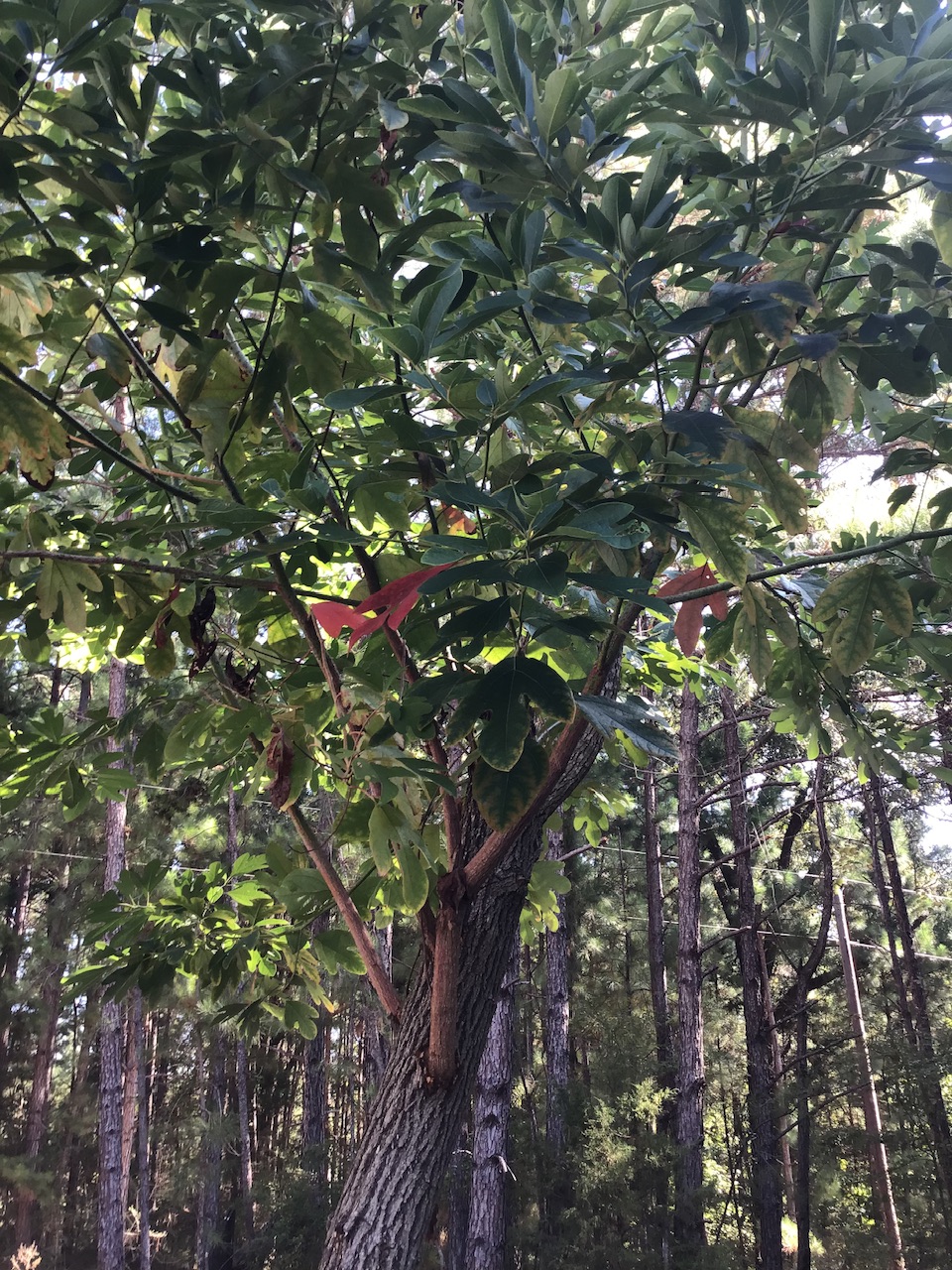
See, right there, 3 red leaves on my favorite Sassafras tree! (Very soon to be featured in an ‘Herbal Explorations’ post)
But, I’m not going to complain about that now. Instead we’ve got lots of happy snaps, and even a few scary ones.
We’re gearing up for the fall/winter garden, getting the beds ready for the transplants that have been growing under lights for a month and are very ready for their new outdoor home, just as soon as the temperature drops a bit.
Hang in there brassicas, it’s almost time!
We just started harvesting sweet potatoes from the boxes waiting for replanting.
Those vines helped keep the goats happy and healthy during the extra long heat wave.
Summer keeping a sharp eye on Shadow even though there’s a fence between them. None of the goats have warmed up to him, despite all his best efforts!
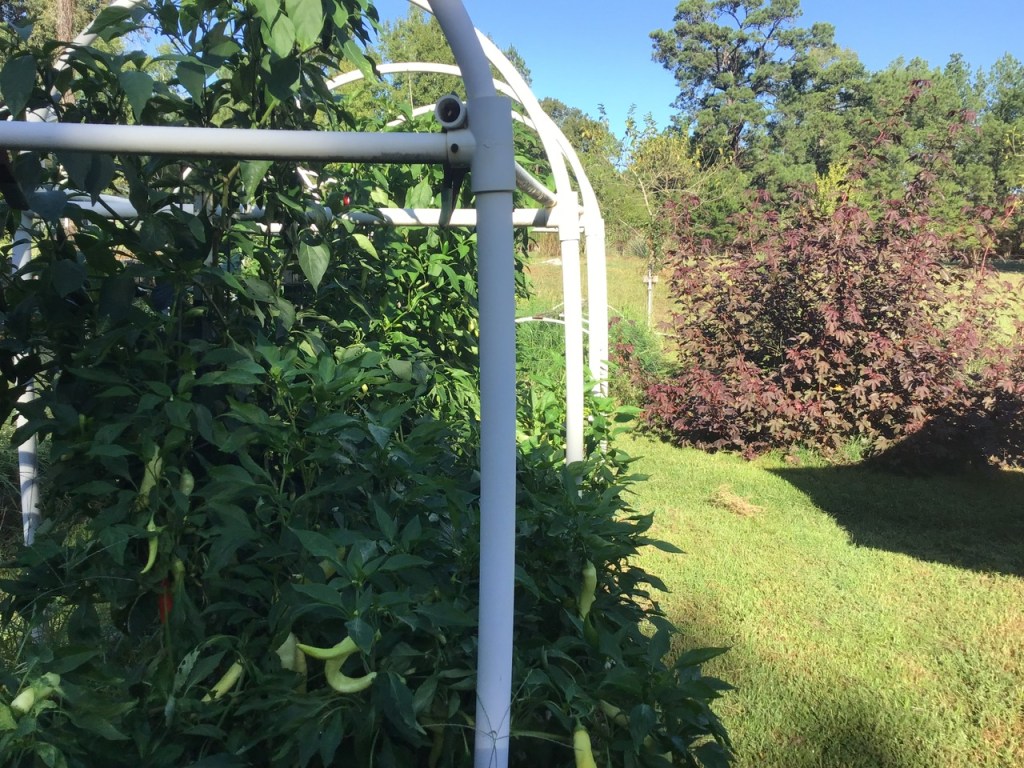
The peppers have come back with gusto after another dose of compost dressing and removing their shade cloth.
Jalapeños and banana peppers and the now monstrous cranberry hibiscus on right that is finally just starting to bloom.
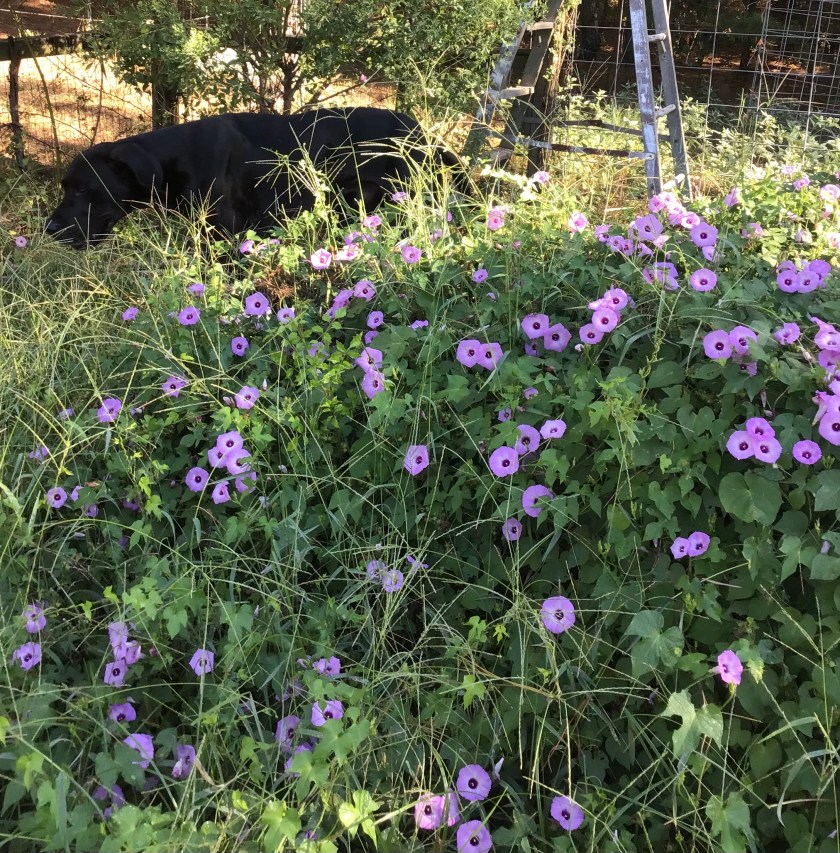
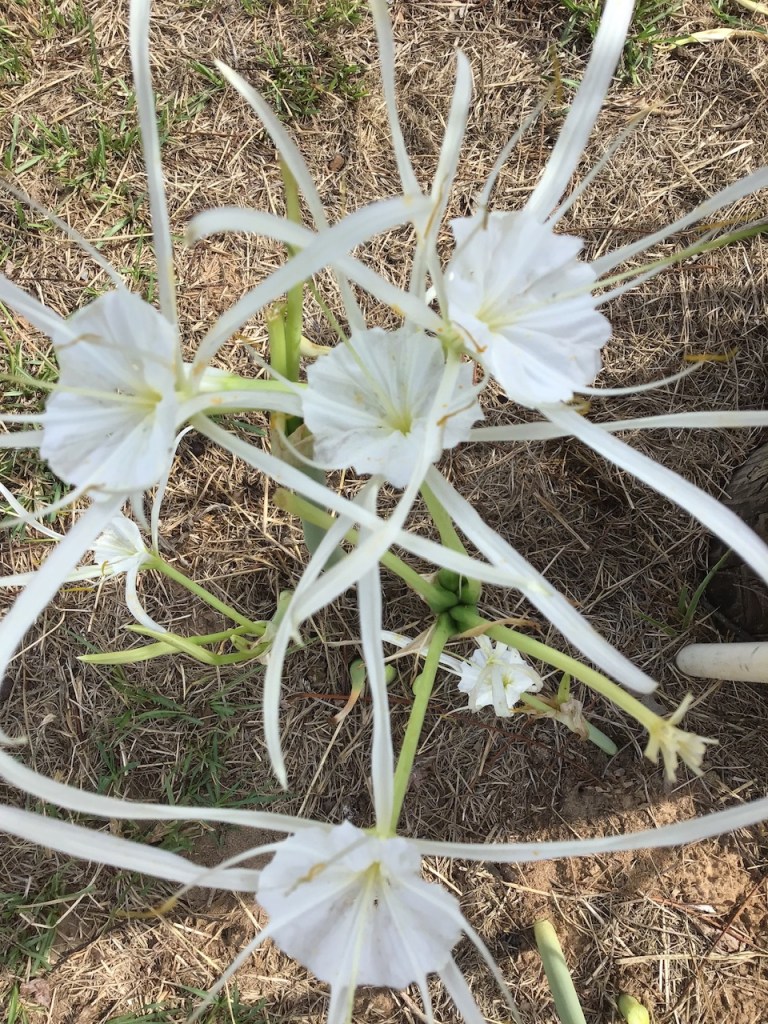
Cucumbers again, yippie! Plus hurricane lilies, turmeric, zinnia and basil keeping the bees happy. And lots of bindweed (morning glory)—scourge to the industrial farmer—a hardy, lovely and welcome cover for the rest of us.
I’m getting about 1/2 gallon of milk a day from 2 goats and making cheese often—mozzarella and soft chèvre every week and a hard cheese whenever I can accumulate at least 3 gallons (preferably 6) in the freezer. The larger the hard cheese the easier it is to age properly and goat milk works just fine for cheese after freezing.
The easiest cheese to make and so delish!
But I’m really looking forward to making Camembert and Munster again. Just like all things natural, cheeses also have seasons. I was very disappointed by a so-called Brie I just splurged on from the grocery store. They should call it a processed Brie-like imitation and market it in the aisle with Velveeta. Quel scandale!
A few more friendly faces . . .
As I mentioned last update, we had a sausage-fest this summer, that is, a super-high percentage of males born, of all species—cats, pigs, sheep, chickens, goats. So odd.
Now we have 3 young male cats, a new thing for us. But one of them is a real scaredy cat, we’re never able to get close to him and he’s rarely around except for meal time.
Always crouching in the shadows and darting off even from the camera.
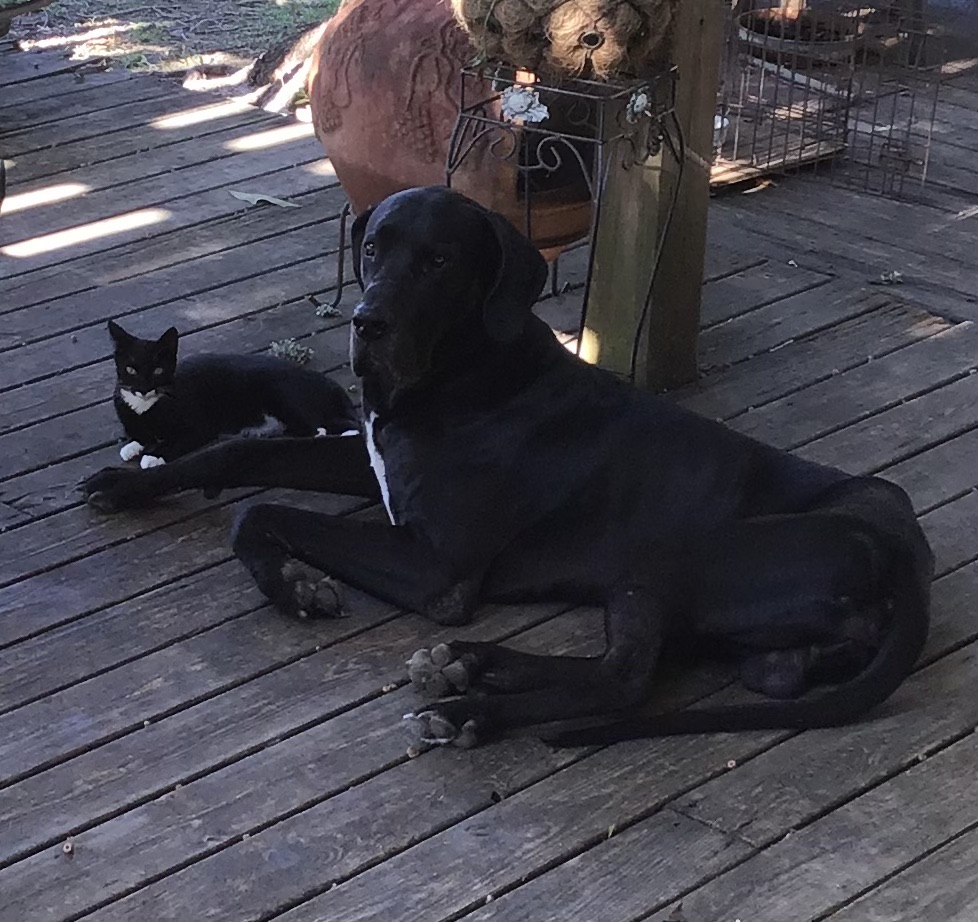
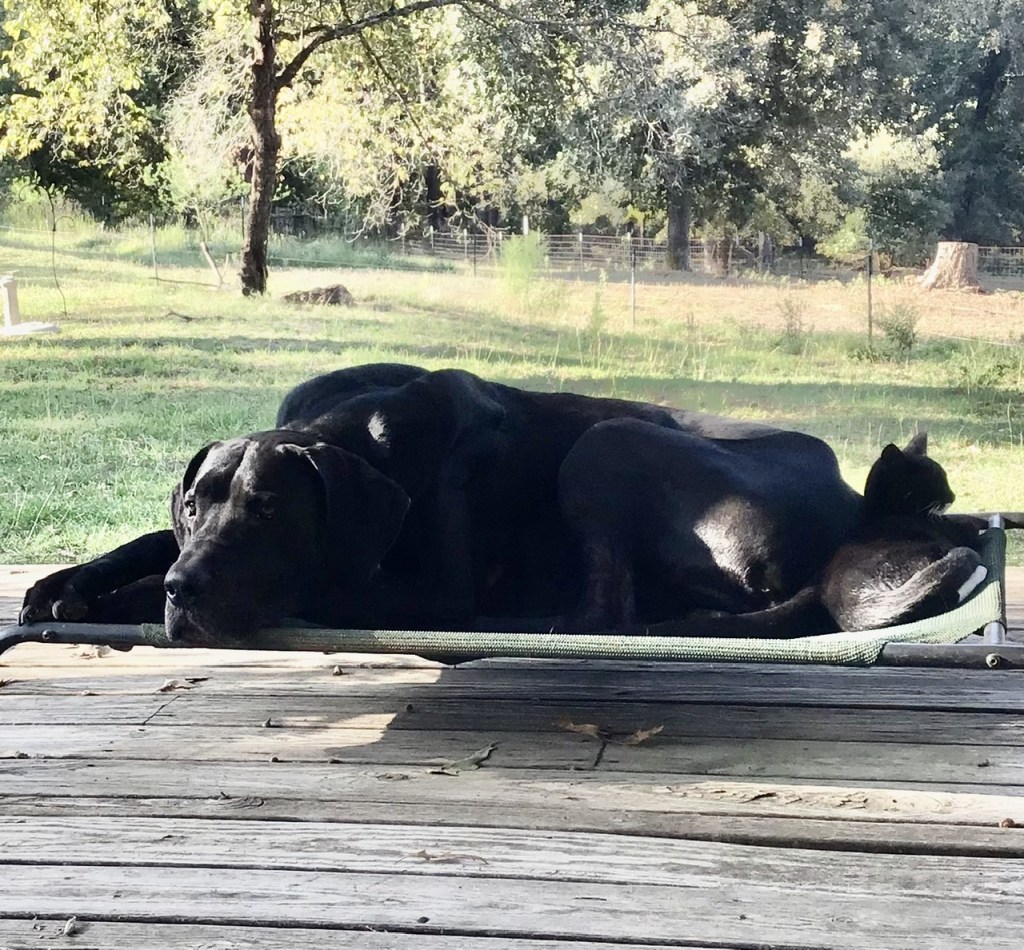
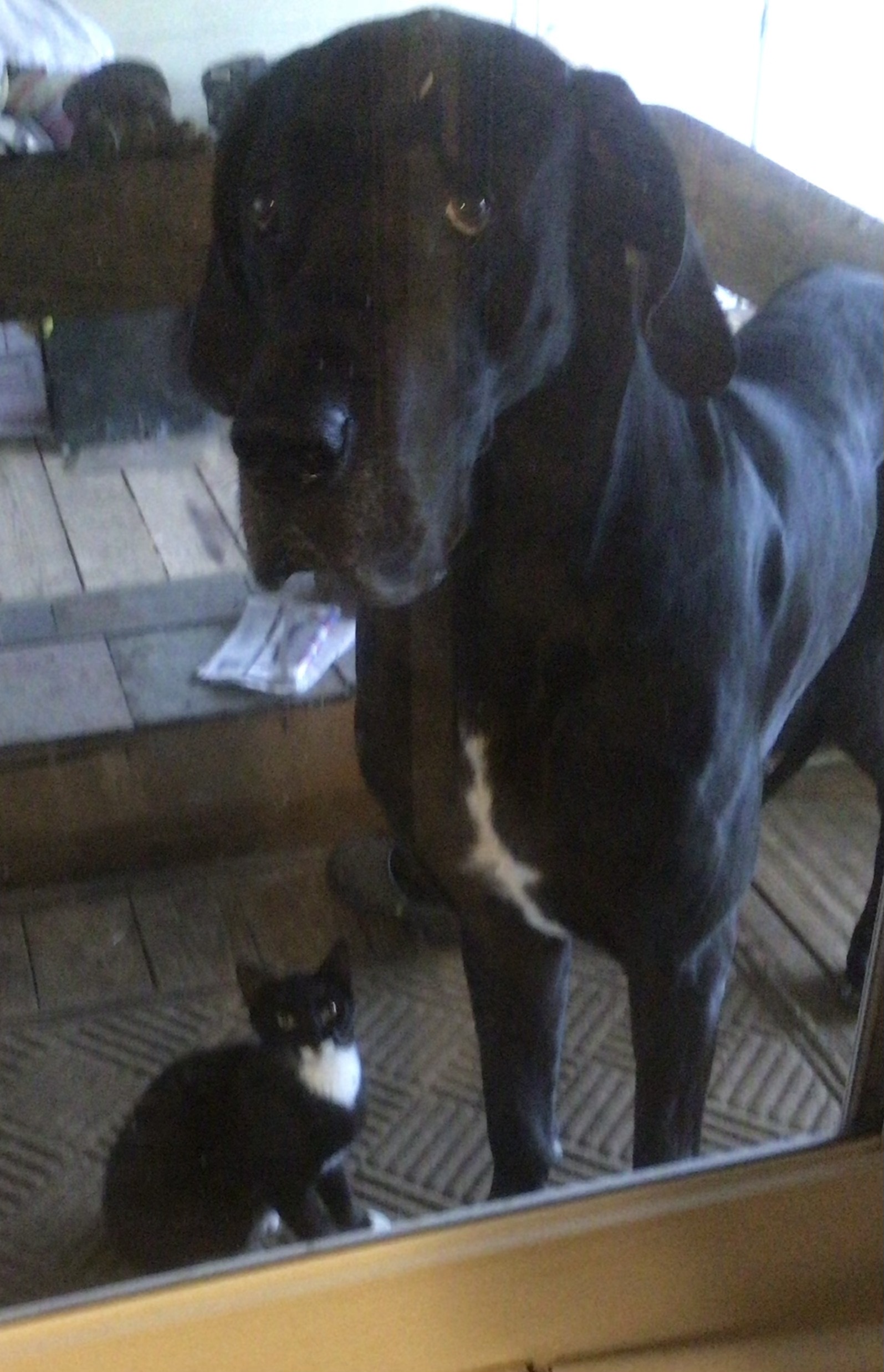
Also odd but true—our black cat, Mittens, hangs out with our black Shadow and our blond Tony hangs out with our blond Bubba and Buttercup—go figure!
“Hey in there! Where’s our breakfast?!”
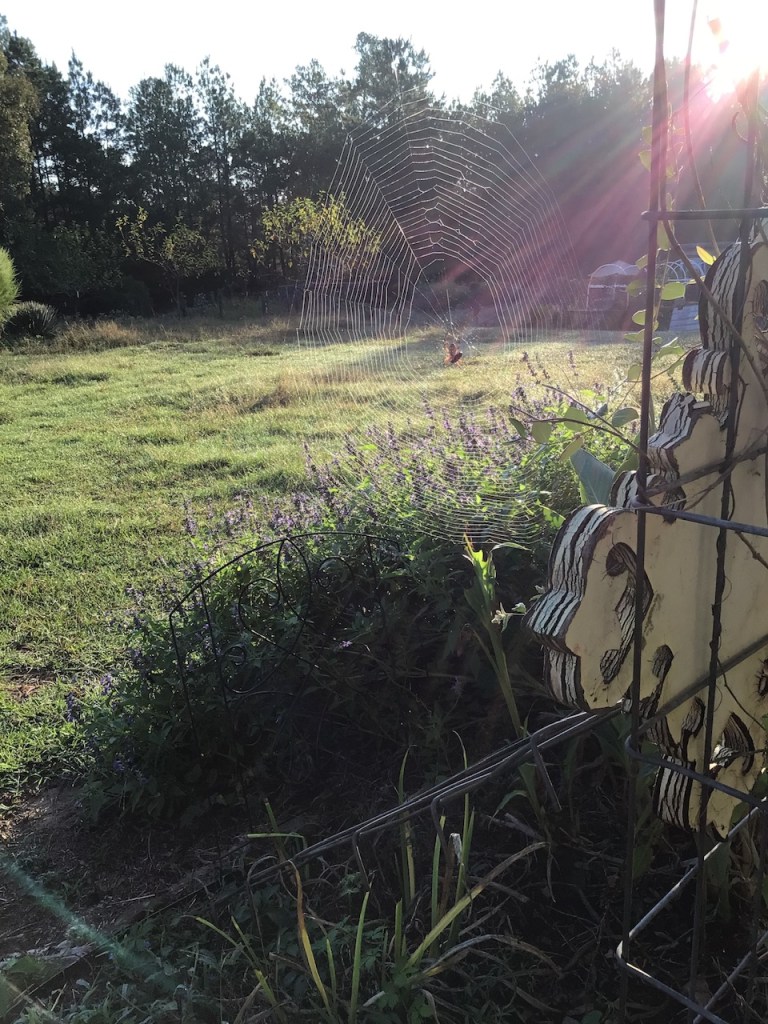
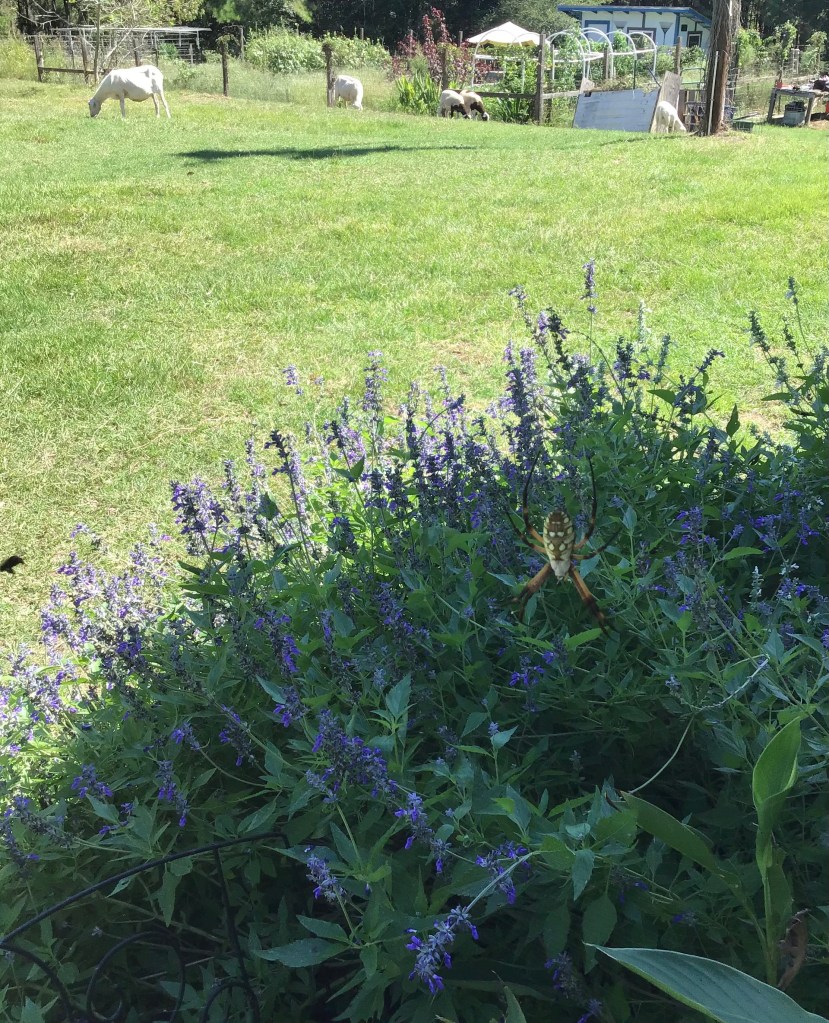
I love spiders, especially these beauties, but some folks find them scary, apparently.
Now here’s a real foe . . . .
Gross! Looks like right out of a horror movie. And he has a lot of friends haunting our compost heap. 🤢
But who loves ‘em but our very scary Halloween rooster . . .
Poor guy, we’ve no idea what happened to him, but he is one scary-looking dude!
Soon we will be making the tough but necessary fall homestead decision—who will get bred and who will shuffle off to freezer camp?
But not a care in the world for these contented creatures!
Hope you’re having a fine Sunday and thanks for stopping by!
I’m critical of high-tech solutions and when I hear them in tandem with big claims of sustainability, especially at a global level, I automatically bristle.
Still, the first time someone called me a Luddite, I balked.
I know there are plenty of us—vocal advocates and quiet dissenters alike—bemoaning so much of the tech being shoved down our throats, most certainly when it comes to food. I’ve been vocally ‘anti-GMO’ and ‘anti-geoengineering’ and ‘anti-vaxx’ and ‘anti-surveillance’ which in their linguistic game really just amounts to PRO-nature.
Yet it is becoming more common, even among the homesteading ‘community’ and ‘off-griders’ to consider these two powerful forces as intrinsically intertwined. As if sustainability cannot be achieved without modern tech, forgetting we somehow made it all the way up to the industrial era with relatively little of it.
We often hear of technology being a Trojan Horse. But, that’s an understated analogy, considering in that story it was a “gift”—insinuating it was one that could’ve been rejected. There is no rejecting a good portion of this tech flooding into our lives today. You will not escape the digital prison, at least not completely. Those 5G towers are screaming their frequencies over your head day and night whether you like it or not. The weather modification is a thing, whether I like it or not. (NOT!)
We also hear of technology being as any other tool—to be used for good or ill. Yet, is that a fair assessment when these tools are largely invisible? And when they are overwhelmingly in the hands of very few, and when fewer still would be able to replicate them in any capacity?
What am I missing? Where is the healthy balance? To explore these questions over the next few posts, I’m bringing in considerable help.
A young ‘homestead influencer’ I’ve heard about for years is about to release a new book and her attitude about the tech sounds pretty healthy. In the book she explores the question, “What are we leaving behind in our race toward progress?”
Like most of us, she has zero intention of recreating a ‘Little House on the Prairie’ lifestyle. She has managed to incorporate the tech into her life on her terms. So far, it seems.
Many of us certainly feel as the diaspora—dispersed between cultures—natural and digital.
I can’t help but wonder, is losing our soil connected to losing our soul?
I have a cousin in Colorado with a farm I’d call pretty high-tech. He’s a permaculture/biodynamics guy and has been very successful and has the perfect background to enlighten me, I’m sure.
He worked all over the world before his current venture, which has recently gone on the market after 20 years of development and WOW, talk about a success story! To increase the value of a property by such an extraordinary measure is truly remarkable. And that’s only part of his success story.
He too seems to have managed the tech, rather than the tech managing him.
I was quite moved by his 2015 speech:
“I remember! These qualities of life giving wholeness that our ancestors knew deep in their bones have been drawn off, separated, reduced, modified, pasteurized, homogenized, radiated – their vitality degraded, their life giving forces mutilated beyond what our cells might recognize. We now consume what are at best facsimiles of food, laboratory concoctions, genetically mastered ingredients – simulacra that do not build our cellular health but create work for our bodies, that weaken our fortitude and break our spirits. These laboratory wonders parade in full color down our grocery store isles. -all screaming for our purchasing dollars. More money is spent on the campaigns intended to seduce us than on the so-called food inside. These products are combinations of ingredients that we can not pronounce, masquerading as food and covered up with contemporary Eco-socially correct overly-designed, brightly bannered sales pitches in suspect containers claiming to bring us momentary bliss – all hawking only slight variations of amber waves of commodities meant for one thing and one thing only – to efficiently generate profit for a few, and from the most devastating chain of ecological rape and pillage the world has ever experienced – all leaving an accumulated insurmountable debt to future generations.”
Excerpt from a speech given by Brook LeVan at the 12th Annual Sustainable Settings Harvest Festival on September 20th, 2015:
“In the modern world, progress and innovation are often celebrated as unambiguously positive. New technologies, ideas, and ways of living are readily embraced with the assumption that they must be better than what came before. While it is true that certain advancements have brought undeniable benefits, such as improved hygiene, faster means of travel, effective medical treatments, and enhanced communication, it is crucial to critically examine the broader implications of modern progress. Often, the rapid pace of change leaves little room for reflection on whether newer solutions are truly superior to time-tested practices. As society becomes more complex and interconnected, the allure of novel and convenient solutions can overshadow the wisdom of the ancestors. Practices that have served humanity for generations may be disregarded in favour of modern alternatives that promise quick results and ease. For example, the trend toward processed foods and sedentary lifestyles has led to health problems that were less prevalent in societies that followed more traditional dietary and physical activity patterns. Likewise, the reliance on fiat money and speculative investment has created economic instability compared to more sound financial practices.”
Sound financial practices? What will the future kids know of that when even homesteaders are encouraging others to go deep into debt to finance their ‘off-grid’ dream property as if that’s magically sustainable? We used to call that debt-slavery.
Curtis Stone is a popular YT homesteader, and I’m not really meaning to diss him here, because it’s quite possible if I were a young man in my prime I wouldn’t be having such reservations as I do.
Risky behavior is common in youth, yet do we not expect a mature individual, as a mature culture, to become less risk-tolerant with time?
Debt has alway been encouraged for farmers when all the fancy new equipment becomes de rigueur—and a great many lost their farms that way during the Great Depression.
I’m not the gambling type myself, yet I see the technological sphere permeated with these types. From my vantage point, they appear to be addicts.
As if The Tech is not sketchy enough to me, there’s also the obvious fact of The Money, because you can’t have one without the other. That’s where the rabbit hole starts to go very deep.
(17:53) Gambling on people’s lives. That’s where the tech is headed. Not a ‘Black Mirror’ episode. Reality. Our debt-creation machine riding squarely on the backs of every cyber-unit, that is, every man, woman, and child, every living thing, all resources all around the world. Internet of Things, Internet of Bodies.
Alison McDowell of WrenchintheGears has been doing deep dives on this topic for many years, her work is hefty and dense, expertly sourced, and crucial in this discussion.
All this data. All the electricity required to run all this tech. All the power to be had, when all that power is in the hands of so very few.
So, I suppose I am a bit of a Luddite. I’ll be exploring this reality in the next few posts, I hope you’ll join me by adding your thoughts about the topic in the comments.
Ug, am I in a mood! Read on for a big fat bitch fest.
First I’m going to bitch about the weather. Then I’m going to bitch about the garden. Finally I’m going to bitch about all the dumb bitches.
I will end with one positive paragraph, however, so y’all can leave satisfied that there’s no need to fret on my behalf. 😆
Let me first set the proper tone.
Time stamp 35:53. It’s an old clip, but as valid as ever. Oh my, do I have rant-envy! How I wish I were this good!
You’re worried about what you’re putting in your fucking body?! What about what you’re fucking breathing?!!
I listen to Carol nearly every day; she’s one of the precious few who gets what’s happening and has a proper level of peeve about it all. Go ahead and give the first 30 minutes a listen, if you care to hear about all the (manufactured!) weather destruction around our realm.
If you want to be that person, who writes in the comments that all this is normal and they can’t control the weather, feel free, because I could use a good target for all this vitriol!
And just for the record, I know they use the word ‘control’ to confuse folks, because then they have plausible deniability. Because they don’t exactly “control it” like we control the thermostat in our homes. They manipulate it, where and when they can, in order to cause destruction, in order to profit from disaster capitalism and play the Stocks with weather futures and food prices and every other piece of the economy which is weather-dependent, which is a whole helluvalot.
If you are safe and secure in your tiny little area, good for you, your region is not on the targeted list, YET.
This is not about Bill Gates and his ‘proposed’ solar radiation management. This is SO much bigger and he is one drop in the bucket of the wild, Wild West that is happening in our skies and with our atmosphere. It’s been going on for decades! I’m SO SO damn tired of the denial and the Pollyanna pretending and the stoic excuses!
The general consensus that we can just keep throwing money at the problems and they will magically get fixed by technology is not just absurd and dangerous, it is fatal.
How’s this for the next big fix by Big Biz?
“Now, the likes of Bayer, Corteva and Syngenta are working with Microsoft, Google and the big-tech giants to facilitate farmerless farms driven by cloud and AI technology. A cartel of data owners and proprietary input suppliers are reinforcing their grip on the global food system while expanding their industrial model of crop cultivation.” From Net Zero to Glyphosate: Agritech’s Greenwashed Corporate Power Grab “Whereas traditional breeding and on-farm practices have little or no need for GE technologies, under the guise of ‘climate emergency’, the data and agritech giants are commodifying knowledge and making farmers dependent on their platforms and inputs. The commodification of knowledge and compelling farmers to rely on proprietary inputs overseen by algorithms will define what farming is and how it is to be carried out.”
How do you make the world believe there’s a climate emergency? It takes a lot more than hyped-up media coverage and fraudulent stats—there has to be something to cover after all. Enter mass-scale weather modification in key areas—droughts, floods, earthquakes—YES THEY CAN!
Not to mention they’ve cornered the markets of: Disaster Preparedness, 1st Response, Disaster Relief, and Reconstruction, of the entire globe.
Someone has to keep shaking that can to keep everyone fighting you know!
“There’s a meme that circulated on social media a while back that perfectly sums up the polarized, manipulated mayhem, madness and tyranny that is life in the American police state today:
“If you catch 100 red fire ants as well as 100 large black ants, and put them in a jar, at first, nothing will happen. However, if you violently shake the jar and dump them back on the ground the ants will fight until they eventually kill each other. The thing is, the red ants think the black ants are the enemy and vice versa, when in reality, the real enemy is the person who shook the jar. This is exactly what’s happening in society today. Liberal vs. Conservative. Black vs. White. Pro Mask vs. Anti Mask. The real question we need to be asking ourselves is who’s shaking the jar … and why?”
Weather warfare is real and it is happening. And it is going to get worse.
Around here, with nearly two months now without rain, high temperatures, drying winds, it’s very easy to grasp what sitting ducks we all really are. We spend the entire mornings just trying to keep what’s not already dead from dying. The time and energy and repetition is exhausting and demoralizing. The afternoons are spent indoors, grateful for the air conditioning and that we’ve had no animal fatalities from the heat, so far.
Most of the garden is dead and depressing. The tomatoes fried, the cucumbers almost gone and getting bitter, the squashes mostly dead, even the heat-loving luffa, which has never succumbed to the heat in past summers. One of four chayote squashes is still barely hanging on, and that’s supposedly another heat-lover.
Not even regular watering helps.
Thinking this ‘heat dome’ could be parked over us for another three months, or wildfires could be next on their battle plan is more than I can bear. I set a single perfect pinecone on the windowsill to remind me fall will surely come, eventually.
Then come the normalizers, Lord Have Mercy! The Fucking Chemtrail Deniers, How I LOATHE them! Let me count some ways:
The evolution of the geoengineering psy-op as I’ve experienced it over the last decade or so has been a recurring nightmare.
I’m thinking it might be helpful to those new to the topic and also to those compiling the multi-colored yarns of our clown world for knitting a scarf for their future grandchildren.
No kids, the skies did not always look like this. Don’t believe the Con-trail Believers!
Some early ‘rationales’ for the lines, dubbed chemtrails, back in the ancient past (circa 2010) — these would be the various layers of gaslighting I heard during my first inquiries on the topic.
*First tier. This is when I would randomly ask Google questions like, WTF is wrong with the sky? What’s the difference between weather and climate? What’s a ‘space fence’? What the hell is wrong with the weather? Answers: Planet Nabiru causing atmospheric disturbance The wind patterns changing due to ‘El Nino’ Contrails, a con that keeps on giving WiFi, atmospheric phenomenon due to widespread wifi Radar, result of new tech
*Second tier. This is when I started seriously questioning and challenging on social media. What’s geoengineering? What the fuck is wrong with the weather? What are ‘sun dogs’? What is ‘solar radiation management’? What are chemtrails? Answers: Not there, my imagination (yes, I got that regularly) Military operations, not my business (ditto) New brand of ‘green’ Jet fuel Military chaff End of days Coal Fly Ash Military fuel dumps Contrails, the con persists!
*Third tier: Self-replicating Nano-bots (now we’re getting somewhere!) Space fence, for real! Germ warfare Weather warfare (DUH!) My imagination—yes, still!
I do try to focus on the positive, and there is a bit of it. Hubby’s first sunflower-melon patch was a big hit. It’s gone now, but we’ve got some really amazing watermelons to celebrate his success!
The pumpkins have also been pretty impressive, and amazingly they are still alive, though it does feel odd to have ripe pumpkins laying around everywhere in July.
Guess who else loves pumpkins? The plants got so big they’ve grown past the garden fence into the goat’s forage area, so, fair play.
But selfish old queen that she is, she wouldn’t share a single bite with her mates!
For a couple hours in the morning it’s not so terrible standing still in the shade with mist from the sprinklers blowing on me.
At least the okra is still alive
Moringa, a lovely plant that just might make it long enough to produce before frost.
While we definitely have fewer pollinators visiting the garden this summer, at least we do still have a few nibbling at the drying flowers. May they survive and multiply!
And of course, tomorrow’s Funny Friday, so that might help my torrid mood. 😆
Pokeweed is one of the most controversial yet fully legal weeds you’ll hear about, I’m sure!
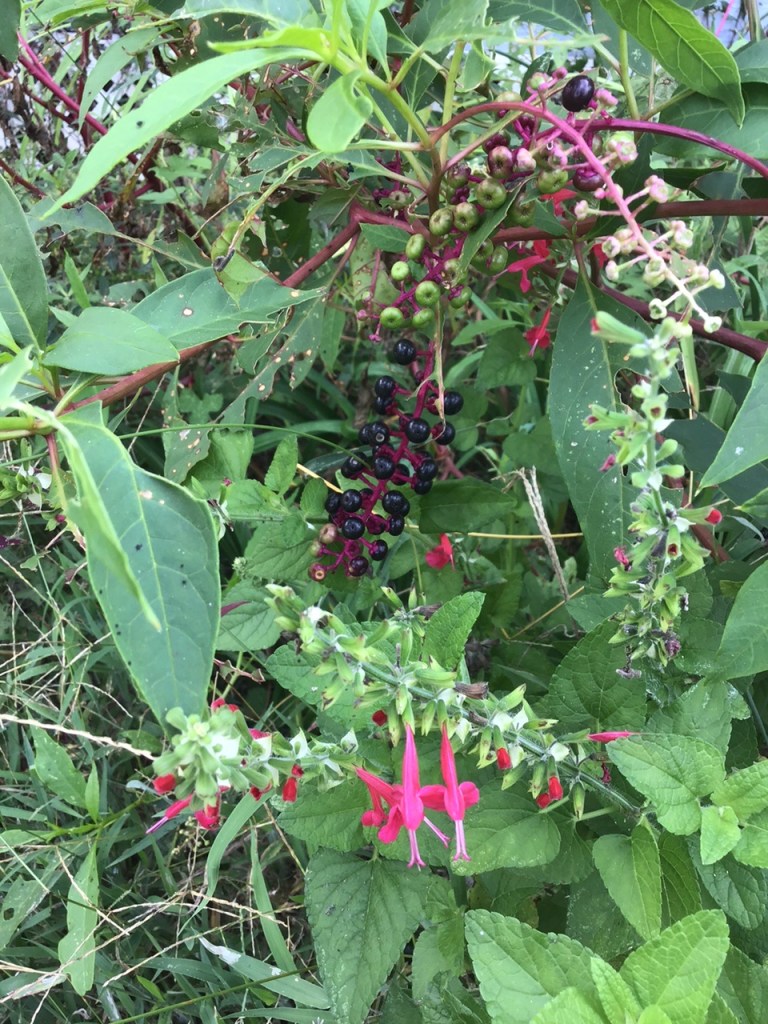
A young plant on left surrounded by poison ivy. On right a mature plant with ripe and unripe berries surrounded by fireweed
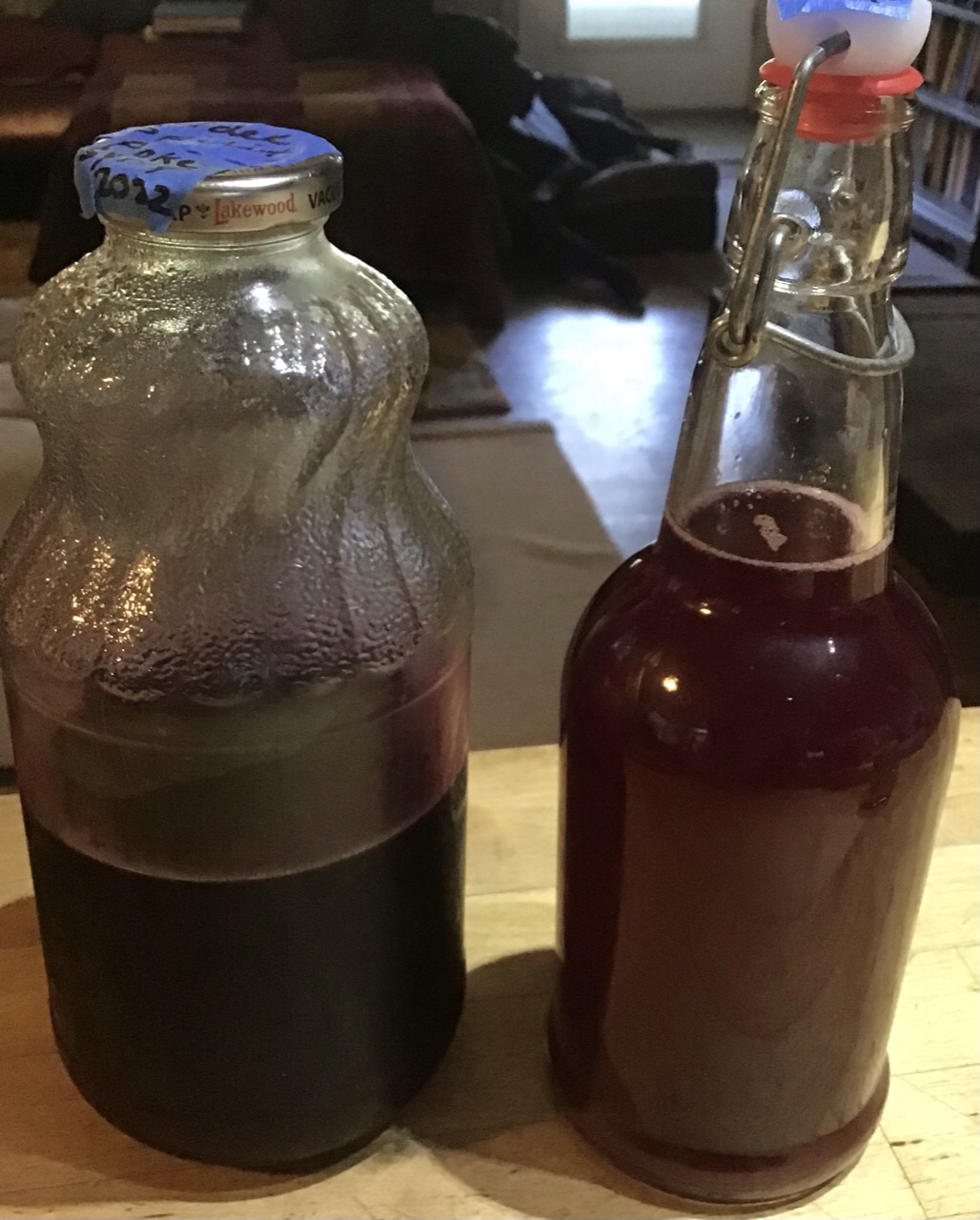
Elderberry-Pokeberry syrup for flavoring cocktails and Pokeberry kombucha—such lovely colors!
There is a hefty amount of misinformation on this ubiquitous plant, but in recent years there’s been a significant pushback, especially among Southerners, where for some it’s been a staple crop for generations.
Though its reputation is still highly contested! The YT video below tells a good chunk of poke’s dramatic story. 😁
It is used as an ornamental in some areas, while others consider it invasive. Ranchers consider it a nuisance and try to eradicate it, though it loves nitrogen-rich soil, so tends to pop back up wherever animals have been penned up or have heavily grazed, therefore fertilizing the land.
We do use it as an ornamental and a food crop, and I’ve written short posts about it here and here. I make wine and syrup from the berries and use the greens in many dishes. The popular belief that the greens must be boiled 3 times is mistaken and overkill.
However, care must be taken in its preparation and it’s not to be eaten raw. The above video explains a lot for those wanting to give poke a fair shake!
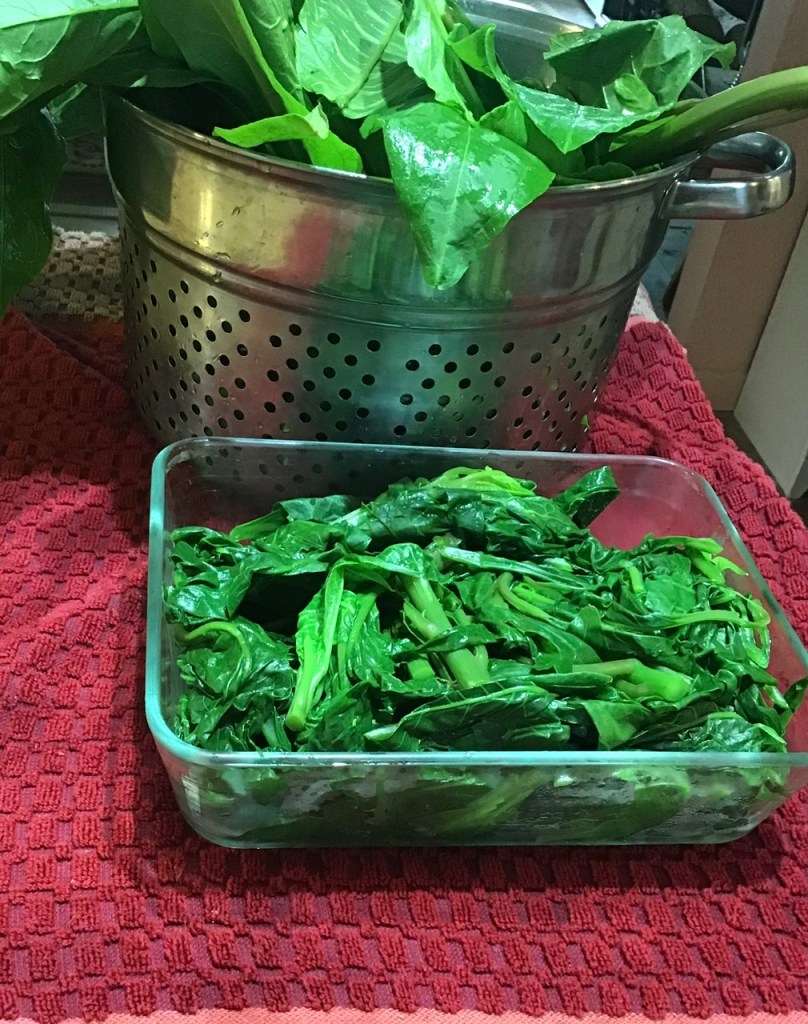
Rinsing well before submerging in boiling water.
Boiled in batches until limp, rinsed in cold water, then used in a dish that will be cooked, like a casserole or stir-fry, or frozen for future use.
The common advice to boil it three times disintegrates the leaves into slime, but you’ll hear that all over the internet and probably from your neighbors too.
That is, if they aren’t already convinced it’s poisonous.
This false belief most likely comes from four places: 1) The farmers and ranchers who would like to see it eradicated because it so successfully competes with the grasses. 2) The high-end wine-makers of our predecessors, because the ripe berry juice was used to color inferior quality wine to make it sell better. 3) Rockefeller medicine which demonizes traditional healing herbs and practices. 4) Chemical dye manufacturers who wanted to dominate the market as it was (and still is) used as a natural fabric dye.
The economic importance of pokeweed to our ancestors was sure to be unpopular with manufacturers and industrialists wanting to create dependency on their products.
A few benefits taken from the sources linked below, not the best translations, unfortunately, but some interesting info. (They do also repeat the plant leaves cannot be used after the stalk turns crimson, but in my experience and in the video above, this is not the case.)
“The young shoots of Ph. americana are eaten cooked as a substitute for asparagus in spring, and its tender leaves were eaten as a substitute for spinach even by the North American (Delaware and Virginian) Indians. We can found this kind of utilization nowadays too: at markets in the southern states of the USA it is sold as „sprouts” even these days, and they sell its young, tender leaves tinned (Poke Salet Greens). At some places it is still cultivated, though only in small-scale. The tender, bright inner part of the stem is crumbed in cornstarch and fried. They use the young plants before crimson coloration, but the cooking water needs to be discarded. Its ripe berries are added to cake pastries. The roots and the leafy stems are traditionally used for purple-brown dyeing. This colour is not much permanent, after body painting it can be removed easily. The root contains much saponin so it can be used for making soaps. The leaf ’s powder or the leaves were used for external treatment of cancerous wounds. After it got into Europe it was not only planted as an ornamental plant, but its dark purple dye was used for food coloration. The liquor of the berries were pressed, fermented and cleaned up by straining and afterwards it was evaporated down to about honey density in Chinas. The product was used at one for the coloration of foods, preserved fruits, sweets, liqueurs and wines; and for example alias Succus Phytolaccae inspissatus it was sold in German pharmacies. The berries were used to colour the wines of poorer quality with such a success that the plant was widely grown in Portugal, Spain, France and Italy. An ethnobotanical fact about the plant in the Carpathian Basin is that the Transylvanian (Kalotaszeg, Kiskapus) people put the fruit in the barrel cabbage to give it a red colour. Thanks to it betacyanin content it can be used as an industrial dye, but its colour is not as persistent as the colour of the scarlet oak (Quercus coccifera) is. Rarely it was used for wool and silk coloration too. The crimson coloured sap of the berries was used as ink (for example by the soldiers in the World War), that is where English name, inkberry derives from. A limner from Missouri, Bingham used it as paint. Its therapeutical utilization has traditions too. The Delaware Indians considered it to which has cardiac restorative effect, and the Virginian tribes used it for its strong psychotic effect. They presumed it is useful against rheumatism, tumours and in smaller doses against syphilis too. Its therapeutical utilization is comprehensive. Earlier the European therapeutics used it too as an emetic: Radix, Herba et Baccae Phytolaccae. Its root, leaves and fruits are used in the homeopathy too. The plant is a pharmaceutical base material even nowadays. Its drug is used as an antirheumaticum, purgaticum and emeticum (alias “poke root” or „Phytolacca”) in the USA, besides the lush root may can be used against breast cancer, too. The berries are utilized there for food coloration too, and with its leaves they adulterate, or rather substitute the „Folia Belladonnae”. The modern medicine started to show interest in it, thanks to the antiviral protein (pokeweed antiviral protein, PAP) that blocks the infection and reproduction of the HIV virus. The external use of PAP has an inhibi- tory effect on the plant RNS viruses too. The transgenic plants that contain the gene of this protein became resistent to a wide range of viruses. They impute that the root of the Ph. americana has blood cleanser, anti- inflammatory, expectorant, sedative, stupefying and purgative effects too. There are experiments for its uti- lization to cure the autoimmun diseases, especially the rheumatic arthritis. The plant contains toxic compounds against micro-fungi and molluscs too. The lectins extracted from it have toxic effect on the juvenile larvae of the southern corn rootworm (Diabrotica undecimpunctata howardi).”
Web references Armstrong, W. P.: Pokeweed: an interesting American vegetable. In: Economic Plant Families. Wayne’s World, Escondido, California. http://waynesword.palomar.edu/ecoph24.htm Hedrick, U. P. (ed.) & Moore, M. (upd.) (1972): Sturtevant’s edible plants of the world. Dover Publications, New York. E-version: The Southwest School of Botanical Medicine. http://www.swsbm.com NIAES (2005): Japanese Fungi on Plants. National Institute for Agro-Environmental Sciences Natural Resources Inventory Center, Microbial Systematics Laboratory, Tsukuba, Ibaraki, Japan. http://www.niaes.affrc.go.jp/inventry/microorg/eng/kingaku-rs.htm Plants For a Future. http://www.scs.leeds.ac.uk/pfaf/ RBGE (2001): Flora Europaea database. Royal Botanic Garden Edinburgh, Edinburgh, UK. http://193.62.154.38/FE/fe.html
Compare that to what our US institutions repeat: All parts poisonous, lots of toxicity fear-mongering, and usually including advice not to plant it in your garden.