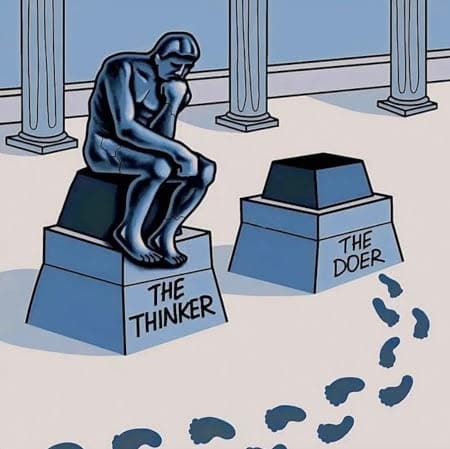
I Have a Dream!

I have a dream that when asked where I sell my delicious locally-produced raw milk cheeses my response will be one of beaming pride instead of deflated frown.

Instead of–“Sorry, I can’t sell them, it’s illegal”–in my dream I reply instead:

“I have an assitant who delivers our homemade cheeses twice a week to the community Farmstead Store in town. You probably should call her and make arrangements because she always sells out by lunch. We have Farmstead Stores in every small town in our region who send out drivers to exchange with one another. Our free-range pork and our neighbor’s beef sell out even faster than the cheeses. They’ve also got year-round fresh produce there, eggs of course, honey, wine, kombucha–all sourced and produced from within 15 miles.”
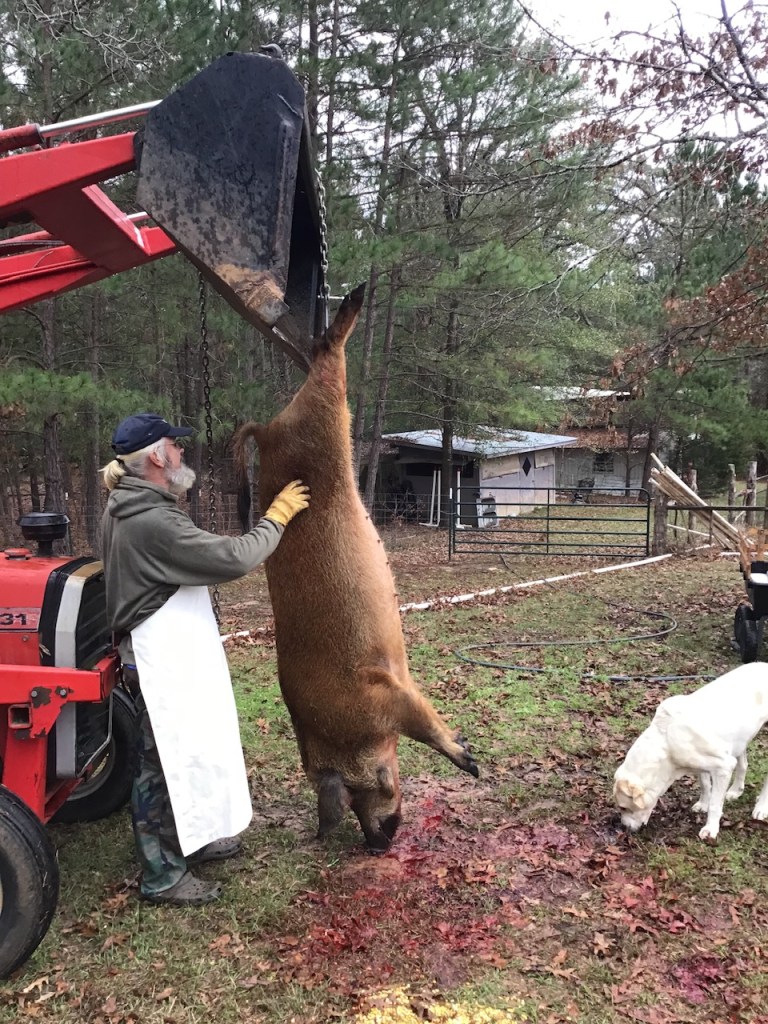
Instead of my dream, in my reality I get asked, “Can’t you get a license?”

No! No, of course I cannot get a license! Instead of dream-speak I get the nightmare reality.

It’s not only impossible to get a license for a home cheesemaking operation, it just happens to also be against my philosophy.

“An agorist is one who applies the principles of libertarianism consistently through counter-economic practice. They aim, that is, to bring about the voluntaryist society not through political (in)action but through direct counter-economic action.”

No, I cannot get a license. Since we are in the South, I wonder if another appeal might be in order?

Imagine if instead of ‘philosophy’ I said ‘religion’. So my reply becomes:

“Appealing to State and Federal officials for what I, and my neighbors, choose to purchase for consumption is against a fundamental aspect of my religion which preaches the gospel that God chooses my food through my tastebuds.”

“This is not a trivial point. A free society is not merely an ideal society to be philosophically formulated, but a process to be enacted through conscious action. Thus, the idea of separating the free society from the actions that free human beings must (or must not) engage in is self-contradictory. What else defines a free society except for those actions?” James Corbett

“Furthermore,” I continue in my dream space, “I’m allergic to paperwork and authoritarian nincompoops and I refuse to spend what little time I have left on this spinning green insane asylum kissing the arses of Velvetta-eating officials mansplaining me what I must do to make safe cheese.”

Also from Corbett
In “An Agorist Primer” Konkin explains:
“We see that nearly every action is regulated, taxed, prohibited, or subsidized. Much of this Statism — for it is only the State that wields such power — is so contradictory that little ever gets done. If you cannot obey the (State’s) laws and charge less than [because of “Fair Trade” laws], more than [because of “Anti-Trust” laws], or the same as [because of laws against cartels] your competitor, what do you do? You go out of business or you break the law. Suppose paying your taxes would drive you out of business? You go out of business — or you break the law. Government laws have no intrinsic relationship with right and wrong or good and evil. Historically, most people knew that the royal edicts were for the king’s good, not theirs. People went along with the king because the alternative looked worse. [. . .] But everyone is a resister to the extent that he survives in a society where laws control everything and give contradictory orders. All (non-coercive) human action committed in defiance of the State constitutes the Counter-Economy.”
In effect, Konkin takes the plight of the modern-day citizen, stuck in a web of ridiculous, contradictory, and impossible-to-follow laws, rules and regulations, and flips it on its head. It is not a source of shame to be acting against the arbitrary whims of the state, but a virtue. Economics is the realm of white markets: legal, licensed, sanctioned and regulated exchanges in the aboveground economy. Counter-economics is everything else: black market and gray market activity either specifically outlawed by the state or not licensed or approved by it.
People tend to get squeamish when they hear “black market,” but we’re not just talking about gunrunning, counterfeit smuggling or drug dealing here. Any (non-violent) activity that doesn’t have the blessing of the state is counter-economic.

“Of course, individually, these actions seem unimportant, even trivial. But in combination they drain significant resources away from the clutches of the state and toward the people participating in the actual productive economy. It is estimated that 20% to 30% of Americans fail to report taxable income. In some parts of Latin America it’s closer to 80%. Can you imagine if it were 100%? A few isolated counter-economists acting in a disorganized haphazard faction is a minor inconvenience to the powers-that-shouldn’t-be. Millions of people acting in concert in a deliberate undermining of state authority is a revolution. This is the promise of counter-economics.”

The quotes that are not in my dream are taken from the following 2 articles by James Corbett, well worth the read.

https://substack.com/redirect/ba0aa4ad-e65c-49d6-889b-40771af20c61?j=eyJ1IjoiYXBsankifQ.vij_GSi8NAkTixijJIkYbmIMsSylddJaDImehSkL3TQ

Do you have a dream, too? Care to share?? 😁🤗

Healing, or Perception Management

“Don’t sweat the small stuff. And it’s all small stuff.” ~ Idiots everywhere

“That which doesn’t kill you makes you stronger.” Fathers everywhere

“Where God closes a door, he opens a window.” Mothers everywhere

“Best cancer EVER!” ~ Stefan Molyneuxhttps://freedomain.com/freedomaininterviews/how-cancer-can-make-you-well-stefan-molyneux-with-laurette-lynn/, shilly online philosopher

“It’s just a flesh wound!” Monty Python

The message is clear and ubiquitous in the modern world, that favorite word of religions, wanna-be warriors, social programmers and closet tyrants everywhere: Transcend.

Or suffer. Your choice.

Transcend pain, transcend discomfort, transcend ennui.
Transcend mind, transcend body, transcend your very sex.

Jennifer Bilek might tell us a thing or two about that.

“The speed and coordination of this deployment—from zero “transgender children” before 2000 to their ubiquitous presence in schools and media within two decades—reveals orchestrated social engineering rather than natural cultural evolution.

The speed of normalization reveals coordination impossible through organic social change. Within two decades, major medical associations endorsed pediatric transition, schools implemented gender identity policies, and laws passed making it child abuse to question a minor’s gender identity. This transformation required massive funding, institutional capture, and media compliance—all documented in the money flows Bilek traces.”

Growth, like healing, does not happen on a fixed schedule, and sometimes it never happens. But, permanent medical interventions invented to create a profitable market out of confused and abused children is truly circling the drain.

It really irks me when those who call themselves and think of themselves as healers, use this form of gaslighting, which is actually perception management, in order to train ‘patients’ and the public how they should feel.

What’s actually happening at a fundamental level is cognitive and emotional dissociation. It makes the healer feel a lot bettter than the patient.

It’s an epidemic really. Magical thinking, positivity, silver linings, Hopium–they really only get you so far–which is to the next moment, where your mood or situation will have necessarily altered, but the REAL healing, the real growth, was simply relinquished to the back seat.

To rear it’s head another day. A day when most likely that fair weather friend or healer has moved on to greener pastures. More hopefully, the seeker has to. And by seeker I mean, the one looking for the healing.

It is the worst possible solution to be in because 99% of nitwits everywhere call themselves healers and having to navigate that at the precise moment of your own weakness is really shitty.

“Instead of ending these experiments, wealthy transsexuals like Martine Rothblatt began creating legal and linguistic frameworks to normalize their fetish. Rothblatt, who built satellite surveillance systems and founded Sirius XM, authored the first gender rights legislation and created ideological structures supporting body dissociation. The shift to “transgender” accomplished multiple strategic goals: it removed medical gatekeeping, expanded the market beyond surgical candidates, created ambiguity about what the term meant, and most crucially, included children.”

Soon, just another decade or so, this worst possible solution will be obvious to everyone with any cognitive function left. Because the endless loop between healers and patients will encompass the vast majority of the population. Wounded healers will become the most common archetype of the modern ages.

“Understanding the financial architecture behind gender ideology matters because it fundamentally changes how we perceive and respond to this phenomenon. When we recognize that the same billionaires funding gender clinics invest in artificial wombs, that the same foundations promoting “trans kids” advance transhumanist philosophy, that the same corporations threatening economic sanctions for “bathroom bills” develop human augmentation technology, the seemingly inexplicable suddenly becomes comprehensible. This isn’t about civil rights or social progress—it’s about market preparation for humanity’s technological transformation.
Breaking the spell, as Bilek emphasizes, requires following the money. The trail leads from philanthropic foundations through medical institutions to tech companies, revealing coordinated investment in reshaping humanity’s relationship with biological reality. This essay traces that trail, examining how gender ideology serves as psychological and cultural preparation for transhumanism’s larger project: the transformation of human beings into technological substrate.
What follows challenges comfortable narratives on all sides of the political spectrum. The evidence presented comes not from speculation but from documented financial transactions, institutional connections, and the explicit statements of the movement’s leaders. The patterns revealed demand we reconsider everything we think we know about why gender ideology emerged when it did, spread as rapidly as it has, and encounters such fierce protection from institutional power despite growing public opposition.

Children internalize this commodification through comprehensive indoctrination. They learn about “choosing” their sex characteristics like selecting avatar features in video games. School curricula teach about “families created through technology” and normalize the idea that biological parents are merely “genetic donors.” They see their bodies as collections of customizable parts rather than integrated biological systems. This dissociation from physical reality serves the larger project of normalizing human augmentation, genetic modification, and eventual merger with artificial intelligence.”

The Wounded Healer, the Autistic once called the Artistic? The previous victims of collective perception management, noticing.

Noticing no healing is happening. And calling out the so-called Healers.

ALL For Sale

When I lived in Europe in the 90s it was not too uncommon to see an amazing castle for sale for a pittance. I do mean a real castle, or a vast country estate that included a structure that once was a castle.

And I do mean a pittance, as in, they were not able to give these places away.

Vauburg, France (not my image), bit of a multi-generational hodge-podge.

Sometimes that was because they came with strings attached, so I can understand. Or it was designated for a specific purpose or with strict regulations. You had to restore it, for example, which was something that cost so much that the just wealthy could not afford it.

I had a French boyfriend for a while, who boasted some aristocratic lineage and took me to the castle where his aunt still lived. I marveled at the exquisite property and at the lingering formality of his kin who addressed each other, that is as husband and wife, in the formal, using ‘vous’.

Maybe the uber-wealthy could afford it, if they cared to, but they just didn’t have the interest?

Or, which I’m actually more inclined to think these days, even with their fortunes, they would not be able to restore it. Because the skills to accomplish such an extraordinary endeavor have been lost to time.

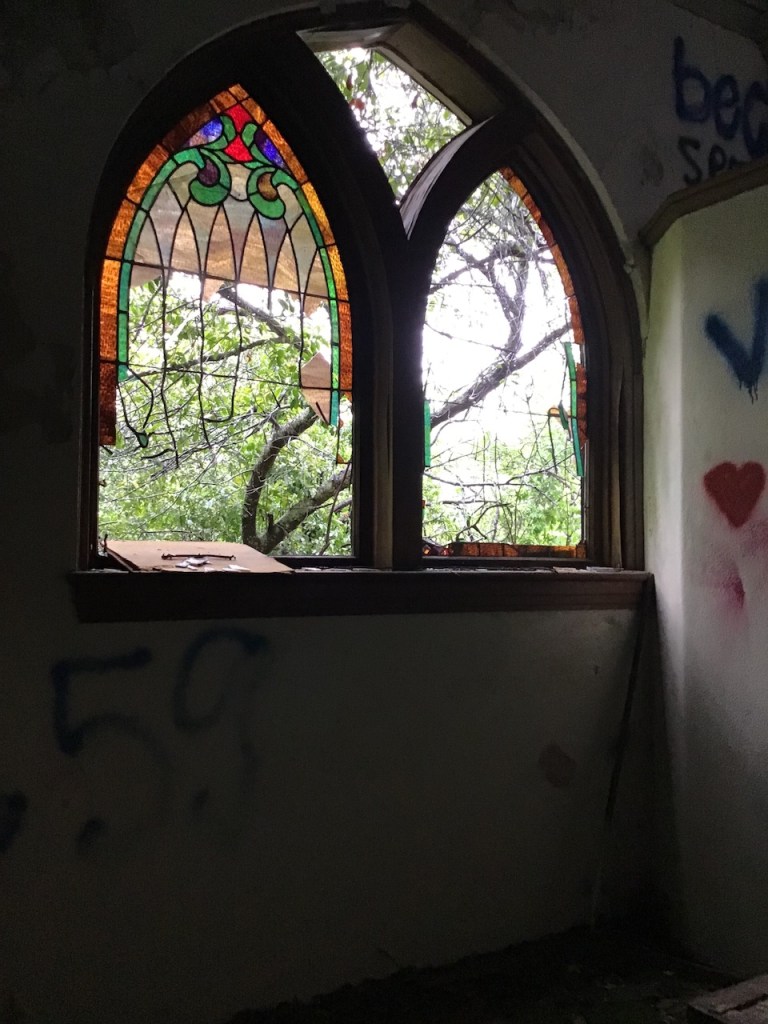
A single example of the dozens of architectural marvels which have been destroyed in our little city, with more on the chopping block all the time.

In those days I dreamed of becoming a travel writer, or a writer of historical fiction. So, it’s not a huge stretch for me now to covet an interest in such parallel stories here, today, locally.

This is the closest real city to us, Palestine. What I’d call a small city today, though growing steadily. It was never more than a small city, as far as population goes. Just how it amassed such an amazing amount of great architecture is a real mystery to me. Though there are official stories.

I knew there was some interesting history there, and all around here, but it’s not like I’ve had a lot of time for exploring such idle pastimes, with all the work trying to build up a homestead.

But lately I’ve been squeezing in some time and loving it!

And of course, you’ve got to blossom where you’re planted. I used to tour every castle or abbey or old walls or ruins I could find, whether in the Old Town of any European city or hamlet, or a day hike away from the nearest bus stop.

This Old World has entered center stage for me again thanks to the Cyber World, which is really kinda crazy. But, true.

I’ve seen this old church for sale the last few times while driving through the downtown streets marveling at the old buildings.

I stop for lunch, and at a favorite antique shop, where I see tourists, which I find delightful. Though they only have much interest in the antique shops and the cafes and the provided entertainment. Still, it’s fun hearing German in the tourist office and hearing ladies from places all around the region, even in a rainstorm, there to peruse what our little city has to offer.

I was a novice travel writer, until I met the love of my life, who I managed to lure from the beaches of Thailand to a trailer park in Mena, Arkansas.

Hubby and I at ‘Roman ruins’ in Spain 2003—note our cute matching outfits—that was not planned.

And look who returned the favor by luring me into the deep woods of East Texas to spend an exceptional amount of time doing menial labor. 😏

I was also a beginner tour guide, Mayflower Tours. I lasted about two weeks, until I realized how unsuited I was to a job hosting a bus full of retirees for four-day trips to and around Branson, Missouri three times a month.

I think they weeded out a lot of us that way. There must be a trick to how many bossy seniors and cowboy theaters can be stomached for minimum wage, but I couldn’t figure that out quite fast enough. Another potential career option in the toilet.

And yet . . .

When I see precious gems like this my imagination sparks just like those days in Spain, France, Germany, UK, Czech Republic, Poland . . . Ok, everywhere, just about everywhere. I was very much a Europhile. Still am.

And yet . . .

I’m so struck by the lack of general interest. And knowledge. And, frankly, care.

I see the collapsing remnants of a structure worth saving. I see a history worth understanding and passing forward.

That’s the shot to inspire a buyer’s creative juices? Yikes. What about its real history, does anyone care? And, where’s the roof?

But the Realtors, who are there to sell this precious gem, see little of that world, neither the past nor the true potential. It’s such a shame. Such a very common, and so very confusing, big fat shame.

Will it become an ‘event venue’ as they suggest? It’s hard to imagine the kind of events that would make such a renovation effort worthwhile, or particularly palatable. Is there even such skilled workmanship available today?

Dare I question, true philanthropy, if it ever existed at all, is it dead?

There are many such gems in our little city, which suggest but mere clues to the true treasures in our midst, in plain sight—all teetering in a world of nearly forgotten but, dare I hope, at least a cyber-revival?

A taste of the hidden history in plain site, he’s getting to all the states eventually, and beyond, one of a great many channels sparking my renewed interests . . . 😁

Devious vs Clever

Does narrative control our lives?

Do mere words, forever shifting on the barnyard wall, mold our collective behavior?

If a lie lands in the narrative, and no one knows it’s a lie, does it pass for the truth?

Enter, the Scapegoat:

“No, everything seems conditional now, contingent on proof of cognitive compliance. Their cancellation of me has been cemented into their own identities. The people who were once closest to me now exist in direct opposition to the person they imagine I’ve become. There is no way to dissuade them, to show them that I really am me, the same me I’ve always been. I realize the framing they’ve embraced since the lockdowns cannot shift without destabilizing the shaky narrative they’ve chosen to inhabit. I am the problem. I have to be the problem in order for their reality to remain steady.”
Alison McDowell

Oh how I know this role so very well! I was born into it—by chance, divine intervention, twist of fate—I have no idea.

Alison, having experienced life primarily as the golden child, here feeling it now so poignantly, perhaps for the first time, navigating as an outsider, has put words on my reality as I never could. Such poignant, touching, true words.

There is something about venturing into new territory and trying to map the landscape for yourself that highlights what is most special and unique about a particular place from a particular perspective. It’s a kind of magic I think. What has become invisible to the native through habituation has new meaning through new eyes and in turn brings new insights to the observers’ previous perspectives simultaneously.

It’s why I wanted to be a travel writer, why I thought I could be good at it, because if I could recognize that level of magic, surely I could learn to apply it myself.

But now I deal in inner worlds, instead of outer ones. So many of us find ourselves here in these times that we can hardly consider ourselves outsiders anymore. Can we?

“The Herculean effort to struggle to come to an understanding of something alone, without mature guidance and the fellowship of other stumbling souls is more than most can bear. This is what angers me about the glib soundbites in praise of the ‘freedom’ for individuals to simply learn alone via internet study.” Christine Jones

Withered Leaves & Spoiled Fruits meet Wrench in the Gears, if only here in my words. I hear you say the same thing, though you are physically and in so many other ways, so far away, from me and each other.

But, in ways that don’t seem to matter to me much these days.

That we are each middle aged women who have been cast off—by our own or divine, or others’ design—how delightful, still, to find sister castaways.

What I’ve come to learn lately navigating the inner worlds at the expense of the outer ones is that words matter much less. Labels hardly at all. That works out pretty well since language has forgone nuance words have become superfluous. (Spellcheck just tried to correct me from ‘become’ to ‘Beyoncé’, how apropos)

The inner world narrative is not man’s narrative. Words hardly fit. Words hardly fathom. The words sound ever-more more political the further in you journey. Falsity reigns and duplicity rains and you find that words only rein in reality. They don’t invent it, they don’t even represent it, not really. The map is not the territory.

In fact, it becomes more difficult to navigate the inner worlds the more you rely on the words.

What are thoughts but words yet expressed? What am I to rely on once words begin to lose their meaning to me? Me, who spent four decades devoted to the study of words. Who considered language to be the cornerstone of civilization and all that made it function.

What a shift, now to think in fact it is not words that craft the spells that create our cultures, but rather enclose them, like walled gardens or mazes, constructs that sometimes illuminate and sometimes obstruct. Sometimes nurture and sometimes confound.

Once upon a time “devious” and “clever” were not synonymous. To understand how they’ve become so confounded one must explore the inner world, beyond the words and into the being. There the answer lies.

Lies?

Perhaps the lies inherent in the words, inherited with the words, are driving us collectively mad? Everywhere I hear about the ‘clever’ machinations of the great powers. Clever?

Perhaps if we shake hard enough, like a soaked dog after his bath, the words will be cast off like water droplets, leaving the cleansed being behind.