
Homestead Happenings

Mostly happy snaps this post, plus a few weather woes.

Hubby’s gorgeous melon patch is starting to produce more than just a feast for the eyes. He’s come up with quite an integrated system there and when I expressed how impressed I was with his companion planting scheme (and wondered whether he’d been taking a permaculture course on the sly) he informed me it was all a matter of frugality.

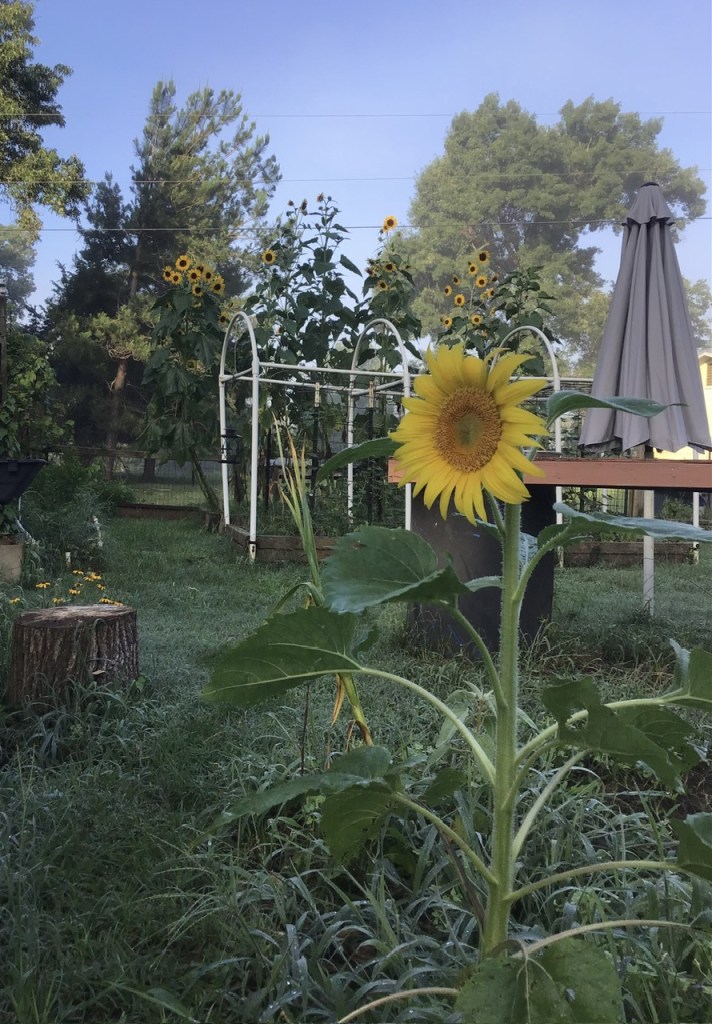
His penny-pincher logic is: the melon mounds have a lot of water run-off and sometimes erosion, so he added a ring of clover at the base of them. It’s just a bonus they are also good for the soil and the bees. The sunflowers are fodder for the goats and the chickens, plus they help shade the melons. The sea of black-eyed Susan’s just turned up there, apparently as impressed as me with the space.

Hopefully the melons don’t go the way of the onions, which has been our worst year yet. Luckily the garlic still did fine, which is from our saved seed, which previously came from a nearby friend’s saved seed. That has become a theme.

Elephant garlic does much better here than anything else, and I’ve tried many others for many years. I think I’ll give up that practice now and stick with what works, avoiding future costs and frustrations.

The success of the tomatoes and peppers so far has also been thanks to saved seed. I bought several varieties of each from the store, just for more variety, and those are the ones suffering more from the rain and high humidity. Several have already died, a few aren’t growing at all, and several of the others have bad issues.

Ours on the left, theirs on the right.

The purchased squash is already full of pests before giving us even a single fruit.

At least we got a few zucchini off our own saved seed before it too is already beginning to succumb to some kind of mold.

But other saved seed, the Trombetta squash and the mystery squash from last year, have proven to be more resilient than the popular varieties.

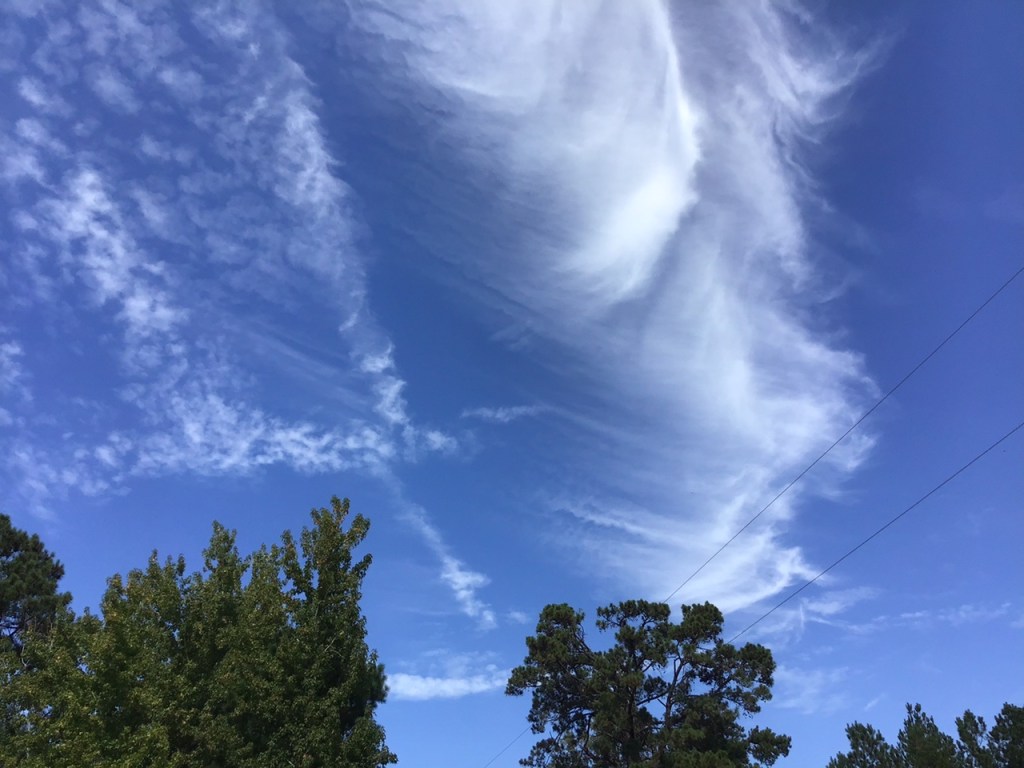
The filth-filled skies continue and not even the regular rains clear them up for long. I’m sure the sorry state of the skies has nothing to do with the crazy storms, right? The intense lightening, sudden flooding rain bursts, intolerable humidity, hail, tornadoes, and so on, that folks are experiencing across the country?

Just ‘mother nature’ they tell us. OK.

Well, too much ‘mother nature’ is not so good for the garden. It looks plenty green and lush, so that’s nice. But, look a little closer and we find it’s not so pretty below the surface.

But we’ve been relatively fortunate so far this year, just lots of rain and some wind gusts. Others have had far worse.

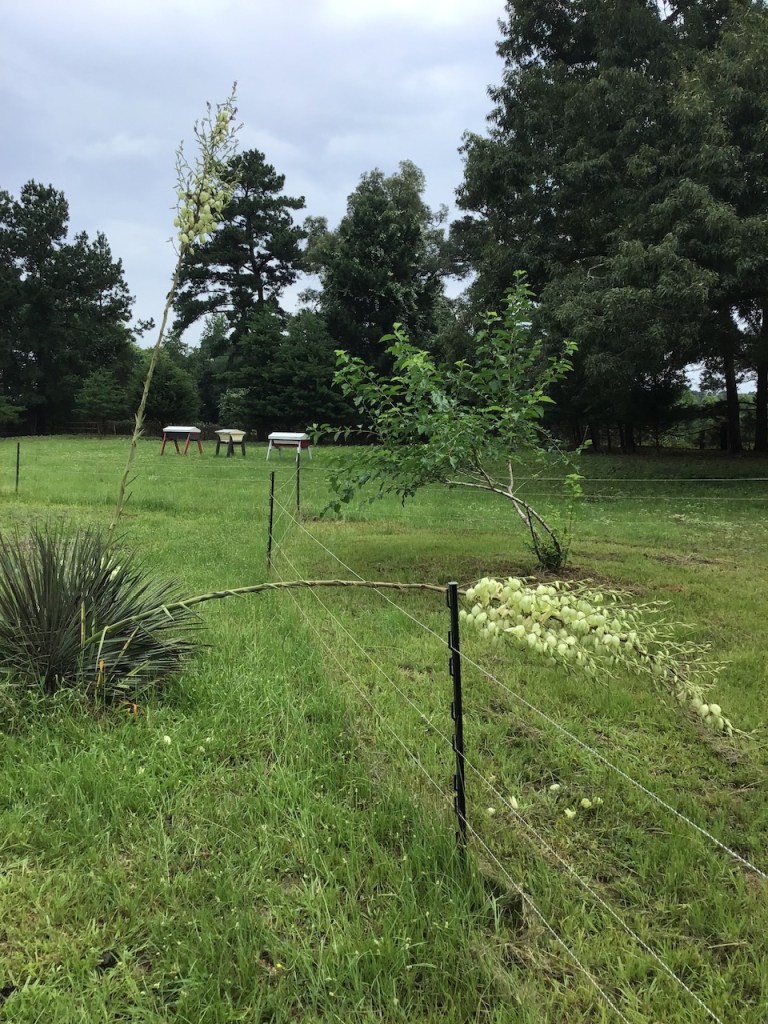
The yucca didn’t get lucky, but the blossoms are still lovely, even on the ground.

There’s some long-term requirements that fall on Hubby, which I mentioned last update, an upgraded culvert is required now in order to drive to the back half of our property. He’s already gotten started on that, a huge undertaking for sure. After that he can look forward to tackling the pond that’s now washed out.

In better news, there’s been some amazing growth in just one week.

A side by side comparison of 8 days growth.

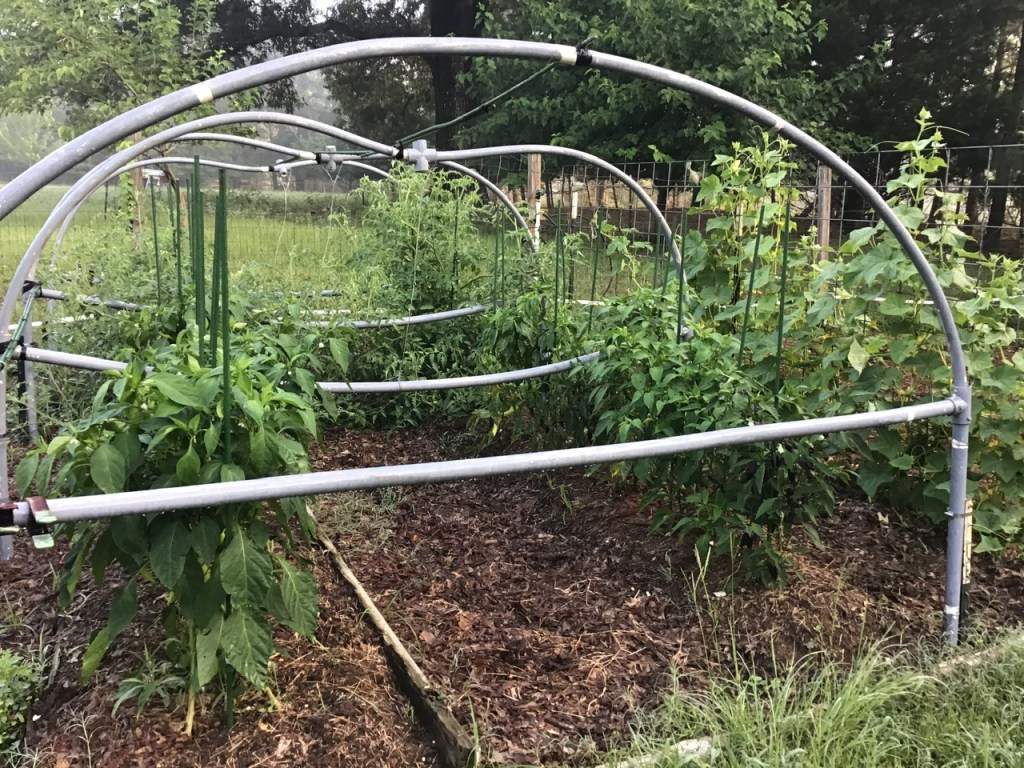
We’ve prepared for the swelter season by crafting another shading system where these tomatoes and peppers should be much happier into late summer. It’s recycled from another project and a bit awkward to move through, but it should do the trick just fine for supporting the shade cloth.

The asparagus beans, a first timer here, have really taken off in the last week. I’m excited to try them!

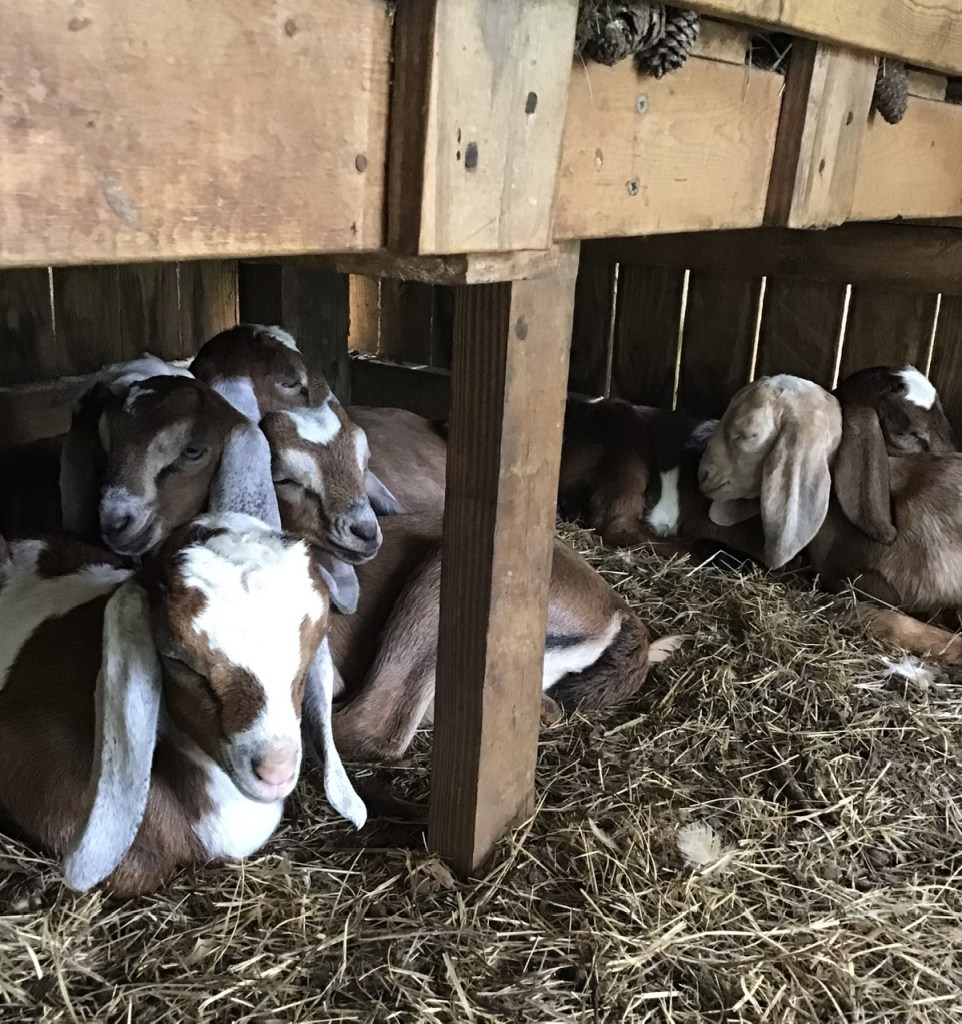
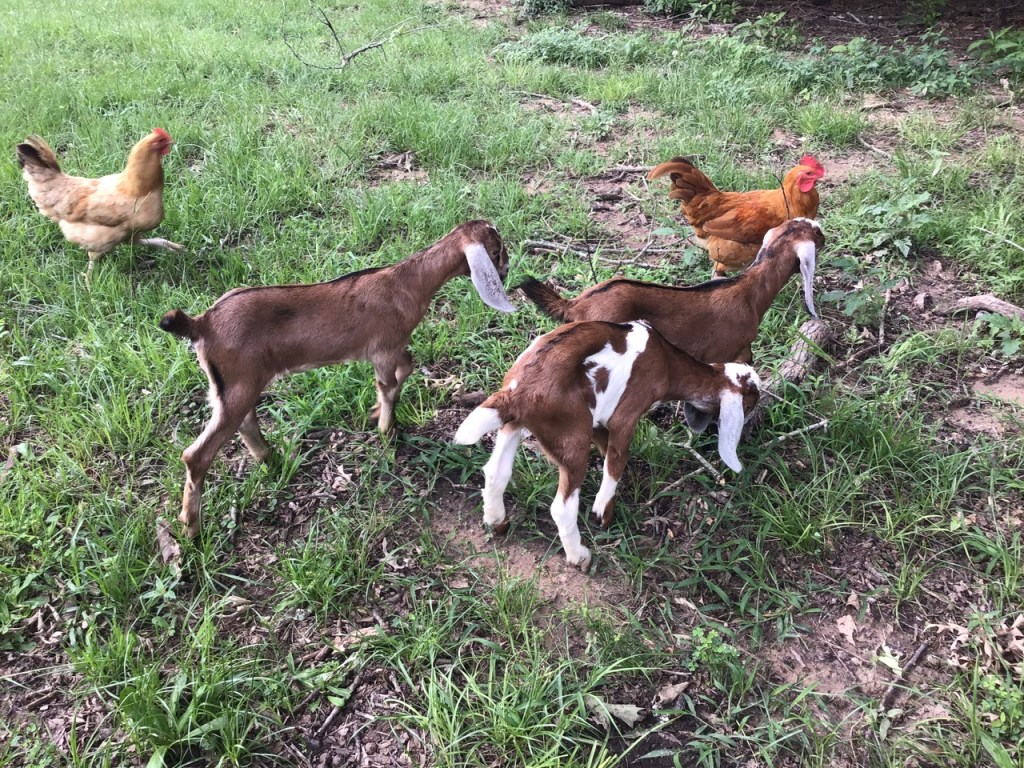
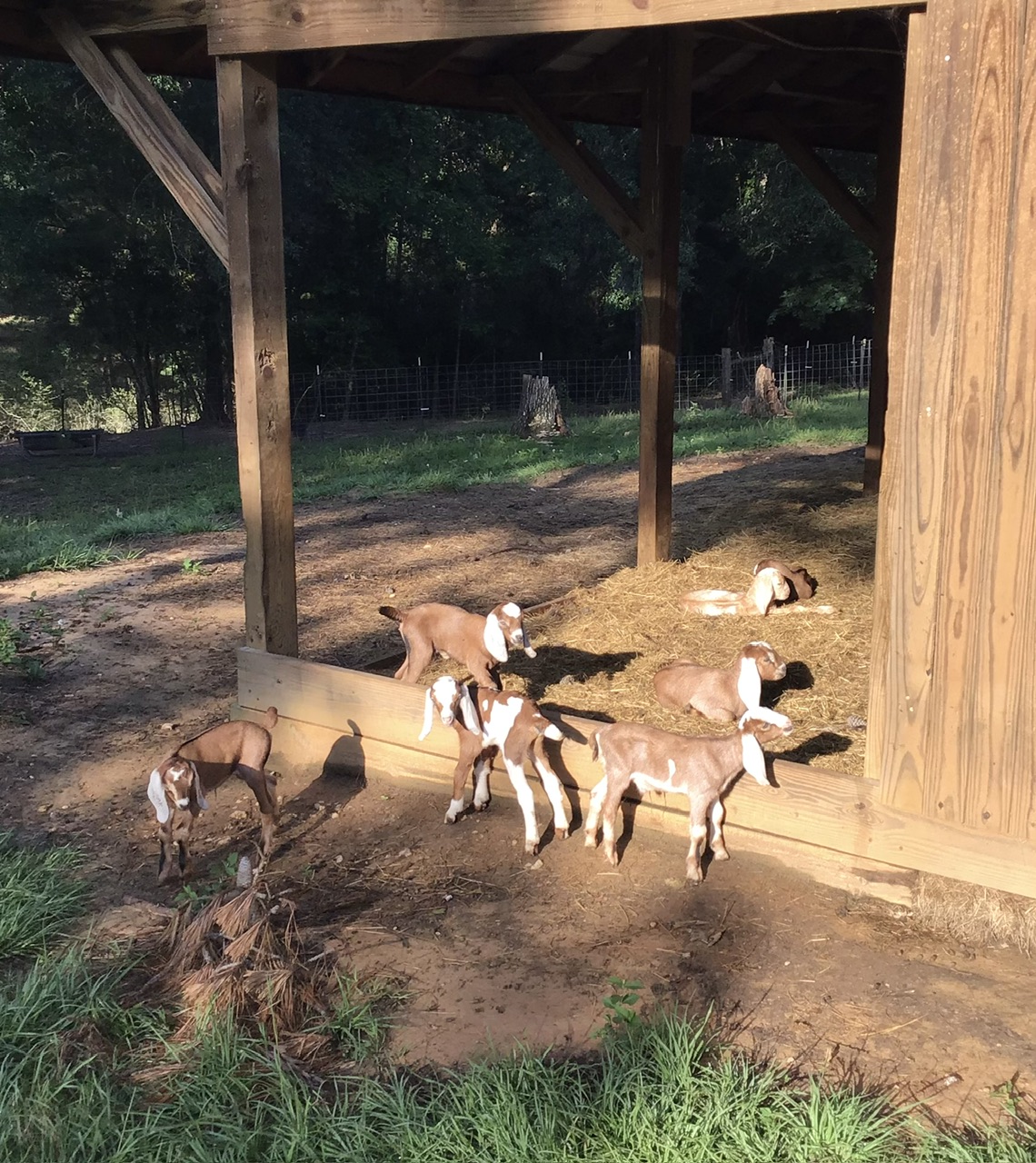
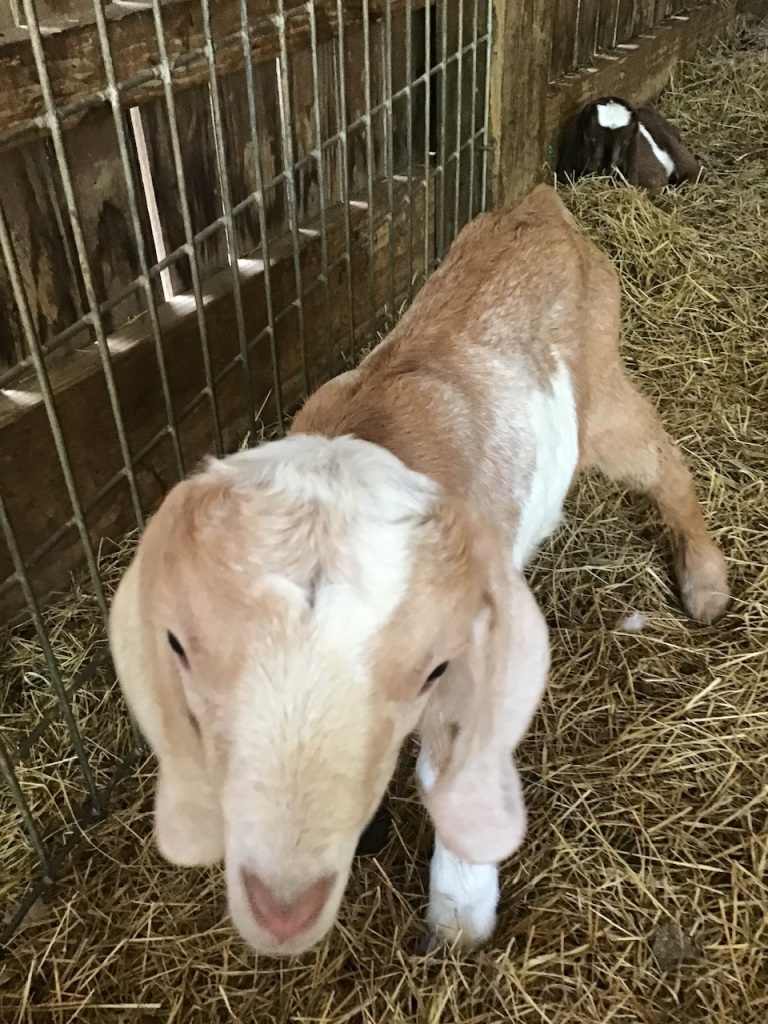
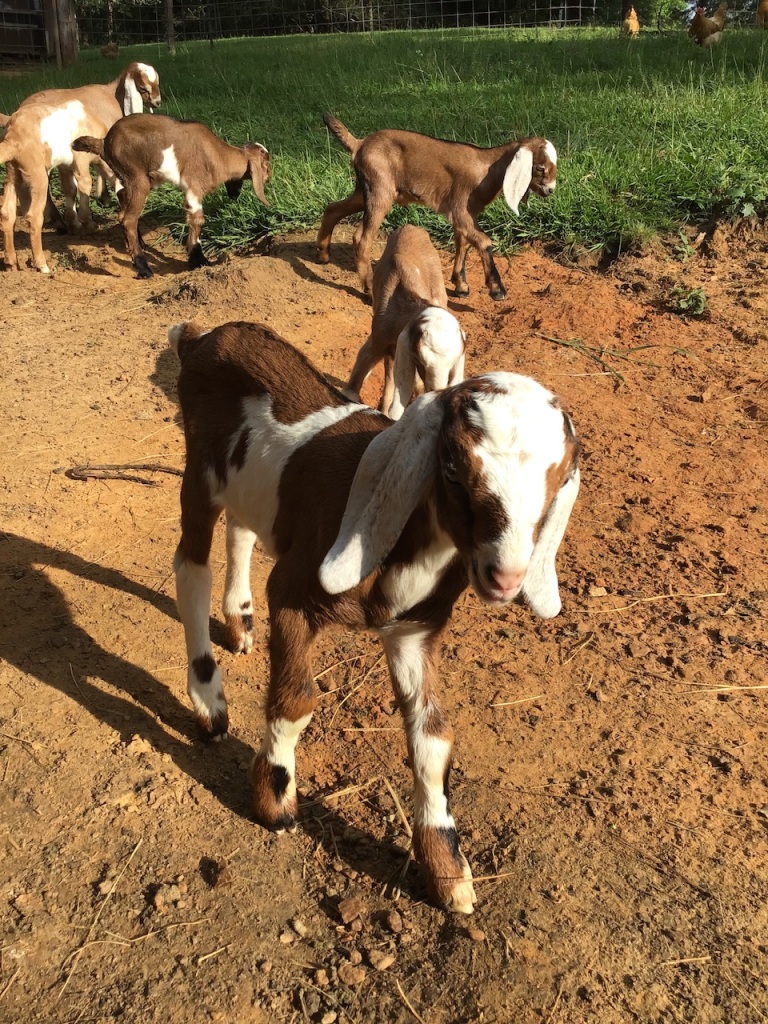
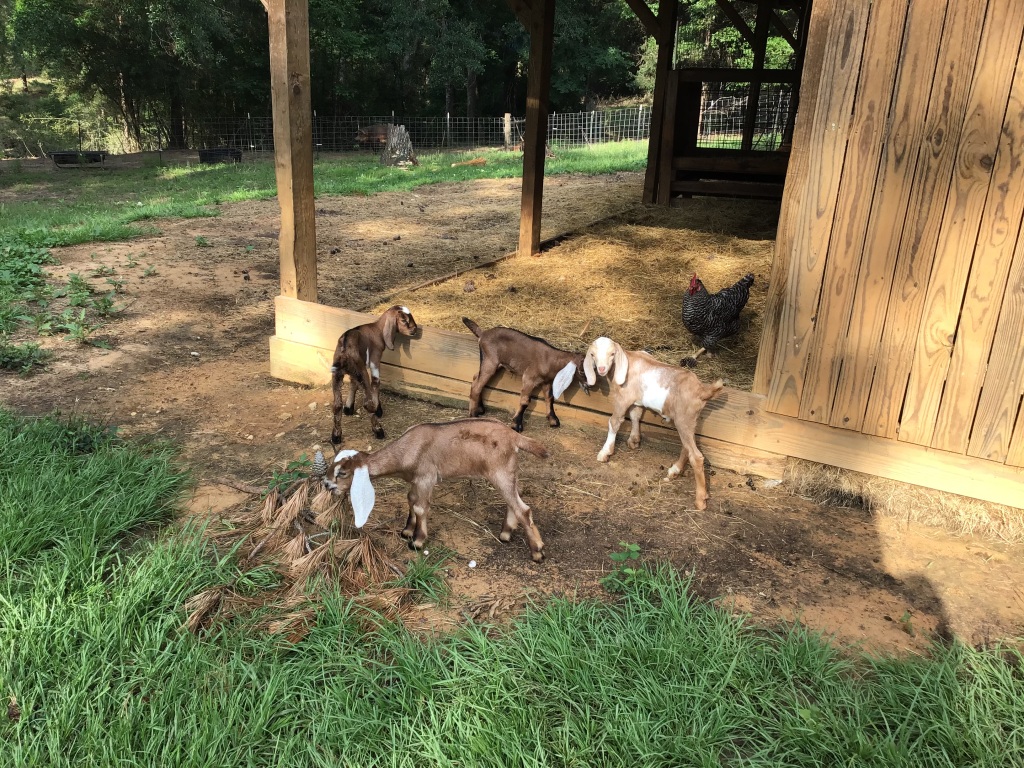
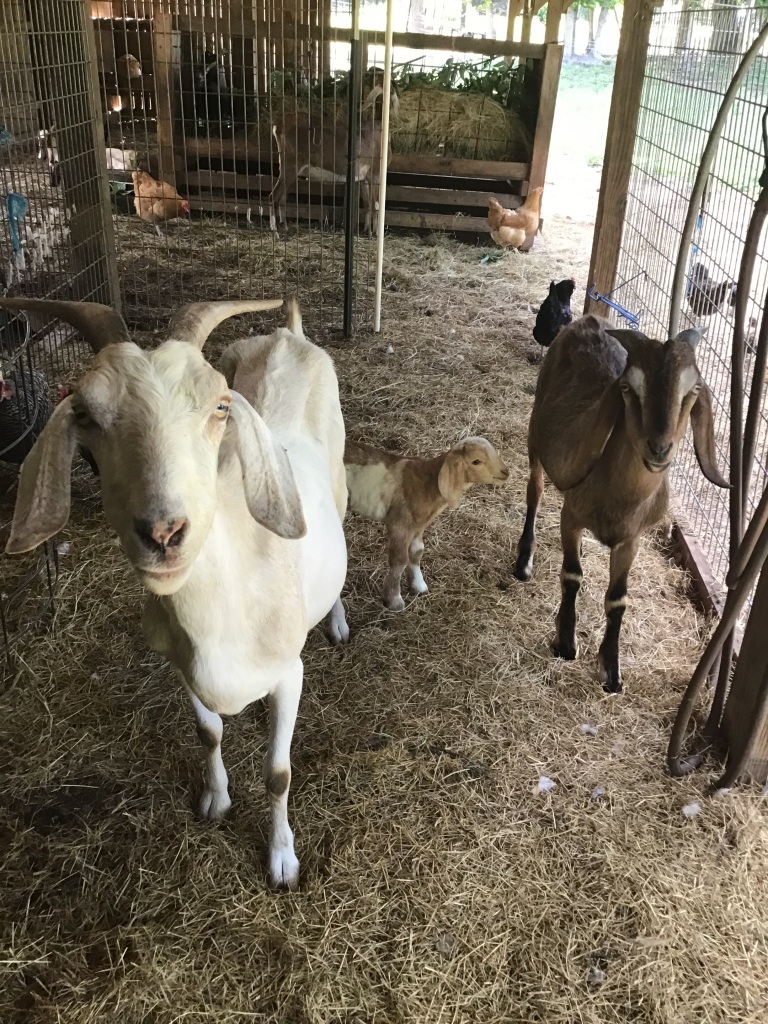
In even better news, the mamas and kids are growing well. We’ve started forcing them out of the corral during the day so I was able to give that space a much needed refreshing.

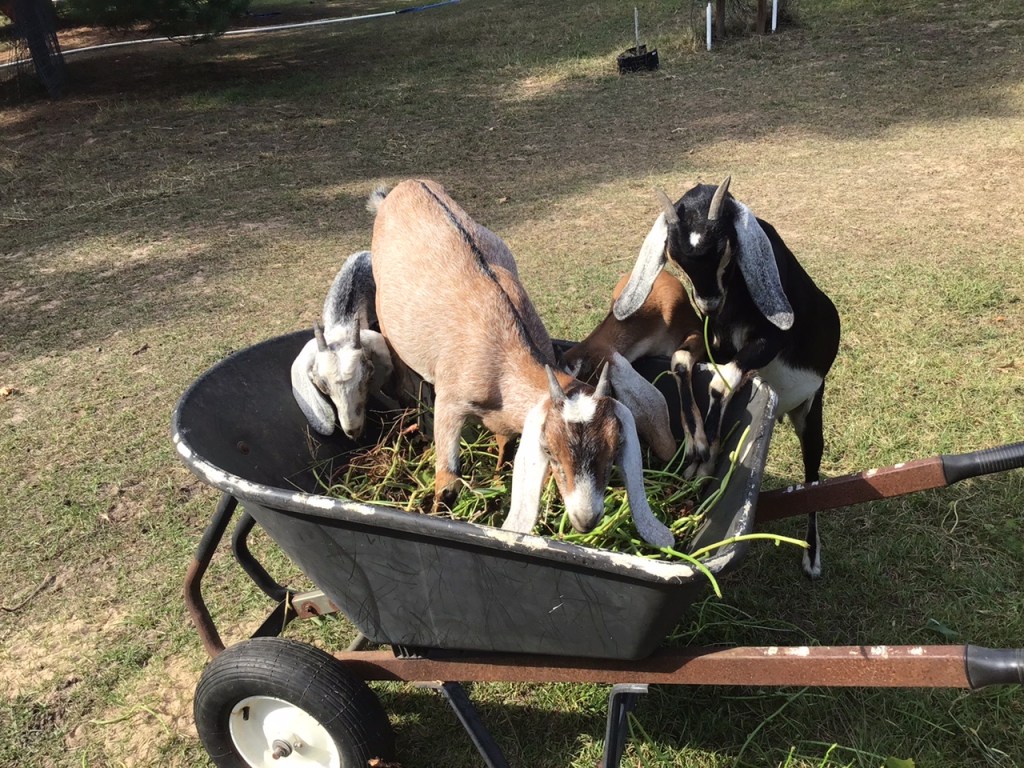
It seems they sometimes prefer following the chickens instead of their mamas. 😆

I’m getting the first fresheners ready for milking by training them on the milk stand. Soon it will be time to start separating them at night so I can milk them in the mornings before putting them back together again during the days. It’s not a happy time for anyone and I’m not looking forward to it.

But, I am looking forward to making lots of cheese again. We’re getting a bit of milk from Chestnut, who rejected her boy, and her girl is only nursing from one side. So, if I weren’t milking her she’d become even more lopsided than she already is.

It’s not a lot of milk, but enough for a little mozzarella now and then. I’ve found another method from my new favorite YT channel which is completely natural and far more tasty than the vast majority of those found online.

Raw milk mozzarella, mmmmm!

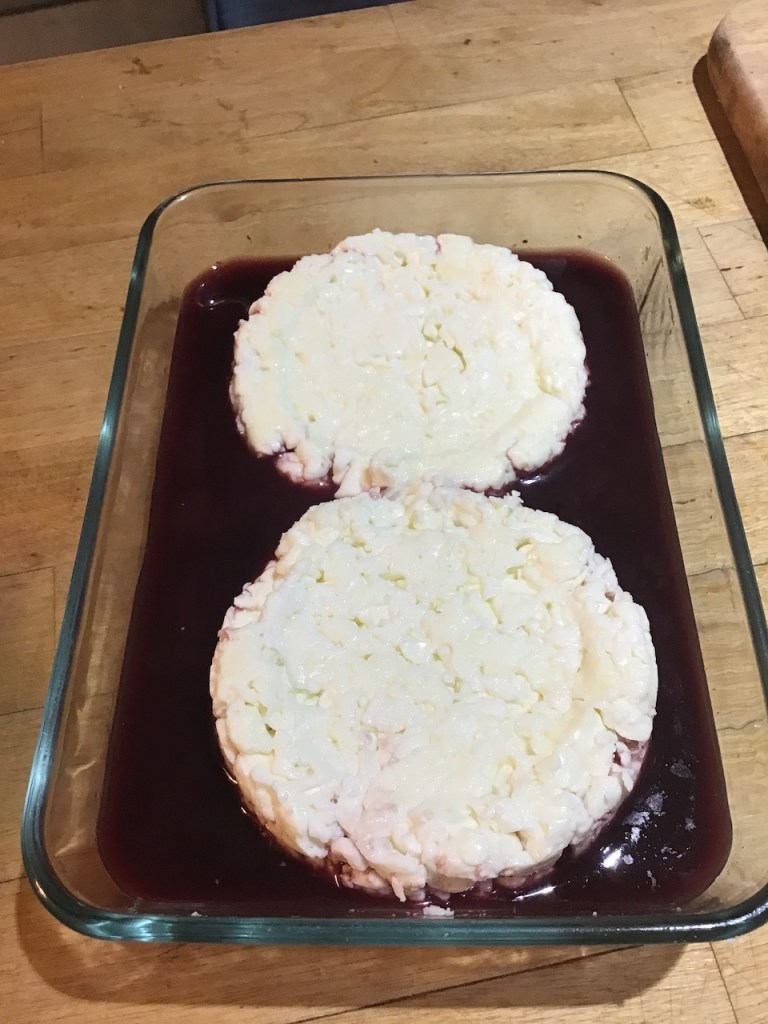
Unfortunately, the 2nd time I tried it was a failure. But, 99.9 % of the time a failed cheese can always become another delicious cheese. Some of my best cheeses have been from failures.

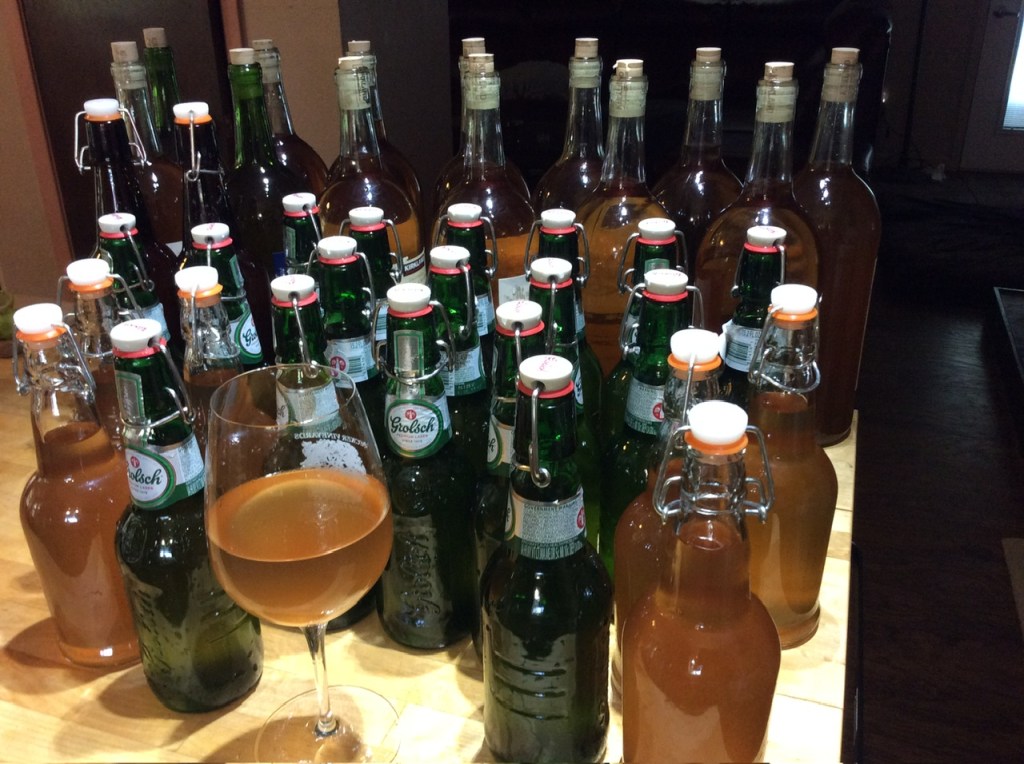
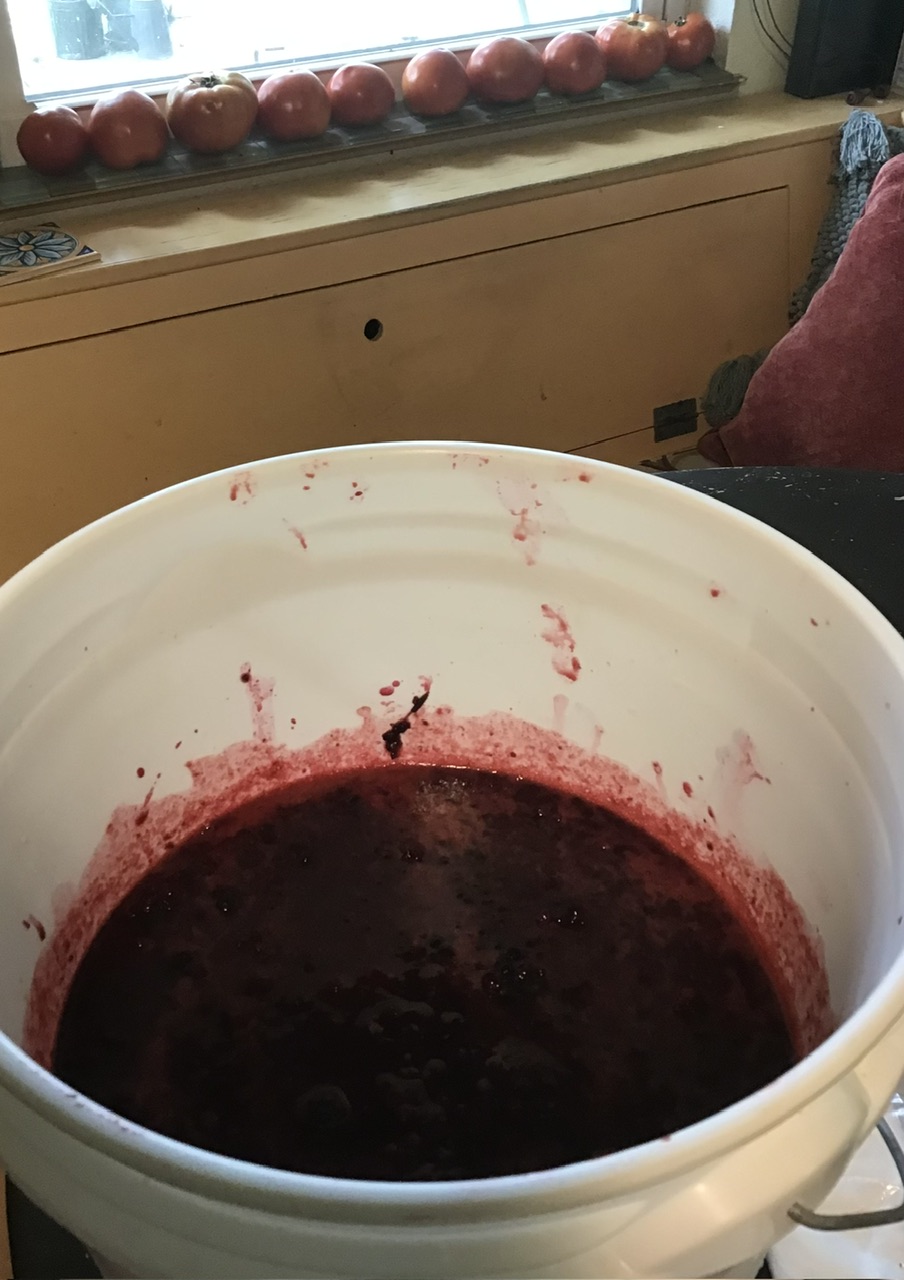
Not necessarily the case with failed wine. This cheese ‘failure’ will be soaked for a couple of days in the leftover must of the now fermenting wine, another tip I learned from my new fav YT channel.

This one was mulberry and I’ve also started a blackberry.

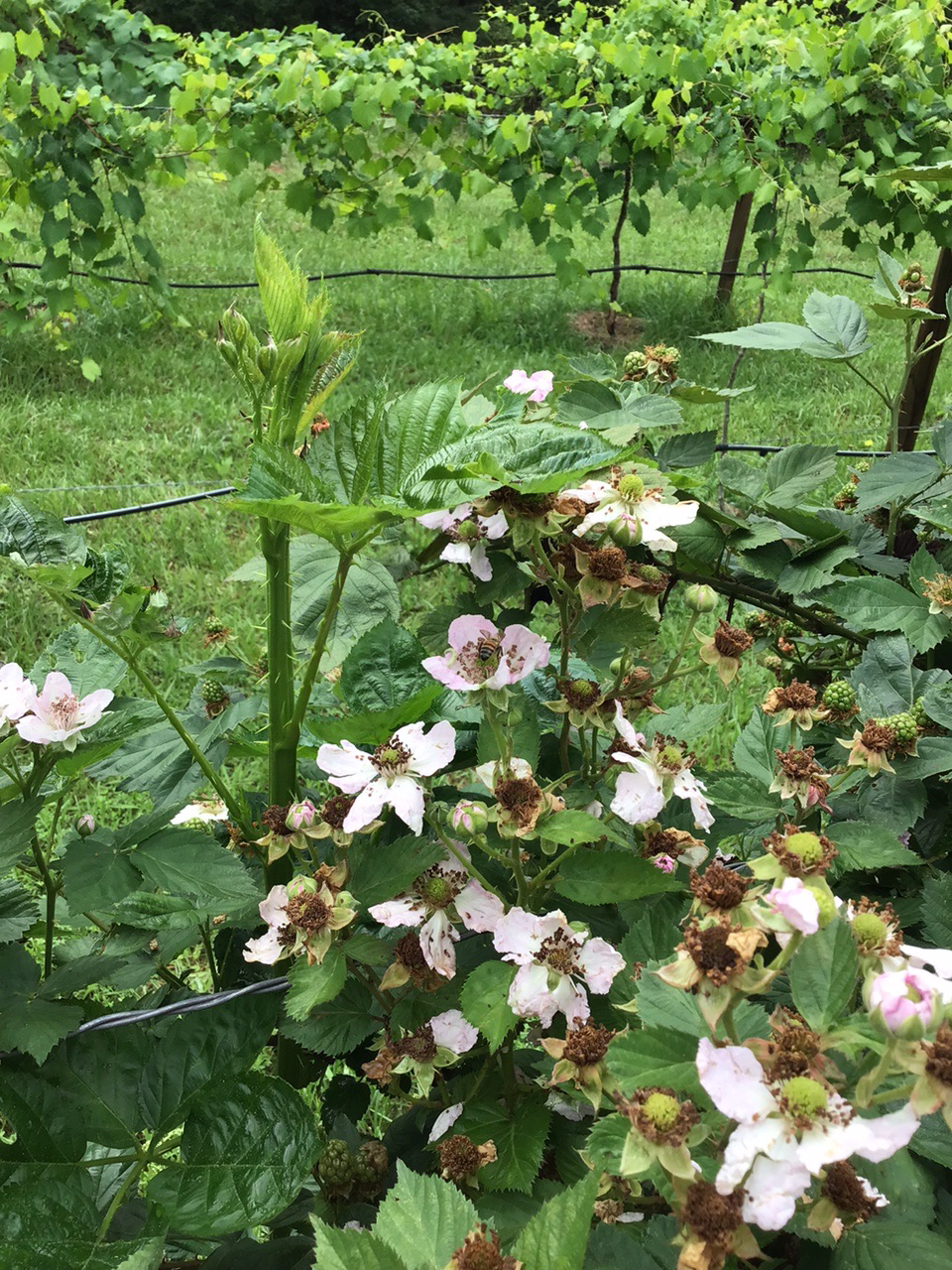
The blackberries seem to very much appreciate the extra rain and our harvest has been great, inspiring me to make blackberry wine for the first time. Last year’s harvest was very disappointing after getting some kind of strange disease right after their flowering period. (Not normal development, despite what several folks claimed at the time.)

I’ve decided to try more natural, traditional methods with the wine-making, like with the cheeses. Modern methods require all kinds of chemically-obtained inputs, which most insist are necessary for a fool-proof product.

Yet, last year we had a major failure using that method and ended up with several cases of vinegar. Very disappointing after all that work. We have had great success in the past or we might be too discouraged to try again.

Blackberries, banana peppers and Nigella seed pods

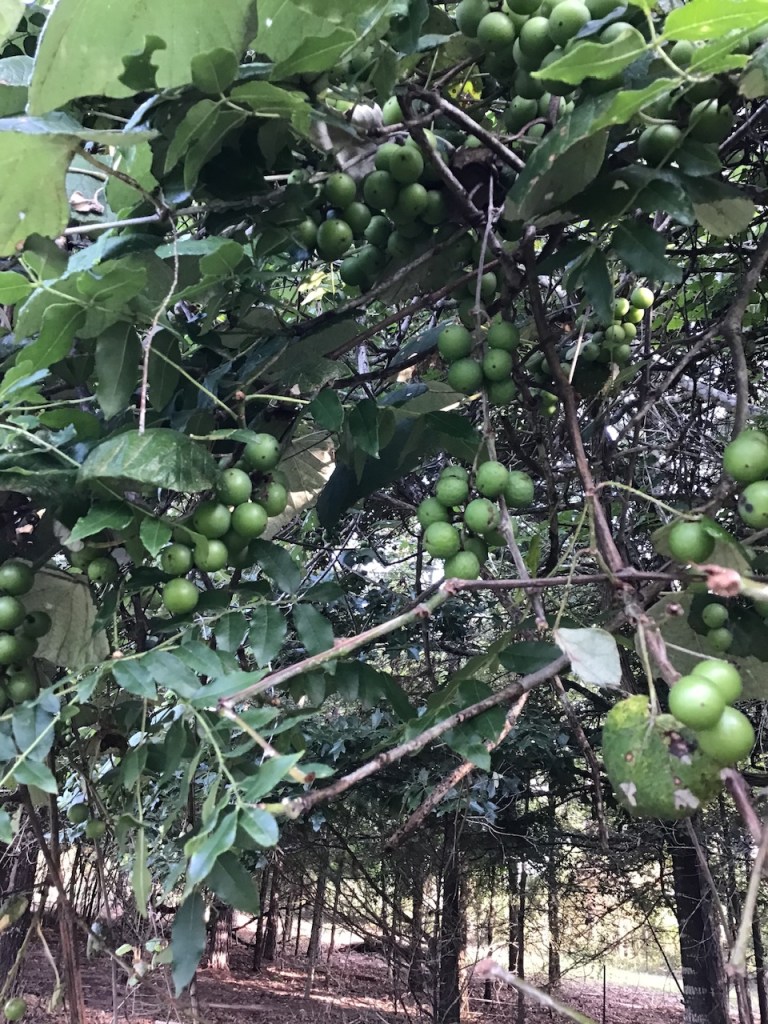
Traditionally, country wines were not made with all those foreign yeasts and I don’t really want my blackberry wine to taste like merlot anyway. While we may not have a decent cultivated grape harvest this year, the wild grapes look promising again. Also the pears are looking good, could be a bumper crop like we get only every few years.

If so, I’m going to do some side-by-side experiments, traditional methods vs. modern methods, and make a real project of it.

Blackberry wine in the making, hopefully

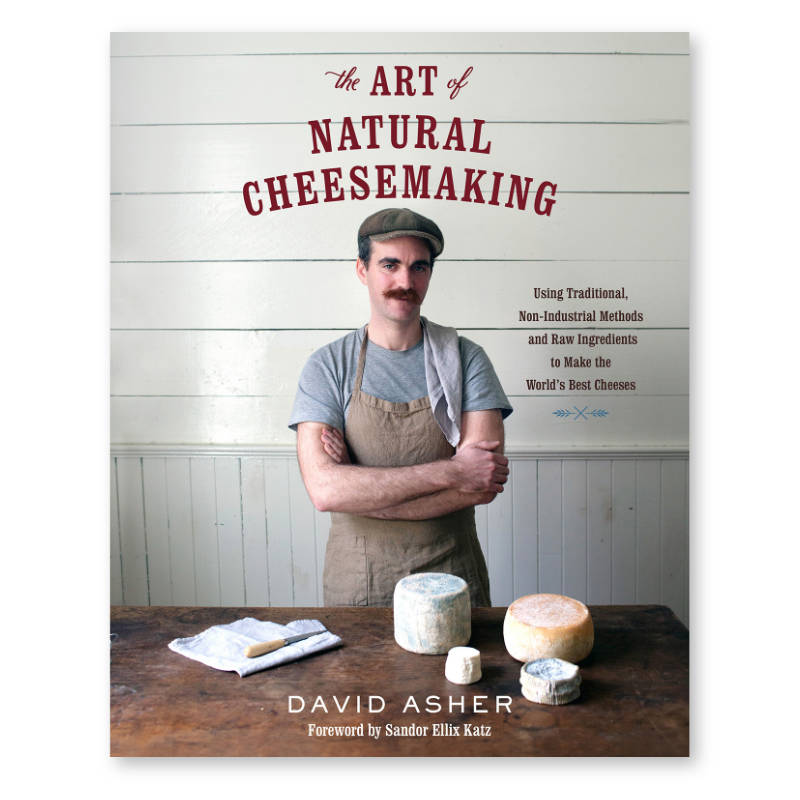
It’s easy to find lots of instruction using the identical modern method. For that I’ll rely on this book.

The wild grapes are looking promising. Our cultivated grapes still uncertain.

It’s not as easy to find good instruction on traditional methods, no surprise there. But this channel has a lot to offer and she uses nothing but a homemade fruit fermentation starter for her wines.

A teetotaler who makes wine, don’t see that everyday!

She also teaches how to make natural sodas and mead on her channel which I’m also very eager to try.

Blackberries fermenting beautifully after 36 hours.

The elderberry is also liking the extra rain. I might even try to make elderberry wine too. The blossoms are excellent in kombucha and will make an effervescent ‘champagne’ like beverage or flavor a cordial. And the goats love it. It’s just an all-around fantastic plant that is popping up everywhere now, so I’m going to create a big grove of them trailing down the hill.

A couple happy snaps in parting.

Thanks for stopping by!

Homestead Happenings

Some brief updates this post and not as many happy snaps as I’d like. But, it’s been so busy and carting my tablet around everywhere is not usually an option, especially where it’s wet and dirty, which is a lot of places at the moment.

Kidding season is over and it’s been a bit stressful, no surprise there. I’ve been wanting to try something new—which is the greatest lost homestead technique I could think of—making our own rennet.

We’ve only had goats a few years now, all of this still feels very new, but, we do want to keep moving forward on the path to self-reliance, so this one is pretty essential on that list. It was as challenging as I expected it to be!

I am squeamish, so that’s the first of the issues. Hubby does all the slaughtering and butchering and for a while I did help plucking chickens, but then we got a machine, so I don’t even do that anymore. I’m not accustomed to seeing the interiors of the animals, let alone having to identify all the parts.

So, trigger warning for this section for anyone reading more squeamish than me! Move to the next section, if you please.

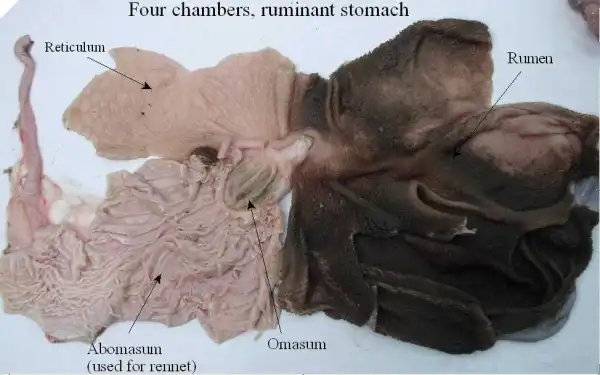
For the briefest of intro lessons, rennet is made from the 4th stomach of the ruminant animal, the abomasum.

This photo is from a calf, so for us we were dealing with far smaller features. Obviously, this is a precious commodity. The abomasum must come from a nursing animal, as it still has the enzymes required for cheesemaking. It can also come from a stillborn, an unfortunate event turned into a beneficial one with proper immediate attention.

In our case, we’ve had 2 stillborn, one this year and one last year. This year we also had a very small doe, a first freshener, who had fairly large twins. We decided to cull one of her kids as part of our efforts. Of course this is never an easy decision to make, and I lose sleep over stuff like this. I was never meant to be a goat farmer, I just want to make cheese!

Anyway, I am glad for the tough choice and going through the trouble to acquire this precious skill. Hubby and I sat down before the guts together, at the kitchen table. One of the great many sentences I could never have imagined I’d be writing!

It’s not easy to find information on the how-to’s of this process, and I certainly had no one to call or visit for advice. It was not enough information to substantially build my confidence, that’s for sure. Sometimes that just takes doing it.

Luckily, I did find one YouTube video, and one blog, both again working with a calf, for which I’m exceptionally grateful.

Another brief aside about rennet, if I may bore many readers a bit further! As I’ve written before, most cheese made today, at least in the U.S., is not made from real rennet, it’s made from a lab-grown rennet substitute, made by Pfizer.

While it’s not that expensive for home cheese makers to buy animal rennet online, relatively speaking, considering only a tiny amount is required, I don’t want to have to entirely rely on far-away sources for such an essential item.

Another thing I’ve been experimenting with to overcome this issue is vegetable rennet, again, from a natural, local source, not a GMO lab-purchased source. We have figs, so that’s what I’m using, but nettles are another source.

It’s not possible to set a large hard cheese with this method, but it works for soft cheeses and very small, what I’d call semi-hard cheeses (because they don’t need a press) like the one I just tried after discovery this channel’s excellent demonstration.

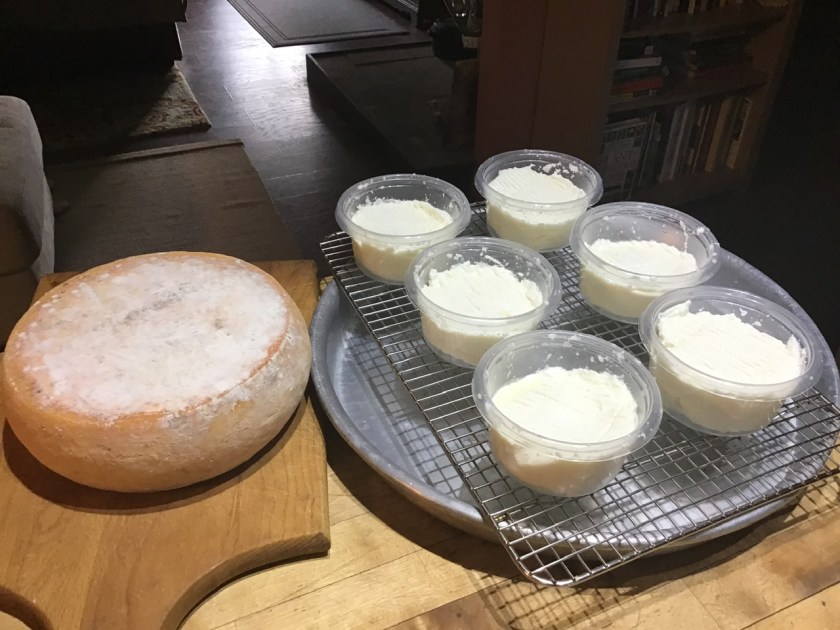
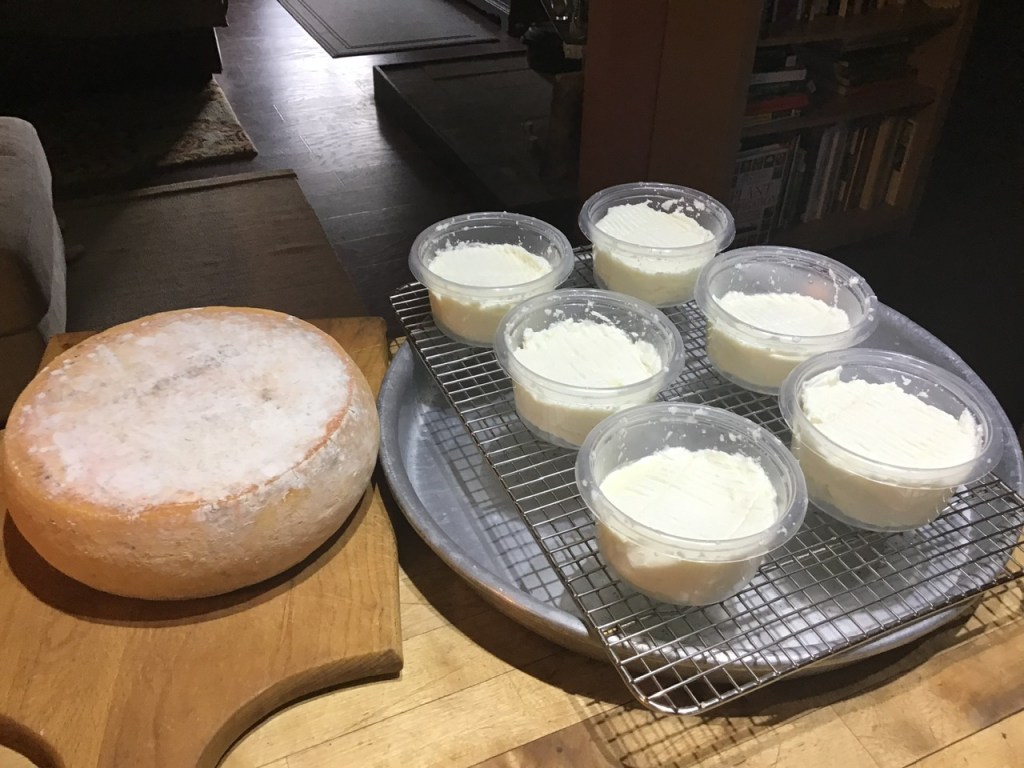
This cheese is so easy! I’ve only just made it, so I can’t yet vouch for the taste, but he makes it look delicious. For this cheese you don’t need any special equipment—no molds or cultures, no aging fridge, and no rennet. Instead of the cute baskets he uses I just poked some holes in an old sour cream container. (And can I just add how much I adore his heavy accent and classic Italian hand gestures!)

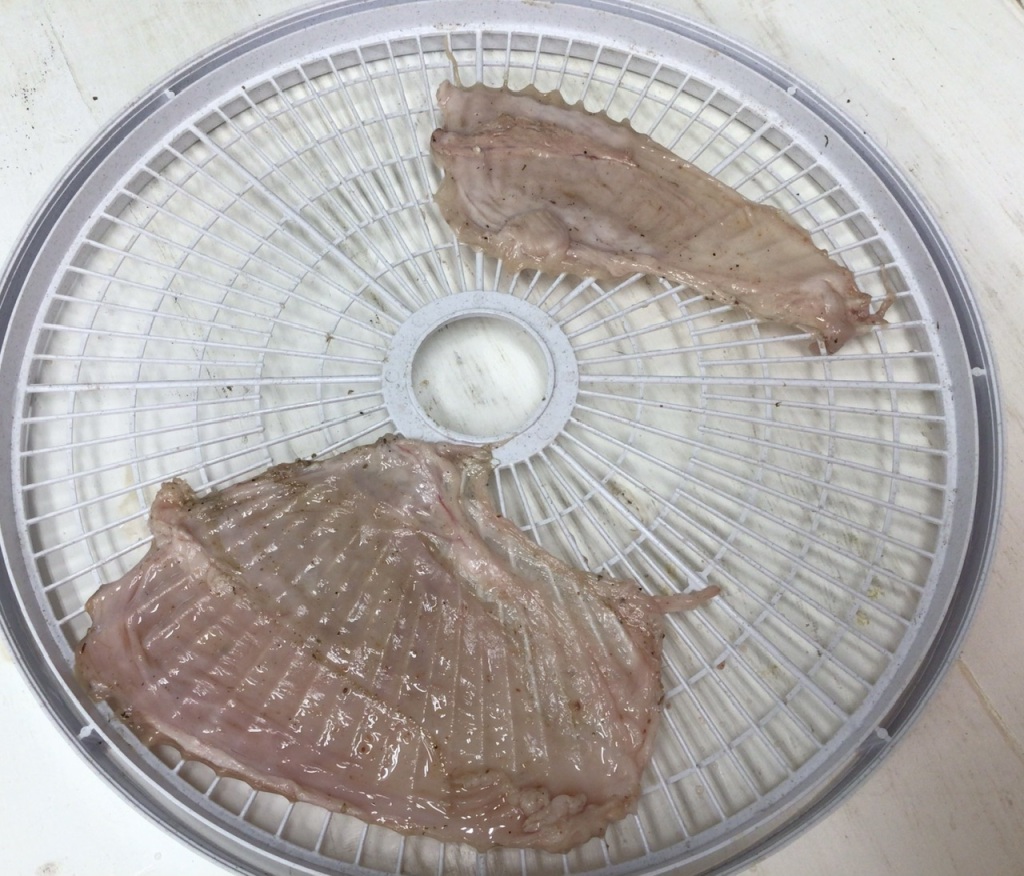
We did eventually figure it all out, and here is our final product, now drying for 3 months or so, according to processing directions. It will then be sealed and last for many years and make many dozens of cheeses.

A great big thanks to the multi-layered efforts of man and nature for this magical gift!

In weather news, we’ve had a lot of rain. While I mentioned last update how much I love the rain, it is causing problems. We lost most of our onion harvest, for starters. This is a big disappointment because we were so close to harvest, just a couple more weeks. Not anymore, they were rotting in the ground, we had to pull them, lost a great many, and the others are mostly very small still.

So between the pitiful potatoes and the sad state of the onions, we are not starting off too well. The peas are already done as well, because of the heat, but that’s pretty normal here.

What’s not normal is my usual complaint—the manufactured weather. We can’t drive to half our property until Hubby upgrades our culvert, a huge undertaking. But we are very lucky this time around! No hail, or tornadoes, or other immediate disasters to deal with, like a great many.

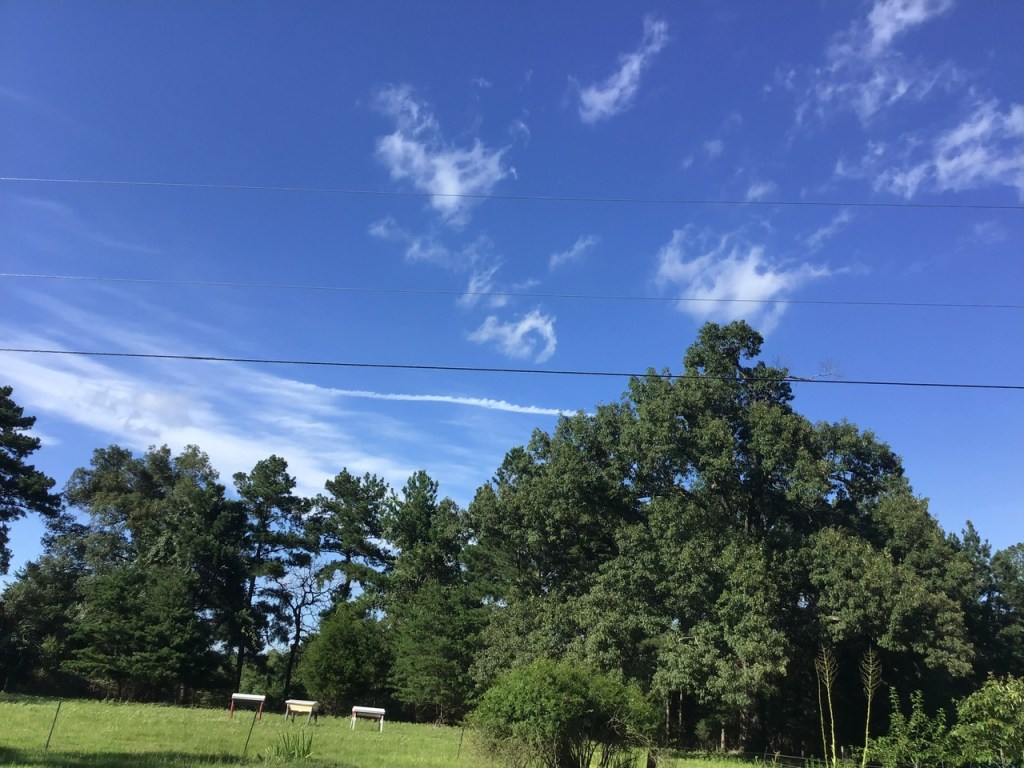
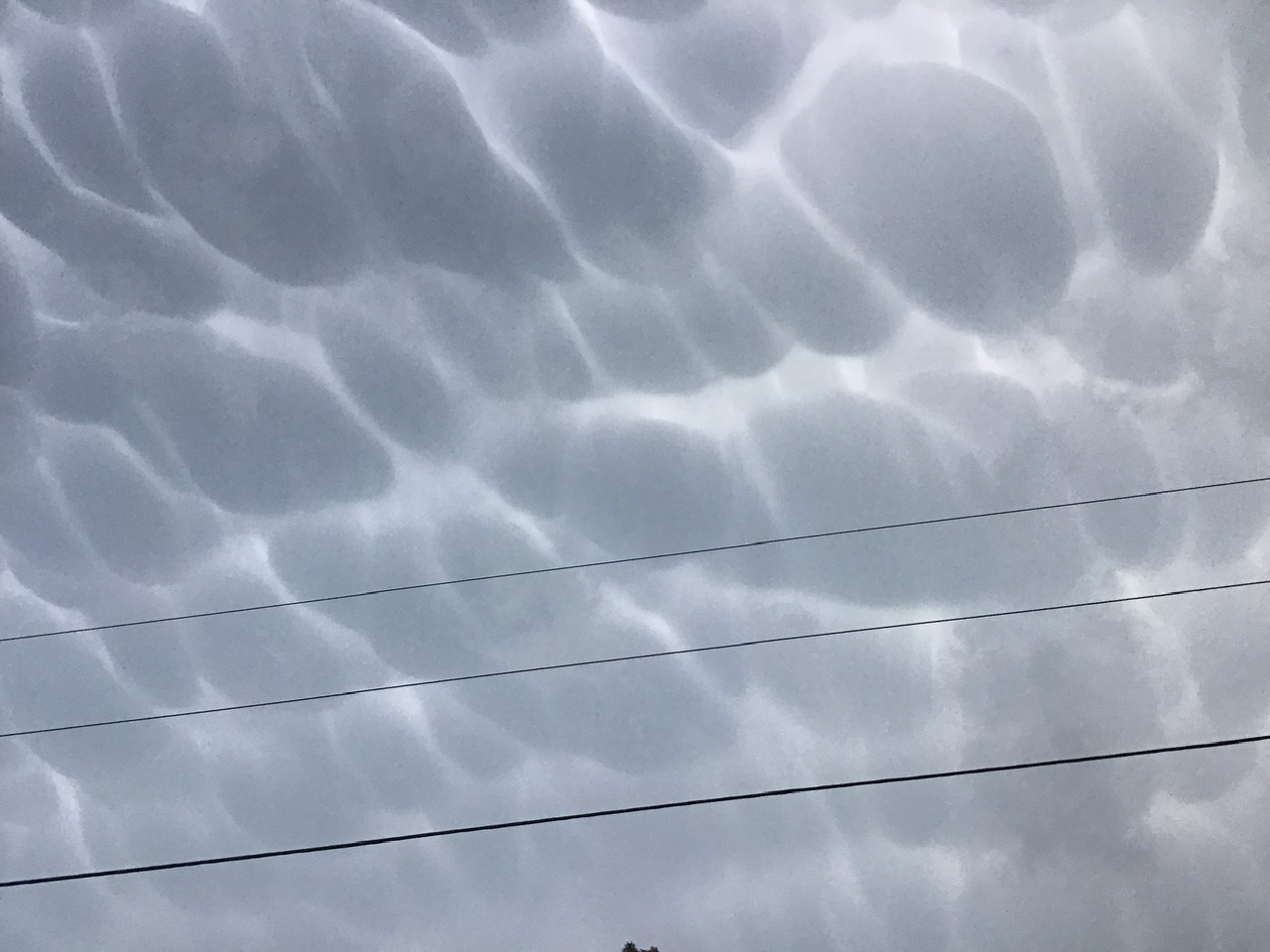
Yes, more manmade clouds above our head. We’ll learn what NASA calls them next post.

But, I have a future Geoengineering Update in the works, so I’ll save further lecturing and complaining for now!

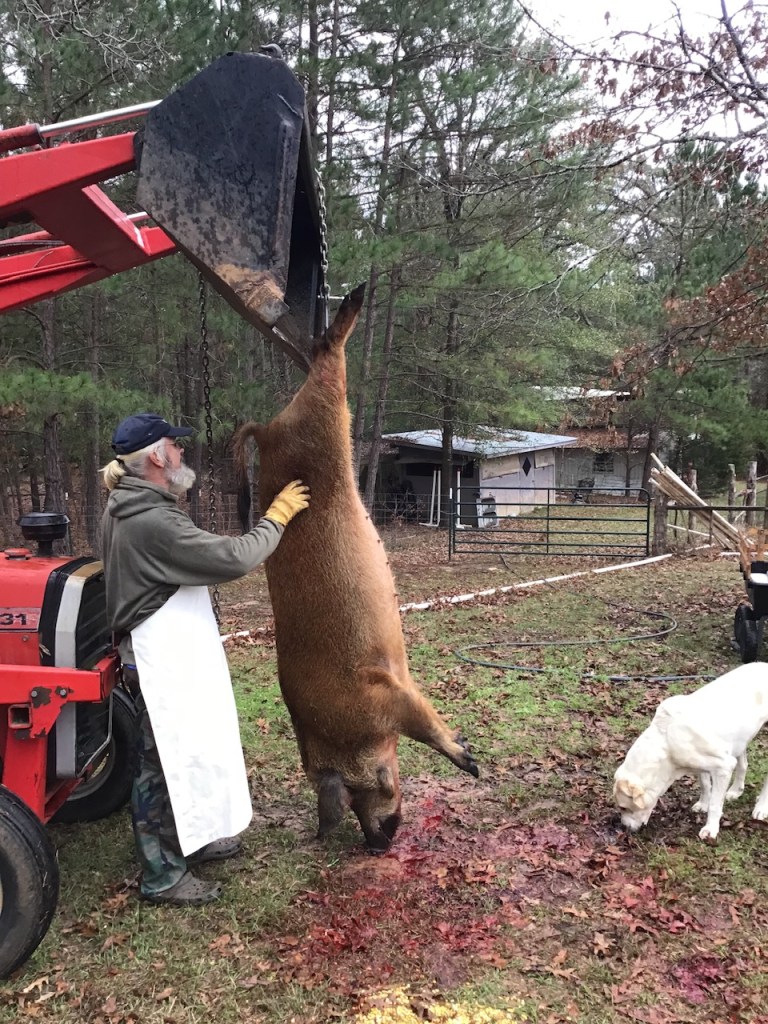
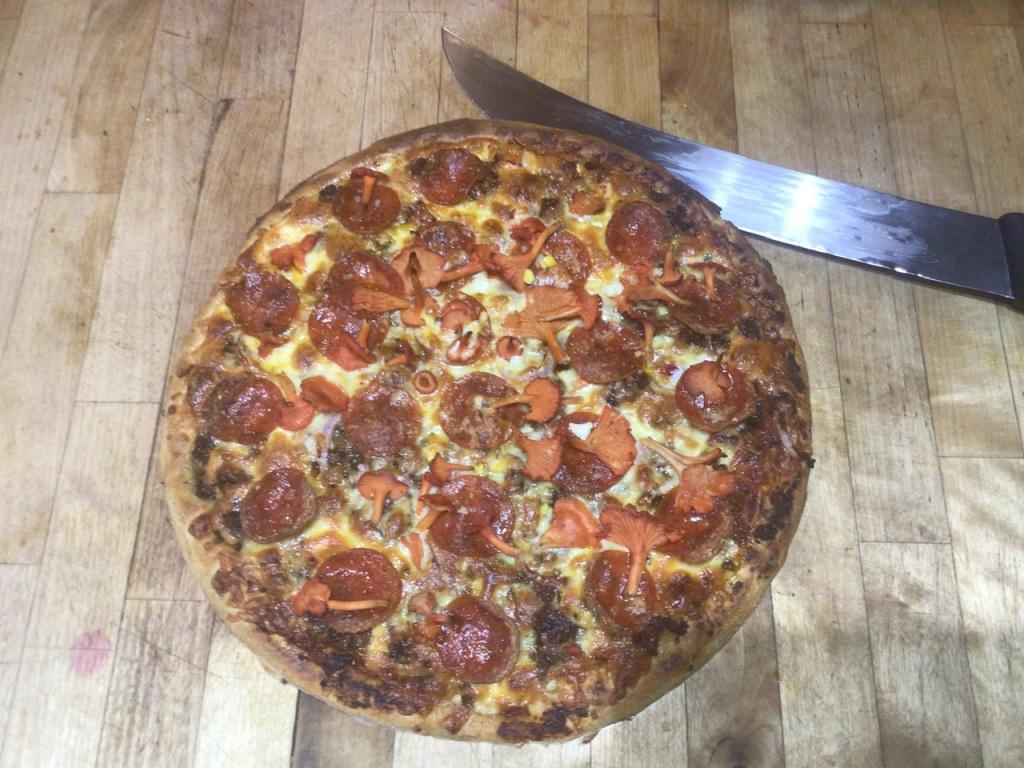
Instead we’ll end with a snap of one of our favorite dinners, just how we like it, burned to perfection! Not our pepperoni or cheese this time, but some just foraged chanterelles, homemade sourdough crust, and homegrown pork sausage. 😋

Thanks for stopping by!

Homestead Happenings

Weird scenes inside the homestead! What have we to add to the big wide web of weird today? A couple of things only, along with some sad news and some happy snaps. Successes and failures, as usual. Trying to keep them all in stride, which with the wild flowers and a short country drive, isn’t too big a challenge at the moment.

Creepy visitor appearing everywhere after the rains

Best to get the crap out of the way first, I prefer. We’ve got seemingly severe blackberry failure and an established bee colony suddenly lost. I could write exhaustively on just those two, but since I’m already exhausted, I’ll keep it brief. And continue the relentless churning in my mind alone.

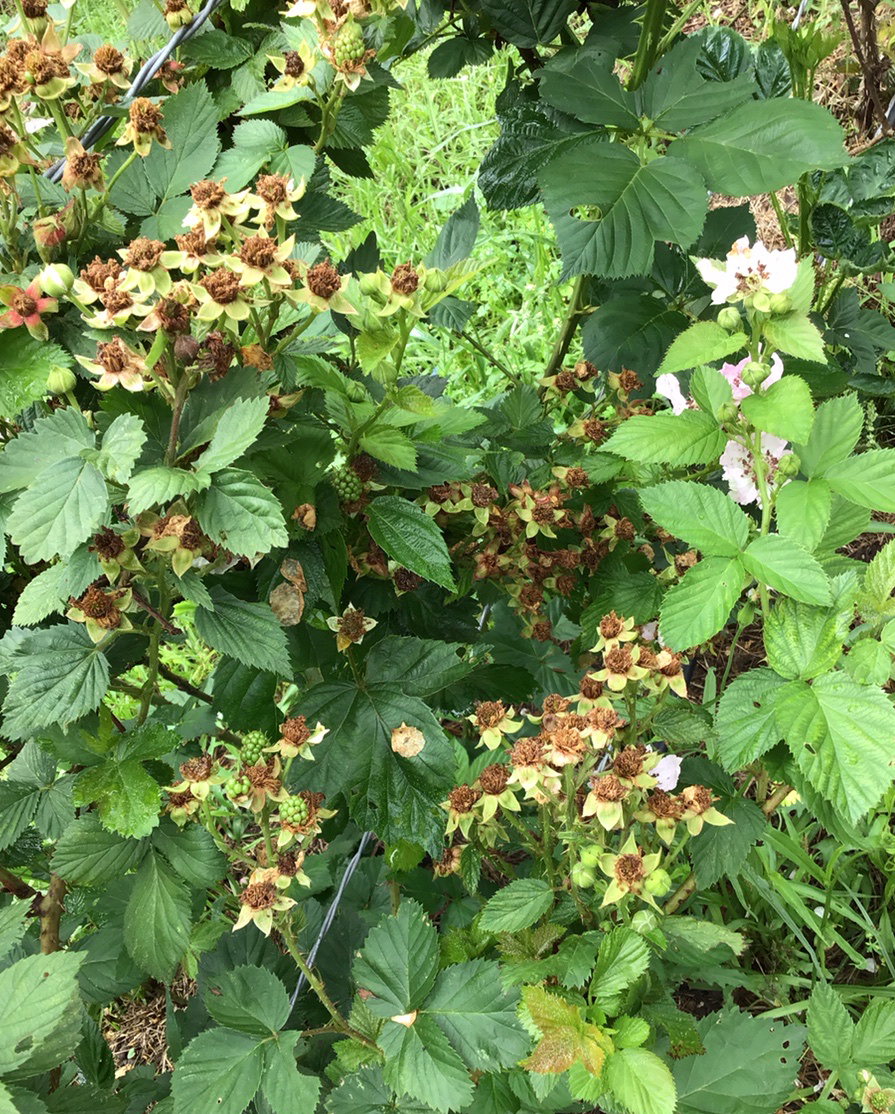
These photos and several more have seen the cyber rounds this week, let me assure you! And the cornucopia of responses we’ve received is rather astounding. Long story short—we’ve had some lovely rains, finally. But it sent our blackberries from thriving and gorgeous, to this brown, crispy-looking horror nearly overnight.

Not just a few bushes either, the entire row, a dozen bushes easy. It looks terrible. So we got a bit frantic and have been sending photos to Ison’s Nursery, where we got them. Also, to various friends and forums, where we’ve had answers to run the gamut: too dry, a virus, a fungus, a blight, Botryosphaeria canker, empty pocket syndrome, aphid damage, and then the kicker . . . This is totally normal development.

Wait, whaaat??

You mean to tell me these could be normally progressing blackberries and after many years of growing blackberries we just never noticed it before?!

Well that would certainly be a big and welcomed WOW! Yes please!

But unfortunately, I don’t think so. They look brown and shriveled beyond anything I’ve seen in any of the online photorama. And there’s no sign of aphids, and it’s not cane blight, and it’s certainly not too dry, although I totally understand that guess, since that’s exactly what it looks like.

And I do so appreciate all the speculation, seriously! It gets me thinking and exploring every time and I do so love all the effort and camaraderie inherit in it. Be wrong, it’s not the end of the world!

Of course, what I did so notice among the seeds of speculation was the one that was, unsurprisingly, totally missing. Toxic rain perhaps? Some other oddities in the atmosphere, perhaps? Not on anyone’s radar? Really?

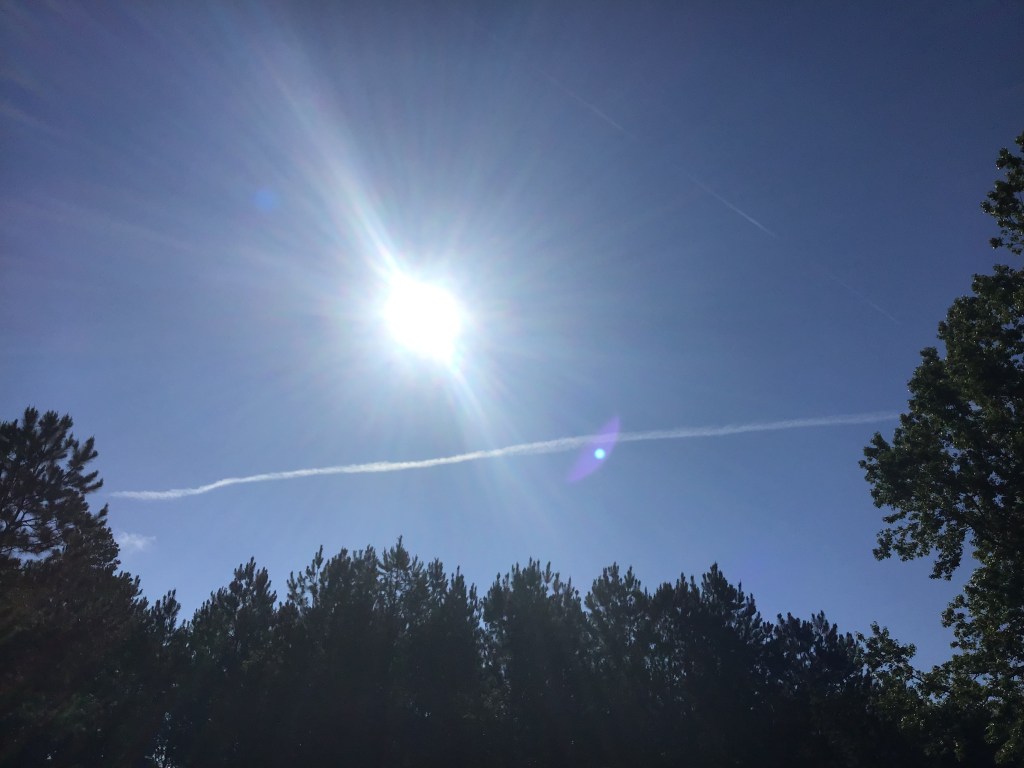
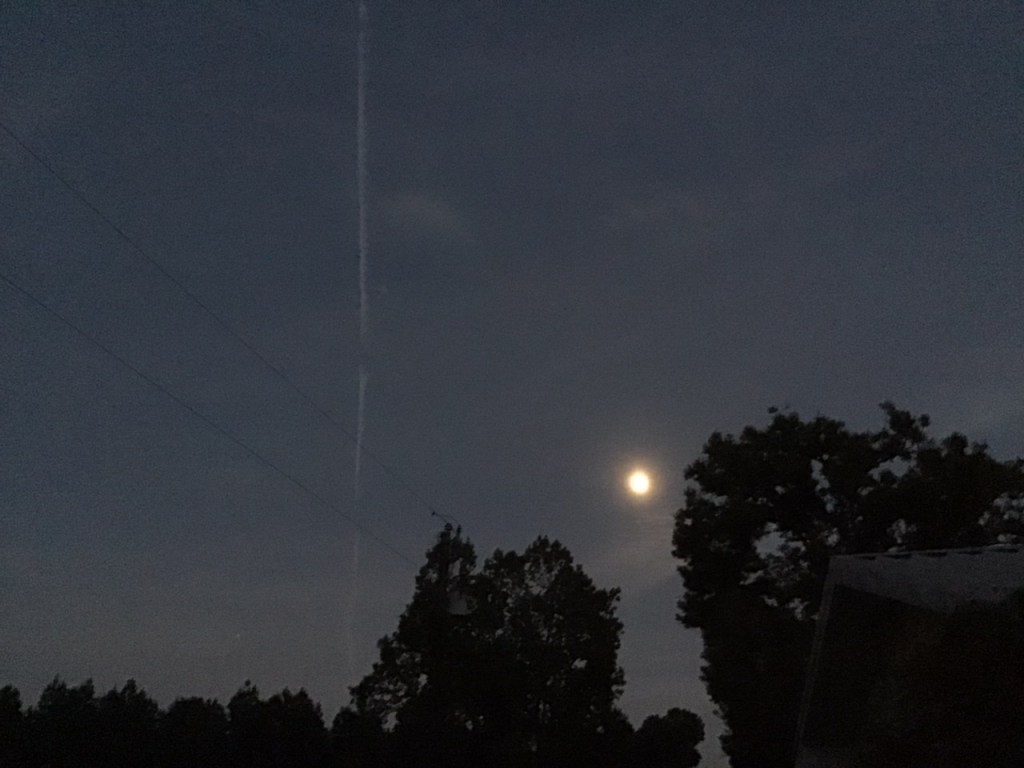
No idea what’s happening in this photo with the blue dot-purple ring, I just snapped the shot with the tablet as soon as I saw the trail while busy in the garden.

On better themes . . .

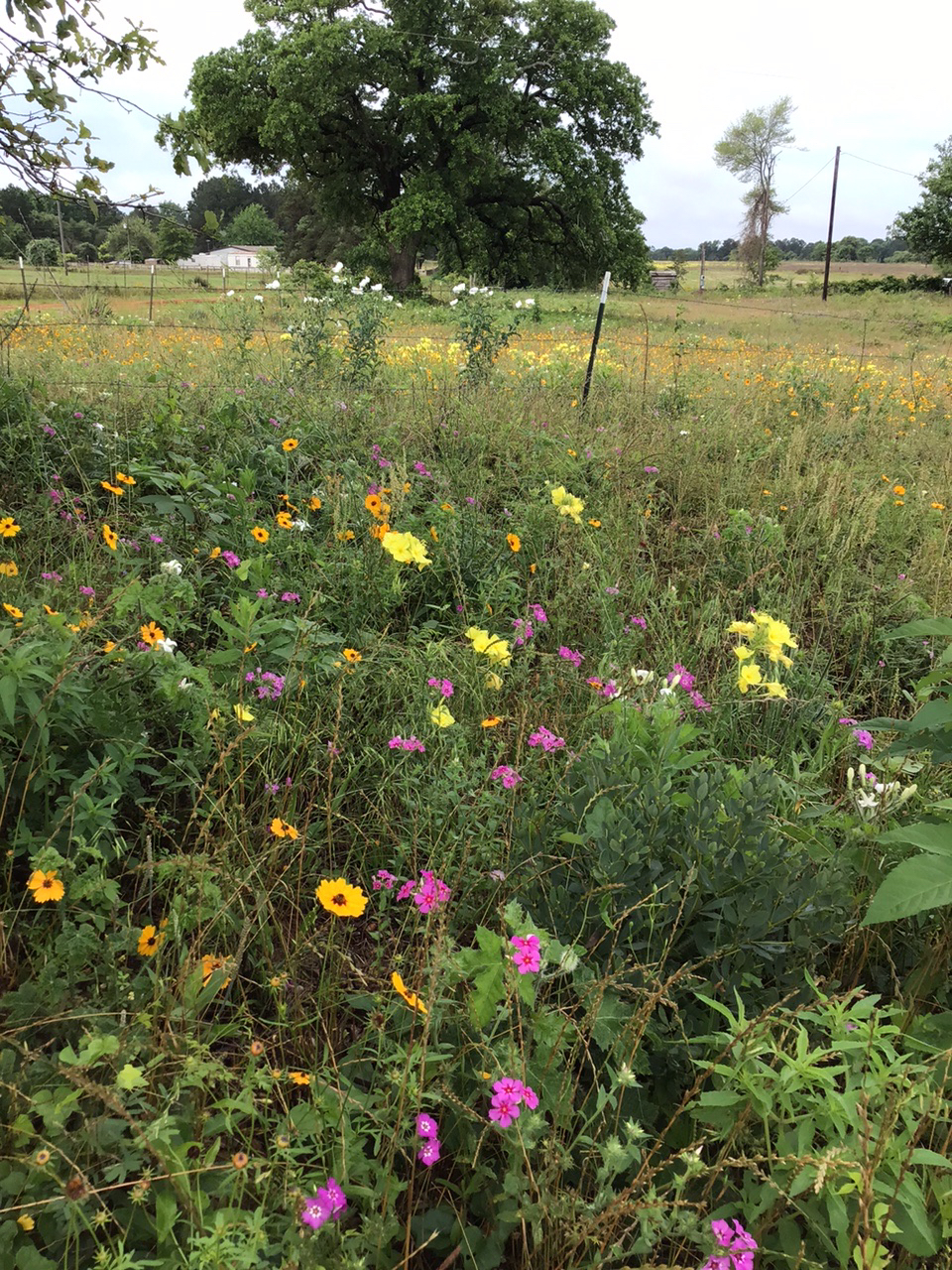
I also took some lovely happy snaps of the wild flowers blooming along the road, which was so much more gorgeous than what I was able to capture here. But I tried, and that should count for something, no?

And on that note, this post will have a Part 2 to finish later, cause that’s all I can manage at the moment. More to follow, so much more!

Thanks for stopping by!

I leave with a song that motivates me when I really need it most. Hope it works for y’all too!

Kensho’s ‘Stinking Peasant’

‘Stinky cheese’ is an official cheese category for those unfamiliar with the great wide world of cheeses. Really! They include the washed-rind cheeses, but some others as well, depending who you talk to.

These would include such well-known varieties as Muenster, Limburger, Raclette, but also some relatively new popular favorites like the Stinking Bishop of Charles Martell & Son – Cheesemakers and Distillers.

The Stinking Bishop—the name inspiration behind my own new cheese—the Stinking Peasant!
About the Stinking Bishop:
“The rind becomes sticky and pink, with a pungent, almost meaty aroma, while the interior is velvety smooth and almost spoonable. It is bound with a strip of beechwood, which also imparts its own woody notes to a cheese that is farmyardy, but not as strong as its smell, or its name, would suggest.”

The wash-rind process used to be referred to as “putrefaction fermentation”so you can understand why they might want to change the name.

When I set out 7 years ago into the glories of cheesemaking I had no idea I’d also be making my own ‘signature’ cheeses. At the time I was responding to the sorry fact that in order to buy even a remotely decent cheese I had to drive several hours. And even then, nothing was made from raw milk. I bought freeze-dried cultures just like the vast majority of home cheesemakers do. I found a lot of success imitating the favorites—mozzarella, Pepper Jack, Camembert, Parmesan, Swiss, dozens of cheeses. I’ve tried making just about every cheese you’ve ever heard of, and quite a few unknown to even real cheese aficionados.

Of course, considering there are 1400 named cheese varieties in the world, I still have a long way to go!

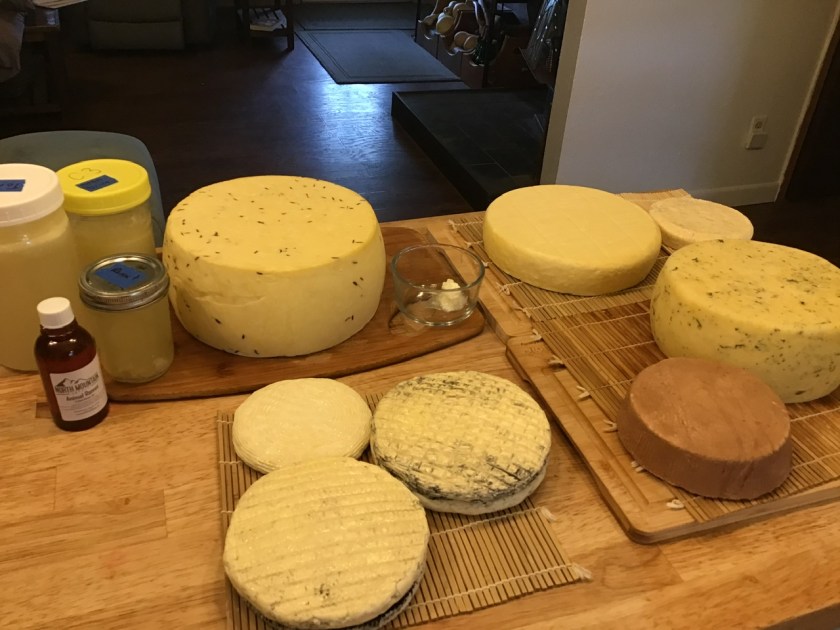
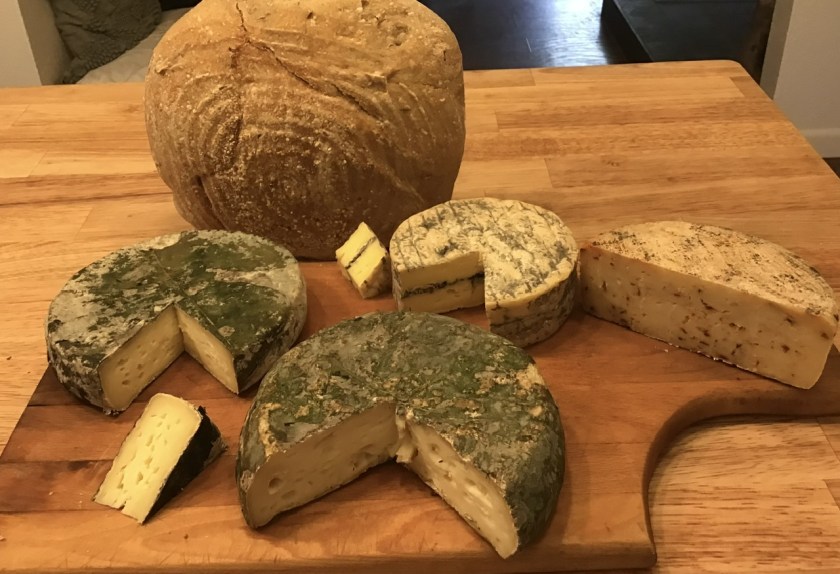
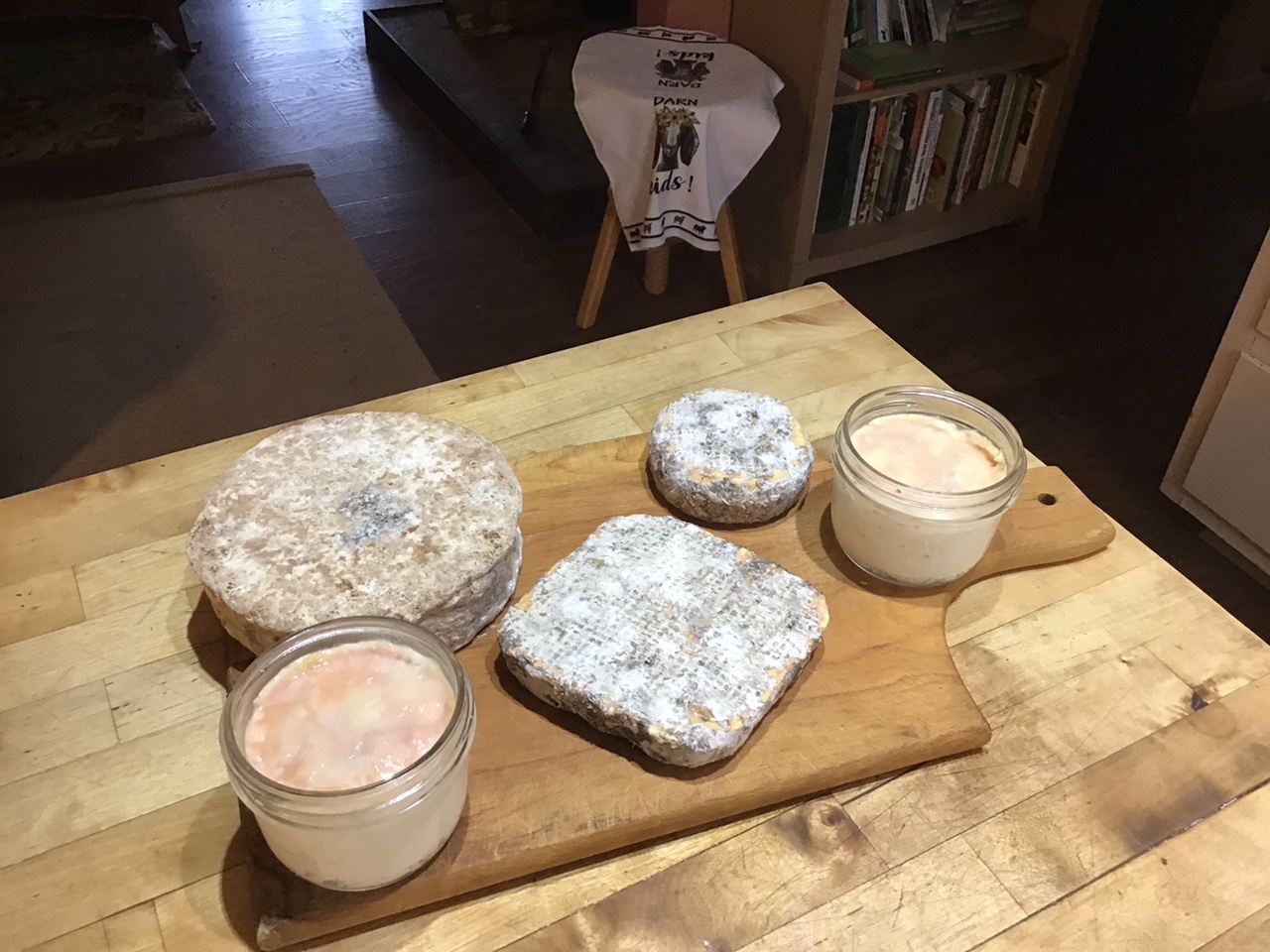
Several of my ‘signature’ goat cheeses now ripe and ready to eat. Still in the aging fridge are Pepper Jack, Dill Havarti and Caraway Gouda

But, the more I learned, the more I wanted to get back to basics. The more I got back to basics, the more I began to understand what a beneficial and even necessary learning experience it has been. Sure I can spend much time and effort recreating other people’s cheeses. But even better is to invent my own!

That means developing our ‘terroir’. No more purchased cheese cultures. Milking our own goats and making raw milk cheeses with our own wild yeasts, yogurt and buttermilk, all which change flavors and colors with the season.

Like a true Roquefort can only come from Roquefort, France and real Champagne only from Champagne. These have PDO status, that is Protected Designation of Origin.

The process is only part of the story, because the finished product is a signature of its terroir. Affinage, that is, the art of maturing the cheeses, is the next crucial component.

Not that I have any interest in throwing my cheeses into any rings with the big guys. Not a chance, even if my cheeses were that good (I think they are!). I have no interest in turning my pleasurable hobby into a stressful profession.

“In its simplest form cheesemaking is the aggregation and preservation of protein; in its highest form cheesemaking is alchemy. . . Many traditional European cheeses are on the decline or have disappeared. It is ironic that the United States is leading the resurgence of artisan cheese and is the fastest growing market for specialty cheese on the planet. Can we Americans be the saviors of French terroir? Or will our efforts to reveal our own terroir be stillborn because of insurmountable regulatory hurdles?”
~Mateo Kehler
Jasper Hill Farm, Greensboro VT

Anatole and the Robot (1960) — The story of a professional cheese taster whose job has gone to a robot. I think Anatole has the right idea:
“I sniff, I taste, I think, and then I use the magic of my imagination!”

Source:
The Oxford Companion to Cheese edited by Catherine Donnelly, foreword by Mateo Kehler

My favorite cheese-making book:

What Are Friends For?

One thing I never liked about teaching was being the center of attention. I was told I’d get used to it, but in 20+ years, that never happened.

It’s not that I’m a shy wall-flower, far from it. It’s also not that I didn’t appreciate that stage-ease in other teachers when I was a student. In fact, I rather liked it.

Still, I always felt like, if I could design my own classes they would never be lectures, never large groups. Even though some of my large lecture experiences as a student were very positive.

But, that’s because getting lost in the crowd is so easy.

Far more challenging is small group, low structure. It’s a very unique dynamic and my personal preference. It’s not necessarily conducive to many teaching tasks, but it does work very well for other things. Especially if your goals are real community ties over speculative market drivers.

After all, when you consider what motivates most teachers, money rarely tops the list. Small group, low structure is the least beneficial monetarily speaking, for obvious reasons. That’s probably why it’s so rare.

Seven ladies in my tiny kitchen, oh my. BTW, that’s Kombucha we’re imbibing, not beer!

Many hands make light work. I think that means not just a lighter work load. It’s also ‘light work’ as in, bringing the joy of community into our work and into our homes. Incorporating the unique contribution of each individual toward a common goal. It’s a beautiful thing. It’s pretty much the opposite of what incorporation has come to mean in modern parlance—which is more like automatons performing tasks to perfection at the command of a central authority.

“Um, excuse me, but your Shankleesh balls are not uniform!”

We are witnessing in our ‘Institutional Affairs’ that not only are we being conditioned to not discuss religion or politics, but it is becoming a requirement for receiving public funding.

While personally I’m ambivalent to these policies, because on the one hand I appreciate a separation between Church and State. Still, on the other hand I perceive what’s actually happening is an enmeshment of Globalist agendas with local affairs. An infiltration which began long ago that lately has been picking up pace.

Perhaps it is unfair that Christian-affiliated groups are getting squeezed out of public affairs. I can certainly empathize with their predicament and growing resentment. And yet, far more important to me is that I have encountered first-hand and through others’ stories that part of the means to this end is being achieved by categorically excluding crucial topics from public dialogue.

The de-platform and shadow banning and cancel culture that’s being most hyped online often excludes what’s been happening locally in folks’ churches, State-run organizations like the Master Gardeners, and State and church-affiliated out-reach programs and charities, not to mention in the schools.

This in particular makes small gatherings an essential part of a healthy public and community life. Feeling threatened by group-think and ostracized for a differing opinion occurs far less often.

Particularly, when we are gathered around wholesome work, like learning skills together, getting necessary things done, or just sitting on the porch—shooting the shit, so to speak—group identity is replaced by an individual-level camaraderie, where the label is not the first thing on everyone’s radar and money takes the back seat to true care. Christian, Buddhist, Atheist, Republican, Anarchist, whatever—these are the social constructs as much as gender identity or which church or which school or which job one has, if any at all.

Differences can be appreciated in a friendly and comforting surrounding rather than creating strict and professional-level hierarchies. Sure, it’s still great to have like-minds around, but they don’t have to be like-minds set in stone or the whole edifice risks collapsing.

When the goal is a better life, actually living it, politics is naturally relegated to the background, not because it’s a forbidden or contentious topic, but because in the manner of human relations it belongs in the background.

Or, even better, six feet underground!

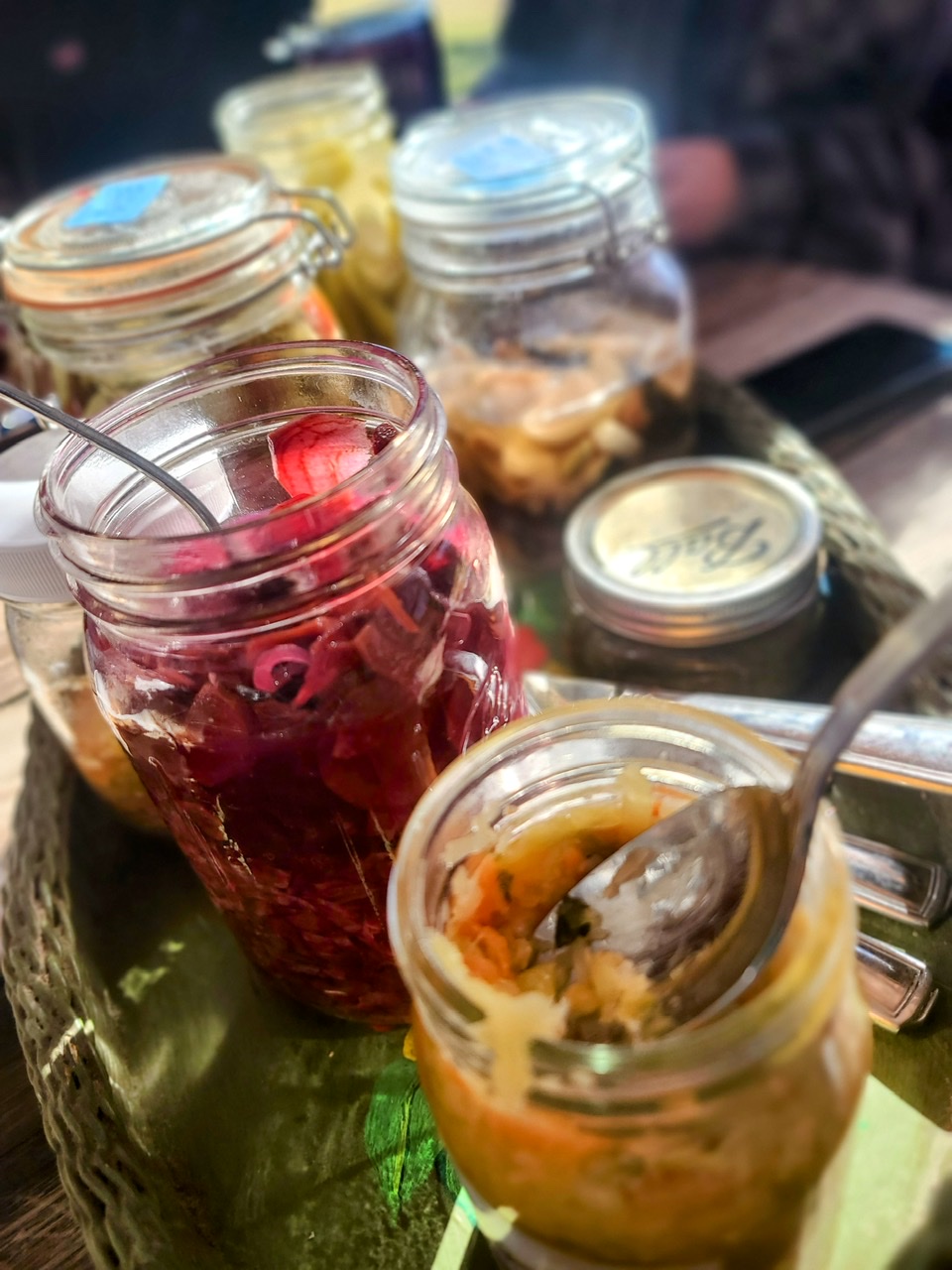
Lunch al fresco with lots of ferments to sample, yum!

And for these reasons, I feel charmed and grateful for the, so far, two ‘Fermenting Workshops’ I’ve hosted here on the wee homestead, with a lotta help from my friends.

Thanks and well done, Ladies! What lovely and wonderfully productive days—I look forward to many more!

All in a day’s work—West African Sweet Potato Ferment, Lemon-Dill Kraut and Shankleesh to take home for you and your family’s enjoyment !

A very special thanks to Nicole Faith, our supreme community organizer and A+ homesteading student, who also provided these photos, along with her exuberant enthusiasm and gracious courage. 😘

Homestead Happenings

Never a dull moment on the wee homestead. Since our last update we’ve got limping dogs, goat rodeo, weather whiplash, a huge harvest of sweet potatoes, new cheeses and old ferments.

If it’s the cooler temps or longer nights or more critters creeping around, we can’t say, but our dogs have been doing a lot of midnight galavanting. First they got into skunks, and that was bad enough. Now we go out first thing in the morning to find them wet and limping and exhausted. We’ve started taking them for walks during the day trying to tire them out and make sure they get enough gentle exercise, because we’re worried they’re going to get themselves into some real trouble. It’s working out very well for our barn cat, Skittles, who now roams wherever she wants without fear of attack.

Milking just three goats twice a day is proving to be quite the chore considering with the two first-fresheners it’s a constant battle of wills. It seems every day they learn a new trick trying to get free treats. First it was bucking and kicking, then squatting making milking impossible, now one has graduated to full refusal, getting up on the milk stand only to lay down flat. It takes both of us, Hubby to hold legs and supply food, me to grasp the bucket with one hand and milk with one hand, each with our reflexes on full alert to shift, draw, grab in the split second it takes a hoof to swipe, spill, crush. It’s really not fun. At all. I have to remind us both that it takes patience and to stay focused on the rewards.

Cheese!

In garden news we got a very early frost and then the temps shot right back up to the high 80s. It’s cooled down a bit since then again and we got a whole 1/2 inch of rain, woohoo! It hardly made a difference, but maybe my fall seeds have a better chance now of germinating.

We harvested loads of sweet potatoes and still have more to go. The vines can’t handle even a light frost, like the basil, so we got all we could manage beforehand though the tomatoes and peppers survived, so that was a pleasant surprise.

I continue to experiment with fermenting all kinds of veggies and they are coming out so delicious. I moved them from the aging fridge to make room for the cheeses, but they kept great in there all summer. We’ve got all kinds of goodies—cucumbers, basil, peppers, okra, carrots, cabbage—and soon I’ll be tying sweet potatoes.

A whole world of deliciousness I’ve only really embarked on seriously starting this year, and thanks to this excellent book.

P.S. Sorry for all the sideways photos and if you get a crink in your neck trying to view them you can thank WordPress for that. I spent an hour trying to correct them, and it’s not working. My WordPress experience is getting worse and worse, which is why the days of this blog will be over soon as it’s just become too annoying to continue it. It’s gone steadily downhill since they forced the Block Editor on everyone. They continually make changes that only make it harder and more time-consuming to post. Oh well, it was fun while it lasted!

In the meantime, thanks for stopping by!

Homestead Happenings

I’ve got some complaining to do today, but there are some rays of sunshine, too, fear not!

Let’s get the crap out of the way first, don’t you think?

In the mornin’, in the evenin’, ain’t we got fun?!

“Climate change”— aka Geoengineering/Weather Modification — continues to haunt us. That is, in droughting us out, mercilessly. I have little hope for the fall garden. I’ve had very poor germination in some crops, none at all in others. That could be the high soil temperature, the still scorching sun and heat even now into October, or perhaps it’s all that crap in the atmosphere.

The pastures are so parched, which means, as I mentioned last time, more sheep than we’d wanted to will go to freezer camp.

The upside is, we are eating very well these days. We’d slowed down on meat consumption over the summer because the freezers were low. The hens had really slowed down laying too in the heat. Now we’ve got meat and egg surplus and we’ve been indulging accordingly.

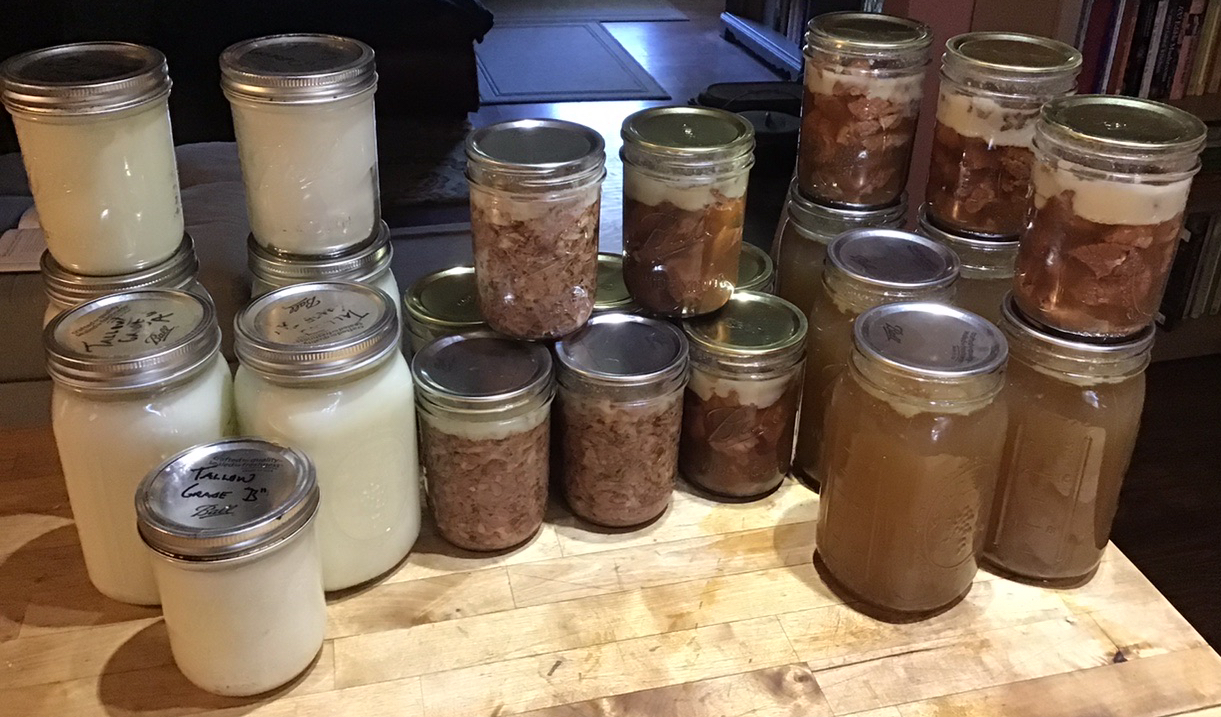
That also means tallow, which is like white gold to me!

Hubby also pressure canned us some lamb and broth. Yum!

They want a pretty penny for this stuff, which makes sense considering all the costs and effort involved. A basic tallow balm will set you back $15/ounce! I’ve already made one hand balm with rather erotic-scented essential oils that’s got the thumb’s up from my sole customer. 🤗
On to the garden . . .

The purple Czech hot pepper is still my season favorite. It’s still doing beautifully (under shade cloth) and is a lovely little plant I’ll try to over-winter indoors. Hubby is making hot sauce in the fermentation crock that I’m sure will be top-notch.

Pictured: the purple Czechs in the center back, Thai basil to its left, sweet basil upfront—so it is protected from full sun in every direction except from the east.
Even under shade cloth and screening the fall crops are not germinating. Luckily I was able to start a few indoors under grow lights.
Tomatoes also started indoors mid-summer under grow lights, now looking pretty good transplanted outside last month. Fingers crossed it doesn’t frost too early and we’ll get the rare fall harvest of plump red tomatoes. Dare to dream!

We’ve finally fully weened the kids and it’s been a very loud few days! I’ve got enough milk again to make some good cheeses, which is just about my favorite thing to do in the world. Or, I just really missed it all summer and I’m really sick of the garden.

The kids will be fine without their mamas, they just don’t know it yet. 😆

I’ve got to get practicing my cheeses again, because the interest in homesteading has really been growing around here. A nearby group has formed and asked us to share some knowledge, which we are pleased to do. Hubby will be lending a hand in the butchery department and I will be offering my fermentation wisdom— in kombucha, soft cheeses and sourdough—for now, hopefully moving on to more advanced skills if interests persist. It’s been a very long time since I’ve done any teaching and I’m already nervous! But, I’m so pleased folks are really starting to see the value in more self-reliant living.

Whether it’s out of necessity or innate interest, I’m thrilled more folks are choosing a more natural lifestyle.

And . . .I think the more the big shit stinks, the more we should be celebrating the small stuff.

And . . .Just in time for Halloween . . .a visit from a black widow!

Trial & Many Errors

There’s the good kind of failures—like those you are able to remedy; And the bad kind—like those you can’t control; And the worst kind—like those you could control, if only you could figure out what went wrong.

We have a collage of all 3 today!

Failed cheeses, failed fruits, and sun scorch.

Penicillium roqueforti has dominated my Little Turds and now we have little blue turds, which is a big fat failure.

This is the most aggressive cheese fungus and once the spores get started it’s extremely difficult to correct the issue. As much as I love blue cheese, this is not the process for making it. As a surface mold it does not taste good, it’s the veining of the blue cheese that brings out the nice flavors. I don’t make blue cheese, because in order to make other cheeses you must exclude the blue to get the white (geotrichum candidum),or any others, to dominate.

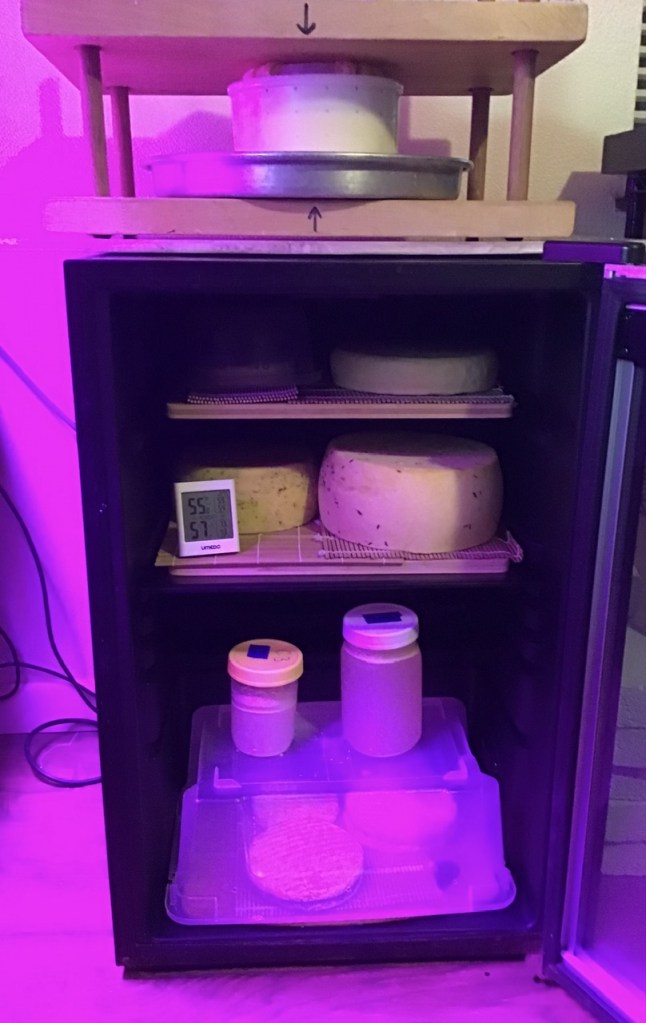
Even a hobbyist will quickly learn that you need a separate space, equipment and unique aging fridge just for the blues. This particular invasion happened very quickly, in just 2 days, because a beverage fridge does not make a very good aging fridge for cheeses. But, it’s all I’ve got. The temperature varies unexpectedly and you can’t control the humidity. Sure, a lot of cheese makers out there claim there are certain tricks for modifying the humidity levels of the mini-fridge, but they just don’t work, or they are far too high maintenance for me.

The fridge got too cold by just a few degrees, and this was the result. The two without any blue are from an older experiment, also failed, because their white fungal coat is not thick enough. I’m hoping a snug fig wrapping will magically transform the problem. But, I doubt it.

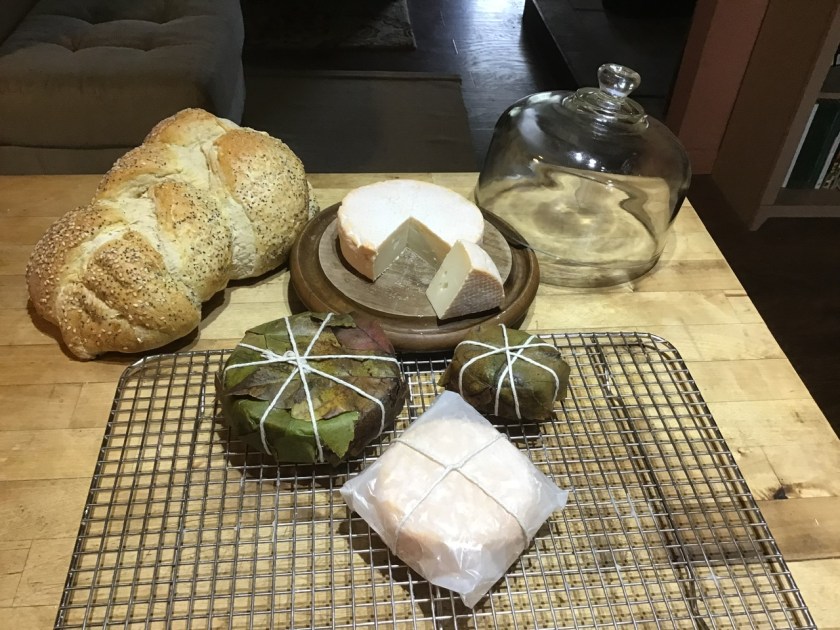
Wrapped in fig leaves (with a bit of sage on one too, to cover the naked parts) back into their Tuperware-fashioned high-humidity space, and back into the aging fridge.

As for the little blue turds, I’m going for maximum shock treatment, just to continue the experiment at this point, because I think they are beyond repair. I have them at room temperature now and I might even try spraying on some geotrichum candidum, just to see what happens.

The orchard is a continual string of failures, the nectarines being just the latest one. We’ve planted so many fruit trees in there we’ve lost track. We planted a couple of plums, one that actually produced for a couple of years, then both suddenly died. The grapes are looking terrible this year, the apples hardly ever bloom and never produce any fruit, the peaches die a year or two after planting, and now we finally got some nectarines and they look like this. The worst part is, once you cut out all the bad parts, the few nibbles of good fruit you have left are absolutely delicious.

Oozing and pock-marked and tiny. ☹️

We’ve got one reliable pear tree, another two that get a great crop about every 3 years. And the figs, my favorite, that are on some boom-bust mystery cycle we haven’t figured out.

Hubby is beyond frustrated with the fruit trees, so he’s got a mini-project filling up the orchard now, his own hog feed production line.

I think he’s trying to teach those miserable fruit trees a lesson by planting a thriving row of squashes between the rows as feed for the pigs. The cost of feed is getting crazy! And of course, we’d much rather feed the pigs off the land. Trombetta and chayote squashes, and luffa, are growing great and will soon make for some happy pigs.

Luckily we at least have some giant blackberries to soothe our disappointments a bit.

While the garden is still hanging in there despite intense heat and very little rain, the signs of stress have already started. Even heat lovers like the turmeric are getting sun scald. The leaves of the tomatoes and tomatillos are looking equally sad. I’ve covered what I can with shade cloth and screening, and I’ve got my fingers crossed, and that’s about all I can do about that.

Sir Turmeric has a sunburn and Trombetta’s leaves are looking sad.

If the melons disappoint me again this year, at least I can feel better knowing the bees were very pleased. That is, except for the little bitch who stung me on the middle finger while I was harvesting cucumbers. The simplest of all these problems to solve—must wear gloves now while harvesting.

The Noir des Carnes cantaloupes alive with so many buzzing bees!

Oh, and last but not least, the shallots never bulbed. No idea why. I bet Bubba knows, but he’s not talking.

Forbidden Cheeses: Little Turd & Wetnurse Breast

I ran out of attention span last post before I got to talking about cheese. Now that we have three mamas in milk I’ll be having a ball experimenting with new cheeses, which along with kombucha experimenting, is my favorite homesteady sort of thing to do.

Gardening and cooking being not far behind, to be sure!

Aged chèvre (goat cheese) in the French tradition is made of the highest craft and care, even when they are whimsically-named, like Crottin (Little Turd) and Sein de NouNou (Wetnurse breast).

But here in the U.S., Land of the FreeTM, Velveeta is ‘safe’ for consumers and aged goat cheeses, ideal for homestead creation, are completely illegal.

Because they care so very much, right?

“Chèvre evolved in frugal farming households of the sort that continue to make it today. It is a cheese that’s very economical, in both time and ingredients; made on the family farm, where there are many chores to take care of and livestock to feed, a cheese that didn’t need much attention or many costly ingredients fit right in.”

That is in Central France and other locations where it’s not illegal to sell. These are cheeses that require few inputs and no regular purchases—you don’t need a cheese press, or any expensive cultures, or even rennet. Fig sap (or other coagulants like nettles) can easily be substituted for rennet as only a few drops are used to set a gallon of milk.

These are also cheeses suitable to make in warm climates, similar to the more well-known goat cheeses like Feta or a fresh goat cheese. What makes the aged chèvre so unique is that it can only be made with raw milk. You may find hard raw milk cheeses in your grocery store or farmer’s market, like Gouda or Cheddar, these are pressed cheeses aged over two months, which are legal to sell with all the proper licensing. (I have NO interest in that!)

Feta, aged in salted whey for 2 weeks, some still soaking for a sharper flavor and others now drying for packaging in Foodsaver bags for longer storage.

These illegal aged goat cheeses sit at room temperature for about four days.

Imagine the horror the germophobes have with that!

You most certainly can’t do that with pasteurized milk. These cheeses were invented before pasteurization and before refrigeration and aged for a month or two in caves.

Mine will be aged in Tupperware bins inside a small beverage fridge I use for aging cheeses. (I would prefer not to use plastics at all, but they work just fine and I don’t have other options at the moment.).

I use natural cultures, not store-bought or freeze-dried, developed from previous cheeses, and stored in the freezer. Once the cheeses develop their fungal coat after a couple of weeks, they will be wrapped and aged for about a month.

Traditionally wrapping for these cheeses include leaves, like grape and fig, and even hornet’s nests. A few will also be coated with ash, instead of wrapping, like the traditional Sein de NouNou.

It is positively amazing how differently the cheeses will taste based on just a few variables in the process!

“Relatively unknown in North America, this class of cheeses includes some of France’s most famous fromages: ash-coated and pyramid-shaped Valencay; Sainte Maure—pierced with a blade of straw (the industrial version of Sainte Maure features plastic straws!); and small, moldy Crottin are all aged chèvre cheeses. Perhaps the only well-known North American aged chèvre is Humboldt Fog, a creamy, ash-ripened goats’ milk cheese from Humboldt County, California.”

(I’ve not looked into why or how the Humboldt Fog is legal to mass produce and sell. I plan to dig into that, but my initial guess is they’ve been able to either find a way to use pasteurized goat milk or they have a state-of-the-art affinage ‘cave’ where they can age it over two months without losing the creamy texture.)

“Goats are a belligerent species that have rejected the rigorous production regime thrust upon their bovine cousins. Unlike cows, who contentedly chew their cud in confinement and produce enormous quantities of milk year-round, goats refuse to be cogs in the machine of industrialized dairying.”

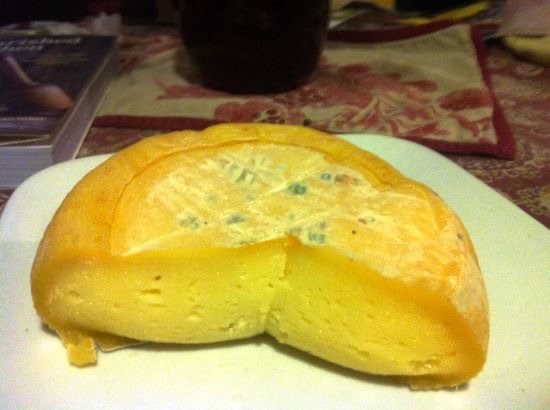
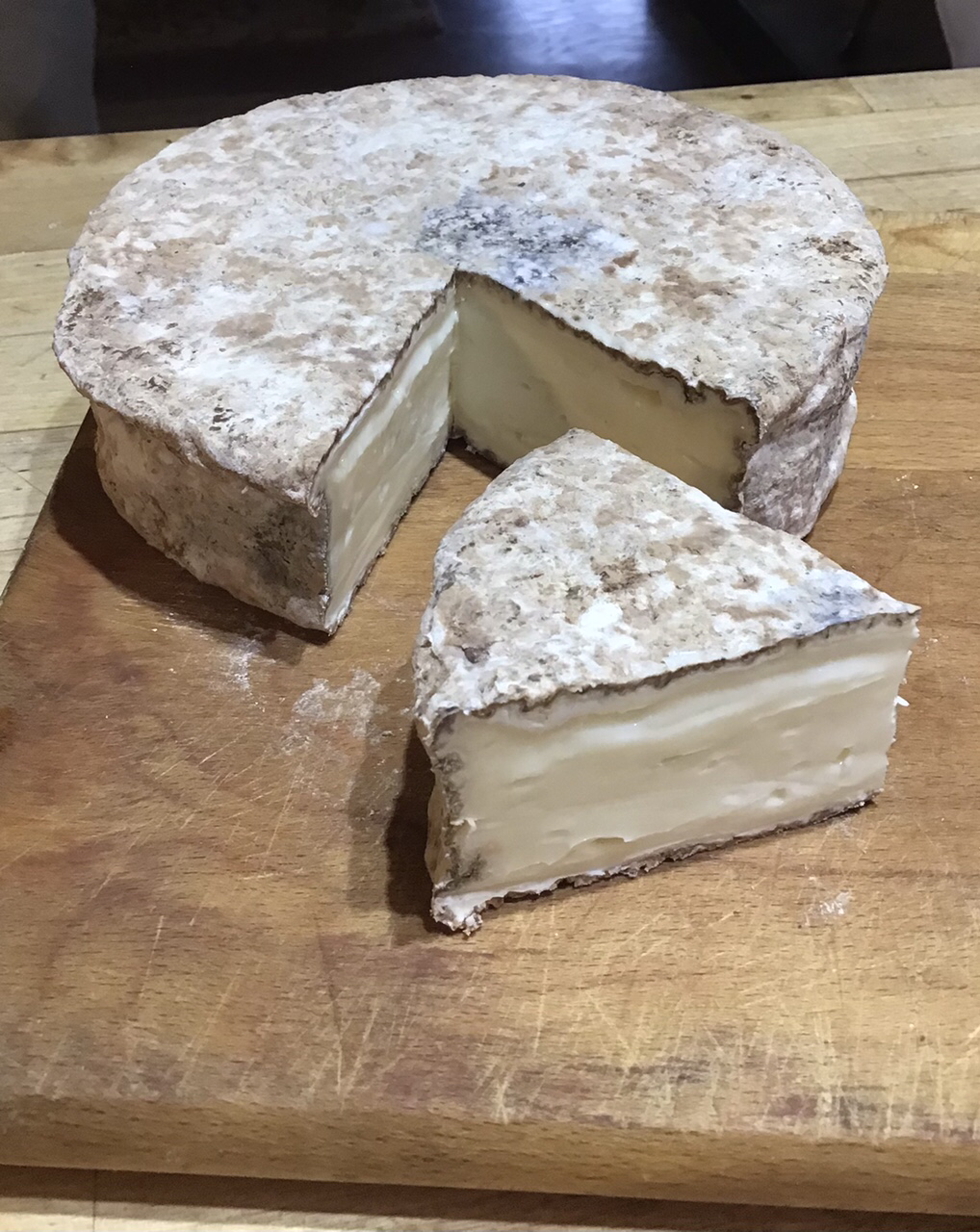
On left: Cutting into the last Kensho cheese experiment, aged two months, a washed-rind cheese similar to something between a Muenster and Gouda.
Result: Delicious Success!

A most excellent resource, and the source of the above quotes:

Goats, a belligerent species? HA!
The perfectly adorable non-conformists more like!

The latest and last addition to the herd this year (in the foreground) yet to be named, and already twice the size of our wee Athena (in the background, about 5 days old), formerly Zena, we decided we prefer the former.
Any name suggestions on our newest? We are at a loss so far with this big girl who is sure to be a lifetime keeper! She came out huge and most active and ready to suckle immediately and play within 1 day!

Kids, Kombucha, Bees & Cheese 

What better day to ponder than Mother’s Day why kids are so darn cute?!

The newest kids, born yesterday, Phoebe’s firsts—Hercules & Zena—notice he is twice the size of her!

We’ve bartered or sold most of our piglets already. We’re not on social media where such information is exchanged, but it certainly does seem the homesteading community in our area is growing rapidly. Yippie!

One family who came by insisted we were under-profiting from our piglets. Their 11-year old daughter offered her mom to pay us $50 more than we were charging, ‘for the cuteness factor’. Aren’t kids precious!

In not-so-cute news, the swelter season has started abruptly. Bye, bye beets and broccoli, before your time, because I think not even the shade cloth can save you now. The last rain that was hyped on about for days, that flooded some areas and caused tornadoes in others, yielded us a whopping 1/4 inch, not even enough to penetrate the mulch layer.

Of course I’m happy we didn’t get hit with another tornado, but I can still be miffed I have to start watering the garden. Half my roses haven’t even bloomed yet, or the zinnias. The parsley and celery have gone to seed before I got a decent harvest from them and the lettuce will soon follow, no doubt.

The bees are feeling it, too. I checked these hives last week and they were just half-full, yet the bees are bearding. Unfortunately, the swarm we got a couple of weeks ago left after only one day, unhappy with the digs I’d offered apparently. Now it’s already too hot for me to do the splits I’d planned. Better luck next spring.

I’m so pleased to be getting any strawberry harvest at all, they’ve never done well before. Then I saw this video and quickly got a reality check.

Hubby tried to make me feel better by saying those were probably grown in California and loaded with pesticides harvested by illegal aliens. He’s mentioned before something is off about this (Fabulous!) channel. It must be CGI, or heavily staged, or something. Never has a country cottage been so clean and picturesque. Where’s the chicken poop on the table and the flower pots dug up by the puppies? Good questions!

By ‘doing well’ I see I need to learn a thing or two about growing strawberries. They are too crowded and between the humidity and the wet mulch they are mostly half-rotted by the time they get ripe. I’m really loving the strawberry kombucha though! As well as the blackberry, and mulberry. I’ve started making the kombucha tea from yaupon, which grows like a weed around here. It’s delicious and sweeter than the store-bought green tea I usually use.

And speaking of mulberries, what a great surprise, Hubby found a full grown, wild mulberry tree in a spot we walk by regularly and never noticed before. What a treasure hidden in plain site!

More mulberries, please!

And this post has reached my attention span limit, so I leave the cheese to the next post. It’s gonna be a good one all on its on, really! Stay tuned!

Instead I exit abruptly, like spring has done in East Texas, with this quick lesson from Bubba in best yoga techniques.

The ’Just Chill’ technique ala Bubba