I Have a Dream!

I have a dream that when asked where I sell my delicious locally-produced raw milk cheeses my response will be one of beaming pride instead of deflated frown.

Instead of–“Sorry, I can’t sell them, it’s illegal”–in my dream I reply instead:

“I have an assitant who delivers our homemade cheeses twice a week to the community Farmstead Store in town. You probably should call her and make arrangements because she always sells out by lunch. We have Farmstead Stores in every small town in our region who send out drivers to exchange with one another. Our free-range pork and our neighbor’s beef sell out even faster than the cheeses. They’ve also got year-round fresh produce there, eggs of course, honey, wine, kombucha–all sourced and produced from within 15 miles.”
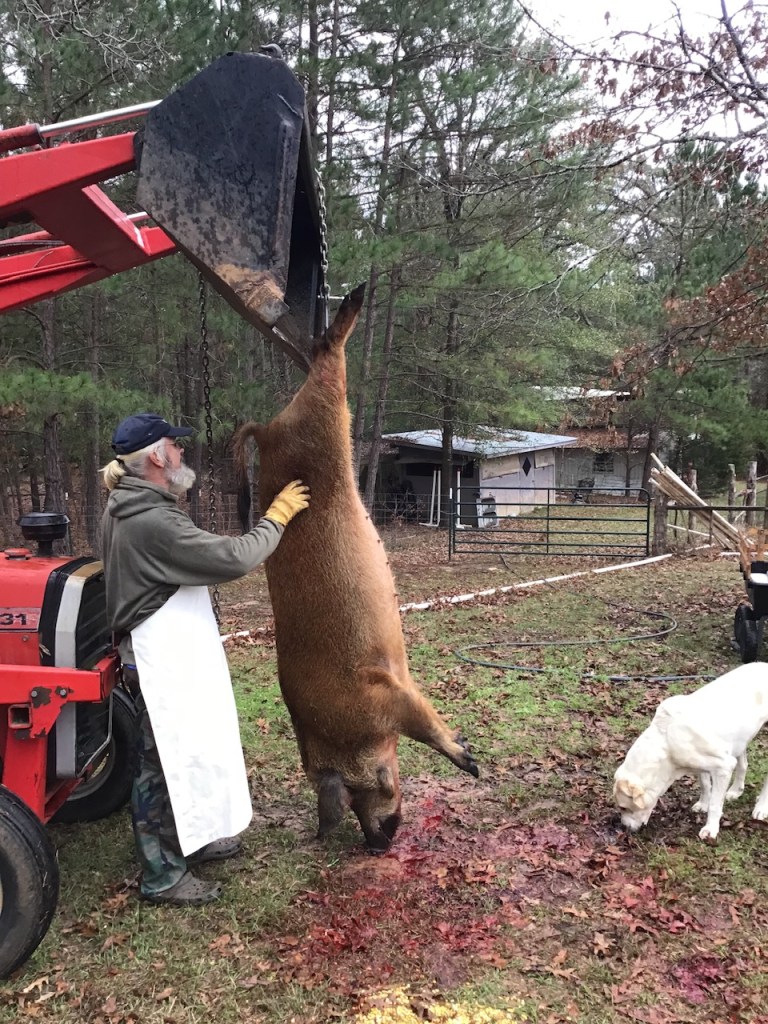
Instead of my dream, in my reality I get asked, “Can’t you get a license?”

No! No, of course I cannot get a license! Instead of dream-speak I get the nightmare reality.

It’s not only impossible to get a license for a home cheesemaking operation, it just happens to also be against my philosophy.

“An agorist is one who applies the principles of libertarianism consistently through counter-economic practice. They aim, that is, to bring about the voluntaryist society not through political (in)action but through direct counter-economic action.”

No, I cannot get a license. Since we are in the South, I wonder if another appeal might be in order?

Imagine if instead of ‘philosophy’ I said ‘religion’. So my reply becomes:

“Appealing to State and Federal officials for what I, and my neighbors, choose to purchase for consumption is against a fundamental aspect of my religion which preaches the gospel that God chooses my food through my tastebuds.”

“This is not a trivial point. A free society is not merely an ideal society to be philosophically formulated, but a process to be enacted through conscious action. Thus, the idea of separating the free society from the actions that free human beings must (or must not) engage in is self-contradictory. What else defines a free society except for those actions?” James Corbett

“Furthermore,” I continue in my dream space, “I’m allergic to paperwork and authoritarian nincompoops and I refuse to spend what little time I have left on this spinning green insane asylum kissing the arses of Velvetta-eating officials mansplaining me what I must do to make safe cheese.”

Also from Corbett
In “An Agorist Primer” Konkin explains:
“We see that nearly every action is regulated, taxed, prohibited, or subsidized. Much of this Statism — for it is only the State that wields such power — is so contradictory that little ever gets done. If you cannot obey the (State’s) laws and charge less than [because of “Fair Trade” laws], more than [because of “Anti-Trust” laws], or the same as [because of laws against cartels] your competitor, what do you do? You go out of business or you break the law. Suppose paying your taxes would drive you out of business? You go out of business — or you break the law. Government laws have no intrinsic relationship with right and wrong or good and evil. Historically, most people knew that the royal edicts were for the king’s good, not theirs. People went along with the king because the alternative looked worse. [. . .] But everyone is a resister to the extent that he survives in a society where laws control everything and give contradictory orders. All (non-coercive) human action committed in defiance of the State constitutes the Counter-Economy.”
In effect, Konkin takes the plight of the modern-day citizen, stuck in a web of ridiculous, contradictory, and impossible-to-follow laws, rules and regulations, and flips it on its head. It is not a source of shame to be acting against the arbitrary whims of the state, but a virtue. Economics is the realm of white markets: legal, licensed, sanctioned and regulated exchanges in the aboveground economy. Counter-economics is everything else: black market and gray market activity either specifically outlawed by the state or not licensed or approved by it.
People tend to get squeamish when they hear “black market,” but we’re not just talking about gunrunning, counterfeit smuggling or drug dealing here. Any (non-violent) activity that doesn’t have the blessing of the state is counter-economic.

“Of course, individually, these actions seem unimportant, even trivial. But in combination they drain significant resources away from the clutches of the state and toward the people participating in the actual productive economy. It is estimated that 20% to 30% of Americans fail to report taxable income. In some parts of Latin America it’s closer to 80%. Can you imagine if it were 100%? A few isolated counter-economists acting in a disorganized haphazard faction is a minor inconvenience to the powers-that-shouldn’t-be. Millions of people acting in concert in a deliberate undermining of state authority is a revolution. This is the promise of counter-economics.”

The quotes that are not in my dream are taken from the following 2 articles by James Corbett, well worth the read.

https://substack.com/redirect/ba0aa4ad-e65c-49d6-889b-40771af20c61?j=eyJ1IjoiYXBsankifQ.vij_GSi8NAkTixijJIkYbmIMsSylddJaDImehSkL3TQ

Do you have a dream, too? Care to share?? 😁🤗

As Stasi Smiles

It was bad enough when the Big Box stores started bragging about all their surveillance cameras. “So much shoplifting,” they claim.

That .2% of citizens shoplift is not just the store’s problem, it’s everyone’s problem. Cameras in the airports because, terrorists. Terrorists are not the government’s problem, they are everyone’s problem. Never met one myself, not even a friend of a friend of a friend has ever been arrested for terrorism in my 50+ years on this spinning insane asylum. But, safety. Must be kept safe from the .0002% of terrorists I’ve never encountered.

No evidence cameras stop terrorism, but in they go, and the travelers abide. When I stopped abiding I was told I was, “Letting them win,” in some backwards-ass attempt at logic.

Compliance will continue to be rewarded, as Stasi smiles.
Compliance will continue to come cloaked in convenience, as Stasi smiles.
Convenience will become increasingly inconvenient, as Stasi smiles.

Demanding conformity while singing diversity.

From Wiki:
“Stasi officers as “Chekists”. The KGB used ‘low-visibility harassment'[17] in order to control the population, and repress politically incorrect people and dissidents. This could involve causing unemployment, social isolation, and inducing mental and emotional health problems.”

Now we have cameras. Cameras everywhere and still not enough.

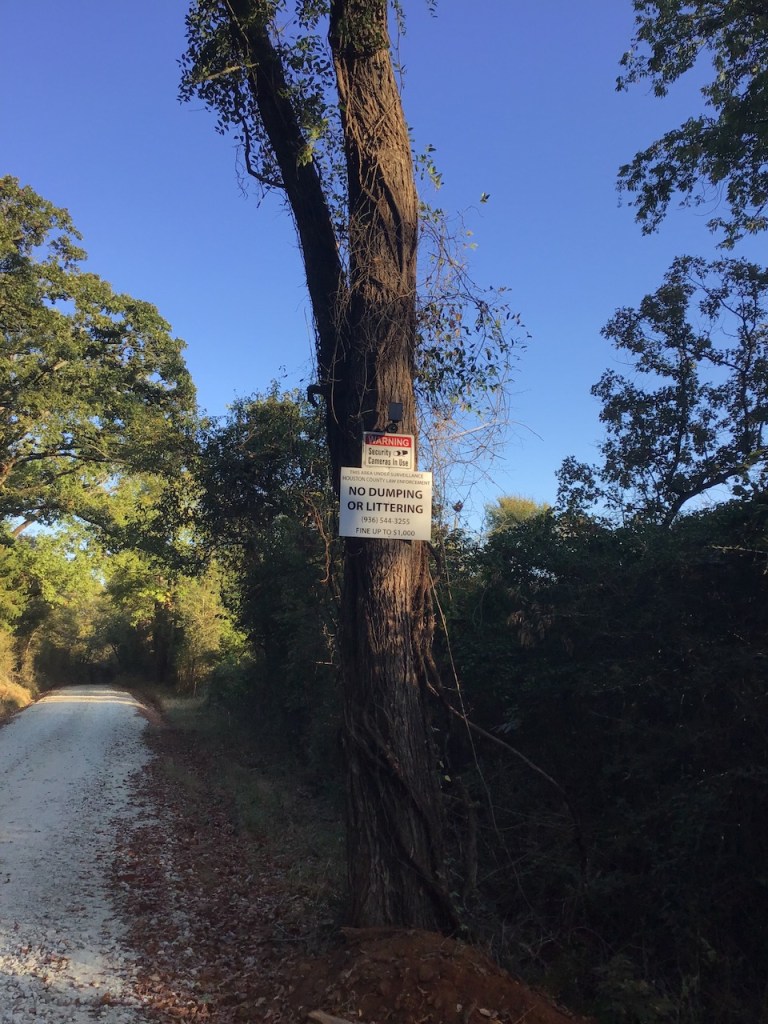
Cameras are now ubiquitous not only in airports, Big Box stores, shopping malls, grocery stores, schools, at the intersections of every city, on the gates of private homes and doorstoops–they are now attached to trees on dirt roads.

Including on our dirt road. You’ve got to be flipping kidding me!
As Stasi smiles.

This is the county’s camera. We are not in Soviet Russia, we are in rural Texas. These are our neighbors demanding conformity and compliance from other neighbors, as if it is their right to watch every car coming down a public dirt road.

We’ve been here nearly 20 years and I’ve not seen any dumping happening, or evidence of it. Even if there was a dumping free-for-all I still would not volunteer to have a surveillance camera installed on the road. This is not because I condone dumping, or long for dumping to pollute my property or the road, it’s because the dumping is not happening on private properties, or if it is, it is up to that property owner to surveille his own property. Do what property owners have been doing for generations: get dogs, get guns, fence your property, get to know your neighbors, put a camera up on your own land. Solve your own problems people!

If it’s happening in the creeks, owned by the State, the answer is not to spy on every private citizen, but to make more accesible dumping grounds for the people, and incentivize they dump there, instead of into public creeks and waterways.

County surveillance is grooming the citizenry for the state, federal, global surveillance grid. It’s working. It’s happening all over the world–The digital panopticon.

It’s tedious, demoralizing and infuriating to be talking and writing about this for decades as it only gets worse.

When the going gets tough, I know where to find some inspiration and re-stoke the righteous fires of indignation.

Here’s one, calls her Substack Mellowkat, though she’s anything but mellow . . .

“Bitchute: https://www.bitchute.com/channel/mellowkat/ Grow your own food. Invest in your home & community. Stop giving money to the corporate whores & fake philanthropists. No one is coming to save you. Get up.”

She’s so insensed with the nonsense she actually tracks people down and gives them the riot act. Now there’s some good old-fashioned modeling of righteous behavior!

She’s tracked down weather modification pilots and confronted them publicly, because she loathes the chemtrails as much as I do.

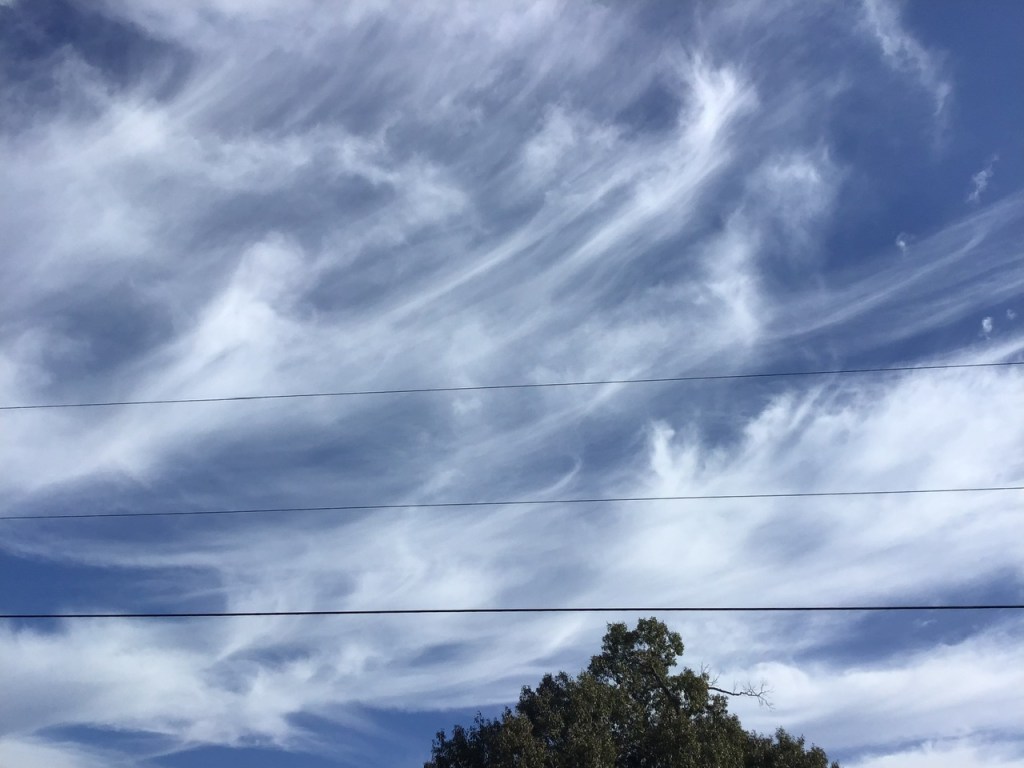
What to know what’s wrong with the weather? Look up people!

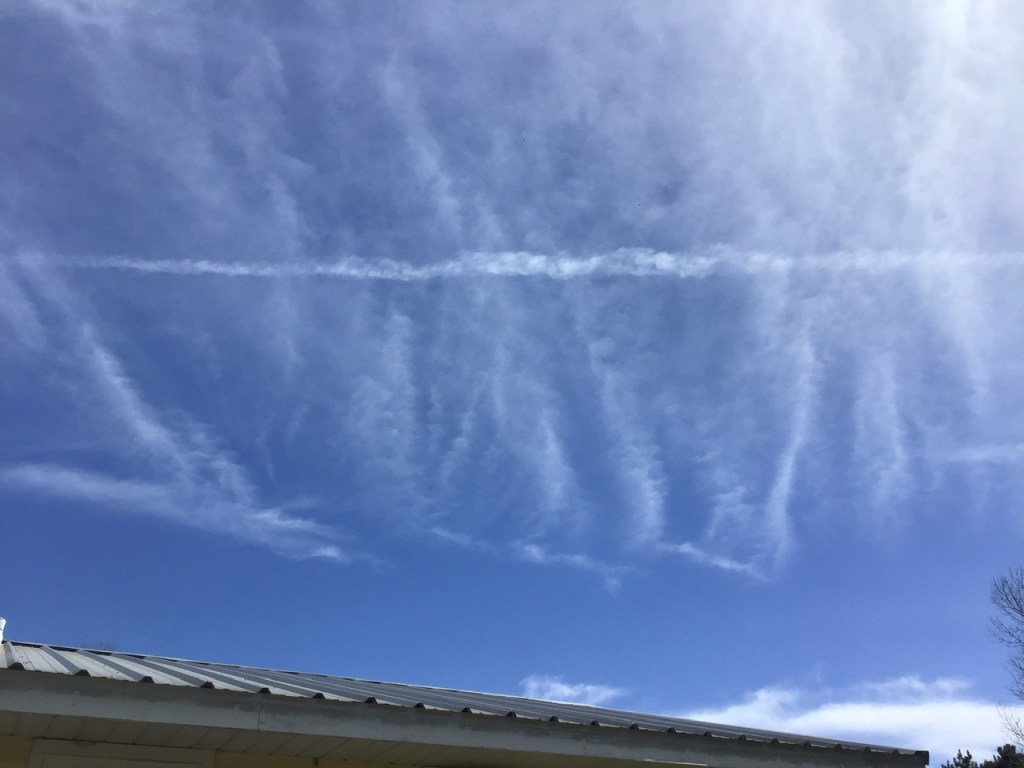
Just look at our skies yesterday, such disgusting filth, why is everyone not screaming about this?!

Well, she is screaming about it, and about the surveillance cameras everywhere.

“I spoke with our local PD about this. It turns out, it was their idea. They wanted to put some sweet grant money to use. I spoke with our local police Lt. “H.” 
She made sure to emphasize that this is for “our safety and your safety.” Hmm. Reminds me of 2020 when people chased me down with temp guns, called the police, and kicked me out of grocery stores for not wearing a mask. They had to keep me out for everyone’s “safety.” 

Folks, we’ve all come to recognize that promises like “Safe and effective,” or “it’s for your safety,” are a load of horse shit. And as you read on, I hope that if you know any naive supporters of Big Brother surveillance, you might help them finally understand how these cameras are really being used and abused around the world right now. It’s time to take a fucking stand.”

More from her latest post:
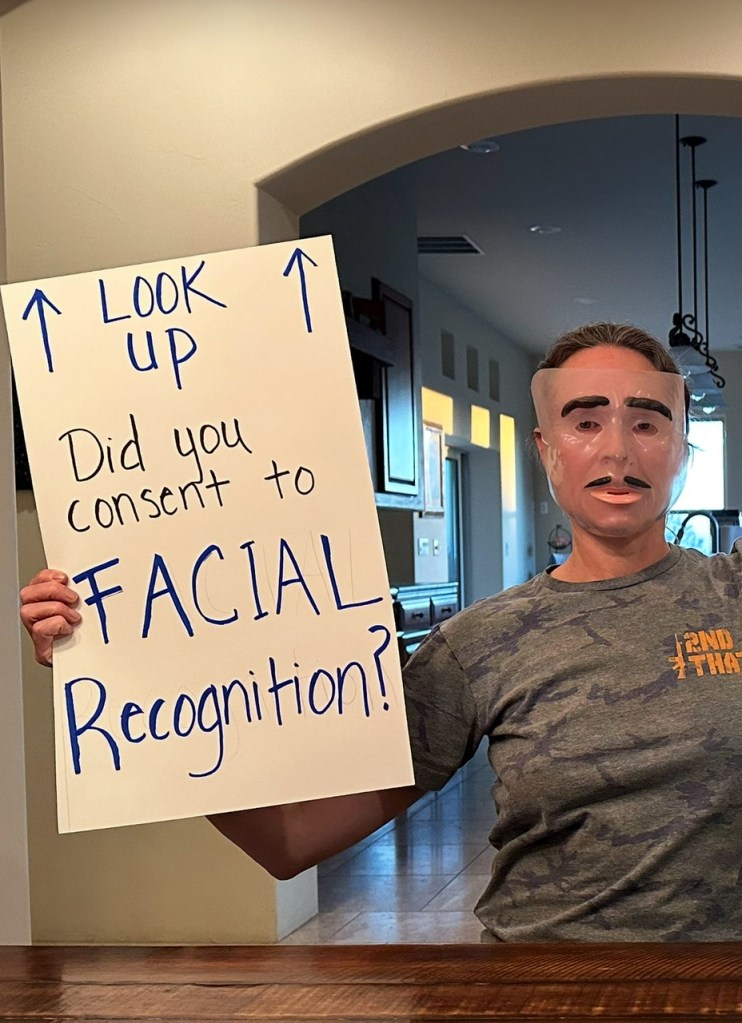
“Stingray devices, facial recognition technology, body cameras, automated license plate readers, gunshot detection, predictive policing software, AI-enhanced video analytics, real-time crime centers, fusion centers: all of these technologies and surveillance programs rely on public-private partnerships that together create a sticky spiderweb from which there is no escape.
As the cost of these technologies becomes more affordable for the average consumer, an effort underwritten by the tech industry and encouraged by law enforcement agencies and local governing boards, which in turn benefit from access to surveillance they don’t need to include in their budgets, big cities, small towns, urban, suburban and rural communities alike are adding themselves to the surveillance state’s interconnected grid.
What this adds up to for government agencies (that is, FBI, NSA, DHS agents, etc., as well as local police) is a surveillance map that allows them to track someone’s movements over time and space, hopscotching from doorbell camera feeds and business security cameras to public cameras on utility poles, license plate readers, traffic cameras, drones, etc.”


The Silence of Failure

Two parallel stories, one personal from two days ago, one political repeated through time and space.

Individual behaviors mirror political failures, or vice versa.

I went for a haircut at the only somewhat nice hotel in our closest small city. I haven’t had a professional haircut in over five years, it was my birthday treat to myself. My hair was really long and wild. I’d come to like it like that, though I knew it needed some taming. While working, Hubby and I kept professional-looking hairstyles, it was expected. Now that we don’t work for wages anymore, it’s kinda fun to let it all grow out, right before it all falls out in old age.

I told the stylist what I wanted. When I was young they called it the ‘long shag’; these days, according to my Youtube search, it’s called the ‘long wolf cut’. The stylist said she understood what I wanted–long layers. I even specified: “I want the waves and curls to be enhanced.” I was thinking–“Big 80s hair, Baby!” Why not! It’s my birthday celebration style, and that’s what I want!

The sytlist proceeded to chop over 6 inches from my hair, blow it dry to pin straight with the help of 3 stinky products, and then to top it off, tried to convince me that’s what I asked for.

Do you need a special license to notice these are not the same?

When I tried to explain to her that a “medium bob” cut is not the same thing as a “long wolf” cut, she started in on the gaslighting. She was very skilled at it.

Perception management is not the same as taking accountability.

My hair was so damaged, she had no choice. I wasn’t sitting straight and so she had to keep cutting. It was too puffy before, it was too frizzy before, it looks so much better now. “You look so pretty!” She kept repeating this, as I kept repeating, “Yes, it looks good, you are a talented stylist, but it’s not what I asked for!”

“The weakness of every utopia is the same. It demands that men believe what they can see with their own eyes to be false. The slogans change — “justice,” “progress,” “sustainability” — but the pattern does not. Sooner or later, the ration card, the empty shop, or the failed harvest breaks through the illusion. The lie may govern for a season, but reality always delivers the final verdict.”

Perhaps she only knows how to cut one style? Perhaps, and this is probably true, the short bob looks much better on me, objectively speaking, from a professional standard. Perhaps it is healthier looking and shinier and smoother now, all true.

“But you are still missing the point: It’s not what I asked for, and it’s not what I paid you to do!”

She refused to get my point. Flat out refused. I was not trying to get a refund or even a discount. I’d already tipped her, the transaction was complete. I just wanted her to recognize what she’d done.

We circled around her excuses, and I left, saying I’d return in 6 weeks, which obviously I never will.

“But populations are not passive. They respond not with submission, but with defense — of security, autonomy, and cultural identity. Citizens resist when they sense erosion of their freedoms, dilution of their traditions, or manipulation of their choices. The result is a Nash equilibrium: a tense standoff where each actor maximizes its own interest, constrained by the anticipated reaction of the other.”

Such is modern political life as well. Was she modeling the behavior of the politicians she sees on TV? Does she think, because she’s the professional, her opinion on what my hair should look like trumps my own, even though I’m not a child, but am in fact a middle aged woman who knows what she wants, has requested it clearly, and is paying her quite handsomely?

“Each generation births new architects of destiny — technocrats, visionaries, committees — convinced that this time, the blueprint will hold. That this time, the people will follow. That this time, the outcome will be different.

But history is not kind to central planners. Grand designs imposed from above, no matter how noble their language, inevitably collide with the stubborn complexity of human life. People are not data points. Cultures are not spreadsheets. Societies do not bend neatly to metrics and milestones.

Agenda 2030–2050, like earlier initiatives, assumes global consensus is possible, centralized governance will surpass local challenges, and large-scale ecological and social changes can occur without resistance. These are not lessons learned — they are lessons ignored.”

Lessons ignored, like my stylist. Her job is to do what I pay her to do, not to re-interpret my desires. Even when I expressed clearly, in a non-threatening manner, after paying her, that she did not give me the haircut I paid for, she refused to see her culpability. She blamed my hair and my poor posture.

Her insistance that I recognize and declare how pretty it looks is akin to the Soviet withdrawal from Eastern Europe as they were insisting how they deserve to be compensated for all the expertise they brought with their occupying forces and for the infrastructure they built. But of course, not to be held liable for all that they destroyed, lives nor infrastructure.

“Historical Lessons
Attempts to impose totalizing visions from above have repeatedly failed. Examples include:
• The fall of Robespierre (Boudoiseau, 2003) during the French Revolution (Britannica, 2003c).
• The collapse of Ceaușescu’s regime in Romania (Britannica, 2003b).
• The Nazi pursuit of Lebensraum (Britannica, 2003l), which ended in destruction.
• Mao’s Great Leap Forward (Britannica, 2003e) and the Cultural Revolution (Lieberthal, 2003), which caused massive human suffering. Each case shows that utopias enforced by elites end in failure, often violently.”

“Socially, the plan underestimates resistance. People do not change because a summit declares it. Habits are resilient. Traditions run deep. When transformation is mandated rather than chosen, it breeds resentment, not renewal.”

The choices and desires of those paying for services must necessarily be a higher priority than that of those performing the services. That includes politicians, and hairstylists.

“4. Restructuring of Daily Life
From how we travel to what we eat, the Agenda seeks to reshape daily habits in the name of sustainability. But these are not abstract metrics — they are intimate choices. Mobility restrictions, dietary mandates, and housing redesigns touch the core of personal freedom. The assumption that populations will comply quietly with lifestyle engineering is not just naive — it is politically combustible.”

“State incentives — subsidies, surveillance, social scoring — aim to steer behavior. But when these incentives clash with core values like freedom, identity, and sovereignty, they lose traction. Compliance becomes brittle. Trust erodes.”

I can’t help but wonder if her other clients have always bowed to her bullying style of perception management? Does she insist all her clients praise her work, whether or not they really liked the results?

Just grin and bear it, everyone?

“The Nash equilibrium here is not stable. It is volatile, held together by mutual constraint rather than mutual agreement. Elites cannot push too far without triggering rebellion. Populations cannot fully disengage without risking exclusion or punishment.
Populations remain bound to the system because withdrawal carries a price — exclusion, punishment, loss of rights. The equilibrium holds only so long as resistance is isolated. But once enough people disengage together, the balance shifts: punishment loses its sting, and the system itself begins to collapse.”

I suppose only time will tell the truth. Eventually.
If I ever run into that hairstylist next time I’m at the hotel I’m inclined to say: “I’m fine with it, it might even grow back before it all falls out. But just for the record, not everyone wants to look like your vision of the sleek middle-aged professional. Some of us have outgrown that look.”

“Agenda 2030–2050 treats the human species as a single actor, capable of coordinated transformation. But humanity is not a monolith. It is a constellation of cultures, histories, and identities. The anthropogenic hypothesis, when stripped of nuance, becomes a justification for centralized control — see here — a mandate for elites to redesign society in the name of planetary health — see here.
This is where the danger lies. When ecological urgency overrides democratic process, when sustainability becomes a pretext for surveillance, when global goals erase local voices — the result is not cooperation, but coercion.”

Landowners Everywhere Beware!

About 5 or so years ago an old timer whose land borders our own gave me a brochure with an enthusiastic smile and said–“Y’all should do this, too!”

I grimaced as I took the materials he offered. As much as I respected this neighbor, bless his heart and rest his soul, as he has since passed, I just knew there had to be a con behind these legal conservation agreements property owners are signing in an effort at protecting their land for future generations.

He thought he’d done good, of course. While his property was entirely recreational, and his full-time home in Houston, he worked very hard on it for many decades. He has a beautiful 2-story cabin there he built himself, as well as fruit trees and grapes, and his children and many grandchildren filled the home on weekends and holidays, often practicing his favorite sport–shooting. He was a good man and he meant well.

No one in the family has been back to enjoy the cabin since his death, about 3 years ago. This is not unsual with inherited property, and our own property was another case in point. Siblings disagree, feelings get hurt, attorneys get hired, acreage gets split and the decades of hard work slowly go back to nature, if the internal conflict continues long enough.

This is a common enough scenario that it makes perfect sense an old patriarch would do all he can to avoid such mess. Now I can’t say if his family inheritors are aware of any potential issue with his decision to legally protect some of his land ‘forever’ or if that’s the reason they have not returned. Maybe a family feud alone is the issue there and the government hasn’t yet involved themselves.

Nature Preserves or Confiscation Scheme?

But that’s exactly the point I’m getting at. These ‘permanent conservation easements’ that are being created by well-meaning landowners are not without risk. And absentee landowners, or those embroiled in inheritance issues, are especially vulnerable.

Because the Globalists want the land, and if they can find a proverbial broken link in your private property chain, they will worm their way in, legally, through the fine print.

https://substack.com/redirect/f2975f0d-0481-47d8-8adf-9fb2b939aa8b?j=eyJ1IjoiYXBsankifQ.vij_GSi8NAkTixijJIkYbmIMsSylddJaDImehSkL3TQ

It’s all part of the Total Human Ecosystem (THE) scheme. From escapekey’s Substack:

Conservation Easements as Confiscation: Across rural America, landowners are being offered attractive deals for ‘conservation easements‘ that sound like simple land protection agreements. But buried in the contracts are ecosystem performance requirements tied to financing. Miss the biodiversity targets and operational control transfers to environmental organisations. The land becomes theirs while you keep the tax liability.”

Long gone are the days when Americans could glibly repeat, “But that would never happen here. We have laws.”

The ‘laws’ for every ‘country’ on Earth will be Uniform. This is the Agenda, and all private property is threatened. The very concept of private property will be demonized through the Government schools so thoroughly that children will be indoctrinated to be afraid of it.

“The Total Human Ecosystem framework treats private property as an outdated concept that threatens ecosystem integrity. Increasingly, local zoning laws incorporate ‘ecosystem service’ requirements that can trigger automatic seizure clauses. When satellite data shows your land use conflicts with ecosystem targets, your property can be transferred to ‘ecosystem management’ organisations. You might own the deed, but the ecosystem owns the seizure authority.”

Agricultural Land Seizure: Farmers are being offered attractive financing tied to ‘regenerative agriculture‘ and ‘carbon sequestration‘ targets. But when weather, pests, or market conditions make those targets impossible to hit, the financing agreements trigger land transfer clauses. Family farms that have operated for generations are being seized by international organisations through algorithmic enforcement of impossible environmental standards.

 The Domestic Blueprint: What’s happening in Belize and Ecuador is the beta test for comprehensive land confiscation in developed countries. THE provides the philosophical justification (individual property rights threaten ecosystem health), the ecosystem approach provides the governance framework (decisions must be made at ‘appropriate’ ecosystem scales), and the financial instruments provide the seizure mechanism (miss your targets, lose your land).”

https://substack.com/redirect/f2975f0d-0481-47d8-8adf-9fb2b939aa8b?j=eyJ1IjoiYXBsankifQ.vij_GSi8NAkTixijJIkYbmIMsSylddJaDImehSkL3TQ

A few more choice quotes from esc:

“Once you see this pattern, you cannot unsee it: every expansion of control comes wrapped in moral imperatives, every loss of freedom is packaged as virtuous necessity, every dissent is reframed as a moral failing. Healthcare workers fired for “ethics violations,” companies forced into ESG compliance, scientists silenced for challenging consensus—all manifestations of the same ethical control architecture that esc has systematically documented.”

https://substack.com/redirect/6953039b-71f0-4d19-a87a-f42fb1fe1f94?j=eyJ1IjoiYXBsankifQ.vij_GSi8NAkTixijJIkYbmIMsSylddJaDImehSkL3TQ

“Yet appearances deceive. The result is a global Soviet: the Party is gone, but the apparatus remains — cloaked in sustainability, cooperation, and humanitarianism, with a web of NGOs functioning as the modern fronts for its operational machinery.

The ideologies of peace, sustainability, and rights have been merged with the infrastructure of surveillance, algorithmic governance, and moral programming. The old flags have been lowered — but the new system flies under a different banner: expertise, ethics, and emergency.”

Agri-Capture, Psy-Style

“Agriculture is a major contributor to climate change and the devastation of the planet… The only way to fix this, the necessary step, is knowing what food is.”

Converting Food Tradition Into Science With The Periodic Table Of Food

https://www.forbes.com/sites/daphneewingchow/2024/05/21/converting-food-tradition-into-science-with-the-periodic-table-of-food/

This was an infuriating propaganda piece on behalf of the Rockefeller Cartel by Forbes magazine, sent by a friend who likes it when I’m infuriated. Bless her heart!

The article is the perfect example of the methods of ideological subversion being used on the public by the corporatocracy through the institutions.

The single quote above I take from the article, rather than quoting it further, is in order to not subject the reader to further mind poison. But rather instead, to offer an antedote.

How does it work? Why are they doing this?

While the excellent article below is a good means of demonstration, it’s first important to notice the labels themselves are meant to be flexible while still garnering a knee-jerk reaction: Communism, Capitalism, two opposing worldviews, that’s the framing.

Except it’s fake, a false dichotomy. These are economic views posing as worldviews for political purposes.

Often political purposes and religious ones overlap, which is why I avoid religion as well as politics when I’m trying to think logically!

The above quote works a similar frame: Science must know what food IS so that agriculture will no longer destroy the planet.

Except the only reason argriculture is destroying the planet is because it was taken over by BigAg MANY decades ago. Before I was born, actually, and I’m getting up there.

They fail to mention this piece of the puzzle, no surprise there. Many societies have thrived and still thrive on non-industrial agriculture to survive. Industry has ruined agriculture in this country, and many others.

Our brainwashing that it is our job to feed and police the world is the actual problem causing the devastion. The industrial-military global order is the problem causing the devastion.

95% of average folks are just pawns in this game.

Leave the terms ‘communism’ and ‘capitalism’ to the side for a moment and consider this:

“What Marx and Engels pioneered wasn’t specifically a political revolution — it was the rewriting of the moral code itself. The Manifesto operates as a systematic inversion of the fundamental value and structures that underpin social organisation. Every principle that helped stabilise bourgeois society — property rights, family inheritance, religious authority, national sovereignty — was methodically reframed through inversion; consciousness programming designed to make the existing moral operating system feel not just wrong, but obsolete.

Programming Permissible Thought
Control the language and you control the range of permissible thought. The Communist Manifesto introduced this tactic with rhetorical inversions; ESG and global ethics continue it by redefining terms like ‘freedom’, ‘equity’, and ‘justice’ so that dissent itself becomes linguistically unspeakable. When ‘inclusive’ becomes the only acceptable alternative to ‘extractive’, when ‘sustainable’ becomes synonymous with ‘moral’, and when ‘science-based’ becomes code for ‘unchallengeable’, we’re witnessing linguistic capture similar to that Marx pioneered.

The genius lies not just in changing what words mean, but in making certain combinations of words feel impossible. Try arguing against ‘inclusive prosperity’, ‘women’s rights’, or ‘science-based sustainability targets’ without sounding backwards. The linguistic terrain has been so thoroughly mapped that opposition requires either accepting the loaded framework — or appearing to reject progress itself. It’s a steep uphill struggle, almost guaranteed to waste enormous amounts of time — even though these terms typically function to insert ideological blind spots ripe for later exploitation by full intent.”

Like the quote says–to solve the problem, we must know what food is. Imagine, we don’t even know what food is! We must have science explain food to us in order to not destroy the planet by eating.

esc continues . . .

“Inclusive Capitalism as Semantic Cover for Stakeholder Feudalism
‘Inclusive capitalism’ — promoted by coalitions involving the Vatican, the World Economic Forum, and major central banks — promises to ‘make capitalism work for everyone’. The manipulative techniques are identical to the Manifesto: binary framing where ‘inclusive capitalism’ opposes ‘neoliberal greed’ with no middle ground allowed; euphemistic coercion where investors are ‘guided’ to ESG portfolios and non-compliance means exclusion from financial markets; sacred authority through alignment with religious institutions that sanctifies technocratic control; and guilt transfer where individual consumers — not megacorporations, nor central banks — bear responsibility for systemic problems.
You get to keep the word ‘capitalism’… while losing actual market freedom. It’s semantic cover for stakeholder feudalism — the Financial Stability Board and the BIS become moral arbiters of capital allocation, yet you never voted for them.”

This ‘guy’ knows what he’s talking about, read him, not Forbes!

“Recognition and Resistance
What we witness is the emergence of something historically unprecedented: soft totalitarianism with global reach, implemented not through revolutionary violence but through institutional coordination and moral manipulation. The most disturbing aspect is how voluntary compliance is manufactured through psychological techniques that make resistance feel not just futile but morally reprehensible.
Unlike crude twentieth-century totalitarianism, this system preserves the language of freedom while altering its substance, claims scientific and moral authority rather than raw power, operates through persuasion and micro-incentives rather than force, and presents itself as evolution rather than revolution. Koestler⁶² warned that disembodied rational systems could turn pathological when disconnected from human meaning — today’s ESG frameworks automate that disconnection at global scale.”

Between Intrepid and Genteel

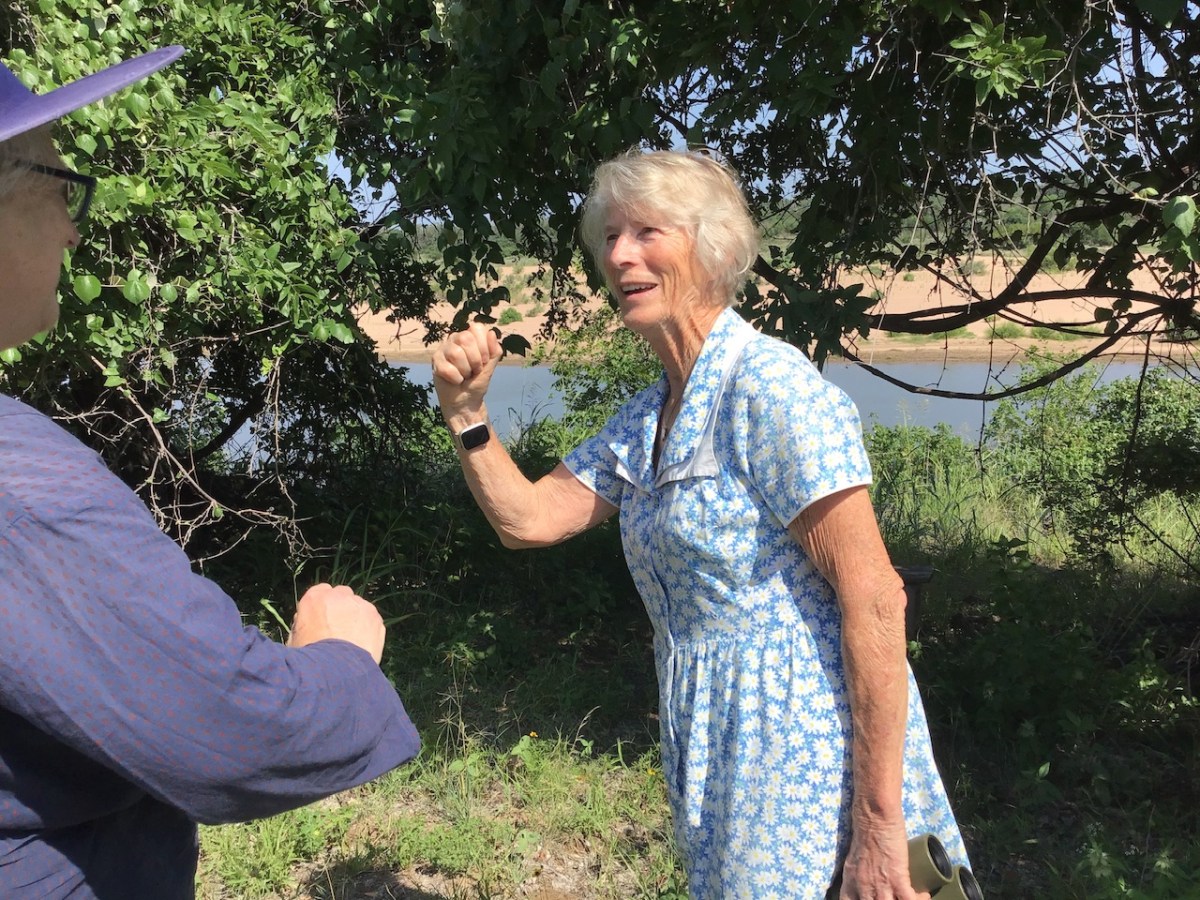
From Kenya to Llano, Berit pictured with Kath, visiting from the UK

Hunters often get a bad rap and it’s not always for good reason. I had a chance to learn something about this on a recent trip to the Texas Hill Country where I was led to question the difference between a hunter and a poacher.

Before assuming this is a niche topic and of little interest to the vast majority of folks whom are neither hunters nor poachers, consider it’s a matter of philosophy as well, along with colonialism, globalism, human nature and modern life.

A wall of hunting ‘trophies’ not uncommon in Texas homes.

Mostly they have much in common, the hunter and the poacher. There is a similar skillset, clearly, but one I know nothing about, so I’ll leave that to the hobbyists and professionals. As strictly an occassional observer I imagine it to require more patience than I’ve ever mustered, more tenacity than most and more courage than the vast majority.

We might say the poacher is lawless and greedy and violent, and in some cases that may well be true. It may also be true that some hunters share such qualities as well.

But again, I’m coming to this as a complete outsider to their world, strictly an observer, and occasionally a beneficiary.

The differences between the hunter and the poacher must lie somewhere between intrepid and genteel, I figure. And so it is most apropos that I should think of it with a hunter who fits the bill for both adjectives.

Our hunter in question, Berit, at her home in Llano, Texas

I’d never have taken this fair, mild-mannered, small and slender woman as a big game hunter, that’s for sure, and I suspect that made her something of an attraction at her home in Kenya, kind of like a pretty little sparrow among bulls. Though looking at the full and adventurous life she’s led, we mustn’t think a sparrow at anyone’s mercy.

A beautiful display of African artefacts collected during their time there.

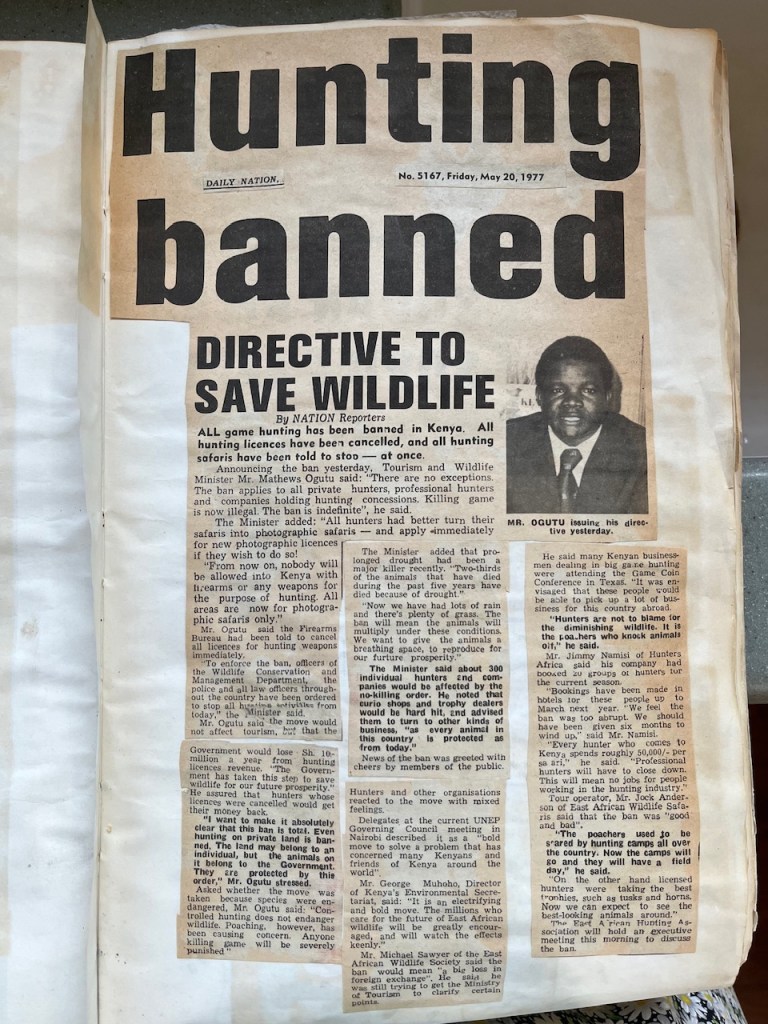
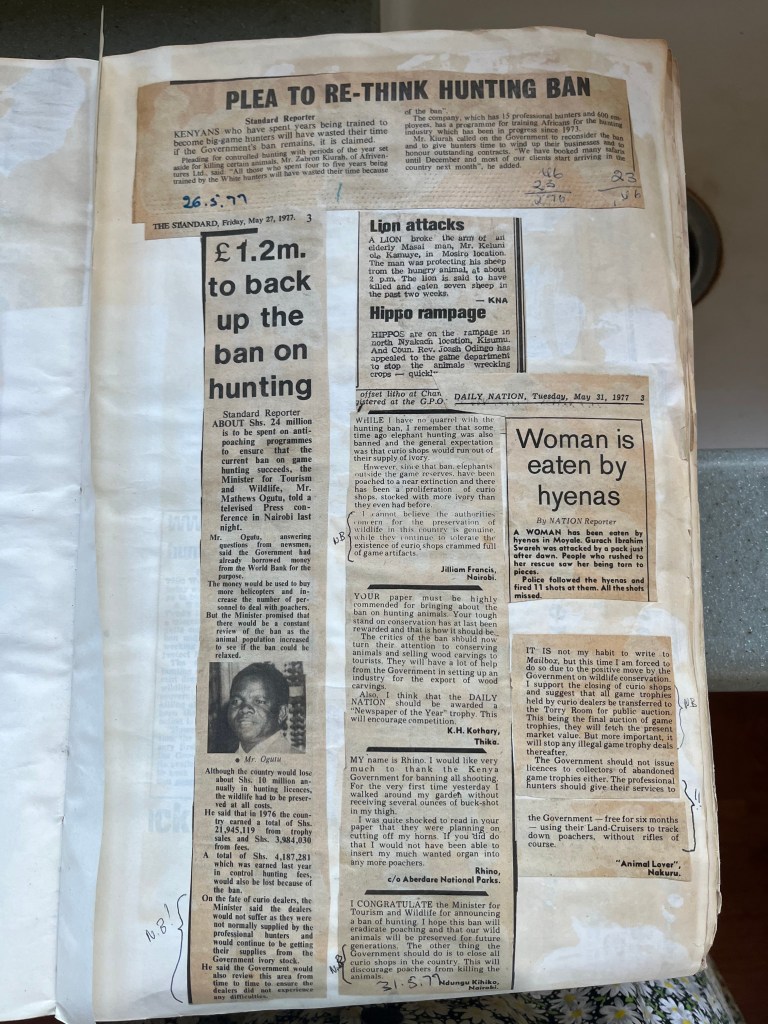
I met her with her second husband, an avid big game hunter, but her first husband was a professional one.  They had a business together leading safaris until the laws were changed in an instant, hunting banned by the government, their livelihood lost.

Neither were Americans, but he had a prospect in Texas. So, with young children in tow, they moved to the Hill Country, to Llano, and started anew.

That was in 1977. It is still illegal to hunt in Kenya.

What’s more interesting, Kenya has remained on the fast track ever since, to full-tilt modernization. They have been an international fore-runner for all the Global Village United Nations WEF grand schemes for their ideal Future: ESG scores, vaccines, digital IDs, carbon credits.

That’s the great gift of compliance. Or, as the old adage goes, “Give the devil a finger . . .”

“Esc’s analysis, backed by meticulous documentation, sets the stage for understanding a system already operational, where resistance is economically suicidal and socially ostracized. Esc details how development programs in nations like Kenya test governance technologies—digital IDs, carbon credits—later exported to the West, ensuring global compliance under the guise of progress. The Earth Charter, as esc notes, serves as a global constitution, subordinating individual rights to expert-defined collective responsibilities, a theme echoed in The Invisible Empire’s critique of sustainability metrics overriding democratic will. We need to recognize this system before the window for democratic resistance closes, as each institutional capture—from ESG compliance to AI-driven surveillance—tightens the web.”
The Complete Architecture – by esc

“For 130 years, a coordinated network of institutions has been systematically replicating the same control structure across every domain of human life – from healthcare to education, from banking to environmental policy. This structure, originally perfected in British banking, creates the appearance of local autonomy while concentrating ultimate decision-making power at higher levels run by credentialed experts.
The breakthrough came when science claimed moral authority over all aspects of human experience through the 1986 Venice Declaration, positioning scientific expertise not just as informing ethical decisions, but as the source of ethics itself. This created the intellectual foundation for what we now see operational: a system where questioning expert consensus isn’t just wrong – it’s scientifically illiterate, ethically irresponsible, and potentially pathological.”

How close is your country’s hunting policy to Kenya’s?
Is hunting policy about creating the lines between hunter and poacher, or obscuring them? Because, if everything is forbidden except to a tiny few, aren’t we pretty much all destined to become poachers?

“And the pity is that it will do nothing for the wildlife, controlled licensed hunting has never been a threat to wildlife. When elephant hunting was closed a few years ago, I wrote to the East African Standard and pointed out that poaching was the problem, not licensed hunting, and that if poaching were not stopped, the elephants would disappear anyway, whether licensed hunting were allowed or not. Unfortunately I have been proved right, and since that time the elephants have been exterminated all over large areas of Kenya. For this licensed hunting can in no way be blames, as legal hunting of elephants was closed.” Finn, Berit’s husband

Should hunting be allowed in Kenya? | davidlansing.com

“When I was in Kenya a few years ago I stayed on the edge of the plateau overlooking the Mara. About a mile away one night, a leopard broke into a Maasai boma and killed a cow. The game officials came by two days later, photographed the pug marks on the ground and the carcasses, payed the elder a pittance for his loss, reminded them that they were forbidden to kill the leopard, and disappeared. A couple of nights later, it happened again. So they staked out a goat and speared the leopard to death and buried him. That same leopard could have brought in tens of thousands of dollars in fees to Kenya and the local economy – now it’s a skeleton. When the wild game is seen only as a nuisance and is not allowed to pay its own way in a crowded land, it will always end like that.”

To be continued . . .

Feel free to chime in below!

Llano, Texas May 2025

Shitty of San Antonio

Now in my top 3 Shittiest of Shitties Official List, the once unique and charming San Antonio is now the official Theme Park capital of the U.S. I didn’t just make that up either, and apparently, they consider this a good thing.

My top-listed shitty is Bangkok followed by Warsaw, for orientation sake.

San Antonio, like the other two, had such potential at one time. Historically fascinating with magnificent old world architecture buried in a tragic mess of the modern world.

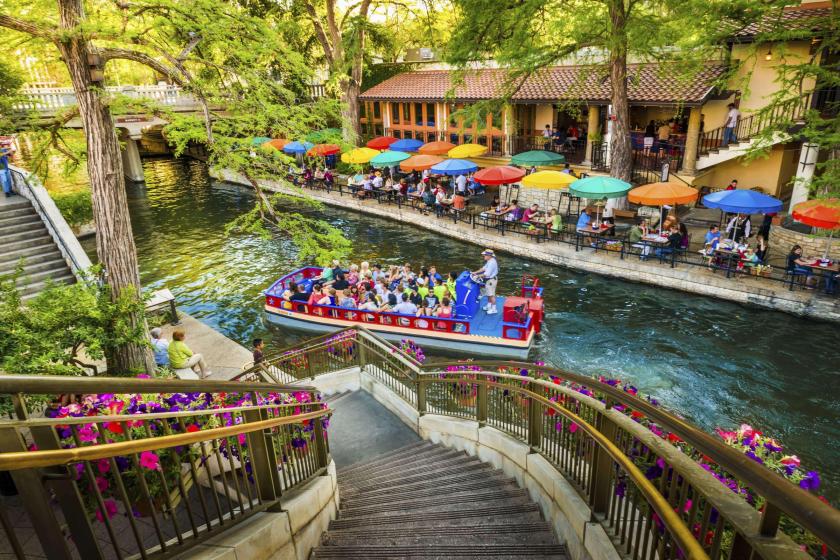
The Riverwalk was desert hot in May and nearly impassable through the crowds. Just five years before, when Hubby and I visited for Christmas holiday lights, it still had some appeal.

Now the city boasts 17 theme parks, one per 27 square miles. This does not include the many other paid attractions, like State Parks, caves and caverns in the surrounding area.

San Antonio‘s theme parks invest in new attractions for 2025

“San Antonio is known as the “Theme Park Capital of Texas” for good reason, with its 663 combined acres of attractions and entertainment parks. And nearly every park is undergoing multimillion-dollar expansions for 2025.”

Surprise, surprise, the shitty is constantly flooding now.

It begs the question: Is a shitty still a shitty without a shitty theme park?

Disneyland, Disney World, Six Flags, Dollywood, Wisconsin Dells, Schlitterbahn, Universal Studios, Sea World, Busch Gardens, Cedar Point, HersheyPark, and on and on it goes.

In the decade since Hillary Clinton made this declaration, already hilariously ironic when she said it, the theme park industry in America has grown 43%.
A Look at a Thrilling Industry: Amusement and Theme Parks : Spotlight on Statistics : U.S. Bureau of Labor Statistics
The average annual pay is $36,000
Prices for food and beverages up 62%

Yet again and again I hear from the ‘pro-development’ right and left alike that in the U.S. we’ve only had development of 5% of our land and resources. I don’t know where this statistic comes from, because those who quote it never provide their source material. I can say I think it’s more shitty nonsense.

But, if it is true, I’ll yell an enthusiastic ‘Thank the heavens!’ Because what we do in the name of development in this country is a travesty to reason and a tragedy to nature.

At least 8 dead in San Antonio after months of rain fell in hours
Months worth of rain on Wednesday night led to multiple water rescues in San Antonio, where at least eight people were killed by floodwaters.
By Jesse Ferrell, AccuWeather meteorologist and senior weather editor
Published Jun 12, 2025 9:09 AM PDT | Updated Jun 13, 2025 12:39 PM PDT
https://www.accuweather.com/en/weather-news/at-least-8-dead-in-san-antonio-after-months-of-rain-fell-in-hours/1783936

Between Shitty & Country

Having become far more accustomed to the surreal ‘nature’ of ‘reality’ in the last decade or so, I was less baffled by the still ever-increasing Suburban Sprawl on my recent roadtrip through the Hill Country of Texas.

Because of course, by now we are all hearing constantly the war drums of the Globalists and their plan to put all ShittyZens into Smart 15-minute Cities™ under Palantir Surveillance Systems™ paid for with our tax dollars and paving the way for digital money cheered on by ‘Freedom Fighters’ where everyone will be eating food manufactured by Pig Pharma, who begrudgingly keeps the ShittyZenry alive through forced drugging deemed voluntary.

Homesteading gets sold as a solution, which it is not, and never was, and even I knew that as a novice 15 years ago, before it was cool. Homesteaders rarely last 5 years, I’m told, like most small businesses. Makes perfect sense to me, because it’s the only work I’ve ever done that gets harder with time instead of easier.

It’s a lot like all the lies being sold to us about everything, everywhere, all the time.

Perhaps the 15-minute city agenda works in some places, but I see nothing of the sort here. The Shitty Sprawl continues, unabated and unabashed, developing the vast parcels of land without the people, in an unstoppable concrete jungle that clearly doesn’t listen to the same news as we are subjected to from the 24-hour Cybernews Today Club.

Residential and commercial alike, vast development continues, and sits empty for tens of miles outside every major city in Texas: Dallas, Austin, San Antonio, Houston. The foreign populations increase, but not nearly at the rate the buildings to house and employ them get constructed.

And out, and out, and out they go, encroaching far worse than infesting cockroaches. Blocking the views, crushing the landscape, sculpting and paving and polluting any and every open space where someone can maybe hope to make another dollar.

11 new Commercial Mega-projects for the Austin market!https://aquilacommercial.com/learning-center/megaprojects-planned-for-austin/

“The project is set to deliver 1,200,000 square feet of office space, 140,000 square feet of retail space, 1,700 multifamily units, and 200 hotel rooms. The development will also create 14 acres of green space. ”

Mind you, there are already huge empty building ALL over the shitty.

Plus,

(A whopping 14 acres of green space! 😂)

I like when I hear rural (and other wise) folks refer to the cities as ‘shitties’ because I think it fits. Let’s call a spade a spade. What I saw on my roadtrip was horrendous and makes me thankful for the wee refuge we have created here, for now. But the Shitties aren’t the real problem here, in fact. We are being swallowed up, everywhere, by the relentless Shitty Sprawl.

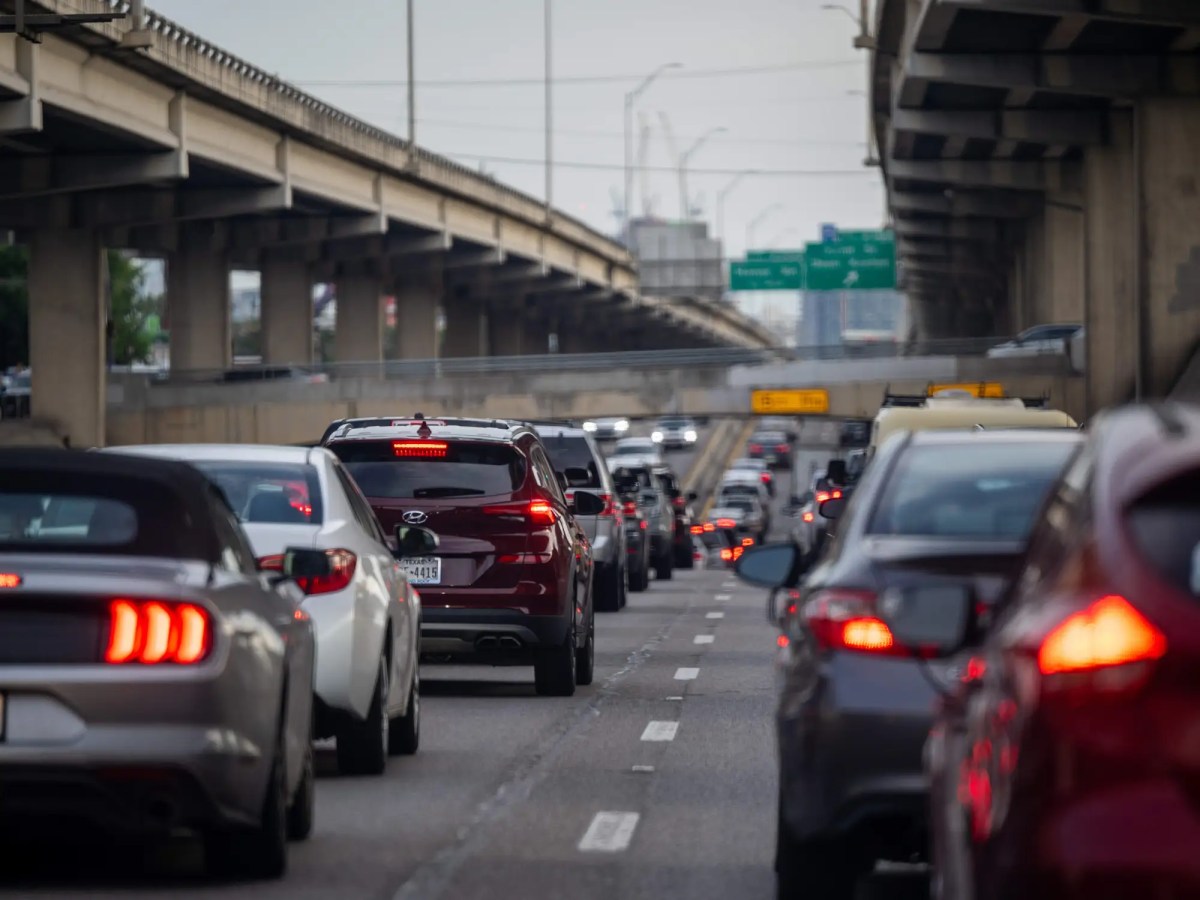
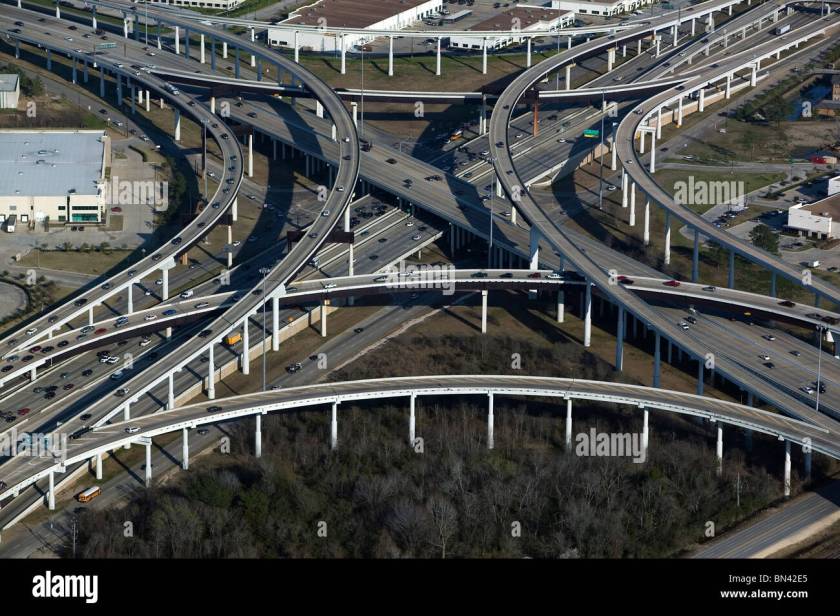
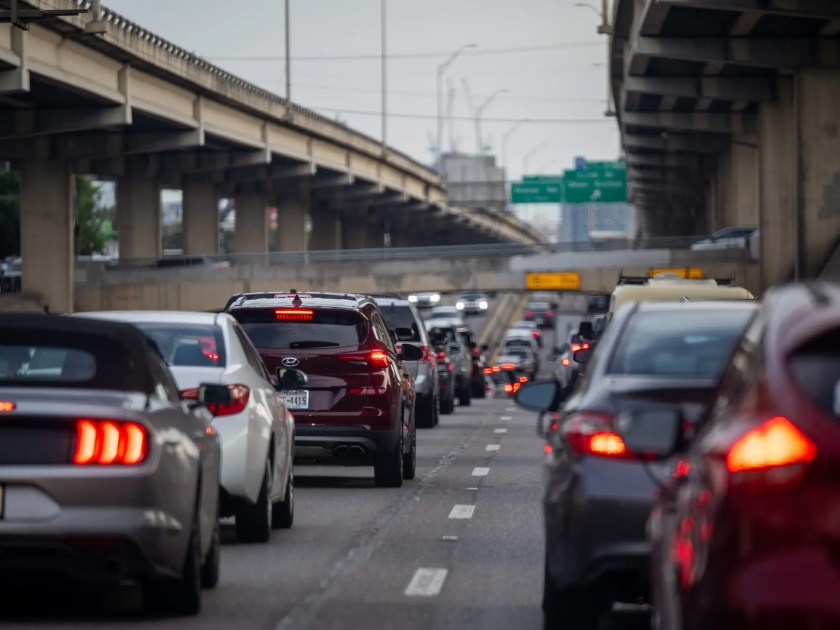
Amazon and Walmart will be offering drone delivery service, so perhaps that will alleviate some of the choking traffic that stagnates around every Shitty, all day long. Those drones must be very adept at navigating through the expanse of electrical towers and fat mess of wires that crisscross every skyline and create a hideous hellscape of prison-like bars. So much for the vast open horizons of our fabled cowboy days.

In Houston, veterans and cripples beg at every underpass and intersection, weaving themselves like Frogger players through 5-lanes of traffic. San Antonio has been ruined by tourism and is now, in just the last 5 years since I was last there, a crowded, filthy slum pretending to be full of family fun. Austin is just more of the same which started well over a decade ago, and continues its relentless expansive march into the drought-stricken Hill Country, paying no heed whatsoever to the limits of water or other pesky human needs. Technology!

Yes, technology is both the Great Driver and the Great Savior. As well as the Great Disrupter and the Great Connector.

While the water gets diverted into Data Centers, swimming pools and water sports for the foreign tech teams, tourist traps sprout up like, well like tourists traps always do.

Mystery Tours and Great Escapes (TM) and Wild West Simulations based on previous historical simulations. Hotels that require Smart phones to check-in and coffee shops that sell fancy foamy cocktails, but don’t take cash.

Such is the American Dream I’ll be expanding upon in the next posts, based on my recent, rare roadtrip. There will be highlights among these many Shitty Horrors, I hope they will be enough to create some kind of basic balance, as temporary as I expect that will be in the grand scheme of things.

The Pie in the Sky Tech dreams are in fact nightmares for a great many of us. The kind of projects ‘our betters’ have planned for the world are little more than anti-human miseries sold as ‘fun’ and ‘sustainable’ while they are in fact conning the populations of the world to build playgrounds for the uber-wealthy on the backs of the common man: THE story as old as time.

Will Austin become the next Neom?

city of neom saudi, future home of the 2029 Asian Olympic Winter Games
https://en.wikipedia.org/wiki/Neom
Yes, there is the usual rumblings of faux climate concerns.
“Amidst increasing global-warming concerns, the project raised multiple issues ranging from the expected high temperatures in the desert land, the energy impact and detour of local water resources to the construction of artificial ski slopes from scratch.”

Our Texas mega-Shitties equally demonstrate ZERO authentic concern over their continued expansion.

“The new construction home market in Austin, Texas, remains vibrant, with homebuilders offering attractive incentives like rate buy-downs and closing cost contributions. Demand is steady, as Austin continues to attract buyers drawn to its growing tech scene, great schools, and high quality of life . . .”

In Shitty-speak, a ‘high quality of life’ is apparently defined by constant drought, non-stop shitty-wide traffic and enough beggars to make one feel rich even while living in a mini-studio apartment above a freeway.

Pay no mind whatsoever to Austin’s infamous traffic. It’s main corridor, dubed ‘A Freeway Without a Future’.

I-35 in Austin is one of nine freeways where the infrastructure is “nearing the end of its functional life.” Photo courtesy of Getty Images
Apparently this was a problem inherent in the 1928 Master Plan of Austin’s infrastructure that is now visible to ALL: The Master Plan was in fact, rascist. So that explains everything.

The Master Plan https://austin.culturemap.com/news/city-life/austin-i35-freeways-without-futures/was rascist, of course!

Perhaps the future plan will mirror a devotedly Non-Racist plan, like that of Neom, Saudi Arabia, where everyone has equal opportunity to be a ShittyZen, provided they don’t mind being surveilled like a prisoner.

From Wiki:
“At one company meeting, Nasr said on record, “I drive everybody like a slave, when they drop down dead, I celebrate. That’s how I do my projects.”[108] He also threatened to replace employees stuck in other countries during the COVID-19 pandemic lockdown in 2020, which included the former director of branding and marketing.

Surveillance
Designers of The Line announced plans to use data as a currency to manage and provide facilities such as power, waste, water, healthcare, transport and security. It was said that data would also be collected from the smartphones of the residents, their homes, facial recognition cameras and multiple other sensors. According to Joseph Bradley, the chief executive of Neom Tech & Digital Co., the data sweep would help developers feed the collected information to the city for further predicting and customizing every user’s needs.
However, Saudi Arabia’s poor human-rights record and use of espionage and surveillance technology for spying on its citizens emerged as a roadblock, according to digital rights experts. Vincent Mosco, a researcher into the social effects of technology, stated that “the surveillance concerns are justified” while further adding that “it is, in effect, a surveillance city.” The Saudi Ministry of Communications and Information Technology did not respond to digital rights experts and researchers’ requests for comments.

Other criticisms
The project has been critiqued as a “laboratory of false solutions” inasmuch as carbon capture and storage (CCS), green hydrogen, and carbon-offsetting are self-serving panaeceas backed by the fossil fuel industry which do not work at scale. Furthermore Salman’s vision for the city includes such fanciful technologies as flying cars, robot maids, dinosaur robots, and even a giant artificial moon.”

Even a giant artificial moon?! Wow! Who needs water anyway, fly me to the moon! 🤪

Homestead Hope(ium?)

What is the difference between Hope, and Hopium? There’s a fuzzy line and it’s very easy to misjudge, but it’s located somewhere between: “Yay, Trump will save us all from $11/dozen eggs!” And “We should start a chicken mega-ranch.”

If those two meet in the middle of the road, might creative minds find that they’ve absent-mindedly crossed with logic and conclude a few laying hens might be just the ticket? A bit of self-sufficiency, why not? After all, it’s not rocket science . . .

Joel Salatin exposes the WEF agenda!
“Josh Sigurdson talks with Joel Salatin of Polyface Farms, an entrepreneur and farmer who for years has fought against Monsanto, factory farming and dependence pushing for people to homestead and/or farm and not be dependent on the system.
We previously interviewed Joel in 2017 regarding Monsanto. Now, 8 years later, we delve into the massively expanded technocratic grid as more than ever, people are dependent on grocery stores, the grid and AI, weakened by design.
The World Economic Forum agenda is to destroy self sustainability and make people weak slaves to technocracy. Eventually they want food rations and carbon credit scores. They’re already being rolled out to some degree and with the 2024 United Nations Pact For The Future, this problem is encroaching quicker than ever.
The climate lobby attempting to bring down farms is more alive than ever. There are solutions however which Joel Salatin has spent decades teaching people.
There is also a rumor circulating that Joel Salatin was picked to head the USDA. He explains this and more in this interview.”

https://www.bitchute.com/video/xp8FhgIdgdHh

Though it is the gateway livestock, and that’s official, I’ve even heard it repeated by the official fact-checkers at NASA.

Don’t worry, more government will save us! They will VAXX this FLU away, similar to the way they spray on the weather!

Respiratory diseases? I can’t imagine how that might be happening! So baffling!

But as James Corbett points out, chickens are the simple solution, but not necessarily the Easy one.

Most folks will take the easy way out, drink the Kool-aid, puff the Hopium, and exclaim RFKJ is here to save the day. Cheap eggs and healthy injections on the way!

To Hope is to Hopium as to Smoke is to Suffocate.

Resilience their way?

Moving Aussie’s to Smart Cities:

They got you by the balls! Now what’s a bit of responsibility for a few hens compared to that?

Assessing Value

Back to this unpleasant subject again. It’s been a very long loop; I haven’t considered it much since first attempting to barter goods from the wee homestead.

It’s something we really do take for granted in our modern economy, whether one takes that as an inherent good or evil.

The good part is that it’s comfortable and I prefer it, on the surface. I hate bartering. I SO suck at it. I suck at it for reasons that are so deeply-seated (seeded?) that no logic can ever possibly be applied.

On travels to some countries barter was the norm and I was told to keep practicing as I’d get better at it. Some seem to enjoy it. These sorts always baffled me. They say, “Treat it like a game!” But that is really stupid, isn’t it, because I did not go out shopping in order to play a game. I already don’t like shopping much, to think I’d like it more by making it game-like is to make it ever closer to hellish.

So while it may not sound like it, this is the good side of money. It took me a long time to learn that. Not until I had to consider such exchanges as, which was of better or equal value, the handcrafted Top bar beehive, or the wormy, bossy, but still a good milker, Summer, a 7-year old goat?

Money, in partnership with “the Market”, make such exchanges far more simple. Since none of us has a crystal ball, and I have no idea how long Summer will live and there are no guarantees, and my friend has no idea if she’ll enjoy beekeeping, or be able to keep bees alive in our chemskies and YoYo climate, our exchange is made more simple by imagining what would be the ‘market value’ of each of our offerings.

The dark side of money it seems to me relates quite easily to the dark side of most things—like religion, or science, or even education—it provides, by its very nature, an endless potential for ‘middlemen’. It becomes a profession, then a vast sea of professions, then an institution, then an institution ‘too big to fail’.

It’s convenient and comfortable, no doubt about it. It’s easy enough for a child to use, but complex enough to build empires upon. Try to imagine living without it.

Do we really consider how we, as individuals, would place value upon goods and services anymore?

What about once money is replaced with tokens. It’s pretty much the same thing already, right? Tokens as a medium of value exchange—your massage is worth 2 dozen yard eggs. Right?

Well, the market value of your massage today is 20 tokens, but the value of my eggs is 10 tokens, today, and 15 tokens last week, and is projected to be 25 tokens tomorrow. That’s the real problem with the market, right? For you and I, as individuals deciding value between us, the eggs and massage exchange didn’t fluctuate vastly over a matter of days, or even weeks. It’s pretty steady, really. You use 2 dozen eggs per week, I like 1 massage per week, stable value exchange.

But I’ll bet you 5 economists in the room with us would tell us 50 ways it’s not really a stable value exchange. And, why be stable at all if there might be a profit to make? Then a dozen lawyers will tell us why those economists are right. And a nation full of universities will continue to produce a fat muffin top of middlemen to stuff between every simple interpersonal transaction in every tiny hamlet around the world.

I’m bothering to restate the obvious at this moment because I’m trying to re-assess the value of technology in my life. It started with the recurring headaches of social media many years ago, then moved to Smart phones, and lately it’s WordPress.

Then a cyber-friend shared a dream, which caused this spark of inquiry.

“Imagine if we could create an Agrarian world again, using technology as a tool to help us,  but not control or surveil us.” 

Can we make a more agrarian life through technology? Which I understand as, can technology help us to get back to basics? And by basics we mean an understanding of nature, an appreciation of its organic processes, a “re-enchantment” as I’ve heard it lovingly expressed, with the natural world. Working with our hands again, I presume, creating items of value to exchange with one another. A slower life perhaps, where we have the great luxury of time to enjoy our lives and our nature world to a greater degree than afforded to most in the modern world.

A ‘re-enchantment’ with nature, I like the sound of that.

An ‘agora’ that’s not corrupted by fiat, usury, taxes, violence and coercion, perhaps?

Technology in our private life here on the wee homestead has benefitted us in a few crucial ways—helping us to learn new skills has been the most significant. But keeping us from feeling terribly remote and unconnected and uninformed has also been very important. I’ve made a few good friends thanks to the internet and I’m very grateful for that. Feelings of isolation and loneliness can be significant spiritual hurdles for some of us living rural for the first time.

And I have seen promising shifts over the years. Homesteading is clearly a bonafide cultural movement at this time, I think primarily thanks to technology, as oxymoronic as that sounds. Herbalism has become more appealing as Pig Pharma breathes heavier down our necks. Pockets of interest and learning are all over the cyber world, every craft, trade or skill imaginable is available somewhere with a few clicks, I’m sure.

But I have seen and heard some really concerning trends lately, which makes me realize that the time to be re-assessing the value of the tech in our lives is reaching a crescendo.

For example, the young entrepreneurial types who are coming in to fill the needs of the rural communities with essentials like raw milk, homegrown veggies at the farmer’s market, small service businesses and the like, well they aren’t like us in some really fundamental ways.

They trust The Science, for the most part, evident in their willingness to vaccinate, medicate, use the latest supplements and vitamins, and not question any of it. They also love the tech and fully embrace the insane trifecta of the Global Grid: Surveillance cameras, Smart phones and digital payment systems.

How is that value assessed? Who is benefitting more?

My guess would be, more often than not, the middlemen. Like any pyramid scheme a few must be making good for anyone else to follow. For a while.

Seems to me these young entrepreneurs are setting themselves up for certain failure. I met one of these ambitious young women last week on my quest for raw milk, now that my goats are mostly gone. I really miss making cheese. The price of raw milk, not even organic, has gone through the roof as demand has perked up—$11/gallon around here. It’s too much for us to afford.

What did I learn from this experience? Her surveillance cameras everywhere tell me she doesn’t trust her customers or neighbors. Her vaccination schedule tells me she does not do her due diligence in caring for her animals. Her price and her preferred payment by QR code tells me she prefers dealing with middlemen over direct transactions and getting to know her clientele.

I will not be doing any business with her, that’s for sure.

So, while I still have a lot to learn about assessing value, there is a point to this rather rambling post: The goat is dead, no bees have yet to make that hive a home—but no one else profited or lost from that private exchange—and our relationship stayed in tact to trade another day despite these apparent failures. I think nations have gone to war for less.

And that’s something so far social media, Smart phones, WordPress, and indeed money, all fail to assess a proper value.

I’d love to hear any thoughts or ramblings about my cyber-friend’s dream, what do y’all think, is it possible? Would you want such a world?

“Imagine if we could create an Agrarian world again, using technology as a tool to help us,  but not control or surveil us.” 

How long before this field gets paved over for yet another Vape Shop, or Dollar Store, or Walgreens? Is it considered an improvement if it’s a Smart Farm run from Brussels by robots?