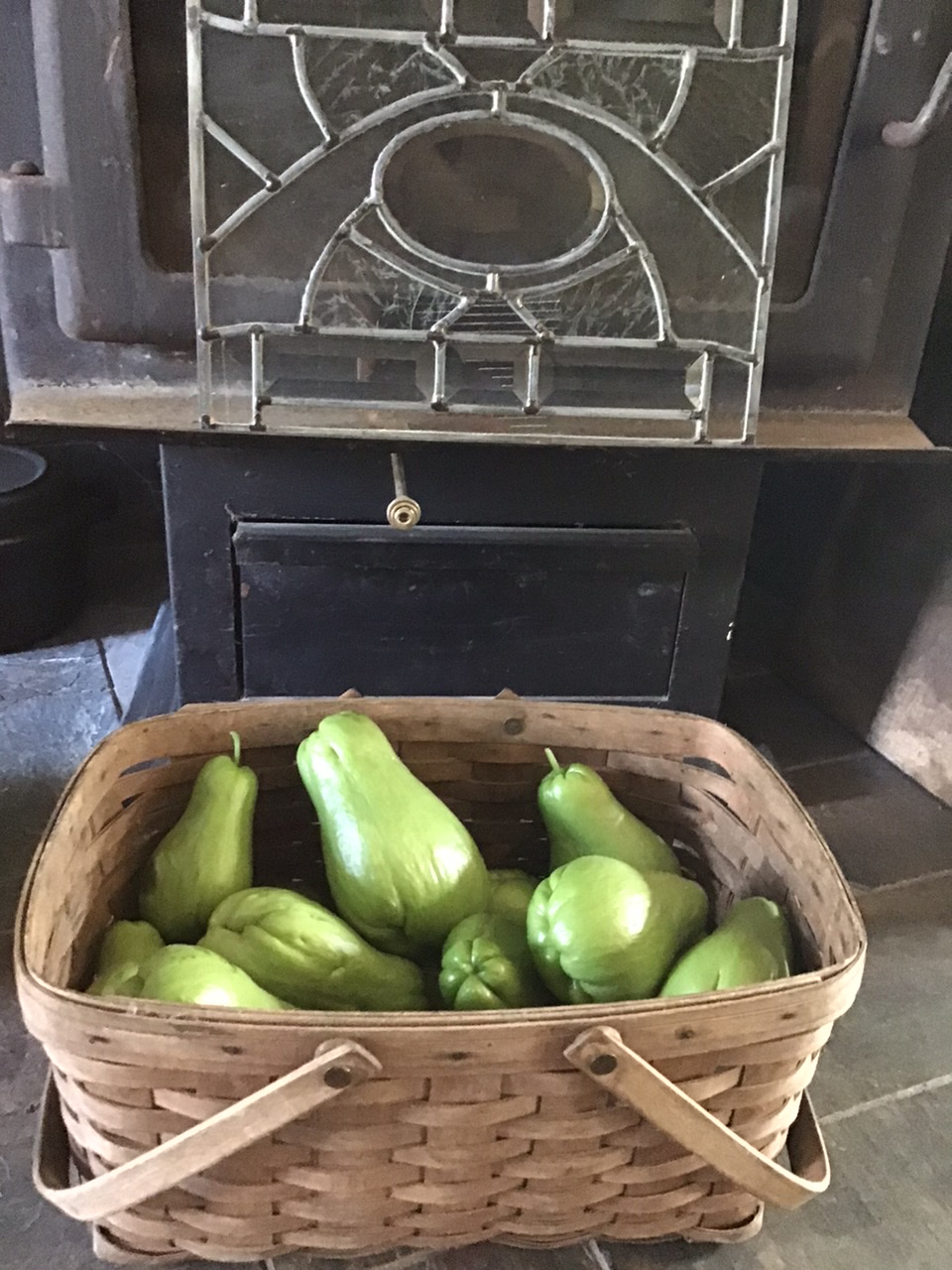
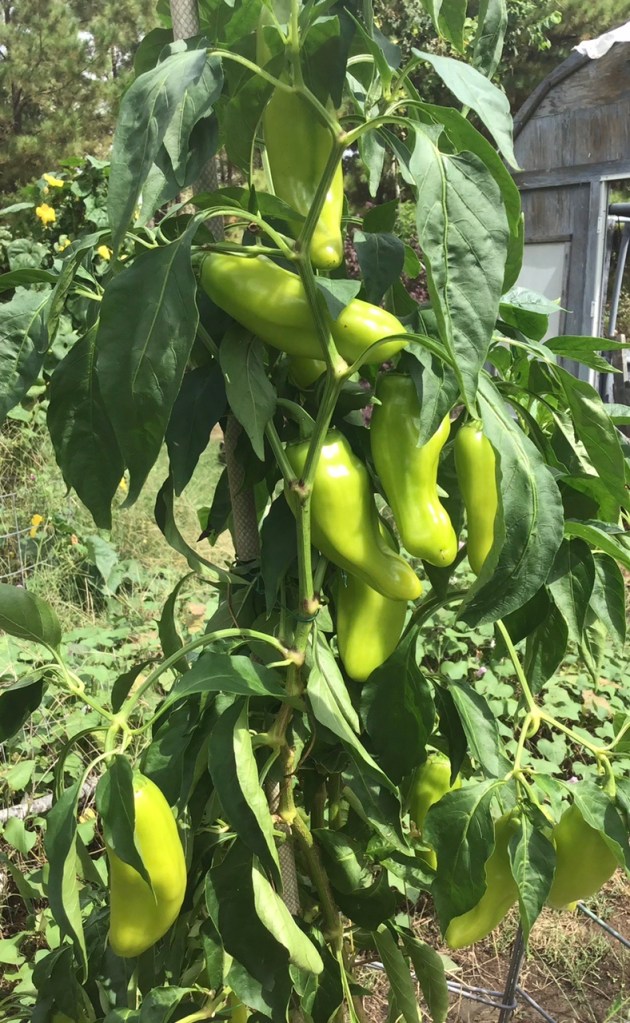
This post is just a quick plant profile because I’m so very pleased we’ve finely been successful growing this impressive and delicious squash. We’ve tried at least five times previously and they never lived through the summer and died long before producing fruit in early fall. I wish I knew how we got lucky this time!
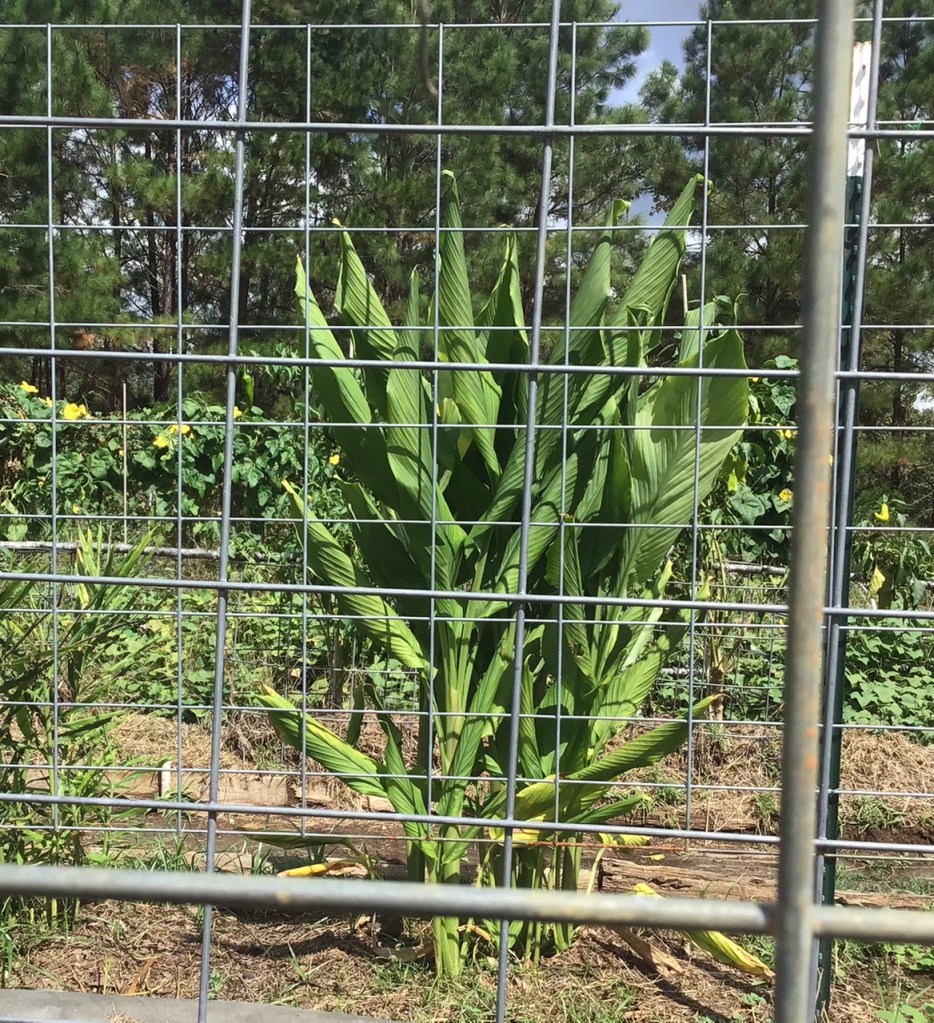
A perennial with leaves, fruit and root all edible. One plant can easily produce 100 fruits a year. It’s a day-length sensitive plant grown in tropical and subtropical areas.
In Zone 8 it can come back from the roots if well-mulched. Fingers crossed here! It was first domesticated in southern Mexico and Central America. The fruits are used raw like a zucchini or cucumber, or cooked like potatoes.
It’s a very popular vegetable in Creole cooking. It’s used in fritters, stuffed, pickled and smothered.
We’ll be trying all of those!
Sources: Perennial Vegetables by Eric Toensmeier Louisiana Real & Rustic by Emeril Lagasse
No politics or unpleasant ponderings this post, I promise!
Just some homesteady happy snaps and a well wishing for a wonderful weekend. 🙂
A sea of sweet potatoes soon to be harvested.Mexican tarragon—an attractive replacement for French tarragon that does much better in the South.
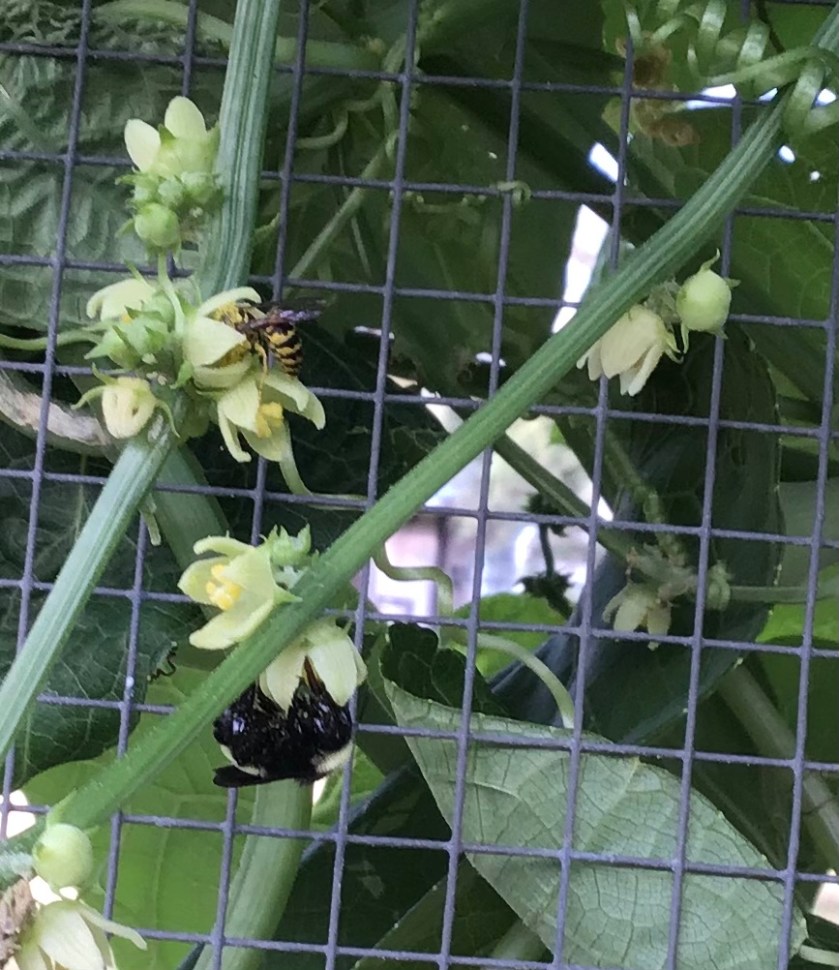
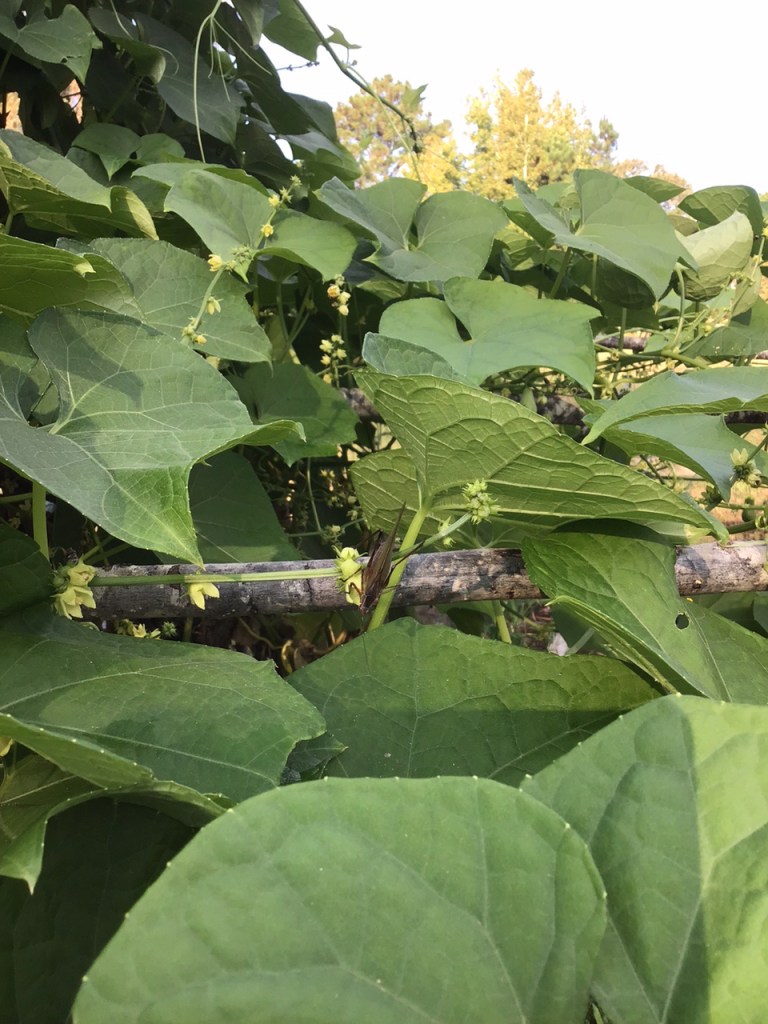
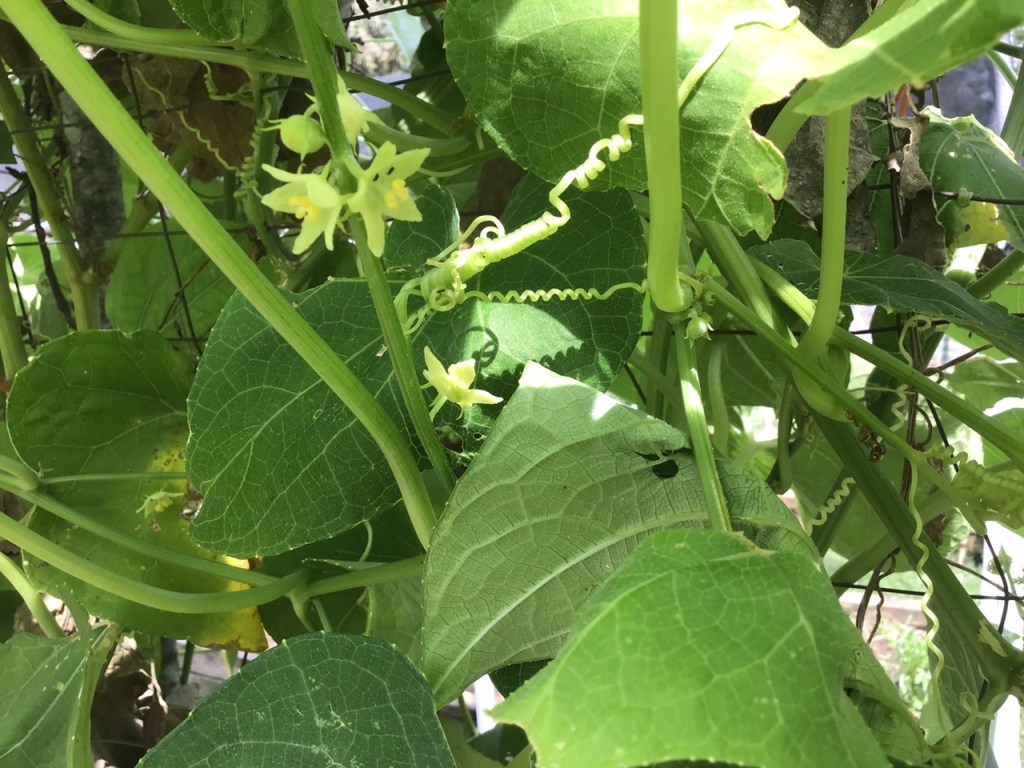
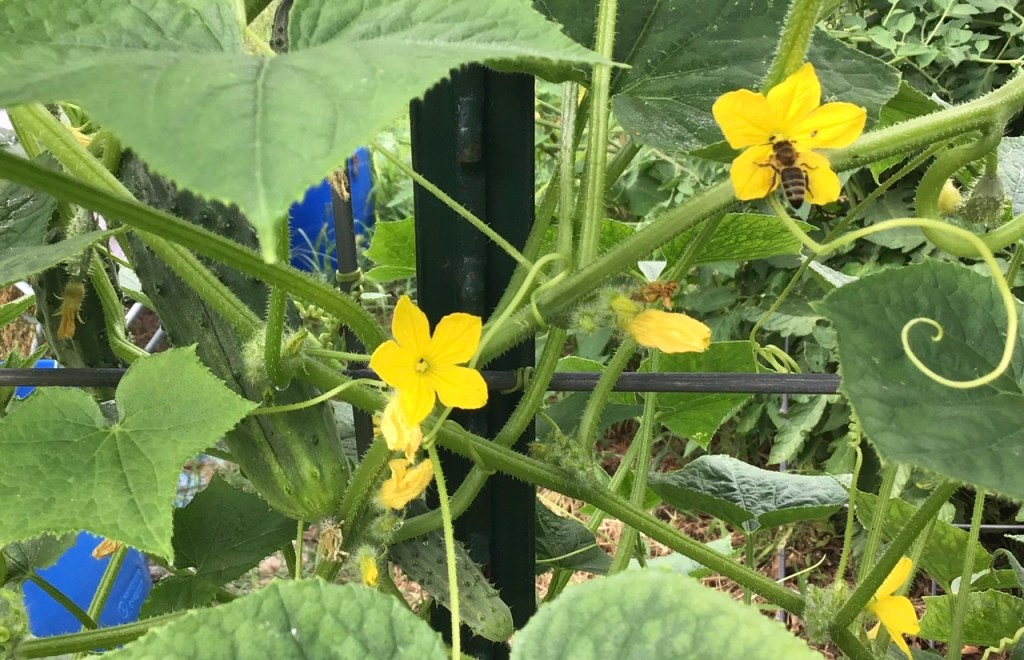
So excited for the mirliton (chayote squash)! It’s growing like mad, covered in flowers and fruit and providing perfect habitat for bees, wasps, crickets, etc.
Volunteer cherry tomatoes thriving on the old duck coop! We’ve never had tomatoes last all summer before, but now I can see how nature would have it done. This is almost an entirely shaded space and the entire coop is filled with volunteers: malabar spinach, datura, and these delicious little morsels.
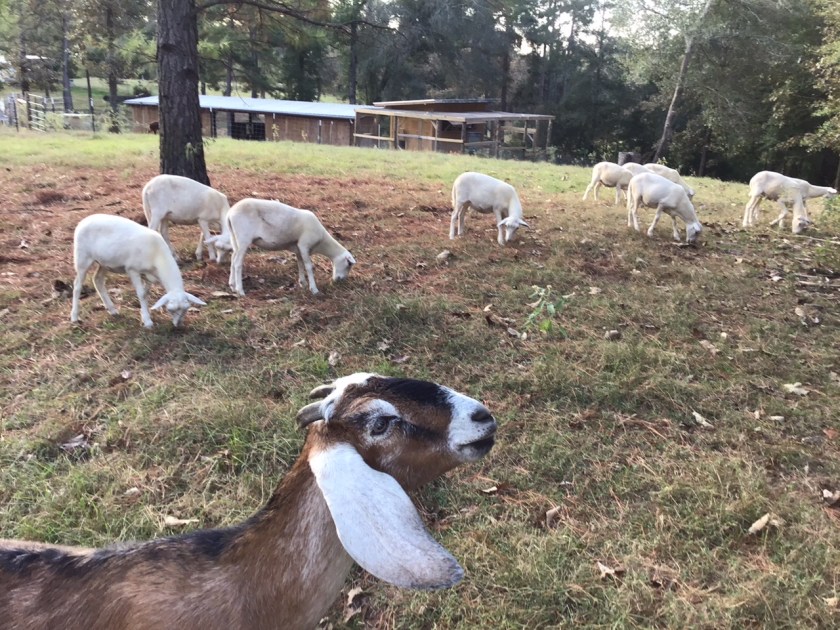
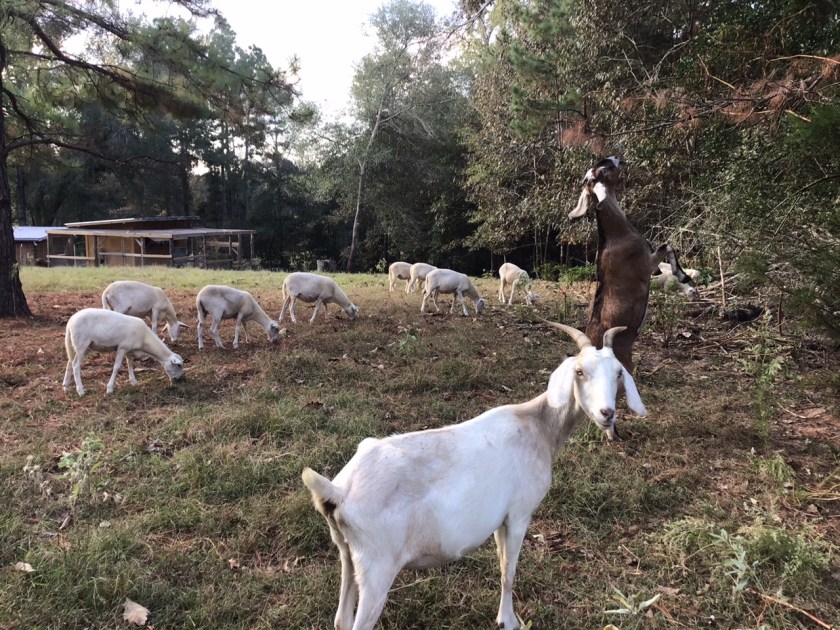
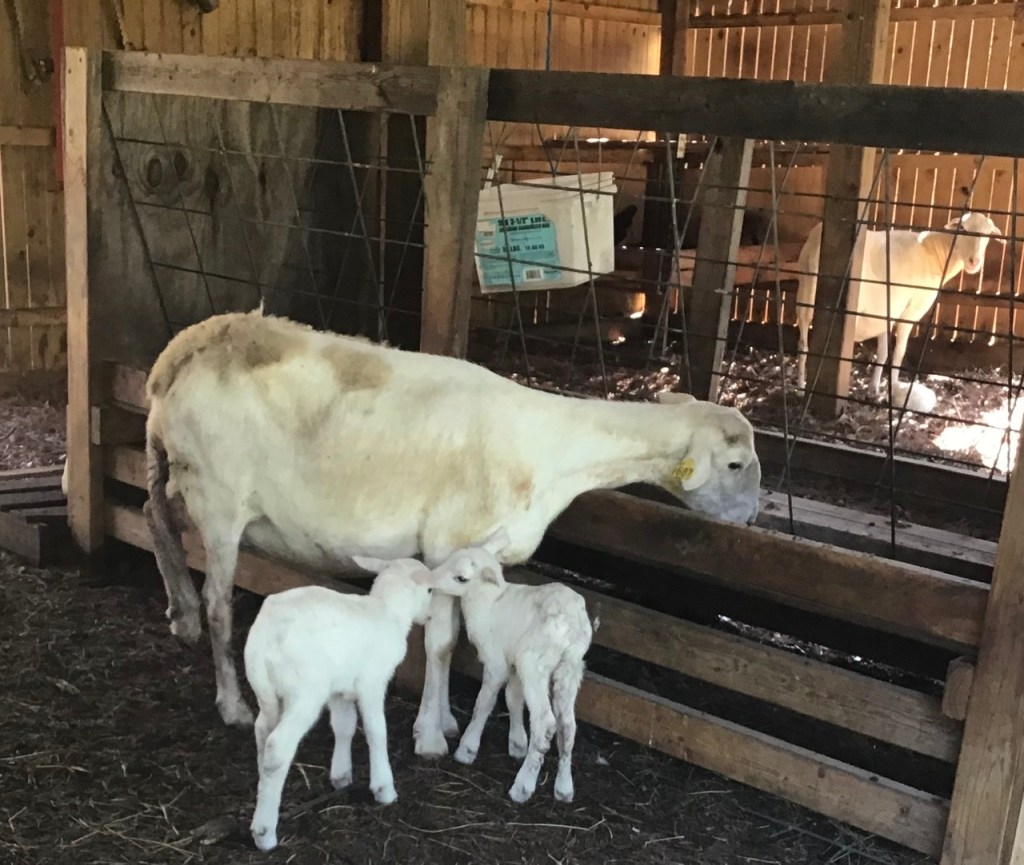
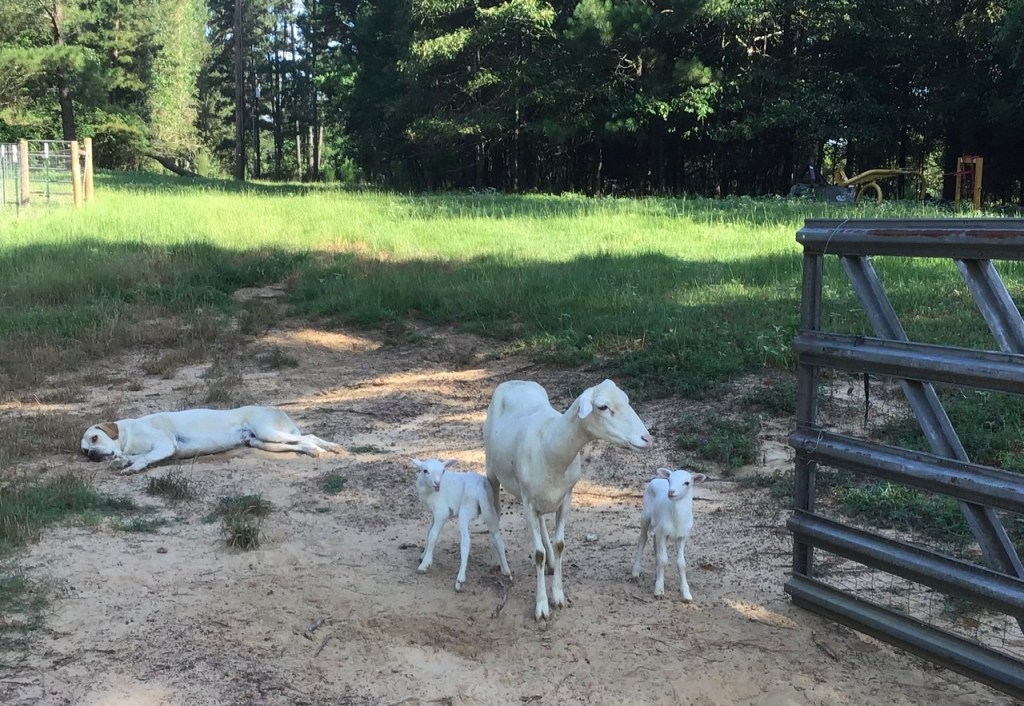
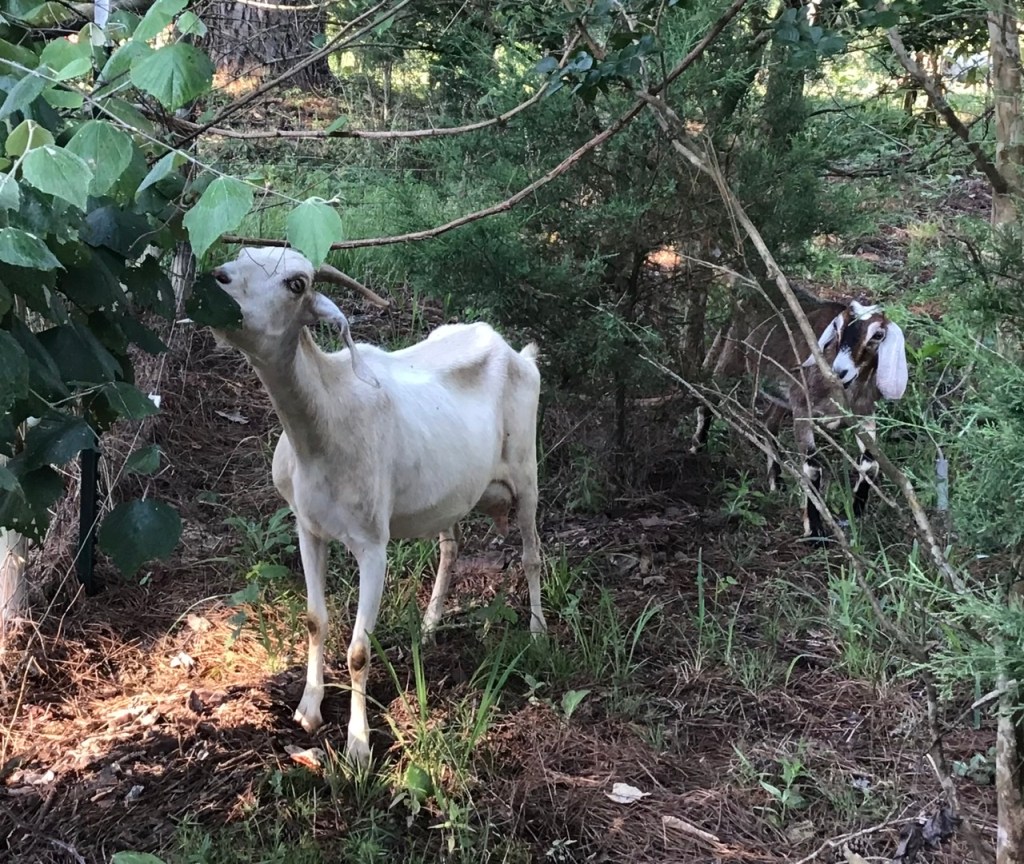
Time to wean the lambs. It was a loud couple of days as mamas and babies were separated, but with Summer as surrogate herd Queen everyone has mellowed down again. Phoebe, the goat pictured on the left, will have her first mating encounter next month. Her sister, Chestnut, jumped the gun, by jumping the fence to be near the rams, the little hussy! FYI—a goat crossed with a sheep is a Geep, very rare and not very desirable.
Drum roll, please, for this next rare shot . . . A Skittles sighting!
Our barn cat, Skittles, who we see about once a week and lives mostly in the trees.
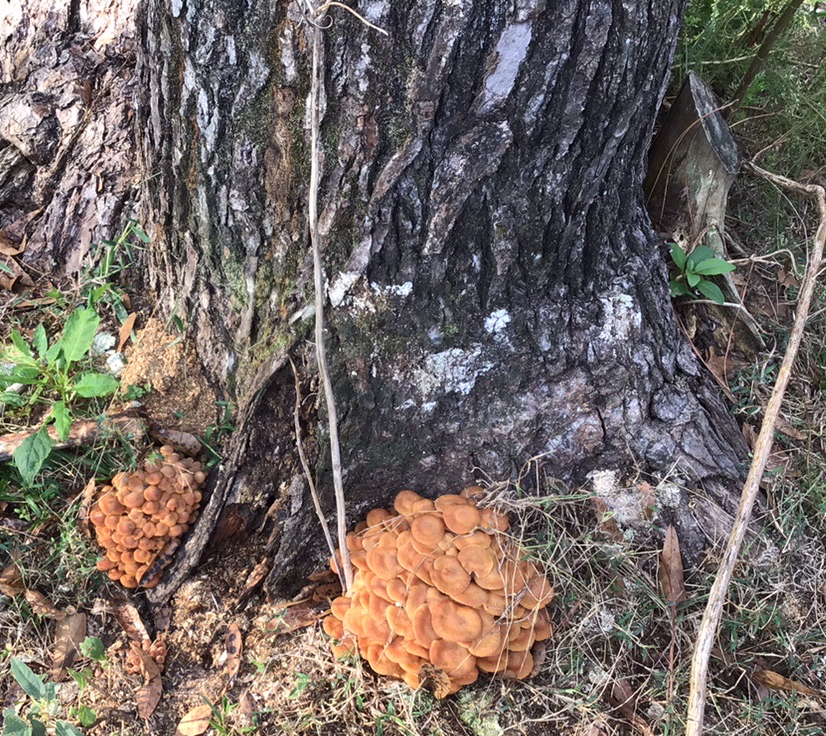
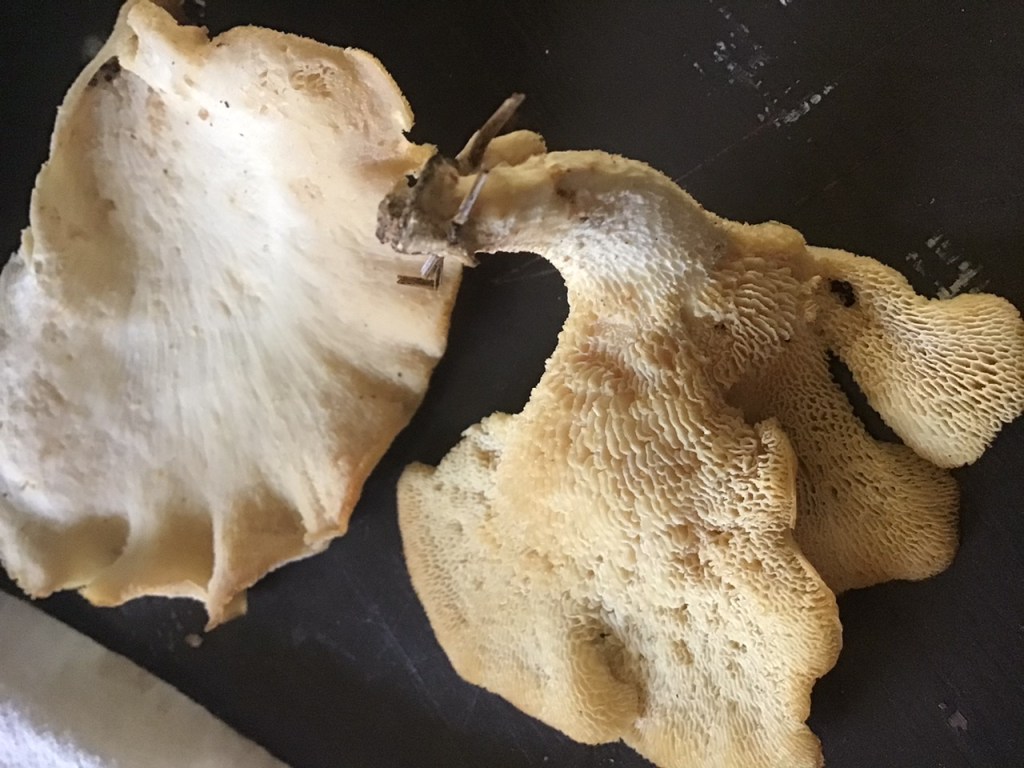
Mystifying mushrooms! These are quite common, honies (armillaria tabescens) claimed to be good by a good many foragers, but we haven’t tried them yet, because my mushrooming buddy and her husband got wretchedly ill on them once. Oops, I promised no unpleasantries. 😉
Buttercup paying homage to the pack leader, Tori, she does this multiple times a day.
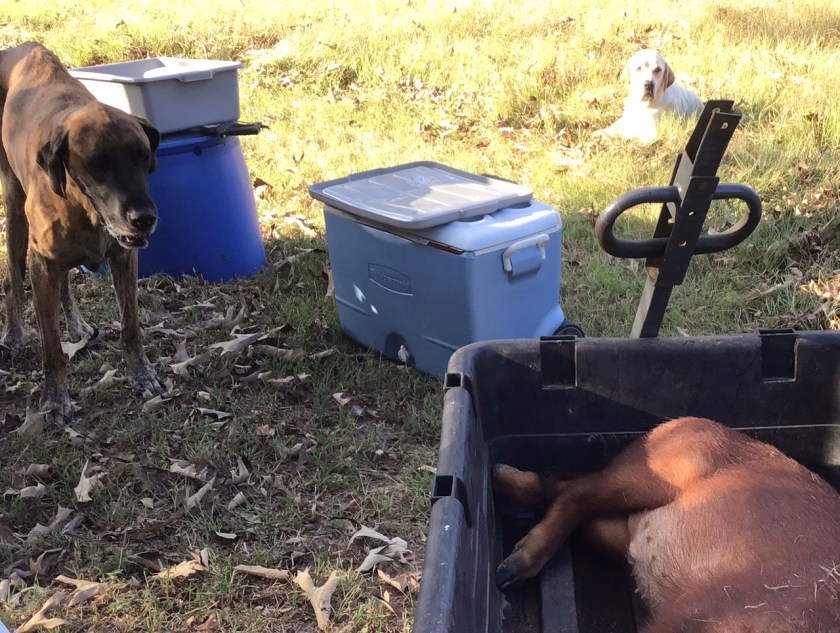
I suppose these next snaps might be unpleasant to some, sorry! I do get that, I felt that at first too, but I was gradually desensitized as I realized how much economic sense it makes, what an amazing skill it is, and especially how magically delicious it is.
Always an attentive audience at slaughter time.
Our favorite foraging expert who we forayed with nearby this past spring has a great new website all about medicinals. Here’s a short podcast about it, and reminding me that now is the time I should be collecting some goldenrod before winter! Medicine Man Plant Co
No rest for the weary around here! Our goal of year-round garden harvesting has been met and is every bit as rewarding, and exhausting, as I expected.
Living, working and eating according to the season is remarkably satisfying. In the last couple of years especially I’ve spent much less time learning from books and much more on direct observing and experimenting.
I’m thinking our next goal should be to throw the calendar and the clock out with the garbage. Show those Amish what a real Luddite looks like! HA! 🙂
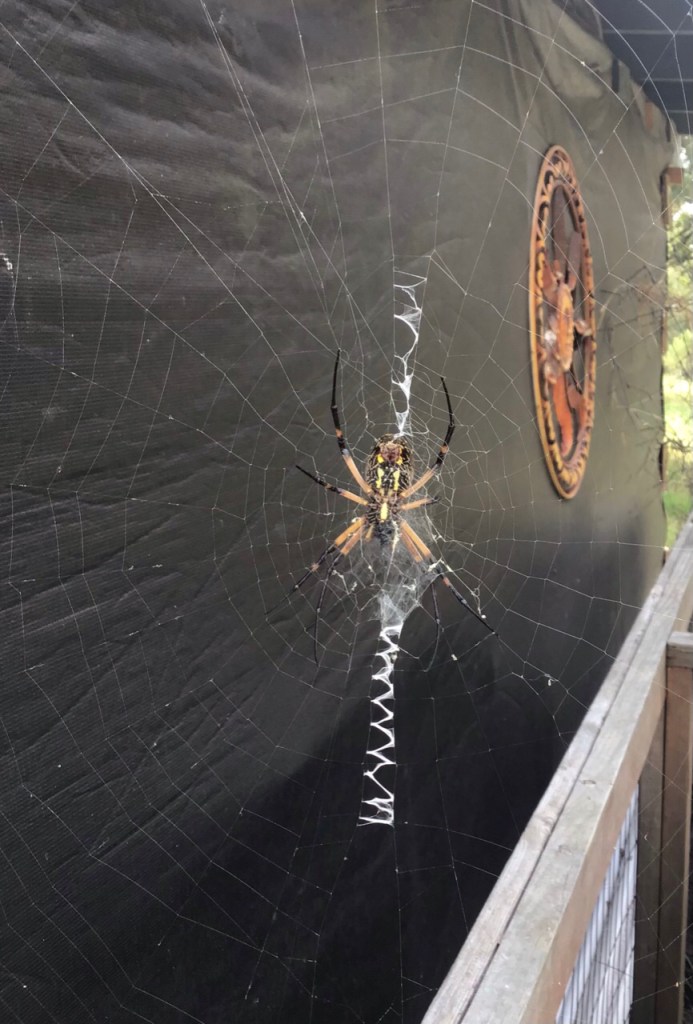
This time of year the spiders tell me it’s a good thing I’ve got the cool season crops out already. Many of them were started indoors, then transferred outside under shade cloth which will remain until the heat breaks, fingers crossed we don’t get an early frost.
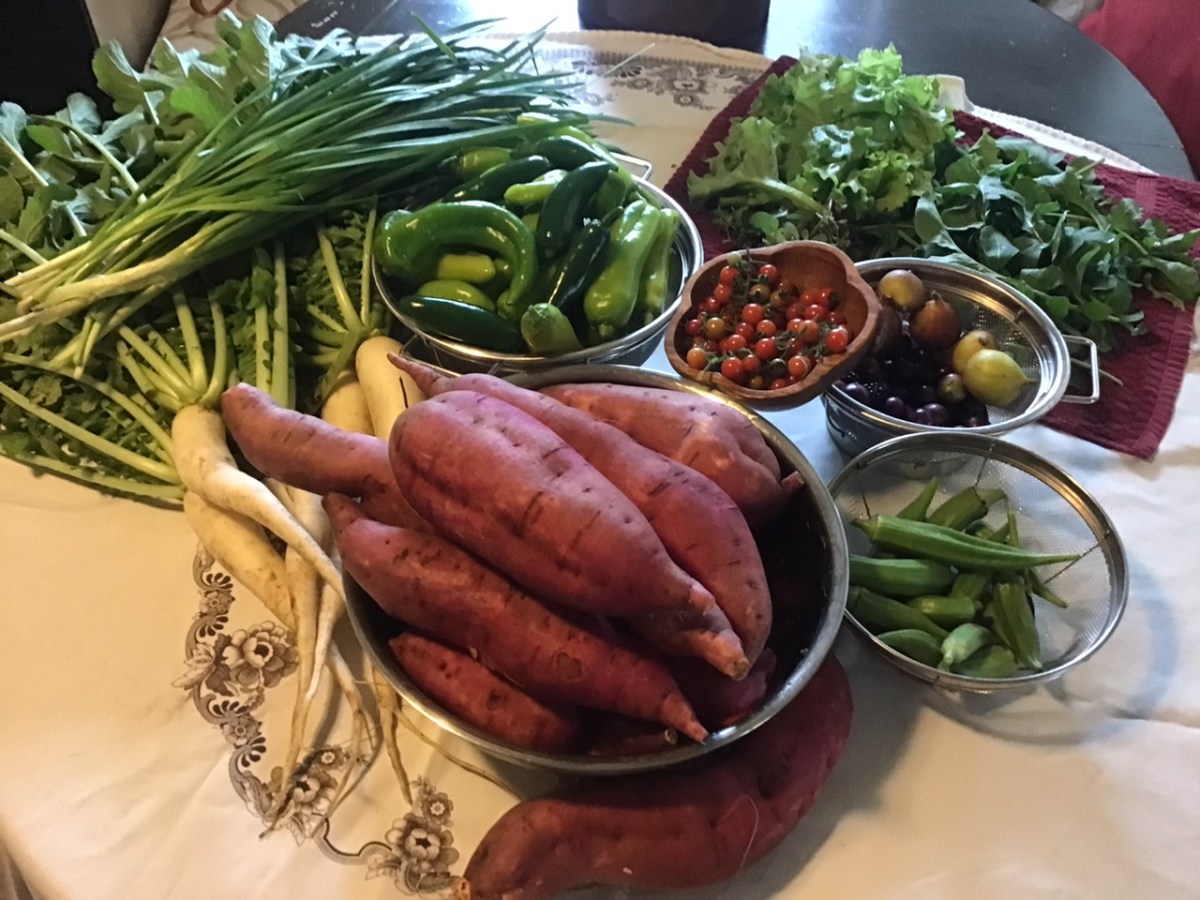
I’ve just started harvesting the sweet potatoes, the luffa and peppers are going crazy, the radishes, volunteer cherry tomatoes and lettuces are finally happy again and I’m most excited for the mirliton squash (chayote) that is finally getting its first flowers. This will (hopefully) be our first success with mirlitons following multiple failed attempts. I love this squash, but it thrives in southern Louisiana mostly, because it needs a very long warm season, even longer than we get here. I started these indoors in February, along with the turmeric, also a first for us this year.
As soon as it cools down I’ll also be harvesting honey, lots of herbs for drying and pesto, along with foraged leaves and roots for teas— sassafras, beauty berry, sumac—and once we finally get some rain, it’ll be time for mushrooms.
Hubby will be filling the freezer with lamb and pork and freshening our flock for spring lambs and a few to add to our growing herd of milking goats.
Hibiscus in May, hibiscus today . … still not blooming because I got a late start.
The honey bees love the Thai basil and the native bees especially love the salvia and the sweet potato and luffa flowers. We’ve decided next year to plant an entire row of luffa in the orchard just for the bees and pigs.
Hope you can enjoy a moment of piglet playtime! Surely there will be time for a wee rest in late winter?
The Sweltering Season has officially begun, later than usual for these parts, lucky for us.
Long weeks of crazy heat and zero rain makes for four lazy dogs and one crabby wife.
So Handy Hubby comes to the rescue once again!
I wanted to share this one because it’s a cool off-grid hack, even though we aren’t off-grid. The ability to pump water from your natural spring, creek or man-made pond or other source has advantages for any landowner. There is the savings on your water bill of course, and the peace of mind in having an alternate water supply, but beyond that the untreated water is better for the plants, animals and environment.
While it does take some significant time and expense initially, to set it up, move it around and then conveniently store it away when not in use is just what we need around here.
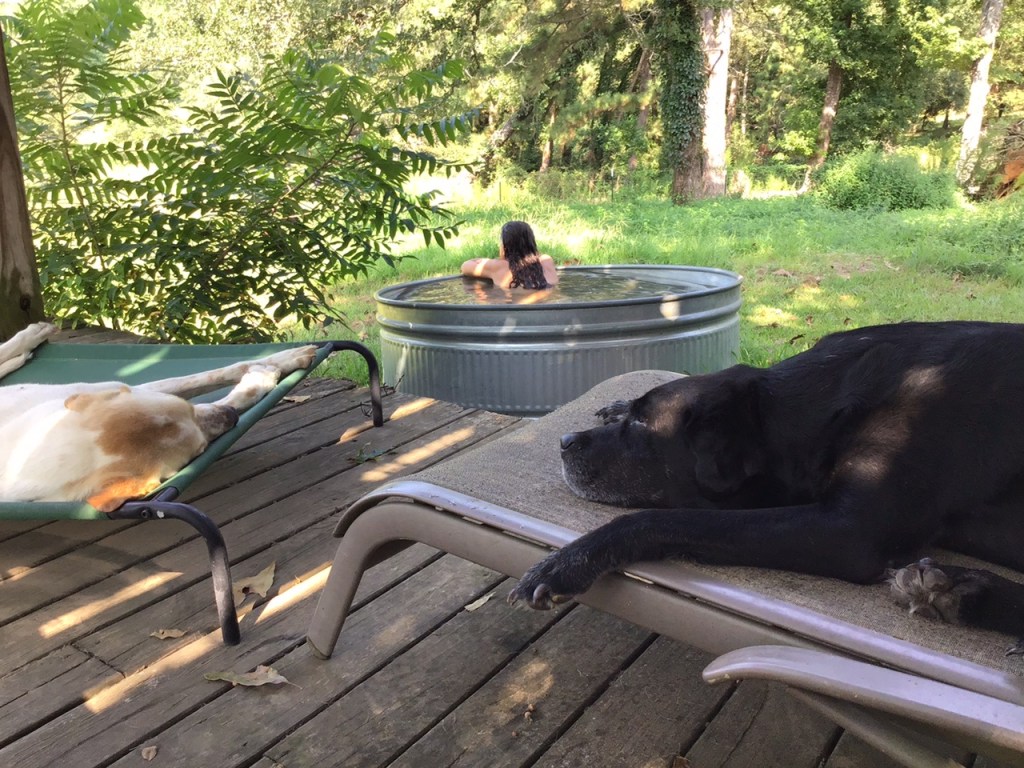
We soak the yard and garden with it, and then soak in it ourselves in our 200 gallon stock tank. A real redneck sort of system, but so refreshing!
I asked for a detailed explanation on Hubby’s handiwork to include here for anyone interested and he mumbled, “Just glue it and screw it.”
Yes a man of few words, but great actions, just like I like ‘em. 🤣
On further pressuring him he said if there was anyone reading this that must know the details, just say so in a comment below and he’ll let me figure out a way to persuade him to oblige.
The friend who traded us for Summer, our first milking goat, patiently tried to coach me, not nearly as concerned as I was.
“Are you massaging her udder with a warm wash cloth before you milk her?”
Yes I am!
“Are you feeding her her favorite treat before and after milking?”
Yes, again!
Though I did try on the first day to transition her from her animal cracker addiction to fresh cucumbers straight from the garden, thinking of her long term health.
Summer would have none of it.
After 3 days of barely being able to coax a cup from her I thought for sure I’d created some awful affliction, maybe worse than mastitis, yet to be listed in any book, from my sheer incompetence, or maybe that she just didn’t like me, at all.
Her udder was full to the point of bursting, but I was failing miserably at filling my pail. At that point if my friend had advised me to bring scented candles, perhaps some champagne too, to our milking sessions I’d have asked, “Which scent does she prefer?”
But as chance would have it, on the 4th day we had visitors. Friends of this friend wanted one of our young boars for future breeding. These were true farm folk, born and raised. I wasted no time whining about my failure as a blossoming milkmaid.
I played coy for the necessary split second before taking them up on their offer to take a peak at her.
When they saw her udder they had concerns. The dreaded ‘mastitis’ term crossed their lips and I felt even more deflated.
“Oh, no, how do I fix that?” I lamented.
Summer hopped right up on the milk stand for her animal crackers. At least we got that part down. They both examined her udder more closely and concurred it wasn’t particularly hot, so probably not mastitis, followed by my great sigh of relief.
The large man, with a deep country drawl, stepped behind her then and proceeded to pound at her swollen bag with an upward motion and milk burst out both her teets.
“Ain’t nothin’ wrong with this goat!” he confirmed. Then he gave a couple of tugs and strong, steady milk streams came pouring forth.
“How did you do that?” Was my relieved exclamation.
He proceeded to show me how it was all my bad, I was not being nearly rough enough.
“You gotta get way up in there hard and pull that milk down. Give her some good shots with your fist, like this. As long as your not bruising her or using a 2 x 4, she’s fine.”
Summer was completely calm and unfazed by this approach. Apparently I was tickling her more than milking her. We’re already up to a quart with my refined method.
I envy the rednecks and all their learnin’. So little seems to phase them, whereas I still get squeamish around blood and death and dis-ease after a decade of the most typical farm foibles.
Perhaps reading my mind and wishing to make me feel better, the large man shared a story as we stood at the gate before their departure.
“Now, I apologize in advance,” he began, “we just met, but let me tell you . . .”
And he proceeded to tell the story, flush with explicatives, about his recent long haul (he’s a truck driver in addition to a farmer, few make it these days as ‘just’ farmers) when his Bigrig broke down.
“Well I had to get one of them Ubers to take me into town and I ain’t ever been so scared in my life!” He’s a veteran, served overseas in the Middle East, grew up on a farm, been a truck driver for decades, but that Uber driver had him clinging with both hands for dear life, begging to Jesus and swearing to never get in a car with one of them crazy drivers for anything money can buy.
I inquired if he’d gone online to give the driver a poor rating.
“A poor rating?” he questioned. “They don’t go that low!”
He’s probably too nice of a guy to give that driver an ear-full while he had the chance. But I bet I would’ve!
I tried to find an appropriate fun song about goats to finish this post, but the best one was about a Billy.
Big days on the wee homestead! The cucumbers are coming in by the bushel full, the lambs are dropping like rabbits, the mushrooms are growing like mad and the bees sound exceptionally pleased. I can’t keep up!
Luckily, Handy Hubby is here now every day, thanks to his ‘early retirement’ (that is his layoff six months ago) thanks to The Great Scamdemic. With his steady efforts and attention our place is shaping up beautifully and my stress levels have been reduced by half, even as chaos still reigns. For these are not the only new milking mamas, I’m now officially a milkmaid in training myself!
Welcome, Summer! Two piglets for a goat in milk was our barter with a friend. She’s settling in nicely and Phoebe was the first of the herd to greet her.
Learning to milk in humid and buggy 95 degrees F is every bit as pleasant as it sounds. 😏
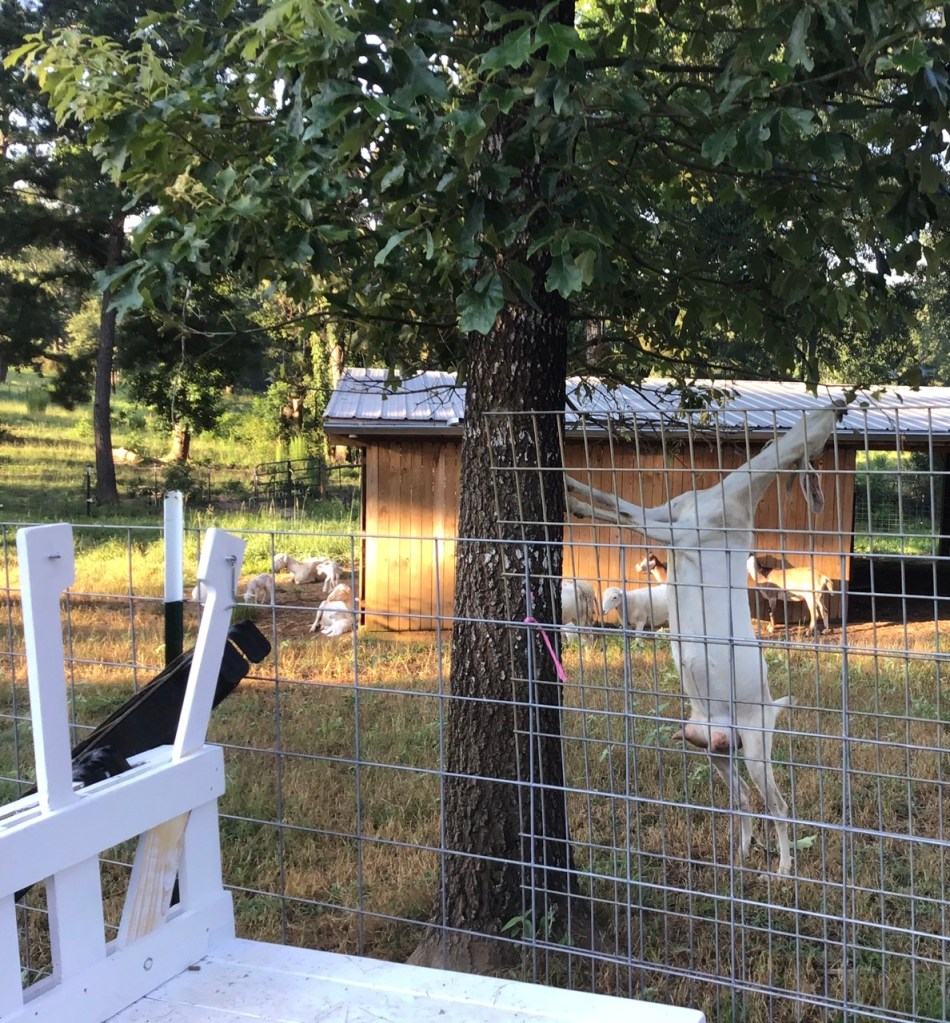
Impressive udder and gymnast-like capabilities!
Handy Hubby crafted me a nice milk stand from plans posted by Fias Co Farms, a very good resource for goat newbies.
The chanterelles will surely give up very soon in this heat, so I forced myself to brave the mosquitoes and ticks once more to gather one last big basket full. I came across a new variety while hunting that’s not in any of my books, so I contacted Texas Foraging expert Mark ‘Merriwether’ Vorderbruggen, who identified it and directed me to this excellent site:
Since our temps went from April-like to August-like overnight, I got stuck in a bit of a bind with the bees. Because I’m trying to work between 3 different hive types (very stupid, do not entertain this folly I would advise) I’m trying to get them to move of their own accord. It is working, but it is quite a slow process. I will eventually have 3 colonies from this one very full nuc without too much destruction or fuss, or at least that’s my plan.
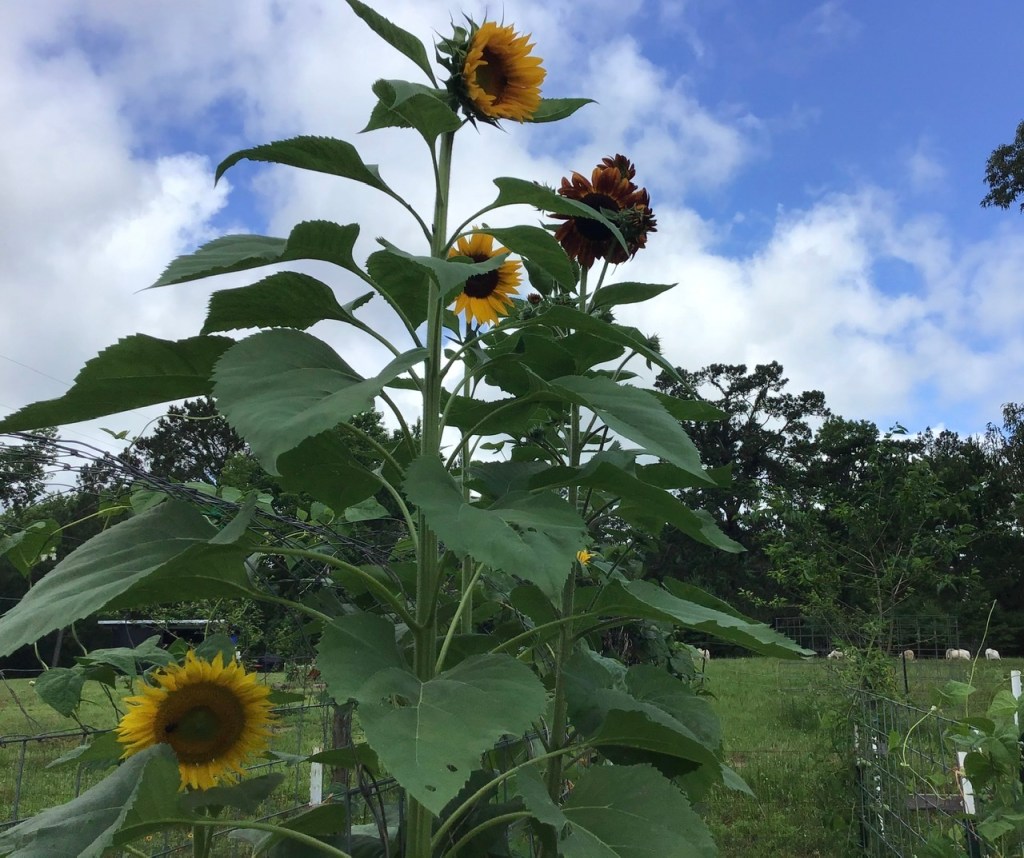
To end I offer a true garden success. I’ve been experimenting a lot with companion planting, sometimes with advice from permaculture books, but sometimes just by my own observations. This year I planted sunflowers very early, before it was warm enough for the cucumbers and melons. My thought was to attract the bees to the garden like a lure down to the still small cucumbers. It’s worked like a charm and the trellises are bursting with activity.
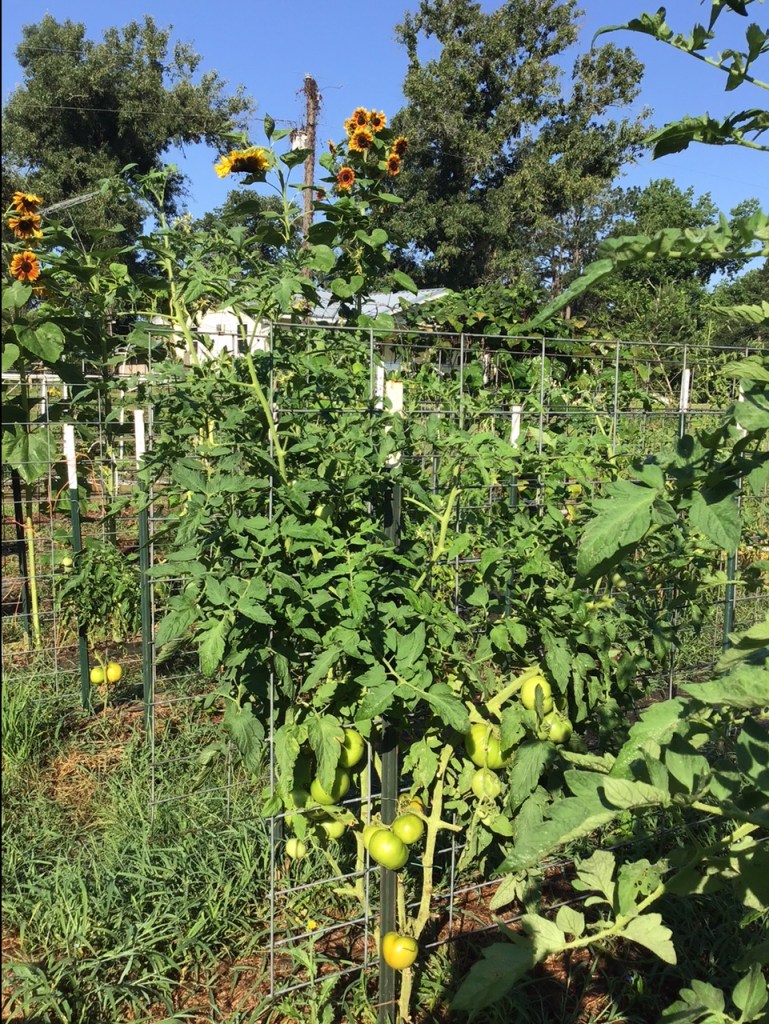
I’m also trying some new tricks with the tomatoes, letting the cherry types go wild, but highly managing the large varieties and interspersing them with various herbs, lots of comfrey, turmeric and ginger. The results are not yet in on those efforts, but I’ll keep y’all posted.
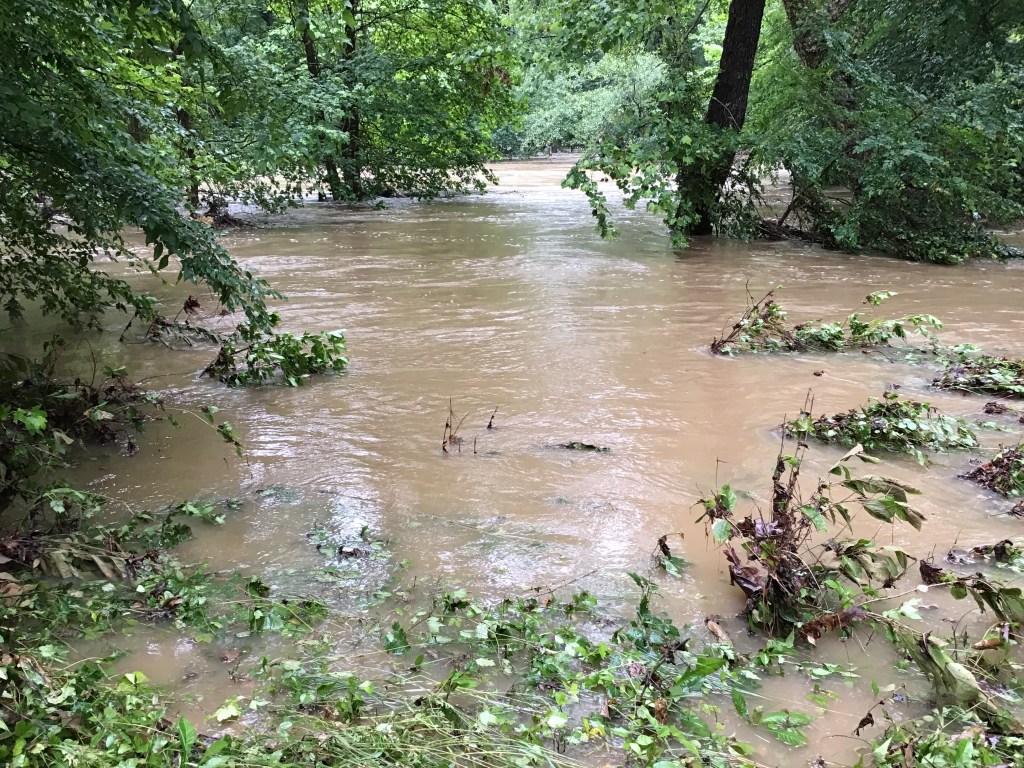
Wow, what weather! We got 12 inches of rain overnight on Monday, far more than we’ve ever seen here. Unlike the tornadoes, hurricanes and hail, however, I don’t complain about the rain. This region was made for rain, and lots of it. It’s the droughts that are far more difficult to withstand, and far more unnatural.
Texas Weather Modification doesn’t respond to public inquiries and they don’t share data on all the various projects happening around the state, so who’s to say if this was all Mother Nature. Man’s tech being ‘proprietary’ after all, we peons and peasants are relegated to the realms of conspiracy theory. Folks will continue to deny the weather warfare schemes until the bitter end, I suppose. No one wants to believe man is manufacturing the weather, despite clear evidence right at our fingertips.
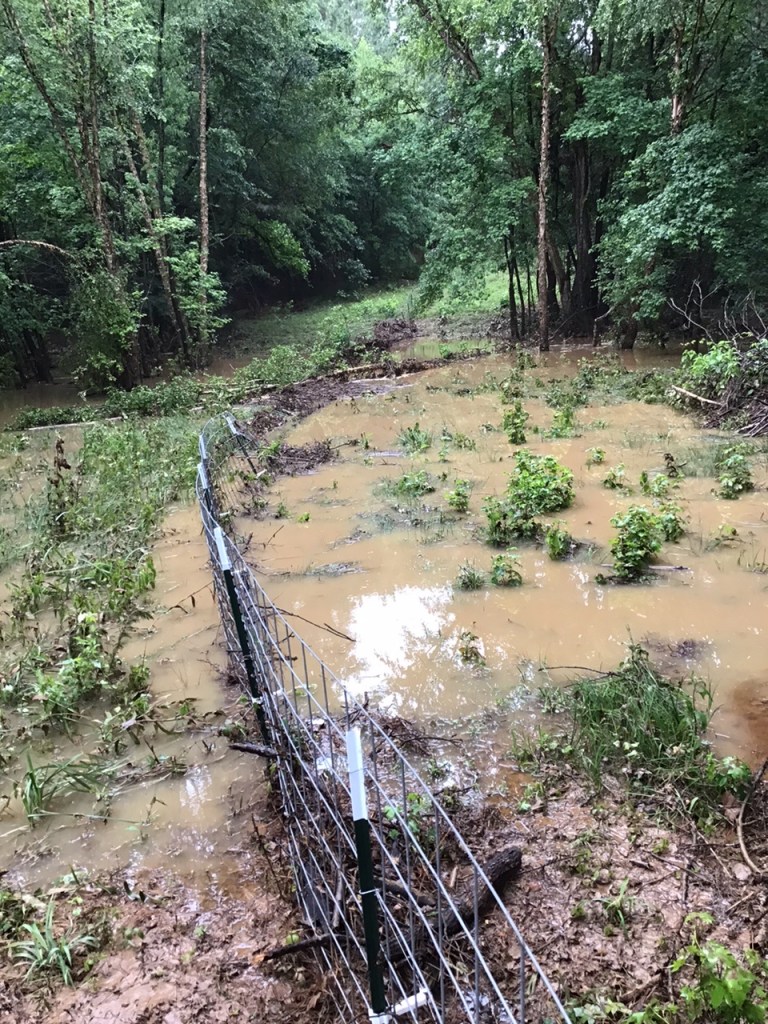
However, that’s beside this particular post’s point. This is what we woke up to, the sound of Niagara Falls outside our window! While still in bed I said to Hubby, “What is that sound? It can’t be wind, the trees aren’t blowing!” One look outside and I saw, that’s the creek that now looks like the Mississippi, flowing right over the road and bridge (sorry for the shaky camera, I was focused on the roar more than the image).
While we had several fence issues from the debris, lost a favorite old tree, and the electricity was out for a spell, it’s absolutely amazing to me how resilient nature can be.
The water was mostly receded in just one day and then, out come the lovely fruits as kind rewards for our losses and extra labor.
Chanterelles abound, the flowers and veggies are flourishing. The mosquitoes and ticks too, no gifts given without associated costs.
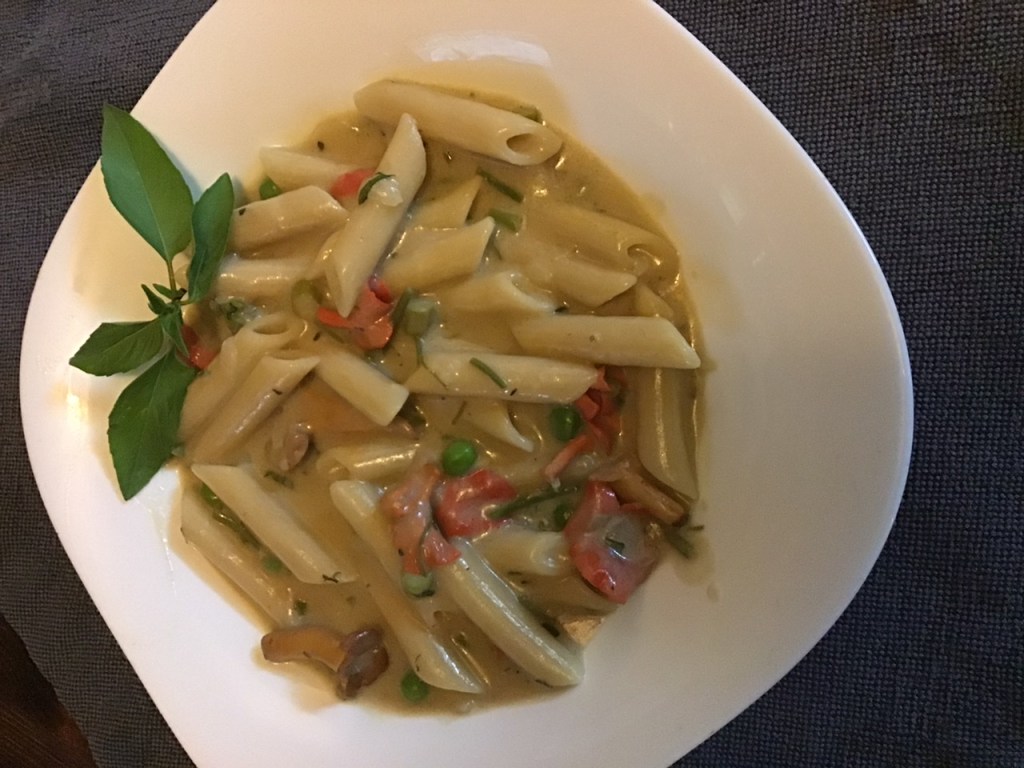
One delicious dinner of pasta in cream sauce with chanterelles, green brier tips and sweet peas. And another favorite tonight, pizza of course, which Hubby pronounced my best ever. Our own homemade cheese, bacon and sourdough crust certainly help the chanterelles sautéed in garlic butter make their best impression. .
While hunting chanterelles I stumbled upon a rather large patch of this rare beauty which I once mistook for a wild orchid. Actually it’s a Purple Pleat-leaf, in the Iris family. It’s gorgeous in the wild, but wilts immediately when cut. I carefully uprooted a few of the tiny shallow bulbs and transplanted them in the garden.
Hopefully the bees will find them as lovely as I do! If not, they still have their garden favorites.
There is the famous gardening adage of ‘4 in a row’ but it seems there should be another one something like ‘Every single success brings 4 new challenges’.
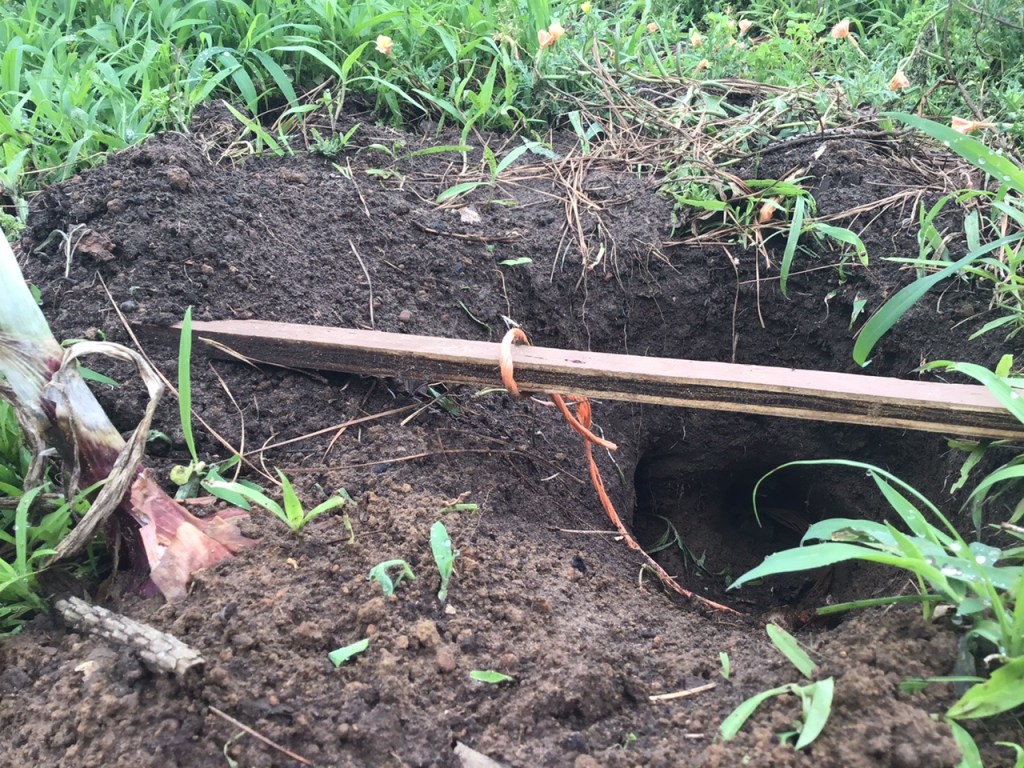
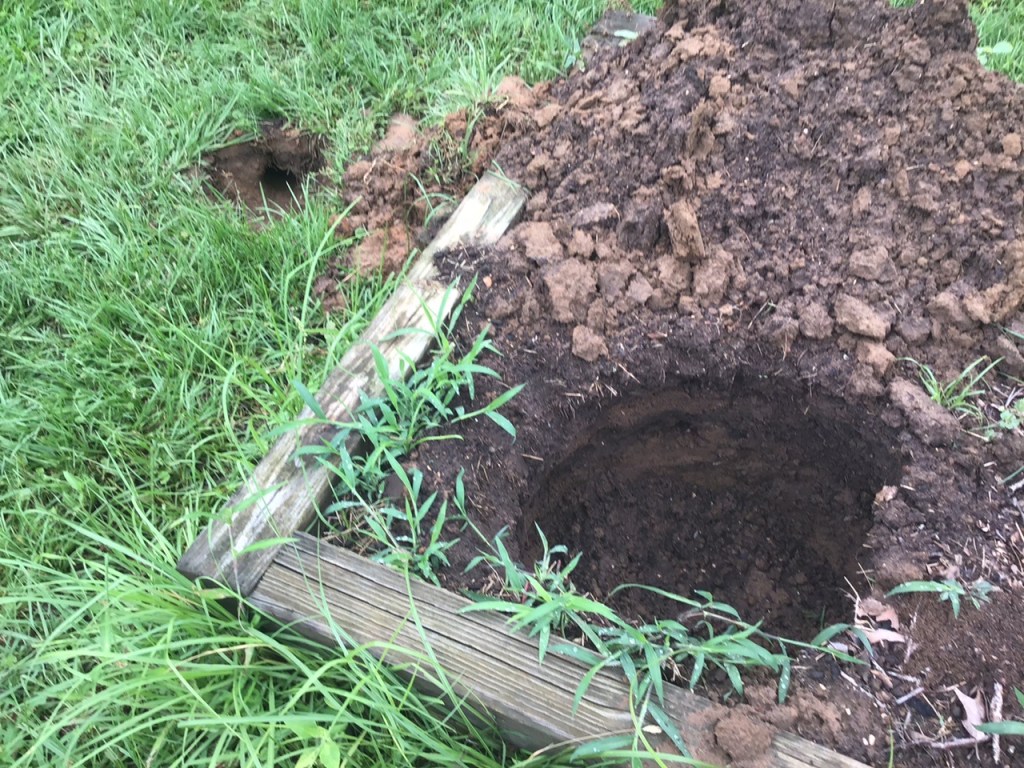
Because of course, now that we’ve spent years building up a gorgeous loamy soil from our heaps of sand and clay, the moles, voles and gophers have moved in with a vengeance. It’s gotten so bad I’ve had to enlist Handy Hubby with his big guns.
Rodent traps: a lot of work, but at least they are working, 4 captured, and counting.
And now that we have the fanciest coop in the county, we’re losing more eggs and chicks than ever—to the only beasts still able to penetrate the walled and fenced fortress—snakes. Another job for . . . Guess who?
Yes, that’s a water moccasin, poisonous. Hubby’s also found a couple of HUGE rat snakes stuffed full of eggs and chicks.
A dozen chicks lost and a broody hen giving new meaning to ‘a bucket of chicken’
Of course the snakes don’t go after the rodents, why go to the extra effort of hunting when there’s free food lying around everywhere?
Of course the cat doesn’t go after the snakes or the rodents, or maybe she does, but she can’t keep up with the steady traffic.
So we’ve lost all our cabbages, most of our broccoli, a couple dozen onions (don’t believe the hype, onions are not a rodent deterrent by any stretch of the imagination).
But, at least the forest beasts are well-fed.
Tori: “I don’t like onions anyway, where’s the chicken?!”
What to do with giants’ bones you find in the garden? You call the Authorities, who ‘donate’ them to the Smithsonian, where they disappear forever.
What to do with a dead owl found in your yard? You call the Authorities, who tell you to throw it in the trash, and pretend it never happened.
Electrocuted on your perfectly safe electrical wires? Impossible. Just like a duck the year before? Impossible.
Just like you, your own-human-self, jolted with permanent shoulder injury by our perfectly safe electricity? Nonsense.
That’s impossible. That never happens. That’s why we never record it or offer any way for any one to document it, because that proves it never happened.
The duck, the owl, your shoulder, NEVER happened. Report that, and that only, #6, to the Proper Authorities.
Yes Sir, that never happened. I have no electrocuted owl in my freezer. I have never been hurt personally by your Superior methods. I adore your system. I bow to your Eternal Authority.
We had a Foraging Walk that was well worth the two years waiting. The first postponement was after a tornado leveled their property during one of their tribal ceremonies, the Caddo Mounds in Weeping Mary, which I wrote about here and here.
The second time was during the initial stages of the Plandemic, when I cancelled due to mask mandates.
On this fun foray, 3rd time was a charm, no storms, no masks and a very educational afternoon. Top 3 things I learned:
1. Medicinal weeds should never be dehydrated in a machine, something about chemistry. Two ubiquitous weeds I thought had no other redeeming qualities besides bee food: Goldenrod and Carolina geranium, are in fact beneficial medicinals.
2. There’s a compound in red cedar that inhibits the breakdown of alcohol for 18 hours. So, a common practice is to soak some branch tips in strong spirits for a month. The final product becomes kind of like Absinthe in that it’s potent enough to cause hallucinations, which can lead to great art, says me, or, a cheap date, says Hubby.
3. Foraging in areas where there was once iron mining operations, quite common around here apparently, unbeknownst to me, should be avoided due to potential mercury contamination.
A super exciting swarm event is next on the Fun list!
I’ve been wanting to populate a couple of re-furbished TopBar hives, but the dimensions are not the same as those Hubby’s crafted, so splits would prove very challenging.
Bearding in summer, not too unusual in our hot climate. But, bearding in spring, probably a sign they’re really cramped.
I was hoping for swarms, and got one off the ‘bearding’ hive I recently wrote about (pictured above). They stationed themselves about 75 feet away in a young cedar tree and I got lucky to find them there immediately, while I was nearby harvesting mulberries. This is our first plentiful mulberry crop and I’m not sure what to make with them. Any suggestions?
I did recently learn from the Deep Green Permaculture site that it’s possible to get a 2nd crop of mulberries by cutting the branches back after the 1st harvest.
As far as the swarm goes, my first attempt was dismal, in the ‘Don’t do this!’ category of the pathetic novice, which I should know better by now, which I post so y’all can laugh at me, as I well deserve.
I don’t know what I was thinking! I wasn’t even good at holding a tray like that as a cocktail waitress. Spontaneous blasphemy makes this quick clip RATED R—For Mature Audiences Acting Immaturely Only. (Bet you didn’t know in a past life I was a sailor!)
Cringe-worthy
The 2nd attempt was successful, thanks to Hubby, who sawed the branch off into my waiting hands so I could gently walked them over to their new hive. They seem to be adjusting nicely! These thoughtful bees saved me lots of messy work.
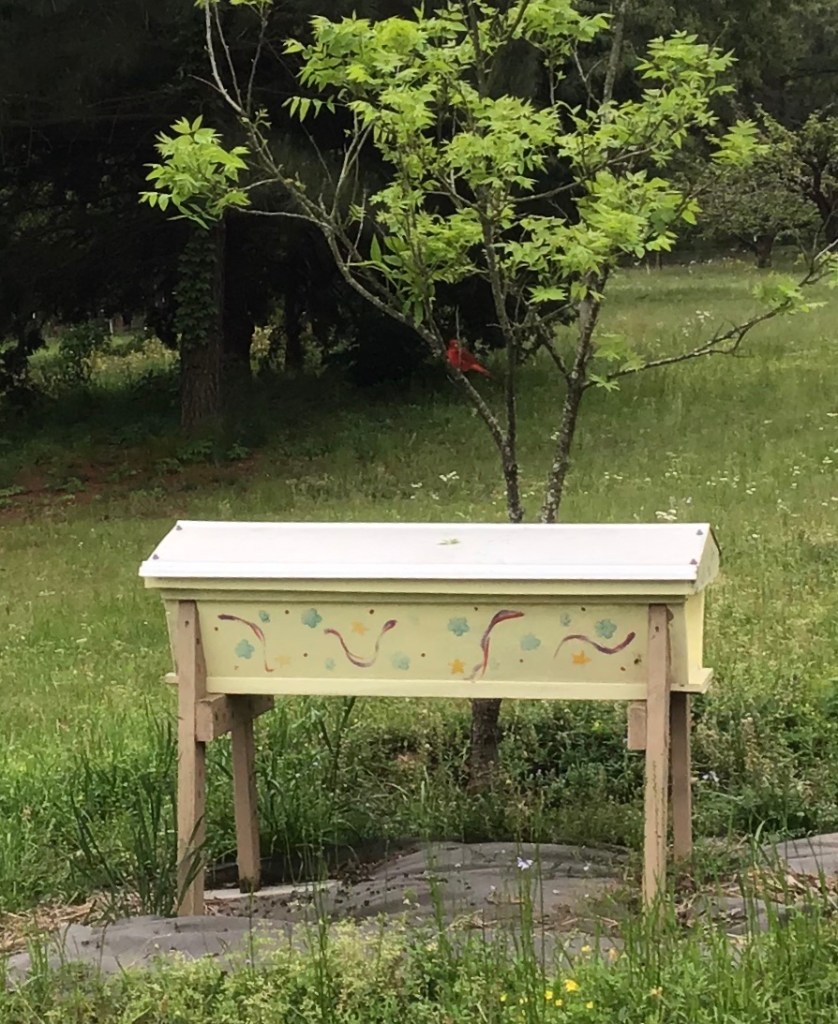
The Ninja* colony has attracted a gorgeous bird, which I’m pretty sure after consulting my field guide, is a Summer Tanager. Though I don’t approve of his hunting live bees, he does also forage dead bees under the hive, so he gets a pass.
*Ninja colony, so named due to their constant battling yet relatively calm nature. I believe this is at least partly due to their position right next to the house, where they get constant traffic, but seem unperturbed by it, unlike the more remote colonies at the far end of the orchard, who are just plain abusive.