A lot of folks still aren’t grasping this manipulative strategy, so I want to make a glaring point of it this post.
It’s easier for others to recognize classic rudeness, and shrug it off. It’s considered good manners to be tolerant of others’ petty foibles or potential misunderstandings or cultural differences and so on.
But folks aren’t putting a stop to plain old gaslighting, even when it’s obvious. They aren’t calling it out, and naming for it what it is—abusive, highly toxic, anti-social, not only for those who perpetrate, and their victims—but also from those merely viewing or reading.
Abuse radiates much further than those immediately involved in the moment.
This little rant, or welcome observation, depending on your position, was inspired by a small YT channel, another East Texas gardener, which I was curious to view from his title today—Garden Failures: Looks like another bad year.
The kind of title of a seemingly honest person just sharing his experience, not a hustler looking to sell me shit or snare me into another Cult-ur, is one of the nice rare finds still sometimes popping in my social feeds.
I watched only a few minutes before taking a gander at the first comment, and was relieved to find a someone seemingly aware of the enormous amount of weather manipulation going on, and clicked because I saw there was a reply.
But, much to my annoyance and disappointment, it was the typical reply of a Master Gaslighter.
Screenshot
To be shamed as you seek validation, or understanding, is gaslighting. This ‘rude behavior’ is far more than rude and it is tolerated in our culture far more than bullying. Why?
This behavior is graver than victim-blaming and bullying, it is an aggressive attempt to diminish, deflect, avoid, minimize, and control the perceptions, research, feelings and lived reality of the host.
The host, as in the one who has had the audacity and courage to seek understanding in the first place, in a hostile environment and against the norms of the Cult-ure.
I’d just been listening to Jon Levi discussing it, so it was very fresh in my mind. I’ve experienced it all my life, as ALL have in our Cult-ure.
It’s just that some go along with it, instead of recoil from it.
I have gaslit others before, sometimes knowingly, sometimes quite unconsciously, only realizing it years later. My mindset was at those times to ‘fight fire with fire’ and maybe that’s a good strategy, at times, with those who have breached the boundaries into your personal life and betrayed you.
But the large majority of the time those gaslighting others on social media is ALL about narrative control and social engineering. Sometimes I wonder if these are actual individuals, but I don’t bother to check, because I’ve experienced it enough in real life to know if these are just AI bots replying to one another, well, they have a pretty good idea of the human condition.
Is it because the political world has so infiltrated every aspect of our existence that folks have come to accept a steady supply of gaslighting in their lives?
I’ve stopped fighting fire with fire myself, too much gas out there, I’m too old for that now.
But, I wonder, besides avoidin the gaslighters, which seems quite impossible these days, what other action might one take?
Some brief updates this post and not as many happy snaps as I’d like. But, it’s been so busy and carting my tablet around everywhere is not usually an option, especially where it’s wet and dirty, which is a lot of places at the moment.
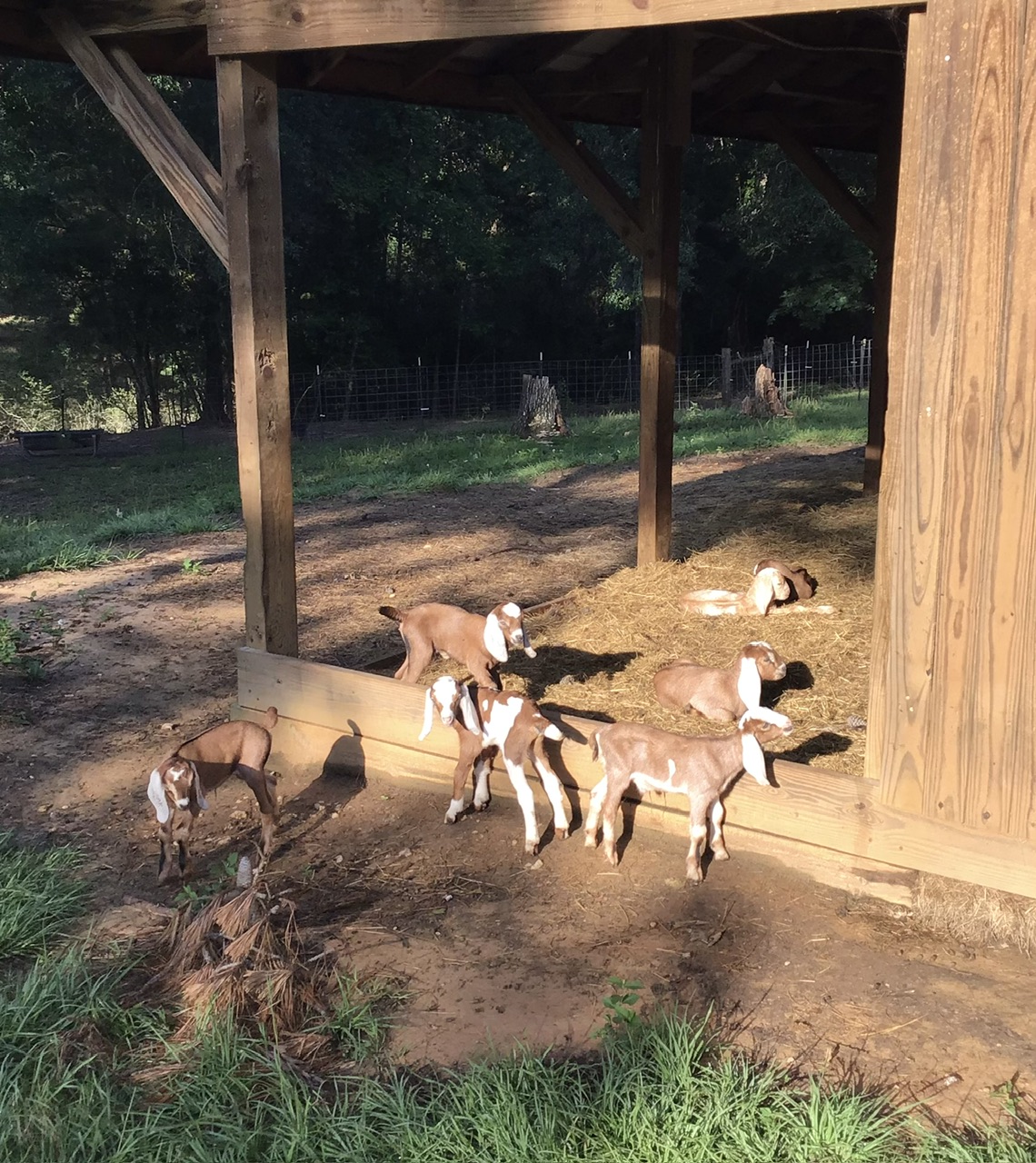
Kidding season is over and it’s been a bit stressful, no surprise there. I’ve been wanting to try something new—which is the greatest lost homestead technique I could think of—making our own rennet.
We’ve only had goats a few years now, all of this still feels very new, but, we do want to keep moving forward on the path to self-reliance, so this one is pretty essential on that list. It was as challenging as I expected it to be!
I am squeamish, so that’s the first of the issues. Hubby does all the slaughtering and butchering and for a while I did help plucking chickens, but then we got a machine, so I don’t even do that anymore. I’m not accustomed to seeing the interiors of the animals, let alone having to identify all the parts.
So, trigger warning for this section for anyone reading more squeamish than me! Move to the next section, if you please.
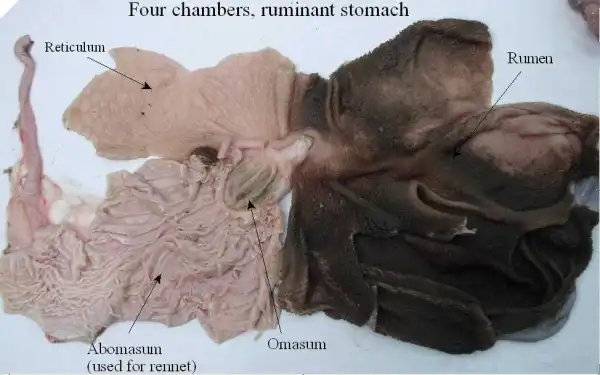
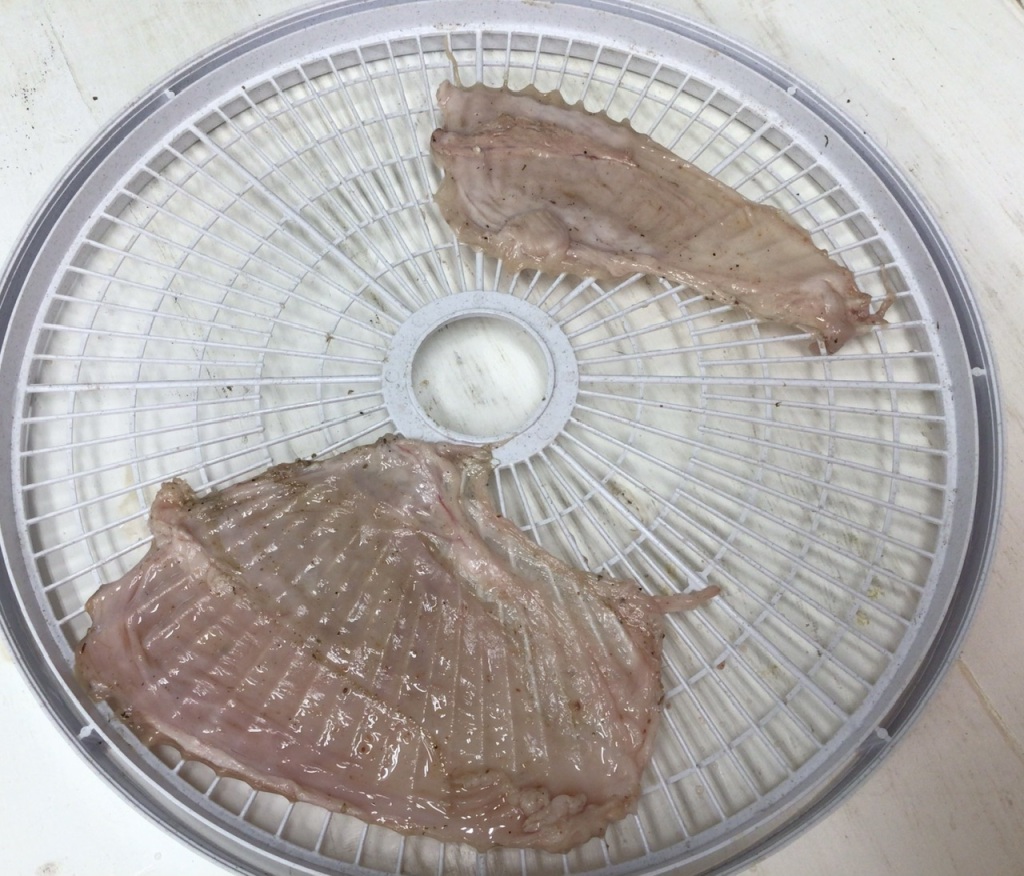
For the briefest of intro lessons, rennet is made from the 4th stomach of the ruminant animal, the abomasum.
This photo is from a calf, so for us we were dealing with far smaller features. Obviously, this is a precious commodity. The abomasum must come from a nursing animal, as it still has the enzymes required for cheesemaking. It can also come from a stillborn, an unfortunate event turned into a beneficial one with proper immediate attention.
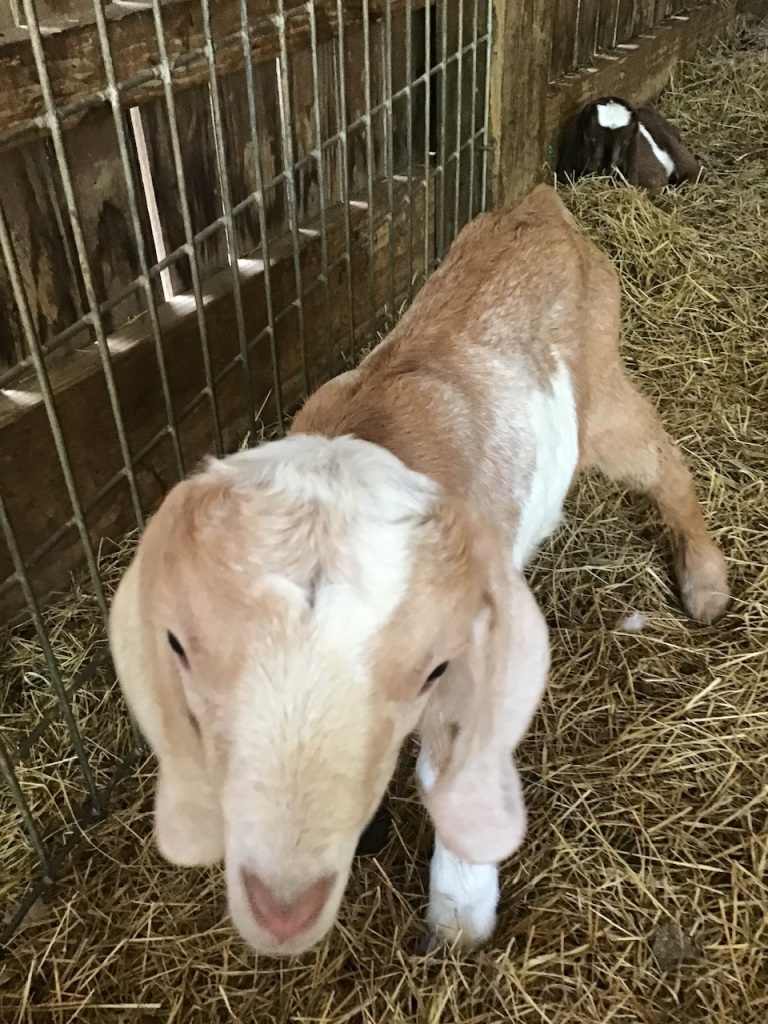
In our case, we’ve had 2 stillborn, one this year and one last year. This year we also had a very small doe, a first freshener, who had fairly large twins. We decided to cull one of her kids as part of our efforts. Of course this is never an easy decision to make, and I lose sleep over stuff like this. I was never meant to be a goat farmer, I just want to make cheese!
Anyway, I am glad for the tough choice and going through the trouble to acquire this precious skill. Hubby and I sat down before the guts together, at the kitchen table. One of the great many sentences I could never have imagined I’d be writing!
It’s not easy to find information on the how-to’s of this process, and I certainly had no one to call or visit for advice. It was not enough information to substantially build my confidence, that’s for sure. Sometimes that just takes doing it.
Luckily, I did find one YouTube video, and one blog, both again working with a calf, for which I’m exceptionally grateful.
Another brief aside about rennet, if I may bore many readers a bit further! As I’ve written before, most cheese made today, at least in the U.S., is not made from real rennet, it’s made from a lab-grown rennet substitute, made by Pfizer.
While it’s not that expensive for home cheese makers to buy animal rennet online, relatively speaking, considering only a tiny amount is required, I don’t want to have to entirely rely on far-away sources for such an essential item.
Another thing I’ve been experimenting with to overcome this issue is vegetable rennet, again, from a natural, local source, not a GMO lab-purchased source. We have figs, so that’s what I’m using, but nettles are another source.
It’s not possible to set a large hard cheese with this method, but it works for soft cheeses and very small, what I’d call semi-hard cheeses (because they don’t need a press) like the one I just tried after discovery this channel’s excellent demonstration.
This cheese is so easy! I’ve only just made it, so I can’t yet vouch for the taste, but he makes it look delicious. For this cheese you don’t need any special equipment—no molds or cultures, no aging fridge, and no rennet. Instead of the cute baskets he uses I just poked some holes in an old sour cream container. (And can I just add how much I adore his heavy accent and classic Italian hand gestures!)
We did eventually figure it all out, and here is our final product, now drying for 3 months or so, according to processing directions. It will then be sealed and last for many years and make many dozens of cheeses.
A great big thanks to the multi-layered efforts of man and nature for this magical gift!
In weather news, we’ve had a lot of rain. While I mentioned last update how much I love the rain, it is causing problems. We lost most of our onion harvest, for starters. This is a big disappointment because we were so close to harvest, just a couple more weeks. Not anymore, they were rotting in the ground, we had to pull them, lost a great many, and the others are mostly very small still.
So between the pitiful potatoes and the sad state of the onions, we are not starting off too well. The peas are already done as well, because of the heat, but that’s pretty normal here.
What’s not normal is my usual complaint—the manufactured weather. We can’t drive to half our property until Hubby upgrades our culvert, a huge undertaking. But we are very lucky this time around! No hail, or tornadoes, or other immediate disasters to deal with, like a great many.
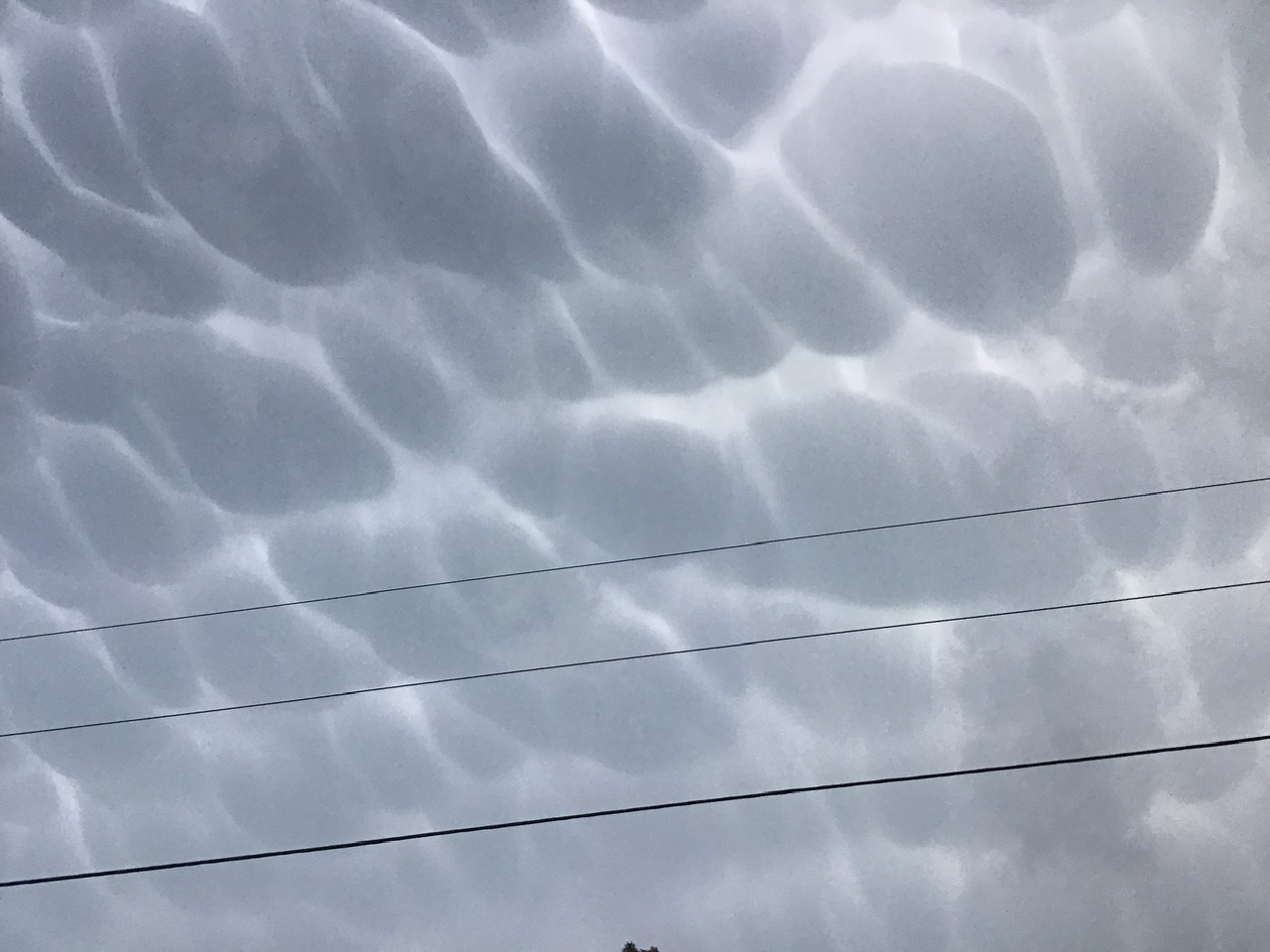
Yes, more manmade clouds above our head. We’ll learn what NASA calls them next post.
But, I have a future Geoengineering Update in the works, so I’ll save further lecturing and complaining for now!
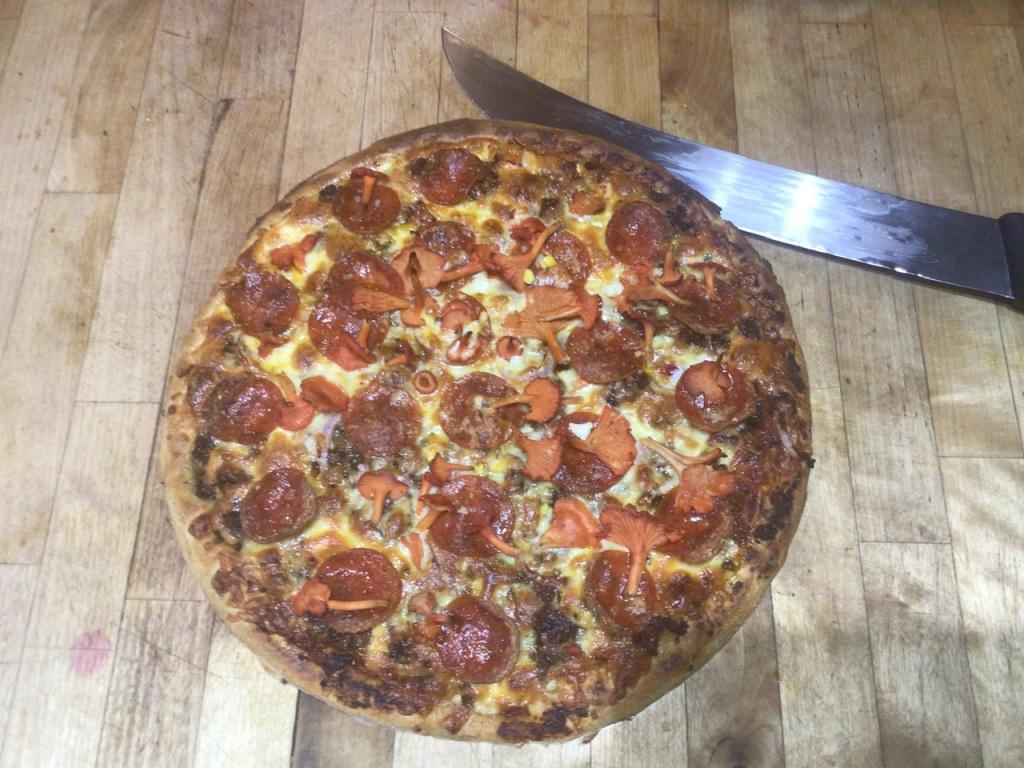
Instead we’ll end with a snap of one of our favorite dinners, just how we like it, burned to perfection! Not our pepperoni or cheese this time, but some just foraged chanterelles, homemade sourdough crust, and homegrown pork sausage. 😋
An interesting week on the wee homestead, worth a quick update with many happy snaps and a couple of video clips.
We’ve had some wonderful days and nights of rain, too much for most, but quite fine for me. Hubby will unfortunately have to repair some fencing, nothing new there.
All the usual erosion issues will fall on him and his little old tractor once again, so I make great efforts to contain my glee. Our water is out and so is the phone, but that’s not unusual either.
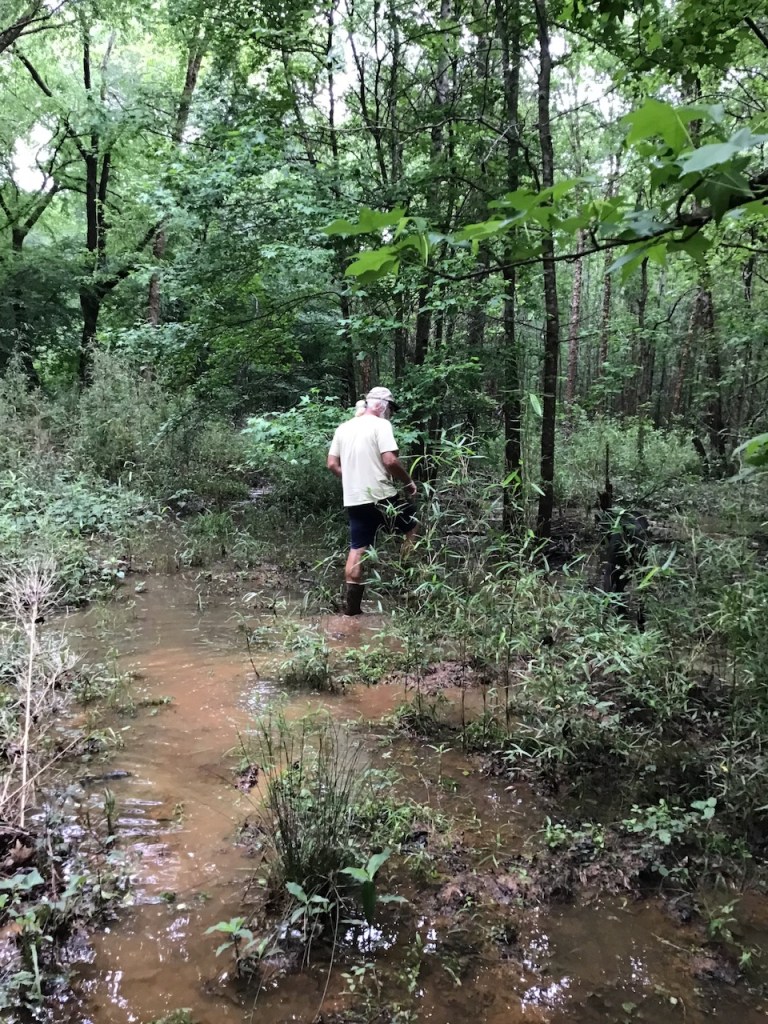
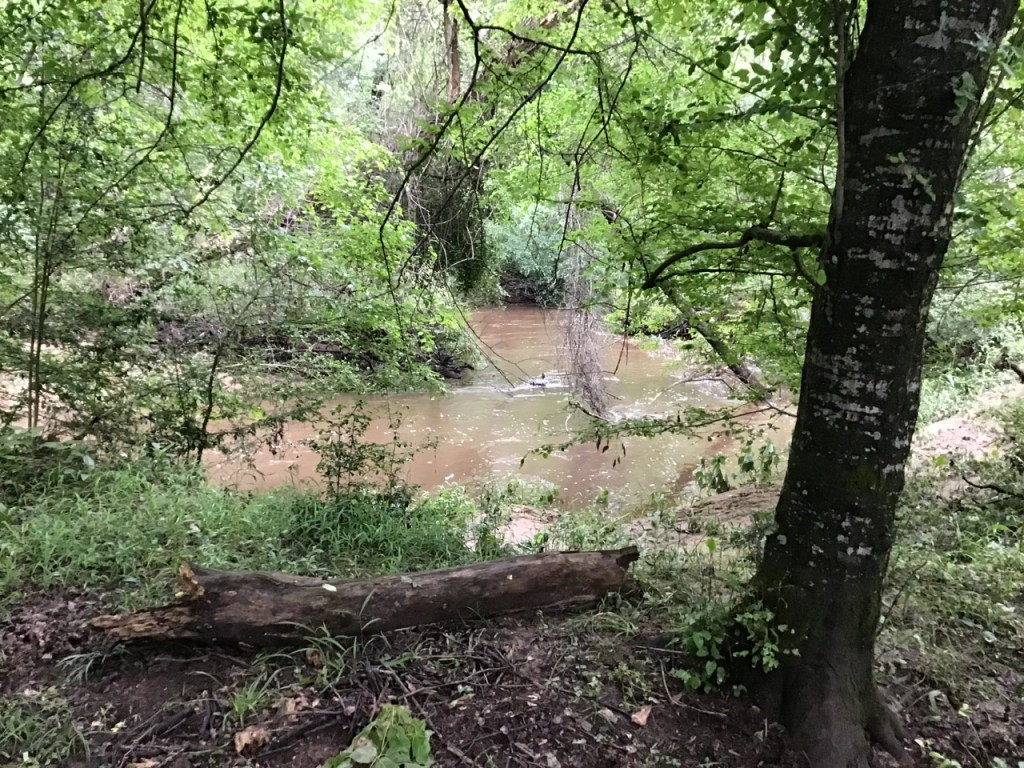
The creek overflowing its banks and the pond washing out.
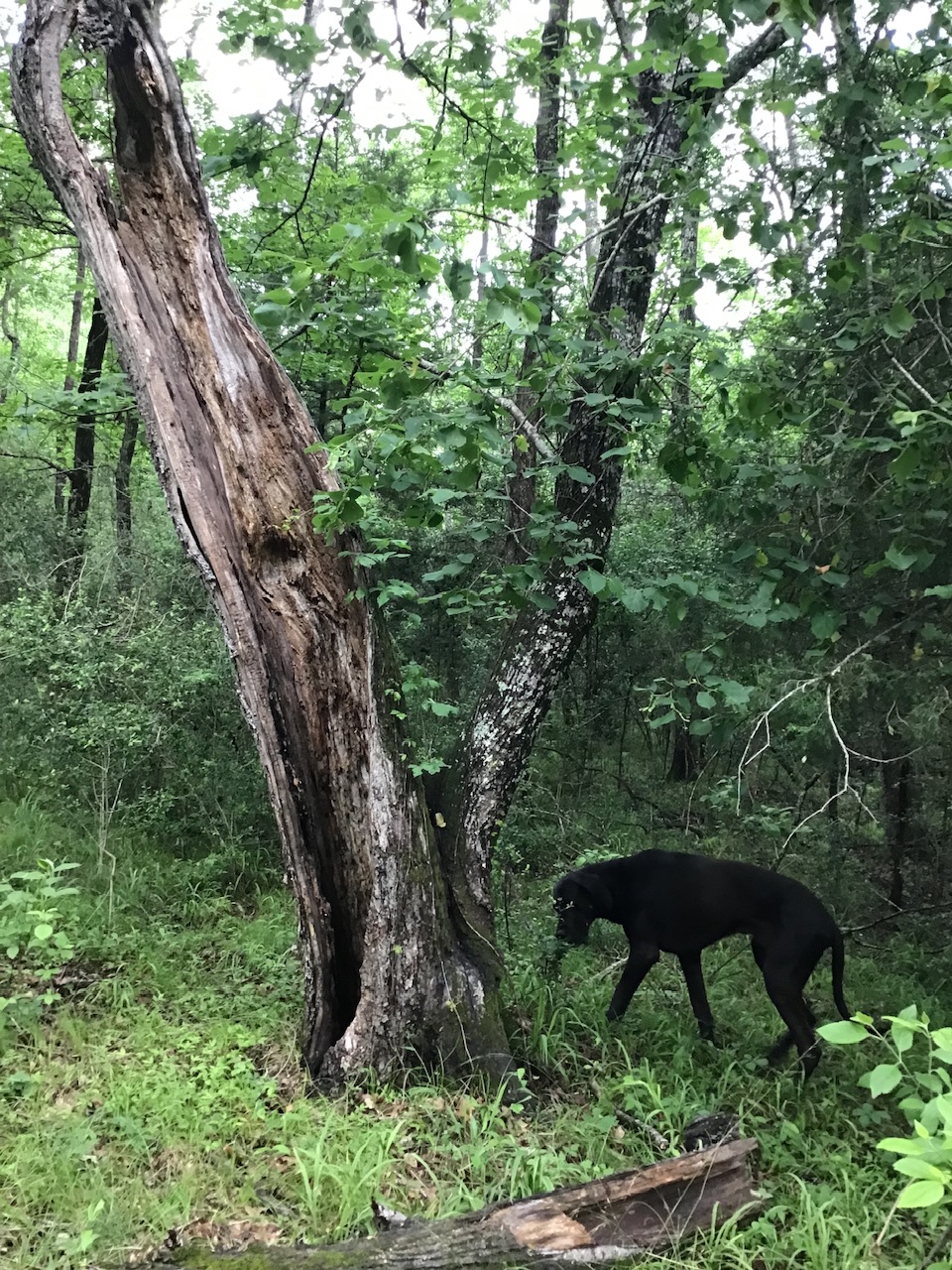
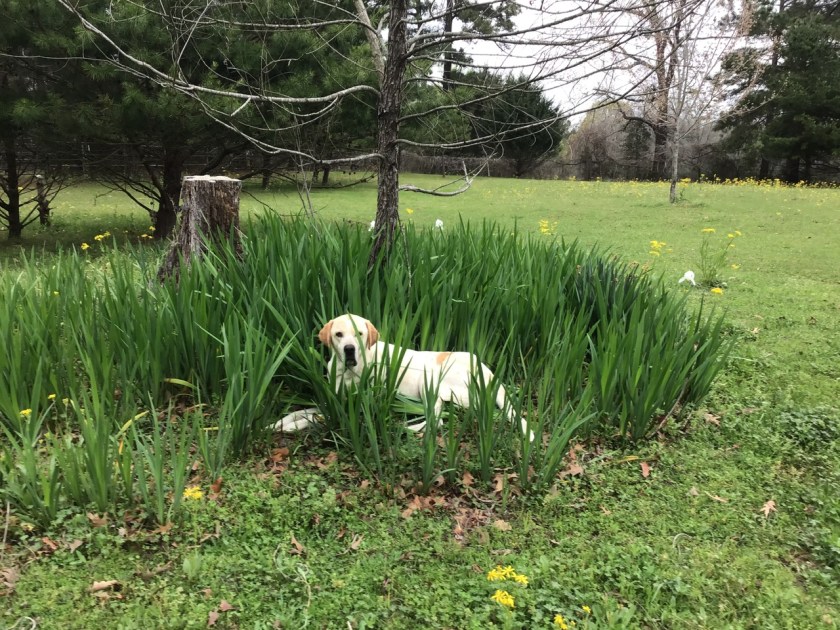
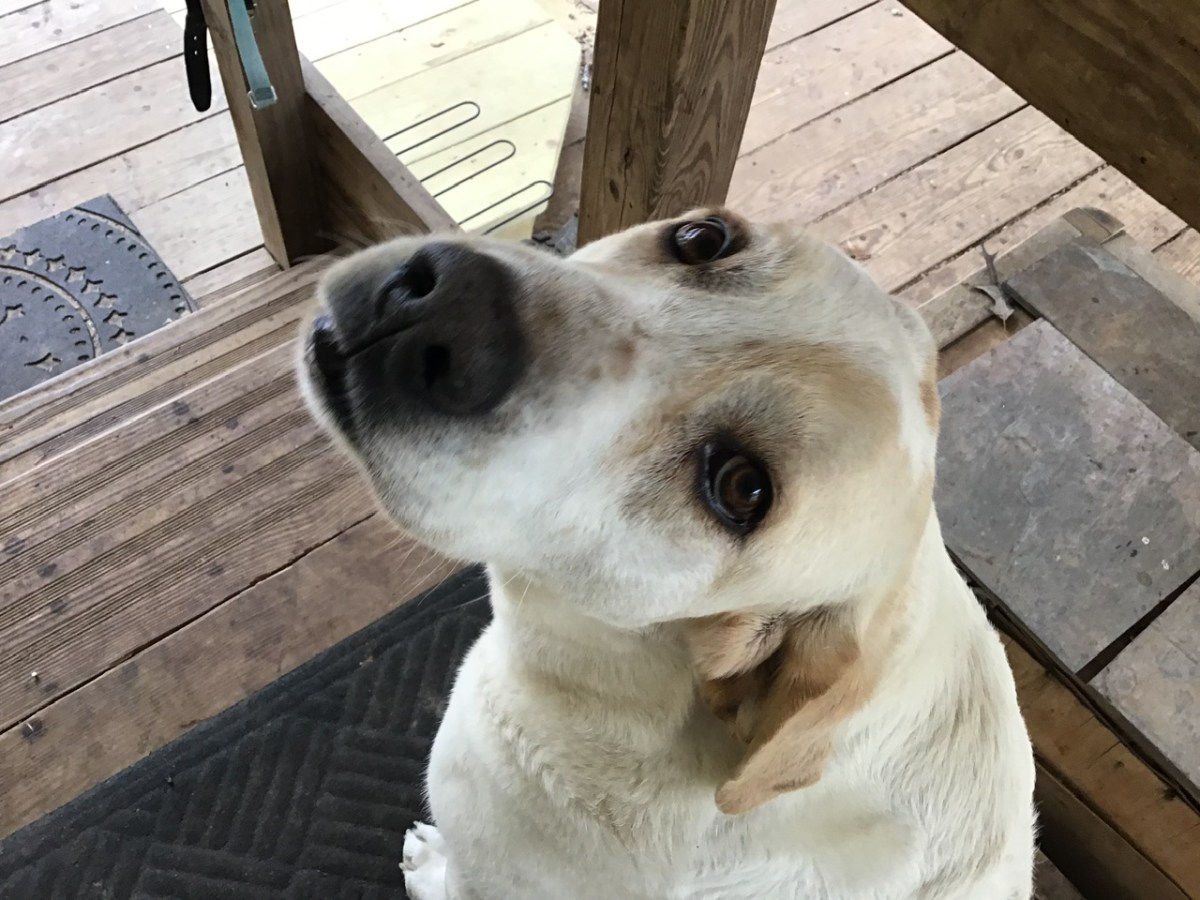
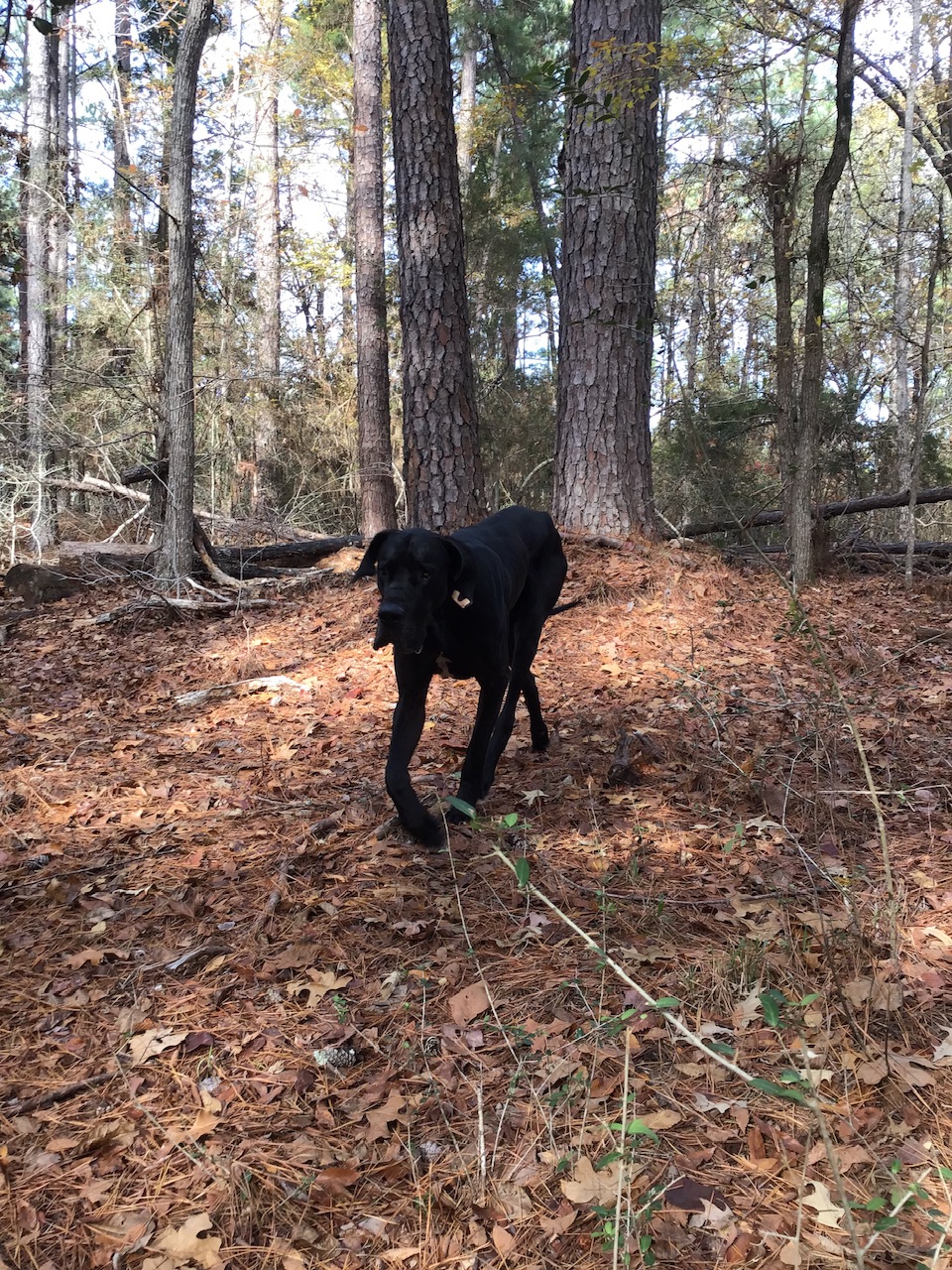
Shadow sniffing around, but not nearly as tuned into the wildlife as our livestock guardian dogs. In fact, he seems to be a bit allergic to the great outdoors, especially in summer!
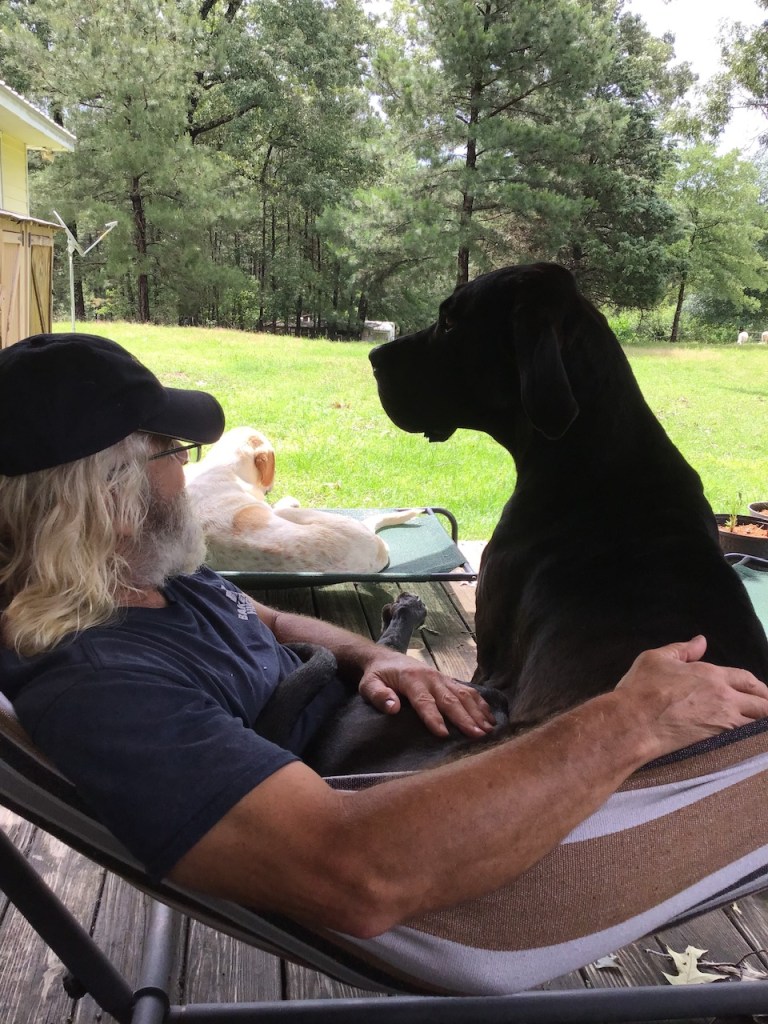
I think he prefers his time lounging in the hammock with Daddy. 🥰
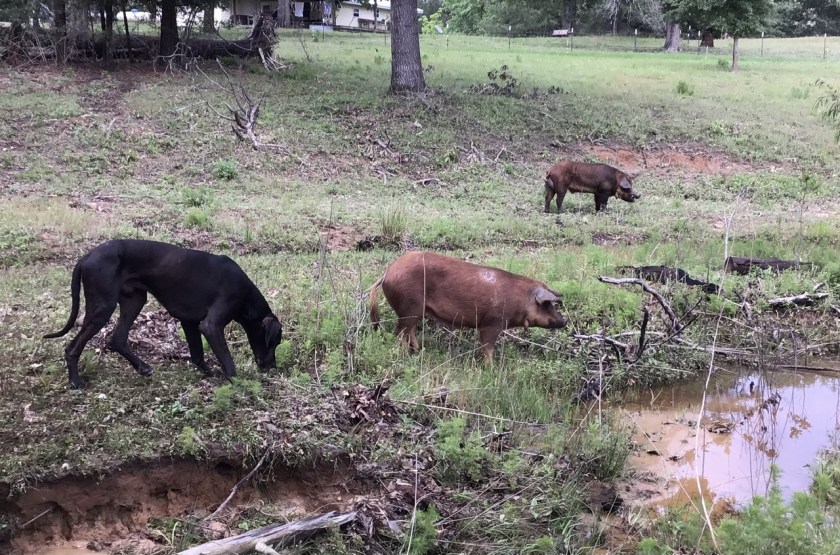
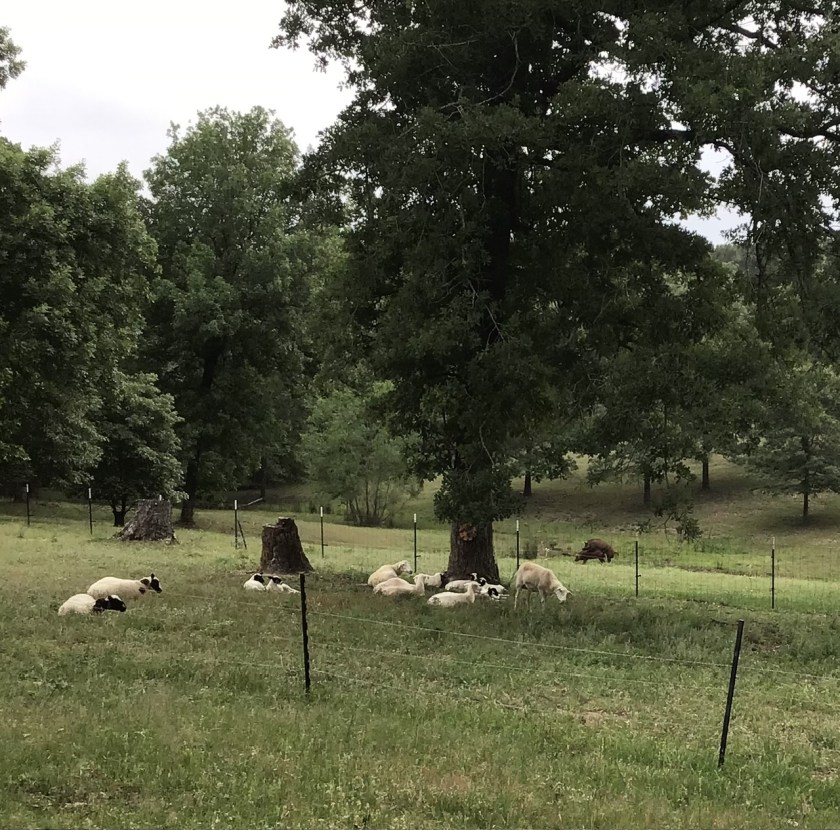
He does also appreciate chasing the pigs and goats and sheep, as much as we keep hollering at him to knock it off.
If you’re wondering what’s happened to scar up poor Pattie’s back like that, zoom in on the following photo to find the culprit.
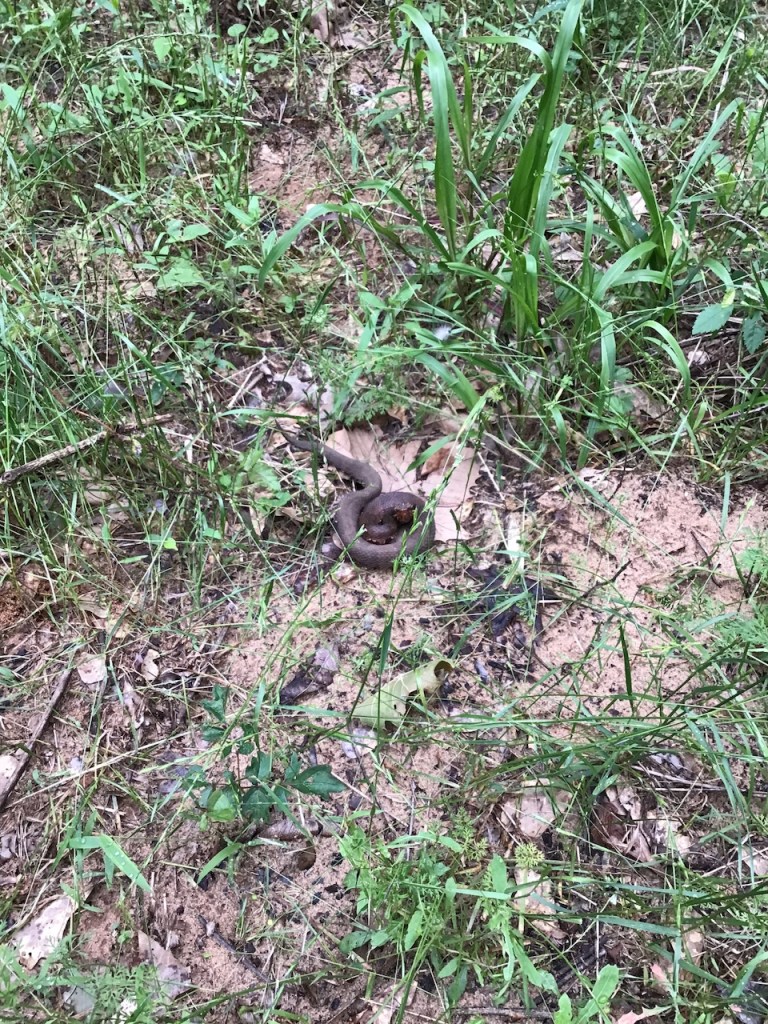
The rains have certainly seemed to wake up the wild life—just in the past few days we’ve seen a scorpion, 2 water moccasins, 2 copperheads, and Hubby even thinks he saw a coral snake.
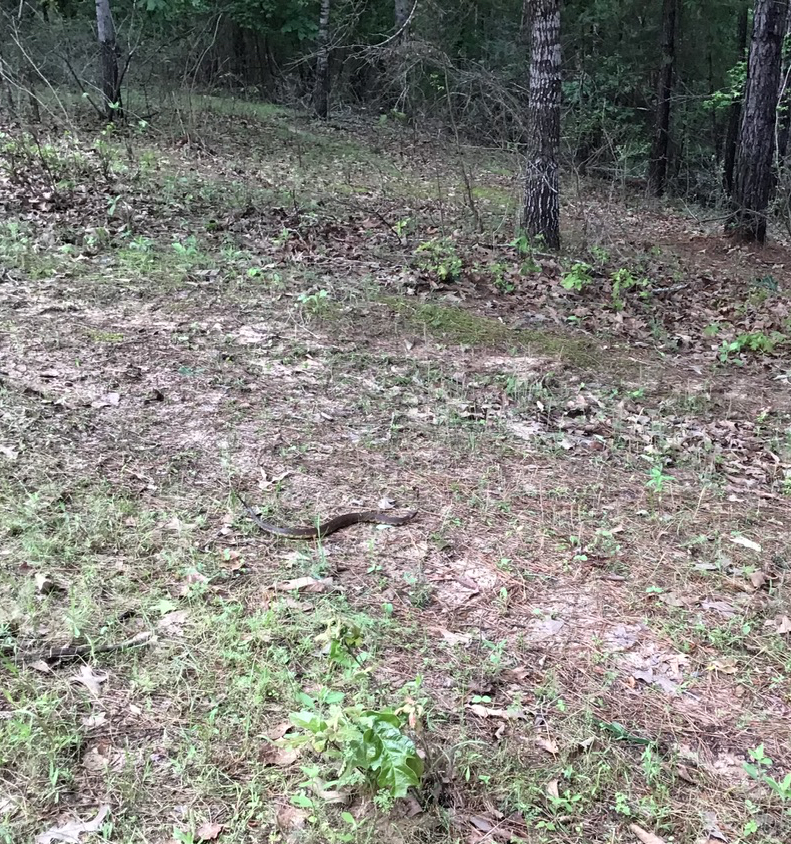
I followed one for a couple of minutes as he made his way back to the pond.
Water moccasin making its way back to the pond
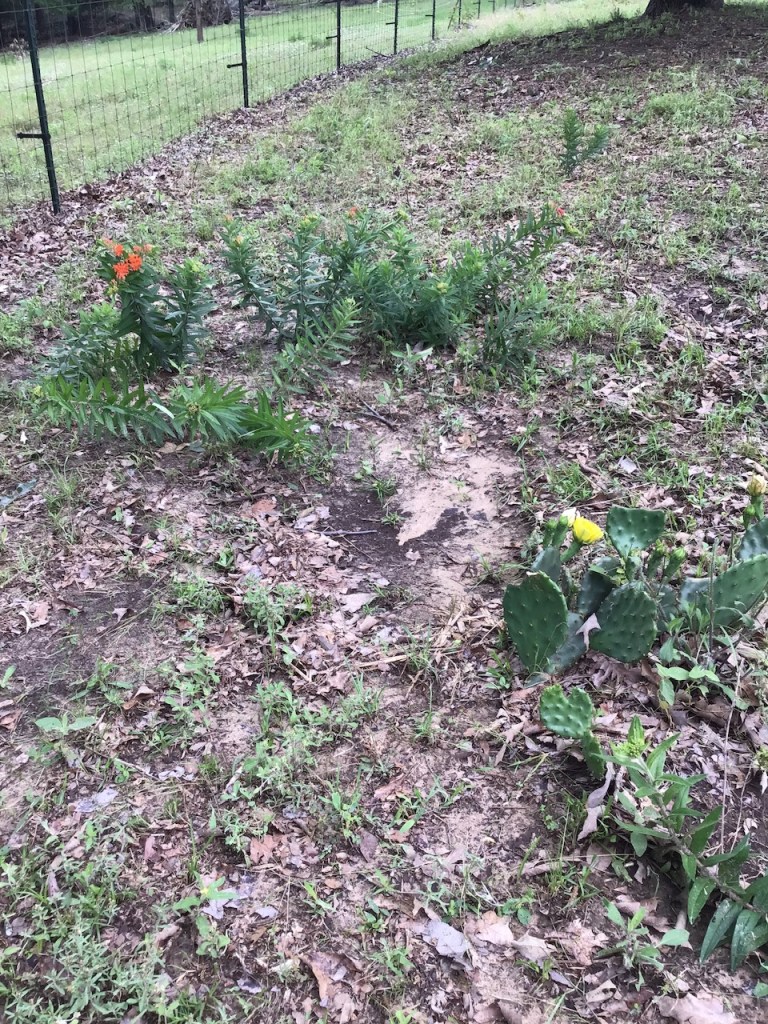
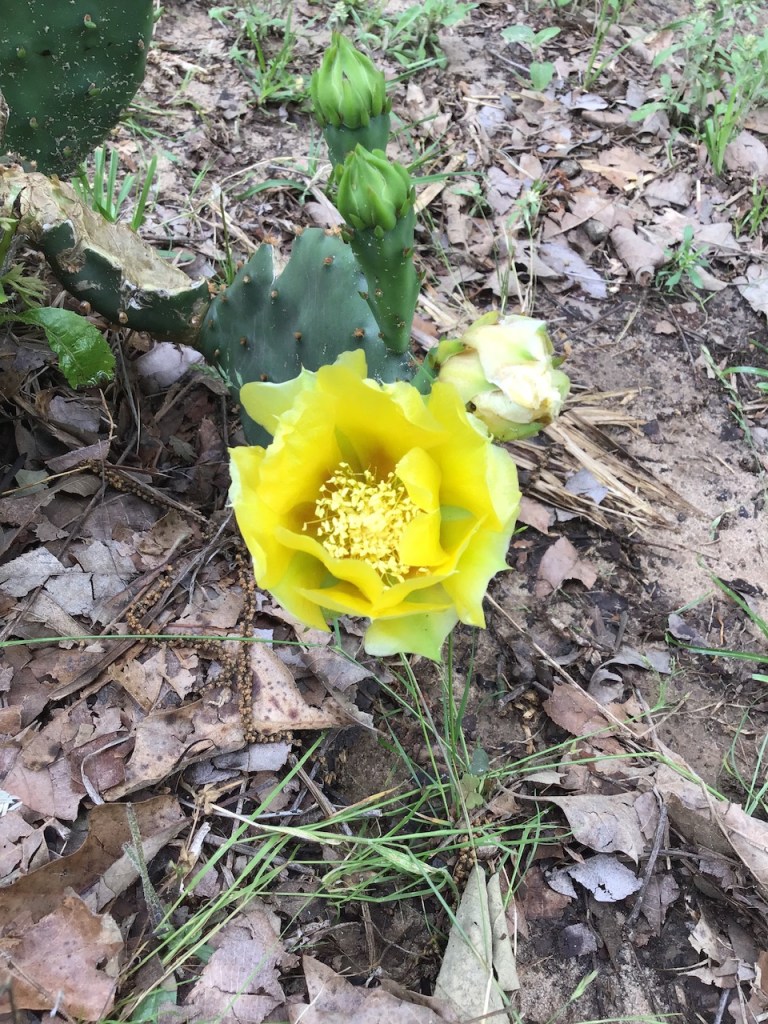
There are some more pleasant sitings as well, like these, wild butterfly weed (Asclepius) and Prickly pear cactus (Opuntia).
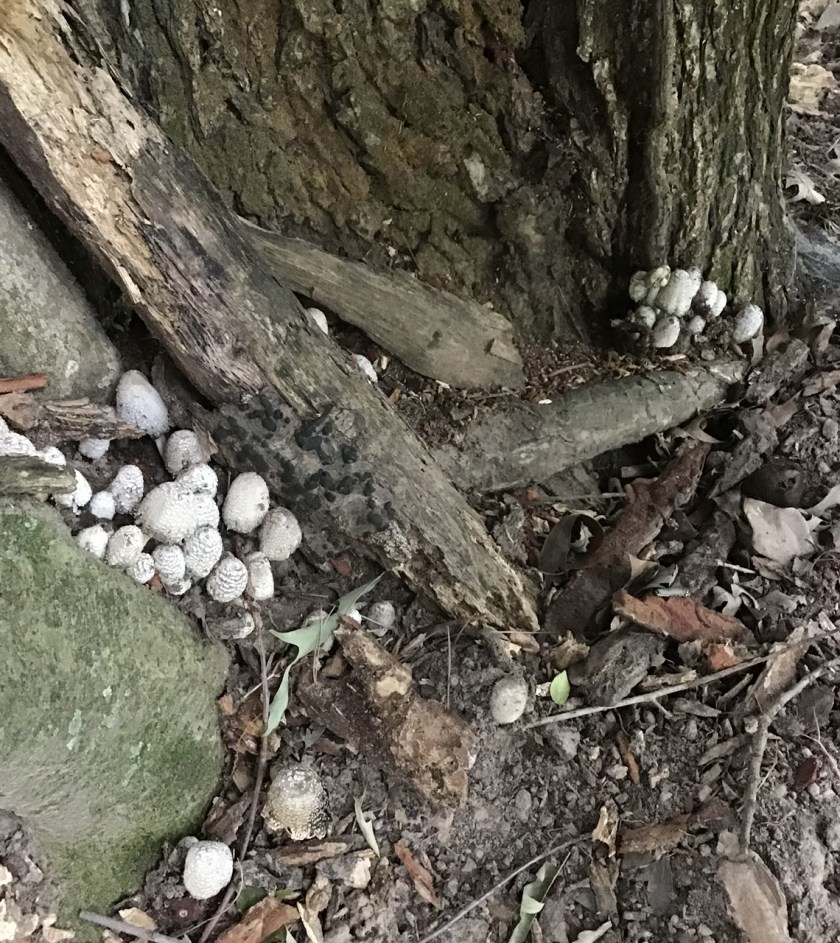
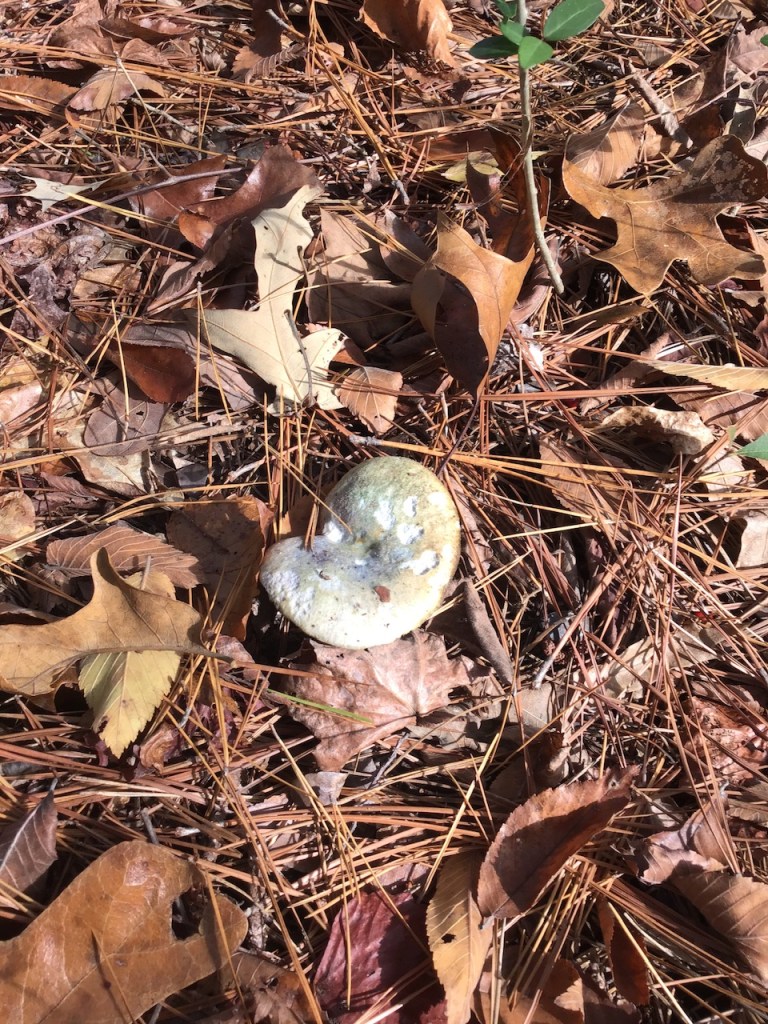
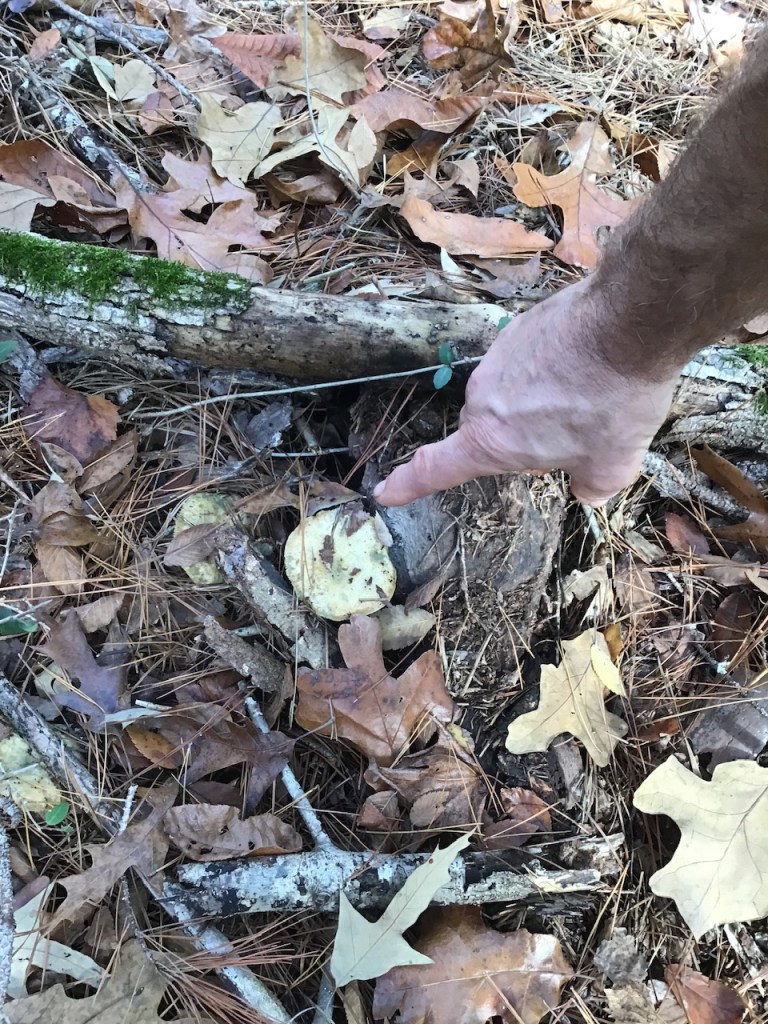
And some cute mushrooms that I haven’t been able to identify.
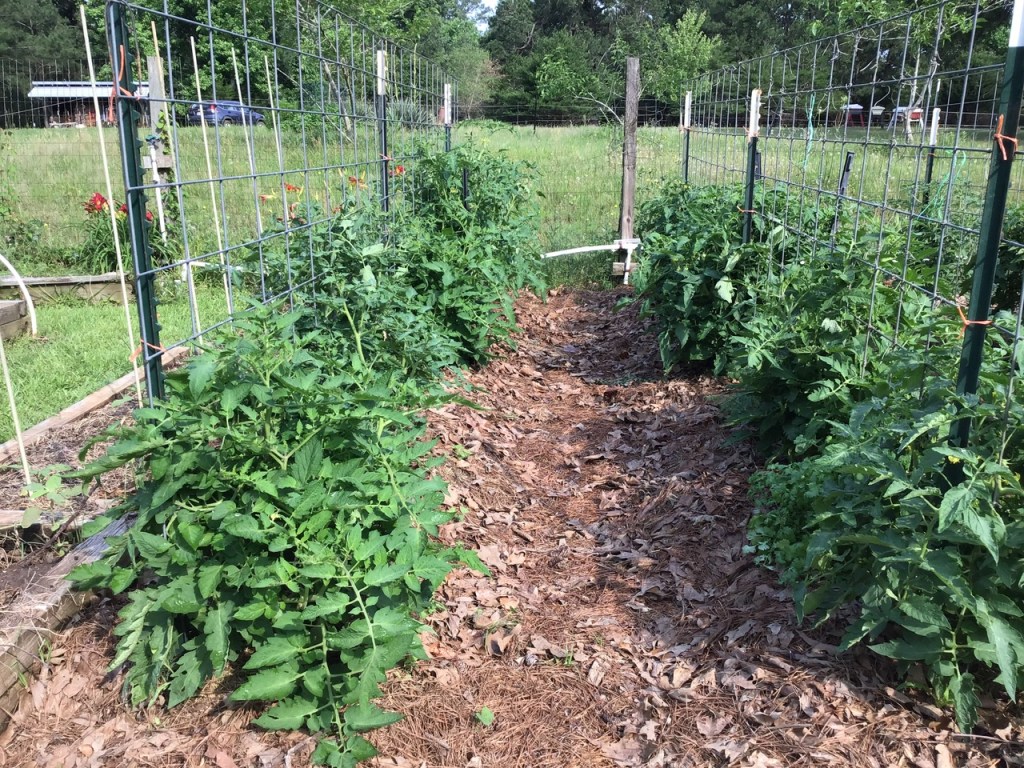
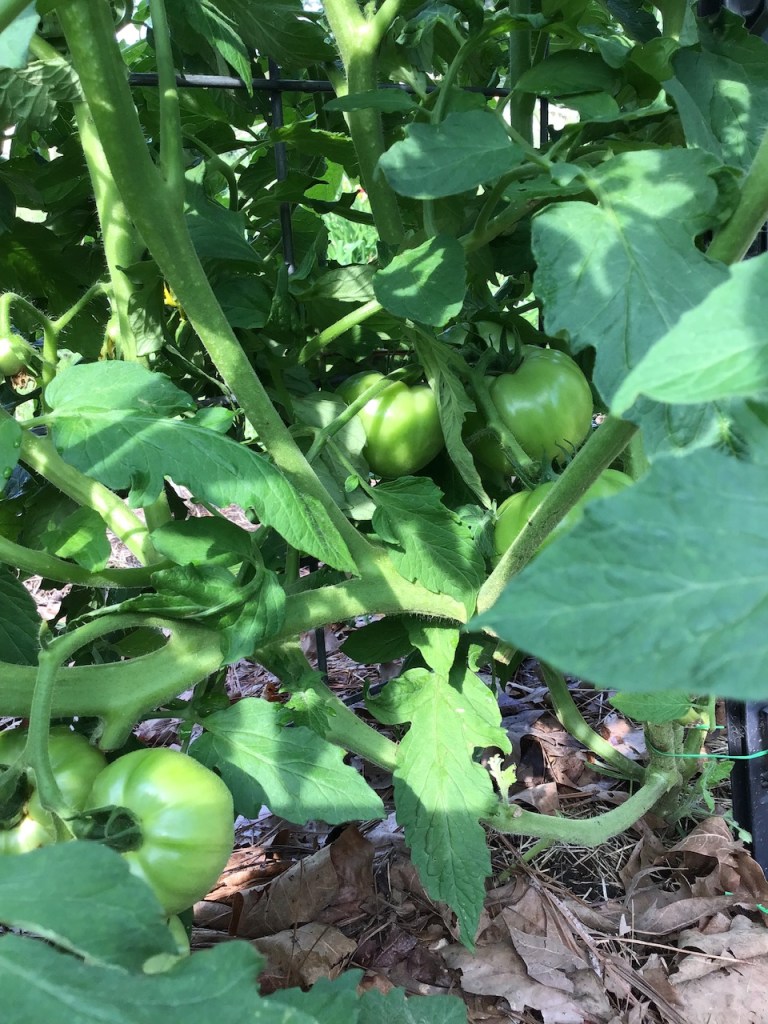
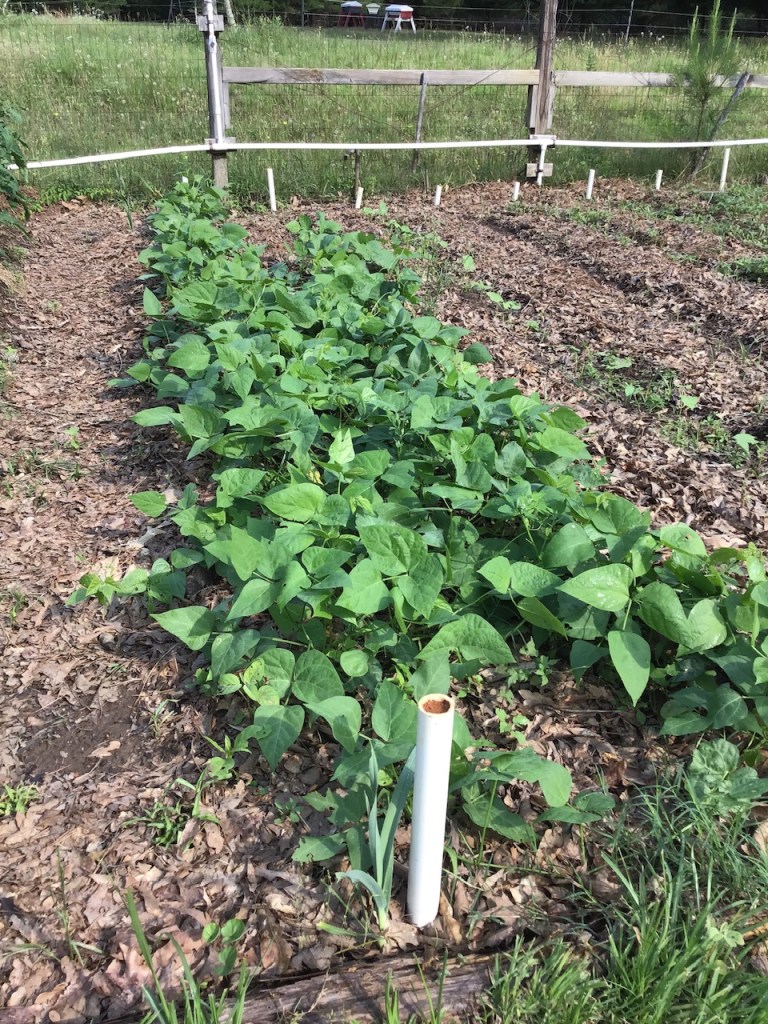
The garden is doing fine, tomatoes are growing very well, all from our saved seed. Beans and cucs just coming in and the peppers are getting their first flowers.
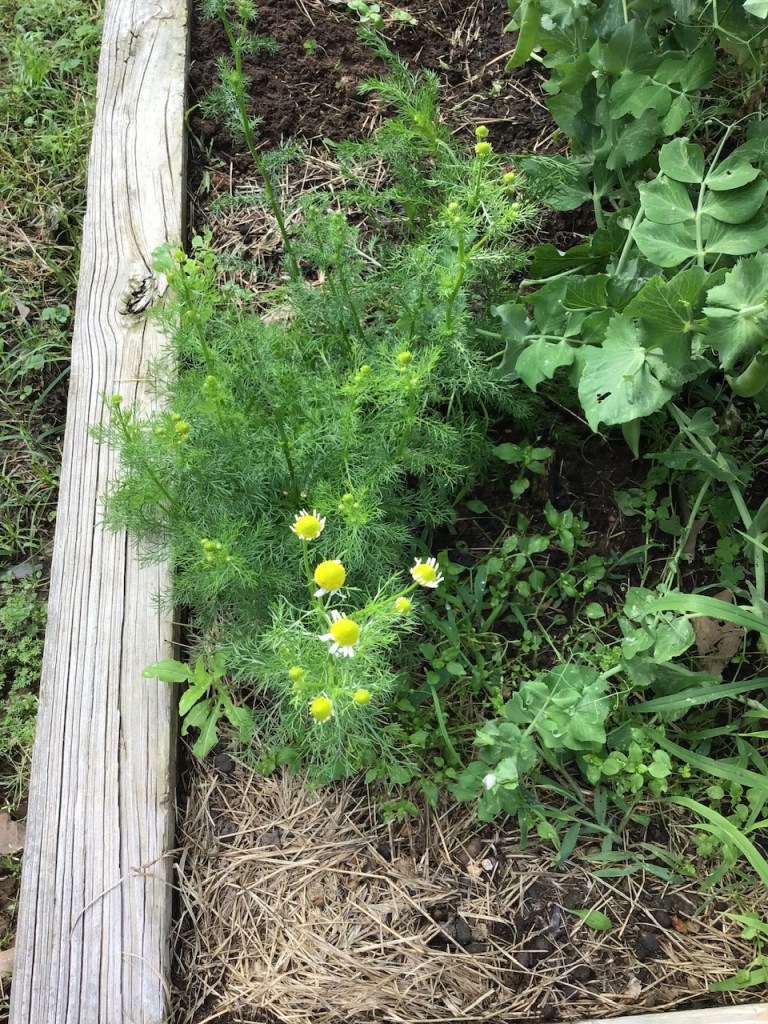
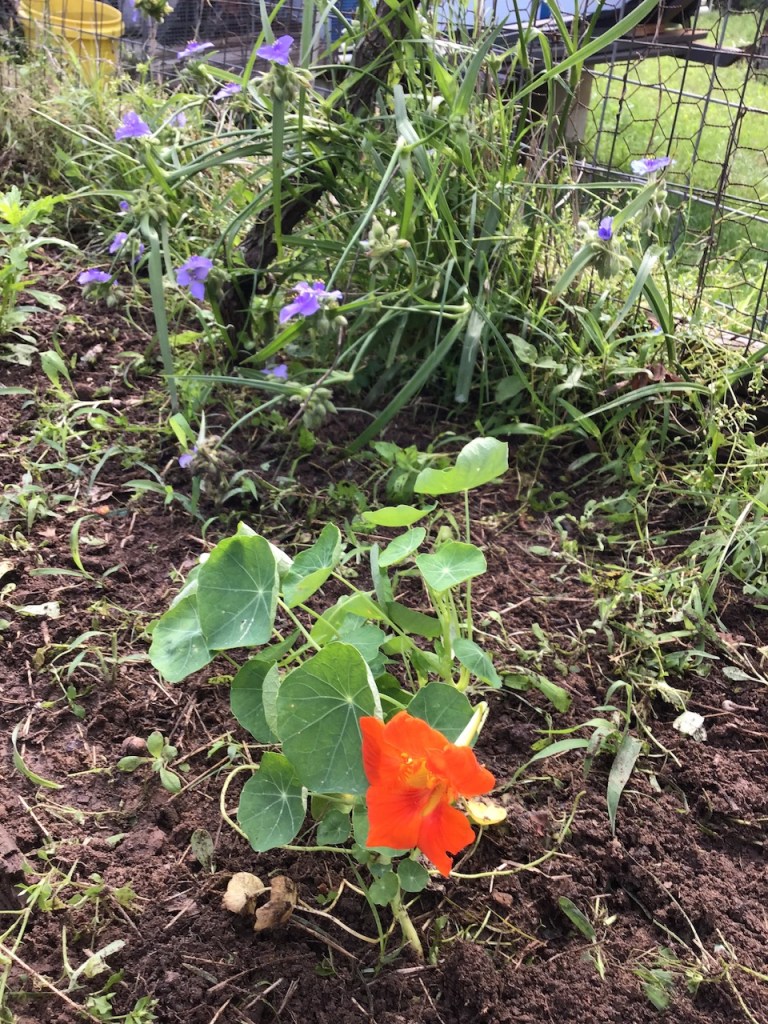
The first datura bloom, the German chamomile flowering by the snap peas and a nasturtium blooming near the wild spiderwort (a medicinal I’ve posted about here).
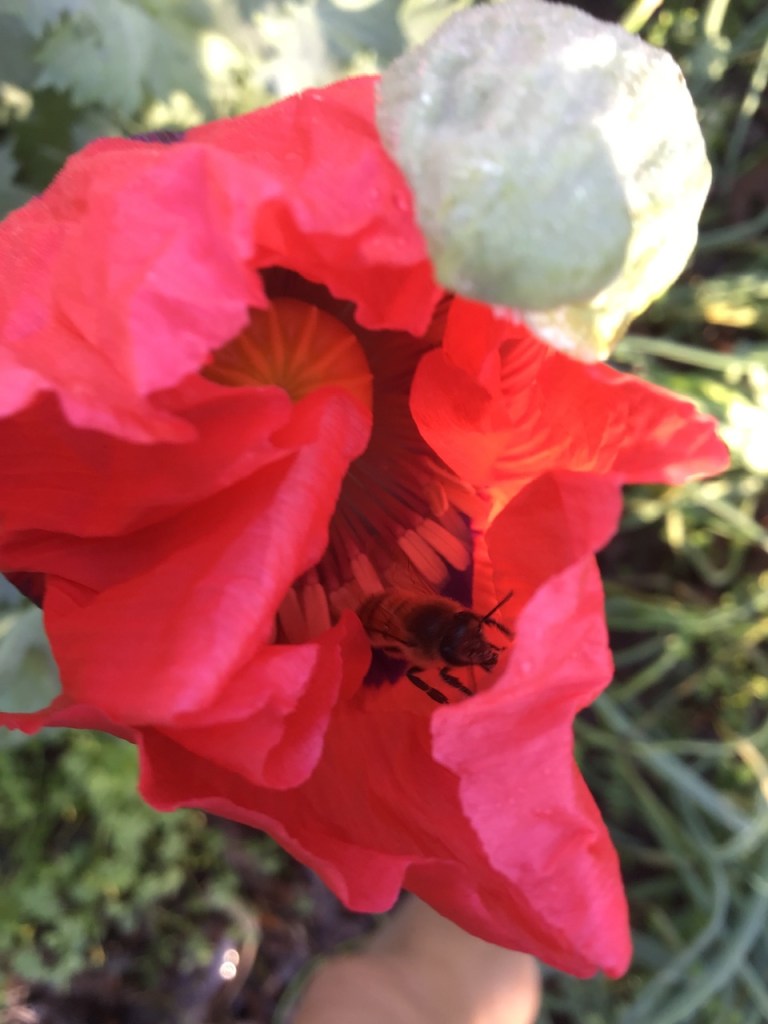
In closing, a quick view of honeybees bathing in Poppy pollen.
And other news this post, including Hubby’s big mistake, lots of garden snaps, critter updates and the new normal weather chaos.
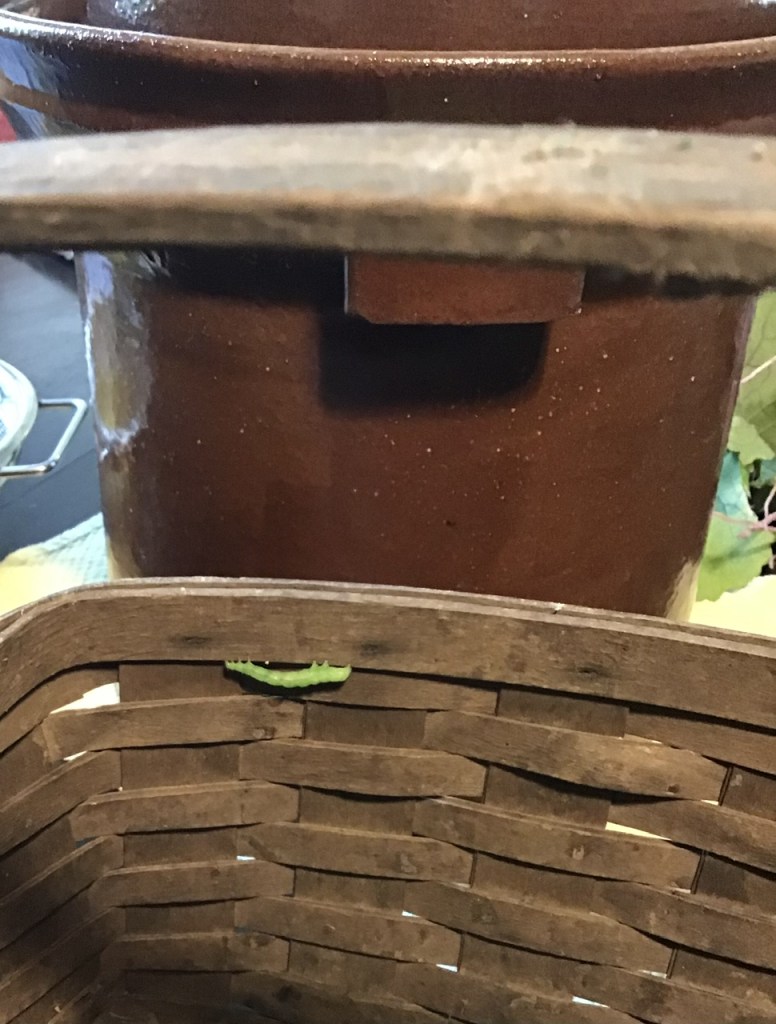
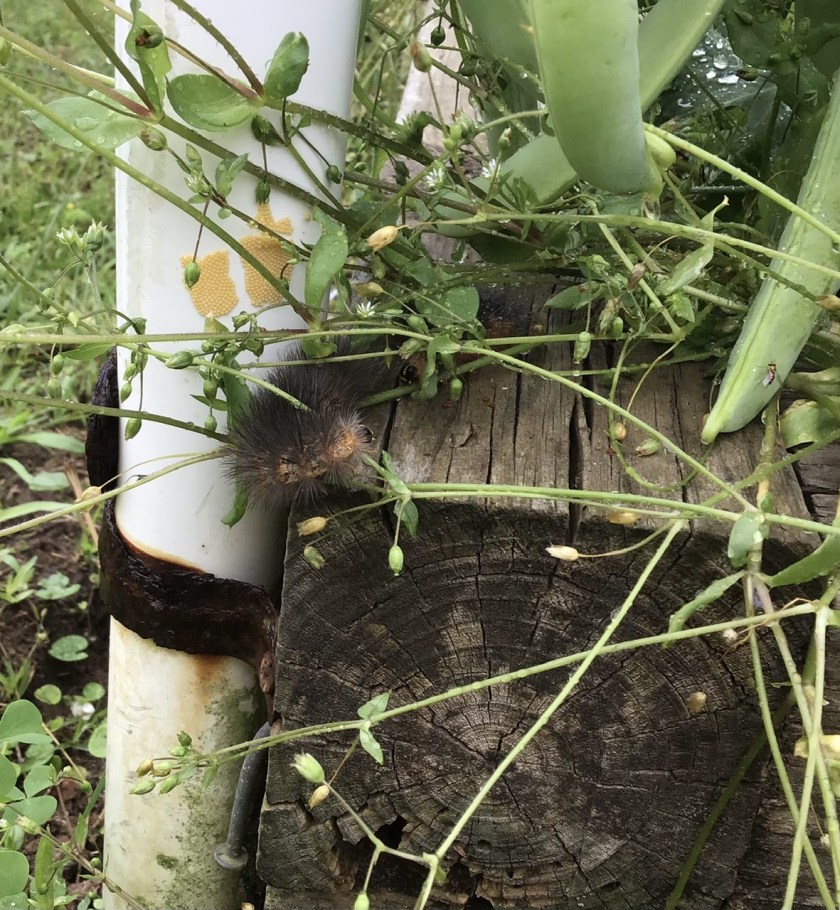
Big ones, small ones, skinny ones, fat ones . . .
Black ones, white ones, green ones, yellow ones . . .
Let’s see, perhaps a bit of 80s pre-conditioning before our current day “You vill eat ze bugs!”?
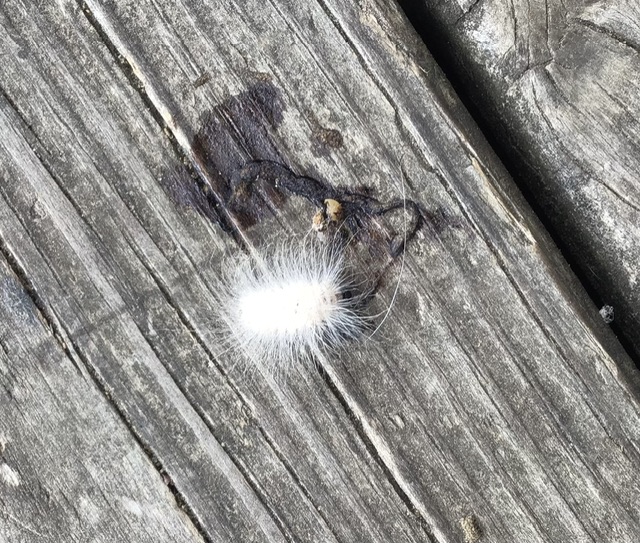
We’ve never seen so many, and such a variety. They do not look the least bit appetizing and clearly the birds agree, or there couldn’t possibly be so many.
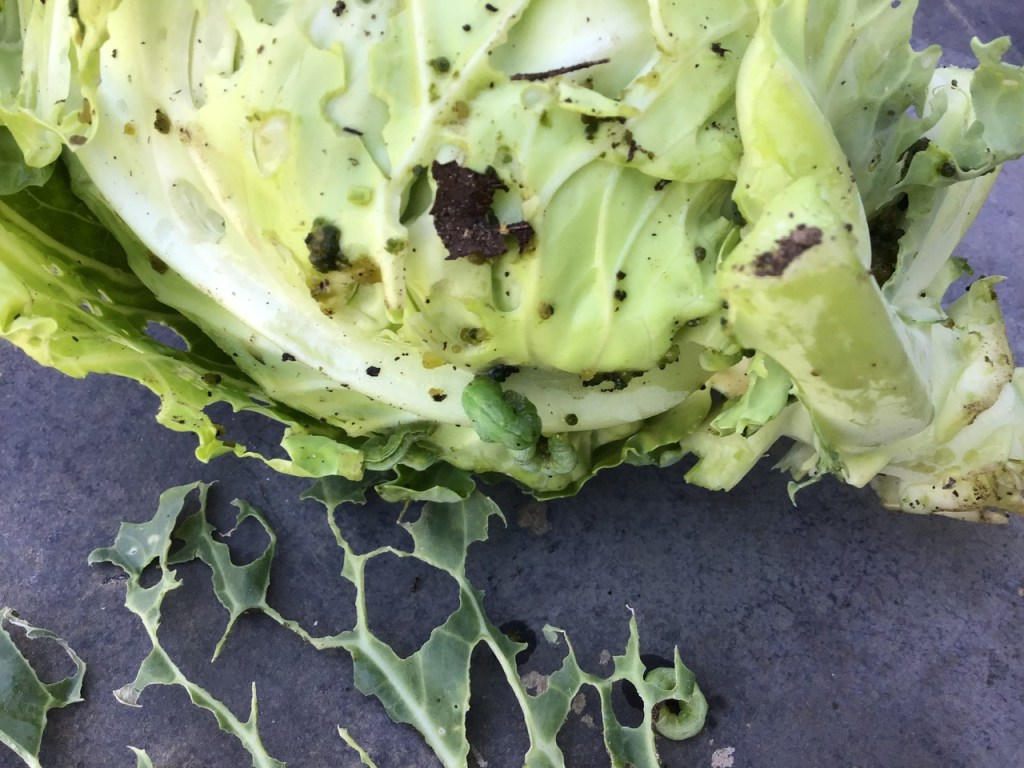
I’m not exaggerating when I say you cannot take a step without seeing one. I’m hoping they turn into gorgeous butterflies and soon we’ll have a garden full of them. But I haven’t looked them up yet and they could easily become some voracious relative of horn worms for all I know, about to attack the tomatoes.
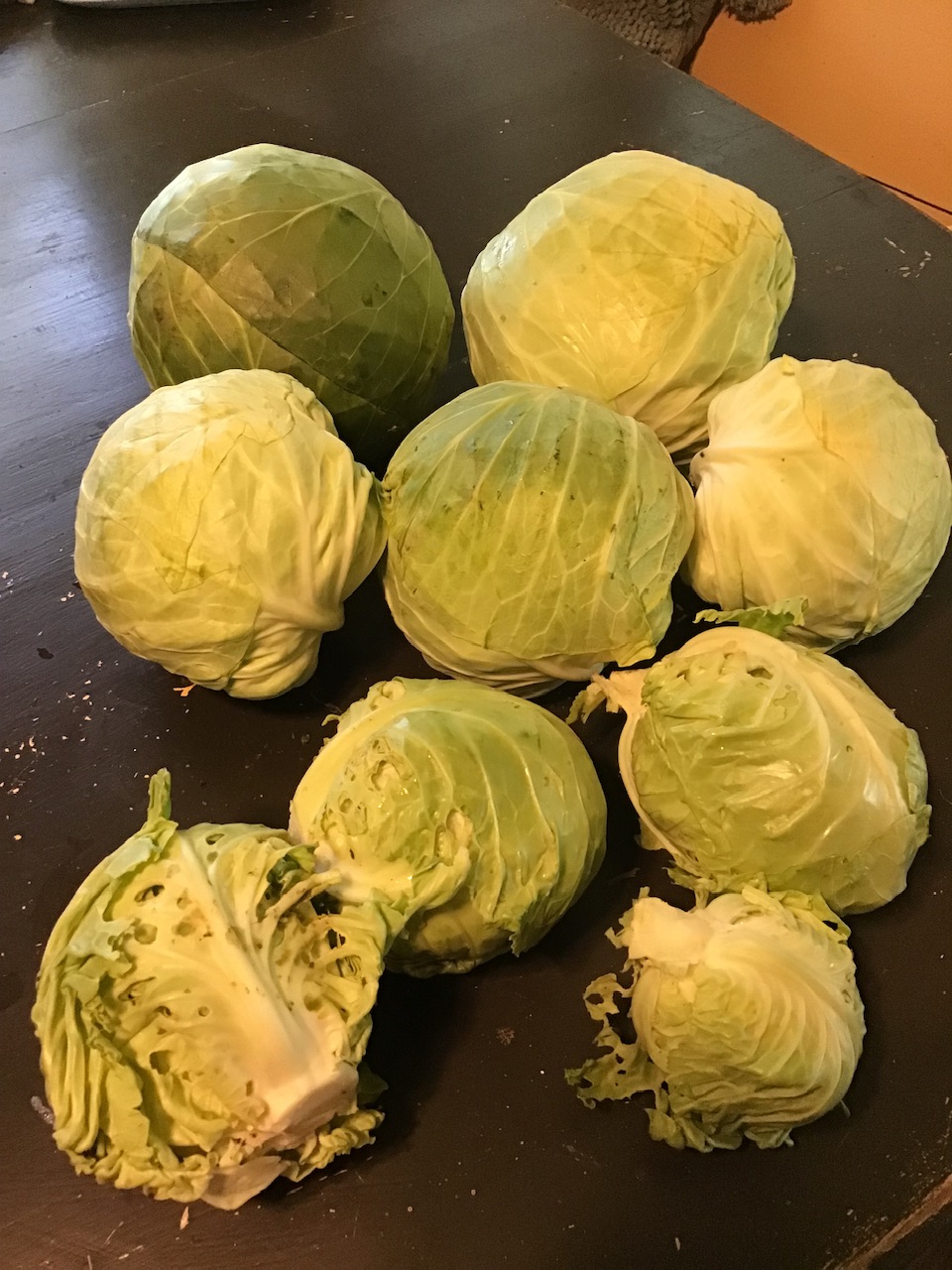
They’ve destroyed my spring cabbages and are working on the fava beans and snap peas now.
Fall cabbages in the back compared to spring cabbages up front
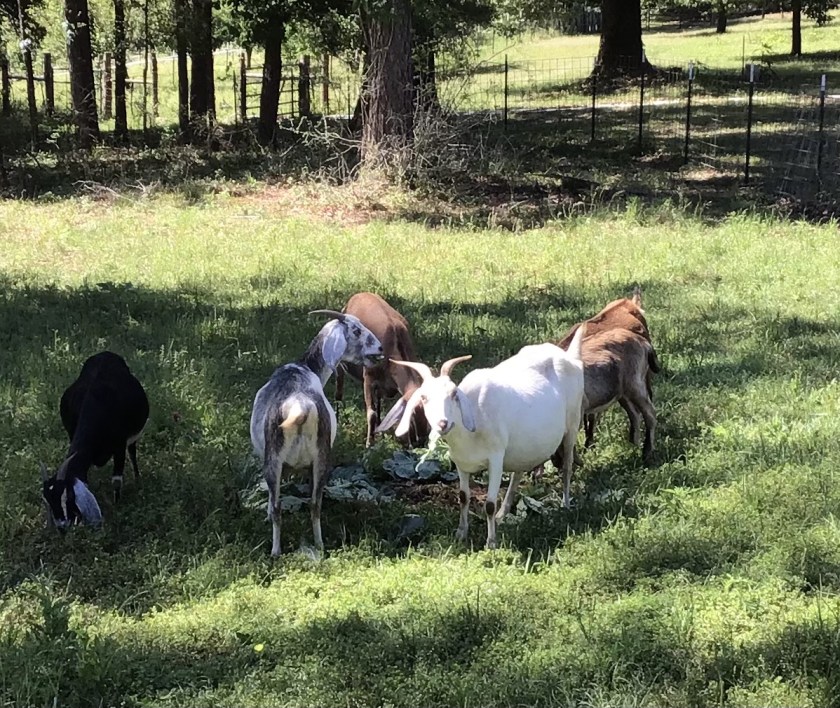
At least the goats appreciated all those Swiss cheese-like leaves.
Snap peas don’t last long here anyway and while those creepy crawlers get the leaves of them, and those of the radishes, at least they leave us the fruits.
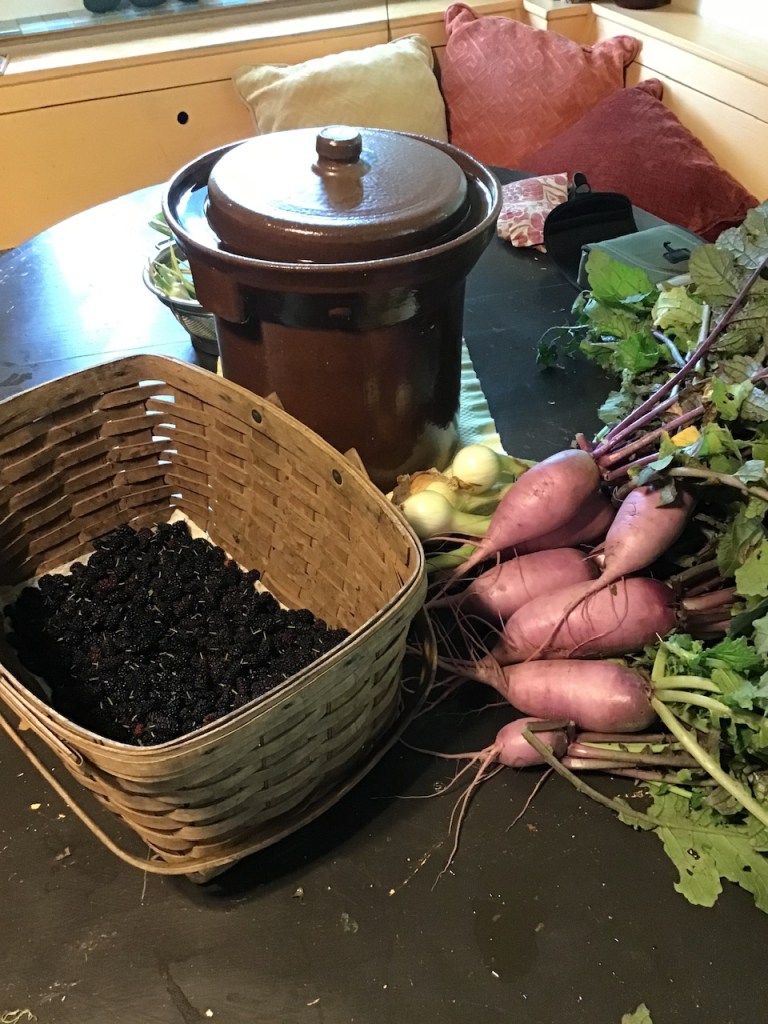
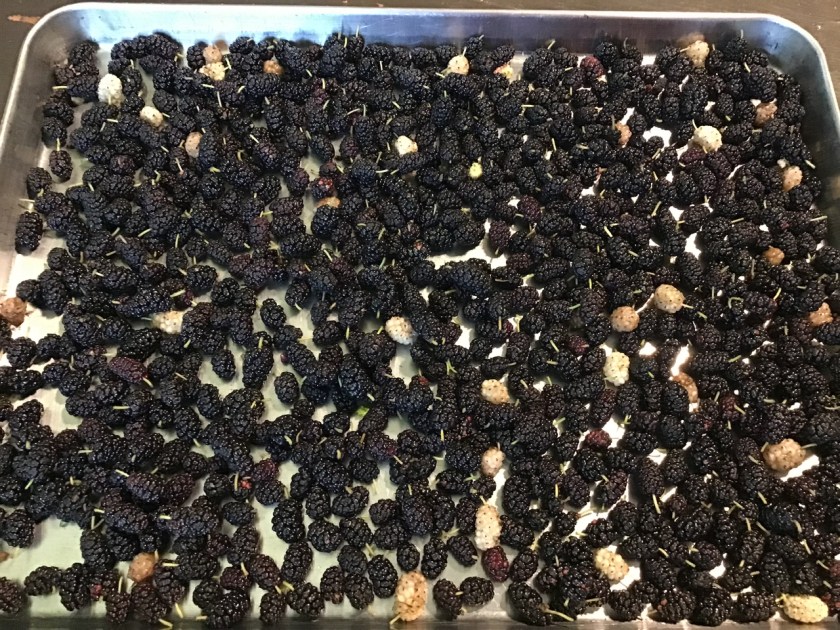
I’ve already made a large crock of sauerkraut and a quart of fermented radishes. Plus we’ve been getting loads of mulberries thanks to Hubby who has been destroying the tent worms that have been appearing all spring. Those little buggers love the wild cherries too and can easily destroy all leaves and fruits in a matter of days.
So, big kudos to Hubby for coming to the rescue, and spending a fair amount of tedious time harvesting these little beauties as well.
But, Hubby is also responsible for the misdemeanor crime of killing our potatoes! I should’ve caught it. I know, he was just trying to help. So, he filled our potato buckets with too much compost too fast and now we have potato disaster.
Lesson learned, you can only add a couple inches at a time, even if the greens are much taller than that.
I’ve got lots of herbs companion planted with the tomatoes that are all looking great.
Thyme, cilantro and dill growing between tomatoes
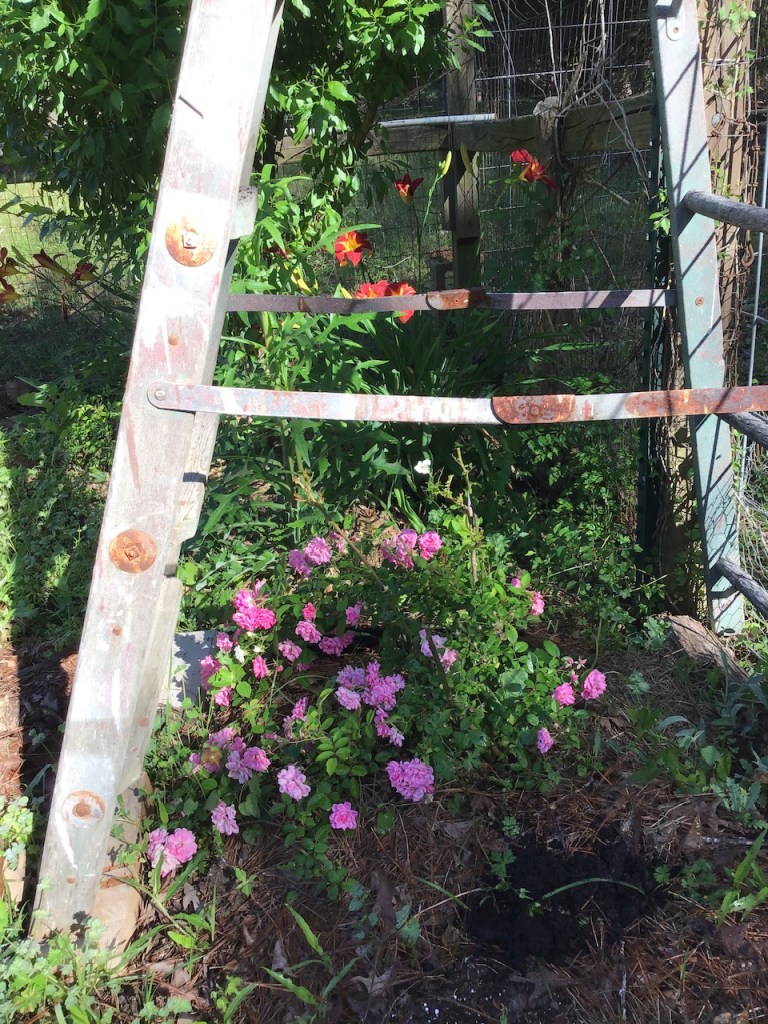
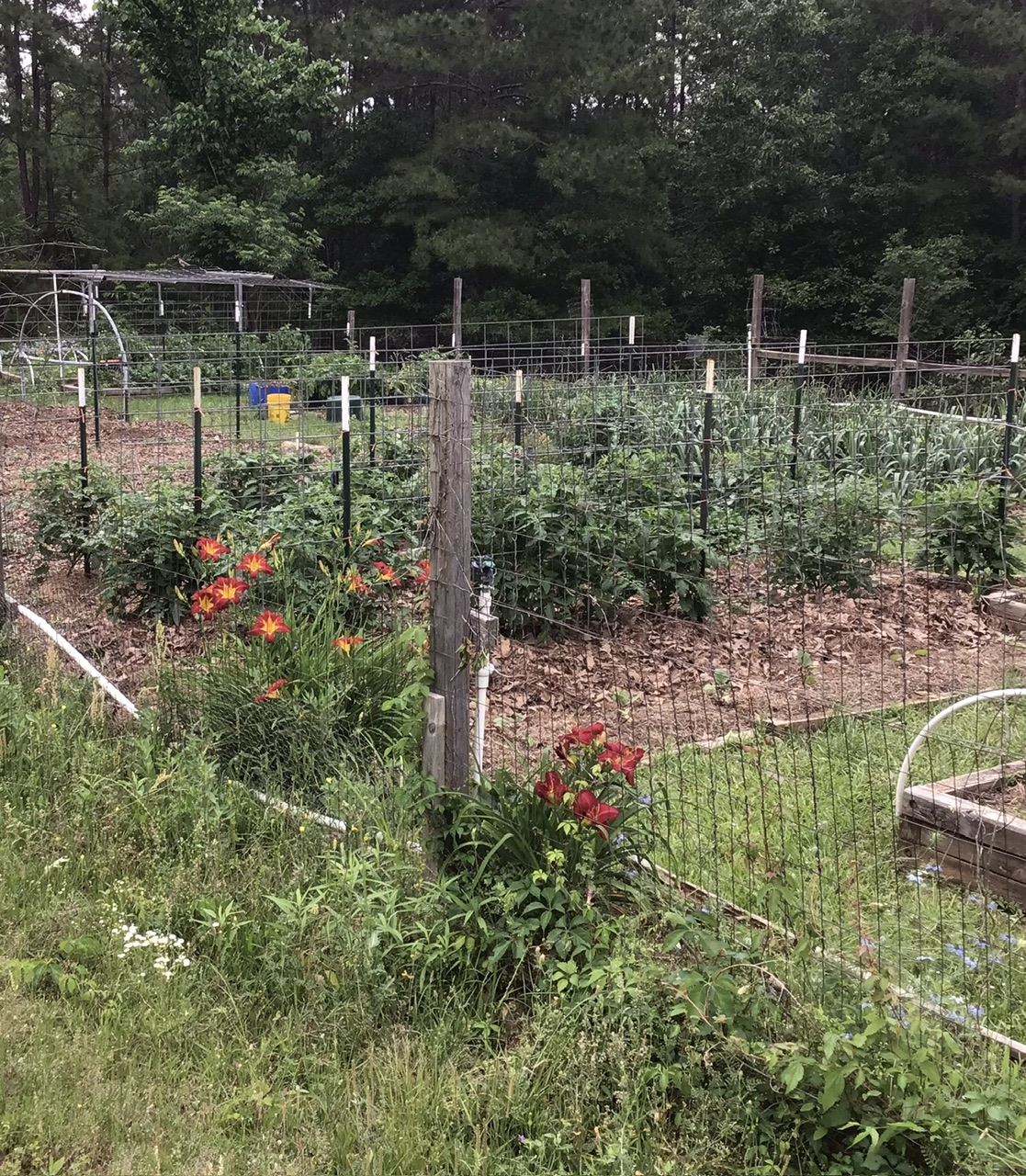
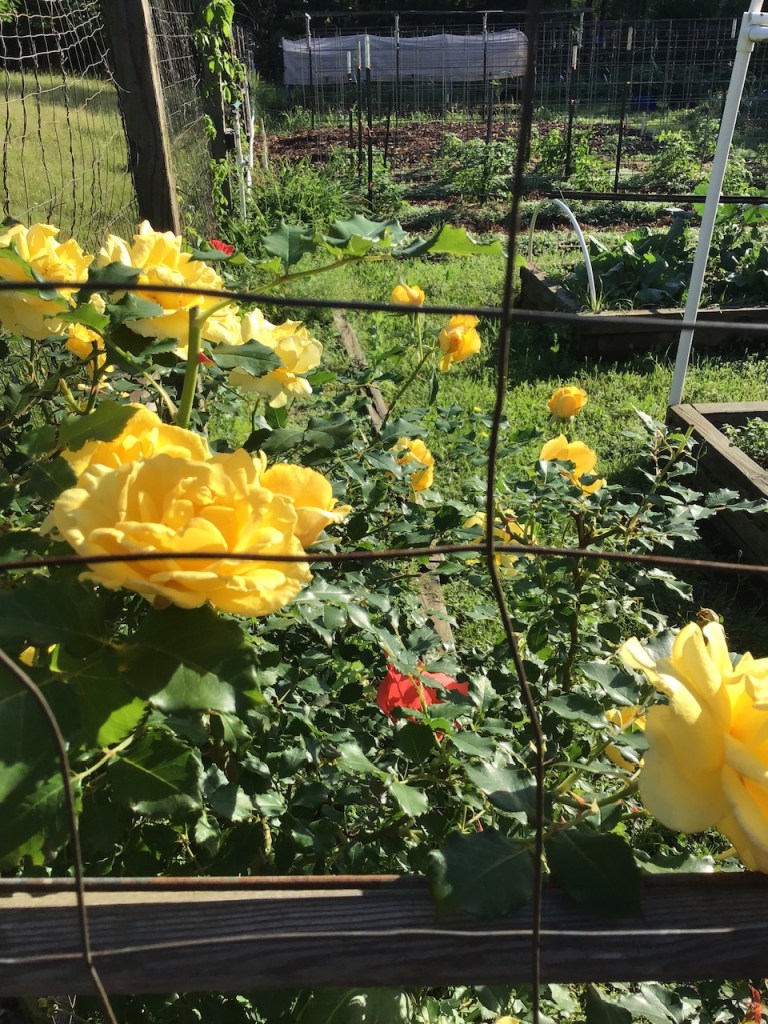
One of the best garden decisions I’ve made is far more flowers in the garden. Not only to attract pollinators, but to attract us too. It’s a far more inviting space than just rows of crops and makes me want to go in and play. 😊
The Peggy Martin rose just one year after planting a cutting from a friend.
And the Burr rose, many years old, huge and seemingly indestructible, even from constant nibbling by the sheep and goats.
And one of my garden favorites, which my photo doesn’t do justice at all: Nigella, a delicious seed and lovely tiny blooms in blue and white.
Their seeds have a grape-like flavor and are delicious in bread and kombucha.
A larger garden view
Another fruit that so far seems successful are the persimmons. We have both Virginia and Asian planted and the flowers on them are so unique, just like their fruits.
I’ve also got the citrus planted at last and I’m so excited! I cannot fail! (Says no one but me and I’ve gotten quite a few discouraging words from others on this venture.)
Planted along with the new ‘kiss me under the garden gate’ flower which is doing quite well, and the still unfinished wattle fence.
In the best news we have our first kids just born this morning. Milking season approaches too quickly!
The weather madness continues, unfortunately. Big surprise.
Some still think these are contrails! Good grief!
This weekend’s forecast looks like a drop-down menu: 1/16th inch rain possible, or severe storms, or flooding, or hail, or tornadoes. Try planning for those options, peasants! 😩
Hope life is a little more predictable in your neck of the woods!
Almost entirely happy snaps and almost no complaining at all, really! The garden is mostly great, the weather mostly fine, summer in full swing already, ready or not.
It’s been busy around here, as usual. But, busy in the country way, which is very different. Our preservation season has already begun, and it’s fixing to get very busy very soon. I have mixed feelings about that, but here it is anyway.
I’ve been saving the rose petals for drying and kombucha after admiring their scent and beauty in many lights and angles.
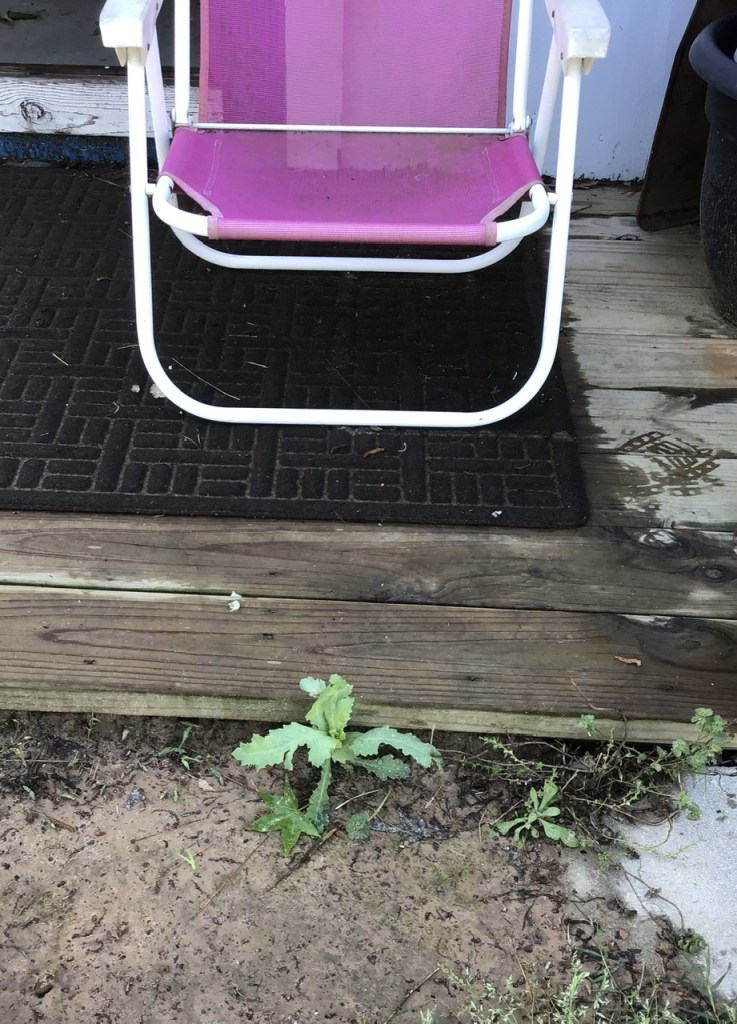
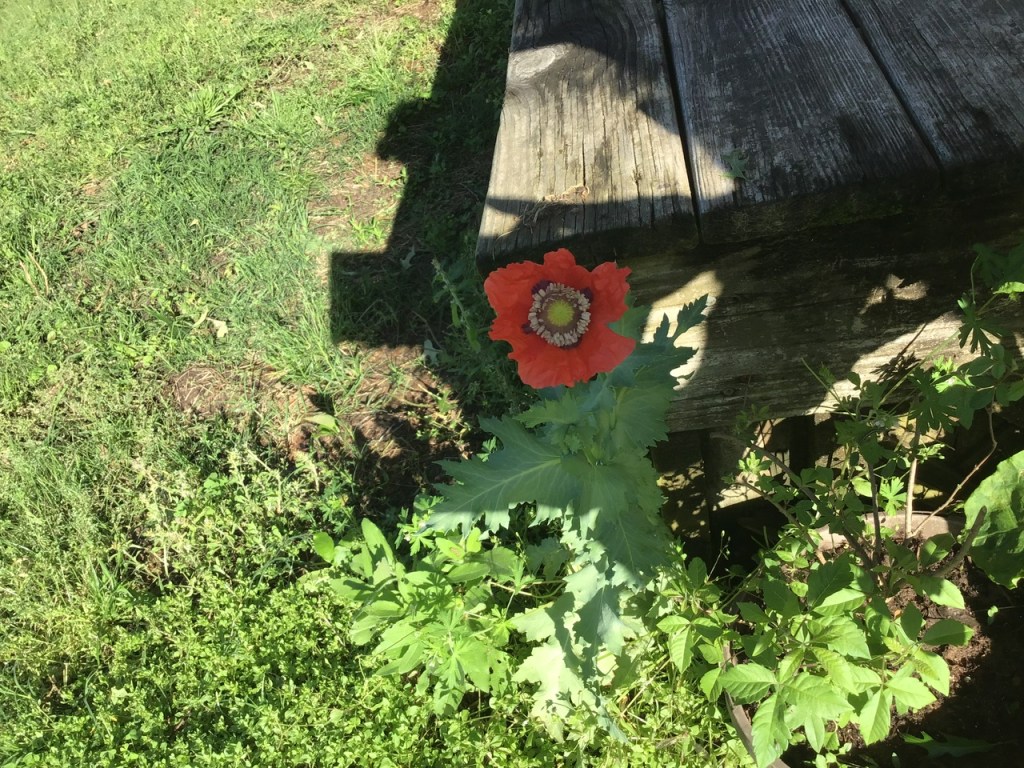
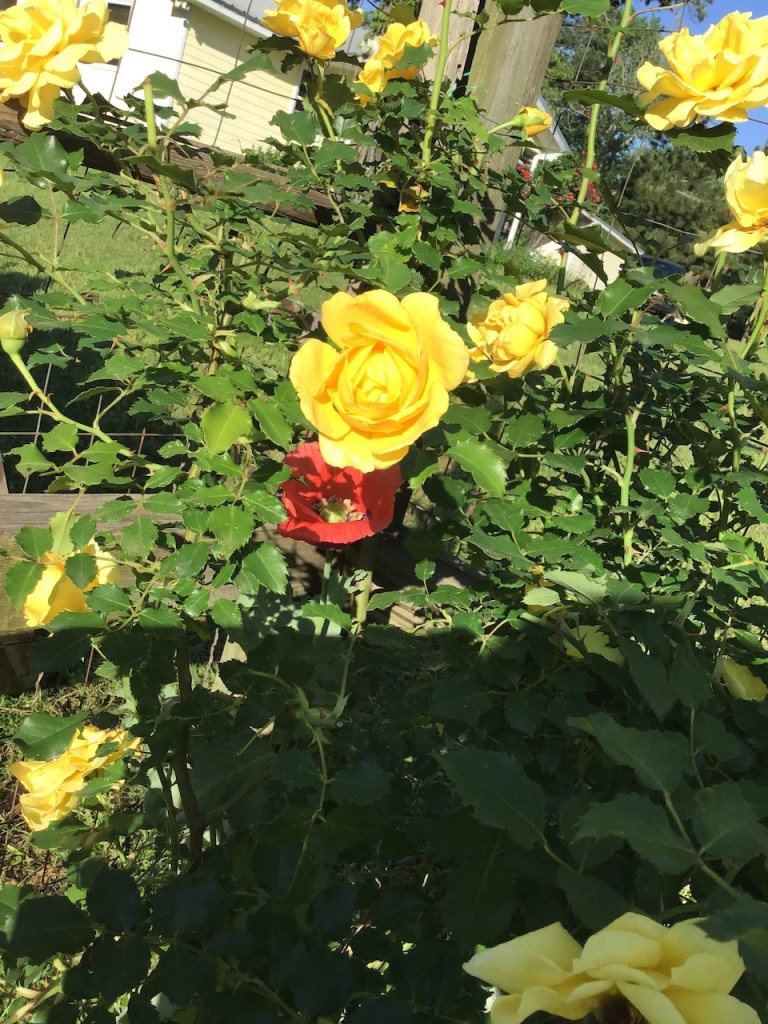
The poppies continue to pop up in random places, among the roses and in cracks and crevices, like dandelions.
And the bees love them as much as I do.
Another rose variety, the thornless Peggy Martin, I just planted last year, is now getting its first blooms.
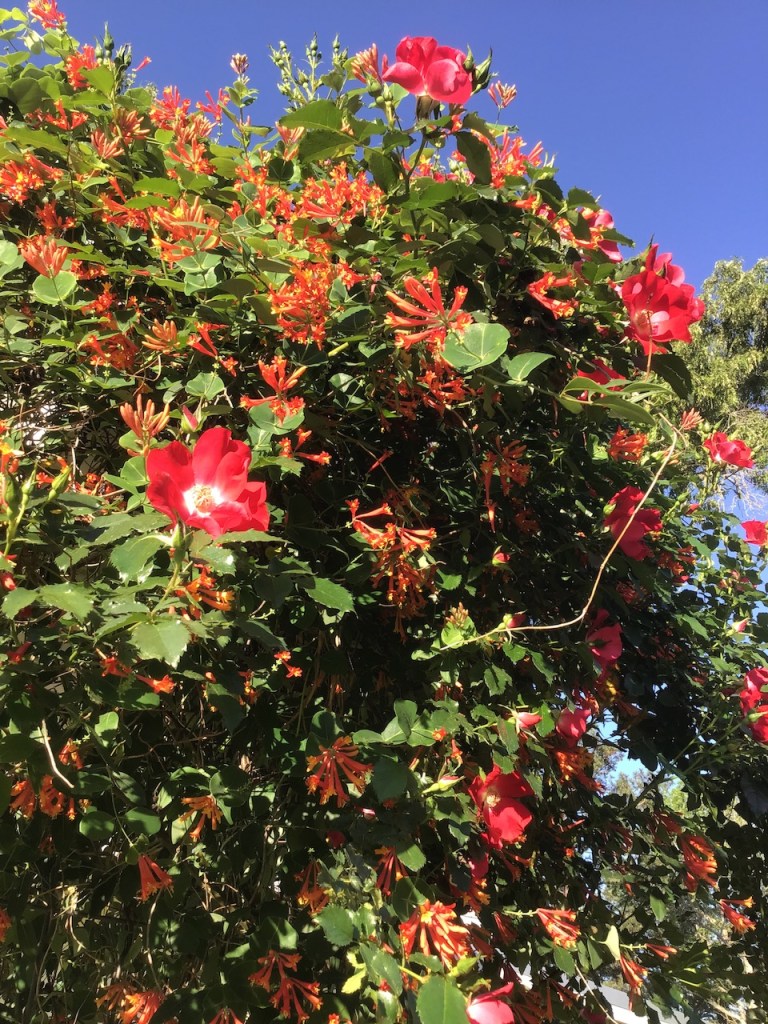
I’m so very pleased with the transition from cool-season coral honeysuckle blooms to the Dortmond rose takeover, lovely! I especially like the short spell they co-habitat.
The wattle fence I began with the best intentions is languishing due to too many other priorities. It has been a sheep deterrent at least, since the mamas and lambs have taken over the front yard. And even Shadow doesn’t dare stand in their way!
This is where the citrus will go, my new big project. I’m even considering throwing an avocado in there too. I know, very ambitious! But, I want to give some of the new methods a try and it seems like a good time. This side of the house is ideal, the house breaking the north wind and the heavy late afternoon sun. Plus, there’s the extra warmth accumulated in the walls of the house to help in cold snaps, along with the extra heating and draping methods that seem to be working for others.
Ooohhh, anticipation!
Just like the tomatoes and cucumbers coming so soon, right around the corner, and I can hardly wait. The last fermented cucumbers we used up a week ago, amazingly, and they were still crispy and flavorful. I plan to continue and expand my fermenting efforts this summer and fall. More herb pastes, more tea blends, more spice mixes.
The lambs are still doing fine, my how fast they grow.
Spring lambs on springs! 😆
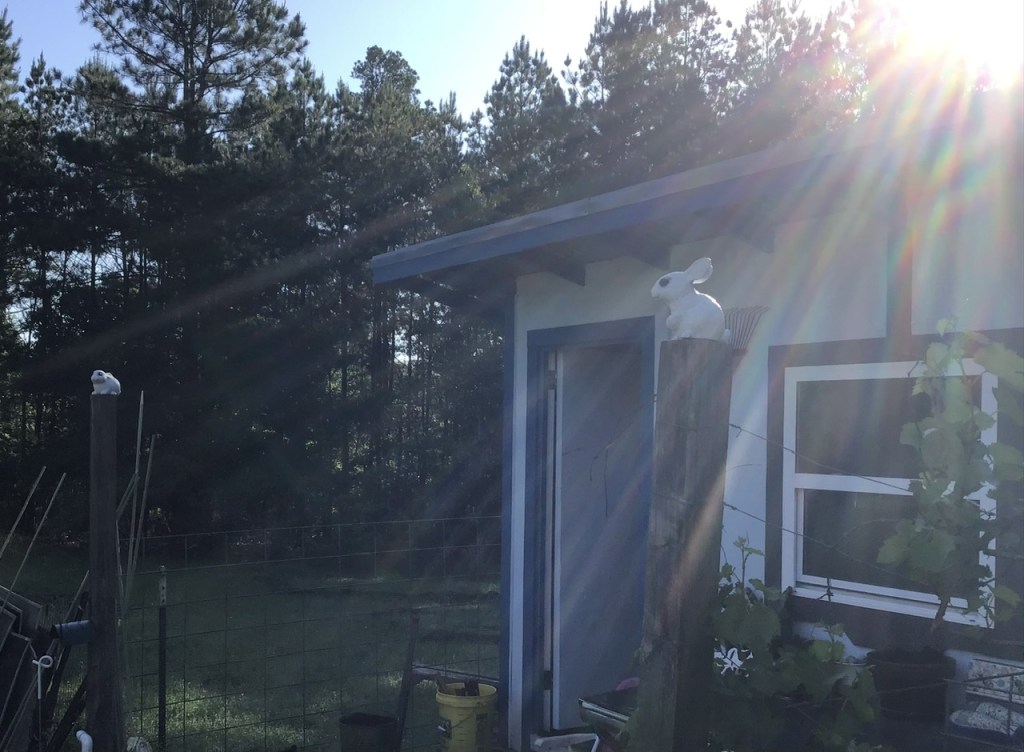
My garden mascots, two white rabbits.
And my single complaint—the spray continues to ruin our beautiful days.
Is this why we can so clearly see these colors, because we have an atmosphere saturated with reflective particulate matter?
Cool pic, or chem-filled haze?
“I’m no prophet Lord, I don’t know nature’s ways.” ‘Anticipation’ by Carly Simon
When I lived in Europe in the 90s it was not too uncommon to see an amazing castle for sale for a pittance. I do mean a real castle, or a vast country estate that included a structure that once was a castle.
And I do mean a pittance, as in, they were not able to give these places away.
Vauburg, France (not my image), bit of a multi-generational hodge-podge.
Sometimes that was because they came with strings attached, so I can understand. Or it was designated for a specific purpose or with strict regulations. You had to restore it, for example, which was something that cost so much that the just wealthy could not afford it.
I had a French boyfriend for a while, who boasted some aristocratic lineage and took me to the castle where his aunt still lived. I marveled at the exquisite property and at the lingering formality of his kin who addressed each other, that is as husband and wife, in the formal, using ‘vous’.
Maybe the uber-wealthy could afford it, if they cared to, but they just didn’t have the interest?
Or, which I’m actually more inclined to think these days, even with their fortunes, they would not be able to restore it. Because the skills to accomplish such an extraordinary endeavor have been lost to time.
A single example of the dozens of architectural marvels which have been destroyed in our little city, with more on the chopping block all the time.
In those days I dreamed of becoming a travel writer, or a writer of historical fiction. So, it’s not a huge stretch for me now to covet an interest in such parallel stories here, today, locally.
This is the closest real city to us, Palestine. What I’d call a small city today, though growing steadily. It was never more than a small city, as far as population goes. Just how it amassed such an amazing amount of great architecture is a real mystery to me. Though there are official stories.
I knew there was some interesting history there, and all around here, but it’s not like I’ve had a lot of time for exploring such idle pastimes, with all the work trying to build up a homestead.
But lately I’ve been squeezing in some time and loving it!
And of course, you’ve got to blossom where you’re planted. I used to tour every castle or abbey or old walls or ruins I could find, whether in the Old Town of any European city or hamlet, or a day hike away from the nearest bus stop.
This Old World has entered center stage for me again thanks to the Cyber World, which is really kinda crazy. But, true.
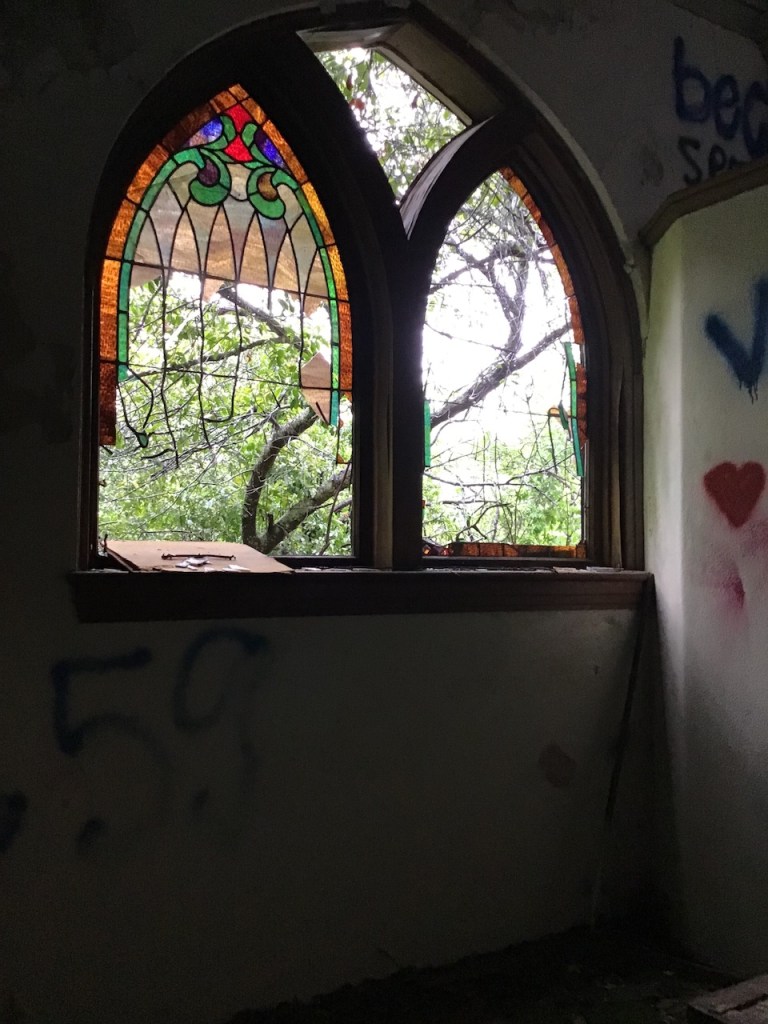
I’ve seen this old church for sale the last few times while driving through the downtown streets marveling at the old buildings.
I stop for lunch, and at a favorite antique shop, where I see tourists, which I find delightful. Though they only have much interest in the antique shops and the cafes and the provided entertainment. Still, it’s fun hearing German in the tourist office and hearing ladies from places all around the region, even in a rainstorm, there to peruse what our little city has to offer.
I was a novice travel writer, until I met the love of my life, who I managed to lure from the beaches of Thailand to a trailer park in Mena, Arkansas.
Hubby and I at ‘Roman ruins’ in Spain 2003—note our cute matching outfits—that was not planned.
And look who returned the favor by luring me into the deep woods of East Texas to spend an exceptional amount of time doing menial labor. 😏
I was also a beginner tour guide, Mayflower Tours. I lasted about two weeks, until I realized how unsuited I was to a job hosting a bus full of retirees for four-day trips to and around Branson, Missouri three times a month.
I think they weeded out a lot of us that way. There must be a trick to how many bossy seniors and cowboy theaters can be stomached for minimum wage, but I couldn’t figure that out quite fast enough. Another potential career option in the toilet.
And yet . . .
When I see precious gems like this my imagination sparks just like those days in Spain, France, Germany, UK, Czech Republic, Poland . . . Ok, everywhere, just about everywhere. I was very much a Europhile. Still am.
And yet . . .
I’m so struck by the lack of general interest. And knowledge. And, frankly, care.
I see the collapsing remnants of a structure worth saving. I see a history worth understanding and passing forward.
That’s the shot to inspire a buyer’s creative juices? Yikes. What about its real history, does anyone care? And, where’s the roof?
But the Realtors, who are there to sell this precious gem, see little of that world, neither the past nor the true potential. It’s such a shame. Such a very common, and so very confusing, big fat shame.
Will it become an ‘event venue’ as they suggest? It’s hard to imagine the kind of events that would make such a renovation effort worthwhile, or particularly palatable. Is there even such skilled workmanship available today?
Dare I question, true philanthropy, if it ever existed at all, is it dead?
There are many such gems in our little city, which suggest but mere clues to the true treasures in our midst, in plain sight—all teetering in a world of nearly forgotten but, dare I hope, at least a cyber-revival?
A taste of the hidden history in plain site, he’s getting to all the states eventually, and beyond, one of a great many channels sparking my renewed interests . . . 😁
The exciting season continues! Mostly plant talk this post. And, we’ve got our first lambs, I’m workin’ my first wattle fence, there’s some flower photos and fancy garden plans.
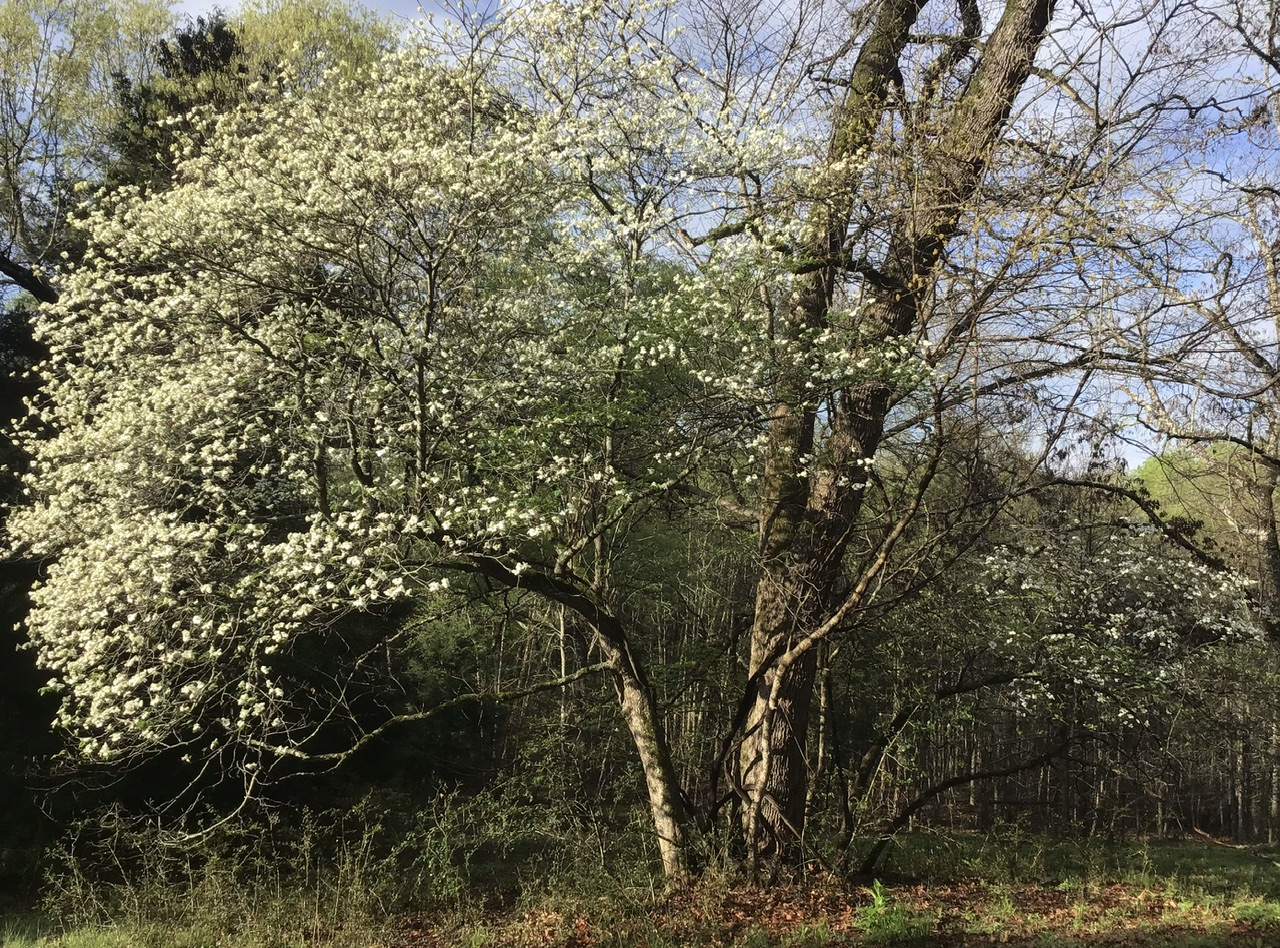
A first-time mama is the first to drop a perfect set of twins!Dogwoods blooming beneath oaks
Trumpet, or coral, honeysuckle on our front porch usually attracts hummingbirds by now. It’s looking gorgeous and I’m quite proud of it because it’s one I propagated from the wild. But, where are our feathered friends?
Seed saving has definitely upped our game in the garden. Buying seeds is certainly far easier than saving them. Where we once just had to plan one large garden space, now there are three. It feels like juggling! You’ve got to keep all the spaces perfectly coordinated. I had to make a chart. I am not a chart sort of person. I’m the kind of person who instantly glazes over at the mere inclusion of a chart in any piece of literature.
So really my chart was more like a list of do’s and don’ts in a useless graph format. Don’t plant the pumpkins with the zucchini. Don’t plant the luffa with the Trombetta. Do plant different varieties of cucumbers, peppers, melons and watermelons at least 1/2 mile apart. (Is that even possible?) Musk melons and watermelons are safe to plant together, but French cantaloupe most certainly cannot be planted with American varieties or with green melons.
And that’s just the summer season’s produce, there’s a whole different set of charts for the winter veggies.
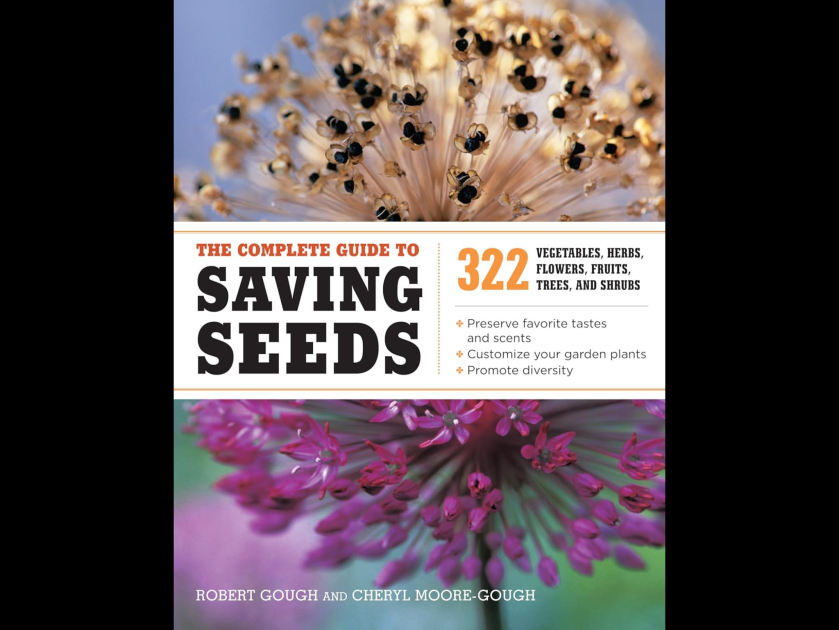
Luckily, I’ve got some good guidance in a great book and, even better, some bigger minds to follow in the form of Gavin’s Newsletter. He’s just started a book club and his first book up for April just happens to be the one I’m reading.
Why save seed? From the book we learn a few good reasons: *selecting for specific traits, *preserving diversity, *saving money, *creating superb plants, *And, going on an adventure. “The art of saving seeds may so intrigue you that you’ll branch out to your own plant-breeding adventures with such long-term seed-saving projects as growing oaks from acorns.”
Perhaps that could be me! Or perhaps I should’ve started this about 30 years ago.
But, those do all sound like good reasons to me, plus I’ll add one more. It’s a good way to exercise your body and your brain at the same time.
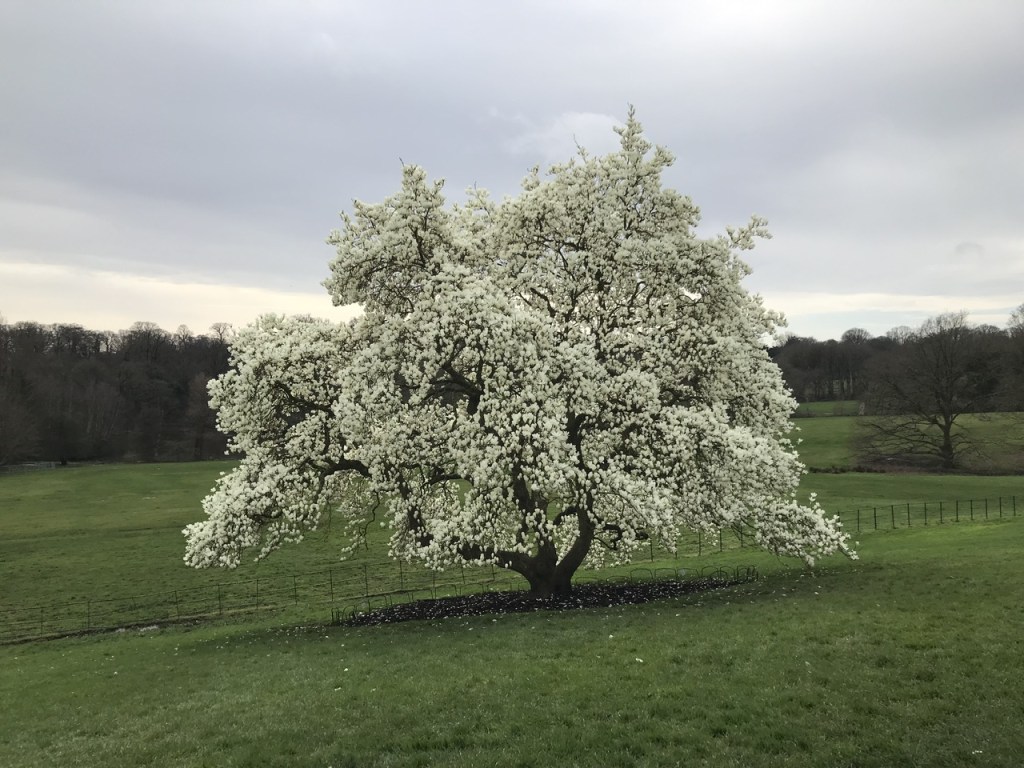
But, propagating something so slow-growing from seed at this stage of life, I think I’ll need more bang for the buck than an oak. Like, this magnificent magnolia!
(Photos sent by a friend in UK, wow, what a specimen!)
Of course, not all seed saving is complicated. After all, it used to be something every farmer would do, and their children, too. If I’d grown up doing it I’d probably think I’m making much ado about nothing.
In particular, most of the common herbs we love—dill, cilantro, basil, parsley couldn’t be easier—let them go to seed, collect the seed once dry, keep in a paper bag over winter, and sprinkle back out in spring.
Easy-peasy, leaving more time for flowers!
More flowers, herbs and medicinals has been the big goal besides seed saving. I’ve always liked hollyhocks and other traditional ‘cottage garden’ favorites. How fortunate for me to find one I’ve never heard of before, with a really cute name.
Inspiration photo only, real or photoshop, no clue
Flower name: “Kiss me over the garden gate” Latin name: Persicaria orientalis (formerly Polygonum orientale) is an annual member of the buckwheat family. The tall plants produce pretty pink pendulous blooms.
I’ve just planted it under the bedroom window inside my work-in-progress wattle fence.
What’s a wattle fence?
I had no idea what that was until I read about another blogger, Re-Farmer, building one. It looked like a fun and do-able project perfect for a precision-challenged person like myself.
And it is! There are lots of YouTube videos on the process, but I think this one was the best—a much taller and longer wattle fence than I’ve tried to produce, but who knows, as my skills develop I could step it up a notch. 🤔
The other big garden plan this year are a few citrus trees. We’ve been wanting them for a long time, but all fruit trees are a challenge here with our crazy weather. (And it’s not just us! All kinds of complaints about it from YouTubers and neighbors alike. It didn’t used to be like this.)
Anyway, this guy’s got some great suggestions and solutions and we so love our citrus, so we’re going to make an investment toward our citrus-filled future with Myer’s lemon, Mexican lime and Satsuma orange.
Another small plan is more peppers, specifically seasoning peppers, also called spice peppers (though they aren’t always spicy as in hot), like pimiento’s and such.
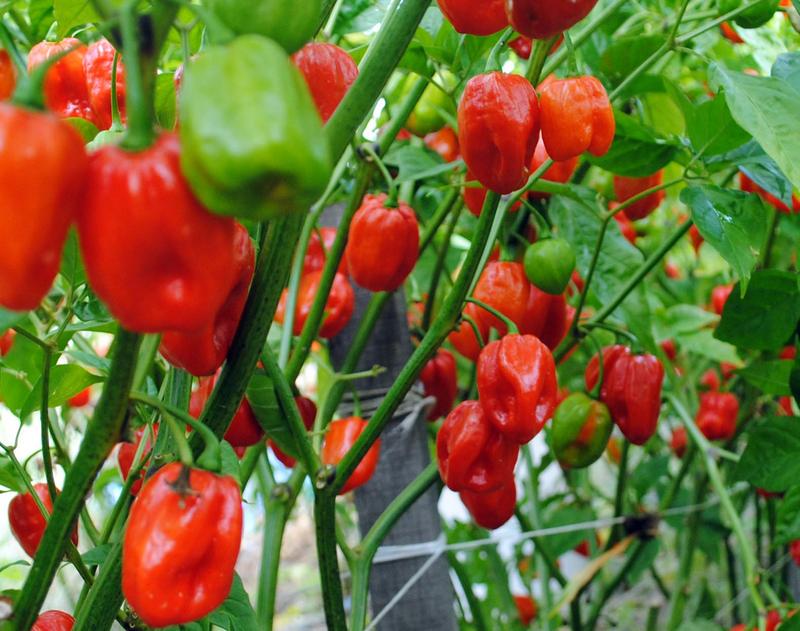
As much fermenting as I’ve been doing I see they are an excellent addition to all kinds of dishes. Plus, peppers do pretty well here usually, and they harvest in fall when there’s little else happening, and they are lovely little plants some folks grow just as ornamentals. Four excellent reasons to squeeze them into the rotation. Here’s one variety I’m trying:
“(C. chinense) 99 days. (green > orange-red > red) [Venezuelan heirloom. Seed source from Donna Hudson in TN.] Has the same shape, size, color and aroma as Habanero, but is sweet, spicy, and delicious, with only a trace of heat. Highly aromatic fruits; their flavor is unusual and complex, with overtones of black pepper and coriander, and undertones of other spicy flavors. An excellent choice for sautéed vegetables, rice and bean dishes, paprika, or herbal vinegars. The thin-walled pendant fruits are 1 x 2 in., tapering at both the stem and blossom end. Plants have good foliage cover and bear at 18 in. high. Seedlings grow slowly at first, but grow rapidly later in the season to 48 in. or more.”
Like I said, it’s the exciting season on the wee homestead!
I came across a great artifact—a Monday, July 21, 1969 edition of The Odessa American, a Texas newspaper, with this particular edition all about the ‘awesome’ moon landings.
I must say, I’m rather shocked at the disgraceful condition the astronauts of Apollo 11 left their host space. I mean really, we go to the park and are ordered to ‘leave no trace’ — while they, the great men of the world, are allowed to pollute everywhere they go.
Costly Junk Left Behind On The Moon
Space Center, Houston (AP) — Two Apollo 11 astronauts leave behind one of the most expensive junk yards in the universe when they lift off from the moon today.
They discarded almost $1 million worth of cameras, tools, and breathing equipment up there. The cameras included the black and white television camera that captured their moon walk for the world. This camera cost the Aeronautics and Space Administration $250,000.
Also in the litter—a Kodak worth $50,000 and a Hasselblad camera that cost $11, 176.
After returning to the moon lander’s cabin, the astronauts opened the hatch and dumped the back packs which kept them alive during their walk. Each of these units, called the Portable Life Support System, cost NASA $300,000. Moon tools designed especially for the astronauts added to the junk pile. Tongs, a scoop, a long-handled hammer, an extension handle and other items were dropped when the space men were through with them. These tools cost $45,000.
Largest item to be left was the descent stage of the lunar module. NASA is reluctant to put a cost on this two-ton piece of metal since it’s only part of a lunar module that cost $41 million. Even if the spacecraft stage hadn’t been left on the moon, it could never have been returned to earth; it has no heat shield. An American flag was left on the moon. The space agency doesn’t know how much it cost and doesn’t want to.
NASA bought a large number of flags from different manufacturers, a spokesman said, and then removed all labels. One was selected at random. “We’ve no idea which one is up there,” said the spokesman. “This was so no company could make a big thing of their flag being on the moon.”
A silicone-water bearing electronically-reduced messages of goodwill from 78 countries cost NASA nothing. A private firm produced it at no cost to the government.
A plaque bearing the autographs of the astronauts and of President Nixon couldn’t be priced. It was made in the metal shop at NASA of materials already at hand.”
I sure do hope the next men that land there will be thoughtful enough to take out the trash! 😂
This post we’ve got some happy snaps, the usual weather bitching, a bit of pre-planning and some good news on two healing fronts.
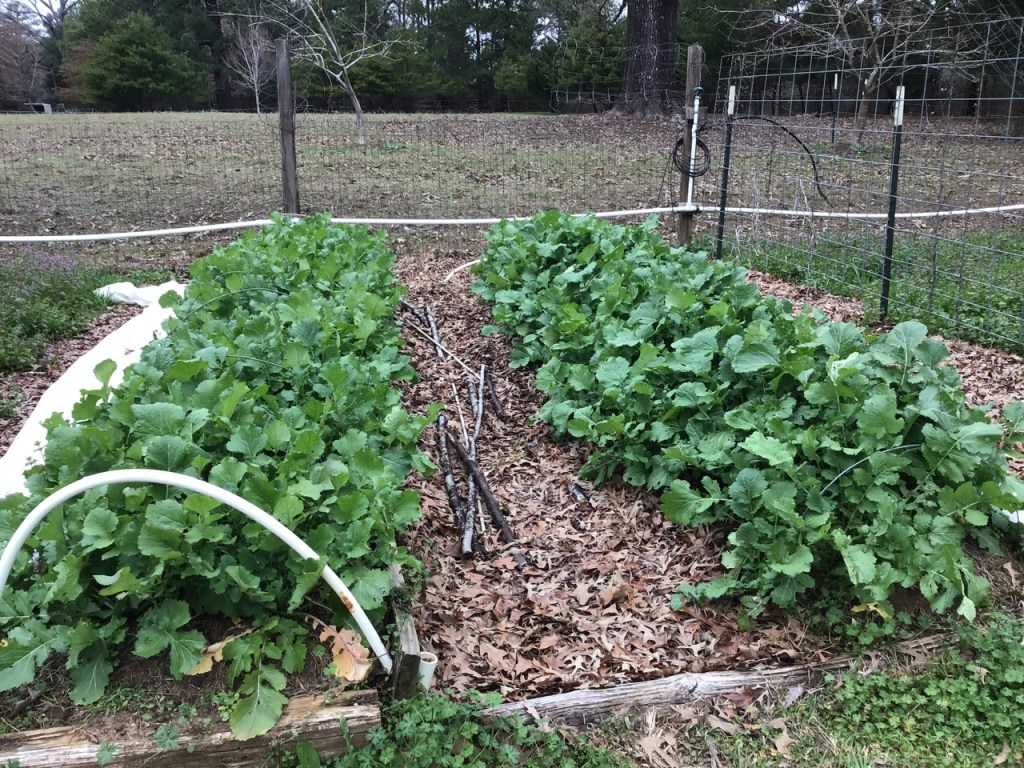
(From bottom left: mini-mustard greens and new lettuce germinated inside about to be transplanted to replace all we’ve eaten; several types of onions and elephant garlic (which does best here, by far); and turnips for us and the pigs. 😋)
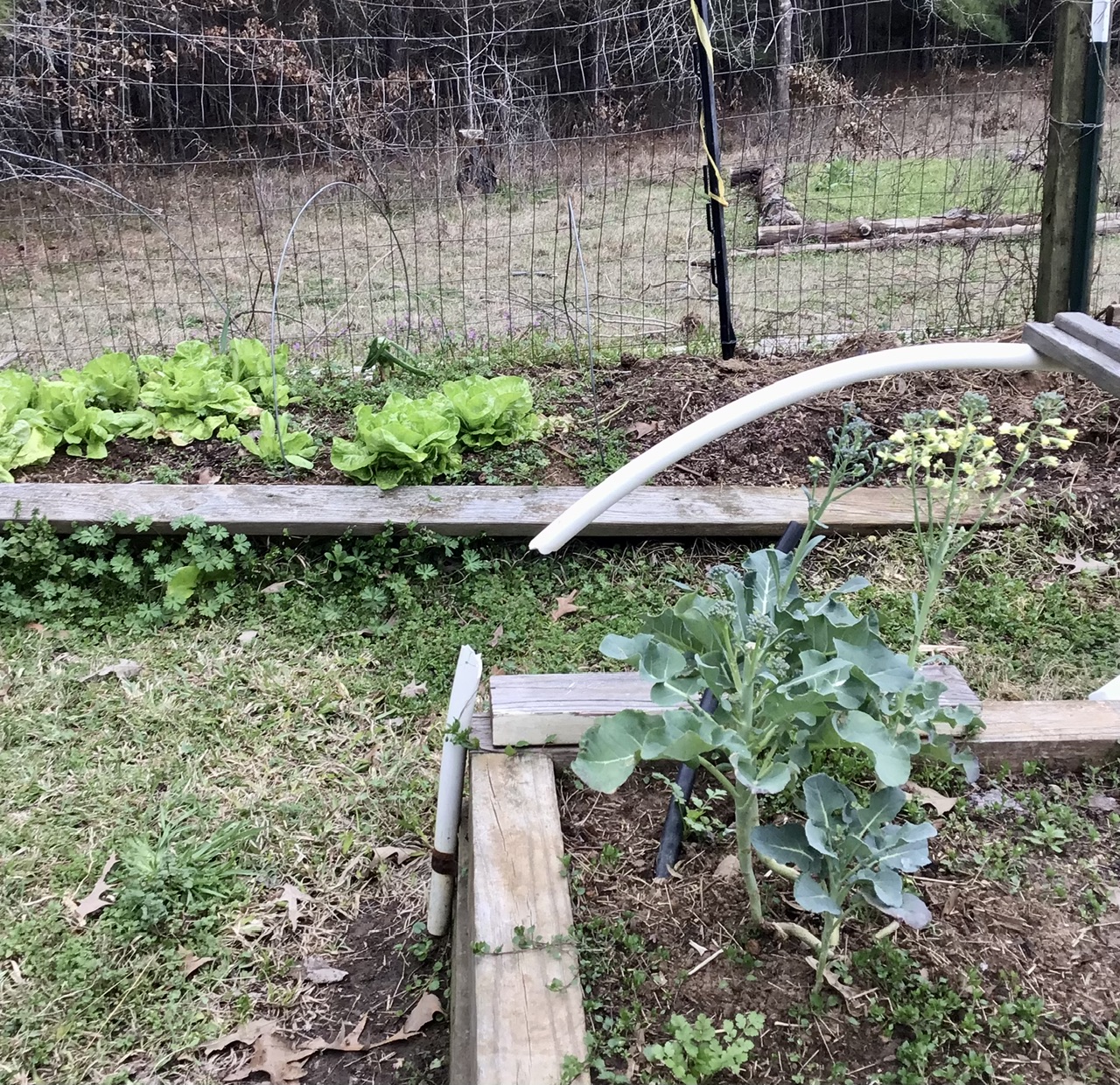
The cauliflower is long gone, the broccoli nearly so, but a new crop is already in the works inside on a heat mat. Succession planting has its limitations in our East Texas Yo-Yo Season (formally known as ‘winter’). Sometimes you get lucky with a warm stretch and get a nice surprise (yay, third times a charm, the carrot seeds finally germinated!) other times you get premature bolting (that dumb broccoli didn’t even produce a good head yet!).
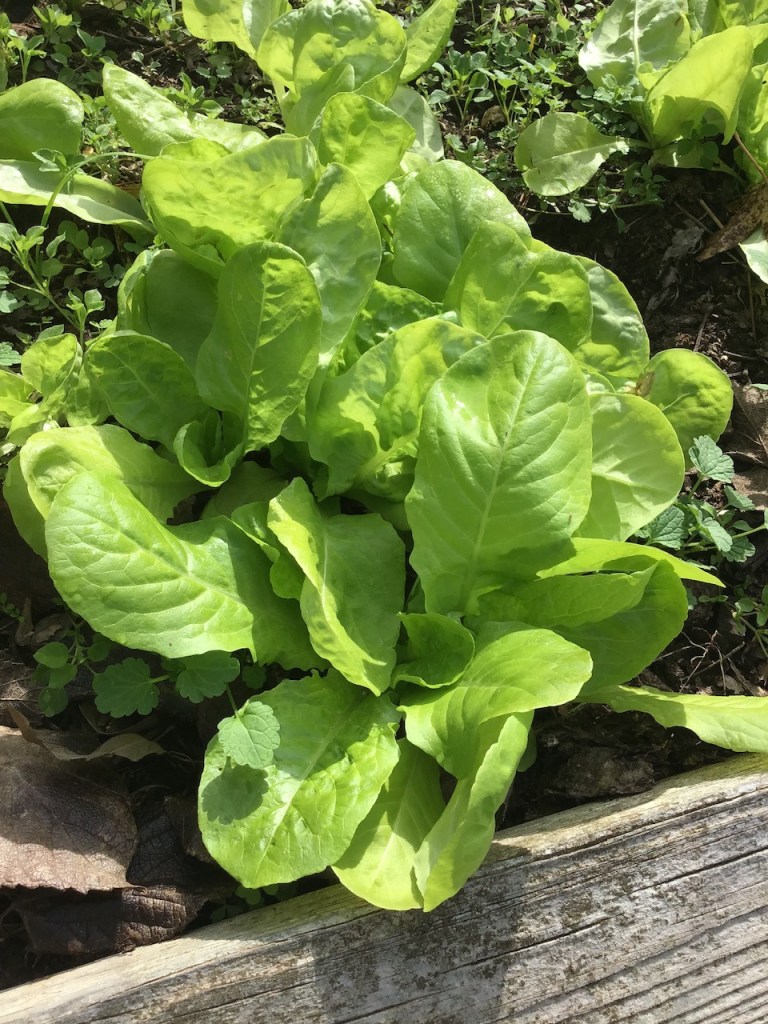
Premature bolting 😖 But some nice butter lettuce still doing well by covering during cold swings
I do not appreciate it, and I think it stresses us all at some level, not just me, not just the more sensitive 4-legged and 2-legged, but all of life. Five warm days go by, in the 70s (but feeling hotter), with an unseasonal and hot stinking wind coming from the south, then suddenly, the very next day, it’s 40, lows in the 20s, and the dogs are shedding, also unseasonably.
Our ‘Arctic chicks’ — confused broody hens confusing weather whiplash for spring
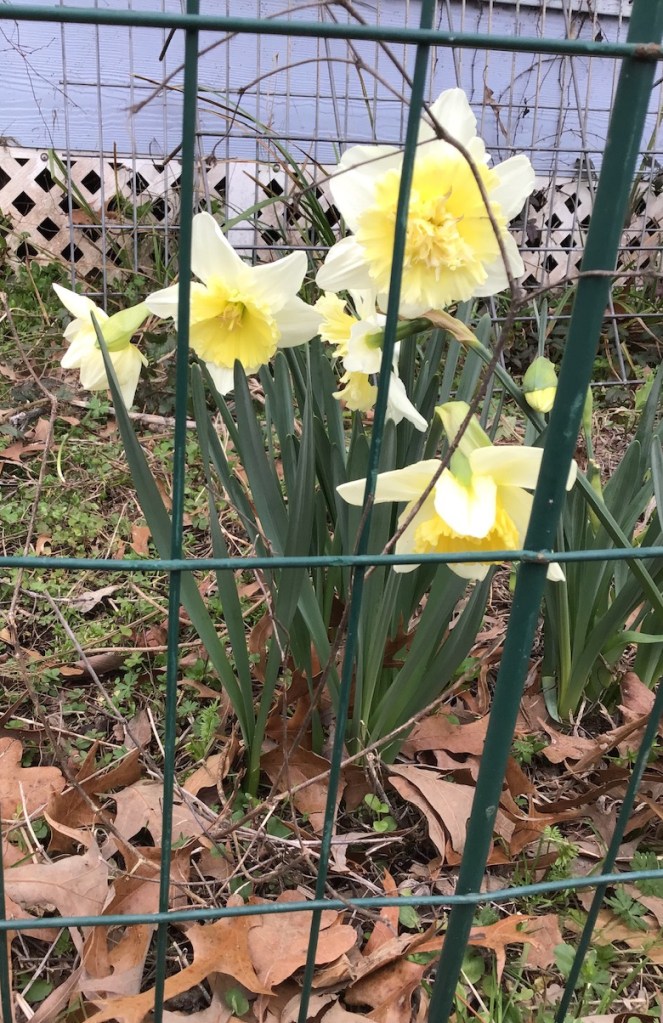
Yes, we get the surprise arctic chicks on occasion. It’s nice to see a bee or two about. We get early daffodils. But we also get another lost fruit crop because it is sure to frost and now, again, everything is blooming far too early.
And it seems to me, the more folks are catching on, the more the establishment pushes back, with the gaslighting and the misdirection and the normalizing.
Going back to the 1800s! And how’s that working out for us?
Despite the man-made manipulation, or maybe because of it, I’ve come to appreciate the old adage ‘Let nature take its course’ on a whole new level. We’ve had two overlapping critter health issues these last months, both with their unique challenges.
Shadow’s blood-spurting ear was by far worse, but still, in every case, I don’t like not knowing what to do, stressing about my lack of knowledge, feeling useless, and that’s how I felt during Chestnut’s ordeal as well.
Please allow my whine for just another moment, it’s been illuminating for me, in a way.
Self-reliance is a cornerstone goal for us. Relying on vet care is not an option for a number of reasons, beginning with the cost, ending with the lack of trust we have for the medical establishment, and with a very long and convoluted journey in between where we try to figure out how to bridge this enormous gap, with no training.
We are lucky for the internet, but you know how that goes. One problem, a dozen conflicting pieces of advice. We ask around as well, we are certainly grateful the many suggestions offered, but still it’s nerve-racking making ill-informed decisions, and no matter what anyone might pretend, health is not an exact, one-size fits all kind of science.
Chestnut was acting strangely, very suddenly. She went from just fine to a few hours later she was lethargic and not eating much and separated herself from the herd.
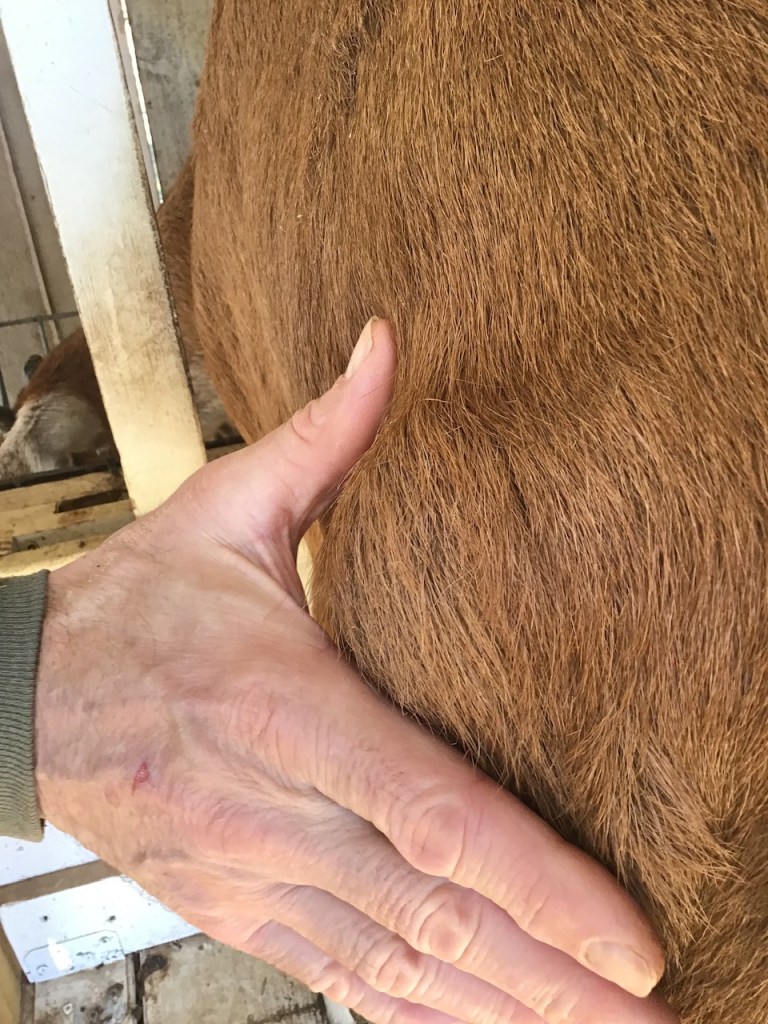
My goat friend suggested Ivermectin and it seemed to work fine. Then she quickly developed an abscess on her side. Related? No clue. It looked terrible, but it was not bothering her at all. I read lots of advice, but decided to let nature take its course after reading one description that sounded most similar to what I was seeing. Though they recommended lancing it at the end stage to avoid ‘infection’. (In the above photo you can see the ‘before and after’, the photo on right taken yesterday, sorry for the blurriness.). It got very large and it was not easy to do nothing!
It’s been over a month now, and it is healing nicely. Patience was the correct remedy, not lancing. I think we have an addiction to unnecessary interference in our culture.
The ordeal with Shadow was a serious challenge. You might recall the middle of the story from our last Happenings post. It started all the way back in November with a little nick on the tip of his ear. The cat?
Who knows, but it was shockingly difficult to get the blood flow under control.
We had much advice, some of it new and excellent (thanks again Kath and Zoe!), but wow, did that take some patience and perseverance, which mostly landed on Hubby, as per usual. (Male privilege! 😂)
Three months later and it is completely healed and all’s well that ends well, thank heavens!
What exuberance, no one around here can keep up with him! He runs circles around us all, then sits patiently by Hubby’s side until the next round.
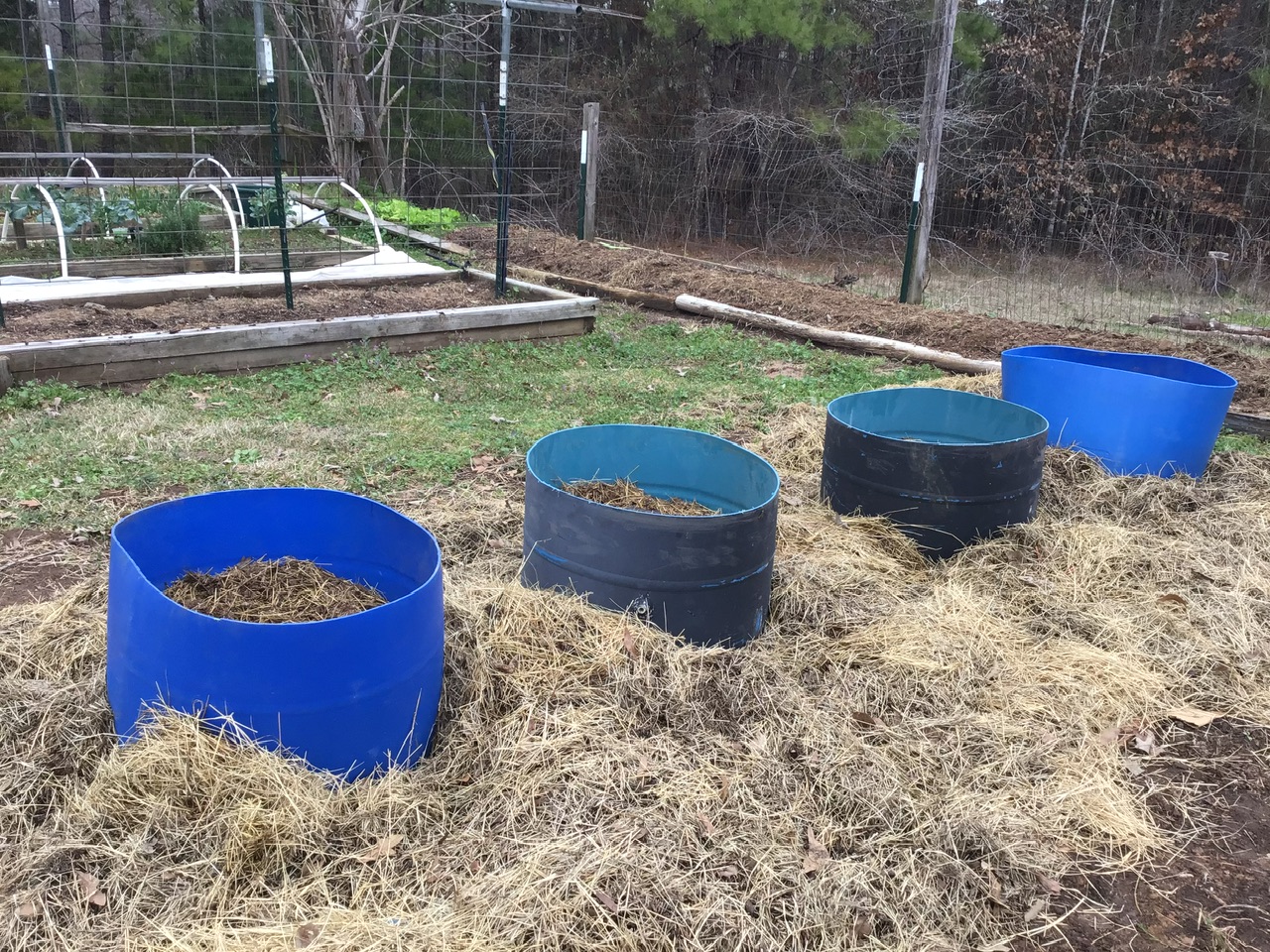
We LOVE potatoes, but they aren’t the easiest to grow here. This ‘barrel-layering’ technique has proven to be more successful.
We love potatoes so much we also buy them in bulk when they’re on sale and Hubby cans them up and they fry up in tallow so quick it’s like a delicious fast food that’s a cheaper and healthier alternative to the industrially processed varieties.
It is a long and labor-intensive project, that’s 45 pounds of potatoes there, it took him the best part of a day to do, but we’ll be appreciating the effort for 28 delicious meals. 😊
Looking ahead we’re doing a bit of planning—I’ll be giving another beginner’s fermentation course next month and Hubby’s got some good livestock trades in the works, we’re committed to foraging more for mushrooms and cultivating our own.
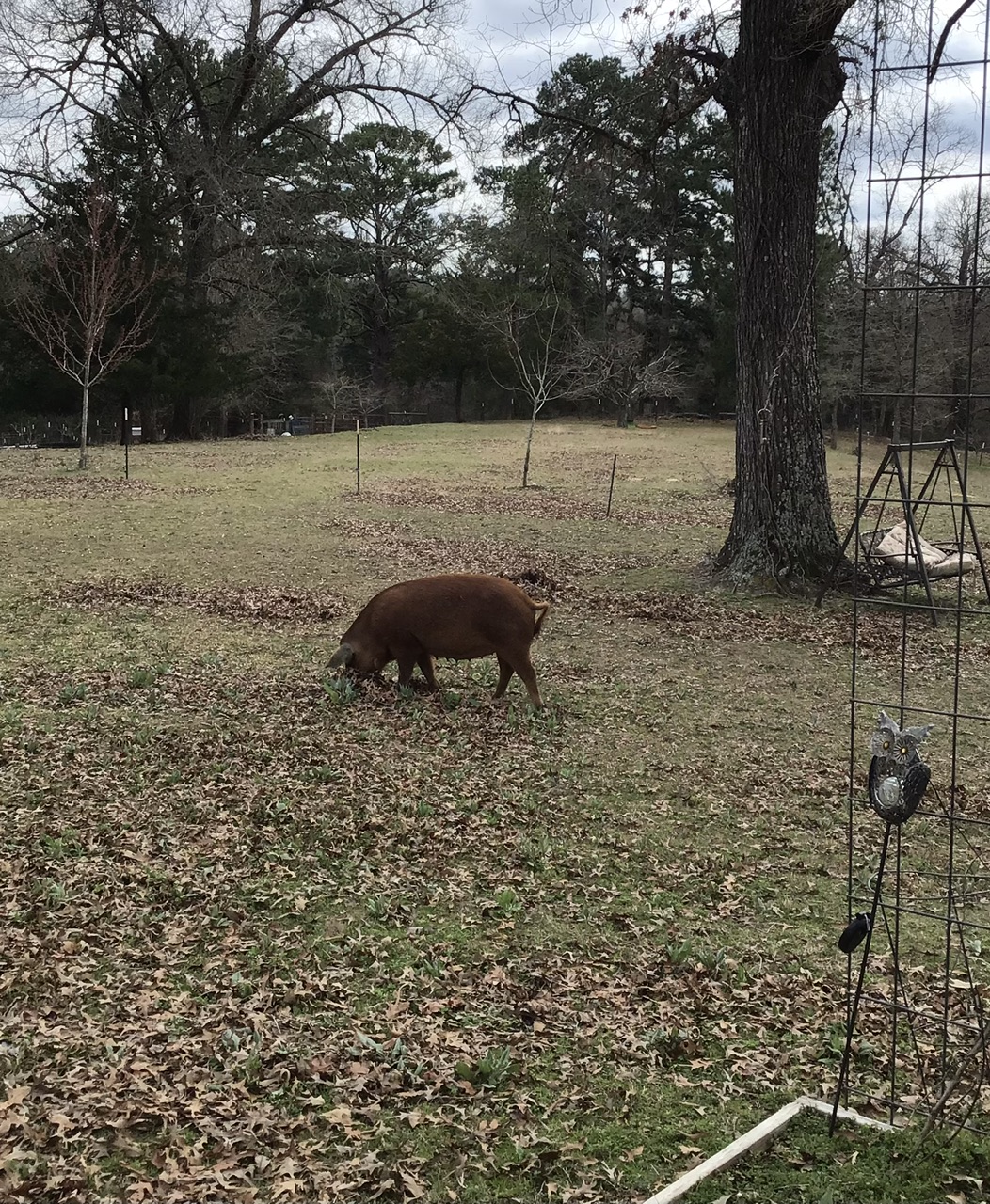
Patty, our mama-to-be, eating up the last acorns. Already many of her piglets claimed for bartering deals. 😁
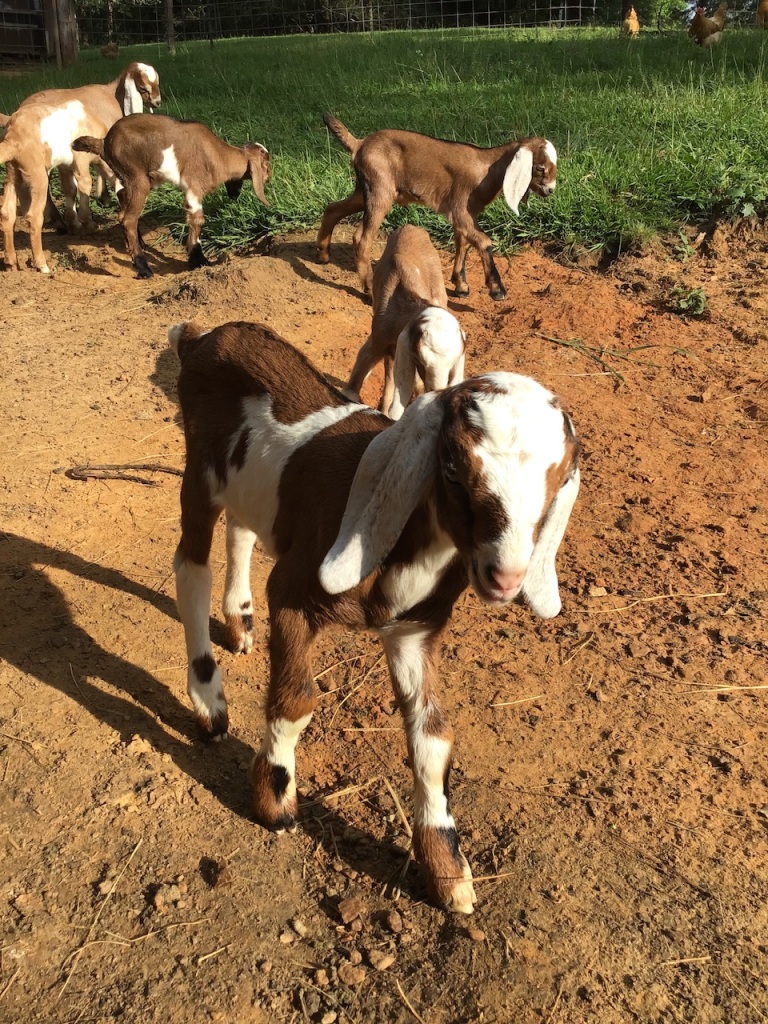
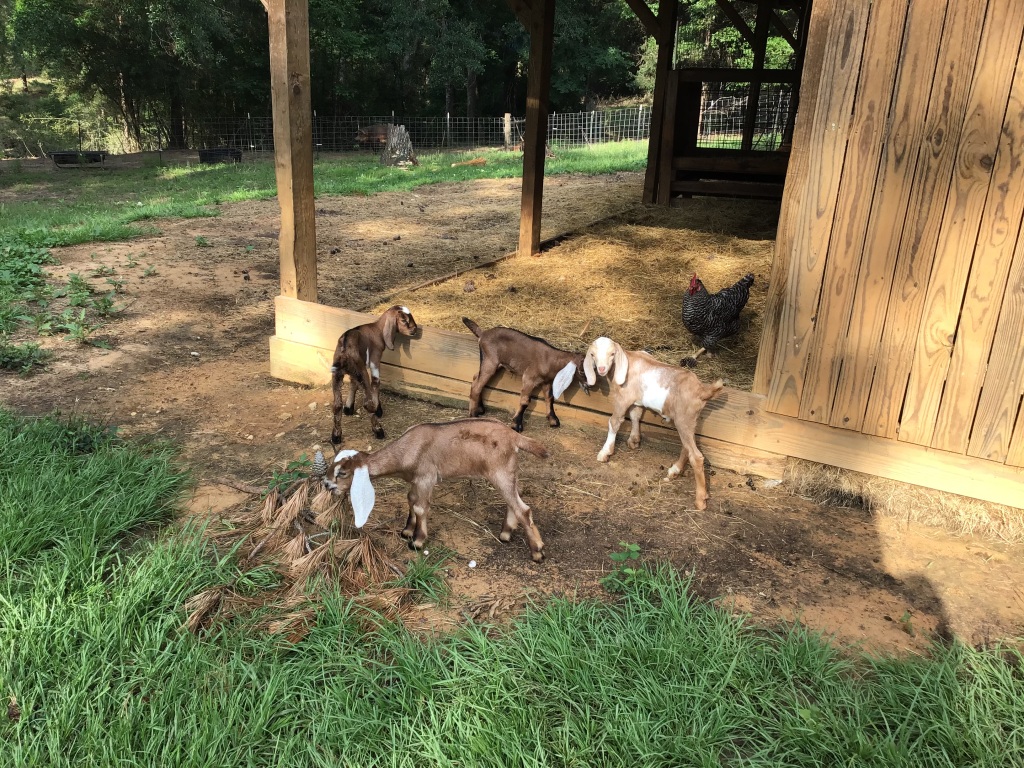
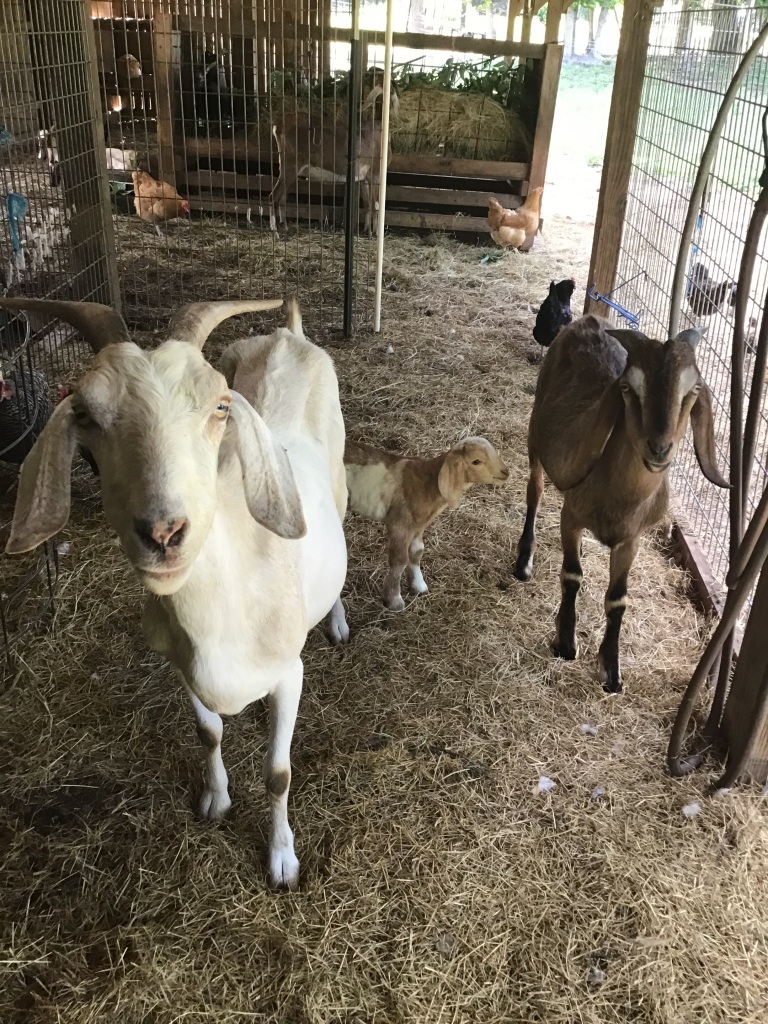
Here’s a current little visit with our herd, including, hopefully many healthy, expectant mamas with kids growing fine.
Not that little guy, he’s our first buck, we call him Teaky.
5 expectant mamas among our St. Croix-Dorper flock
Incorporating more permaculture design in the garden and orchard is an on-going big goal. We have a couple spaces empty and I’d love to try something really unique like this:
Permaculture-Inspired image I’m dreaming about!
Where I’d be including my fun garden-art projects, like these:
Lots of grand plans in the works, always, but it’s the simple things that make the hard stuff worth while.
Wow, I’ve posted no update since the end of August (aka Late Swelter Season). Now here we are already well into Weather Whiplash Season, my how time flies!
This post we’ve got lots of happy snaps, the usual weather bitching, some cheese boasting, and long laments about our dear Shadow’s woes.
Notice the band-aid on his ear? Useless. But, apparently we needed to learn that the hard way.
Sometimes time flies, but when things get really bad, it crawls. Especially when it goes instantly from nothing much to Holy Shit!
And as bad as it is, in the big picture the weather whiplash is still way worse. So, best get that report out of the way first. No rain, in our rainy season. No real season at all, just a rainless rollercoaster, and not nearly as fun as that sounds.
Not natural clouds, folks! And soon the kids won’t be able to see any difference, though the atmosphere has significantly changed in the last two decades, as the weather has changed, as they lie about their climate scam, and charge ‘carbon taxes’ to ordinary folks to pay for their madness. Makes me SO FURIOUS!
I could be taking such photos on a regular basis, but it gets old. And then someone could comment on the ‘pretty’ sunset. 🤯. Argghhh, Noooo! Can’t someone please make it stop?!
No? Ok, moving on.
More bad news. We’ve had the most prolific acorn year since we’ve been here, that’s about 15 years. Sounds like good news, I know. It is good news, in many ways. The pigs are getting fat, the sheep and goats are gorging. Literally. And that’s the problem. One of the young twins gorged himself to death. It was terribly sad. His little stomach ballooned up as if his body couldn’t contain it anymore and he was suffering for hours.
I’d read baking soda could help, but it did not in this case. Perhaps it was too severe. I also read there’s a surgical procedure which would alleviate the pressure in his gut, but I don’t have the confidence to perform that myself and the vets around here don’t treat goats. I held the little guy for a long time, trying to keep him warm and help him feel better, but we lost him. Oh the perils of animal husbandry!
Another problem of the acorn bumper crop is much less severe. We live under a large oak tree and have a metal roof. It’s been rather windy lately and once those nuts start shaking loose, it’s kinda like the sky is falling. If our veteran neighbor with PTSD comes by I expect he’ll be darting for cover quick, because it sounds eerily like machine gunfire when they get popping off the roof.
The acorn perks include some plump pigs and happy goats, two of which I’m still milking, which is making for some very tasty cheeses.
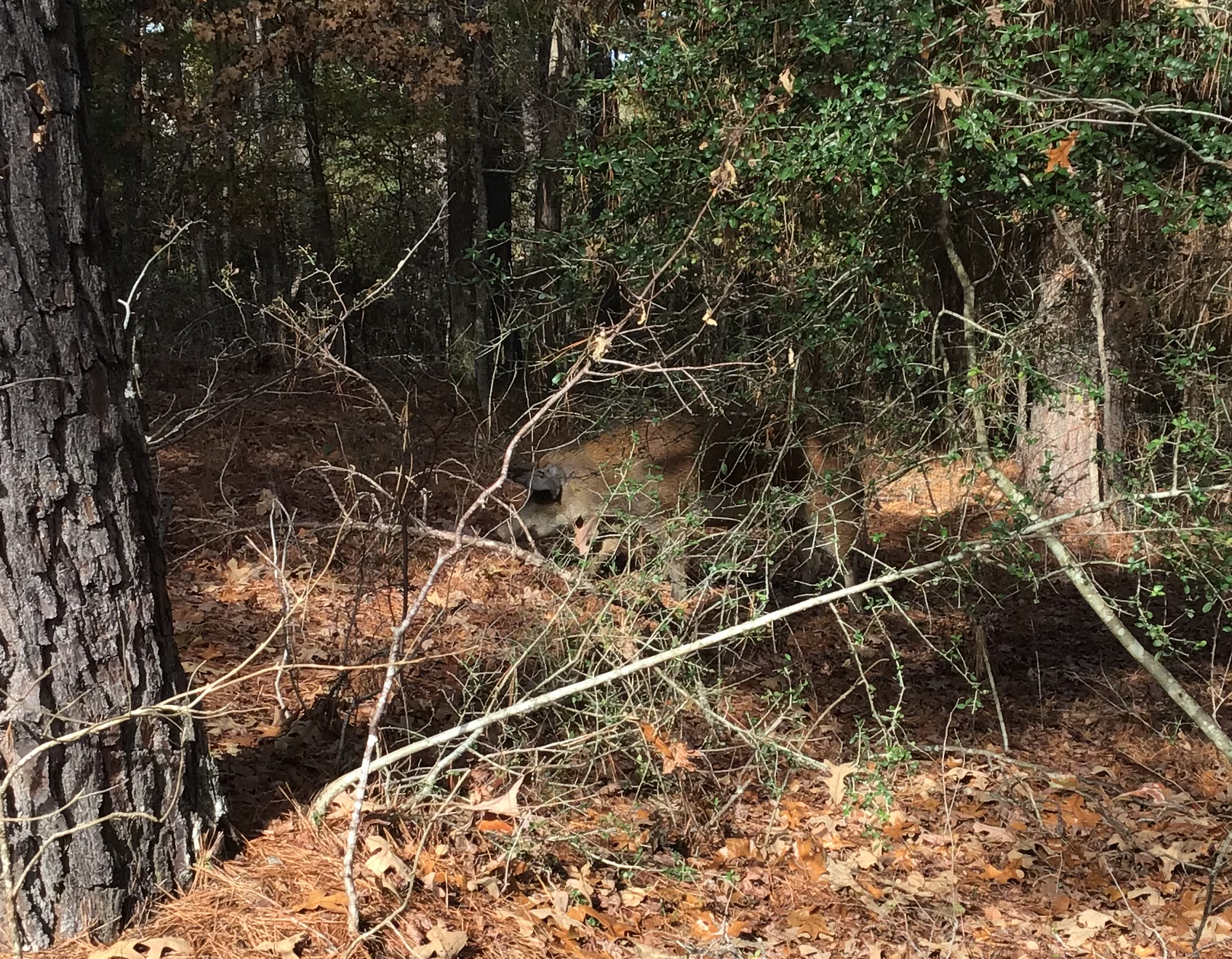
Under the oaks: happy pigs, sheep and goats.Can you spot the perfectly camouflaged foraging pig?Happy goats make for delicious cheeses.
I’ve gotten so successful I’m confident enough to get very daring!
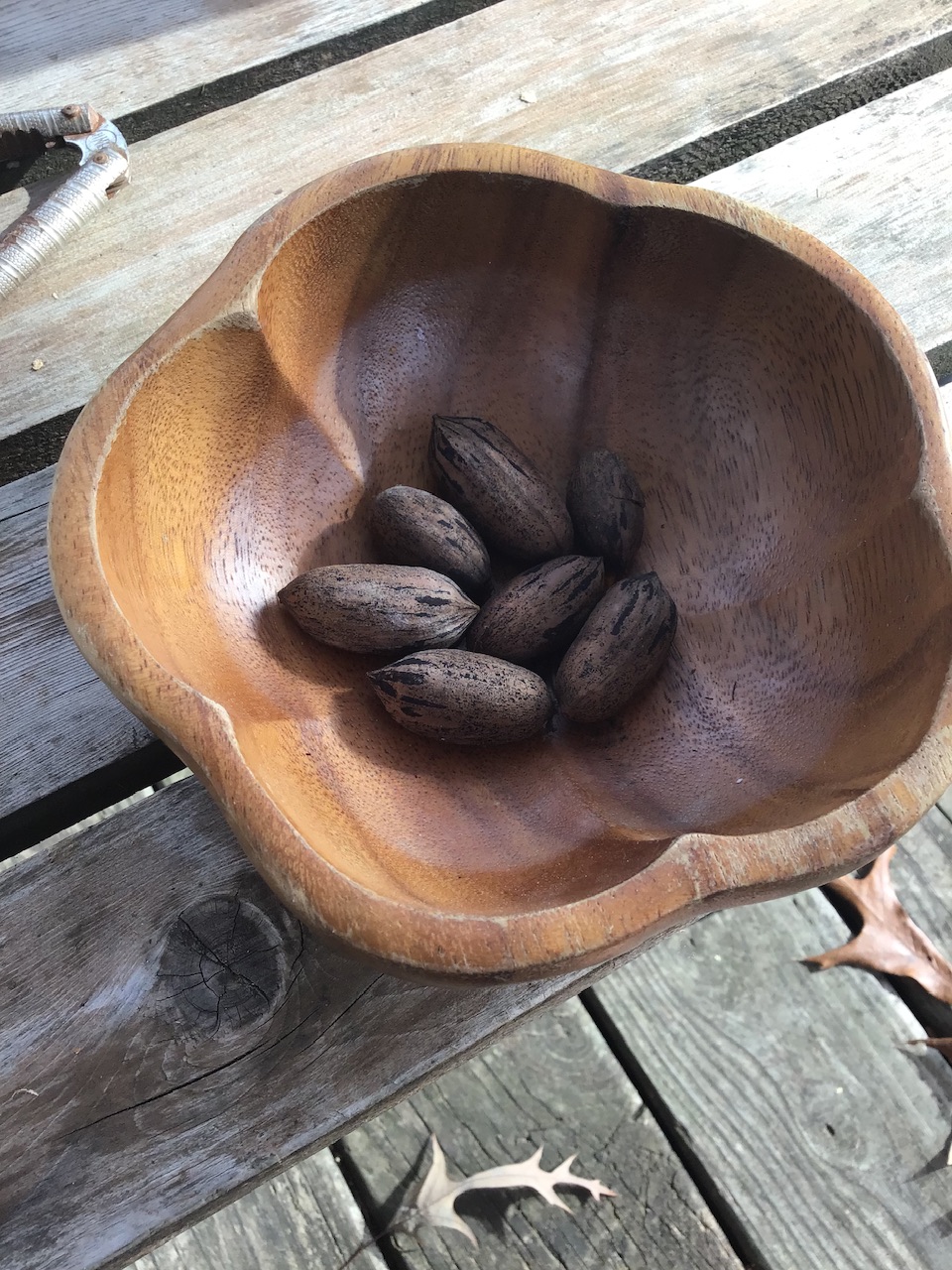
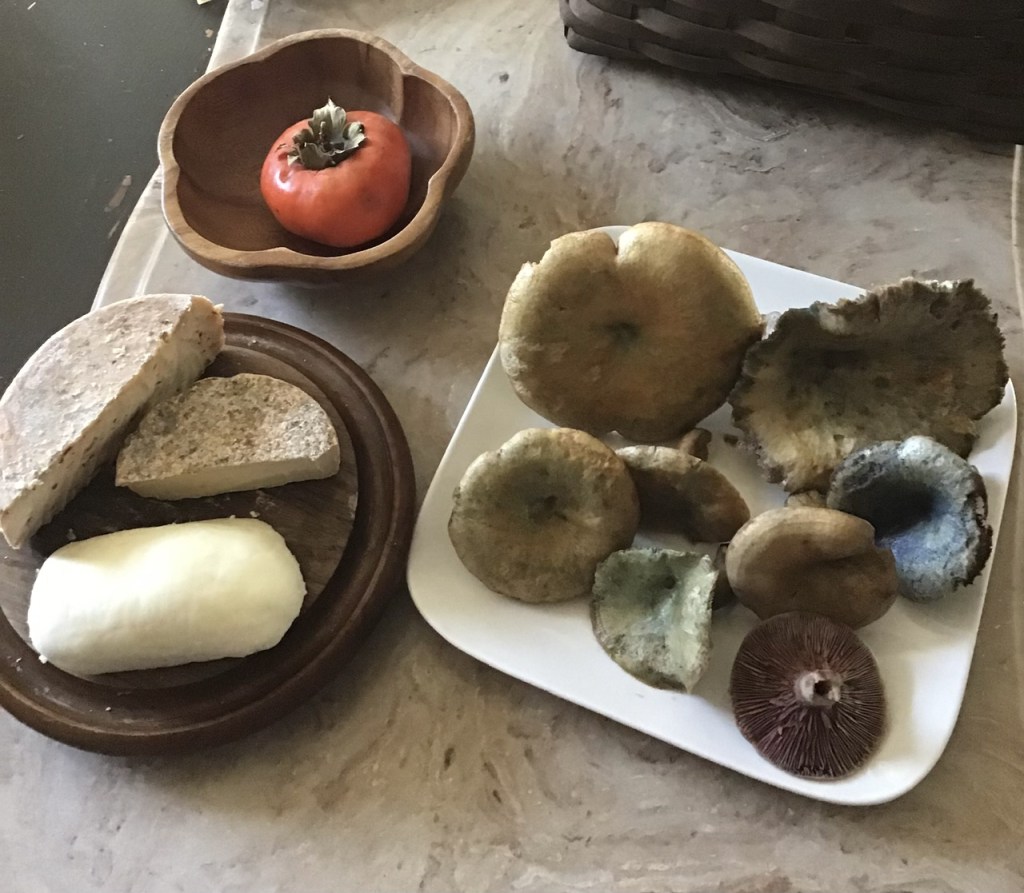
Chèvre wrapped in sassafras and fig leaves for aging.More aged chèvre—the top log is covered in dried goldenrod leaves and flowers, the bottom one is wrapped in honeybee comb.Our first pecan harvest—less than impressive, but still delishLactarius paradoxus mushrooms, homemade goat cheeses and first Japanese persimmon
Our fruits were nearly non-existent this summer, but we did just get our first ‘crop’ of persimmons, a whopping 5 of them! A couple of years ago I harvested lots of them from a neighbor’s tree and they were delicious; that was the first time we’d ever tried them.
Fuji persimmon
We planted both varieties, but the American variety takes much longer to start producing fruit and the fruits are generally smaller. These pictured above are Fuji, quite different, harder, larger, less sweet, not at all astringent, and also very tasty. The closest in taste I’d say would be a very ripe mango, the American varieties are especially super sweet, like jam.
If you’d like to learn more about this fancy fruit, here’s an enthusiastic lesson from James Prigione.
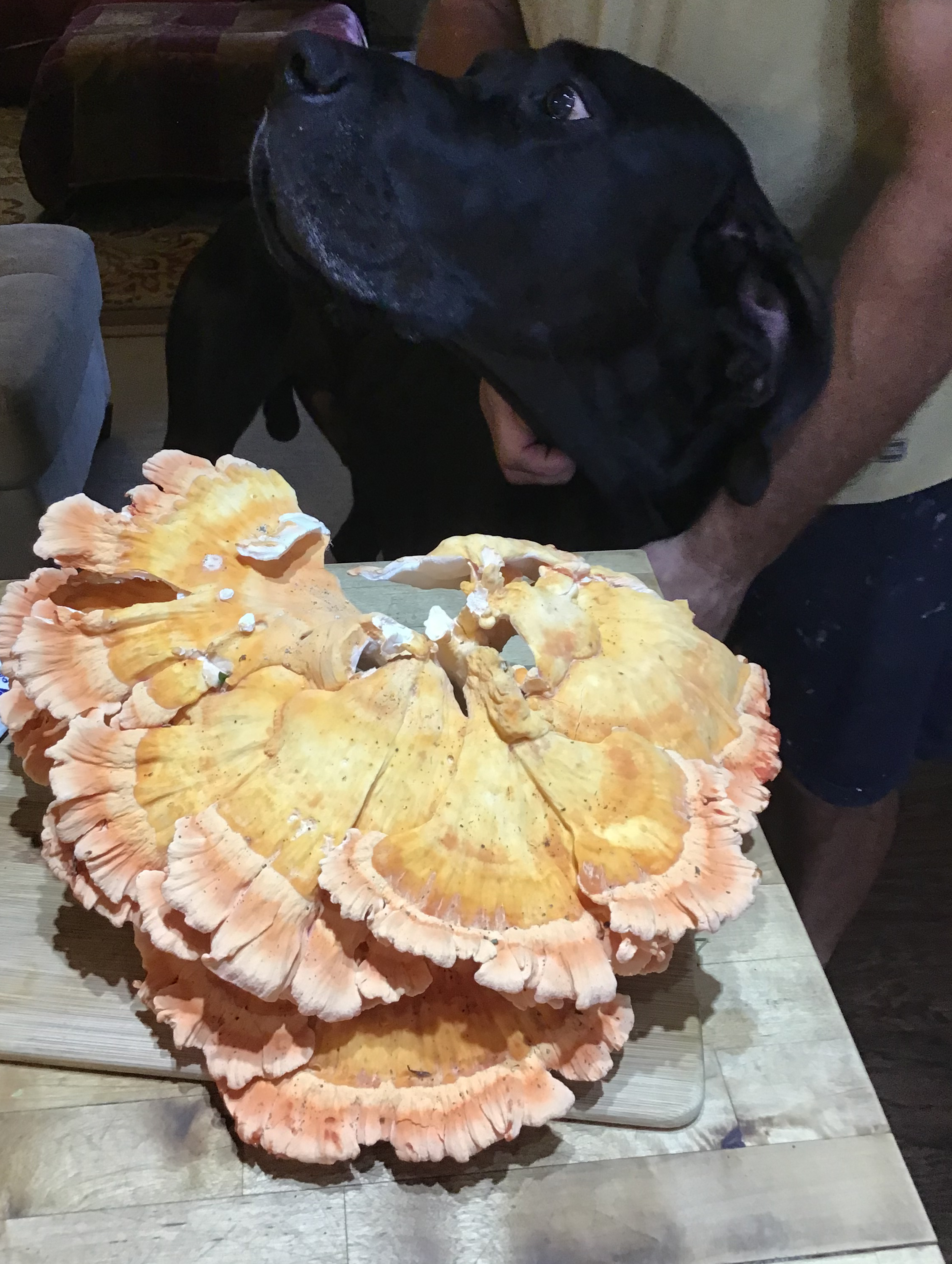
We’ve been getting a few mushrooms, but the lack of rain is certainly hindering our foraging experience. A friend brought us a huge chicken of the woods, our first time trying it and it was excellent.
Laetiporus sulphureus
The lactarius paradoxus are hard to spot and deceptively unattractive. In fact, they are exceptionally tasty and have a longer shelf-life, and of course a different season, than our favorite chanterelles.
Even while foraging mushrooms it seems the grass is always greener on the other side of the fence. 🤔
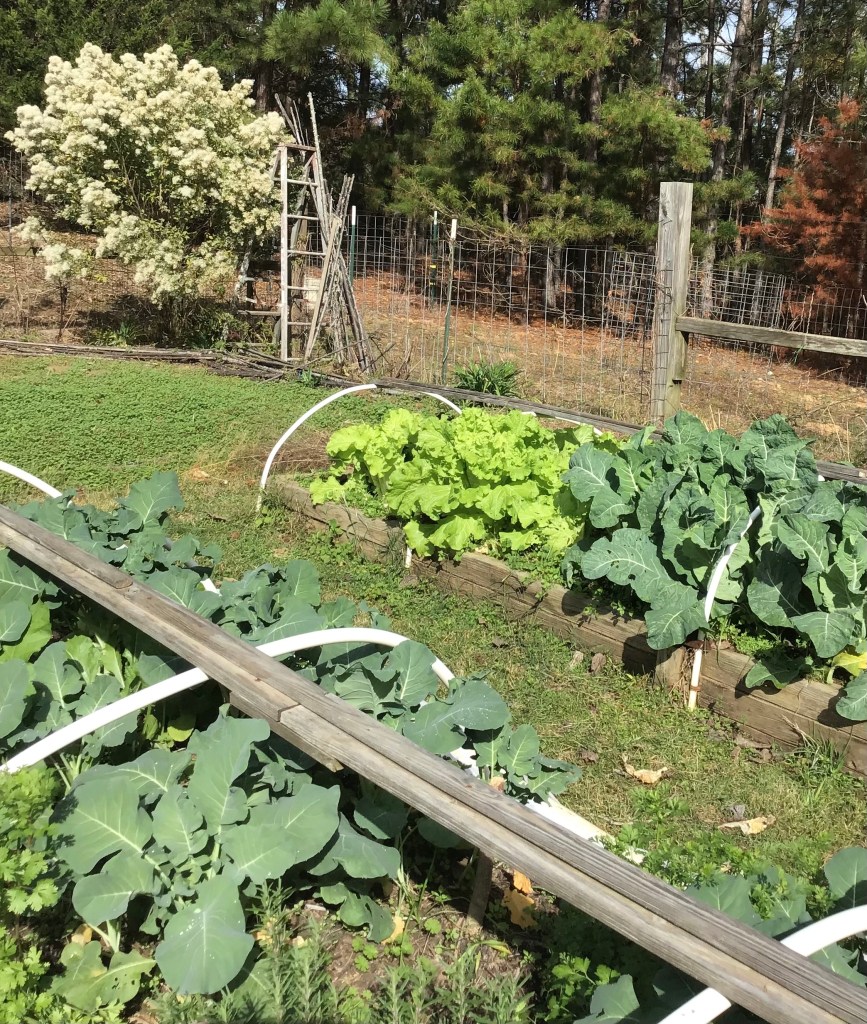
In the garden we do have two nice full boxes of varied cool-season produce we protect from the frosts with row cover cloth. In addition to lettuces there’s some broccoli and cauliflower, spring onions, cilantro and parsley, radishes and Chinese cabbage. We’ve also got our garlic already shooting up and a couple rows of turnips started for the pigs come spring. Our neighbors are now buying eggs from us, so we throw in the surplus veggies when we can.
3 of 6 colonies survived our terrible summer. The hives are a bit hodge-podge at the moment while we do maintenance on them.
The honeybees are occasionally making an appearance, though since the frost there is little for them to forage. One of their last favorites is another one considered a ‘nuisance plant’ by the ‘experts’—it’s called tree groundsel and it’s pictured after the frost in the right photo above, in the background behind the boxes. Quite a lovely late-season plant, if you ask me.
And approaching it before the first frost sounded like the buzzing metropolis that it was! A last hoorah for the bees.
So we come back to the current day and our crazy Shadow drama. It all started with a tiny Band-Aid.
He’s got the ear-span of a small plane and we have the living room space of its cockpit. When he shakes his head he invariably hits some piece of wall or corner of furniture with his Dumbo ears and it’s actually pretty amazing it didn’t happen already: a tiny gash on the tip of one ear that he doubtlessly cannot even feel.
Forever happy and oblivious
We were racking our brains for several days, trying everything we could think of and just digging ourselves deeper. One tiny failed Band-aid led to bigger Band-aids led to bigger wraps led to taping menstrual pads to the poor creature!
Nothing was working. We also tried several over-the-counter products, like liquid Band-aid, blood-clotting powder, and some spray-on crap. Not only was nothing working, they all seemed to be making the problem worse.
We even tried to craft our own ‘No flap ear wrap’ made out of my doo-rags, which also didn’t work. So, we purchased a pricey one online which should be arriving any day now. Obviously, this is a universally common dog issue. A result of over-domestication no doubt, but that’s fodder for another post.
Then I start racking my pea brain in frantic desperation. How to stop the blood flow pronto?! Crimp his ears with clothes pins? Tie his ears up on top of his head with a scrunchy? Stitches? Soldering? How about just cut the whole ear off? Yes, we did briefly consider the vet. But we’ve been spending the many months since we got him trying to detox him from all the vet potions and it feels we are finally making some headway there. I kept imagining the new meds that would be required for this new issue and their invariable side-effects, which would start us off at square one with his detox.
Clearly I don’t think very well in high-stress situations. I was really trying hard and the bad ideas were piling on. The blood, which had gone from a tiny occasional drop, to a full-on drip, to a steady stream, and from then within a few hours a sprayer-hose in every direction with every shake of his head. And that boy loves to shake his head.
Between the blood splatter and the acorn fire it feels we could be living in a battlefield training zone.
Yup, the crazy, bloody mess had arrived and is still visible all over our living room, deck, porch, siding. We covered all the furniture and even the walls with old towels and sheets. Hubby started following him around everywhere, with a giant towel extended between his outstretched arms each time he sensed a head shake was about to turn into a sprayer-hose of the sticky, red, splatter paint across the windows, the screens, the ceilings even. (Where are those magical elves when you need a deep house cleaning?)
We needed a miracle, and fast!
And thank the heavens, I got that miracle in one brief email. Thank you UK herbalists, Kath and Zoe, miracle workers! It should’ve occurred to me sooner. Me, especially, considering I did start the Herbal Explorations pages earlier this year and have been getting educated on herbal remedies. It honestly did not occur to me that herbs could solve this acute issue. I didn’t think anything would be fast or effective enough, especially when every other thing we were trying had failed and even worsened the problem.
Zoe suggested powdered myrrh as her preferred method in order to stop the blood flow, but we didn’t have that on hand. I ordered some online, but in the meantime chose among her other options, yarrow, and we have plenty on hand because I like it in Kombucha. I made a strong tea with it, as well as grounding some up into a powder and that whole concoction I held on his ear a few times with a cloth, some of that powder getting into the wound and sticking there, and the blood flow finally stopped. Holy Heavens! As of this writing we are still in good form and have our reserve remedies soon arriving in the mail.
What I clearly need now is an official Herbal First-Aid course. Herbs are not just for gentle healing and routine health, I see, they can be used in emergencies, too.
Why did I not think about it sooner?! It seems like such a no-brained to me now, that I’ve started to consider other potentials that didn’t occur to me at the time—like the old Russian folk remedy bees podmore—which I just happen to have been saving for a rainy day for 3 years now.
Quite an expensive lesson, but a welcome one nonetheless. 😊
Thank you from Hubby’s ‘White Elephant’! 😆
A huge thanks and deep bow to Kath and Zoe, from all of us on the wee homestead! 🙏 🤗