Creating the Global Citizen

“Alvin Toffler predicted ‘demassification’: a process ‘in which a relatively homogeneous social collectivity (or one conceptualized as such) is broken down into (or reconceptualized in terms of) smaller, more diverse elements’. This is the prize for big social networks: compartmentalize people into echo chambers and bombard them with confusing distractions and dead ends.”

Confuse the words, creating a smokescreen of misunderstanding: Like: community=network=market
Obviously these words used to mean very different things in the actual world, before the virtual environment muddied the waters. The market wants all kinds of personal details about you and so they pretend they are in a community with you. Your network of friends and acquaintances and business relations may indeed form a community at some basic level, but to expand this concept out in an attempt to create from this a sense of ‘global community’ is preposterous. It is a Benetton ad, not a community.

Yet it has infiltrated and infected the actual world as we’ve all experienced. The great Convid is example enough. But, there’s more. 

Even small local shops in rural Texas feel entitled to ask shoppers for their phone number, to use video surveillance indiscriminately, to appeal to shoppers for ‘community’ donations and to shove their mailing list and ‘loyalty card’ at you. I seriously doubt they will draw the line at the next big thing the big box markets teach them.

Please take a sensor bracelet at the entrance, this will ensure you a positive shopping experience.”

That is no community for me!

Deb Filman does a fine job of ranting about this, and an even better job breaking it down for folks, especially parents, because it really is the kids they are after. They always start with the easiest targets.

Are We Educating Children or Training Bots? That is the question!

More concept confabulation: Training=programming=learning
Deb has some choice words to share about this, so I’ll be brief. These words and concepts are being deliberately confused in order to create cognitive dissonance in order to get us to comply. Social engineering has become an acceptable system for indoctrination of populations and is being normalized and implemented by the United Nations and cooperating global partners through our institutions, and directly into our LOCAL communities, all of them.

The U.N.: Creating child social activists all over the country on our dollar.

More muddying of words and concepts happens all the time. This is to be expected. This is not a new tactic at all. If they still teach Animal Farm in school, let’s hope the correct message is still being taken from it. The rules written on the barnyard wall keep shifting. (Therefore, it must be my job to keep shifting with the rules, right?)

More word meshing:
Individuals=collectives
Regulate=Control=Master=Suppress

“It is the responsibility of civil society to experiment with models of effective global citizenship.”

To experiment with models! It is our responsibility, as global citizens, to experiment with our populations through education, to create good global citizens.

That is, for one, to train children in ‘Emotional Regulation’ in order to make good ‘Global Citizens’. Soldiers are trained in emotional regulation. As much as you might get annoyed at the Hobby Lobby with the number of emotionally unregulated children, this is not something that we want as institutional directives aimed at children. Why? Because as the establishment experts know very well, it leads to neuroticism. One kind of behavior required at school, another one at home, another one in public, another one at church, another one here and there and everywhere, and what the kids end up with is not an education, but the essential life skill required of a psychotic society: Mask Juggling.

In other words, become better adjusted at nebulous, shifting, always uncertain unreality. Who does that serve?

From Wiki, the ‘experts’, right?!

“Psychodynamic therapy uses the idea of a Faustian bargain to explain defence mechanisms, usually rooted in childhood, that sacrifice elements of the self in favor of some form of psychological survival. For the neurotic, abandoning one’s genuine feeling self in favour of a false self more amenable to caretakers may offer a viable form of life, but at the expense of one’s true emotions and affects. For the psychotic, a Faustian bargain with an omnipotent self can offer the imaginary refuge of a psychic retreat at the price of living in unreality.”

I can’t help but wonder, as illogical as all this obviously is, could it actually be the setup for the next great fall?

“We had created a global civilization, and for what? So the whole thing could come crashing down into the ocean, bringing unimaginable misery upon the earth? What purpose could such suffering possibly serve? The answer—in truth, the loss, death, despair, desolation, sickness, ill-treatment, indignity and, as Nietzsche wrote, ‘profound self-contempt, the torture of self-mistrust and the wretchedness of the vanquished’ rarely change ordinary men and women. Extraordinary people change through the good thing, and through the self-mastery that yokes them to it; the joyous source of the world. But such types are few and far between. For the masses, there is no hope because all they have is hope, and habit, and expectation, and desire, and possession, and progress, and business, and money, and all the other illusions of the egoic system.
That man had to be disillusioned was not, quite obviously, a message which could find very much popular support in a world of illusions, but then no message worth hearing ever does. The individual knows that the evil and pain and suffering she has gone through has not been for naught. Being sensitive and kind—those rarest of qualities in the civilized system—the individual finds no pleasure in the idea that everyone has to go through hell to reach heaven.”
 33 Myths of the System by Darren Allen

A Case for Applied Bitterness

The Promise and The Fantasy: It is said Love is God’s weapon.

Revelation 21: 1-6
“Then I saw a new heaven and a new earth, for the first heaven and the first earth had passed away, and there was no longer any sea. I saw the Holy city, the new Jerusalem coming down out of heaven from God, prepared as a bride beautifully dressed for her husband. And I heard a loud voice from the throne saying, “Look! God’s dwelling place is now among the people, and he will dwell among them. They will be his people, and God himself will be with them and be their God. He will wipe every tear from their eyes. There will be no more death or mourning or crying or pain, for the old order of things has passed away. He who was seated on the throne said, ” I am making everything new!” Then he said, “Write this down for these words are trustworthy and true.” He said to me: “It is done. I am the Alpha and the Omega, the Beginning and the End. To the thirsty I will give water without cost from the spring of the water of life.”

The Promise and The Fantasy: An end to all pain, suffering, sacrifice.

“Man will oppose everything except a Hand Extended, … he will stand up in the face of every hazard except Lonely Time; that for the sake of his poorest and shakiest and screwiest principle he will lay down his life, endure pain, ridicule, and even sometimes, that most demeaning of American hardships, discomfort, but will relinquish his firmest stand for Love …
Love — or the fear of Not Having It, or the worry of Not having Enough of It, or the Terror of Losing It — certainly does conquer all.”
~Ken Kesey, Sometimes a Great Notion

Repeat after me: I believe in LOVE!

Repeat after me: I believe in LOVE!

The New Age Movement:
Love as weapon of coercion and behavior modification

Benjamin Creme (1922-2016), Aquarian Age conspiracist
From Wiki:

“Creme said that he was first contacted telepathically by his Master in January 1959, when Creme was asked to make tape recordings of his Master’s messages.[19] Creme first began to speak publicly of his mission on 30 May 1975, at the Friends Meeting House on Euston Road in London, England.[20][21] His central message announced the emergence of this group of enlightened spiritual teachers who would guide humanity forward into a new epoch, the Aquarian Age of peace and brotherhood, based on the principles of love and sharing. At the head of this group would be the one who occupies the office of the Christ, Maitreya, the World Teacher,[1] expected by all the major religions as their “Awaited One”: the Christ to the Christians; the Imam Mahdi to the Muslims; the Messiah for Jews; and the 5th Buddha (i.e., Maitreya) for Buddhists. As early as 1982, however, Creme emphasized that Maitreya would reveal himself fully only when Humanity began to live in right relationship to one another – most notably, by living in peace, and by beginning to share the world’s resources more equitably.[22][23]

Creme asserted that Maitreya was the World Teacher for the Age of Aquarius, and that during the transition of one astrological cycle to another humans undergo a quickening of their evolution, while experiencing crisis after crisis.[45]”

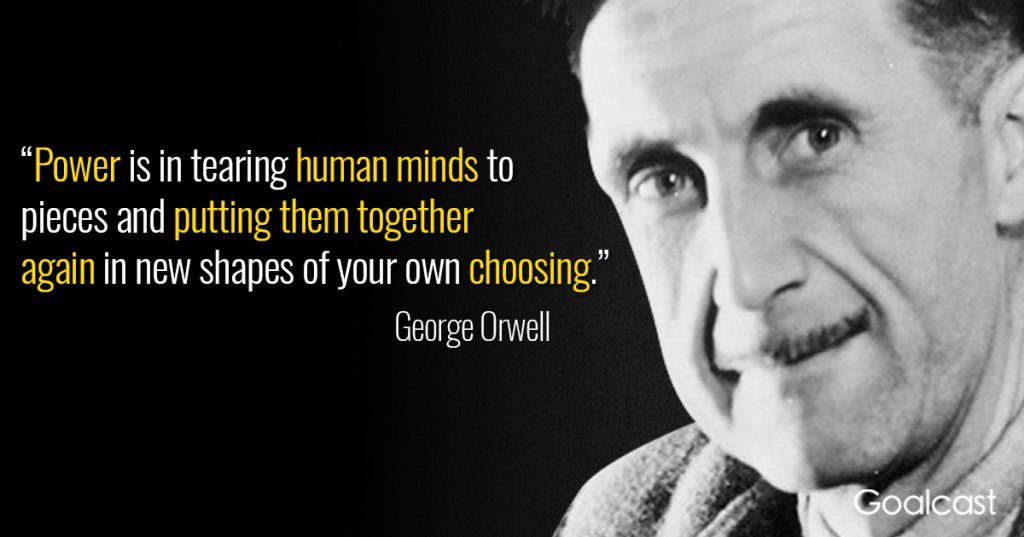
At the end of George Orwell’s 1984, broken, humiliated, every bit of his humanity smashed, Winston waits for the bullet in the back of the head and thinks, “He had won the victory over himself. He loved Big Brother.

Become the weakest, most vulnerable, most obedient and acquiescent version of yourself, and then the world will be peaceful.

Love one another blindly in a thick global stew of brotherly affection, and then the world will be free of war.

Lay down your weapons and your sour pusses, and then the world will be free of crime.

Give all your worldly goods away, and then the world will be free from exploitation.

Spread all your love all around everywhere all the time, give it all you’ve got—mind, body, soul—And then we will all live as One.

We SO Rock!

Times are tough, the mood around here is tight and demoralized. I won’t sugar coat it. Two months of 100+ degrees and no rain is bound to have emotional as well as physical consequences. We are victims and I refuse to pretend otherwise.

It’s one thing after another and because it’s so hot everything takes far greater effort. I’d go down the big list of all the things breaking down and all the things we can’t keep up with, but it’s way too long.

And no one likes a complainer, right? Don’t wallow in misery, right? Don’t bring others down?

If I had a dollar for every time I read or hear somewhere some version of—“Don’t play the victim”or “You’ve got to get out of the victim mentality” —I’d spit on it, wad it up in a tight ball, and shoot it out the barrel of a gun right between the eyes of every idiot who repeats such self-serving nonsense.

We ARE victims and there are a great many of us. Victims of medical experimentation, victims of weather warfare and disaster capitalism, victims of theft, victims of bullying and coercion, and that’s just those who are lucky enough not to be victims of far worse.

What is the ‘victim mentality’ exactly and who does it serve if we all bypass it? Who does it serve if we swallow our anger and resentment and bitterness?

Folks like to say it serves oneself, as in, then the dark emotions don’t haunt you and bring you down. They say we shouldn’t be vindictive, or hang on to past abuses and that hate will eat away at our souls and even cause cancer and other serious diseases.

In fact, it’s blind optimism and relentless positivity that keep folks stuck in denial and complacency, which can easily prove fatal, for the individual and the culture.

It is considered extremely ‘uncool’ to ‘play the victim’ even when you are a victim. Why is that? The media would have us believe everyone is playing the victim and that’s what’s wrong with our culture—so litigious, everyone looking for a handout, too many snowflakes.

While that may be partially true, and most certainly exploited, they leave out one very big piece of the social puzzle. Like, should we not be concerned that we have created a culture with so many victims, whether perceived or real?

I’ll leave y’all to ponder that question for a bit while I digress.

Because, we SO ROCK!

Sure, it really sucks at the moment. But at such times I take more notice of all the things we’ve done right. It’s not bypassing all that’s gone wrong, it’s holding both reality extremes in my mind at the same time.

We recently celebrated our 20th anniversary, and 15 of those years we’ve had this property, which we purchased, BASED ON BEING VICTIMS. After Hurricane Katrina, we saw first hand what the government response is to a crisis and we also saw how helpless most folks were. It was very eye-opening. We took action, to make sure we were not victims again.

We were victims again. And again. These are not ‘natural’ disasters, not one of them.

But for argument sake, even if the hurricanes and tornado were not manipulated by man (they were!) the consequences of those disasters were most definitely exacerbated by man.

These are disasters with perpetrators. Each time the (supposed) natural disasters were made far worse by people. We were robbed after the first one, as well as permanently losing my teaching contract at that time. The second time we were left paying 3 rents—one on the apartment we couldn’t live in, the mortgage on this property that had no finished home to live in yet, and the house to which we evacuated. The third time saw more grifters try to take advantage of our compromised and very stressful situation under the guise of helping.

Each time we’ve taken action based on that victim status to try to ameliorate it for the next time.

That’s why we rock. In the last 15 years we have carved out an awesome wee homestead. We cleared loads of land, just the two of us and a little old tractor. Built a cabin, 3 chicken coops, a corral, a large garden, a large orchard, remodeled our home, acquired many different kinds of livestock, have been learning beekeeping, foraging, cheesemaking, herbalism and LOADS of other life skills that were completely new to us, and have helped a few others on their journey to do the same.

As victims it is our duty to arm others (or at least try, especially for the next generations) with the tools they will need to bring down the perpetrators who currently evade us. It only serves the perpetrators to pretend there are no victims, or to micro-manage others’ victim status and behavior.

A victim mentality can be healthy, or it can be destructive. What most folks do is try to exploit it or minimize it.

They try to exploit it by using it as an excuse to do nothing—this is not a victim mentality—this is a grifter mentality. They try to minimize it because the folks around them are too lazy, indifferent, busy, selfish, adolescent, or cruel to listen to them and allow them to express their true feelings rather than those that are socially acceptable and make everyone else feel comfortable.

The guilt and shame should go squarely and solely on the shoulders of the abusers and those making excuses for the abuse. If victims of repeated abuses turn into individuals with a grifter mentality it could be because they’ve witnessed so often first-hand that this is the winning strategy in our culture. I seriously doubt telling such individuals to stop ‘playing the victim’ will do a damn bit of good. And, why should it?

So, all hail the victims! And more power to us. Not the corrupting brand of power that turns us into tyrants and perpetrators ourselves, but the inner-power it takes to hold that victimhood out for all to see, in order to enlighten, to righteously blame and accuse, and to give the next generation a better chance at identifying their abusers, holding them accountable, as well as in fortifying their own lives and livelihoods against further victimization.

Feast or Famine

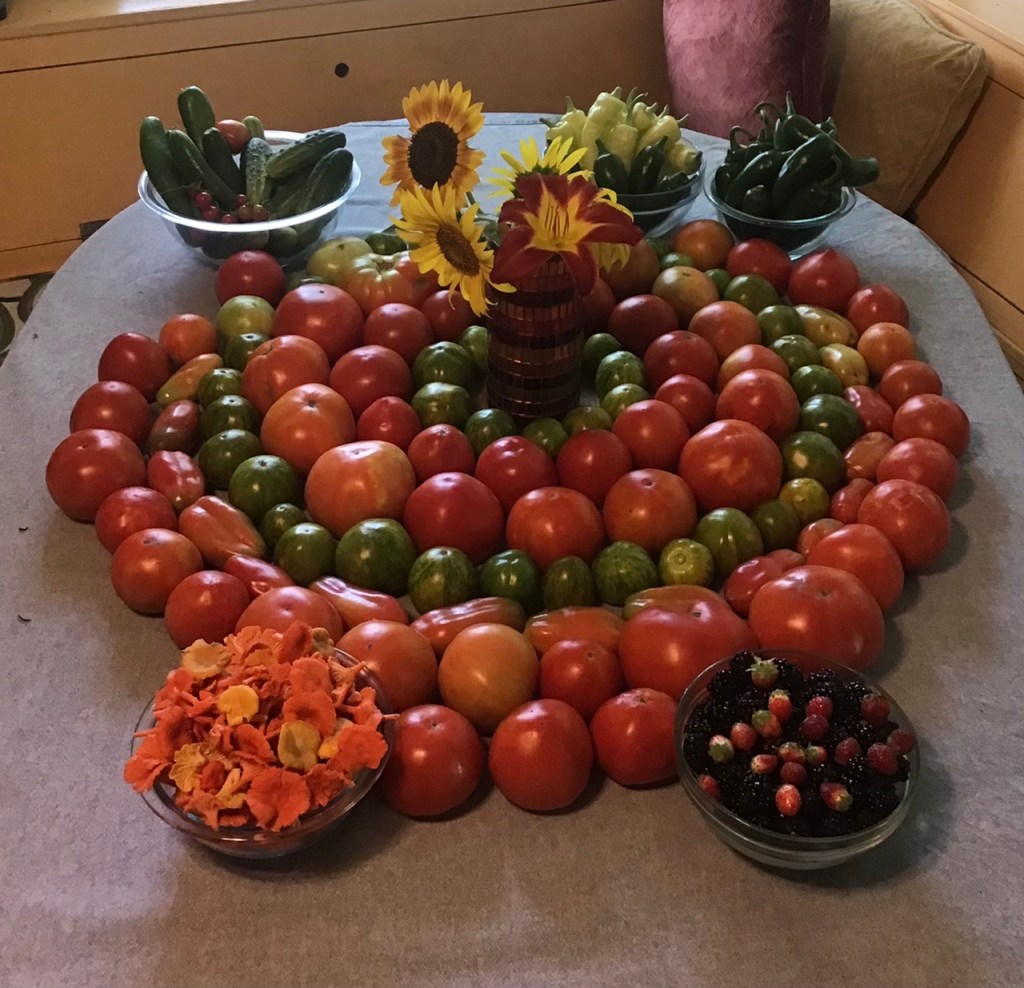
We are just days away from no tomatoes. Just as I was really getting sick of them.

There’s an attitude to surplus, just as there is to scarcity. Maybe we could even call it opposing frequencies.

I’ve known wealthy folk, in my younger days, who refused to eat leftovers, ever, no matter what it was, even lobster or filet mignon. One could almost be convinced of a certain ‘trickle down’ economic theory when in their presence.

While I was really lucky to be friends with them, because I got a lot of free upscale leftovers, I did find that attitude to be wasteful, and was not shy about expressing it.

It behooved me to see all that good food go into the garbage, not even composted. I couldn’t eat all the leftovers created from a weekend lake house party, and there certainly weren’t any livestock to benefit, not even doggie bags.

I think my 2nd favorite thing about having pigs, after the sausage and bacon and ham, is that I feel zero guilt about throwing away our surplus. It’s not throwing it away at all, I’ve come to realize, it’s really more like pre-seasoning our sausage.

So it was interesting to read an article the other day from an author who presented a graph from the “Bureau of Labor Statistics (BLS) data demonstrating a substantial decrease in household food expenditure as a percentage of income—from 44 percent in 1901 to a mere 9 percent in 2021.”

It was considered a ‘good thing’ according to this graph and this author that food prices had become so negligible in the modern economy.

I’d be willing to bet the farm that the general public agrees with this premise. To have the essentials of life—that is, food and water—as cheap as possible, indeed feels like a good thing. If those are brought to them poisoned is mostly not a thought at all.

Once the essentials are met, as in our modern Maslow’s hierarchy of needs, we can move on to entertainment.

Oh, except for that other pesky thing, energy. Because WiFi and game boys and television aside, we do still NEED our fridges and freezers and air conditioners.

And if you think that’s exaggerated, watch the mass exodus from the South to the North if the World Economic Forum has their way and all those civilizing conveniences disappear before too long. All while we are sweltering down here under the umbrella of ionospheric heaters up there.

But, aside. Let’s get back to the basics. Food and water, even before energy. You already know the feast or famine feeling. I know you do.

Do you give a care when you shower that 5 more minutes will break the bank? Have you ever lived in a situation where you carried all the water you needed for the day?

Do you consider when you buy your groceries that 5 more dollars will break the bank? Have you ever lived in a situation where a few dollars meant dinner or no dinner?

Every technology is a Trojan Horse. From shoes, to language, to music, to roads, to windmills, to combines, to bombs, to telephones, to cybernetics. Every one. Man existed before all of them. Somehow. Not even the ionospheric heaters causing us drought and weather chaos will bring about the extinction of man.

Man, in whatever form, of whatever species we care to classify, is a feature, or a bug, of this ‘solar system’.

Or, maybe I’m wrong, and we will perish like the supposed dinosaurs.

But my sense says, its otherwise. It says we survive in surplus, in scarcity, in love and in hate. We remain under masters, in servitude, and occasionally at some magnificent moments, I imagine, its otherwise.

We survive wars and diseases and lies. We survive pop music and step mothers and manufactured weather.

They say we must thrive, to thrive is to succeed. To succeed is to know progress. To progress IS.

To succeed is to feast.
Yet to feast indefinitely, is impossible. It will eventually lead to famine.

Because failure IS the inevitable consequence of success.

Beauty is Intoxicating

Every gift is a curse. But, is every curse also a gift?

I’m going to take the long way around a pretty basic question, but one that I am honestly curious about and would love to hear any thoughts on the matter.

When I was a teenager, I had a number of “love interests” that were short-lived, but intense enough that I remember them vividly. I went from Tom-boy to boy-crazy fairly quickly, in just one summer actually. For someone so young I found myself navigating very choppy waters without a smidgeon of skill.

Two of them, around the age of 16 and 17, are fit examples for this story. One was a short-term boyfriend, another was a near miss.

The near miss was a one-legged salesman. I was a shoe sales clerk at the shopping mall in Chesterfield, Missouri. It was actually a really good job and I was glad to have it. Suburban life before car age is brutally boring for someone like me. I finally felt free and so adult-like as I strutted through the mall on breaks in my heavily discounted Overland Trading Company shoes.

I don’t remember which shop it was now, but I would expressly wander in that direction just to see if he was there. He would smile at me, I felt he was even waiting for me to pass by, and I would smile back, maybe give a cute little wave for added effect.

That he had only one leg was not what made me want to gawk at him. But rather that he was gorgeous. I mean, seriously Gorgeous. Handsome, amazing build, confident, well-dressed, and just the right amount of older for a 16 year old to get herself swooning in his direction.

We talked at some point. Went to the food court together. Became, not exactly friends, but something like ‘mall buddies’. Then somehow it happened that we decided to have a real date, where he came over to my house to pick me up in his car.

And I will never forget that moment. It was a sudden disaster. That he had one leg did not phase me in the public sphere, not at all. It felt like a non-issue. Sure, I was curious what had happened, and I’m sure I asked at one point and he answered, but I don’t recall his story. I liked him. I especially liked looking at him. I liked that he liked me. I remember, I really liked that.

I remember he was kind, and a gentleman. And I hated myself. I hated myself that suddenly, seeing him in my house, something switched for me that I could not comprehend. I sensed overwhelmingly, all of a sudden, that I could not be who he needed me to be. It was a shameful, and quite devastating feeling for me at that ripe young age.

On one other occasion not long afterward I again became intoxicated by another young man’s beauty. He was my age and the son of a family friend from church. Everybody loved him. It also ended badly, despite my genuine feelings for him, that certainly went beyond just his great looks. And that also came down to the same issue, in 20/20 hindsight: I can’t be who you need me to be. The realization coming too late to avoid the associated pain. Their beauty, I really believe, clouded what I should’ve seen before leading them on.

And my point in sharing these very old recollections is, could the opposite also be true? I guess I feel it would be nice if it were. I saw a man the other day who was clearly very compromised—and my heart went out to him, in a very pitying way. I knew, from his appearance, he suffered many hardships in life. I’d like to believe that in his apparent curse, he has found a deeper gift. Sort of like the opposite of the gift of beauty that invariably bestows pain due to all of us who are so entranced by it.

Or, I’m just looking for an avenue out of my automatic pity for him? Thoughts?

Random Notes: Understanding False Hierarchies

Digging through my files for content. Make of them what you will. Or won’t. Comments most welcome!

False hierarchies, that is all hierarchies not based in nature, are crippling our civilization. And maybe, that’s just natural.

They are invariably:

~Based on fluffing not rivaling, so that the leader is replaced by a Yes-man rather than an honorable man.

~Confusing true power with temporary status

~Leading a horse to water, noticing he does not drink, and blaming him for being stupid. Rather than questioning if the horse is intuiting more about the contents of the water than you are.

~I’m in charge, you’re responsible. That is not meant to mean you are to act as my scapegoat. It is meant to represent the bond between the care-givers.

~Helping people adjust to their servitude is not actually helping. It’s akin to helping addicts find their next fix, you are opting to make yourself feel better in the moment by helping someone else feel better in the moment, at the expense of long-term solutions. The proverbial thumb in the dike.

~Hardest lesson for an empath (or a yes-man) to learn—stop cleaning up other people’s messes—you are only making it worse for the next generation.

~America has roughly 35 million acres of lawn and 36 million acres housing and feeding recreational horses. 

https://www.ratical.org/ratville/CAH/warisaracket.htm

~The tragic hero is brought down by his virtues, not his vices!

World War I: The Great War Was also the Great Enabler of Progressive Governance

“It was decided to make [the soldiers] help pay for the war, too. So, we gave them the large salary of $30 a month. All they had to do for this munificent sum was to leave their dear ones behind, give up their jobs, lie in swampy trenches, eat canned willy (when they could get it) and kill and kill and kill …and be killed. But wait!

Half of that wage (just a little more than a riveter in a shipyard or a laborer in a munitions factory safe at home made in a day) was promptly taken from him to support his dependents, so that they would not become a charge upon his community. Then we made him pay what amounted to accident insurance—something the employer pays for in an enlightened state—and that cost him $6 a month. He had less than $9 a month left.

Then, the most crowning insolence of all—he was virtually blackjacked into paying for his own ammunition, clothing, and food by being made to buy Liberty Bonds. Most soldiers got no money at all on pay days.
We made them buy Liberty Bonds at $100 and then we bought them back—when they came back from the war and couldn’t find work—at $84 and $86. And the soldiers bought about $2,000,000,000 worth of these bonds!”

~As Carroll Quigley writes, its success was partly due to “its ability to present itself to the world as the defender of the freedoms and rights of small nations and of diverse social and religious groups”. (2)

Empire of hypocrisy | winter oak

Happiness vs Joy

Have you ever pondered the difference of certain words often used interchangeably? Or, what that difference, or obfuscation of difference, might mean?

There seems little doubt the art of subtlety is being systematically erased from human consciousness.

One coy glance to move a man, or your entire derrière in the air?

If this is a natural phenomenon resulting from the rise of systems thinking, or a top-down control mechanism, or desensitization gone amok, or devolution, or democratization, I can only speculate. And stay open to suggestions.

But I do find it to be a personal goal and an evolutionary imperative that we don’t let subtlety die in the nebulous gray zone.

I kind of relate it to the difference between American cheese and aged chèvre. And the difference between emotions, feelings and sensations.

Our culture has become increasingly sensationalized. It’s become a gamers’ world of goal-oriented stimulus that must be fed on a constant basis.

Fleeting hits of happiness have all but replaced the finer nuances of lasting joy. Considering absurd comments like Hilary Clinton’s ‘Americans have a happiness deficit’ I can’t help but consider the context conspiratorially. She is not blind, or dumb. So she must be bullshitting on the commands of her handlers.

Do a quick search on ‘Americans and Happiness’ and it’s clear this relationship is not only Big Business, but Big Science, as well as Big Politics.

“Further complicating matters has been the bias critics have shown when examining happiness. Sociologists have viewed happiness through the lens of society, psychologists the mind, physicians the body, preachers one’s faith, politicians the government, and so on. This has made the field a jumble or hodgepodge of viewpoints, more so I believe than most other subjects. As well, all sorts of experts have attempted to control or take ownership of happiness in America in some way, this too contributing to the scattered nature of the subject. Businesspeople, government officials, and religious leaders have seen themselves as arbiters of happiness and have assumed responsibility for delivering it to Americans in order to solidify their own power. Likewise, politicians from each persuasion have often claimed to be the greater instrument of happiness than their competitors, making it appear that the emotion can be bestowed rather than earned.” The (American) Pursuit of Happiness | Psychology Today

Is happiness an emotion? Indeed, it is not. Joy is an emotion. Happiness is a mood. A sensation. Have any of the mainstream consensus trance defenders bothered to notice that?

Joy is bound to life itself, its opposite is pain. Together they create a kind of ‘trauma bond’ that keeps us engaged and inquiring incessantly into others and the world around us. It comes from the well-spring of the eternal natural world. Or, God, if you prefer.

Happiness is a day at the games or a fine concert or great sex. I’m not knocking it! I’m just saying, there’s far more to life than that, and if you can’t taste the difference between American cheese and aged chèvre, then perhaps you should not be speculating on the condition or the ills of the American culture.

Sisyphus Today

Hubby, in a moment typical of his wry wit, said to me the other day:

Your persistence could be confused with masochism.”

“HA! Wouldn’t that make a good meme” I replied.

But the more I got to thinking about it, the more I remembered the story of Sisyphus.

For those unfamiliar with this character in Greek myth, here’s a few select quotes from Wikipedia:

“As a punishment for his crimes Hades made Sisyphus roll a huge boulder endlessly up a steep hill in Tartarus.[8][18][19] The maddening nature of the punishment was reserved for Sisyphus due to his hubristic belief that his cleverness surpassed that of Zeus himself. Hades accordingly displayed his own cleverness by enchanting the boulder into rolling away from Sisyphus before he reached the top which ended up consigning Sisyphus to an eternity of useless efforts and unending frustration. Thus, it came to pass that pointless or interminable activities are sometimes described as “Sisyphean”. Sisyphus was a common subject for ancient writers and was depicted by the painter Polygnotus on the walls of the Lesche at Delphi.[20]”

“In experiments that test how workers respond when the meaning of their task is diminished, the test condition is referred to as the Sisyphusian condition. The two main conclusions of the experiment are that people work harder when their work seems more meaningful, and that people underestimate the relationship between meaning and motivation.[25]”

My introduction to the myth came through Albert Camus, one of my favorite authors while at university. Again, from Wiki:

“Influenced by philosophers such as Søren KierkegaardArthur Schopenhauer, and Friedrich Nietzsche, Camus introduces his philosophy of the absurd. The absurd lies in the juxtaposition between the fundamental human need to attribute meaning to life and the “unreasonable silence” of the universe in response.[1] Camus claims that the realization of the absurd does not justify suicide, and instead requires “revolt.” He then outlines several approaches to the absurd life. In the final chapter, Camus compares the absurdity of man’s life with the situation of Sisyphus, a figure of Greek mythologywho was condemned to repeat forever the same meaningless task of pushing a boulder up a mountain, only to see it roll down again.

The essay concludes, “The struggle itself … is enough to fill a man’s heart. One must imagine Sisyphus happy”.

What absurdity we have witnessed these last few years! How many of us have become Sisyphus in so many ways—whether trying to open the eyes of our friends and loved ones and wider community, or trying to navigate the New Normal, or make sense of the media and political shit show?

Some advice from Camus? Maybe, maybe not. He wasn’t too big on Hopium.

“There is no fate that cannot be surmounted by scorn.”

And how about this clever little cartoon as a modern-day Sisyphus myth?

How Lies Land

With all the obvious lies flying around the entire Mediated-Sphere, I got to reminiscing about my former best friend at university who was an unrepentant liar.

The story of the end of our friendship still hurts to recall, 30 years later. I lost not only her friendship at that time, but that of the circle of friends we shared as well. A double whammy, if you will.

While I understand there are always (at least) two sides to every story, I haven’t spoken to her since those days, so how she recalls these events, or if she recalls them at all, I don’t know, and I don’t care.

I’m recounting this story now because I see in the public in general there are FAR too many who are too hesitant to tear themselves away from liars and the clearly corrupt institutions they are running, which I know will be to their detriment in the long-term, as well as to the detriment of us all.

The longer you wait, the more entrenched, and accepted, the lies become.

I share this story as an appeal, yet another one, and a warning.

My little story is inconsequential to everyone else but me. But it does have an accompanying lesson from which anyone could benefit.

This friend and I were so tight we shared a studio apartment and were nearly inseparable for several years. I met her at the beginning of my freshman year, not long after I met my boyfriend.

To make a long and dramatic story short and succinct—she was sleeping with my boyfriend all those years behind my back. After he and I broke up, she still didn’t tell me about the two of them. Then she got pregnant by him, but I still didn’t know. She asked me to borrow money and I asked why. She became very secretive.

I heard from another friend she had been reading my private journal, because she wanted to find out if I was still in love with the ex-boyfriend. I got suspicious and tried to talk with her several times about it all, but she waved me off each time. I refused her the money and she got livid. We got into a screaming fight. I was still baffled by it all because I didn’t know the real issue—that she was pregnant by my ex-boyfriend and wanted the money for an abortion.

Even after all that, I would’ve forgiven her, if only she had come clean. She never did. I wrote in my journal, which I knew by then she was reading, that it’s not the lies that break trust so much as the refusal to face them even when confronted. The cover-up was worse than the initial lies.

Why? Because that’s where I learned every single person in our circle of friends knew about their liaison except for me. For years.

It wasn’t about the boyfriend, either. I’d have handed him over with pleasure, had she ever asked. But then, that’s the whole point for a narcissist, or someone intent on winning at any cost—it’s not as fun if you don’t steal it—fair and square.

She deflected, made excuses, minimized, tried to turn the tables. She showed no remorse, would take no accountability, refused to apologize, or even to listen to me, or show me a shred of compassion.

You might think it was the humiliation, or the betrayal, that caused me so much pain and that guided my decision-making after that point. But as painful as those were, that was not my breaking point.

No. My breaking point was being honest with myself about the content of their characters that had become glaringly obvious at that point, so much so that I could no longer stand to be around them. Any of them. They could not look me in the eye. They would not show an ounce of remorse or try to understand my pain or my position.

It was really, really hard, but I walked away.

I wish I could say that was the last time I made such a mistake. No again. It took another couple of decades for me to correct this issue. It took until the point I realized that it was my fault.

Of course I don’t take any blame away from her, her behavior was deplorable. But, I also knew her moral standards were low. I knew she’d done similar things to other friends. I just thought, because I was more loyal to her, a better friend, more honest, more committed, I could inspire her to not play me that way. I should’ve known better.

Giving such people the benefit of the doubt, and second chances and third chances, is not loyalty, or strength, or courage. It is enabling liars and it is highly damaging to self-respect.

She went on to become a pharmaceutical rep. I have little doubt she has still not done enough soul searching to realize or regret yet another move down the low road.

And this is where we stand in America. We are being lied to by those all around us, by those who have positioned themselves as our betters, our leaders, our trusted officials, our media.

They are lying. The time for excuses is over, already decades ago. The problems we need to face will not be fixed by voting for the next Liar In Chief. To continue on with the charade at this late date makes you a collaborator by every definition, no longer able to claim innocence or ignorance.

LIVE NOT BY LIES
“On the day Solzhenitsyn was arrested, February, 12, 1974, he released the text of “Live Not by Lies.” The next day, he was exiled to the West, where he received a hero’s welcome. This moment marks the peak of his fame. Solzhenitsyn equates “lies” with ideology, the illusion that human nature and society can be reshaped to predetermined specifications. And his last word before leaving his homeland urges Soviet citizens as individuals to refrain from cooperating with the regime’s lies. Even the most timid can take this least demanding step toward spiritual independence. If many march together on this path of passive resistance, the whole inhuman system will totter and collapse.”

by Edward E. Ericson, Jr. and Daniel J. Mahoney, The Solzhenitsyn Reader

Still This Love Crap

Have you ever experienced unrequited love? Ever love someone who was so out of your league they didn’t know you existed? Ever been horribly, unfairly, unceremoniously jilted by a lover? Ever love someone for years who treated you like shit most of the time? Ever love someone who turned out to be completely different than the one you thought you fell in love with?

Ever tried to muster up feelings of love for someone or something you did not, could not, love?

And yet still, despite its ephemeral nature—from its meaning, to its translation, to how it is individually experienced—some of our greatest thinkers, philosophers, social critics, poets, not to mention a good chunk of pop culture, still repeats “Love is the answer.”

We should love everyone and especially nature. That’s what’s wrong with the world, they insist, not enough love. And every time I hear this, I roll my eyes, even when it comes from someone I love.

https://www.bbc.co.uk/sounds/play/b08njtjg

Most recently I heard it in an interview coming from Wendell Berry (link). How someone so inspiring, who has led such a charmed and wholesome and respectable life, who now at an advanced age seems so wise, could repeat such nonsense confirms for me only one thing: “We don’t see things for what they are, we see them for what we are.”

Love is the answer to the West’s problems, they say, because you take care of what you love. And the younger thinker and social critic Paul Kingsnorth agrees with him.

How lovely.

Now here’s a homework assignment I’d love to give to these fools. Kingsnorth likes to study tribal cultures, which I think is really cool. He likes them because they have a solid home in nature, unlike Westerners. And I agree. So, I think he should ask all those tribal folks their opinions about this ‘love’ solution so many Western thinkers keep harping on about.

My bet is, it doesn’t translate. At all. I bet he’d have to write an entire essay for them about what he means by love in the first place, let alone how he expects that will solve anything.

How do you make someone love you? Or care about you? I have a difficult time imagining a more monumental task. And yet, somehow those who care about nature are tasked with getting those very great many, like the Technocrats and their vast entourages, to not only love it, but to respect it, to care for it, to nurture it even. Seriously?

What a debilitating delusion they are spewing. And not just once or twice out of an understandable desperation. But constantly, for decades now.

Yet to call it out for the obvious shallow fantasy that it is, I become the bitch.

Well then, so be it. Let me play that role for a minute or two right now.

Imagine Mother Nature is your very own mother. Maybe you love your mother, let’s give it the benefit of the doubt. You love her, but your sisters love her more. And your mother and your sisters are screaming at you—“You don’t love me!” “You don’t care about me!” “You are exploiting me and you must stop!”

How will you respond to their shrieks and demands of love and care? Deny your lack of love, perhaps? Maybe yell back that they are all wrong about you? Maybe ask what they mean by that?

You might be so sure of your love that you ask what you can do to prove it?

Maybe Mom replies she wants you to write her a poem professing your loving feelings. So you do. You go even further, and you write 10 poems and throw in a tediously long essay to boot. And you’re very proud of your efforts and you feel you’ve really captured the intense love you have for her.

And she says she likes them, even the tediously long essay. In fact, everyone who loves her also agrees how perfectly you’ve captured those feelings of love through your words. Astonishing.

But, after all, those are just words, and you said to love her is to care for her, so she wants to see some action.

So with the same zeal you wrote the ten poems and tediously long essay you tackle the part where your loving words become caring actions.

You chop wood and carry water for her. You refrain from any negativity in her presence, because she doesn’t like it. You insist that everyone in her company, through shame or coercion or even force, abide by her rules and preferences.

At long last, she is satisfied with your efforts. You can feel the power of her appreciation filling your heart and coursing through your veins.

She tells you, “Child, you are a true master of loving care!”

“Except, you see, there’s so many children over there who don’t love me. And their lack of love for me is upstaging your love. Their lack of love is demonstrably more powerful than your true love. What can you do about this?”

And you reply, “Great Mother, don’t you worry, I can make them love you like I do!”

Really? Can you? What makes you so sure about that?

You read them your poems, and they smirk. Then they read your tediously long essay and shrug. You show them your admirable work in fetching wood and carrying water for your Great Mother, and they respond by clear cutting your forest and damming your river.

Then they tell you their favorite joke, laughing all along.

The joke goes like this: There were these three dudes on a yacht. One was an American, another was Russian, and the third one was Mexican. They were all drinking and getting boastful as drunken men like to do.

The Russian said, “In my country, we have so much vodka we can afford to throw it away!” And he takes a full bottle of vodka and throws it into the ocean.

They all laugh harder. So, the Mexican says, “In my country, we have so much tequila we can afford to throw it away!” And he takes a full bottle of tequila and throws it overboard.

And they all laugh harder still. Then the American says, “Well, in my country we have so many . . .

And he picks up the Mexican and throws him overboard.

The Russian and American look at each and howl with laughter. And the American blurts out between guffaws, “Tough love!”

To The Holy Spirit

O Thou, far off and here, whole and broken,
Who in necessity and in bounty wait,
Whose truth is light and dark, mute though spoken,
By Thy wide grace show me Thy narrow gate.

Wendell Berry