A few choice quotes from Juliette de Bairacli Levy who did not mince words about her views on modern medicine.
This excerpt is from 1952! It’s astounding to me that it’s only gotten worse in the last 70 years. They keep doubling-down, and the public keeps buying it up.
“The present-day farmer has been educated to consider disease as inevitable and the only scientific cure as being in the artificial remedies of the modern veterinary surgeon who through over-rigid orthodox training and himself under the influence of advertisement, is too often a mere vendor of the products of the vast and powerful chemical and serum manufacturers. For the vested interests in modern medicine are stupendous. Businessmen who have never owned an animal fatten like breeding toads upon the ailments of farm stock which need not know sickness at all if they had daily access to the herbs of the fields. The true farmer should cultivate his own medicines in his own fields, and he should not consider himself as being a farmer if he has to resort to outside help for keeping his animals in health, and healing them when in sickness. Science is providing the ruination of true farming; the only thing that I, and countless others, have noted as flourishing alongside science, is disease!—disease of the earth, disease of crops and disease of the animal and people who feed on the diseased produce.”
“Professor Szekely had declared emphatically, that the curing of the ailments of his patients is often a simple task in comparison with the freeing of their bodies from the accumulations of chemical drugs lodged in their tissues — the drugs derived from orthodox medical chemo-therapy, and from the poisons sprayed upon fruits and vegetables by the modern farmer, or placed in tinned and bottled foods as preservatives. Many of his patients are Americans, and in present-day America the chemist seems to be running amok, spraying and poisoning everything edible.” ~Juliette de Bairacli Levy, 1952, The Complete Herbal Handbook For Farm And Stable
The influence of advertisement, you say? Naw, can’t be that!
I don’t know when the breaking point will be, how it will come about, who will throw the first punch or the last. But, I’ve got some good quotes to share this post, of the variety that make me wonder if the public has finally had enough of the lies.
Or, was Bezmenov right? It’s hopeless at this point?
More false claims about raw milk, inspiring a good article from a wise woman, Sally Fallon of Weston A. Price. A few quotes:
“In a press release dated March 25, 2024,3 the U.S. Department of Agriculture (USDA), Food and Drug Administration (FDA) and Centers for Disease Control and Prevention (CDC), as well as state veterinary and public health officials, announced investigation of “an illness among primarily older dairy cows in Texas, Kansas, and New Mexico that is causing decreased lactation, low appetite, and other symptoms.”
“The agencies claim that samples of unpasteurized milk from sick cattle in Kansas and Texas have tested positive for “highly pathogenic avian influenza (HPAI).” Officials blame the outbreak on contact with “wild migratory birds” and possibly from transmission between cattle. The press release specifically warns against consumption of raw milk, a warning repeated in numerous publications and Internet postings.”
“The truth is that “viruses” serve as the whipping boy for environmental toxins, and in the confinement animal system, there are lots of them — hydrogen sulfide, carbon dioxide, methane and ammonia from excrement, for example. Then there are toxins in the feed, such as arsenic added to chicken feed, and mycotoxins, tropane and β-carboline alkaloids in soybean meal. By blaming nonexistent viruses, agriculture officials can avoid stepping on any big industry toes nor add to the increasing public disgust with the confinement animal system.”
“Nearly a decade ago we won the mandatory national Radio Frequency Animal Identification (RFID) regulation. It was pushed on the heels of the mad cow paranoia as a way to track and find diseases quickly.”
For you youngsters, it was a draconian measure that was incredibly prejudiced against small outfits. For example, a Tyson factory could register one RFID tag for a whole house of 20,000 chickens—one per flock. But an outfit like ours would have to RFID every single chicken. Costs ranged from $2 to $5 per tag.
Every time you moved animals from one addressed premise to another, you had to notify authorities. Thousands of farmers around the country attended the hearings and voiced their opposition. The backlash was severe and eventually the USDA pulled the plan. It’s been dormant for a long time and we thought it was dead.”
********
Moving on to an essay that hits close to the mark, I think.
“In an election year that follows more than a decade of rising populist dissatisfaction, high-skill but low-status rejects are coming to look like a formidable social class.
Increasingly, it’s not just obscure farmers or overtaxed truckers who feel cheated out of the respect they’ve earned: it’s also debt-ridden college kids, heterodox tech magnates and blacklisted intellectuals. It’s manual laborers whose wages get depressed by inflation and illegal immigration, but it’s also artists whose projects get passed over to make room for yet another adaptation of The Color Purple. This helps explain why Trump has mobilized young people, blue-collar workers, white evangelicals, law-abiding Hispanics and black business owners, all in unexpected numbers: those are people who feel, in one way or another, despised without cause.
But the bitter irony is that in trying to outdo the founders’ virtue, we have created an unnatural aristocracy far more hide-bound and unworthy than the old-world royalty they fled. Our self-styled betters have neither raised us up toward a more perfect meritocracy nor led us triumphantly into a classless paradise. They have simply replaced an imperfect class system with a grotesque and nonsensical one. They promised to cater to throngs of frustrated pariahs; instead, they created more of them, adding to their number daily from the exiles of the natural aristocracy. Whether or not it is desirable that the resulting coalition should once again find itself represented by Donald Trump — a profoundly suboptimal champion — it was inevitable. This presidential contest is shaping up into a face-off between the incompetent elect and the excellent outcasts. It may not be the most exhilarating choice to have to face. But it’s not a particularly difficult one, either.”
And closing with an appropriate poem that was posted in the comment’s section of the post by Salatin quoted above. An author I’m very familiar with, but the poem is new to me.
THE WRATH OF THE AWAKENED SAXON by Rudyard Kipling
It was not part of their blood, It came to them very late, With long arrears to make good, When the Saxon began to hate.
They were not easily moved, They were icy — willing to wait Till every count should be proved, Ere the Saxon began to hate.
Their voices were even and low. Their eyes were level and straight. There was neither sign nor show When the Saxon began to hate.
It was not preached to the crowd. It was not taught by the state. No man spoke it aloud When the Saxon began to hate.
It was not suddently bred. It will not swiftly abate. Through the chilled years ahead, When Time shall count from the date That the Saxon began to hate.
Some are shocked and appalled by this, as they should be, according to me. Others think it will be a fantastic improvement to human life, or a great way to make more fiat, or a solution to the burden on the caring professionals, or they love tech for tech’s sake, or whatever.
Those of us who love history and dwell constantly on the question ‘how has it come to this’ were well aware of this potential because we study the trajectory of modern life. I could begin with the first critics centuries ago, but for brevity sake, I’ll start instead with my own life, the only history available to me to know thoroughly enough.
Working mother, divorced parents, step parents, then step siblings, professional daycares, neighborhood babysitters, after school programs, junk food, convenience food, lots of TV. Family history of: diabetes, heart disease, obesity, cancer, vision problems, depression, eczema, alcoholism, Parkinson’s, and, you get the picture.
And I would not say my family life was bad. It was the typical American suburban life of a great many growing up in the 70s and 80s. Neither particularly good, nor bad, just normal. Normal, as in well-normalized.
Like most families my parents would joke about voting for the ‘lesser of two evils’. They probably learned that from their parents. My mom went to community college and got her degree once we were gone, in sociology. She worked full-time all her adult life and didn’t regret it. My dad remained ‘upwardly mobile’ as his Protestant father taught him to be.
In fact, we have retired before him, and he has just had his first heart attack.
They are both still with us, but they do not read this blog, so I could say whatever I wanted. 😏. But, that’s not the point of this particular post.
Let’s leave it at this—in hindsight, my unique perception of growing up this way is, in a nutshell—there was not a lot of parenting happening. The results of this having widespread and devastating effects.
It is from these original seeds of pseudocare that have been not only consistently irrigated in our own territories, but have been dispersed throughout the world these last five-plus decades which has ensured the trajectory to the ridiculous place where we now find ourselves: Drowning in pseudocare so deeply we can scarcely recognize what real care looks like anymore.
Another quick peak at the fruits those seeds have produced.
Yet even facing all of this, I’m still optimistic, as I have been all my life. Even at the worst of times, even during a few prolonged worst of times, I must’ve still learned something vital from my half-assed upbringing and collapsing culture.
So, here it is, in another nutshell:
Believe in yourself, believe it can change, but don’t practice in sidestepping the hard stuff. And the hardest of the hard stuff is care, real care—for yourself, for others, for the future—that is why we are here. How you go about that is your personal journey and your only real duty to discover and live. That is all there is to do in a life well-lived.
Which is why I want to once again quote an obvious example of someone doing exactly that, Gavin Mounsey, who is rocking the real care like a hurricane these days! Wait . . . What?? Ok, terrible simile aside . . .
I believe he knows what needs to happen next and is becoming the living manifestation of that in his own life first, and passing it around. Leading by example, it’s the only way. It’s the same cardinal rule as storytelling—Show, don’t tell.
“I want to give my energy to improving and increasing the resilience of my local community, not your hyper centralized one size fits all infrastructure.
“Freedom is not a consolatory prize that can be given to us to reward our obedience and capitulation to a system of violent coercion. It is not something that can be granted or provided to you by some government that wrote some thing on a piece of paper. Freedom is your birthright, and you either live it and embody it, or you allow yourself to be put in a mental cage by statists and other abusive institutions or individuals. My ancestors bloodlines are traced back to a people described in today’s terms as The Gaels. “Saoirse” is Irish Gaelic word for “Freedom”. Saoirse is an ancient concept that comes from the original Brehon laws of the Druidic (and eventually Celtic) world before the time of Christ. In the times when that word was created, my ancient ancestors lived without a centralized state, without prisons and without police.
“Saoirse means many things to different people. For some it means freedom to think, express and freedom to learn, for others it’s the freedom of imagination and the freedom of the spirit. And for some it also means freedom to set up parallel societies.
“This is one of the reasons that I included glimpses into two historical cultural cross sections of ancient cultures that existed without a centralized state and police/prison system in my essay as I feel that we can glean wisdom from stateless societies that existed for centuries to millennia in how to design more ethical, equitable, honest, Regenerative and practical ways to organize community, encourage amicable/respectful behaviour in humans and collaborate to leave this world a little bit more free and beautiful than it was when we got here after we are gone.
“With all that being said, I want to emphasize that I think that placing any culture, group of people or individual on some pedestal as pure is unhealthy. I feel we should be vigilant to make sure we are not romanticizing their past nor romanticizing the potential of their worldviews to provide solutions to the present challenges we face.
“The path to become connected to place with a reciprocal relationship, reverence and humility is the path to embrace indigeneity ourselves.
“It is a great starting point to create pockets of decentralized resistance to oligarchic / statist tyranny as growing your own medicine and veggies may appear harmless, but in a parasitic global plutocracy it represents a decisive action that severs the tentacles of tyranny in a critically important aspect of our lives (how we access food and medicine). Thus, it is a radical and revolutionary act that appears benign to the hubristic philanthropaths and demociders, serving as a sort of covert sedition in a world governed by parasites that want us dependent, gardening to grow or own food and medicine is like a hammer wrapped in velvet that knee caps big pharma’s plans to poison us slowly through dependence on their system for health care and also strikes the spine of the digital gulag system, breaking its back so it can no longer have any strength to influence our lives through controlling our access to food/medicine.
A better essay about the importance of self-reliance and health as the ideal antidote to modern societal tyranny I could not have written! And he has a YT channel. 😁
He was also kind enough to try to address our biggest garden nuisance within the scope of his permaculture lens. He offered many potential solutions, and bless his heart for the effort.
But I’ll just repeat my personal favorite: hot and spicy gopher wings. 🤪
What an example of authentic care—growing in the real and cyber worlds simultaneously—where even sassy meat-eaters and smart-asses and AI are welcome to stuff up their comments sections. Now that’s grace under fire!
Thanks to guys like these, in the coming decades I predict courageousfellowship will become the new sexy.
“Everyone’s favorite “health freedom” guru said as much…of course, not publicly but in an email that’s been shared. You can find the write-up about it here. Planet Waves Interview Details RFK Jr. in his own words; “I’m grateful for your courage and intellectual integrity. I have an open mind on this issue but no bandwidth to spend the time energy and credibility capital to personally investigate it. I feel the same way towards those people who passionately and knowledgeably argue that 9/11 is an inside job. It could be true. But there are opportunity costs in taking on this cause and I think diminishing returns to my overall effectiveness. I cannot right every wrong or expose every falsehood. I need to be strategic In choosing my battles. If you reflect, you will find that you do the same. I admire and encourage you but I must beg off on this war for the time being. I’m more likely to join if you get it nearer the goal line where the cost/returns ratio improves.” In other words, you blaze the trail, I’ll reap the rewards of an easy and marked path if and when you get to the destination. What douche bag of epic proportions! He KNOWS the science and knows he’s broadcasting fallacies every single day to his millions of fans (donors) and will continue to perpetuate the Big Lie because the costs are too high. Instead, he’ll let other’s (people who don’t matter to HIM or his All Mighty Dollar) take all the risks.”
Hubby, in a moment typical of his wry wit, said to me the other day:
“Your persistence could be confused with masochism.”
“HA! Wouldn’t that make a good meme” I replied.
But the more I got to thinking about it, the more I remembered the story of Sisyphus.
For those unfamiliar with this character in Greek myth, here’s a few select quotes from Wikipedia:
“As a punishment for his crimes Hades made Sisyphus roll a huge boulder endlessly up a steep hill in Tartarus.[8][18][19] The maddening nature of the punishment was reserved for Sisyphus due to his hubristic belief that his cleverness surpassed that of Zeus himself. Hades accordingly displayed his own cleverness by enchanting the boulder into rolling away from Sisyphus before he reached the top which ended up consigning Sisyphus to an eternity of useless efforts and unending frustration. Thus, it came to pass that pointless or interminable activities are sometimes described as “Sisyphean”. Sisyphus was a common subject for ancient writers and was depicted by the painter Polygnotus on the walls of the Lesche at Delphi.[20]”
“In experiments that test how workers respond when the meaning of their task is diminished, the test condition is referred to as the Sisyphusian condition. The two main conclusions of the experiment are that people work harder when their work seems more meaningful, and that people underestimate the relationship between meaning and motivation.[25]”
My introduction to the myth came through Albert Camus, one of my favorite authors while at university. Again, from Wiki:
“Influenced by philosophers such as Søren Kierkegaard, Arthur Schopenhauer, and Friedrich Nietzsche, Camus introduces his philosophy of the absurd. The absurd lies in the juxtaposition between the fundamental human need to attribute meaning to life and the “unreasonable silence” of the universe in response.[1] Camus claims that the realization of the absurd does not justify suicide, and instead requires “revolt.” He then outlines several approaches to the absurd life. In the final chapter, Camus compares the absurdity of man’s life with the situation of Sisyphus, a figure of Greek mythologywho was condemned to repeat forever the same meaningless task of pushing a boulder up a mountain, only to see it roll down again.
The essay concludes, “The struggle itself … is enough to fill a man’s heart. One must imagine Sisyphus happy”.
What absurdity we have witnessed these last few years! How many of us have become Sisyphus in so many ways—whether trying to open the eyes of our friends and loved ones and wider community, or trying to navigate the New Normal, or make sense of the media and political shit show?
Some advice from Camus? Maybe, maybe not. He wasn’t too big on Hopium.
“There is no fate that cannot be surmounted by scorn.”
And how about this clever little cartoon as a modern-day Sisyphus myth?
When you draw a heart, you are showing them where to aim.
“LaVey had one solid philosophy non-Satanists need to adopt: self-preservation. LaVey likely picked this up from Nietzsche. “There has never been a great ‘love’ movement in the history of the world that hasn’t wound up killing countless numbers of people, we must assume, to prove how much they loved them! Every hypocrite who ever walked the earth has had pockets bulging with love!”
This is what Alice Bailey describes as the “externalization of the hierarchy”: the hidden rulers slowly revealing themselves.
“The “simpler code” devised for the masses used to be organized religions. It is now becoming the Temple of the Mass Media and it preaches on a daily basis extreme materialism, spiritual vacuosity and a self-centered, individualistic existence. This is exactly the opposite of the attributes required to become a truly free individual, as taught by all great philosophical schools of thought. Is a dumbed-down population easier to deceive and to manipulate?
“These blind slaves are told they are “free” and “highly educated” even as they march behind signs that would cause any medieval peasant to run screaming away from them in panic-stricken terror. The symbols that modern man embraces with the naive trust of an infant would be tantamount to billboards reading, ‘This way to your death and enslavement,’ to the understanding of the traditional peasant of antiquity.” – Michael A. Hoffman II, Secret Societies and Psychological Warfare
“Meanwhile Mitterrand’s Minister of Culture, Jack Lang, led a relentless policy of promotion of the “culture of inversion” (defined recently by Paul Kingsnorth as the dedication of “the cultural elites, and sometimes the political and economic elites… not to upholding the cultural forms they inherited, but to turning them on their heads, or erasing them entirely.”) This program manifested itself in such examples as raves in the Louvre and post-modern ballets featuring excrement and menstrual blood. This was the era in which Mélenchon came of age as a member of Mitterrand’s socialist party, where he held positions of senator and then minister. The Mélenchon of 2022 is very clearly the heir of this moment, not a new invention or deviation.
“This is the “peripheral” France—rural, consisting of small- and medium-sized towns and overseas territories—upon which Bernard-Henri Levy each day vomits his class hatred, despite the fact that, for over thirty years, it has been hit hard by the practical consequences of his liberal gospel, to the point that, in the poorest rural regions, living conditions are even more dramatic than in the “problem” suburbs. It comes as no surprise that this France, which comprises more than 60 percent of the population, has been completely wiped off the left intelligentsia’s radar. It is simply the logical consequence of the process that has led the modern left, since its conversion to the principles of economic and cultural liberalism, to gradually abandon its original social base in favor of the new, overeducated and hyper-mobile upper-middle classes living in globalized metropolises, who represent only 10 to 20 percent of the population and are structurally protected from liberal globalization’s problems (when they do not benefit directly from it) […]
If you’ve wondered why Geoengineering has not been front-and-center in the prolonged and highly contentious discussion on Climate Change, maybe some past quotes from Rabbi Jay Michaelson will prove enlightening. He suggested in 1998 a new Manhattan Project.
“Geoengineering more than just “feels wrong.” [FN227] The tunnel-vision of geoengineering robs the environmental community of the ability to solve other critical problems at the same time as climate change: deforestation and overconsumption, for example. Surely, it is better to just get used to the idea of “living lightly” [FN228] than to scatter dust in the sky or seed oceans with iron, especially when living lightly is good for all of us anyway.
Moreover, an environmentalist’s distaste for the materialistic ideals that undergird the root causes of climate change does not make attempting to thwart those ideals either practical or morally *133 justified. Conspicuous consumption is deeply entrenched in American self-conceptions, and in conceptions of Americans by people in the developing world who want to be like them. [FN231]
I suggest it is both unwise and counter-democratic to tell billions of consumers that “We Know Better,” and set about changing deep structures without regard to the life-defining goals of the consumers themselves. Such action is unwise because it pins the biosphere’s integrity on the hope of overcoming something deeply ingrained in Western culture. And it is counter-democratic because, until the members of that culture change its constitutive forces, overcoming them in the name of a paternalistic deep environmentalism thwarts their clearly expressed preferences. [FN232]
To take a more familiar example, it would surely be optimal to empower oppressed indigenous people at the same time as we save a tropical rainforest by granting local populations more control over forest resources. But if a simple purchase of land will save more rainforest, and a separate human-rights campaign can help the indigenous people, and if each has a better chance for success than the integrated empowerment solution, then perhaps it is wiser to divide and conquer. Better to divide opponents whose interests differ and reach incremental consensus than fight them all at once and lose. A policy of land rights for indigenous people may offend agricultural interests, governing power elites, present title holders, and a host of other constituencies. A land purchase, on the other hand, offends fewer people, may please some (power elites for instance), and is more likely to succeed. Meanwhile, a separate human rights campaign is unlikely to interest agricultural users or (some) transnational corporations, and it also is more likely to succeed. Killing one bird at a time may be the “right” way to go, because it minimizes opposition and makes coalition-building easier.
Climate change is an excellent subterfuge; it allows environmentalists to “get at” fossil fuel use, deforestation, perhaps even overconsumption itself– in the name of saving civilization as we know it. Geoengineering, in contrast, gets at nothing other than climate change. On the contrary, not only does sowing plots of ocean with iron filings not save the rainforest, it costs environmentalists precious leverage in their efforts to do so because some of the pressure to address the underlying causes is relieved. [FN240] One of the very strengths of geoengineering–that it requires relatively little sacrifice–is thus one of its great drawbacks to political environmentalists. Anyone who wants to use climate change as a way to “get at” some undesirable but politically popular activity will be sorely disappointed by a geoengineering project.
Political sleight-of-hand can engender a certain ambivalence. It is somewhat dishonest, and can be counterproductive, as in the case of a hopeless but photogenic species such as the California condor being saved instead of more needy but less attractive candidates. Sleight-of-hand can also be a tremendous gamble; trying to kill two birds with one stone is often riskier than trying to kill just one. In the case of climate change, using the biosphere’s climatic integrity as a leverage point is quite a risk: if scientists are right, we may be in deep trouble if GHG emissions and deforestation (the “real targets”) are not reduced. When the nominal goal is itself important, sleight-of-hand is a high-stakes game.
In the end, the debate about geoengineering is largely a debate about what sorts of environmental policies to pursue in an imperfect world. It seems almost preposterous to buck the trends of holistic systems management and suggest running like the Sorcerer’s Apprentice from symptom to symptom. It may also seem as though driving less or cutting fewer trees is simpler than scattering dust particles in the stratosphere. It is certainly more elegant. But when the Damocles’ sword of massive biotic disruption is hanging over our heads, we should choose what works. And the bottom line is that, though the regulatory strategies envisioned in Kyoto must continue to play out their roles, we need more than a global Marshall Plan of incentives and reductions to avert potentially disastrous climatic change.
We need a Manhattan Project.”
Excerpts taken from: Jay Michaelson in the Stanford Environmental Law Journal
“The countries of the West are committed to universal, free, compulsory education. The United States first made this commitment and has extended it further than any other. In this country 92.5% of the children who are fourteen years old and 71.3% of those between fourteen and seventeen are in school. It will not be suggested that they are receiving the education that the democratic ideal requires. The West has not accepted the proposition that the democratic ideal demands liberal education for all. In the United States, at least, the prevailing opinion seems to be that the demands of that ideal are met by universal schooling, rather than by universal liberal education. What goes on in school is regarded as of relatively minor importance. The object appears to be to keep the child off the labor market and to detain him in comparatively sanitary surroundings until we are ready to have him go to work.
“The results of universal, free, compulsory education in America can be acceptable only on the theory that the object of the schools is something other than education, that it is, for example, to keep the young from cluttering up homes and factories during a difficult period of their lives, or that it is to bring them together for social or recreational purposes.”
“Education is supposed to have something to do with intelligence. It was because of this connection that it was always assumed that if the people were to have political power they would have to have education. They would have to have it if they were to use their power intelligently. This was the basis of the Western commitment to universal, free, compulsory education. I have suggested that the kind of education that will develop the requisite intelligence for democratic citizenship is liberal education, education through great books and the liberal arts, a kind of education that has all but disappeared from the schools, colleges, and universities of the United States.”
~The Great Conversation: The Substance of a Liberal Education by Robert M. Hutchins, 1952
More by Hutchins . . .
“Because of experimental science we know a very large number of things about the natural world of which our predecessors were ignorant. In the great books we can observe the birth of science, applaud the development of the experimental technique, and celebrate the triumphs it has won. But we can also note the limitations of the method and mourn the errors that its misapplication has caused. We can distinguish the outlines of those great persistent problems that the method … may never solve and find the clues to their solutions offered by other methods and other disciplines.”
“Liberal education was aristocratic in the sense that it was the education of those who enjoyed leisure and political power. If it was the right education for those who had leisure and political power, then it is the right education for everybody today.”
Zuckerkandl! a comic book Hutchins published in 1968, later made into a cartoon short, narrated himself. It’s about disentanglement and living guilt-free and is said to be a parody of Freud.
“American homemakers are increasingly aware of their rich heritage of cooking, of its wide variety as a result of its regional origins. We have the fine culinary traditions of those who settled in Louisiana, Virginia, New England, the South, the North, the East, and the West. No statement of the excellence of the cooking of American homemakers, who are representative of every race of mankind, is complete without a reference to the fine cooking of the Negroes of the South, who are natural gourmets. They seem to have inherited a sort of tradition of good cooking, and it may be that this will have a large place in the final development of a real American type of cookery.”
Introduction, The Gold Cookbook by Master Chef Louis P. De Gouy 1947
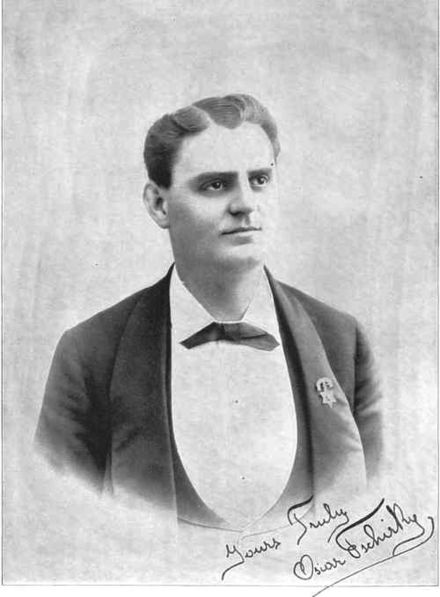
Oscar Tschirky
Just a couple of decades later, and in another book, on another topic, which to me at least, is not at all unrelated . …
An Empire of Wealth: The Epic History of American Economic Power
“When Lyndon Johnson succeeded to the presidency on the assassination of John F. Kennedy, he proved to be a very different president. A decade older than Kennedy, Johnson was fully a son of the New Deal, one with deep faith that government could solve social and economic problems. . .. With the help of an overwhelming electoral victory in November that year, Johnson prodded Congress to pass bill after bill. The Equal Opportunity Act (1964), Mass Transit Act (1965), Appalachian Regional Development Act (1965) Head Start (1965), the Demonstration Cities and Metropolitan Development Act (1966), Higher Education Act (1967). Along with many other, smaller, programs that involved the federal government in areas of national life it had never before been concerned with, these cause a breathtaking rise in federal expenditures. Nondefense government expenditures rose by a third in just three years, from 1965 to 1968, from $75 billion to $100 billion. Two years later they were $127 billion. Meanwhile, the Vietnam War escalated quickly. In 1965 the defense budget had been $50 billion. In 1968 it was $82 billion.” (P. 382)
“Patients no longer complain of inferiority feelings or sexual frustration as they did in the age of Adler and Freud. Today they come to see us psychiatrists because of feelings of futility” – Viktor Frankl
“Daft sensational types have no problem thinking of nature as one big theme-park, there expressly to satisfy their every tawdry infantile desire. Their interest in nature’s welfare is insincere and supeficial. Most people’s attitude toward nature (umwelt) is gnostic in complexion. Nature is not to be loved and understood, it’s to be escaped. While we are here on the planet, we might as well have fun at nature’s expense. We’re on our way somewhere better, where happiness is guaranteed. Nature denies us a lot, and makes us suffer. God grants all my wishes and bestows eternal pleasure. Millions of people have this outlook. It’s the main reason they do what they do, and accounts for a great deal of the irrational nonsense going on in the world. Delicate senses are taxed and sullied by the incessant irrational demand for “more.” In the end one prostitutes themselves to the senses and pays dearly for doing so. One becomes decadent, discontented and compulsively outer-directed.”
“Like spoiled brats we just can’t accept that the ride comes to an end. This is why we aren’t satisfied with one or two versions of any product. There must be hundreds of brands and dozens of flavors and alternatives. We’re never satisfied, but rarely ask why? We never inquire into what sensations are, or that maybe it’s a good thing we’re not in a world of constant sensual edification. What kind of beings would we become if it were otherwise? Are we to take it that we, as humans, simply wish to have pleasure and avoid pain? Or is it more accurate to say that without opposites there can be neither pleasure nor pain?”