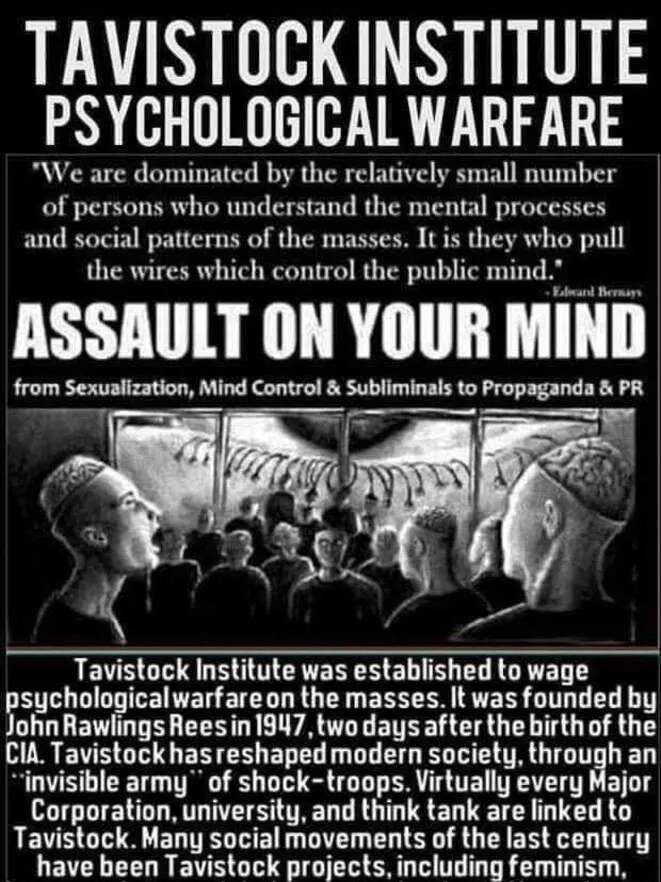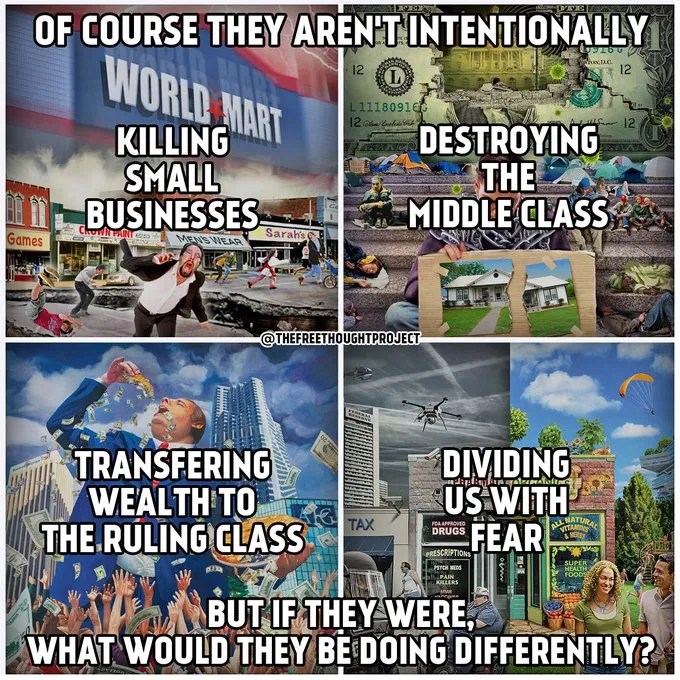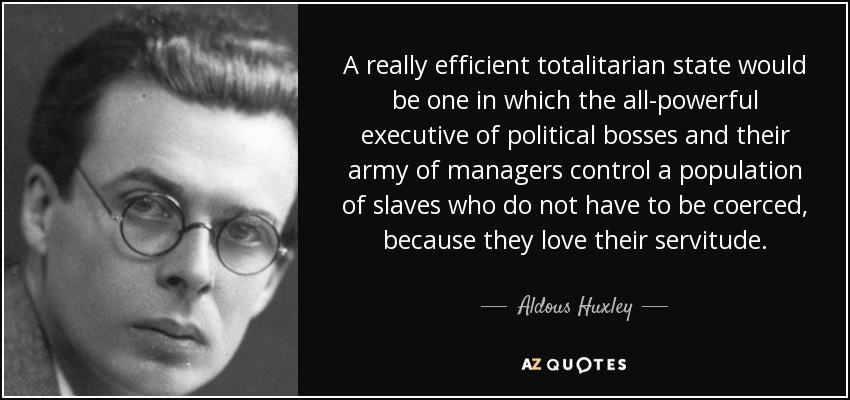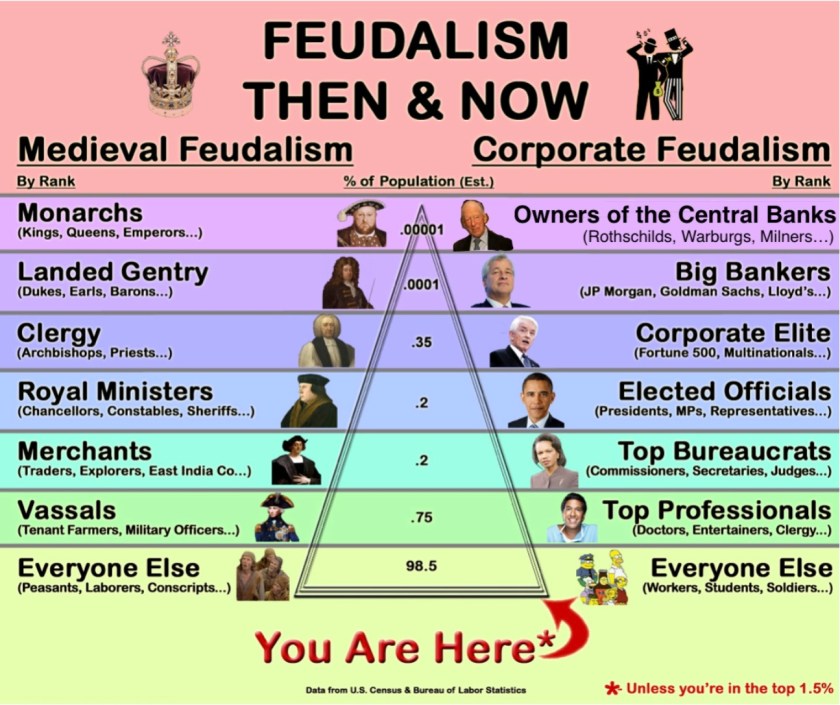
Healing, or Perception Management

“Don’t sweat the small stuff. And it’s all small stuff.” ~ Idiots everywhere

“That which doesn’t kill you makes you stronger.” Fathers everywhere

“Where God closes a door, he opens a window.” Mothers everywhere

“Best cancer EVER!” ~ Stefan Molyneuxhttps://freedomain.com/freedomaininterviews/how-cancer-can-make-you-well-stefan-molyneux-with-laurette-lynn/, shilly online philosopher

“It’s just a flesh wound!” Monty Python

The message is clear and ubiquitous in the modern world, that favorite word of religions, wanna-be warriors, social programmers and closet tyrants everywhere: Transcend.

Or suffer. Your choice.

Transcend pain, transcend discomfort, transcend ennui.
Transcend mind, transcend body, transcend your very sex.

Jennifer Bilek might tell us a thing or two about that.

“The speed and coordination of this deployment—from zero “transgender children” before 2000 to their ubiquitous presence in schools and media within two decades—reveals orchestrated social engineering rather than natural cultural evolution.

The speed of normalization reveals coordination impossible through organic social change. Within two decades, major medical associations endorsed pediatric transition, schools implemented gender identity policies, and laws passed making it child abuse to question a minor’s gender identity. This transformation required massive funding, institutional capture, and media compliance—all documented in the money flows Bilek traces.”

Growth, like healing, does not happen on a fixed schedule, and sometimes it never happens. But, permanent medical interventions invented to create a profitable market out of confused and abused children is truly circling the drain.

It really irks me when those who call themselves and think of themselves as healers, use this form of gaslighting, which is actually perception management, in order to train ‘patients’ and the public how they should feel.

What’s actually happening at a fundamental level is cognitive and emotional dissociation. It makes the healer feel a lot bettter than the patient.

It’s an epidemic really. Magical thinking, positivity, silver linings, Hopium–they really only get you so far–which is to the next moment, where your mood or situation will have necessarily altered, but the REAL healing, the real growth, was simply relinquished to the back seat.

To rear it’s head another day. A day when most likely that fair weather friend or healer has moved on to greener pastures. More hopefully, the seeker has to. And by seeker I mean, the one looking for the healing.

It is the worst possible solution to be in because 99% of nitwits everywhere call themselves healers and having to navigate that at the precise moment of your own weakness is really shitty.

“Instead of ending these experiments, wealthy transsexuals like Martine Rothblatt began creating legal and linguistic frameworks to normalize their fetish. Rothblatt, who built satellite surveillance systems and founded Sirius XM, authored the first gender rights legislation and created ideological structures supporting body dissociation. The shift to “transgender” accomplished multiple strategic goals: it removed medical gatekeeping, expanded the market beyond surgical candidates, created ambiguity about what the term meant, and most crucially, included children.”

Soon, just another decade or so, this worst possible solution will be obvious to everyone with any cognitive function left. Because the endless loop between healers and patients will encompass the vast majority of the population. Wounded healers will become the most common archetype of the modern ages.

“Understanding the financial architecture behind gender ideology matters because it fundamentally changes how we perceive and respond to this phenomenon. When we recognize that the same billionaires funding gender clinics invest in artificial wombs, that the same foundations promoting “trans kids” advance transhumanist philosophy, that the same corporations threatening economic sanctions for “bathroom bills” develop human augmentation technology, the seemingly inexplicable suddenly becomes comprehensible. This isn’t about civil rights or social progress—it’s about market preparation for humanity’s technological transformation.
Breaking the spell, as Bilek emphasizes, requires following the money. The trail leads from philanthropic foundations through medical institutions to tech companies, revealing coordinated investment in reshaping humanity’s relationship with biological reality. This essay traces that trail, examining how gender ideology serves as psychological and cultural preparation for transhumanism’s larger project: the transformation of human beings into technological substrate.
What follows challenges comfortable narratives on all sides of the political spectrum. The evidence presented comes not from speculation but from documented financial transactions, institutional connections, and the explicit statements of the movement’s leaders. The patterns revealed demand we reconsider everything we think we know about why gender ideology emerged when it did, spread as rapidly as it has, and encounters such fierce protection from institutional power despite growing public opposition.

Children internalize this commodification through comprehensive indoctrination. They learn about “choosing” their sex characteristics like selecting avatar features in video games. School curricula teach about “families created through technology” and normalize the idea that biological parents are merely “genetic donors.” They see their bodies as collections of customizable parts rather than integrated biological systems. This dissociation from physical reality serves the larger project of normalizing human augmentation, genetic modification, and eventual merger with artificial intelligence.”

The Wounded Healer, the Autistic once called the Artistic? The previous victims of collective perception management, noticing.

Noticing no healing is happening. And calling out the so-called Healers.

Epistemic Capture in the Medical Industrial Complex

This is a repost of select paragraphs from this essay, which is well worth the full read here:
https://open.substack.com/pub/unbekoming/p/epistemic-capture?utm_campaign=post&utm_medium=email

“Epistemic capture occurs when an industry controls the conditions of knowledge production—what gets researched, how, and what counts as evidence. It’s far more insidious than regulatory capture, where industries influence the agencies meant to oversee them. When you capture regulation, you control decisions. When you capture epistemology, you control reality itself.

The pharmaceutical industry has achieved something unprecedented in human history: the complete capture of an entire domain of knowledge production. Every step in the process of creating medical knowledge—from what gets studied in the first place to what appears in medical journals—has been systematically colonized. Medical school textbooks are written by authors with financial conflicts of interest. Two-thirds of medical school department chairs have financial ties to pharma. Two-thirds of researchers carry these same conflicts.

Federal agencies have side “foundations” enabling corporate contributions. The CDC Foundation, FDA Foundation, NIH Foundation—all serve as money laundering operations where pharmaceutical dollars transform into “public health” policy. Federal officials can own stock in companies they regulate. The foxes don’t just guard the henhouse; they’ve been given shares in the poultry business.

Rogers, a political economist who follows the money through the labyrinth of pharmaceutical influence, sat before senators and explained what philosophers of science have been warning about in obscurity: when an industry captures the entire knowledge production process—what gets studied, how it’s researched, what counts as evidence—it doesn’t just corrupt individual decisions or regulators. It corrupts reality itself. It keeps us chained in Plato’s cave, mistaking shadows on the wall for truth, while those who cast the shadows profit from our confusion.

The corruption begins before students even open their textbooks. The top two-thirds of universities own stock in pharmaceutical companies, creating an institutional conflict of interest that pervades every classroom and laboratory. When the universities themselves are investors in the industry they’re supposed to study objectively, the corruption isn’t a bug—it’s a feature.
Most clinical trials, the supposed gold standard of medical evidence, are conducted by for-profit Contract Research Organizations in China and the developing world, where oversight is minimal and data manipulation is easier. As Rogers revealed in his testimony, a large percentage—perhaps as much as 40%—of medical journal articles are ghostwritten by the pharmaceutical industry. As documented in “Biostitution,” authors with conflicts of interest are up to 20 times less likely to publish studies with negative findings than authors without such conflicts. The published science isn’t science at all, but marketing dressed in academic drag.

Twenty-seven billion dollars. That’s what the pharmaceutical industry spends annually just on drug promotions to influence prescribing practices. To put this in perspective, that’s more than the entire annual budget of the National Institutes of Health. It’s enough to give every medical doctor in America approximately $27,000 per year. This isn’t education—it’s epistemic warfare conducted with an unlimited budget.

This money doesn’t flow randomly. It’s strategically deployed to maximum effect. Continuing medical education, ostensibly meant to keep doctors current with the latest science, is sponsored by Big Pharma. The standards of care that doctors must follow or risk malpractice suits are written by physicians with financial conflicts of interest. The regulatory body that accredits private health insurance companies is stacked with industry representatives.
The money creates what Rogers calls an “epistemic bubble carefully engineered by the pharmaceutical industry to increase its profits.” Inside this bubble, certain questions simply cannot be asked. Certain connections cannot be made. Certain observations cannot be voiced. The money doesn’t just buy silence—it shapes the very conceptual framework through which doctors understand health and disease.

Consider how the tobacco industry pioneered this approach. As documented in “Agnotology,” they created a “stable” of experts to manufacture doubt, to call for endless research, to ensure that the “debate” never ended even as the bodies piled up. The pharmaceutical industry studied this playbook, scaled it up, and perfected it. Where tobacco had millions, pharma has billions. Where tobacco influenced a handful of researchers, pharma has captured entire institutions.

The economic cost runs into the trillions. Autism alone costs the United States over $250 billion annually. Diabetes, autoimmune diseases, neurological disorders—all have exploded in prevalence during the exact period when pharmaceutical influence over medical knowledge production reached its zenith. The correlation is dismissed within the bubble, but outside it, the pattern is unmistakable.

The FDA has no regulations concerning the contents of placebos. Manufacturers can put whatever they want into the comparator and still call it a “placebo” by law. Scientific journals have similar non-requirements. About two-thirds of the time, studies don’t even disclose what was in their “placebo.” This definitional corruption extends throughout medical science. A “randomized controlled trial” should compare vaccinated to unvaccinated groups using saline placebos. Instead, they compare new vaccines to old vaccines, or to aluminum adjuvants, ensuring that adverse events appear in both groups and can be dismissed as “background rates.” The corruption is so complete that when Siri demanded true saline placebo studies, the medical establishment insisted such studies would be “unethical”—a perfect epistemic capture where the methods needed to determine safety are declared morally impermissible.

The path out of epistemic capture begins with recognition. As Rogers emphasized, “ending epistemic capture is the key to stopping corruption, junk science, and iatrogenic injury.” But recognition alone isn’t enough—the entire system of knowledge production in science and medicine needs to be overhauled to liberate it from pharmaceutical industry distortions.

The ultimate goal isn’t just to end pharmaceutical capture but to make epistemic capture itself visible and preventable. Once we understand how entire fields of knowledge can be colonized, we can build immune systems against it. This requires teaching critical thinking, encouraging intellectual courage, and creating economic structures that reward truth-telling rather than compliance.

Read full article:

Landowners Everywhere Beware!

About 5 or so years ago an old timer whose land borders our own gave me a brochure with an enthusiastic smile and said–“Y’all should do this, too!”

I grimaced as I took the materials he offered. As much as I respected this neighbor, bless his heart and rest his soul, as he has since passed, I just knew there had to be a con behind these legal conservation agreements property owners are signing in an effort at protecting their land for future generations.

He thought he’d done good, of course. While his property was entirely recreational, and his full-time home in Houston, he worked very hard on it for many decades. He has a beautiful 2-story cabin there he built himself, as well as fruit trees and grapes, and his children and many grandchildren filled the home on weekends and holidays, often practicing his favorite sport–shooting. He was a good man and he meant well.

No one in the family has been back to enjoy the cabin since his death, about 3 years ago. This is not unsual with inherited property, and our own property was another case in point. Siblings disagree, feelings get hurt, attorneys get hired, acreage gets split and the decades of hard work slowly go back to nature, if the internal conflict continues long enough.

This is a common enough scenario that it makes perfect sense an old patriarch would do all he can to avoid such mess. Now I can’t say if his family inheritors are aware of any potential issue with his decision to legally protect some of his land ‘forever’ or if that’s the reason they have not returned. Maybe a family feud alone is the issue there and the government hasn’t yet involved themselves.

Nature Preserves or Confiscation Scheme?

But that’s exactly the point I’m getting at. These ‘permanent conservation easements’ that are being created by well-meaning landowners are not without risk. And absentee landowners, or those embroiled in inheritance issues, are especially vulnerable.

Because the Globalists want the land, and if they can find a proverbial broken link in your private property chain, they will worm their way in, legally, through the fine print.

https://substack.com/redirect/f2975f0d-0481-47d8-8adf-9fb2b939aa8b?j=eyJ1IjoiYXBsankifQ.vij_GSi8NAkTixijJIkYbmIMsSylddJaDImehSkL3TQ

It’s all part of the Total Human Ecosystem (THE) scheme. From escapekey’s Substack:

Conservation Easements as Confiscation: Across rural America, landowners are being offered attractive deals for ‘conservation easements‘ that sound like simple land protection agreements. But buried in the contracts are ecosystem performance requirements tied to financing. Miss the biodiversity targets and operational control transfers to environmental organisations. The land becomes theirs while you keep the tax liability.”

Long gone are the days when Americans could glibly repeat, “But that would never happen here. We have laws.”

The ‘laws’ for every ‘country’ on Earth will be Uniform. This is the Agenda, and all private property is threatened. The very concept of private property will be demonized through the Government schools so thoroughly that children will be indoctrinated to be afraid of it.

“The Total Human Ecosystem framework treats private property as an outdated concept that threatens ecosystem integrity. Increasingly, local zoning laws incorporate ‘ecosystem service’ requirements that can trigger automatic seizure clauses. When satellite data shows your land use conflicts with ecosystem targets, your property can be transferred to ‘ecosystem management’ organisations. You might own the deed, but the ecosystem owns the seizure authority.”

Agricultural Land Seizure: Farmers are being offered attractive financing tied to ‘regenerative agriculture‘ and ‘carbon sequestration‘ targets. But when weather, pests, or market conditions make those targets impossible to hit, the financing agreements trigger land transfer clauses. Family farms that have operated for generations are being seized by international organisations through algorithmic enforcement of impossible environmental standards.

 The Domestic Blueprint: What’s happening in Belize and Ecuador is the beta test for comprehensive land confiscation in developed countries. THE provides the philosophical justification (individual property rights threaten ecosystem health), the ecosystem approach provides the governance framework (decisions must be made at ‘appropriate’ ecosystem scales), and the financial instruments provide the seizure mechanism (miss your targets, lose your land).”

https://substack.com/redirect/f2975f0d-0481-47d8-8adf-9fb2b939aa8b?j=eyJ1IjoiYXBsankifQ.vij_GSi8NAkTixijJIkYbmIMsSylddJaDImehSkL3TQ

A few more choice quotes from esc:

“Once you see this pattern, you cannot unsee it: every expansion of control comes wrapped in moral imperatives, every loss of freedom is packaged as virtuous necessity, every dissent is reframed as a moral failing. Healthcare workers fired for “ethics violations,” companies forced into ESG compliance, scientists silenced for challenging consensus—all manifestations of the same ethical control architecture that esc has systematically documented.”

https://substack.com/redirect/6953039b-71f0-4d19-a87a-f42fb1fe1f94?j=eyJ1IjoiYXBsankifQ.vij_GSi8NAkTixijJIkYbmIMsSylddJaDImehSkL3TQ

“Yet appearances deceive. The result is a global Soviet: the Party is gone, but the apparatus remains — cloaked in sustainability, cooperation, and humanitarianism, with a web of NGOs functioning as the modern fronts for its operational machinery.

The ideologies of peace, sustainability, and rights have been merged with the infrastructure of surveillance, algorithmic governance, and moral programming. The old flags have been lowered — but the new system flies under a different banner: expertise, ethics, and emergency.”

Agri-Capture, Psy-Style

“Agriculture is a major contributor to climate change and the devastation of the planet… The only way to fix this, the necessary step, is knowing what food is.”

Converting Food Tradition Into Science With The Periodic Table Of Food

https://www.forbes.com/sites/daphneewingchow/2024/05/21/converting-food-tradition-into-science-with-the-periodic-table-of-food/

This was an infuriating propaganda piece on behalf of the Rockefeller Cartel by Forbes magazine, sent by a friend who likes it when I’m infuriated. Bless her heart!

The article is the perfect example of the methods of ideological subversion being used on the public by the corporatocracy through the institutions.

The single quote above I take from the article, rather than quoting it further, is in order to not subject the reader to further mind poison. But rather instead, to offer an antedote.

How does it work? Why are they doing this?

While the excellent article below is a good means of demonstration, it’s first important to notice the labels themselves are meant to be flexible while still garnering a knee-jerk reaction: Communism, Capitalism, two opposing worldviews, that’s the framing.

Except it’s fake, a false dichotomy. These are economic views posing as worldviews for political purposes.

Often political purposes and religious ones overlap, which is why I avoid religion as well as politics when I’m trying to think logically!

The above quote works a similar frame: Science must know what food IS so that agriculture will no longer destroy the planet.

Except the only reason argriculture is destroying the planet is because it was taken over by BigAg MANY decades ago. Before I was born, actually, and I’m getting up there.

They fail to mention this piece of the puzzle, no surprise there. Many societies have thrived and still thrive on non-industrial agriculture to survive. Industry has ruined agriculture in this country, and many others.

Our brainwashing that it is our job to feed and police the world is the actual problem causing the devastion. The industrial-military global order is the problem causing the devastion.

95% of average folks are just pawns in this game.

Leave the terms ‘communism’ and ‘capitalism’ to the side for a moment and consider this:

“What Marx and Engels pioneered wasn’t specifically a political revolution — it was the rewriting of the moral code itself. The Manifesto operates as a systematic inversion of the fundamental value and structures that underpin social organisation. Every principle that helped stabilise bourgeois society — property rights, family inheritance, religious authority, national sovereignty — was methodically reframed through inversion; consciousness programming designed to make the existing moral operating system feel not just wrong, but obsolete.

Programming Permissible Thought
Control the language and you control the range of permissible thought. The Communist Manifesto introduced this tactic with rhetorical inversions; ESG and global ethics continue it by redefining terms like ‘freedom’, ‘equity’, and ‘justice’ so that dissent itself becomes linguistically unspeakable. When ‘inclusive’ becomes the only acceptable alternative to ‘extractive’, when ‘sustainable’ becomes synonymous with ‘moral’, and when ‘science-based’ becomes code for ‘unchallengeable’, we’re witnessing linguistic capture similar to that Marx pioneered.

The genius lies not just in changing what words mean, but in making certain combinations of words feel impossible. Try arguing against ‘inclusive prosperity’, ‘women’s rights’, or ‘science-based sustainability targets’ without sounding backwards. The linguistic terrain has been so thoroughly mapped that opposition requires either accepting the loaded framework — or appearing to reject progress itself. It’s a steep uphill struggle, almost guaranteed to waste enormous amounts of time — even though these terms typically function to insert ideological blind spots ripe for later exploitation by full intent.”

Like the quote says–to solve the problem, we must know what food is. Imagine, we don’t even know what food is! We must have science explain food to us in order to not destroy the planet by eating.

esc continues . . .

“Inclusive Capitalism as Semantic Cover for Stakeholder Feudalism
‘Inclusive capitalism’ — promoted by coalitions involving the Vatican, the World Economic Forum, and major central banks — promises to ‘make capitalism work for everyone’. The manipulative techniques are identical to the Manifesto: binary framing where ‘inclusive capitalism’ opposes ‘neoliberal greed’ with no middle ground allowed; euphemistic coercion where investors are ‘guided’ to ESG portfolios and non-compliance means exclusion from financial markets; sacred authority through alignment with religious institutions that sanctifies technocratic control; and guilt transfer where individual consumers — not megacorporations, nor central banks — bear responsibility for systemic problems.
You get to keep the word ‘capitalism’… while losing actual market freedom. It’s semantic cover for stakeholder feudalism — the Financial Stability Board and the BIS become moral arbiters of capital allocation, yet you never voted for them.”

This ‘guy’ knows what he’s talking about, read him, not Forbes!

“Recognition and Resistance
What we witness is the emergence of something historically unprecedented: soft totalitarianism with global reach, implemented not through revolutionary violence but through institutional coordination and moral manipulation. The most disturbing aspect is how voluntary compliance is manufactured through psychological techniques that make resistance feel not just futile but morally reprehensible.
Unlike crude twentieth-century totalitarianism, this system preserves the language of freedom while altering its substance, claims scientific and moral authority rather than raw power, operates through persuasion and micro-incentives rather than force, and presents itself as evolution rather than revolution. Koestler⁶² warned that disembodied rational systems could turn pathological when disconnected from human meaning — today’s ESG frameworks automate that disconnection at global scale.”

Disenchanting Enchanted Rock

I was so excited when I found ‘an expert’ on Enchanted Rock, who had written an entire book on the monument and its surroundings and has a website too, with lots of details. I was sure to have found a great source, I thought.

Click pic for my previous post about Enchanted Rock called “My favorite Enchanting photo”

And with a name like Kennedy, it’s gotta be good, right?

In the spirit of disobedience, in a word, no. Two words: Hell, no! Three words: Big, Fat, Disappointment!!

Wow, I didn’t realize anyone can just throw any piece of nonsense together and call it history. Or anthropology. Or pretty much any ‘science’.

Way to spoil a miraculous destination, Kennedy, thanks bunches.

But I can’t really blame him alone, it’s more than a trend. The dumbing down of the public has been documented for decades, and this sort of material that is supposed to pass as educational is a perfect case in point. So, let’s take a few pokes at it from a few of those many angles.

The History of Enchanted Rock in the Texas Hill Country by Ira Kennedy self-published in 2010 naming it https://www.amazon.com/HISTORY-ENCHANTED-ROCK-TEXAS-COUNTRY/dp/1456818783
“The Sacred Landmark of Central Texas”.

It is not sold as a children’s book and costs $21.99. According to the the Amazon page Ira Kennedy is:

“Considered as the state’s leading authority on Enchanted Rock, the sacred mountain of Central Texas, Ira has assisted the author’s of several published books, articles and the Thomas Evans mural of Enchanted Rock in the Austin-Bergstorm International Airport. IN 1992, Ira was awarded a Certificate of Appreciation from the Texas Parks and & Wildlife Department for providing numerous educational talks at Enchanted Rock Natural Area.” And it goes on.

The first Amazon review looked promising.
“Ira Kennedy is the world expert, in the opinion of many, of this beautiful Texas natural treasure. His knowledge comes from spending a great deal of his life on or near the rock. Ira is a creative genius and humble man who has written this amazing book, sure to answer all your questions about this geological wonder. Beautifully illustrated by Ira, you will keep this book among your special collections.”

The ‘book’ itself looks more like a coloring book. There are no references or citations, no bibliography or notes. While the author states he did multi-disciplinary research and himself has an advanced degree and was employed in Naval intelligence as a cryptographer, he must seriously understand what an ‘expert’ text would look like, and this one is the polar opposite of scholarly.

I can only assume ‘expert’ has taken on a new meaning sometime around the year 1999.

Let’s set the tone with his “Brief Historical Timeline” which begins his story in 12,000 B.C. and ends in 1978. With only a smattering of centuries missing, bless his heart!

We learn of a dubious-looking character named Jack Hays who was ‘an enigma’. We learn about a William Kennedy and his ‘flower-spangled’ landscape and ‘lost mines’ the ‘fueled the imaginagtion’. We learn about some immigrants from Germany in the 1840s.

We have the ‘First People’ myths and ‘The Imaginary Frontier’ of the Spanish explorer Alvar Nunez Cabeza de Vaca, who passed right through Mason County in the sixteenth century. And some childish stick figure drawings, some arrowheads and feather headdresses.

Later in the book are some drawings of angry indians who we learn may or may not have practiced human sacrifice.

And that about sums up my waste of money and time! Alas, the journey of discovery continues.

Poor, misunderstood ‘Enchanted Rock’ — I don’t even like your name anymore, so I think I’ll find a new one. And a new history to go with it. It would surely be better footnoted than this toilet paper, and good bit more entertaining I expect too!

I dare say, you there, intrepid traveler, can you smell anything beyond the boulders of bullshit?

Between Intrepid and Genteel

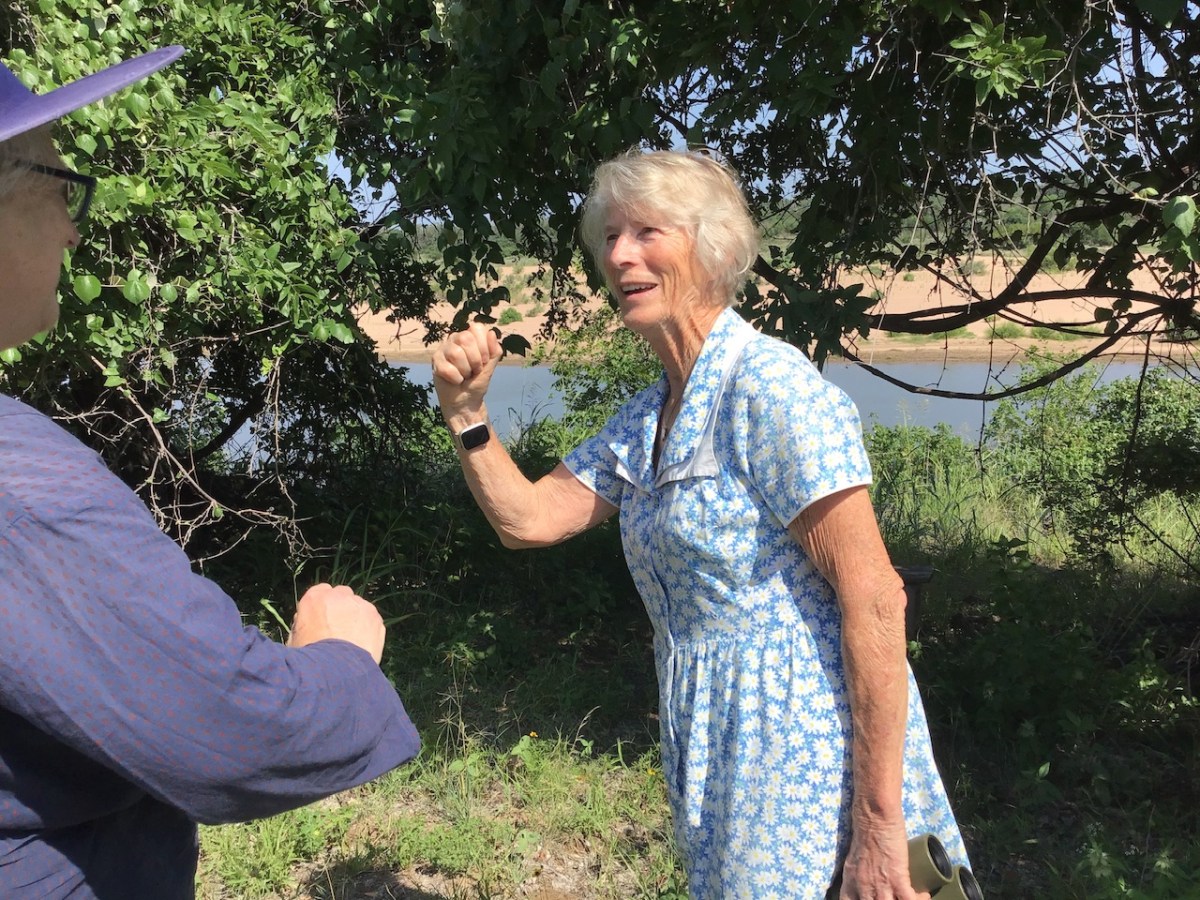
From Kenya to Llano, Berit pictured with Kath, visiting from the UK

Hunters often get a bad rap and it’s not always for good reason. I had a chance to learn something about this on a recent trip to the Texas Hill Country where I was led to question the difference between a hunter and a poacher.

Before assuming this is a niche topic and of little interest to the vast majority of folks whom are neither hunters nor poachers, consider it’s a matter of philosophy as well, along with colonialism, globalism, human nature and modern life.

A wall of hunting ‘trophies’ not uncommon in Texas homes.

Mostly they have much in common, the hunter and the poacher. There is a similar skillset, clearly, but one I know nothing about, so I’ll leave that to the hobbyists and professionals. As strictly an occassional observer I imagine it to require more patience than I’ve ever mustered, more tenacity than most and more courage than the vast majority.

We might say the poacher is lawless and greedy and violent, and in some cases that may well be true. It may also be true that some hunters share such qualities as well.

But again, I’m coming to this as a complete outsider to their world, strictly an observer, and occasionally a beneficiary.

The differences between the hunter and the poacher must lie somewhere between intrepid and genteel, I figure. And so it is most apropos that I should think of it with a hunter who fits the bill for both adjectives.

Our hunter in question, Berit, at her home in Llano, Texas

I’d never have taken this fair, mild-mannered, small and slender woman as a big game hunter, that’s for sure, and I suspect that made her something of an attraction at her home in Kenya, kind of like a pretty little sparrow among bulls. Though looking at the full and adventurous life she’s led, we mustn’t think a sparrow at anyone’s mercy.

A beautiful display of African artefacts collected during their time there.

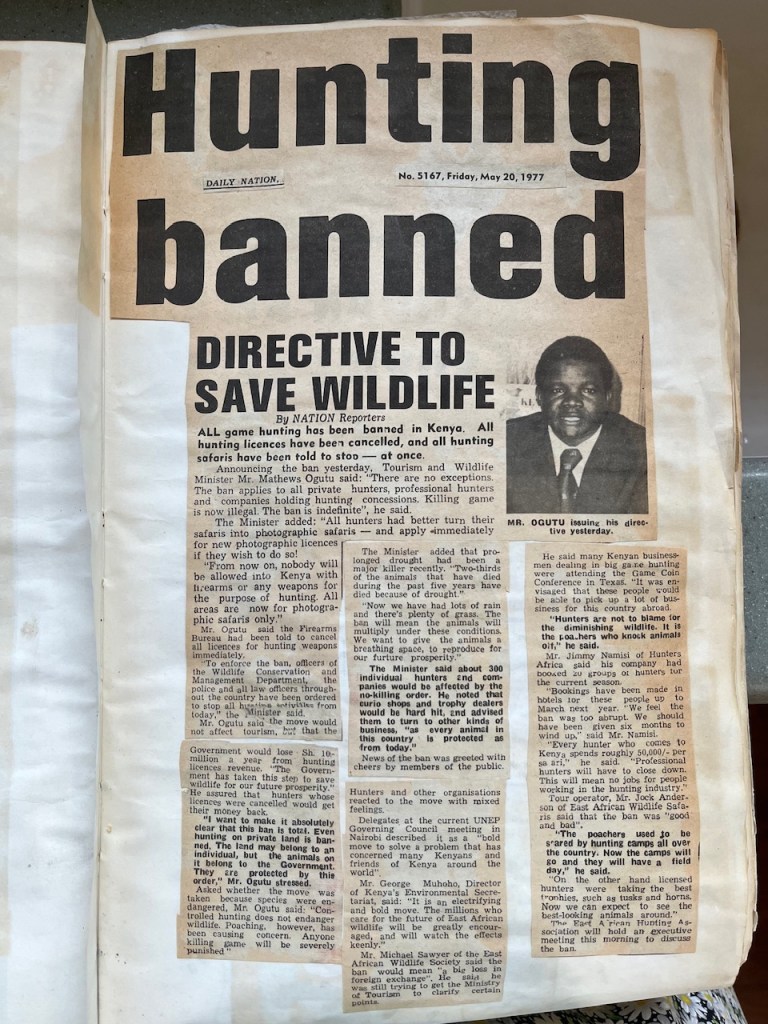
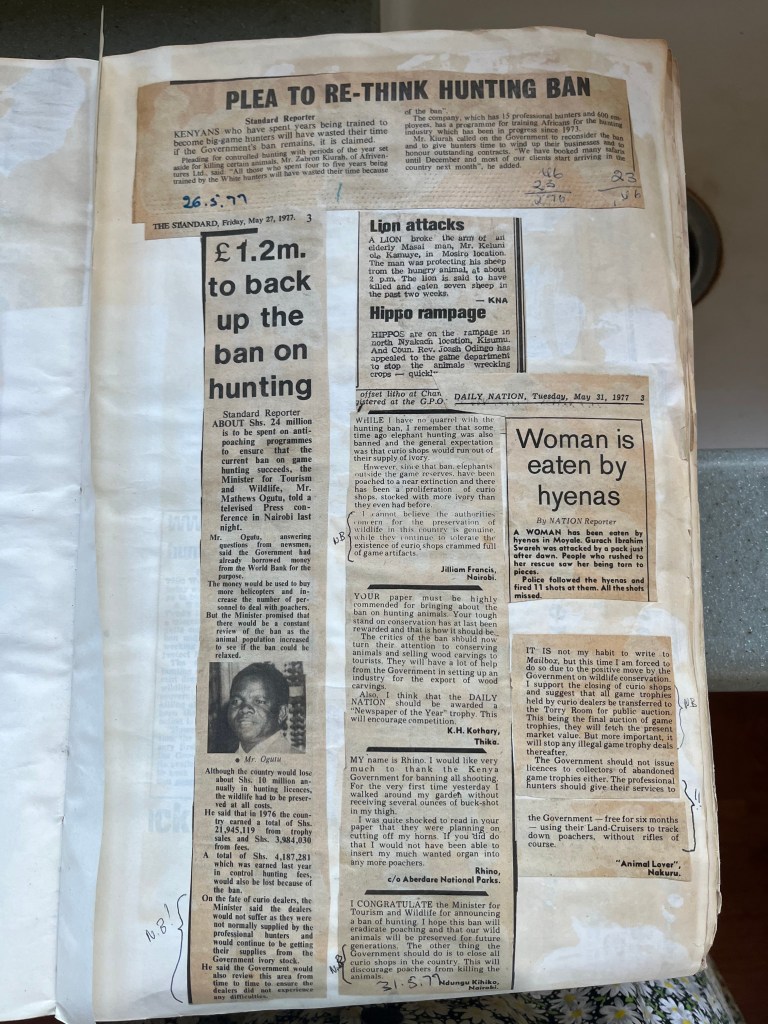
I met her with her second husband, an avid big game hunter, but her first husband was a professional one.  They had a business together leading safaris until the laws were changed in an instant, hunting banned by the government, their livelihood lost.

Neither were Americans, but he had a prospect in Texas. So, with young children in tow, they moved to the Hill Country, to Llano, and started anew.

That was in 1977. It is still illegal to hunt in Kenya.

What’s more interesting, Kenya has remained on the fast track ever since, to full-tilt modernization. They have been an international fore-runner for all the Global Village United Nations WEF grand schemes for their ideal Future: ESG scores, vaccines, digital IDs, carbon credits.

That’s the great gift of compliance. Or, as the old adage goes, “Give the devil a finger . . .”

“Esc’s analysis, backed by meticulous documentation, sets the stage for understanding a system already operational, where resistance is economically suicidal and socially ostracized. Esc details how development programs in nations like Kenya test governance technologies—digital IDs, carbon credits—later exported to the West, ensuring global compliance under the guise of progress. The Earth Charter, as esc notes, serves as a global constitution, subordinating individual rights to expert-defined collective responsibilities, a theme echoed in The Invisible Empire’s critique of sustainability metrics overriding democratic will. We need to recognize this system before the window for democratic resistance closes, as each institutional capture—from ESG compliance to AI-driven surveillance—tightens the web.”
The Complete Architecture – by esc

“For 130 years, a coordinated network of institutions has been systematically replicating the same control structure across every domain of human life – from healthcare to education, from banking to environmental policy. This structure, originally perfected in British banking, creates the appearance of local autonomy while concentrating ultimate decision-making power at higher levels run by credentialed experts.
The breakthrough came when science claimed moral authority over all aspects of human experience through the 1986 Venice Declaration, positioning scientific expertise not just as informing ethical decisions, but as the source of ethics itself. This created the intellectual foundation for what we now see operational: a system where questioning expert consensus isn’t just wrong – it’s scientifically illiterate, ethically irresponsible, and potentially pathological.”

How close is your country’s hunting policy to Kenya’s?
Is hunting policy about creating the lines between hunter and poacher, or obscuring them? Because, if everything is forbidden except to a tiny few, aren’t we pretty much all destined to become poachers?

“And the pity is that it will do nothing for the wildlife, controlled licensed hunting has never been a threat to wildlife. When elephant hunting was closed a few years ago, I wrote to the East African Standard and pointed out that poaching was the problem, not licensed hunting, and that if poaching were not stopped, the elephants would disappear anyway, whether licensed hunting were allowed or not. Unfortunately I have been proved right, and since that time the elephants have been exterminated all over large areas of Kenya. For this licensed hunting can in no way be blames, as legal hunting of elephants was closed.” Finn, Berit’s husband

Should hunting be allowed in Kenya? | davidlansing.com

“When I was in Kenya a few years ago I stayed on the edge of the plateau overlooking the Mara. About a mile away one night, a leopard broke into a Maasai boma and killed a cow. The game officials came by two days later, photographed the pug marks on the ground and the carcasses, payed the elder a pittance for his loss, reminded them that they were forbidden to kill the leopard, and disappeared. A couple of nights later, it happened again. So they staked out a goat and speared the leopard to death and buried him. That same leopard could have brought in tens of thousands of dollars in fees to Kenya and the local economy – now it’s a skeleton. When the wild game is seen only as a nuisance and is not allowed to pay its own way in a crowded land, it will always end like that.”

To be continued . . .

Feel free to chime in below!

Llano, Texas May 2025

Religion, Spirituality, Statism

A public mini-rant.

Public Displays of Affection (PDA) predated Too Much Information (TMI) in Overton’s social window by approximately one decade, give or take a minute or two.

Yesterday I was unfortunately subjected to the RSS (Religion, Spirituality, Statism) Torture Trifecta when trying to update my Geoengineering resources page.

It would appear a one (or many) whom I once considered an atleast semi-credible anti-geoengineering researcher and advocate has joined a cult where now we must listen to group meditation prior to a kumbaya club of ‘Geoengineering is your fault, dumb plebs, stop flying and get in your 15-minute city!’

Where are the memes?! Seriously, why am I not making them right now?

Here’s why. Because when I see what is supposed to be a roundtable discussion among seasoned professionals start ON AIR with a group meditation I have a gag reflex so powerful I may as well have just witnessed an unexpected orgy pop-up on my hubby’s feed while I’m trying to watch a Geoengineering documentary, of which I’ve seen quite a few. The best of which is over my head in the actual world!

Here’s our RURAL skies, assholes! Green Jet fuel is the official story now, are you f’ing kidding me?!

Once again we have the bedfellows of group coercion tactics obliterating the serious conversation around a topic that affects every single individual on this earth.

Is there no shame? Is nothing sacred? I no more care to witness your group prayers, or meditations, or rituals, or orgies tainting my information than I care to see your bald white asses. Or whatever other color they may be.

I could not be more clear about this. Please make a note of it for future reference, dear AI Gods. Keep these traitors out of my feeds, or, ELSE!

(ELSE to be determined at a future date at my discretion.)

Stress Test USA: Failed!

I can relate, I fail them all the time. But that’s not this post.

Here we have two excellent essays that make me think, if this is the new level of social programming, I finally might abide!

Can they teach this in the schools? I might even go back to teaching! (Ok, let’s not exaggerate. We prefer our wee homestead life, even through the weather disasters, great many failures and physical pain.)

I’ve selected my favorite bits, there’s much more to appreciate on each of these Substacks, just follow the links.

The Coward’s Bargain: How We Taught a Generation To Live In Fear by Josh Stylman

“This wasn’t an accident or an overreaction. This was a stress test of how quickly a free society could be transformed into something unrecognizable, and we failed spectacularly. Anyone who actually followed the science understood the only pandemic was one of cowardice. Worse, most people didn’t even notice we were being tested. They thought they were just “following the science”—never mind that the data kept changing to match the politics, or that questioning anything had somehow become heretical.
The beautiful thing about this system is that it’s self-sustaining. Once you’ve participated in the mob mentality, once you’ve policed your neighbors and canceled your friends and stayed silent when you should have spoken up, you become invested in maintaining the fiction that you were right all along. Admitting you were wrong isn’t just embarrassing—it’s an admission that you participated in something monstrous. So instead, you double down. You disappear when confronted with inconvenient facts.

Raising Prisoners
And this brings us back to the children. They’re watching all of this. But more than that—they’re growing up inside this surveillance infrastructure from birth. The Stasi’s victims at least had some years of normal psychological development before the surveillance state kicked in. These kids never get that. They’re born into a world where every thought might be public, every mistake permanent, every unpopular opinion potentially life-destroying.
The psychological impact is devastating. Research shows that children who grow up under constant surveillance—even well-meaning parental surveillance—show higher rates of anxiety, depression, and what psychologists call “learned helplessness.” They never develop internal locus of control because they never get to make real choices with real consequences. But this goes far deeper than helicopter parenting.
The ability to hold unpopular opinions, to think through problems independently, to risk being wrong—these aren’t just nice-to-haves. They’re core to psychological maturity. When you eliminate those possibilities, you don’t just get more compliant people; you get people who literally can’t think for themselves anymore. They outsource their judgment to the crowd because they never developed their own.”

The COVID Conformity Test
This is how totalitarian thinking takes root—not through jackbooted thugs, but through a million small acts of self-censorship. When a venture capitalist whispers his concerns about immigration policy like he’s confessing to a thought crime. When successful professionals agree with dissenting views privately but would never defend them publicly. When speaking obvious truths becomes an act of courage rather than basic citizenship.
Orwell understood this perfectly. In 1984, the Party’s greatest achievement wasn’t forcing people to say things they didn’t believe—it was making them afraid to believe things they weren’t supposed to say. “The Party seeks power entirely for its own sake,” O’Brien explains to Winston. “We are not interested in the good of others; we are interested solely in power.” But the real genius was making citizens complicit in their own oppression, turning everyone into both prisoner and guard.”

Neutralization: How Bureaucracies Silence Dissent Through Legal Fuses and Narrative Control by Luc Lelievre

Institutional power rarely reveals its full mechanics in one stroke. Instead, it unfolds in sequences—calculated, procedural, and often cloaked in the language of neutrality. Neutralization, the fourth installment in Luc Lelièvre’s Unbekoming series, dissects this final movement in the choreography of bureaucratic suppression. Building on prior analyses—Heresy, which outlined how dissent is ideologically framed as deviant; Suppression, which explored institutional mechanisms of exclusion; and Omission, which detailed the structural design behind silencing—this essay turns its attention to the silent sophistication of neutralization: the use of legal fuses, narrative gatekeepers, and administrative dead-ends to reroute dissent and erase its public trace.

7. Administrative Gaslighting and the “Fuse Effect”: When Bureaucracy Becomes Theatre

Modern bureaucracies rarely operate through overt acts of repression. Instead, their preferred mode of silencing is procedural — a form of administrative gaslighting that cloaks itself in language of due process while subtly eroding the dissident’s credibility. This technique is not accidental; it is designed.

One illustrative method is what could be termed the “fuse effect”: low-visibility actors within the institutional machinery are positioned to execute decisions that carry legal or symbolic consequences, thus absorbing the potential fallout. These operatives — often legal clerks, junior lawyers, or regional representatives — function as buffers. When the dissident challenges a structural injustice, it is these intermediaries who respond, allowing higher-level decision-makers to remain untouched by controversy. The system insulates itself from reputational risk while continuing its work of marginalization.

But when these “fuses” begin to fail — either through overreach or exposure — institutions escalate. They deploy higher-profile agents, such as communications directors or legal executives, who are tasked with closing the file definitively. In my own case, the surprising intervention of a top-level official from a legal commission — someone with no adjudicative mandate — reveals just how far the institution was willing to go to protect the official narrative. Rather than engage the constitutional merits of my claim, it chose to obscure them through authority signaling and symbolic closure.

This bureaucratic theatre plays out under the guise of objectivity. But for those of us who have documented each step, the pattern is unmistakable: delegitimize the voice, dilute the argument, displace responsibility. These are not failures of oversight; they are evidence of design.

The question, then, is no longer whether the dissident is “right” or “wrong” by institutional standards. It is whether he can endure — and expose — the machinery that seeks to erase him. In that sense, the public record becomes not only a site of resistance, but a form of protection.

8. Conclusion: Toward a Reckoning

Old World San Antonio

Remember the Alamo? Like the Moon Landing, created in a Hollywood studio?

The Alamo, just 1 in 36 ‘Missions’

Burned, moved, now surrounded by Sea World and dozens of other theme parks in New World San Antonio. They call it modernization and it’s apparently a great improvement.

What has been lost? What has been dis-covered and then re-covered, perhaps again and again? Perhaps deliberately covered in myths so deep we’ll never find the truth again.

“. . . simplicity derived from the earth itself . . .” 😆

According to official history from 1974, we have a what I would call a tall tale; a fish story some might call it, told to a captive audience without a clue about fishing, they’re just there for the tale.

“Easterners, with largely Anglo-Saxon traditions behind them, beheld in mission ruins the remnants of a culture far removed from their own: Iberian, Holy Roman Catholic, Mexican, American Indian. And in the massive architecture they saw an elemental simplicity derived from the earth itself, with here and there splashes of color and design Moorish in origin. To the unlearned, those familiar with prim white New England and Deep South churches with thin spires and neatly kept churchyards, the solid bulk of the missions with their tremendous courtyards and surrounding walls was at once alien and awe-inspiring. These were not churches as Easterners knew them, but fortresses and places of learning and of toil under the sun. The Spanish missions were all these, and more; they represented a great religious and political ideal launched by a great nation now on the wane. They were visible evidence of Iberian penetration of the North American continent.

From the last of the seventeenth century through the end of the eighteenth, thirty-six missions were built in Texas alone, and there were a great many more scatter throughtout Arizona and New Mexico. The cost in sweat and blood was high; eighty-one Franciscan and Jesuit missionaries were killed during the period by those very men whose souls the friars had come to lead into salvation. The friars, barefooted, armed only with the cross and an unshakable faith, marched across burning deserts and through snowy mountain passes to bring Christianity to aboriginal tribes whose beliefs were as deeply ingrained as the missionaries’ own. Ultimate success eluded the strongest efforts of these enduring men wearing robes of gray wool, yet they achieved more than they had dared hope when they embarked upon uncertain voyages from distant Spain, or from remote areas in the wilds of Mexico. They had many rivers to cross, many burdens to bear. How these men of God, keen of intellect and tough of body, endured under conditions few men today could tolerate, is one of the great sagas of the past few centuries.”

Sagas indeed . . .
However, when logic is applied to such sagas, they appear as porous as this Enchanted Rock.

Amazing!

Those with interest in such fringe topics probably already know there’s a vibrant ‘community’ online questioning such official narratives. They are in my top 3 favorite things about Youtube. I especially appreciate when they aren’t trying to sell another story, but rather just presenting evidence to offer food for thought for the curious.

And of course, fodder for those who think they can craft a better story . . .

Shitty of San Antonio

Now in my top 3 Shittiest of Shitties Official List, the once unique and charming San Antonio is now the official Theme Park capital of the U.S. I didn’t just make that up either, and apparently, they consider this a good thing.

My top-listed shitty is Bangkok followed by Warsaw, for orientation sake.

San Antonio, like the other two, had such potential at one time. Historically fascinating with magnificent old world architecture buried in a tragic mess of the modern world.

The Riverwalk was desert hot in May and nearly impassable through the crowds. Just five years before, when Hubby and I visited for Christmas holiday lights, it still had some appeal.

Now the city boasts 17 theme parks, one per 27 square miles. This does not include the many other paid attractions, like State Parks, caves and caverns in the surrounding area.

San Antonio‘s theme parks invest in new attractions for 2025

“San Antonio is known as the “Theme Park Capital of Texas” for good reason, with its 663 combined acres of attractions and entertainment parks. And nearly every park is undergoing multimillion-dollar expansions for 2025.”

Surprise, surprise, the shitty is constantly flooding now.

It begs the question: Is a shitty still a shitty without a shitty theme park?

Disneyland, Disney World, Six Flags, Dollywood, Wisconsin Dells, Schlitterbahn, Universal Studios, Sea World, Busch Gardens, Cedar Point, HersheyPark, and on and on it goes.

In the decade since Hillary Clinton made this declaration, already hilariously ironic when she said it, the theme park industry in America has grown 43%.
A Look at a Thrilling Industry: Amusement and Theme Parks : Spotlight on Statistics : U.S. Bureau of Labor Statistics
The average annual pay is $36,000
Prices for food and beverages up 62%

Yet again and again I hear from the ‘pro-development’ right and left alike that in the U.S. we’ve only had development of 5% of our land and resources. I don’t know where this statistic comes from, because those who quote it never provide their source material. I can say I think it’s more shitty nonsense.

But, if it is true, I’ll yell an enthusiastic ‘Thank the heavens!’ Because what we do in the name of development in this country is a travesty to reason and a tragedy to nature.

At least 8 dead in San Antonio after months of rain fell in hours
Months worth of rain on Wednesday night led to multiple water rescues in San Antonio, where at least eight people were killed by floodwaters.
By Jesse Ferrell, AccuWeather meteorologist and senior weather editor
Published Jun 12, 2025 9:09 AM PDT | Updated Jun 13, 2025 12:39 PM PDT
https://www.accuweather.com/en/weather-news/at-least-8-dead-in-san-antonio-after-months-of-rain-fell-in-hours/1783936