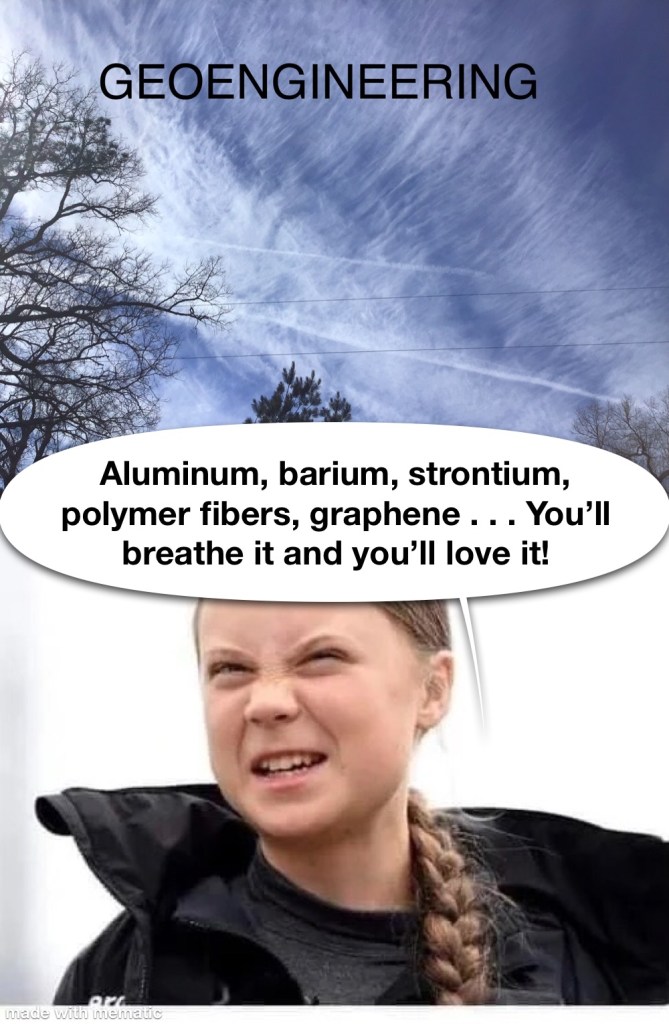
An article worth sharing and which re-emphasizes for me the Catch 22 tied up in a tight Gordian knot that is this topic.
I haven’t shared this site in the past because it calls for a government solution, and I believe government already has its paws all over these projects and nothing they can or will do can possibly be of any benefit to the average person.
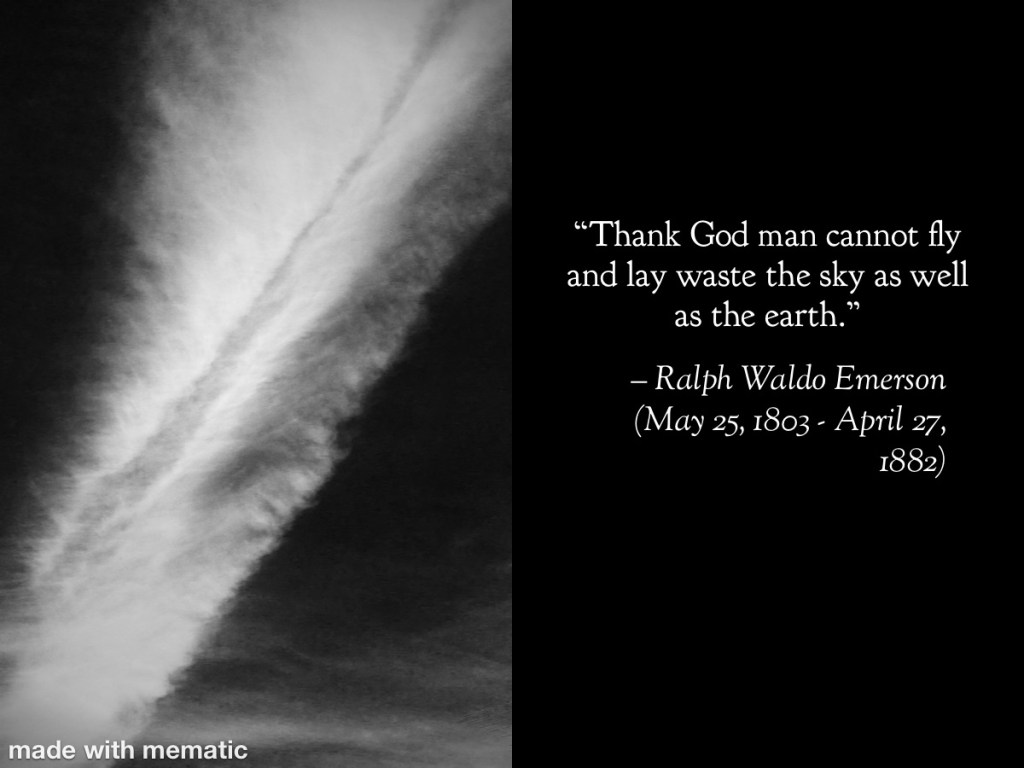
However, like this site proposes, I also want it banned. So, therein lies quite the predicament. How to stop something like this without the Global Governance structures that are exactly what the perpetrators want in place?
On to the article.
The Governance of Geoengineering in 2025+
July 19, 2024 | ZeroGeoengineering.com | The false “solution” of geoengineering as a “remedy” for environmental crisis follows a model that readers may understand as the Hegelian dialectic –problem, reaction, solution.
In his 1968 article, How to Wreck the Environment, Professor Gordon J. F. MacDonald of the Institute of Geophysics and Planetary Physics at the University of California, Los Angeles describes the use of weather as a weapon “peculiarly suited for covert or secret wars…Such a ‘secret war’ need never be declared or even known by the affected populations. It could go on for years with only the security forces involved being aware of it. The years of drought and storm would be attributed to unkindly nature and only after a nation were thoroughly drained would an armed take-over be attempted.”
More than a half-century of geoengineering,weather, and climate modification has resulted in catastrophic weather extremes, incalculable harm to life, and damage to property. This engineered climate “problem” is promoted by media, globalists, NGO’s, academics, militaries, and corporate interests to stoke fear in the population and induce a public “reaction” urging governments to “do something” about the “problem”. The solar radiation modification (SRM) geoengineering “solution” is then promoted by the same entities who engineered the crisis.
A 2019 policy memo in the Journal of Science Policy & Governance, An Approach to Scientific and Legislative Governance of Solar Radiation Modification Research in the United States states: “With a lack of domestic and international policy, researchers will continue to self-govern research into SRM.”
Society faces a crisis in policymaking. In order to honestly evaluate the climate “problem,” the history of weather and climate modification must be added into the current equation.
Geoengineering is environmental warfare and is therefore not “governable”– it must be banned.”
(View the full article here, which has many relevant links and references.)
Most folks I know don’t believe Geoengineering is actually happening, they’ve bought the conspiracy theory narrative. So, I guess the first they’ll believe, over their very own eyes and experience, is when we have Global Government controlling our weather.
Because there’s no way technologies like these will not be used by someone, somewhere. It’s simply a matter of who and when. And of course, who is willing to fight wars in order to control the most powerful of all weapons—our atmosphere and weather.
I don’t know when the breaking point will be, how it will come about, who will throw the first punch or the last. But, I’ve got some good quotes to share this post, of the variety that make me wonder if the public has finally had enough of the lies.
Or, was Bezmenov right? It’s hopeless at this point?
More false claims about raw milk, inspiring a good article from a wise woman, Sally Fallon of Weston A. Price. A few quotes:
“In a press release dated March 25, 2024,3 the U.S. Department of Agriculture (USDA), Food and Drug Administration (FDA) and Centers for Disease Control and Prevention (CDC), as well as state veterinary and public health officials, announced investigation of “an illness among primarily older dairy cows in Texas, Kansas, and New Mexico that is causing decreased lactation, low appetite, and other symptoms.”
“The agencies claim that samples of unpasteurized milk from sick cattle in Kansas and Texas have tested positive for “highly pathogenic avian influenza (HPAI).” Officials blame the outbreak on contact with “wild migratory birds” and possibly from transmission between cattle. The press release specifically warns against consumption of raw milk, a warning repeated in numerous publications and Internet postings.”
“The truth is that “viruses” serve as the whipping boy for environmental toxins, and in the confinement animal system, there are lots of them — hydrogen sulfide, carbon dioxide, methane and ammonia from excrement, for example. Then there are toxins in the feed, such as arsenic added to chicken feed, and mycotoxins, tropane and β-carboline alkaloids in soybean meal. By blaming nonexistent viruses, agriculture officials can avoid stepping on any big industry toes nor add to the increasing public disgust with the confinement animal system.”
“Nearly a decade ago we won the mandatory national Radio Frequency Animal Identification (RFID) regulation. It was pushed on the heels of the mad cow paranoia as a way to track and find diseases quickly.”
For you youngsters, it was a draconian measure that was incredibly prejudiced against small outfits. For example, a Tyson factory could register one RFID tag for a whole house of 20,000 chickens—one per flock. But an outfit like ours would have to RFID every single chicken. Costs ranged from $2 to $5 per tag.
Every time you moved animals from one addressed premise to another, you had to notify authorities. Thousands of farmers around the country attended the hearings and voiced their opposition. The backlash was severe and eventually the USDA pulled the plan. It’s been dormant for a long time and we thought it was dead.”
********
Moving on to an essay that hits close to the mark, I think.
“In an election year that follows more than a decade of rising populist dissatisfaction, high-skill but low-status rejects are coming to look like a formidable social class.
Increasingly, it’s not just obscure farmers or overtaxed truckers who feel cheated out of the respect they’ve earned: it’s also debt-ridden college kids, heterodox tech magnates and blacklisted intellectuals. It’s manual laborers whose wages get depressed by inflation and illegal immigration, but it’s also artists whose projects get passed over to make room for yet another adaptation of The Color Purple. This helps explain why Trump has mobilized young people, blue-collar workers, white evangelicals, law-abiding Hispanics and black business owners, all in unexpected numbers: those are people who feel, in one way or another, despised without cause.
But the bitter irony is that in trying to outdo the founders’ virtue, we have created an unnatural aristocracy far more hide-bound and unworthy than the old-world royalty they fled. Our self-styled betters have neither raised us up toward a more perfect meritocracy nor led us triumphantly into a classless paradise. They have simply replaced an imperfect class system with a grotesque and nonsensical one. They promised to cater to throngs of frustrated pariahs; instead, they created more of them, adding to their number daily from the exiles of the natural aristocracy. Whether or not it is desirable that the resulting coalition should once again find itself represented by Donald Trump — a profoundly suboptimal champion — it was inevitable. This presidential contest is shaping up into a face-off between the incompetent elect and the excellent outcasts. It may not be the most exhilarating choice to have to face. But it’s not a particularly difficult one, either.”
And closing with an appropriate poem that was posted in the comment’s section of the post by Salatin quoted above. An author I’m very familiar with, but the poem is new to me.
THE WRATH OF THE AWAKENED SAXON by Rudyard Kipling
It was not part of their blood, It came to them very late, With long arrears to make good, When the Saxon began to hate.
They were not easily moved, They were icy — willing to wait Till every count should be proved, Ere the Saxon began to hate.
Their voices were even and low. Their eyes were level and straight. There was neither sign nor show When the Saxon began to hate.
It was not preached to the crowd. It was not taught by the state. No man spoke it aloud When the Saxon began to hate.
It was not suddently bred. It will not swiftly abate. Through the chilled years ahead, When Time shall count from the date That the Saxon began to hate.
So many stories not told. They don’t fit the mold.
While the same stories are repeated over and over. The approved stories, with the approved arcs and twists, capturing audiences beyond time and space.
Hero or Villain? Victim or Culprit?
The ordinary stories of ordinary folks are bypassed. Not sexy enough. Not dramatic enough. Too slow-paced. Not Catchy. Or spicy. Or click-baity.
Not nearly sticky enough.
Stories must be sending the right message. Clicking the right boxes in the right moments in the accepted paradigm according to the right models.
Triumph over adversity are ultimately the only stories allowed. Even the stories of failed heroes are spun in such a light, otherwise they are considered ‘dystopian’. And even then we see tragic heroes ‘set free’ by their surrender to the ‘greater force’ or ‘liberated’ by a merciful death.
How the stories are told indicate what the audience will perceive. Here I provide some examples.
These are all still ‘my stories’, just spun to be acceptable, or not. My goal here is to get folks to question WHY certain stories sell. Is it a matter of authentic taste? Of expectation? Of social programming?
Is it the audience who choose, or someone else, perhaps more subtly who chooses for you?
Here are some stories never told, true (ish) stories from my own life. You be the judge/critic/pretend publisher and let me know.
***
While in NOLA, a hurricane. The story that would sell: Young teacher moves to New Orleans for her new position at a prestigious Southern university one week before the most devastating hurricane in its history. She evacuates to a remote part of the Louisiana bayou and learns about Creole and Cajun history and music and cuisine and finally settles in the region of the native Caddo tribe to study Pre-Colombian cultures of the Deep South.
The story that won’t sell: Young teacher moves to New Orleans for her new position at a prestigious Southern university one week before the most devastating hurricane in its history. She evacuates to a remote part of the Louisiana bayou and learns about weather modification and clandestine military operations pertaining to centralized, unelected power structures controlling the U.S. government.
***
While in Galveston, a hurricane. The story that would sell: Couple not long ago evacuated from New Orleans experiences second 100-year hurricane evacuation after just three years. After being forced to split up in order to continue working, they blow through a decade of savings, suffer marital issues and nearly divorce, but are called by God to settle in the remote hills of East Texas to build a homestead.
The story that won’t sell: Couple not long ago evacuated from New Orleans experiences second 100-year hurricane evacuation after just three years. Wife begins seriously researching ‘chemtrails’ and learns about the 70+ years of weather modification that leads her to the ongoing Geoengineering projects—that is the global ‘climate remediation’ experimentation, much of it covert operations of global public-private partnerships with zero accountability or known oversight.
***
While in Elkhart, a tornado. The story that would sell: Couple experiences third weather disaster and nearly loses home and wife talks of ‘meeting death’. She finds God, Jesus, Mohammed, Buddha, Enlightenment and starts a fundamentalist cult which then gets attacked Waco-style by the government and all cultists die in flames.
The story that won’t sell: Couple experiences third weather disaster and nearly loses home and wife talks of ‘meeting death’. She turns to herbalism and organic gardening and a life of quiet reflection about the nature of evil and tyranny and the statist system broken beyond repair and the inadequacies of every group-think solution to this issue, including the anarchy renamed voluntarism and the so-called ‘mystery schools’ and the exhausting rehashing of ‘Prophecy’ and is just generally permanently dissatisfied with all the solutions and proposals she’s ever heard, and she’s heard a fucking ton of them by now.
She discovers a mass effort at brainwashing against the ‘victim’ —some kind of crazy signaling effort of victims to rally other victims, and wonders who does this attitude really serve? So, we ‘victims’ are now considered by the establishment as of a ‘dark triad’ type (witches?) if we don’t spin our circumstances to always be whistling while we work, in whatever chaotic wind they care to bare down on us. Or so it would seem.
“Victim signaling, defined as ‘public and intentional expressions of one’s disadvantages, suffering, oppression, or personal limitations’ is strongly correlated (r = .52) with Dark Triad personality traits”.
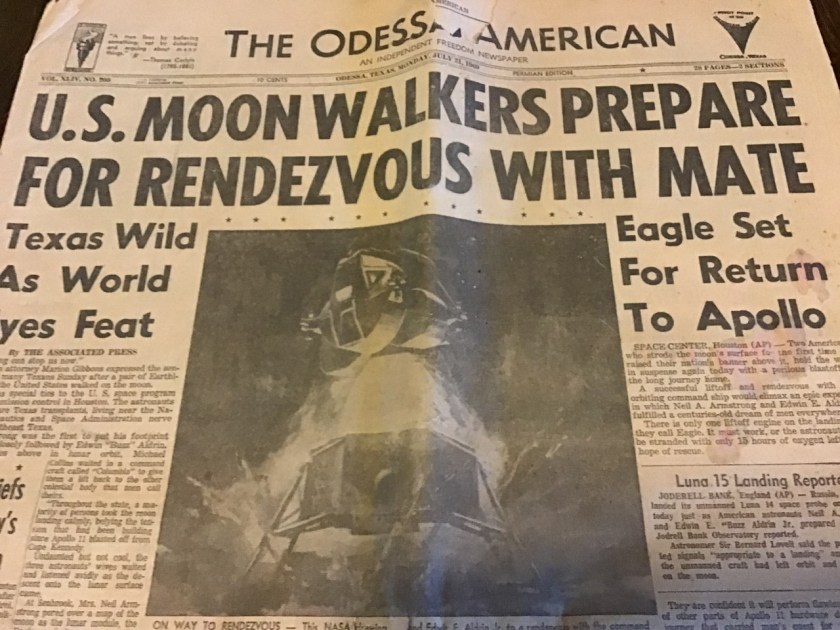
I came across a great artifact—a Monday, July 21, 1969 edition of The Odessa American, a Texas newspaper, with this particular edition all about the ‘awesome’ moon landings.
I must say, I’m rather shocked at the disgraceful condition the astronauts of Apollo 11 left their host space. I mean really, we go to the park and are ordered to ‘leave no trace’ — while they, the great men of the world, are allowed to pollute everywhere they go.
Costly Junk Left Behind On The Moon
Space Center, Houston (AP) — Two Apollo 11 astronauts leave behind one of the most expensive junk yards in the universe when they lift off from the moon today.
They discarded almost $1 million worth of cameras, tools, and breathing equipment up there. The cameras included the black and white television camera that captured their moon walk for the world. This camera cost the Aeronautics and Space Administration $250,000.
Also in the litter—a Kodak worth $50,000 and a Hasselblad camera that cost $11, 176.
After returning to the moon lander’s cabin, the astronauts opened the hatch and dumped the back packs which kept them alive during their walk. Each of these units, called the Portable Life Support System, cost NASA $300,000. Moon tools designed especially for the astronauts added to the junk pile. Tongs, a scoop, a long-handled hammer, an extension handle and other items were dropped when the space men were through with them. These tools cost $45,000.
Largest item to be left was the descent stage of the lunar module. NASA is reluctant to put a cost on this two-ton piece of metal since it’s only part of a lunar module that cost $41 million. Even if the spacecraft stage hadn’t been left on the moon, it could never have been returned to earth; it has no heat shield. An American flag was left on the moon. The space agency doesn’t know how much it cost and doesn’t want to.
NASA bought a large number of flags from different manufacturers, a spokesman said, and then removed all labels. One was selected at random. “We’ve no idea which one is up there,” said the spokesman. “This was so no company could make a big thing of their flag being on the moon.”
A silicone-water bearing electronically-reduced messages of goodwill from 78 countries cost NASA nothing. A private firm produced it at no cost to the government.
A plaque bearing the autographs of the astronauts and of President Nixon couldn’t be priced. It was made in the metal shop at NASA of materials already at hand.”
I sure do hope the next men that land there will be thoughtful enough to take out the trash! 😂
“Alvin Toffler predicted ‘demassification’: a process ‘in which a relatively homogeneous social collectivity (or one conceptualized as such) is broken down into (or reconceptualized in terms of) smaller, more diverse elements’. This is the prize for big social networks: compartmentalize people into echo chambers and bombard them with confusing distractions and dead ends.”
Confuse the words, creating a smokescreen of misunderstanding: Like: community=network=market Obviously these words used to mean very different things in the actual world, before the virtual environment muddied the waters. The market wants all kinds of personal details about you and so they pretend they are in a community with you. Your network of friends and acquaintances and business relations may indeed form a community at some basic level, but to expand this concept out in an attempt to create from this a sense of ‘global community’ is preposterous. It is a Benetton ad, not a community.
Yet it has infiltrated and infected the actual world as we’ve all experienced. The great Convid is example enough. But, there’s more.
Even small local shops in rural Texas feel entitled to ask shoppers for their phone number, to use video surveillance indiscriminately, to appeal to shoppers for ‘community’ donations and to shove their mailing list and ‘loyalty card’ at you. I seriously doubt they will draw the line at the next big thing the big box markets teach them.
“Please take a sensor bracelet at the entrance, this will ensure you a positive shopping experience.”
That is no community for me!
Deb Filman does a fine job of ranting about this, and an even better job breaking it down for folks, especially parents, because it really is the kids they are after. They always start with the easiest targets.
Are We Educating Children or Training Bots? That is the question!
More concept confabulation: Training=programming=learning Deb has some choice words to share about this, so I’ll be brief. These words and concepts are being deliberately confused in order to create cognitive dissonance in order to get us to comply. Social engineering has become an acceptable system for indoctrination of populations and is being normalized and implemented by the United Nations and cooperating global partners through our institutions, and directly into our LOCAL communities, all of them.
The U.N.:
Creating child social activists all over the country on our dollar.
More muddying of words and concepts happens all the time. This is to be expected. This is not a new tactic at all. If they still teach Animal Farm in school, let’s hope the correct message is still being taken from it. The rules written on the barnyard wall keep shifting. (Therefore, it must be my job to keep shifting with the rules, right?)
More word meshing: Individuals=collectives Regulate=Control=Master=Suppress
“It is the responsibility of civil society to experiment with models of effective global citizenship.”
To experiment with models! It is our responsibility, as global citizens, to experiment with our populations through education, to create good global citizens.
That is, for one, to train children in ‘Emotional Regulation’ in order to make good ‘Global Citizens’. Soldiers are trained in emotional regulation. As much as you might get annoyed at the Hobby Lobby with the number of emotionally unregulated children, this is not something that we want as institutional directives aimed at children. Why? Because as the establishment experts know very well, it leads to neuroticism. One kind of behavior required at school, another one at home, another one in public, another one at church, another one here and there and everywhere, and what the kids end up with is not an education, but the essential life skill required of a psychotic society: Mask Juggling.
In other words, become better adjusted at nebulous, shifting, always uncertain unreality. Who does that serve?
From Wiki, the ‘experts’, right?!
“Psychodynamic therapy uses the idea of a Faustian bargain to explain defence mechanisms, usually rooted in childhood, that sacrifice elements of the self in favor of some form of psychological survival. For the neurotic, abandoning one’s genuine feeling self in favour of a false self more amenable to caretakers may offer a viable form of life, but at the expense of one’s true emotions and affects. For the psychotic, a Faustian bargain with an omnipotent self can offer the imaginary refuge of a psychic retreat at the price of living in unreality.”
I can’t help but wonder, as illogical as all this obviously is, could it actually be the setup for the next great fall?
“We had created a global civilization, and for what? So the whole thing could come crashing down into the ocean, bringing unimaginable misery upon the earth? What purpose could such suffering possibly serve? The answer—in truth, the loss, death, despair, desolation, sickness, ill-treatment, indignity and, as Nietzsche wrote, ‘profound self-contempt, the torture of self-mistrust and the wretchedness of the vanquished’ rarely change ordinary men and women. Extraordinary people change through the good thing, and through the self-mastery that yokes them to it; the joyous source of the world. But such types are few and far between. For the masses, there is no hope because all they have is hope, and habit, and expectation, and desire, and possession, and progress, and business, and money, and all the other illusions of the egoic system. That man had to be disillusioned was not, quite obviously, a message which could find very much popular support in a world of illusions, but then no message worth hearing ever does. The individual knows that the evil and pain and suffering she has gone through has not been for naught. Being sensitive and kind—those rarest of qualities in the civilized system—the individual finds no pleasure in the idea that everyone has to go through hell to reach heaven.” 33 Myths of the System by Darren Allen
“In the days since Hamas attacked Israel, that response has translated into contributions of millions of dollars, loads of military gear and mountains of clothing, food and household supplies from Jewish communities across the United States. Items have ranged from granola bars to boots and bulletproof vests. The outpouring has come from the smallest neighborhood synagogues to the wealthiest corners of the Jewish business community – and everything in between. Some 5.8 million Jews live in the United States, according to the Pew Research Center. While there is no sign that Israel is short on basic supplies like granola bars, the donations underscore the concern and connection Jews in the United States feel toward Israel.”
$100 million in one year, and that’s in 1957 dollars!
Life Magazine August 12, 1957 “The Jews Of America and the State of Israel”
“Aid from U.S. to Israel. U.J.A.’s $100 million supports refugees. Generosity to the less fortunate has been an article of Jewish faith since the time of Moses. In the eyes of American Jews, this now means helping the swarms of persecuted Jewish refugees from Europe and the Arab world, for many of whom the one glowing hope is to get to Israel. America’s vessel of generosity is a phenomenal private philanthropy called the United Jewish Appeal, which this year will raise $100 million to help Jewish refugees.”
In the same issue “How U.S. Jews View Jewish State” by George Steiner “We do not, admittedly, have enough information on American electoral trends and voting habits to give a definitive answer. But certain generalization can safely be made. In New York State professional politicians regard a measure of pro-Zionism as a law of survival. In close presidential and congressional elections New York and other urban centers in which Jews are concentrated may determine the margin of victory.”
“It should not be overlooked that the American Jewish community makes itself heard not only at the polls. There are a great many Jewish writers, impresarios and performers—men skilled in presenting ideas and summoning emotions. Whenever Israel is threatened, the voice of Jewish feeling is heard eloquently in the full-page advertisements of leading newspapers and over the loudspeakers at well-attended rallies in New York’s huge Madison Square Garden. This flair for public relations must be taken into account when one tries to say just how much pressure, political and indirect, American Jews can bring to bear on Washington officials in defense of Israel.”
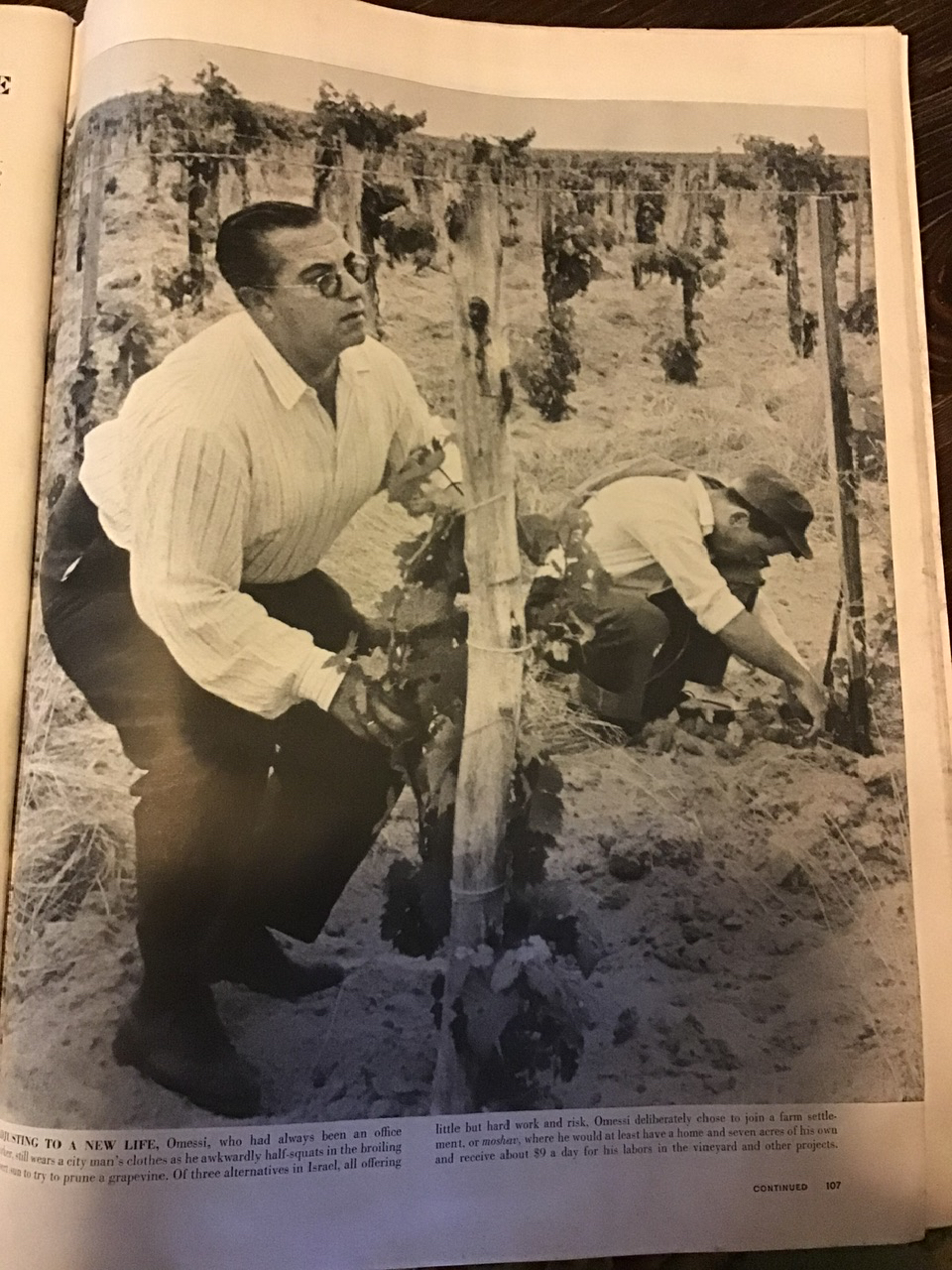
“Adjusting to a new life, Omessi, who had always been an office worker, still wears a city man’s clothes as he awkwardly half-squats in the broiling desert sun to try to prune a grapevine. Of three alternatives in Israel all offering little but hard work and risk, Omessi deliberately chose to join a farm settlement, or moshaw, where he would at least have a home and seven acres of his own and receive about $9 a day for his labors in the vineyard and other projects.” 😂 😂
I wonder how long Omessi lasted as a farm laborer in his new home?!
Will this be the tipping point for the geoengineering discussion? Thank y’all for the comments on the last post, much appreciated. I intend to get to them pronto, it’s just I’ve been a bit under the weather. Irony?
But I couldn’t resist sharing this new one first. I found it to be an informative discussion and RKJ had a few good questions I hadn’t already heard, which is impressive considering I could recite a good portion of Dane’s points.
Not that I’m a fan of RKJ, but he does bring with him a famous name and a large audience, not to mention his contacts in the environmental groups. Maybe this will be the catalyst for these groups to finally take this seriously?
On the other hand, I did find instances where RKJ sounds to me to be dismissive—when he says things to Dane like ‘your story’ and ‘your theory’ —and especially when he says he can’t imagine something staying so hidden for so long.
I actually had a chuckle at that one! Really? Can’t imagine that at all, decades of government secrecy and misinformation never crossed your radar? Hmmm.
RKJ broaches the biggest conspiracy theory . . .for real, or just for fun and profit?
Just some random news here, make of it what you will, because I’m done trying to convince the willfully blind they can see. Connect the dots, or don’t.
“Indeed, experts agree that no lifestyle adjustment can replace sustainable development.
Researchers have linked these and other extreme heat events around the world to man-made global warming, particularly the burning of fossil fuels. Shortening school days and staying indoors during peak hours are surface-level solutions which often come with their own hidden costs. Lourdes Tibig, climate science adviser for the Philippines-based Institute for Climate and Sustainable Cities, says that recent extreme heat underscores “the importance of incorporating climate change and resiliency into long-term development planning.”
On Geoengineering, most infamous Geoengineer, Dr. D. Keith:
“It’s not really a moral hazard, it’s more like free riding on our grandkids.”
New from Dr. David Keith:
“David Keith has worked near the interface between climate science, energy technology, and public policy for twenty-five years. He took first prize in Canada’s national physics prize exam, won MIT’s prize for excellence in experimental physics, and was one of TIME magazine’s Heroes of the Environment. Keith is Professor of Applied Physics at the Harvard School of Engineering and Applied Sciences and Professor of Public Policy at the Harvard Kennedy School, and founder of Carbon Engineering, a company developing technology to capture CO2 from ambient air to make carbon-neutral hydrocarbon fuels. Best known for his work on the science, technology, and public policy of solar geoengineering, Keith led the development of Harvard’s Solar Geoengineering Research Program, a Harvard-wide interfaculty research initiative.”
Abstract Temperature-attributable mortality is a major risk of climate change. We analyze the capacity of solar geoengineering (SG) to reduce this risk and compare it to the impact of equivalent cooling from CO2 emissions reductions. We use the Forecast-Oriented Low Ocean Resolution model to simulate climate response to SG. Using empirical estimates of the historical relationship between temperature and mortality from Carleton et al. (2022), we project global and regional temperature-attributable mortality, find that SG reduces it globally, and provide evidence that this impact is larger than for equivalent cooling from emissions reductions. At a regional scale, SG moderates the risk in a majority of regions but not everywhere. Finally, we find that the benefits of reduced temperature-attributable mortality considerably outweigh the direct human mortality risk of sulfate aerosol injection. These findings are robust to a variety of alternative assumptions about socioeconomics, adaptation, and SG implementation.
“The nebulous nebula that is Congress cannot escape from a vast black hole of wasteful spending. The debt ceiling debacle demonstrated that lawmakers are light-years away from sustainable spending reforms. One problem is that agencies, such as the National Aeronautics and Space Administration (NASA), have had a veritable blank check to waste taxpayer dollars as they see fit. For example, NASA’s mission back to the moon has already been plagued by scheduling delays and cost overruns, and taxpayers will likely have to shell out $100 billion before another “small step” can happen. Policymakers must reassess mission priorities and blaze a better path forward before more taxpayer dollars are shuttled to NASA. According to a new audit by NASA’s Inspector General (IG), the agency’s Space Launch System (SLS) rocket slated to ferry astronauts to the moon is an astounding $6 billion over budget. NASA had originally thought that using some of its older technologies (e.g., Space Shuttle and Constellation Programs) would save the mission money and incorporated these savings into initial cost estimates. But, “the complexity of developing, updating, and integrating new systems along with heritage components proved to be much greater than anticipated” and costs have skyrocketed out of control.”
St. Louis, one of many favored hotspots of experimentation and where I grew up. Like many ‘sacrifice zones’ I grew up hearing the propaganda: “If you don’t like the weather in Missouri, just wait 5 minutes.” This was common throughout many states of the Midwest, not just Missouri. The truth is, few alive today know truly natural weather. It’s been manipulated since before air travel even existed! If they can do it on a small scale in the 60s, they can do it regionally and beyond today.
This post is inspired by Alison McDowell’s series, Letters from the Labyrinth.
Attention all Dandelions!
I served as a Peace Corps Volunteer in the Czech Republic from 1994-1996, returning there in 1998-9 to teach at the Natural Sciences Faculty at Charles University in Prague.
I’ve written often about my experience and consider those years to have been formative on many levels, including that which defines my worldview to the present day.
While I have written often about those years, I have shared almost no criticism about my time there or the Peace Corps as an institution. I wrote a blog with other Returned Peace Corps Volunteers for several years, from which I was unceremoniously deplatformed as soon as I ventured into (unbeknownst to me at the time) the forbidden territory of ‘conspiracy theory’.
The Peace Corps was established in 1961 by John F. Kennedy. “Ask not what your country can do for you, but what you can do for your country.”
From Wiki: “On March 1, 1961, Kennedy signed Executive Order 10924 that officially started the Peace Corps. Concerned with the growing tide of revolutionary sentiment in the Third World, Kennedy saw the Peace Corps as a means of countering the stereotype of the “Ugly American” and “Yankee imperialism,” especially in the emerging nations of post-colonial Africa and Asia.[28][29] Kennedy appointed his brother-in-law, Sargent Shriver, to be the program’s first director. Shriver fleshed out the organization and his think tank outlined the organization’s goals and set the initial number of volunteers. The Peace Corps began recruiting in July 1962; Bob Hope recorded radio and television announcements hailing the program.”
Globalism, before it was cool.
The organization was in the Czech Republic for only seven years. From the Peace Corps’ ‘legacy booklet’:
“Through the work and contributions of Volunteers, the Peace Corps has emerged as a model of success for efforts to promote sustainable development at the grass-roots level. The Peace Corps, however, is much more than a development agency. Volunteers embody some of America’s most enduring values: optimism, freedom, and opportunity. Volunteers bring these values to communities around the world not to impose them on other people or cultures, but to build the bridges of friendship and understanding that are the foundation of peace among nations.”
A portion of Vaclav Havel’s parting statement to the Peace Corps: “The results of the Peace Corps’ work can be seen throughout the Republic. The Peace Corps assisted in establishing many new libraries, completed more than 100 ecological projects, and gave more than one thousand Czech entrepreneurs the opportunity to gain new business experience.” Prague, 1997
Ambassador Shirley Temple Black attended the official opening of the Peace Corps office in Prague in 1991.
Speaking of Temple-Black: According to Kounalakis, “Her personal and informal style worked well with the new government, made up of formerly imprisoned, hard laboring and human rights Charter 77-signing artists, musicians, actors and a playwright president named Vaclav Havel. Many of those new Czechoslovak political leaders admired their American colleague, President Ronald Reagan, an actor-politician like themselves who expressed in the clearest terms – and to the whole world – their deepest desire for freedom.”
The dissident playwright turned politician, President Vaclav Havel’s wife was also a famous actress. Olga Havlová – Wikipedia
Also from Wiki:
“Havel was born in Prague on 5 October 1936[8] into a wealthy family celebrated in Czechoslovakia for its entrepreneurial and cultural accomplishments. His grandfather, Vácslav Havel, a real estate developer, built a landmark entertainment complex on Prague’s Wenceslas Square. His father, Václav Maria Havel, was the real estate developer behind the suburban Barrandov Terraces, located on the highest point of Prague—next door to which his uncle, Miloš Havel, built one of the largest film studios in Europe.[9] Havel’s mother, Božena Vavrečková,[10] also came from an influential family; her father was a Czechoslovak ambassador and a well-known journalist.
“He was known for his essays, most particularly The Power of the Powerless (1978), in which he described a societal paradigm in which citizens were forced to “live within a lie” under the Communist regime.[19] In describing his role as a dissident, Havel wrote in 1979: “we never decided to become dissidents. We have been transformed into them, without quite knowing how, sometimes we have ended up in prison without precisely knowing how. We simply went ahead and did certain things that we felt we ought to do, and that seemed to us decent to do, nothing more nor less.”[20]
As far as Peace Corps assignments go, I was sometimes rightly chided as having ‘served’ in the “Paris of the Peace Corps.” I did not live in a village in a shack without running water, as is often the stereotype, and sometimes the reality.
I got lucky, very lucky in fact. I was assigned to a brand new school, with a private office, and lived in the vacated 2-bedroom flat of the school’s principal. It even had a private phone.
At the Ambassador’s Residence in Prague, feeling sophisticated. Champagne socialism, free-market capitalism? Who knew, who cared?!
A short time after arriving I was summoned to the state-of-the-art, just being organized, computer room. I had requested an e-mail address. The teacher running the show was excited, thrilled even, to have someone even remotely interested in his very claustrophobic cyber-world.
The enormous room was full of donated equipment, mostly used, monitors and hard-drives and equipment I didn’t recognize were stacked up on every inch of the floor and only he and a handful of others knew how to use it all, or even cared to use any of it.
And new shipments were coming in at a regular clip. He couldn’t keep up with all the offerings.
At the same time, the old Soviet materials were stacked up on the street twice a week to be hauled away by the trash crew. Huge stacks of newspapers, magazines, books, busts, badges, portraits that seemed bottomless in those early days.
“We just traded one Big Brother for another,” one teacher quipped.
I was thrilled to be there. I fully expected to find, as per the slogan, “The toughest job you’ll ever love.” Bring it on, I thought.
But, I was young and naive and idealistic and I didn’t understand bureaucracy. I was dumb enough to think I was supposed to be honest on the seemingly endless ‘ratings forms’ we were required to complete. Instead of spend five minutes giving five stars and glowing reports to any and all activities and instructors like most of my fellows, I actually thought about it, wrote what I thought needed improvement, made suggestions I thought would be helpful.
That got me labeled as a complainer almost immediately, I later learned.
One thing we weren’t supposed to complain about was the vaccine schedule. Even though some volunteers were insisting they were getting sick from it.
However, the Volunteer Handbook was unequivocal. “Also during Staging, you will be given immunizations that are required for overseas travel and for re-entry into the United States. Please do not obtain any immunization before going to Staging. If you are sensitive to any immunizing agents or medications, or have religious reservations concerning the taking of immunizations or medications, you should notify the Office of Medical Services before accepting an invitation to training.”
Other project missions had impressive corporate sponsors, like the English-language essay contest about women’s role in Czech society, organized by Fran Aun, currently a Public Relations professional with such current successes as the trans campaign:
You can pee next to me!
Fran Aun’s efforts in Prague got me noticed. Hmmm, yikes?
Me, so proud, sitting at the table in the middle for our celebratory cruise on the Vltava, because my students dominated the essay contest winning multiple corporate-sponsored prizes, including a new computer for my 1st place winner and a super fancy new copy machine for my school.
The Peace Corps is now hiring for a new position: Climate Financing Support Specialist.
My Report Card for the Agency, according to their own stated goals:
To help the people of such countries and areas in meeting their needs for trained manpower, particularly in meeting the basic needs of those living in the poorest areas of such countries,
And to help promote a better understanding of the American people on the part of the peoples served
And a better understanding of other peoples on the part of the American people.
As for goal number one, I give a C-. I do not consider an essay questioning women’s role in modern society to be more in line with basic needs of the poorest children in orphanages.
As for goal number two, I give a B+. That is, considering the people who were actually served were not those needing to meet basic needs, but those with an American-loving entrepreneurial spirit, that seems ‘fair’, I guess.
As for goal number three, I give an unequivocal F. The only stories that are allowed are those demonstrating our relentless positivity and the plate-spinning and mask juggling and illusions of a thousand other cultures who apparently dream of becoming just like U.S.
What I actually learned in my service from the Czech people, and tried to bring back home to fulfill the 3rd goal was categorical rejected by the current day Peace Corps: suspicion of government, especially volunteering; the critical importance of life skills; self-reliance over government reliance; local aid over foreign aid; and in fact, a good dose of paranoia, which was rampant among the Czechs, and would be wisely adopted by the majority of U.S. in the present times.
The line between entrepreneurs, civil servants, and philanthropists was breached ages ago, and it seems like Americans might be the last to know.
Fellow RPCV TEFL Volunteer, Antonio Lopez, “While I was serving my term as a Peace Corps Volunteer, I was definitely aware that a large scale societal change was under way, and that I was taking part in it. I guess I felt that way because I was a teacher working with teenagers, people who are always in a process of change and seeing the world around them with fresh eyes.”
From the best essay I’ve read all month (not James Corbett, but I was reminded of his excellent vid on the topic, so I used that image).
This one comes from a ‘new to me’ writer on Substack called ‘The Upheaval’:
“The most obvious answer is that ridicule undermines authority. Or, perhaps more accurately, it is inherently destabilizing to brittle, illegitimate, undeserving authority. Hence why, as Milan Kundera put it in The Joke, “No great movement designed to change the world can bear sarcasm or mockery, because they are a rust that corrodes everything it touches.”
Me: Milan Kundera was my favorite writer for years and I’ve read most of his works, some of it multiple times. I find it extraordinary that despite his popularity among New York intelligentsia, that same circle has not understood its deeper implications, clearly, otherwise they would’ve seen right through the corporate-fascist institutions they are still supporting even now.
“The answer strikes to a much deeper insight: genuine humor is utterly reliant on its connection with the truth. As any good comic could explain, the best jokes play off the gap between expectation and reality; or between propriety (social pretense) and reality; or on irony, the gap between words and their real meaning; and so on – in all cases the most effective humor functions through revelation.”
“Nor perhaps why, pearls firmly in hand, a 2021 EU report literally titled “It’s Not Funny Anymore” warned breathlessly that, by “blurring the lines between mischief and potentially radicalising messaging,” the “transgressive humour” of online “meme culture” threatens to expose people to such amorphous “far-right” and “extremist” notions as “anti-elite arrogance and condescension,” or jokes making fun of those who “do not question the information that comes from mainstream press and politics.” And why, decrying that “humour has been weaponised as a form of resistance against a political culture that is supposedly curtailing free speech,” it called for increased global efforts to “monitor” and “quarantine” such humor in partnership with tech companies and “progressive communities.”
Me: Indeed. Just try to find funny political memes on a basic Google search today. Hardly a laugh to be found.
“But humor’s intimate relationship with the truth also explains why the authoritarian is typically incapable of it. If the punchline of a joke is not the revelation of the real but simply the reiteration of the lie, no genuine laughter – of the kind that seems to well up unbidden from deep within the listener – can be produced. Hence why most mainstream comedy has long since replaced laughter with “clapter,” why the left can’t meme, and why the EU report bemoaned the fact that “attempting to counter extremist humour with a form of alternative humour has proven very difficult.”
Me: As much as I agree and appreciate this entire essay and hope ya’ll will go read it, I also need to add that seed of doubt, because it’s there.
A question for y’all: Does humor also serve the tyrannical system by normalizing its crimes and diffusing the hostility of the masses? After all, back in the day it was the ‘court jesters’ who performed at the behest of the rulers. It is part of the ‘bread and circus’.
And so far, it has proven to be completely ineffectual at curbing the influence of the unelected elite whose power has only increased despite all the best efforts of George Carlin, among precious few others.
It may make us feel better, but does it really have any chance of changing the game? Because, if it did, wouldn’t it have worked by now? Is humor just the new ‘Opium of the masses’? After all, the ‘Emperor With No Clothes’ remains the Emperor.