Herbal Explorations: Datura

I’ve added a new ‘weed’ to the Herbal Explorations pages. It’s long, but fascinating, at least according to me. 😁

I hope I can help you enjoy my favorite flower from afar!

Common names: Thornapple, Jimsonweed, Devil’s trumpet, Mad apple, Stinkweed, and many more

Scientific names: Datura fastuosa, sanguinea; D. Stramonium; D. Metel
Solanaceae family

Datura is one of those weeds with a very long and very sordid history, but that’s only part of the reason it is my very favorite.

My datura inoxia with Bubba behind surely enjoying its ephemeral scent

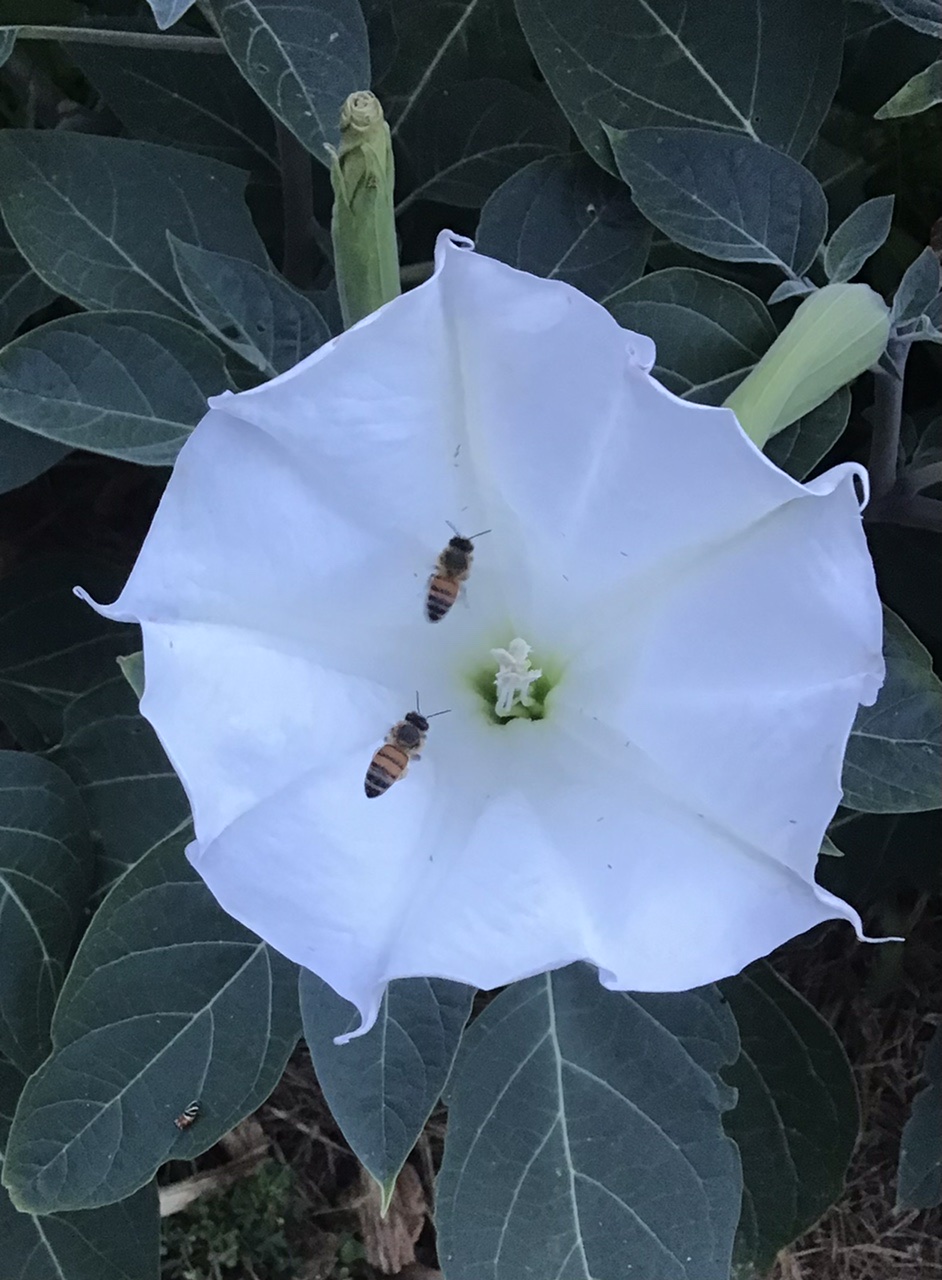
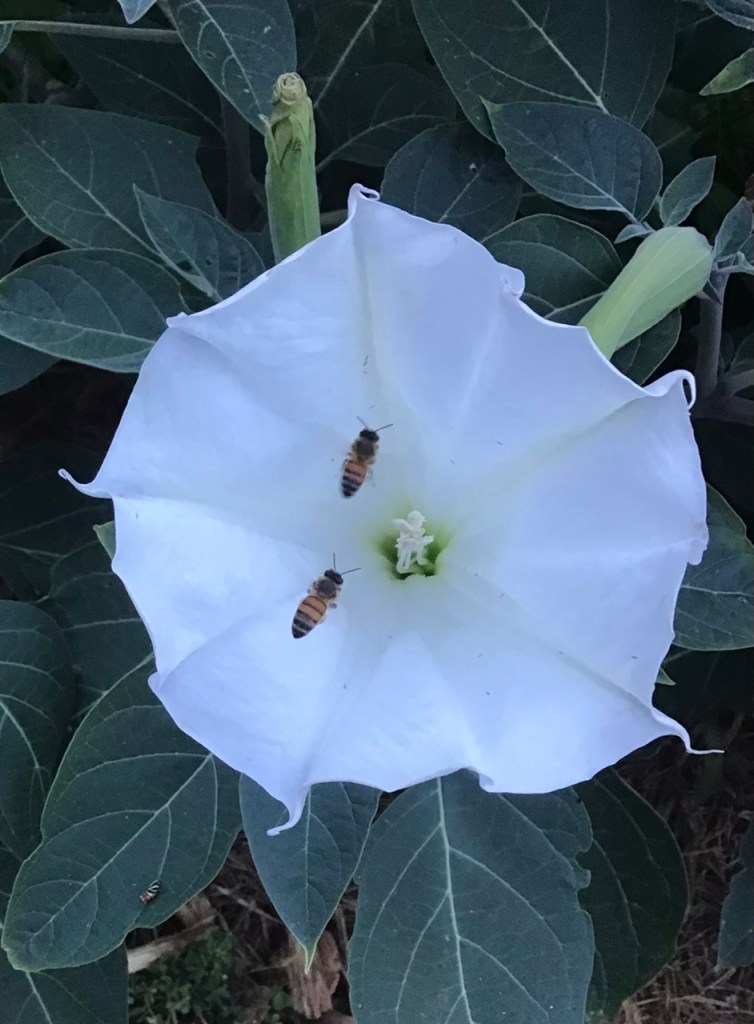
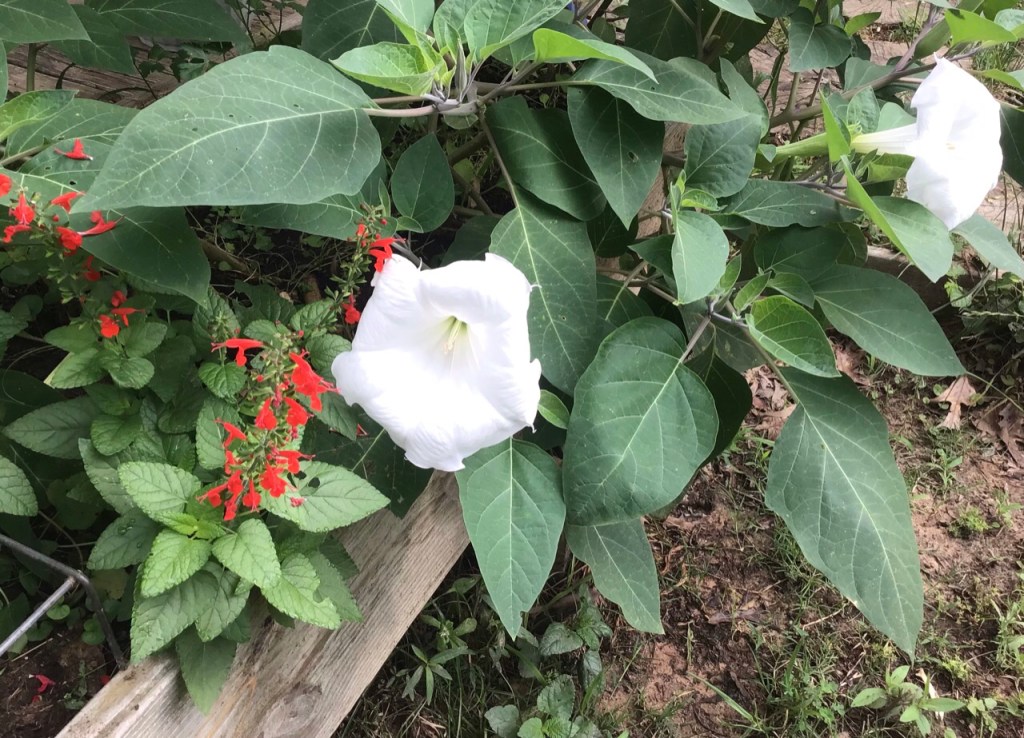
It’s a luxuriously soft bloom, thick and silky, opening at dusk. For a very short time while opening it emits the most seductive scent I could imagine. It makes me want to just dive in and drink it up!

And sometimes I do smother my nose right into the center of it and breathe deeply as the smooth velvety petals brush my cheeks, but the scent does not become stronger in such close proximity. It remains very subtle, almost dainty, like a sweet teasing, a slight flirtation that drifts into an unrequited mystique.*

On the nightstand, just opening, when its fragrance is strongest

Man has been tempted and fascinated by this weed since long before written history.

From Wiki:

“The case of D. metel is unique in that not only is the plant not a true species at all, but an assemblage of ancient pre-Columbian cultivars created from D. innoxia in the Greater Antilles, but evidence is mounting that it was introduced to the Indian subcontinent no later than the second century CE – whether by natural or human agency is, as yet, unknown – making it one of the most ancient plant introductions (if not the most ancient) from the New World to the Old World (see Columbian Exchange).”

Datura metel fastuosa from Wiki

While there are many varieties, all with distinctive features, it is the scent especially that is said to vary dramatically among species—from noxious to intoxicating—sometimes dependent solely on the nose of the beholder.

From Wiki again:

Datura is a genus of nine species of highly poisonous, vespertine-flowering plants belonging to the nightshade family (Solanaceae). They are commonly known as thornapples or jimsonweeds, but are also known as devil’s trumpets (not to be confused with angel’s trumpets, which are placed in the closely related genus Brugmansia). Other English common names include moonflowerdevil’s weed, and hell’s bells. All species of Datura are extremely poisonous and potentially psychoactive, especially their seeds and flowers, which can cause respiratory depression, arrhythmias, fever, delirium, hallucinations, anticholinergic syndrome, psychosis, and even death if taken internally.”

From Reader’s Digest Magic & Medicine of Plants 1986:

“Jimsonweed: Although it has antispasmodic, painkilling, and narcotic properties, jimsonweed is a plant to be avoided. Every part of this weed, which is a member of the notorious nightshade family, is extremely poisonous and may cause death. (It) was once a popular asthma remedy. . . .The root and leaves were used externally in folk medicine to treat boils and cuts. The American physician and botanist Charles Millspaugh stated in his Medicinal Plants (1892) that jimsonweed was employed ‘as a narcotic, soothing drug’ for epilepsy and neuralgia. He also noted that it was recommended as an ointment for burns and scalds.” (P. 226)

~~~~~~~~~~

From Plant Intoxicants: A Classic Text on the Use of Mind-Altering Plants by Baron Ernst von Bibra (Die narkotischen Genussmittel und der Mensch by Wilhelm Schmid, Nuremberg, 1855)

(Datura fastuosa, sanguinea; D. Stramonium; D. Metel)

“An intoxicating drink called tonga is prepared from the seed capsules of this plant. This brew has a violent and powerful effect. Johann Jakob von Tschudi in his ‘Travels in Peru’ describes the effects as he saw them on an Indian who had taken the tonga.
‘Shortly after swallowing the beverage he fell into a heavy stupor. He sat with his eyes fixed vacantly on the ground, his mouth convulsively closed, and his nostrils dilated. In the course of a quarter of an hour his eyes began to roll, foam issued from his half-opened lips, and his whole body was shaken by frightful convulsions. After these violent symptoms subsided, a profound sleep of several hours followed. In the evening I saw the Indian again. He was relating to a circle of attentive listeners the particular of this silicon, during which he allegedly communicated with the spirits of his forefathers. He appeared very weak and exhausted.’
The name yerba de huaca (herb of the graves) thus derived from the peculiar idea of the Indians that they can communicate with the spirits of their forefathers, generally after consuming the thornapple plant.”
In former times the old Indian priests drank the thornapple if they wished to converse with their gods. Moreover, priests at the oracle of Delphi administered the prepared seeds of the thornapple to their seers to put them in the desired prophetic ecstasy. In the sun temples at Sogamossa, near Bogota in the Andes of New Granada a similar practice was carried out by the Indians.” (P. 77-78)

~~~~~~~~~~~~~~~~

From Witchcraft Medicine: Healing Arts, Shamanic Practices, and Forbidden Plants by Claudia Muller-Ebeling, Christian Ratsch, and Wolf-Dieter Storl

The famous Flying Ointment

“The ointments (Unguentum populeum) were not forbidden; they were officially used for the treatment of pain, as a numbing wound dressing, as an executioner’s salve, for rheumatism, and for hemorrhoids. The common people were also quite familiar with plants that move the spirit, and used them for love potions and as spices to make beer more inebriating. . . .The courts themselves made use of such ointments. The inquisitors used them to revive defendants after they had been thoroughly questioned and—due to the effects of scopolamine—used the ointments as ‘truth serums’ to break the resistance of tortured prisoners.” P.51

‘Witches’ markets’ in Mexico sell ‘pomada de toloache’ made from the leaves and petals using the variety Datura inoxia (Mill.,syn, datura meteloides DC)

~~~~~~~*More on scent*~~~~~~~~

I am so enamored with the scent of this flower, I wish I could find it in bottle! But so far, I don’t think it exists.

I wonder, how would they re-create a scent that smells differently to different people? Considering ‘smellovision’( a play on ‘television)’ is apparently already possible and coming soon to a computer near you, I dare say there are some scents science will never capture, and perhaps datura will be one of them.

“The concept of digital smell technology was already being discussed openly in mainstream news in 2018, and The Monell Center in Philadelphia, PA, is actively engaged in research to digitize chemosensory data. The notion of a mixed, augmented reality, integrating smell technology, is no longer in the sci-fi realm.” ~Stephers

Part 4: The Scent of Fear ~ Musings on Fear and Olfaction – Piece of Mindful

If I could upload the scent for you now, I would! 😊

~~~~~~~~~~~~~~~~~~~~

Here is some more interesting information on the psychoactive properties of Datura. Scopolamine, the so-called ‘mind control’ drug is an active ingredient.

From Wiki again: Psychoactive Use

“In Pharmacology and Abuse of Cocaine, Amphetamines, Ecstasy and Related Designer Drugs, Freye asserts: Few substances have received as many severely negative recreational experience reports as has Datura. The overwhelming majority of those who describe their use of Datura find their experiences extremely unpleasant; both mentally and often physically dangerous.
  However, anthropologists have found that indigenous groups, with a great deal of experience with and detailed knowledge of Datura, have been known to use Datura spiritually (including the Navajo and especially the Havasupai) Adequate knowledge of Datura‘s properties is necessary to facilitate a safe experience. The ancient inhabitants of what became central and Southern California used to ingest Datura to “commune with deities through visions”. The Southern Paiute believe Daturacan help locate missing objects. In ancient Mexico, Datura also played an important role in the religion of the Aztecs and the practices of their medicine men and necromancers. It was reportedly used by the Aztecs for ritual sacrifice and malevolent purposes as well. In modern-day Mexico, some datura species are still used for sorcery and other occult practices, mostly in the southern region of Veracruz, specifically in the city of Catemaco.

Bernardino de Sahagún, in around 1569, called attention to Datura in these words: “It is administered in potions in order to cause harm to those who are objects of hatred. Those who eat it have visions of fearful things. Magicians or those who wish to harm someone administer it in food or drink. This herb is medicinal and its seed is used as a remedy for gout, ground up and applied to the part affected.”

Christian Rätsch has said, “A mild dosage produces medicinal and healing effects, a moderate dosage produces aphrodisiac effects, and high dosages are used for shamanic purposes”. 
Wade Davis, an ethnobotanist, also lists it as an essential ingredient of Haitian zombie potion. In Western culture, the same species (Datura stramonium) has been said to have been commonly used by witches as an ingredient for their flying ointments and was regularly included in detailed recipes of magical ointments dating back as far as the early modern period, predominately in New England and Western Europe. During the anti-witchcraft hysteria of colonial times it was considered unlucky or inappropriate to grow D. stramonium in one’s garden due to its supposed reputation for aiding in incantations.”

~~~~~~~~~~~~

For more information on its psychoactive properties visit:

Erowid Vault: Datura

Homestead Happenings

A few updates from our very busy and already very hot summer. We’ve got bad news about the blackberry issue mentioned last month; a brief report on what Handy Hubby has deemed our ‘ Summer Sausage-fest’; some harvest and critter happy snaps; and a really funny question. Ending, like the beginning, with my favorite flower.

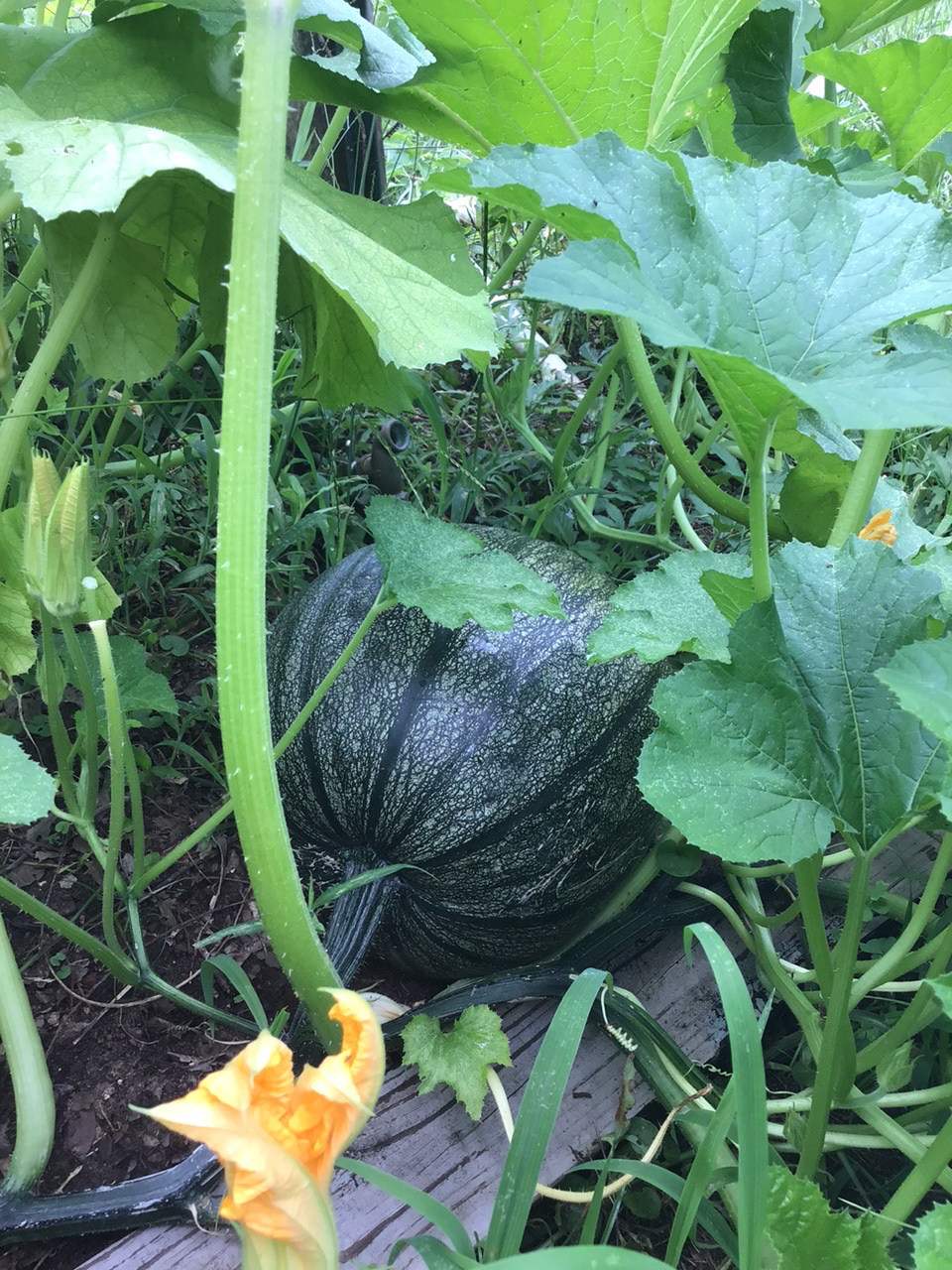
Kakai hull-less pumpkin

Novice seed-saving mistake on my part—don’t plant Kakai pumpkins next to zucchini. Even though one is a winter squash and the other a summer squash, they are both part of the same family: Curcurbita pepo.

According to Southern Exposure Seed Exchange “Curcurbita pepo: Most zucchini and summer squash are of this species. Winter squash varieties do not store well and are best eaten within a few months of harvest, but also need less time curing to sweeten up. Best planted in monthly successions throughout the summer due to vine borer susceptibility. If you have trouble growing these squash, try luffa gourds or Tromboncino summer squash as a substitute for zucchini.”

Squash, Pumpkin, & Zucchini Growing Guide

I planted these pumpkins for the first time because a friend gifted me the seeds. The seeds are so delicious I decided to try them even though I’ve not had success growing pumpkins in years past.

Well, these are a big success! Except, now those seeds have surely been cross-pollinated with the neighboring zucchini, which according to this farmer, means the seeds will no longer be hull-less, defeating the whole purpose of planting this variety of pumpkin.

Don’t I feel dumb!

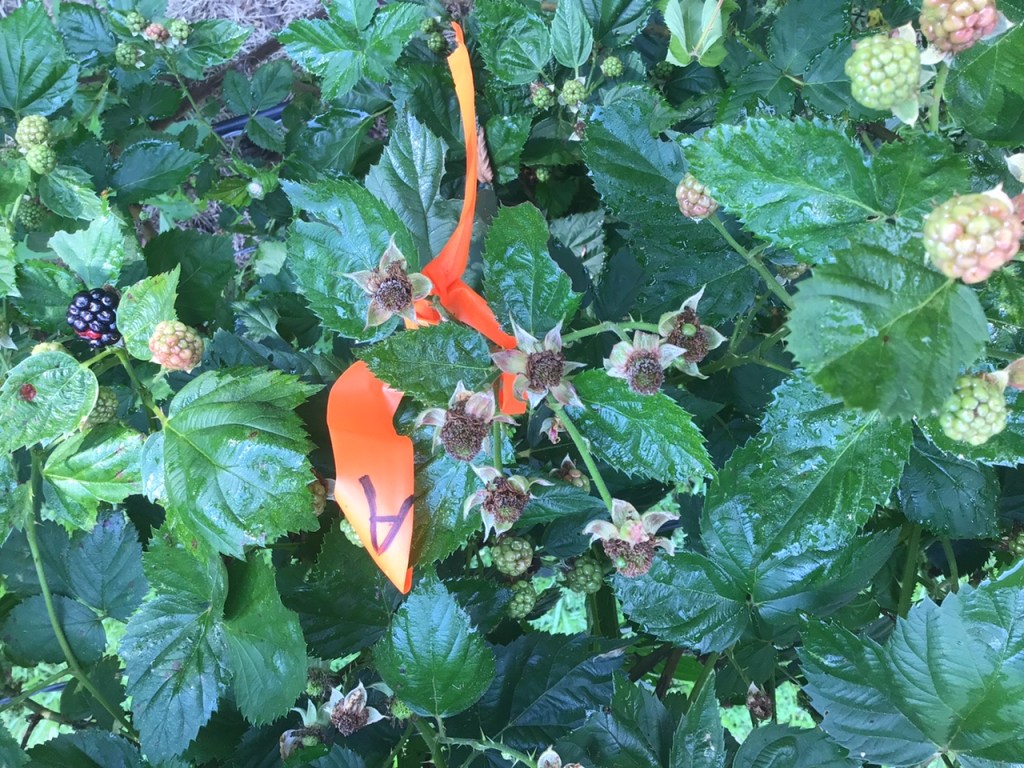
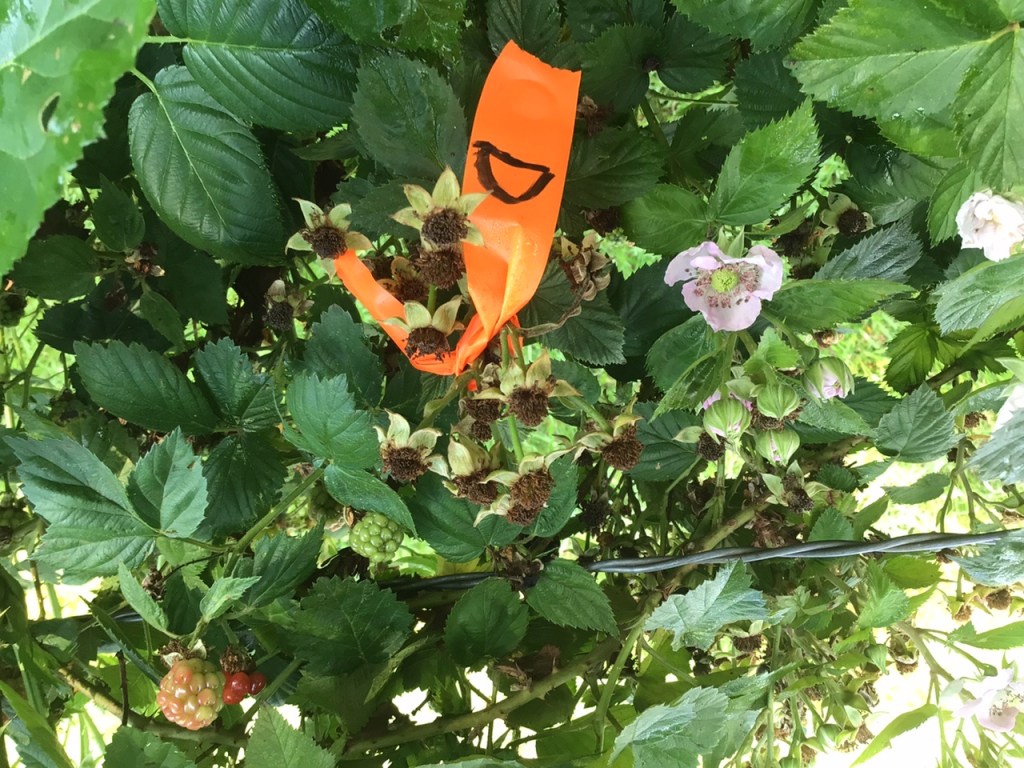
And dumber still! We are no closer to solving the blackberry issue. Hubby did some scientific-like sleuthing to eliminate potential variables. One commenter on a forum said what we were seeing was totally normal blackberry development and we just had to wait a bit longer for our huge harvest.

So, Hubby took some before and after photos, about two weeks apart. As hopeful as we were that he was right, we were skeptical, and he has now been proven to be wrong. Unfortunately for us, the mystery remains and the blackberry harvest is puny.

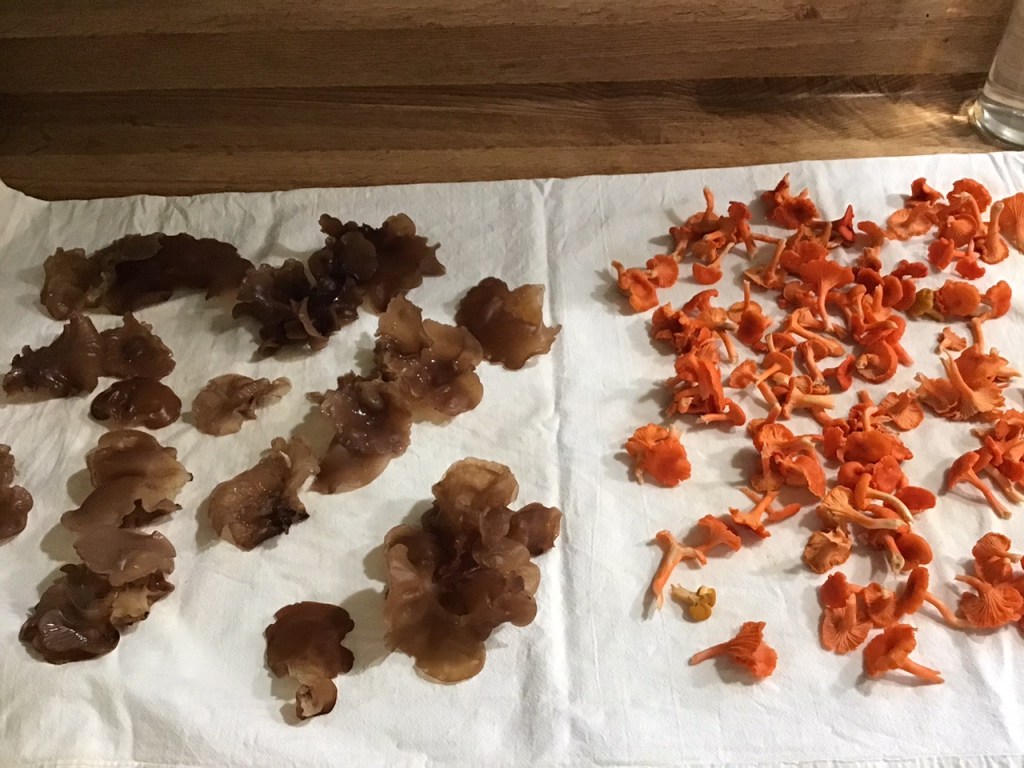
But, we have been blessed with a few weeks of prolific chanterelles, which we love, though their tiny size requires some patience while picking. I’ve tried them preserved in oil for the first time and we’ve been enjoying them in crepes, omelettes, soup and sauces.

Chanterelles and while foraging for them we find
Not-Bert ducking and covering! 😆

We’re also getting a bumper crop of tomatoes and peppers, with Hubby continuing to pressure can while I remain fixated on fermenting.

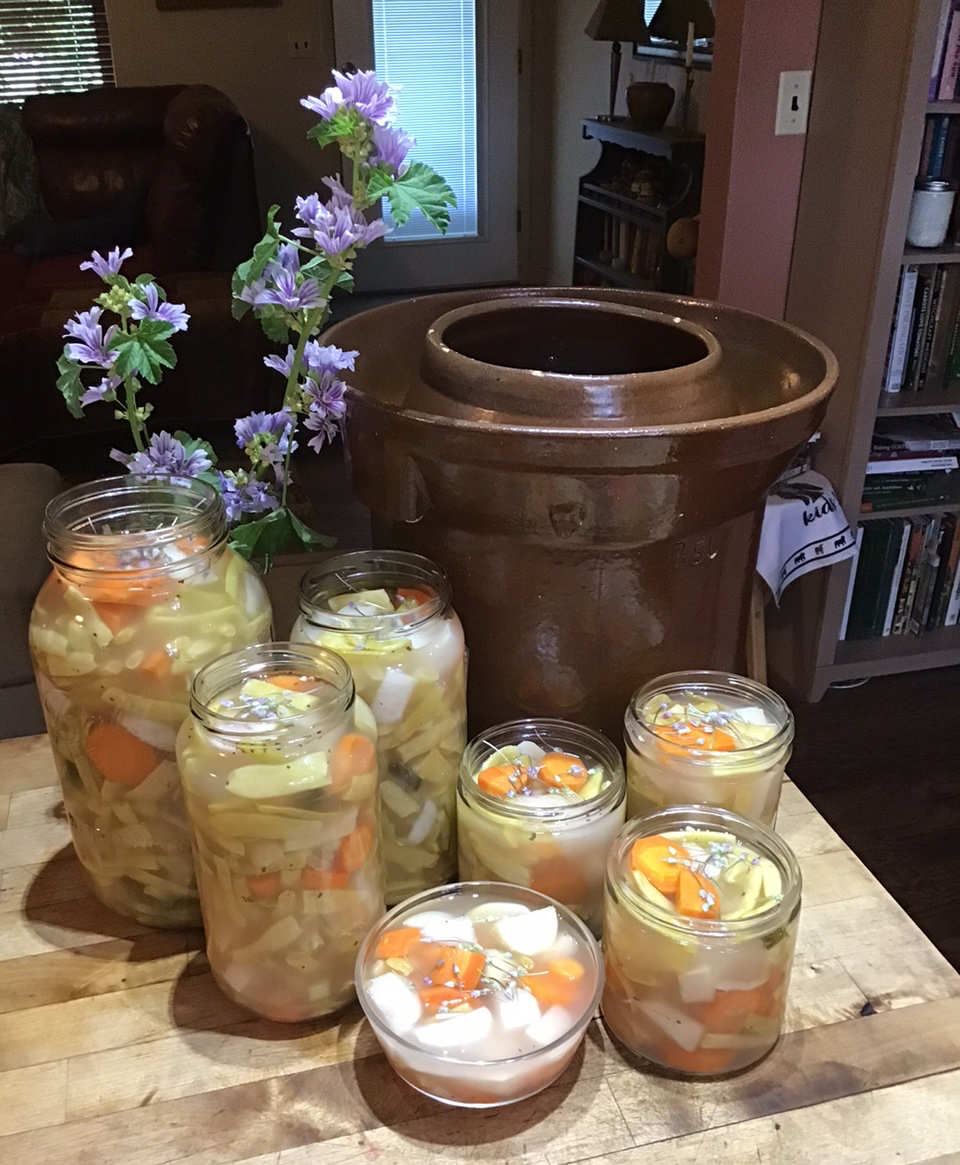
On left Pressure canning carrots, green beans, banana peppers and jalapeños;
fermenting the same on right.

Harvest Art!

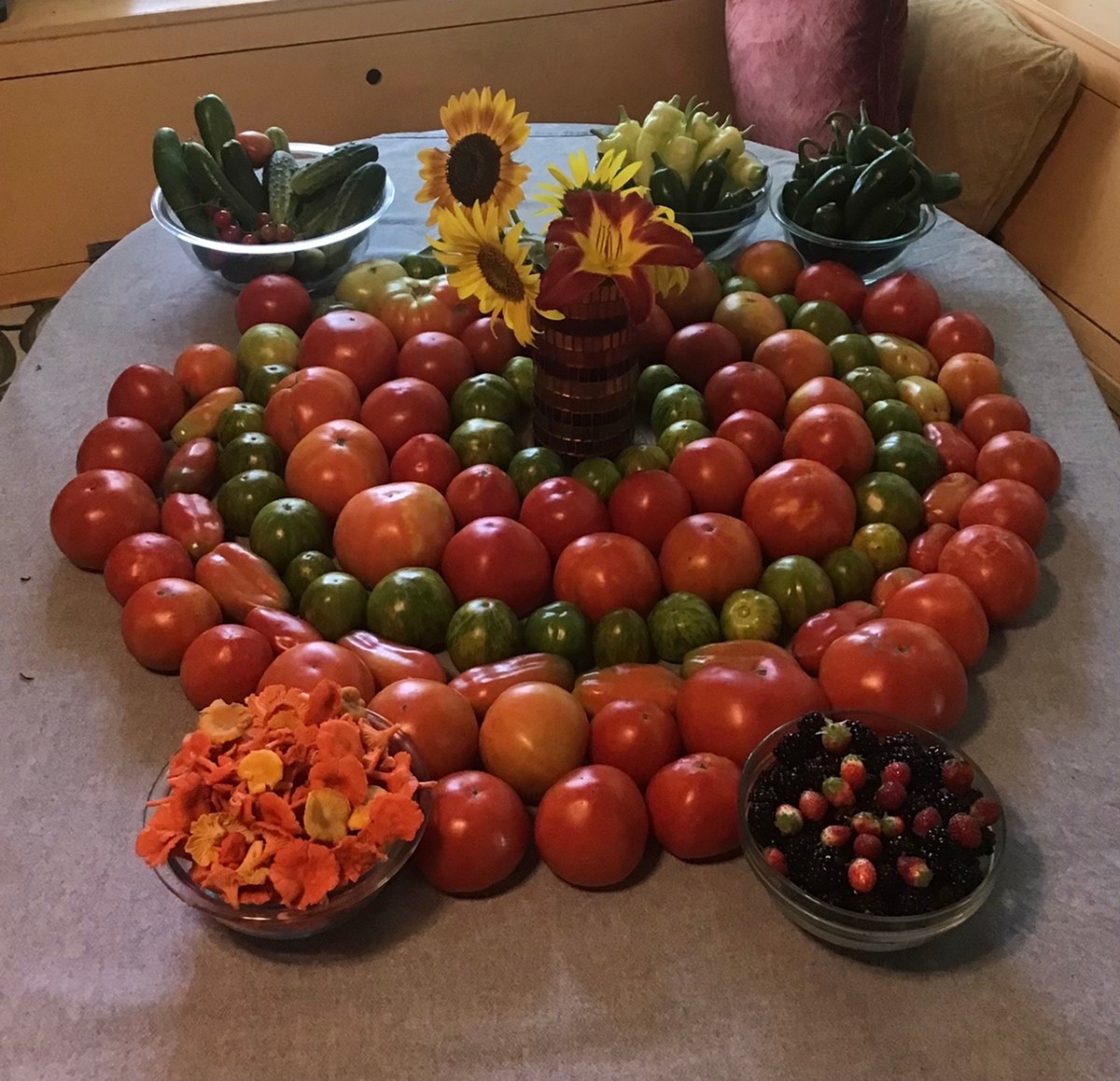
We rarely eat an entirely vegetarian meal, but with so much produce I thought I’d challenge myself to use every vegetable in one meal. As it’s so rare I thought I also better commemorate it with a photo!

Tomatoes topped with my own aged chèvre; cucumber and corn salad with salsa verde; veggie casserole au gratin; kombucha cocktails

More garden happy snaps.

Because obviously we have a lot more seeds than sense or cents, Hubby decided we didn’t have nearly enough to do with a huge garden, an orchard and squash plot, and a menagerie of critters, so he planted a separate melon maze as well! It’s actually pretty impressive and already producing, but we’ll see with this heat and drought how well it does. We were hoping the ‘El Nino’ predictions would be correct and we’d be wetter and cooler this year—so far, not panning out!

Hubby’s ingenious companion planting—esthetically pleasing and practical— sunflowers helping to shade the melon mounds.

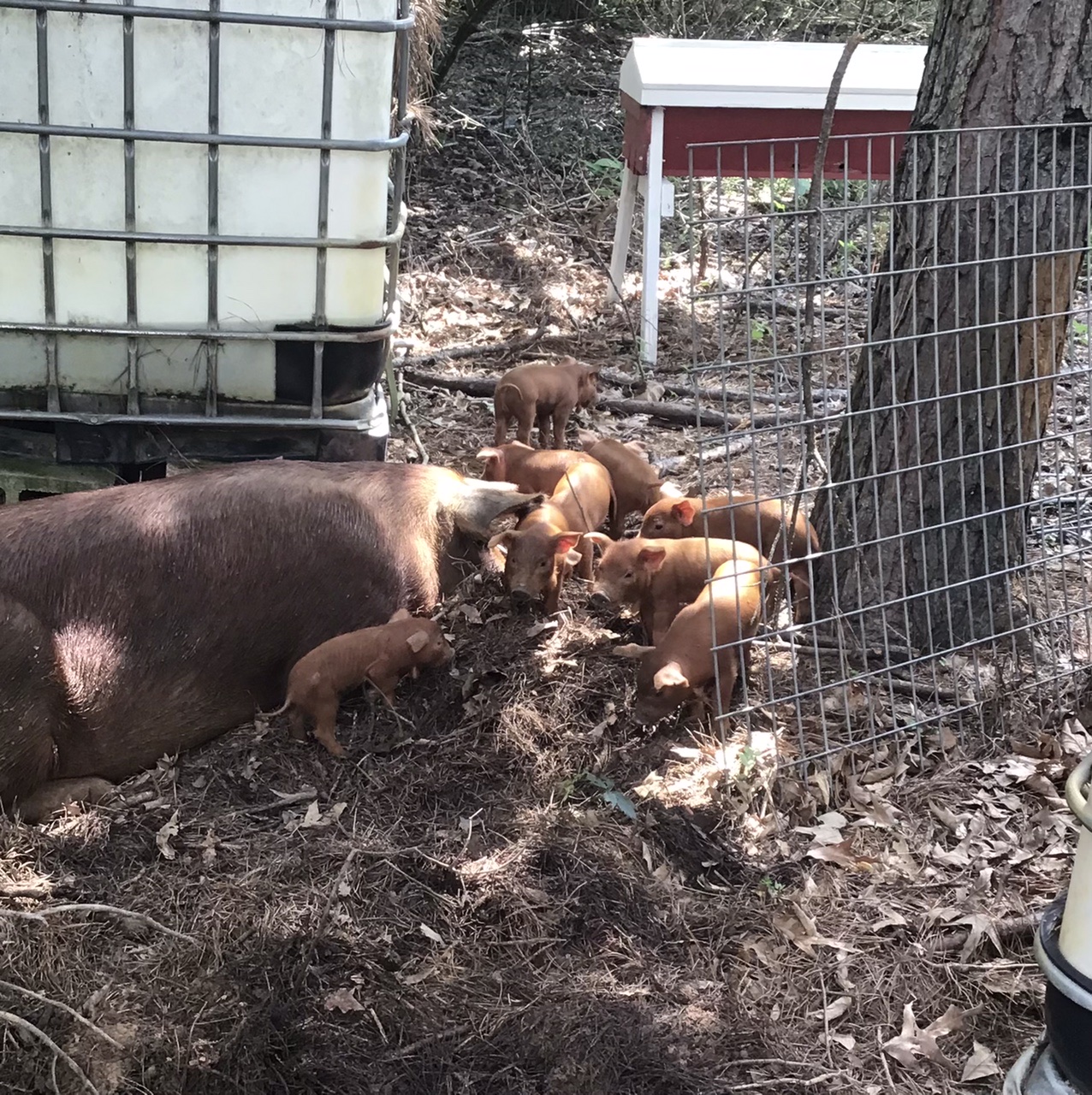
Patty’s first litter: 9 males and only 2 females!

And still dumber still!! We’ve been gifted an unwelcome ‘Sausage-fest’ this year as far as livestock goes. A whopping 80% male birth rate among pigs, goats and sheep.

Of this year’s kids: 1 female, 4 male

Of course, all the critters are cute little blessings, but no one really wants a Sausagefest.

However, Hubby did take the next big leap in livestock rearing and learned to castrate the piglets. He’s been avoiding that like the plague for YEARS! The lambs and kids are pretty easy and he’s been doing that since the beginning. But piglets are a different story.

I’m too squimish for all of it, so he never got any pressure from me to buck up, I’m not that big of a hypocrite. The nudge actually came inadvertently from a timely email from a friend who didn’t even realize at the time our current Sausagefest challenge.

I think it was seeing a girl do it, alone, that put the final bee in his bonnet! Or, is that spur in his boot, since this gal was demonstrating the ‘Boot method’.(We’re not on FB, so couldn’t see the entire post, but here’s the link, if you dare.) https://www.facebook.com/100064629581910/posts/in-the-past-ive-struggled-to-castrate-piglets-for-a-few-factors-i-took-an-old-ti/632005412297106/

He did the deed and it was a full success, bravo brave man! A real homesteading hero! 🤗

Now for the funny question, which sprouted from a favorite blogger’s recent post.

Plans for the Weekend? – Dispatches from the Asylum


In it we are presented with the ‘13 Do’s and Don’ts’ from the CDC about survival after a nuclear attack. It’s even funnier than the original!

From the life-saving list:
Do take a shower, but don’t use conditioner on your hair.
That’s even better than Duck & Cover!
Yes, you read that right! There’s our tax dollars hard at work to keep us safe.

I laughed so hard I wanted to include it somehow in our ‘Funny Friday’ post, but decided it really needed a whole section devoted to it.

So, before you click the link to look it up in order to verify (or afterward, if you promise to come back and reply!) here’s my question.

Can you guess why hair conditioner should not be used in the aftermath of a nuclear attack according to the experts?

Finally, the gorgeous, sublimely-scented Datura to leave us with some beauty and grace to cleanse the palette from the bad hair days certain to haunt us for decades after nuclear destruction. 😂

Thanks for stopping by!

Alfred Russel Wallace by Naked Emperor

Good article worth sharing! Of course, everyone’s heard of Charles Darwin. But Alfred Russel Wallace? I never have. Have y’all?

From the article:

“But after his death, Wallace quickly disappeared into relative obscurity until he was brought back into the public consciousness at the start of this millennium. This was due to a number of reasons. Firstly, Darwin came from a prominent family and had the support of influential figures in the scientific community, whereas Wallace was from a more humble background.”

He was anti-vaxx, anti-tyranny, anti-eugenics — so that might have something to do with it. Plus, he wasn’t wealthy or well-connected. So it’s no mystery why he doesn’t make the school books.

And then, there’s this, so there’s yer sign! 😆

“He also wrote about the dangers and wastefulness of militarism and wanted people to realise “that all modern wars are dynastic; that they are caused by the ambition, the interests, the jealousies, and the insatiable greed of power of their rulers, or of the great mercantile and financial classes which have power and influence over their rulers; and that the results of war are never good for the people, who yet bear all its burthens (burdens)”.”

Quick read, well worth it!

Alfred Russel Wallace, Wikipedia

Geoengineering Update

Will this be the tipping point for the geoengineering discussion? Thank y’all for the comments on the last post, much appreciated. I intend to get to them pronto, it’s just I’ve been a bit under the weather. Irony?

But I couldn’t resist sharing this new one first. I found it to be an informative discussion and RKJ had a few good questions I hadn’t already heard, which is impressive considering I could recite a good portion of Dane’s points.

Not that I’m a fan of RKJ, but he does bring with him a famous name and a large audience, not to mention his contacts in the environmental groups. Maybe this will be the catalyst for these groups to finally take this seriously?

On the other hand, I did find instances where RKJ sounds to me to be dismissive—when he says things to Dane like ‘your story’ and ‘your theory’ —and especially when he says he can’t imagine something staying so hidden for so long.

I actually had a chuckle at that one! Really? Can’t imagine that at all, decades of government secrecy and misinformation never crossed your radar? Hmmm.

RKJ broaches the biggest conspiracy theory . . .for real, or just for fun and profit?

Geoengineering Update

Just some random news here, make of it what you will, because I’m done trying to convince the willfully blind they can see. Connect the dots, or don’t.

“Indeed, experts agree that no lifestyle adjustment can replace sustainable development. 

Researchers have linked these and other extreme heat events around the world to man-made global warming, particularly the burning of fossil fuels. Shortening school days and staying indoors during peak hours are surface-level solutions which often come with their own hidden costs. 
Lourdes Tibig, climate science adviser for the Philippines-based Institute for Climate and Sustainable Cities, says that recent extreme heat underscores “the importance of incorporating climate change and resiliency into long-term development planning.”

‘Uncharted territory’: How Asia is coping with extreme heat – CSMonitor.com

……….

…….

On Geoengineering, most infamous Geoengineer, Dr. D. Keith:


“It’s not really a moral hazard, it’s more like free riding on our grandkids.”

New from Dr. David Keith:

“David Keith has worked near the interface between climate science, energy technology, and public policy for twenty-five years. He took first prize in Canada’s national physics prize exam, won MIT’s prize for excellence in experimental physics, and was one of TIME magazine’s Heroes of the Environment. Keith is Professor of Applied Physics at the Harvard School of Engineering and Applied Sciences and Professor of Public Policy at the Harvard Kennedy School, and founder of Carbon Engineering, a company developing technology to capture CO2 from ambient air to make carbon-neutral hydrocarbon fuels. Best known for his work on the science, technology, and public policy of solar geoengineering, Keith led the development
of Harvard’s Solar Geoengineering Research Program, a Harvard-wide interfaculty research initiative.”

Abstract
Temperature-attributable mortality is a major risk of climate change. We analyze the capacity of solar geoengineering (SG) to reduce this risk and compare it to the impact of equivalent cooling from CO2 emissions reductions. We use the Forecast-Oriented Low Ocean Resolution model to simulate climate response to SG. Using empirical estimates of the historical relationship between temperature and mortality from Carleton et al. (2022), we project global and regional temperature-attributable mortality, find that SG reduces it globally, and provide evidence that this impact is larger than for equivalent cooling from emissions reductions. At a regional scale, SG moderates the risk in a majority of regions but not everywhere. Finally, we find that the benefits of reduced temperature-attributable mortality considerably outweigh the direct human mortality risk of sulfate aerosol injection. These findings are robust to a variety of alternative assumptions about socioeconomics, adaptation, and SG implementation.

https://media.rff.org/documents/WP_23-23.pdf

……..

“The nebulous nebula that is Congress cannot escape from a vast black hole of wasteful spending. The debt ceiling debacle demonstrated that lawmakers are light-years away from sustainable spending reforms. One problem is that agencies, such as the National Aeronautics and Space Administration (NASA), have had a veritable blank check to waste taxpayer dollars as they see fit. For example, NASA’s mission back to the moon has already been plagued by scheduling delays and cost overruns, and taxpayers will likely have to shell out $100 billion before another “small step” can happen. Policymakers must reassess mission priorities and blaze a better path forward before more taxpayer dollars are shuttled to NASA.
According to a new audit by NASA’s Inspector General (IG), the agency’s Space Launch System (SLS) rocket slated to ferry astronauts to the moon is an astounding $6 billion over budget. NASA had originally thought that using some of its older technologies (e.g., Space Shuttle and Constellation Programs) would save the mission money and incorporated these savings into initial cost estimates. But, “the complexity of developing, updating, and integrating new systems along with heritage components proved to be much greater than anticipated” and costs have skyrocketed out of control.”

It’s Time to Bring NASA’s Moon Mission Budget Back to Earth | RealClearScience

…….

St. Louis, one of many favored hotspots of experimentation and where I grew up. Like many ‘sacrifice zones’ I grew up hearing the propaganda: “If you don’t like the weather in Missouri, just wait 5 minutes.” This was common throughout many states of the Midwest, not just Missouri. The truth is, few alive today know truly natural weather. It’s been manipulated since before air travel even existed! If they can do it on a small scale in the 60s, they can do it regionally and beyond today.

……..

…….

………

Sweet dreams!

Homestead Happenings

Lots to report since the last HH post. We’ve got slithering scares, miracle kids and lots of garden goodies.

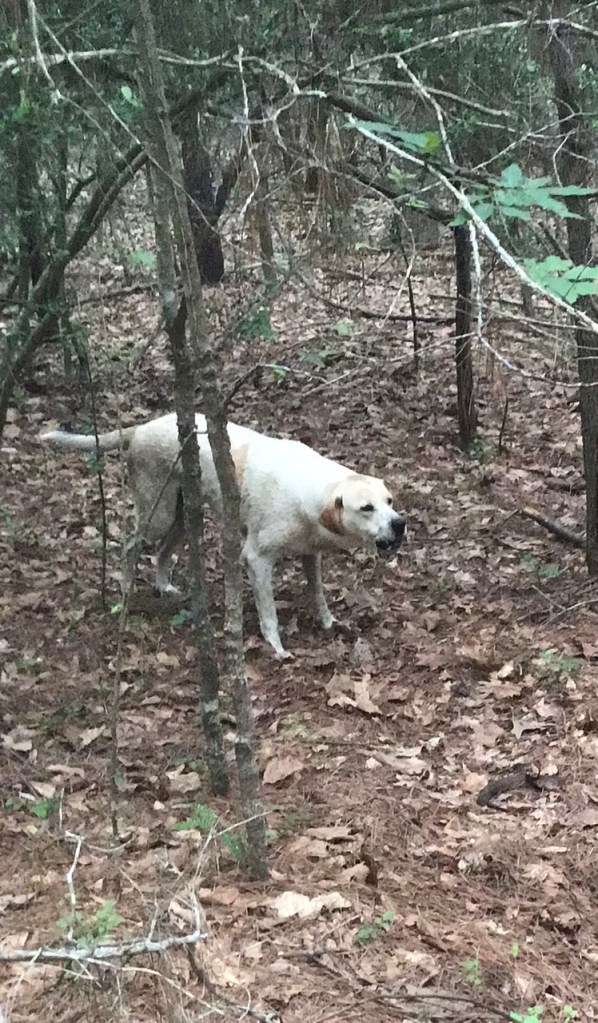
My oh my, we’ve been busy! We haven’t had much time to do leisurely things, like take the dogs for a long walk in the back forty, which you might remember last post when Bubba saved us from a giant water moccasin with his ferocious warning barks.

It’s not that unusual to see snakes near the pond, where we were at that time, or along the creek. But I’m sure you can imagine my surprise finding them in the garden!

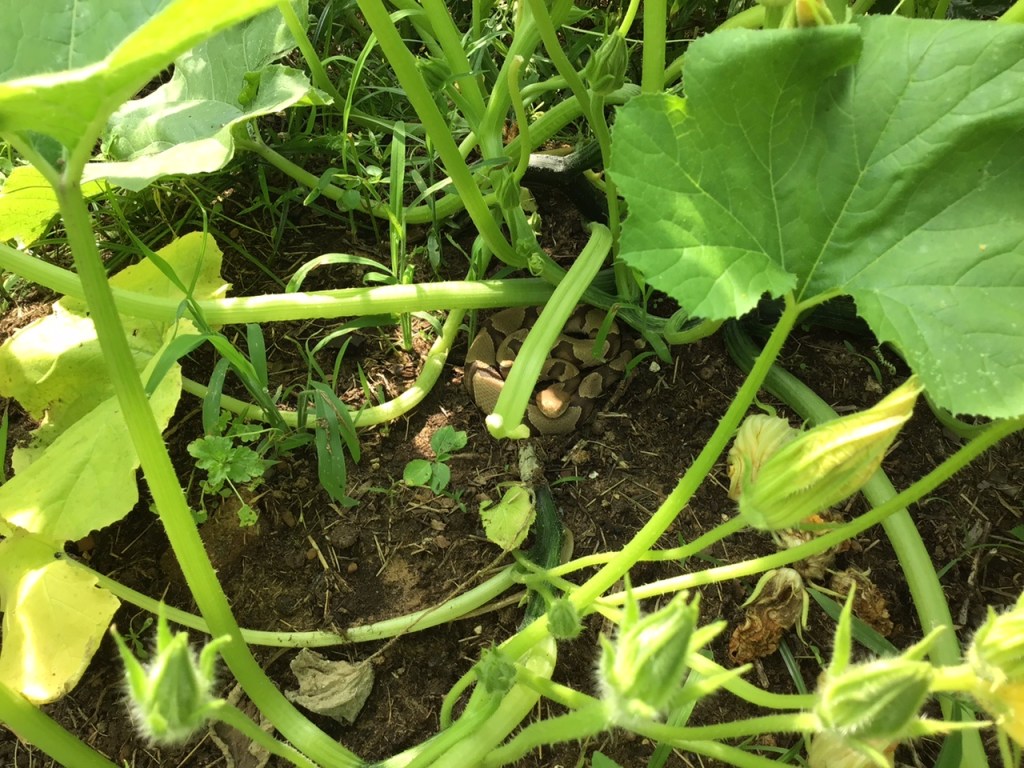
One copperhead under the squash, which I was lucky not to grab by mistake. It’s very typical of me to reach down without thinking as soon as I see something that shouldn’t be there, like twigs or weeds or dead leaves. Or, to pick a mature fruit, obviously.

Sometimes I don’t even wear my glasses to garden, or gloves, or shoes. Guess I’ll be re-thinking those habits now. Just as I reached my hand in, it registered, and I froze, and then laughed.

Hubby finds it humorous that I scream like crazy whenever I see a roach, I absolutely LOATHE them. But a snake, (beyond the startled OH!) even a poisonous one, not at all. I find them pretty amazing, and they’ve never bothered me (and I’ve had plenty of close encounters) or been aggressive, or been in the house. So I feel safe to just laugh and take pictures.

And then call over Hubby to take care of it for me. 😂

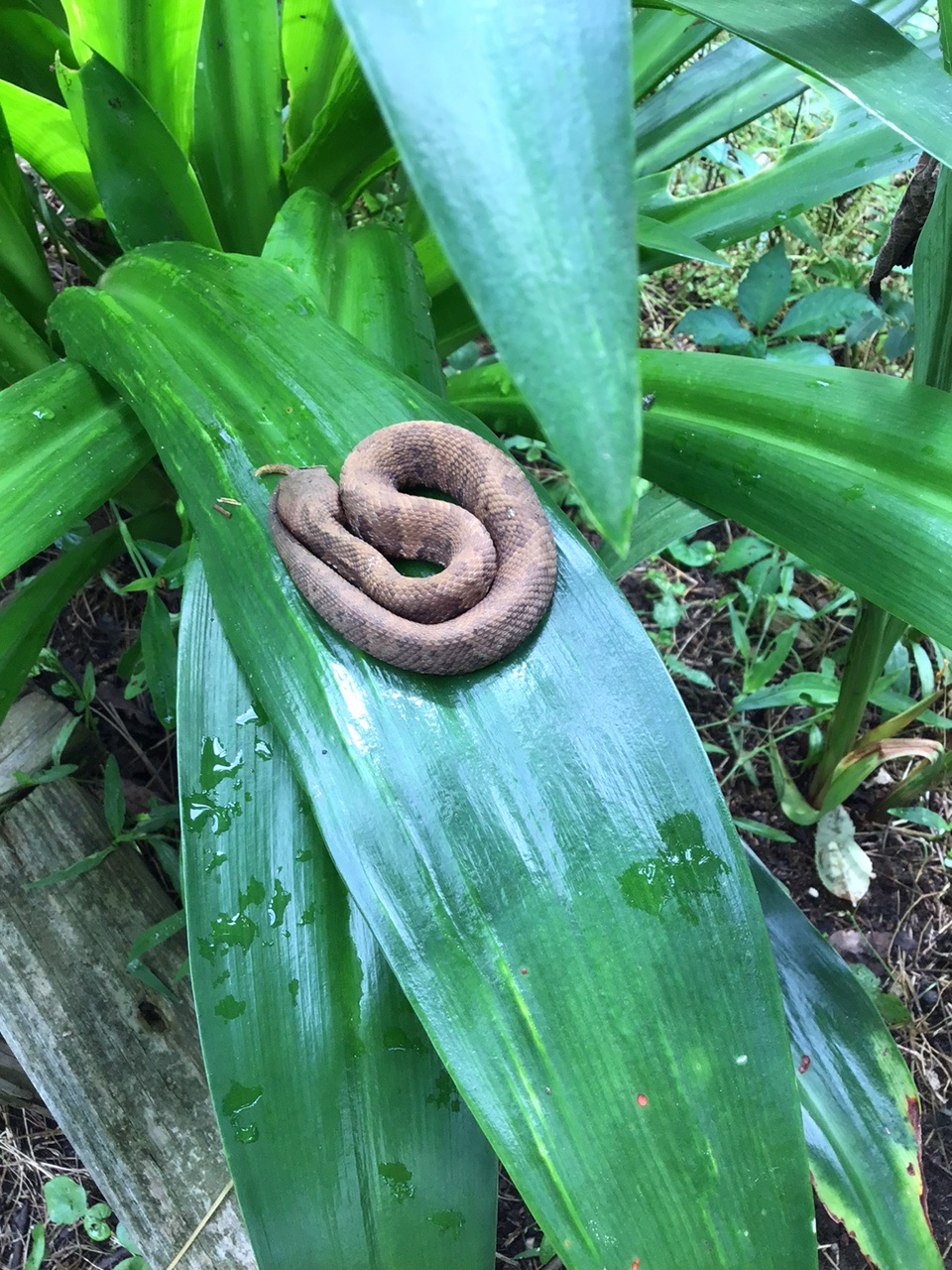
The other copperhead was just a baby, snoozing away on a swamp lily frond under the elderberry tree, kinda adorable-like. Here’s some perspective.

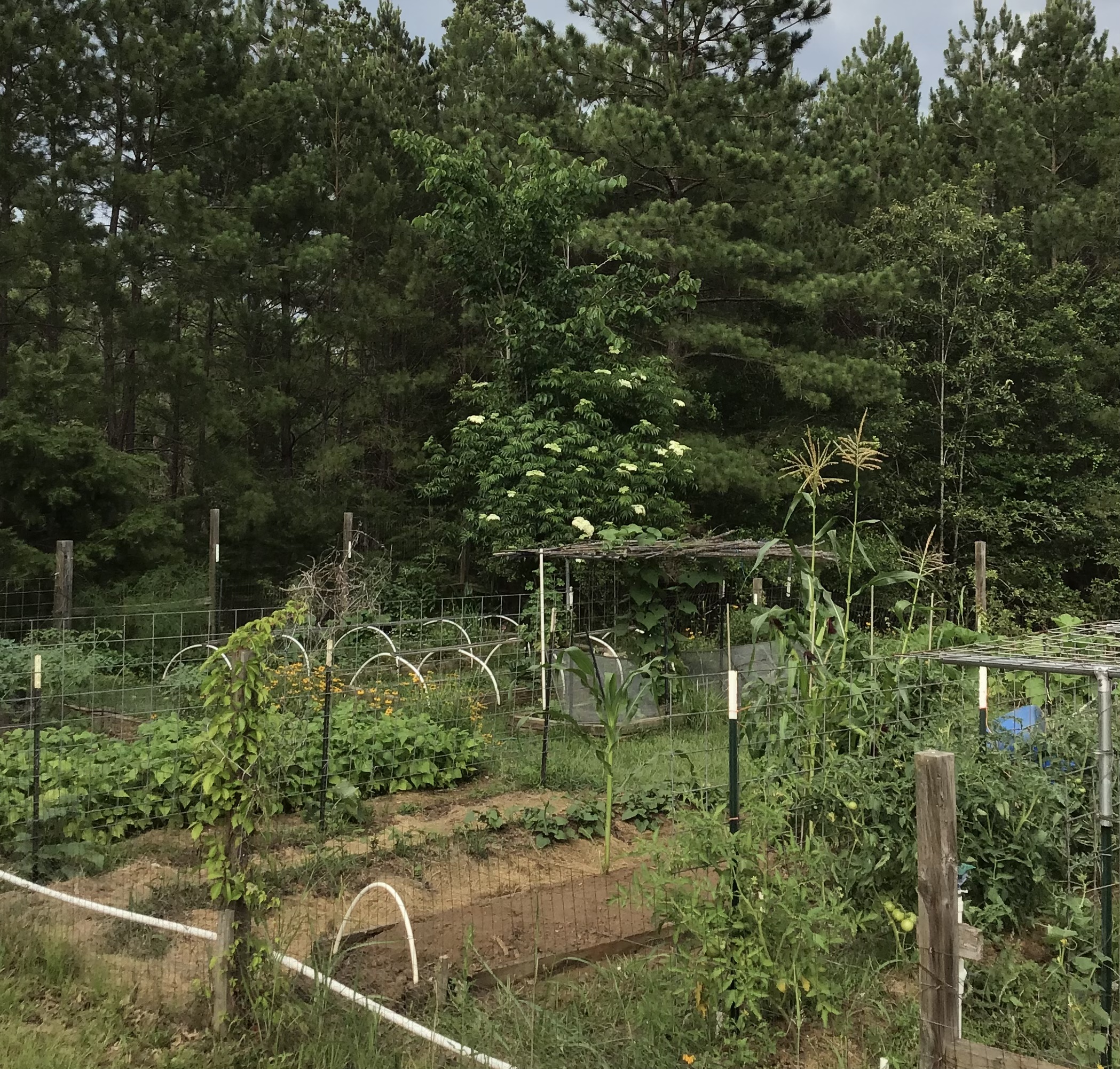
The elderberry from a distance, dead center. It’s quite a lovely specimen I think, but a bit too happy there, it’s getting invasive. The swamp lily is just underneath it.
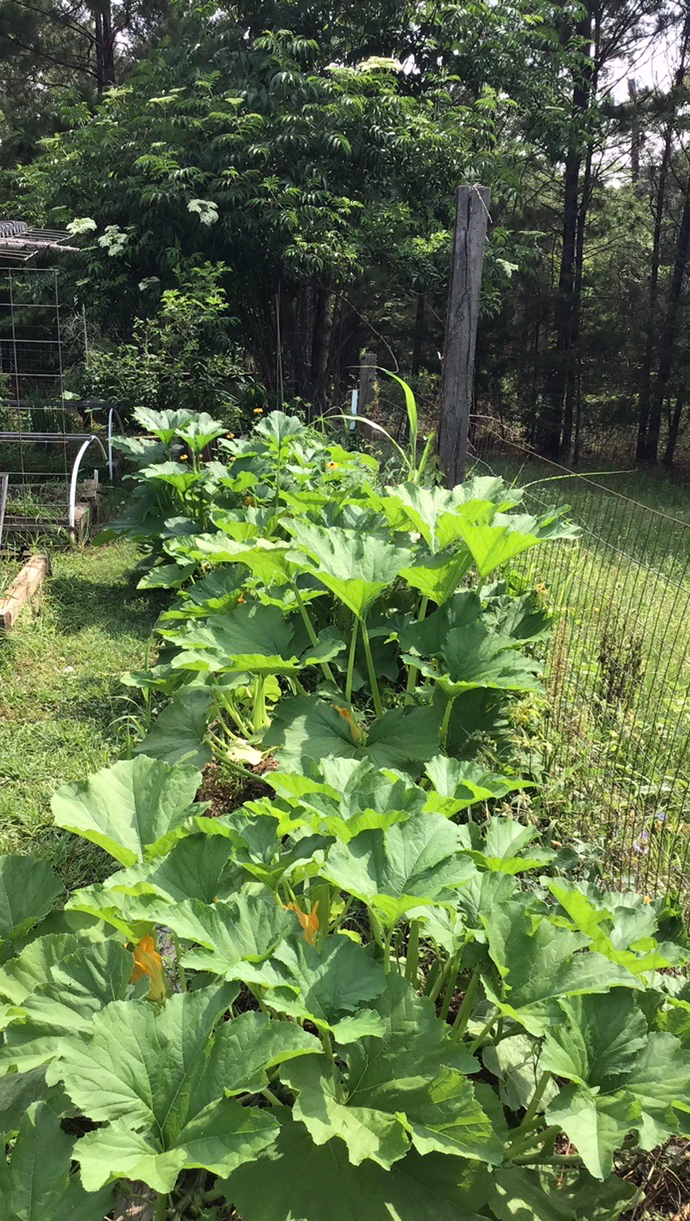
Elderberry in the back. Up front, Zucchini and pumpkin—just learned today not only the fruit and blossoms are edible—but also the leaves. Can’t wait to try them!

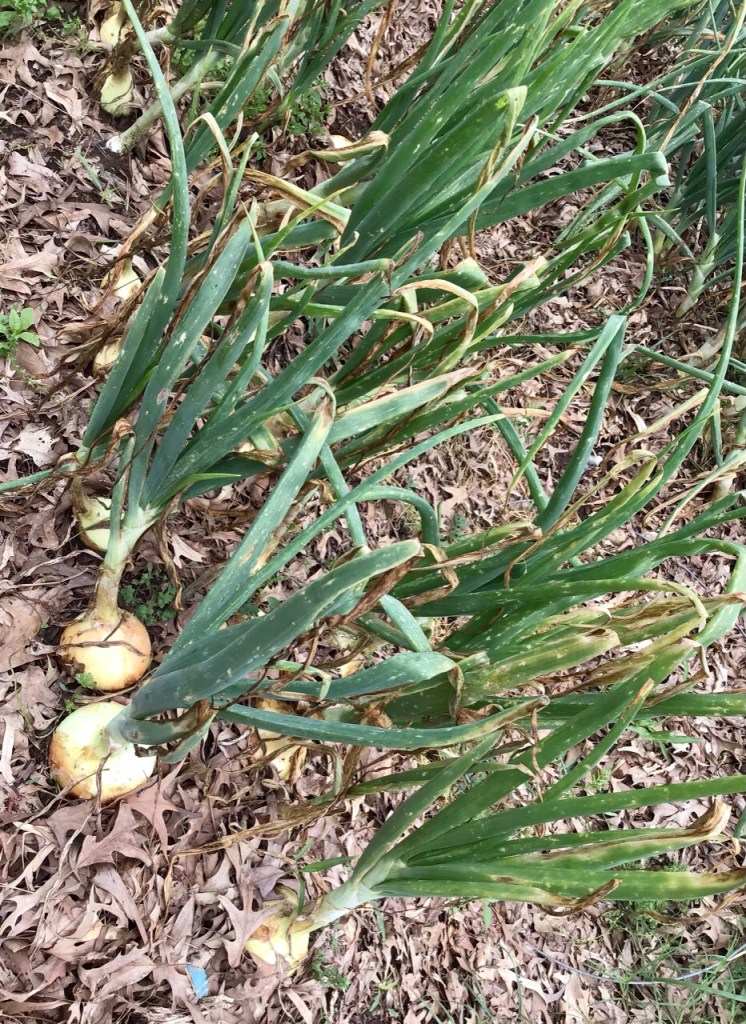
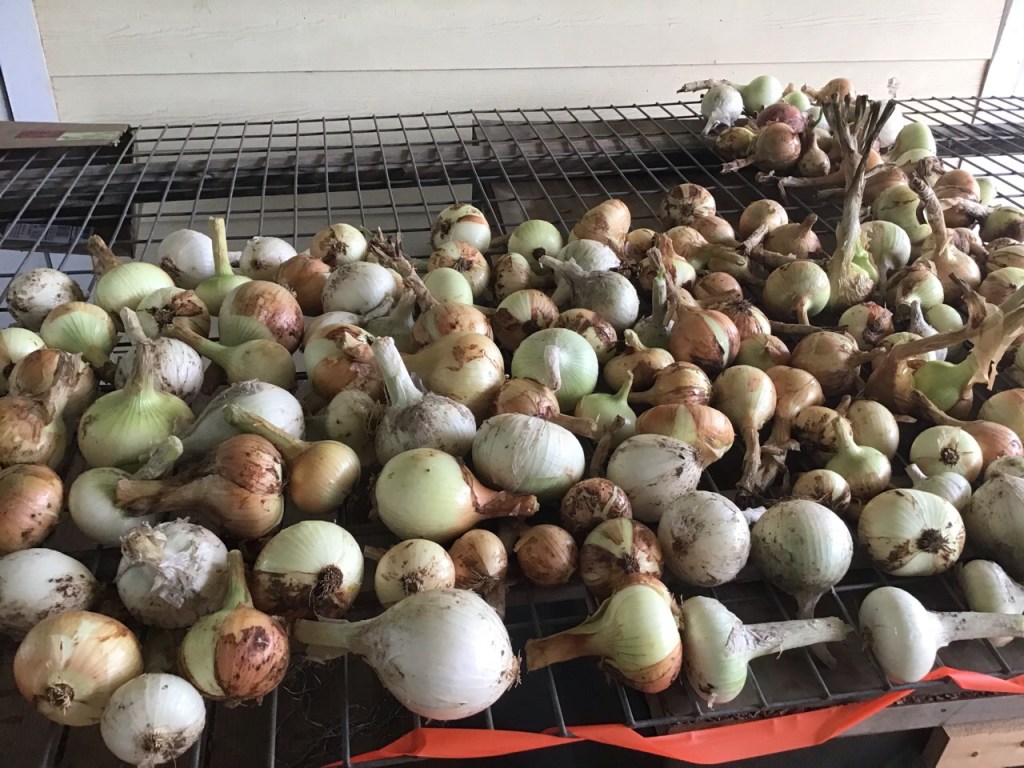
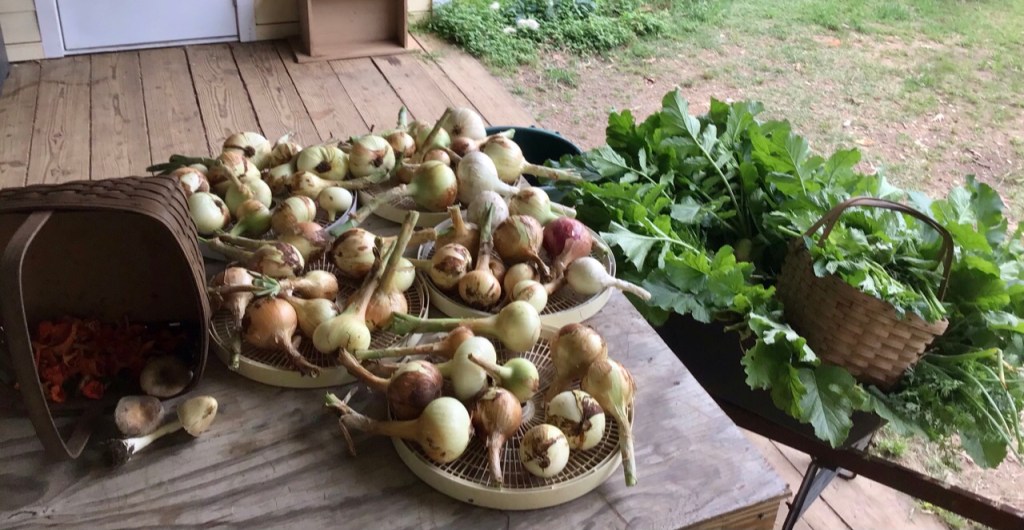
We’ve finally got all the onions harvested, now just the garlic is left. That will be coming out very soon.

That’s about 2/3 of them pictured here. All the rest were quite small and so we’ll use them up first.

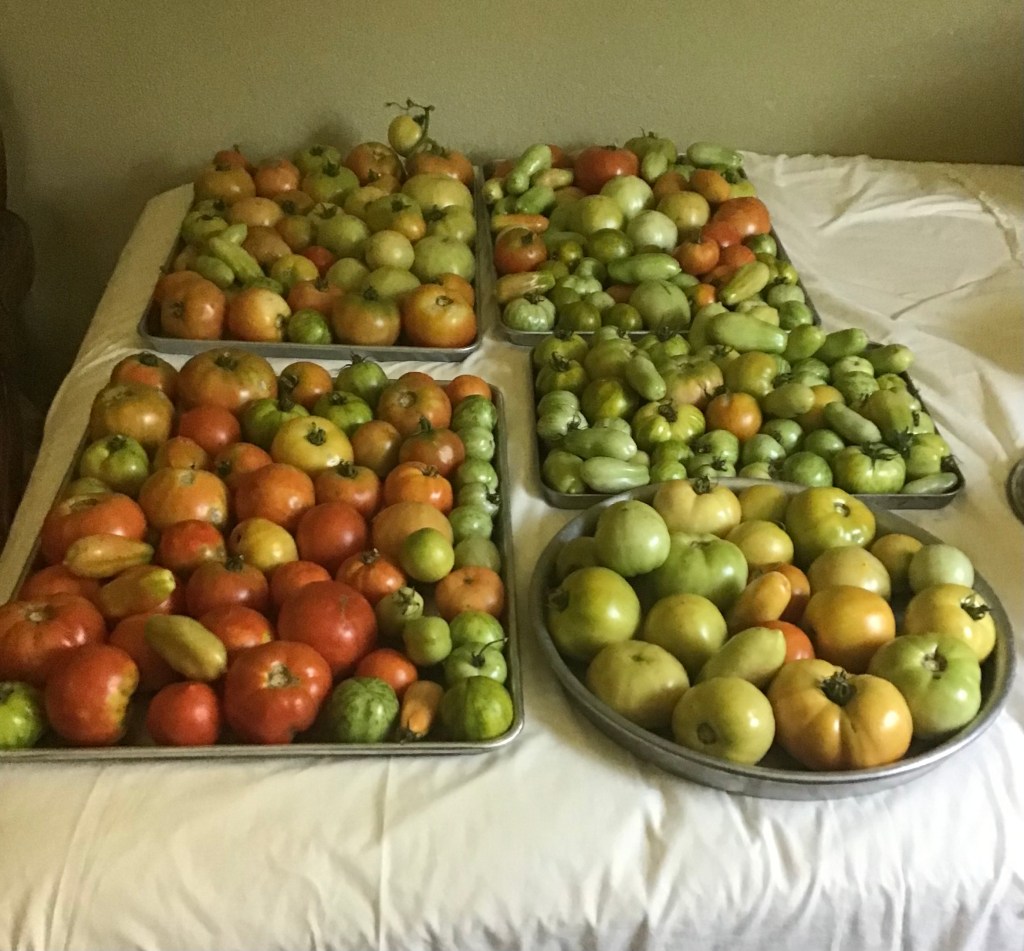
The tomatoes are looking awesome, but I don’t want to get too excited, because that could change any day with little warning. I planted loads of tomatoes because last year was not a good year for them, so I’m extra anxious for a decent crop.

We’ve also harvested all the new potatoes and while not terribly impressive, it was a better effort than past years for sure. The secret did not seem to be growing them in containers, which I tried for the first time, but rather lots and lots of poop. I tried them three different ways this year, none of them particularly better producing.

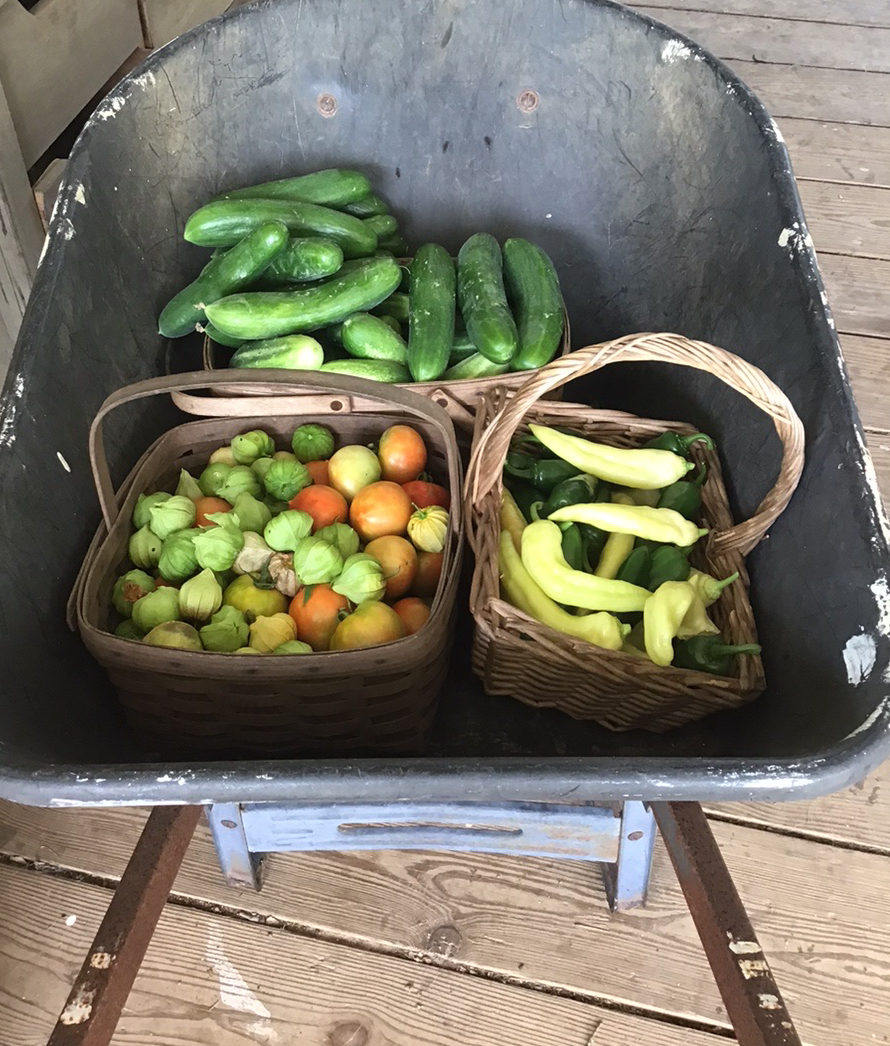
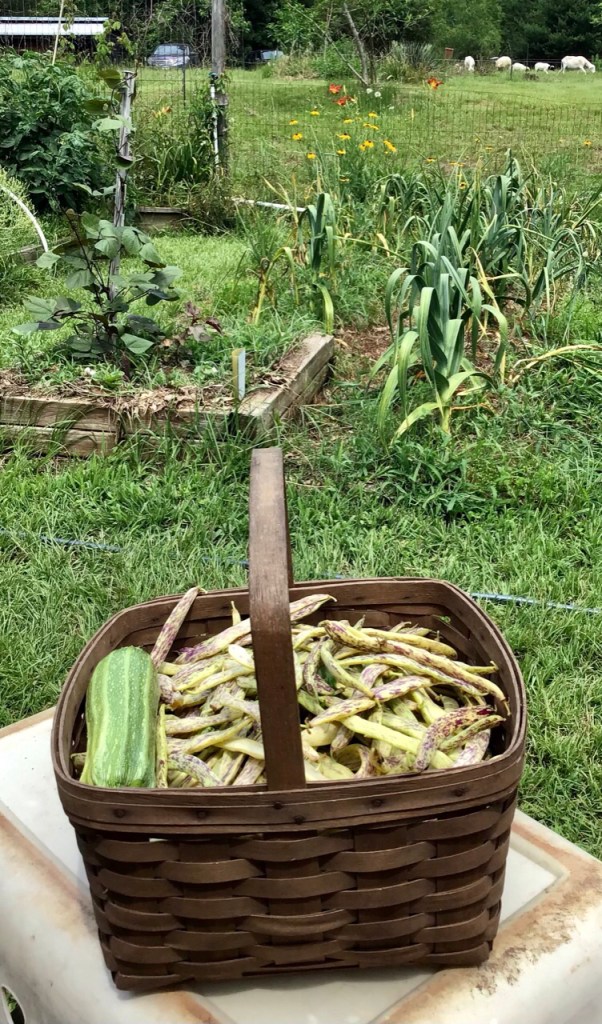
We’re also getting loads of green beans, after a couple of bad years. And some delicious peppers.

So many green beans that Hubby’s just canned 13 pounds of them! Such a joy for me that he’s taken over all the canning, which I’ve always dreaded. I never even tried the pressure canner and I’m not wanting to even a little. He is quite methodical about the process and can accomplish a lot in a short time and without breakage, far better than any of my past canning efforts.

Efficient, industrial, high yield, detail and process-oriented. Thank heavens for Hubby

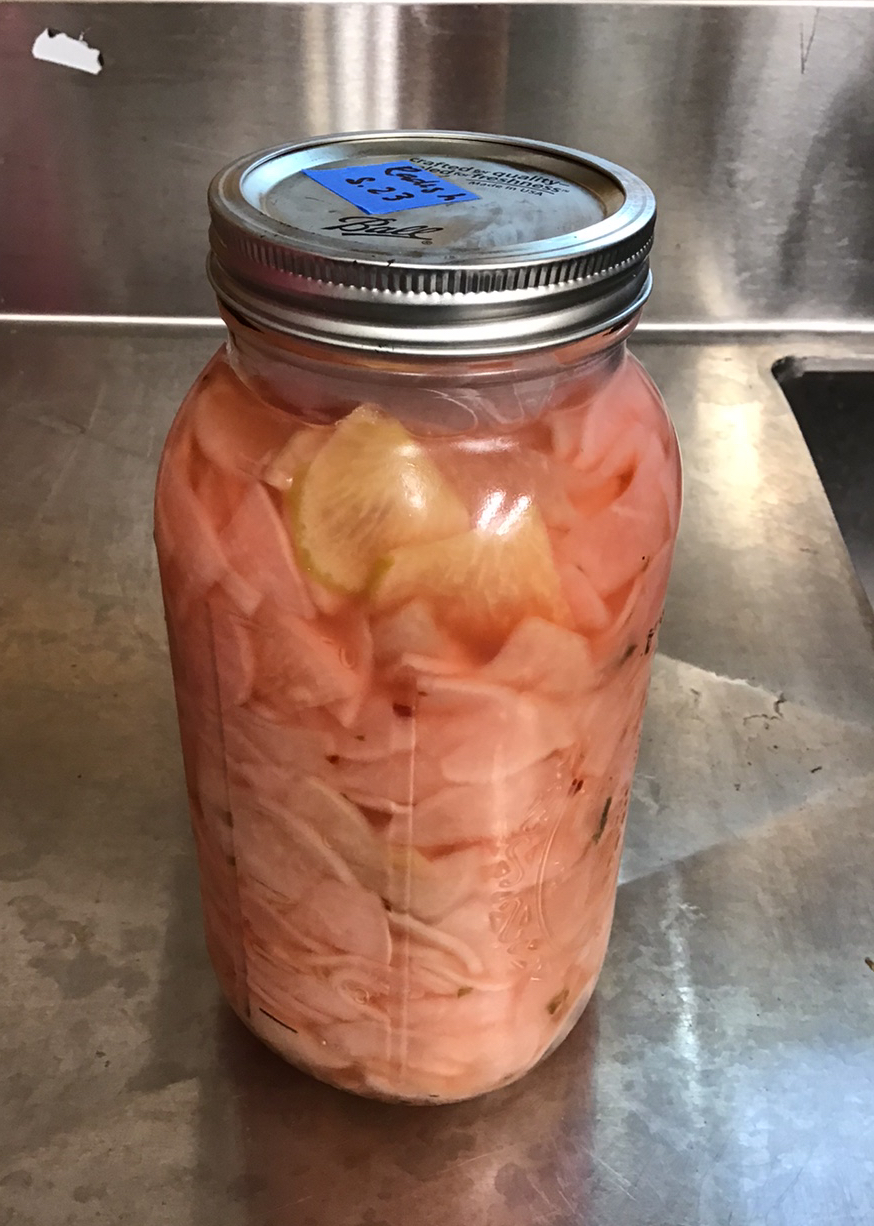
But I do really love the fermenting and am experimenting with it very successfully. I made a celery-mint paste that is surprisingly delicious and a gallon of radishes that will last us easily through the summer. Next on the to-try list is green beans.

Customizable, small-batch, creative and so pretty in pink! Much more my style

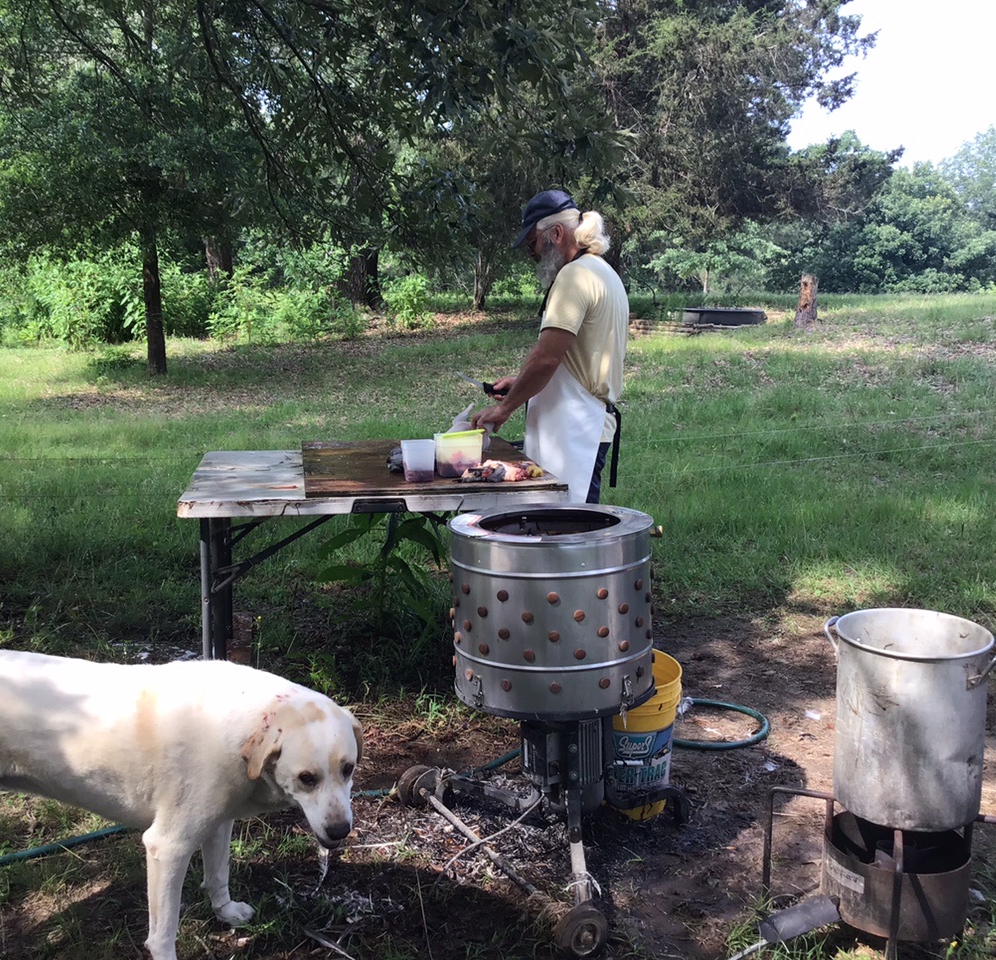
A friend gave us half a dozen roosters, which Hubby quickly processed into freezer camp to save us from listening to the crowing wars for any longer than necessary. A handyman and a gentleman.

Hubby at the processing station. Not exactly government-approved. Bubba and Buttercup’s favorite days, all the heads and feet they can eat!

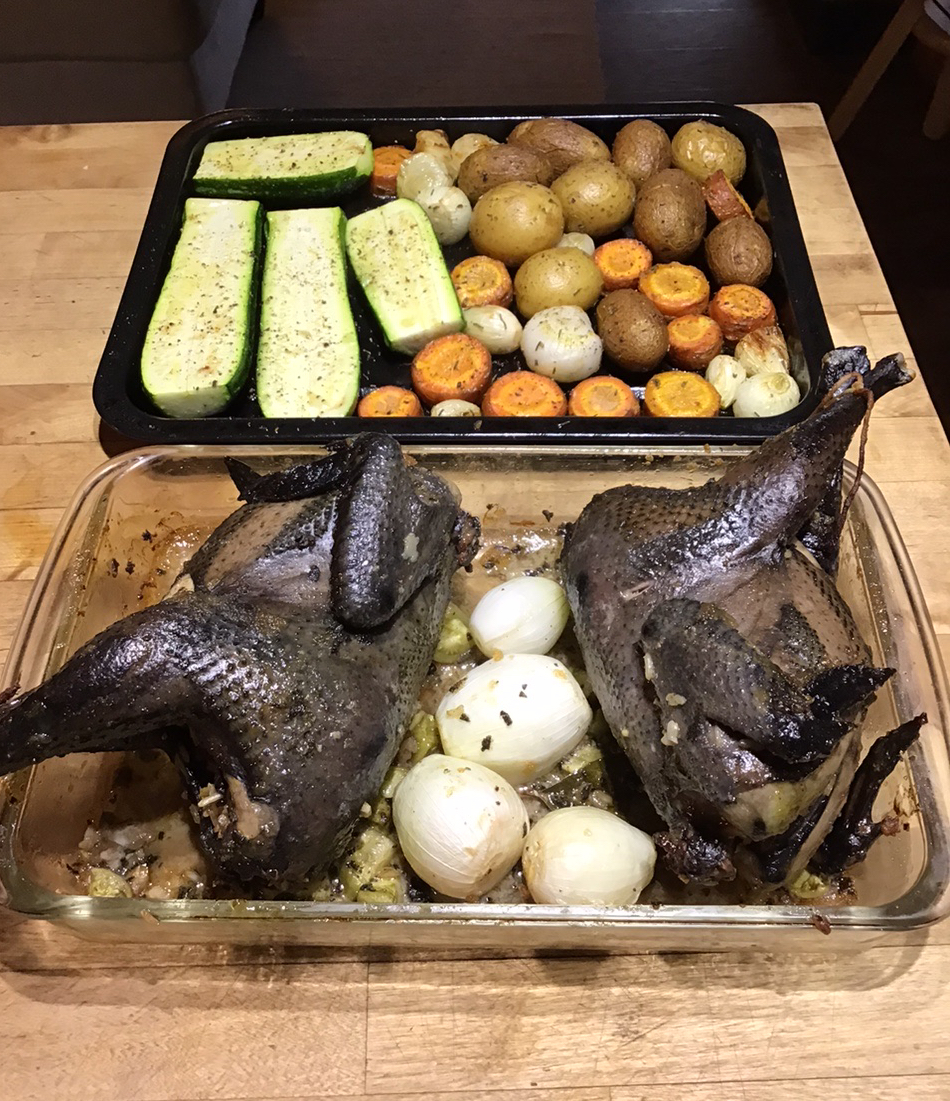
A couple of the roos were these little Bantums which became Sunday’s dinner—stuffed with rice and home-cured bacon, herbs and last year’s dried cherry tomatoes—and basted with ginger-melon marinade. Don’t be too off-put by their black skin and bones, they were delicious!

Dinner for two plus the much needed, time-saving leftovers.

Also served with foraged chanterelles in cream sauce and just harvested blackberries over pound cake for dessert. Mmmm.

And the best saved for last this post, the miracle! In the last post it was Bubba who was the savior, this time it was Buttercup.

Take a bow, Buttercup!

We’ve got two pregnant does, due the first week of June. Because of that I’ve been a bit weary putting the herd too far from the corral, but I did it anyway. They are such homebodies normally and always come right back to the gate after disappearing into the woods for a while. Sometimes it’s harder to get them to go out and forage instead of sticking their head through every fence.

Double-protection required for the grape vines along the fence

Go forth and forage lazy goats! There’s acres of woods to eat, not my landscaping!

Except, only Phoebe disappeared into the forest that day. Alone, and so unlike her. She is the most herd-oriented of them all. She’ll start screaming if the entire group isn’t together at all times. If she was separated from her sister the first year, or her twins the year after that, you’d think from her incessant screaming that all hell’s broken loose. I’m sure the entire county can hear her sometimes.

But, silence. It happened about 3 or 4 pm, I suspect, that was the last time I saw her with the rest of the herd at the fence. We didn’t notice until it was time to put them up for the night in the corral. She was no where in sight, and we immediately went searching. We knew something must be very wrong. We searched until dark with no luck.

I went again the first thing the next morning. All the places I figured she might be holding out, having prematurely dropped her brood, waiting for them to get their legs, so she could bring them up to the usual gate. I walked all along the areas they frequent. It’s very easy to tell where the scrub gets thick again, compared to where they’ve eaten everything up to shoulder-height. I called out for her, listened for any responses or rustle of leaves, nothing.

After coffee and milking Hubby and I went back out together, along with Bubba and Buttercup. Shadow had to get left behind because the goats are still very weary of him. Bubba and I searched and called for an hour or so, nothing. I started to think the worst.

We went back and I was making some toast and cheese before heading back out again, so hungry. It was already hot and muggy and I was sick of slogging through the poison ivy and mosquitoes. I was stuffing a bite into my mouth when a very sweaty Hubby comes up to the window yelling.

“I’ve been yelling for you!”

What?!

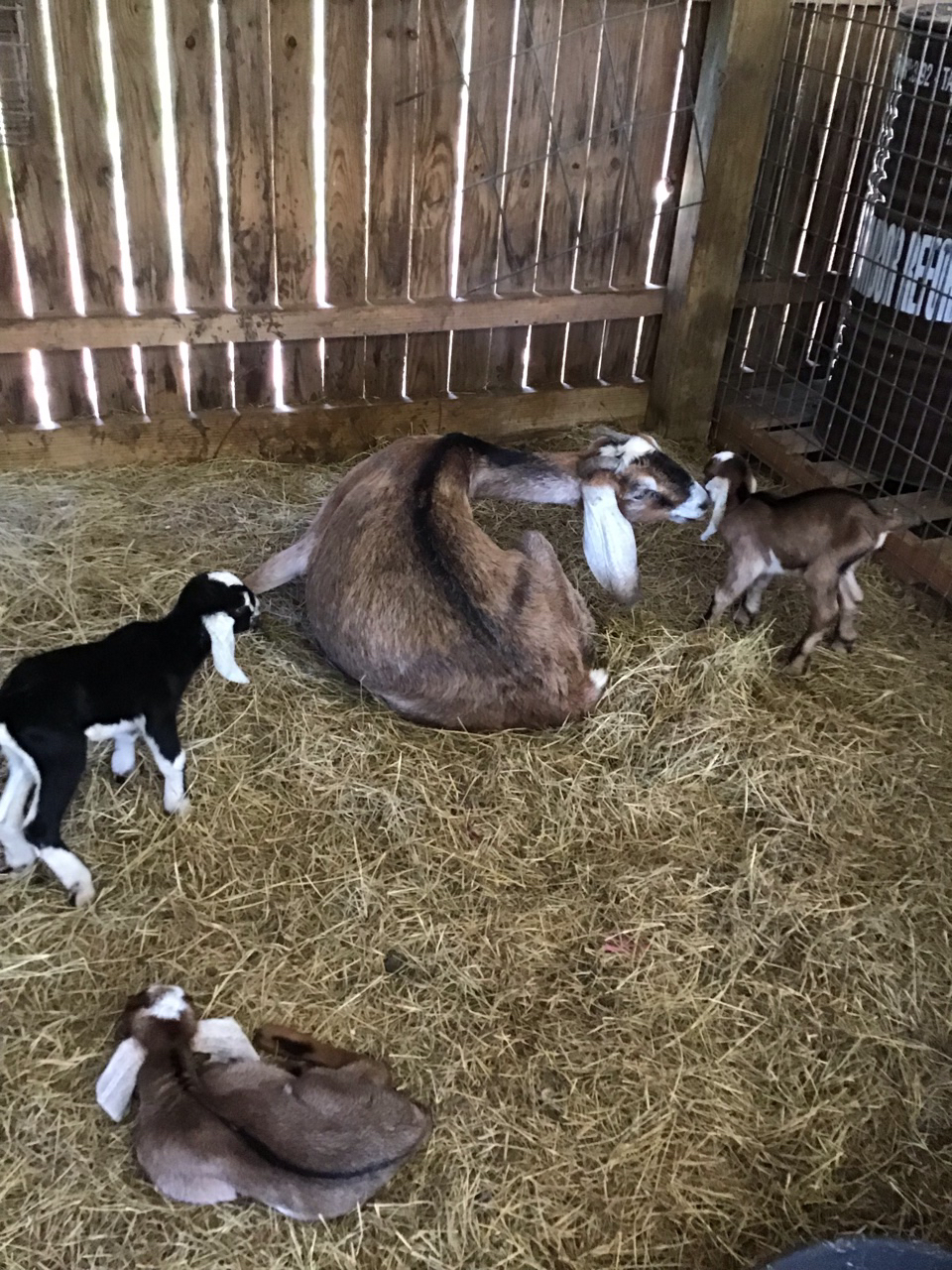
He found her! He went far beyond where I’d stopped when he noticed Buttercup started weaving back and acting determined. He followed her and she stopped at a bewildered Phoebe and newly born triplets.

It took us another couple of hours to lure her back while carrying the triplets in a laundry basket across pretty challenging terrain.

But it was a happy ending and mama and babies are all doing well!

Preemies still under observation, but doing fine.

Ahh, the simple life!

Thanks for stopping by!

Homestead Happenings

Continuing on from the previous post, more weird scenes. Plus, lots more happy snaps, an update on Scrappy with video clip, danger averted, and mushrooms galore.

Starting with the weird and disgusting, so those trying to eat and read, or others simply of an easily-queasy disposition, may skip right down to the happy snaps post haste.

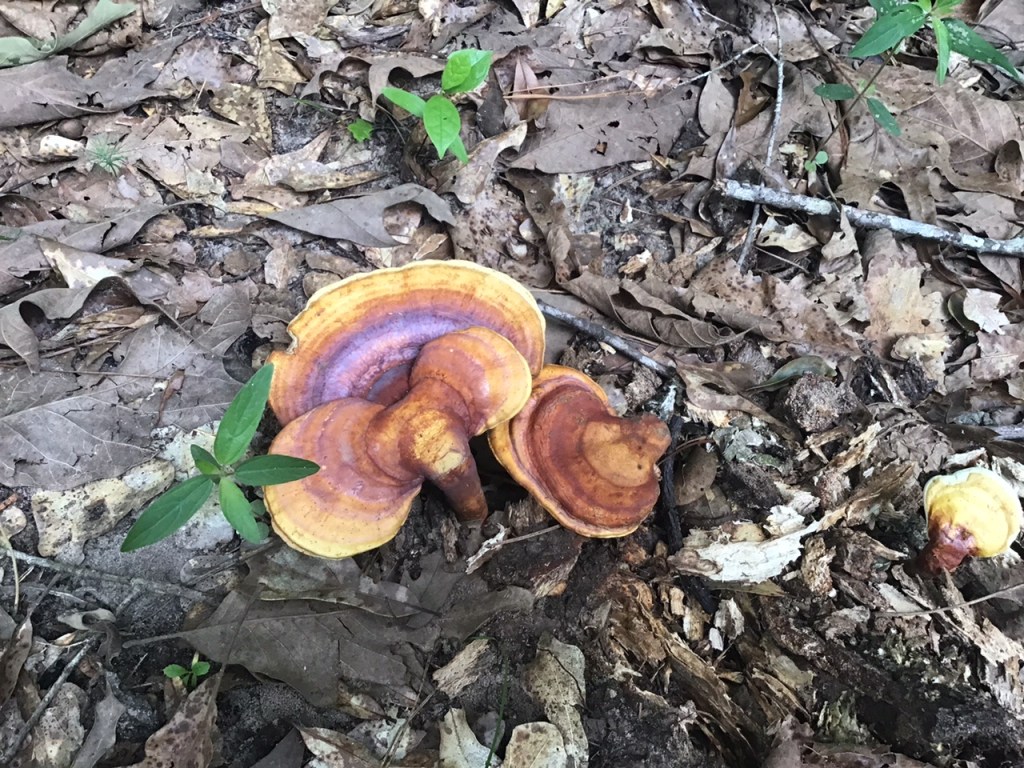
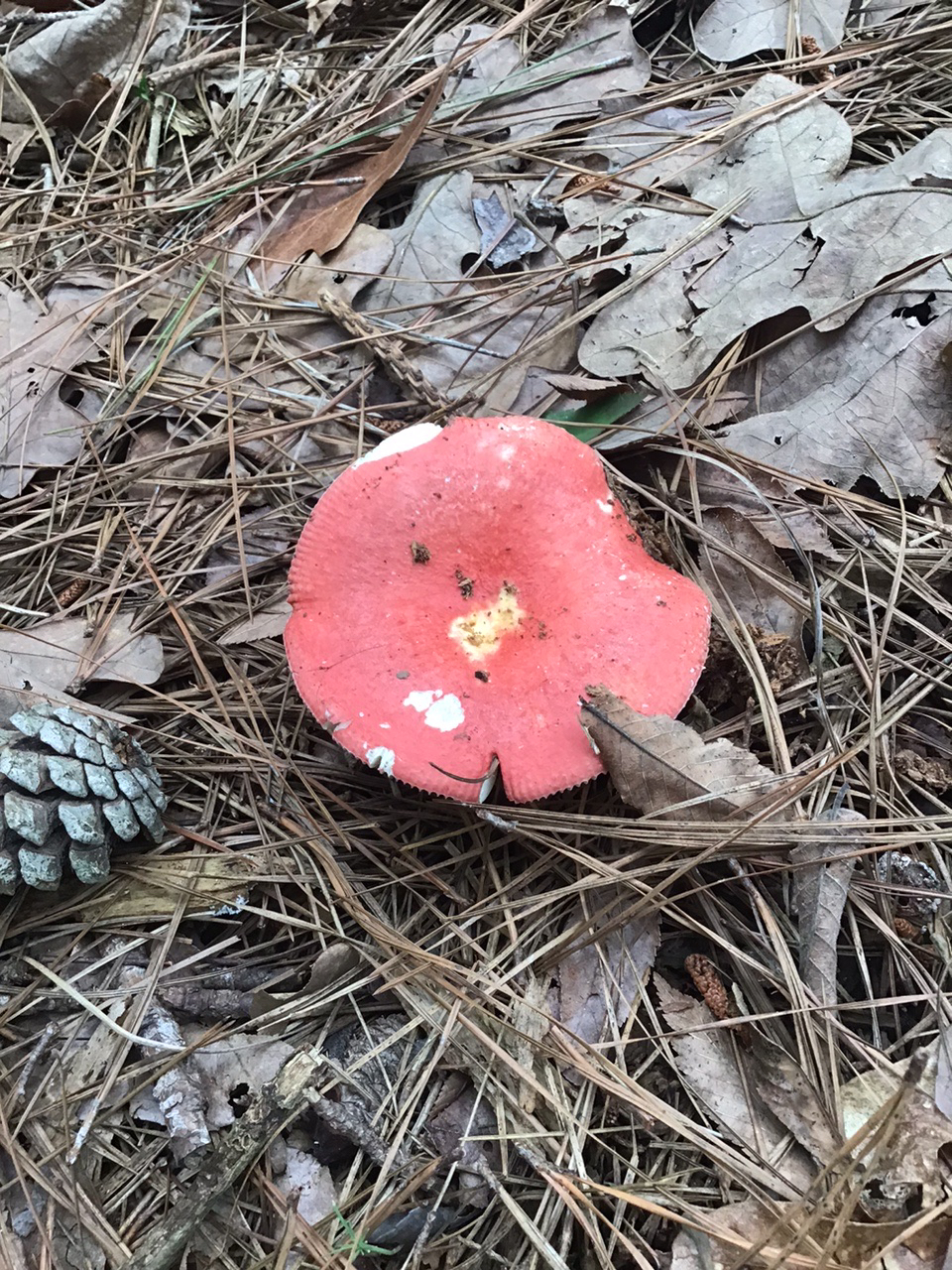
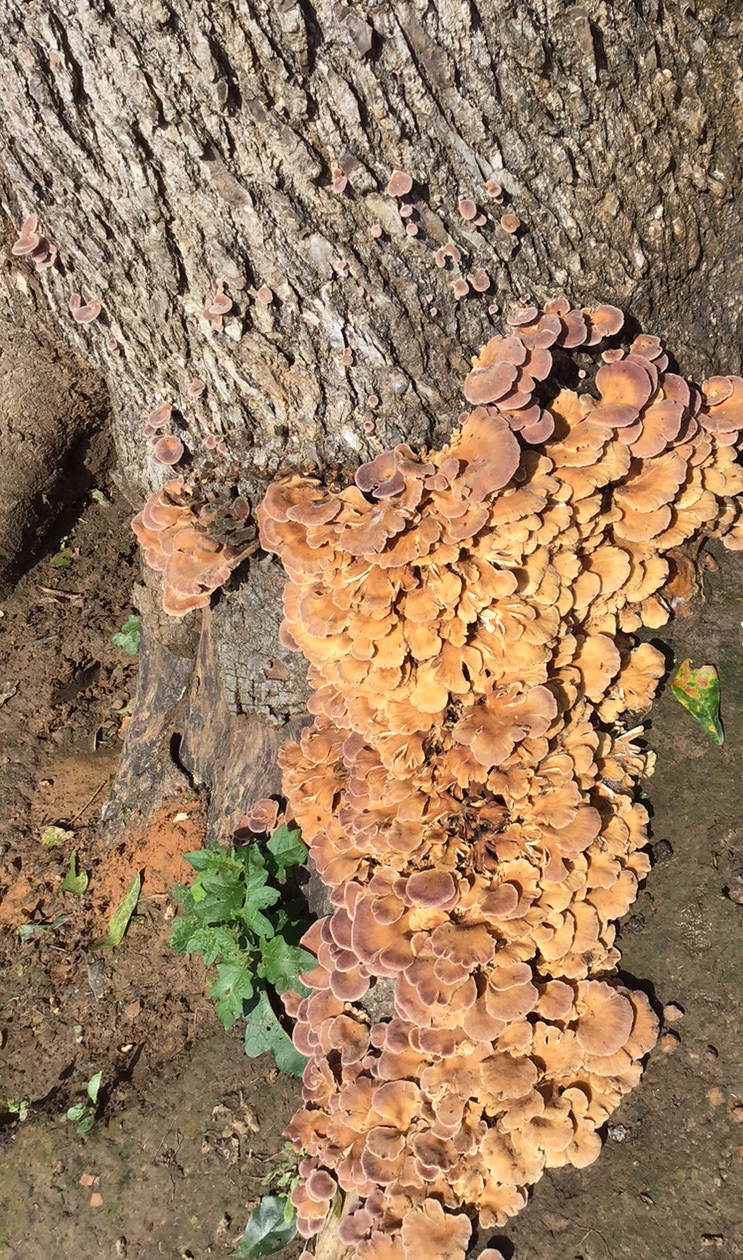
Thanks to the lovely rains last week, which may or may not have destroyed our blackberries (still documenting), we’ve been finding plenty of mushrooms. Some we know very well, like chanterelles, and hunt for them routinely. Most others we collect, and I try to identify, usually without success.

Occasionally that proves to be a disgusting lesson. Boletes in particular bring unwelcome inhabitants and you may just wake up to this sight as you’re making your morning coffee.

If that concerns you, best to leave them in the wild and admire from a safe distance!

Not edible, but cute!

Staying in the weird-disgusting realm, I mentioned last we lost an established bee colony, which was a big disappointment. I wanted to figure out what went wrong with them, and thankfully Hubby noticed the empty hive almost immediately, thanks to the observation window, that so many beekeepers complain about.

I was able to bring all the comb in for inspection. It was highly unusual, because the colony left behind quite a bit of resources, in this case pollen. That means something must’ve been very wrong. Luckily we did capture a swarm off this hive the last month, so it wasn’t a total loss. The culprit behind their total departure from the hive, the dreaded wax moth.

Hubby noticed immediately the spotty brood pattern, sure sign of a failing queen. Had he not noticed and had I not taken action, very quickly all the colony’s painstaking acquisition of pollen and long, hard work of drawing out the wax comb, all would’ve been lost within a fortnight. Wax moth damage in a hive is truly disgusting, the clean-up of which is probably the dirtiest job a beekeeper faces.

Saving the comb, therefor the pollen, therefor the hive body, was the silver lining to this colony collapse. And, it was a good scientific observation for me. What happens is the wax moth eggs as they develop, having been laid in the empty cells where the bees then place their pollen, grow into larvae that pushes out the pollen. From that point they squiggle around a lot. Some of them are able to make it as far as the next room in search of a place to cocoon. Pretty amazing!

Bee pollen is actually pretty tasty, is said to be healthy, and makes a great flavoring for kombucha. I’m sure they eat the larvae in some cultures, just like with silk moths, but don’t worry, I’m not that weird, yet.

*******The rest of this post is safe for the easily-queasy!********

But, there is still danger afoot! And Bubba lets us know about it. A water moccasin on the loose and ready to terrorize the troop, if not for Bubba’s keen scouting.

Bubba sounds the alarm, such a good boy!

In other homestead news, Scrappy, whose Mama rejected him at birth, is doing just fine raised on the bottle. Hubby even set up a portable milk station for him, which he adjusted to almost immediately.

In garden news we’ve been harvesting onions and we’re quite pleased with the prolific results for the 2nd year in a row. We’re about 2/3 to completion. Where the onions and garlic have come out, we’ll be planting okra, sweet potatoes, and melons.

The tomatoes and green beans are coming in great, and a few forgotten flowers too.

Never forgotten, Datura, one of my very favorites. If only I could capture that most sublime scent when the blossom first opens!

In more critter news, Shadow is still adjusting well to country life, with occasional hiccups. Like, he still likes to chase the goats and the lambs if they stray too far from the herd.

Is he gone yet?!

Only the pigs remain unconcerned with his massive curiosity.

And he seems to find the kittens quite exasperating!

And that’s kinda weird for us too, because we’re not cat people, this is the first time having kittens around at all, yet they seem to be taking over!

It’s an exhausting life for a townie-dog, I’m sure!

Thanks for stopping by!

Do you have any critter or garden news to share?

Homestead Happenings

Weird scenes inside the homestead! What have we to add to the big wide web of weird today? A couple of things only, along with some sad news and some happy snaps. Successes and failures, as usual. Trying to keep them all in stride, which with the wild flowers and a short country drive, isn’t too big a challenge at the moment.

Creepy visitor appearing everywhere after the rains

Best to get the crap out of the way first, I prefer. We’ve got seemingly severe blackberry failure and an established bee colony suddenly lost. I could write exhaustively on just those two, but since I’m already exhausted, I’ll keep it brief. And continue the relentless churning in my mind alone.

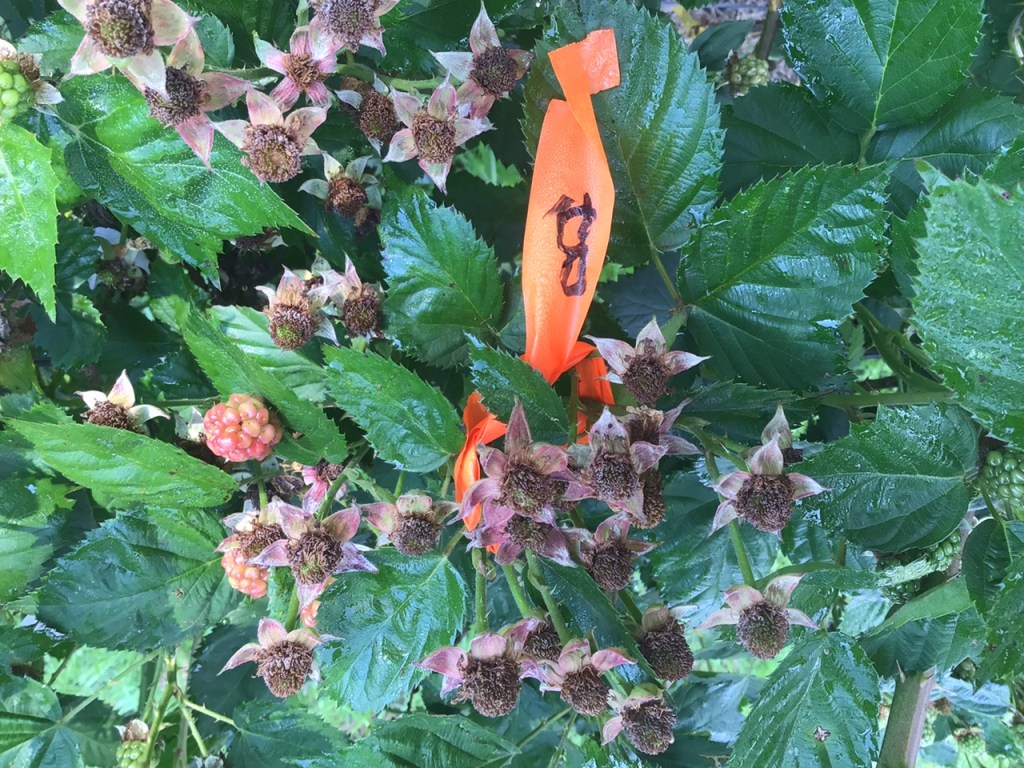
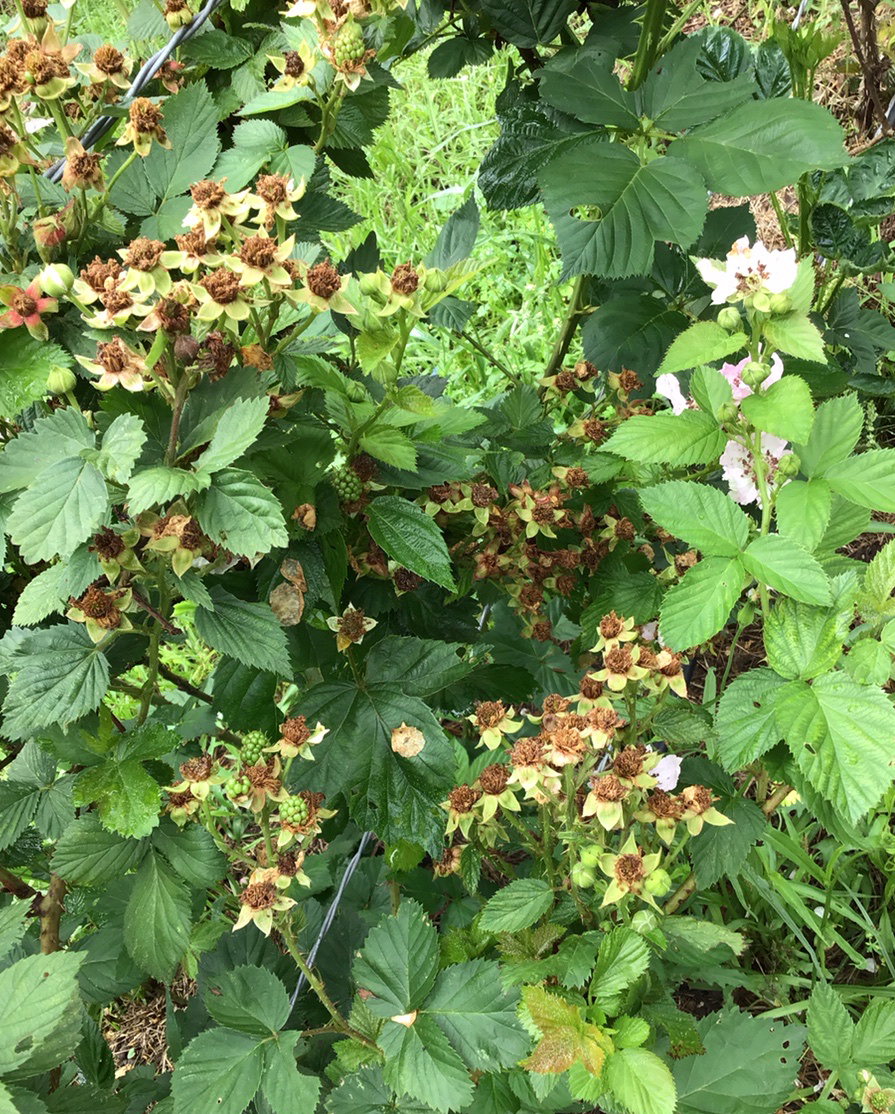
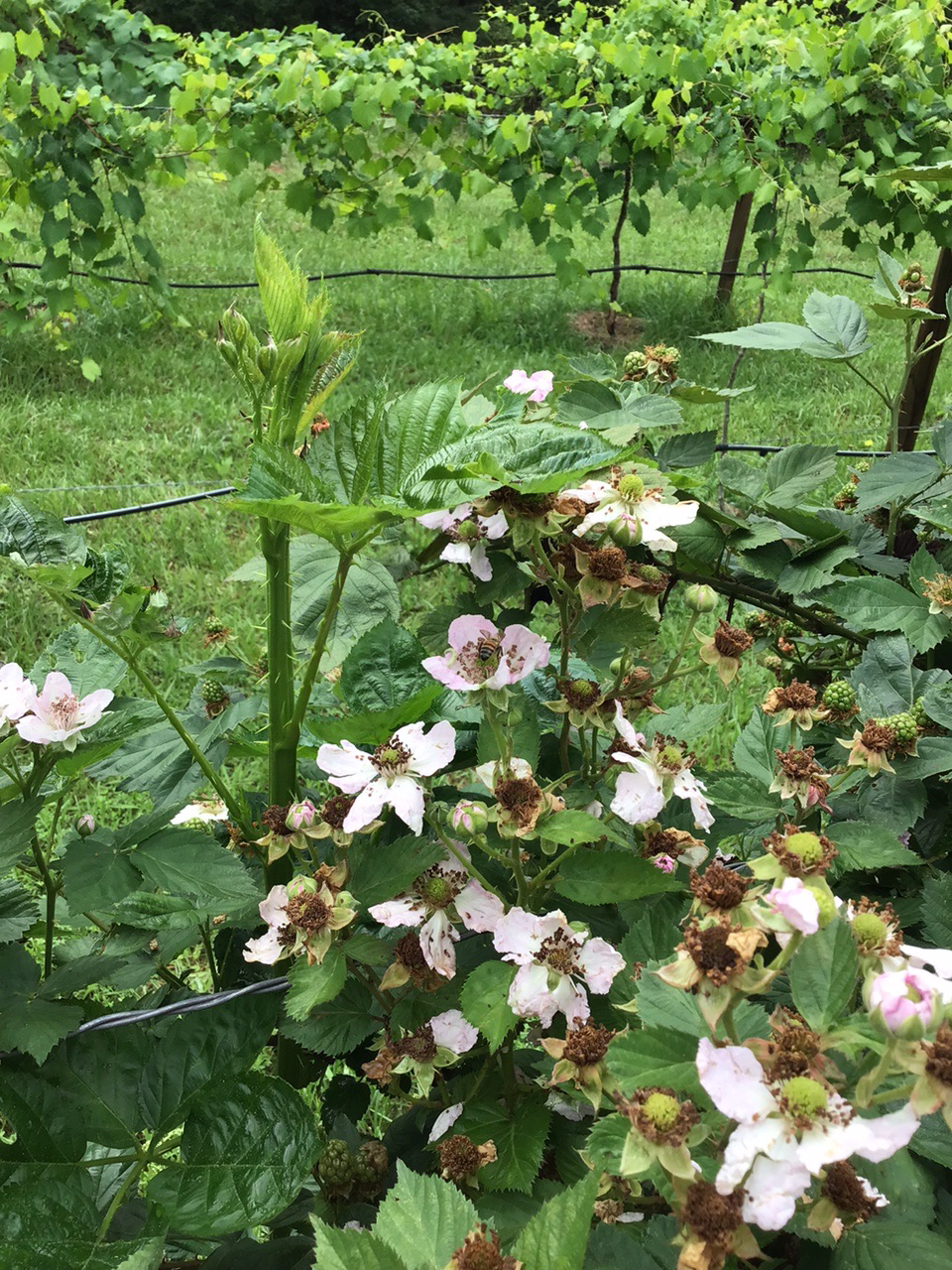
These photos and several more have seen the cyber rounds this week, let me assure you! And the cornucopia of responses we’ve received is rather astounding. Long story short—we’ve had some lovely rains, finally. But it sent our blackberries from thriving and gorgeous, to this brown, crispy-looking horror nearly overnight.

Not just a few bushes either, the entire row, a dozen bushes easy. It looks terrible. So we got a bit frantic and have been sending photos to Ison’s Nursery, where we got them. Also, to various friends and forums, where we’ve had answers to run the gamut: too dry, a virus, a fungus, a blight, Botryosphaeria canker, empty pocket syndrome, aphid damage, and then the kicker . . . This is totally normal development.

Wait, whaaat??

You mean to tell me these could be normally progressing blackberries and after many years of growing blackberries we just never noticed it before?!

Well that would certainly be a big and welcomed WOW! Yes please!

But unfortunately, I don’t think so. They look brown and shriveled beyond anything I’ve seen in any of the online photorama. And there’s no sign of aphids, and it’s not cane blight, and it’s certainly not too dry, although I totally understand that guess, since that’s exactly what it looks like.

And I do so appreciate all the speculation, seriously! It gets me thinking and exploring every time and I do so love all the effort and camaraderie inherit in it. Be wrong, it’s not the end of the world!

Of course, what I did so notice among the seeds of speculation was the one that was, unsurprisingly, totally missing. Toxic rain perhaps? Some other oddities in the atmosphere, perhaps? Not on anyone’s radar? Really?

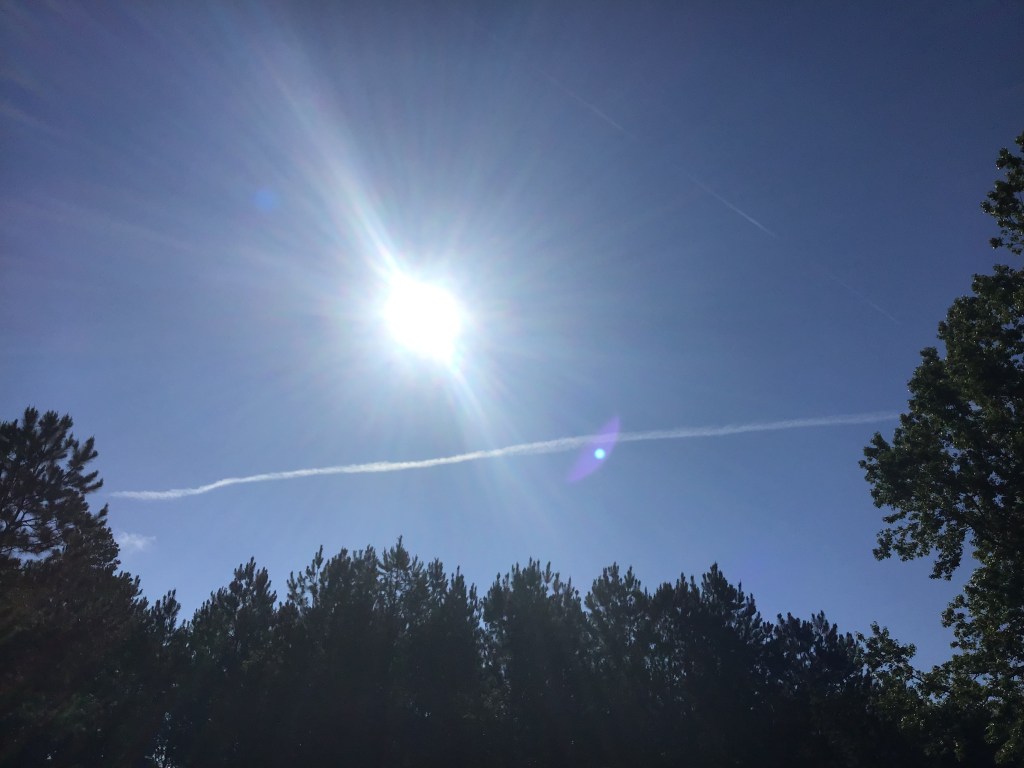
No idea what’s happening in this photo with the blue dot-purple ring, I just snapped the shot with the tablet as soon as I saw the trail while busy in the garden.

On better themes . . .

I also took some lovely happy snaps of the wild flowers blooming along the road, which was so much more gorgeous than what I was able to capture here. But I tried, and that should count for something, no?

And on that note, this post will have a Part 2 to finish later, cause that’s all I can manage at the moment. More to follow, so much more!

Thanks for stopping by!

I leave with a song that motivates me when I really need it most. Hope it works for y’all too!

The They

Reciprocal relationship
Oh my no
Rather exploit
Now
Than work to sow

Just
Disrupt the flow
A kind of magic
Black
No doubt
But black that bleeds
That
Pretty purple haze

Oz of pigeons
Plentiful prey
Waltzing fantasy
Spinning always
Winning
Before
Turning to
Dismay

Say, sweetheart
Master of today
Collecting souls
As if that’s ok
What on earth will you do
When everyone can see
You?

What My Peace Corps Service Taught Me About Global Governance, Medical Coercion and Cancel Culture

This post is inspired by Alison McDowell’s series, Letters from the Labyrinth.

Attention all Dandelions!

I served as a Peace Corps Volunteer in the Czech Republic from 1994-1996, returning there in 1998-9 to teach at the Natural Sciences Faculty at Charles University in Prague.

I’ve written often about my experience and consider those years to have been formative on many levels, including that which defines my worldview to the present day.

While I have written often about those years, I have shared almost no criticism about my time there or the Peace Corps as an institution. I wrote a blog with other Returned Peace Corps Volunteers for several years, from which I was unceremoniously deplatformed as soon as I ventured into (unbeknownst to me at the time) the forbidden territory of ‘conspiracy theory’.

The Peace Corps was established in 1961 by John F. Kennedy.
“Ask not what your country can do for you, but what you can do for your country.”

From Wiki:
“On March 1, 1961, Kennedy signed Executive Order 10924 that officially started the Peace Corps. Concerned with the growing tide of revolutionary sentiment in the Third World, Kennedy saw the Peace Corps as a means of countering the stereotype of the “Ugly American” and “Yankee imperialism,” especially in the emerging nations of post-colonial Africa and Asia.[28][29] Kennedy appointed his brother-in-law, Sargent Shriver, to be the program’s first director. Shriver fleshed out the organization and his think tank outlined the organization’s goals and set the initial number of volunteers. The Peace Corps began recruiting in July 1962; Bob Hope recorded radio and television announcements hailing the program.”

Globalism, before it was cool.

The organization was in the Czech Republic for only seven years.
From the Peace Corps’ ‘legacy booklet’:

“Through the work and contributions of Volunteers, the Peace Corps has emerged as a model of success for efforts to promote sustainable development at the grass-roots level. The Peace Corps, however, is much more than a development agency. Volunteers embody some of America’s most enduring values: optimism, freedom, and opportunity. Volunteers bring these values to communities around the world not to impose them on other people or cultures, but to build the bridges of friendship and understanding that are the foundation of peace among nations.”

A portion of Vaclav Havel’s parting statement to the Peace Corps:
“The results of the Peace Corps’ work can be seen throughout the Republic. The Peace Corps assisted in establishing many new libraries, completed more than 100 ecological projects, and gave more than one thousand Czech entrepreneurs the opportunity to gain new business experience.” Prague, 1997

Ambassador Shirley Temple Black attended the official opening of the Peace Corps office in Prague in 1991.

Shirley Temple Black’s Remarkable Second Act as a Diplomat | History| Smithsonian Magazine

Speaking of Temple-Black:
According to Kounalakis, “Her personal and informal style worked well with the new government, made up of formerly imprisoned, hard laboring and human rights Charter 77-signing artists, musicians, actors and a playwright president named Vaclav Havel. Many of those new Czechoslovak political leaders admired their American colleague, President Ronald Reagan, an actor-politician like themselves who expressed in the clearest terms – and to the whole world – their deepest desire for freedom.”

The dissident playwright turned politician, President Vaclav Havel’s wife was also a famous actress. Olga Havlová – Wikipedia

Also from Wiki:

“Havel was born in Prague on 5 October 1936[8] into a wealthy family celebrated in Czechoslovakia for its entrepreneurial and cultural accomplishments. His grandfather, Vácslav Havel, a real estate developer, built a landmark entertainment complex on Prague’s Wenceslas Square. His father, Václav Maria Havel, was the real estate developer behind the suburban Barrandov Terraces, located on the highest point of Prague—next door to which his uncle, Miloš Havel, built one of the largest film studios in Europe.[9] Havel’s mother, Božena Vavrečková,[10] also came from an influential family; her father was a Czechoslovak ambassador and a well-known journalist.

“He was known for his essays, most particularly The Power of the Powerless (1978), in which he described a societal paradigm in which citizens were forced to “live within a lie” under the Communist regime.[19] In describing his role as a dissident, Havel wrote in 1979: “we never decided to become dissidents. We have been transformed into them, without quite knowing how, sometimes we have ended up in prison without precisely knowing how. We simply went ahead and did certain things that we felt we ought to do, and that seemed to us decent to do, nothing more nor less.”[20]

Remembering Ambassador Shirley Temple Black – U.S. Embassy in   The Czech Republic

++++

Me, 1994, naive and idealistic

As far as Peace Corps assignments go, I was sometimes rightly chided as having ‘served’ in the “Paris of the Peace Corps.” I did not live in a village in a shack without running water, as is often the stereotype, and sometimes the reality.

I got lucky, very lucky in fact. I was assigned to a brand new school, with a private office, and lived in the vacated 2-bedroom flat of the school’s principal. It even had a private phone.

At the Ambassador’s Residence in Prague, feeling sophisticated.
Champagne socialism, free-market capitalism? Who knew, who cared?!

A short time after arriving I was summoned to the state-of-the-art, just being organized, computer room. I had requested an e-mail address. The teacher running the show was excited, thrilled even, to have someone even remotely interested in his very claustrophobic cyber-world.

The enormous room was full of donated equipment, mostly used, monitors and hard-drives and equipment I didn’t recognize were stacked up on every inch of the floor and only he and a handful of others knew how to use it all, or even cared to use any of it.

And new shipments were coming in at a regular clip. He couldn’t keep up with all the offerings.

At the same time, the old Soviet materials were stacked up on the street twice a week to be hauled away by the trash crew. Huge stacks of newspapers, magazines, books, busts, badges, portraits that seemed bottomless in those early days.

“We just traded one Big Brother for another,” one teacher quipped.

I was thrilled to be there. I fully expected to find, as per the slogan, “The toughest job you’ll ever love.” Bring it on, I thought.

But, I was young and naive and idealistic and I didn’t understand bureaucracy. I was dumb enough to think I was supposed to be honest on the seemingly endless ‘ratings forms’ we were required to complete. Instead of spend five minutes giving five stars and glowing reports to any and all activities and instructors like most of my fellows, I actually thought about it, wrote what I thought needed improvement, made suggestions I thought would be helpful.

That got me labeled as a complainer almost immediately, I later learned.

One thing we weren’t supposed to complain about was the vaccine schedule. Even though some volunteers were insisting they were getting sick from it.

However, the Volunteer Handbook was unequivocal. “Also during Staging, you will be given immunizations that are required for overseas travel and for re-entry into the United States. Please do not obtain any immunization before going to Staging. If you are sensitive to any immunizing agents or medications, or have religious reservations concerning the taking of immunizations or medications, you should notify the Office of Medical Services before accepting an invitation to training.”

Another touchy topic for the form-police was concerning which projects got funded. My grant request for the impoverished orphanage for ‘Romany’ (Gypsy) children was rejected, while seemingly less necessary funding was granted to other projects, especially those in cooperation with other agencies, like USAID (in our case, for English-language textbooks), in more recent cases, it’s known for such causes as: With USAID Support, Ukraine’s Tech Sector Thrives Despite Russia’s Full-Scale War | Ukraine | Press Release | U.S. Agency for International Development

Other project missions had impressive corporate sponsors, like the English-language essay contest about women’s role in Czech society, organized by Fran Aun, currently a Public Relations professional with such current successes as the trans campaign:

You can pee next to me!

Fran Aun’s efforts in Prague got me noticed. Hmmm, yikes?
Me, so proud, sitting at the table in the middle for our celebratory cruise on the Vltava, because my students dominated the essay contest winning multiple corporate-sponsored prizes, including a new computer for my 1st place winner and a super fancy new copy machine for my school.

The Peace Corps is now hiring for a new position: Climate Financing Support Specialist.

My Report Card for the Agency, according to their own stated goals:

  1. To help the people of such countries and areas in meeting their needs for trained manpower, particularly in meeting the basic needs of those living in the poorest areas of such countries,
  2. And to help promote a better understanding of the American people on the part of the peoples served
  3. And a better understanding of other peoples on the part of the American people.

As for goal number one, I give a C-. I do not consider an essay questioning women’s role in modern society to be more in line with basic needs of the poorest children in orphanages.

As for goal number two, I give a B+. That is, considering the people who were actually served were not those needing to meet basic needs, but those with an American-loving entrepreneurial spirit, that seems ‘fair’, I guess.

As for goal number three, I give an unequivocal F. The only stories that are allowed are those demonstrating our relentless positivity and the plate-spinning and mask juggling and illusions of a thousand other cultures who apparently dream of becoming just like U.S.

What I actually learned in my service from the Czech people, and tried to bring back home to fulfill the 3rd goal was categorical rejected by the current day Peace Corps: suspicion of government, especially volunteering; the critical importance of life skills; self-reliance over government reliance; local aid over foreign aid; and in fact, a good dose of paranoia, which was rampant among the Czechs, and would be wisely adopted by the majority of U.S. in the present times.

The line between entrepreneurs, civil servants, and philanthropists was breached ages ago, and it seems like Americans might be the last to know.

Fellow RPCV TEFL Volunteer, Antonio Lopez, “While I was serving my term as a Peace Corps Volunteer, I was definitely aware that a large scale societal change was under way, and that I was taking part in it. I guess I felt that way because I was a teacher working with teenagers, people who are always in a process of change and seeing the world around them with fresh eyes.”