Virology’s Death March

It couldn’t make me happier to see that the pseudoscience of virology is on its way out! I don’t need a Utopia to be happy, I just need to know the bullshit sciences are going down, kicking and screaming of course, as useless as that will soon prove.

The top 3 on my Shit-Sciences list: virology, nutrition and climate — all pseudosciences full of con artists passing themselves off as scientists while getting public approval, respect and major funding as real science—with detrimental effects on life.

So, I just have to share the latest, copied entirely from DPL’s Newsletter on Substack. For the full-article with all links, comments, formatting and memes, read it directly here, this copied version is incomplete, meant for your quick perusal.

Hacking At the Root of the Virus Issue

Introduction
Starting out on the No Virus topic, I was introduced to the isolation issue. Cowan mentioned that the 1954 Enders paper showed a failed control and I searched for this paper to confirm it for myself. At the back of the paper under “Other agents isolated during the study” Enders discussed the failed control and this was enough to know that virology was dead (refer to an earlier article here). The below meme was born from this knowledge.

A further two years of study and I was confident enough to start chasing down the Mutton co trolls and the 77th brigade on Twitter. I joined some sharp peeps and a team of people are now confronting these twitter sewer dwellers on a daily basis. One thread has been ongoing since 10 March this year, believe it or not! You can have a look at that thread here.

For the longest time my focus was on the isolation process because this seemed to be the best angle to take down virology seeing as this same method is still being used today with some small changes in the process. Being new to the subject I did not really question this angle because the entire movement was talking about the isolation issue.

However, the most fundamental assumption of virology is that a viral agent can be transmitted by means of natural pathways for a sick person to make a healthy person sick. If there is no proof to support this assumption, then virology is well and truly dead. The meme obviously had to be updated as seen below.

Latest Update

The idea of hacking away at transmission was recently given a very good update with two presentations by Cowan.
Firstly
The true issue of where the idea or theory of virology comes from was well divined in a presentation discussing Inductive vs Inventive theories (the full length presentation can be seen here).

Conclusion

Every single transmission study that we have reviewed has shown that transmission has never been successfully demonstrated. Most of these studies include the injection of ground-up spinal fluid into the brains and lungs of animals and the remaining studies are observational, where there is little to no control over a large number of variables that can influence the results.
The virus pushers hate addressing this point because it cannot be addressed with the current body of peer reviewed publications.

I hope you’ll pay him a visit on his Substack, he’s got a small team there and they’re doing some great work!

Technology & Sustainability II

I venture once more into this unsavory file. I have to force myself, because there are about three thousand things I’d rather be thinking and writing about. Here’s the first one in my on-going efforts.

But, it’s the kind of questions that keep circling round and round in my mind day and night. Why are technology and sustainability being pushed on the public as essentially and inextricably connected? With the follow-up question being, and why do folks keep accepting it?

I read and listen to quite a bit trying to wrap my tiny mind around it all. I still can’t. But, do know I’m not giving up, and feel free to click around at some articles and quotes of interest.

All I can come up with is, it’s a classic Bait & Switch.

https://www.forbes.com/sites/forbestechcouncil/2021/04/28/how-technology-is-driving-a-sustainable-future/

https://www.weforum.org/agenda/2020/01/using-technology-and-innovation-to-ensure-the-world-won-t-starve-by-2050/

“Three years ago, Olam International, a global agribusiness company with nearly $27 billion in annual revenue, took a big step toward helping the agriculture field meet its ambitious goals to lower greenhouse gas emissions, reduce waste, and improve the livelihoods of farmers by launching AtSource with Olam, a groundbreaking digital sustainability platform. AtSource makes it possible for customers to trace their products’ origin, measures the environmental and social impact of those supply chains, and offers insights on how to influence them for the better. Customers can view the journey from source to factory for more than 20 ingredients across more than 60 supply chains, and in many cases they can trace crops to specific groups of farmers, calculating the environmental footprint of a specific crop by volume, origin and destination.”

Obviously, this is customers and regulators teamed together to squeeze producers around the world into compliance. It is not that much different than administrators and students taking over academia, squeezing the critical voices out of even tenured professors, which I experienced first-hand.

Businesses will have to employ this technology in order to ‘live up to’ their sustainability pledges according to the Davos Agenda 2022.

I wonder if the rancher up the road has made a sustainability pledge to the Davos kingpins? I dare say he hasn’t the slightest clue what the global public-private partnerships have in store for him, his cattle and his land.

How digital technology can improve your sustainability game | World Economic Forum

“Sustainability is no longer just a buzzword, but an environmental, economic and social driver that’s changing our day-to-day lives in almost every way imaginable.”

https://www.forbes.com/sites/forbestechcouncil/2021/08/31/how-technology-can-provide-a-more-sustainable-future-for-the-industrial-sector/

How is the digitization of all life going to create global sustainability?

“For example, a 5G-enabled IoT network allows smart cities to automatically monitor and manage utility systems, helping conserve water, combat pollution and reduce energy consumption. Smart cities will also enable dynamic traffic management systems that continuously collect and process data from thousands of vehicles to reduce traffic congestion and pollution. Additionally, smart agriculture will allow the industry to minimize their use of water, fertilizers and pesticides through a more precise application. This is a significant opportunity, as agriculture irrigation currently accounts for 70% of water use worldwide. Finally, 5G-enabled smart buildings and homes will be equipped with sensors that react to environmental conditions and occupancy to reduce energy consumption caused by lighting, heating and cooling.”

Sure, there are problems with industrial agriculture, this is not news. But why are the only solutions offered requiring so much tech and so many sacrifices for the average person?

Why don’t they talk about why there are such water constraints? What’s causing so many droughts, for example? (Geoengineering and Weather Modification!) Why do we allow industry and corporations and global mass consumerism to exploit our resources? How will digitizing everything change that?

“In recent years, agricultural regions around the globe have been subject to extensive and increasing water constraints. Major droughts in Chile and the United States have affected agricultural production while diminishing surface and groundwater reserves. These and other extreme weather events, like floods or tropical storms, are also expected to be more frequent. Climate change is projected to increase the fluctuations in precipitation and surface water supplies, reducing snow packs and glaciers and affecting crop’s water requirements.
Coupled with these changes, farmers in many regions will face increasing competition from non-agricultural users due to rising urban population density and water demands from the energy and industry sectors. In addition, water quality is likely to deteriorate in many regions, due to the growth of polluting activities, salination caused by rising sea levels and the abovementioned water supply changes.”

Water and agriculture – OECD (check out their site also for plenty of Covid19 and Ukraine propaganda)

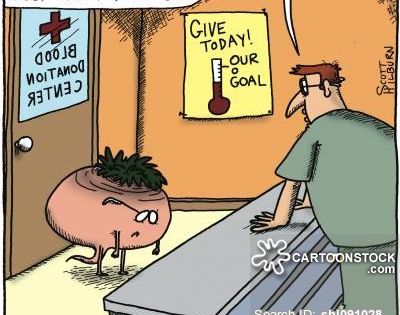
All I seem to find is more big business solutions aimed at getting blood from turnips.

What is the role of technology in sustainability? – MAHB

Digitalization to achieve sustainable development goals: Steps towards a Smart Green Planet – ScienceDirect

Technology & Sustainability

I’m critical of high-tech solutions and when I hear them in tandem with big claims of sustainability, especially at a global level, I automatically bristle.

Still, the first time someone called me a Luddite, I balked.

I know there are plenty of us—vocal advocates and quiet dissenters alike—bemoaning so much of the tech being shoved down our throats, most certainly when it comes to food. I’ve been vocally ‘anti-GMO’ and ‘anti-geoengineering’ and ‘anti-vaxx’ and ‘anti-surveillance’ which in their linguistic game really just amounts to PRO-nature.

Yet it is becoming more common, even among the homesteading ‘community’ and ‘off-griders’ to consider these two powerful forces as intrinsically intertwined. As if sustainability cannot be achieved without modern tech, forgetting we somehow made it all the way up to the industrial era with relatively little of it.

We often hear of technology being a Trojan Horse. But, that’s an understated analogy, considering in that story it was a “gift”—insinuating it was one that could’ve been rejected. There is no rejecting a good portion of this tech flooding into our lives today. You will not escape the digital prison, at least not completely. Those 5G towers are screaming their frequencies over your head day and night whether you like it or not. The weather modification is a thing, whether I like it or not. (NOT!)
We also hear of technology being as any other tool—to be used for good or ill. Yet, is that a fair assessment when these tools are largely invisible? And when they are overwhelmingly in the hands of very few, and when fewer still would be able to replicate them in any capacity?

What am I missing? Where is the healthy balance?
To explore these questions over the next few posts, I’m bringing in considerable help.

A young ‘homestead influencer’ I’ve heard about for years is about to release a new book and her attitude about the tech sounds pretty healthy. In the book she explores the question, “What are we leaving behind in our race toward progress?”

Old-Fashioned On Purpose by Jill Winger of The Prairie Homestead

The book is coming out soon, but she discusses it at length here:
https://thejoegardenershow.libsyn.com/326-an-introduction-to-modern-homesteading-with-jill-winger

Like most of us, she has zero intention of recreating a ‘Little House on the Prairie’ lifestyle. She has managed to incorporate the tech into her life on her terms. So far, it seems.

Many of us certainly feel as the diaspora—dispersed between cultures—natural and digital.

I can’t help but wonder, is losing our soil connected to losing our soul?

I have a cousin in Colorado with a farm I’d call pretty high-tech. He’s a permaculture/biodynamics guy and has been very successful and has the perfect background to enlighten me, I’m sure.

He worked all over the world before his current venture, which has recently gone on the market after 20 years of development and WOW, talk about a success story! To increase the value of a property by such an extraordinary measure is truly remarkable. And that’s only part of his success story.

He too seems to have managed the tech, rather than the tech managing him.

I was quite moved by his 2015 speech:

“I remember! 
These qualities of life giving wholeness that our ancestors knew deep in their bones have been drawn off, separated, reduced, modified, pasteurized, homogenized, radiated – their vitality degraded, their life giving forces mutilated beyond what our cells might recognize. We now consume what are at best facsimiles of food, laboratory concoctions, genetically mastered ingredients – simulacra that do not build our cellular health but create work for our bodies, that weaken our fortitude and break our spirits.  These laboratory wonders parade in full color down our grocery store isles.  -all screaming for our purchasing dollars.  More money is spent on the campaigns intended to seduce us than on the so-called food inside.  These products are combinations of ingredients that we can not pronounce, masquerading as food and covered up with contemporary Eco-socially correct overly-designed, brightly bannered sales pitches in suspect containers claiming to bring us momentary bliss – all hawking only slight variations of amber waves of commodities meant for one thing and one thing only  – to efficiently generate profit for a few, and from the most devastating chain of ecological rape and pillage the world has ever experienced – all leaving an accumulated insurmountable debt to future generations.”

Excerpt from a speech given by Brook LeVan at the 12th Annual Sustainable Settings Harvest Festival on September 20th, 2015:

The Movement — Videos

As little media as I consume, I read or hear such attitudes on a daily basis.

Just today in fact from The Naked Emperor:

“In the modern world, progress and innovation are often celebrated as unambiguously positive. New technologies, ideas, and ways of living are readily embraced with the assumption that they must be better than what came before. While it is true that certain advancements have brought undeniable benefits, such as improved hygiene, faster means of travel, effective medical treatments, and enhanced communication, it is crucial to critically examine the broader implications of modern progress. Often, the rapid pace of change leaves little room for reflection on whether newer solutions are truly superior to time-tested practices.
As society becomes more complex and interconnected, the allure of novel and convenient solutions can overshadow the wisdom of the ancestors. Practices that have served humanity for generations may be disregarded in favour of modern alternatives that promise quick results and ease. For example, the trend toward processed foods and sedentary lifestyles has led to health problems that were less prevalent in societies that followed more traditional dietary and physical activity patterns. Likewise, the reliance on fiat money and speculative investment has created economic instability compared to more sound financial practices.”

Sound financial practices? What will the future kids know of that when even homesteaders are encouraging others to go deep into debt to finance their ‘off-grid’ dream property as if that’s magically sustainable? We used to call that debt-slavery.

Curtis Stone is a popular YT homesteader, and I’m not really meaning to diss him here, because it’s quite possible if I were a young man in my prime I wouldn’t be having such reservations as I do.

Risky behavior is common in youth, yet do we not expect a mature individual, as a mature culture, to become less risk-tolerant with time?

Debt has alway been encouraged for farmers when all the fancy new equipment becomes de rigueur—and a great many lost their farms that way during the Great Depression.

I’m not the gambling type myself, yet I see the technological sphere permeated with these types. From my vantage point, they appear to be addicts.

As if The Tech is not sketchy enough to me, there’s also the obvious fact of The Money, because you can’t have one without the other. That’s where the rabbit hole starts to go very deep.

(17:53) Gambling on people’s lives. That’s where the tech is headed. Not a ‘Black Mirror’ episode. Reality. Our debt-creation machine riding squarely on the backs of every cyber-unit, that is, every man, woman, and child, every living thing, all resources all around the world. Internet of Things, Internet of Bodies.

Alison McDowell of WrenchintheGears has been doing deep dives on this topic for many years, her work is hefty and dense, expertly sourced, and crucial in this discussion.

All this data. All the electricity required to run all this tech. All the power to be had, when all that power is in the hands of so very few.

So, I suppose I am a bit of a Luddite.
I’ll be exploring this reality in the next few posts, I hope you’ll join me by adding your thoughts about the topic in the comments.

We SO Rock!

Times are tough, the mood around here is tight and demoralized. I won’t sugar coat it. Two months of 100+ degrees and no rain is bound to have emotional as well as physical consequences. We are victims and I refuse to pretend otherwise.

It’s one thing after another and because it’s so hot everything takes far greater effort. I’d go down the big list of all the things breaking down and all the things we can’t keep up with, but it’s way too long.

And no one likes a complainer, right? Don’t wallow in misery, right? Don’t bring others down?

If I had a dollar for every time I read or hear somewhere some version of—“Don’t play the victim”or “You’ve got to get out of the victim mentality” —I’d spit on it, wad it up in a tight ball, and shoot it out the barrel of a gun right between the eyes of every idiot who repeats such self-serving nonsense.

We ARE victims and there are a great many of us. Victims of medical experimentation, victims of weather warfare and disaster capitalism, victims of theft, victims of bullying and coercion, and that’s just those who are lucky enough not to be victims of far worse.

What is the ‘victim mentality’ exactly and who does it serve if we all bypass it? Who does it serve if we swallow our anger and resentment and bitterness?

Folks like to say it serves oneself, as in, then the dark emotions don’t haunt you and bring you down. They say we shouldn’t be vindictive, or hang on to past abuses and that hate will eat away at our souls and even cause cancer and other serious diseases.

In fact, it’s blind optimism and relentless positivity that keep folks stuck in denial and complacency, which can easily prove fatal, for the individual and the culture.

It is considered extremely ‘uncool’ to ‘play the victim’ even when you are a victim. Why is that? The media would have us believe everyone is playing the victim and that’s what’s wrong with our culture—so litigious, everyone looking for a handout, too many snowflakes.

While that may be partially true, and most certainly exploited, they leave out one very big piece of the social puzzle. Like, should we not be concerned that we have created a culture with so many victims, whether perceived or real?

I’ll leave y’all to ponder that question for a bit while I digress.

Because, we SO ROCK!

Sure, it really sucks at the moment. But at such times I take more notice of all the things we’ve done right. It’s not bypassing all that’s gone wrong, it’s holding both reality extremes in my mind at the same time.

We recently celebrated our 20th anniversary, and 15 of those years we’ve had this property, which we purchased, BASED ON BEING VICTIMS. After Hurricane Katrina, we saw first hand what the government response is to a crisis and we also saw how helpless most folks were. It was very eye-opening. We took action, to make sure we were not victims again.

We were victims again. And again. These are not ‘natural’ disasters, not one of them.

But for argument sake, even if the hurricanes and tornado were not manipulated by man (they were!) the consequences of those disasters were most definitely exacerbated by man.

These are disasters with perpetrators. Each time the (supposed) natural disasters were made far worse by people. We were robbed after the first one, as well as permanently losing my teaching contract at that time. The second time we were left paying 3 rents—one on the apartment we couldn’t live in, the mortgage on this property that had no finished home to live in yet, and the house to which we evacuated. The third time saw more grifters try to take advantage of our compromised and very stressful situation under the guise of helping.

Each time we’ve taken action based on that victim status to try to ameliorate it for the next time.

That’s why we rock. In the last 15 years we have carved out an awesome wee homestead. We cleared loads of land, just the two of us and a little old tractor. Built a cabin, 3 chicken coops, a corral, a large garden, a large orchard, remodeled our home, acquired many different kinds of livestock, have been learning beekeeping, foraging, cheesemaking, herbalism and LOADS of other life skills that were completely new to us, and have helped a few others on their journey to do the same.

As victims it is our duty to arm others (or at least try, especially for the next generations) with the tools they will need to bring down the perpetrators who currently evade us. It only serves the perpetrators to pretend there are no victims, or to micro-manage others’ victim status and behavior.

A victim mentality can be healthy, or it can be destructive. What most folks do is try to exploit it or minimize it.

They try to exploit it by using it as an excuse to do nothing—this is not a victim mentality—this is a grifter mentality. They try to minimize it because the folks around them are too lazy, indifferent, busy, selfish, adolescent, or cruel to listen to them and allow them to express their true feelings rather than those that are socially acceptable and make everyone else feel comfortable.

The guilt and shame should go squarely and solely on the shoulders of the abusers and those making excuses for the abuse. If victims of repeated abuses turn into individuals with a grifter mentality it could be because they’ve witnessed so often first-hand that this is the winning strategy in our culture. I seriously doubt telling such individuals to stop ‘playing the victim’ will do a damn bit of good. And, why should it?

So, all hail the victims! And more power to us. Not the corrupting brand of power that turns us into tyrants and perpetrators ourselves, but the inner-power it takes to hold that victimhood out for all to see, in order to enlighten, to righteously blame and accuse, and to give the next generation a better chance at identifying their abusers, holding them accountable, as well as in fortifying their own lives and livelihoods against further victimization.

Feast or Famine

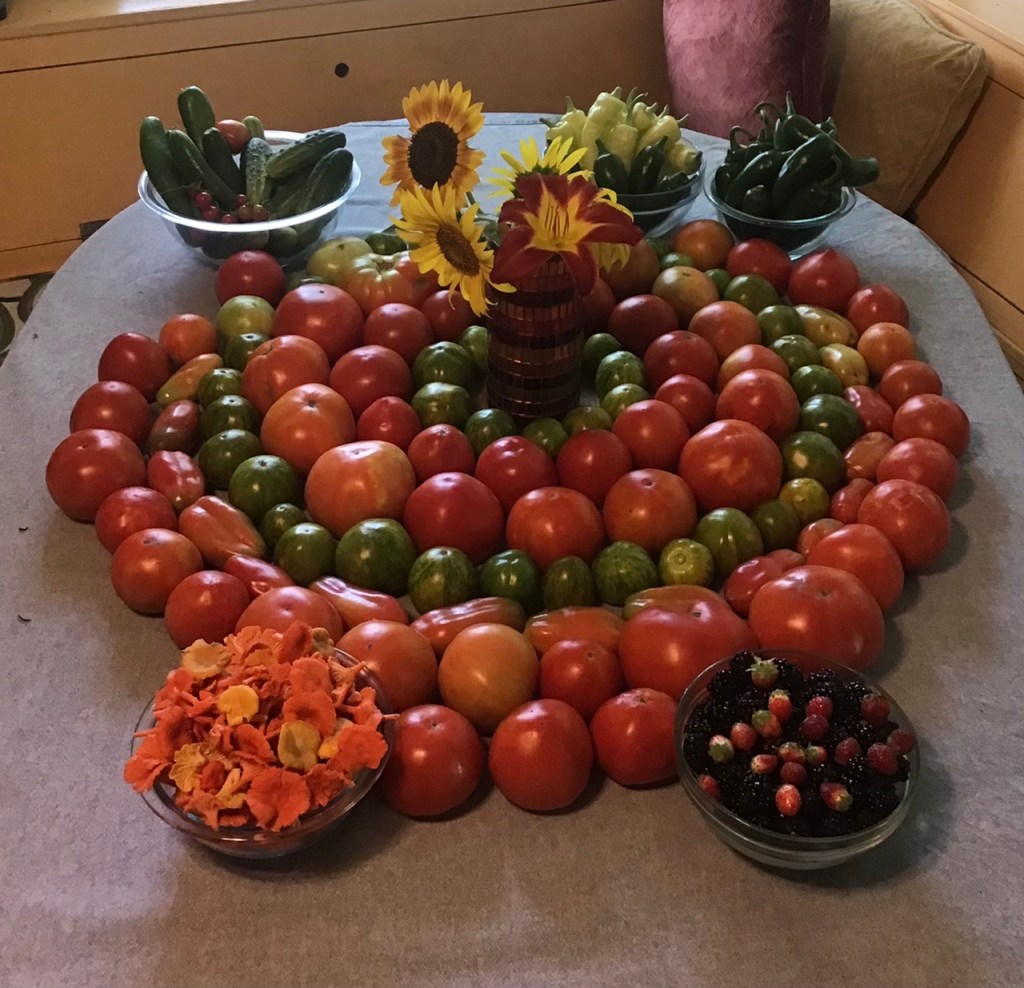
We are just days away from no tomatoes. Just as I was really getting sick of them.

There’s an attitude to surplus, just as there is to scarcity. Maybe we could even call it opposing frequencies.

I’ve known wealthy folk, in my younger days, who refused to eat leftovers, ever, no matter what it was, even lobster or filet mignon. One could almost be convinced of a certain ‘trickle down’ economic theory when in their presence.

While I was really lucky to be friends with them, because I got a lot of free upscale leftovers, I did find that attitude to be wasteful, and was not shy about expressing it.

It behooved me to see all that good food go into the garbage, not even composted. I couldn’t eat all the leftovers created from a weekend lake house party, and there certainly weren’t any livestock to benefit, not even doggie bags.

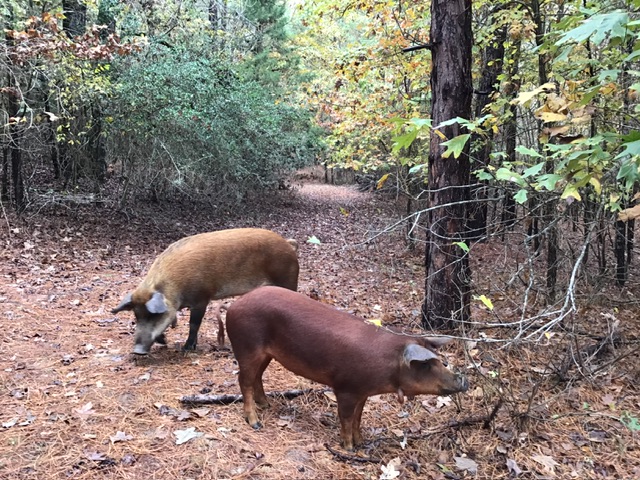
I think my 2nd favorite thing about having pigs, after the sausage and bacon and ham, is that I feel zero guilt about throwing away our surplus. It’s not throwing it away at all, I’ve come to realize, it’s really more like pre-seasoning our sausage.

So it was interesting to read an article the other day from an author who presented a graph from the “Bureau of Labor Statistics (BLS) data demonstrating a substantial decrease in household food expenditure as a percentage of income—from 44 percent in 1901 to a mere 9 percent in 2021.”

It was considered a ‘good thing’ according to this graph and this author that food prices had become so negligible in the modern economy.

I’d be willing to bet the farm that the general public agrees with this premise. To have the essentials of life—that is, food and water—as cheap as possible, indeed feels like a good thing. If those are brought to them poisoned is mostly not a thought at all.

Once the essentials are met, as in our modern Maslow’s hierarchy of needs, we can move on to entertainment.

Oh, except for that other pesky thing, energy. Because WiFi and game boys and television aside, we do still NEED our fridges and freezers and air conditioners.

And if you think that’s exaggerated, watch the mass exodus from the South to the North if the World Economic Forum has their way and all those civilizing conveniences disappear before too long. All while we are sweltering down here under the umbrella of ionospheric heaters up there.

But, aside. Let’s get back to the basics. Food and water, even before energy. You already know the feast or famine feeling. I know you do.

Do you give a care when you shower that 5 more minutes will break the bank? Have you ever lived in a situation where you carried all the water you needed for the day?

Do you consider when you buy your groceries that 5 more dollars will break the bank? Have you ever lived in a situation where a few dollars meant dinner or no dinner?

Every technology is a Trojan Horse. From shoes, to language, to music, to roads, to windmills, to combines, to bombs, to telephones, to cybernetics. Every one. Man existed before all of them. Somehow. Not even the ionospheric heaters causing us drought and weather chaos will bring about the extinction of man.

Man, in whatever form, of whatever species we care to classify, is a feature, or a bug, of this ‘solar system’.

Or, maybe I’m wrong, and we will perish like the supposed dinosaurs.

But my sense says, its otherwise. It says we survive in surplus, in scarcity, in love and in hate. We remain under masters, in servitude, and occasionally at some magnificent moments, I imagine, its otherwise.

We survive wars and diseases and lies. We survive pop music and step mothers and manufactured weather.

They say we must thrive, to thrive is to succeed. To succeed is to know progress. To progress IS.

To succeed is to feast.
Yet to feast indefinitely, is impossible. It will eventually lead to famine.

Because failure IS the inevitable consequence of success.

Chop Wood, Carry Water

Trip to town, so sad. Two machines tried to rip me off and no working humans looked capable of anything.

Don’t load, don’t count, don’t smile. What do ya do?

Hostessing was once a thing, like customer service. I was a really good hostess once, let me assure y’all!

It’s more than charm and service, it’s an art and a craft.

So, it’s no mystery to me why the cats eat with the dogs on our back porch: Good food + Good vibes= Good company.

Being a good hostess is similar to being a good teacher—observation, agility, ingenuity—are higher qualifications than even empathy, discernment and a sense of propriety—all already a challenge for most.

A teacher cannot play the same role as a bouncer, though that is mostly what is required these days.

My greatest failures in the classroom mirror my greatest failures in life. I’d sum them up to a kind of mis-navigation of the cherished Comfort Zone. As an example I offer a brief recap of my worst classroom lesson ever.

It was taken from a book of suggested lessons for EFL/ESL (English as a Foreign/Second) students and it was called: ‘Dog or Wolf?’

These are lessons designed to generate conversation in the target language, so students learn new vocabulary, practice old expressions, participate with one another, and ultimately create a student-centered learning environment. Sometimes it works, sometimes it doesn’t, occassionally it’s a classroom catastrophe.

This is where the observational and flexibility skills of the teacher can really shine. Or, really, not.

I thought I knew these students well enough to pull it off. NOT!

Was it my mood? My confidence? My lack of fluidity that particular day? I really can’t say, even now, but oh how that failure, just that one day out of how many other lesser failures, who knows, but that particular one has stuck in my craw still 2+decades later.

They were mostly Japanese students, from various cities, all college-aged. The caliber of student willing and able to travel to the desert US to immerse themselves in American life, indoctrination, and university culture. We had a good rapport, they were good students. Their English was at a level I knew they could perform well with the material.

I presented it, gave the requisite handouts, grouped them in fours as per the instructions and posed the preliminary question:

If you could choose, would you choose to be a dog or a wolf?

There were follow-up questions about culture and civilization, surplus vs scarcity, independence and hierarchy. In my mind it generated a brilliant potential conversation and I was looking forward to it.

The question was meant to lead to an exchange between group members who would discuss the merits of their choice, as opposed to the deficiencies of the other option. It was based on the assumption there would be some who would choose dog and others who would choose wolf, for various reasons, creating an atmosphere for debate.

Except all the students agreed on dog at the preliminary question, leaving me standing there with my mouth agape and no further game plan.

I nudged, painfully, at my more philosophical follow-up questions and got crickets. Obviously, everyone would be a dog—comfort, ease, predictability, discipline, training—DUH!

The ‘best’ student, a relatively large young man from Okinawa, who was more bold and out-going than the rest, immediately intuited my dilemma. He raised his hand and said he wanted to change his answer.

But, I was stuck in my own personal baffledom. I tried to go with it, push through, take the ball he’d so generously tossed me and run with it, but I remained, I don’t know, just sort of, stranded there, for way too long a moment.

And then I couldn’t get it back.

Anyone who has never stood in front of a classroom most likely underestimates the skill it takes to be good at it. And when I say good, I don’t just mean popular. And I don’t just mean effective. I mean the kind of good where one can walk the line between popular and effective, because it is impossibly narrow. Those who pull off that level of impossible should be studied and duly rewarded and I’m sure there are more than a few. So, it’s not actually impossibly narrow. Just too narrow for me that day, that lesson.

They should also study bombs like mine that day.

After missing the generous handoff, I was so tongue-tied and disgusted, with it all—them, myself, the lesson—that I dismissed the class early.

The Okinawan student stayed there, obviously to discuss it with me. He wanted to make me feel better about the clear and dismal failure, I think. It was a really sweet gesture and very appreciated, even in the moment, but it didn’t really help me make sense of it all.

Like, why was I so confident that lesson would work? So confident, in fact, that I didn’t even have a Plan B. Bad teacher! So confident, in fact, that I became rigid. And frankly, still feel judgmental of those students (so passive, so acquiescent, so like, totally lame!).

Not really like me. So stuck in my own thinking that it’s not conceivable to me every student would choose dog over wolf that I could not, in fact still feel challenged to, mentally adjust from my misperceptions. Yes, even now.

A room of 30 students and only one wolf, and that one only under pressure, and with a savior complex no less.

What happens in world become so ‘civilized’ we’ve all become obedient dogs? And, obedient to what, and to whom?

Don’t think, don’t fight, don’t roam, what do we do? What happens when man becomes too civilized? Too domesticated? Too content?

I still don’t know what to do with such a muddle. Would you?

Homestead Happenings

Sometimes I look at Handy Hubby and whine, “Please, make it stop!”

Then I think of the shrimp scene in the film Forest Gump—you got your boiled shrimp, your fried shrimp, your grilled shrimp, shrimp creole, your gumbo . . . .

Only with me it’s tomatoes.

In my defense I planted so many tomatoes because last year was not good for tomatoes, so we didn’t can up nearly as much as we wanted and were way short on salsa. The crop burned up so fast, it was pathetic, even though I planted just as many, we got far less.

So this year I was really determined. Decidedly, way too determined.

And, while we do (still!) have a bumper crop, it’s not exactly ideal, because once again, it’s so hot so fast that they are burning and exploding on the vine if I try to let them ripen properly. So, I have to bring them in to ripen, which means I’m really, really sick of looking at them everywhere.

Due to excessive heat we have uneven ripening, sun scald and plants dying while still full of unripened fruit.

But they are good, so, so good! My very favorite way to enjoy them is so simple—sliced and liberally doused with salt and pepper and served with— Everything!

We can chow through a good many this way, and it lasts for just a month or two, which makes our enjoyment all the sweeter.

So garden fresh you can eat them naked!

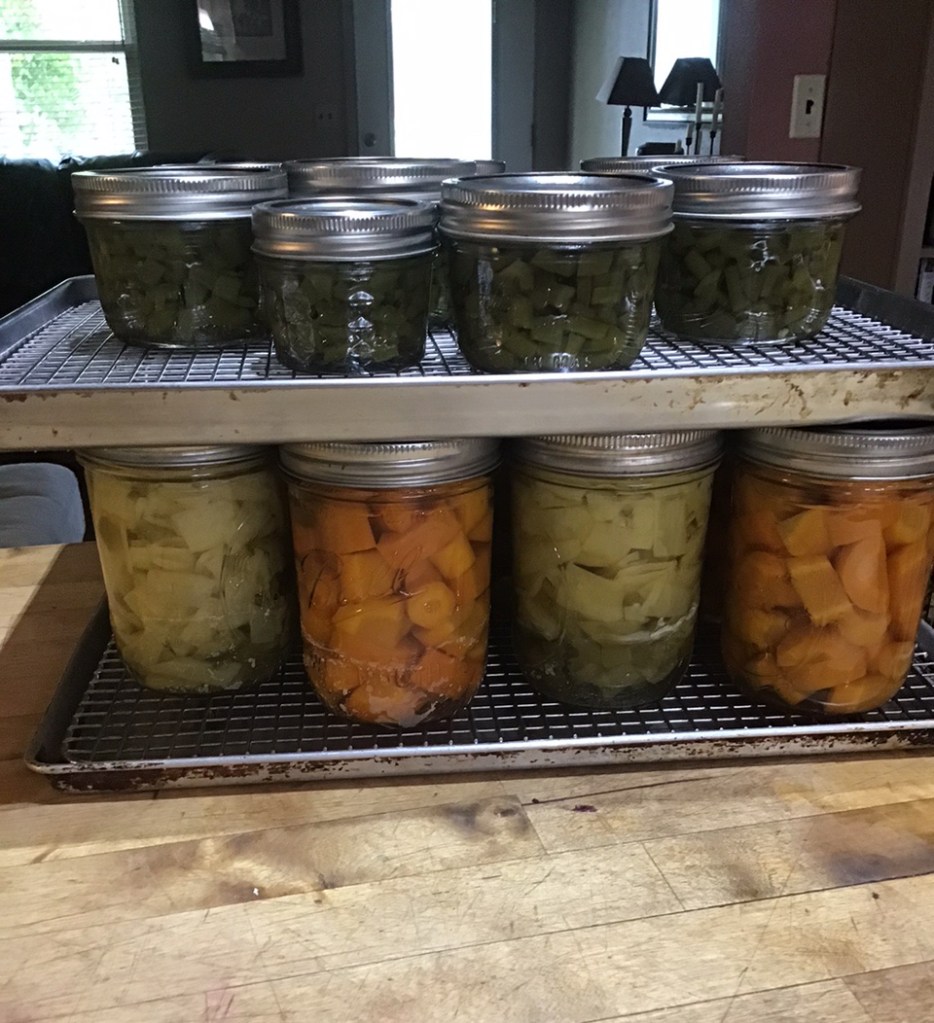
Then you got your salsas, your chutneys, your marinaras, your tomato soup, your creamed tomato soup, your plain canned, your Rotella style, spicy juice for cocktails, ketchup, barbecue sauce . . .. 😆. Did I miss anything?

And the cucumbers. Oh please, don’t get me started on the cucumbers! How I long for them all winter, and within two months can hardly stand to harvest them any longer.

I purposely planted fewer this spring, planning to stagger them more, for a longer season. In fact, there should not be so many cucumbers at all based on my inputs, and the sad fact that there are NO bees on them. By that I mean our own honey bees are not visiting our garden, though there are two colonies within 75 feet of it.

Speaking of bees, half of my colonies, that’s 3 out of 6, have perished this summer. I’m not surprised when I lose a colony over the winter or early spring, but 3 that were going strong into the summer, this is unheard for me, and super depressing.

I also notice far fewer native bees, and the ones I am seeing are much smaller. The wasps seem to be doing very well, so maybe that’s who is keeping us in bushels of cucumbers at the moment?

And of course we’re offering the surplus to anyone! We give it to neighbors, bring it to gatherings, get the word around that it is available, for free. What we can’t eat or give away goes to the goats and pigs and they need to eat too!

So, when I get the occasional comment that we should sell it at the farmer’s market or somewhere equivalent, I understand the well-meaning at heart. But, what I’m actually self-censoring myself from saying does stray a bit from the habitual and expected smile and nod.

Because what I sometimes hear, though I’m sure was not at all the intentioned meaning is:
It’s really not enough that you work your fucking ass off to produce all this fine produce, you should now go out and spend money on gas hauling it to town and suffer through the rules and regulations and pay for a booth and market it to a public who mostly doesn’t give a shit what they eat, and let’s face it, mostly just wants it cheap and convenient. So, don’t just plant it, nurture it, harvest it, sort it, wash it, package it, but now haul it to a market 20+miles away and stand there in the blazing heat all day so you can clear about $30.30 a truckload.

Sounds so awesome! Sign us up! 😳

On a brighter note, here’s something you’ll really like, because the world really does need one more cute kitten video!

Oh and Happy Independence Day y’all, thanks for stopping by!

Geoengineering Update

Will this be the tipping point for the geoengineering discussion? Thank y’all for the comments on the last post, much appreciated. I intend to get to them pronto, it’s just I’ve been a bit under the weather. Irony?

But I couldn’t resist sharing this new one first. I found it to be an informative discussion and RKJ had a few good questions I hadn’t already heard, which is impressive considering I could recite a good portion of Dane’s points.

Not that I’m a fan of RKJ, but he does bring with him a famous name and a large audience, not to mention his contacts in the environmental groups. Maybe this will be the catalyst for these groups to finally take this seriously?

On the other hand, I did find instances where RKJ sounds to me to be dismissive—when he says things to Dane like ‘your story’ and ‘your theory’ —and especially when he says he can’t imagine something staying so hidden for so long.

I actually had a chuckle at that one! Really? Can’t imagine that at all, decades of government secrecy and misinformation never crossed your radar? Hmmm.

RKJ broaches the biggest conspiracy theory . . .for real, or just for fun and profit?

What My Peace Corps Service Taught Me About Global Governance, Medical Coercion and Cancel Culture

This post is inspired by Alison McDowell’s series, Letters from the Labyrinth.

Attention all Dandelions!

I served as a Peace Corps Volunteer in the Czech Republic from 1994-1996, returning there in 1998-9 to teach at the Natural Sciences Faculty at Charles University in Prague.

I’ve written often about my experience and consider those years to have been formative on many levels, including that which defines my worldview to the present day.

While I have written often about those years, I have shared almost no criticism about my time there or the Peace Corps as an institution. I wrote a blog with other Returned Peace Corps Volunteers for several years, from which I was unceremoniously deplatformed as soon as I ventured into (unbeknownst to me at the time) the forbidden territory of ‘conspiracy theory’.

The Peace Corps was established in 1961 by John F. Kennedy.
“Ask not what your country can do for you, but what you can do for your country.”

From Wiki:
“On March 1, 1961, Kennedy signed Executive Order 10924 that officially started the Peace Corps. Concerned with the growing tide of revolutionary sentiment in the Third World, Kennedy saw the Peace Corps as a means of countering the stereotype of the “Ugly American” and “Yankee imperialism,” especially in the emerging nations of post-colonial Africa and Asia.[28][29] Kennedy appointed his brother-in-law, Sargent Shriver, to be the program’s first director. Shriver fleshed out the organization and his think tank outlined the organization’s goals and set the initial number of volunteers. The Peace Corps began recruiting in July 1962; Bob Hope recorded radio and television announcements hailing the program.”

Globalism, before it was cool.

The organization was in the Czech Republic for only seven years.
From the Peace Corps’ ‘legacy booklet’:

“Through the work and contributions of Volunteers, the Peace Corps has emerged as a model of success for efforts to promote sustainable development at the grass-roots level. The Peace Corps, however, is much more than a development agency. Volunteers embody some of America’s most enduring values: optimism, freedom, and opportunity. Volunteers bring these values to communities around the world not to impose them on other people or cultures, but to build the bridges of friendship and understanding that are the foundation of peace among nations.”

A portion of Vaclav Havel’s parting statement to the Peace Corps:
“The results of the Peace Corps’ work can be seen throughout the Republic. The Peace Corps assisted in establishing many new libraries, completed more than 100 ecological projects, and gave more than one thousand Czech entrepreneurs the opportunity to gain new business experience.” Prague, 1997

Ambassador Shirley Temple Black attended the official opening of the Peace Corps office in Prague in 1991.

Shirley Temple Black’s Remarkable Second Act as a Diplomat | History| Smithsonian Magazine

Speaking of Temple-Black:
According to Kounalakis, “Her personal and informal style worked well with the new government, made up of formerly imprisoned, hard laboring and human rights Charter 77-signing artists, musicians, actors and a playwright president named Vaclav Havel. Many of those new Czechoslovak political leaders admired their American colleague, President Ronald Reagan, an actor-politician like themselves who expressed in the clearest terms – and to the whole world – their deepest desire for freedom.”

The dissident playwright turned politician, President Vaclav Havel’s wife was also a famous actress. Olga Havlová – Wikipedia

Also from Wiki:

“Havel was born in Prague on 5 October 1936[8] into a wealthy family celebrated in Czechoslovakia for its entrepreneurial and cultural accomplishments. His grandfather, Vácslav Havel, a real estate developer, built a landmark entertainment complex on Prague’s Wenceslas Square. His father, Václav Maria Havel, was the real estate developer behind the suburban Barrandov Terraces, located on the highest point of Prague—next door to which his uncle, Miloš Havel, built one of the largest film studios in Europe.[9] Havel’s mother, Božena Vavrečková,[10] also came from an influential family; her father was a Czechoslovak ambassador and a well-known journalist.

“He was known for his essays, most particularly The Power of the Powerless (1978), in which he described a societal paradigm in which citizens were forced to “live within a lie” under the Communist regime.[19] In describing his role as a dissident, Havel wrote in 1979: “we never decided to become dissidents. We have been transformed into them, without quite knowing how, sometimes we have ended up in prison without precisely knowing how. We simply went ahead and did certain things that we felt we ought to do, and that seemed to us decent to do, nothing more nor less.”[20]

Remembering Ambassador Shirley Temple Black – U.S. Embassy in   The Czech Republic

++++

Me, 1994, naive and idealistic

As far as Peace Corps assignments go, I was sometimes rightly chided as having ‘served’ in the “Paris of the Peace Corps.” I did not live in a village in a shack without running water, as is often the stereotype, and sometimes the reality.

I got lucky, very lucky in fact. I was assigned to a brand new school, with a private office, and lived in the vacated 2-bedroom flat of the school’s principal. It even had a private phone.

At the Ambassador’s Residence in Prague, feeling sophisticated.
Champagne socialism, free-market capitalism? Who knew, who cared?!

A short time after arriving I was summoned to the state-of-the-art, just being organized, computer room. I had requested an e-mail address. The teacher running the show was excited, thrilled even, to have someone even remotely interested in his very claustrophobic cyber-world.

The enormous room was full of donated equipment, mostly used, monitors and hard-drives and equipment I didn’t recognize were stacked up on every inch of the floor and only he and a handful of others knew how to use it all, or even cared to use any of it.

And new shipments were coming in at a regular clip. He couldn’t keep up with all the offerings.

At the same time, the old Soviet materials were stacked up on the street twice a week to be hauled away by the trash crew. Huge stacks of newspapers, magazines, books, busts, badges, portraits that seemed bottomless in those early days.

“We just traded one Big Brother for another,” one teacher quipped.

I was thrilled to be there. I fully expected to find, as per the slogan, “The toughest job you’ll ever love.” Bring it on, I thought.

But, I was young and naive and idealistic and I didn’t understand bureaucracy. I was dumb enough to think I was supposed to be honest on the seemingly endless ‘ratings forms’ we were required to complete. Instead of spend five minutes giving five stars and glowing reports to any and all activities and instructors like most of my fellows, I actually thought about it, wrote what I thought needed improvement, made suggestions I thought would be helpful.

That got me labeled as a complainer almost immediately, I later learned.

One thing we weren’t supposed to complain about was the vaccine schedule. Even though some volunteers were insisting they were getting sick from it.

However, the Volunteer Handbook was unequivocal. “Also during Staging, you will be given immunizations that are required for overseas travel and for re-entry into the United States. Please do not obtain any immunization before going to Staging. If you are sensitive to any immunizing agents or medications, or have religious reservations concerning the taking of immunizations or medications, you should notify the Office of Medical Services before accepting an invitation to training.”

Another touchy topic for the form-police was concerning which projects got funded. My grant request for the impoverished orphanage for ‘Romany’ (Gypsy) children was rejected, while seemingly less necessary funding was granted to other projects, especially those in cooperation with other agencies, like USAID (in our case, for English-language textbooks), in more recent cases, it’s known for such causes as: With USAID Support, Ukraine’s Tech Sector Thrives Despite Russia’s Full-Scale War | Ukraine | Press Release | U.S. Agency for International Development

Other project missions had impressive corporate sponsors, like the English-language essay contest about women’s role in Czech society, organized by Fran Aun, currently a Public Relations professional with such current successes as the trans campaign:

You can pee next to me!

Fran Aun’s efforts in Prague got me noticed. Hmmm, yikes?

Me, so proud, sitting at the table in the middle for our celebratory cruise on the Vltava, because my students dominated the essay contest winning multiple corporate-sponsored prizes, including a new computer for my 1st place winner and a super fancy new copy machine for my school.

The Peace Corps is now hiring for a new position: Climate Financing Support Specialist.

My Report Card for the Agency, according to their own stated goals:

  1. To help the people of such countries and areas in meeting their needs for trained manpower, particularly in meeting the basic needs of those living in the poorest areas of such countries,
  2. And to help promote a better understanding of the American people on the part of the peoples served
  3. And a better understanding of other peoples on the part of the American people.

As for goal number one, I give a C-. I do not consider an essay questioning women’s role in modern society to be more in line with basic needs of the poorest children in orphanages.

As for goal number two, I give a B+. That is, considering the people who were actually served were not those needing to meet basic needs, but those with an American-loving entrepreneurial spirit, that seems ‘fair’, I guess.

As for goal number three, I give an unequivocal F. The only stories that are allowed are those demonstrating our relentless positivity and the plate-spinning and mask juggling and illusions of a thousand other cultures who apparently dream of becoming just like U.S.

What I actually learned in my service from the Czech people, and tried to bring back home to fulfill the 3rd goal was categorical rejected by the current day Peace Corps: suspicion of government, especially volunteering; the critical importance of life skills; self-reliance over government reliance; local aid over foreign aid; and in fact, a good dose of paranoia, which was rampant among the Czechs, and would be wisely adopted by the majority of U.S. in the present times.

The line between entrepreneurs, civil servants, and philanthropists was breached ages ago, and it seems like Americans might be the last to know.

Fellow RPCV TEFL Volunteer, Antonio Lopez, “While I was serving my term as a Peace Corps Volunteer, I was definitely aware that a large scale societal change was under way, and that I was taking part in it. I guess I felt that way because I was a teacher working with teenagers, people who are always in a process of change and seeing the world around them with fresh eyes.”

Spring Sensations

I’m not sure what to make of it, but I’m sharing this quickie just the same.

A gorgeous day of new life, new moves, and what feels like genuinely natural weather for a change.

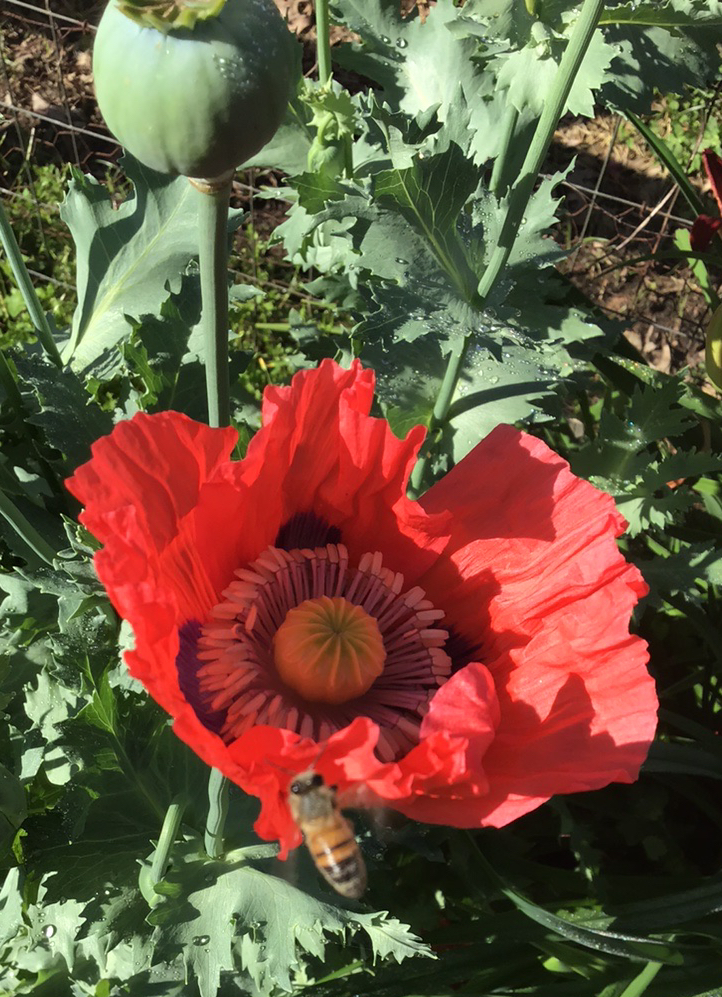
First rose, first poppy, first lamb and the kittens come out to play. 🤗

Just a few minutes old and already knows the routine

And, I expect Geoengineering/weather modification has hit the popular charts, at last, yay!

I will admit I thought this very popular channel must be shills of some sort, because they seemed to be completely avoiding the obvious weather warfare for years now.

Be that as it may, they’ve been clueing in more and more lately, and now, I consider their cherry popped. It’s about time! I don’t know what to make of it exactly, but I do believe in the gaming world it means we’ve just leveled up.