I grew up in the suburbs; I found it really boring; I watched a lot of TV, especially cartoons.
For better or worse, a good portion of my sense of justice came from Bugs Bunny.
Which is actually a lot more healthy than what passes for justice these days, I’d say!
During that time artificial reality did not blur so readily with actual reality. Now when I watch any media I see cartoons everywhere. I see cartoons when I look at people, too. So many have created caricatures of themselves it is clear there is too little authentic left to matter in them anymore. It’s like a return to the primitive, only plastic. Surface obsessed–the inner world collapsed in order to buttress the phony outer world of a manufactured jungle.
The following I copied and/or jotted down from still more media consumption, from a writer I imagine is real, who calls himself Stylman. Interesting name. I stopped following, despite his many wise expressions, when he wrote he thought the crazy weather is being controlled by the fears of the people who believe in geoengineering. A lunatic, obviously. And yet, some prescient views nonetheless.
“And it’s a road to nowhere—a few winners, millions of casualties, and an entire generation taught that their value lies in their ability to perform rather than create, to influence rather than contribute, to be seen rather than to matter.”
Now we live in an era where TikTok influencers who dance for thirty seconds make more than teachers, nurses, or the engineers who build our bridges. We’ve moved from celebrating skill to monetizing attention, from honoring achievement to rewarding performance and exhibitionism.
The fame machine isn’t just anti-human—it’s filling the void left by our disconnection from authentic community and natural guidance, while simultaneously being the logical response to living under constant surveillance.
But this isn’t cultural drift – it’s social engineering. The same institutional forces that have systematically replaced real information, real money, and real community are now replacing authentic human development with performance for strangers. This reflects a broader pattern: we live in an era where every essential human system has been replaced with artificial substitutes designed to harvest our energy rather than nourish our souls.
We’ve built a system that teaches them to treat their lives like content. That tells them: if you’re not being seen, you’re not really here. That your private self has no value unless it’s validated by strangers. We’ve stripped away something essential—the right to exist without an audience.”
While I agree, it’s actually much worse, in my experience.
The invasion of privacy of public systems and the individuals willing to force this state on everyone have deeply influenced inter-personal relationships as well–corrupting them, disfiguring them into parallel invasions–where expectation, extraction, exploitation has become the nauseating norm, and accountability has become entirely absent.
The public and private realities mirroring each other. Recently when I was visiting a dear friend who is Uber-Tech-Attached I had a Truman Show Moment, where she was gushing over her new air-fryer and I got the uncomfortable and uncanny sense I was unvoluntarily in an infomercial.
It’s a very creepy feeling I knew she would not understand.
Folks are faking their way through life, and this will have continued disastrous consequences.
The invasions will continue, until the trespasses are rejected and honor is restored to privacy and to nature.
The dangers of such a system, where access is assumed–access to your private spaces, your private thoughts, from your micro-expressions to your quotidian habits–is a culture of mutual parasitism, not even close to mutual understanding. This is not a culture more connected, it’s a culture more devolved. Incapable of boundaries, non-chalant around respect and autonomy, mocking of custom and structure, collapsing into a decaying emptiness. The nothingness of perpetually dissolving illusions, like the garish carricatures of a cartoonish, substanceless life.
A life perpetually romanticising illusion.
Even as its entire life support system slips away.
I attract scorpions, I always have. It’s my sweet blood, I’m sure, I can be very irrestistible when I want.
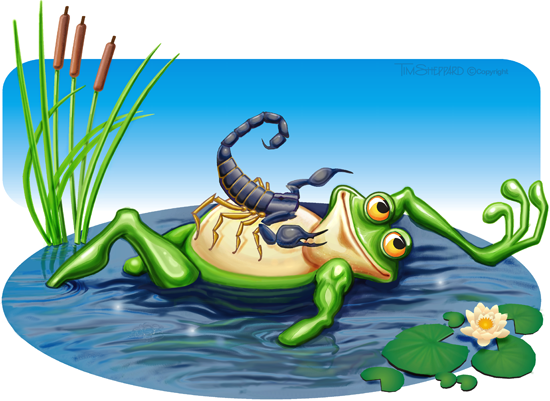
There are a lot of us. You can imagine us as the frogs. Some of us let their hearts and wallets bleed out dry for stray cats, which then makes them act nasty toward fellow frogs. Others turn their skin to poison for protection, which doesn’t really work all that well, because it gets some scorpions really high.
And still others migrate to Florida, where they freeze in manufactured ice storms.
Scorpions on frogs has been a pretty common theme for a while. It’s so common in fact that a new language is being crafted as I live and breath, right now, in this very cyberworld, also manufactured by man, like the Florida ice storms.
In scorpion-speak, everything was working just fine until the frogs started complaining.
But, the message in the bottle is that there are far more frogs than scorpions and the messengers are dropping many truths right into our very laps all about them. All kinds of clandestine information is flowing, on how to uncover them, how to trap them, how to recognize the master scorpions and even how ship them off to a land far, far away.
It’s a very exciting time! It’s becoming fashionable even! Soon the frogs will be free from scorpion influence! Maybe even forever!!
I do tend to get too enthusiastic and hopeful, but the thing is, I really think it’s working this time. I think it might even be coordinated. But, you know, they call me a conspiracy theorist.
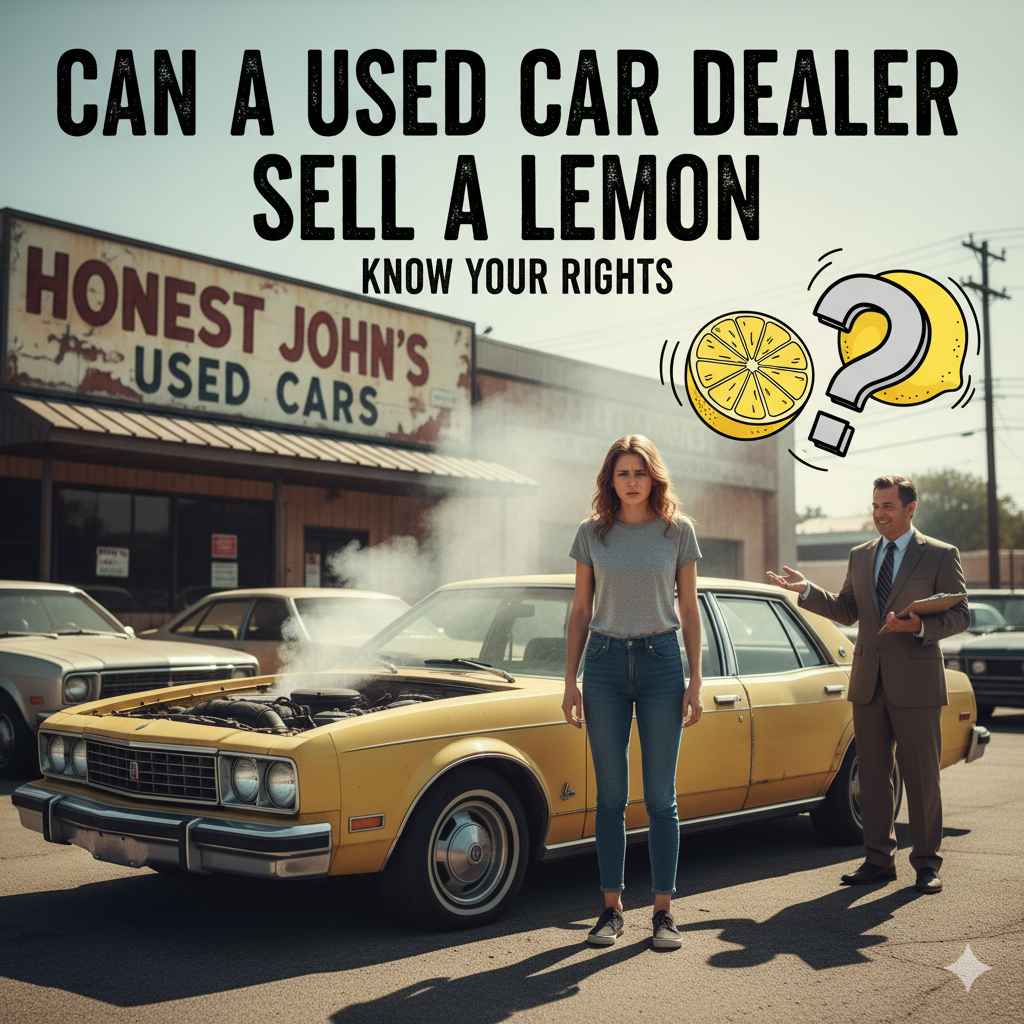
This time they’ve given us the words. The words are the map to the behavior. The behavior is the path to extermination. From what I’ve been able to work out so far, it’s a lot like used-car sales with them.
First, they get their foot in the door. Then, they try to sell you a lemon.
“Foot-in-the-door technique is a compliance tactic that aims at getting a person to agree to a large request by having them agree to a modest request first. This technique works by creating a connection between the person asking for a request and the person that is being asked. If a smaller request is granted, then the person who is agreeing feels like they are obligated to keep agreeing to larger requests to stay consistent with the original decision of agreeing.”
If you buy it, their quick onto your back, for as long as they feel like free-riding. They’ll expect you to cart them around everywhere without ever learning to paddle for themselves. They’ll expect to suck your life’s energy while you’re paddling them around, cooking for them, cleaning for them, while simultaneously entertaining them. When you complain you’re too drained and exhausted, they’ll snap at you that you are weak and that you should really try harder. Their drive matters far more than your fatigue.
Once they’ve got their claws in you, you’ll wish you were the frog freezing to death in Florida. They have all kinds of tricks, let me tell you!
If you try to pry them off your back once attached, here’s what you should expect to hear. They are, in fact, the true victims! They will actually try to persuade you this is true, even if they have to shapeshift before your very eyes, distort words just spoken, and throw you under the bus, all at the same time.
Indeed, Frog, why have you been so dissappointing a carrier? Why are you so cruel and malintentioned that your energy and vitality are not infinitely enduring? Why are you holding back?
You said you wanted me to be comfortable, Frog, and I am no longer, so fix it! I want more!
And you see I’m not capable of crossing the river by myself, it’s so obvious, what are you, some kind of a dumbass? I suppose you’d be fine if I just drowned. You’re just mean, that’s it. You pretend to be kind and caring, but you don’t care, you’ll just leave me by the side of the river while you go off with your other frog friends.
I know plenty of other frogs who will help me, you know. Not that I need help, of course. Just with this one little thing about getting across the river. And you won’t even do that. But, another will. They always do. You’ll see.
I don’t know, Scorpion, the frogs, well, they’re catching on to your tricks. They’re starting to collectively block you. That can’t be fun! The young scorpions, they’re getting more and more lazy and entitled, while the young frogs are getting wiser and craftier. I don’t know, but it doesn’t seem to be looking too good for your kind anymore.
One fellow frog has even started selling deep-fried scorpion chips, and I tasted one, and wow, are they tasty!
Character is what’s left when no masks hold. We recognize it most often in its absence.
Give a one power and watch, do they use it to make others more comfortable, or do they use it to dominate?
Here is a perfect example of a wolf preying on men who love it. Look at who she is being, not who she says she is. She’s a self-proclaimed coach, for men, who have been abused by narcissistic women.
She’s wearing a black neglige and has an eroticised naked woman in the very obvious background. Her career took off when she started focusing on wounded men. Big surprise!
Here is your wolf in lamb’s clothing, men. Why do you love her? She talks the talk, she looks the part, you fall for it, again, and again. A poser, pretending, while on the hunt.
She will poison every healthy relationship you have as you long for the fantasy she creates with her makeup and her emotional manipulation. She speaks of her own clientele as objects while buoying their egos without any context.
A true Machivallean artisan maneuvering in plain site and getting applauded for it!
Pro-tip: No serious woman wears a black neglige to make her intellectual point. She’s fishing for vulnerable men, beware.
Narcissism has become a popular modern buzzword, but the dilution of its meaning from its mythological context and its misuse in clinical definitions has contributed to a lack of appreciation for the dire social and personal consequences of tolerating narcissistic abuse.
In modern times, when we think of narcissism we tend to point to “selfie culture” and a saturation of self-centeredness among those who enjoy it. Just yesterday I had the perfect opportunity to witness this while at a restaurant for lunch. A middle-aged woman with dyed black hair and matching bright red lips and nails had just entered her car, which was directly opposite the window where I was seated.
I watched, laughing to myself, as she spent the next five minutes taking pictures of herself in different poses: pouting, smiling, flipping her hair around, like she was a sexy actress on stage instead of a no-longer-attractive woman in a huge black SUV, just pretending. I imagine she has all the latest filters on her camera’s lens and wherever she’s headed next will be dark enough that the illusion is not prematurely disolved.
And while this is really cringy, its not particularly dangerous for anyone else but the poor sap she gets her hooks in next. Sorry dude, better luck next time!
Clinically, and even historically, this is not really the brand of narcissism that is causing so much mayhem in our world.
However, clinically the definitions are at once well-defined, and nebulous, and over-lapping, and found under the heading of the ‘dark triad’ personality disorders. While these are certainly interesting to study and are attempting to become more scientific with more data over time, they aren’t necessary to understanding why these personality disorders become so socially destructive.
The problem is not the cringy aging woman who wants to maintain the illusion of youth and beauty indefinitely in order to gain sexual approval in the marketplace. The problem is when the fantasy is allowed to trump the reality.
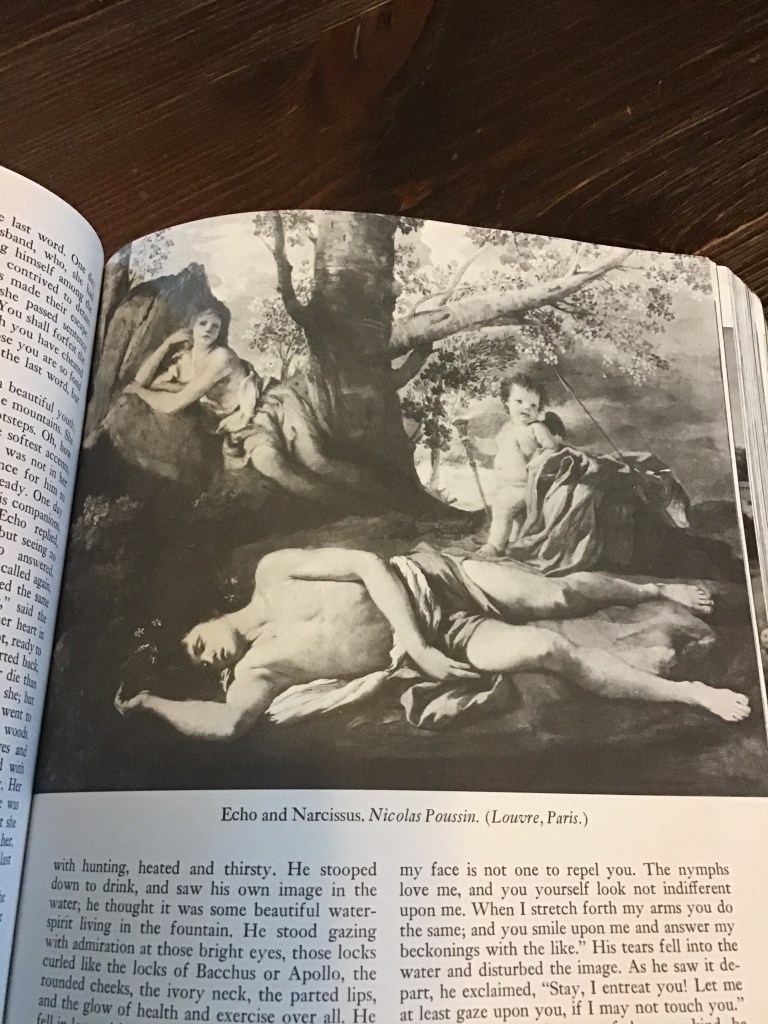
Society does still associate selfie-culture with the myth of narcississus, but only superficially. We correctly identify the beautiful youth who falls in love with his image in the water as narcississtic. But, we fail to look deeper into the lesson the ancient myth is attempting to teach us.
While there is no one official narcissus myth, one popular version includes his female companion, Echo. Whereas Narcissus is the disembodied face, Echo is the voice which mimics his, repeating, without agency, but symbolizing the intention of love and care through her adoration of him.
The real lesson is not just about the superficiality of beauty that fades, or the personal destructiveness of being overly-fascinated by one’s own appearance or superficial desires, but about the inherent dangers of illusion, especially when those illusions echo through the culture, without agency, repeating the words of the narcissist.
Reach out to touch the beautiful illusion in the water and it dissappears, and with it so does its echo, that’s the essence of the myth. There is no substance there, it’s a mirage. The face has no body, no core, no real form.
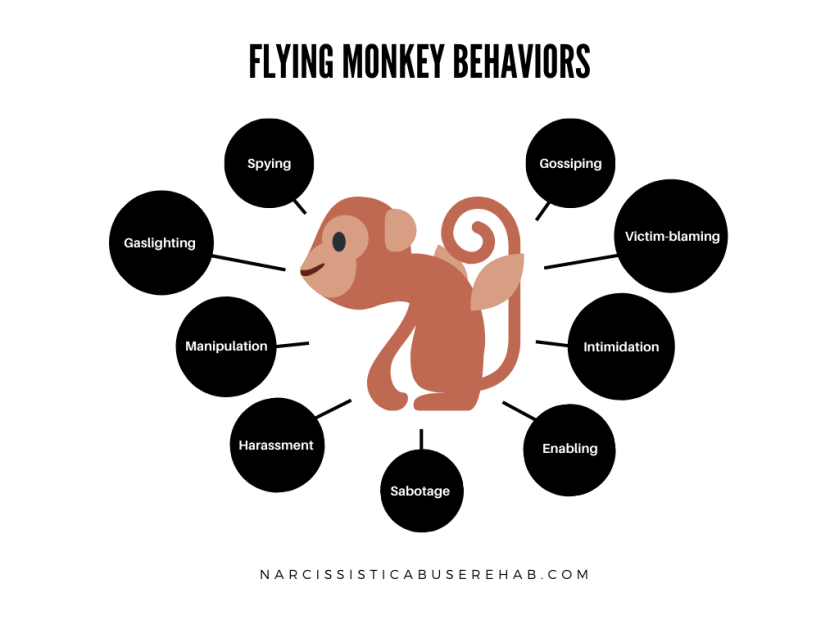
In popular culture today, Echo’s role represents the ‘flying monkeys,’ which are those figures doing the bidding of the narcissists, spreading his delusions. Narcissists are experts at manipulating others into doing their dirty work, whether that be their dishes or their crimes.
In psychoanalytical terms, this means the narcissistic personality has not done the difficult work of developing an authentic self. There is nothing behind the mask. S/he is a shape-shifter, a cameleon, the disembodied creature in a shared fantasy.
When these attributes become socially acceptable, indeed institutionalized, the culture itself becomes permeated with such types. Toxicity becomes the norm. Fantasy, being the preferred state of the masses, replaces reality. Narcississtic abuse becomes systemic.
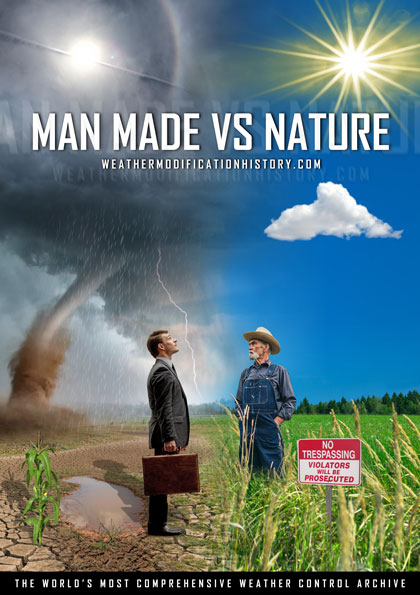
At the societal level, Geoengineering presents a typical example of how this looks in action. And, there are a great many direct parallels between narcississtic abuse as it plays out in personal relationships and in the aggregate, that is, the public domain.
Empty promises like ‘safe and effective’ become accepted as truth. Meaningless words and slogans replace honest dialogue and debate. Hollow gestures replace accountability.
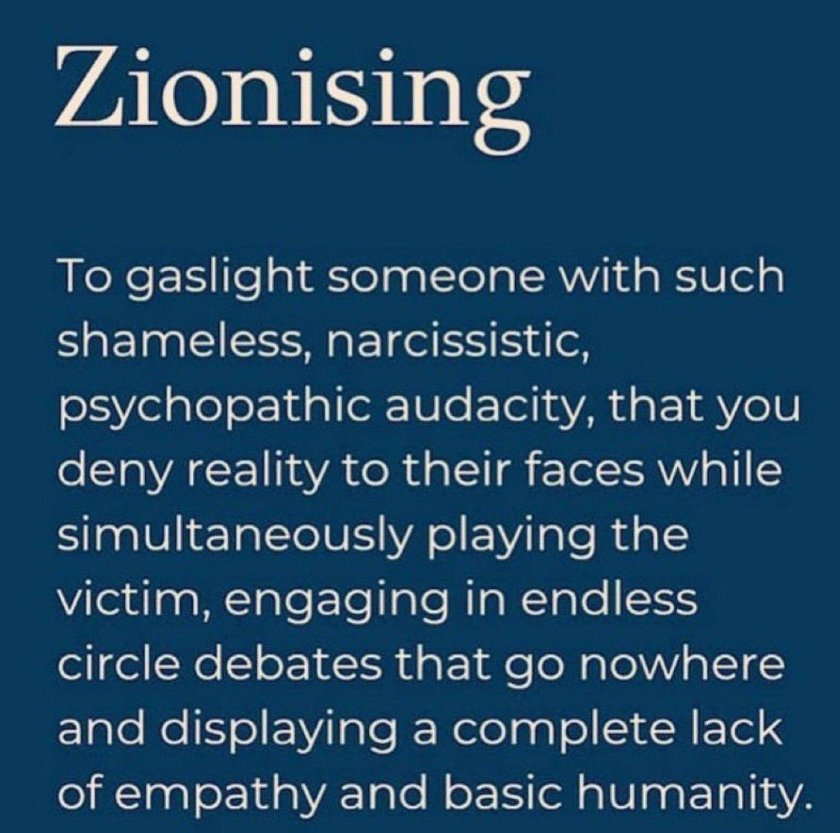
In the personal relationship this looks like the philandering spouse who swears they’ve cheated for the last time, over and over. Or the sister or friend who apologizes for wrongdoing, but then hides behind ignorance or innocence, or tries to blame shift and gaslight to get out of being held accountable for her poor actions or insensitive behavior.
In the public sphere this normalized behavior becomes the governments and institutions who are granted immunity, the banks that are too big to fail, and the laws that are twisted to absolve the guilty and victimize the innocent.
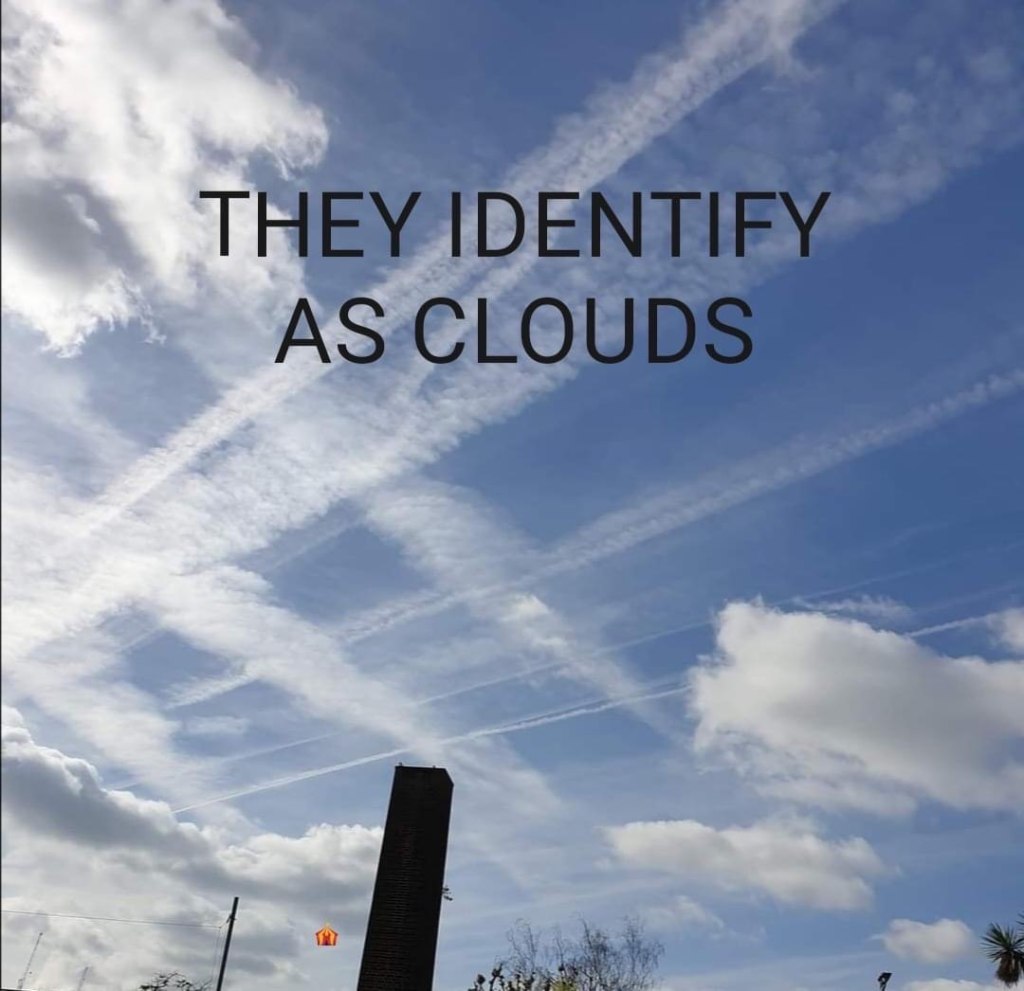
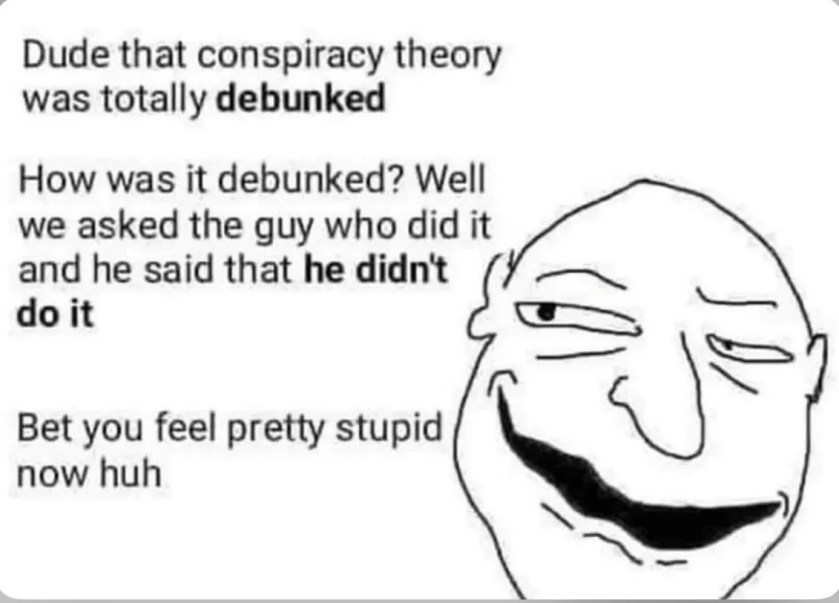
What have we been told for the last decades about Geoengineering? At first we were told not to believe our lying eyes, nothing is happening, ‘chemtrails’ aren’t real, and you are all gullible conspiracy-believing nutjobs.
Next, we are told that it’s actually benevolent, they are trying to fix the broken climate. Totally safe and effective. We just need the states to put a few crucial laws in place, then everyone will be happy. Fantasies and illusions replace accountability.
More empty promises, more hollow gestures — like the states stalling with laws that will never stop the assault, but will get a new market brewing for all the attorneys and advocacy groups and health care professionals, who will make a lot of money from the fallout. Entrepreneurship, that will solve it. More tech, better tech, that will solve it.
The argument gets twisted around intentionality, did they mean to harm, or not? Let me go out on a huge limb here and suggest that every single person involved will say they didn’t intend to harm. That’s rocket science.
That question itself serves the abusers. The real question, the one the victim would ask is, “Should abusers be able to hide behind innocence, ignorance or incompetence?”
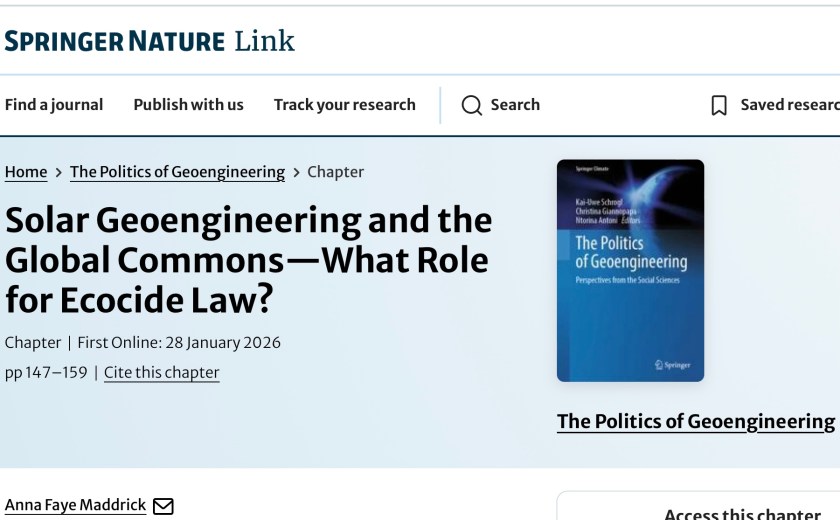
Solar Geoengineering and the Global Commons—What Role for Ecocide Law? | Springer Nature Link “As a result, initially peaceful, yet ultimately harmful geoengineering projects could exemplify unintentional hostile use of weather modification technologies. However, ENMOD does not take this form of use into account, so cannot provide a viable tool.”
Meaningless words–words that magically transform, or lose and gain significance depending on whims and propaganda shifts–global warming, global cooling, climate change, abrupt climate shift, climate remediation.
These parallel the meaningless words and hollow gestures of the narcissitic abuser — I’m sorry, I didn’t meant to, it’s really not that bad, it’s just your impression. The dog ate my homework.
It’s not my fault. No agency. No accoutability.
You’re not perceiving what you think you are perceiving! You’re not feeling what you think you’re feeling! it’s just your impression! Your subjective experience! If it were true, everyone would be experiencing it exactly the same like you!
Plausible deniability is the safe space for abusers of all kinds.
They will even go as far as admit the wrongdoing, but still not be held accountable for it. Like Narcissus, all image with no substance, all face with no body.
Other common tricks of the trade: manipulation of perception, moving the goal post, feigning, finessing, presenting harmful acts as benevolent–it’s for your own good, for the good of the community, because they are so concerned about you, about the environment.
What do you mean we can’t flood your home? But the farmers need rain, you’re being selfish. Isn’t that why you bought insurance? Why aren’t you more resilient? Why should you be so upskittled by a tornado or two, they happen all the time. We were just doing our job!
I will NOT end this post, or this life, drowning in their sea of dysfunctions, because that’s exactly what works best, FOR THEM.
I truly believe that if the individual will stop accepting such abuses in their personal lives, what’s acceptable on the societal level will assuredly, eventually, shift as well, and very dramatically.
Stop approving of the toxic behavior, stop believing the lies, stop being their Echo, because narcissistic abusers are pathological attention-seekers. Call them out, demand accountability, do not accept empty promises and meaningless words, and watch as the little rats start to scurry.
Learn about narcississtic abuse and root it out of your life, personally and professionally. Achieve greater levels of discernment through diligence and determination. Real resilience comes from principled positions rigorously and consistently applied. Insist others practice what they preach, as you yourself do the same.
This is not idealism, this is the tough work of forcing reality to win over illusion. It is the tough work of embodiment, of authentic Self creation.
“We’re often told that narcissism doesn’t exist or that we’ve attracted these people into our lives because of our own issues. This harmful victim-shaming keeps people trapped in abusive dynamics.
In this episode, Dr Peter Salerno explains that narcissism is real and identifiable. Narcissists are invested in their image at the expense of their true self, and they intentionally seek out environments where they can exploit others.
This conversation will help you identify if you’re dealing with a narcissist, trust your body’s reaction to mistreatment, and begin to think about whether it’s a relationship you want to remain in.”
We may still be victims of their floods and tornadoes and varied toxic tampering, but we don’t have to accept their delusional fantasies and their illusions of control. And that WILL make a difference.
I have a dream that when asked where I sell my delicious locally-produced raw milk cheeses my response will be one of beaming pride instead of deflated frown.
Instead of–“Sorry, I can’t sell them, it’s illegal”–in my dream I reply instead:
“I have an assitant who delivers our homemade cheeses twice a week to the community Farmstead Store in town. You probably should call her and make arrangements because she always sells out by lunch. We have Farmstead Stores in every small town in our region who send out drivers to exchange with one another. Our free-range pork and our neighbor’s beef sell out even faster than the cheeses. They’ve also got year-round fresh produce there, eggs of course, honey, wine, kombucha–all sourced and produced from within 15 miles.”
Instead of my dream, in my reality I get asked, “Can’t you get a license?”
No! No, of course I cannot get a license! Instead of dream-speak I get the nightmare reality.
It’s not only impossible to get a license for a home cheesemaking operation, it just happens to also be against my philosophy.
“An agorist is one who applies the principles of libertarianism consistently through counter-economic practice. They aim, that is, to bring about the voluntaryist society not through political (in)action but through direct counter-economic action.”
No, I cannot get a license. Since we are in the South, I wonder if another appeal might be in order?
Imagine if instead of ‘philosophy’ I said ‘religion’. So my reply becomes:
“Appealing to State and Federal officials for what I, and my neighbors, choose to purchase for consumption is against a fundamental aspect of my religion which preaches the gospel that God chooses my food through my tastebuds.”
“This is not a trivial point. A free society is not merely an ideal society to be philosophically formulated, but a process to be enacted through conscious action. Thus, the idea of separating the free society from the actions that free human beings must (or must not) engage in is self-contradictory. What else defines a free society except for those actions?” James Corbett
“Furthermore,” I continue in my dream space, “I’m allergic to paperwork and authoritarian nincompoops and I refuse to spend what little time I have left on this spinning green insane asylum kissing the arses of Velvetta-eating officials mansplaining me what I must do to make safe cheese.”
Also from Corbett In “An Agorist Primer” Konkin explains: “We see that nearly every action is regulated, taxed, prohibited, or subsidized. Much of this Statism — for it is only the State that wields such power — is so contradictory that little ever gets done. If you cannot obey the (State’s) laws and charge less than [because of “Fair Trade” laws], more than [because of “Anti-Trust” laws], or the same as [because of laws against cartels] your competitor, what do you do? You go out of business or you break the law. Suppose paying your taxes would drive you out of business? You go out of business — or you break the law. Government laws have no intrinsic relationship with right and wrong or good and evil. Historically, most people knew that the royal edicts were for the king’s good, not theirs. People went along with the king because the alternative looked worse. [. . .] But everyone is a resister to the extent that he survives in a society where laws control everything and give contradictory orders. All (non-coercive) human action committed in defiance of the State constitutes the Counter-Economy.” In effect, Konkin takes the plight of the modern-day citizen, stuck in a web of ridiculous, contradictory, and impossible-to-follow laws, rules and regulations, and flips it on its head. It is not a source of shame to be acting against the arbitrary whims of the state, but a virtue. Economics is the realm of white markets: legal, licensed, sanctioned and regulated exchanges in the aboveground economy. Counter-economics is everything else: black market and gray market activity either specifically outlawed by the state or not licensed or approved by it. People tend to get squeamish when they hear “black market,” but we’re not just talking about gunrunning, counterfeit smuggling or drug dealing here. Any (non-violent) activity that doesn’t have the blessing of the state is counter-economic.
“Of course, individually, these actions seem unimportant, even trivial. But in combination they drain significant resources away from the clutches of the state and toward the people participating in the actual productive economy. It is estimated that 20% to 30% of Americans fail to report taxable income. In some parts of Latin America it’s closer to 80%. Can you imagine if it were 100%? A few isolated counter-economists acting in a disorganized haphazard faction is a minor inconvenience to the powers-that-shouldn’t-be. Millions of people acting in concert in a deliberate undermining of state authority is a revolution. This is the promise of counter-economics.”
The quotes that are not in my dream are taken from the following 2 articles by James Corbett, well worth the read.
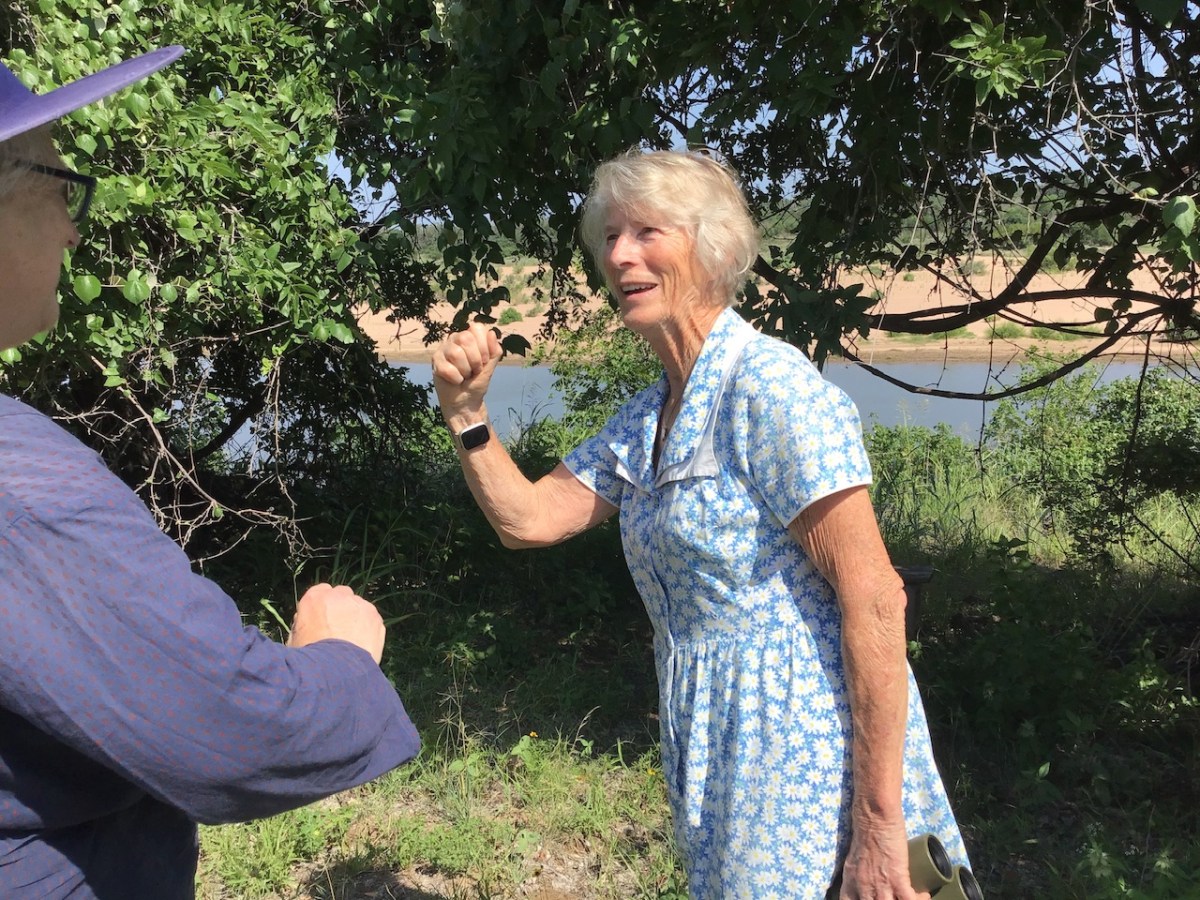
From Kenya to Llano, Berit pictured with Kath, visiting from the UK
Hunters often get a bad rap and it’s not always for good reason. I had a chance to learn something about this on a recent trip to the Texas Hill Country where I was led to question the difference between a hunter and a poacher.
Before assuming this is a niche topic and of little interest to the vast majority of folks whom are neither hunters nor poachers, consider it’s a matter of philosophy as well, along with colonialism, globalism, human nature and modern life.
A wall of hunting ‘trophies’ not uncommon in Texas homes.
Mostly they have much in common, the hunter and the poacher. There is a similar skillset, clearly, but one I know nothing about, so I’ll leave that to the hobbyists and professionals. As strictly an occassional observer I imagine it to require more patience than I’ve ever mustered, more tenacity than most and more courage than the vast majority.
We might say the poacher is lawless and greedy and violent, and in some cases that may well be true. It may also be true that some hunters share such qualities as well.
But again, I’m coming to this as a complete outsider to their world, strictly an observer, and occasionally a beneficiary.
The differences between the hunter and the poacher must lie somewhere between intrepid and genteel, I figure. And so it is most apropos that I should think of it with a hunter who fits the bill for both adjectives.
Our hunter in question, Berit, at her home in Llano, Texas
I’d never have taken this fair, mild-mannered, small and slender woman as a big game hunter, that’s for sure, and I suspect that made her something of an attraction at her home in Kenya, kind of like a pretty little sparrow among bulls. Though looking at the full and adventurous life she’s led, we mustn’t think a sparrow at anyone’s mercy.
A beautiful display of African artefacts collected during their time there.
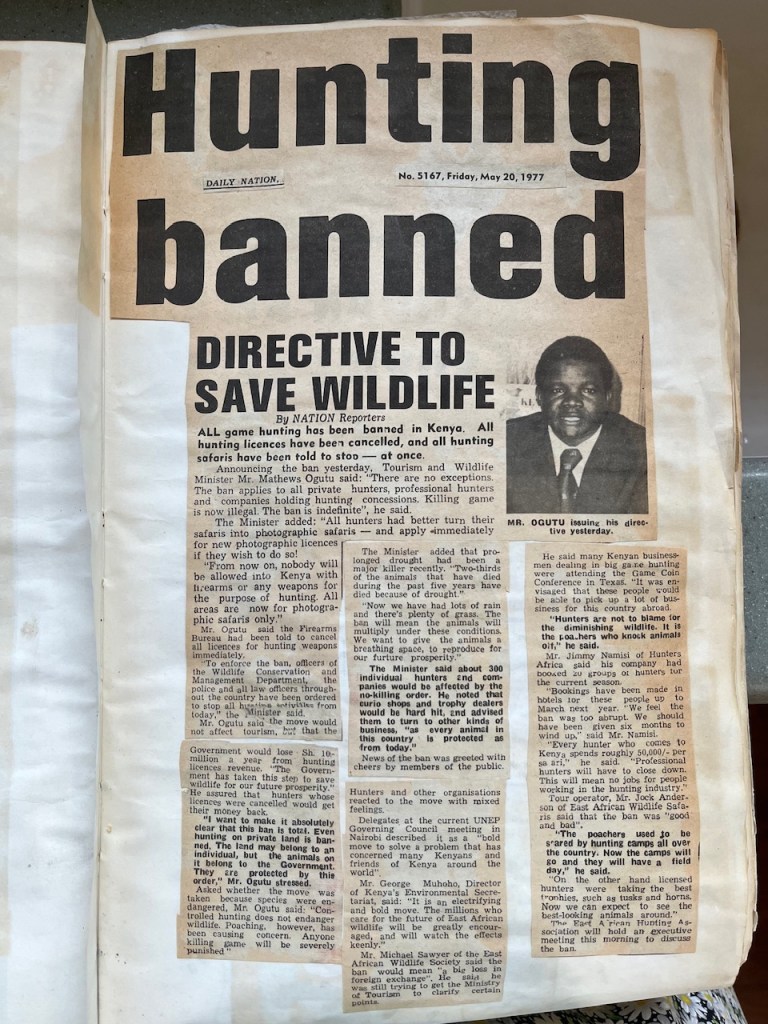
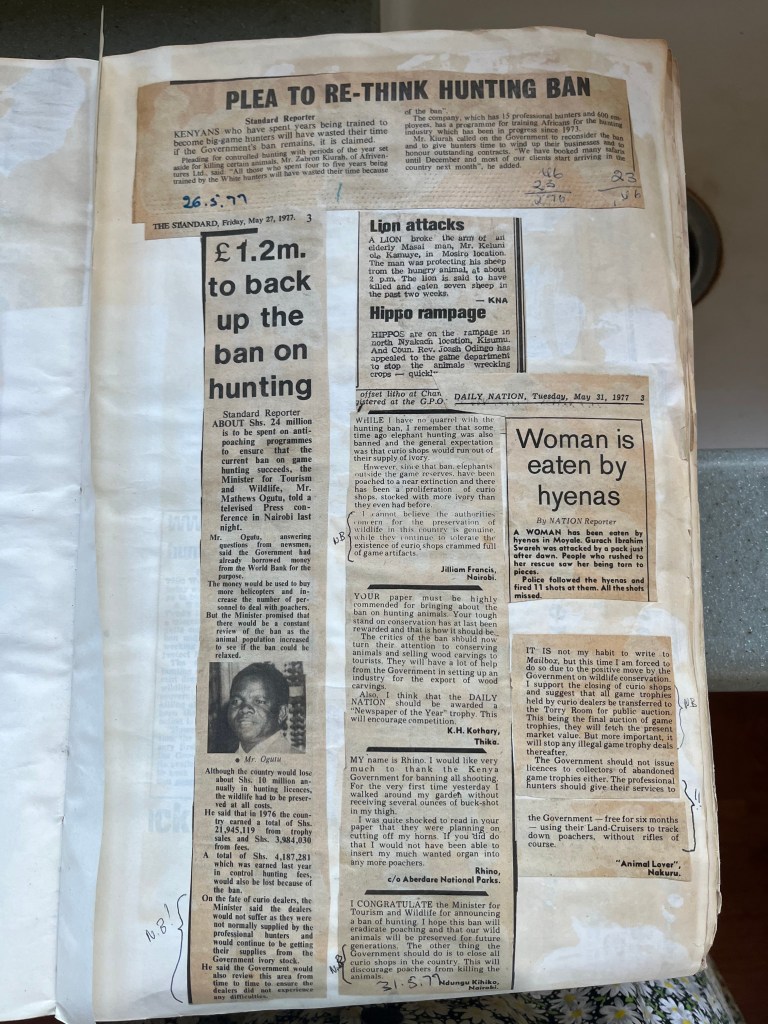
I met her with her second husband, an avid big game hunter, but her first husband was a professional one. They had a business together leading safaris until the laws were changed in an instant, hunting banned by the government, their livelihood lost.
Neither were Americans, but he had a prospect in Texas. So, with young children in tow, they moved to the Hill Country, to Llano, and started anew.
That was in 1977. It is still illegal to hunt in Kenya.
What’s more interesting, Kenya has remained on the fast track ever since, to full-tilt modernization. They have been an international fore-runner for all the Global Village United Nations WEF grand schemes for their ideal Future: ESG scores, vaccines, digital IDs, carbon credits.
That’s the great gift of compliance. Or, as the old adage goes, “Give the devil a finger . . .”
“Esc’s analysis, backed by meticulous documentation, sets the stage for understanding a system already operational, where resistance is economically suicidal and socially ostracized. Esc details how development programs in nations like Kenya test governance technologies—digital IDs, carbon credits—later exported to the West, ensuring global compliance under the guise of progress. The Earth Charter, as esc notes, serves as a global constitution, subordinating individual rights to expert-defined collective responsibilities, a theme echoed in The Invisible Empire’s critique of sustainability metrics overriding democratic will. We need to recognize this system before the window for democratic resistance closes, as each institutional capture—from ESG compliance to AI-driven surveillance—tightens the web.” The Complete Architecture – by esc
“For 130 years, a coordinated network of institutions has been systematically replicating the same control structure across every domain of human life – from healthcare to education, from banking to environmental policy. This structure, originally perfected in British banking, creates the appearance of local autonomy while concentrating ultimate decision-making power at higher levels run by credentialed experts. The breakthrough came when science claimed moral authority over all aspects of human experience through the 1986 Venice Declaration, positioning scientific expertise not just as informing ethical decisions, but as the source of ethics itself. This created the intellectual foundation for what we now see operational: a system where questioning expert consensus isn’t just wrong – it’s scientifically illiterate, ethically irresponsible, and potentially pathological.”
How close is your country’s hunting policy to Kenya’s? Is hunting policy about creating the lines between hunter and poacher, or obscuring them? Because, if everything is forbidden except to a tiny few, aren’t we pretty much all destined to become poachers?
“And the pity is that it will do nothing for the wildlife, controlled licensed hunting has never been a threat to wildlife. When elephant hunting was closed a few years ago, I wrote to the East African Standard and pointed out that poaching was the problem, not licensed hunting, and that if poaching were not stopped, the elephants would disappear anyway, whether licensed hunting were allowed or not. Unfortunately I have been proved right, and since that time the elephants have been exterminated all over large areas of Kenya. For this licensed hunting can in no way be blames, as legal hunting of elephants was closed.”
Finn, Berit’s husband
Should hunting be allowed in Kenya? | davidlansing.com
“When I was in Kenya a few years ago I stayed on the edge of the plateau overlooking the Mara. About a mile away one night, a leopard broke into a Maasai boma and killed a cow. The game officials came by two days later, photographed the pug marks on the ground and the carcasses, payed the elder a pittance for his loss, reminded them that they were forbidden to kill the leopard, and disappeared. A couple of nights later, it happened again. So they staked out a goat and speared the leopard to death and buried him. That same leopard could have brought in tens of thousands of dollars in fees to Kenya and the local economy – now it’s a skeleton. When the wild game is seen only as a nuisance and is not allowed to pay its own way in a crowded land, it will always end like that.”
I can relate, I fail them all the time. But that’s not this post.
Here we have two excellent essays that make me think, if this is the new level of social programming, I finally might abide!
Can they teach this in the schools? I might even go back to teaching! (Ok, let’s not exaggerate. We prefer our wee homestead life, even through the weather disasters, great many failures and physical pain.)
I’ve selected my favorite bits, there’s much more to appreciate on each of these Substacks, just follow the links.
The Coward’s Bargain: How We Taught a Generation To Live In Fear by Josh Stylman
“This wasn’t an accident or an overreaction. This was a stress test of how quickly a free society could be transformed into something unrecognizable, and we failed spectacularly. Anyone who actually followed the science understood the only pandemic was one of cowardice. Worse, most people didn’t even notice we were being tested. They thought they were just “following the science”—never mind that the data kept changing to match the politics, or that questioning anything had somehow become heretical. The beautiful thing about this system is that it’s self-sustaining. Once you’ve participated in the mob mentality, once you’ve policed your neighbors and canceled your friends and stayed silent when you should have spoken up, you become invested in maintaining the fiction that you were right all along. Admitting you were wrong isn’t just embarrassing—it’s an admission that you participated in something monstrous. So instead, you double down. You disappear when confronted with inconvenient facts.
Raising Prisoners And this brings us back to the children. They’re watching all of this. But more than that—they’re growing up inside this surveillance infrastructure from birth. The Stasi’s victims at least had some years of normal psychological development before the surveillance state kicked in. These kids never get that. They’re born into a world where every thought might be public, every mistake permanent, every unpopular opinion potentially life-destroying. The psychological impact is devastating. Research shows that children who grow up under constant surveillance—even well-meaning parental surveillance—show higher rates of anxiety, depression, and what psychologists call “learned helplessness.” They never develop internal locus of control because they never get to make real choices with real consequences. But this goes far deeper than helicopter parenting. The ability to hold unpopular opinions, to think through problems independently, to risk being wrong—these aren’t just nice-to-haves. They’re core to psychological maturity. When you eliminate those possibilities, you don’t just get more compliant people; you get people who literally can’t think for themselves anymore. They outsource their judgment to the crowd because they never developed their own.”
The COVID Conformity Test This is how totalitarian thinking takes root—not through jackbooted thugs, but through a million small acts of self-censorship. When a venture capitalist whispers his concerns about immigration policy like he’s confessing to a thought crime. When successful professionals agree with dissenting views privately but would never defend them publicly. When speaking obvious truths becomes an act of courage rather than basic citizenship. Orwell understood this perfectly. In 1984, the Party’s greatest achievement wasn’t forcing people to say things they didn’t believe—it was making them afraid to believe things they weren’t supposed to say. “The Party seeks power entirely for its own sake,” O’Brien explains to Winston. “We are not interested in the good of others; we are interested solely in power.” But the real genius was making citizens complicit in their own oppression, turning everyone into both prisoner and guard.”
Neutralization: How Bureaucracies Silence Dissent Through Legal Fuses and Narrative Control by Luc Lelievre
Institutional power rarely reveals its full mechanics in one stroke. Instead, it unfolds in sequences—calculated, procedural, and often cloaked in the language of neutrality. Neutralization, the fourth installment in Luc Lelièvre’s Unbekoming series, dissects this final movement in the choreography of bureaucratic suppression. Building on prior analyses—Heresy, which outlined how dissent is ideologically framed as deviant; Suppression, which explored institutional mechanisms of exclusion; and Omission, which detailed the structural design behind silencing—this essay turns its attention to the silent sophistication of neutralization: the use of legal fuses, narrative gatekeepers, and administrative dead-ends to reroute dissent and erase its public trace.
7. Administrative Gaslighting and the “Fuse Effect”: When Bureaucracy Becomes Theatre
Modern bureaucracies rarely operate through overt acts of repression. Instead, their preferred mode of silencing is procedural — a form of administrative gaslighting that cloaks itself in language of due process while subtly eroding the dissident’s credibility. This technique is not accidental; it is designed.
One illustrative method is what could be termed the “fuse effect”: low-visibility actors within the institutional machinery are positioned to execute decisions that carry legal or symbolic consequences, thus absorbing the potential fallout. These operatives — often legal clerks, junior lawyers, or regional representatives — function as buffers. When the dissident challenges a structural injustice, it is these intermediaries who respond, allowing higher-level decision-makers to remain untouched by controversy. The system insulates itself from reputational risk while continuing its work of marginalization.
But when these “fuses” begin to fail — either through overreach or exposure — institutions escalate. They deploy higher-profile agents, such as communications directors or legal executives, who are tasked with closing the file definitively. In my own case, the surprising intervention of a top-level official from a legal commission — someone with no adjudicative mandate — reveals just how far the institution was willing to go to protect the official narrative. Rather than engage the constitutional merits of my claim, it chose to obscure them through authority signaling and symbolic closure.
This bureaucratic theatre plays out under the guise of objectivity. But for those of us who have documented each step, the pattern is unmistakable: delegitimize the voice, dilute the argument, displace responsibility. These are not failures of oversight; they are evidence of design.
The question, then, is no longer whether the dissident is “right” or “wrong” by institutional standards. It is whether he can endure — and expose — the machinery that seeks to erase him. In that sense, the public record becomes not only a site of resistance, but a form of protection.
A flock, it is not. There will never be a revolution in America.
More like, when I say jump . . .
Kinda like Bugs Bunny getting his feet shot at while Yosemite Sam demands he ‘Dance!’. . .
It’s a relationship.
Americans will never revolt. They will never rebel. I’m not talking our military here, I’m talking the people, the masses, who will gladly vote for war if they are commanded by their team, but who will never en masse lift a finger in inconvenience to support it. A placard, perhaps. But not a pinky finger otherwise.
Why? This man nails it and it’s so spot on I fear reposting it. Truth bombs this huge are usually dropped by assets. Even listening can get you on a list, I’m sure. Because, America is so damn free.
But this murdering convert to Islam is correct nonetheless. Our guns can’t save us from, or in, this battle. We have already lost. We were conquered from within long before this current administration. We do not have the heart to rebel because rebellion and revolution require artists, the kind of artists, and warriors, who cannot be bought. We don’t have that, we haven’t had that for a long time now. We have conformity, collusion, corruption and therefore we’ve got what we deserve. Politics is downstream from culture.
Start at the 1:15 mark, it’s only about 10 minutes, and it’s brutal. Not for the feight of heart, I’m afraid, but absolutely the truth as I see it. Listen and weep, or not.
“Alvin Toffler predicted ‘demassification’: a process ‘in which a relatively homogeneous social collectivity (or one conceptualized as such) is broken down into (or reconceptualized in terms of) smaller, more diverse elements’. This is the prize for big social networks: compartmentalize people into echo chambers and bombard them with confusing distractions and dead ends.”
Confuse the words, creating a smokescreen of misunderstanding: Like: community=network=market Obviously these words used to mean very different things in the actual world, before the virtual environment muddied the waters. The market wants all kinds of personal details about you and so they pretend they are in a community with you. Your network of friends and acquaintances and business relations may indeed form a community at some basic level, but to expand this concept out in an attempt to create from this a sense of ‘global community’ is preposterous. It is a Benetton ad, not a community.
Yet it has infiltrated and infected the actual world as we’ve all experienced. The great Convid is example enough. But, there’s more.
Even small local shops in rural Texas feel entitled to ask shoppers for their phone number, to use video surveillance indiscriminately, to appeal to shoppers for ‘community’ donations and to shove their mailing list and ‘loyalty card’ at you. I seriously doubt they will draw the line at the next big thing the big box markets teach them.
“Please take a sensor bracelet at the entrance, this will ensure you a positive shopping experience.”
That is no community for me!
Deb Filman does a fine job of ranting about this, and an even better job breaking it down for folks, especially parents, because it really is the kids they are after. They always start with the easiest targets.
Are We Educating Children or Training Bots? That is the question!
More concept confabulation: Training=programming=learning Deb has some choice words to share about this, so I’ll be brief. These words and concepts are being deliberately confused in order to create cognitive dissonance in order to get us to comply. Social engineering has become an acceptable system for indoctrination of populations and is being normalized and implemented by the United Nations and cooperating global partners through our institutions, and directly into our LOCAL communities, all of them.
The U.N.:
Creating child social activists all over the country on our dollar.
More muddying of words and concepts happens all the time. This is to be expected. This is not a new tactic at all. If they still teach Animal Farm in school, let’s hope the correct message is still being taken from it. The rules written on the barnyard wall keep shifting. (Therefore, it must be my job to keep shifting with the rules, right?)
More word meshing: Individuals=collectives Regulate=Control=Master=Suppress
“It is the responsibility of civil society to experiment with models of effective global citizenship.”
To experiment with models! It is our responsibility, as global citizens, to experiment with our populations through education, to create good global citizens.
That is, for one, to train children in ‘Emotional Regulation’ in order to make good ‘Global Citizens’. Soldiers are trained in emotional regulation. As much as you might get annoyed at the Hobby Lobby with the number of emotionally unregulated children, this is not something that we want as institutional directives aimed at children. Why? Because as the establishment experts know very well, it leads to neuroticism. One kind of behavior required at school, another one at home, another one in public, another one at church, another one here and there and everywhere, and what the kids end up with is not an education, but the essential life skill required of a psychotic society: Mask Juggling.
In other words, become better adjusted at nebulous, shifting, always uncertain unreality. Who does that serve?
From Wiki, the ‘experts’, right?!
“Psychodynamic therapy uses the idea of a Faustian bargain to explain defence mechanisms, usually rooted in childhood, that sacrifice elements of the self in favor of some form of psychological survival. For the neurotic, abandoning one’s genuine feeling self in favour of a false self more amenable to caretakers may offer a viable form of life, but at the expense of one’s true emotions and affects. For the psychotic, a Faustian bargain with an omnipotent self can offer the imaginary refuge of a psychic retreat at the price of living in unreality.”
I can’t help but wonder, as illogical as all this obviously is, could it actually be the setup for the next great fall?
“We had created a global civilization, and for what? So the whole thing could come crashing down into the ocean, bringing unimaginable misery upon the earth? What purpose could such suffering possibly serve? The answer—in truth, the loss, death, despair, desolation, sickness, ill-treatment, indignity and, as Nietzsche wrote, ‘profound self-contempt, the torture of self-mistrust and the wretchedness of the vanquished’ rarely change ordinary men and women. Extraordinary people change through the good thing, and through the self-mastery that yokes them to it; the joyous source of the world. But such types are few and far between. For the masses, there is no hope because all they have is hope, and habit, and expectation, and desire, and possession, and progress, and business, and money, and all the other illusions of the egoic system. That man had to be disillusioned was not, quite obviously, a message which could find very much popular support in a world of illusions, but then no message worth hearing ever does. The individual knows that the evil and pain and suffering she has gone through has not been for naught. Being sensitive and kind—those rarest of qualities in the civilized system—the individual finds no pleasure in the idea that everyone has to go through hell to reach heaven.” 33 Myths of the System by Darren Allen
Some say It’s on Its last legs. The ‘coming collapse’ crowd is growing, that’s for sure. I’m pretty sure we can confirm we’re no longer fringe.
“There are mighty forces arrayed against us. They threaten our liberty, our livelihoods, our families, and even, possibly, our sanity. We may find ourselves, if we are awake at all, resentful or even angry at the situation we find ourselves in. We may want to ‘resist them’. But how? Our governments, except possibly at a local level, seem to largely be against us. The corporations, as they always have been, are against us. The media…ditto. The institutions of civil society? Largely captured. Our faith communities? Well, maybe some hope there, but all too often, the same deal. So, what are we to do?”
I don’t believe that, exactly. Our beloved Institutions have always been in service to Empire and I believe Empire is now in the process of refining itself, shedding its skin in order to reinvent itself. Empire is like the Ouroborus, eternal and regenerative.
These opinions may look opposing at first glance, but in fact they are complimentary.
I believe Empire is the rolling stone on which the Individual’s sword is sharpened. We will never be without It, we have never been without It.
That does not mean resistance to Empire is futile. But it is painful. From happy slave to disgruntled dissident is a long and lonely journey. It has to be.
Empire’s tactics evolve, forcing the Individuals’ along with It. Not in a David vs Goliath manner, but more like in a perpetuating Gordian Knot. We need each other too much, we are not who we are, one without the other.
For as long as Empire has existed, the Individual has fought to escape it.
He has fought so hard against It, that he has become It. The fight, or dance, however you choose to feel it, has become excruciatingly intimate over time.
At some moments in the cycle, perhaps all it takes are whips and chains to keep the system of Empire churning. In current times It is far more sophisticated. It wants willing and happy slaves, that’s what helps the Master slaves sleep better at night. Mental slavery, debt slavery, touchless torture.
We each must choose. The Individual must have free will.
It’s not that one is alone on the path away from Empire. There are a great many unhappy slaves. You will find them everywhere along your course, which has existed for as long as Empire.
“The classic example of ideological motivation is the ‘work ethic’; the idea, which has driven the workers of the West for the past few centuries, that we are morally obliged to work for the system for our entire lives so that, perhaps, one day, we will no longer have to work. A subtler modern example of ideological discipline might be ‘team spirit’ — the means by which loss of purpose, dignity, joy and freedom at work is compensated with group-bonding. “I didn’t agree with the purpose of the war; I was just looking out for my buddies—applies equally to the army platoon, the office department and the school class.” 33 Myths of the System by Darren Allen
We learn in the Empire’s schooling that the opposite of pleasure is pain. Furthermore, they teach us, that as a species we inherently seek to experience pleasure and to avoid pain.
And yet, sado-masochism is visible everywhere in our cultures. There are those who actively seek pain, and a great many who experience pain, and still go back to do it again, and again, willingly. Mothers and soldiers come to mind. Giving birth is rarely described as pleasurable. Soldiers rarely relish in their battle fatigue. Are we to believe they are all masochistic?
What’s missing here? Perhaps the opposite of pleasure is not pain exactly, but a specific kind of pain, the kind inherent in seeking virtue. Why do we not avoid this kind of pain as well, as a general rule?
The Individual’s path is painful because virtue is the opposite of pleasure, as Empire is opposite of the Individual.
That may sound like a notion of the Stoics, yet I’m definitely Dionysian by nature. It is not for the backache or the sweat or the frustration that I garden. It is for the fruits of my labor. It is for the care I’m able to show to the soul and soil and the hope that my efforts grow beyond my finite existence and wisdom. It is the pain of true ‘virtue seeking’.
I want them all, all my fruits, not out of selfishness, but to distribute at my preference and at my leisure and not according to the dictates or conveniences of Empire.
And yet, Empire is not my enemy. We may fight, or dance, but I do not wish Its collapse. Specifically, I wish It to continue to increase the virtue of the Individual. Even though I know that requires significant pain.
I have been amazed by the incredible virtue of some of those I’ve found along my Individual course.
The following comes from the latest post of one of these Virtuosos, Gavin Mounsey. I like Gavin not only for his beautiful photos and keen mind and wholesome work, there are many others who fit that bill. What I find most unique about him is, he doesn’t bypass the dirty work. That is rare in my experience. He stays focused on the good, on the light, on the solutions, but not at the expense of the hard truth. It’s a tough balance I know.
“Taking steps to embrace food sovereignty and a path that consciously nurtures symbiotic relationships are ways of living that are synonymous with a more happy, passionate and creative life. As our basic survival needs become fulfilled through our own “hands-on work” and skills, it frees up a lot more time to pursue the things we are truly passionate about in life. Embracing that self-sufficient lifestyle is so much more fulfilling than working ‘for the man” getting a pay check of digital fiat currency, trading it with 5 different middle men to get our food, water, energy and fulfill our transportation needs. It really does improve not only the quality of life, but the perception of what is meaningful in one’s life. It effects our very psychological foundations as we rediscover the simple joys in life. It helps us move away from the hyper-distracted, over-stimulated, digital chemical culture that has built up around us and allows us to let go of greed and materialism by truly coming to know the beauty of planting a seed in the soil, nurturing it to grow, and reaping what we sow.”
“Now is the time to reaffirm our alliances with the living Earth, to nurture new symbiotic relationships with the soil, people, plants and fungi in our local communities. Human empires rise and fall, and history teaches us that when they fall, it is those that know how to grow/forage for their own food, medicine and preserve it, that survived.”
“We can create oasises of health, resilience, and abundance in each of our communities… we can become the solution, break from dependence on centralized systems and help others to do the same. It begins with the soil and the seeds and it evolves into nurturing symbiotic connections with those whom we share our communities with. Each of us can embody the medicine that the land and our communities need too survive and thrive though the tough times ahead.
“Thus, each and everyone one of us should now be focusing our efforts on honing our skills related to food/medicine cultivation, preservation and developing a reciprocal relationship with the land where we live.”
“Saving up money for a ‘rainy day’ is not a solid way to prepare for emergencies because money has no innate value. Seeds, good soil, gardening skills, increased health/immunity, preserving experience and the symbiotic relationships and friendships we forge with neighbors and the broader community we are a part of (through sharing our abundant harvests and seeds and helping others to grow regenerative gardens) are however things that have innate value.”
There’s so much inspiration in his excellent article, many great reasons to start a garden, but also much information about all the rewards gardening reaps.