Rebel Canning?!

Drama in the canning community? This sounds serious. Especially now that it’s coming home to roost.

Or is that roast?

Yes, now that Hubby has enthusiastically taken up canning, there’s trouble brewing in Kensho paradise.

It’s not only that he dominates our small kitchen for hours on end, heats up the house with his fancy pressure canner, or is filling every conceivable space with his jars. It’s not even that’s he’s far better at it than I ever was.

No, I’m generous that way, perfectly willing to share in the glory.

I am, however, growing weary of his methodology. His modern, high-tech, USDA, strictly by the book, precision style is beginning to conflict with my laissez-faire, look how the old timers did it, just wing it attitude.

I suggested we try the ‘Open Kettle Method’, which for the record is taken directly from my 1933 Kerr Home Canning Guide.

He quips, “No way, it’s not approved.”

Huh?

And I’ve just learned we’re not alone in this clash. There’s some fiery online debate—wouldn’t you know it—as in politics, so in the kitchen.

They call themselves the ‘Rebel Canners’ and that’s got me quite intrigued. Those rascals are daring to question The Official Science! They must all have a death wish. Clearly they have they never heard of botulism.

It was no sooner than Hubby and I had a tiff over water bath timing that a YouTube video hit the top of my feeds.

How did they know?

A rebel canner, in the flesh.

She doesn’t look nearly as crazy as I thought she would. She brings up the Amish, who never pressure can.

Never! Not even for meat.

It’s positively scandalous.

Hubby tries to block out the insanity coming from the speakers. I tell him I want to try it. Meat, my dear, imagine, meat water bath canned!

Let’s go for it!

He looks at me with the same look as when I try a new foraged mushroom without proper identification. And I know just what that look means.

I can repeat the sentence for him, I’ve heard it so often.

“You go ahead, sweetie, someone has to live to tell the story.”

Terminate, Abort, Kill

The political establishment and media outlets, including those in the so-called ‘alternative community’ are guilty of faulty narrative framing in order to create maximum conflict and division.

My goal with this post is to offer each side of the ‘abortion argument’ ways they might tweak their strategy in order to improve their position against their opponents. I don’t mean only the Right/Left positions, because a growing number of folks around the world have already left that reservation far behind and are entertaining other ‘spaces’—the new buzzword.

I will dare to conclude with a very easy solution that will never be accepted by any political or religious group, because it is the most individually empowering solution possible.

On the ‘Political, Religious Right-Conservative’—how might you improve your position?

Those who you deem to convince that abortion is wrong and should be heavily regulated, if not illegal, are not swayed by your terminology misuse. The science terms for the development of the fetus: from zygote to embryo to fetus to baby, are replaced in your arguments by the word ‘baby’ in all circumstances, and this is done even by those who consider themselves “alternative” and devoted to science, like Mike Adams, ‘The Health Ranger’, who rages on regularly about ‘baby killers.’

The popular ‘Let the states decide’ argument is not really an argument. It is a power-based position, one to choose in order to deflect taking a position personally based on individual circumstances, while allowing others (as in scientific authorities and politicians) to make the decisions for everyone. Local politics is hardly independent of federal influence. The Left’s concern is one of access. The notion that a teenage girl who wishes to terminate her pregnancy should hop on a bus (with her parent’s permission we assume) to travel across an entire state, or several, for this two-hour procedure does not address their primary issue. It’s not just about the money.

Slogans such as “on-demand abortions” and “using abortion as contraception” are misleading and ignoring the science. The ‘morning after’ pill (used to be called Plan B)* is considered here to be exactly equivalent to the surgical procedure in the first trimester, as it is in the last. In fact, these procedures are about as similar as an egg is to a chicken.

Human life begins at conception.” Yes, but all life begins at conception, including synthetic life. This leads into the ‘murder is a slippery slope’, another faux-argument, because there is no evidence whatsoever that girls who have abortions go on to commit murders later in life.

If it is true that ending a pregnancy prematurely is the same as murder, and that it is making our society more cruel as a result, then war, all war, must also be included in that conversation. It appears that you wish to blame women for societal violence for ending the life of a zygote, while to fight in wars, sometimes to the death, is considered heroic. There is an inconsistency in your position that is seen by your opponents as weak, evasive and hypocritical.

On the ‘political-secular Left-Progressive’ —how might you improve your position? The abortion industry should be your main cause of concern, if you wish to influence your opponents.

Normalizing all forms of abortion and ignoring the crimes of the industry are two weaknesses making you appear callous and insensitive, which is not the image the Left is expected to be crafting.

Science is in your favor, but not as your periodic scapegoat. It is not logical to cling to science when it comes to terminology, but then to deny the religious mantra of “Human life begins at conception.”

What we used to call “Test-tube babies” prove human life begins at conception. As does all of life. In vitro fertilization is incredibly popular and reliable. If you’re going to use science to back up your arguments, then actually use the science.

Where is the science today? Our bodies, and our genetic make-up, are becoming technological tools in service to the ‘higher power’ of AI.

First came Petris, then came Wombs, then came Bubba in a baby carriage!

Demonstrate to “the Right” that their real enemy is not those who would choose to discard the zygote developing in their womb, but those who currently consider the womb, and in fact the entire body, as irrelevant to future life.

The social engineering component of this normalizing process is ‘equality’ for the “LGBTQ community”.

Assisted Reproductive Technology’ is the latest terminology for this ever-growing industry. ‘Abortion’ is rolled out for public consumption to obscure and obfuscate this fact. Abortion, as a moral issue, has been all but irrelevant for decades considering where the Science stands.

Unwanted pregnancies and ‘unwanted’ embryos.
Where once we had adoption, now we have surrogacy, and . . .
An emerging market!

“During the selection and transfer phases, many embryos may be discarded in favour of others. This selection may be based on criteria such as genetic disorders or the sex. One of the earliest cases of special gene selection through IVF was the case of the Collins family in the 1990s, who selected the sex of their child.[137] The ethic issues remain unresolved as no consensus exists in science, religion, and philosophy on when a human embryo should be recognised as a person. For those who believe that this is at the moment of conception, IVF becomes a moral question when multiple eggs are fertilised, begin development, and only a few are chosen for implantation.”
In vitro fertilisation – Wikipedia

That was then . …

This is now (actual already 5 years old, because, it’s proprietary). …

What do you think the new market(s) are going to be?
I bet you already know, that is, if you already know there are ‘Bio-bags’ used to grow lamb fetuses.

(Figure from a 2017 Nature Communications paper describing an extra-uterine life support system, or “biobag”, used to grow lamb fetuses.[1])

In 2017, fetal researchers at the Children’s Hospital of Philadelphia published a study showing they had grown premature lamb fetuses for four weeks in an extra-uterine life support system.[1][6][7]

Gender equality and LGBT[edit]
In the 1970 book The Dialectic of Sex, feminist Shulamith Firestone wrote that differences in biological reproductive roles are a source of gender inequality. Firestone singled out pregnancy and childbirth, making the argument that an artificial womb would free “women from the tyranny of their reproductive biology.”[25][26]
Arathi Prasad argues in her column on The Guardian in her article “How artificial wombs will change our ideas of gender, family and equality” that “It will […] give men an essential tool to have a child entirely without a woman, should they choose. It will ask us to question concepts of gender and parenthood.” She furthermore argues for the benefits for same-sex couples: “It might also mean that the divide between mother and father can be dispensed with: a womb outside a woman’s body would serve women, trans women and male same-sex couples equally without prejudice.”[27]

This is a global industry.

“None of this is surprising of course. Russia loves genetic stuff.
In August 2019, the State Duma commissioned a report on how to upgrade Russia’s outdated laws so that humans could be genetically enhanced in cool new ways. The study examined:
… the possibilities of conflict-free development of a new generation of technologies for using assisted reproductive technologies (genome editing, metabolic management during pregnancy, etc.) to create a new (contractual) type of society based on more advanced legislation.
The first step was obvious: we need to know everyone’s genome.
In July 2021, Health Minister Mikhail Murashko revealed plans to issue “genetic passports” to all Russians, with special attention given to the little ones.”
https://edwardslavsquat.substack.com/p/genetic-russia?utm_medium=email

The most appropriate course of action for a concerned society is the same one that is most appropriate for the individual.

That is: Take Charge of Your Fertility!! — That’s the title of a book that’s been around since the ‘90s that should be taught in every school.

Why do schools teach more about sex education than reproductive education? I can think of many reasons, many of those centering on money, power and and the social engineering required to keep the proper channels well-greased.

I was taught the only choices for a girl are abstinence, or artificial birth control methods like: The Pill, IUD, sponge, condom, etc. Abstinence until marriage sounded as absurd to me then as it does to me now. Expecting a girl to ignore or erase her sexual maturity for a decade plus is simply cruel and is bound to create issues individually and for the society.

Yet each of these offered birth control methods require regular purchases from the drug store or doctor.

Imagine how empowering it would be for a pre-teen girl to understand her menstrual cycle, physically and emotionally. The process of Natural Birth Control is so easy and it trains a girl to listen to her body. Anyone who can remember to take a pill every day can learn how to read their basal body temperature every day.

Unfortunately I knew nothing of this method until I was nearly 40.

Of course, I understand it is not fool-proof, but then there is the ‘Plan-B’*. There are natural abortificants as well, if only the information were made available.

If a girl chooses against pregnancy, and she knows her body thanks to a proper education that tells her immediately when there is a fertilized egg just then attaching to her uterine wall thanks to her basal body temperature (as it is something she will most likely not feel) and long before that mass of cells should be called ‘a baby’, she can disrupt the development of the embryo, and not have to live her life with the label of ‘murderer’ thrown at her every time the socio-political engine decides to roll down those tracks, again.

Taking Charge of Your Fertility: The Definitive Guide to Natural Birth Control, Pregnancy Achievement, and Reproductive Health by Toni Weschler, MPH

*Notice again the inflammatory language in the renaming of this product, “Emergency Contraception”. To take contraception daily is far more profitable than to take one pill a month only when you need it.

It is my sincere hope that biologically-informed, naturally-gendered girls will someday prove that they do not need the government, or the corporations, or the priest-class—scientific or otherwise—to control their fertility.

We are perfectly capable of managing our fertility and reproduction all on our own with the proper information and resources.
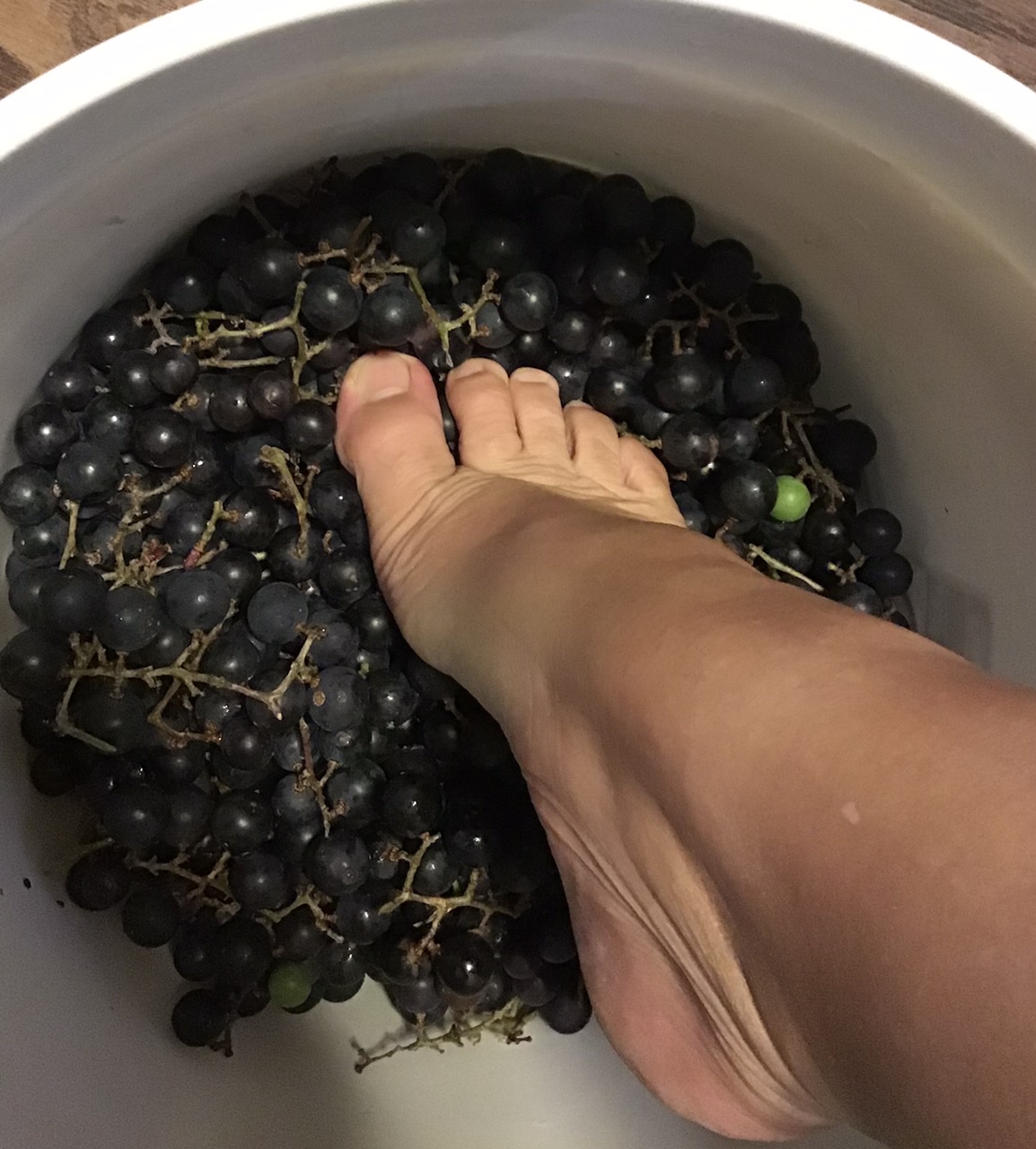
Is It Life, Or Is It Politics?


Money sucks the life out of Life.

While folks argue about what is life, Life has become a fucking clown show.

It’s the conquering aristocracy who calculate their conceptions to the sky clock.  

Normal folk had sex. And had sex, maybe even daily, maybe even from puberty to death.  And the women drank tea each month until they decided not to anymore.  Then they had a baby.  Worked for centuries.

Then came in The Nobles.  The Church. The State. The Medics. Not necessarily in that order.  All there in order to provide protection.

That is, each from the other.

When the nobles, the church, the state, the medics, decided the peasants were having too many babies, or too much sex, or too much leisure, they stepped in.  In order to provide protection.

And then when they needed more soldiers to fight in their future battles, or more souls on the lands they just conquered, they dictated to their peasants, “Have more babies for our nation’s-religion’s-tribe’s greatness!”  

And when they decided once again there were too many babies they dictated to their peasants, “Your babies will be cursed with the plague!” That’s the modern equivalent of “Your babies must be sterilized!” Or, “Your germ-factory children are killing Grandma!”

Or, “Global climate change is caused by overpopulation!”

In the meantime they kill off all the witches who know all the safe brews.  Always, in order to provide protection.

They cry about the horrors of unplanned pregnancy!  Or, the horrors of killing God’s creation! In tandem. In concert.

They leave out the facts.  A woman could potentially have approximately 1, 233 children in her lifetime, according to God.  That’s an approximation, of course.  

A man, good heavens, we’d need a mathematician to calculate that! Harems exist for a reason.

Everything we know about human reproduction originates in animal husbandry.  And it’s absolute nonsense when science and culture claim that all women in a tribe will cycle together with the moon.  

What sort of evolutionary sense does that even make?

The ‘Red Tent’ was always about the tea.

Squash Mysteries

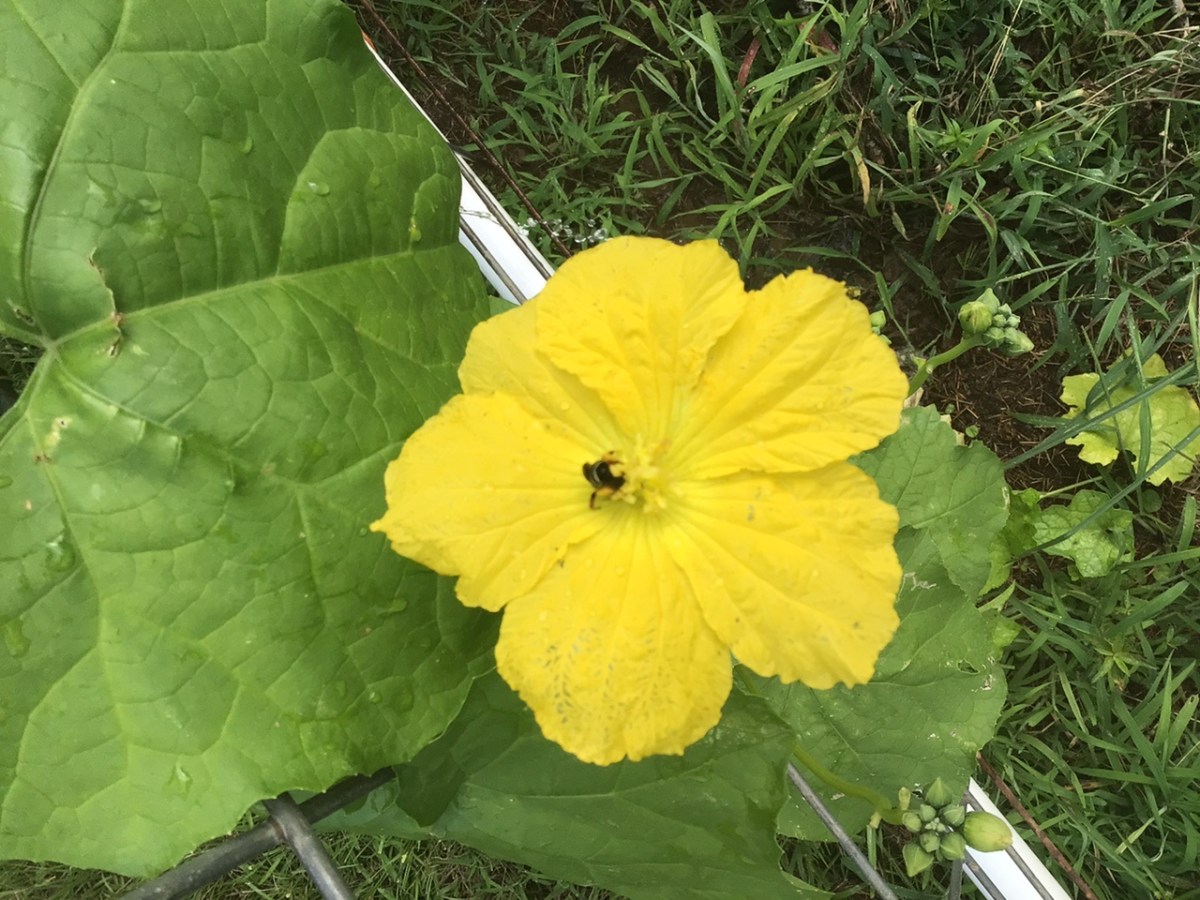
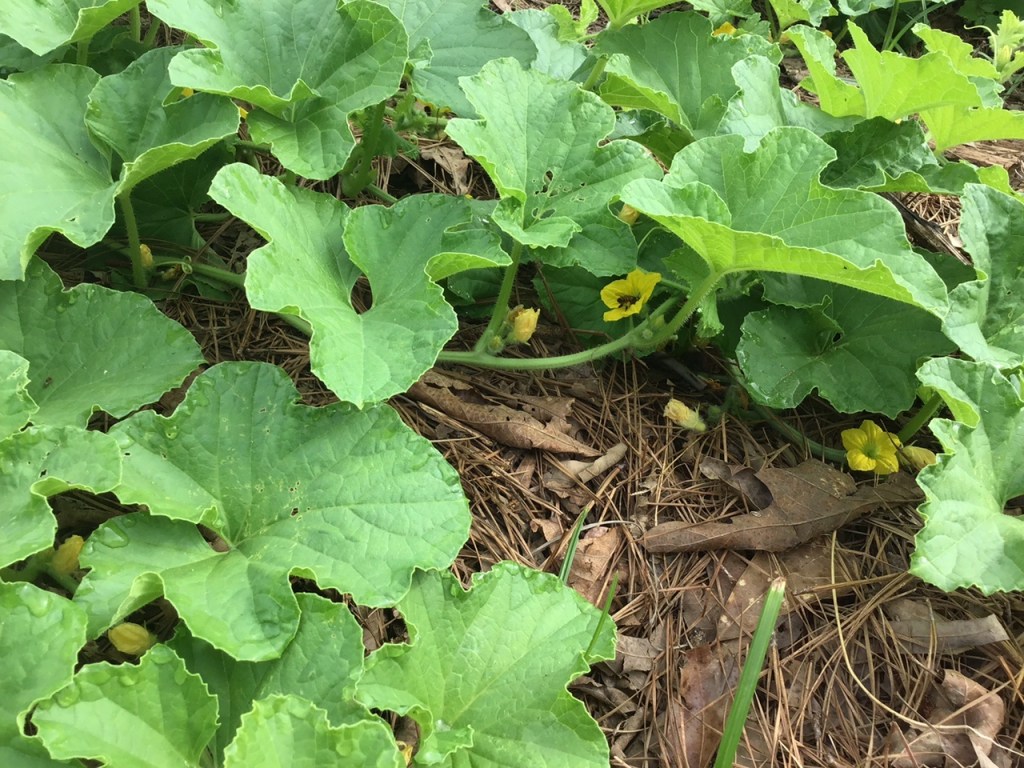
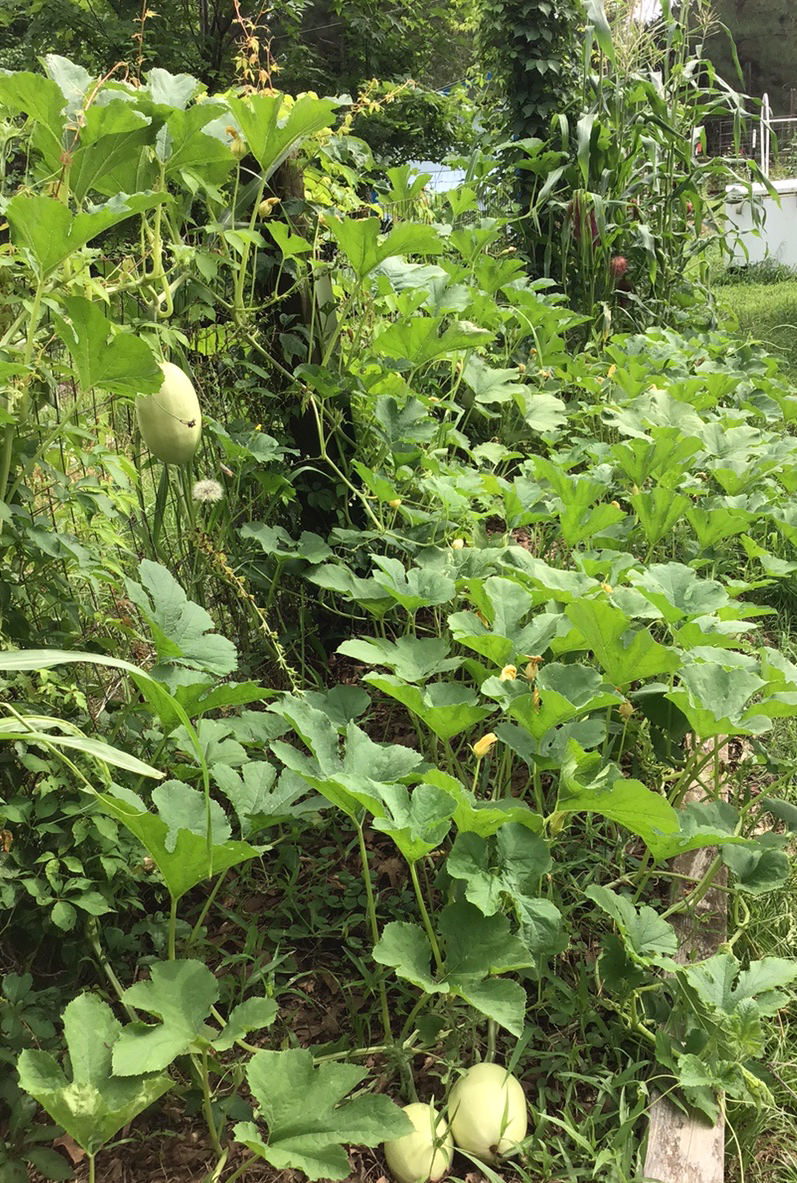
Hey, you bee, you got my cucumber in my Trombetta!
Right?!

Some interesting twists and turns in the garden, as usual.

I did realize that cross-pollinating between cucumbers and squash do occur. It’s result is sometimes ‘parthenocarpic’, fruit that is seedless.

But, different fruits off the same plant?
This is news to me.
But, I’ll bet the Robo-Bees in the future technocrazy will have an ap for that!

These really did come off the same plant, same age, Hubby just happened to harvest some before I got a side-by-side photo. Next time.

I have the big seed-saving goals this year, but there is a learning curve for sure.

Because of space requirements, and that learning curve that seems to be getting steeper by the month, I decided to start with just a few crops. I already do most of the herbs, and the other easy stuff, like okra and sunflowers. I’ve ventured slightly into peppers and tomatoes, with negligable results.

Cucumbers, melons and squash are all in the ‘challenging’ category. I thought I planned correctly when I put the ones I want to seed-save at opposite ends of the garden, but then. . .

In my reference book, The Complete Guide to Saving Seeds by Robert & Cheryl Gough, it seems pretty hopeless. “Recommended isolation distance for varieties that can cross-pollinate is 1 1/2 to 2 miles; recommended isolation distance for other Cucurbita species is 1/4 mile.”

As in, Miles?! Oh my.

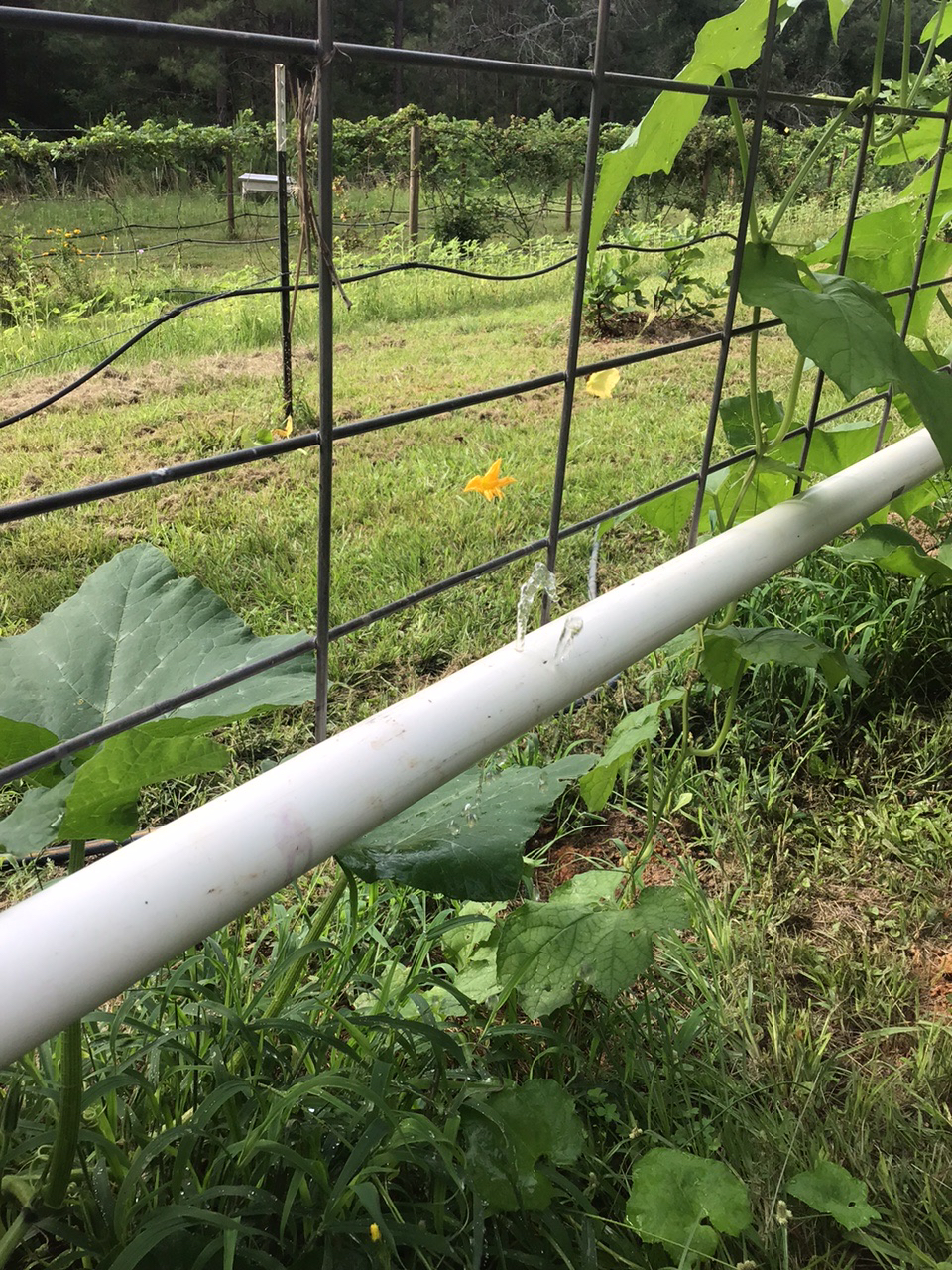
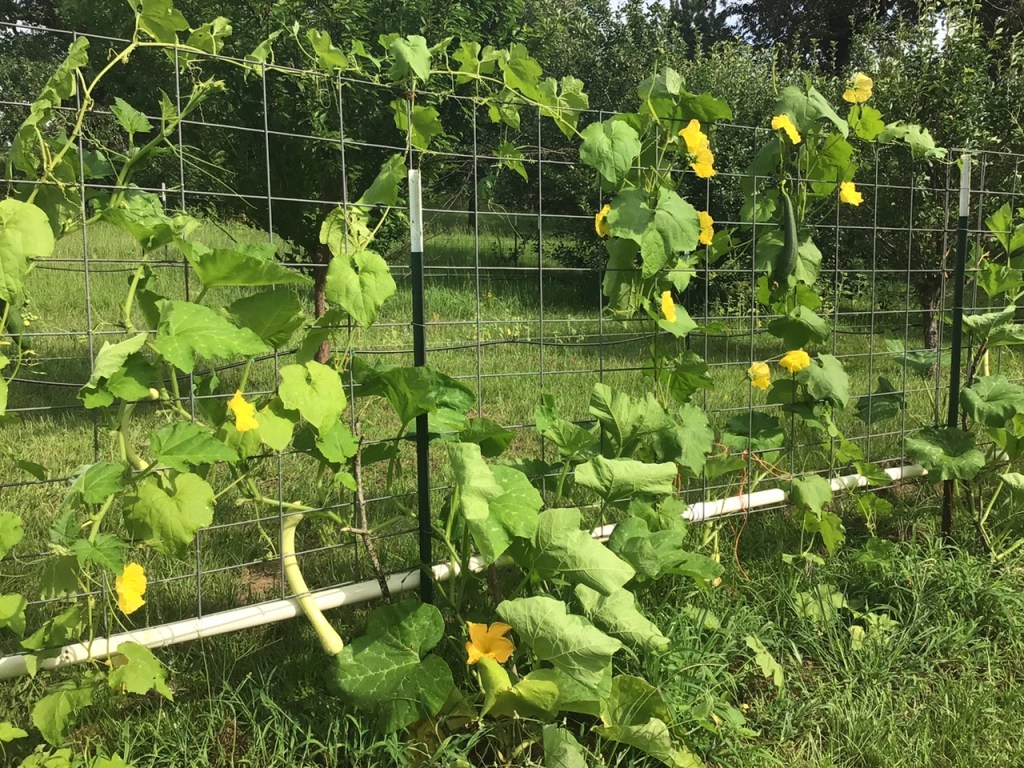
And furthermore, there’s another squash mystery. I’ve got zucchini right by Trombetta, as already mentioned. Yet the zucchini leaves, which look gorgeous, better than I’ve ever seen them, are flowering, and not producing. Yet the cucumbers and Trombetta are producing like crazy, and the Trombetta leaves are not really looking too good.

Any gardener, myself included, would immediately claim a gorgeous zucchini plant flowering just fine, but not producing, is the result of poor pollination.

But, I know, that’s highly unlikely. First, I’ve seen bees on them. Second, the nearby Trombetta and cucumber, also bee-pollinated, are producing just fine.

So, what gives?

And furthermore, more, why does spellcheck capitalize Trombetta and not zucchini?

I’m open to facts, theories, or random guesses.

Homestead Happenings

Busy days on the wee homestead as we try to maximize our production with the swelter season clock ticking. The scheduled weather is HOT and DRY for us for the foreseeable future and just staying on top of the watering is a big task.

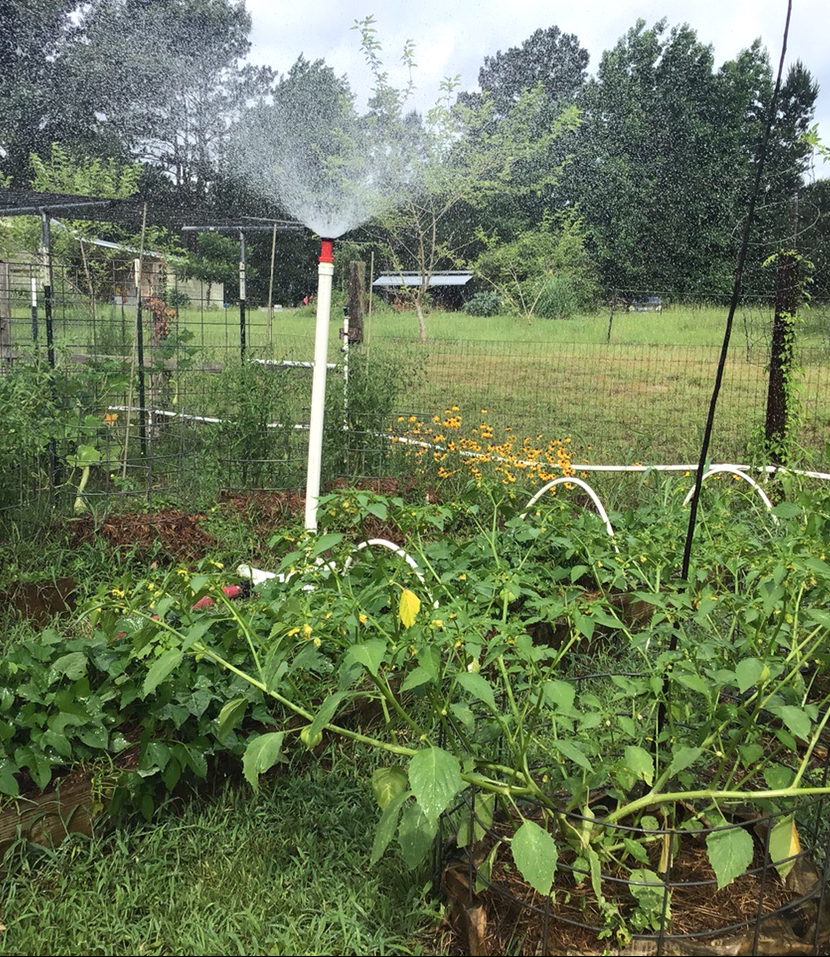
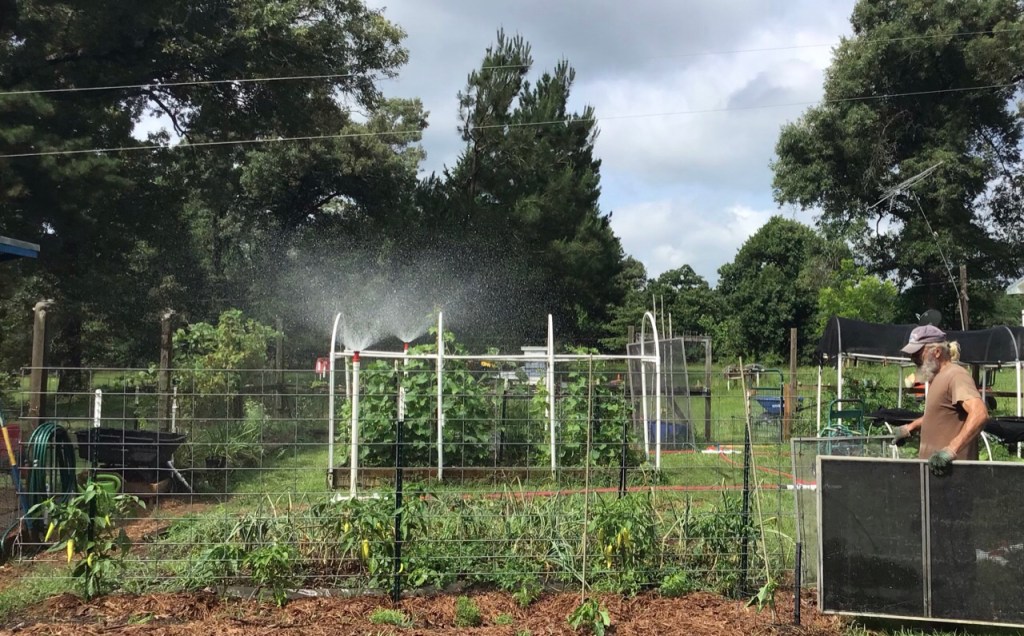
Hubby’s pond water pumping system is a life saver for the plants, but it still requires an entire morning per section in the garden, around the house, in the orchard, which means he’s walking back and forth, moving hoses, rearranging sprinklers, and sweating. It’s not easy, or free, but comparatively it’s our best option and I’m very grateful for it!

Adding shade cloth and screening wherever we can.

And, while I’m on the gratitude train, let’s give a big cheer and thank MAN for the air condition! We’ll be spending much more time indoors for a while, me especially.

Welcome new additions to the garden this year, Poppy and Nigella. Very happy for these, I’ve tried many times for poppies with no luck, and the nigella was gifted from a friend and the blue and white flowers are so darling and the seeds so delicious!

We continue to experiment with different preserving techniques and flavor combinations and it’s SO much more enjoyable for me to have his company and help in this endeavor, now that he’s home all month long!

Last year’s experiments of watermelon rind pickles and melon butter were a fine success we hope to repeat again this summer. Lately he’s also been making cream of mushroom soup from our foraged chanterelles that is SO delicious, as well as blackberry preserves. He’s also canned a bunch of potatoes and made a huge batch of ratatouille for the freezer. That’s a first for both of those, so we’re looking forward to the taste test.

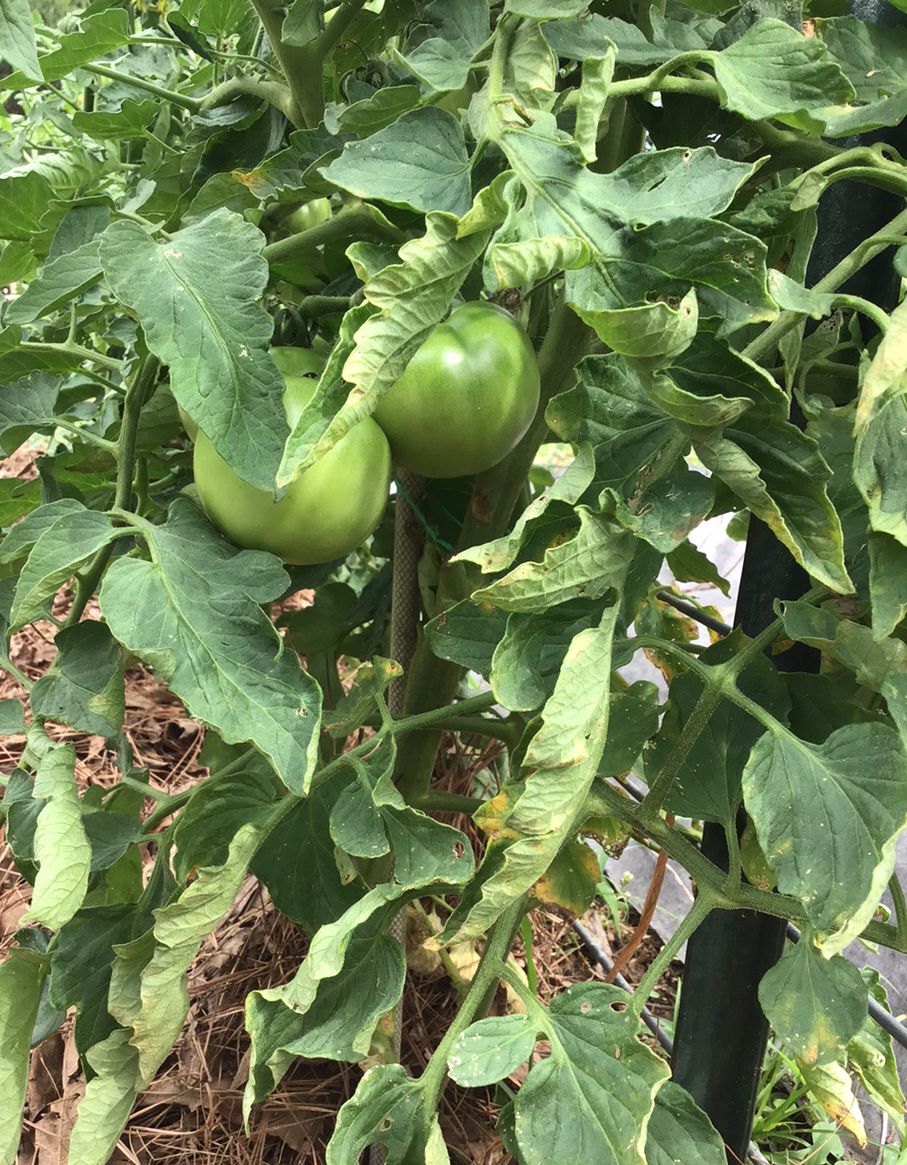
The cucumbers are coming in well, the melons still looking very promising, but the heat is definitely taking its toll on the tomatoes already. That is disappointing because we do love tomatoes and needed to re-stock our marinara this year. Hopefully we’ll find some neighbors with a bumper crop who are willing to trade for some of our prolific squash!

Lots more to share, on another day! 😁
Thanks for stopping by!

Trial & Many Errors

There’s the good kind of failures—like those you are able to remedy; And the bad kind—like those you can’t control; And the worst kind—like those you could control, if only you could figure out what went wrong.

We have a collage of all 3 today!

Failed cheeses, failed fruits, and sun scorch.

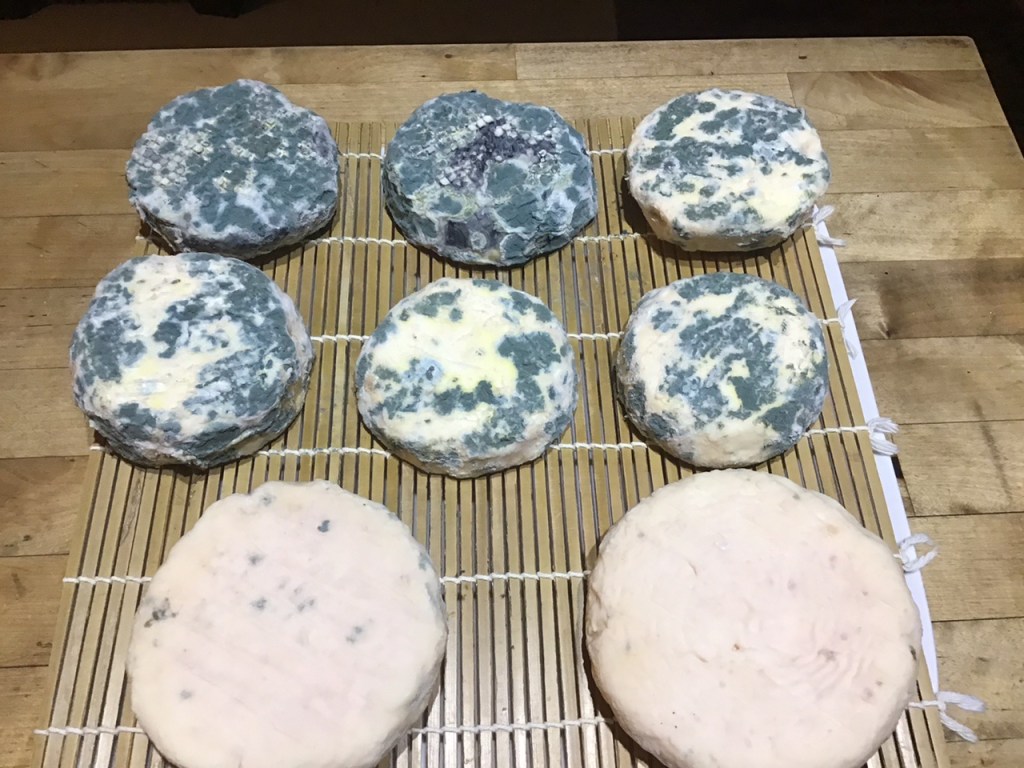
Penicillium roqueforti has dominated my Little Turds and now we have little blue turds, which is a big fat failure.

This is the most aggressive cheese fungus and once the spores get started it’s extremely difficult to correct the issue. As much as I love blue cheese, this is not the process for making it. As a surface mold it does not taste good, it’s the veining of the blue cheese that brings out the nice flavors. I don’t make blue cheese, because in order to make other cheeses you must exclude the blue to get the white (geotrichum candidum),or any others, to dominate.

Even a hobbyist will quickly learn that you need a separate space, equipment and unique aging fridge just for the blues. This particular invasion happened very quickly, in just 2 days, because a beverage fridge does not make a very good aging fridge for cheeses. But, it’s all I’ve got. The temperature varies unexpectedly and you can’t control the humidity. Sure, a lot of cheese makers out there claim there are certain tricks for modifying the humidity levels of the mini-fridge, but they just don’t work, or they are far too high maintenance for me.

The fridge got too cold by just a few degrees, and this was the result. The two without any blue are from an older experiment, also failed, because their white fungal coat is not thick enough. I’m hoping a snug fig wrapping will magically transform the problem. But, I doubt it.

Wrapped in fig leaves (with a bit of sage on one too, to cover the naked parts) back into their Tuperware-fashioned high-humidity space, and back into the aging fridge.

As for the little blue turds, I’m going for maximum shock treatment, just to continue the experiment at this point, because I think they are beyond repair. I have them at room temperature now and I might even try spraying on some geotrichum candidum, just to see what happens.

The orchard is a continual string of failures, the nectarines being just the latest one. We’ve planted so many fruit trees in there we’ve lost track. We planted a couple of plums, one that actually produced for a couple of years, then both suddenly died. The grapes are looking terrible this year, the apples hardly ever bloom and never produce any fruit, the peaches die a year or two after planting, and now we finally got some nectarines and they look like this. The worst part is, once you cut out all the bad parts, the few nibbles of good fruit you have left are absolutely delicious.

Oozing and pock-marked and tiny. ☹️

We’ve got one reliable pear tree, another two that get a great crop about every 3 years. And the figs, my favorite, that are on some boom-bust mystery cycle we haven’t figured out.

Hubby is beyond frustrated with the fruit trees, so he’s got a mini-project filling up the orchard now, his own hog feed production line.

I think he’s trying to teach those miserable fruit trees a lesson by planting a thriving row of squashes between the rows as feed for the pigs. The cost of feed is getting crazy! And of course, we’d much rather feed the pigs off the land. Trombetta and chayote squashes, and luffa, are growing great and will soon make for some happy pigs.

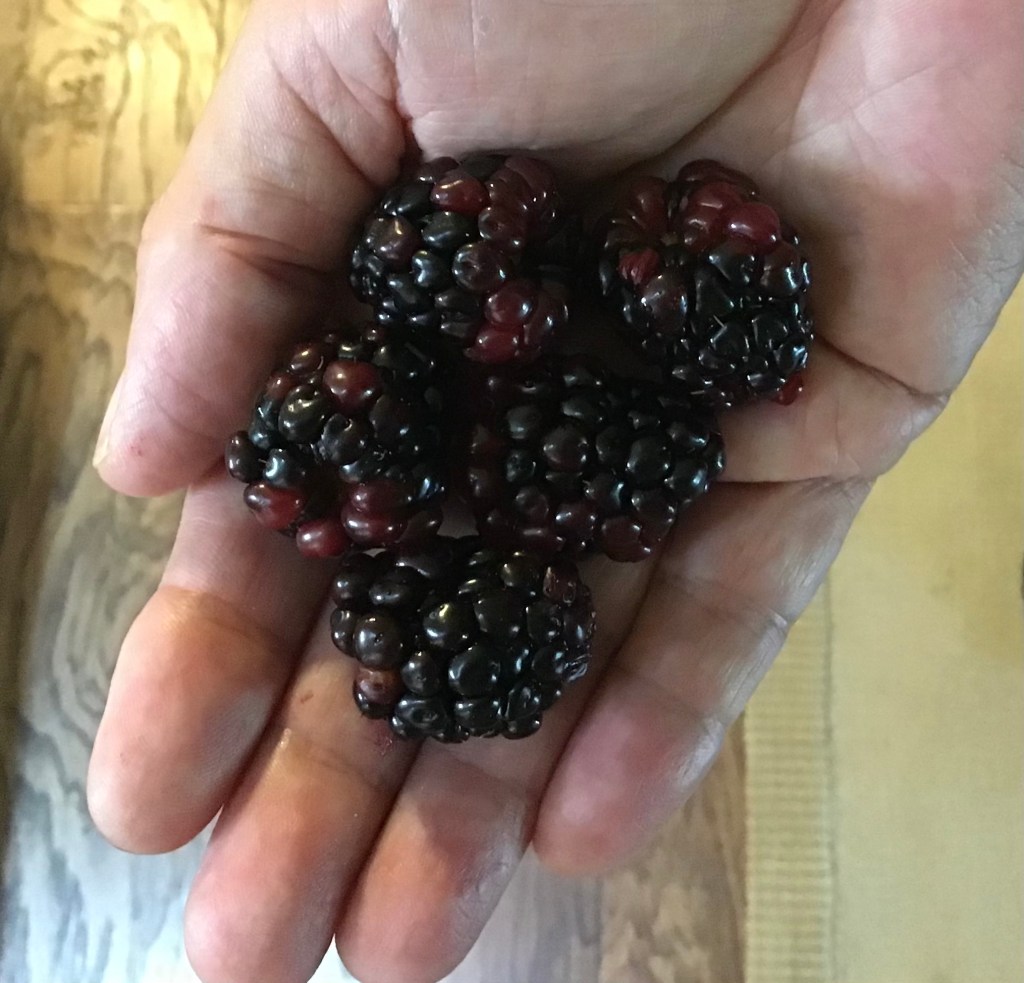
Luckily we at least have some giant blackberries to soothe our disappointments a bit.

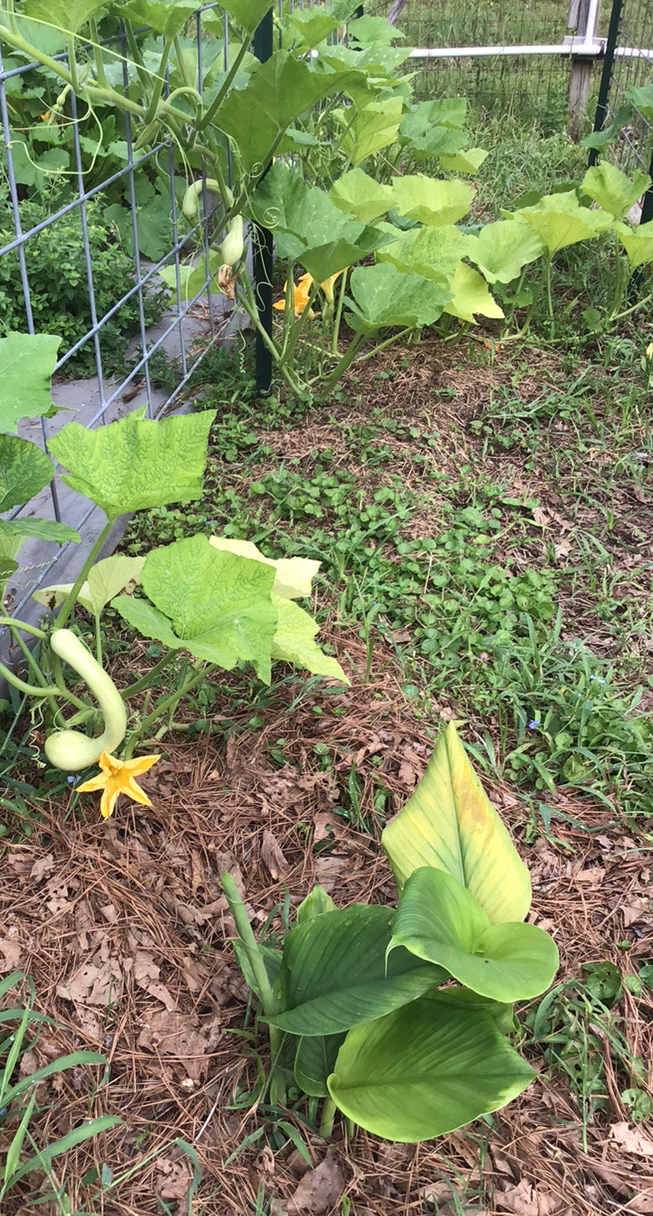
While the garden is still hanging in there despite intense heat and very little rain, the signs of stress have already started. Even heat lovers like the turmeric are getting sun scald. The leaves of the tomatoes and tomatillos are looking equally sad. I’ve covered what I can with shade cloth and screening, and I’ve got my fingers crossed, and that’s about all I can do about that.

Sir Turmeric has a sunburn and Trombetta’s leaves are looking sad.

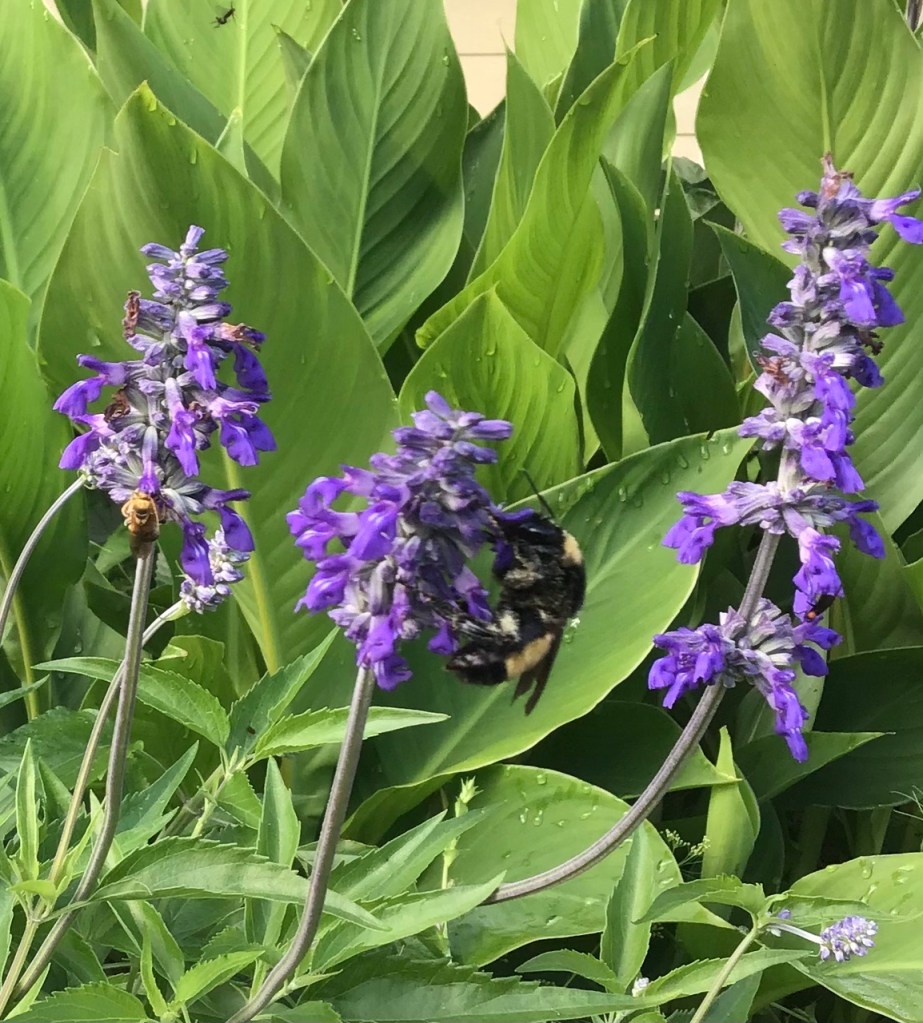
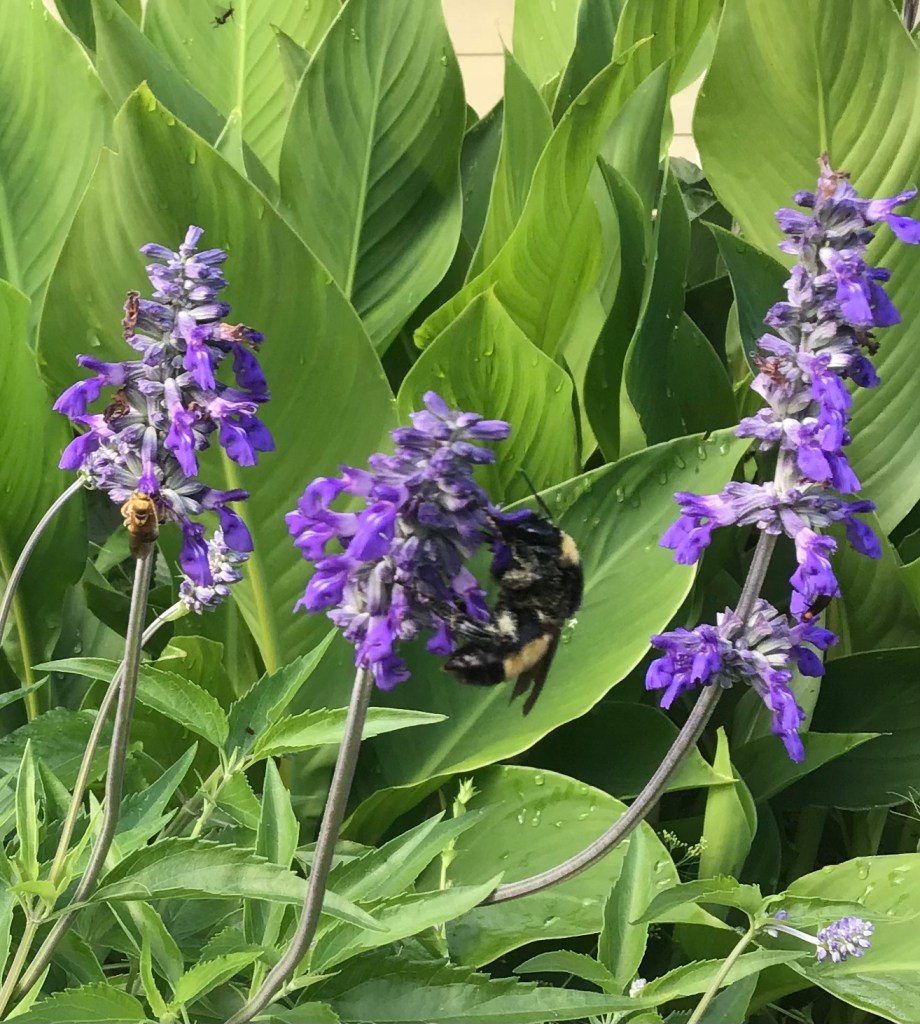
If the melons disappoint me again this year, at least I can feel better knowing the bees were very pleased. That is, except for the little bitch who stung me on the middle finger while I was harvesting cucumbers. The simplest of all these problems to solve—must wear gloves now while harvesting.

The Noir des Carnes cantaloupes alive with so many buzzing bees!

Oh, and last but not least, the shallots never bulbed. No idea why. I bet Bubba knows, but he’s not talking.

Homestead Happy Snaps

I have so very much I could be reporting on from the wee homestead, but I only have the energy to share some photos, a couple short vids and a few brief comments.

We’ve got some really weird weather that has us back in long sleeves and pants after a few weeks of blistering heat. I have no time to get started down that fool’s path at the moment. Moving along.

The bees have finally graced us with their presence in the garden, I was getting a bit worried! They are all over the cucumbers, which we’ve just started harvesting.

They also found the cantaloupe at last, thank goodness, this is my primo experiment for this summer. This is a true heirloom French cantaloupe, Noir des Carmes, which you can’t buy anywhere in these parts. I learned from the seed catalogue that what we call cantaloupe in the U.S. was renamed, these ’muskmelons’ in green or orange (with the ‘netted’ skin) are not the original cantaloupe, which does not ship well, and so was never popularized here.

“Noir des carmes” cantaloupe, named after the Carmelite monks.

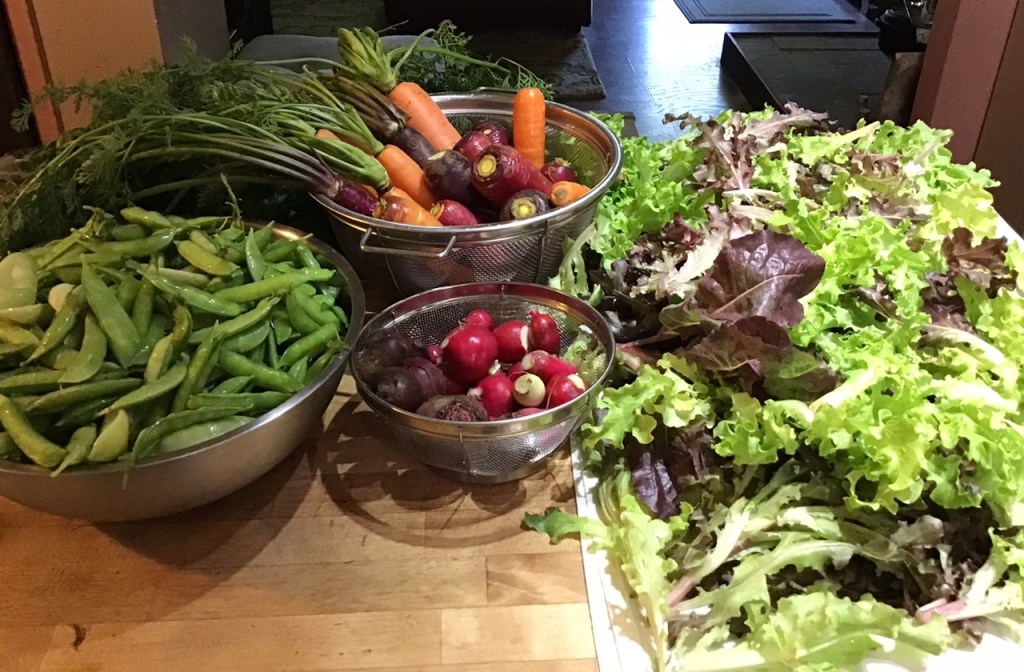
Hubby had some surprising success with peas in his ’gorilla garden’ — a new experiment. We were gifted a garbage bag full of seeds, some of them 8 years old, which I thought would be useless. He threw them down in a spot he’d roto-tilled for the purpose, mixed up all the cool-season seeds together and broadcast them, watered them a couple of times, and we actually got a big bowl of peas out of the effort. I so love fresh peas and they are not always a reliable crop around here. He planted them later than advised too, so I was very surprised he got anything at all. He estimates germination at about 20%.

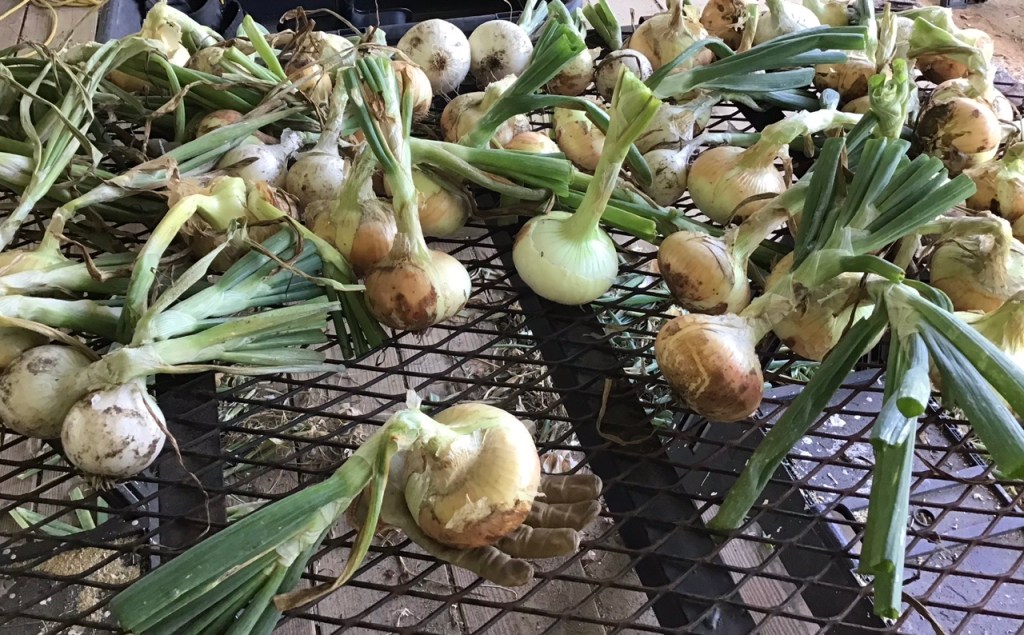
We got a great harvest of onions and canned up a couple of batches of French Onion Soup, mmmm. I have my glove under one in the middle photo to show their nice size. It was our best onion harvest to date, and I think that is owed to all the sheep poop and the mild winter.

I was proudly exclaiming to Hubby some kudos on our team effort with pressure canning the soup when he had to burst my little bubble by explaining how that makes us one teeny-tiny fraction closer to the recommended annual Ball Blue Book chart from 1966.

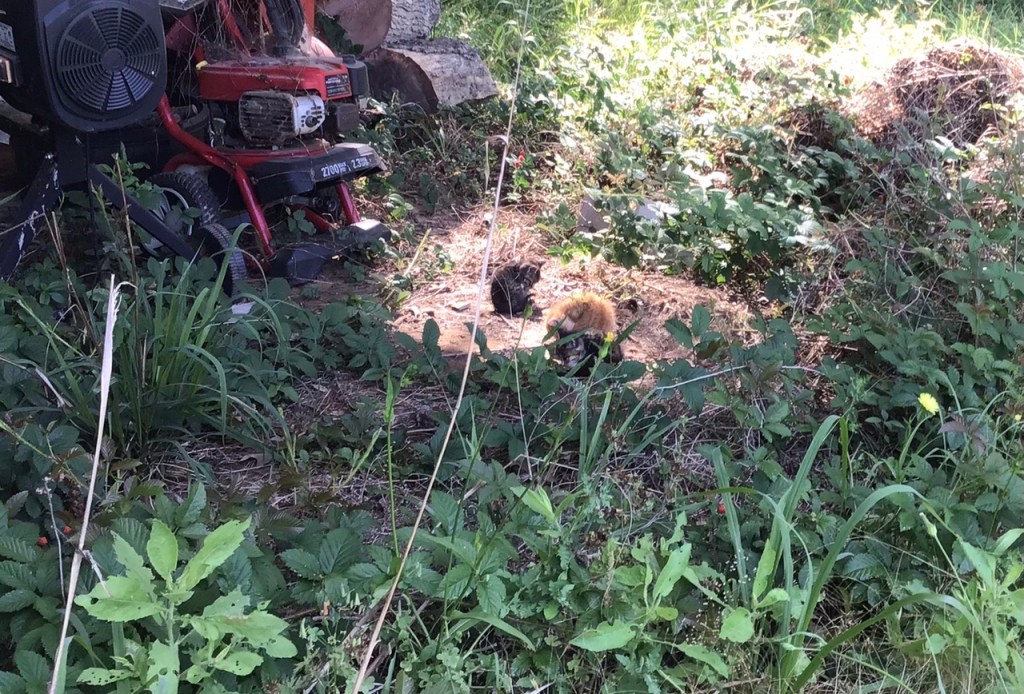
We have kittens! We just happened upon them in the old tractor barn while gathering dewberries.

The kids are growing SO fast!

They are following mamas into the woods, playing and jumping around and are so fun to watch.

Once again, I did not mean to hit ’slow mo’ on this short vid, but it’s a good thing I did, because you can really see the ‘look’ of triumph in Walnut’s demeanor after she bullied tiny Athena. I guess goats are something of a belligerent species!

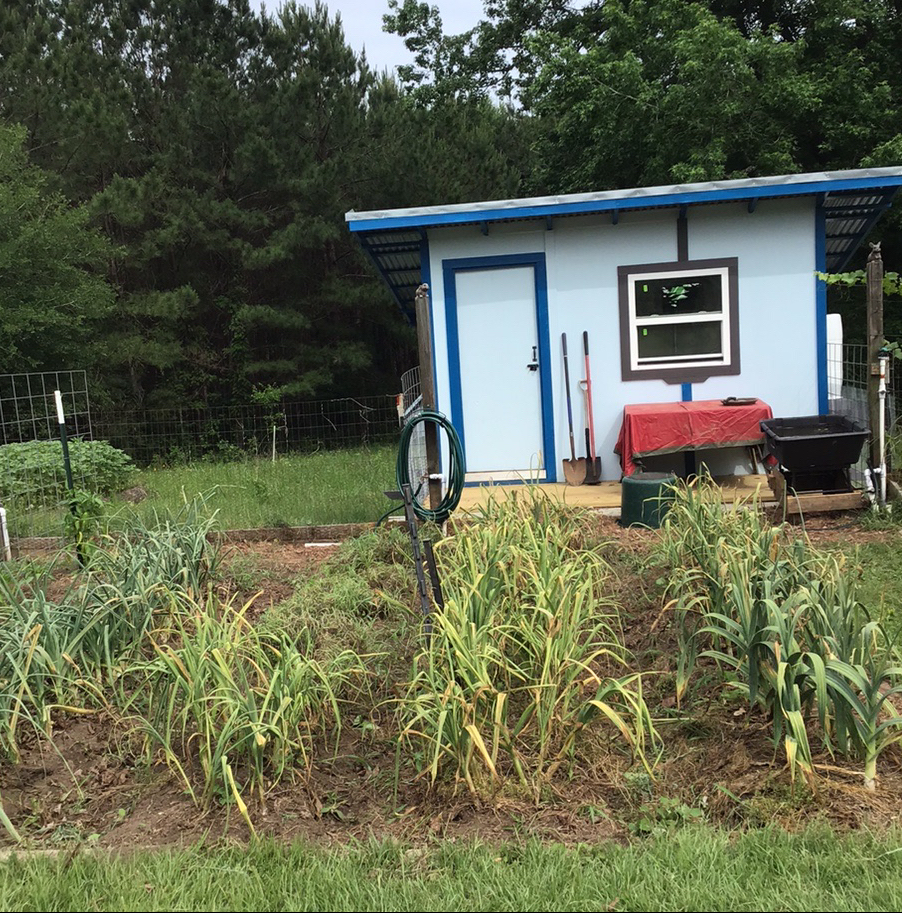
And to end, the best part, my new She-shed, thanks to Hubby, which will get an entire post of its own very soon!

Garlic still to be harvested in front of my recycled garden shed—
Oh the joys of being at the top of Hubby’s to-do list!

A Bit on Gardening

“He is grumpy and coarse and all the things I was warned about. He takes his contest with nature very seriously and finds no comfort in its unpredictable forces. Like most gardeners, he never vacations. In winter when all is quiet and still, he would much rather spend his time fretting—about the fruit trees budding, about the relentless springs frosts that may or may not come, about the sun and the moon. Gardeners, I discovered, are tough, content to be grim”

The Cook and the Gardener: A Year of Recipes and Writings From the French Countryside by Amanda Hesser, 1999

Forbidden Cheeses: Little Turd & Wetnurse Breast

I ran out of attention span last post before I got to talking about cheese. Now that we have three mamas in milk I’ll be having a ball experimenting with new cheeses, which along with kombucha experimenting, is my favorite homesteady sort of thing to do.

Gardening and cooking being not far behind, to be sure!

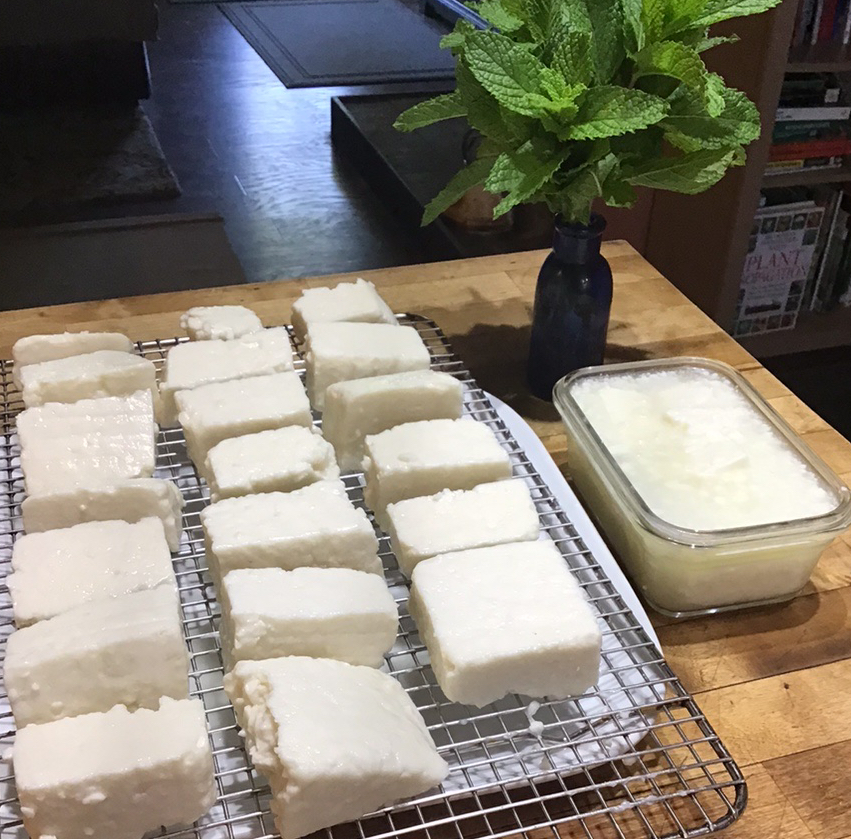
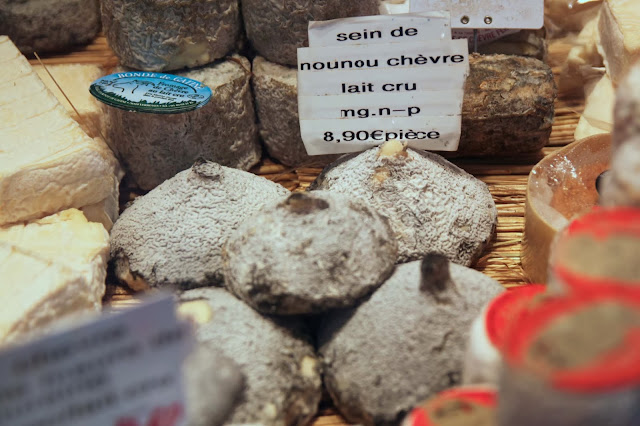
Aged chèvre (goat cheese) in the French tradition is made of the highest craft and care, even when they are whimsically-named, like Crottin (Little Turd) and Sein de NouNou (Wetnurse breast).

But here in the U.S., Land of the FreeTM, Velveeta is ‘safe’ for consumers and aged goat cheeses, ideal for homestead creation, are completely illegal.

Because they care so very much, right?

“Chèvre evolved in frugal farming households of the sort that continue to make it today. It is a cheese that’s very economical, in both time and ingredients; made on the family farm, where there are many chores to take care of and livestock to feed, a cheese that didn’t need much attention or many costly ingredients fit right in.”

That is in Central France and other locations where it’s not illegal to sell. These are cheeses that require few inputs and no regular purchases—you don’t need a cheese press, or any expensive cultures, or even rennet. Fig sap (or other coagulants like nettles) can easily be substituted for rennet as only a few drops are used to set a gallon of milk.

These are also cheeses suitable to make in warm climates, similar to the more well-known goat cheeses like Feta or a fresh goat cheese. What makes the aged chèvre so unique is that it can only be made with raw milk. You may find hard raw milk cheeses in your grocery store or farmer’s market, like Gouda or Cheddar, these are pressed cheeses aged over two months, which are legal to sell with all the proper licensing. (I have NO interest in that!)

Feta, aged in salted whey for 2 weeks, some still soaking for a sharper flavor and others now drying for packaging in Foodsaver bags for longer storage.

These illegal aged goat cheeses sit at room temperature for about four days.

Imagine the horror the germophobes have with that!

You most certainly can’t do that with pasteurized milk. These cheeses were invented before pasteurization and before refrigeration and aged for a month or two in caves.
Mine will be aged in Tupperware bins inside a small beverage fridge I use for aging cheeses. (I would prefer not to use plastics at all, but they work just fine and I don’t have other options at the moment.).

I use natural cultures, not store-bought or freeze-dried, developed from previous cheeses, and stored in the freezer. Once the cheeses develop their fungal coat after a couple of weeks, they will be wrapped and aged for about a month.

Traditionally wrapping for these cheeses include leaves, like grape and fig, and even hornet’s nests. A few will also be coated with ash, instead of wrapping, like the traditional Sein de NouNou.

It is positively amazing how differently the cheeses will taste based on just a few variables in the process!

“Relatively unknown in North America, this class of cheeses includes some of France’s most famous fromages: ash-coated and pyramid-shaped Valencay; Sainte Maure—pierced with a blade of straw (the industrial version of Sainte Maure features plastic straws!); and small, moldy Crottin are all aged chèvre cheeses. Perhaps the only well-known North American aged chèvre is Humboldt Fog, a creamy, ash-ripened goats’ milk cheese from Humboldt County, California.”

(I’ve not looked into why or how the Humboldt Fog is legal to mass produce and sell. I plan to dig into that, but my initial guess is they’ve been able to either find a way to use pasteurized goat milk or they have a state-of-the-art affinage ‘cave’ where they can age it over two months without losing the creamy texture.)

“Goats are a belligerent species that have rejected the rigorous production regime thrust upon their bovine cousins. Unlike cows, who contentedly chew their cud in confinement and produce enormous quantities of milk year-round, goats refuse to be cogs in the machine of industrialized dairying.”

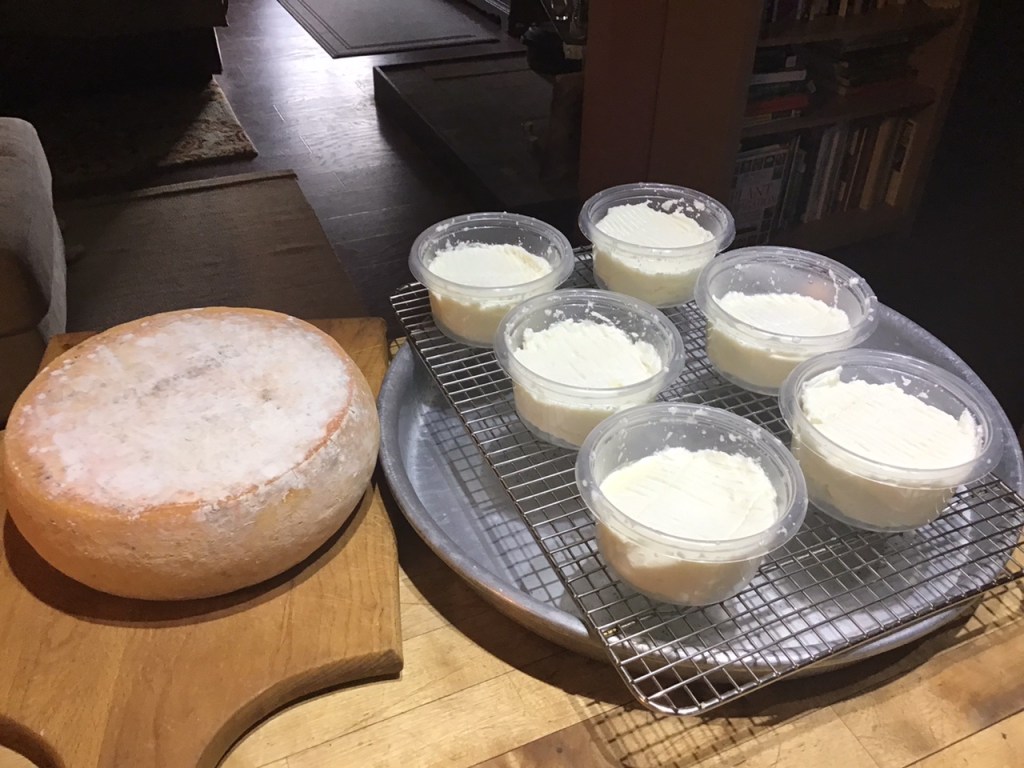
On left: Cutting into the last Kensho cheese experiment, aged two months, a washed-rind cheese similar to something between a Muenster and Gouda.
Result: Delicious Success!

A most excellent resource, and the source of the above quotes:

Goats, a belligerent species? HA!
The perfectly adorable non-conformists more like!

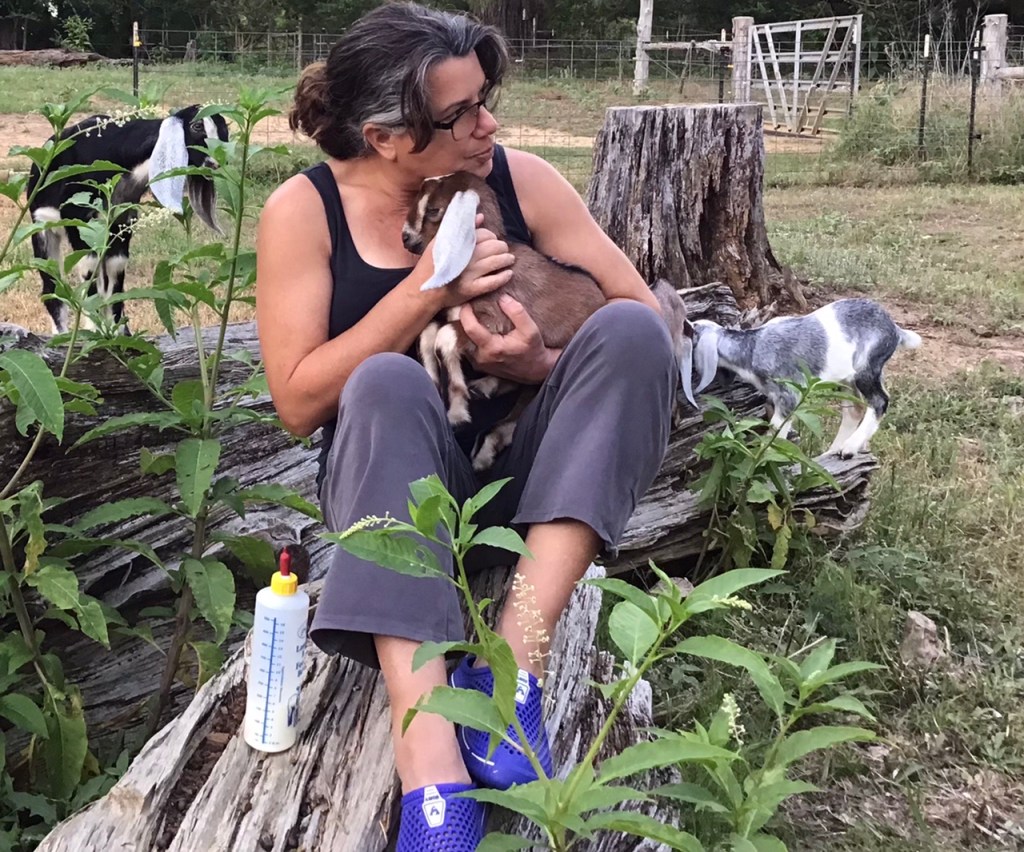
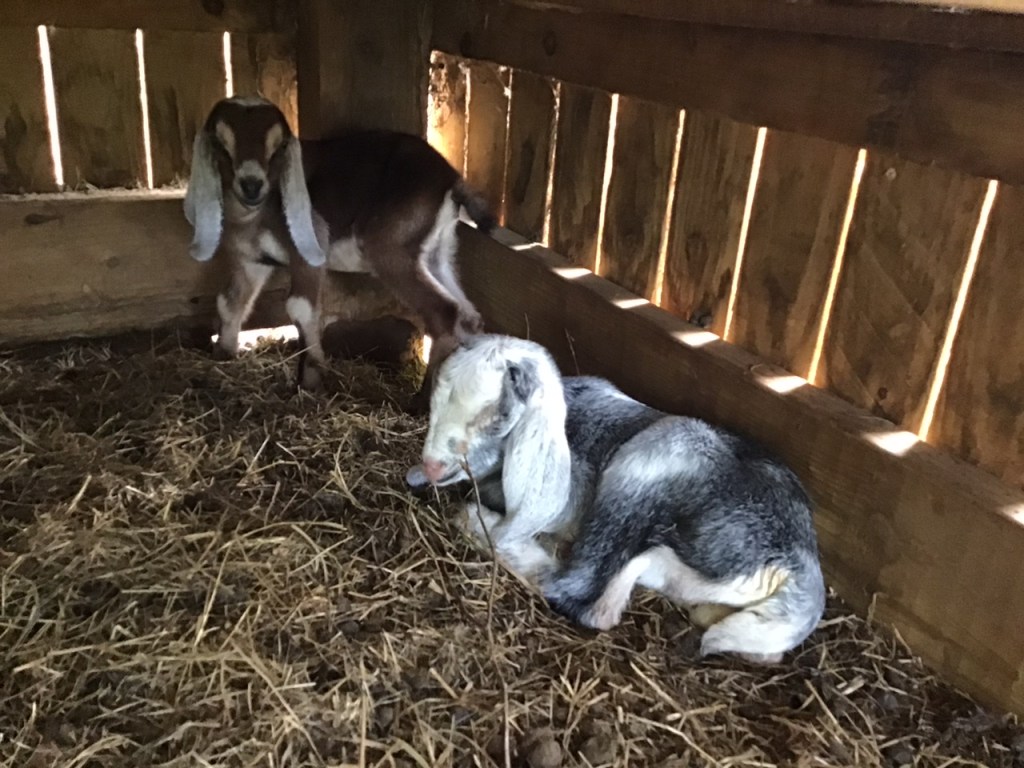
The latest and last addition to the herd this year (in the foreground) yet to be named, and already twice the size of our wee Athena (in the background, about 5 days old), formerly Zena, we decided we prefer the former.
Any name suggestions on our newest? We are at a loss so far with this big girl who is sure to be a lifetime keeper! She came out huge and most active and ready to suckle immediately and play within 1 day!

Kids, Kombucha, Bees & Cheese 

What better day to ponder than Mother’s Day why kids are so darn cute?!

The newest kids, born yesterday, Phoebe’s firsts—Hercules & Zena—notice he is twice the size of her!

We’ve bartered or sold most of our piglets already. We’re not on social media where such information is exchanged, but it certainly does seem the homesteading community in our area is growing rapidly. Yippie!

One family who came by insisted we were under-profiting from our piglets. Their 11-year old daughter offered her mom to pay us $50 more than we were charging, ‘for the cuteness factor’. Aren’t kids precious!

In not-so-cute news, the swelter season has started abruptly. Bye, bye beets and broccoli, before your time, because I think not even the shade cloth can save you now. The last rain that was hyped on about for days, that flooded some areas and caused tornadoes in others, yielded us a whopping 1/4 inch, not even enough to penetrate the mulch layer.

Of course I’m happy we didn’t get hit with another tornado, but I can still be miffed I have to start watering the garden. Half my roses haven’t even bloomed yet, or the zinnias. The parsley and celery have gone to seed before I got a decent harvest from them and the lettuce will soon follow, no doubt.

The bees are feeling it, too. I checked these hives last week and they were just half-full, yet the bees are bearding. Unfortunately, the swarm we got a couple of weeks ago left after only one day, unhappy with the digs I’d offered apparently. Now it’s already too hot for me to do the splits I’d planned. Better luck next spring.

I’m so pleased to be getting any strawberry harvest at all, they’ve never done well before. Then I saw this video and quickly got a reality check.

Hubby tried to make me feel better by saying those were probably grown in California and loaded with pesticides harvested by illegal aliens. He’s mentioned before something is off about this (Fabulous!) channel. It must be CGI, or heavily staged, or something. Never has a country cottage been so clean and picturesque. Where’s the chicken poop on the table and the flower pots dug up by the puppies? Good questions!

By ‘doing well’ I see I need to learn a thing or two about growing strawberries. They are too crowded and between the humidity and the wet mulch they are mostly half-rotted by the time they get ripe. I’m really loving the strawberry kombucha though! As well as the blackberry, and mulberry. I’ve started making the kombucha tea from yaupon, which grows like a weed around here. It’s delicious and sweeter than the store-bought green tea I usually use.

And speaking of mulberries, what a great surprise, Hubby found a full grown, wild mulberry tree in a spot we walk by regularly and never noticed before. What a treasure hidden in plain site!

More mulberries, please!

And this post has reached my attention span limit, so I leave the cheese to the next post. It’s gonna be a good one all on its on, really! Stay tuned!

Instead I exit abruptly, like spring has done in East Texas, with this quick lesson from Bubba in best yoga techniques.

The ’Just Chill’ technique ala Bubba