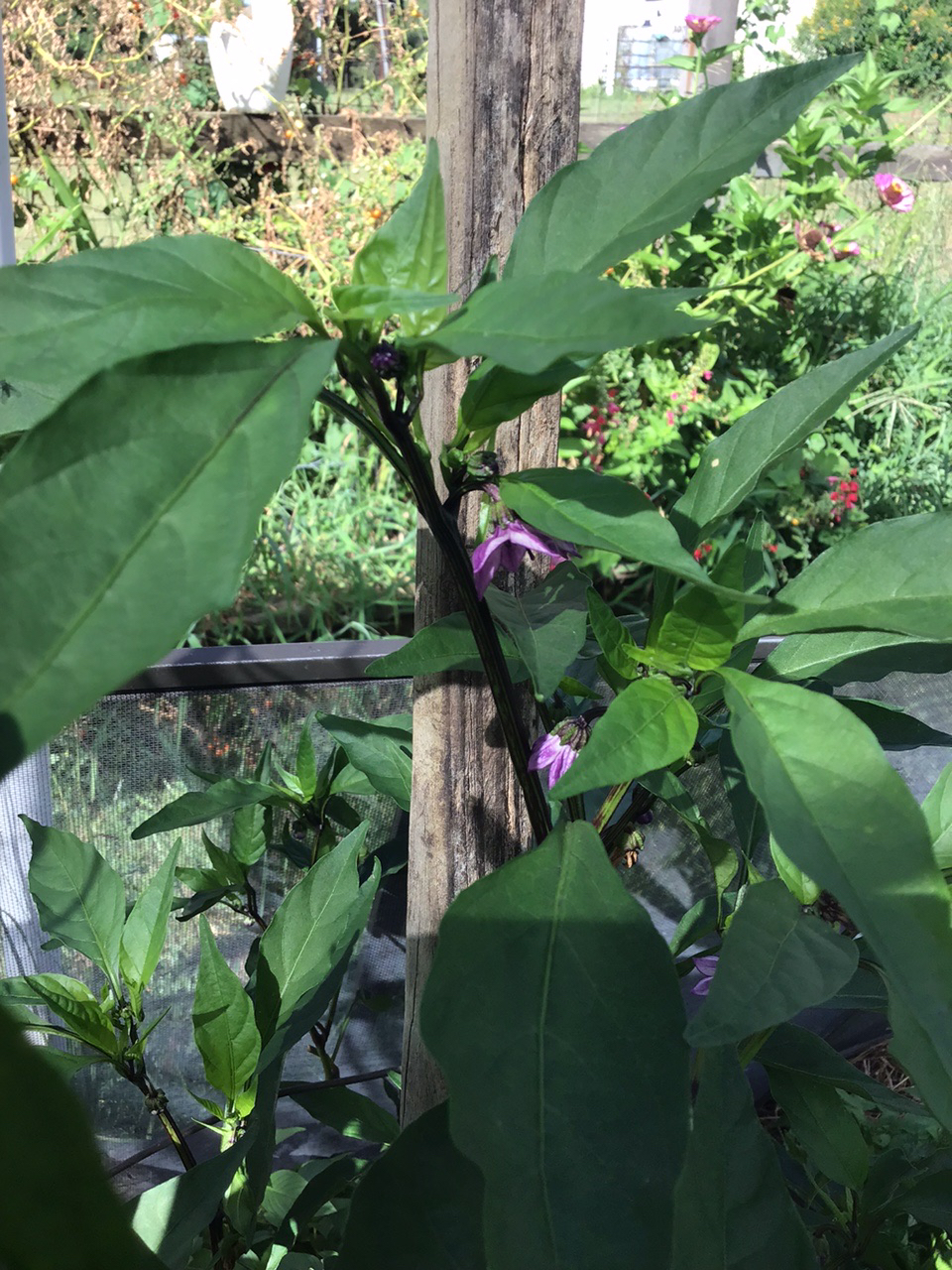
These really did come off the same plant, same age, Hubby just happened to harvest some before I got a side-by-side photo. Next time.
I have the big seed-saving goals this year, but there is a learning curve for sure.
Because of space requirements, and that learning curve that seems to be getting steeper by the month, I decided to start with just a few crops. I already do most of the herbs, and the other easy stuff, like okra and sunflowers. I’ve ventured slightly into peppers and tomatoes, with negligable results.
Cucumbers, melons and squash are all in the ‘challenging’ category. I thought I planned correctly when I put the ones I want to seed-save at opposite ends of the garden, but then. . .
In my reference book, The Complete Guide to Saving Seeds by Robert & Cheryl Gough, it seems pretty hopeless. “Recommended isolation distance for varieties that can cross-pollinate is 1 1/2 to 2 miles; recommended isolation distance for other Cucurbita species is 1/4 mile.”
As in, Miles?! Oh my.
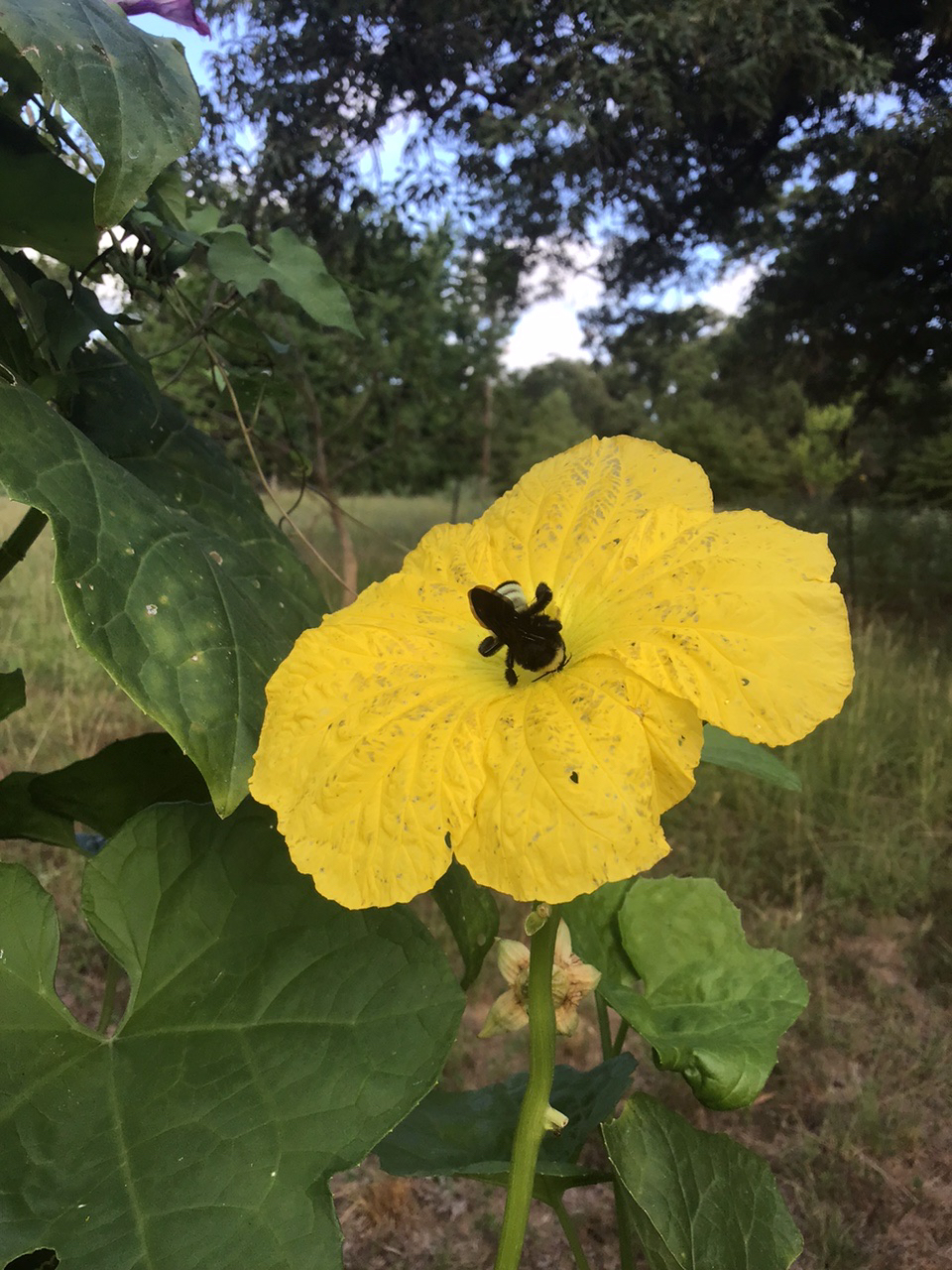
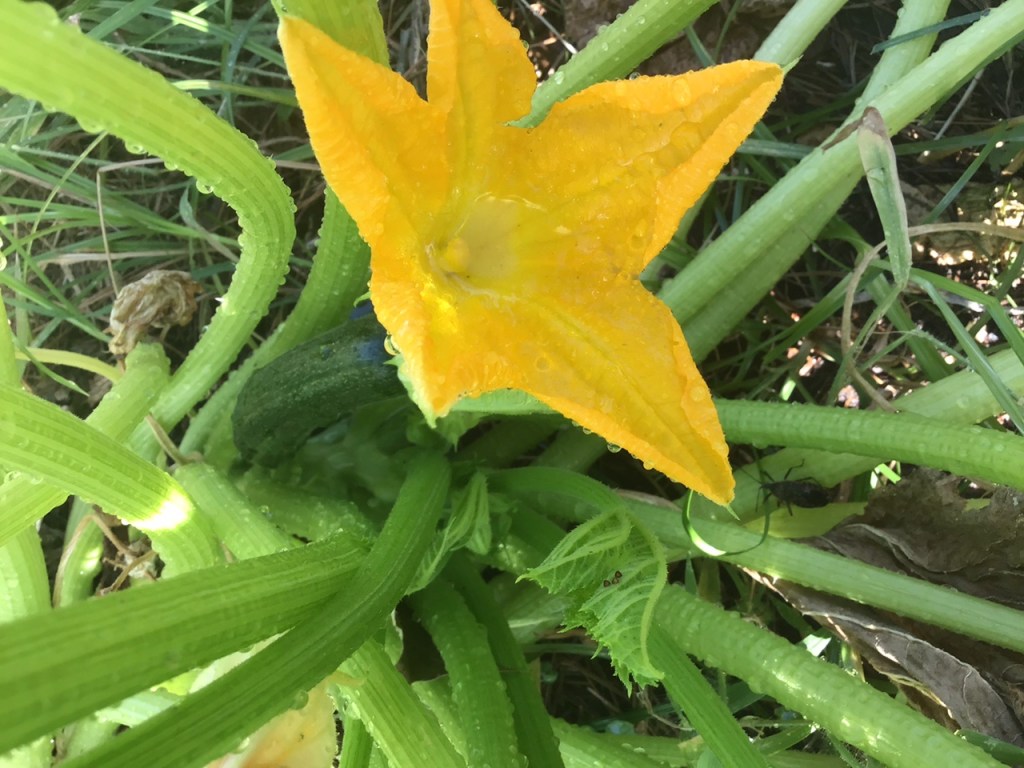
And furthermore, there’s another squash mystery. I’ve got zucchini right by Trombetta, as already mentioned. Yet the zucchini leaves, which look gorgeous, better than I’ve ever seen them, are flowering, and not producing. Yet the cucumbers and Trombetta are producing like crazy, and the Trombetta leaves are not really looking too good.
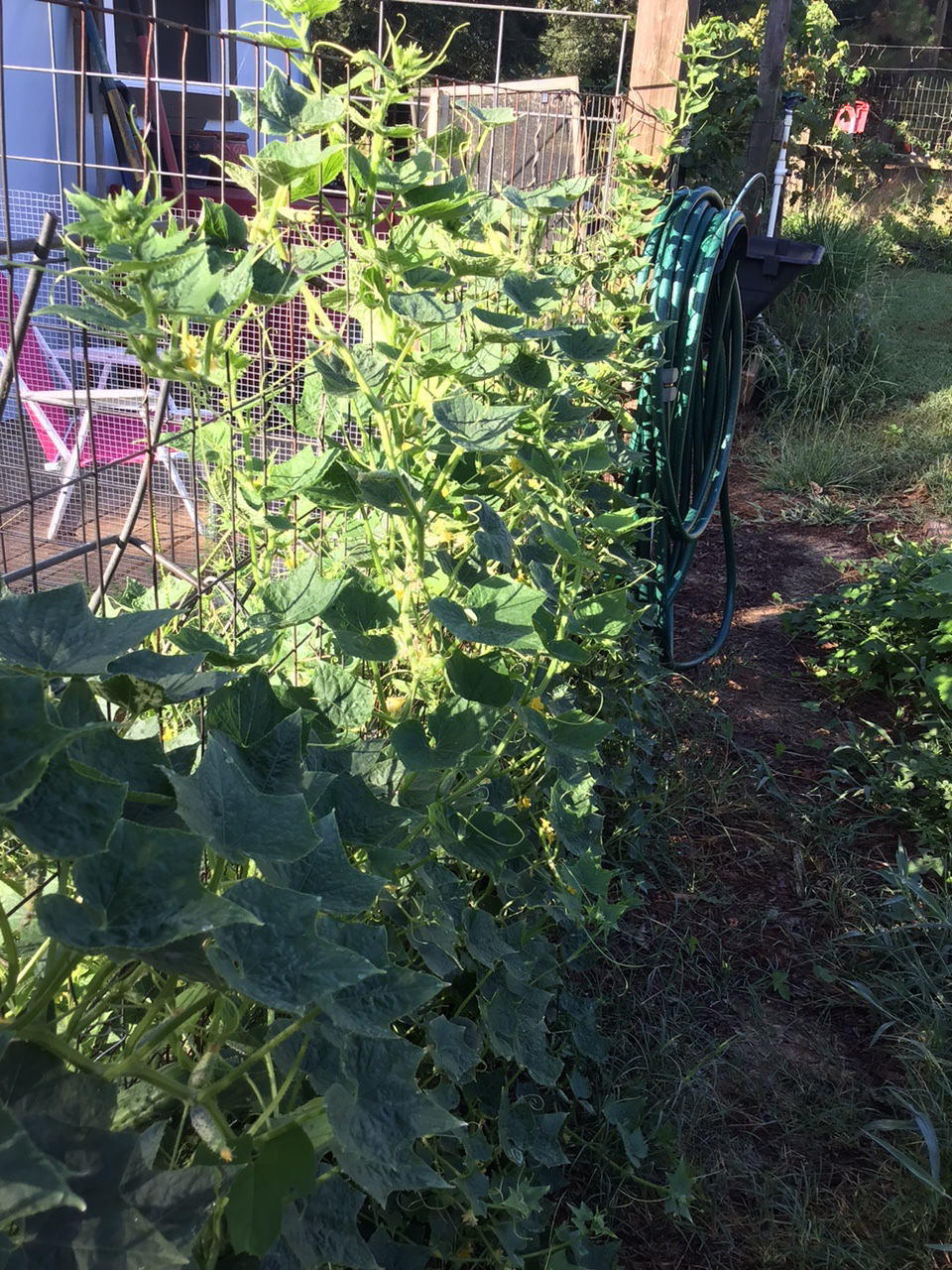
Zucchini in foreground looking happy, Trombetta at left, yellowing
Any gardener, myself included, would immediately claim a gorgeous zucchini plant flowering just fine, but not producing, is the result of poor pollination.
But, I know, that’s highly unlikely. First, I’ve seen bees on them. Second, the nearby Trombetta and cucumber, also bee-pollinated, are producing just fine.
So, what gives?
And furthermore, more, why does spellcheck capitalize Trombetta and not zucchini?
Just what are the Globalists and their minions taking from us, really?
They are stealing our wealth, that much is very clear. In that move they are accumulating enormous power, those two go hand in hand. They are creating a monoculture—their ideal “One World”—which on the surface to a great many around the world sounds like a nice thing.
These folks, mostly the young and those of ‘aspiring’ economies, expect to see more opportunities, a more equal distribution of resources, better access to education, a higher standard of living.
I want those things for them too.
This doesn’t sell as well in the U.S. and other Western countries. Our standard of living is already quite high, relatively speaking. So the promotion angle of their scheme is different with us. We get verbally spanked for being too successful.
We get optimal inflation and free training in resilience and a taste of tyranny and are expected to be grateful for it.
Whether you buy into the Globalist socio-economic vision or expect to benefit from it is the crux of most folks’ concern—either for or against—if they are concerned at all.
But what’s really being stolen, the root of the issue, as I see it, is much more serious than material gains or losses, or more convenient global commerce. Or mass immigration. Or even a totalitarian takeover.
Both Hubby and I were avid travelers when we met, and continued in that vein for many years afterwards. Most of this was before widespread use of the internet, when traveling alone was really traveling alone. If you got homesick you waited two weeks for a letter, or stood in line at the pay phone, or just suffered through it.
Mark Twain has supposedly said, “Traveling makes you humble.” I believe he meant the real kind of travel, not the group tours through Europe hitting ten capitals in ten days brand of modern tourism. No military base or corporate job or trust fund to cling to either. Those types are real traveling about as much as glamping resembles real camping.
To be a stranger in a strange land is a consciousness altering and life changing experience. When I saw McDonalds and signs in English and waves of expats, I got my fill of nostalgia quickly, and moved on. I experienced lots of loneliness. LOTS. I was scared sometimes. I put myself in some compromising positions, which I then had to navigate without the safety nets of language, cultural familiarity, kinship, or commraderie. “Travails” —that is the deepest purpose of travel and what separates a traveler from a tourist, or an occupier.
When I see signs in this country in Spanish or Chinese I feel sorry for those travelers, or immigrants. They are missing something essential through our obsession with making everyone feel safe and welcomed.
They are missing the life-changing opportunity to become ingratiated to another, in testing their own metal, in developing their own personal resilience and emotional fortitude. And ultimately, their ability to adapt to an environment, and to transform themselves.
We are not doing them any favors by denying them these opportunities and calling it welcoming and inclusive.
What we are actually doing is fostering weakness and projecting our own sheltered materialism onto all those who come here in order to experience cultural strength and conscious, courageous individuality—in us—and in themselves.
Busy days on the wee homestead as we try to maximize our production with the swelter season clock ticking. The scheduled weather is HOT and DRY for us for the foreseeable future and just staying on top of the watering is a big task.
Hubby’s pond water pumping system is a life saver for the plants, but it still requires an entire morning per section in the garden, around the house, in the orchard, which means he’s walking back and forth, moving hoses, rearranging sprinklers, and sweating. It’s not easy, or free, but comparatively it’s our best option and I’m very grateful for it!
Adding shade cloth and screening wherever we can.
And, while I’m on the gratitude train, let’s give a big cheer and thank MAN for the air condition! We’ll be spending much more time indoors for a while, me especially.
Welcome new additions to the garden this year, Poppy and Nigella. Very happy for these, I’ve tried many times for poppies with no luck, and the nigella was gifted from a friend and the blue and white flowers are so darling and the seeds so delicious!
We continue to experiment with different preserving techniques and flavor combinations and it’s SO much more enjoyable for me to have his company and help in this endeavor, now that he’s home all month long!
Last year’s experiments of watermelon rind pickles and melon butter were a fine success we hope to repeat again this summer. Lately he’s also been making cream of mushroom soup from our foraged chanterelles that is SO delicious, as well as blackberry preserves. He’s also canned a bunch of potatoes and made a huge batch of ratatouille for the freezer. That’s a first for both of those, so we’re looking forward to the taste test.
The cucumbers are coming in well, the melons still looking very promising, but the heat is definitely taking its toll on the tomatoes already. That is disappointing because we do love tomatoes and needed to re-stock our marinara this year. Hopefully we’ll find some neighbors with a bumper crop who are willing to trade for some of our prolific squash!
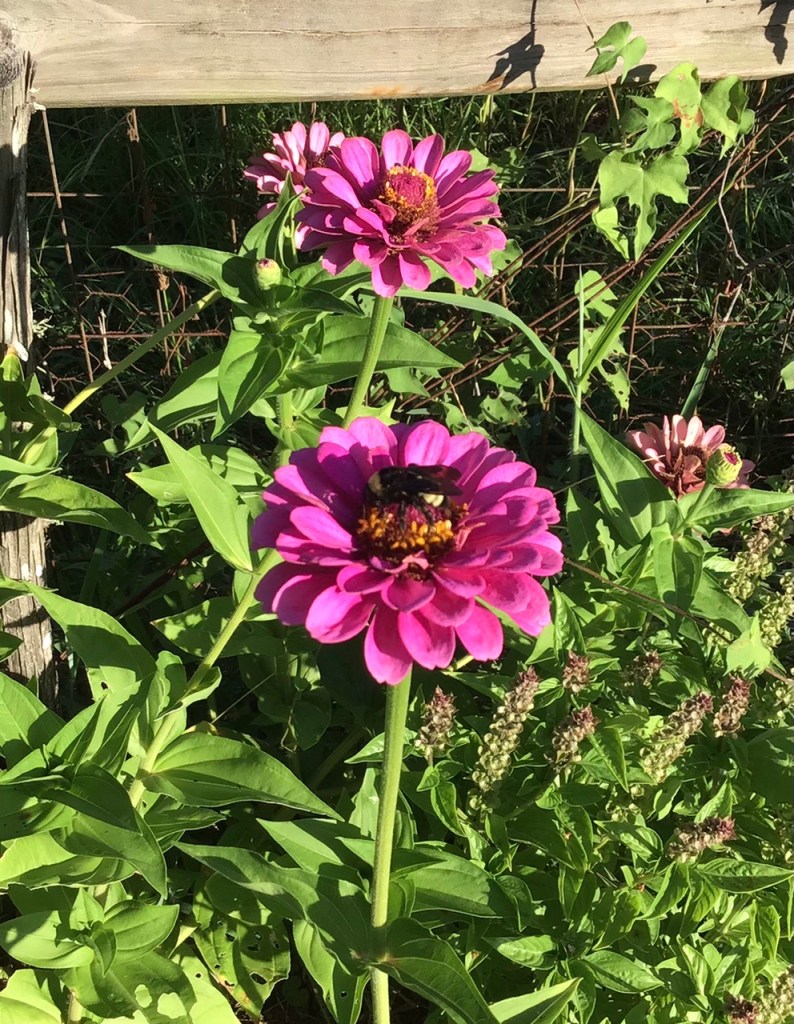
Roma never does well hereNoire des Carmes getting close!Suoy Long a salad cuc favUp, up and away!Sweet potatoes and Black-eyed Plenty of forage for the growing herd!Precious Athena, my favoritePhoebe and her other kid, HerculesBumble bee on ZinniaSpice basil flowering WAY too earlyCastor bean flowering WAY too early
Lots more to share, on another day! 😁 Thanks for stopping by!
There’s the good kind of failures—like those you are able to remedy; And the bad kind—like those you can’t control; And the worst kind—like those you could control, if only you could figure out what went wrong.
We have a collage of all 3 today!
Failed cheeses, failed fruits, and sun scorch.
Penicillium roqueforti has dominated my Little Turds and now we have little blue turds, which is a big fat failure.
This is the most aggressive cheese fungus and once the spores get started it’s extremely difficult to correct the issue. As much as I love blue cheese, this is not the process for making it. As a surface mold it does not taste good, it’s the veining of the blue cheese that brings out the nice flavors. I don’t make blue cheese, because in order to make other cheeses you must exclude the blue to get the white (geotrichum candidum),or any others, to dominate.
Even a hobbyist will quickly learn that you need a separate space, equipment and unique aging fridge just for the blues. This particular invasion happened very quickly, in just 2 days, because a beverage fridge does not make a very good aging fridge for cheeses. But, it’s all I’ve got. The temperature varies unexpectedly and you can’t control the humidity. Sure, a lot of cheese makers out there claim there are certain tricks for modifying the humidity levels of the mini-fridge, but they just don’t work, or they are far too high maintenance for me.
The fridge got too cold by just a few degrees, and this was the result. The two without any blue are from an older experiment, also failed, because their white fungal coat is not thick enough. I’m hoping a snug fig wrapping will magically transform the problem. But, I doubt it.
Wrapped in fig leaves (with a bit of sage on one too, to cover the naked parts) back into their Tuperware-fashioned high-humidity space, and back into the aging fridge.
As for the little blue turds, I’m going for maximum shock treatment, just to continue the experiment at this point, because I think they are beyond repair. I have them at room temperature now and I might even try spraying on some geotrichum candidum, just to see what happens.
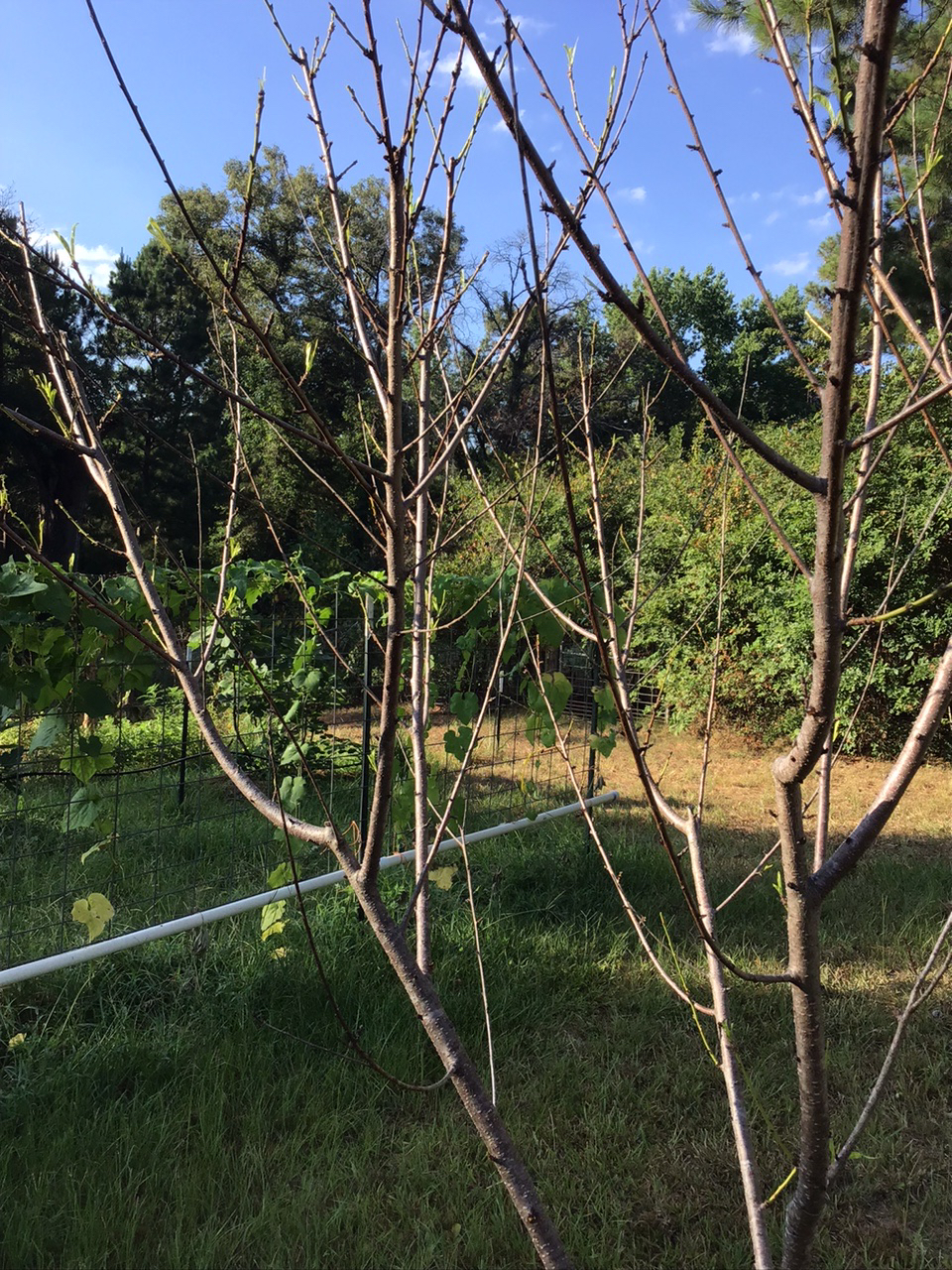
The orchard is a continual string of failures, the nectarines being just the latest one. We’ve planted so many fruit trees in there we’ve lost track. We planted a couple of plums, one that actually produced for a couple of years, then both suddenly died. The grapes are looking terrible this year, the apples hardly ever bloom and never produce any fruit, the peaches die a year or two after planting, and now we finally got some nectarines and they look like this. The worst part is, once you cut out all the bad parts, the few nibbles of good fruit you have left are absolutely delicious.
Oozing and pock-marked and tiny. ☹️
We’ve got one reliable pear tree, another two that get a great crop about every 3 years. And the figs, my favorite, that are on some boom-bust mystery cycle we haven’t figured out.
Hubby is beyond frustrated with the fruit trees, so he’s got a mini-project filling up the orchard now, his own hog feed production line.
I think he’s trying to teach those miserable fruit trees a lesson by planting a thriving row of squashes between the rows as feed for the pigs. The cost of feed is getting crazy! And of course, we’d much rather feed the pigs off the land. Trombetta and chayote squashes, and luffa, are growing great and will soon make for some happy pigs.
Luckily we at least have some giant blackberries to soothe our disappointments a bit.
While the garden is still hanging in there despite intense heat and very little rain, the signs of stress have already started. Even heat lovers like the turmeric are getting sun scald. The leaves of the tomatoes and tomatillos are looking equally sad. I’ve covered what I can with shade cloth and screening, and I’ve got my fingers crossed, and that’s about all I can do about that.
Sir Turmeric has a sunburn and Trombetta’s leaves are looking sad.
If the melons disappoint me again this year, at least I can feel better knowing the bees were very pleased. That is, except for the little bitch who stung me on the middle finger while I was harvesting cucumbers. The simplest of all these problems to solve—must wear gloves now while harvesting.
The Noir des Carnes cantaloupes alive with so many buzzing bees!
Oh, and last but not least, the shallots never bulbed. No idea why. I bet Bubba knows, but he’s not talking.
I have so very much I could be reporting on from the wee homestead, but I only have the energy to share some photos, a couple short vids and a few brief comments.
We’ve got some really weird weather that has us back in long sleeves and pants after a few weeks of blistering heat. I have no time to get started down that fool’s path at the moment. Moving along.
The bees have finally graced us with their presence in the garden, I was getting a bit worried! They are all over the cucumbers, which we’ve just started harvesting.
They also found the cantaloupe at last, thank goodness, this is my primo experiment for this summer. This is a true heirloom French cantaloupe, Noir des Carmes, which you can’t buy anywhere in these parts. I learned from the seed catalogue that what we call cantaloupe in the U.S. was renamed, these ’muskmelons’ in green or orange (with the ‘netted’ skin) are not the original cantaloupe, which does not ship well, and so was never popularized here.
From top left: Spaghetti squash with backdrop of sweet corn, tomatoes just starting to turn, elderberry just blooming, black-eyed Susan decorating sweet potato vines, and cucumbers starting up their trellis.
Hubby had some surprising success with peas in his ’gorilla garden’ — a new experiment. We were gifted a garbage bag full of seeds, some of them 8 years old, which I thought would be useless. He threw them down in a spot he’d roto-tilled for the purpose, mixed up all the cool-season seeds together and broadcast them, watered them a couple of times, and we actually got a big bowl of peas out of the effort. I so love fresh peas and they are not always a reliable crop around here. He planted them later than advised too, so I was very surprised he got anything at all. He estimates germination at about 20%.
We got a great harvest of onions and canned up a couple of batches of French Onion Soup, mmmm. I have my glove under one in the middle photo to show their nice size. It was our best onion harvest to date, and I think that is owed to all the sheep poop and the mild winter.
I was proudly exclaiming to Hubby some kudos on our team effort with pressure canning the soup when he had to burst my little bubble by explaining how that makes us one teeny-tiny fraction closer to the recommended annual Ball Blue Book chart from 1966.
We have kittens! We just happened upon them in the old tractor barn while gathering dewberries.
The kids are growing SO fast!
They are following mamas into the woods, playing and jumping around and are so fun to watch.
Once again, I did not mean to hit ’slow mo’ on this short vid, but it’s a good thing I did, because you can really see the ‘look’ of triumph in Walnut’s demeanor after she bullied tiny Athena. I guess goats are something of a belligerent species!
And to end, the best part, my new She-shed, thanks to Hubby, which will get an entire post of its own very soon!
Garlic still to be harvested in front of my recycled garden shed— Oh the joys of being at the top of Hubby’s to-do list!
“He is grumpy and coarse and all the things I was warned about. He takes his contest with nature very seriously and finds no comfort in its unpredictable forces. Like most gardeners, he never vacations. In winter when all is quiet and still, he would much rather spend his time fretting—about the fruit trees budding, about the relentless springs frosts that may or may not come, about the sun and the moon. Gardeners, I discovered, are tough, content to be grim”
The Cook and the Gardener: A Year of Recipes and Writings From the French Countryside by Amanda Hesser, 1999
I ran out of attention span last post before I got to talking about cheese. Now that we have three mamas in milk I’ll be having a ball experimenting with new cheeses, which along with kombucha experimenting, is my favorite homesteady sort of thing to do.
Gardening and cooking being not far behind, to be sure!
Aged chèvre (goat cheese) in the French tradition is made of the highest craft and care, even when they are whimsically-named, like Crottin (Little Turd) and Sein de NouNou (Wetnurse breast).
But here in the U.S., Land of the FreeTM, Velveeta is ‘safe’ for consumers and aged goat cheeses, ideal for homestead creation, are completely illegal.
Because they care so very much, right?
“Chèvre evolved in frugal farming households of the sort that continue to make it today. It is a cheese that’s very economical, in both time and ingredients; made on the family farm, where there are many chores to take care of and livestock to feed, a cheese that didn’t need much attention or many costly ingredients fit right in.”
That is in Central France and other locations where it’s not illegal to sell. These are cheeses that require few inputs and no regular purchases—you don’t need a cheese press, or any expensive cultures, or even rennet. Fig sap (or other coagulants like nettles) can easily be substituted for rennet as only a few drops are used to set a gallon of milk.
Straight from goat to curd is the best way to make chèvre, no refrigeration, no heating, at all. Pictured from left: 1. Straining the milk with fine mesh. 2. The soft curd, after sitting in the pot for two days, now draining in their forms, made from small tuperware poked with many holes. 3. After 24 hours of draining, sitting beside a homemade cheese ready to be cut: A signature Kensho cheese experiment.
These are also cheeses suitable to make in warm climates, similar to the more well-known goat cheeses like Feta or a fresh goat cheese. What makes the aged chèvre so unique is that it can only be made with raw milk. You may find hard raw milk cheeses in your grocery store or farmer’s market, like Gouda or Cheddar, these are pressed cheeses aged over two months, which are legal to sell with all the proper licensing. (I have NO interest in that!)
Feta, aged in salted whey for 2 weeks, some still soaking for a sharper flavor and others now drying for packaging in Foodsaver bags for longer storage.
These illegal aged goat cheeses sit at room temperature for about four days.
Imagine the horror the germophobes have with that!
You most certainly can’t do that with pasteurized milk. These cheeses were invented before pasteurization and before refrigeration and aged for a month or two in caves.
Mine will be aged in Tupperware bins inside a small beverage fridge I use for aging cheeses. (I would prefer not to use plastics at all, but they work just fine and I don’t have other options at the moment.).
I use natural cultures, not store-bought or freeze-dried, developed from previous cheeses, and stored in the freezer. Once the cheeses develop their fungal coat after a couple of weeks, they will be wrapped and aged for about a month.
Traditionally wrapping for these cheeses include leaves, like grape and fig, and even hornet’s nests. A few will also be coated with ash, instead of wrapping, like the traditional Sein de NouNou.
It is positively amazing how differently the cheeses will taste based on just a few variables in the process!
“Relatively unknown in North America, this class of cheeses includes some of France’s most famous fromages: ash-coated and pyramid-shaped Valencay; Sainte Maure—pierced with a blade of straw (the industrial version of Sainte Maure features plastic straws!); and small, moldy Crottin are all aged chèvre cheeses. Perhaps the only well-known North American aged chèvre is Humboldt Fog, a creamy, ash-ripened goats’ milk cheese from Humboldt County, California.”
(I’ve not looked into why or how the Humboldt Fog is legal to mass produce and sell. I plan to dig into that, but my initial guess is they’ve been able to either find a way to use pasteurized goat milk or they have a state-of-the-art affinage ‘cave’ where they can age it over two months without losing the creamy texture.)
“Goats are a belligerent species that have rejected the rigorous production regime thrust upon their bovine cousins. Unlike cows, who contentedly chew their cud in confinement and produce enormous quantities of milk year-round, goats refuse to be cogs in the machine of industrialized dairying.”
On left: Cutting into the last Kensho cheese experiment, aged two months, a washed-rind cheese similar to something between a Muenster and Gouda. Result: Delicious Success!
A most excellent resource, and the source of the above quotes:
Goats, a belligerent species? HA! The perfectly adorable non-conformists more like!
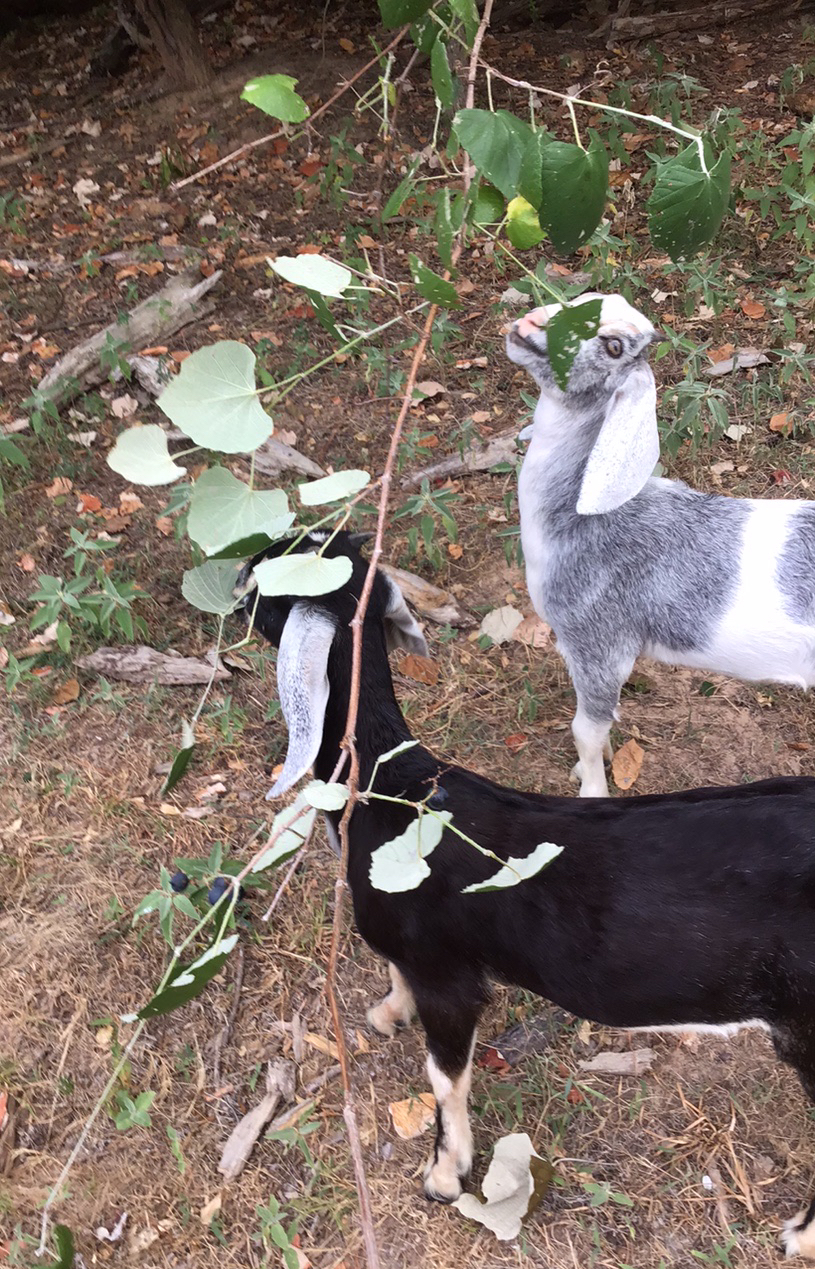
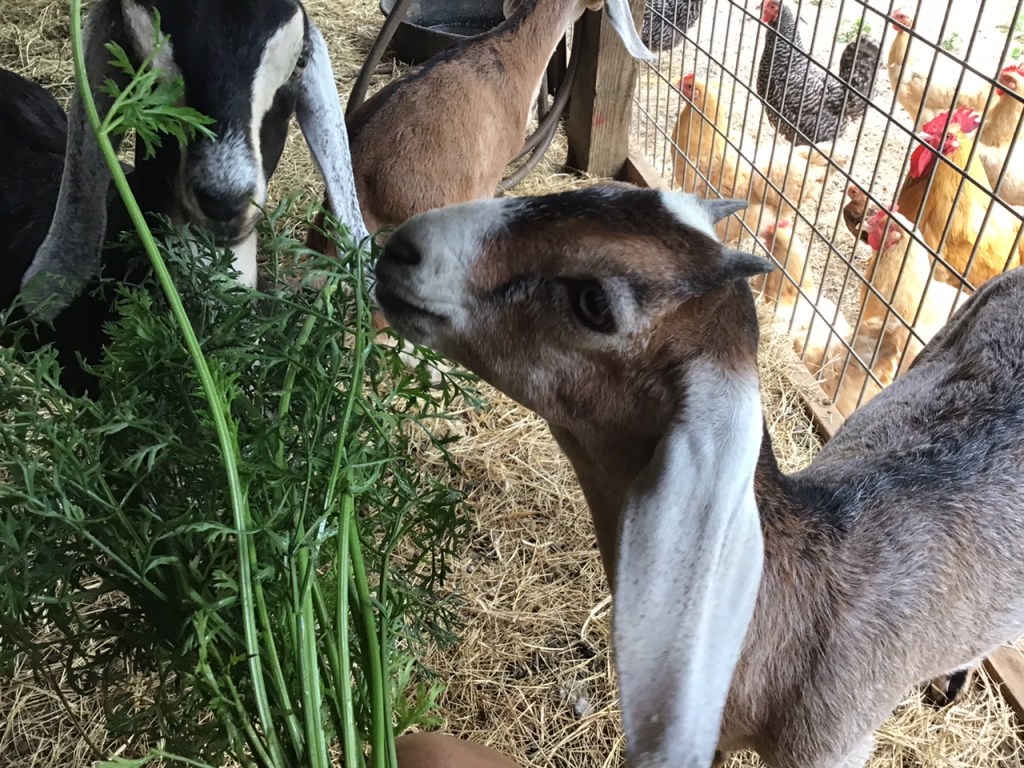
The latest and last addition to the herd this year (in the foreground) yet to be named, and already twice the size of our wee Athena (in the background, about 5 days old), formerly Zena, we decided we prefer the former. Any name suggestions on our newest? We are at a loss so far with this big girl who is sure to be a lifetime keeper! She came out huge and most active and ready to suckle immediately and play within 1 day!
What better day to ponder than Mother’s Day why kids are so darn cute?!
The newest kids, born yesterday, Phoebe’s firsts—Hercules & Zena—notice he is twice the size of her!
We’ve bartered or sold most of our piglets already. We’re not on social media where such information is exchanged, but it certainly does seem the homesteading community in our area is growing rapidly. Yippie!
One family who came by insisted we were under-profiting from our piglets. Their 11-year old daughter offered her mom to pay us $50 more than we were charging, ‘for the cuteness factor’. Aren’t kids precious!
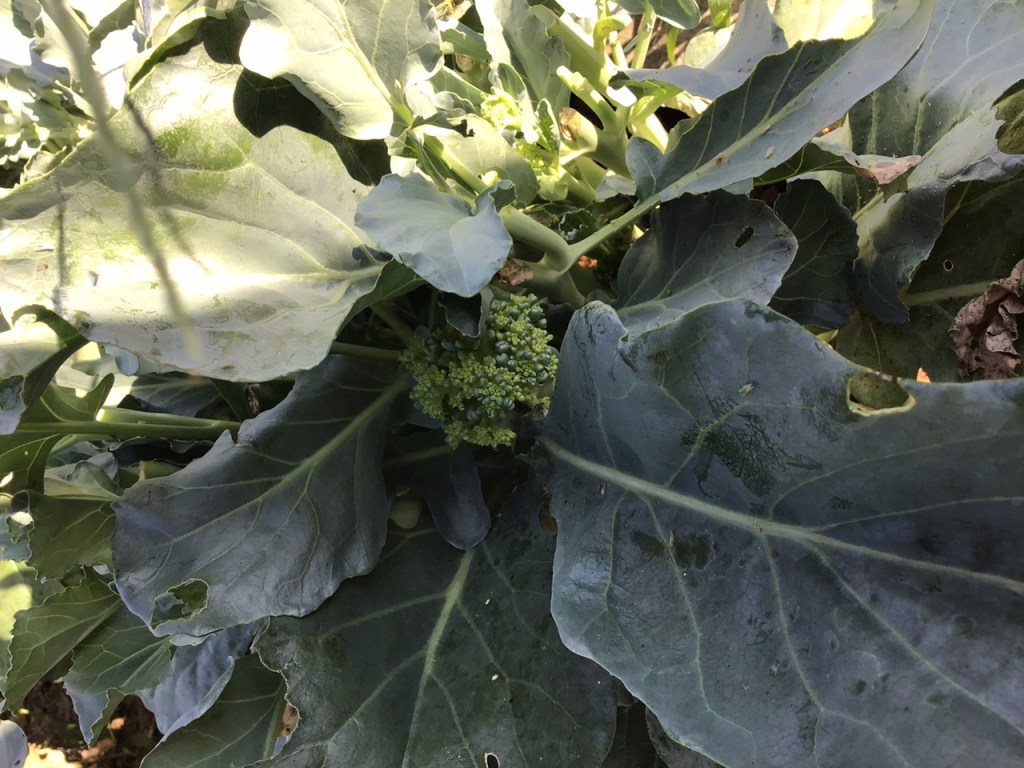
In not-so-cute news, the swelter season has started abruptly. Bye, bye beets and broccoli, before your time, because I think not even the shade cloth can save you now. The last rain that was hyped on about for days, that flooded some areas and caused tornadoes in others, yielded us a whopping 1/4 inch, not even enough to penetrate the mulch layer.
Of course I’m happy we didn’t get hit with another tornado, but I can still be miffed I have to start watering the garden. Half my roses haven’t even bloomed yet, or the zinnias. The parsley and celery have gone to seed before I got a decent harvest from them and the lettuce will soon follow, no doubt.
The bees are feeling it, too. I checked these hives last week and they were just half-full, yet the bees are bearding. Unfortunately, the swarm we got a couple of weeks ago left after only one day, unhappy with the digs I’d offered apparently. Now it’s already too hot for me to do the splits I’d planned. Better luck next spring.
I’m so pleased to be getting any strawberry harvest at all, they’ve never done well before. Then I saw this video and quickly got a reality check.
Hubby tried to make me feel better by saying those were probably grown in California and loaded with pesticides harvested by illegal aliens. He’s mentioned before something is off about this (Fabulous!) channel. It must be CGI, or heavily staged, or something. Never has a country cottage been so clean and picturesque. Where’s the chicken poop on the table and the flower pots dug up by the puppies? Good questions!
By ‘doing well’ I see I need to learn a thing or two about growing strawberries. They are too crowded and between the humidity and the wet mulch they are mostly half-rotted by the time they get ripe. I’m really loving the strawberry kombucha though! As well as the blackberry, and mulberry. I’ve started making the kombucha tea from yaupon, which grows like a weed around here. It’s delicious and sweeter than the store-bought green tea I usually use.
And speaking of mulberries, what a great surprise, Hubby found a full grown, wild mulberry tree in a spot we walk by regularly and never noticed before. What a treasure hidden in plain site!
More mulberries, please!
And this post has reached my attention span limit, so I leave the cheese to the next post. It’s gonna be a good one all on its on, really! Stay tuned!
Instead I exit abruptly, like spring has done in East Texas, with this quick lesson from Bubba in best yoga techniques.
So many babies! It’s not easy getting good shots sometimes, but I’ll admit I don’t have the time or patience to sit around too long. We have our first kid!
Walnut, first kid of Chestnut
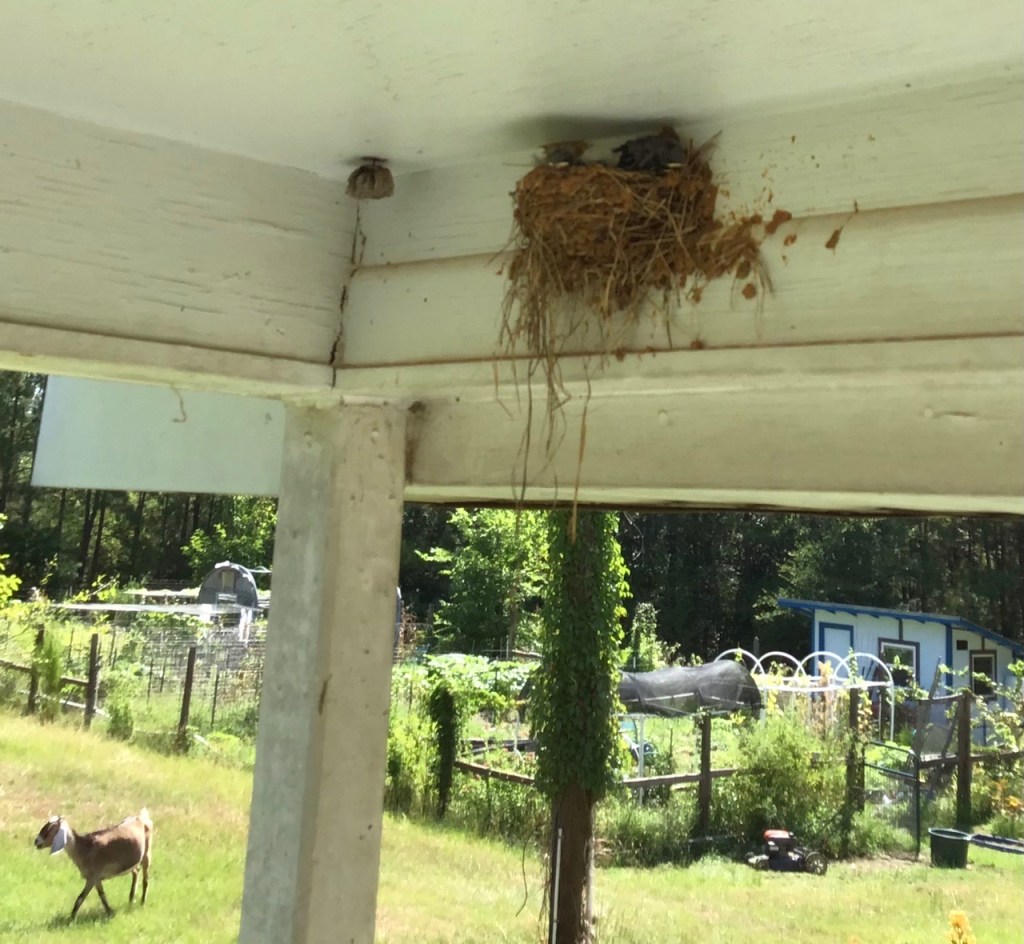
Swallows just out of the nest, and on the right, can you spot the Cardinal still sitting on hers?
Hummingbirds are so hard to photograph. They have wars over this coral honeysuckle every sunrise and sunset and throughout the day, but it’s nearly impossible to catch them at it. Wow, are they fast!
These guys aren’t easy to happy snap either, but we do so love when they pay us a visit! And thanks y’all too, cyber visits can be almost as fun (sometimes)! 😁
Yes, it’s a thing and it sounds a lot like modern slavery.
Social Impact Investing. Doesn’t that sound super? Now the corporations and governments, through their other super sounding ‘Public-Private Partnerships’ (the latest fancy phrase for fascism) will be openly programming your children, no more beating around the bush about it.
This is about surveillance, its proliferation and its management. It’s also exactly why I quit teaching. It became painfully obvious within the university systems involved with educational technology that this was the direction they were heading years ago.
They tried to sell it to us all wrapped in glowing marketing slogans, appealing to teachers’ better instincts to help their students. Most teachers, like 99% of them, bought it, no questions asked. Surveillance does not help people, it life-squashes them. It is not a long-term motivational strategy either, it does not help with coaching, all it does is invade folks’ minds and lives.
Of course, they are going to say everything you want to hear—they know we need a heavy coating of sugar to take our medicine. It’s all about helping the poor, raising all boats, no child left behind, build back better bullshit.
But “Pay for Success Financing” is not about helping people, it’s about making money off poverty. Like the old saying goes:
“If shit had value, the poor wouldn’t have asses.”
Please folks, stop buying their propaganda! They’ve got our number, because they’ve got our data. They know how to outfox the Left, the Right, the churchies and the anarchists, and everyone in between. And they want the children. They want to own the next generations forevermore and from cradle to grave.
They are expert snake oil salesmen and they would swindle their own grandmothers, so imagine what they’d be willing to do to yours!
Alison McDowell calls it out—the soft global coup—and breaks it down so well in this video, I cannot recommend it enough.