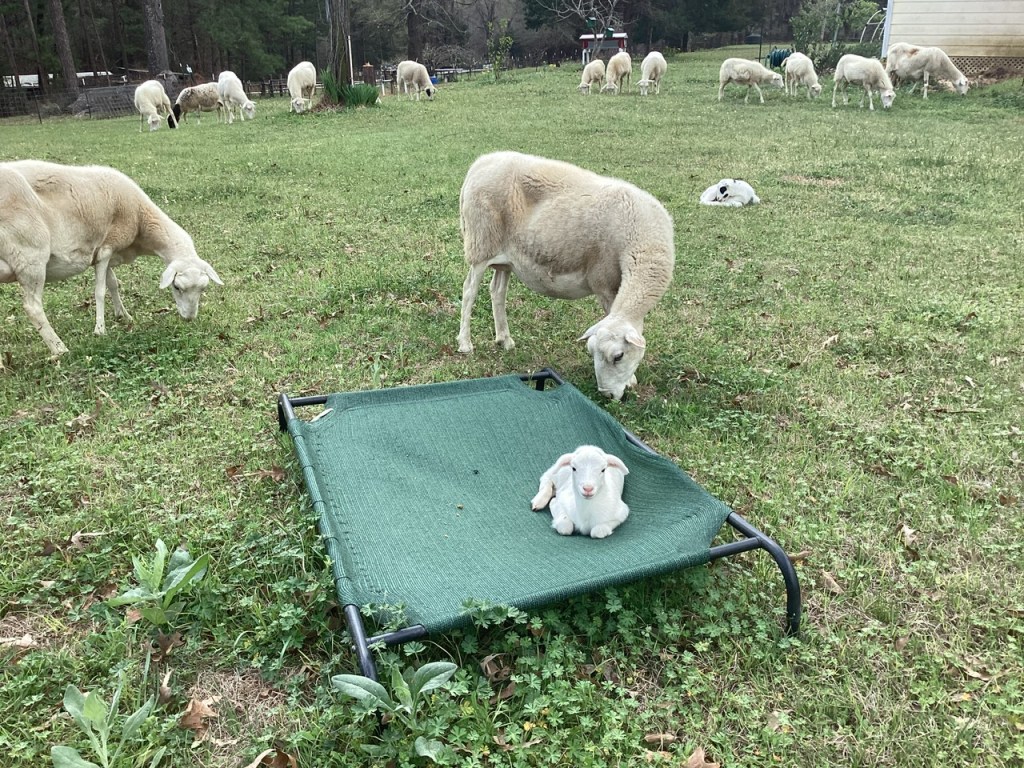
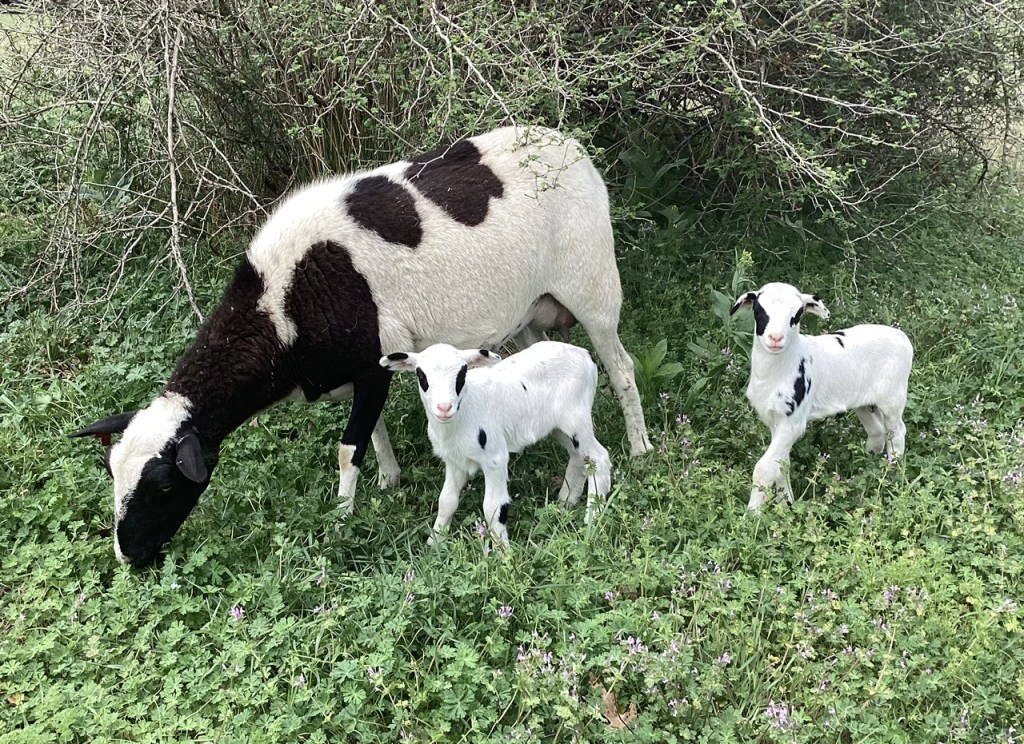
Such a synchronistic interview popped into my feeds, which I just have to share. Not only is our wee homestead full of young blood sucking down mamas’ milk, but I’m also teaching another cheesemaking workshop this week.
So, milk is big on my mind, nothing unusual there.
This interview from Weston A. Price is priceless! It really is such an awesome feeling for me when a new and powerful voice comes on the scene repeating what I sincerely believe and what we have been diligently cultivating on the wee homestead. We are losing too much of great value in our blind rush toward ‘progress’. We’ve got to work harder to keep hold of our wise traditions, or they will be lost forever.
Clearly this issue is getting lots more attention lately, but it has been on the radar of many cheese-lovers since the 90s, including yours truly, because I was so peeved to have to give up cheese, because I was suddenly ‘lactose-intolerant’, like loads of other people. But at that time it was only in the U.S. I couldn’t eat breat or cheese, not in Europe.
Today in Europe they have also been inundated with ‘vegetarian’ rennet and glyphosate and other chemical industrial products and processes, and when it comes to cheese, the vast majority are not labeled as such. I got suspicious, started asking a lot of uncomfortable questions, and found out A LOT about GMOs and our body’s reaction to them.
The interview summary and link for anyone interested in some fantastic cheese talk (he even talks about the maggot-ripened cheeses I’ve mentioned quite a few times on this blog!)
Traditional cheesemakers respect the process of cheesemaking. They honor the environment, the animal, its milk and traditional techniques – all of which lead to delicious, nutritious cheese. Industrial cheesemaking, in stark contrast, emphasizes sterile conditions, uniformity, and artificial inputs (including GMO-derived rennet). The cheese that results from the conventional approach is consistent… but misses a lot in terms of flavor profile and nutrients.
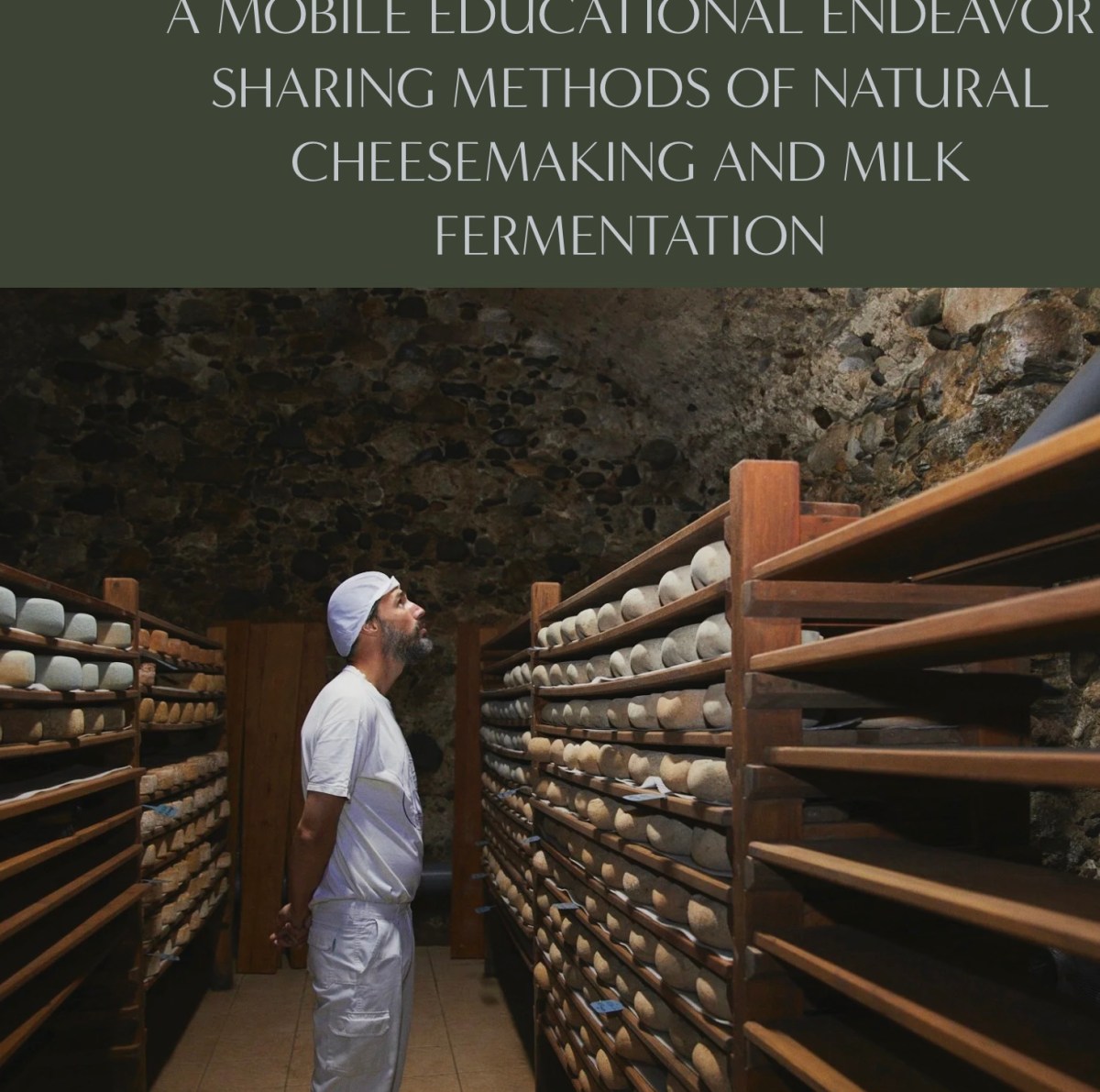
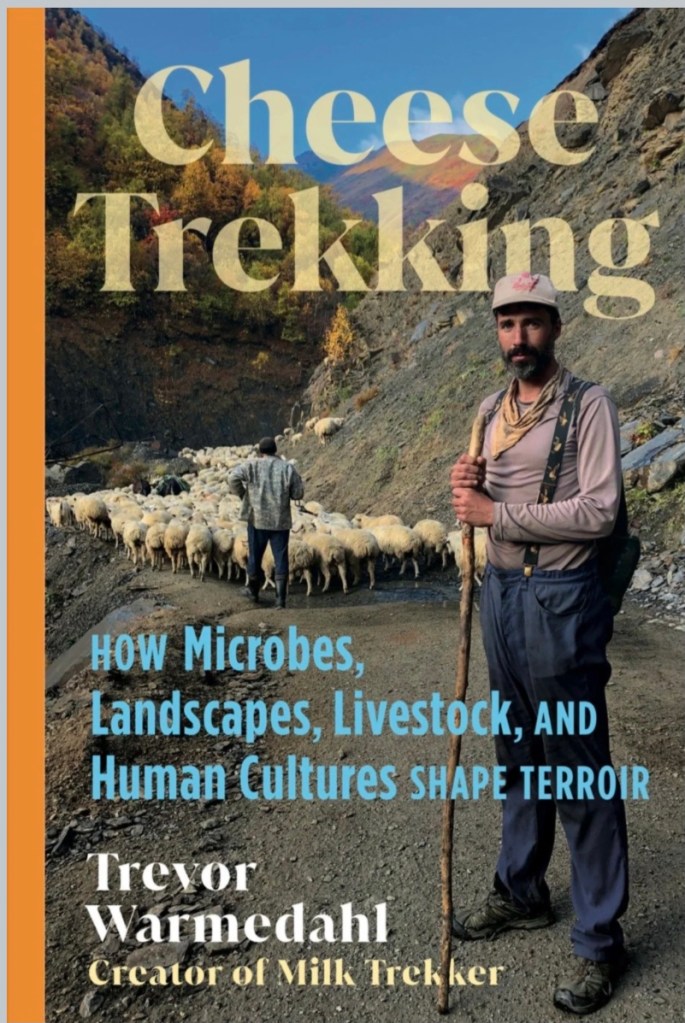
Trevor Warmedahl is a cheesemaker, fermentation educator and the author of Cheese Trekking. Today, he takes us on a cheese adventure, as we gain insight on traditional, artisanal cheesemaking. He gives us pause about what is in our fridge and where it comes from.
Trevor has trekked all over the world, working alongside artisanal cheesemakers, so he understands and shares the importance of working with (instead of against) microbes and nature. He describes cheeses you may have never heard of, along with unique approaches to making them. Trevor also helps us take stock of what has been lost in our modern approach to cheesemaking.
Just some happy snaps with minimal commentary this post, because it’s been too long. With more coming very shortly, as soon as my new keyboard arrives, because I loathe the hunt and peck method of the digital keyboard.
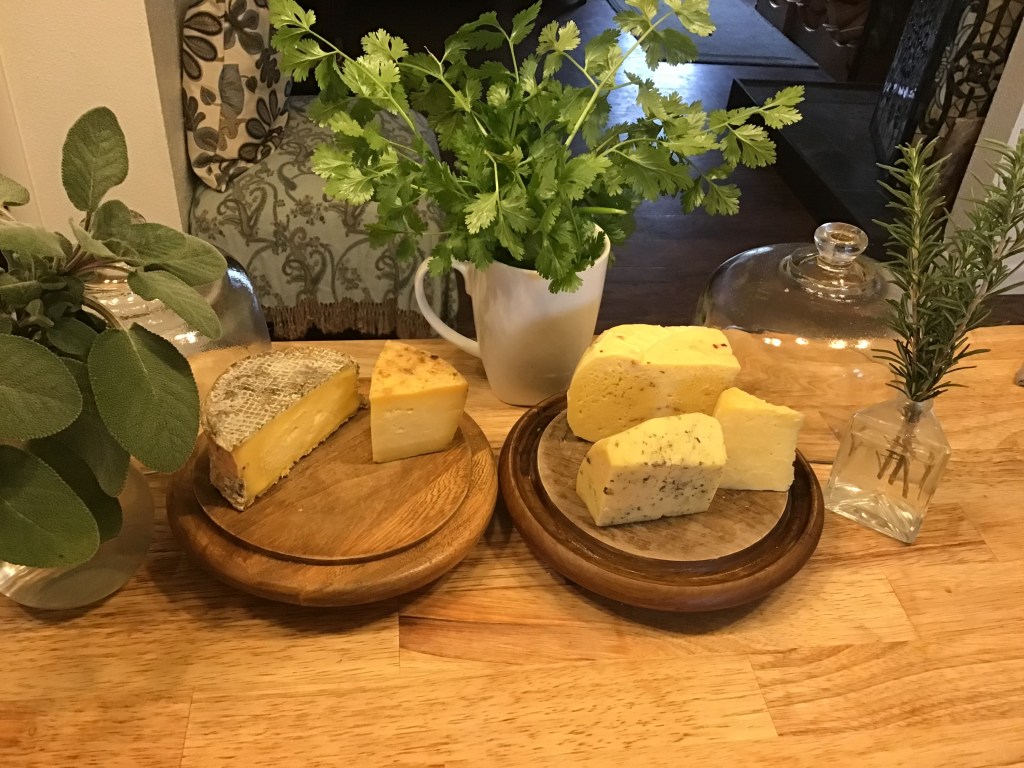
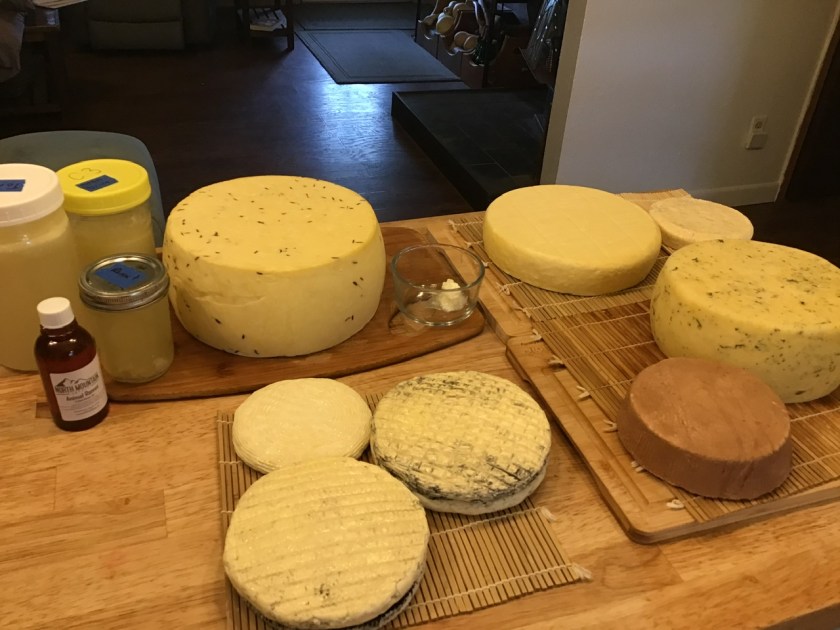
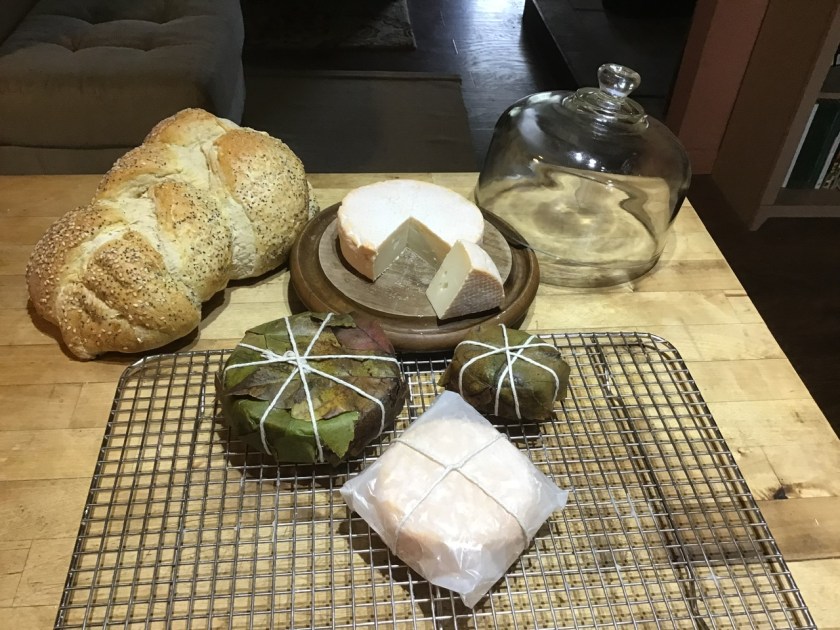
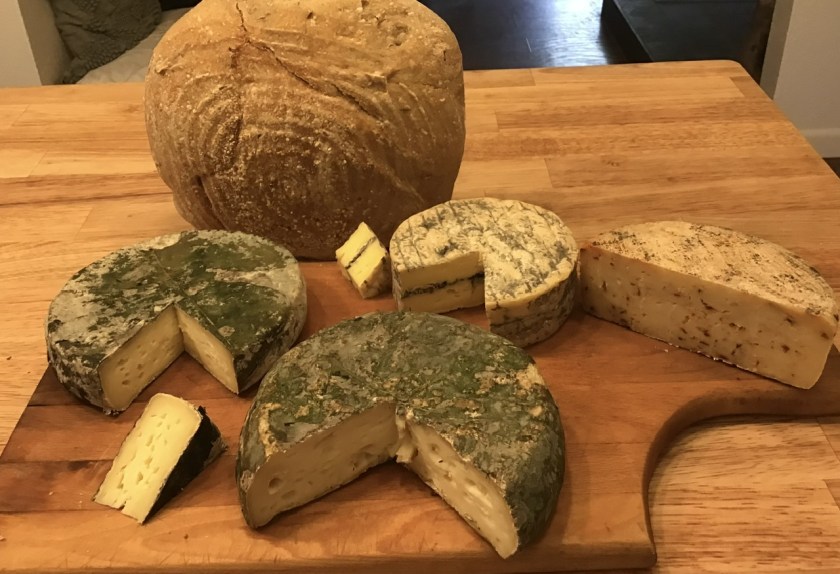
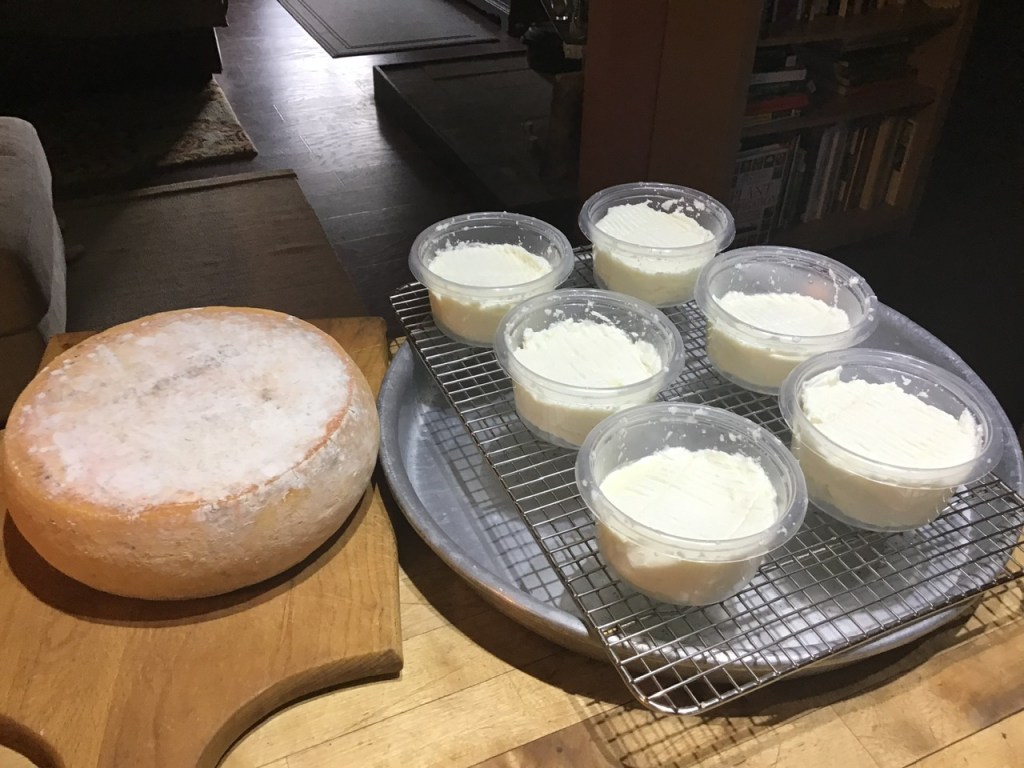
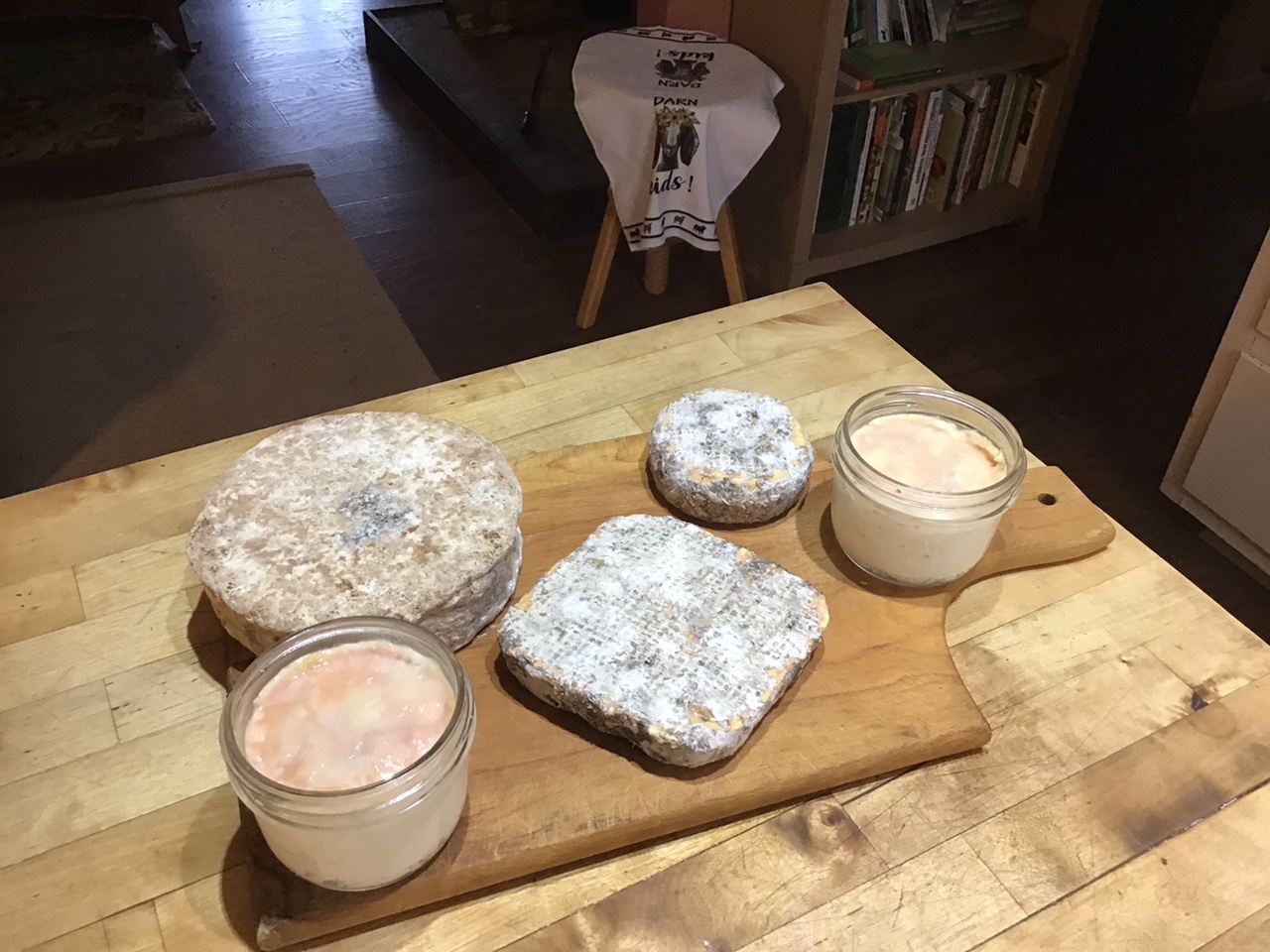
Some aged cheeses and winter herbs: smoked cheese on lees, kenshobert, pepper havarti, dill havarti and cheddar, with some fresh sage, cilantro and rosemary.
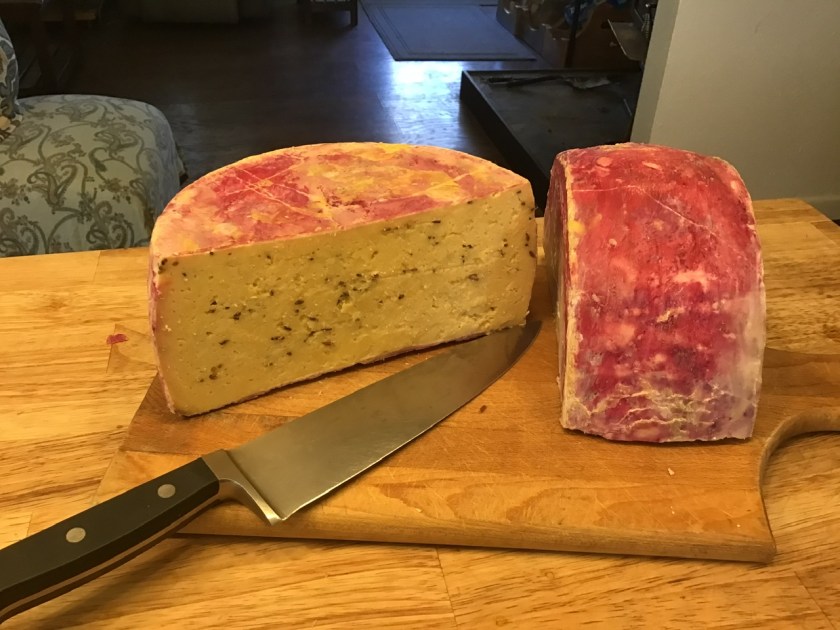
My biggest cheese this season from 9 gallons, caraway cheddar aged in a poke-tinted tallow coating. Unfortunately, it’s not my favorite. Fortunately, others like it fine so I happily gave the whole thing away.
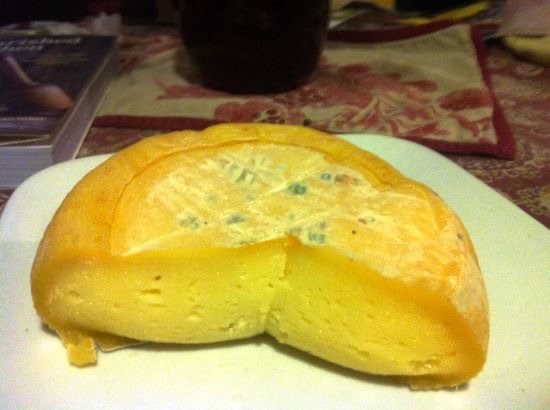
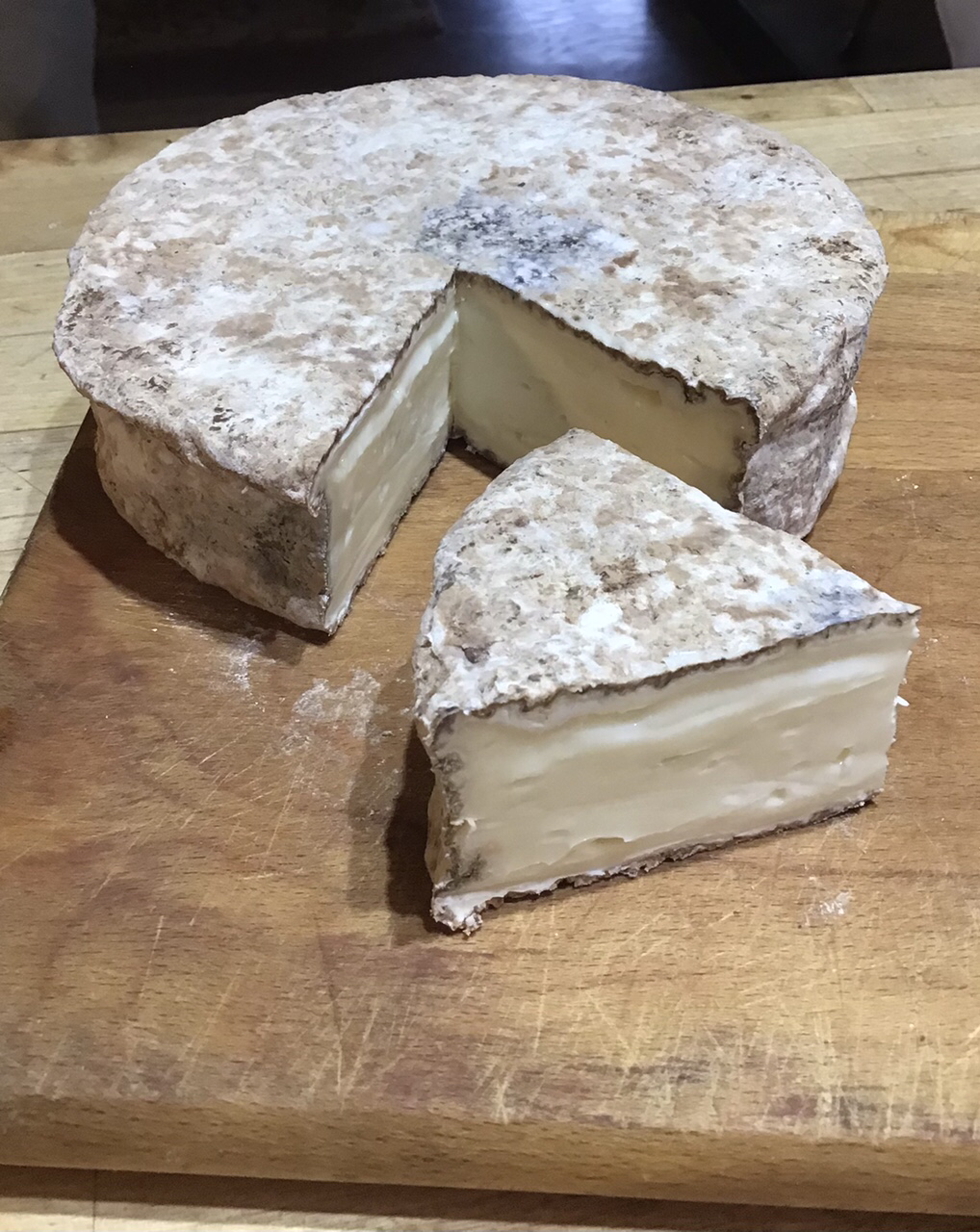
My personal favorite, my signature Kenshobert, a local take on Camembert.
A large dill havarti and variety of experiments, most quite good!
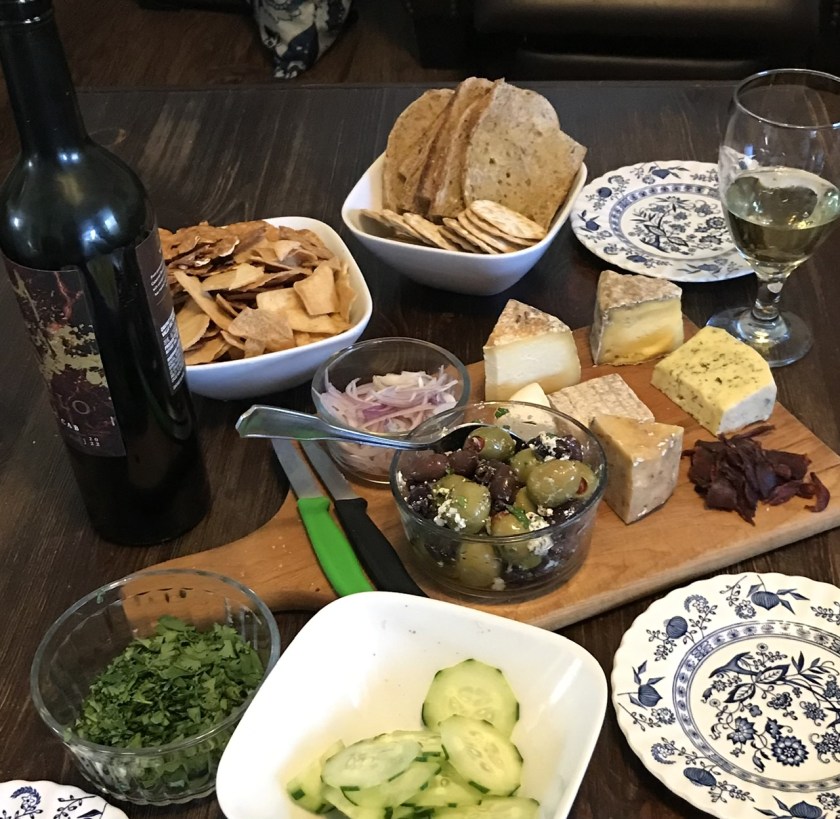
Sharing a charcuterie board of cheeses and cured lamb.
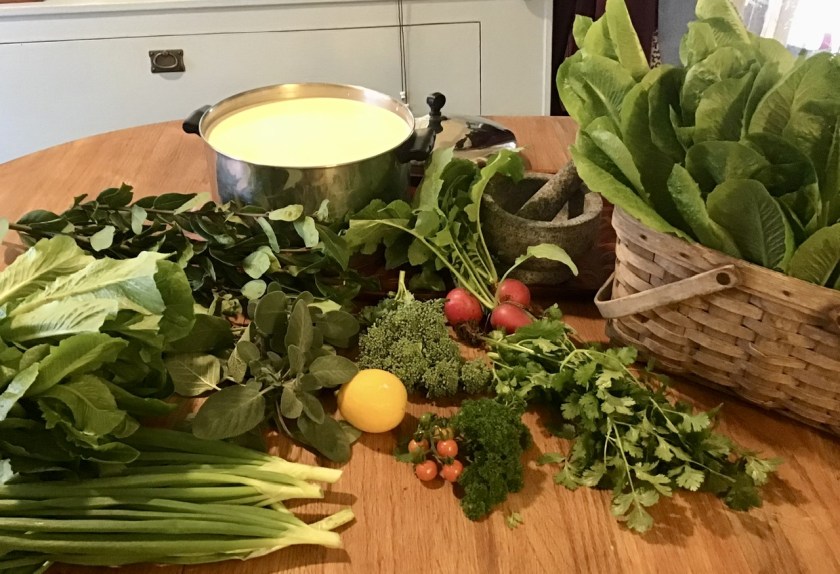
A winter harvest of romaine, onions, herbs, radishes and even an orange from our little shrub and some cherry tomatoes because it’s been so unseasonably (and unnaturally) warm. Plus a pot of today’s milk becoming clabber for tomorrow’s cheese.
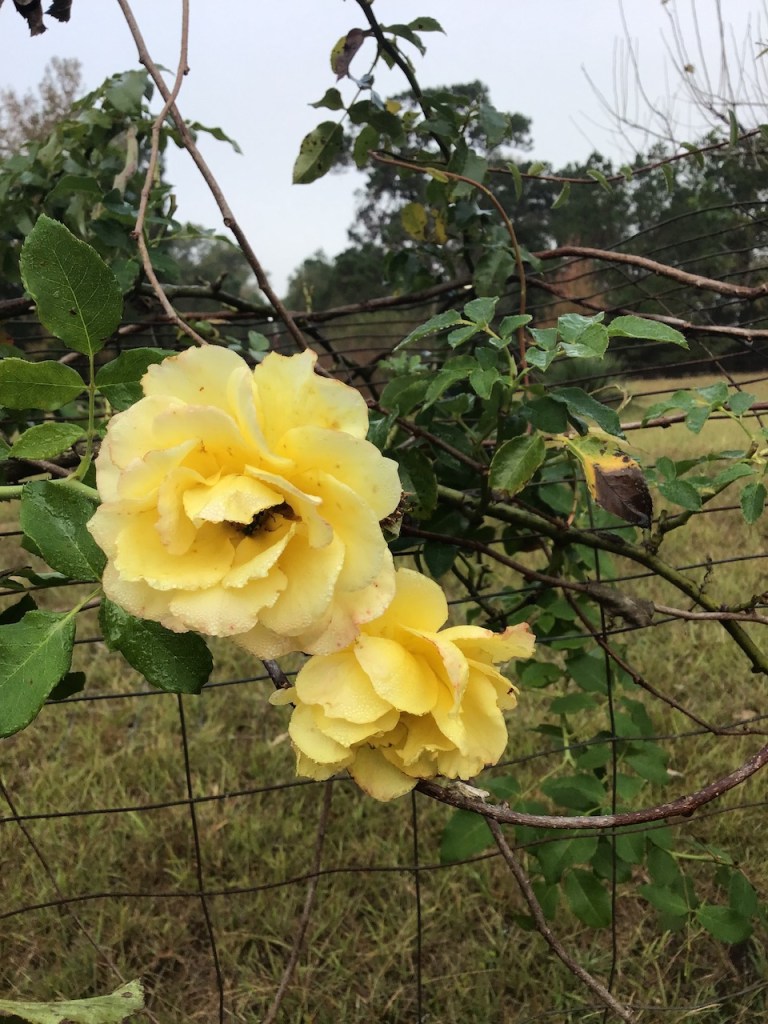
A Christmas bumblebee!
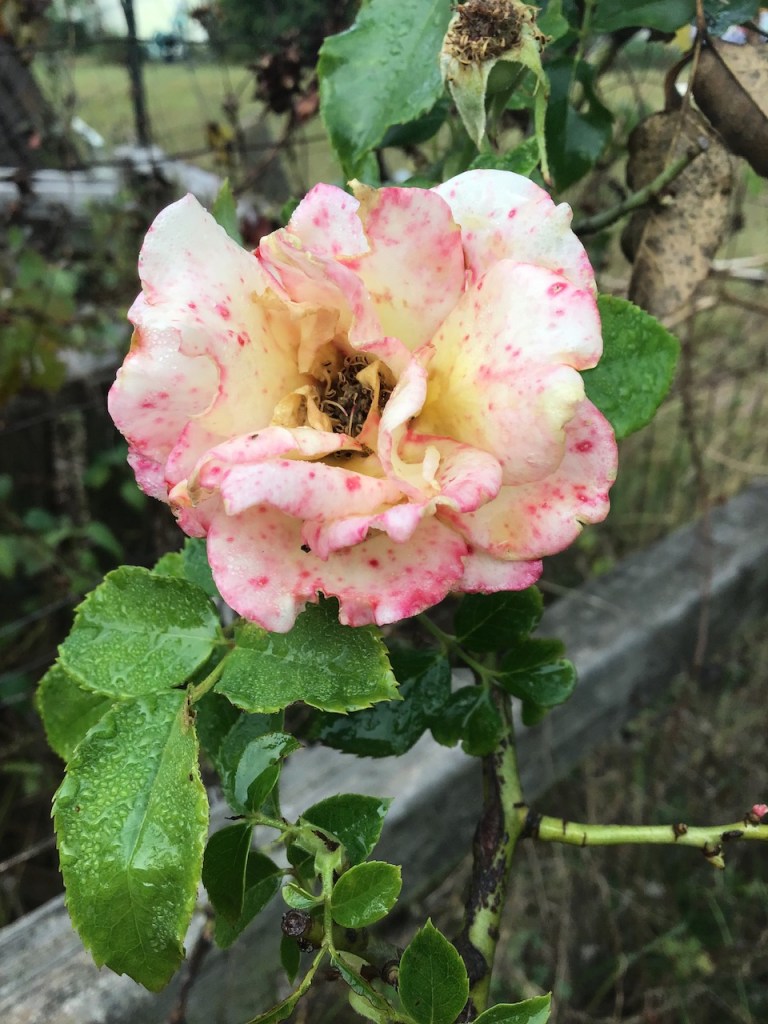
Unusual winter roses turning strange colors.
A few more happy snaps . . .
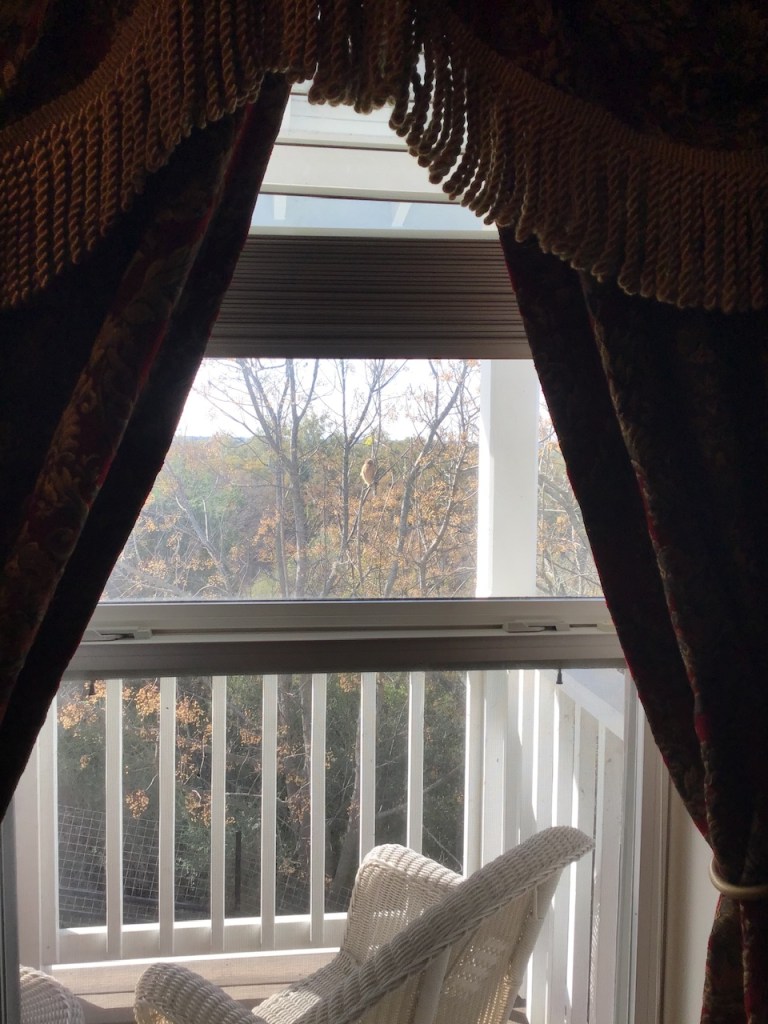
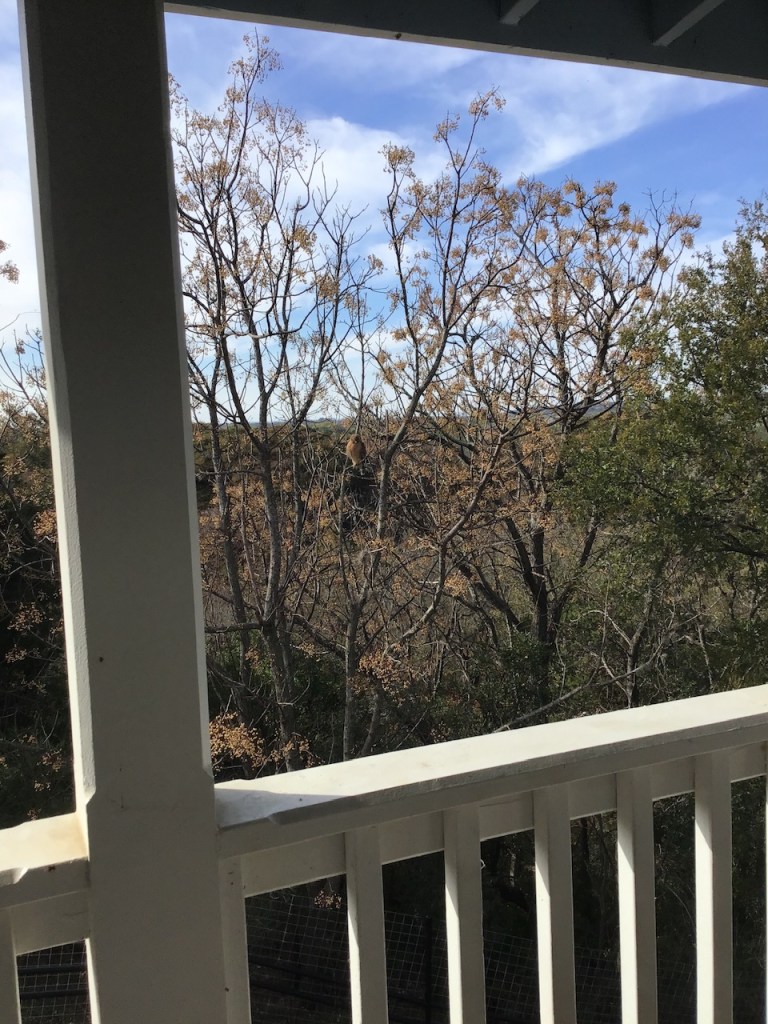
A darling bird of prey I watched right off our balcony from our recent quick roadtrip to Gruene in the Hill Country.
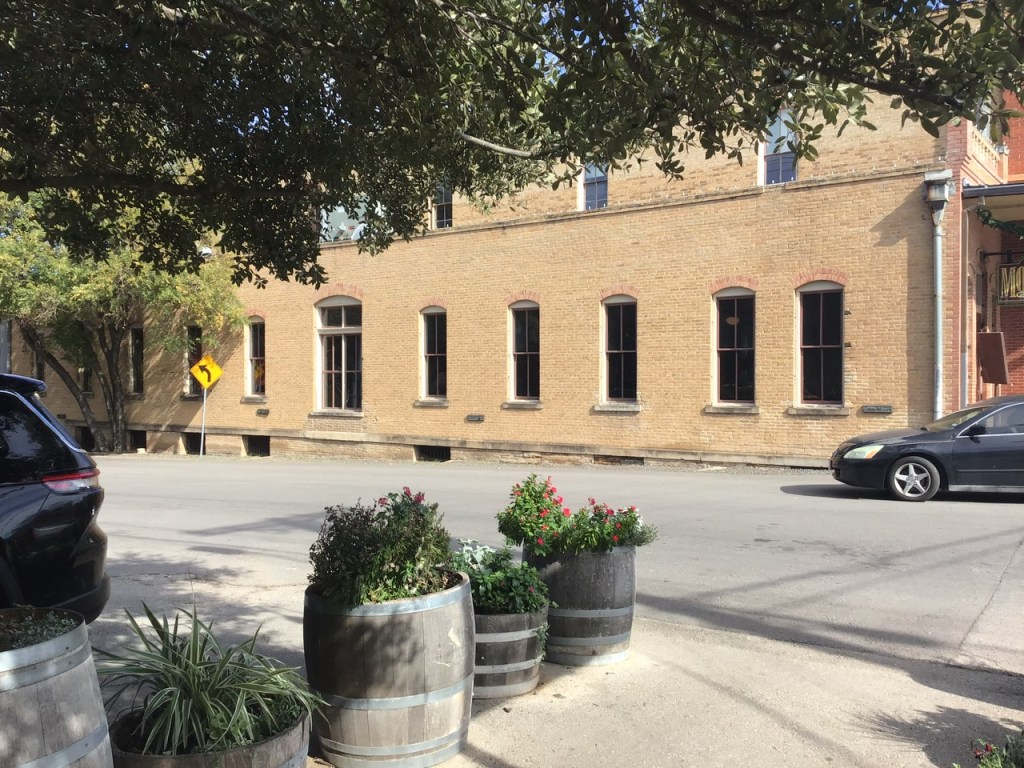
Also in Gruene, a so-called ‘mud-flooded’ building, more coming soon on that conspiracy theory in the new year.
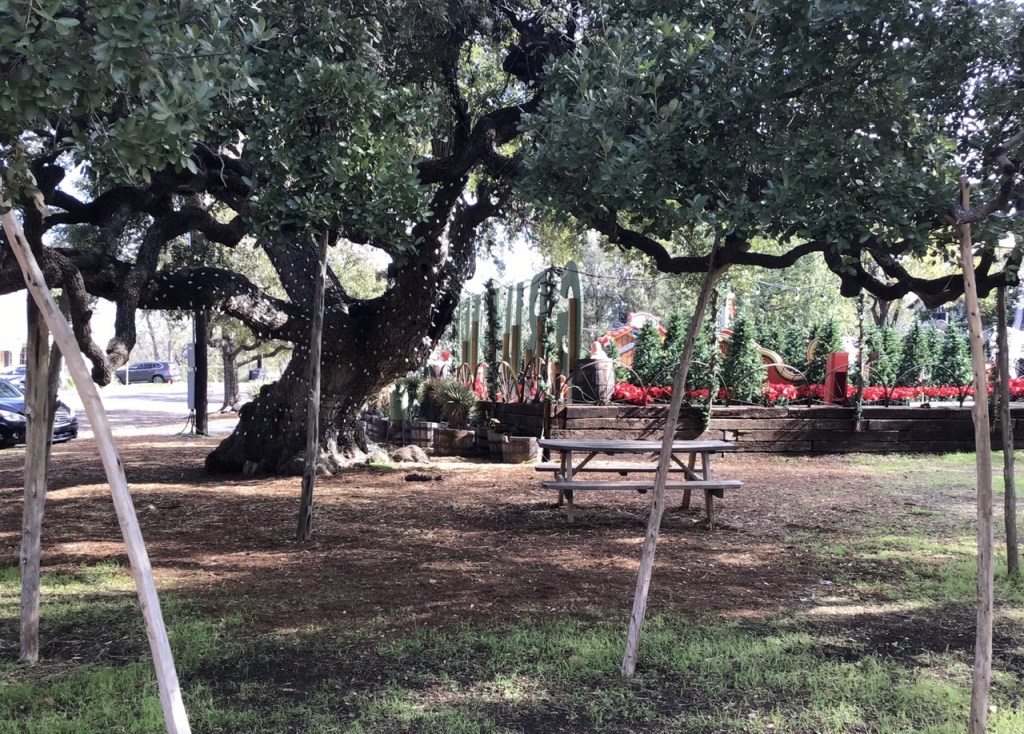
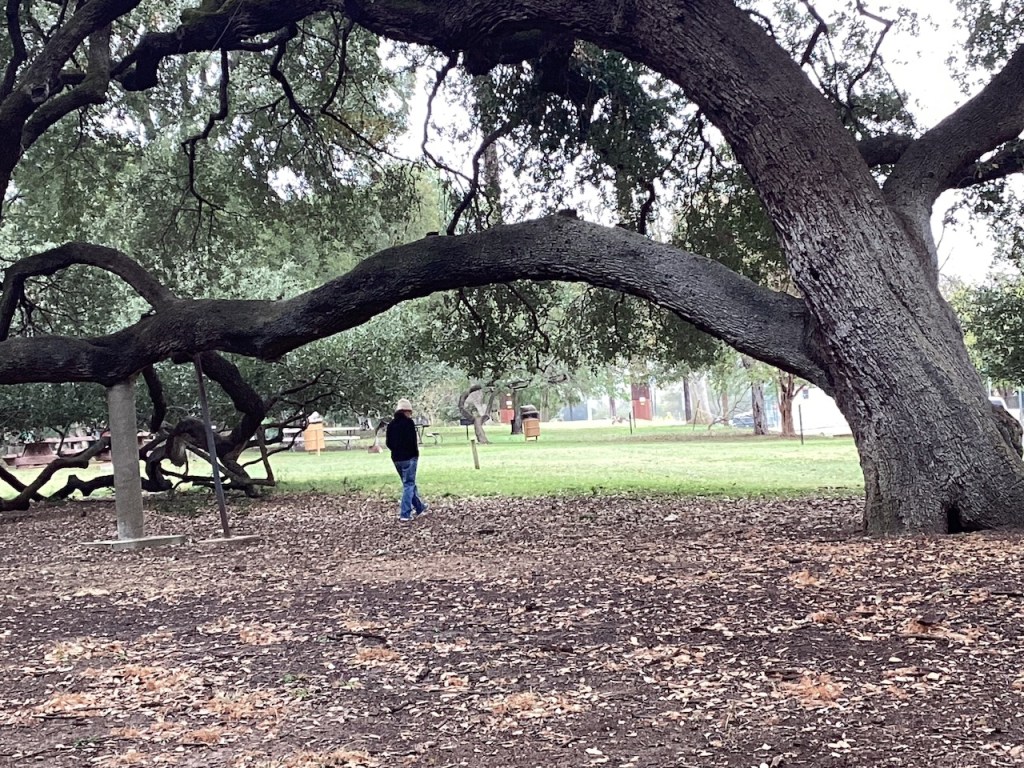
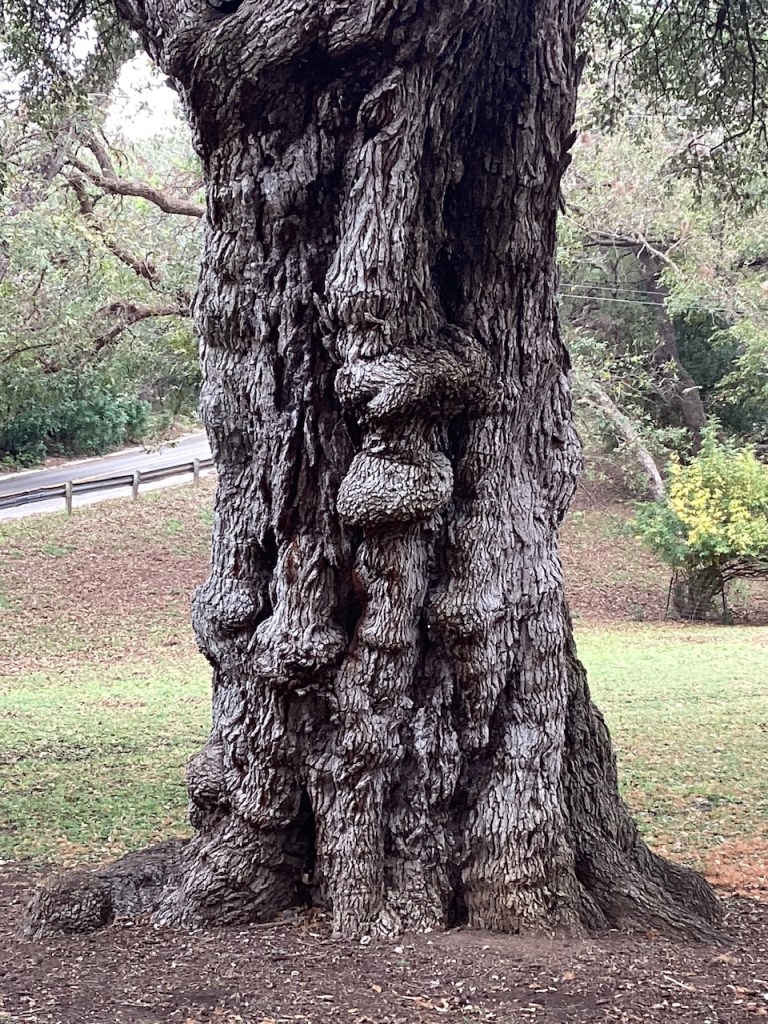
They have preserved some gorgeous trees there from the ever-encroaching urban sprawl, and more power to ’em!
I taught my Beginners Cheesemaking Workshop at the Senior Center and as always when teaching, I learned SO much.
Beyond the barely controlled kitchen chaos, of which I fully approve, there were the usual sort of mistakes to learn from, like why a random rennet failure for one participant, and why another’s curd did not want to separate from its whey. Those issues were fixed, total failure averted, which is the very best way to teach cheesemaking.
Lots can go wrong but most likely you’ll still have good cheese, that’s my primary teaching goal. It may not be the cheese you were going for, but that’s ok.
Do first, talk later, that’s how it should be with cheesemaking, according to me. There really is a method to my madness, and it’s staunchly ‘anti-science’. This is totally logical, because folks were making cheese LONG before anyone understood the science behind it. In fact, much of the science behind it is still disputed.
You don’t need to know what rennet is, or study a recipe first, or have all your ducks in a row before diving in. In fact, like with many new skills, too much information is actually an impediment to just getting started.
I like to allow the alchemical magic to lure the potential future cheesemaker into the process all on its own. Their desire for more knowledge, more structure, more understanding is a far more powerful teacher than I could ever be prattling on about all the minutea on the science of cheesemaking.
Which is more fascinating, the art or the science of cheesemaking? That will depend on the individual, but let’s face it, for most of us, art is far more fun.
So my moto is, let’s get in and get dirty! And we did, wow, did we make an impressive mess. A deep bow to the very kind ladies who did all the cleanup, I definitely scored there. I should’ve calculated better how much mess there would be, but what fun is there in that?
In my personal debriefing session once home and reflecting on the experience, I had a few ‘room for improvement’ points to make, but not around the mess or the chaos. (Note to self: bring extra cheese for the ones who get stuck washing up.)
Those details are important, but not nearly as important as the most important thing I learned, which is–folks out here don’t actually believe in germ theory. This is something of a revelation for me.
Despite the 5 extra bottles of hand sanitizer in the back room, and the chemically-scented dish soaps by the sink, and the properly clean kitchen that demonstrated good hygienic practices, once the ball got rolling, not a peep about bad bacteria was overheard.
We did eventually talk a bit about bacteria, and so-called germs and my disdain for anti-bacterial products and chemically-laden scents and their detriment to the cheesemaking process, not to mention general good health.
But in practice it was pretty clear the bad germs propaganda was not fully instilled in this clever group of girl and ladies (and our one token man who chivalrously helped me with all the heavy lifting).
Right into the cheese pot went many pairs of bare hands to stir the curd without a moment’s hesitation. I was immediately and very pleasantly surprised.
Then, because of mistakes in one group, and excesses in another, the curds of many pots became communal. A dozen pair of hands, not one that had been scientifically anti-bacterialized (I brought my own soap, which they all used, and several raved about) salting and pouring and forming and pressing.
And while I could see in my mind’s eye my mother’s face pinching into a look of mounting disgust, all I could think was, “This is so awesome!”
Teaching beginning cheesemaking has one crucial thing in common with teaching adults beginning a foreign language: The biggest hindrance to success is fear of failure. And, constant failure is the only way to learn how to do it.
Our education system, in addition to forcing on children such complete nonsense as germ theory, instills in them very early on to harbor a fear of failure.
If I could re-educate around one axiom the entirity of the Western schooling system it would be to learn to fail first, so you get good and used to it.
Take the shame out of failure and watch as the love of learning soars.
Here’s my ‘All you need to know about learning in 3 easy lessons’:
Lesson 1: Fail. Lesson 2: Learn from those failures! Lesson 3: Rinse & Repeat!!
“You’ve spent your entire life believing a story about disease that simply isn’t true. Every time you’ve reached for antibiotics, every time you’ve worried about “catching” something, every time you’ve surrendered your health to medical authority, you’ve been operating under a fundamental misconception that has shaped Western medicine for over a century. Louis Pasteur’s germ theory – the idea that we’re sterile beings under constant attack from external microbes – didn’t just become medical dogma by accident. It triumphed through a combination of political connections, self-promotion, and what we now know from Pasteur’s own hidden notebooks was scientific fraud. The theory promised simple solutions: identify the germ, develop the drug, conquer the disease. But here’s the thing about simple stories – they’re usually wrong.”
This isn’t just an academic dispute between dead scientists. Right now, your body is maintaining thousands of delicate balances – pH, blood sugar, mineral ratios, temperature – through feedback loops of staggering complexity. Walter Cannon called this state homeostasis, building on Claude Bernard’s revelation that we don’t actually live in the external world but in our own internal fluid environment. When this internal environment stays balanced, you have energy, clarity, resistance to disease. But modern life assaults this balance relentlessly: 150 pounds of sugar per year disrupting blood glucose, chronic stress flooding your system with hormones meant for brief emergencies, thousands of chemicals your liver was never designed to process, processed foods that can’t be properly digested. Your digestive enzymes fail, partially digested food leaks into your bloodstream, your immune system exhausts itself fighting food particles instead of threats, and those helpful microorganisms in your body start changing into forms associated with disease. The symptoms you develop – the arthritis, diabetes, chronic fatigue, cancer – aren’t random attacks by germs. They’re the predictable result of your internal environment breaking down.
And this is where the curse becomes clear: by convincing us that disease comes from outside, that our health is beyond our control, that only medical experts with their drugs can save us, the germ theory has robbed us of our power. We’ve become a society spending over a trillion dollars yearly on healthcare while ranking dead last among developed nations in health outcomes. We’re first in infant mortality, cancer rates, chronic disease, and pharmaceutical consumption. The medical system excels at crisis intervention but has completely failed at prevention because it’s been looking in the wrong direction for over a century.”
I have not read this particular book, but these quotes repeat what a great many experts have been publishing for as long as Pasteur has been relentlessly promoted in their stead. They have been, and continue to be, buried beneath pseudoscientific propaganda in order to sell a lot of chemical crap to the public.
It’s been through reading some of these works combined with nearly 15 years of cheesemaking I’ve come to realize a few crucial truths:
*Air-born ‘viruses’ have never been scientifically proven to exist.*
*Trying to abolish bacteria to create a ‘sterile’ environment does more harm than good.*
*Fear of contagion is FAR more contagious than the so-called contagious diseases.*
I’ll let the experts argue amongst themselves all the fine details of the various theories which were buried so that Pasteur could dominate public health for over a century.
I know enough from my limited research what is necessary to lead a happier, healthier life and I’m so pleased to know that while the general public may go through the motions to pay some lipservice to germ theory, in all practicality, a lot of them don’t really believe it either.
The modern-day experts trying to unbury Pasteur’s contemporary critics and practices are pushing through the censorship and making life happier and healthier for a lot of folks. If you want to learn more, check out some of their work, loads of it is available for free.
An easy place to start would be with Mike Stone: “In the past—even as recently as 2017, when I first began investigating—there was very little material available for those questioning the mainstream narrative, and what did exist was often difficult to find or access. Today, however, there is an abundance of resources—dedicated websites, books, podcasts, documentaries, Substacks, and more. As I noted three years ago, this growing community of independent thinkers has been reexamining long-held scientific assumptions—not only in virology, but also in bacteriology, immunology, genetics, and even vitamins/nutrition. By critically analyzing old research and questioning foundational claims, people are rediscovering logic and genuine inquiry in place of rote belief. This movement reflects a collective return to critical thinking, open discussion, and the pursuit of truth through shared investigation—a modern renaissance of independent science.”
I have a dream that when asked where I sell my delicious locally-produced raw milk cheeses my response will be one of beaming pride instead of deflated frown.
Instead of–“Sorry, I can’t sell them, it’s illegal”–in my dream I reply instead:
“I have an assitant who delivers our homemade cheeses twice a week to the community Farmstead Store in town. You probably should call her and make arrangements because she always sells out by lunch. We have Farmstead Stores in every small town in our region who send out drivers to exchange with one another. Our free-range pork and our neighbor’s beef sell out even faster than the cheeses. They’ve also got year-round fresh produce there, eggs of course, honey, wine, kombucha–all sourced and produced from within 15 miles.”
Instead of my dream, in my reality I get asked, “Can’t you get a license?”
No! No, of course I cannot get a license! Instead of dream-speak I get the nightmare reality.
It’s not only impossible to get a license for a home cheesemaking operation, it just happens to also be against my philosophy.
“An agorist is one who applies the principles of libertarianism consistently through counter-economic practice. They aim, that is, to bring about the voluntaryist society not through political (in)action but through direct counter-economic action.”
No, I cannot get a license. Since we are in the South, I wonder if another appeal might be in order?
Imagine if instead of ‘philosophy’ I said ‘religion’. So my reply becomes:
“Appealing to State and Federal officials for what I, and my neighbors, choose to purchase for consumption is against a fundamental aspect of my religion which preaches the gospel that God chooses my food through my tastebuds.”
“This is not a trivial point. A free society is not merely an ideal society to be philosophically formulated, but a process to be enacted through conscious action. Thus, the idea of separating the free society from the actions that free human beings must (or must not) engage in is self-contradictory. What else defines a free society except for those actions?” James Corbett
“Furthermore,” I continue in my dream space, “I’m allergic to paperwork and authoritarian nincompoops and I refuse to spend what little time I have left on this spinning green insane asylum kissing the arses of Velvetta-eating officials mansplaining me what I must do to make safe cheese.”
Also from Corbett In “An Agorist Primer” Konkin explains: “We see that nearly every action is regulated, taxed, prohibited, or subsidized. Much of this Statism — for it is only the State that wields such power — is so contradictory that little ever gets done. If you cannot obey the (State’s) laws and charge less than [because of “Fair Trade” laws], more than [because of “Anti-Trust” laws], or the same as [because of laws against cartels] your competitor, what do you do? You go out of business or you break the law. Suppose paying your taxes would drive you out of business? You go out of business — or you break the law. Government laws have no intrinsic relationship with right and wrong or good and evil. Historically, most people knew that the royal edicts were for the king’s good, not theirs. People went along with the king because the alternative looked worse. [. . .] But everyone is a resister to the extent that he survives in a society where laws control everything and give contradictory orders. All (non-coercive) human action committed in defiance of the State constitutes the Counter-Economy.” In effect, Konkin takes the plight of the modern-day citizen, stuck in a web of ridiculous, contradictory, and impossible-to-follow laws, rules and regulations, and flips it on its head. It is not a source of shame to be acting against the arbitrary whims of the state, but a virtue. Economics is the realm of white markets: legal, licensed, sanctioned and regulated exchanges in the aboveground economy. Counter-economics is everything else: black market and gray market activity either specifically outlawed by the state or not licensed or approved by it. People tend to get squeamish when they hear “black market,” but we’re not just talking about gunrunning, counterfeit smuggling or drug dealing here. Any (non-violent) activity that doesn’t have the blessing of the state is counter-economic.
“Of course, individually, these actions seem unimportant, even trivial. But in combination they drain significant resources away from the clutches of the state and toward the people participating in the actual productive economy. It is estimated that 20% to 30% of Americans fail to report taxable income. In some parts of Latin America it’s closer to 80%. Can you imagine if it were 100%? A few isolated counter-economists acting in a disorganized haphazard faction is a minor inconvenience to the powers-that-shouldn’t-be. Millions of people acting in concert in a deliberate undermining of state authority is a revolution. This is the promise of counter-economics.”
The quotes that are not in my dream are taken from the following 2 articles by James Corbett, well worth the read.
This is a repost of a few of my first cheesemaking adventures way back in 2015. I decided to repost it since not only is it Hubby’s favorite, but also because my cheesemaking workshop is right around the corner, so my cheese posts are getting more views lately.
From the archives:
I’ve now made nearly two dozen different cheeses. When I started out, my only raw milk source was a five-hour round-trip drive, I was aging them in the veggie drawer of the fridge, and I was following the recipes to the letter.
I now have an aging fridge packed with cheeses, my raw milk source is at least in the ballpark, I’m creating my own recipes, and I may even spring for a pricey PH-tester. It’s been a long, fun road with a steep learning curve made in a relatively short time, which is what I say about pretty much everything in our adopted rural lifestyle.
But the best cheese I’ve made so far was the third one I attempted, and it started out as a smelly, rather disgusting potential disaster.
In our cheese-making class, we were strongly encouraged to take notes on our every hard cheese-making venture and being the diligent student I usually am, I do. This time was no exception.
Has odd fishy odor” is at the top, middle and end of the third cheese’s entry. I was a bit reluctant to include the less-than-savory details as to why that might be.
First, a bit of background on my past experiences with stinky cheese. I am no expert, I can’t even call myself a true aficionado, but I’m more cheese-fearless than most, especially most Americans. After all, I did live in France for a while, and spent a few months in Corsica, where I met the only cheese that scared me off.
The Corsican cheese is quite popular and, being a sensitive traveler attracted to regional specialties, I was anxious to give it a try. I went to the farmers’ market, found the oldest, roughest-looking cheese-monger of all the vendors and marched right up to examine his wares. He looked like an ex-sailor with wrinkled, sun-burnt skin, black patterns on his forearms where I assume tattoos were once legible, and an easy-going, toothless grin. He eyed me as I pretended to know what I was doing. I glanced over his table and tried to make out the curious handwriting to learn what I might be able to pronounce well-enough to order.
My eyes went right to the group of words I was searching for – traditional Corsican cheese – how easy was that? I felt already triumphant. In my best French, I tell him I want that cheese, and he replies, “Avec ou sans habitants?” At that point I feel certain I saw a glimmering in his eyes. He points down to the sign below the ‘traditional Corsican cheese’ sign, which reads just as he has stated: “AVEC OU SANS HABITANTS.”
Instead of triumphant, I’m instantly befuddled. I had no idea what that meant, and the question so baffled me I thought I clearly did not understand. I said quite sincerely, “I don’t understand.” But, in retrospect, I think I kinda did, I just didn’t want to believe it. “With or without inhabitants,” it was clear and easy to understand even for a non-French-speaker. This was not a linguistic block I was having, it was a reality check.
At that moment my market companion attempted to come to my rescue. She didn’t speak English, but understood my dilemma apparently without words exchanged, being French and rather snobbish about her cheeses. “Inhabitants …,” she repeated to my complete horror, “as in maggots.” After which she pinched up her nose slightly and gave a nearly imperceptible shake of her head, like she was trying to reassure me – ”Don’t worry, on the mainland we don’t eat that sort of cheese.”
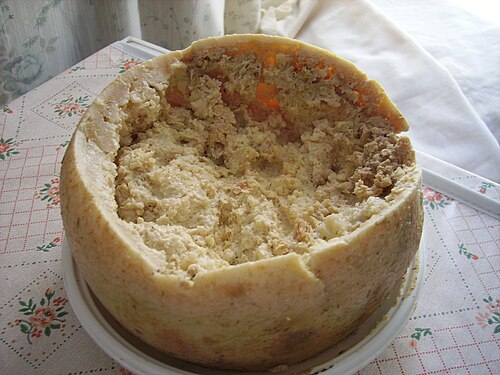
Maggots, I’ve since discovered, is just one of may unsavory methods of ripening, there are many, like ‘cheese mites’ and they are still deliberately used to ripen certain cheeses in various parts of the world, like Casu martzu – Wikipedia.
Wiki image of maggot-ripened cheese
So, back to my Cheese No. 3. The first two times I followed two different farmstead cheese recipes to the letter, wrapped them to age, and made my notes, nice and clean, without any question of potential perfection in outcome. This third time I found a recipe online that was so vague in steps, measurements and temperatures, I had to wing it a bit for the first time.
To make matters worse, this particular day had a pronounced increase in kitchen traffic. After I’d muddled through the recipe and began the pressing process, Handy Hubby had a dramatic building challenge of the electrical variety that required him to tear into the wall in the vicinity of the press. He’d just been on the roof cleaning up mice nests, and they’d managed to chew through some of the wires, which he now had to replace.
I wondered momentarily if that was something I should include in my notes. Nah, best forgotten, I decided.
But I could not forget, and what I’d hoped would be a quick in-and-out project around the press turned into an hour, going on who knew how many more. With Hubby going in and out, meant the dogs are following him. They think this is a game and don’t understand Hubby’s irritation as he curses the mice only under his breath … and … is sweating through his T-shirt. Right over the press!
Tori and Papi, our dogs at the time, who were often guilty of playing games around the cheese press.
Finally, the straw to break this camel’s back – I glance over from the sink as Tori’s tail brushes over the press. Tori is our Dane-Mastiff and about 6 feet from nose to tail tip. In a flash I imagine it snake-like engulfing the entire cheese.
“Stop, stop, oh my god, stop the pressing!”
I neither wanted to perceive myself as excessively anal nor offend Hubby’s already delicate mood any further, but my stomach was churning and my mind screaming at me for what I was allowing to happen to that poor cheese. I immediately disassembled the press, moved it to the office, and, with trepidation, examined the cheese, slowly unwrapping it from the muslin.
Just as I had suspected, dry-wall debris, dog hair, and who knew what other invisible entities had found their way onto the surface of Cheese No. 3.
In a moment of panic and disgust, I nearly threw it in the garbage. Then I thought, no, wait, chill, this will be the perfect testing ground. I’ll continue to do everything wrong, according to all things science and sensibility, and see what happens.
So, I stopped following the vague directions and followed instinct instead. What would the Corsican cheese-monger have done, I repeated to myself as I decided not to wrap it, to leave it at room temperature uncovered for days, then put it in with the others to age in the drawer of the fridge.
Not only did it look completely different from the others, it also smelled completely different. The fishy smell had stabilized, mold started growing on the air-dried, uncovered rind, and the texture softened inside until it began to sort of pooch out around the middle like love handles.
I felt some encouragement then, thinking, “Might good cheeses be like good dogs and begin to resemble their masters?”
A couple weeks more and it began to look and smell so delicious the temptation was starting to weigh on me. It was becoming irresistible. On Christmas Eve, I could wait no longer. The vague directions said it would be ready in two months, but my instincts were saying, ”Dig in, woman!”
The luckiest mistake: Cheese #3
So I did, and it was delicious! I am now convinced the best cheeses were discovered quite by accident and our ancestors turn over in their graves every time we get squeamish over a few dog hairs or even . . . maggots.
The only problem is, I have no idea how to imitate it.
The latest cheese ‘failure’ supposed to be a pepper jack– story and tasting coming soon!
Fast forward to last week, October 2025, and we have another crazy cheese mistake, which may turn out to be just as delicious!
Here’s the ‘pepper jack’ after further aging abuses, looking and smelling full of potential!
A sudden mini-miracle has occured and has turned the month I completely intended to be an exceptionally lazy one into a whole big mess of work.
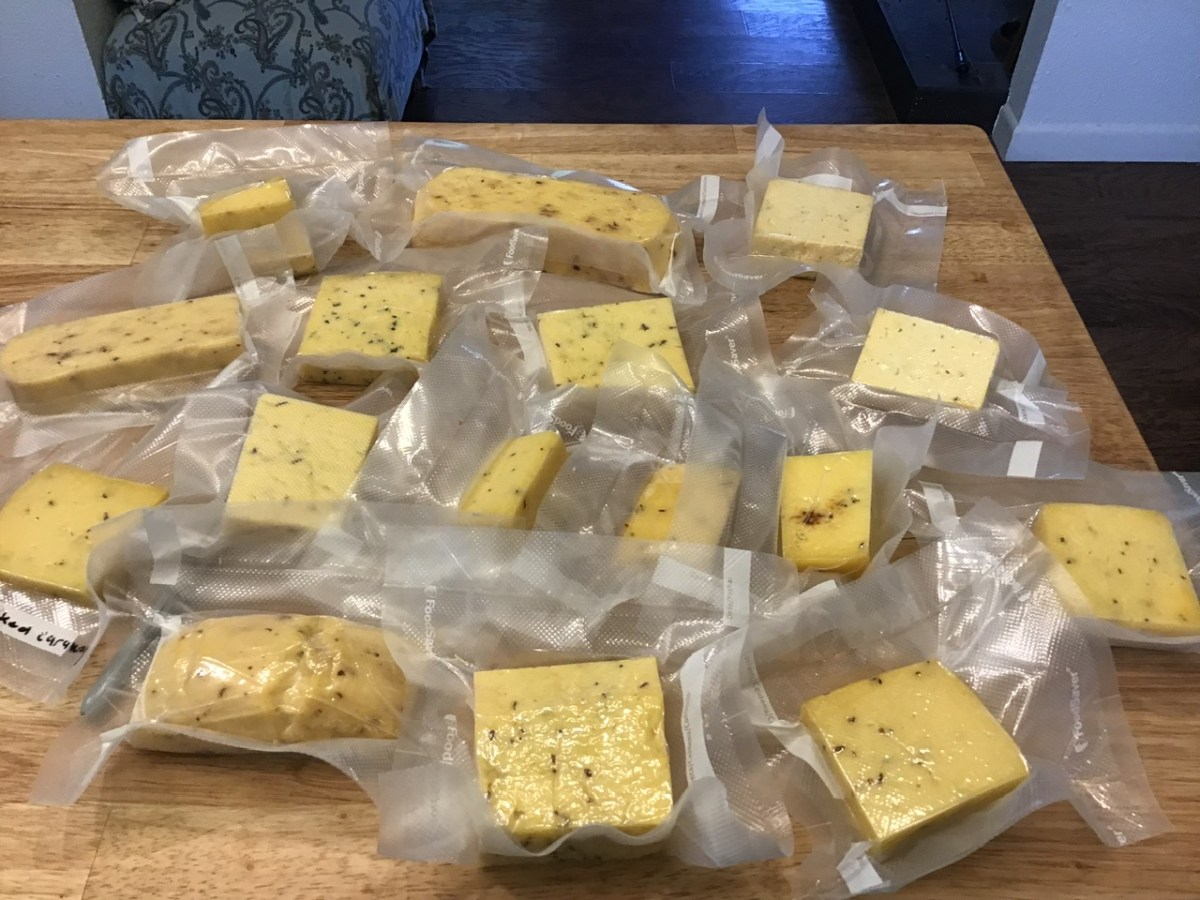
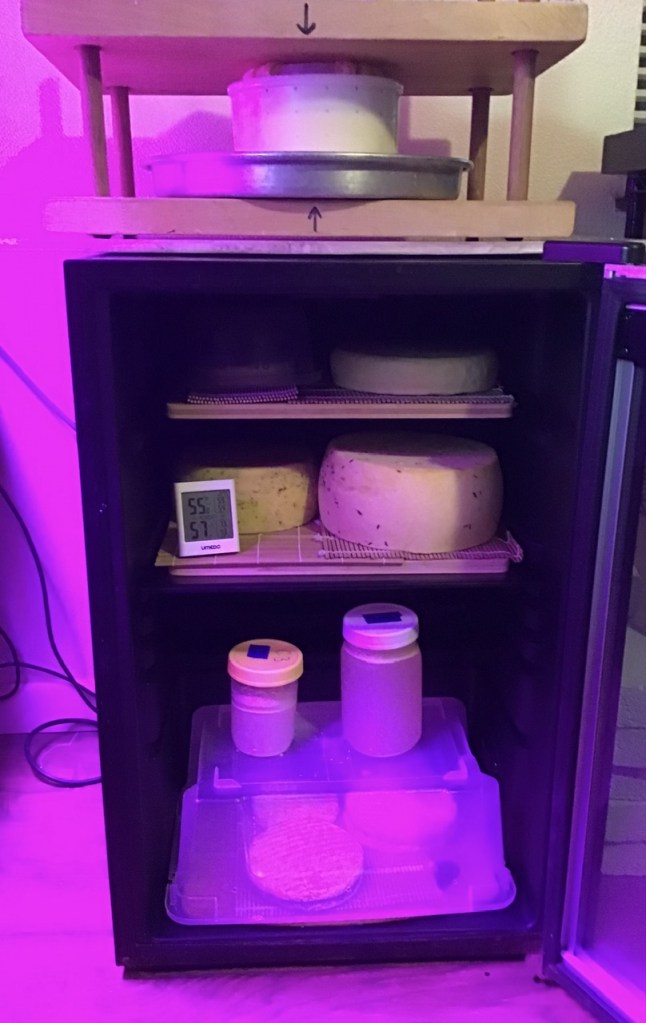
What’s in your cheese cave? A portion of the cheeses I’ve made in the last two weeks, the largest was from 9 gallons, which was transformed into a Caraway Gouda. The smallest was made right in the half-gallon Mason jar with milk directly from the cow, never cooled and ‘backslopped’ from our own homemade goat rennet. Backslopping was a traditional method used on the farm to carry the culture and rennet combination from day-to-day, similar to keeping a fresh starter culture for sourdough bread.
While it’s work I love, the problem-solving has been endless and my shoulder is an on-going issue. After such a long search, this was so unexpected and has caught me off-guard, unprepared and re-injured. Why am I not surprised?
My milk-quest for cheesemaking has been a decade-long challenge. For the briefest of run-downs I’ve watched raw milk prices double in that time, tried and failed at goat rearing, and for the past couple of years I’ve been herdshare hopping, with prices far too high for cheesemaking.
A few weeks ago I tried another herdshare–closer, nicer, and so much cheaper. Finally, I can make cheese to my heart’s content, to hell with my aching shoulder! And thanks to Hubby on early retirement, who is willing and available for all the heavy lifting.
And who also helps with the redneck innovations–having just made me a new collapsible cheese-hanger unit and also made my cheese-press.
I’ve even been able to experiment again it’s so reasonable, at just $3.50/gallon. Not since the goats have I managed to pay so little for such cheese pleasures. My new milk lady is short on customers, half her milk is going to her neighbor’s pigs every day.
All I can think is, how crazy is that? That precious milk goes to the pigs, because it’s illegal to sell it anywhere but at her farm and to process it into cheese to sell is also illegal. While I can imagine those are some very happy pigs, I still wish I could sell cheese.
Actually, not so much the selling part, just the making part. I do often give it away as gifts and I get rave reviews. I’m often asked why I don’t sell it at the Farmer’s Market, because so few know how illegal it actually is. The requirements for licensing are very strict, not a chance a home kitchen would pass, (Great Dane not included!) and even with all the proper paperwork and a professional kitchen, many cheeses are still illegal to sell.
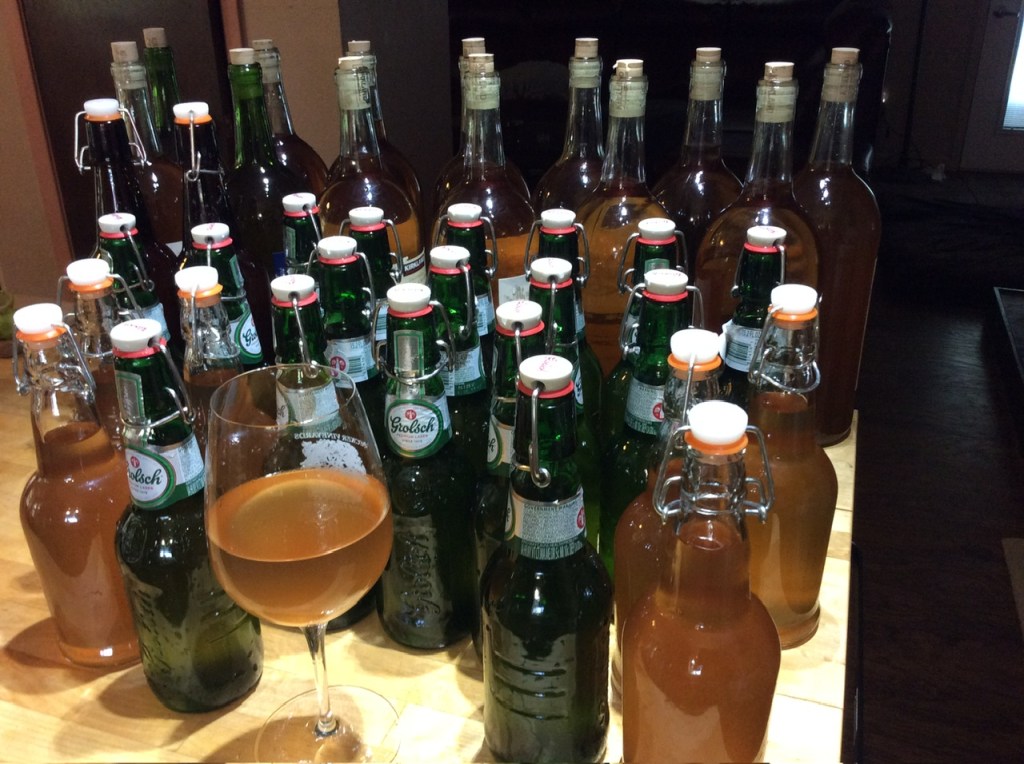
Various whey beneficiaries on the homestead:
I don’t want to run a cheese business anyway. I want a HWB (Hobby with Benefits) with those benefits being financial as well as delicious.
For now, I’m already out of room in my mini-aging fridge. I bought a second one, but once I got all the cheeses in it I had an impossible time getting a steady temperature. I gave up after 3 days of trying, to a mess of 70 degree cheeses sweating and dripping and starting to smell bad. The fridge regularly swings by 30 degrees, a cheesemaking nightmare.
I can work with a steady 50-55, and control humidity using plastic bins, not exactly a cave in the Loire Valley, but I can make it work well enough for a short Redneck affinage.
The non-existent affinage fridge of my dreams would be humidity controlled. The one that’s close enough costs a mere $700 and has temperature control in two sections (nice!). It’s technically for wine but home cheesemakers who can afford it often convert them with great success, or so I’ve read.
Let me just put that up on my vision board and see if it arrives in a timely fashion!
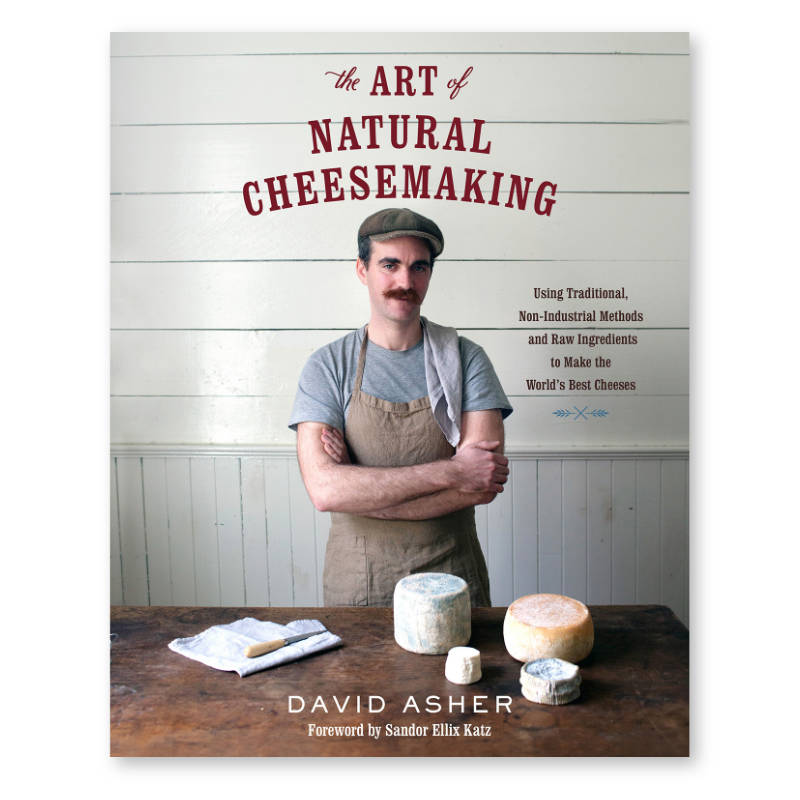
Also on my wishlist, David Asher’s latest book. His first book is my go-to resource and changed everything I was doing in making cheese, “The Art of Natural Cheesemaking: Using Traditional, Non-Industrial Methods and Raw Ingredients to Make the World’s Best Cheeses.”
Despite the struggle for a reliable raw milk source I have come to the wonderful place in my cheesemaking skills that I no longer follow recipes. I still read plenty of recipes, of course. But I read them to glean new techniques, learn cultural differences and especially pre-industrial methods, and imagine new combinations, in order to try them in my own way, like the rest of our cooking here. Hubby works the same way with his culinary craftiness.
It is the key to turning cooking from drudgery to joy, imo. It’s ‘the zone’ like they talk about in sports, or artists in their creative flow. Who wants to do that in their sterile industrial kitchen rather than in the comfort of their own home? Some, I know, but definitely not me.
Some previous cheeses
“Kenshobert” in my territoire version of Camembert.
Turning a favorite hobby into a business is the joy-killer. Being well-rewarded for a favorite hobby is the goal. That’s magical like milk transforming into 1,000 cheeses is magical. Some call it alchemy, but really it’s just fermentation, maybe the most ordinary and natural process in the world.
Cheesemaking is also economical and beneficial to more than just our health and palette. The dogs and the pigs get all the whey after the ricotta is made–whey ricotta is a delicious ‘by-product’ from making hard cheeses. So from each gallon we get the heavy cream for coffee and ice cream, milk for cheeses, and whey for other recipes and very contended critters.
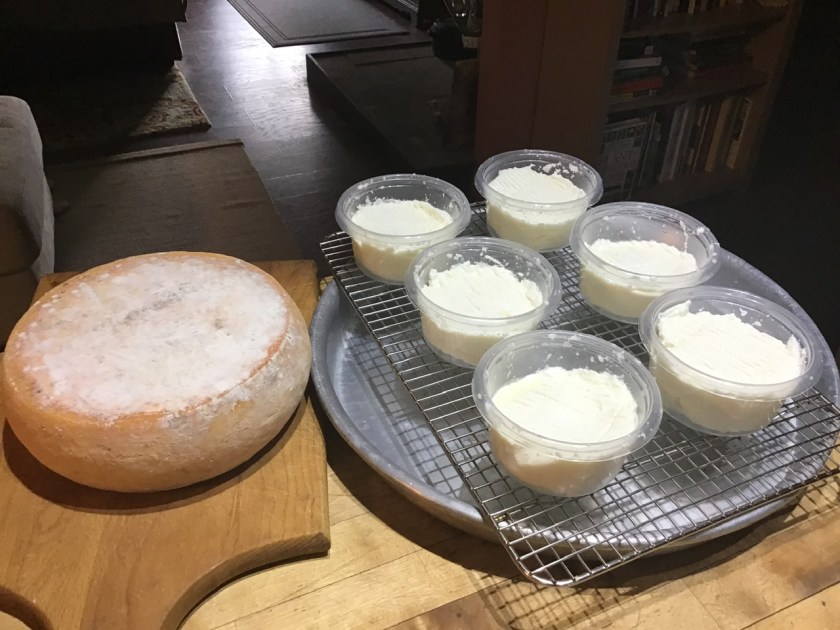
Ricotta pressed overnight then soaked 3 days in homemade hard pear cider. Eaten fresh, with fruit or crackers, it’s mild, slightly sweet and tangy.
The critics of course think it a lot of wasted work when cheese from the grocery store is cheap and plentiful, and there’s a growing network of artisanal cheesemakers who craft excellent cheeses (for a hefty price). I’ve had plenty of such cheeses and they are indeed delicious and worth the money.
A Tomme-style wash-rined cheese with goat cheese crottin-style drainingYogurt cheese with herbs aging in olive oil
But, they are all subject to the laws, which usually means: pasteurization, medicated animals, artificial lab-produced rennet (brought to you by Pfizer!), and freeze-dried cultures, also lab-made.
All that is exactly what I’m trying to get away from, in order to craft the most natural, local cheeses as possible. It’s an impossible task while remaining inside the laws.
Yet, there are folks still alive today who can remember when the laws weren’t so intolerably squashing to taste, creativity and economy. Just as there are old-timers here in Texas who can remember the days when they were allowed to raise, kill, process and sell their own livestock to the public, there are cheesemakers up north (no traditional cheese country in the south, too hot) who can still remember a time they could sell their handmade cheeses produced on farm in their own kitchens. Now most cheeses sold in this country are essentially fake, already lab grown, like the ‘meat’ they keep trying to push on the public.
Somehow there are still the majority who continue to call this freedom and progress.
Mostly happy snaps this post, plus a few weather woes.
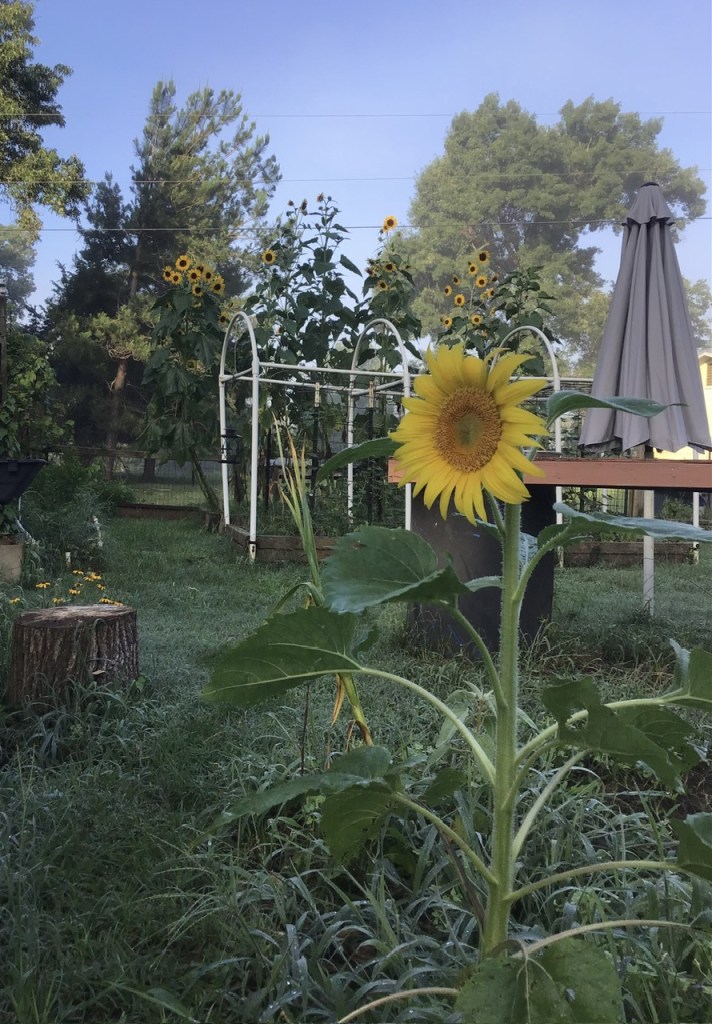
Hubby’s gorgeous melon patch is starting to produce more than just a feast for the eyes. He’s come up with quite an integrated system there and when I expressed how impressed I was with his companion planting scheme (and wondered whether he’d been taking a permaculture course on the sly) he informed me it was all a matter of frugality.
His penny-pincher logic is: the melon mounds have a lot of water run-off and sometimes erosion, so he added a ring of clover at the base of them. It’s just a bonus they are also good for the soil and the bees. The sunflowers are fodder for the goats and the chickens, plus they help shade the melons. The sea of black-eyed Susan’s just turned up there, apparently as impressed as me with the space.
Hopefully the melons don’t go the way of the onions, which has been our worst year yet. Luckily the garlic still did fine, which is from our saved seed, which previously came from a nearby friend’s saved seed. That has become a theme.
Elephant garlic does much better here than anything else, and I’ve tried many others for many years. I think I’ll give up that practice now and stick with what works, avoiding future costs and frustrations.
The success of the tomatoes and peppers so far has also been thanks to saved seed. I bought several varieties of each from the store, just for more variety, and those are the ones suffering more from the rain and high humidity. Several have already died, a few aren’t growing at all, and several of the others have bad issues.
Ours on the left, theirs on the right.
The purchased squash is already full of pests before giving us even a single fruit.
At least we got a few zucchini off our own saved seed before it too is already beginning to succumb to some kind of mold.
But other saved seed, the Trombetta squash and the mystery squash from last year, have proven to be more resilient than the popular varieties.
The filth-filled skies continue and not even the regular rains clear them up for long. I’m sure the sorry state of the skies has nothing to do with the crazy storms, right? The intense lightening, sudden flooding rain bursts, intolerable humidity, hail, tornadoes, and so on, that folks are experiencing across the country?
Just ‘mother nature’ they tell us. OK.
Well, too much ‘mother nature’ is not so good for the garden. It looks plenty green and lush, so that’s nice. But, look a little closer and we find it’s not so pretty below the surface.
But we’ve been relatively fortunate so far this year, just lots of rain and some wind gusts. Others have had far worse.
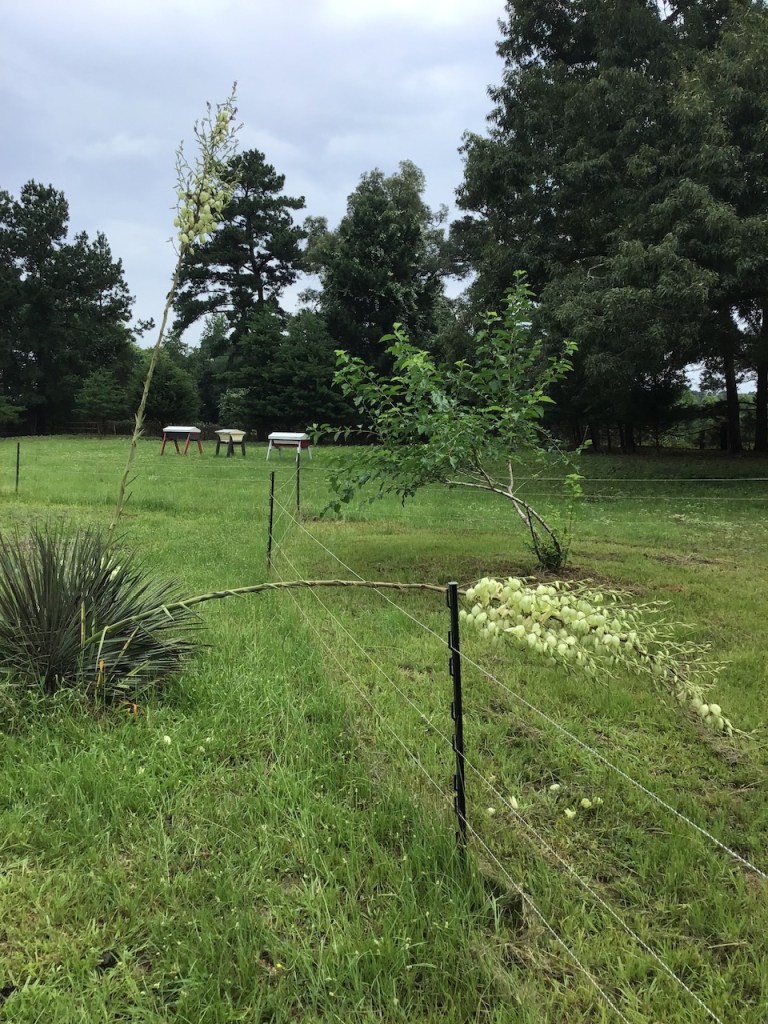
The yucca didn’t get lucky, but the blossoms are still lovely, even on the ground.
There’s some long-term requirements that fall on Hubby, which I mentioned last update, an upgraded culvert is required now in order to drive to the back half of our property. He’s already gotten started on that, a huge undertaking for sure. After that he can look forward to tackling the pond that’s now washed out.
In better news, there’s been some amazing growth in just one week.
A side by side comparison of 8 days growth.
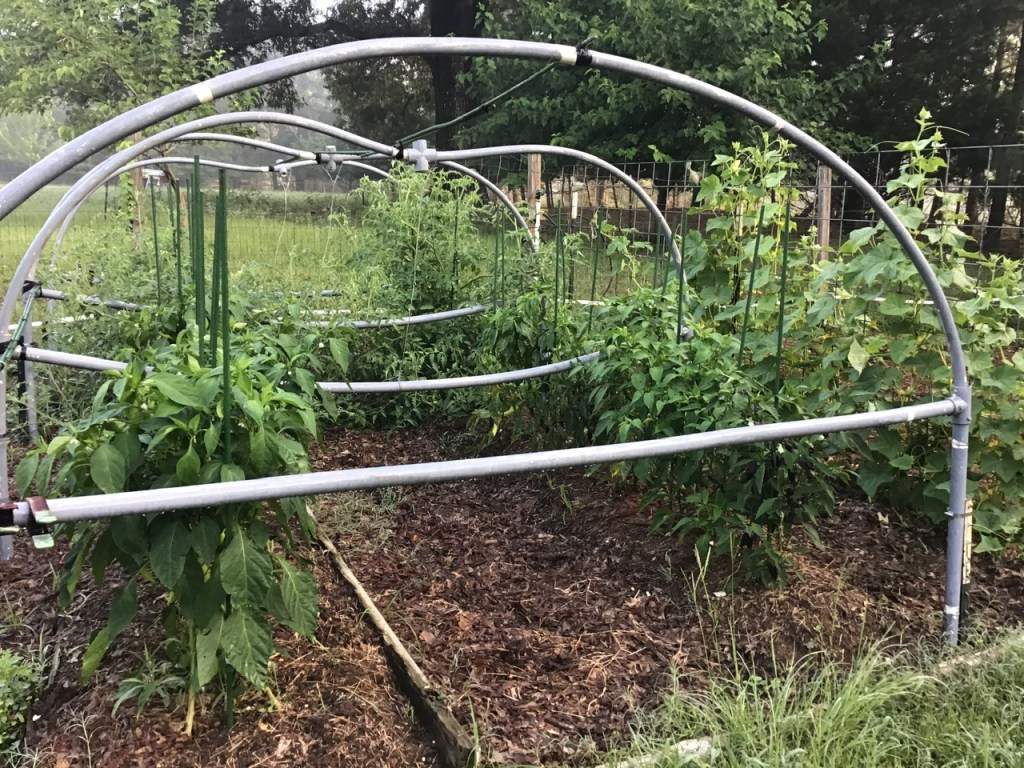
We’ve prepared for the swelter season by crafting another shading system where these tomatoes and peppers should be much happier into late summer. It’s recycled from another project and a bit awkward to move through, but it should do the trick just fine for supporting the shade cloth.
The asparagus beans, a first timer here, have really taken off in the last week. I’m excited to try them!
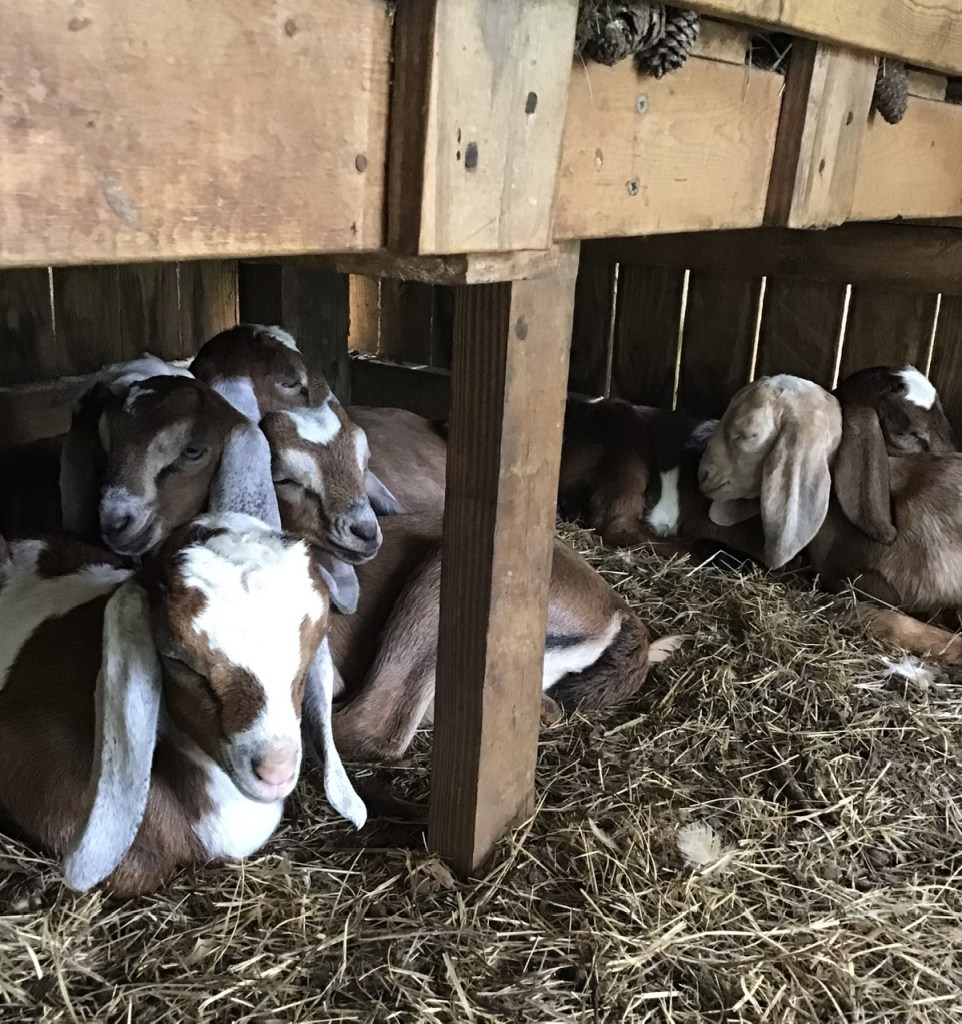
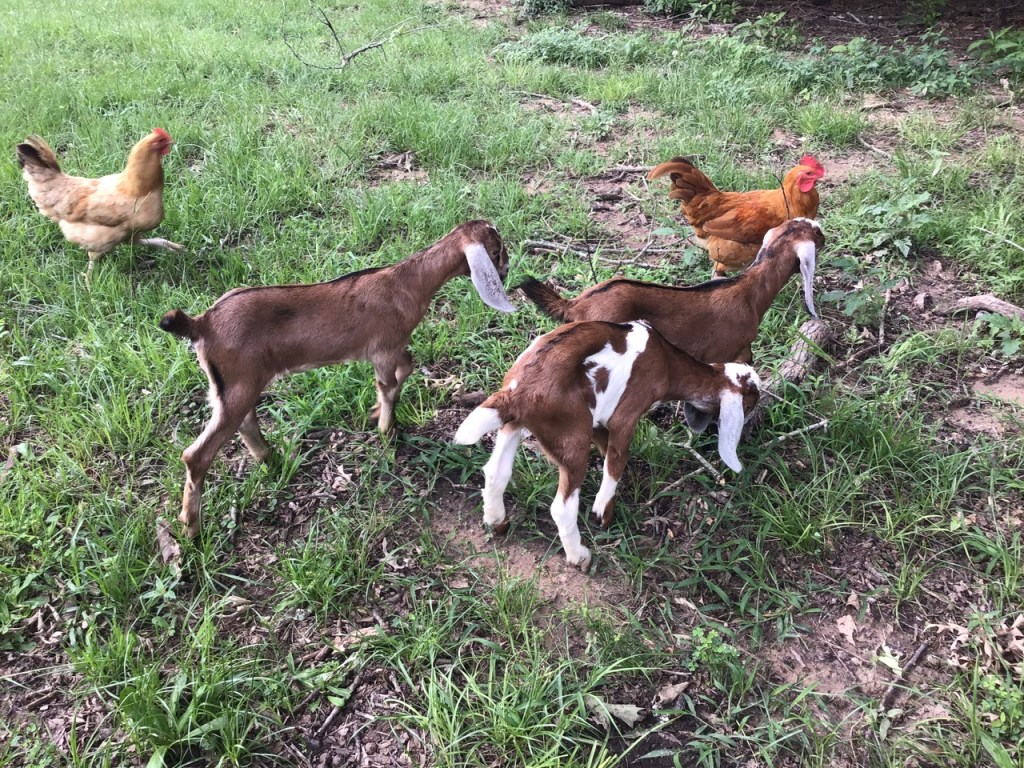
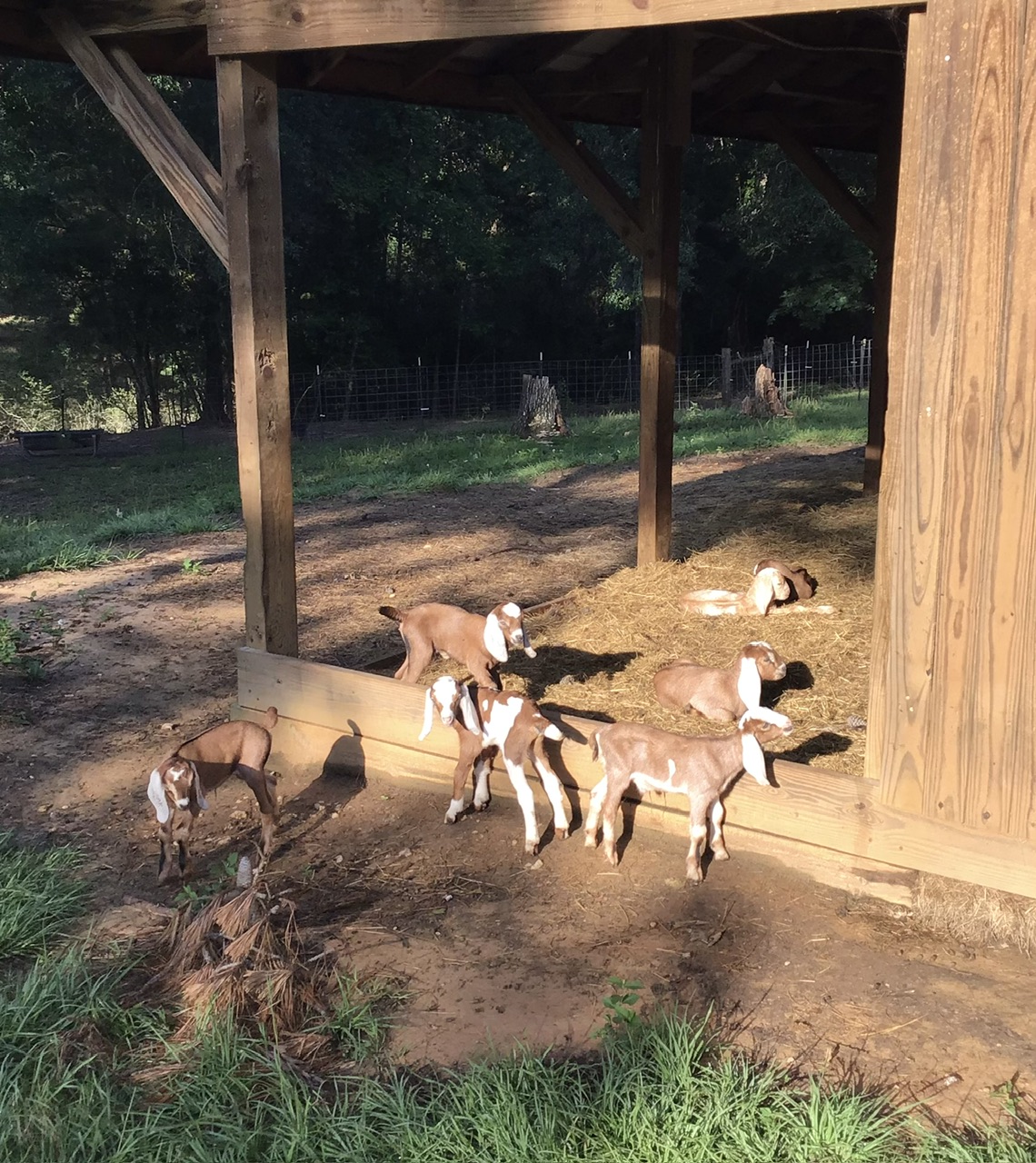
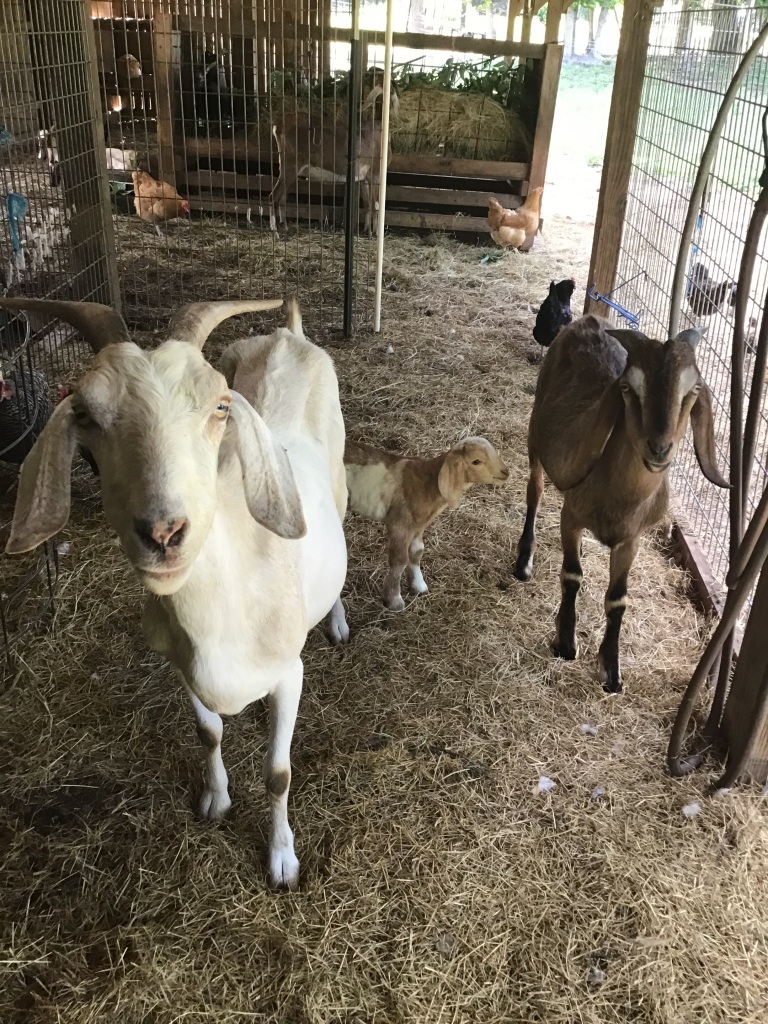
In even better news, the mamas and kids are growing well. We’ve started forcing them out of the corral during the day so I was able to give that space a much needed refreshing.
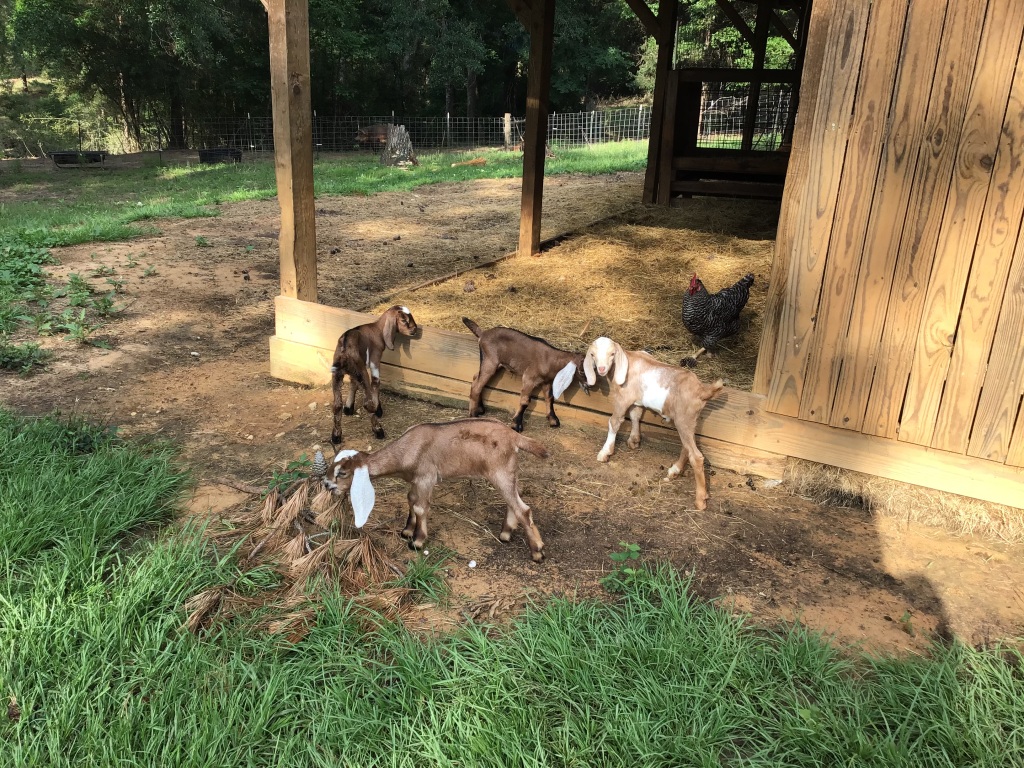
It seems they sometimes prefer following the chickens instead of their mamas. 😆
I’m getting the first fresheners ready for milking by training them on the milk stand. Soon it will be time to start separating them at night so I can milk them in the mornings before putting them back together again during the days. It’s not a happy time for anyone and I’m not looking forward to it.
But, I am looking forward to making lots of cheese again. We’re getting a bit of milk from Chestnut, who rejected her boy, and her girl is only nursing from one side. So, if I weren’t milking her she’d become even more lopsided than she already is.
It’s not a lot of milk, but enough for a little mozzarella now and then. I’ve found another method from my new favorite YT channel which is completely natural and far more tasty than the vast majority of those found online.
Raw milk mozzarella, mmmmm!
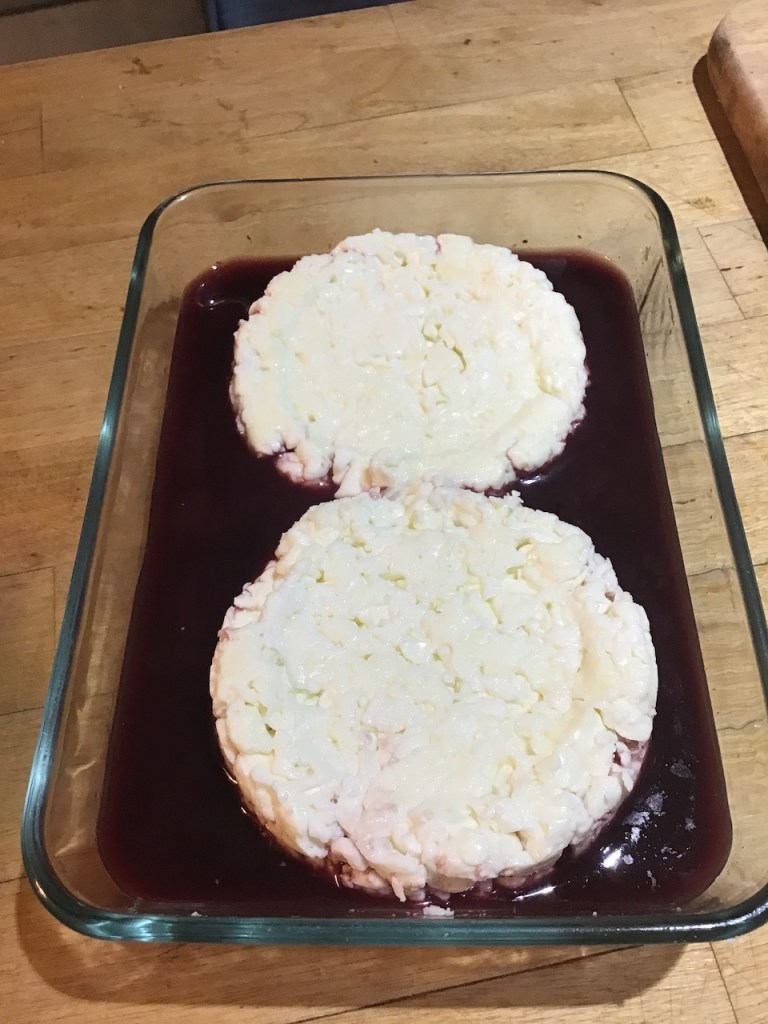
Unfortunately, the 2nd time I tried it was a failure. But, 99.9 % of the time a failed cheese can always become another delicious cheese. Some of my best cheeses have been from failures.
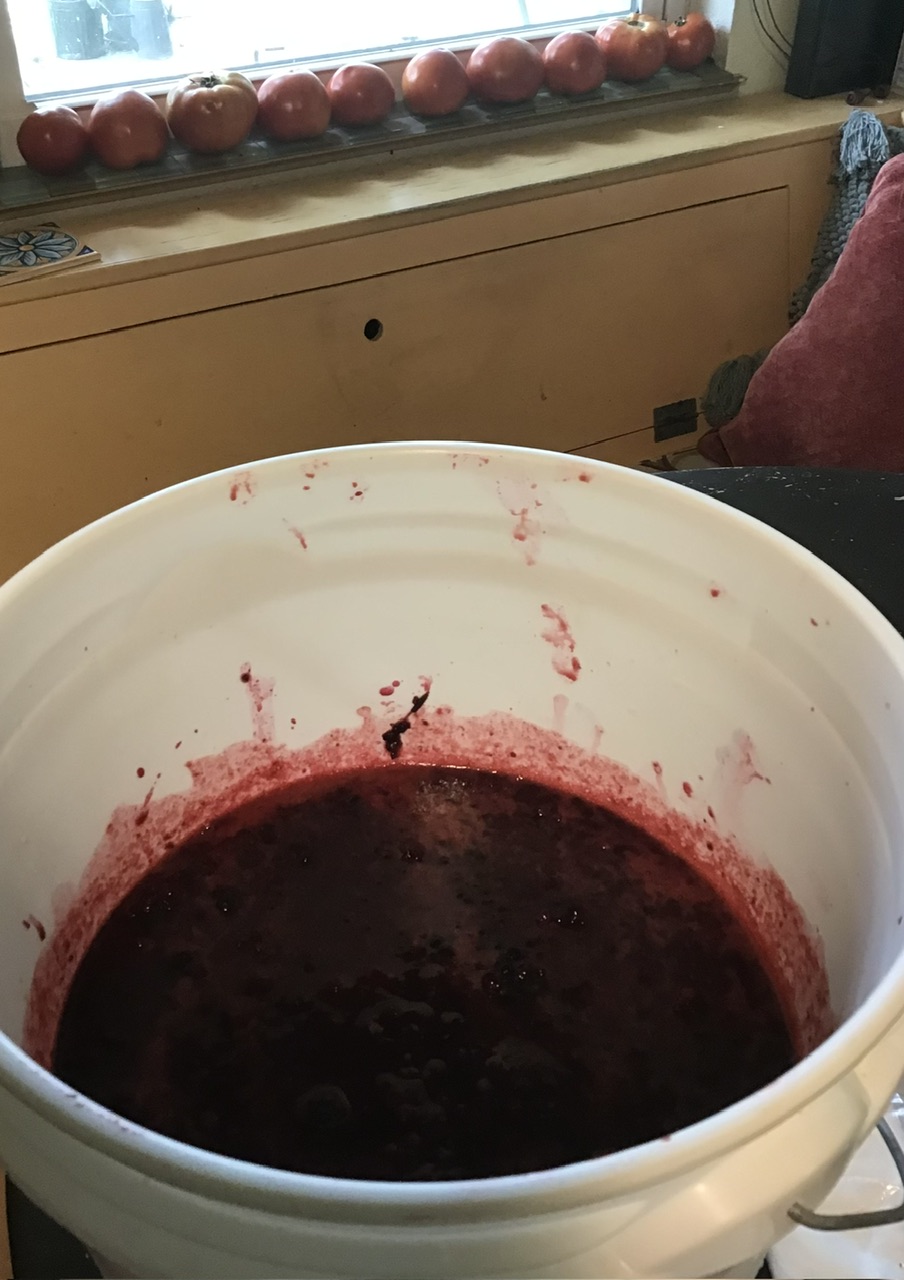
Not necessarily the case with failed wine. This cheese ‘failure’ will be soaked for a couple of days in the leftover must of the now fermenting wine, another tip I learned from my new fav YT channel.
This one was mulberry and I’ve also started a blackberry.
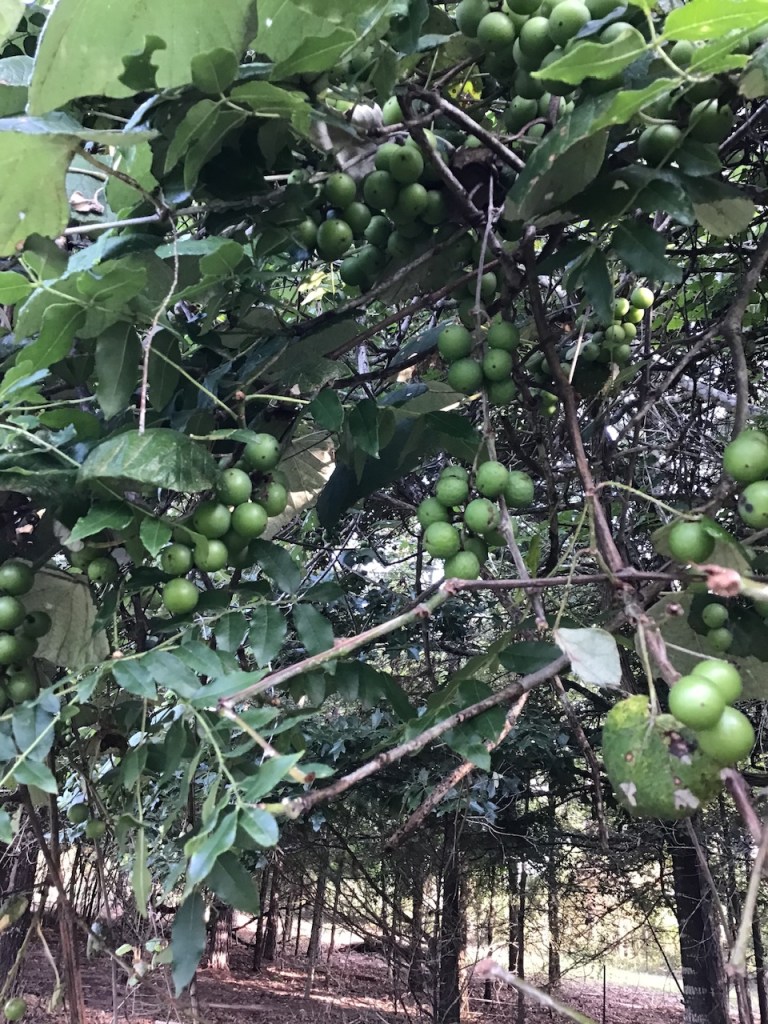
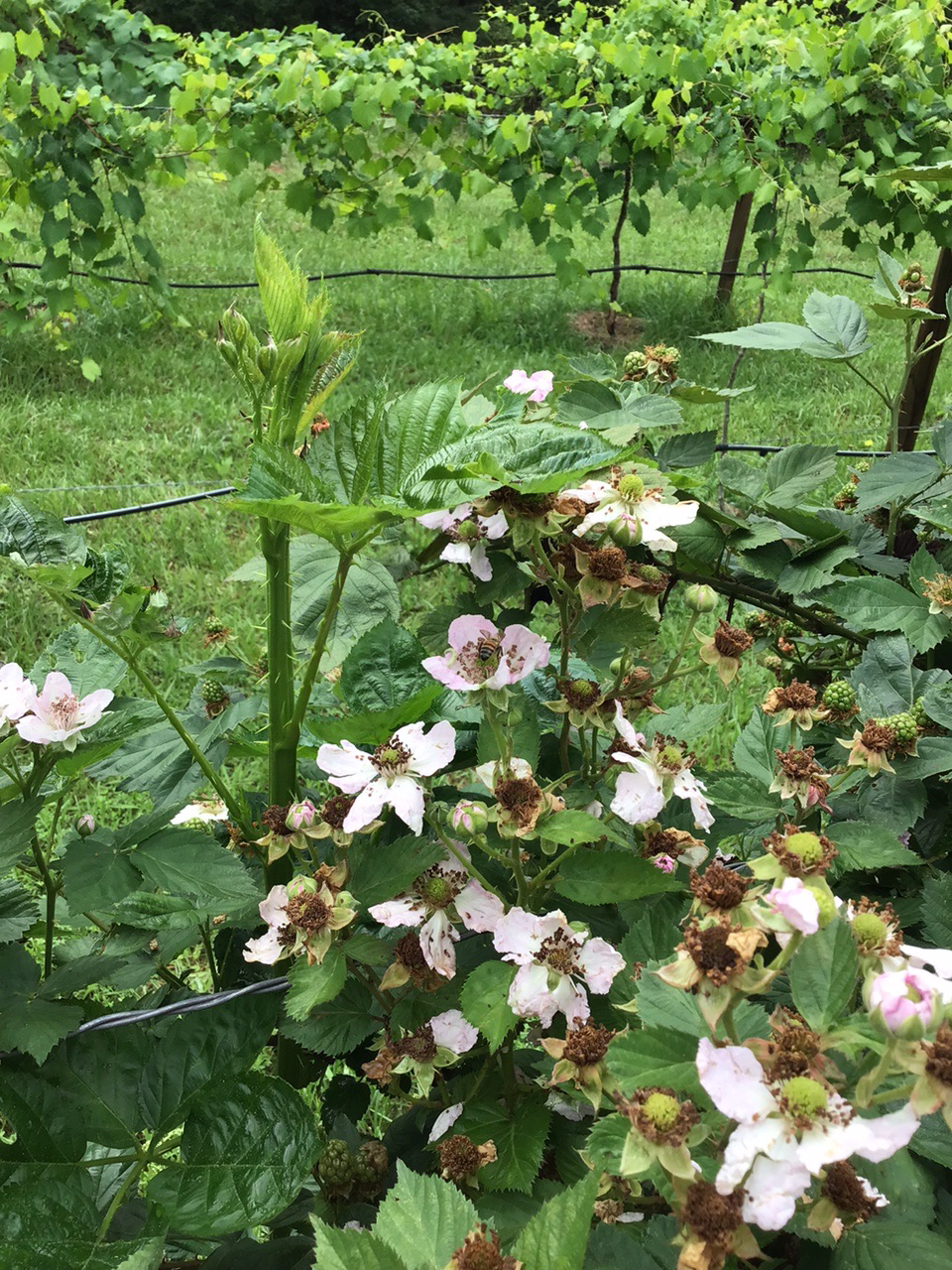
The blackberries seem to very much appreciate the extra rain and our harvest has been great, inspiring me to make blackberry wine for the first time. Last year’s harvest was very disappointing after getting some kind of strange disease right after their flowering period. (Not normal development, despite what several folks claimed at the time.)
I’ve decided to try more natural, traditional methods with the wine-making, like with the cheeses. Modern methods require all kinds of chemically-obtained inputs, which most insist are necessary for a fool-proof product.
Yet, last year we had a major failure using that method and ended up with several cases of vinegar. Very disappointing after all that work. We have had great success in the past or we might be too discouraged to try again.
Blackberries, banana peppers and Nigella seed pods
Traditionally, country wines were not made with all those foreign yeasts and I don’t really want my blackberry wine to taste like merlot anyway. While we may not have a decent cultivated grape harvest this year, the wild grapes look promising again. Also the pears are looking good, could be a bumper crop like we get only every few years.
If so, I’m going to do some side-by-side experiments, traditional methods vs. modern methods, and make a real project of it.
Blackberry wine in the making, hopefully
It’s easy to find lots of instruction using the identical modern method. For that I’ll rely on this book.
The wild grapes are looking promising. Our cultivated grapes still uncertain.
It’s not as easy to find good instruction on traditional methods, no surprise there. But this channel has a lot to offer and she uses nothing but a homemade fruit fermentation starter for her wines.
A teetotaler who makes wine, don’t see that everyday!
She also teaches how to make natural sodas and mead on her channel which I’m also very eager to try.
Blackberries fermenting beautifully after 36 hours.
The elderberry is also liking the extra rain. I might even try to make elderberry wine too. The blossoms are excellent in kombucha and will make an effervescent ‘champagne’ like beverage or flavor a cordial. And the goats love it. It’s just an all-around fantastic plant that is popping up everywhere now, so I’m going to create a big grove of them trailing down the hill.
Some brief updates this post and not as many happy snaps as I’d like. But, it’s been so busy and carting my tablet around everywhere is not usually an option, especially where it’s wet and dirty, which is a lot of places at the moment.
Kidding season is over and it’s been a bit stressful, no surprise there. I’ve been wanting to try something new—which is the greatest lost homestead technique I could think of—making our own rennet.
We’ve only had goats a few years now, all of this still feels very new, but, we do want to keep moving forward on the path to self-reliance, so this one is pretty essential on that list. It was as challenging as I expected it to be!
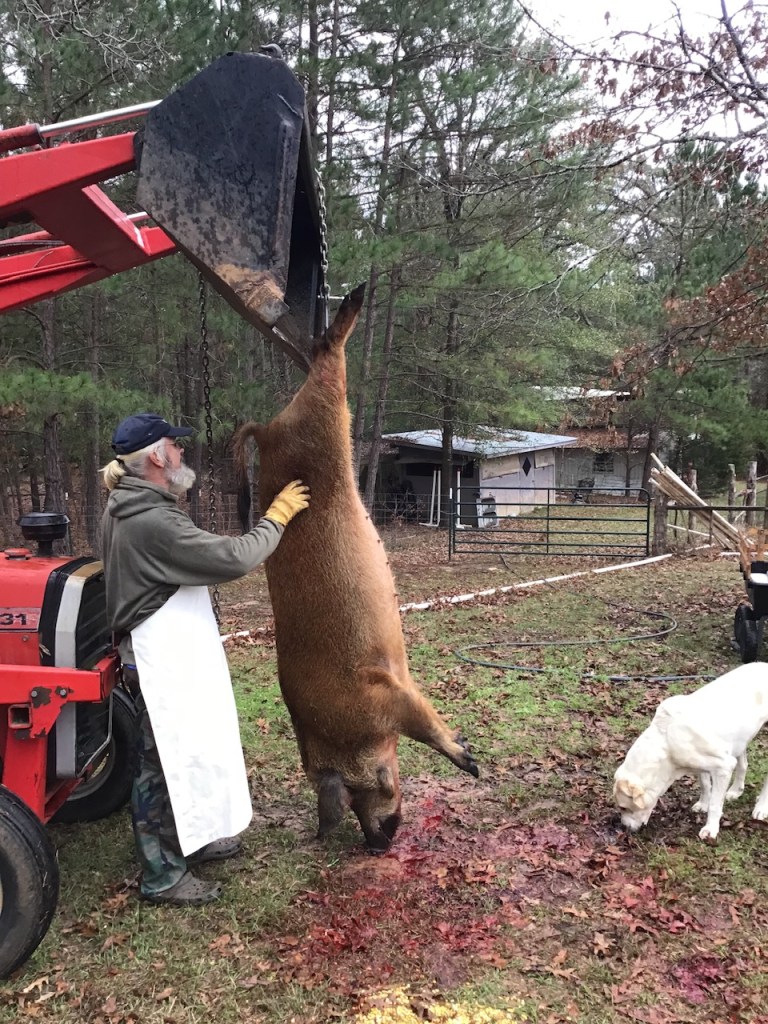
I am squeamish, so that’s the first of the issues. Hubby does all the slaughtering and butchering and for a while I did help plucking chickens, but then we got a machine, so I don’t even do that anymore. I’m not accustomed to seeing the interiors of the animals, let alone having to identify all the parts.
So, trigger warning for this section for anyone reading more squeamish than me! Move to the next section, if you please.
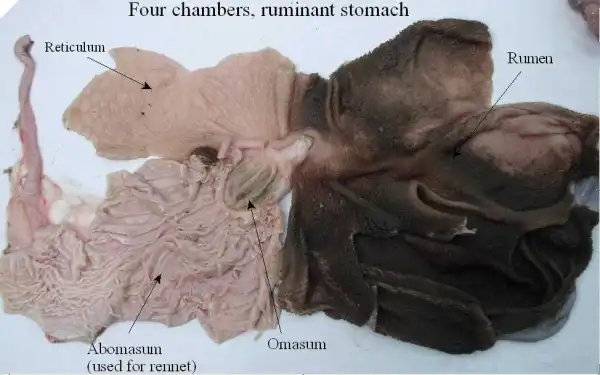
For the briefest of intro lessons, rennet is made from the 4th stomach of the ruminant animal, the abomasum.
This photo is from a calf, so for us we were dealing with far smaller features. Obviously, this is a precious commodity. The abomasum must come from a nursing animal, as it still has the enzymes required for cheesemaking. It can also come from a stillborn, an unfortunate event turned into a beneficial one with proper immediate attention.
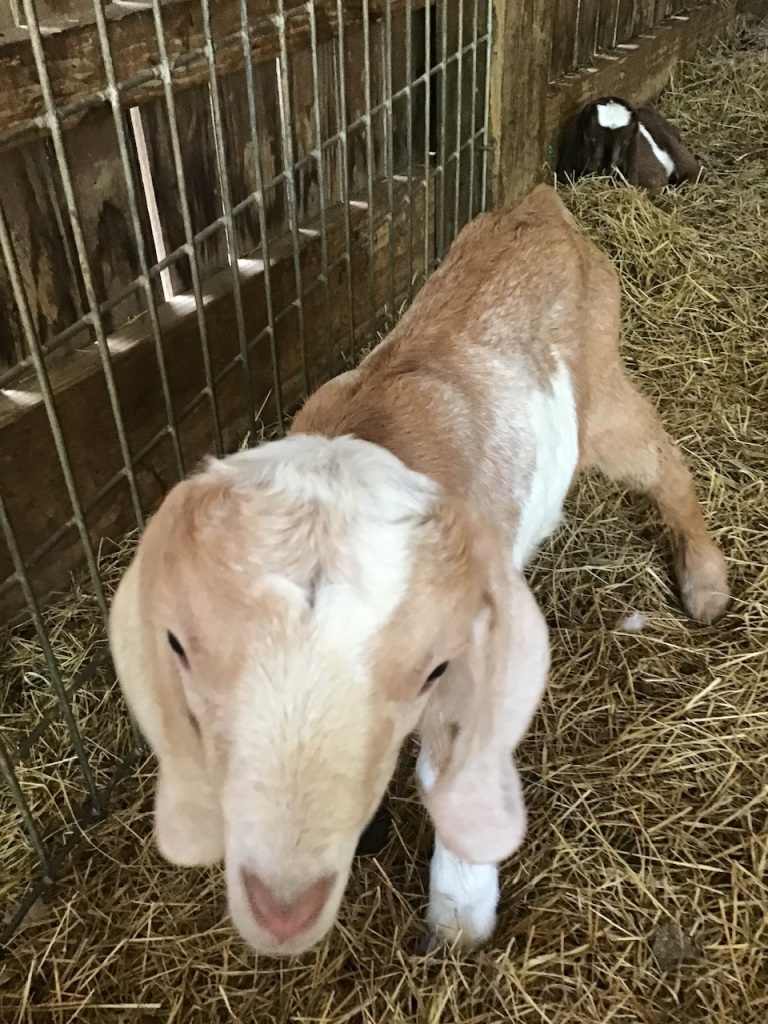
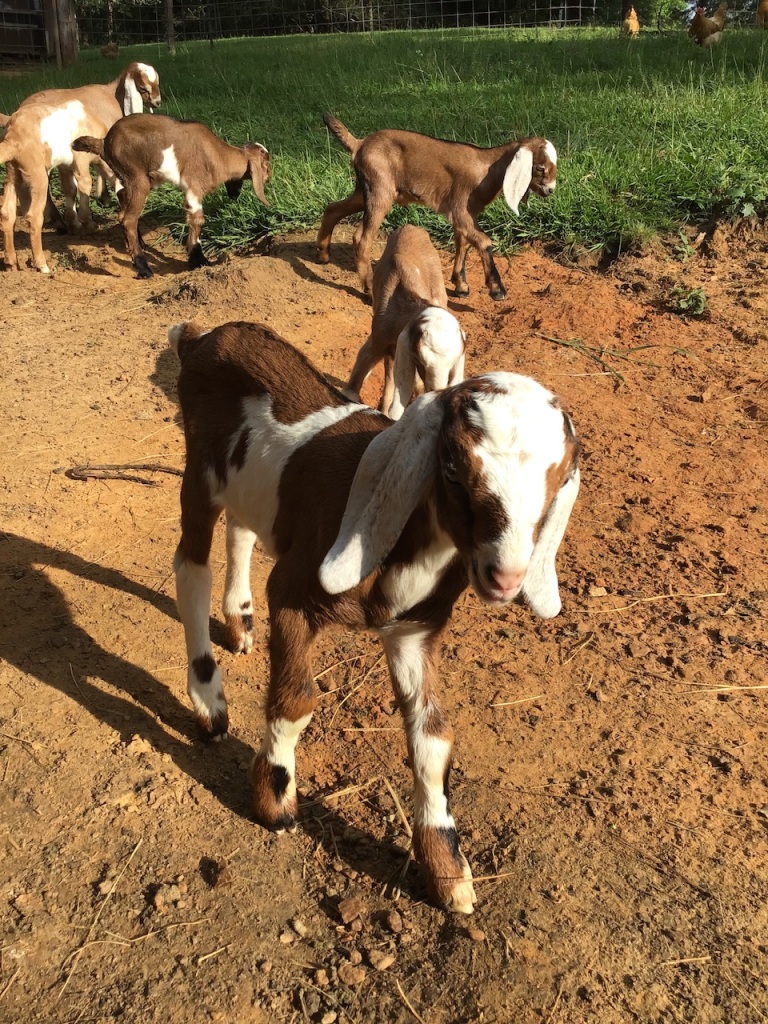
In our case, we’ve had 2 stillborn, one this year and one last year. This year we also had a very small doe, a first freshener, who had fairly large twins. We decided to cull one of her kids as part of our efforts. Of course this is never an easy decision to make, and I lose sleep over stuff like this. I was never meant to be a goat farmer, I just want to make cheese!
Anyway, I am glad for the tough choice and going through the trouble to acquire this precious skill. Hubby and I sat down before the guts together, at the kitchen table. One of the great many sentences I could never have imagined I’d be writing!
It’s not easy to find information on the how-to’s of this process, and I certainly had no one to call or visit for advice. It was not enough information to substantially build my confidence, that’s for sure. Sometimes that just takes doing it.
Luckily, I did find one YouTube video, and one blog, both again working with a calf, for which I’m exceptionally grateful.
Another brief aside about rennet, if I may bore many readers a bit further! As I’ve written before, most cheese made today, at least in the U.S., is not made from real rennet, it’s made from a lab-grown rennet substitute, made by Pfizer.
While it’s not that expensive for home cheese makers to buy animal rennet online, relatively speaking, considering only a tiny amount is required, I don’t want to have to entirely rely on far-away sources for such an essential item.
Another thing I’ve been experimenting with to overcome this issue is vegetable rennet, again, from a natural, local source, not a GMO lab-purchased source. We have figs, so that’s what I’m using, but nettles are another source.
It’s not possible to set a large hard cheese with this method, but it works for soft cheeses and very small, what I’d call semi-hard cheeses (because they don’t need a press) like the one I just tried after discovery this channel’s excellent demonstration.
This cheese is so easy! I’ve only just made it, so I can’t yet vouch for the taste, but he makes it look delicious. For this cheese you don’t need any special equipment—no molds or cultures, no aging fridge, and no rennet. Instead of the cute baskets he uses I just poked some holes in an old sour cream container. (And can I just add how much I adore his heavy accent and classic Italian hand gestures!)
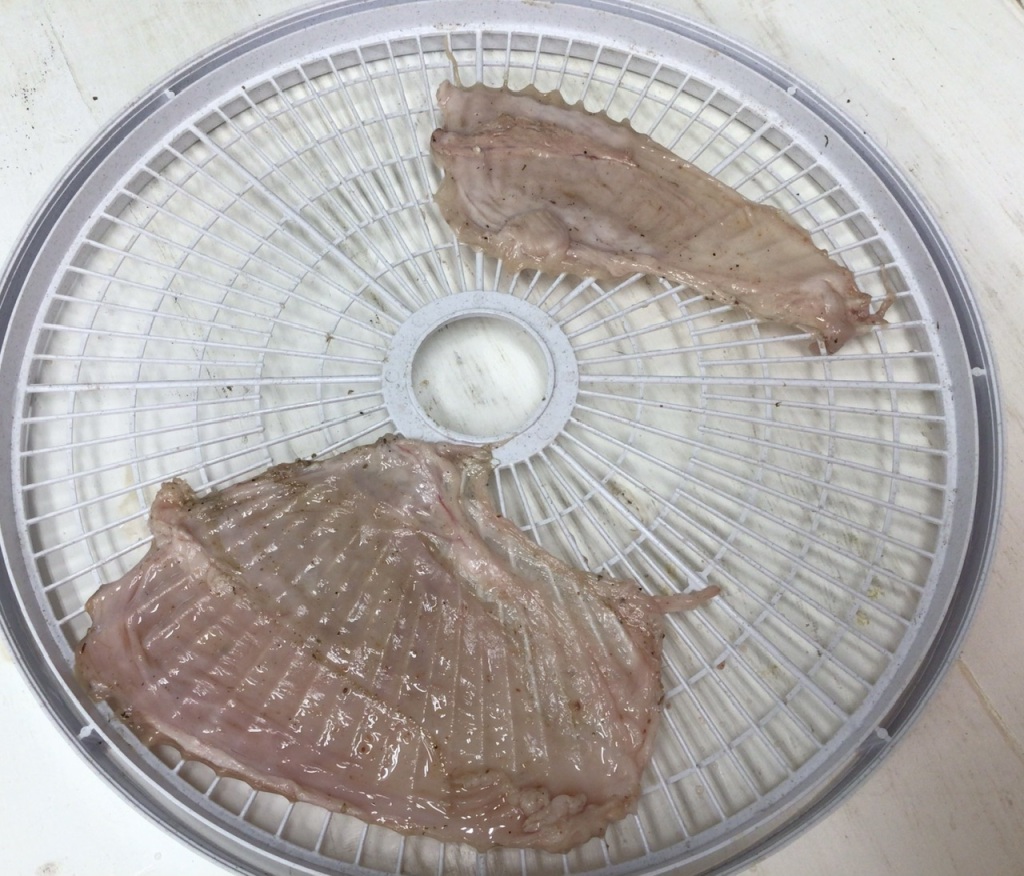
We did eventually figure it all out, and here is our final product, now drying for 3 months or so, according to processing directions. It will then be sealed and last for many years and make many dozens of cheeses.
A great big thanks to the multi-layered efforts of man and nature for this magical gift!
In weather news, we’ve had a lot of rain. While I mentioned last update how much I love the rain, it is causing problems. We lost most of our onion harvest, for starters. This is a big disappointment because we were so close to harvest, just a couple more weeks. Not anymore, they were rotting in the ground, we had to pull them, lost a great many, and the others are mostly very small still.
So between the pitiful potatoes and the sad state of the onions, we are not starting off too well. The peas are already done as well, because of the heat, but that’s pretty normal here.
What’s not normal is my usual complaint—the manufactured weather. We can’t drive to half our property until Hubby upgrades our culvert, a huge undertaking. But we are very lucky this time around! No hail, or tornadoes, or other immediate disasters to deal with, like a great many.
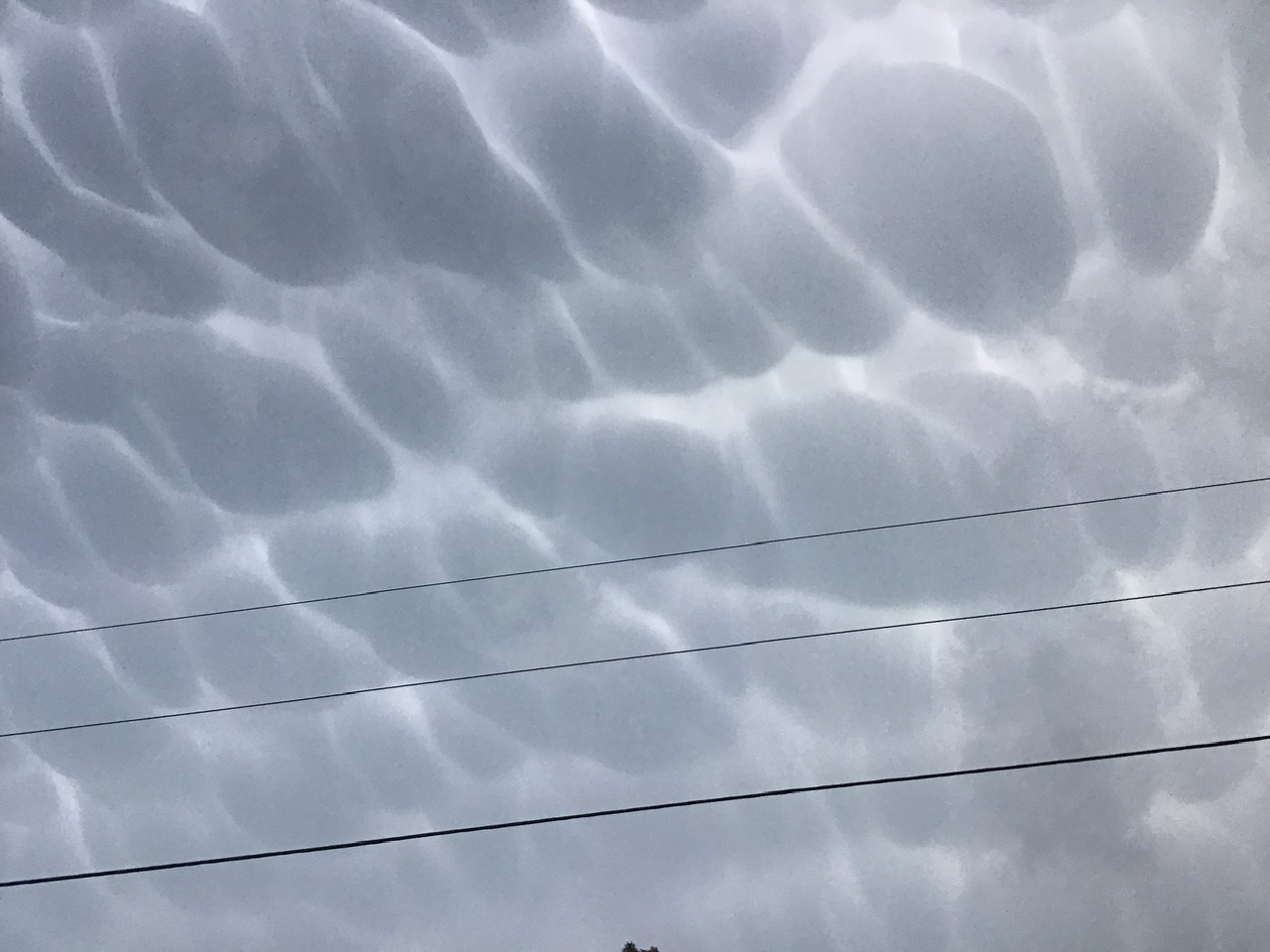
Yes, more manmade clouds above our head. We’ll learn what NASA calls them next post.
But, I have a future Geoengineering Update in the works, so I’ll save further lecturing and complaining for now!
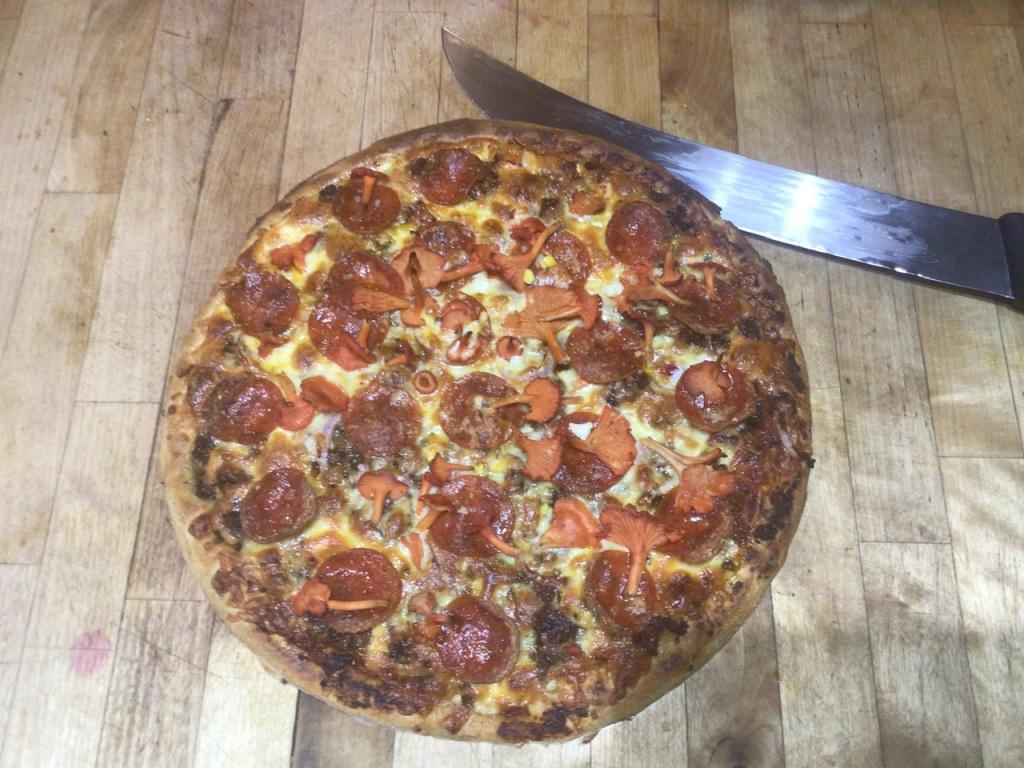
Instead we’ll end with a snap of one of our favorite dinners, just how we like it, burned to perfection! Not our pepperoni or cheese this time, but some just foraged chanterelles, homemade sourdough crust, and homegrown pork sausage. 😋
Weird scenes inside the homestead! What have we to add to the big wide web of weird today? A couple of things only, along with some sad news and some happy snaps. Successes and failures, as usual. Trying to keep them all in stride, which with the wild flowers and a short country drive, isn’t too big a challenge at the moment.
Creepy visitor appearing everywhere after the rains
Best to get the crap out of the way first, I prefer. We’ve got seemingly severe blackberry failure and an established bee colony suddenly lost. I could write exhaustively on just those two, but since I’m already exhausted, I’ll keep it brief. And continue the relentless churning in my mind alone.
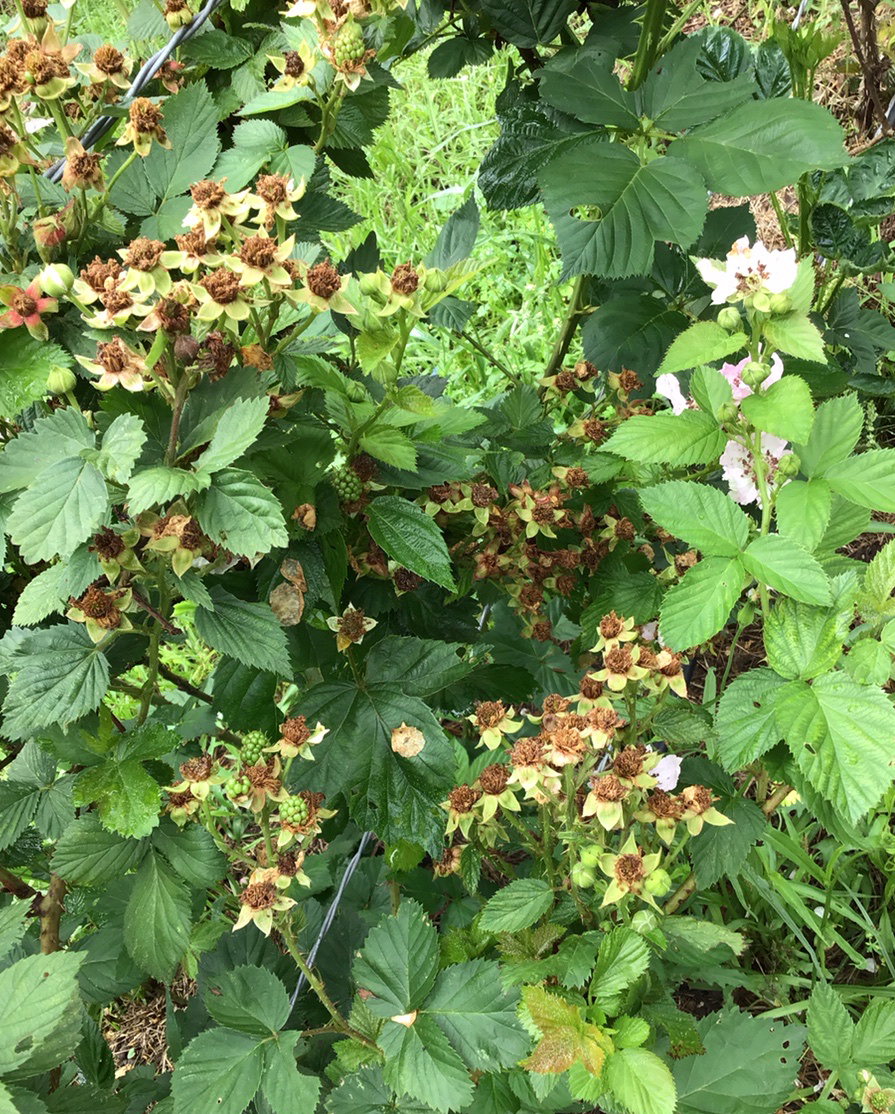
These photos and several more have seen the cyber rounds this week, let me assure you! And the cornucopia of responses we’ve received is rather astounding. Long story short—we’ve had some lovely rains, finally. But it sent our blackberries from thriving and gorgeous, to this brown, crispy-looking horror nearly overnight.
Not just a few bushes either, the entire row, a dozen bushes easy. It looks terrible. So we got a bit frantic and have been sending photos to Ison’s Nursery, where we got them. Also, to various friends and forums, where we’ve had answers to run the gamut: too dry, a virus, a fungus, a blight, Botryosphaeria canker, empty pocket syndrome, aphid damage, and then the kicker . . . This is totally normal development.
Wait, whaaat??
You mean to tell me these could be normally progressing blackberries and after many years of growing blackberries we just never noticed it before?!
Well that would certainly be a big and welcomed WOW! Yes please!
But unfortunately, I don’t think so. They look brown and shriveled beyond anything I’ve seen in any of the online photorama. And there’s no sign of aphids, and it’s not cane blight, and it’s certainly not too dry, although I totally understand that guess, since that’s exactly what it looks like.
And I do so appreciate all the speculation, seriously! It gets me thinking and exploring every time and I do so love all the effort and camaraderie inherit in it. Be wrong, it’s not the end of the world!
Of course, what I did so notice among the seeds of speculation was the one that was, unsurprisingly, totally missing. Toxic rain perhaps? Some other oddities in the atmosphere, perhaps? Not on anyone’s radar? Really?
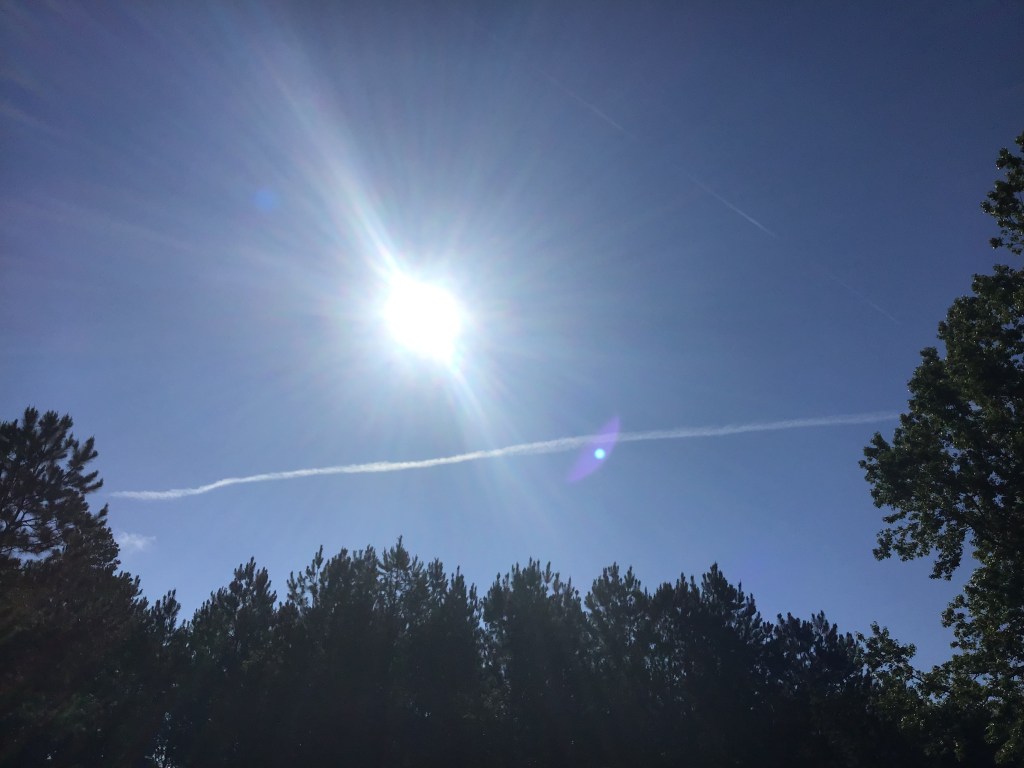
No idea what’s happening in this photo with the blue dot-purple ring, I just snapped the shot with the tablet as soon as I saw the trail while busy in the garden.
On better themes . . .
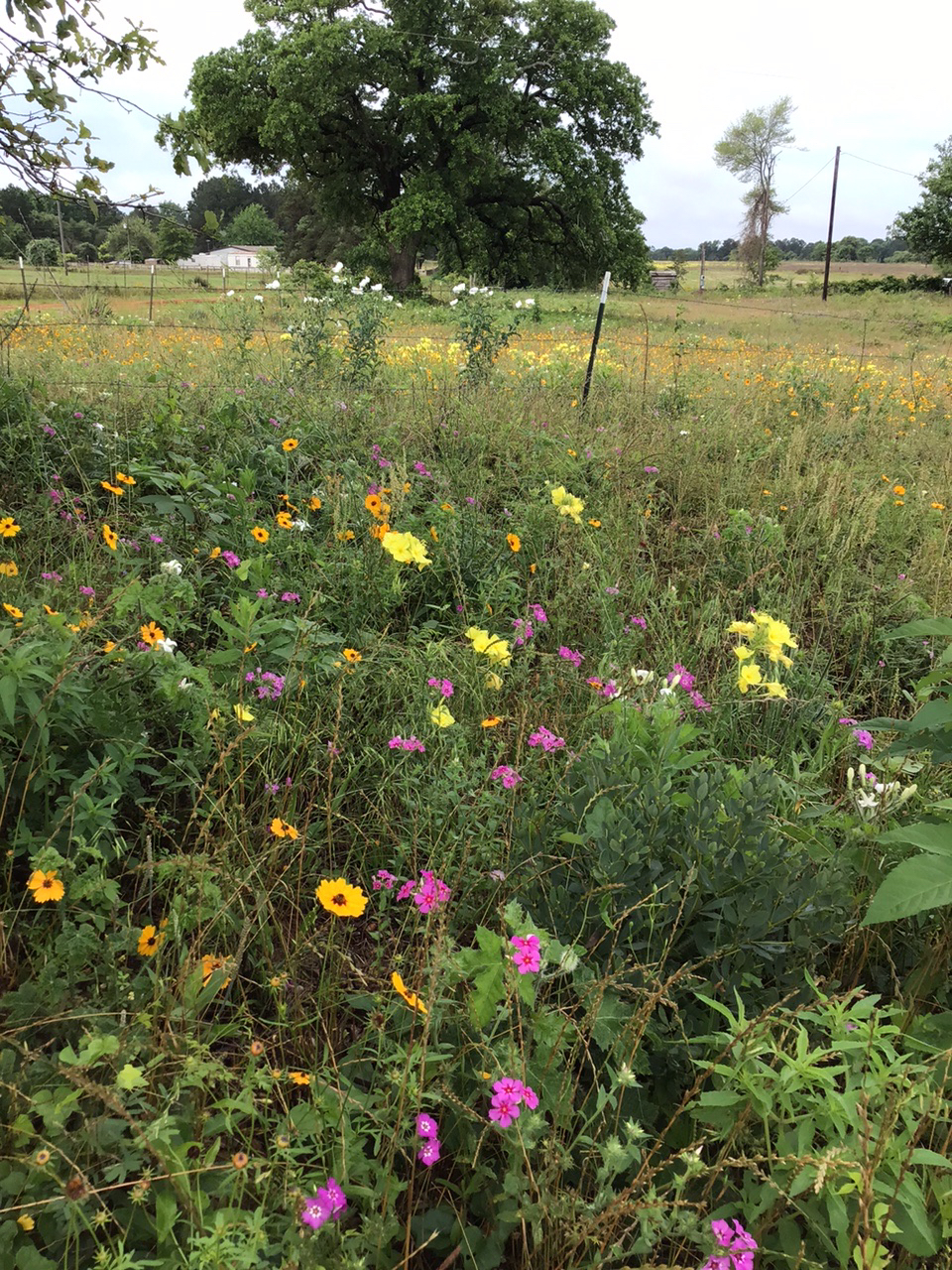
I also took some lovely happy snaps of the wild flowers blooming along the road, which was so much more gorgeous than what I was able to capture here. But I tried, and that should count for something, no?
And on that note, this post will have a Part 2 to finish later, cause that’s all I can manage at the moment. More to follow, so much more!
Thanks for stopping by!
I leave with a song that motivates me when I really need it most. Hope it works for y’all too!
‘Stinky cheese’ is an official cheese category for those unfamiliar with the great wide world of cheeses. Really! They include the washed-rind cheeses, but some others as well, depending who you talk to.
These would include such well-known varieties as Muenster, Limburger, Raclette, but also some relatively new popular favorites like the Stinking Bishop of Charles Martell & Son – Cheesemakers and Distillers.
The Stinking Bishop—the name inspiration behind my own new cheese—the Stinking Peasant! About the Stinking Bishop: “The rind becomes sticky and pink, with a pungent, almost meaty aroma, while the interior is velvety smooth and almost spoonable. It is bound with a strip of beechwood, which also imparts its own woody notes to a cheese that is farmyardy, but not as strong as its smell, or its name, would suggest.”
The wash-rind process used to be referred to as “putrefaction fermentation”so you can understand why they might want to change the name.
When I set out 7 years ago into the glories of cheesemaking I had no idea I’d also be making my own ‘signature’ cheeses. At the time I was responding to the sorry fact that in order to buy even a remotely decent cheese I had to drive several hours. And even then, nothing was made from raw milk. I bought freeze-dried cultures just like the vast majority of home cheesemakers do. I found a lot of success imitating the favorites—mozzarella, Pepper Jack, Camembert, Parmesan, Swiss, dozens of cheeses. I’ve tried making just about every cheese you’ve ever heard of, and quite a few unknown to even real cheese aficionados.
Of course, considering there are 1400 named cheese varieties in the world, I still have a long way to go!
Several of my ‘signature’ goat cheeses now ripe and ready to eat. Still in the aging fridge are Pepper Jack, Dill Havarti and Caraway Gouda
But, the more I learned, the more I wanted to get back to basics. The more I got back to basics, the more I began to understand what a beneficial and even necessary learning experience it has been. Sure I can spend much time and effort recreating other people’s cheeses. But even better is to invent my own!
That means developing our ‘terroir’. No more purchased cheese cultures. Milking our own goats and making raw milk cheeses with our own wild yeasts, yogurt and buttermilk, all which change flavors and colors with the season.
Like a true Roquefort can only come from Roquefort, France and real Champagne only from Champagne. These have PDO status, that is Protected Designation of Origin.
The process is only part of the story, because the finished product is a signature of its terroir. Affinage, that is, the art of maturing the cheeses, is the next crucial component.
Not that I have any interest in throwing my cheeses into any rings with the big guys. Not a chance, even if my cheeses were that good (I think they are!). I have no interest in turning my pleasurable hobby into a stressful profession.
“In its simplest form cheesemaking is the aggregation and preservation of protein; in its highest form cheesemaking is alchemy. . . Many traditional European cheeses are on the decline or have disappeared. It is ironic that the United States is leading the resurgence of artisan cheese and is the fastest growing market for specialty cheese on the planet. Can we Americans be the saviors of French terroir? Or will our efforts to reveal our own terroir be stillborn because of insurmountable regulatory hurdles?” ~Mateo Kehler Jasper Hill Farm, Greensboro VT
Anatole and the Robot (1960) — The story of a professional cheese taster whose job has gone to a robot. I think Anatole has the right idea: “I sniff, I taste, I think, and then I use the magic of my imagination!”
Source: The Oxford Companion to Cheese edited by Catherine Donnelly, foreword by Mateo Kehler